UK Prime Minister’s Questions (PMQs) is potentially one of the most important means for the opposition to challenge the government on the major issues of the day. During PMQs opposition members of parliament put questions to the prime minister in full view of the public and expect well-briefed answers in return. However, the value and the purpose of PMQs has increasingly been called into question by recent research (for a summary see Bates et al. Reference Bates, Kerr, Byrne and Stanley2012) and even internal government debates (see Hansard 1996) contain comments about the shallowness and shortcomings of PMQs. As it currently stands PMQs is widely believed to show off the rhetorical skills of the leaders of the main political parties attracting the attention of the media rather than to hold the government of the day to account.
Even though there is a theatrical aspect to PMQs, we argue that the practice can still ensure the government addresses concerns that it might not otherwise wish to talk about and therefore is an important venue for ensuring accountability and responsiveness. As a result of the topics stressed in PMQs, the government has to confront the difficult issues of the day, which can advantage the opposition by putting the government on the defensive regardless of the completeness of the government’s answers. Due to these efforts, the party or parties in control of government respond to other parliamentarians and consider issues way beyond what they offered in their party platforms. This practice can be observed for parliamentary questions in other national settings (e.g. Green-Pedersen and Mortensen Reference Green-Pedersen and Mortensen2010). Moreover, recent research on Denmark and Belgium has identified a link between the topics of parliamentary questions and the government’s agenda in other decision-making venues (Seeberg Reference Seeberg2013; Vliegenthart and Walgrave Reference Vliegenthart and Walgrave2011; Vliegenthart et al. Reference Vliegenthart, Walgrave and Meppelink2011).
In this article we focus on the issue content of PMQs in the UK (see Bates et al. Reference Bates, Kerr, Byrne and Stanley2012) following similar work on parliamentary questions in other national settings (e.g. Soroka et al. Reference Soroka, Penner and Bidook2009; Vliegenthart and Walgrave Reference Vliegenthart and Walgrave2011). By examining the effect of government and opposition questions as well as frontbench and backbench questions by the opposition on one another we offer a new account of the determinants of the parliamentary agenda that complements existing work. Furthermore, by employing a large-N analysis of all PMQs from 1997 to 2008, we are able to assess the general agenda-setting effects of questions over time, responding to the call for more in-depth empirical analyses of PMQs made by Bates et al. (Reference Bates, Kerr, Byrne and Stanley2012: 24). Our analyses demonstrate that PMQs are an outlet for the opposition and backbench opposition MPs (King Reference King1976) allowing them to put pressure on the government to respond to issues they might rather avoid. As such we throw more light onto the practice and impact of questioning, adding to recent work on legislatures (Bates et al. Reference Bates, Kerr, Byrne and Stanley2012; Martin Reference Martin2012).
To advance this argument, the article first briefly outlines the procedure of PMQs for the period of our analyses (1997–2008), followed by a review of the literature on agenda-setting through parliamentary questions. The article then describes the data and methods used, before reporting the findings from graphical and statistical analyses. The conclusions draw out implications for the study of parliamentary representation.
WHAT ARE PRIME MINISTER’S QUESTIONS?
Prime Minister’s Questions is a parliamentary convention whereby the prime minister answers questions in the House of Commons from members of parliament (including the leader(s) of the opposition, in addition to other backbenchers from all parties). PMQs is perhaps the most public opposition platform, given its prominence in the media and that it follows a regular weekly cycle. Questions for other ministers tend to specialize on specific topics, and other means of challenging the government, such as Opposition Days and debates promoted by private members, do not typically get such attention and are not able to put the government on the spot in the public glare in the same way as PMQs. Overall, PMQs is a procedure that reveals the power of the institution of parliament which, in spite of giving extensive powers to the executive, gives expression to accountability through opportunities to debate and challenge (see Adonis Reference Adonis1993; Judge Reference Judge1993).
PMQs were first introduced in 1961 to formalize the process of members asking questions of the prime minister. Since then PMQs has become a high-profile event in British political life as a well as an increasingly public one through radio and television broadcasts (Bates et al. Reference Bates, Kerr, Byrne and Stanley2012). Since 1997 it has been held as a 30-minute sitting every Wednesday while the House of Commons is in session (Coe and Kelly Reference Coe and Kelly2009). PMQs is a prominent and dramatic venue for agenda-setting for the government and opposition parties that is often noted by media commentators and political satirists alike. However, because of this drama the value of PMQs has more recently been called into question (see Bates et al. Reference Bates, Kerr, Byrne and Stanley2012 for a thoughtful overview of this debate as well as showing considerable evidence that PMQs has become shallower over time). Other recent work has found that, despite the theatrics, PMQs does not appear to be off-putting to the public, although many MPs are largely ambivalent about the entire ritual (Lovenduski Reference Lovenduski2012). While we do not contest these views of PMQs or these findings, we argue that PMQs still has a purpose in seeking to set the policy agenda and to challenge the government alongside the practice of politicians seeking short-term headlines.
Before every PMQ session members submit questions that they would like to ask the prime minister; most often this is a question asking about the prime minister’s engagements for the day. The questions themselves are chosen by a process called ‘The Shuffle’, a random draw from all submitted questions (Coe and Kelly Reference Coe and Kelly2009). The final list consists of roughly 10 to a maximum of 16 questions that are asked, dependent on time. The list of who will ask these questions is made available in advance to every MP, including the prime minister. Questions from the leader(s) of the opposition as well as supplemental questions from other members called on by the Speaker during PMQs are also asked; members do not know who will be called on prior to PMQs (Coe and Kelly Reference Coe and Kelly2009; House of Commons 2008). In practice there are only minor differences between questions selected through ‘The Shuffle’ and those called by the Speaker: namely, that the selection of questions from ‘The Shuffle’ is random and that the names of those asking questions put forth through ‘The Shuffle’ are known to all MPs prior to PMQs. However, as the factsheet on PMQs claims, the prime minister is well briefed on all likely questions (House of Commons 2008), partially evidenced by the stacks of files the prime minister often consults during PMQs.
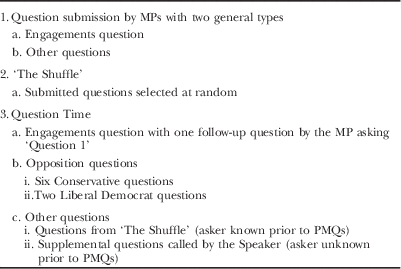
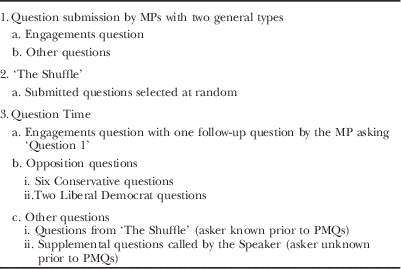
The procedure for asking PMQs is as follows from 1997 to 2008 and is controlled by the Speaker. It is important to note that while this is the general order of PMQs it has been known to change, with a different question other than the engagements question asked first, with more or fewer questions for the opposition and in other ways as the Speaker sees fit. Nevertheless, the process we present here matches nearly all of the PMQs contained in our data set. In general, the first question (often stated as ‘Question 1’) is selected by a random ballot of backbench MPs. This is a standard question asking about the prime minister’s engagements for the day. After this the MP can ask a supplementary question that relates to prime ministerial responsibilities or otherwise to most aspects of government policy. A series of questions from the leader of the largest opposition party follows, followed by a question from another member and then questions from the leader of any other major opposition party. The process finishes with a series of questions determined by ‘The Shuffle’ and the Speaker’s discretion with the total number of questions depending on time. In the period of our data, between 1997 and 2008, when there was a Labour government, questions were asked by the Conservative leader followed by questions from the Liberal Democrat leader. Normally these leaders were given six and two questions respectively from 1997 to 2008, although some variation did occur (House of Commons 2008).Footnote 1 Unlike the MP asking the first question and the supplementary question, and other question-askers that follow, opposition leaders are given a degree of latitude in the topic and manner of their question-asking. This latitude has increased over time, with opposition leaders’ questions taking a disproportionately large amount of time during PMQs compared with other members’ questions (see Bates et al. Reference Bates, Kerr, Byrne and Stanley2012). The Speaker allows opposition leaders to respond to the prime minister’s answers as well as to offer opinions, which may or may not be related to the question being asked. While a question is always asked, a large portion of the official text can be unrelated to that question, and questions themselves are often broad, such as rhetorically asking the prime minister to justify the government’s existence or mentioning specific and unrelated issues, such as offering condolences for a deceased constituent. The questions from other MPs must be far more focused and shorter, with the Speaker interrupting long questions or highlighting that only one question can be asked so as to speed up proceedings; the rate of such interruptions has increased over time (see Bates et al. Reference Bates, Kerr, Byrne and Stanley2012). The prime minister is well briefed on all the topics that are likely to arise, but can still be caught off-guard, especially by supplemental questions where the members posing questions are unknown prior to PMQs (House of Commons 2008).
Prime Minister’s Questions, like other forms of parliamentary questions, is first and foremost a venue for the opposition (Alderman Reference Alderman1992; Green-Pedersen and Mortensen Reference Green-Pedersen and Mortensen2010; Vliegenthart and Walgrave Reference Vliegenthart and Walgrave2011). The fact that the first several questions are reserved for the main opposition party or parties confirms this in very clear and procedural terms (House of Commons 2008). However, once those questions have been asked, the floor opens up and questions from all parties and all levels of political seniority are posed to the prime minister. While cabinet members and other senior politicians inside government are unlikely and are even unable to ask questions, other members of their own party still do. In fact, even members of the government’s own party ask about controversial issues, such as the Iraq War, providing an open venue for debate as is the ideal of the UK parliamentary system (Adonis Reference Adonis1993; Judge Reference Judge1993). Additionally, previous research clearly demonstrates that there are party differences in the number and content of questions (see Green-Pedersen Reference Green-Pedersen2010; Green-Pedersen and Mortensen Reference Green-Pedersen and Mortensen2010; Vliegenthart and Walgrave Reference Vliegenthart and Walgrave2011; Wiberg and Koura Reference Wiberg and Koura1994), no doubt related to party preferences (see Adams et al. Reference Adams, Merrill and Grofman2005; Adams and Somer-Topcu Reference Adams and Somer-Topcu2009). Table 1 summarizes this process for the New Labour government from its election in 1997 to the end of 2008.
The General Process of PMQs for New Labour, 1997–2008
Parliamentary procedure also plays an important role in PMQs. As King (Reference King1976) first noted, PMQs is an important procedure where opposition frontbenchers, opposition backbenchers and government backbenchers all ask questions of prime ministers directed at them and their cabinet. These distinctions are important. The Speaker and ‘The Shuffle’ act independently of party: the former seeks to allocate questions fairly whereas the latter is a random draw. Therefore salient issues will be underrepresented by backbencher questions due to the ability of backbenchers with specific constituency interests to gain access to questions (Coe and Kelly Reference Coe and Kelly2009; House of Commons 2008) and as such salient issues will have lower percentages of backbench questions.
POLICY REPRESENTATION AND QUESTIONS IN PARLIAMENTS
Political scientists usually approach the actions of legislators through an analysis of their careers and how they represent their constituencies, an approach which has been applied to the UK Parliament (Norton and Wood Reference Norton and Wood1993) and to its parliamentary questions (see Bertelli and Dolan Reference Bertelli and Dolan2009; Saalfeld Reference Saalfeld2011). But the wider agenda of parliament might not so closely link to these representative concerns, whereby the actions of MPs reflect wider shifts in the policy agenda. MPs may see themselves as representing the national interest even if refracted through the experiences of their constituents. How well those interests can be represented in a venue like PMQs despite debates over its usefulness (e.g. Hansard 1996) is an open and empirical question. Drawing on existing research on parliamentary questions, we hope to better understand the purpose and effect of PMQs. Regardless of how shallow or conflictual the venue of PMQs has become in recent years (see Bates et al. Reference Bates, Kerr, Byrne and Stanley2012), PMQs remains an extremely public venue that can have strong effects on the content of the political agenda even if the quality of the debate is as dire as popular perception indicates.
As with other opportunities to debate, the venue of PMQs may reflect the selective attention of its participants and leaders to concentrate on one policy topic as opposed to another – in other words, to take ownership (e.g. Budge and Farlie Reference Budge and Farlie1983). Questions give opportunities for political parties to coordinate responses on the big issues of the day, namely members of the opposition parties, which is particularly important in a (predominantly) single-party system (Whitaker Reference Whitaker2006). In the case of PMQs, what counts is the ability of the opposition party to move the government party or parties onto policy topics that it does not want to address – in other words, to shift the government’s attention away from the issues it owns and onto issues it must address because of the demands of governing (Green-Pedersen and Mortensen Reference Green-Pedersen and Mortensen2010). In fact, a combination of media attention and PMQs on a topic the government does not feel comfortable about could help shift public opinion in the opposition’s favour. This relates to the wider literature on legislative agenda-setting (Bräuninger and Debus Reference Bräuninger and Debus2009), and recent work also linking agenda-setting to parliamentary questions (Proksch and Slapin Reference Proksch and Slapin2010; Soroka et al. Reference Soroka, Penner and Bidook2009; Vliegenthart et al. Reference Vliegenthart, Walgrave and Meppelink2011). Other scholars argue that the growing competition over issues creates more of an opportunity for political parties to use venues such as PMQs and other forms of parliamentary questioning to expand the agenda and to challenge the government: ‘increased issue competition among political parties provides the explanation for the increase in non-legislative activities’ (Green-Pedersen Reference Green-Pedersen2010: 348). Moreover, empirical evidence demonstrates that the content of opposition parliamentary questions drives the government’s agenda (Green-Pedersen and Mortensen Reference Green-Pedersen and Mortensen2010). Other empirical work on Belgium shows that the topic choice of questions is conditional on other influences such as issue salience, and more so if it is the opposition party asking questions (Vliegenthart and Walgrave Reference Vliegenthart and Walgrave2011). We should note that, unlike models that consider party positions and preferences (see Adams et al. Reference Adams, Merrill and Grofman2005; Adams and Somer-Topcu Reference Adams and Somer-Topcu2009), this article focuses on shifts in attention. Sometimes shifts in attention can lead to large reforms that may or may not be preference related (see Jones Reference Jones1994). In other words, even the governing party’s own preferences may not be pursued until an issue is salient.
Previous work on parliamentary questions has treated parties as simply governments and oppositions; in this article we expand this out to consider the different groups within political parties. There has been a lot of attention on intra-party politics in the last 40 years, some of it inspired by King’s (Reference King1976) essay and other work that has examined coalition building and alliances (e.g. Kitschelt Reference Kitschelt1994; Laver and Shepsle Reference Laver and Shepsle1996), as well as the loyalty of party groups in an age of partisan dealignment (e.g. Kam Reference Kam2009). Partly for this reason we expect the actions of the leadership group in parties in parliament to be different from that of the backbencher and to be able to shape the agenda independently. Party followers will not necessarily be loyal to the leadership, and this can be reflected in the questions they ask.
We therefore ask, what drives PMQs? We aim to unravel whether government shapes the attention in PMQs or whether it is the opposition, and if so what part or parts of the opposition, from its different parties to its front and backbench, shape attention in PMQs?
The nature of PMQs and their intended use generates several hypotheses about the distribution of attention by party and between party leaders and party members. The first concerns the ability of the opposition to structure the policy agenda.
Hypothesis 1: Opposition questions lead government questions, but not vice versa.
The number of questions asked on a particular issue varies between the government and opposition based on the need for government to claim credit for implemented policies, preferences and general differences in issue ownership between the government and opposition parties (see Adams et al. Reference Adams, Merrill and Grofman2005; Adams and Somer-Topcu Reference Adams and Somer-Topcu2009; Budge and Farlie Reference Budge and Farlie1983; Green-Pedersen Reference Green-Pedersen2010; Wiberg and Koura Reference Wiberg and Koura1994); but the degree of issue salience naturally leads to the most notable differences and shifts in attention (Vliegenthart and Walgrave Reference Vliegenthart and Walgrave2011). Party differences of this sort in the UK have recently been demonstrated through empirical analyses of both the Speech from the Throne (the executive speech delivered by the monarch that opens a new parliament) and Acts of the UK Parliament (Jennings et al. Reference Jennings, Bevan and John2011; John et al. Reference Jennings, Bevan and John2014). By paying greater attention to issues that the public prioritizes, the opposition drives the government’s agenda, prompting government MPs to respond (Green-Pedersen and Mortensen Reference Green-Pedersen and Mortensen2010). However, driven by their own goals and without the need to claim or account for implemented policies, the opposition does not similarly respond to the government’s agenda (Alderman Reference Alderman1992).
Our second hypothesis considers another important dynamic of PMQs: the fact that it provides a voice for both frontbench and backbench opposition MPs. As the frontbench for the government in PMQs only consists of the prime minister answering all questions, with members of the cabinet unable to ask questions, it is impossible to test this argument for the government as no government frontbench questions are asked.
Hypothesis 2: Backbench opposition questions lead frontbench opposition questions, but not vice versa.
PMQs from different sets of actors are designed to react to one another. However, it is through PMQs that backbench opposition MPs receive one of their few opportunities to put forth their unique interests as well as constituency interests. By paying attention to issues other than the most salient issues, backbench opposition MPs have the opportunity to drive future attention from frontbenchers, forcing a reaction (see Green-Pedersen and Mortensen Reference Green-Pedersen and Mortensen2010). Given their unique agendas as well as constituency interests, the same effect does not occur when considering the effect of frontbench opposition questions on backbench opposition questions (see Fenno Reference Fenno1978; Jogerst Reference Jogerst1991; Rasch Reference Rasch1994). However, the opposition is not a unitary actor and smaller parties may face more pressure to keep a coherent message and hierarchy in order to survive.
Hypothesis 3: Smaller opposition parties’ backbenchers have less of an effect on frontbench opposition questions.
In the classic works on British politics, parties have different forms of organization and patterns of central control, which affects the role of backbench MPs in parliament (see McKenzie Reference McKenzie1955). Such variation in party organization is to be expected from the comparative literature on political parties (Katz and Mair Reference Katz and Mair1994). In most political systems, including Britain, there are several oppositions, represented by different political parties. These parties have different relationships between leaders and followers, and also have a specific interest to both the front and backbenchers from other parties. Because of this, we hypothesize that smaller opposition parties will vary in the extent to which they represent the policy agenda. In particular, their followers have less of an influence on the policy agenda than their party leaders. Smaller parties, such as the Liberal Democrats, require a stronger hierarchical structure in order to stay on message and remain competitive, especially in the UK’s first-past-the-post electoral system (Russell and Fieldhouse Reference Russell and Fieldhouse2005). Small party groups in the House of Commons may be more compact and cohesive simply in order to survive.
While we offer no further hypotheses, we should not neglect the admitted influence of factors outside parliament on PMQs that link to government and opposition questions to reflect the concerns of these other venues. Specifically, there is a close relationship between the media and the arena of PMQs. For instance, it is one of the few legislative venues to receive media coverage and interest. Moreover, measures of public priorities such as responses to ‘most important issue’ type questions no doubt also affect the content of PMQs by often highlighting the very issues the opposition hopes to force the government to face. We therefore control for both media attention and public priorities in our statistical analyses.
DATA AND METHODS
Prime Minister’s Questions
The PMQs used in this article are from May 1997 – the start of the Labour government – until December 2008 and are aggregated into totals by major topic per quarter.Footnote 2 A total of 9,062 questions were asked during this time period and were coded according to UK Policy Agendas Project major topic codes (www.policyagendas.org.uk). Each question-and-answer pair was allocated a code according to the content of the question alone, specifically the portion of the official text asking a question and not the text responding to the prime minister’s previous answer, as is possible with opposition questions. This process proved straightforward for all but the questions from the leader(s) of the opposition, with the Speaker holding each MP to a single, focused question. In the case of questions from the leader(s) of the opposition, the question asked at the end of the statement and responded to by the prime minister was the question that was coded. Our data set therefore focuses only on questions and not the theatrics and the debate of PMQs. Nonetheless, it is important to note that this was a distinctive period in British politics largely reflecting the electoral dominance of Labour, which was able to push through its legislative programme in successive parliaments. At the same time the opposition was not thought to be strong, but over time the government came to face increasing criticism, especially over foreign policy. So it is a good period to test for the importance of PMQs, given the dominance of the executive.
To code all 9,062 questions, a large representative sample of questions (approximately one-third of all questions) was double-blind coded by two researchers with disagreements resolved by the project manager. With this cleaned sample an early version of RTextTools (Jurka et al. Reference Jurka, Collingwood, Boydstun, Grossman and van Atteveldt2012) was trained and used as a second coder for the remainder of the questions, with disagreements also addressed by the project manager.Footnote 3 Each observed question includes the date, the full text of the question and answer, the topic of the question and the party of the questioner. We were further able to distinguish question askers, namely whether they were a member of the shadow cabinet (including party leaders)or the so-called frontbench for the two main opposition parties.
Public Opinion
PMQs is one of the most public ways that MPs can express their concerns and represent the views of their constituents, as the frequent references to them in their questions indicate. Therefore, the issue salience to the public plays an important role in determining the distribution of attention in PMQs, particularly for the opposition. To control for the direct effect of public opinion on question-asking we include public opinion in the models of PMQ attention. Namely, we use Ipsos-MORI’s ‘most important issue’ (MII) measure. The most-important-issue question asks, ‘What would you say is the most important issue facing Britain today?’ These data were recoded from Ipsos-MORI’s own coding scheme to match the UK Policy Agendas Project’s major topic codes. In our models, we treat the relationship between public opinion and PMQs as contemporaneous due to the close relationship between current events and PMQs. It is unlikely that PMQs itself influences public opinion as public opinion comes from many sources measuring the general salience of an issue. Furthermore, in spite of the media coverage of PMQs, it does not regularly appear on the front pages of the newspapers or as headline news, making the effect indirect at best.
Media
We also use media data gathered from front-page headlines of The Times (London) as a further control for issue salience. These data were gathered for every Wednesday and were also coded by major topic through a double-blind coding procedure (at about 85 per cent intercoder reliability with disagreements also addressed by the project manager).Footnote 4 Media attention serves to capture both attention to issues due to events and the level of media salience related to different issues. The relationship is tested contemporaneously due to the close relationship between current events and PMQs.Footnote 5
Statistical Models
In order to test our hypotheses we use graphical analyses to demonstrate the similarities and differences between the government and opposition agendas contained in PMQs. In addition to our graphical analyses of PMQs, we use time series cross-sectional models to test the expectation that opposition questions lead government questions, but not vice versa. This procedure allows us to understand why the total agenda changes over time. The two opposition and government models take the following forms with i indicating issue and t indicating time. The models further include fixed effects by topic to account for differences in the average change by issue.
 $$Gov ’ _{{it}} =\,{\rm }Gov ’ _{{it{\rm }{\minus}1}} {\plus}Opp ’ _{{it{\rm }{\minus}1}} {\plus}\,Opinion_{{it}} {\plus}\,Media_{{it }}$$
 $$Opp ’ _{{it}} =\,Opp ’ _{{it{\rm }{\minus}1}} {\plus}\,Gov ’ _{{it{\rm }{\minus}1}} {\plus}\,{\rm }Opinion_{{it}} {\plus}\,Media_{{it }} $$
Where:
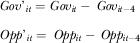 $$\eqalign{ Gov ’ _{{it}} ={\rm }Gov_{{it}} -\,Gov_{{it{\rm }{\minus}4}} \cr Opp ’ _{{it}} =\,Opp_{{it}} -\,Opp_{{it{\minus}4}} $$
In these two models questions by both the government (Gov’) and the opposition (Opp’) have been seasonally differenced based on the corresponding quarter in the previous year. In other words, the number of questions asked by the opposition on the economy in the first quarter of 2007 is subtracted from the total number of questions asked by the opposition on the economy in the first quarter of 2008. This produces the year-on-year difference in questions to account for the parliamentary calendar.Footnote 6 Namely, this differencing accounts for the fact that the government does not spend the same amount of time in session in every quarter and that certain issues, such as the budget, often come up at around the same time each year. The cycles shown in Figure 1 demonstrate both why this transformation is neededFootnote 7 and the transformed data for all questions.Footnote 8 The models further include controls for public opinion (Opinion) and the media (Media).
Government and Opposition Questions vs. Seasonally Differenced (t-4) Questions

We also make use of seasonally differenced data in models including fixed effects for the internal opposition models and our final model. In these models we consider both the frontbench (leader and shadow cabinet) and backbench (all other members) for each party in relation to one another.
ANALYSES
PMQs: An Opposition Agenda?
Beyond demonstrating the seasonality of the data, Figure 1a shows that the number of opposition questions is higher than the government’s. This result contrasts with previous work in the UK that finds a roughly equal share of questions from the government and opposition (Borthwick Reference Borthwick1993). From Figure 1a PMQs is clearly a venue for the opposition’s voice. As discussed earlier, PMQs is one of the few institutional venues where the opposition is given a voice in British politics, which it uses actively (Vliegenthart and Walgrave Reference Vliegenthart and Walgrave2011), partly because the procedure grants several questions to the opposition (House of Commons 2008), so it has opportunities to set the agenda.
Opposition vs. Government Policy
We now turn to differences in the questions asked by the opposition and the government. Figures 2 and 3 present an array of 19 graphs for each of the 19 major topic codes used by the UK Policy Agendas Project. In Figure 2 the total number of questions asked by both the government and opposition by topic is graphed. In Figure 3 the percentage of questions asked by the government by topic is graphed. Combined, these figures demonstrate the total amount of attention to each issue by the government and opposition (Figure 2) and the total share of attention by issue for the government compared with the opposition (Figure 3).
Government vs. Opposition Questions by Topic
Per Cent Government Questions by Topic
Clearly there is a great deal of variation within and between topics, as evidenced by Figures 2 and 3. For example, in Figure 2 the economy gradually declines as an issue for both the government and the opposition over much of the time period, eventually levelling out with a static and rather low level of attention. This is followed by the sudden shock at the end of the period in 2008 with the start of the credit crunch. However, as Figure 3 shows, most of these questions on the economy come from the opposition by a ratio of three to one. The lower share of economy questions asked by the government over nearly the entire time period further indicates that the opposition focuses its attention on issues that are salient for the public.
Parliament responds to outside events in other areas as well. Attention to agriculture in PMQs is generally low, as is to be expected from a generally low salience issue area. But in 1999 agriculture was at the very centre of UK politics with the outbreak of BSE, or ‘mad cow disease’, which led to the slaughter of a large part of the UK cattle population. This crisis produced a spike in attention to agriculture from the opposition, as seen in Figure 2, but there were virtually no questions asked by government MPs on the topic during this same time (see Figure 3), again highlighting the opposition’s desire to focus on salient issues and challenge government.
Driven by the Opposition?
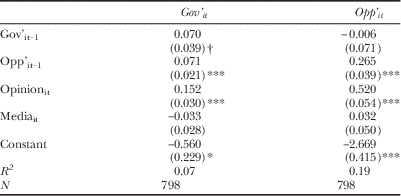
While there are clear differences, especially in the timing and level of attention to different issues by the government and opposition, there are many more similarities between the opposition and government agendas than the literature on party ownership implies. One possible reason for these similarities goes to the heart of PMQs as a means for political debate. Debates are, of course, marked by both actions and reactions with topics chosen by one side and then reacted to by the other. Table 2 presents a time series cross-sectional analysis of government and opposition questions to explore their ordering. The models include a lagged dependent variable, lagged attention from the other party’s questions and controls for public opinion and media salience.
Government vs. Opposition Question Ordering
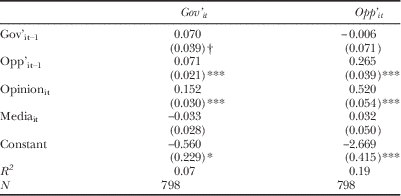
Note: *p≤0.05, ***p≤0.001, † p≤0.10.
N=798 (19 major topics (n)×42 quarters (T)).
Turning first to the government model, the positive and significant result for the lagged opposition questions indicates that the government does follow the opposition as expected by Hypothesis 1. Furthermore, the government model demonstrates that there is little inertia in the governmental agenda, as indicated by the only marginally significant lagged dependent variable. In other words, government questions tend to change quite a bit in their focus from quarter to quarter. This may be the result of a government agenda that is determined by both the previous quarter’s opposition agenda and public opinion, as is indicated by the positive and significant effect for these variables.Footnote 9 There is no effect for the media.
The opposition model also matches our expectations. The insignificant result for the lagged government agenda variable indicates that opposition PMQs do not follow government PMQs. The lagged dependent variable is positive and significant, indicating a degree of inertia in the opposition agenda from quarter to quarter. This is directly counter to the government model and indicates that opposition questions tend to focus on similar issues from one quarter to the next. This is no doubt driven by the patterns of attention to contentious issues discussed above. It is also worth noting that public opinion in this model has a higher effect than in the government model, which indicates that the opposition more closely follows salient issues in its questioning, as to be expected.Footnote 10
Deconstructing the Opposition: Front vs. Backbench Questions
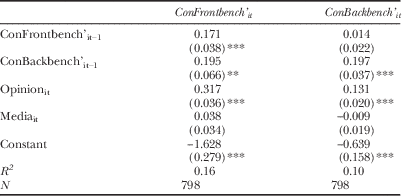
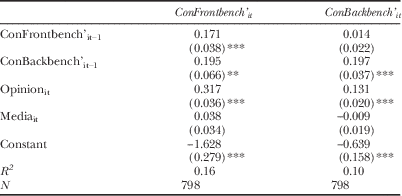
The opposition is, however, quite a broad term and concept. In particular when it comes to UK PMQs during our time period there were two important opposition parties, the Conservatives and Liberal Democrats, both of which had active front and backbenches asking questions. Here we consider the internal dynamics of these two parties by assessing the effects of front and backbench questions on each other for each party. Table 3 therefore presents a time series cross-sectional analysis of front and backbench questions for the main opposition party of the time, the Conservative Party. The statistical models include a lagged dependent variable, lagged attention from the other side of the procedure of PMQs and controls for public opinion and media salience as before.
Conservative Frontbench vs. Backbench Question Ordering
Note: **p≤0.01, ***p≤0.001.
N=798 (19 major topics (n)×42 quarters (T)).
The results in Table 3 suggest that the backbench agenda drives the frontbench agenda. Turning first to the model for frontbench questions we find a powerful effect for backbench questions, matching our expectations that backbenchers drive the frontbench agenda, supporting Hypothesis 2. The effect for lagged frontbench question in this case also demonstrates inertia, indicating how the focus of frontbench questions from the Conservatives persist from quarter to quarter, no doubt driven by the patterns of attention seen for the entire opposition in Figures 2 and 3. Backbench questions also respond to public opinion indicated by the positive and significant effect and at a noticeably higher level than Conservative backbench questions, suggesting that the Conservative leadership knowingly follows general public priorities.
On the other hand, Conservative backbench questions clearly focus on similar questions from quarter to quarter, shown by the positive and significant effect for the lagged dependent variable. Backbench questions also positively respond to public opinion, as indicated by the positive and significant coefficient. However, these backbench questions are not driven by the Conservative frontbench, further supporting Hypothesis 2.
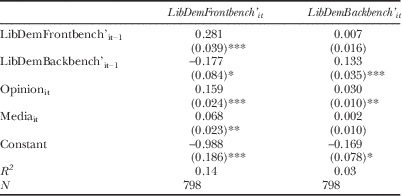
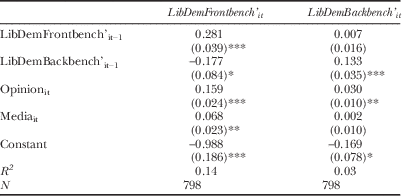
Turning to the other opposition party, the Liberal Democrats, in Table 4 we find quite a different relationship. Namely, the backbench agenda of the Liberal Democrats actually negatively affects the frontbench. This finding is surprising in that it not only suggests a disconnect between the front and backbenches of the Liberal Democrats, but a conscious discounting of the backbencher focus. However, alternative analyses not presented here which only focused on the Liberal Democrat leader and not the shadow cabinet as a whole found an insignificant effect.Footnote 11 Beyond this the patterns of both models are similar to those for the Conservatives, with both clearly showing inertia through their lagged term. In other words, the Conservative Party is driven by the concerns of its backbenchers and moves to respond to public opinion; the Liberal Democrats agenda only appears to respond to public opinion and possibly negatively discounts the interests of their members.
Liberal Democrat Frontbench vs. Backbench Question Ordering
Note: *p≤0.05, **p≤0.01, ***p≤0.001.
N=798 (19 major topics (n)×42 quarters (T)).
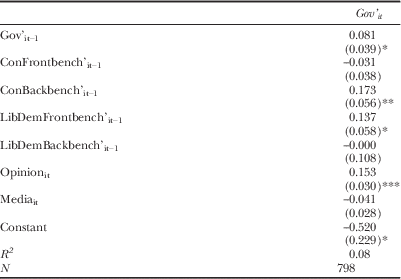
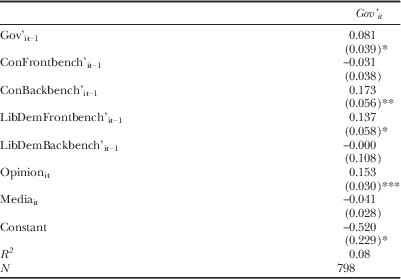
One question remains then: how do these different elements work to drive the government’s agenda? Table 5 presents an extension to the analysis in the government model from Table 2. Specifically, it disaggregates the opposition into the front and backbenches of both the Conservative and Liberal Democrat parties. Here, a slightly better fitting model shows that two elements of the opposition positively and significantly affect government questions. These elements are the Conservative backbench and the Liberal Democrat frontbench, offering further, but more nuanced, support for Hypothesis 1. Conservative backbenchers play an important role in the content of PMQs, as does the Liberal Democrat frontbench, demonstrating both that the opposition matters and that different elements of the opposition by party matters even more.
Opposition Elements on Government Questions
Note: *p≤0.05, **p≤0.01, ***p≤0.001.
N=798 (19 major topics (n)×42 quarters (T)).
CONCLUSION
The topics that appear in Prime Minister’s Questions reflect both the general pressures on the policy agenda and the exigencies of party politics in a parliamentary system whereby MPs ask questions about the current issues of the day in the hope of giving advantage to their parties. But what is particularly noticeable is that the difference between the government and opposition on key policy areas is not generally due to traditional party preferences (with the exception of the labour issue for the Labour government). Instead, the opposition highlights salient issues that are to the government’s discomfort. More importantly the findings suggest that the opposition’s agenda drives government backbench MPs to ask questions on the same topic, particularly when it comes to salient issues, such as on the economy and defence. Nor do opposition questions follow the government’s backbench questions, also demonstrating the agenda-setting power of the opposition (Hypothesis 1). At least in the venue of PMQs, the opposition – from the start of Labour government in 1997 to the end of 2008 – challenged the government on issues it did not wish to stress and increased parliamentary attention on these topics as a result.
The procedure of PMQs ensures that the opposition asks a greater number of questions. The procedure also produces differences in the usage of questions between the front and backbench of opposition parties. The opposition frontbench uses its control over the content of the questions for its own tactical ends, often focusing on the same salient issues. Backbenchers, on the other hand, tend to use the questions for other matters that worry them or their constituents, who are often mentioned in the content of their questions. Backbench MPs from the Conservative Party also drive the questioning of the Conservative frontbench and the questions asked by government MPs (Hypothesis 2; Hypothesis 1). It is difficult to say whether or not this effect is furthered by the observed increase in backbench rebellions through this time period (e.g. Cowley Reference Cowley2002), but our findings are certainly consistent with the phenomenon. However, the frontbench of the Liberal Democrats pays less attention to its backbench, possibly employing a more hierarchical approach in order to be competitive as the smaller party (Hypothesis 3). The Liberal Democrats’ frontbench also has a positive effect on government questions (Hypothesis 1). Despite the increased dramaticism of PMQs over time (e.g. Bates et al. Reference Bates, Kerr, Byrne and Stanley2012) and the general ambivalence concerning the ritual (Lovenduski Reference Lovenduski2012), PMQs still serves a clear purpose in causing the government and the most prominent members of parliament to devote attention to both opposition and backbench issues. While maybe no longer high politics, then, PMQs is indeed still political.
Our results in this article suggest that – at least in the venue of PMQs – opposition and backbench Conservative MPs are able to use the venue to shape the policy agenda in different ways, adding meaning to parliamentary debates (see Adonis Reference Adonis1993; Judge Reference Judge1993). The institution of PMQs has procedures that allow both the opposition and backbenchers to represent the issues they think are important, but for different reasons. For backbenchers this includes the discussion of constituency interests. For the opposition, our results suggest that the real purpose of PMQs for these actors may in fact be to force the government to attend to a set of issues it might wish to avoid. As in the wider European literature on parliamentary questions (e.g. Green-Pedersen and Mortensen Reference Green-Pedersen and Mortensen2010; Seeberg Reference Seeberg2013; Vliegenthart et al. Reference Vliegenthart, Walgrave and Meppelink2011; Vliegenthart and Walgrave Reference Vliegenthart and Walgrave2011), our results demonstrate a responsiveness of the government to the opposition. However, the responsiveness of PMQs is also affected by the institution of ‘The Shuffle’, which creates a clear venue for backbench MPs to participate in the process (Coe and Kelly Reference Coe and Kelly2009; House of Commons 2008). In summary, the ritual and the drama of PMQs, despite appearing to be shallow and media focused, can help backbenchers and the opposition change the attention of government. Nevertheless, future work would do well to consider if the decline in the quality of debate from PMQs has had more dire effects for policy-making beyond the agenda-setting phase.