Passivization involves the reorganization of the grammatical functions and thematic roles in an active sentence. In English, passives are formed with an auxiliary verb “be,” which agrees with the subject in person and number, and a past participle form of the main verb (the “periphrastic” passive). The active sentence in (1a) can be passivized in two ways, which are demonstrated in (1b) and (1c). In (1b), the long passive, the object of the active sentence in (1a), “the window,” carrying a patient role, raises to the subject position, whereas the agent in (1a), “the teacher,” is demoted to the optional prepositional phrase (PP) headed by the preposition “by.” In the short passive construction in (1c), the agent is left out altogether.
(1)


In the standard generative framework, this instance of movement to the subject position is known as argument movement (A-movement): The trace t represents the position from which the argument, “the window,” has moved, resulting in the formation of an A(argument)-chain, indicated by the co-indexation, through which the thematic role of the object is assigned.
PROPERTIES OF THE SERBIAN PASSIVE
Serbian is a typical Slavic language with complex morphology and a relatively free word order. Each argument is marked by morphological case affixes, which indicate the argument's function in a clause, and each modifier agrees with its head in gender, number, and case.Footnote 1 The passive in Serbian is derived in a similar fashion to that in EnglishFootnote 2: the object of the active construction in (2a), “the window,” raises to the subject position in the passive sentence in (2b), forming an A-chain. Once in the subject position, it is marked for the nominative case. The auxiliary “be” agrees with the subject in number and person, whereas the passive participle “closed” agrees with the subject in number and gender. The active subject can be left out in (2b), demoted to the PP headed by the preposition “by” (od strane) and marked in the genitive case (2c), or marked with the instrumental case if carrying the thematic role of instrument in (3a), or experiencer in (3b). This pattern of the oblique noun phrase (NP) carrying instrumental or genitive case is attested in other languages, for example, Russian (Keenan & Dryer, Reference Keenan, Dryer and Shopen2007).
- (2)
a. Učiteljica je zatvorila prozor.
teacher-Fem-Nom-sg aux-3rd-sg close-past-3rd-sg-Fem window-Masc-Acc-sg
“The teacher closed the window.”
b. Prozori je zatvoren ti.
window-Masc-Nom-sg aux-3rd-sg close-pass.part-Masc-sg
“The window was closed.”
c. Prozori je zatvoren ti od strane učiteljice.
window-Masc-Nom-sg aux-3rd-sg close-pass.part-Masc-sg by side teacher-Fem-Gen-sg
“The window was closed by the teacher.”
- (3)
a. Prozori je pogodjen ti granatom.
window-Masc-Nom-sg aux-3rd-sg hit-pass.part-Masc-sg grenade-Fem-Instr-sg
“The window is hit by the grenade.”
b. Marijai je oduševljena ti Markom.
Marija-Nom aux-3rd-sg impress-pass.part-Fem-sg Marko-Instr
“Marija is impressed by Marko.”
THE SERBIAN “BY-PHRASE”
The PP “od strane + Gen NP” can be translated as “on the part of” (literally “by side”).Footnote 3 It is treated as the equivalent of its English counterpart, the by-phrase (Djurković, Reference Djurković2007; Zlatić, Reference Zlatić1997). Zlatić refers to it as “the agentive prepositional phrase headed by the preposition od strane” (p. 195). We thus consider “od strane” to be a complex preposition, because the noun “strane” (side) cannot be modified (*od moje strane, by my side, *od ove strane, by this side). However, it is not restricted to passive constructions and can appear in nominalization structures, or in complements to NPs as in (4).Footnote 4
(4) Dobili smo pozitivnu ocenu od strane Evropske komisije.
received-past-3rd-pl aux-3rd-pl positive-Fem-Acc-sg mark-Fem-Acc-sg by side European-Fem-Gen-sg commission-Fem-Gen-sg
“We received a positive mark from the European Commission.”
THE SERBIAN PASSIVE PARTICIPLE
Passive participles share the agreement paradigm with adjectives, being marked for number and gender. Their case marking, locative in (5), is only obvious in the instance of bare passives.
(5) Živimo u kući izgradjenoj posle 1900.
live-pres-3rd-pl in house-Fem-Loc-sg built-pass.part-Fem-Loc-sg after 1990.
“We live in a house built after 1900.”
In contrast to English, the Serbian passive participle is not homophonous with the past participle (e.g., past participle: izgradila (build-past part.-Fem-sg) versus passive participle: izgradjena (build-pass.part.-Fem-sg).Footnote 5
The Serbian passive participle, in common with English and other languages, can be used as the complement of the copular verb “be,” thus giving rise to the ambiguity between the stative (adjectival)Footnote 6 and dynamic (verbal) passive reading. This ambiguity is even more pronounced in Serbian because of their shared morphological paradigm: The subject in (6) below can either refer to the state of the vase (“being broken”), where no external agent is implied, or to an activity, where an external agent acted upon the vase (“someone broke the vase”).
(6) Vaza je razbijena.
vase-Nom-Fem-sg aux-3rd-sg broken-pass.part-Fem-sg
“The vase is broken.”
THE (IN)FREQUENCY OF THE SERBIAN PASSIVE
Although English and Serbian passives share a number of formal similarities, what sets these two languages apart is the frequency of the use of these constructions. In common with other Slavic languages (Siewierska, Reference Siewierska and Shibatani1988), passives are rarely used in Serbian (Progovac, Reference Progovac2005; Stanojčić & Popović, Reference Stanojčić and Popović1992). Djurković (Reference Djurković2007) reports that Kostić's (Reference Kostić2001) corpus of contemporary literary language (1,004,686 words) contains only 1,290 passives. In a much smaller corpus of everyday conversational language (of around 30,000 words, 5,233 utterances; Savić & Polovina, Reference Savić and Polovina1989), consisting of 23 recorded conversations between adults in informal situations (e.g., family discussions) as well as more formal situations (e.g., job interview, doctor's appointment), passive constructions are found in only 1.28% of the utterances (percentage calculated by adding the number of tokens produced by each speaker and dividing by the total number of utterances; Djurković, Reference Djurković2007). This figure is even smaller in child-directed speech: In her corpus analysis of 108,222 adult utterances from the Serbian Electronic Corpus of Early Child Language (Andjelković, Ilić-Ševa, & Moskovljević, Reference Anđelković, Ilić Ševa and Moskovljević2001), Djurković (Reference Djurković2007) reports that passives represent only 0.29% of the total number of utterances directed to children. However, the long passive belongs to a more formal register and is exceptionally rare in everyday conversation (Stanojčić & Popović, Reference Stanojčić and Popović1992), as is the case in a number of languages (see Keenan & Dryer, Reference Keenan, Dryer and Shopen2007, for a review). Our own search of the only two corpora of conversational Serbian (Andjelković & et al., Reference Anđelković, Ilić Ševa and Moskovljević2001; Savić & Polovina, Reference Savić and Polovina1989) revealed no instance of a long (by-phrase) passive.
ACQUISITION OF THE PASSIVE
Studies have consistently shown that passive structures present particular difficulties to children in the course of their grammatical development. Passives are generally rare in spontaneous speech in either children or adults (Bloom, Reference Bloom1973; Brown, Reference Brown1973; Horgan, Reference Horgan1978), though experimental data reveal a discrepancy between the age at which children first produce passives and the age when they comprehend them. Certain instances of passives, for example, “get passives,” are produced around the age of 3 (Crain, Thornton, & Murasugi, Reference Crain, Thornton and Murasugi2009; Pinker, Lebeaux, & Frost, Reference Pinker, Lebeaux and Frost1987), but a clear comprehension of passive structures lags behind until the age of 4 or 5 (Maratsos, Fox, Becker, & Chalkley, Reference Maratsos, Fox, Becker and Chalkley1985; Sudhalter & Braine, Reference Sudhalter and Braine1985) or even 6 (Baldie, Reference Baldie1976; Turner & Rommetveit, Reference Turner and Rommetveit1967).
The delay in the comprehension of passives has been observed in a number of different languages, prompting claims that this delay is universal (Hirsch & Wexler, Reference Hirsch and Wexler2006). In addition to English, it has been noted in Dutch (Verrips, Reference Verrips1996), German (Bartke, Reference Bartke, Bartke and Siegmuller2004), Greek (Terzi & Wexler, Reference Terzi and Wexler2002), Hebrew (Berman & Sagi, Reference Berman and Sagi1981), Japanese (Okabe & Sano, Reference Okabe and Sano2002; Sugisaki, Reference Sugisaki1999), Mandarin Chinese (Haiyun & Chunyan, Reference Haiyun, Chunyan and Crawford2009), Spanish (Pierce, Reference Pierce1992), and Russian (Babyonyshev & Brun, Reference Babyonyshev and Brun2004). However, naturalistic observations in some languages seem to suggest early passive acquisition, for example, Inuktitut (Allen & Crago, Reference Allen and Crago1996), Sesotho (Demuth, Reference Demuth1989), and Quiche’ Mayan (Pye & Poz, Reference Pye and Quixtan Poz1988),Footnote 7 whereas some experimental results in English suggest that even very young children can produce some types of passives if a particular experimental paradigm is employed (Crain et al., Reference Crain, Thornton and Murasugi2009; O'Brien, Grolla, & Lillo-Martin, Reference O'Brien, Grolla, Lillo-Martin, Bamman, Magnitskaia and Zaller2006).
It has been argued that children's performance differs depending on the type of passive under investigation: Young children may show a better command of short (truncated) passives in (7a) as opposed to long passives as in (7b) containing the by-phrase (Fox & Grodzinsky, Reference Fox and Grodzinsky1998):
- (7)
a. Mary is pushed.
b. Mary is pushed by Lisa.
However, whereas Horgan (Reference Horgan1978) reports no evidence of long passives in children's spontaneous speech, a number of experimental studies have shown an equally good (or equally poor) production of long and short passives by children (Crain et al., Reference Crain, Thornton and Murasugi2009; Hirsch & Wexler, Reference Hirsch and Wexler2006; O'Brien, Grolla, & Lillo-Martin, Reference O'Brien, Grolla, Lillo-Martin, Bamman, Magnitskaia and Zaller2006).
Furthermore, a number of studies report that children's level of passive comprehension is partly determined by the type of verb used. Passives of psychological verbs (“see,” “remember”), which refer to some mental state, seem to be more difficult than those of actional verbs (“kiss,” “push”), which refer to concrete actions. Such a discrepancy is not noted in the active voice (Fox & Grodzinsky, Reference Fox and Grodzinsky1998; Gordon & Chafetz, Reference Gordon and Chafetz1990; Hirsch & Wexler, Reference Hirsch and Wexler2006; Maratsos, Fox, Becker, & Chalk Reference Maratsos, Kuczaj, Fox, Chalkley and Collins1979, Reference Maratsos, Fox, Becker and Chalkley1985; Sudhalter and Braine, Reference Sudhalter and Braine1985). Although children's comprehension of passives of actional verbs seems robust enough by about 5 years of age, these studies show that comprehension of passives of psychological verbs seems difficult until about the age of 7, or even later.
ACCOUNTS OF DIFFICULTIES WITH PASSIVES
Despite the large volume of research in this area, there is little consensus on what makes the comprehension and production of passives difficult for children. Some recent studies have even questioned whether the difficulties are real or just an artifact of experimental methodology (for a discussion, see Lillo-Martin & Snyder, Reference Lillo-Martin and Snyder2009).
We consider two different types of theories that are influential in the literature: the frequency accounts, which invoke the infrequent input of passives in parental speech as the principal reason for the difficulty children show with this construction (Brooks & Tomasello, Reference Brooks, Tomasello, Fox, Jurafsky and Michaelis1999; Gordon & Chafetz, Reference Gordon and Chafetz1990), and the linguistic accounts, which argue that particular grammatical principles may be inoperative in very young children (Borer & Wexler, Reference Borer, Wexler, Roeper and Williams1987; Fox & Grodzinsky, Reference Fox and Grodzinsky1998).Footnote 8
Gordon and Chafetz (Reference Gordon and Chafetz1990) argue that children's better performance on actional as opposed to psychological verbs can be explained by the more frequent occurrence of actional passives in children's environment. This argument has recently been questioned on the basis of evidence from twin studies. Findings reported by Ganger, Dunn, and Gordon (Reference Ganger, Dunn and Gordon2005) reveal a strong genetic component in the development of passives of psychological verbs, but not of actional verbs: in their study, identical twins showed a more similar performance on passives of psychological verbs than did fraternal twins, a pattern not seen with actional verbs.
The linguistic account developed by Borer and Wexler (Reference Borer, Wexler, Roeper and Williams1987), and its more recent version in Wexler (Reference Wexler2004), proposes that the difficulties in passive comprehension experienced by children are due to a delayed maturation of a grammatical component: the ability to form A-chains. According to Borer and Wexler's (Reference Borer, Wexler, Roeper and Williams1987) A-chain deficit hypothesis (ACDH), children are unable to interpret the argument chain created by the movement of the object argument to the subject position. Young children thus have difficulties interpreting passives of both actional and psychological verbs, but the relatively good performance on the actional passive is due to a strategy of interpreting this passive not as verbal but as adjectival. As mentioned earlier, verbal and adjectival passive forms are homophonous in a number of languages, including English; therefore, the same form of the participle (e.g., “broken”) is used for the verbal passive (“The toy was broken by Mary”) and adjectival passive (“The toy looks broken”). However, the two forms are derived by different mechanisms. Verbal passives are traditionally described as derived by movement, as illustrated in (1).Footnote 9 In contrast, the derivation of adjectival passives does not involve movement: the syntactic representation of the adjectival passive is the same as that of any adjective: “the red toy,” “an interesting toy.” Adjectival passives are acquired early (Horgan, Reference Horgan1978), and cross-linguistic evidence confirms that in languages where adjectival passives are not homophonous with verbal passives, children demonstrate an early mastery of adjectival passives, but a delayed knowledge of verbal passives (e.g., Hebrew: Berman & Sagi, Reference Berman and Sagi1981; Greek: Terzi & Wexler, Reference Terzi and Wexler2002), exactly as predicted by the ACDH. Because psychological verbs rarely make good adjectival passives (adjectival: “This pirate looks feared” versus verbal: “This pirate is feared by everyone”), children cannot rely on the adjectival strategy with these verbs, demonstrating a chance performance.Footnote 10
In contrast to Borer and Wexler's ACDH, Fox and Grodzinsky (Reference Fox and Grodzinsky1998) argue that children's difficulty with passive constructions is related to the properties of the by-phrase and not to their inability to interpret the argument chains created by the movement of the complement NP to the position of the subject. These authors argue that children have mastered passive constructions but cannot transmit the external theta role of the predicate to the by-phrase. Their experiment, conducted on 13 children aged 3 years, 6 months (3;6) to 5 years, 5 months (5;5), demonstrated that the problem with passive constructions disappeared when the by-phrase was eliminated in both actional and psychological verbs (i.e., in short passives).
In view of the exceptionally low frequency of passives in Serbian, the development of this structure in such a language may bring particularly useful insights to the debate on the contribution of the linguistic experience and innate linguistic constraints. There is little systematic data on the acquisition of short versus long passives of both actional and psychological verbs in Serbian. In the following sections, we discuss the results of two less well-known studies of the development of passives in Serbian and present the rationale for our own investigation of this construction.
Djurković (Reference Djurković2007) compared the comprehension and spontaneous production of passives of actional verbs to that of transitive impersonal “reflexive–passives,” which involve the reflexive clitic “se,” in 2- to 6-year-old children acquiring Serbian. Both constructions have traditionally been described as instances of the passive (see Note 2); however, the differences in the morphosyntax of the impersonal (related to whether the operation involved in creating the structure is valence preserving or valence changing), led Djurković to argue that the impersonal should not be analyzed as a type of passive. Four sentences were tested in each condition (impersonal reflexive, participial passive, and the control active sentence), with both perfective and imperfective verbs (tested separately). The passive condition involved two sentences with the short passive and two sentences with the long, od strane–phrase passive. The results of her study suggest that the reflexive impersonals and participial passives are treated differently by young children: The youngest group tested, 2-year-olds, reached 80% correct performance on the impersonals (as well as the actives) but only a chance performance on passives. The discrepancy is observed in all the ages tested: 5- and 6-year-olds achieve around 90% correct or higher on impersonals, in contrast to passives, where 5-year-olds reached 66% correct and 6-year-olds reached 80% correct. There was no difference between the children's performance in long as opposed to short passives; thus, the results of the two types of passives were collapsed (the contrast between the long and short passive was not the focus of this study, therefore the small number of experimental items). Older children were somewhat better with passives of perfective as opposed to imperfective verbs, whereas younger children showed no difference in this respect. An earlier unpublished study by Stojanovic (Reference Stojanovic2004; as discussed in Djurković, Reference Djurković2007) also compared the reflexive passive to the participial passive in Serbian children aged 2;6 to 5;6, obtaining results consistent with those of Djurković (Reference Djurković2007): better performance on the reflexive construction than on the participial passive. The results of these two studies point to a delay in the acquisition of passives in Serbian, parallel to the one observed in the other languages reviewed earlier. However, in both of these studies only passives of actional verbs were investigated.
THIS STUDY
In view of controversies still present in the literature on the acquisition of the passive, the aim of this study is to contribute further to the debate of whether the delay in the comprehension of passives is universal, by investigating the acquisition of this construction in Serbian. Because psychological passives seem to be the test case for knowledge of the verbal passive, and the difference between short and long passives seems crucial to some accounts of the difficulty this construction presents to children, we aim to tease apart the differences in the acquisition of passives of actional versus psychological verbs by considering the following questions:
1. Do Serbian children show a difference in their comprehension of actives versus passives?
2. Is there a difference in the comprehension of passives of actional versus passives of psychological verbs in children acquiring Serbian?
3. Is there a difference in the comprehension of short versus long passives, with either actional or psychological verbs, in children acquiring Serbian?
PREDICTIONS
Here we consider the predictions of the two distinct types of accounts of children's difficulty in acquiring passives that were discussed earlier: frequency accounts (e.g., Gordon & Chafetz, Reference Gordon and Chafetz1990) versus the two linguistic accounts (ACDH of Borer & Wexler, Reference Borer, Wexler, Roeper and Williams1987; and Fox & Grodzinsky, Reference Fox and Grodzinsky1998) for the acquisition of long versus short passives of actional and psychological verbs in Serbian.
The frequency accounts predict that long passives should present more difficulties than short passives because the long passive is rarely used in the everyday speech children are exposed to. If it is the case that psychological passives are infrequent in Serbian, as they seem to be in English, it is predicted that passives of these verbs should be more difficult than passives of actional verbs.
According to the linguistic account of Fox and Grodzinsky (Reference Fox and Grodzinsky1998), long passives that include the agent phrase will be more difficult than short passives, irrespective of the type of verb, actional or psychological. No difference is predicted between passives of actional as opposed to psychological verbs.
In contrast, the account of Borer and Wexler (Reference Borer, Wexler, Roeper and Williams1987) predicts that all passives should present difficulties for young children. However, because, as in English, Serbian adjectival passives are homophonous with verbal passives, children should perform better on passives of actional as opposed to psychological verbs: They should be able to rely on the adjectival strategy of interpreting actional passives as adjectival, a strategy which is not available with psychological verbs.
METHOD
Participants
Ninety-nine monolingual Serbian-speaking children, aged between 42 and 90 months (3;6–7;6 years), were recruited from kindergartens in central Belgrade. They were divided by age into three groups: the youngest group, aged 3;6–5;0 (n = 24; mean age = 4;3); the middle group, aged 5;1–6;1 (n = 22; mean age = 5;6); and the eldest group, aged 6;2–7;6 years (n = 53; mean age = 7;0). Only children whose health records showed no hearing, neurological, psychological, or cognitive impairments were included in the sample.
Procedure
A two-choice picture-selection task was designed to test knowledge of active and passive structures, based on Maratsos et al. (Reference Maratsos, Fox, Becker and Chalkley1985) and Hirsch and Wexler (Reference Hirsch and Wexler2006). A subset of actional and psychological verbs used in these studies was used for Serbian: actional verbs ljubiti (“kiss”), nositi (“carry”), and gurati (“push”) and psychological verbs posmatrati (“watch, observe”), voleti (“love”), and sanjati (“dream of, about”; note that in Serbian this verb requires no preposition). The thematic roles assigned by the three actional verbs are <agent, theme>, and the three psychological verbs <experiencer, theme>. The verbs were matched for their case assigning properties: In the active, all the verbs assign nominative to their subjects and accusative to their objects. In the long passive, each agent or experiencer is demoted to the “od strane” phrase where it is marked genitive. The verbs were used in the imperfective form because this was a more natural form to use with the three psychological predicates. However, the actional verb “kiss” was used in the perfective form (perf. “poljubiti,” imperf. “ljubiti”), in order to avoid the special connotation carried by the passive participle of the imperfective form “ljubljeni” (translated as “beloved”).
The frequency for each verb in the active as well as the participial form (Kostić, Reference Kostić1999) is given below. No statistically significant differences between the two groups of verbs were found.
a. actional verb, active: gurati (“push”): 39, ljubiti (“kiss”): 593, nositi (“carry”): 1526;
b. psychological verb, active: posmatrati (“watch”): 117, sanjati (“dream”): 626, voleti (“love”): 1470;
c. actional verb, passive participle: guran (“pushed”): 1, poljubljen (“kissed”): 2, nošen (“carried”): 11;
d. psychological verb, passive participle: posmatran (“watched”): 4, sanjan (“dreamed”): 3, voljen (“loved”): 7.
Note that one of the psychological verbs, voleti (“love”), is reported to be in the first 100 words of first and second graders (6- to 8-year-olds; Lukić, Reference Lukić1982); the other five verbs, although not in this list of most frequent words in a child's lexicon, were considered to be common enough for children to understand independently of the experimental situation.
There were six test conditions, with 6 items in each condition, totaling 36 items: actional active (AA), actional long passive (ALP), actional short passive (ASP), psychological active (PA), psychological long passive (PLP), and psychological short passive (PSP). Each verb was used twice in each of the six conditions, with different agents and patients in each use. All sentences were semantically reversible and involved animate NPs. The full list of sentences used in the experiment is given in Appendix A, and examples of pictures used with verbs “carry’” and “dream” are given in Appendix B.
Some of the psychological verbs (“love” and “dream”) were depicted with the aid of thought bubbles. We expected no difficulties with this pictorial convention because thought bubbles have been used successfully with English-speaking children, typically developing (Hirsch & Wexler, Reference Hirsch and Wexler2006; Maratsos et al., Reference Maratsos, Fox, Becker and Chalkley1985; Wellman, Hollander & Schult, Reference Wellman, Hollander and Schult1996; among others) and atypically developing (e.g., in Williams syndrome, Perovic & Wexler, Reference Perovic and Wexler2010). The children were asked to point to one of the two pictures that matched the sentence stimuli presented orally to them, whereas the experimenter kept record of the picture chosen by the child on a separate test form. One of the pictures matched the stimulus, whereas the other picture showed the reversed situation. For instance, for the sentence with the actional verb “carry,” “Lela carries Miša” (Lela nosi Mišu), the child is asked to point to one of the two pictures: one picture showing Lela carrying Miša and the other picture showing Miša carrying Lela. Similarly, the passive sentence “Lela is carried” (Lela je nošena) is accompanied by one picture showing Lela being carried by Miša and the other picture showing Miša being carried by Lela. The pictures were presented in pairs, varying the side where the correct picture appeared (left/right), to prevent children from getting used to pointing only in one direction. To help minimize task demands, only four characters (two boys, two girls) were used throughout the experiment. The children were familiarized with the characters prior to the presentation of experimental items: the children were shown each character individually and then asked to name them. Testing was conducted in a quiet room in the kindergarten. The testing session lasted 15–20 min.
Results
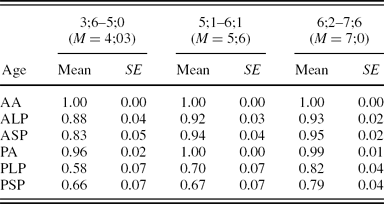
The data were analyzed using the generalized linear mixed model function with a logit link (Gelman & Hill, Reference Gelman and Hill2007), with Age Group as a between-subject factor (three levels—age groups 3;6–5;0, 5;1–6;1 and 6;2–7;6) and Sentence Type as a within-subject factor (six levels: AA, ALP, ASP, PA, PLP, and PSP). The generalized linear mixed model (carried out in SPSS 19) treats the outcome variable as binary (each participant's forced choice answer is either correct or incorrect) and is therefore more suited to data that are not normally distributed (for advantages of logistic mixed models in psycholinguistic research, see Agresti, Reference Agresti2002; and Jaeger, Reference Jaeger2008, among others). Table 1 gives estimated mean probabilities correct for each sentence type for each of the three age groups.
Estimated mean proportion correct and standard error for each age group
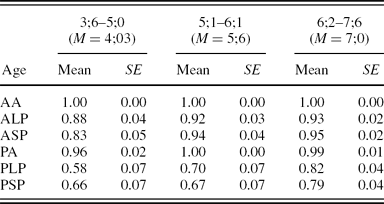
Note: Values are in years;months. AA, actional active; ALP, actional long passive; ASP, actional short passive; PA, psychological active; PLP, psychological long passive; PSP, psychological short passive.
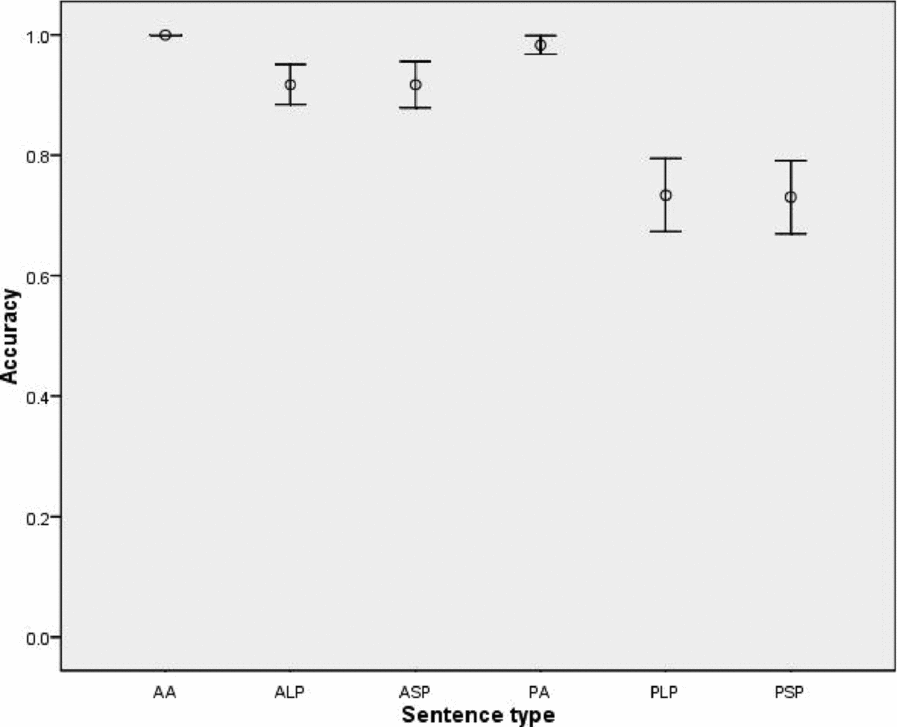
To eliminate the zero variance in one of the conditions (i.e., the 100% correct performance of all 99 children on AA), we subtracted a point on AA from a randomly chosen child from the oldest group, which is disadvantageous to the expected group effect. Estimated mean probabilities correct and 95% confidence intervals for each sentence type for the three groups are displayed in Figure 1. In the following F tests, all degrees of freedom have been Satterthwaite corrected.
Estimated mean proportion correct and 95% confidence intervals for all sentence types, for the three age groups collapsed. AA, actional active; ALP, actional long passive; ASP, actional short passive; PA, psychological passive; PLP, psychological long passive; PSP, psychological short passive.

The model revealed significant main effects of Age Group, F (2, 377) = 11.157, p < .001, and Sentence Type, F (5, 186) = 21.393, p < .001. Age Group × Sentence Type interaction was not significant. The main effect of Age Group indicates that the overall performance of the children in the three age groups differed: Sidak-corrected comparisons revealed that, overall, children in the oldest group performed better than the youngest group, t (442) = 3.276, p = .003, but no differently to the middle group, t (442) = 1.689, p = .092. No differences were observed between the youngest and the middle groups, t (485) = 2.076, p = .675.
The main effect of Sentence Type suggests that, for all groups, some sentences were more difficult to comprehend than others. Sidak-corrected comparisons showed that children's performance on actives of actional verbs, AA, was not significantly different from that on actives of psychological verbs, PA: t (117) = 2.163, p = .095. However, actives of actional verbs, AA, were comprehended significantly better than passives of actional verbs, short ASP: t (576) = 4.282,p < .001, odds ratio = 10.59, and long ALP: t (102) = 4.715, p < .001, odds ratio = 10.59, as well as passives of psychological verbs, short PSP: t (101) = 8.588, p < .001, odds ratio = 43.43; and long PLP: t (101) = 8.83, p < .001, odds ratio = 42.69.
On the active of psychological verbs, PA, the children performed better than on both short and long psychological passives, PSP: t (109) = 7.962, p < .001, odds ratio = 17.88; and PLP: t (110) = 8.168, p < .001, odds ratio = 17.57, as well as both short and long actional passives: ASP t (123) = 3.311, p = .005, odds ratio = 4.36; and ALP: t (128) = 3.608, p = .002, odds ratio = 4.36.
Short and long passive constructions of either type of verb were comprehended equally well: actional passives, ASP and ALP, t (194) = 0.000, p > .999, were no different from each other, and neither were psychological passives, PSP and PLP: t (194) = 0.080, p = .996.
DISCUSSION
Our results show that young Serbian-speaking children demonstrate a very good comprehension of actional passives, short and long: children in the youngest group (mean age = 4;3) achieved over 80% correct performance on the task, rising to over 90% correct performance for the two older groups (mean age = 5;6 and 7;0). Their performance on actives, both of actional and psychological verbs, was at ceiling. In contrast, the children studied here showed a significantly worse performance on passives of psychological verbs, both short and long: around 60% correct at the youngest age studied, around 70% correct between the ages 5 and 6, and around 80% correct at the oldest age tested (mean age = 7;0). The developmental trend for the acquisition of these structures is the same for all three age groups studied here, although the overall performance of the youngest group was statistically significantly worse than that of the oldest group.
These results are in line with the findings reported in English and other languages: The discrepancy between the passives of psychological, as opposed to passives of actional, verbs has been observed in the majority of studies that compared these two types of verbs in the literature (cf. references mentioned earlier). Note that there was no difference in the performance of the children in our study on long versus short passives, of either actional or psychological verbs, also in line with references mentioned earlier.
We will first consider whether the observed difference between passives of psychological and actional verbs can be explained by some specific properties of these two groups of verbs. In the processing literature, these include the frequency of the lexical item, its imageability (concreteness), argument structure, and lexical semantic complexity. It is feasible that some of these variables may have affected the processing of psychological as opposed to actional verbs in our participants. This, however, would only concern the passive forms, because no effect would be observable in children's performance on the actives, which was at ceiling.
In selecting the verbs for use in this experiment, the two groups of verbs were matched in frequency. Furthermore, an attempt was made to establish how common each of these verbs was in everyday conversation. We analyzed 44 of the 75 CHAT files (58.66%) in the Andjelković et al. (Reference Anđelković, Ilić Ševa and Moskovljević2001) corpus, which contain passive tokens in adult utterances (approximately 5 files for each of the eight children, for samples recorded between the ages 1;8 and 4;0). We found no examples of passive constructions for any of the six verbs used in our study, and the following number of tokens for the actives of the same verbs: ljubiti (“kiss”) × 5, nositi (“carry”) × 4, gurati (“push”) × 1, voleti (“love”) × 15, and none for the psychological verbs posmatrati (“watch”) and sanjati (“dream”). Our analysis of the Savić and Polovina (Reference Savić and Polovina1989) adult conversational corpus revealed similar figures: no passives of the six verbs used in the study, and the following number of tokens for the actives: nositi (“carry”) × 1, gurati (“push”) × 3, voleti (“love”) × 20, sanjati (“dream”) × 1, posmatrati (“watch”) × 1, and none of ljubiti (“kiss”). The high frequency of “love” is in line with the finding that this verb is in the first 100 words in the vocabulary of children aged 6 to 8 (Lukić, Reference Lukić1982). However, despite its high frequency and the pervasive presence in children's vocabularies, the passive of voleti (“love”) was as difficult to comprehend as the other two psychological verbs, posmatrati (“watch”) and sanjati (“dream”), which rarely featured in the two corpora. There was an equal percentage of children who correctly understood the short passive (reaching two out of two correct) of each of the three verbs: “love,” 31.7%; “dream,” 36.6%; and “watch,” 36.6%.
Another factor that could have influenced children's understanding of particular verbs used in our study is that of imageability or concreteness. Young children are better at comprehending more concrete vocabulary, thus it is feasible that the actional verbs used here were generally easier to comprehend than those involving psychological verbs. To depict “love” and “dream,” we also had to resort to using thought bubbles. This pictorial convention has been successfully used in a number of experimental studies in English, with typically and atypically developing children (see references in the Method Section), thus we expected Serbian-speaking children to behave no differently. However, this may not have been the case: we are aware of no other study in Serbian that also used thought bubbles.
It has also been argued that semantic complexity of verbs (i.e., their causal structure; Gennari & Poeppel, Reference Gennari and Poeppel2003), may play a role in sentence comprehension. Despite having the same thematic structure, verbs may still differ with respect to whether they denote some change in state. The stative versus eventive distinction thus reflects the difference in verbs’ semantic complexity: eventive verbs entail conceptual units such as CAUSE, BECOME, or CHANGE, as well as the resulting STATE, whereas stative verbs only denote states (Dowty, Reference Dowty1979). For this reason, eventive verbs may be expected to be harder to process than stative verbs for our children, as was experimentally confirmed in English-speaking adults (Gennari & Poeppel, Reference Gennari and Poeppel2003). The psychological verbs used in our experiment were all stative, and the actional verbs were all eventive, yet our participants found passives of stative verbs more difficult than passives of eventive verbs. More research is needed, focusing on a larger set of verbs, to establish the role of semantic complexity in processing different types of verbs in Serbian (in both active and passive voice); however, our current results suggest limited impact of this variable, at least for child participants.
Related to the above issue is the role of thematic structure of particular verbs used in our study. It has been shown that thematic structure of verbs can have a differential effect on how easily they can be passivized (Ferreira, Reference Ferreira1994; Gennari & MacDonald, Reference Gennari and MacDonald2009). Some theta roles are more prominent than others (e.g., agent and experiencer as opposed to theme or cause; see thematic prominence hierarchy, Grimshaw, Reference Grimshaw1990). This is reflected in the syntactic position of arguments carrying these theta roles: Agents and experiencers are typically subjects, whereas arguments assigned the theme role are typically objects. The interplay of thematic structure and surface grammatical relations is best seen with experiencer verbs: In the case of subject experiencer verbs (“love,” “remember”), the argument carrying the experiencer theta role is already in the subject position. With object experiencer verbs (“amuse,” “surprise”), where the experiencer NP is the object, the most obvious way to raise the prominence of the experiencer, at least in English, is to passivize it. Gennari and MacDonald (Reference Gennari and MacDonald2009) found that theme–experiencer verbs were more commonly passivized than agent–theme verbs, even though both sets of verbs were eventive.
Could it be the case that our participants’ performance on some passives was better because those verbs were easier to passivize, because of their thematic structure? The two groups of verbs used in our experimental stimuli involved agent–theme verbs (“push,” “carry,” and “kiss”) and experiencer–theme verbs (“love,” “dream,” and “watch”); these groups of verbs were chosen for their identical case-assigning properties. However, these verbs also happen to assign thematic roles that are equal in prominence: In the passive construction both agent and experiencer subjects are demoted to the by-phrase, thus the pattern of worse performance on psychological passives (experiencer–theme verbs) versus actional passives (agent–theme verbs) observed in our participants cannot obviously be linked to the thematic prominence of particular arguments. Note that it is likely that Serbian is consistent with English in allowing passivization of theme–experiencer verbs more easily than of experiencer–theme verbs, as confirmed by intuitions of several native speakers consulted. Furthermore, instances of passivised forms of “impress,” “interest,” and “motivate” were found in the Andjelković et al. (Reference Anđelković, Ilić Ševa and Moskovljević2001) corpus, though a detailed analysis needs to be carried out to compare how common this type of passive is in child-directed speech. Note, however, that languages have different means of making experiencers prominent. Serbian allows extensive scrambling, thus active structures with a fronted experiencer object may be comparably productive, or even a preferred option to express thematic prominence than passivization, according to native speakers:
(8) Mariju je oduševio/interesovao/motivisao Marko
Marija-Fem-Acc aux-3rd-sg impressed/interested/motivated-sg-Masc Marko-Masc-Nom
“Marko impressed/interested/motivated Marija.”
Future research would benefit from taking into account each of the above properties of the verbs more systematically; however, this brief overview suggests that the disparity between our participants’ performance on passives of actional as opposed to psychological verbs is not clearly related to the specific properties of actional versus psychological verbs outside the passive.
In the following sections, we discuss the patterns observed in our data with reference to the predictions made by the three different accounts of the difficulty with the passive construction outlined earlier, the frequency accounts, and the two linguistic accounts, Borer and Wexler, and Fox and Grodzinsky.
According to the frequency approaches, the late acquisition of passives is due to their infrequent input (Brooks & Tomasello, Reference Brooks, Tomasello, Fox, Jurafsky and Michaelis1999; Gordon & Chafetz, Reference Gordon and Chafetz1990; Tomasello, Brooks, & Stern, Reference Tomasello, Brooks and Stern1998). In addition to the results from twin studies reviewed earlier, which show the importance of the genetic component in the development of passives, a number of studies claim that frequency of input does not seem to play a crucial role in the acquisition of syntactic structures in general (see Legate & Yang, Reference Legate and Yang2002; Valian, Reference Valian, Ritchie and Bhatia1999, for a review) or the passive structure itself (see Hirsch & Wexler, Reference Hirsch and Wexler2006, for a critique of Gordon & Chafetz, Reference Gordon and Chafetz1990). However, there is also growing support for the role of statistical learning in different aspects of language acquisition that cannot be ignored (for a review, see Gómez & Gerken, Reference Gómez and Gerken2000). It is beyond the scope of this paper to reexamine this evidence here, but we shall discuss Djurković (Reference Djurković2007)'s corpus study of the role of the frequency of linguistic input in the acquisition of verbal passives in Serbian because it is most relevant to our data. Djurković analyzed spontaneous data from the corpus of eight Serbian children in Andjelković et al. (Reference Anđelković, Ilić Ševa and Moskovljević2001), aged 1;6–4, and their caregivers, comparing the frequency of passive (not distinguishing verbal and adjectival passive) and the passive-like impersonal construction, which includes the reflexive clitic “se.” Her results show an equally low frequency of the passive and the impersonal construction in the caregivers’ speech; however, children produced a significantly higher number of impersonal constructions than passive constructions.Footnote 11 In addition, her experimental data on a comprehension task reveal that, despite the rarity of impersonals and passives in the input, Serbian 2- to 6-year-olds find impersonals significantly easier than actional passives. This data provides a strong argument against the role of frequency in the acquisition of passives in Serbian.
The predictions of the linguistic account of Fox and Grodzinsky (Reference Fox and Grodzinsky1998) stated that children should show difficulties with the long passive but not with the short passive, because of the difficulty with transmission of the theta role to the agent in the by-phrase. This prediction is not borne out: Long passives were found to be no more difficult than short passives, for actional and psychological verbs, within the same age; that is, there is no difference with regard to the age of acquisition of short versus long passives. In this regard, our results are in line with those reported in a number of studies in the literature. Note that the study conducted by Fox and Grodzinsky (Reference Fox and Grodzinsky1998) has been criticized on empirical grounds (for details, see Hirsch & Wexler, Reference Hirsch and Wexler2006): the most pertinent problem being the small sample of children who show the relevant pattern. Although 8 of the 13 children tested in Fox and Grodzinsky (Reference Fox and Grodzinsky1998) showed poor performance on long as opposed to short passives (and 5 children did not), this pattern was not replicated in subsequent studies. Sixty children aged 3–5;11 in Hirsch and Wexler (Reference Hirsch and Wexler2006) showed no discrepancy between their comprehension of long versus short passives of either actional or psychological verbs. At the same time, these 60 children showed a significantly better performance on actional verbs, both long and short, than on psychological passives, long and short. The same pattern of no difference between long and short passives, but a discrepancy between actional and psychological passives, was also observed in 77 typically developing children between 3;6 and 14 years old, whose knowledge of passives was used as control in a study on passives in Williams syndrome (Perovic & Wexler, Reference Perovic and Wexler2010).Footnote 12
The second linguistic account (Borer & Wexler, Reference Borer, Wexler, Roeper and Williams1987), argues that all verbal passives are difficult for young children because of to their inability to interpret A-chains created by NP movement in the passive. However, in languages where verbal passives are homophonous with adjectival passives, such as Serbian and English, it is expected that children should show a better performance on passives of actional verbs, because they treat them as adjectival passives (which do not involve movement and the formation of A-chains). This strategy is not as efficient with psychological verbs; therefore, poorer performance is expected with the passive of psychological verbs, both short and long. The ability to interpret A-chains matures around the age of 7 (Borer & Wexler, Reference Borer, Wexler, Roeper and Williams1987, suggest this age to be 5 years, although subsequent studies point to the age of 7; for a discussion, see Hirsch & Wexler, Reference Hirsch and Wexler2006), thus it is possible to see consistently poor performance in 4-, 5-, and 6-year-olds, which then improves around the age of 7.
Our results seem to fit well with these predictions: no difference was observed in the comprehension of short versus long passives of either actional or psychological verbs. The children's comprehension of passives was affected by the type of verb used: psychological passives were comprehended significantly worse than actional passives, for all the age ranges investigated in this study. Both of these results are in line with results on the passive comprehension reported for English (e.g., Gordon & Chafetz, Reference Gordon and Chafetz1990; Hirsch & Wexler, Reference Hirsch and Wexler2006; Maratsos et al., Reference Maratsos, Kuczaj, Fox, Chalkley and Collins1979, Reference O'Brien, Grolla, Lillo-Martin, Bamman, Magnitskaia and Zaller1985; Sudhalter & Braine, Reference Sudhalter and Braine1985). To interpret actional passives, our participants could also have used the strategy of interpreting actional passives as adjectival. In line with reports for English (Horgan, Reference Horgan1978), adjectival passives appear early in spontaneous speech of young Serbian children: Djurković (Reference Djurković2007) reports that out of the small number of passives produced spontaneously in the Andjelković et al. corpus (74 tokens, in 59,796 utterances), only 16% were clearly verbal passives, whereas 84% were resultative (adjectival) passives.
Our results also reveal important effects of maturation: Although at the age of 5;6 there is no significant improvement in comparison to the youngest age tested (4;3), at the age of 7;0, both actional and psychological passives are within reach of most children. Thus, the data from Serbian lends support to claims that the delay in the acquisition of passive may be general (Hirsch & Wexler, Reference Hirsch and Wexler2006).Footnote 13
Note, however, that a more recent version of the input frequency accounts may arrive at predictions that are similar to those of Borer and Wexler (Reference Borer, Wexler, Roeper and Williams1987). Starting from the premise that sentence processing demonstrates Frequency × Regularity interactions (Pearlmutter & MacDonald, Reference Pearlmutter and MacDonald1995), that is, “the interpretation of less regular sentence types (those with idiosyncratic syntax-meaning mapping) depend heavily on specific experience (frequency) of that exact structure,” Wells, Christiansen, Race, Acheson, and MacDonald (Reference Wells, Christiansen, Race, Acheson and MacDonald2009, p. 252) show that adults intensively trained on relative clauses attained increased levels of reading speed for object relatives (the less regular structure, because of its idiosyncratic object–subject–verb order) than on subject relatives (the more regular structure, because of its subject–verb–object order commonly found in other structures). Applied to the structures investigated here, this account predicts that actional passives, being more regular (i.e., ambiguous to the adjectival passives that are relatively frequent in the input), should be easier for the children to comprehend. In contrast, psychological passives, being the “irregular construction,” (i.e., not commonly used as adjectival passives, and therefore not frequently heard in the input), should be more difficult. This seems to be confirmed in our data: All the children performed significantly better on actional passives than on psychological passives. Nevertheless, this account still cannot account for the differences between long passives and short passives. Although long passives are fairly absent from everyday speech, as our analyses of the two corpora demonstrated earlier, our participants performed very well on long passives of actional verbs. This lack of discrepancy between the short and long passives in our results is unexpected even on this version of frequency accounts.
It is also worth considering whether the children were employing some other kind of strategy to interpret passive sentences, based on their knowledge of morphology. Recall that the passive participle agrees with the passive subject in gender and number. Could then the children use their knowledge of agreement to work out the appropriate subject in the passive sentence? This at first seems a plausible option: The picture stimuli used in our experiment involved two children, a boy and a girl, thus the gender of the passive subject (the patient) and the agent (implicit in the short passive, or expressed in the by-phrase in the long passive) is always different, providing the critical clue to the child. Upon hearing “the girl is kissed by the boy,” where both the subject and the participle are marked for feminine and the noun in the by-phrase is marked for masculine, the child should point to the picture where the girl is being kissed by the boy, rather than the picture where the boy is being kissed by the girl. If the gender of the agent and the patient were the same (e.g., “the girl is kissed by the mother”), the relevant clue would be missing, thus children's performance should suffer. Note that this could explain the poor performance of the children tested in Djurković (Reference Djurković2007).Footnote 14 In her study, the stimuli depicted characters of the same gender in three out of the four experimental sentences, therefore making it more difficult for the children to rely on the hypothesized gender-agreement strategy. In our study, all of the stimuli depicted characters of different gender; therefore, providing the gender agreement clue, and children achieved a consistently high performance. However, such a strategy fails to explain one crucial detail: recall that our participants showed a different pattern on the passives of psychological as opposed to actional verbs. If gender agreement is used as a clue to interpret the passive sentence, the same performance should be seen on passives of both actional and psychological verbs, and this was not the case: our participants showed a significantly worse performance on passives of psychological verbs, as opposed to actional verbs.
Thus, Borer and Wexler's (Reference Borer, Wexler, Roeper and Williams1987) account seems to go furthest in explaining the dichotomy in the comprehension of passives of actional versus psychological verbs and the lack of dichotomy in the comprehension of short versus long passives observed in our results.
Future research is needed in order to settle a number of questions that arise from our results. To further corroborate that the ACDH of Borer and Wexler (Reference Borer, Wexler, Roeper and Williams1987) does account for our data (i.e., that the difficulties in the comprehension of the passive in Serbian children here stem from difficulties with the interpretation of A-chains), it would be useful to investigate whether other structures involving A-chains would be equally delayed in Serbian-speaking children of the same age. In English, there is strong evidence that raising constructions (raised: “Mary seems to John to be wearing a hat”; unraised: “It seems to John that Mary is wearing a hat”), which also involve A-chain formation, are also affected in the children of the same age (Hirsch & Wexler, Reference Hirsch, Wexler, Dubinsky and Davies2007). It has been claimed that subject-to-subject raising does not exist in Serbian (Progovac, Reference Progovac2005), thus the relevant structure to investigate is that of unaccusatives (“John arrived”), which also involves A-chain formation. There is evidence that the acquisition of unaccusative verbs is delayed in Russian (Babyonyshev, Ganger, Pesetsky, & Wexler, Reference Babyonyshev, Ganger, Pesetsky and Wexler2001; but see Guasti, Reference Guasti2002, for a review of other languages where unaccusatives are not affected).
CONCLUSIONS
This study contributes new results to the cross-linguistic literature on the acquisition of passives. Comprehension of actional versus psychological passives, and short versus long passives of both actional and psychological verbs, was compared for the first time in children acquiring Serbian. No differences were revealed in the way Serbian children treat short and long passives, regardless of verb type, actional or psychological, in line with (the majority of) findings reported in the literature on the English passive. In addition, the dichotomy in the mastery of passives of actional verbs versus passives of psychological verbs, observed in a number of studies cross-linguistically, was also confirmed in Serbian: At all the ages tested, our participants showed a poorer performance on passives of psychological verbs than on passives of actional verbs, a result which was not found for these verbs in their active forms. The observed patterns seem to best be accounted for by the ACDH of Borer and Wexler (Reference Borer, Wexler, Roeper and Williams1987), which successfully accounts for languages like Serbian where verbal passives are homophonous with adjectival passives.
Serbian children's ability to comprehend psychological passives appears to mature around the age of 7, again in line with findings reported for English and other languages, thus supporting proposals that the delay in the acquisition of passives may be universal.
APPENDIX A: TEST SENTENCES
Actives with actional verbs (AA)
1. Ana ljubi Vuka.
Ana kisses Vuk.
2. Vuk nosi Anu.
Vuk carries Ana.
3. Vuk gura Anu.
Vuk pushes Ana.
4. Miša ljubi Lelu.
Miša kisses Lela.
5. Miša nosi Lelu.
Miša carries Lela.
6. Lela gura Mišu.
Lela pushes Miša.
Long passives with actional verbs (ALP)
1. Ana je poljubljena od strane Vuka.
Ana is kissed by Vuk.
2. Vuk je guran od strane Ane.
Vuk is pushed by Ana.
3. Ana je nošena od strane Vuka.
Ana is carried by Vuk.
4. Miša je nošen od strane Lele.
Miša is carried by Lela.
5. Miša je poljubljen od strane Lele.
Miša is kissed by Lela.
6. Lela je gurana od strane Miše.
Lela is pushed by Miša.
Short passives with actional verbs (ASP)
1. Vuk je poljubljen.
Vuk is kissed.
2. Ana je nošena.
Ana is carried.
3. Vuk je guran.
Vuk is pushed.
4. Miša je poljubljen.
Miša is kissed.
5. Miša je nošen.
Miša is carried.
6. Lela je gurana.
Lela is pushed.
Actives with psychological verbs (PA)
1. Lela posmatra Mišu.
Lela watches Miša.
2. Miša voli Lelu.
Miša loves Lela.
3. Miša sanja Lelu.
Miša dreams about Lela.
4. Vuk posmatra Anu.
Vuk watches Ana.
5. Ana voli Vuka.
Ana loves Vuk.
6. Ana sanja Vuka.
Ana dreams about Vuk.
Long passives with psychological verbs (PLP)
1. Vuk je voljen od strane Ane.
Vuk is loved by Ana.
2. Ana je posmatrana od strane Vuka.
Ana is watched by Vuk.
3. Vuk je sanjan od strane Ane.
Vuk is dreamed about by Ana.
4. Miša je voljen od strane Lele.
Miša is loved by Lela.
5. Lela je sanjana od strane Miše.
Lela is dreamed about by Miša.
6. Lela je posmatrana od strane Miše.
Lela is watched by Miša.
Short passives with psychological verbs (PSP)
1. Lela je posmatrana.
Lela is watched.
2. Miša je voljen.
Miša is loved.
3. Lela je sanjana.
Lela is dreamed about.
4. Ana je voljena.
Ana is loved.
5. Vuk je sanjan.
Vuk is dreamed about.
6. Vuk je posmatran.
Vuk is watched.
APPENDIX B
Examples of pictures used for the verbs nositi (“carry”) and sanjati (“dream”)
ACKNOWLEDGMENTS
We thank all of the children, parents, and teachers for participating in this study; Suzana Linić for help with preparation of test materials and illustrations; Darinka Andjelković, Milja Djurković, and Nada Ilić-Ševa for help with the Serbian corpora; Peter Ackema, Amela Čamdžić, Nichola Gallon, Jill House, Vikki Janke, and Neil Smith for helpful comments; and Gordon Craig for statistical advice.