1. Introduction
The GATT/WTO is a product of its historical context: in the final days of World War II, political polarization and high tariffs undercut the renewal of worldwide trade. As part of efforts to restart the world economy, the GATT was tasked with mediating and encouraging national bargains to reduce tariff levels. Its success in doing so is central to our understanding of both the rationale of the global trade regime and the role of the United States as a leader of that regime. Using the results of this initial set of tariff swaps, we interrogate three often heard claims about America's role in these formative moments of the post-war liberal economic order.
First, much has been written about the impetus for American leadership in general (e.g. Krasner, Reference Krasner1976; Ikenberry, Reference Ikenberry2011) and in the creation of the GATT in particular (Bagwell and Staiger, Reference Bagwell and Staiger2002; Barton et al., Reference Barton, Goldstein, Josling and Steinberg2006). Explanations point to self interest, both to protect exporters (Dür, Reference Dür2010) and security (Kindleberger, Reference Kindleberger1973; Krasner, Reference Krasner1982) as well as the ways US policy reflects institutional access on the part of particular producers (Bailey et al., Reference Bailey, Goldstein and Weingast1997; Gilligan, Reference Gilligan1997; Goldstein and Gulotty, Reference Goldstein and Gulotty2021). Using the data on the tariff negotiation process, that is, offers, responses, and the final deals, we assess whether or not US participation in the trade regime was driven by post-war bilateral relationships – security and economic – or by domestic considerations – either of exporter interests or by producers who feared import competition.
Second, and related, the explanation for the success of the post-war order is often attributed to a US decision to provide preferential and asymmetric access to her home market (Kindleberger, Reference Kindleberger1973; Krasner, Reference Krasner1976; Ikenberry, Reference Ikenberry2011). In the conventional rendering of the origins of the liberal economic regime, the US offered access to the home market as a carrot to facilitate closer security and economic ties; this beneficence was explained as the cost of gaining acceptance for a US led system following a hegemonic war (Gilpin, Reference Gilpin1988). To see if this is true, we use our tariff data to assess whether or not the US acted any differently than the other participating nations.
Third, since so much has been said of US security interests in the post World War II years, we look closely at one case, US–French negotiations, to evaluate whether or not economic policy reflected the needs of an important ally. Goldstein and Gowa (Reference Goldstein and Gowa2002) argue that one of the functions of the trade regime was to reassure Western allies against American economic predation. If so, the US may have offered better terms in the bargaining process in the GATT47 Round. Comparing bargaining outcomes in industries that were more or less affected by wartime bombing, we assess whether or not the US was more amenable to French requests in goods originating in the most hurt regions.
Foreshadowing our most general finding, the US was less a liberal warrior and more a seeker of stability. The US did not provide asymmetric access to the domestic market to fuel industrial development, even to a security partner. The US did reduce their average tariff by about 25%, with special attention to trading partners who were subject to either economic and/or political instability. However, in the main, what negotiators offered in return for increased access for exporters was predictability in trade. Instead of reduction, the US substituted the binding of a rate at its current level, giving the foreign trader certainty about the cost of doing business in the US. This promise to refrain from capricious price changes at the border provided much of the fuel that spurred the embryonic liberal order.
This analysis contrasts with two alternative views on the impetus for tariff liberalization. Some scholars suggest that post World War II, the US took on the mantle of economic leadership, and like its predecessor, became ideologically committed to free trade. For others, American liberalization was a response to the needs of domestic groups, in particular, the interests of exporters who were being harmed by foreign discrimination (Dür, Reference Dür2010). We offer a different perspective and test it by examining the GATT47 negotiations. Our explanation begins with an analysis of the ‘rules of the game’ and we suggest the interests of participants were endogenous to process. The rules enacted in the trade parlay were based on American legislation enacted in 1934 which pitted negotiators from the State department against congressional representatives who were reticent to upset domestic import competing groups. This dynamic was brought into the Round itself – the Round was not organized to be a cohesive vision of post-war reconstruction, but rather as a series of bilateral deals. For its part, the US was spurred less by its desire to take on global leadership than the fear that the State department would lose its negotiating authority in 1948. While no study of tariff policy should ignore the organization of domestic interests, we argue that the institutional rules that directed, mobilized, and finessed the interests of all participants explain much of what occurred.
Our analysis of this foundational trade negotiation begins in section 2 with a review of how the US structured its trade liberalization program. We follow in section 3 with descriptive data on the GATT47 negotiations; we use this aggregate data to assess whether or not the data comport with the conventional expectations for US behavior. In sections 4 and 5, we take a more micro look at US decisions on specific-tariff-reduction requests. We use this more specialized dataset to test a number of explanations for the outcome of dyadic negotiations. Section 6 draws some conclusions from this study for the analysis of both past and current US trade policy.
2. Trade Treaties
Why an international trade treaty as opposed to unilateral reductions in border measures? Answers to this question fills volumes, and range from domestic constraints, to geopolitical interests, to a prisoner's dilemma produced by competitive tariff setting. Fewer studies, however, unpack the explicit treaty itself, providing an explanation for just why one product, and not another, is brought into the agreement. We argue that the particular choice of products is an important arena of study and in the case of GATT47, the interaction of the rules used for liberalization and product choice provides novel insights into US behavior post World War II.
2.1 The 1947 Geneva Negotiations
The Geneva trade conference, the first under the auspices of the GATT, posed both a logistical and political challenge. Logistically, the organization had to coordinate asks and offers across hundreds of products and almost two dozen nations. In making these deals, US negotiators were constrained and far more so than were their counterparts. In terms of what the US could offer, negotiators from the State Department were given a ‘short stick’: product eligibility was determined by congress, there was a set ceiling on potential cuts, and they needed to finish quickly before congressional authorization for the talks lapsed. Since negotiations began with a list of requests for border reductions, the State Department needed to find, consult, and mobilize export interests in order to produce a list. And finally, swaps needed to be of reciprocal value; only products from countries who were the principal supplier of that good in 1938 could be considered for a tariff reduction; all treaty partners needed to agree to a Most Favored Nation (MFN) provision assuring bilateral deals would extend to all other nations in attendance (Hawkins, Reference Hawkins1951).
Politically, negotiators also had to grapple with ongoing international political rivalries. The most prominent of the economic challenges at the time may have been the dispute between the US and UK over imperial preferences (Eckes, Reference Eckes1995). The UK had concluded a treaty with the US in 1939 but congress continued to push the State department to force a fundamental disassembling of the preference system. Meanwhile, geopolitics loomed: while the Soviet Union was invited to the negotiations, by early 1947 relations had already begun to deteriorate.
The US faced multiple hurdles in concluding this Round. After 11 years of Cordell Hull at the helm, the State Department now vigorously defended tariff treaties as a means to secure both economic and security goals. But not everyone agreed. Congress was divided on the issue of trade liberalization and so demanded periodic renewals of negotiating authority and a precise protocol of just how, and when, negotiators could make a deal.Footnote 1
2.2 The Logic of Writing a Trade Agreement
Trade agreements have been credited with performing multiple functions. Among political analysts who worry about time inconsistency problems, formal treaties enable governments to commit to a particular course of action, whether domestic economic reform or tariff liberalization (e.g.: Staiger and Tabellini, Reference Staiger and Tabellini1987; Bagwell et al., Reference Bagwell and Staiger2002; Baccini and Urpelainen, Reference Baccini and Urpelainen2014). For others, treaties are important because of electoral politics – a treaty is a public commitment to economic reform, tying the hands of future governments (Mansfield and Milner, Reference Mansfield and Milner2012). And for still others, treaties are a way to respond to activated export interests (Dür, Reference Dür2010). But functional theory can only go so far; ex post benefits alone do not tell us when and why a nation comes to the bargaining table, why those negotiation procedures were chosen, and why some obligations, but not others, were undertaken by each party. It may be true, as Bagwell and Staiger (Reference Bagwell and Staiger2002) argue, that reciprocal agreements are a means to assure that neither party faces a loss in relative market access, but as a political matter, we need to understand why one producer, and not another, is selected for that trade-off bundle.Footnote 2
In devising a stable agreement, negotiators use a specific product tariff reduction as a ‘chit’ that is traded in exchange for improved export market access for a different producer.Footnote 3 While the transaction leads to efficiency gains, each of these chits is associated with some economic dislocation and some risk to domestic support. The negotiator strives to minimize the dislocation price that must be paid for a foreign concession. In general, two strategies were employed by the US: they often excluded politically charged products from the negotiation and negotiations focused on the low-cost producer's products. The low-cost producer option held a number of less obvious advantages. Under most favored nation provisions, there was less of a risk of free riding. As well, the principal supplier rule limited the liberalization ‘shock’ to a smaller, and predictable, set of primary and secondary producers.
Once enacted, trade deals are valued because there is a mutuality of interest between exporters in the low-cost producing state who benefit from lower tariffs, and governments who seek to promote trade volume. These deals are stable, however, not because of the efficiency gains of the agreement, but rather because exporters become ‘hostages’ deterring governments from backing out of the deal. Hypothetically, nations could always renege on a deal by pulling out a product from the bundle but if not replaced, the other nation is empowered to remove a product of similar value of the other's choosing.Footnote 4 In this sense, the tariff reductions in the bundle generate hostages for both sides and make the agreement more enduring.
What products find their way into the final agreement? In theory, governments should make specific decisions on concessions at home based on the value of a partner's market. The negotiation procedures, however, influenced the outcome. While it is true that consumers benefited from trade liberalization, domestic prices were never paramount. Rather, the procedures themselves biased the direction of the talks toward exporter interests. Exporters were the source of the lists of requests, i.e., when nations come to the table, they had in hand a list of ‘asks’ for market access generated at home. So while much has been written about the efficacy of import competing groups seeking to protect the home market (see, for example, Schattschneider, Reference Schattschneider1935; Grossman and Helpman, Reference Grossman and Helpman1994), trade liberalization was driven by which exporters gained a voice in their home governments. The logic of reciprocal dyadic negotiations made exporters the linchpin to crafting a stable tariff bargain, both in finding consensus for an agreement and in assuring its stability (Bailey et al., Reference Bailey, Goldstein and Weingast1997; Gilligan, Reference Gilligan1997; Dür, Reference Dür2010; Goldstein and Gulotty, Reference Goldstein and Gulotty2021).
The role of exporters in 1947 sheds light on a number of theoretical debates on the drivers of trade liberalization. First, both Bailey et al. (Reference Bailey, Goldstein and Weingast1997) and Gilligan (Reference Gilligan1997) offer explanations for why trade liberalization was possible for the post Great Depression United States. In both models, the mobilization of exporter interests is a necessary requisite for liberalization, creating counter pressures to balance the organized voice of import competing producers. Our study confirms that the rules of trade liberalization did rely on exporters as predicted by these authors. However, we find that exporter interests were integrated into trade negotiations as a result of negotiating rules, which dictated that the State department collect data on export opportunities. Second, and related, there are differences in the literature about the impetus for exporter organization. Both Gilligan (Reference Gilligan1997) and Dür (Reference Dür2010) suggest that organization occurs prior to treaty negotiations. Dür, for example, argues that exporters are loss averse and organize in reaction to foreign discrimination. While this may be true later in the century, in 1947, the role of exporter interests was still nascent. In 1947, exporters were neither experiencing losses in export markets nor were they yet a potent electoral force in domestic politics.Footnote 5 Instead, it appears that the State Department, and the procedural rules of the early GATT, were critical in playing this ‘organizing’ role.
2.3 What Can Governments Offer?
With the declassification of the history of tariff negotiations, we now know exactly what products were discussed in the first Round of negotiations.Footnote 6 Not unexpectedly, country requests varied across dyads, reflecting differences in the interests of the parties. For a product to enter the negotiating process, one member of the dyad asked for a concession on that tariff line, and we can assume that the ask was motivated by the interest of a domestic exporter. These requests, however, were constrained by that nation's willingness to open up its own market in return. This suggests that the ask is a metric of both domestic needs for export markets and the degree of constraint faced by the negotiator. Generalizing from the now public data, we find that nations’ dealt with this trade off by implementing three different strategies.
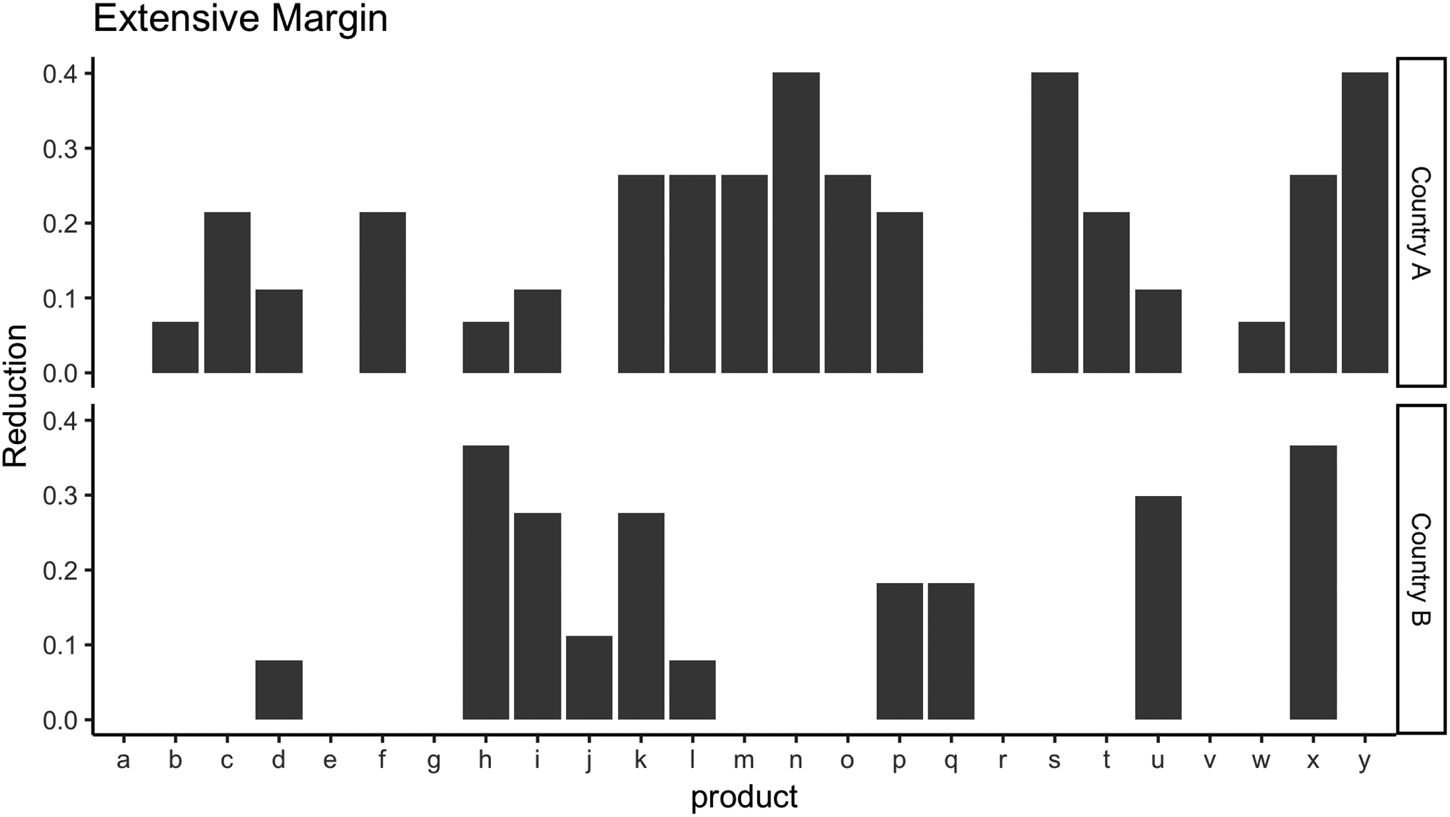
First, governments differed on the number of products they brought to the table; this breadth of products in a treaty is referred to as the extensive margin. For example, France could ask the US to reduce rates on a small handful of products or they could list the whole US schedule as products of interest. Why not just ask for everything? The political disadvantage to having a large extensive margin, as we argue below, is that a broader set of tariff demands will risk activating a larger coalition of domestic interests and also does not signal any hierarchy of support for specific products. Constrained governments could not make large commitments.
This dimension is visualized in Figure 1. Country A has made demands on nearly every product, whereas Country B only has demands on little over half of the products.
Theoretical extensive margin

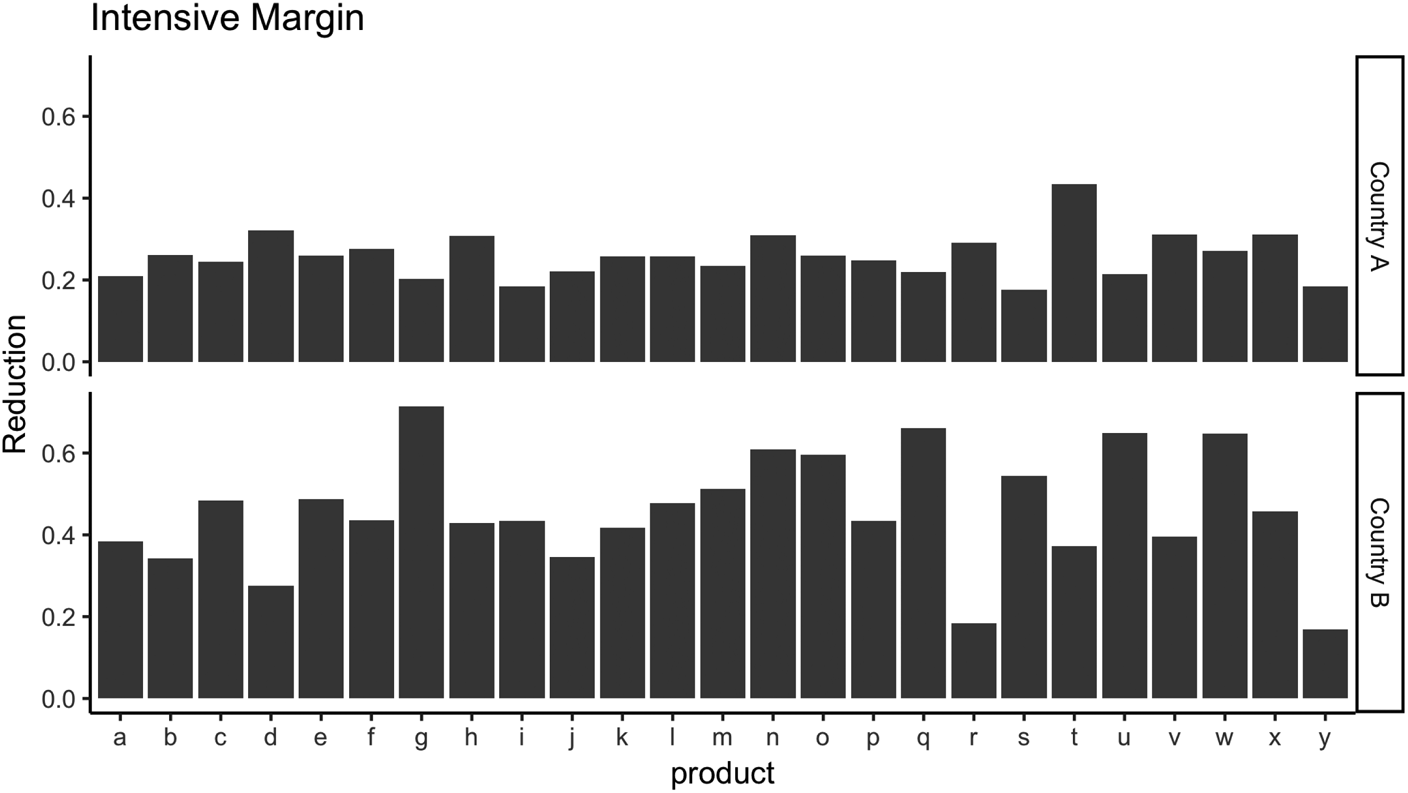
Second, when asking for a concession, governments could ask for either a deep or a shallow reduction on a particular product. This is the intensive margin. For example, the US could ask France for a reduction of either 10%, 25%, or 50% of their existing tariff on cotton. Again, governments were constrained in what they asked for because of the need to balance value. For its own part, under the Reciprocal Trade Agreements Act (RTAA), the US could only offer back cuts to 50% of the pre-existing value. This meant that to increase the value of the swaps, the US needed to offer more products for potential reductions. Other nations were not so constrained, even allowing products to be placed on the free list. As well as asking for tariff reductions, nations often asked for a product to be bound at the existing rate.Footnote 7 Why would a nation see a binding at the existing rate as a concession? Assurance against a tariff hike is advantageous if rates are expected to rise. Given the past behavior of trading nations, backsliding was not an unreasonable expectation, particularly given that many tariffs were applied on a specific basis and so were sensitive to inflation. The commitment to not raise a tariff rate provided stability while still allowing governments to hold exporters hostage, which was necessary to sustain all concessions.
We visualize this dimension in Figure 2, which displays a hypothetical schedule of demands for two countries. The top panel, country A, has a less intensive set of tariff cuts than the tariff demands in the bottom panel in the products that would become part of the treaty.
Theoretical intensive margin

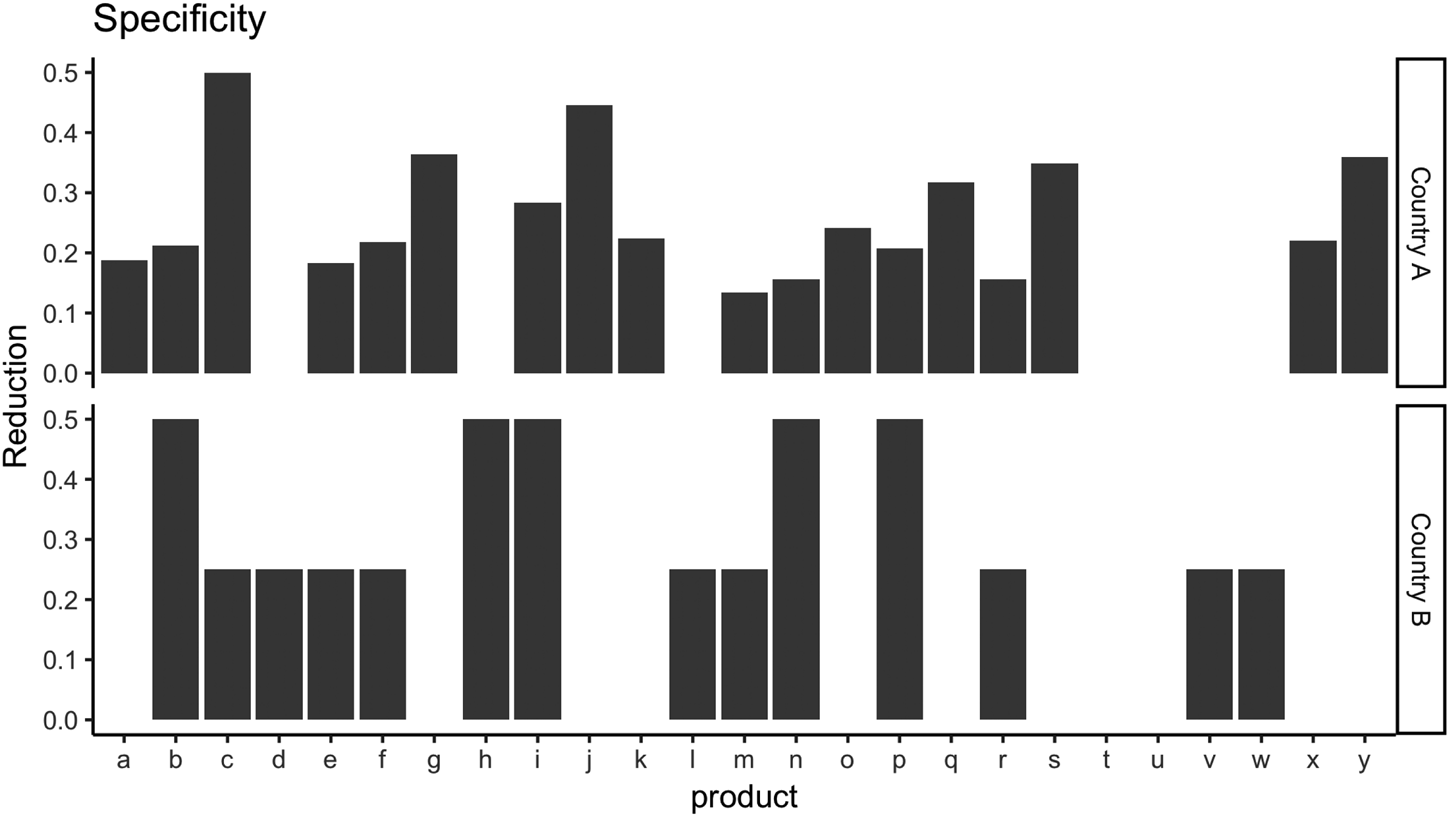
Third, nations varied in how they integrated their intensive and extensive margin demands, making some nations’ proposals much more specific than others. Specificity was a mechanism by which a government could signal a particular need. Asking for more particularistic demands, however, came with a cost – a partner who was also constrained might not be able to respond and the outcome would be a far less successful negotiation than either side desired. In general, less discretion tied the hands of both sides.
Figure 3 indicates this variation, as Country A has a wide variety of requests, while Country B selects between two, a 50% reduction and a 25% reduction. Country A is indicating that products g and r are a particular priority. As is explained below, the data show that the choice of how to negotiate, that is, whether or not the nation on the other side of the table adopted one or the other of these strategies, is a key predictor for success in a negotiation with the US.
Theoretical specificity

2.4 Choosing a Strategy
How did the ‘rules of the game’, affect this choice of a negotiating strategy by participating governments? The rules chosen were an extension of those used in earlier US trade agreements, and first enunciated when congress granted statutory authority to negotiate the US tariff schedule. They reflected the then political interests of US congressional representatives. For example, the principal supplier rule, which dictated that negotiations occur only with the low-cost producer of a good, provided there was transparency. Congress knew ex ante whether or not products in their district would be in the reciprocal bundle once a partner was announced. Furthermore, since any concession would be extended to others who were subject to a MFN agreement with the US, this provided some assurances about future competition.
GATT negotiations began with each nation canvasing their own exporters to determine what foreign concessions would be valuable and making inferences about one another as to what would be acceptable to the importing nation. After receiving the product list of asks from each other, countries responded with a list of bilateral offers. These were seen by all the participant nations but not the general public. Offers were followed by bilateral negotiations. The offers were not binding in any respect and counter offers were changed substantially, both up and down. In principle, they could have also been supplemented by offers on new items but in practice that almost never occurred (Bagwell et al., Reference Bagwell, Staiger and Yurukoglu2020).
The GATT rules required nations to report at least twice a month on the status of talks and list products open for possible cuts. The talks opened at the start of the year and the target date for completion of this process was originally set for 15 August 1947; although nations sent in their asks and offers in a timely manner, the first bilateral negotiations began on 23 April. It went slowly. By mid-June 1947, 298 meetings had been held by the 93 pairs of countries. Some countries met often (five pairs met over ten times) but most met only sporadically.
Of course, not all dyads of negotiations were equally important. If we use trade volume in 1938 to organize the group, 25 dyads accounted for 87% of all trade of the group. Canada–US trade alone was about 11%; UK–US trade was another 10%. The next seven were either among UK and current or ex-colonies or between European nations. The US trade profile with Europe was small – US–Benelux trade was about 3.6% of total trade among all the negotiating countries and that was the highest for the US. Progress toward agreement was not necessarily associated with the amount of trade. The first completed negotiation was between Canada and Norway, which ranked 55th in trade importance. Every other set of talks dragged on. Still, the US footprint at the talks was significant, with a bilateral trade proportion of almost 39%.
Looking at the US dyads, there was considerable variation on both the scope and outcome of talks. The US’ two top trading partners, Canada and the UK, had previous bilateral deals which had reduced many of the less politically sensitive tariffs. Talks now were more difficult and occurred in the shadow of the UK's preference system. Talks with Australia were difficult not only because of the interaction with UK preferences but also because of US duties on wool products, butter, and beef. Australia's original offers were taken off the table due to the perception of US unwillingness to reduce rates. Talks with the Benelux countries were easier for the US although the depth of cuts were less than in the Australia case. Finally, US talks with Latin American nations were completed early on with little fanfare.
3. Who Gave What to Whom, and Why?
To determine why nations were more or less successful in negotiations, we use the data on tariff requests, responses, as well as final tariff outcomes. These data are drawn from three sources: first, we looked at the declassified asks, offers, and outcomes for each of the nations who were party to the 1947 Geneva Round; second, we add to that dataset all US products with a 50% or more equivalent tariff in the Smoot Hawley Tariff Act; third, we consider industry level production data on products raised in the French–US negotiations. Drawing on these sources, we ask a set of questions about negotiating strategies and outcomes.
• Who asked for what to whom? In negotiating with the US, did others focus their requests (intensive margin) or spread them across products (extensive margin)?
• What was the relationship between asks and US responses? Did the number and type of requests made to the US affect the probability of success?
• Was there a terms-of-trade effect? Did tariff concessions center on products with ‘optimal’ tariffs as predicted by economic theories of trade agreements developed by Bagwell and Staiger (Reference Bagwell and Staiger2002)?
• Did the US have preferred trading partners? Did the US decision on tariff cuts reflect partner domestic characteristics, including ally status, government type, exchange rate regime, pre-existing treaties?
• Did the US prioritize post-war reconstruction? To what extent did the US incorporate the effects of World War II damage in their decision to increase access to the US market?
3.1 Negotiation Outcomes
To answer these questions, we begin with an examination of negotiating behavior. The bargaining rules in the early GATT Rounds forced nations to make decisions about requests with limited knowledge of the politics of their trading partner, both in terms of what the partner would accept and in terms of what the partner would demand in return. This meant that bargaining partners had little information on how the other nation would respond to their asks until they received a written response. To get to this final stage, nations needed to show some interest in opening up their market; if a nation was unable or unwilling to open their own market, they were limited in what they could demand of others.
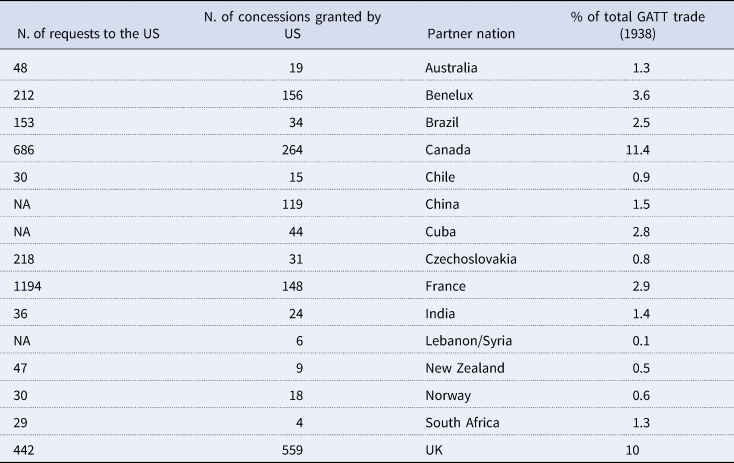
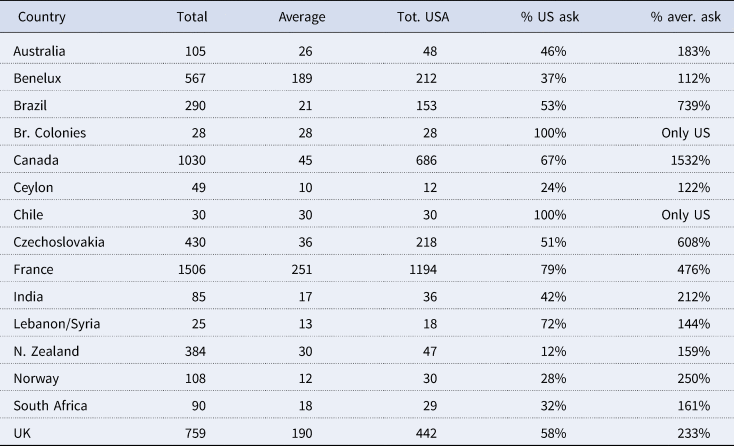
We begin with a review of requests, which provides a metric not only of the interests of foreign exporters but what import competing interests might be affected by the negotiations. We display offers and responses in three tables. Table 1 lists the number of US bilateral concessions in the Round, organized by the magnitude of the partner's exports to the US in 1938, as a percentage of all exports of the nations participating in the GATT Round. Given the war, 1938 is the closest ‘normal’ year and it was the year that was used by the US negotiators to calculate reciprocal concessions. Viewed this way, Canadian trade was most important to the US, representing about 11% of all its trade with the attending nations. Canada asked the US for concessions on 686 products and the US responded positively on 263 of those requests. This was not Canada's first bilateral trade negotiation with the US – they had an existing bilateral that was concluded before the war. Viewing the aggregate data, trade dependence alone cannot explain the pattern of requests and concessions. For example, France asked for the most products, 1194, from the US yet that dyad was only 2.9% of pre-GATT trade. Likewise, if trade flows alone explained the pattern, France would not have received as many concessions as they did. We look more closely at the relationship between import flows and negotiations in the next section.
Requests and concessions by percent of all GATT trade by US and partner nation, GATT47

Countries’ strategies at the bargaining table varied. Some nations sought security in current rates, focusing more on the threat that the US could potentially raise rates in the future. Others focused on obtaining market access commitments. Some nations focused on their major trading partners; others had a less specific policy. Table 2 provides data on this variation in requests and outcomes with the US and compares the US data with other negotiating partners. The first column, Total asks, sums the total listed requested tariff changes by each country of all other countries in the first round of negotiation. Canada, for example made 1,030 product level requests. The second column, Average ask, shows that the average number of requests varied across dyads, with states concentrating their effort on particular countries. The third column, Total USA, lists the number of tariff line changes asked of the US. The next column, % US ask, computes the percentage of the average country's requests relative to the number asked of the US. This is a measure of how focused a nation was on the US market. Some countries were completely focused on the US, such as Chile, and some countries were focused elsewhere, such as Norway. The final column, % average asks, is the ratio of the requests of the US to the average request, showing that some countries demanded much more of the US than other countries, such as Canada, and some parties demanded the same amount, such as Benelux.
Asks of US relative to other GATT members, GATT47

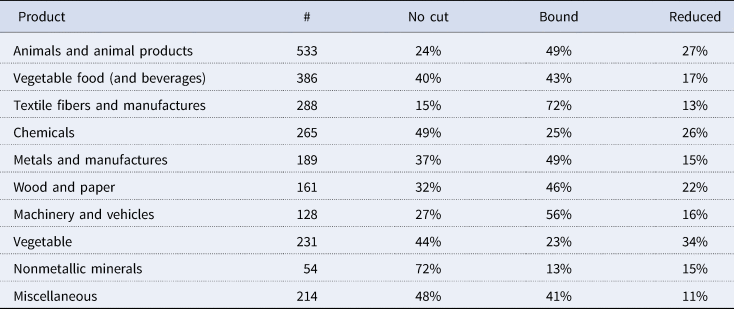
Finally, Table 3 illustrates that there was considerable variation in the type and number of concessions the US granted across product groupings. Here, the second column indicates the percent of asks that were refused, the third, the number of products in that category that were bound. and the last, the number reduced. The number of possible products that were requested in each category is listed in the first column. It appears that the US refused a significant percentage of requests in some categories. In particular, almost three quarters of the requests in non-metallic minerals were rejected as were almost half of chemical products. There is similarly significant variation in whether or not the outcome was a reduction or a binding. Textile products were bound but not cut; the largest number of cuts was in animal products and the highest percentage of cuts was in vegetable products. Primary product producers were the least successful in terms of access to the US but this, in part, reflected the small number of requests.
Specific US cuts, by product category

3.2. The US Pattern: What Did America Offer?
Before joining the GATT, US tariff rates varied dramatically across products and product groupings. Even under Smoot–Hawley, rates were not uniformly high. Rather, the high average reflected the 500 or so products that had a duty equivalent of over 50% ad valorem. Other products entered the US with a variety of rates and many products came in free. We focus on these highly protected products over time since they should be a logical target for foreign exporters yet represent an industry powerful enough to garner protection. What happened to them?
The principal explanations offered by scholars for the selection of products for liberalization or protection are associated with domestic product-level characteristics. To test this relationship between politics and tariff cuts, we connect the GATT negotiation lists to a list of products with high levels of protection prior to the 1934 RTAA. For these highly protected products we code some of the information that we assume negotiators had in hand when they went to Geneva, such as the pre-war volume of imports, the purported principal supplier (both before and after the 1930 tariff) as well as detailed information about the specificity of the tariff schedule on particular products. We then trace the outcomes for these highly protected products through the GATT negotiations, and code those which are requested for a reduction, which are reduced, which are bound at the Smoot–Hawley rate, and which are left untouched.
To evaluate the political constraints faced by US negotiators, we examine proxies for the anticipated degree of import competition based on the size of the partner economy, the number of demands in the sector, and the degree of specificity in requests. We expect that for US negotiators, being asked for a non-specific, across-the-board cut allows for more flexibility in creating politically feasible bundles, whereas more targeted demands constrain effective responses. Therefore, the partners with larger markets and those that make more demands should be more successful when facing a US negotiator while those who have very specific requests will be less so. As well as looking at domestic factors, we look at terms-of-trade explanations for what products should be in a trade treaty. We begin here.
Were there terms of trade products? Terms-of-trade based theories aim to jointly explain protectionism and reciprocal treaties as a function of the strategic inefficiency produced when governments try to expand market access (Johnson, Reference Johnson1953; Bagwell and Staiger, Reference Bagwell and Staiger2002). When governments engage in this sort of beggar-thy-neighbor tariff setting, tariffs are pushed higher to extract more revenue from foreign exporters. Trade agreements can help resolve this inefficiency, exchanging tariff revenue for improved trade volume in ways that expand national income (Ludema and Mayda, Reference Ludema and Mayda2013; Beshkar et al., Reference Beshkar, Bond and Rho2015; Bown and Crowley, Reference Bown, Crowley, Bagwell and Staiger2016; Nicitaet al., Reference Nicita, Olarreaga and Silva2018).
This logic suggests that, at the product level, whether a negotiation can succeed depends on whether the pre-treaty tariff level was inefficiently high for revenue purposes. If governments had raised tariffs so high as to cut off imports, then revenues were not the goal. Furthermore, if a tariff is too high to allow trade, binding that tariff at the prior rate would have little effect on trade volumes. To test this expectation from economic analysis, we evaluate whether tariff cuts varied by the level of pre-agreement trade volume. We expect that if the US were only cutting tariffs to maximize national income, the United States would avoid concessions on products subject to prohibitive levels of protection.
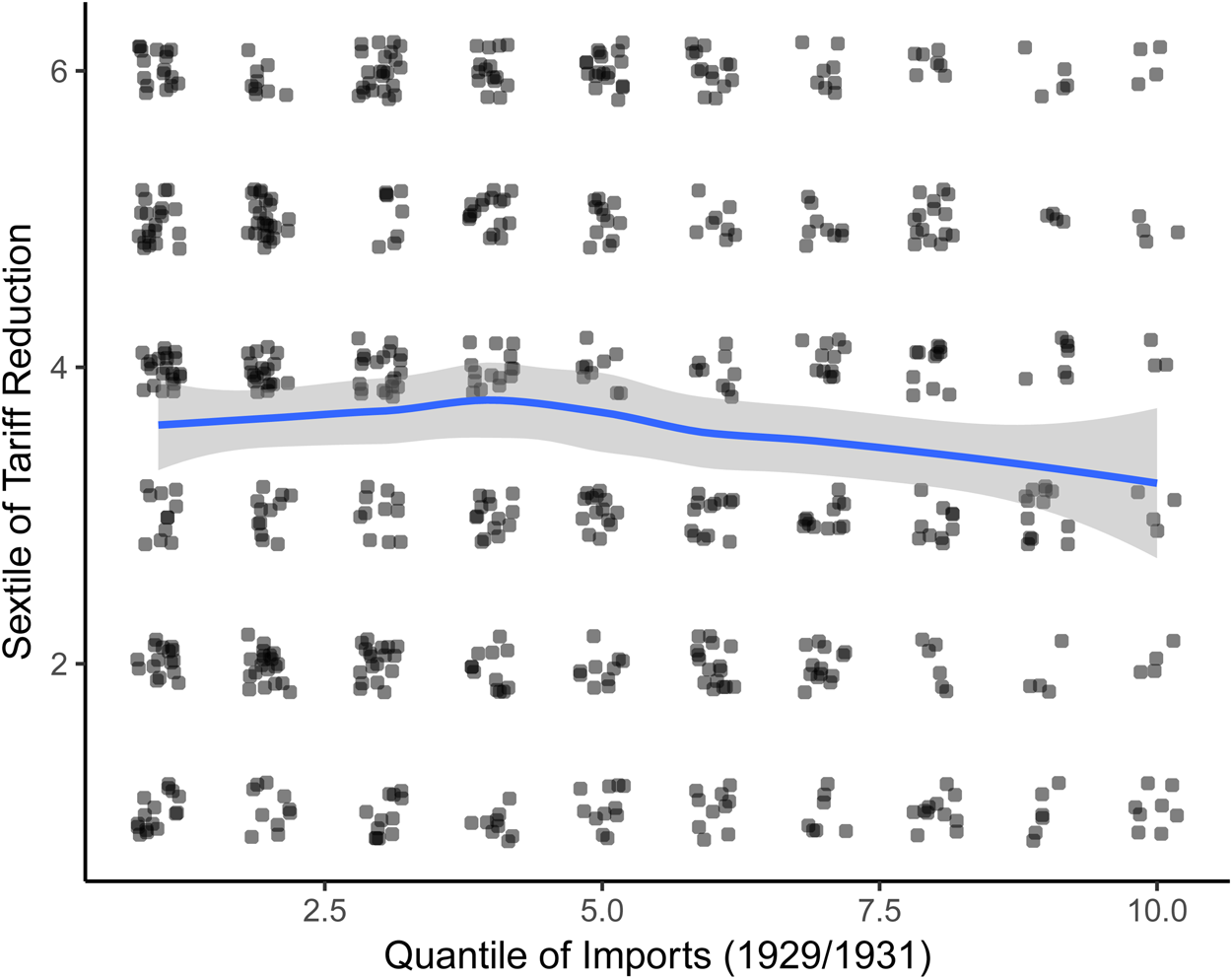
Figure 4 displays deciles of 1930 import levels and sextiles of tariff reductions for these highly protected products (with a small jitter for visualization). For comparability, each tariff has been transformed into an ad valorem reduction, and then summed for the period from 1934 to 1963. We then fit a local polynomial regression, displaying the 95% confidence intervals.Footnote 8
Analysis of depth of tariff reductions by import volume

Counter to standard political economy models, in the years leading up to and including the post-war period, the trade flow indicator is a poor predictor of tariff outcomes. Moreover, the direction of the change is in an unexpected direction: the more a product was imported, the less was the tariff cut. This is not to say that the US did not shift its policy over time and grant access to the market for these products, but rather that simple measures of import volume appear to be a poor predictor of early treaty outcomes. To explain who gained access and when, we need more fine grained analysis that allows us to dis-aggregate by trading partner. To do that, we return to the data on the GATT47 negotiations to see just what occurred at the negotiation table.
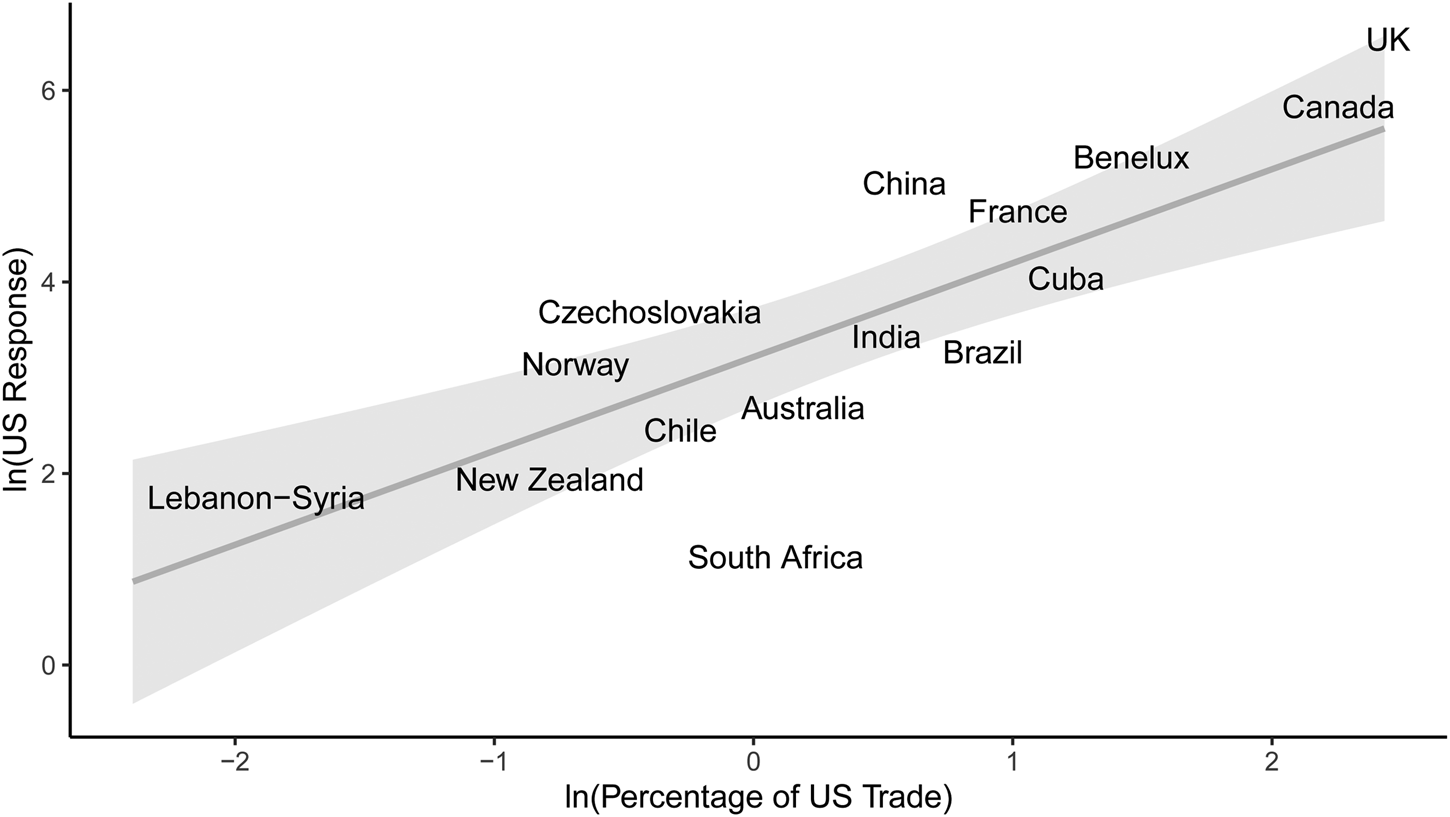
Did aggregate trade flows matter? We begin our analysis of GATT requests and offers by considering the aggregate trade flows between the US and each of its trading partners. Did large nations get more from the US than did small nations? Figure 5 provides the natural log of the number of products reduced by the US (League of Nations (1921–1938), US Government (1932–1930)). As we can see, US negotiations did focus on our principal trading partners, although that does not explain all the variation we see above.
Bivariate relationship between number of reduced tariffs lines and US trade

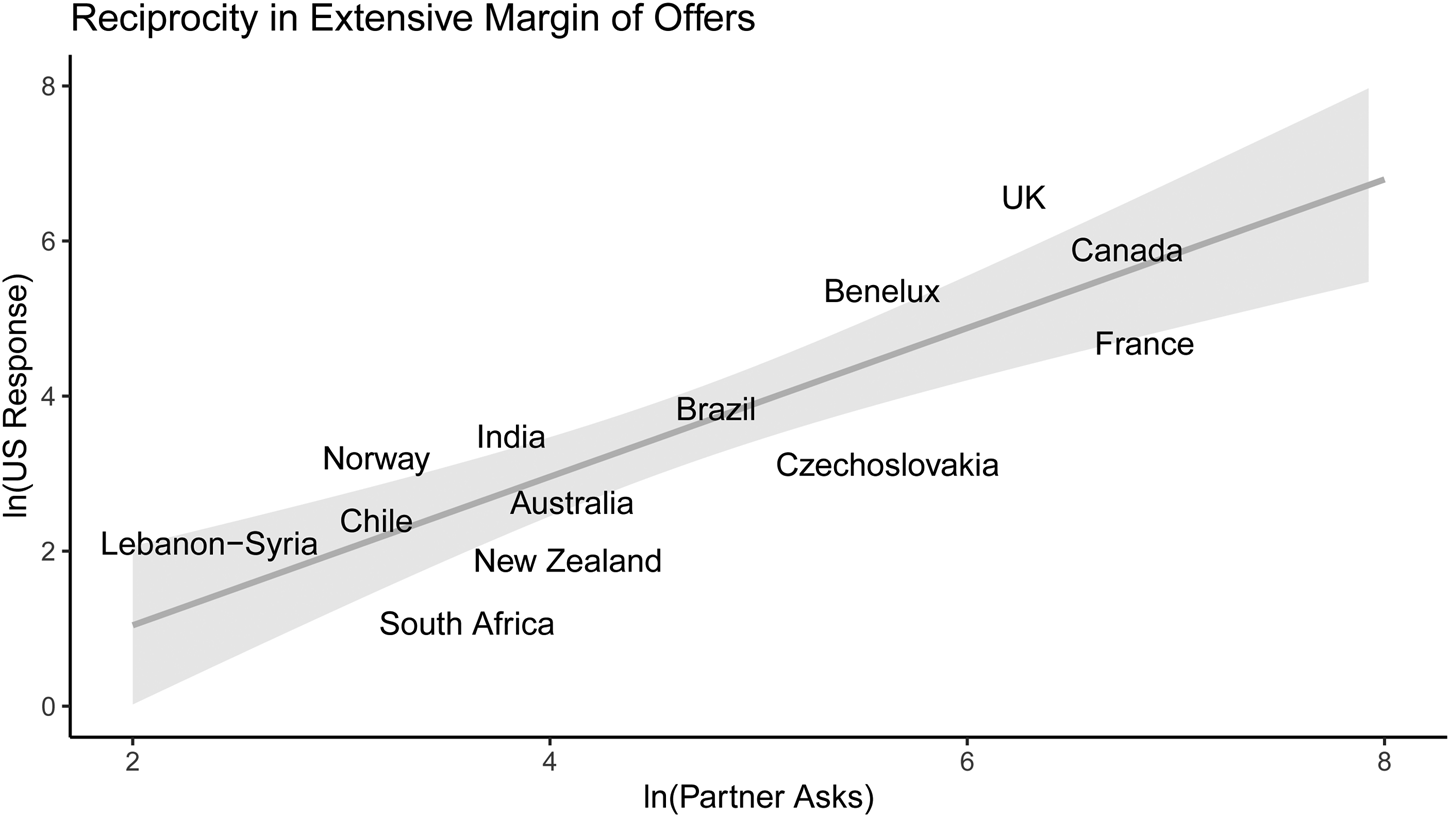
How much did the US give? Beginning with Figure 6, we look at the relationship between what the US was asked for and what the foreign negotiator gained. Along the x-axis is the natural log of the number of US tariff line changes that were asked of the US; the y-axis is the number of US tariff line commitments the US gave in response to those asks. The plot indicates that the more products the US partner asked for, the higher, in general, was the concession that the US gave. France under performed on this front, and the UK over performed.
Analysis of the extensive margin of tariff reductions by import volume

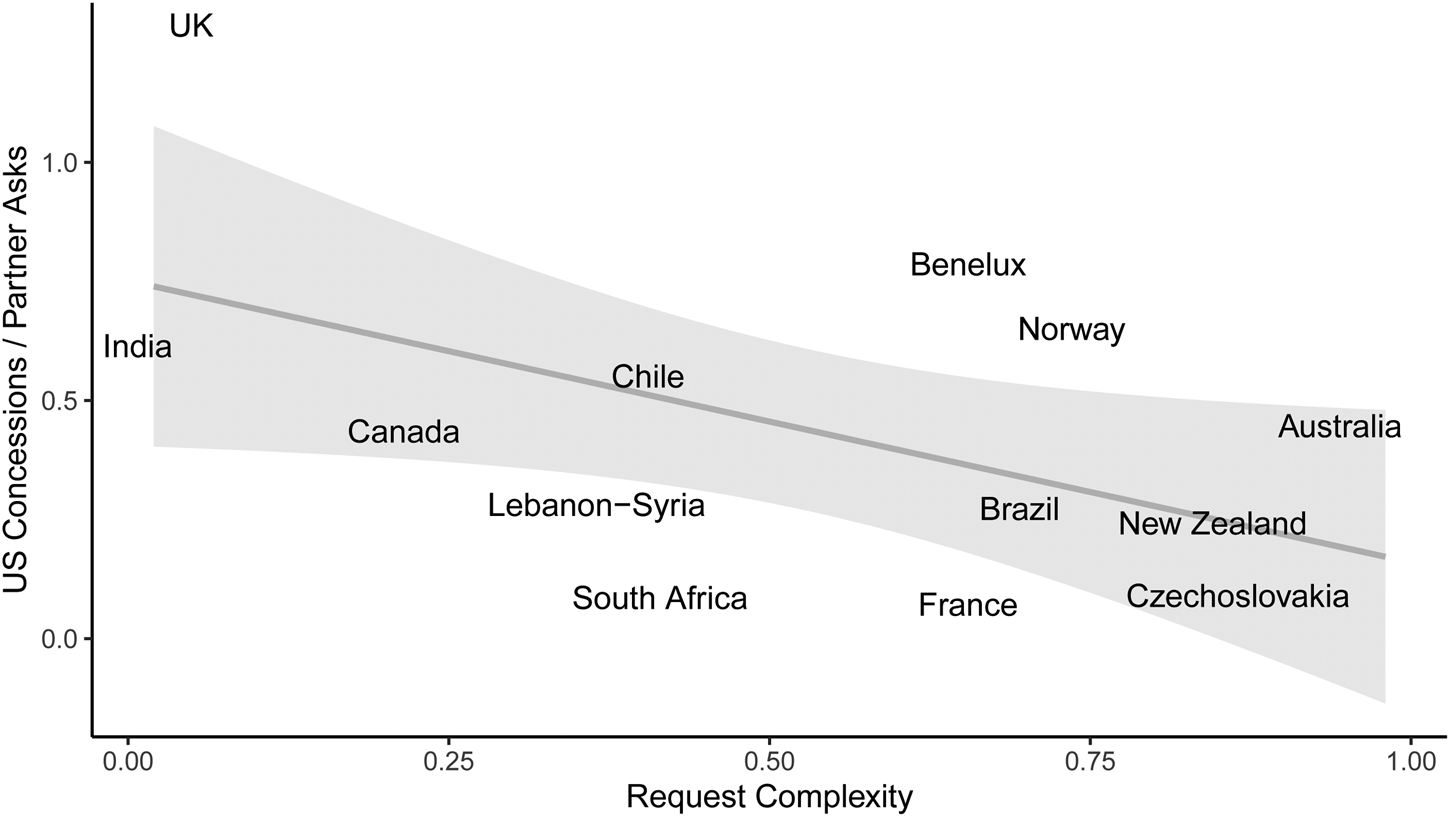
Was there a better, or worse, strategy available for gaining access to the US market? The next figure, Figure 7, depicts the ratio of US concessions to the partner requests as a function of the type of requests that were made. Here we organize request types by specificity of requests. In this figure, the X axis is a measure of specificity and the Y axis is a ratio of how many concessions were granted, given the asks of the other nation. A high ratio indicates that the US gave a higher share of concessions for every reduction or binding that the partner requested; a low ratio indicates that the US gave fewer concessions than the partner asked for. The plot shows that the more specific the request, the less the US conceded. It appears that the US schedule changed most often when countries listed many products but without specifying a variety of different reduction requests.
US Response to specific requests

Earlier agreements What other factors, outside the negotiation process, could explain this variation in tariff outcomes? Would knowledge of US politics, derived from previous experiences in negotiations with the US, make a partner better at navigating within US domestic constraints? By 1946, many but not all of the partners in the GATT had negotiated prior agreements. To test whether or not nations who had engaged earlier with the US were more successful subsequently, we compare strategies and responses for those with and without bilateral agreements with the US pre-GATT. However, we find no evidence that nations with bilateral treaties received more of what they asked for than new negotiators, controlling for trade flow. This is somewhat unexpected given that the choice of early treaty partner was endogenous to a set of relationships the US had developed prior to the creation of the GATT.
Bindings vs tariff reductions Examining the US response in terms of concessions alone may miss variation in the intensive margin of tariff concessions. As well as reducing rates, the US also offered to bind current rates. Binding specific tariff rates, when combined with inflation, amounted to liberalization (Irwin, Reference Irwin1998). The fear of future protectionism, replacing or bolstering these obsolescing tariffs, were such that these bindings were treated as a concession.
To capture this potential source of variation, we use the share of bindings relative to reductions as a measure of the value of assured access for foreign governments. To account for the fact that proportions are restricted to the interval [0,1], we follow Cribari-Neto and Zeileis (Reference Cribari-Neto and Zeileis2010) and use a beta regression with a logistic link function. We use this model to examine the role of political and international economic uncertainty in determining binding vs reductions in the US negotiations.
We examine two sources of uncertainty. First, we look at political uncertainty. This was an era of US fear of Soviet expansion. Did the US use access to the US market as a means to undercut the sway of communism? Second, as well as political uncertainty, this was an era of market instability. We examine this international economic uncertainty by looking at the exchange rate regime. If a nation had an unstable exchange rate, and/or their price levels are shifting out of sync with the US, we hypothesize that their interest in a tariff cut will be less valuable than a binding. We look at each of these in turn.
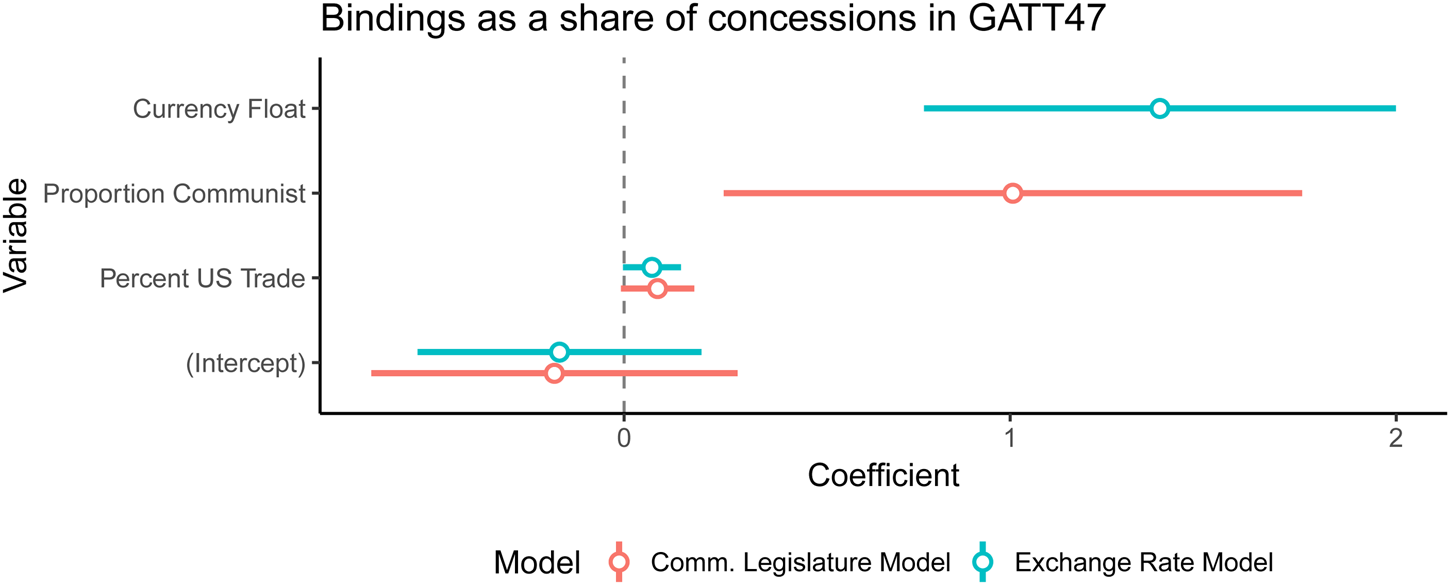
Partner regime attributes Figure 8 displays the estimates of two regression models of the share of bindings in concessions in the 1947 GATT. The first model assesses whether the degree of domestic communist opposition is a predictor of trade outcomes. Given politics in the late 1940s, we expect that nations with larger Communist party representations in the national legislature would be more constrained in making political deals with the West. Our prior is that the larger the communist party, the fewer products would be on an ask and/or concession list. Similarly, our expectation in that these governments would value bindings from the US as a reassurance that the US would not deploy higher tariffs as a sanction against any further gains on the part of Communist legislatures. To test this, we look at both reductions and bindings as outcome variables.
Coefficients of share of concessions as bindings on country level characteristics

To assess the choice of binding vs tariff cut, we regress the percent of negotiated tariff lines with a binding on the proportion of Communist to non-communist party seats, as well as the percent of US trade. We find that governments with more communist party representation were more likely to receive US bindings in exchange for concessions rather than reductions in tariffs. From these data alone, however, we cannot determine whether this pattern is a function of the partner's strategy, the perception that the United States would be unwilling to give concessions, or the social and economic conditions that enabled the election of these politicians. Still, the rise of communist opposition in the later part of that decade dampened tariff concessions in left leaning nations.
As well as this being an era in which the Communist left was ascending in parts of the world, it was a period of currency shifts and resultant changing price levels. In these years, the exchange rate regime was in flux and there was considerable uncertainty about the type of regime and the role of the dollar in the future. To capture this uncertainty, we examine whether or not the US partner's currency was recently devalued via a float. This variable is also displayed in Figure 8. It does appear that the percentage of US concessions that took the form of a binding are higher among countries with a floating exchange rate. Again, this correlation does not rule out potential confounding factors that would drive both exchange rate choices and the sorts of demands made in the 1947 GATT. We return to both these findings in our discussion section.
4. Concessions to Security Interests
Perhaps the least tested, but most often assumed, is that the US integrated its international economic polices with its post World War II security needs (Irwin et al., Reference Irwin, Mavroidis and Sykes2008, 199). The creation of a liberal international order is said to have gone hand in hand with the rebuilding of the Western Alliance. But did it?
To evaluate whether or not the US internalized war damage when deciding concessions, we look closely at the negotiations with France. The US–French relationship was a key part of the rebuilding of the western alliance system. After the UK, France was both the main partner for negotiations with the US and a lynch pin to US security strategy after the war. If the US was willing to sacrifice domestic production in order to foster growth among allies, it would likely appear in these negotiations. France was an industrial power, which even devastated by war was the principal supplier of hundreds of US imports, including chemical products, textiles, and machines. It was also highly protected: by 1931, the average tariff in France (38%) was slightly higher than that of the US (35%) and below that of Germany (40%) (Irwin, Reference Irwin2002, 153). Finally, in contrast to the United Kingdom where the central issue was preferences, the US–France negotiations focused on the MFN rate (US Tariff Commission, 7).
Our strategy is to examine the pattern of US-French negotiations in the years in which the French economy was recovering.Footnote 9 We begin with a measure of the degree of destruction across French industries wrought by the war. Using this destruction metric, we then look at product level outcomes in these dyadic negotiations, and evaluate whether or not the French case suggests that the US was willing to change strategy given the dire situation of post-war French industry. We do this with two data sources. First, we code 744 products out of the 758 total French tariff lines that the US had requested for a reduction.Footnote 10 For these 744 products, we obtain data on the equivalent ad valorem rate pre-negotiation, the depth of the US ask, and the French responding counter-offers.Footnote 11 We follow these products through the negotiations to assess French responsiveness. We then look directly at the US tariff schedule and, in particular, French imports to the US that were subject to high rates.Footnote 12
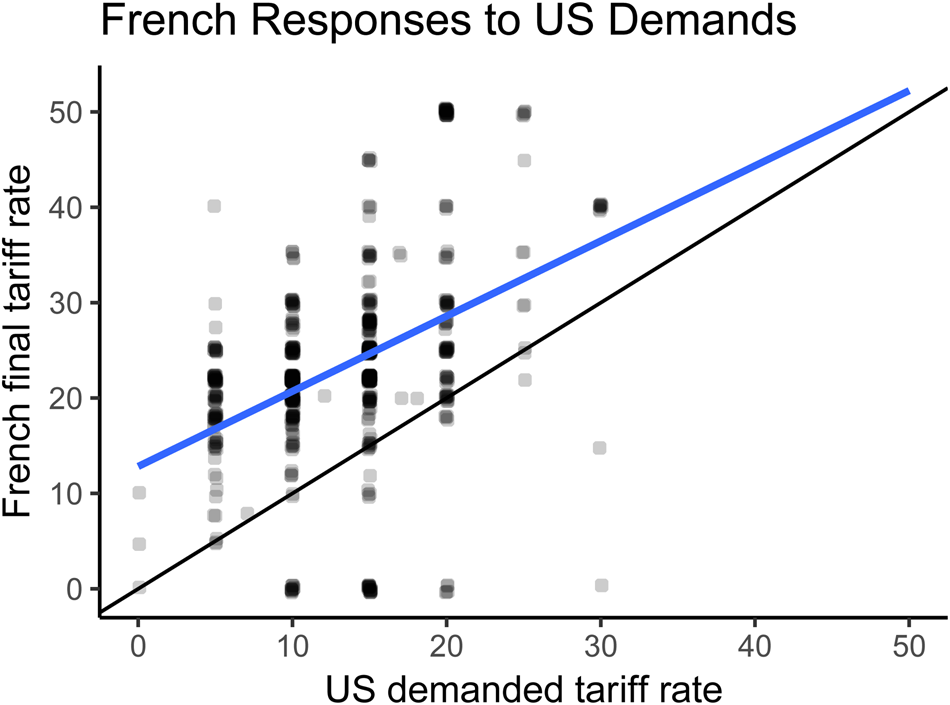
Looking first at US demands for French concessions, we see that the vast majority of US asks were for tariff reductions and not bindings – the US only requested a binding at the prior rate on 36 of the 744 products, and half of those 36 requests were requests to bind at 0 tariff. The French response to these demands is illustrated in Figure 9, with the US requested tariff rate for each product displayed on the x-axis, while the y-axis shows how the French responded. Both are in terms of the nominal ad valorem rates. The 45 degree line indicates a French response of exactly the requested reduction; the points above indicate that the French tariff offer was less than that requested by the US. Overall, the French counter offered a tariff that was 10–25 percentage points higher than what the US asked for, and it was rare for France to offer to reduce a tariff to a rate below the US request.
French responses to US demands (%)

Why was this set of negotiations so unsuccessful? To answer this question we use an alternative measure of French need. While no measure of objective need exists, we do have a metric of producer suffering. Using bombing sorties, we can estimate the level of devastation and then use that as a proxy for French interests.
Our identifying assumption is that the extent of bombing in an industry is exogenous to the 1947 tariff negotiations.Footnote 13 Figure 10 displays the Allied bombing data superimposed upon the 96 modern départements of France.Footnote 14 The size of the circle depicts the number of bombing runs in a single reported latitude and longitude target in France. We use this to calculate French industrial exposure to bombing during World War II.Footnote 15
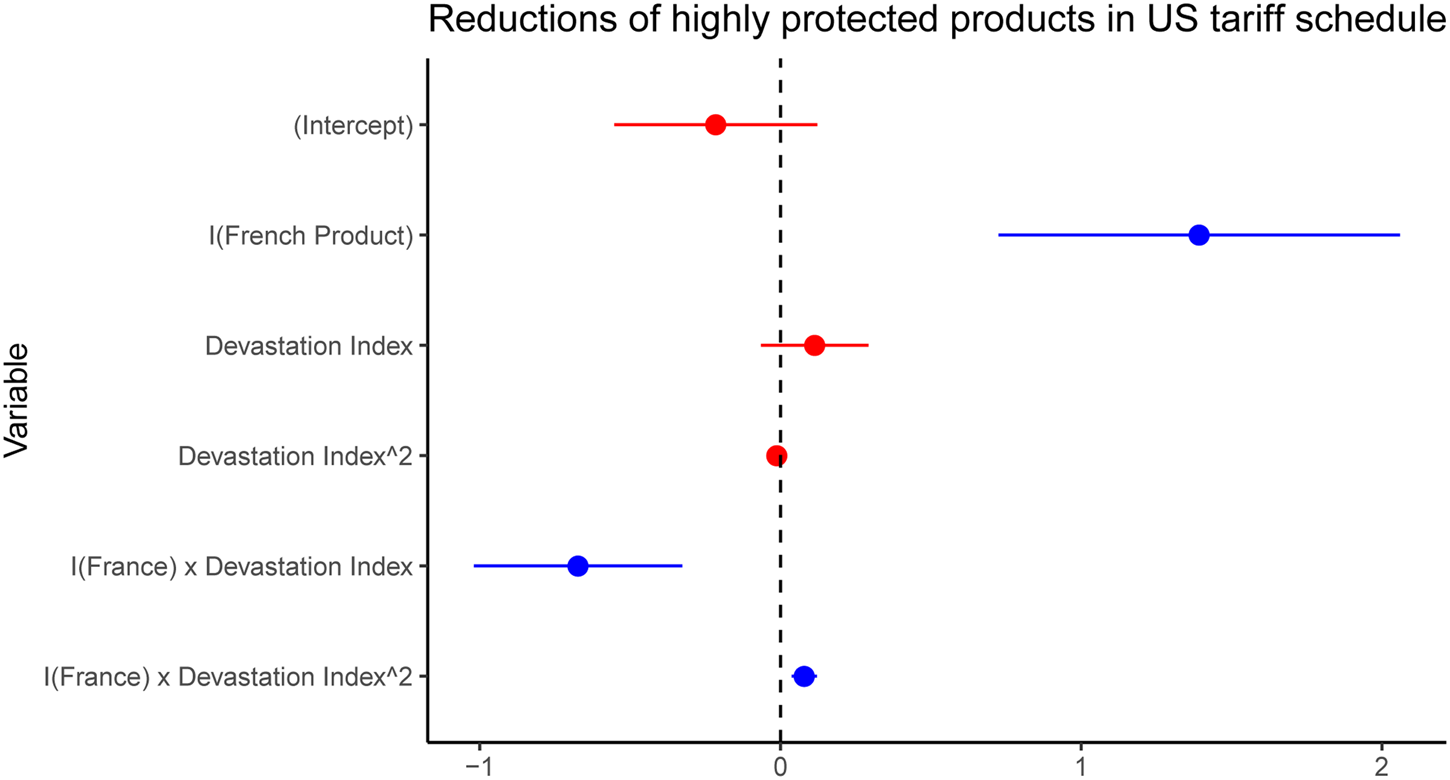
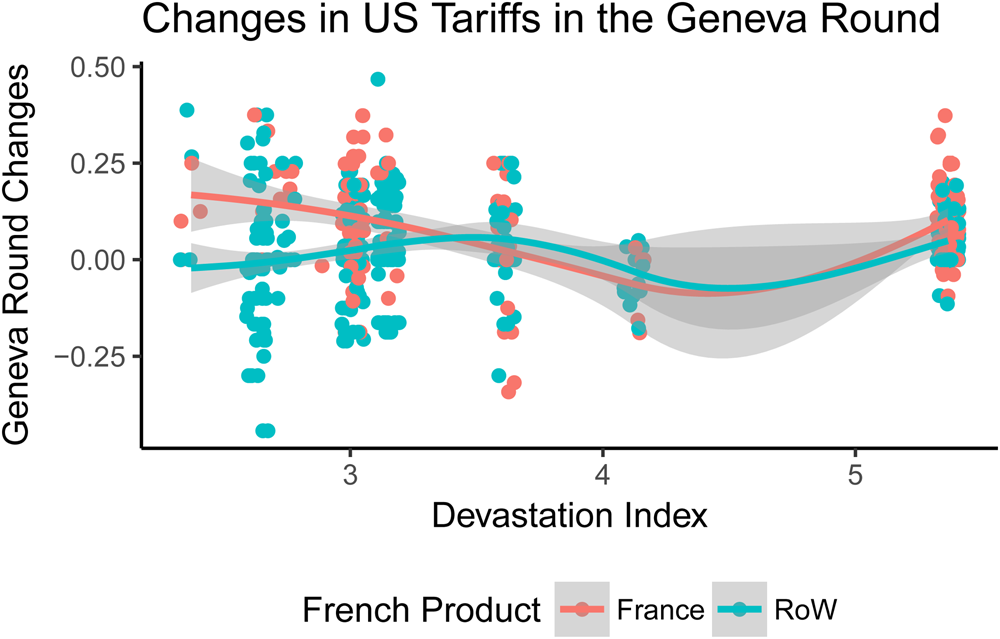
Using this Devastation index as the independent variable, we evaluate the relationship between tariff outcomes and the state of the industry. We begin by asking whether or not the loss of French industry influenced US willingness to allow French products into the US market. As a control, we also evaluate tariff cuts in products that were devastated by the war but were not principally supplied by France and so were not subject to negotiation. While these same products could have been subject to bombing in other countries, the devastation index is specific to the economic geography of France.Footnote 16 These products could have been subject to tariff reductions, but those would have been in response to demands from the rest of the world (RoW). Figure 11 reports the estimates for the 495 most highly protected US tariff lines, indicating a strong negative relationship between exposure to Allied bombing and reductions in the US tariff. The industry with the median exposure to bombing is associated with 17 percentage points more protection than the least exposed industry.
WWII bombing of France

Coefficient estimates from regressing US tariff changes on French domestic constraints

US tariff changes in response to French devastation index

It is possible that products whose industries were damaged were less likely to benefit from an increase in US market access, so the French did not make requests, and so the US did not lower its tariffs. Looking at the data, however, the most damaged industry, textiles, asked for and received significant reductions. We suspect that the US made concessions on textiles knowing that the increase in market access would not be damaging to US industry, as France was unlikely to be competitive in that sector. The fact that fewer concessions are made on more bombed sectors may reflect the absence of organized industrial export interests within France, particularly in the immediate aftermath of the war.
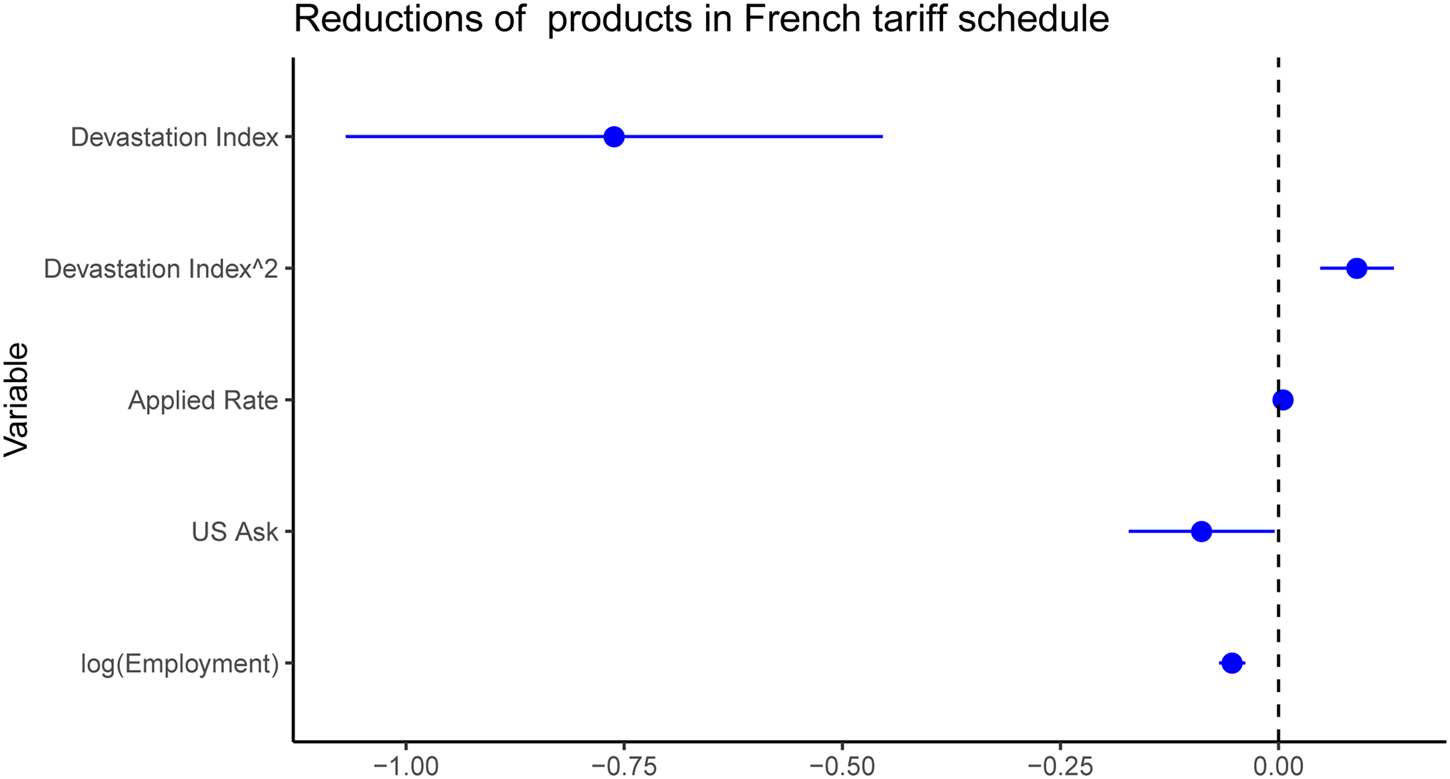
Looking in the other direction, that is, at the French tariff schedule, we can assess whether the loss of employment from the war influenced the French response to American requests that we displayed above. When we dis-aggregate products by level of destruction, we now observe a strong negative relationship between areas with relatively more destruction and the willingness to make concessions. It appears that the more the product was associated with a bombed French industry, the less willing the French were to make concessions. This bi-variate relationship is displayed in Figure 12, suggesting that for all but the most bombed industry, bombing reduced the likelihood of a tariff change by the US. Higher values on the y-axis corresponding to a larger gap between the US request and the French response.
Coefficient estimates from regressing French tariffs on French domestic constraints.

The data provide insight into just what happened in this dyadic negotiation: according to the regression coefficients displayed in Figure 13, French responses to US export interests varied by the degree to which the home producers had been affected by the war. If the producer had suffered, the French were less likely to grant the US request, giving their destroyed industries more time to recover before being exposed to US competition. This was not because the US was overshooting in its demands, rather, the US was less likely to make demands of French tariff lines in devastated industries. Rather than undercutting support for protection, the French behavior was more consistent with treating these sectors as infant industries.
5. Creating Open Borders: Understanding the Road Taken
Tariff negotiations are a moment in which negotiators are asked to make an almost existential trade-off between the particularistic needs of different producers, pitting geographically located import competing business against the often more efficient exporter industries. At the same time, negotiators must weigh the benefits of the trade agreement on aggregate national wealth and consumer prices against these more specific producer groups’ demands. Analysts have offered a bevy of theories about how and when the negotiations go in favor of one or the other, but few have examined the specific deals themselves, a reflection of the lack of data on the micro-processes of negotiations. The data and analysis we present begins to fill in that lacuna and provides some novel insights into why some products and not others may be targeted in trade agreements.
First, America's negotiating strategy explains the depth and scope of the Round. Focusing on formal negotiations, it appears that the rules that were supported by the US reflected the underlying political constraints faced by politicians at home. The fear of political resistance explains why the talks were clouded in secrecy, and negotiators well understood that they were constrained in what products could become ‘hostages’ in a trade bundle (Goldstein and Gulotty, Reference Goldstein and Gulotty2014). As explained in previous analyses of the early trade regime, reciprocity centered exporters in tariff setting (Bailey et al., Reference Bailey, Goldstein and Weingast1997; Gilligan, Reference Gilligan1997; Dür, Reference Dür2010). The design of negotiations not only assured new markets for US exporters but as well, influenced what exporter interest's foreign government chose to endorse in negotiations.
Reflecting its dominant position in the post-war world economy, the US was the major recipient of asks across all dyads. Given constraints imposed on negotiators by US domestic politics, nations that used a strategy emphasizing the extensive margin, were more successful than nations that asked for fewer and deeper reductions. Negotiators were constrained by a system of pre-vetting tariff cuts and made choices in the shadow of a potential backlash from import competing groups at home. Because of this domestic constraint, to be successful in a deal with the US, countries needed to bring open-ended and under-specified sets of requests for tariff reductions, allowing the American negotiator to craft an acceptable agreement.
After assessing all the cuts, we find little evidence that the US gave more than they got in the Round, as suggested by authors who see GATT47 as indicative of the rise of US hegemony and the use of the US market as a safe haven.Footnote 17 This should not be surprising given that the rules of the Round followed the principal of reciprocity. Our findings reinforce what Bagwell et al. (Reference Bagwell, Staiger and Yurukoglu2020) demonstrate in the Torquay Round, that governments went to great pains to balance their overall gains and losses, including those granted indirectly via MFN.Footnote 18
Second, our analysis provides insight into the products that the US protected and what export goods negotiators prioritized. Bilateral swaps, or what we describe as the ‘hostage’ taking aspect of negotiations, forced these choices among products and sectors. Reviewing the outcomes, the US was resistant to cutting tariffs in chemicals and non-metallic minerals, but most other product lines in the tariff schedule were reduced in the 20–25% range, below that authorized by Congress. It appears that the US was less influenced by security policy goals than is often suggested. While the US supported post-war reconstruction bilaterally, via World Bank aid, IMF loans, and the NATO alliance, the US did not provide asymmetric access to the US market. At best, the US provided secure access, perhaps reflecting the lingering shadow of inter-war trade protectionism. Thus, while the traditional metric used for the success of the early trade Rounds was the reduction in overall tariff levels, the more important outcome here was security of access. The majority of US concessions in 1947 were not cuts in a tariff at all but a commitment to not raise the rate in the future. While a binding does not show up in a statistical analysis of tariff rates, the promise to forestall any upward shift in rates was highly consequential to trading partners and was a legitimate, and equal, way to balance increased access for US exporters.
On the export side, the depth of concessions varied across dyads. Exporters gained concessions in products ranging from automotive parts to canned salmon, but the bulk was in agricultural products, particularly cotton.Footnote 19 When measured by export flows, the US obtained concessions on over 80% of agricultural exports and about 40% of exports of non-agricultural products. Specific rate reductions varied, and since foreign negotiators were less restrained than were their American counterparts in what they could offer in response to an ask, the exporter often found that the concession exceeded the demand. Overall, for non-agricultural products, the reductions requested by the US exporter led to, on average, a 25% rate cut while for agricultural products, the cuts were more than double that amount.Footnote 20
Third, we did not find that negotiations were driven by terms of trade considerations. Using the proxy of product specific trade flows, we found imports to be a poor predictor of tariff outcomes. And, even more surprising, we found that the more a product was imported, the less was the tariff cut. It appears that the US tariff schedule was more likely a reflection of domestic politics and not of the use of market power to create optimal tariffs.
As well as these specific observations, the data provide us with a number of more general comments to connect our inquiry's findings to the regime's later trajectory.
• The reciprocity norm. While the GATT47 was sensitive to the need to balance concessions, this norm eroded over time. In the process of accession to the GATT, older members did not totally equilibrate the costs of membership to the new entrant and Bagwell and Staiger (Reference Bagwell and Staiger2011) confirm that over time country-level free riding existed in the accession process. There were many reasons for the abrogation of the norm but its effect was to create different classes of nations, based on degree of openness. Over time, this bifurcation, even when defended because of developmental goals, undermined the legitimacy of the organization (Goldstein and Gulotty, Reference Goldstein and Gulotty2021).
• Principal supplier rule There was a purpose to the US insisting on a principal supplier rule in these early negotiations but the rule had unintended consequences. While popular because it provided visibility of potential swaps for elected officials and limited free riding, the rule created two externalities. First, the rule undercut potential tariff cuts with nations with smaller export footprints. Since American negotiators were unable to offer deeper reductions on the fewer products that they traded, less trade intensive nations extracted less access to the US market than did larger exporters. Second, because negotiating rules prioritized exporters, the US, the worlds predominant importer and low-cost producer, appeared in the vast majority of potential swaps. The result was more US-dyadic bundles, reinforcing the American exporters’ advantages.
• Changing nature of production. As the nature of international production changed, MFN had a multiplier effect and the benefits of access to the US market spread to nations who were not the low-cost producer at the time of the negotiation (Kim et al., Reference Kim, Liao and Imai2020). While negotiations based on the principal supplier eliminated competition in 1947, there was no consideration of how production would shift in line with tariff reductions. As result, no one considered a process of re-equilibrating concessions as new producers came into the market. Further, over time, supply chains multiplied across more nations, and the interests of producers themselves became attenuated. By the turn of the century, firms themselves were so differentiated that the idea of an industry interest no longer existed. Globalization itself had un-moored the liberalization process from its origins.
Historians should be wary of claiming that US efforts to rebuild the trading order, post war, reflected a cohesive internationalist policy vision. The US supported an iterative bilateral bargaining system because it suited its domestic constraints and facilitated economic stability. Yet, the rules proved to be functional in a way not likely then understood by the US government. Reciprocity was achieved by requiring each government to submit lists of requests. The exporters that hoped to benefit from these requests became, in effect, the future domestic supporters of sustained cooperation. Then ex post, each party would hold the products of the other hostage and the agreements would be self enforcing. Achieving uniform and low tariffs was not the goal of the early GATT. Rather, it offered security of market access and the stabilization of the trading system. Thus, while the early GATT is and should be credited with the first efforts of the liberal international trade regime to lower tariffs, its greater accomplishment, and its legacy, is the creation of a predictable trading system.
Acknowledgements
This paper has gone through multiple revisions and we have many others to thank for getting this from idea to print. We want to thank the two anonymous reviewers at the WTR. Their close reading did much to improve the paper. As well, we are grateful to colleagues, including: Kyle Bagwell, Zuhad Hai, Amanda Kennard, Sung Mi Kim, Elizabeth van Lieshout, and Robert Staiger. We would also like to thank the workshop participants at the London School of Economics, and the Workshops of International Politics at the University of Chicago and the University of Pennsylvania.
Appendix: Data Collection
1947 GATT Negotiation history has recently become declassified. The new public record includes all offers, responses, and final concessions. The product lists are tiff documents and not searchable in current form.
For this project, we hand coded the initial requests, the counter offers for all parties and the final concessions by the US.
Requests: All the bilateral requests to parties to the GATT47 were coded by product, request type, and request amount. Benelux countries were coded separately but for most of the analysis they were merged into one negotiating unit. In total, 16 countries’ offers to each other is included in the dataset.
Offers: All bilateral offers where coded by product, offer type (reduction or binding), and amount of the nations coded for requests (United States Tariff Commission, Trade Agreements: A Miscellany of Information. Washington, 16 April 1945).
1. US Tariff Schedule
The US tariff schedule post-GATT (the US’ Protocol) was coded by individual negotiating rights (INRs) from the Round. This includes all products that were negotiated during the GATT49 Round and which now were available to nations with MFN benefits.
A separate tariff schedule was compiled of all products that had a 50% AV tariff in 1929–1930. This tariff schedule included reductions from the bilateral treaties in effect before GATT as well as the GATT reductions. INRs, or the negotiating nation that led to the lowered rate was coded along with the amount of reduction. (See [J. Goldstein and R. Gulotty. ‘America and Trade Liberalization: The Limits of Institutional Reform’, International Organization 68(2) (2014), 263–295.] for a further explanation of the coding rules.)
2. French Industrial Concentration
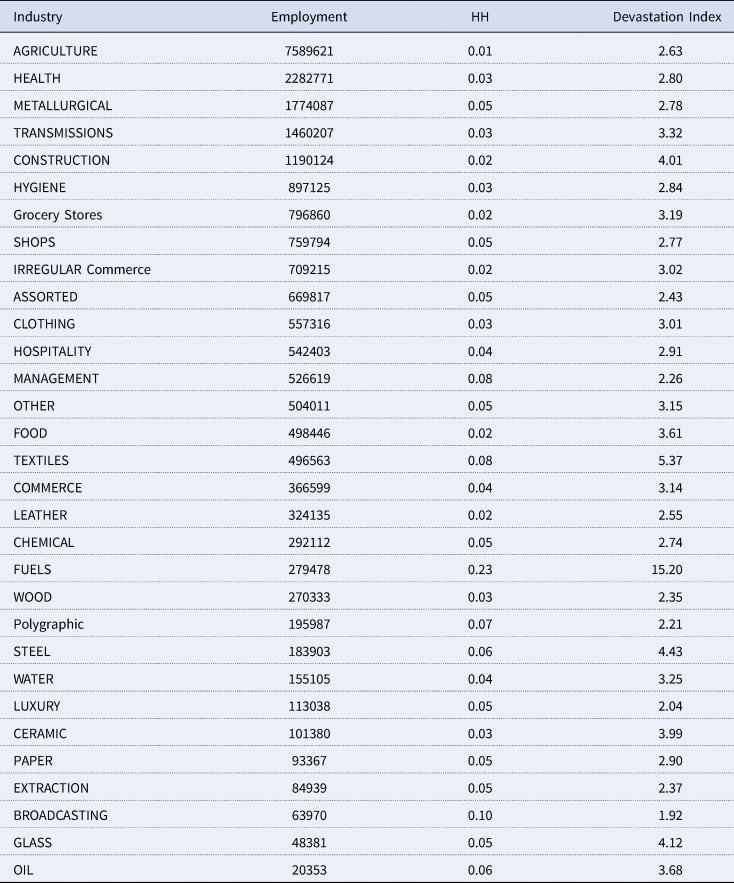
The 1946 census, reported Table XII of Recensement général: 1946 etat civil et activite professionelle, provides employment data across each department in 31 industries. These counts include both men and women at all levels of employment, management, employees, and workers. Table A1 displays the descriptive statistics from France in 1946. The largest industry is agriculture, which includes fishing and forestry; the smallest is the oil sector. The industry with the highest Herfindahl–Hirschman concentration (HH) index is the fuel/ coal sector, located in the northern départements of Pas-De Galais and Nord, coal production was exposed to extensive bombing. The most dispersed sector is agriculture, which is located in many provinces across France.
French industrial employment and concentration in 1946 (France 1949)