

Introduction
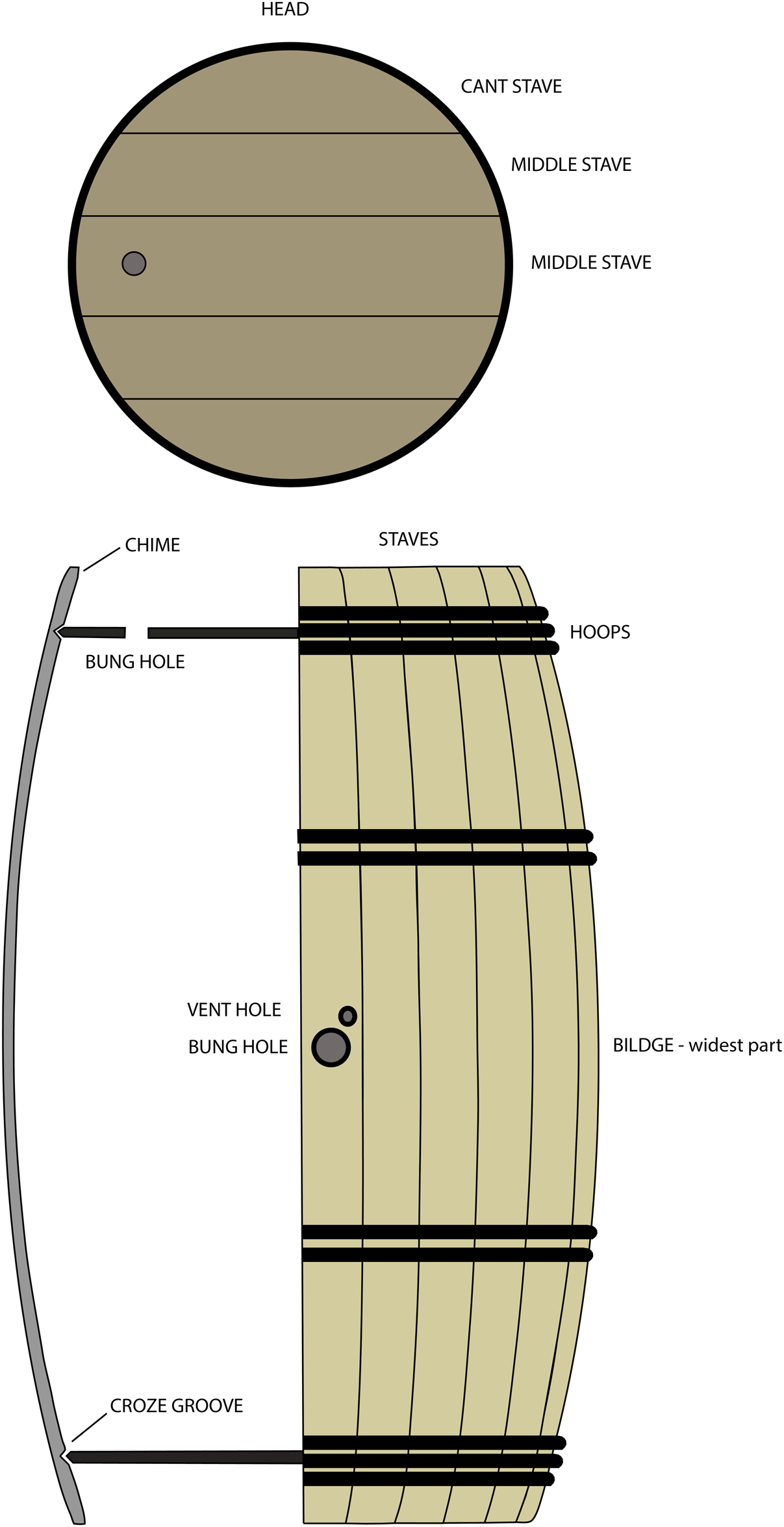
One aspect of the rhythm of life in a Roman fort, and indeed at various locations across the empire, was the regular arrival of goods and supplies. Commodities came in a variety of containers, of which amphorae, being made of more durable material, are most frequently recovered from archaeological contexts and consequently well studied and extensively published. However, barrels, i.e. liquid tight wooden containers (Figure 1), also played a key infrastructural role in the Roman world (e.g. Bevan, Reference Bevan2014), and significantly contributed to a trade and supply network that extended across an empire that reached its greatest extent by the early decades of the second century ad (e.g. Wilson, Reference Wilson, Bowman and Wilson2009; Rubio-Campillo et al., Reference Rubio-Campillo, Coto-Sarmiento, Pérez-Gonzalez and Rodríguez2017). The term barrel has a more recent technical association with a certain size of container, but, for the sake of convenience, the words cask and barrel are used interchangeably here. They are objects designed to enable movement, their bellied form facilitating the rolling and rotation of a potentially large and heavy object. Studies of barrels in later periods show that even before arriving at their first destinations casks may already have had rich, complex lives (e.g. Ross, Reference Ross1985), and once in circulation could have multiple owners and pass through the hands of many people.
Illustration of the terms used for the various parts of a cask. Note position and presence of some elements can vary.

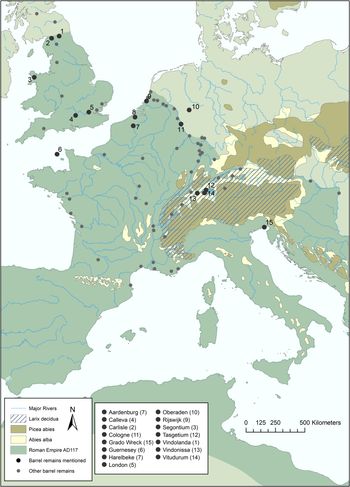
Although organic objects survive less commonly in the archaeological record, evidence has been found sufficiently regularly in Roman contexts (Figure 2) for barrels to be studied as a class, initially by Ulbert (Reference Ulbert1959) and more recently by Marlière, who drew all the strands of evidence together in an extensive synthesis (Reference Marlière2002), a study expanded by other researchers in the last few years (e.g. Frei-Stolba, Reference Frei-Stolba2017). Studies have tended to focus on cataloguing the evidence, developing typologies of the original cask forms, and considering origins, production and primary use. This article builds on this work to explore the potentially complex extended cultural biographies of these objects.
Sites mentioned in text and natural distribution of key species. Grey dots represent other cask finds. Background cask distribution from Marlière (Reference Marlière2002); natural distribution of tree species from the European Forest Genetic Resources Programme (http://www.euforgen.org/); major rivers from the European Environment Agency European catchments and Rivers network system (Ecrins); extent of the Roman empire in ad 117 from the Ancient World Mapping Center (http://awmc.unc.edu). All data sources freely available for use with acknowledgement.

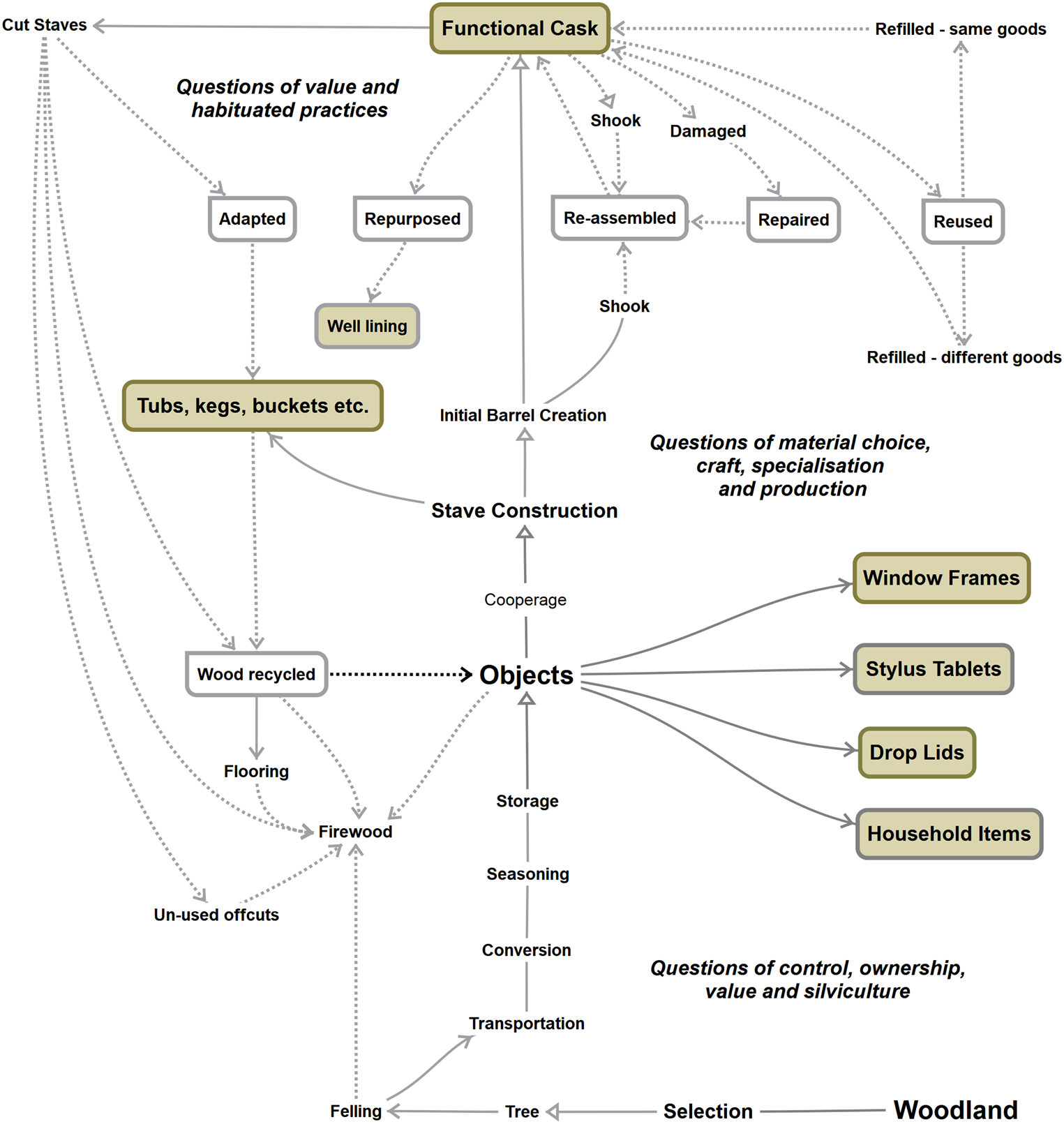
Since the publication of Kopytoff's influential essay on the biography of things (Reference Kopytoff and Appadurai1986), it has become standard to speak in terms of an object's biography and to use this to reflect upon how an object's meaning may change over time (e.g. Gosden & Marshall, Reference Gosden and Marshall1999; Joy, Reference Joy2009). Here we attempt to model some of the complexity inherent in the biography of a cask (Figure 3). We pay special attention to the later stages, examining how reuse, adaption, and recycling are observed in the archaeological record and question to what extent these might reflect normative practices.
Modelling the complex biography or itinerary of a barrel.

In working through a biographical model, a simple birth, life, and death narrative begins to break down and is usefully augmented by other approaches (Hahn & Weiss, Reference Hahn, Weiss, Hahn and Weiss2013: 4; Joyce & Gillespie, Reference Joyce and Gillespie2015: 10–11). Trends in thinking about things have highlighted a ‘turn to the material’, which has been increasingly emphasized over the last twenty years (Hicks & Beaudry, Reference Hicks, Beaudry, Hicks and Beaudry2010: 2–3). While this ‘turn’ cannot be simply characterized, it can be seen to bring together a valuable ‘family of ideas’ (Hodder & Lucas, Reference Hodder and Lucas2017: 121). In particular, it centres around a key unifying theme that posits that ‘people make and use things and things make people’ (Cooney, Reference Cooney, Gardner, Lake and Sommer2016: 16). Thus, a collection of ways of thinking can be considered; biography can work alongside approaches such as affordance, material engagement, and entanglement to explore casks as objects, the people that made them, and the individuals that used and reused them. Admittedly, this can be critiqued as a somewhat ‘pick and mix’ strategy, but, to put it more formally, it adopts the bricolage approach discussed by Olsen (Olsen, Reference Olsen2010: 12–14) and accepts Cooney's pragmatic observation that these approaches occupy a spectrum of thought with ‘significant shared theoretical ground’ (Reference Cooney, Gardner, Lake and Sommer2016: 16 online first).
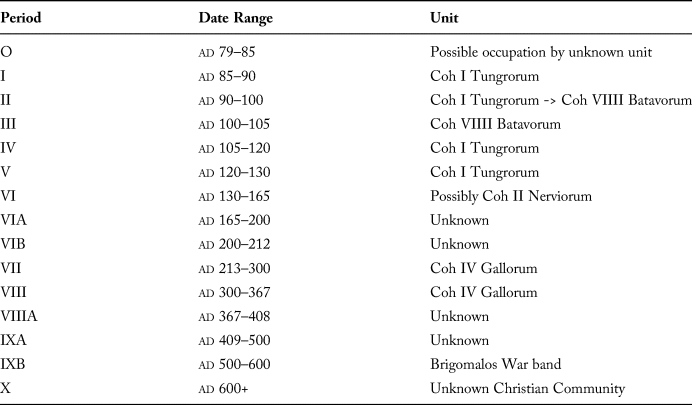
Data from the northern frontier fort and settlement of Vindolanda provides the case study considered here. Located in northern England, 1.4 km south of Hadrian's Wall, approximately half way between Carlisle to the west and Newcastle to the east (Figure 2), it was occupied almost continuously, from c. ad 85 to c. ad 400, by various auxiliary units at different stages of its existence (Birley, Reference Birley2002, Reference Birley2009; Birley et al., Reference Birley, Meyer and Greene2016) (Table 1). The site conditions have allowed for the survival of relevant material across several phases and represents one of a relatively small number of sites that have produced larger assemblages of wooden objects from this period. It lies some considerable distance from the nearest likely primary production sites and the native distribution of the trees from which casks of this period were primarily made (Figure 2). This therefore provides a contrast to sites such as Vindonissa (Fellmann, Reference Fellmann2009) and the vicus of Tasgetium (Benguerel et al., Reference Benguerel, Brem, Ebneter, Ferrer, Hartmann and Leuzinger2012), on the Rhine in Switzerland, and the Colonia Claudia Ara Agrippinensium (Cologne in Germany), which, like Vindolanda, yielded substantial wooden object assemblages from the first and second centuries ad. Here we also explore if other items in the assemblage might be the product of recycling of cask staves. In doing so, we shall raise the question of whether we can go beyond a consideration of material affordance, as first articulated by Gibson (Reference Gibson1979), to more socially mediated approaches (e.g. Knappett, Reference Knappett, Demarrais, Gosden and Renfrew2005). The material from which a cask is made certainly affords a range of physical possibilities, but did social habit and practice result in a consistent range of possibilities?
Phases of occupation at Vindolanda (Vindolanda Trust).

Production, Material, and Use
Before considering the latter stages of a cask's life, it is worth putting this in context and considering the original form of the object, the material, and the production process. Stave-built containers are known from earlier periods (e.g. Earwood, Reference Earwood1993: 169), but these were open-topped vessels, referred to in more recent times as white cooperage (Kilby, Reference Kilby1971: 43–46). Techniques for creating closed casks can be divided into dry cooperage (Kilby, Reference Kilby1971: 46–53) for dry or semi-dry goods, and wet cooperage for liquids (Kilby, Reference Kilby1971: 53–64). Dry cooperage is less exacting than wet cooperage and, for certain functions, results in less robust casks, sometimes only destined for single use (Edlin, Reference Edlin1973: 49). All three types of cooperage are present in Roman contexts with substantial evidence for wet cooperage. This technique is considered to have originated in Gaul, although this is still debated (Desbat, Reference Desbat, Garcia and Meeks1997: 117–18; Marlière, Reference Marlière, Perrot and Pérard2014: 48). Based on current indicators, such as tree species, finds of tools, and the representation of cooperage on funerary monuments, several large cooperage centres have been proposed in Gaul (Marlière, Reference Marlière2002: 177). Irrespective of the origin of the craft, there was a requirement to produce containers of this type at a potentially large scale and such production was highly developed and extensive by the time a northern frontier fort like Vindolanda was first occupied.
Classical authors, such as Strabo and Pliny, indicate that wine was stored or transported in barrels; moreover, the presence of bung and vent holes on many examples indicate that liquids were present (Marlière, Reference Marlière2002: 173). Analytical evidence of tartrate residues from Oberaden (North Rhine-Westphalia, Germany; Hopf, Reference Hopf1967) and resinous material found on the surface of staves from Harelbeke in Belgium (Viérin & Léva, Reference Viérin and Léva1961) have often been cited as proof of wine but this may not be definitive (Benguerel et al., Reference Benguerel, Brem, Ebneter, Ferrer, Hartmann and Leuzinger2012: 55–60). Whether this was the norm has been questioned (Sealey, Reference Sealey2009: 25), and it has been suggested that production centres in Gaul initially produced casks for ale, for which there is increasing archaeological evidence, their use being extended to wine in the imperial period (Marlière, Reference Marlière2001: 186). Casks were produced in a variety of sizes (see below) and were therefore likely to contain a variety of commodities. For example, the casks may have contained foodstuff including fish (Sciallano, Reference Sciallano1993: 18; Marlière, Reference Marlière2002: 174), or olives, or olive oil (Benguerel et al., Reference Benguerel, Brem, Ebneter, Ferrer, Hartmann and Leuzinger2012: 269). Irrespective of the specific identification of contents, the development of specialized bulk containers such as these is argued to have been driven by the need to move refined products such as wine and oil (Bevan, Reference Bevan2014: 388).
In more recent times, wet cooperage required long apprenticeships of up to seven years or longer to achieve master status (see Kilby, Reference Kilby1971). Such training imparted and maintained the highly embodied skills necessary to ensure consistent, quick, and reliable production. While there is as clear chaîne opératoire with a series of essential steps (Marlière, Reference Marlière2002: 29–40), which may perhaps be recognizable regardless of cultural or chronological context, the exact way these steps were followed is arguably more a product of learnt habit and practice, driven by cultural context. Habituated modes of practice, learnt from existing practitioners, sustained a consistency of form and helped to maintain the cultural identity of the practitioner. While some simple measuring instruments, such as a pair of compasses, are used to assess the dimensions of the head, much of the work is gauged ‘by eye’, implying increasingly heightened levels of embodied cognition with growing experience (see Malafouris, Reference Malafouris2013: 57–58, and 209 for a consideration of material culture and the extended mind; Marchand, Reference Marchand2010 for a discussion of non-verbal skill transfer and aquisition amongst fine woodworkers). In this sense, the materials, the form of the object, the tools used, and the specific processes involved are potentially very tightly bound with identity; they are ‘entangled’ in the fullest sense. The sum of humans depending on things, things depending on other things, things depending on humans, and humans depending on humans (Hodder, Reference Hodder2014: 19–20) can be argued to be particularly apparent in highly specialized crafts such as this.
From at least the medieval period in Europe, such crafts became more defined and prescribed through formal organizations such as guilds (e.g. Foster, Reference Foster1944; Mair, Reference Mair2013), which further reinforced and maintained the understood, ‘correct’ way of conducting the craft, through rules, rituals, and rites of passage. Such organizations formally underlined the social identity of individuals who identified themselves as ‘coopers’, and who might in turn be identified by others as such. In a first- or second-century ad context, the expression of a craftworker's identity through social structures is evident in the presence of collegia, although the exact role these played continues to be debated (Verboven, Reference Verboven2011), and so far there is no evidence of a collegium of coopers. That a cooper had a recognized identity within the Roman world is, however, demonstrated by at least half a dozen funerary monuments, including an example from Berbourg in Luxembourg that evokes the interior of a cooperage workshop, displaying tools on the wall, barrels, and workers (Marlière, Reference Marlière2002: 120–21).
The species of tree chosen by a cooper must afford the necessary balance of physical properties required to produce a useable stave-built vessel for a given purpose, this restricts what timber might be most suitable in each situation. Nevertheless more than one species could fit the necessary basic criteria and consequently specific traditions of production could emerge based on both practical and cultural choice. It is arguable that it can become a cultural norm to associate an object, such as a barrel, with a specific material. An emerging preference could be reinforced and maintained through the passing on of craft skills across generations, creating an increasing acceptance of ‘the correct way’ for a cask to be made. The choice may be influenced by other factors such as the aesthetic, symbolic, or other properties of the timber chosen. The chemical properties of the wood and production processes, for example, can impart additional qualities, such as flavour variation, to some types of stored contents such as wine (Ribereau-Gayon, Reference Ribereau-Gayon1994). In a potentially complex feedback loop, the desire for, or social acceptance of, aspects such as certain flavour notes might both further reinforce and mediate material choice. Modern wet cooperage in Europe, for example, predominantly uses oak (Ribereau-Gayon, Reference Ribereau-Gayon1994: 8), which has specific effects on aspects such as the colour and flavour of a stored liquid, such as wine. While oak was used for smaller coopered items in the early centuries ad, and may have begun to be used more regularly in the later centuries of the Roman empire (e.g. Rule & Monaghan, Reference Rule and Monaghan1993), it was not the material normally associated with barrel production. Through much of this period, coopered casks were predominantly produced from fir or spruce/larch, with a possible shift from just fir to a mix of species over time (Marlière, Reference Marlière, Perrot and Pérard2014: 53). This choice also contrasts with, for example, Iron Age and Roman Britain (e.g. Horn, Reference Horn2015; Sands & Horn, Reference Sands and Horn2017), early medieval, Viking and medieval Ireland (e.g. Comey, Reference Comey2003, Reference Comey2010), and early medieval Britain (e.g. Cook, Reference Cook2004; Comey, Reference Comey, Bintley and Shapland2013) which all have strong traditions of using yew for coopered items, with possible aesthetic and ritual motivation. While most of these are open-topped vessels, some were clearly designed to hold liquids and there is rare evidence for yew cask staves from early medieval sites in Ireland (e.g. Linnane & Kinsella, Reference Linnane, Kinsella, Deevy and Murphy2009: 115), although whether these represent wet or dry cooperage has yet to be determined.
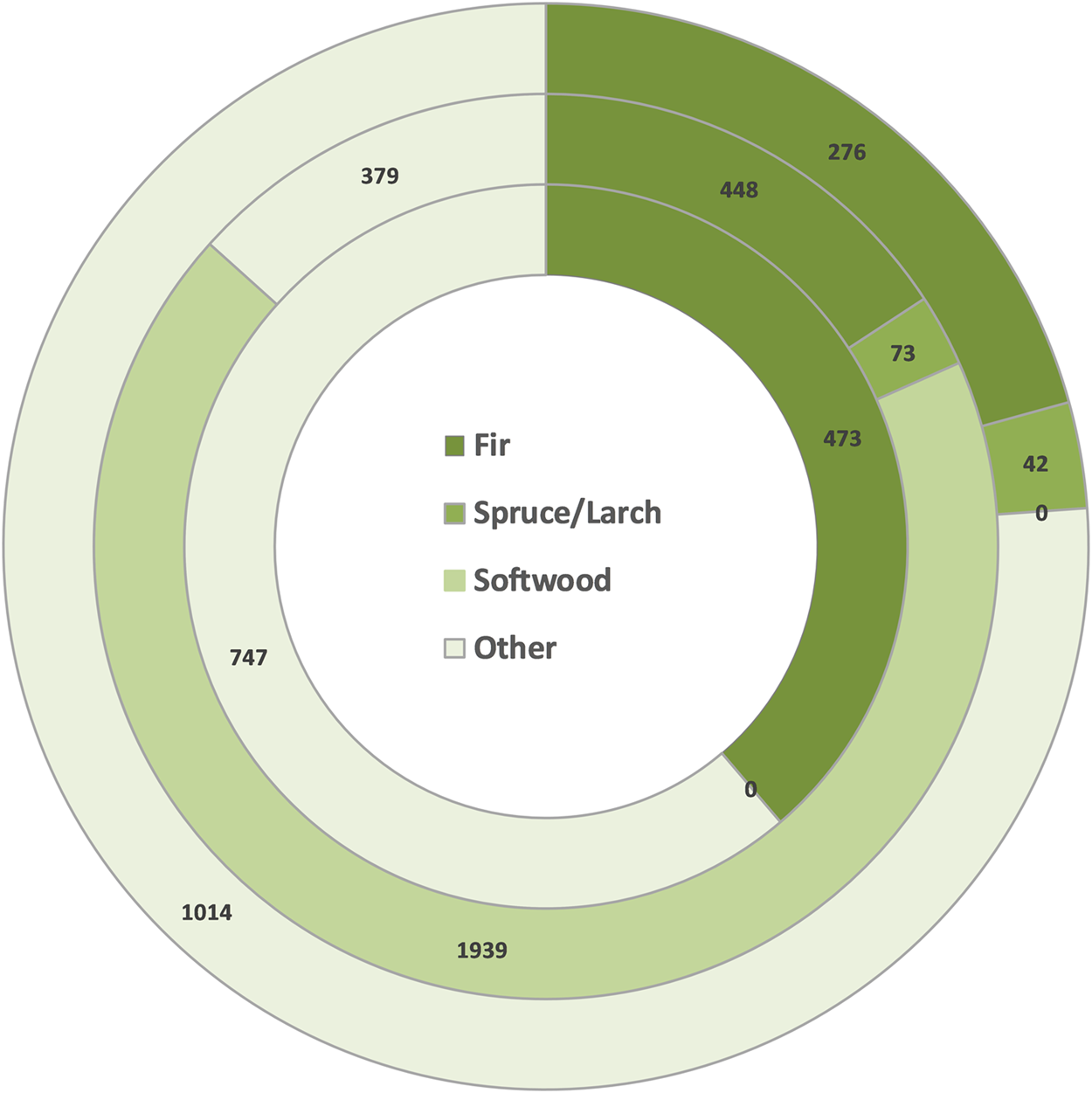
In recently examined assemblages of the Roman period, silver fir not only tends to predominate relative to spruce/larch but can also make up a significant proportion of the total species range recovered, both coopered and non-coopered (Figure 4). The exploitation of this resource has been suggested as the primary cause of its decline in pollen and charcoal records during the first few centuries ad (e.g. Küster, Reference Küster1994; Nakagawa et al., Reference Nakagawa, De Beaulieu and Kitagawa2000) and the explanation given is primarily associated with the use of silver fir in larger construction projects. It is proposed here, however, that barrel production must also have had a significant impact. Modern estimates suggest that an oak tree around 200 years old and with a diameter of c. 90 cm at chest height can, on average, produce two complete casks of standard size containing some 200–300 litres (Edlin, Reference Edlin1973: 98; Marlière, Reference Marlière2002: 29). It is worth noting that surviving Roman barrel capacity could be much greater than this modern standard (Marlière, Reference Marlière2002: 165). Additionally, not every tree will be of a sufficient quality; in a recent article analysing yields suitable for cooperage in Spain, only ten per cent of the logged oak was useable (Riesco Muñoz et al., Reference Riesco Muñoz, Remacha Gete and Gasalla Regueiro2013: 696). The need for quality timber and the fact that wet cooperage required precise skills meant that the casks produced were of enough value to warrant extending their life through repair. Modern estimates put a barrel's longevity at around eight years, during which time repair and possibly disassembly and readjustment might be expected (Marlière, Reference Marlière2002: 37). There is evidence for such activity in, for example, the Roman town of Calleva (modern Silchester; Boon, Reference Boon1974: 264) and it would have required a defined skill set. In more recent times, coopers could be employed primarily for this purpose. The presence of a cooper in London in ad 80–90/95 indicates that local skills were needed, and available, for a range of activities that probably included repair, reassembly, and adaption (Tomlin, Reference Tomlin2016: 86, writing tablet 14).
Proportions of fir, spruce/larch, and undifferentiated softwood species in three of the larger wooden assemblages of the period. Outer circle: Vindolanda; middle circle: Cologne (Tegtmeier, Reference Tegtmeier2016); inner circle: Vindonissa (Fellman, Reference Fellmann2009).

Reuse, Repurposing, Adaption, and Recycling
Archaeologically, reuse and recycling have been repeatedly considered by Schiffer, first in his examination of archaeological context (Reference Schiffer1972) and latterly in his Behavioral Archaeology (Reference Schiffer2010). Four basic behavioural processes that fall under the broad term ‘reuse’ are suggested: lateral cycling, secondary use, recycling, and conservatory processes (Schiffer, Reference Schiffer2010: 32–33). These encompass ways in which an object might move from one person to the next, retaining its original use, keep the same form but change use, be altered to have another use, or be curated. Academic discussion of these themes has had increasing traction in recent years, in part, no doubt, because of the raised profile of recycling in broader modern discourse. The discussion has ranged from considering how the recycling of specific materials is analytically recognized and quantified, such as in Freestone's examination of Roman glass (Reference Freestone2015), or quantifying metal flow and recycling of copper-based metals in Britain in the first millennium ad (Pollard et al., Reference Pollard, Bray, Gosden, Wilson and Hamerow2015), to economic considerations such as Fleming's assessment of recycling in Britain after the fall of Rome's metal economy (Reference Fleming2012), or extended biographies of individual artefact types, such as Swift's examination of rings made from Romano-British bracelets (Reference Swift2012) or Abdelhamid's work on the extended lives of amphorae (Reference Abdelhamid, Hahn and Weiss2013). Inevitably, the focus has predominantly been on inorganic materials such as glass, metal, and pottery. Wood has received relatively limited attention in this context, most commonly in terms of observing reuse, particularly in structures (e.g. Ayre & Wroe-Brown, Reference Ayre and Wroe-Brown2015), and occasionally in relation to wooden objects, of which Goodburn's study of material in Roman London is most relevant here (see below).
While Schiffer's lateral cycling could apply to all objects, depending on social norms, the exact nature of other responses depends in part on the possibilities afforded by the different materials. Thus, while all objects could be subject to lateral cycling or secondary use, the material attributes may allow or constrain certain responses. At a basic level, glass is fragile and shatters but can be melted down; metal cuts, bends, breaks, and melts; pottery breaks and can be reshaped to a limited extent. Wood, on the other hand, burns, snaps but does not shatter, and cannot be melted and reformed. It can, however, be carved, sawn, split, shaved, and bent, attributes that are mediated by the differing anatomies of different species, which make it possible to create a potentially wide range of new forms. Furthermore, in the case of a barrel, as a composite object, it can be taken apart, rebuilt, and adapted.
Schiffer's scheme continues to be a useful basis, but it is inevitably an approximation of the complexity of actual practice (Schiffer, Reference Schiffer2010: 32). For the purposes of this article, the verbs reuse, repurpose, adapt, and recycle are used to capture distinct aspects of the potential biographies of a cask (Figure 3). Reuse here is reserved for a situation in which a cask is reused for essentially its original purpose in the broadest sense (e.g. to contain a liquid); evidence from multiple sites indicates that barrels could be filled and refilled, with overlapping branding marks providing proof of reuse, movement, and possibly changing ownership. Repurposing is used when the primary purpose of the cask has shifted but the form is retained. This could simply be a change in what it contains, such as in the case of the Grado wreck at Gorizia in Italy, which sank at the end of the second century or beginning of the third century ad, containing a cask full of broken glass, presumably destined for recycling (Auriemma, Reference Auriemma2000: 27). Alternatively, repurposing could be more dramatic, such as barrels used in the lining of well shafts. Adaption refers to a coopered structure being retained but the form physically altered, such as cutting down a barrel to produce a tub. Recycling is reserved for situations in which the material from individual components has been used to produce other objects.
Vindolanda – A Northern Frontier Case Study
Amphorae, along with other less durable objects such as skin containers, sacks, and casks, would have been part of the contemporary rhythm of life. They provided a visual signature of the coming and going of materials and goods, connecting a fort like Vindolanda to other settlements, to nearby centres, and to the wider empire. Both sacks and barrels are mentioned in the contemporary correspondence at Vindolanda (e.g. Tab. Vindol. II 180, Bowman & Thomas, Reference Bowman and Thomas1994) and the site has sealed anaerobic conditions suitable for the survival of organic material. Such deposits occur from Period I to Period VII, with the bulk of the material surviving in periods II to V, largely encompassing the reigns of the emperors Trajan and Hadrian. To date, direct evidence for casks comes from 390 surviving coopered elements, representing the dominant artefact class and occurring in all phases that have the appropriate preservation conditions. This assemblage is being examined within a larger project analysing portable wooden objects from the site (Sands & Hather, in prep.) and complements initial studies of a sample of fifty staves examined by Reis (Reference Reis1997) and a targeted assessment of amphorae and cask types by Marlière (Reference Marlière and Birley2003; Marlière & Costa, Reference Marlière, Costa, Birley and Blake2005).
A question of material
Archaeological wood samples can be identified to genus or species based on differences in anatomical structure as defined in standard reference works (e.g. IAWA Commitee, 1989; Schweingruber, Reference Schweingruber1990; Hather, Reference Hather2000). Using this method, we have so far identified 276 items made from fir, which, given its European context, is narrowed down to silver fir (Abies alba Mill.) (Mauri et al., Reference Mauri, De Rigo, Caudullo, San-Miguel-Ayanz, De Rigo, Caudullo, Houston Durrant and Mauri2016). In addition, forty-two items have been identified as made from either spruce or larch, which in our context is probably either Norway spruce (Picea abies Karst.) (Caudullo et al., Reference Caudullo, Tinner, De Rigo, San-Miguel-Ayanz, De Rigo, Caudullo, Houston Durrant and Mauri2016) or European larch (Larix decidua Mill.) (Da Ronch et al., Reference Da Ronch, Caudullo, Tinner, De Rigo, San-Miguel-Ayanz, De Rigo, Caudullo, Houston Durrant and Mauri2016). Spruce and larch are considered by some to be anatomically indistinguishable, especially in archaeological wood (e.g. Chabal & Feugère, Reference Chabal, Feugère, Piquès and Buxó2005: 182). Differences have, however, been suggested and features observed by Batholin are considered the most reliable (Batholin, Reference Batholin1979; Anagnost et al., Reference Anagnost, Meyer and De Zeeuw1994). Work at Vindolanda is beginning to indicate that spruce rather than larch is present, but further research is required.
None of these species, fir, spruce, or larch, has a natural distribution that includes Britain (Figure 2) and the nearest natural occurrence is some 1000 km south of Vindolanda. Notwithstanding that a strong tradition of Roman silviculture allowed for the growth of spruce in Britain (Lodwick, Reference Lodwick2017: 14–15), it is highly unlikely to have produced the size or quantity of material required for the sustained production of casks.
It is worth noting that in more recent times the timber trade has treated silver fir and Norway spruce as one and the same, referring to both as ‘white deal’ (Edlin, Reference Edlin1973: 129), and Roman finds include evidence that the two species were used in the same cask, as in examples from Aardenburg and Harelbeke in Belgium (Frison, Reference Frison1961) and Rijswijk in the Netherlands (Casparie, Reference Casparie and Bloemers1978).
Vindolanda, an edge of empire destination
Few, if any, casks reached as far as a northern frontier fort without having passed through several hands, including the transfer of ownership, probably having been emptied and refilled several times, at times with different contents. Multiple and overlapping branding marks on some staves provide strong physical proof of a complex biography (Figure 5), and similar branding is also common on other sites (e.g. Etter et al., Reference Etter, Brogli, Fellmann, Martin-Kilcher, Morel and Rast1991: 110). Barrels could also be deliberately taken apart, repaired, and rebuilt. Some examples at Vindolanda have a second croze groove, probably showing either repair prior to arrival or further reuse while at the fort.
Tub stave (W-1992-1098) with overlapping brands and original barrel bung in situ.

In addition to branding, marks can be scored into the barrel surfaces and there is a suggestion, just as with terra sigillata stamps, that the original makers were also identifying themselves on the casks. At Tasgetium, for example, the verb fecit (‘he/she made’), incised in cursive script, is found on some barrel heads and it is possible that the same workshop was also responsible for casks found at Vitudurum (Benguerel et al., Reference Benguerel, Brem, Ebneter, Ferrer, Hartmann and Leuzinger2012: 260). Production signatures have not yet been definitively identified on the Vindolanda material, but cursive script is present on some of the cant and middle staves.
Marlière suggests five size classes of cask across the empire (Reference Marlière2001: fig. 103; Reference Marlière2002: 159–67) and identifies three of these amongst the Vindolanda material:
• Group 1: tonnelets – small casks, c. 30–50 cm high
• Group 2: barriques – casks, c. 100 cm high
• Group 5: fûts – extremely large casks, c. 200 cm high.
That very large casks were present is suggested by the survival of one complete middle stave from a barrel head, measuring 1.34 m. Repurposing of larger barrels is indicated by one of the surviving pieces of correspondence from Vindolanda that describes the redistribution of wheat. The tablet starts with the following words: ‘Account of wheat measured out from that which I myself have put into the barrel’ (Tab. Vindol. II 180; Bowman & Thomas, Reference Bowman and Thomas1994). The wheat accounted for is 320 modii, with a modius equivalent to approximately nine litres dry measure, a figure suggesting that, even accounting for some very large Roman barrels, more than one would have been required. That barrels were probably reused as storage containers is also suggested at other sites, such as Vindonissa, where barrels, recessed into the floor of a possible store house, have provided evidence for pomegranates (Bakels & Jacomet, Reference Bakels and Jacomet2003: 553).
None of the casks in the Vindolanda assemblage survive in their complete articulated state, although some individual elements retain their original form, especially the cant and middle staves from heads or less frequently complete side staves. There is, by contrast, substantial evidence that many casks were adapted or recycled, with stave offcuts and staves from cut-down open tubs predominating the assemblage.
Offcuts
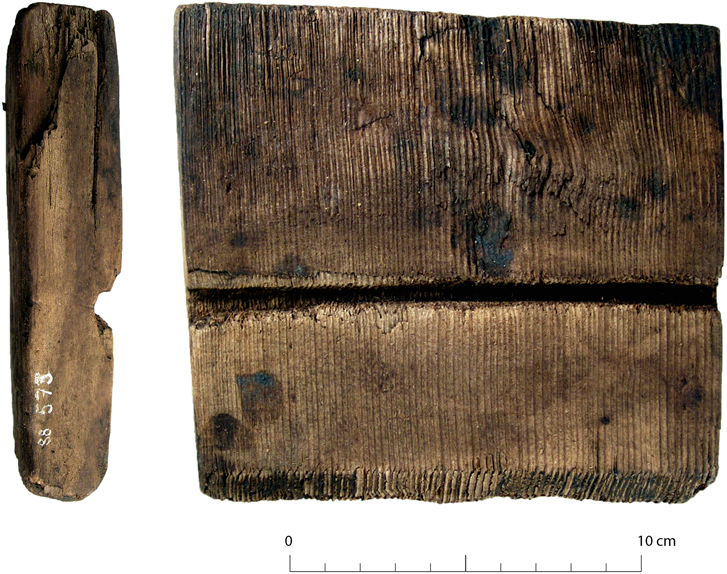
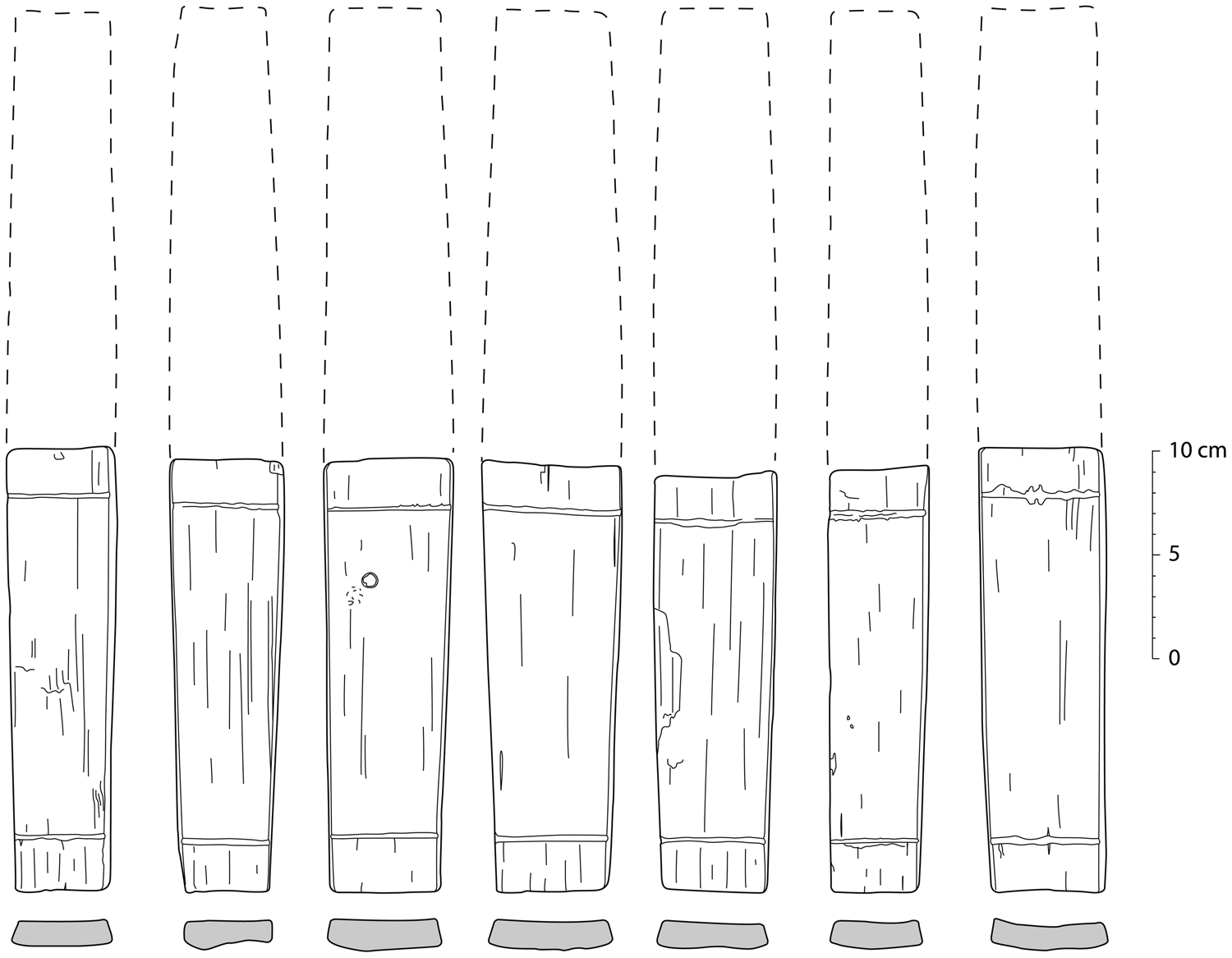
One clear sign that casks were being reused or adapted is the waste from those processes, and there are eight examples from Vindolanda (Figure 6). Although this is a small sample, such offcuts are more likely to be discarded and may never enter the archaeological record, having, for example been destroyed through deliberate burning. The examples that have survived are found in multiple phases (I–IV), which adds weight to the argument that adaption of casks was a relatively routine activity.
Offcut (W-1988-573) sawn from a cask stave.

Adaption of casks to create other coopered forms
It is argued here that Vindolanda unambiguously demonstrates a routine adaption of the larger casks (Marlière's Group 5) to produce open-topped tubs. That these derived originally from casks is shown not only by the thickness and general form of the staves but also by the presence of partial or complete bung holes in some of the shorter tub staves (Figure 6). Many barrel finds have these holes close to the centre of their girth (e.g. Boon, Reference Boon1975: pl. VII), which suggests that more complex conversions might have been undertaken at Vindolanda. If this is the case, the adaption may imply some local coopering skills, as new croze groves would have to be cut and staves refitted to a base. However, complete barrels have been recovered with bung holes closer to the barrel heads (e.g. Kühlborn, Reference Kühlborn1992: 100, fig. 37) and thus the Vindolanda practice might more routinely have been cutting casks in half in the case of larger tubs or cutting the top and the bottom, leaving waste material from the centre in the case of the shorter tubs. Even in this simpler scenario the individual staves were being reshaped to provide a new internal chamfer, an attribute also noted on a similarly adapted tub stave from the fort of Segontium in North Wales (Boon, Reference Boon1975: 54, fig. 2), and some skill would have been required to create a useable tub.
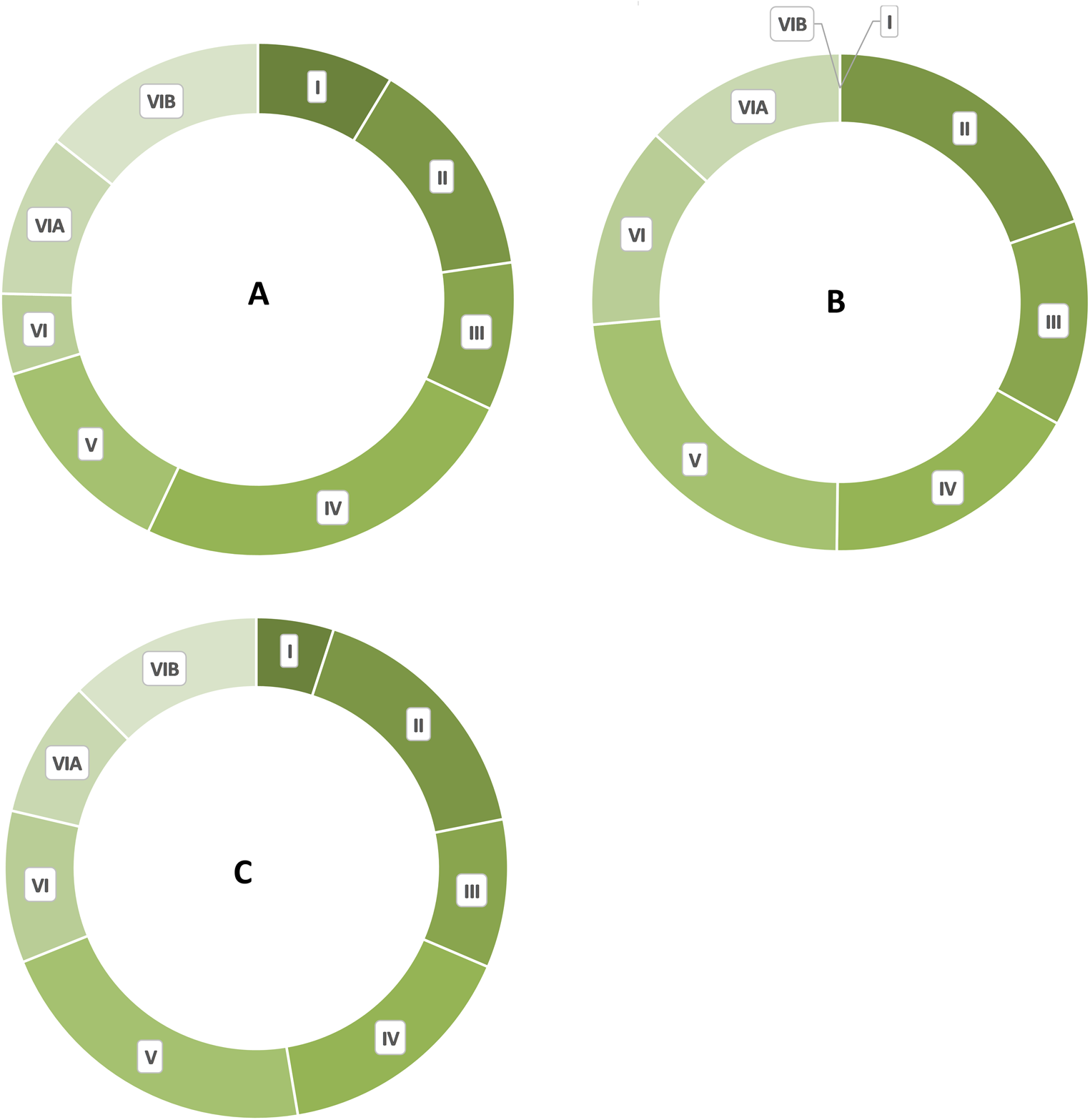
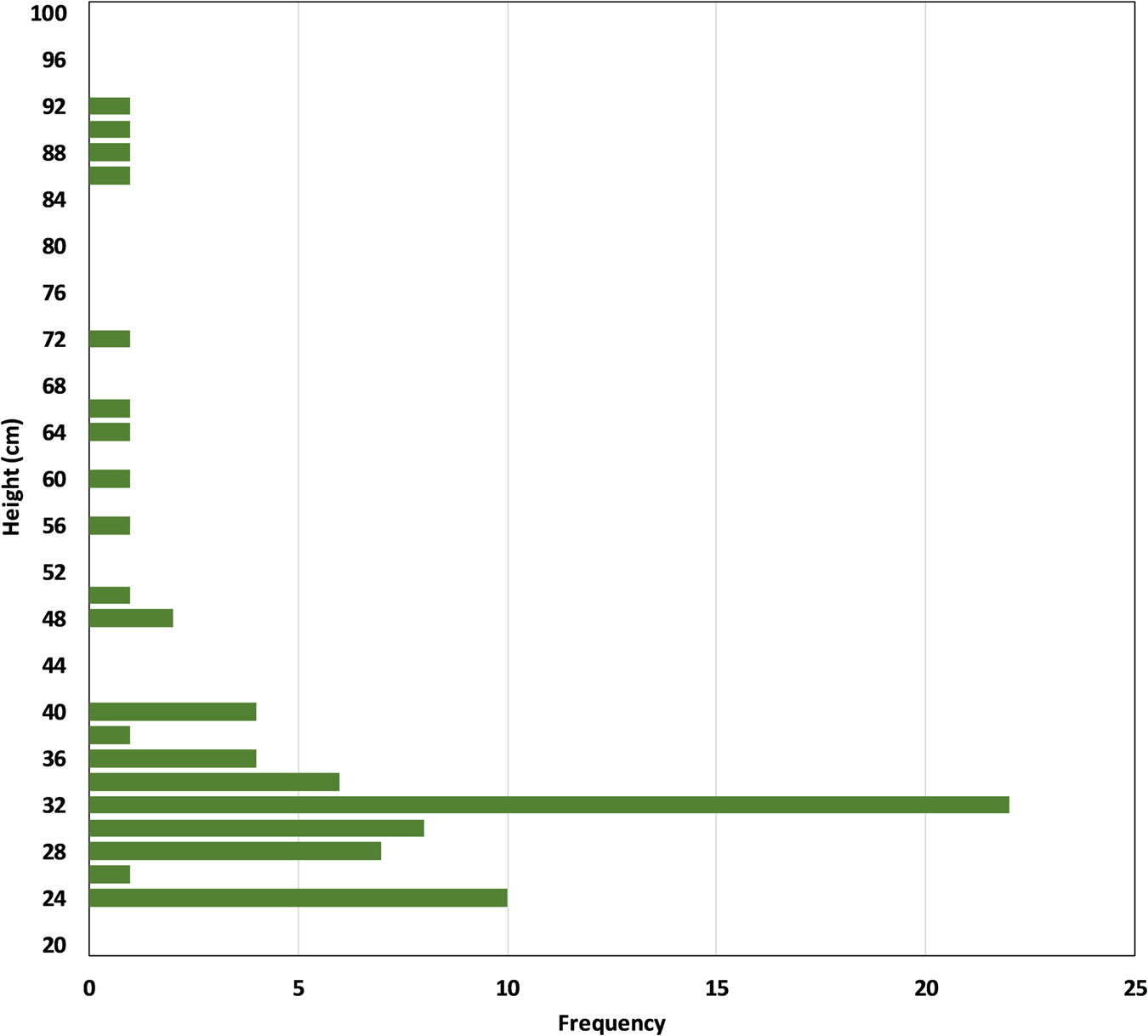
Making tubs is not just a unique response to a chronologically specific requirement. The phases from which the evidence derives clearly shows that such activity was repeated and could be regarded as habituated, at least across this period at this location (Figure 7). No period, where significant organic preservation was present, privileged this behaviour more than another and this activity was taking place irrespective of the specific auxiliary unit occupying the fort. Furthermore, examination of the dimensions of the cut-down items shows consistency in the way this type of conversion was carried out (Figure 8), with the majority falling within a group of shorter items between 24 and 40 cm high, a less frequent middle group between 48 and 72 cm high, and a few tall tubs around 90 cm high. There is a spike in the distribution at around 32 cm, and it is worth noting that this is not explained by multiple staves from the same tub as there is almost equal representation from phases II, III, and IV. The Segontium stave, noted above, is 28 cm in height, well within the predominant range of the shorter tubs found at Vindolanda. A similar style of object is also known at the vicus of Tasgetium, where a small tub in a partially articulated state has an average stave height of 21.5 cm (Benguerel et al., Reference Benguerel, Brem, Ebneter, Ferrer, Hartmann and Leuzinger2012).
Coopered elements by Vindolanda phase. A: all coopered items; B: only head staves, complete cask staves, and bungs; C: only adapted tub staves and offcuts. Normalized as a proportion of wooden finds in each phase.

Frequency distribution showing the height of tub staves at Vindolanda.

Exactly why these tubs were required is not clear; however, as this is a repeated, arguably standardized practice, it suggests a recurrent need. There would have been, for example, a consistent need for leather. Analysis of adapted barrels at the vicus of Vitudurum (Oberwinterthur, Winterthur in the canton of Zürich, Switzerland) provided evidence for traces of animal hair, bristles, and leather or skin residues, suggesting that they were employed in tanning (Clerici, Reference Clerici1983: 21). A similar suggestion has been made for some of the sixteen ‘cask pits’ found at Tasgetium (Benguerel et al., Reference Benguerel, Brem, Ebneter, Ferrer, Hartmann and Leuzinger2012: 268). However, definitive evidence of the presence of tanneries has proved elusive (Driel-Murray, Reference Driel-Murray, Thomson and Mould2011) and, while tubs of such dimensions could have been used in this process, the finds from Vindolanda cannot be definitively assigned to it. This may not, however, be the only explanation and, significantly, some of the stave ends can be argued to have marks characteristic of horses chewing a wooden container in the expectation that it would be filled. On a fort where cavalry would have been an important part of daily life such uses might also be expected; significantly, perhaps, Segontium, where there is evidence for similar tubs, also housed an auxiliary cavalry unit.
Although evidence for the adaption of the larger barrels predominates, the adaption of smaller barrels is also documented. Open-topped containers, such as buckets, and smaller (approximately 20 cm high) straight-sided or slightly tapering casks are both considered to have been produced from staves originally derived from smaller cask types. The latter suggest the local presence of at least some dry coopering skills (Figure 9).
Adapted small barrel staves (W-1992-1069).

Other objects of fir, spruce, or larch: imports, opportunistic, or routine recycling?
Casks represent a ready-to-hand source of a raw material, one that was, in this case, not available locally, and that had certain material affordances. The barrel staves potentially provided a seasoned, pre-cut, predominantly radially converted source of softwood timber, of relatively uniform and predictable dimensions. It would not be surprising to encounter some use of this as a source material, especially when it is not available locally. Items made from the same tree species as a barrel currently include drop lids, wax tablets (tabulae ceratae), framing pieces, and domestic utensils.
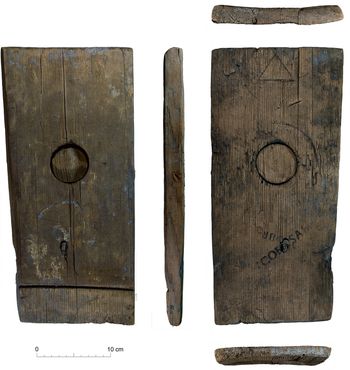
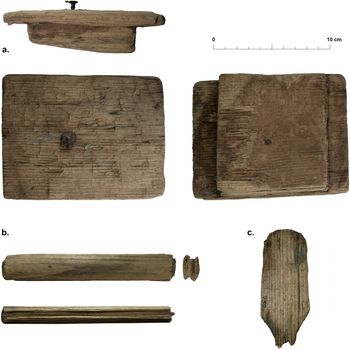
Drop lids are a simple form of square, unhinged lid that has a thick central section with a thin lip. Four of these have been identified at Vindolanda, all made from fir or spruce/larch. All four are relatively roughly made, matching closely the thickness of staves from the larger barrels and, in at least one example, there is a suggestion of the original lower chamfer, with one edge created by utilizing the cut of the croze groove (Figure 10a). These objects, although relatively rare, have so far been identified across three phases (II, III and IV). A drop lid, identified as made from spruce, is also known from Roman contexts at Castle Street, Carlisle (Padley, Reference Padley, Padley and Winterbottom1991: fig. 183). The choice of species is not functionally essential for this simple form, as a later example in oak from Hiberno-Norse York demonstrates (Morris, Reference Morris2000: 2292).
a. Drop lid (W-1988-607), b. Framing element (W-1986-77), c. Spatula (W-1991-732).

A small selection of stylus tablets from Vindolanda has previously been microscopically examined and identified as spruce/larch (Bowman & Thomas, Reference Bowman and Thomas1983: 26–29). This fits with other finds from across Europe and Britain, most of which have also been identified as produced from either fir, spruce, or larch (e.g. Pearce, Reference Pearce2004: 45; Saedlou & Dupéron, Reference Saedlou, Dupéron, Dupouey, Danbrine, Dardignac and George-Leriy2007; Benguerel et al., Reference Benguerel, Brem, Ebneter, Ferrer, Hartmann and Leuzinger2012; Hartmann, Reference Hartmann, Scholz and Horster2015; Stewart, Reference Stewart and Tomlin2016; Tegtmeier, Reference Tegtmeier2016: 21–77). The choice of these species has merit, since a recess can be easily split out and the surface left would have had a rougher texture facilitating the keying of the wax. At locations away from the natural distributions of these species, the ‘exotic’ nature of the wood has been argued to show that the stylus tablets were manufactured elsewhere and reached their destination ready-made (e.g. Bowman, Reference Bowman1994: 47; Austin, Reference Austin, Scholz and Horster2015: 16). Saedlou and Dupéron (Reference Saedlou, Dupéron, Dupouey, Danbrine, Dardignac and George-Leriy2007: 85), suggest that this implies either a large-scale trade in this type of wood, with local production or centres of production near the necessary raw material, the finished article then being distributed further afield. While the presence of tablet production centres is likely, especially as a large and consistent supply would have been required, this does not preclude local manufacture if a source of material was available. The site of Bloomberg in London provides a valuable touchstone here. As at Vindolanda, written texts survive and include a number of tabulae ceratae, although the date range at Bloomberg is earlier (50s to 90s ad). Significantly, Goodburn has argued that barrel parts were used to produce stylus tablets, using the presence of offcuts from the ends of staves and wood chips as proxy evidence for this process (Goodburn, Reference Goodburn and Tomlin2016: fig. 7). He conjectures that, with the ends removed, the central part of the stave could be cut into tablet-sized blocks and subsequently split into individual blanks, estimating that from one large cask in good condition as many as 420 tablets could potentially be manufactured (Goodburn, Reference Goodburn and Tomlin2016: 9). Direct evidence for tablet production is very rare and a find from Cologne indicates that blanks could be produced by sawing rather than splitting (Tegtmeier, Reference Tegtmeier2016: fig. 35).
Goodburn's hypothesis is attractive, and one that had already been positively considered for the Vindolanda material. As a thought experiment, at the very least, it counters an automatic assumption that tabulae ceratae, or indeed other objects made from spruce/larch or fir, must be produced at a distance or require movement of the raw material. It should however be noted that there is no absolute proof that this was part of the recycling behaviours at Vindolanda: while there are stave offcuts present, like those found at Bloomberg, there is no direct connection to the production of tabulae ceratae other than that they are produced from the same species of tree. Furthermore, at Vindolanda there is evidence for extensive reuse of the tablets, with multiple texts superimposed, indicating repeated use. Consequently, even if casks were being reused in local production, either the process was sufficiently labour-intensive or the second-hand material not consistently available such that stylus tablets were worth curating.
Three items (W-1986-77, W-1993-1200, and W-1993-1263) are parts of frames and all are made of the same softwood species as the surviving coopered elements (Figure 10b). All three items are from period III and it is possible that they represent window frames from the commanding officer's residence. More recent excavations have uncovered a fourth example (W-2005-06A) from a context that has only a broad date range (c. ad 92–140); it is therefore not impossible that it was part of the same higher-status building as the first three frames. While similar objects have been found in Britain (e.g. Blurton, Reference Blurton1977: 67, fig. 20), the largest group, from anywhere in the Roman empire, comes from Vindonissa (Fellmann, Reference Fellmann2009: 94–96, 173), where 163 items have been categorized as ‘Fenstersprosse’ or window bars. There, all items were identified as manufactured from fir. Sixteen were also recovered from Roman contexts in Cologne, of which two were identified as spruce and the remainder, apart from one unidentifiable piece, as fir (Tegtmeier, Reference Tegtmeier2016: table 23). As with the stylus tablets, there is no direct evidence at Vindolanda that these items were made from recycled cask parts, and hence this remains conjecture. Nonetheless, these items can no longer be assumed to be either imported complete or produced from imported raw timber. What is perhaps more significant is that, even on the northern frontier, the material deemed to be appropriate for this specific purpose is a wood like silver fir, a timber only available locally from recycled objects and used even though other types of wood could serve the same purpose.
The final object made from silver fir at Vindolanda is a single spatula, which belongs to a broader range of domestic utensils identified in the assemblage (Figure 10c). It is a simple form, readily made from radially cleft timber, and at Vindolanda this artefact type is more usually made from locally available woods. The ease with which these objects could be made and their simple form suggest that this one example may well have been produced from wood recycled from casks. If this is the case, it is plausible that more opportunistic use also occurred.
Conclusion
In this article we have presented a model that explores the cultural biography of barrels, focusing on the Roman empire in the first and second centuries ad, paying special attention to the physical evidence for the latter stages of their existence. A cask had an embodied value, albeit one that could change over time; at a basic level its manufacture required resource, energy, materials, training and continued practice. This sense of ‘value’ promoted longer life uses, repair, and multiple reuse, and this is clearly visible in the archaeological record. The materials from which casks were made could also provide a rationale for adaption and recycling, and, in the case of a northern frontier fort, provided a source of material not naturally present. From this perspective, the behaviours observed at Vindolanda and elsewhere could be read from a purely economic, or instrumentalist, viewpoint. The arrival of a cask at a fort or settlement such as Vindolanda would have provided opportunities for the reuse, adaption, and/or recycling of a useful material that was not locally available; the motivation for doing so might thus be framed as purely pragmatic and opportunistic. However, while this reading of the evidence has merit, it is argued here that some of the practices of recycling, reuse, and adaption were also systematic and habituated. This may be connected to the origins of the casks arriving at a fort like Vindolanda after a long and complex journey and may partly echo the range of things that were most usually produced from these particular tree species closer to their natural origin. While an object and its material had certain affordances, the usual responses were also defined, at least in part, by what was deemed most appropriate to create from it, and this could be socially framed. A line in Kopytoff's original discussion of the cultural biography of things encapsulates some of these interacting influences: ‘Some of this clash between culture and individual is inevitable, at least at the cognitive level. The world of things lends itself to an endless number of classifications, rooted in natural features and cultural and idiosyncratic perceptions’ (Kopytoff, Reference Kopytoff and Appadurai1986: 76). In our case, amid the social interactions, the rituals, the commercial and military imperatives, the reuse, adaption, repurposing, and recycling of objects like wooden casks would have been a necessary, inherently understood part of the rhythm of daily life.
Acknowledgements
Thanks to the Vindolanda Trust for access to the material, especially to Robin Birley and Patricia Birley and, latterly, Andrew Birley and Barbara Birley for their continued support and insights. The team at Vindolanda continue to make our research visits a genuine pleasure. We are grateful for critical suggestions on drafts of this article by Anthony Birley, Andrew Birley, Barbara Birley, Neil Carlin, Lorna O'Donnell, Tadhg O'Keefe, Meriel McClatchie, and the anonymous reviewers. Thanks also to Damian Goodburn and Karen Stuart, MOLA, for valuable discussion. Finally, thanks to Jon Hather for collaboration and initiating the examination of the wooden small finds. Support of the UCD College of Social Sciences and Law Research Fund is gratefully acknowledged.