1. Introduction
The Sauropterygia were a successful group of Mesozoic marine reptiles with a fossil record extending from late Early Triassic to latest Cretaceous times (Rieppel & Hagdorn, Reference Rieppel, Hagdorn, Callaway and Nicholls1997; Welles, Reference Welles1943). The interrelationships of many of its Triassic-aged members, including pachypleurosaurs, nothosaurs, and certain Chinese taxa (Keichousaurus Young, Reference Young1958, Hanosaurus Young, Reference Young1972, Wumengosaurus Jiang et al. Reference Jiang, Rieppel, Motani, Hao, Sun, Schmitz and Sun2008, Dianopachysaurus Liu et al. Reference Liu, Rieppel, Jiang, Aitchison, Montani, Zhang, Zhou and Sun2011) have been subject to debate.
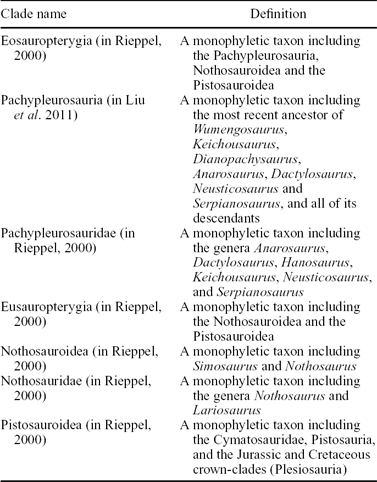
This conflict is partly the consequence of uncertainty as to the taxonomic content of the Pachypleurosauridae and Pachypleurosauria and the resulting disagreements regarding the definition of the clade names. We employ the phylogenetic definitions of the clade names in Rieppel (Reference Rieppel2000) and Liu et al. (Reference Liu, Rieppel, Jiang, Aitchison, Montani, Zhang, Zhou and Sun2011) in this contribution in an attempt to avoid this problem (see Table 1), although the large number of taxa in the definition of the Pachypleurosauridae and Pachypleurosauria is certainly arguable because of the implicit assumption of their monophyly. Despite considerable taxonomic uncertainty within pachypleurosaurs (sensu Rieppel (Reference Rieppel2000) and Liu et al. (Reference Liu, Rieppel, Jiang, Aitchison, Montani, Zhang, Zhou and Sun2011)), the European pachypleurosaurs (Neusticosaurus, Serpianosaurus, Dactylosaurus and Anarosaurus) have consistently formed a clade separate from the Nothosauroidea and the Chinese forms in recent studies; in this contribution, the term ‘European pachypleurosaurs’ is used to refer to these four genera.
Phylogenetic definitions of the clade names used in this contribution

Rieppel (Reference Rieppel2000) regarded the Nothosauroidea as the sister taxon of the Pistosauroidea within the Eusauropterygia, and the Pachypleurosauridea as the sister taxon of the Eusauropterygia. Liu et al. (Reference Liu, Rieppel, Jiang, Aitchison, Montani, Zhang, Zhou and Sun2011) presented a cladogram in which three Chinese taxa (Keichousaurus, Dianopachysaurus and Wumengosaurus) were more closely related to the European pachypleurosaurs than to the Eusauropterygia, and regarded the three Chinese taxa as members of the Pachypleurosauridae. A different view was presented by Holmes, Cheng & Wu (Reference Holmes, Cheng and Wu2008), Shang, Wu & Li, (Reference Li, Rieppel, Wu, Zhao and Wang2011) and Wu et al. (Reference Wu, Cheng, Li, Zhao and Sato2011) in which Keichousaurus is more closely related to the Nothosauroidea than to the European pachypleurosaurs, and Wumengosaurus is a stem taxon of the lineage leading to the clade consisting of the Nothosauroidea and the European pachypleurosaurs. Cheng et al. (Reference Cheng, Wu, Sato and Shan2012) reached a similar conclusion finding that none of the three Chinese taxa in question belongs to the Pachypleurosauridae.
Diandongosaurus acutidentatus Shang, Wu & Li, Reference Li, Rieppel, Wu, Zhao and Wang2011 is a recently described member of the Eosauropterygia from the middle Anisian Guanling Formation in eastern Yunnan, China. The holotype displays a combination of traits seen in nothosauroids such as Simosaurus and Nothosaurus, and the European pachypleurosaurs. For example, characters such as an unconstricted snout, a preorbital region longer than the postorbital region and a supratemporal fenestra smaller than the orbit are common features among the European pachypleurosaurs, whereas the enlarged and procumbent teeth in the premaxilla and anterior portion of the dentary, and the fang-like maxillary teeth suggest nothosauroid affinity. The strict consensus of the phylogenetic analysis by Shang, Wu & Li (Reference Shang, Wu and Li2011) recovered Diandongosaurus among the basal polytomy of the Eosauropterygia, whereas the majority consensus placed this taxon as the basal-most member of the lineage leading to the clade consisting of the European pachypleurosaurs, the Nothosauroidea and Wumengosaurus.
One problem with the holotype, and until recently the only specimen of Diandongosaurus, is the lack of information on the ventral side of the skull; the neck is twisted in its middle portion and although the postcranial elements are exposed in ventral view, the skull is preserved in dorsal aspect. The new specimen described here not only reveals the ventral view of the skull, but also intraspecific variation of the postcranial skeleton, which leads to a revised diagnosis of the taxon. The phylogenetic analysis is also revised to re-examine the relationship of the Pachypleurosauridae, Nothosauroidea and Chinese eosauropterygian taxa such as Keichousaurus, Wumengosaurus, Hanosaurus, and Dianopachysaurus.
Institutional abbreviations. IVPP – Institute of Vertebrate Paleontology and Paleoanthropology, Chinese Academy of Sciences, Beijing, China; NMNS – National Museum of Natural Science, Taichung, Taiwan.
2. Systematic palaeontology
SAUROPTERYGIA Owen Reference Owen1860
EOSAUROPTERYGIA Rieppel, Reference Rieppel1994a
[sensu Rieppel, Reference Rieppel2000]
Diandongosaurus Shang, Wu & Li, Reference Li, Rieppel, Wu, Zhao and Wang2011
Diandongosaurus acutidentatus Shang, Wu & Li, Reference Li, Rieppel, Wu, Zhao and Wang2011
Holotype. IVPP V 17761, a complete skeleton with the skull in dorsal and the postcranial skeleton in ventral views.
Referred specimen. NMNS-000933-F03498, a nearly complete skeleton preserved in ventral view, lacking only the posterior-most section of the tail.
Locality and horizon. Luoping County, Yunnan Province, China; Member II of the Guanling Formation, lower Middle Triassic (Anisian).
Remarks. The occurrence data in the specimen label does not specify a stratigraphic level and age, but it is inferred from the literature data (Zhang et al. Reference Zhang, Zhou, Lu, Xie, Lou, Liu, Sun, Huang and Zhao2009).
Emended diagnosis. A small to medium-sized eosauropterygian with the following characters: enlarged and fang-like premaxillary and anterior dentary teeth; maxilla with one or two fangs and distinctly smaller conical teeth; short snout without constriction; supratemporal fenestra smaller than orbit; broad interorbital bridge; posterolateral process approaching the supratemporal fenestra; presence of a few small vomerine teeth; parietal foramen anterior to supratemporal fenestra; frontal excluded from orbit by prefrontal-postfrontal contact; postorbital excluded from infratemporal fenestra by jugal–squamosal contact; descending process of squamosal reaching lateral side of articular condyle of quadrate; quadratojugal present; ectopterygoid present; distinct trough on the dorsal surface of retroarticular process; vertebral column consisting of about 20 cervical, 18 dorsal, 3 or 4 sacral and 39 caudal vertebrae; anterior caudal ribs 3 to 8 elongate and distally truncated; lateral elements of gastralia distally swollen and curving dorsally; clavicle with a distinct anterolateral process; boomerang-shaped interclavicle (may develop a weak posterior projection); entepicondylar foramen absent; ungual phalanges of pes extremely expanded dorso-ventrally; phalangeal formula 2-4-5-6–3 for manus and 2-3-4-(6/5)-(5/4/3) for pes.
3. Description
We refer NMNS-000933-F03498 to D. acutidentatus based on the following characteristics shared with the holotype: anterolateral process of the clavicle, transverse processes of anterior caudal vertebrae slender and distally truncated, lateral elements of gastralia distally swollen and turned upwards, and ungual phalanges of the pes extremely expanded in dorso-ventral direction.
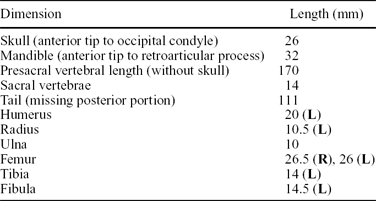
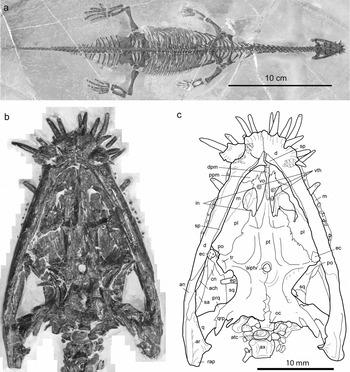
See Table 2 for the measurements. The new specimen is larger than the holotype, the latter being about 85% of the former in the trunk length, and retains 27 caudal vertebrae (Fig. 1a). If the original number of caudals was the same as that in the holotype (39), the new specimen is missing 12 caudals; based on this assumption, the total length of the NMNS specimen is estimated to be about 340 mm. In the following text, the description will focus primarily on the structures not described by, or unavailable to, Shang, Wu & Li (Reference Shang, Wu and Li2011), as well as on the comparison with the European pachypleurosaurs and nothosauroids.
Selected measurements of NMNS00093-F034398, the referred specimen of Diandongosaurus acutidentatus Shang, Wu & Li, Reference Li, Rieppel, Wu, Zhao and Wang2011

R – right; L – left
Referred specimen of Diandongosaurus acutidentatus Shang, Wu & Li, Reference Li, Rieppel, Wu, Zhao and Wang2011 (NMNS00093-F034398). (a) Skeleton in ventral view; (b) skull and mandible in ventral view; (c) camera lucida line drawing of the skull and mandible in ventral view. Abbreviations: ach – adductor chamber; ‘aiptv’ – ‘anterior interpterygoid vacuity’; an – angular; apcl – anterolateral process of clavicle; ar – articular; as – astragalus; atc – atlantal centrum; ax – axis; cal – calcaneum; cd – caudal rib; cl – clavicle; cn – coronoid; co – coracoid; cof – coronoid foramen; cr – cervical rib; cv – cervical vertebra; d – dentary; dlg – distal end of lateral element of gastral rib; dpm – dorsal portion of premaxilla; dr – dorsal rib; dsc – dorsal blade of scapula; dv – dorsal vertebra; ec – ectopterygoid; ep – epipterygoid; fcl – facet for clavicle; fco – facet for coracoid; fi – fibula; ficl – facet for interclavicle; gsc – glenoid portion of scapula; h – humerus; icl – interclavicle; in – internal naris; m – maxilla; mpcl – medial process of clavicle; mt – metatarsal; oc – occipital condyle; pl – palatine; ppm – palatal portion of premaxilla; po – postorbital; prq – pterygoid ramus of quadrate; pt – pterygoid; q – quadrate; qrp – quadrate ramus of pterygoid; rap – retroarticular process; r – rib; sa – surangular; sc – scapula; sp – splenial; spcl – scapular process of clavicle; sq – squamosal; ti – tibia; tp – transverse process; tr – transverse ridge; vo – vomer; v – vertebra; vth – vomerine teeth.

3.a. Skull
The skull of NMNS-000933-F03498 is exposed in ventral view, showing much of the palate between the occluded mandibular rami. The palate anterior to the internal naris mainly consists of the palatal portion of the premaxilla with smaller contributions of the maxilla and vomer (Fig. 1b, c). The premaxilla meets its counterpart along the ventral midline; it is largely covered by the mandibular symphysis anteriorly, and excluded from the internal naris by the vomer–maxilla contact posteriorly. The latter condition is shared with Nothosaurus (Rieppel, Reference Rieppel2000: figs. 55B, 58B, 59B, 60B) but differs from the European pachypleurosaurs and Keichousaurus in which the premaxilla enters the anterior border of the internal naris (Sander, Reference Sander1989: fig. 11a; Carroll & Gaskill, Reference Carroll and Gaskill1985: fig. 14c; Holmes, Cheng & Wu, Reference Holmes, Cheng and Wu2008: fig. 3B). The internal nares are damaged but the right one is nearly complete; they are oval and slightly oblique relative to the midline.
The vomer is well-preserved but detached from the counterpart, exposing the ventral view of the dorsal portion of the premaxilla along the midline (Fig. 1b, c). Each vomer takes a narrow triangular shape with a pointed posterior end, and forms much of the septum separating two internal nares. The sutures with the premaxilla and maxilla are highly interdigitated, but the suture with the pterygoid is nearly straight. There are small teeth or denticles on the ventral surface of the vomer, at least one on the left and two on the right.
The outline of the palatine is unclear owing to cracks at the maxillary suture, but its suture with the pterygoid is nearly straight. The ventral surface is weakly concave and bears very fine ridges. The bone may meet the vomer just posteromedial to the internal naris, although the contact is not confirmed due to damage (Fig. 1b, c).
The pterygoids form most of the palate. A peculiar median opening here referred to as the ‘anterior interpterygoid vacuity’ (Fig. 1b, c) is located in the bottom of a shallow central depression; the nature of this opening and the ‘posterior interpterygoid vacuity’ described below will be discussed in Section 5.b.2. There is a pair of ridges symmetrically extending from the sides of this opening onto the transverse processes towards the ectopterygoid, although this feature appears to have been emphasized by the collapse of the postorbital bar onto the dorsal surface of the palate. The pterygoids are indistinguishably fused anterior to the opening, but the midline suture is open posterior to it, leaving an irregular opening referred to here as the ‘posterior interpterygoid vacuity’ anterior to the basioccipital. The anterior ends of pterygoids taper into a sharp process that inserts between the vomers. The quadrate ramus of the pterygoid extends posterolaterally, and broadly contacts the pterygoid ramus of the quadrate lateral to the occipital region.
The ectopterygoid is a nearly square small bone (Fig. 1b, c). It is sutured to the anterolateral side of the transverse process of the pterygoid, and meets the palatine anteriorly; it appears to have lost a contact with the maxilla and jugal laterally. On the right side, this element is detached from the neighbouring elements and displaced. The ectopterygoid has not been confidently identified in many non-pistosauroid eosauropterygians excluding the Nothosauroidea (Carroll & Gaskill, Reference Carroll and Gaskill1985; Sander, Reference Sander1989; Rieppel, Reference Rieppel1989; Lin & Rieppel, Reference Rieppel1998; Holmes, Cheng & Wu, Reference Holmes, Cheng and Wu2008; Wu et al. Reference Wu, Cheng, Li, Zhao and Sato2011).
Two elements of the braincase, the epipterygoid and basioccipital, can be positively identified. The right epipterygoid is a narrow rod with an expanded base, obviously bent laterally, and sandwiched between the squamosal and the pterygoid. The base of the basioccipital is partially exposed along the midline fissure between the pterygoids; sediments fill this fissure anterior to the basioccipital, suggesting the displacement of the basisphenoid. The posterior surface of the occipital condyle is concave.
The mandible is complete, and individual elements in the right ramus are mostly distinguished (Fig. 1a, b). The dentary occupies at least two-thirds of the ramus. Its ventral surface is slightly concave and bears fine longitudinal ridges. The mandibular symphysis is robust, and longer than those in the European pachypleurosaurs and Keichousaurus (Carroll & Gaskill, Reference Carroll and Gaskill1985; Sander, Reference Sander1989; Rieppel, Reference Rieppel1989; Lin & Rieppel, Reference Rieppel1998; Holmes, Cheng & Wu, Reference Holmes, Cheng and Wu2008). The angular forms the base of the adductor chamber and the ventrolateral edge of the retroarticular process (Fig. 1a, b).
The splenial lines the ventromedial wall of the mandible anterior to the adductor chamber, and contributes to the posterior quarter of the mandibular symphysis. The coronoid is a thin strap of bone forming the coronoid process; the bone contacts the surangular posterolaterally above the anterior edge of the adductor chamber. The articular is entirely covered by the prearticular and angular in ventral view. The prearticular is a large element that forms the medial wall of the adductor chamber anteriorly; posteriorly, it supports the mandibular articulation and forms the short and stout retroarticular process. The ventromedial surface of this bone is noticeably concave.
The marginal teeth are essentially the same as those of the holotype; the five maxillary teeth are large and procumbent, and include two large fangs or caniniform teeth. However, the contrast in size of the fangs and other maxillary teeth is more pronounced than in the holotype. There are two small teeth anterior to the fang, but the large space between the fang and the last premaxillary tooth suggests that there might have been one or two additional maxillary teeth.
3.b. Axial skeleton
The anterior end of the vertebral column is disturbed and individual components of the atlas could not be identified, but there were probably 20 cervical vertebrae present. The posterior portion of the tail is missing, but the rest of the column is preserved in articulation (Fig. 1). The estimated number of presacral vertebrae (38) is the same in NMNS00093-F034398 and the holotype.
There are about 20 cervicals and 18 dorsals in Diandongosaurus. Various features, such as the position and number of rib heads, rib length, or the position of the pectoral girdle, have been used in previous studies to approximate the location of the cervical–dorsal boundary (e.g. Carroll & Gaskill, Reference Carroll and Gaskill1985; Sander, Reference Sander1989; Shang, Wu & Li, Reference Li, Rieppel, Wu, Zhao and Wang2011), leaving the division somewhat arbitrary. A gradual transition of morphology, as well as the presence of an overlapping pectoral girdle, also obscures the boundary. In the holotype, the 19th vertebra is the last one located anterior to the pectoral girdle and in which the double-headed rib was confirmed. The rib becomes gradually longer posteriorly in the proximal portion of the neck (near the shoulder), and this trend continues to the 20th rib; the 21st ribs are the most anterior ones with a truncated distal end, suggesting cartilaginous connection to the ventral element(s). In the referred NMNS specimen, the 20th vertebra is just anterior to the pectoral girdle, and the anterior process of the rib is lost but the distal end is still pointed. The distal portions of the 21st ribs of the referred specimen are covered by the coracoids and the morphology of the distal end cannot be confirmed; the 22nd ribs are the first with a confirmed truncated end.
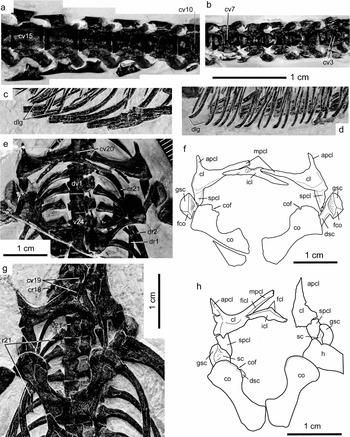
The atlantal centrum is exposed between the occipital condyle and the axial centrum (Fig. 1b, c); the atlantal intercentrum appears to be missing. Judging by the orientation, the atlantal centrum was not fused with the axis. It is short and spherical, with a concavity on its anterior surface. The axial centrum is approximately as long as wide, only about two-thirds of the following centrum in length, and the ventral surface is slightly concave. In the cervical series, lateral constriction of the centrum is more prominent in anterior vertebrae than in posterior vertebrae (Fig. 2a, b); the ventral midline ridge is only weakly developed. Most of the dorsal vertebrae are covered with gastralia, but exposed ones show less constricted, cylinder-shaped centra.
Diandongosaurus acutidentatus Shang, Wu & Li, Reference Li, Rieppel, Wu, Zhao and Wang2011. (a, b) Cervical vertebrae in ventral view (NMNS00093-F034398); (c, d) lateral elements of some gastral sets from both the holotype (c) and NMNS00093-F034398 (d) in ventral view, showing their distal ends that are swollen and curving dorsally. (e–h) Elements of pectoral girdle of NMNS00093-F034398 (e, f) and the holotype (g, h) in ventral view. See Figure 1 for abbreviations.

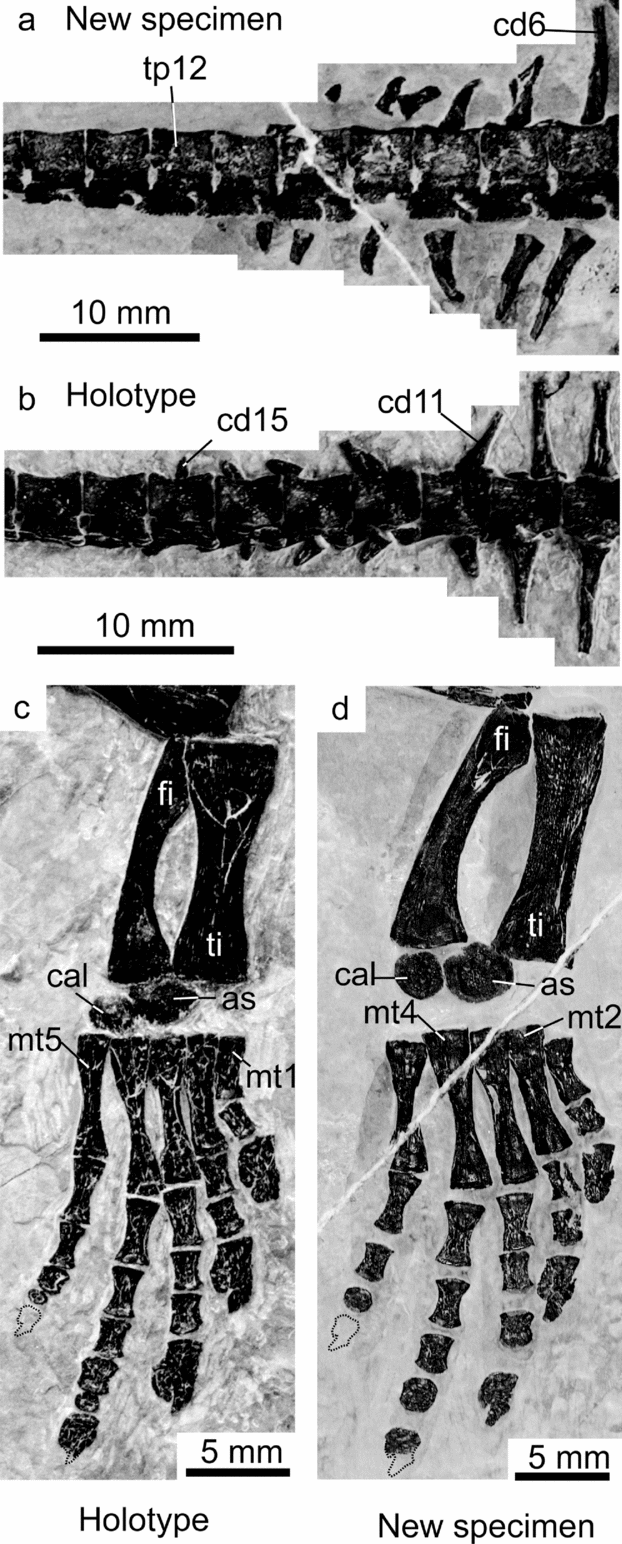
Two vertebrae are confirmed to have ribs that directly articulate with the ilium. The vertebra anterior to and posterior to these articulating ones bear ribs that angle towards the ilium, but their distal ends are covered by the overlying pubis or ischium, and the presence of iliac articulations cannot be confirmed. The holotype has at least three sacral vertebrae (Shang, Wu & Li, Reference Li, Rieppel, Wu, Zhao and Wang2011), and intraspecific variation of sacral count is common among Triassic eosauropterygians (Sander, Reference Sander1989; Lin & Rieppel, Reference Rieppel1998; Rieppel, Reference Rieppel1998 b); the sacral count of Diangongosaurus is probably three, if not four. Anterior caudals are slightly tilted to the right and show parts of neural spines and caudal rib facets at the neurocentral suture. The first caudal ribs are directed posterolaterally, and the distal ends are pointed. The caudal ribs are similar in length until the 6th caudal, then becoming progressively shorter to the 13th caudal, posterior to which ribs are absent (Fig. 3a, b). The most posterior caudal vertebra with ribs is the 15th in the holotype. This difference is attributed to intraspecific variation (c.f. Carroll & Gaskill, Reference Carroll and Gaskill1985).
Diandongosaurus acutidentatus Shang, Wu & Li, Reference Li, Rieppel, Wu, Zhao and Wang2011. (a, b) Caudal vertebrae from both NMNS00093-F034398 (a) and the holotype (b), showing different numbers of the transverse processes between the specimens; (c, d) lower part of the hind limbs from both the holotype (c) and NMNS00093-F034398 (d), showing variation in the phalanx formula between the specimens. See Figure 1 for abbreviations.

There are 26 rows of gastralia corresponding to 13 dorsal vertebrae. This pattern (two gastralia for each vertebra) is also known in some European pachypleurosaurids and pistosauroids (Sander, Reference Sander1989; Storrs, Reference Storrs1991). Each gastralium consists of one medial element and four lateral elements (two per each side). The distal end of the most lateral element becomes swollen and curves; it was probably directed dorsolaterally in life. The same features are observed in the holotype (Fig. 2c, d).
3.c. Appendicular skeleton
The pectoral girdle elements remain articulated in NMNS00093-F034398, providing more accurate topological information than those in the holotype. The pectoral girdle as a whole, excluding the anterior process of the clavicle, was obviously wider than long in life. Minor differences in the morphology of the interclavicle (Fig. 2f, h) can be attributed to the intraspecific variation also known in other eosauropterygians (e.g. Rieppel, Reference Rieppel1989). Shang, Wu & Li (Reference Shang, Wu and Li2011) described the interclavicle of the holotype as ‘arrowhead-shape’, but there is a weak projection on the midline at the anterior and posterior edge, and our re-examination revealed that the lateral ends are actually slightly damaged in the holotype. In the NMNS specimen, the interclavicle is boomerang-shaped, and the posterior edge is smoothly concave without the midline projection; the condition of the anterior projection is unknown due to damage.
Shang, Wu & Li (Reference Shang, Wu and Li2011) considered that the clavicle of the holotype was disarticulated from the interclavicle and scapula, but the NMNS specimen demonstrates that it is not the case (Fig. 2e–h). There is a prominent, characteristic spike near the anterolateral corner of the clavicle (misidentified as a ‘scapular process’ in Shang, Wu & Li, Reference Li, Rieppel, Wu, Zhao and Wang2011), although it is more slender than that in the holotype. What was identified as the dorsal blade of the scapula in the holotype by Shang, Wu & Li (Reference Shang, Wu and Li2011) actually represents the posterolateral extension of the clavicle which overlies the dorsal surface of the scapula. It remains unclear whether or not the narrow medial process of the clavicle met its counterpart to exclude the interclavicle from the anterior edge of the pectoral girdle.
The scapula consists of a ventral portion and a dorsal blade. The dorsal blade is long and the distal end is truncated; scapulae with such characteristics are known in the nothosauroid Simosaurus (Rieppel, Reference Rieppel1994a ), but not in the European pachypleurosaurs. The coracoid foramen is marked as a notch on the edge of pectoral fenestra in the NMNS specimen, but this feature is poorly developed in the holotype.
There are no notable differences in the morphology of the forelimb between the two specimens. There are one or two fewer manual phalanges per digit in the NMNS specimen, but this can be attributed to the preservation.
Diandongosaurus is characterized by a unique foot morphology with peculiar claws; Shang, Wu & Li (Reference Shang, Wu and Li2011) considered 2-3-4-6-5 to be the pedal phalangeal formula of this taxon. The basic foot structure is the same in the NMNS specimen, but it provides further details of the claw morphology and suggests intraspecific variation of phalangeal formula (Fig. 3c, d). The ungual phalanges of first to fourth digits are larger than the penultimate phalanx, and those in second to fourth are distally pointed. The penultimate phalanges of the fourth and fifth digit are round and smaller than the other phalanges. None of the fifth digits of the two specimens retains a claw, and the fifth digit likely lacked such a claw in life. The morphology and size of the most distal phalanges of the fourth and fifth digits preserved in the NMNS specimen does not correspond well to those in the holotype. The minimum pedal phalangeal formula of the NMNS specimen is 2-3-4-5-3, although the count for the fourth and fifth digits is slightly higher in the holotype. Intraspecific variation of phalangeal formula is a common phenomenon among eosauropterygian taxa (Rieppel, Reference Rieppel1989; Sander, Reference Sander1989; Wu et al. Reference Wu, Cheng, Li, Zhao and Sato2011) and it is likely to be the case in Diandongosaurus as well.
4. Phylogenetic relationships
As mentioned in the Introduction above, the cladistic analysis by Shang, Wu & Li (Reference Shang, Wu and Li2011) essentially supported the results of Holmes, Cheng & Wu (Reference Holmes, Cheng and Wu2008) and Wu et al. (Reference Wu, Cheng, Li, Zhao and Sato2011) in which the European pachypleurosaurs and the Nothosauroidea formed a clade, and Wumengosaurus was the sister taxon of this clade; Keichousaurus and Hanosaurus Young, Reference Young1972 (a pachypleurosaourid in Rieppel, Reference Rieppel1998a , Reference Rieppel2000) were more closely related to the Nothosauroidea than to the European pachypleurosaurs. Shang, Wu & Li's (2001) majority consensus found Diandongosaurus to be the most basal stem taxon of this lineage. These results do not conform to the phylogenies by Rieppel (Reference Rieppel2000) or Liu et al. (Reference Liu, Rieppel, Jiang, Aitchison, Montani, Zhang, Zhou and Sun2011) in which Keichousaurus and Wumengosaurus were closely related to the European pachypleurosaurs.
We reran the analysis with additional information provided by NMNS00093-F034398 and two recently described eosauropterygian taxa from China not included in Shang, Wu & Li (Reference Shang, Wu and Li2011): Dianopachysaurus Liu et al. Reference Liu, Rieppel, Jiang, Aitchison, Montani, Zhang, Zhou and Sun2011 and Qianxisaurus Cheng et al. Reference Cheng, Wu, Sato and Shan2012. We revised the data matrix of Cheng et al. (Reference Cheng, Wu, Sato and Shan2012) by incorporating the information in Holmes, Cheng & Wu (Reference Holmes, Cheng and Wu2008), Sato et al. (Reference Sato, Cheng, Wu and Li2010), Liu et al. (Reference Liu, Rieppel, Jiang, Aitchison, Montani, Zhang, Zhou and Sun2011), Shang, Wu & Li (Reference Shang, Wu and Li2011) and Li et al. (Reference Li, Rieppel, Wu, Zhao and Wang2011); note that our new data matrix includes the Thalattosauria, a possible sauropterygian sister taxon not included in Shang, Wu & Li (Reference Shang, Wu and Li2011). The new data matrix scored 18 more characters for Diandongosaurus, leaving only nine missing entries for this taxon (see Appendix S1 in the online Supplementary Material available at http://journals.cambridge.org/geo). The revised data matrix was analyzed using PAUP* 4.0 beta 10 (Swofford, Reference Swofford2002), with all characters unordered and equally weighed.
Two additional analyses (hereafter referred to as second and third analyses) were performed to test the effect of fragmentary taxa. Fragmentary taxa with abundant missing data have been sometimes excluded in previous phylogenetic analyses, and their exclusion may improve the resolution of the cladogram but affects the branching pattern (e.g. Sato et al. Reference Sato, Cheng, Wu and Li2010). In the second analysis, Kwangsisaurus, Sanchiaosaurus and Chinchenia (Rieppel, Reference Rieppel1999) are excluded because of the high percentage of missing data (79.9%, 64.75% and 72.66%, respectively). The third analysis excluded Hanosaurus (49% missing data; Rieppel, Reference Rieppel1998a ) as well.
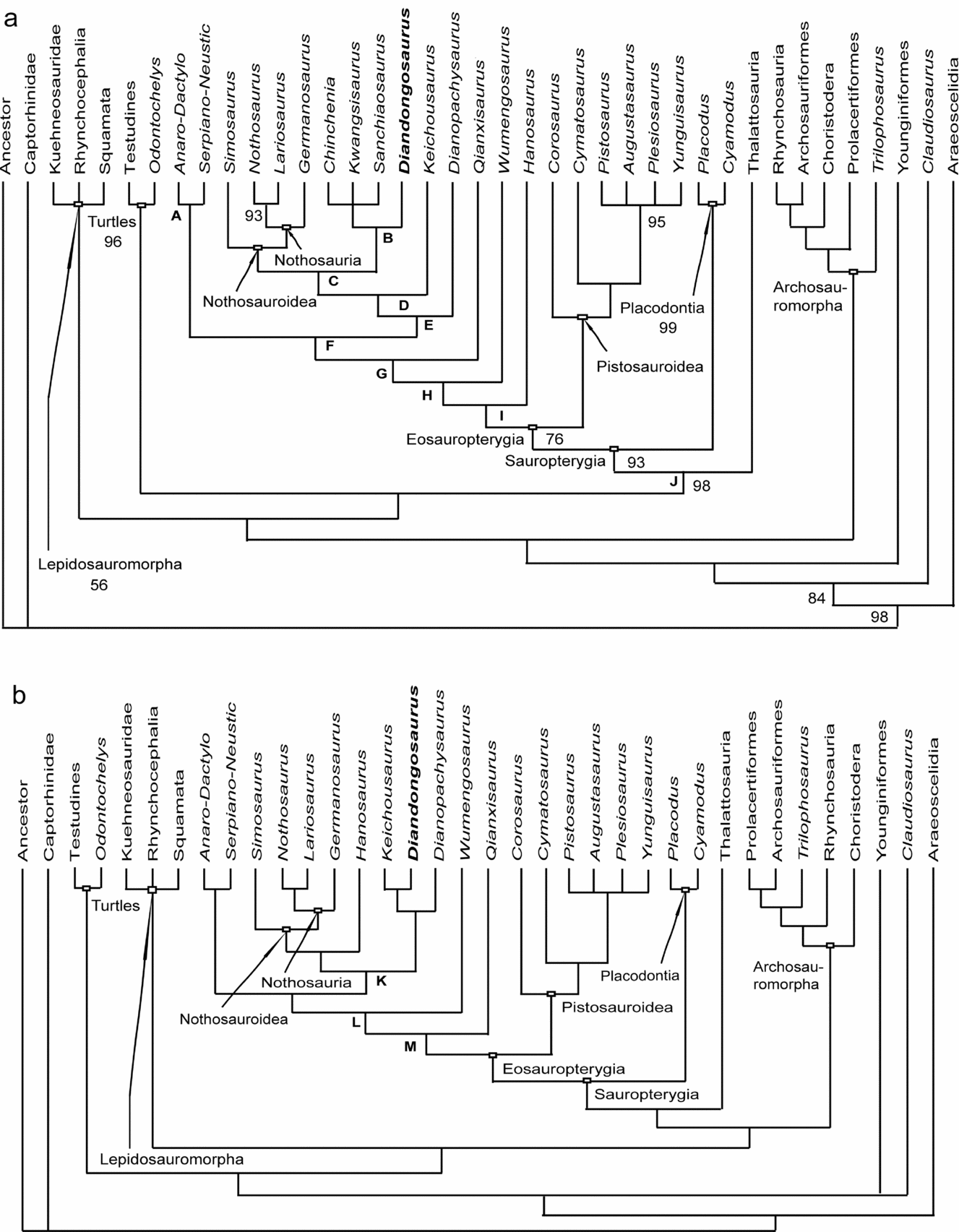
In the first analysis, with all taxa included, a heuristic search produced 12 most parsimonious trees (MPTs), with tree length (TL) of 497 steps, CI = 0.3763, and RI = 0.6837. In the strict consensus tree of the 12 MPTs (Fig. 4a), the phylogenetic relationships of Diandongosaurus with non-pistosauroid eosauropterygians differed considerably from those in Shang, Wu & Li (Reference Shang, Wu and Li2011). The genus was found to be closely related to the Nothosauroidea, being grouped together with three fragmentary taxa (Sanchiaosaurus, Kwangsisaurus, and Chinchenia) to form the sister-group of the Nothosauroidea (clade B in Fig. 4a). The status of the three fragmentary taxa has been problematic, but they have been often regarded as pistosauroids in recent studies (e.g. Rieppel, Reference Rieppel1999, Reference Rieppel2000; Sato et al. Reference Sato, Cheng, Wu and Li2010) and their nothosauroid affinity in this study and Cheng et al. (Reference Cheng, Wu, Sato and Shan2012) was unexpected. Keichousaurus, Dianopachysaurus, the European pachypleurosaurs (clade A), Qianxisaurus, Wumengosaurus and Hanosaurus are successive outgroups of clade C containing the Nothosauroidea and Diandongosaurus with the three fragmentary taxa. The Pistosauroidea splits from the lineage of the above-mentioned taxa (clade I) at the base of the Eosauropterygia. The Eosauropterygia and the placodonts form the Sauropterygia for which the Thalattosauria is the sister taxon.
Strict consensus trees of (a) 12 MPTs of the first analysis with all taxa included, and (b) 8 MPTs of the second analysis without Kwangsisaurus, Sanchiaosaurus and Chinchenia. Arabic numbers in (a) indicate the bootstrap support values; nodes without numbers have a bootstrap support value lower than 50%. See text and Table 3 for node-based clades labeled with capital letters. Abbreviations: Anaro – Anarosaurus; Serpiano – Serpianosaurus.

In the second analysis without Chinchenia, Kwangsisaurus, and Sanchiaosaurus, a heuristic search yielded 8 MPTs with TL = 487, CI = 0.3840, and RI = 0.6865. Their strict consensus does not differ much from that of the first analysis in terms of the relationships among the European pachypleurosaurs, Nothosauroidea and Pistosauroidea, but the relationships of Keichousaurus, Diandongosaurus, Dianopachysaurus, Qianxisaurus, Wumengosaurus and Hanosaurus change drastically (Fig. 4b). Hanosaurus appeared to be most closely related to the Nothosauroidea, and a clade consisting of Keichousaurus, Diandongosaurus, and Dianopachysaurus is the sister taxon of the Nothosauroidea + Hanosaurus clade. Qianxisaurus and Wumengosaurus remain as outgroups of the clade including the Nothosauroidea and the European pachypleurosaurs, but their order is altered so that Qianxisaurus is more basal. Exclusion of the three fragmentary taxa affects tree topology outside the Sauropterygia–Thalattosauria clade as well; turtles, Lepidosauromorpha (represented by Kuehneosauridae, Rhynchocephalia and Squamata) and Archosauromorpha formed a series of successive sister taxa towards the Sauropterygia–Thalattosauria clade.
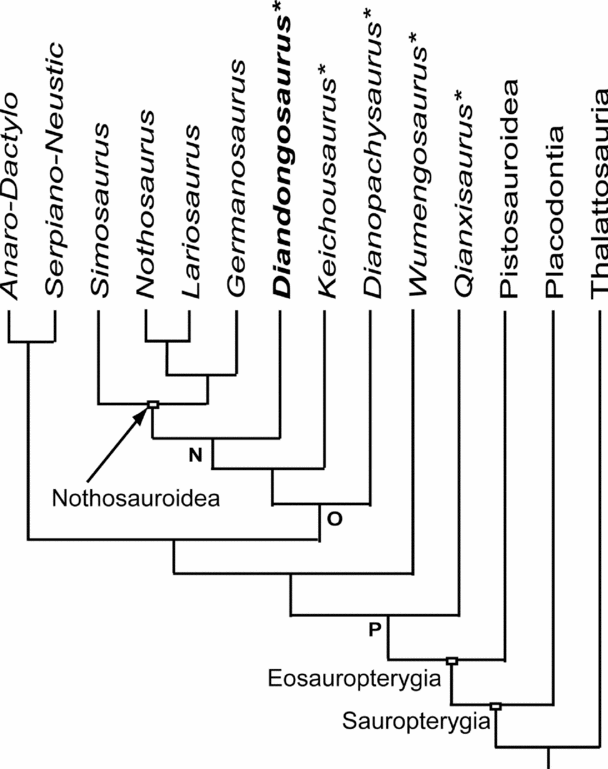
In the third analysis in which Hanosaurus was also excluded in addition to the three aforementioned taxa, a heuristic search also produced 8 MPTs with TL = 478, CI = 0.3912 and RI = 0.6904. The strict consensus of the 8 MPTs (Fig. 5) retained the same relationships of the European pachypleurosaurs, Nothosauroidea, and Pistosauroidea seen in the first and second analyses, whereas the relationships among the Nothosauroidea, Diandongosaurus, Keichousaurus, Dianopachysaurus, Wumengosaurus and Qianxisaurus differ only in that the last two forms switched their positions.

A bootstrap analysis of the first data set (all taxa included) was performed to test the confidence level of the branching pattern (Fig. 4a). The Sauropterygia and Eosauropterygia survived the analysis, but most eosauropterygian taxa form a polytomy; only the sister-taxa relationship of Nothosaurus and Lariosaurus, the monophyly of Placodus and Paraplacodus, and the monophyly and relationship among four pistosauroids, i.e. ((Pistosaurus, Augustasaurus), Plesiosaurus, Yunguisaurus), were recovered.
In summary, NMNS00093-F034398 improves the scoring of Diangongosaurus for the phylogenetic analysis, but the results of three analyses do not differ substantially from those of Cheng et al. (Reference Cheng, Wu, Sato and Shan2012) in which only the holotype was scored. Diandongosaurus, Keichousaurus, and Dianopachysaurus are more closely related to the Nothosauroidea than to European pachypleurosaurs, and Wumengosaurus and Qianxisaurus are basal members of the clade of non-pistosauroid eosauropterygians. Removal of fragmentary taxa results in certain changes within and outside the Sauropterygia–Thalattosauria clade, but a nesting pattern of ((European pachypleurosaurs, Nothosauroidea), Pistosauroidea)) within the Eosauropterygia is maintained in MPTs of the three analyses, although the confidence level of the eosauropterygian relationship was demonstrated to be low in the bootstrap analysis.
5. Discussion
5.a. Phylogenetic relationships
The strict consensus of our analysis with all taxa included (first analysis, Fig. 4a) indicates a close relationship of Diandongosaurus to the Nothosauroidea. The sister-taxon relationship between the clade of Diandongosaurus plus the three most fragmentary taxa (Chinchenia, Kwangsisaurus, Sanchiaosaurus) and the nothosauroid clade was supported by ten synapomorphies including three unequivocal characters under ACCTRAN optimization (Appendix S2 in the online Supplementary Material available at http://journals.cambridge.org/geo): the parietal skull table weakly constricted [19 (1)], the pachyostosis of the dorsal ribs absent [72 (0)] and the bone in dermatocranium distinctly sculptured [138(0)]. Among the seven equivocal synapomorphies, fang-like teeth in the premaxilla and anterior dentary are common in pistosauroids as well.
Successive removal of fragmentary taxa in the second and third analyses changed branching patterns of the cladograms and resulted in a rather puzzling contrast in the strict consensus trees. Removal of Chinchenia, Kwangsisaurus, and Sanchiaosaurus in the second analysis changed the relationships among Diandongosaurus, Keichousaurus and Dianopachysaurus drastically with the latter three forming a clade. In contrast, further removal of Hanosaurus in the third analysis essentially brought back the pattern observed in the first analysis. It is also noted that the nesting relationship of (((Nothosauroidea, Diandongosaurus), Keichousaurus), Dianopachysaurus) is demonstrated in MPTs of the first and third analyses.
Meanwhile, comparison of synapomorphies of major clades in the three analyses suggests that influence of fragmentary taxa is limited in terms of morphological characterization of the clade despite the change of internal branching pattern (Appendix S2 in the online Supplementary Material available at http://journals.cambridge.org/geo). The set of synapomorphies supporting clade E of the first analysis is nearly identical to those of clade K of the second and clade O of the third analysis. The internal branching patterns of those three clades differ, but all unite the Nothosauroidea with Diandongosaurus, Keichousaurus and Dianopachysaurus to form the sister taxon of the European pachypleurosaurs. Another example is shown in the comparison of clades C in the first analysis and L in the second; synapomorphies differ little between the two clades, indicating the minimal role of the three fragmentary taxa (Chinchenia, Kwangsisaurus, and Sanchiaosaurus). Finally, sets of synapomorphies of the clades I in the first analysis, M in the second, and P in the third analysis largely overlap despite the radically different locations or absence/presence of Hanosaurus, indicating that this taxon has little influence on the distribution of derived character states.
Based on the consideration above, we conclude that Diandongosaurus, Keichousaurus and Dianopachysaurus are more closely related to the Nothosauroidea than to the European pachypleurosaurs, although their exact relationships are sensitive to the inclusion of fragmentary taxa. Wumengosaurus and Qianxisaurus are outgroups of the clade including all of the above, but their order is influenced by the fragmentary taxa as well. Inclusion or exclusion of the four fragmentary taxa in this study affect branching pattern sometimes considerably, but had only limited influence in the morphological characterization of major clades.
5.b. Characters of possible phylogenetic significance
The presence of vomerine teeth of Diandongosaurus is unique among the Sauropterygia, whereas the presence of median interptergoid vacuities, maxillary fangs, lateral elements of gastralia with broadened and curved distal ends, and the anterior spike of the clavicle are variably known among the Eosauropterygia. Their possible phylogenetic significance is discussed below.
5.b.1. Vomerine teeth
Vomerine teeth are common among primitive reptiles, including early diapsids such as Petrolacosaurus, Youngina, Claudiosaurus and Proterosuchus (Carroll, Reference Carroll1981; Reisz, Reference Reisz1981; Cruickshank, Reference Cruickshank, Joysey and Kemp1972), but are lost in many later lineages. Among the taxa related to the Sauropterygia, thalattosaurs (e.g. Thalattosaurus, Nectosaurus and Xinpusaurus; Nicholls, Reference Nicholls1999; Liu & Rieppel, Reference Liu and Rieppel2001) and primitive turtles (Odontochelys and Proganochelys; Gaffney, Reference Gaffney1990; Li et al. Reference Li, Wu, Rieppel, Wang and Zhao2008) retain them. Within the Sauropterygia, many placodonts have large palatine teeth but none on the vomers (e.g. Rieppel, Reference Rieppel2000). Romer (Reference Romer1997: p. 460) mentions palatal dentition in Lariosaurus but we were unable to trace the source of this information. Palatal dentition is unknown in other eosauropterygians. The presence of vomerine teeth in Diandongosaurus is reasonably regarded as autapomorphic within the Sauropterygia.
5.b.2. Openings in the palate
One of the most puzzling features of Diandongosaurus is the presence of two openings in the middle of the palate between the pterygoids. We referred them to as ‘anterior and posterior interpterygoid vacuities’ but in quotation marks, because their homology with those in the plesiosaurs (derived pistosauroids) is quite doubtful because of their remote phylogenetic relationships. In addition, morphology of the ‘anterior interpterygoid vacuity’ differs from that in pistosauroids. Most pistosauroids have only one oval vacuity that exposes the basisphenoid and parasphenoid (e.g. Sues, Reference Sues1987), and corresponds to the posterior interpterygoid vacuity in some short-necked plesiosaurs with two (i.e. anterior and posterior) openings (e.g. Williston, Reference Williston1903; Andrews, Reference Andrews1911; Cruickshank, Reference Cruickshank1994). The morphology and location (a round pit in the middle of palate) of the ‘anterior interpterygoid vacuity’ of Diandongosaurus are not comparable with those in these short-necked plesiosaurs. Therefore, the ‘anterior interpterygoid vacuity’ of Diandongosaurus is considered to be an autapomorphy of this taxon.
Although the location of the ‘posterior interpterygoid vacuity’ of Diandongosaurus matches that of pistosauroids, the current phylogeny implies that it is an apomorphy of the former, because a well-defined vacuity occurs only in derived pistosauroids (Yunguisaurus, Augustasaurus, Pistosaurus and plesiosaurs) within the Sauropterygia, whereas it is absent in the basal pistosauroid Cymatosaurus (Rieppel, Reference Rieppel1997) and in various placodonts (Rieppel, Reference Rieppel2000). Furthermore, the small size and irregular shape of this vacuity in Diandongosaurus suggest that it could be the result of postmortem displacement or incomplete ossification, and more specimens are needed to confirm its taxonomic significance.
5.b.3. Epipterygoid
Although the morphology of the epipterygoid has been documented in only a limited number of sauropterygians, considerable variation is known to exist. The narrow, rod-like epipterygoid of Diandongosaurus differs from the large, flat element in Nothosaurus, whereas this element is absent in Simosaurus (Rieppel, Reference Rieppel1994a ). Carroll & Gaskill (Reference Carroll and Gaskill1985) regarded a similarly narrow rod in the skull of Neusticosaurus edwardsi as an epipterygoid, but Rieppel (Reference Rieppel1994b ) questioned their identification. This element remains essentially unknown in other non-pistosauroid eosauropterygians such as Wumengosaurus and Keichousaurus. Outside the lineage leading to the European pachypleurosaurs and nothosauroids, the epipterygoid has a wide base among the pistosauroids, but the dorsal portion could be wide (e.g. Augustasaurus; Rieppel, Sander & Storrs, Reference Rieppel, Sander and Storrs2002) or narrow (e.g. Pistosaurus; Sues, Reference Sues1987), whereas this element in Placodus is a distinct wide element attached to the prootic (Rieppel, Reference Rieppel1995). Although the epipterygoid of Diandongosaurus adds information on the morphological variability of this element within the Sauropterygia, the variation and patchiness of information in related taxa do not give a clear pattern or trend within the group yet.
5.b.4. Maxillary fangs
The presence of maxillary caniniform teeth is a characteristic of the Nothosauridae (Rieppel, Reference Rieppel2000). Simosaurus lacks this feature (Rieppel, Reference Rieppel1994a ). Their presence in Diandongosaurus and Keichousaurus (Holmes, Cheng & Wu, Reference Holmes, Cheng and Wu2008) complicates the polarity decision, and their absence in Simosaurus could turn out to be autapomorphic. It is difficult to confirm their condition in Germanosaurus and Dianopachysaurus for which only dorsal views of the skull are available (e.g. see alternative interpretation of the absence of maxillary fangs in Germanosaurus in Rieppel (Reference Rieppel1997), p.20). Distribution of this character in more basal forms and pistosauroids (e.g. absent in Wumengosaurus and Corosaurus, present in Cymatosaurus and Augustasaurus; Storrs, Reference Storrs1991; Rieppel, Reference Rieppel1997; Rieppel, Sander & Storrs, Reference Rieppel, Sander and Storrs2002; Wu et al. Reference Wu, Cheng, Li, Zhao and Sato2011) suggests that this character is highly homoplastic.
5.b.5. Gastralia
A single gastralium of most sauropterygians including Diandongosaurus consists of five elements (one medial and two pairs of lateral elements), whereas gastralia comprising three elements has been reported only in the European pachypleurosaur Neusticosaurus (Carroll & Gaskill, Reference Carroll and Gaskill1985; Sander, Reference Sander1989). The presence of five elements is likely to represent a plesiomorphic condition among the Sauropterygia.
The distal end of the most lateral element of the gastralium is curved and distally broadened in Diandongosaurus, and reminiscent of that in the European pachypleurosaur Serpianosaurus (Rieppel, Reference Rieppel1989). Only a limited number of nothosauroid taxa have comparable published information, but the presence of lateral elements with broadened and/or curved distal ends has been documented at least in Nothosaurus jagisteus and Lariosaurus xingyiensis (Rieppel, Reference Rieppel2001; Rieppel, Li & Liu, Reference Rieppel, Li and Liu2003), suggesting that such gastralia might be common within this lineage. However, they are often slender, straight and taper into a pointed end in Wumengosaurus (Wu et al. Reference Wu, Cheng, Li, Zhao and Sato2011), pistosauroids Corosaurus and Yunguisaurus (Storrs, Reference Storrs1991; pers. obs.) and some thalattosaurs (Müller, Renesto & Evans, Reference Müller, Renesto and Evans2005; Wu et al. Reference Wu, Cheng, Li, Zhao and Sato2011), whereas they are either curved or angulated among the placodonts (Rieppel, Reference Rieppel2000). Mapping of these states onto proposed phylogenies suggests their homoplastic nature within the Sauropterygia.
5.b.6. Clavicle
The clavicle of Diandongosaurus is characterized by its narrowness relative to other pectoral girdle elements, the narrow medial process, and the long and pointed anterior process. The first two features are comparable to that of the holotype of Paranothosaurus amsleri Peyer Reference Peyer1939 (later synonymized with Nothosaurus giganteus: Rieppel, Reference Rieppel2000), although the latter lacks the distinct anterior process. There is a prominent anterior process in the clavicles of Simosaurus and some species of Nothosaurus and Lariosaurus (Rieppel, Reference Rieppel1994a , Reference Rieppel1998b , Reference Rieppel2001), but they are positioned more medially and not as sharp or long as those in Diandongosaurus. Although the distinct morphology of sharp, long anterior process is an autapomorphy of Diandongosaurus, the presence of an anterior process among nothosauroid taxa may serve as additional evidence of the nothosauroid affinity of Diandongosaurus.
The clavicle is much larger than the scapula, and its anterolateral edge forms a corner in Diandongosaurus. The European pachypleurosaurs Dactylosaurus and Anarosaurus (Sues & Carroll, Reference Sues and Carroll1985; Rieppel & Lin, Reference Rieppel and Lin1995; Klein, Reference Klein2012), the pistosauroids Corosaurus and Augustasaurus (Storrs, Reference Storrs1991; Sander, Rieppel & Bucher, Reference Sander, Rieppel and Bucher1997) and placodonts (Rieppel, Reference Rieppel2000) also have large and somewhat square clavicles. This contrasts with the condition in the European pachypleurosaurs Neusticosaurus and Serpianosaurus (Carroll & Gaskill, Reference Carroll and Gaskill1985; Rieppel, Reference Rieppel1989; Sander, Reference Sander1989), Keichousaurus (Lin & Rieppel, Reference Lin and Rieppel1998), and plesiosaurs in which the ventral portion of the scapula is relatively large and the clavicle lacks the anterolateral corner. The first type may represent a primitive condition within the lineage to the European pachypleurosaurs and Nothosauroidea because of its presence in placodonts and basal pistosauroids. Meanwhile, taxa with the latter type are not closely related in current and previous phylogenetic studies, and their similarities are interpreted as homoplasy.
Acknowledgements
We are grateful to the Paleowonder Fossil and Mineral Museum (Taipei) for their skilful preparation of the specimens used in this study and for providing generous assistance during this project. R. Holmes and an anonymous reviewer gave helpful comments which improved our manuscript. T. S. and X.-C. W. especially thank the Department of Geology of NMNS for their hospitality during their visits. This work was supported by research grants from the NMNS and the National Science Council, Taiwan (NSC-98-2116-M-178-001) (Y.-N. C. & H.-Y. S.); from Tokyo Gakugei University and Inamori Foundation (T.S.), and the CMN (X.-C.W).