1. Introduction
In October 1704, the English private ship of war Postilion returned to her homeport of Rye in East Sussex with the galiot St Maria of Stockholm in tow as a potential prize of war. St Maria had been on her way from Rouen in Normandy with a cargo of French wines after delivering her cargo of Swedish copper in France. When interrogated by English authorities, the 30-year-old master Jörgen Scheel revealed that he was born in Stockholm and that he had always lived there. Scheel further deposed that the entire crew, bar one, were Swedish. That one person was, in master Scheel's opinion, Dutch. A closer inspection of the crew, however, shows that by today's national borders, the crew was of a more eclectic composition than Scheel's deposition would initially suggest. The crew consisted of seven men and a boy hailing from Stockholm, Roslagen, Härnösand, Lübeck, Stettin, Kolberg (Szczecin and Kołobrzeg in present-day Poland respectively), and the Dutch Wadden Sea island of Vlieland. Except for Vlieland, all of these places could be considered Swedish in 1704, but in all cases the crew had travelled a considerable distance to work in the growing metropole, Stockholm. The Swedes from Roslagen and Härnösand had travelled from rural areas north of Stockholm in search of work and the crewmembers from the Pomeranian part of the Swedish realm had travelled across the Baltic.Footnote 1
The background of the crew aboard the St Maria reflects the strongly mobile character of workers in early modern Europe.Footnote 2 All over the continent people moved away from their places of birth in search of a better life elsewhere. Some only moved to the adjacent village, others, like common sailor John Meyners from Vlieland, travelled over hundreds of kilometres, crossing national and cultural borders to find employment. Migration did not, however, just play a central role in the daily life of individuals, it was also a crucial ingredient for the well-being of pre-industrial economies, including those of Copenhagen and Stockholm.Footnote 3
In this article, by comparing the maritime centres of Stockholm and Copenhagen, we will explore the impact of labour migration on the shipping sector of these two cities, which during this period, evolved into the maritime centres of Scandinavia. The article will focus on quantitative and qualitative aspects of migration to the two cities. The first relates in particular to the size and scope of the migrant flow. In nearly every economy, labour migration fulfils an essential role in supplying the economy with a vital production factor: labour. But the quality of the incoming migrant flow – their human capital – is an equally important factor to consider. New growth theory proposes that human capital is an essential ingredient for an economy, and should thus be regarded as a key determinant of an economy's performance.Footnote 4 If a sector can attract workers with relatively high levels of human capital, this may lead to better performance levels; on the other hand, sub-par levels among immigrant groups can lower productivity levels in a recipient labour market.
This article is structured as follows. Before dealing with the two aspects of labour migration to Stockholm and Copenhagen we will outline the socio-economic context, followed by a brief discussion of the key source materials used in our analysis. We then move through some quantitative aspects of the migration of maritime workers by outlining the hinterlands of the two cities, explaining where the two cities drew their workforce from and the scope of the migrant participation in labour markets in Copenhagen and Stockholm. In the final part we will investigate the characteristics of the migrant labour force, focusing in particular on human capital formation in the maritime labour market.
2. Copenhagen and Stockholm in the eighteenth century
Although both Stockholm and Copenhagen played a central role in eighteenth-century Scandinavia's maritime world, the two cities did not prosper simultaneously. Stockholm first rose to international prominence during the Stormaktstiden (Swedish Empire, 1611–1718), while Denmark during the same period experienced economic stagnation and loss of territory.Footnote 5 Both countries suffered greatly during the Great Northern War (1700–1721), and both Stockholm and Copenhagen felt the grave effects of plague in 1710–1711. Stockholm, however, continued to prosper until the middle of the eighteenth century.Footnote 6 In both cities, the shipping sector followed the overall economic trend. Swedish shipping had been revitalised in the 1720s as the government began to support manufacturers, and Stockholm remained an important port thanks to centralising navigation acts such as Bottniska handelstvånget (forced trade in the Bothnian Bay) and Produktplakaten (not unlike the English Navigation Acts) in the first part of the eighteenth century.Footnote 7
The situation in the latter half of the eighteenth century was the opposite of that at the beginning of the century: Copenhagen prospered while Stockholm stagnated, and this was also apparent in the shipping sector. Swedish navigation acts were repealed in 1766 and, while commerce prospered in a number of provincial ports, in particular Gothenburg, Stockholm stagnated.Footnote 8 Denmark similarly saw tonnage increase in some provincial ports, but this did not overshadow the capital as in Sweden. Shipping, particularly in Copenhagen and ports in Schleswig, improved following a series of treaties with North African polities in the 1740s and 1750s.Footnote 9 Economic growth in Copenhagen was a direct result of a strategic focus on shipping and commerce alongside the exploitation of neutrality in the latter part of the eighteenth century. Simultaneously, early mortality decline and a continuous influx of migrants further stimulated the Danish capital's economy.Footnote 10 These diverging development patterns are visible when comparing the cities’ shipping sectors. In 1786, the Danish-Norwegian merchant marine consisted of 3,601 ships with a combined tonnage of 386,000, while the Swedish merchant marine consisted of 1,224 ships with a combined tonnage of 169,000.Footnote 11 The shipping sector remained integral to both countries, and the labour markets continued to need steady influxes of skilled migrant workers.
As was outlined in the introduction, this article seeks to explore how maritime labour migration to Copenhagen and Stockholm contributed to the rise of the shipping sector in both qualitative and quantitative terms. Later, the article will return to both aspects in more detail, but an initial look at the available data shows that both elements of labour migration played an important role. First, the quantity of the migrant labour was significant because of the fragile demographic balance that ruled early modern societies. Due to low natural growth levels in urban areas, the influx of labour was a prerequisite for the expansion of core economic regions. In 1676, English political arithmetician John Graunt was one of the first to explain the now well-known principle that, as a result of high urban mortality levels, immigrants were necessary to support urban population growth – the phenomenon that is now known as the ‘urban graveyard effect’.Footnote 12 The need for immigration in Stockholm and Copenhagen was based on this same principle. Between 1720 and 1748, Stockholm had an excess of 30,000 deaths, with Copenhagen operating around the same level.Footnote 13
The latter half of the eighteenth century saw decreases in mortality across Europe, to which Scandinavia was no exception. Danish historian H. C. Johansen refers to the period 1775–1840 as the ‘early mortality decline’, but stresses that Copenhagen still had a higher mortality rate than other Danish towns.Footnote 14 Nevertheless, during this period Copenhagen became a central node in the North European economy, and as a result the need for migrant workers increased. While Copenhagen, along with the Danish economy, grew, Stockholm stagnated. Population trends in Stockholm during this period can be divided into three broad phases: recovery after the Great Northern War, stagnation from the middle of the century, and growth from 1810.Footnote 15 Across the century, urban mortality in Stockholm remained high – one of the highest in Europe – and the city was heavily reliant on migrants.Footnote 16
The impact of immigration on early modern economies, however, went further than simply facilitating the input of a factor of production. As recent research on the early modern shipping sector has shown – following the assumptions of new growth theory – the quality of the immigrant labour force, or, their human capital, mattered too. What made both the Danish and Swedish fleets successful in the eighteenth century was not only the overall expansion in the number of ships or cargo shipped, but also the parallel improvements in productivity levels aboard their ships; between 1700 and 1800 labour productivity nearly doubled.Footnote 17 During the latter half of the eighteenth century, the merchant navies of Denmark-Norway and Sweden-Finland more than doubled their output at the expense of the major European seafaring powers, in particular Great Britain.Footnote 18 The improvement in performance was partly the result of enhancements in technology, both in terms of ship design and advances in navigation. However, in the shipping sector the investments in physical capital (that is, technology) went hand-in-hand with an increase in human capital (or skill levels).Footnote 19 In other words, as technology advanced, skills of maritime workers became more important. Consequently, the quality of migrant workers and their attendant skills had a significant impact on performance in the recipient economy.
3. Sources
Most, if not all, European powers employed privateers to curtail other countries’ success during the wars of the eighteenth century. A captured ship was taken to a friendly port and the crew were interrogated to ascertain if it was a lawful prize. The close proximity of France and Great Britain as well as the enduring enmity between England and France meant that the majority of the ships captured during the eighteenth century were French. Still, a great number of ships from neutral parties were also captured as these were often less heavily armed than French ships. Denmark in particular exploited its neutral status to increase trade, making Danish ships a target of the British navy.Footnote 20 The interrogations following the capture provide invaluable insights into the composition of the maritime labour force and the mobility of the same. The empirical foundation for this article is the archive held at the National Archives of the UK in the HCA 32 series.Footnote 21 The standing interrogations – the guidelines prepared by the admiralty – changed across the century, but most of the key questions remained the same. This series makes it possible to create a detailed map and analysis of pan-Scandinavian labour migration in the shipping sector during the eighteenth century. Crewmembers were routinely asked, among other things, where they were born, where they lived at the time of capture, where they mustered the ship, and of which prince they were a subject. From the answers, we have created a dataset (the Prize Papers Dataset) consisting of 6,440 ships, of which 856 were registered in a Scandinavian port. Earlier research has shown that the ships and their crews are representative of the European merchant marine of that time.Footnote 22 Of the interrogated sailors, 2,830 originally came from Scandinavia, though not all of them participated in labour markets in Stockholm or Copenhagen. Instead, they sailed on ships hailing from the Low Countries or the German principalities. In this article, we use a sub-sample consisting of 905 sailors who were sailing from either Stockholm or Copenhagen.Footnote 23
Returning to where we began, St Maria of Stockholm’s crew all mustered the ship in Stockholm, but of the three individuals who were interrogated, only the master, Jörgen Scheel, lived in the city.Footnote 24 The other two, the steersman Jürgen May and the carpenter Martin Kyster, claimed to live in Lübeck and Szczecin, respectively. Nonetheless they participated in the labour market in Stockholm. The three men, two of whom were migrants, exemplify two of the three different types of mariners we study in this article, a typology of migration that has been used in previous studies on early modern mobility, and is particularly appropriate for the shipping sector: native workers, sedentary migrants and non-sedentary migrants.Footnote 25 This typology is generally used to distinguish international migrants, in this article we regard anyone not born in either of Stockholm or Copenhagen as migrants.
The first, the group of native workers, consists of those working in the locality of birth (Stockholm and Copenhagen, respectively); master Scheel is an exponent of this category, he was born and raised in Stockholm. Sedentary migrants on the other hand, work and live in a locality other than the one in which they were born. This type constitutes in many ways the ‘classic’ migrant type; an individual moves to another locality (in our case Stockholm or Copenhagen) where he or she settles and makes a living. None of the seamen aboard the St Maria of Stockholm fell within this category, though – as our data will illustrate – it was not an uncommon category for maritime migrants. The last category, non-sedentary migrants, is an important category for the early modern period, especially for the shipping sector. Like sedentary migrants, non-sedentary migrants work in a locality other than the one in which they were born (or at least participate in its labour market), but in contrast to the former they do not settle there. Both Kyster and May belonged to this category; while participating in Stockholm's labour market, both continued to live in the region where they were born. As we will show in this article, the participation of both types of migrants was of importance for the recipient economies, both quantitatively and qualitatively, but the characteristics of the two groups differed substantially and their (relative) numbers changed substantially over time.
4. Maritime migration
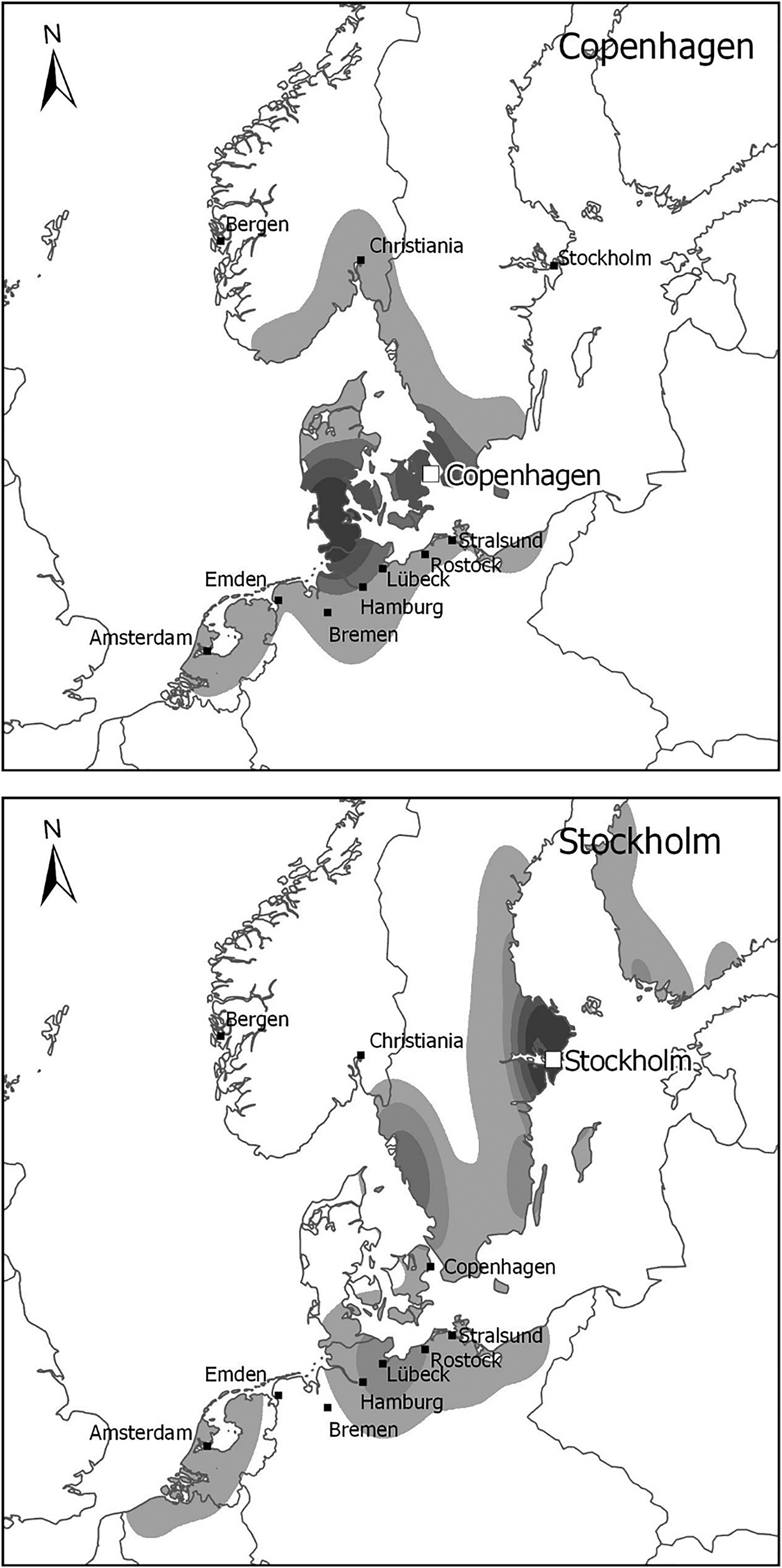
In the following section we will examine the origin of migrants and the way in which these patterns changed over time. Figure 1 serves to help illustrate the general patterns of migration and to assess the attraction of Copenhagen and Stockholm. Colloquially called a ‘heat map’ – the technical term is kernel density map – the two maps show the key regions of origin for crews aboard vessels originating from the two cities during the eighteenth century. The darkest areas reflect the regions with the highest concentrations of migrants, the lighter areas are still important regions of origin for migrants to the respective cities, but had lower concentrations of migrants. Migrants also hailed from areas outside the highlighted regions, though in smaller numbers.
Kernsel density map (‘heatmap’) of the origins of sailors from Copenhagen and Stockholm across the eighteenth century.

The maps provide a number of insights into the migration patterns of workers in both fleets. First, Figure 1 confirms the largely rural character of the migrant force. A key characteristic of labour migration in early modern Europe is that it occurred mainly between rural and urban localities.Footnote 26 Relatively high natural growth levels in the countryside created a large supply of labour, often too large for a rural economy to absorb, making economic opportunities scarce and wages comparatively low.Footnote 27 At the same time, as discussed above, due to the combination of high mortality levels and increased economic activity, urban centres’ demand for workers often exceeded supply, which in turn led to higher wages. This demographic and economic imbalance between rural and urban regions facilitated migration from the first to the latter. The same principles applied in the maritime labour markets of early modern Stockholm and Copenhagen.
The maps, which depict the key urban cores in northern Europe, demonstrate that migrants mainly hailed from rural areas. Within Denmark, Copenhagen chiefly attracted migrants from sparsely populated areas in Jutland and from the islands of Læsø and Bornholm, islands with relatively small populations.Footnote 28 The Stockholm hinterland was similar. Most migrants who came to Stockholm originated from rural maritime areas within the modern borders of Sweden, in particular from the region around Stockholm, but also from Skåne. Finally, migrants moving to either city were almost without exception from maritime regions. Across the century, the mariners – native and migrants – sailing from either Copenhagen or Stockholm came from maritime regions in 96 per cent of cases. Through their origins in maritime communities, migrants possessed high levels of maritime knowledge, making them much sought after in the receiving economies.
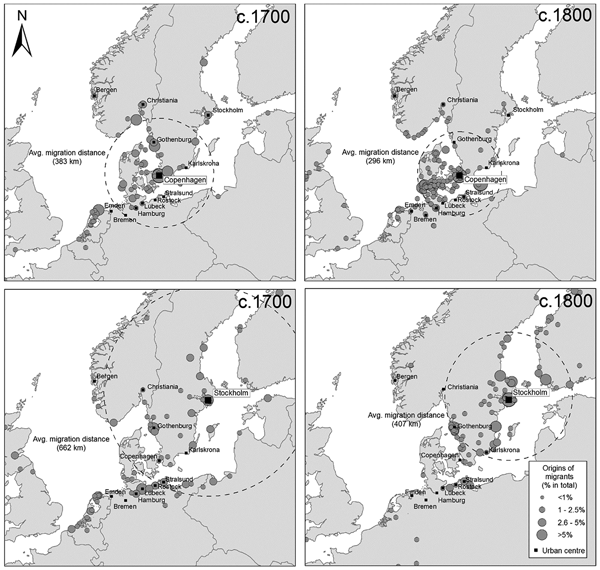
The maps also show that Stockholm and Copenhagen attracted, in particular, migrants from within the confines of their respective national borders, as Captain Scheel’s deposition already indicated. However, foreign migrants also played an important role aboard ship. With regard to foreign-born migrants aboard Copenhagen ships, the maps show, not entirely unsurprisingly, that Norwegians, in particular from the Christiania (Oslo) area, found their way to Copenhagen. Copenhagen ships, however, also sailed with crews from northern Germany, with sailors often coming from the regions around the North German towns of Altona, Hamburg and Bremen. The maps show that the former Danish possessions in Skåne were also important recruitment areas. In the case of Stockholm, foreign migrants came in particular from their ‘overseas’ possessions: Finland and Swedish Pomerania.Footnote 29 In Finland it was particularly the Åbo region (present-day Turku) that sent workers to Stockholm.Footnote 30 The Pomeranian sailors who found their way to Stockholm came from the maritime towns (or their environs) such as Wolgast, Szczecin, Wismar and Stralsund. Swedish Pomerania experienced a shipping boom during the eighteenth century. A contemporary estimate of the importance of shipping stated that one fourth of the 100,000 inhabitants of Pomerania were fed directly from the profits of shipping.Footnote 31 These developments are reflected in the change of hinterland for both cities, as seen in Figure 2.
Origins of sailors sailing from Copenhagen and Stockholm, c. 1700 and c. 1800.

Figure 2 further indicates the changes to the character and origins of migrants. The figure shows a connected labour market in the North Sea. The concept of a heterogeneous region connected by bodies of water was most prominently argued by Fernand Braudel in his genre-defining The Mediterranean and the Mediterranean World in the Age of Philip II, and in the literature on migration, particularly labour migration, contiguous bodies of water have long been perceived as highways of exchange and mobility.Footnote 32 In the beginning of the century, both Stockholm and Copenhagen drew on a more diverse hinterland than was the case at the end of the century. Each grey dot represents the alleged birthplace of a mariner and the size indicates the percentage of migrants from that location, while the circle with dashed lines indicates the extent of the average migration distance from birthplace to the capital city. Migrants came from further afield in the early period, for Copenhagen it was an average of 383 km and for Stockholm 662 km, which made for an eclectic labour market. Sailors in Copenhagen for instance came from Ameland in the Netherlands, Altona in present-day Germany and Halland in Sweden, while sailors in Stockholm came from Vaasa in Finland, Rostock in Germany and again from the Dutch (or Frisian) island of Ameland. The connection to the Dutch Frisian islands was important for both cities in the beginning of the century. A number of different forces were probably in play to create this pattern. The Great Northern War meant that more native and local sailors were pressed into the navies on either side of the sound, meaning the merchant navies had to recruit from further away. Similarly, the strength of the Dutch economy, in particular, made it an attractive prospect for sailors in Southern Jutland to try their luck there rather than in Copenhagen.
5. Migrant characteristics
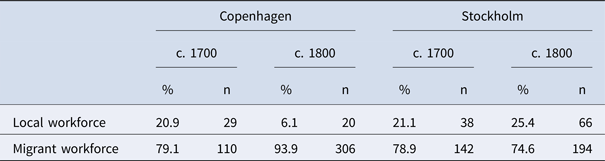
The outline of the two migration systems in the previous section emphasised the importance of labour migrants in the shipping sector of Copenhagen and Stockholm. In the remainder of this article we will zoom further in on an important section of the mobile labour force, namely those migrants, native and foreign, who moved from rural areas to the two urban centres. That this was a sizeable group is demonstrated by Table 1, which presents the ratio of mariners born in Copenhagen or Stockholm and those born in rural, sometimes foreign, towns outside of the metropoles at the beginning and end of the eighteenth century.
Share of local and migrant workers in the shipping sector of Copenhagen and Stockholm, c.1700 and c. 1800

Source: Prize Papers Dataset.
Table 1 shows that aboard the Stockholm merchant fleet at the beginning of the eighteenth century, roughly 79 per cent of mariners were born outside of the city. In Copenhagen this figure was almost exactly the same, though slightly higher. Copenhagen's reliance on migrant labour continued throughout the century and the difference between the two cities grew. Around 1800, 94 per cent of Copenhagen mariners were born outside of the city while the number of migrants in Stockholm's merchant fleet decreased to circa 75 per cent. The slight decrease in migrant participation coincided with Stockholm's general stagnation and the concomitant rise of Gothenburg. However, in both instances the percentages indicate how important migrants were for driving the shipping sector forward. Moreover, it shows how the high demand for workers and relatively high wages in the two cities exerted a strong pull on (potential) maritime workers for the duration of the eighteenth century. Next, we will dissect the characteristics of the maritime population to better understand the composition of the shipping sectors and the migrants’ qualitative impact on the recipient economies.
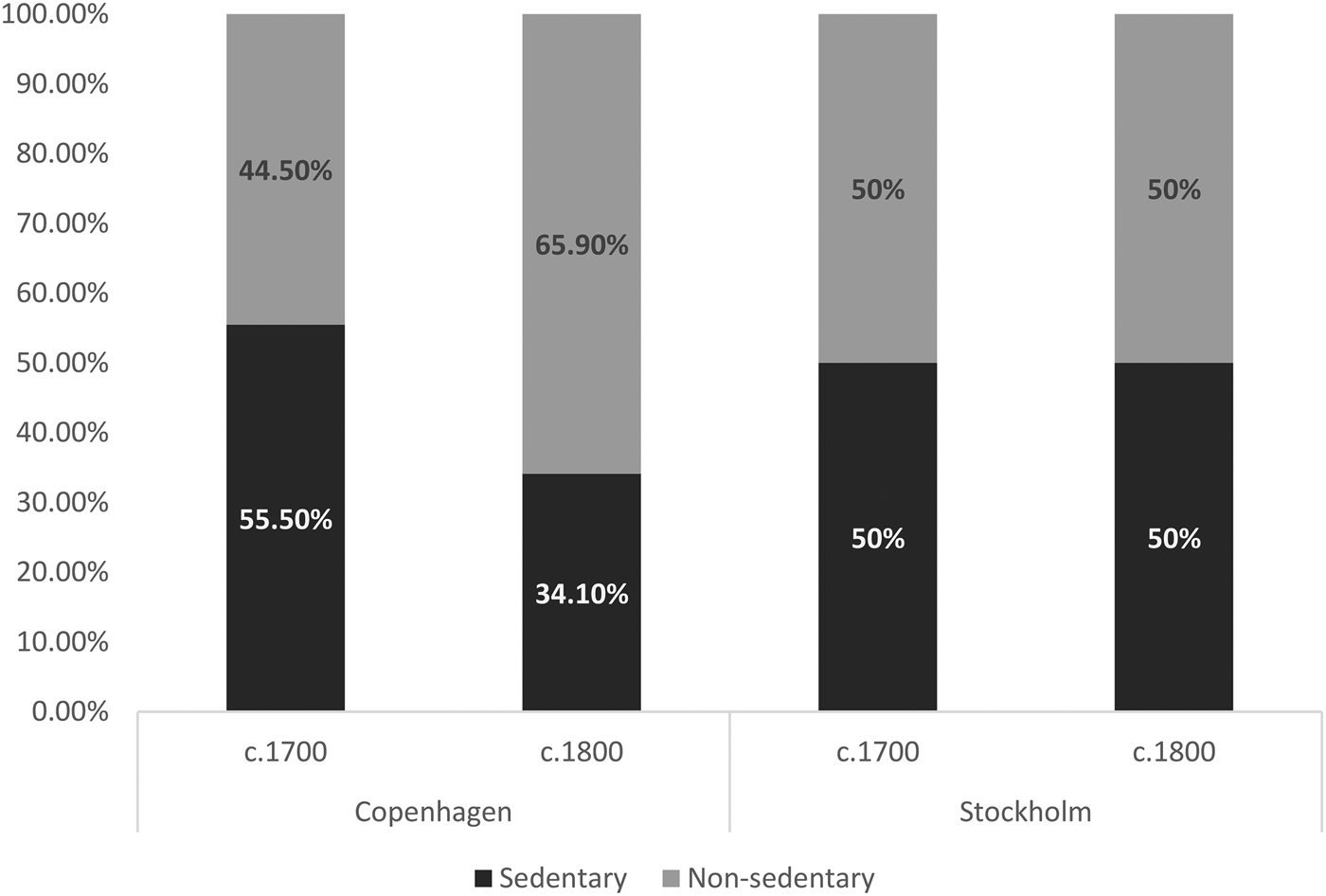
Migrants were important workers in the shipping sector in both capitals across the seventeenth century. As seen in Table 1, around the year 1700 79 per cent of mariners in the database had moved to both Copenhagen and Stockholm; for the later period the numbers are 94 per cent and 75 per cent, respectively. Migration to either city was in other words of great importance throughout the eighteenth century. Figure 3, however, demonstrates some central differences between the two Nordic capitals across the century. Copenhagen experienced a very clear shift in the composition of the migrant workforce. In the early period, the majority of the migrants who participated in the labour market settled in Copenhagen. In the later period, this shifted towards the majority of migrants participating in the Copenhagen labour market being non-sedentary. Stockholm experienced a different trend, with exactly the same percentage of sedentary and non-sedentary migrants settling in Stockholm across the century.
Percentage of different migrant types in Copenhagen and Stockholm's shipping labour force.

Around the year 1800, the patterns changed and more non-sedentary migrants came to Copenhagen to work. At that point, 62 per cent of the sedentary migrants were from rural parts of Denmark, in particular from the tiny island of Bornholm. The non-sedentary migrants also increasingly came from Denmark, with 48 per cent of them born in rural Denmark. A number of these also came from Bornholm, but the vast majority (24 per cent of all non-sedentary) came from Southern Jutland: Aabenraa, Ballum and Haderslev in particular. The change not only indicates a clear dependence on migrants, but also changes to the hinterlands on which Copenhagen relied. Furthermore, Southern Jutland, in particular Flensborg and the surrounding region, experienced a growth in tonnage during the latter part of the century, which meant more hands in the shipping sector, a number of whom ended up in Copenhagen.Footnote 33 The increase in non-sedentary migrants in Copenhagen resembles the increase of non-sedentary migrants in the Netherlands during the same period.Footnote 34 What this likely indicates is a more competitive market: the migrant obtained more advantages by not settling permanently. Maintaining a home in the Wadden Sea area, for instance, meant that a sailor would be in close proximity to both Hamburg and Amsterdam, presenting them with the possibility to pursue opportunities there at short notice if the market in Copenhagen were less favourable.
Stockholm developed in a markedly different way from Copenhagen. When compared, it appears that there was no change in the composition of the migrant workforce across the century. Unlike Copenhagen, Stockholm had no clear uniform hinterland; no single area constituted a majority. Instead North and South Sweden alongside Germany, Poland and Finland were the home regions of the mariners. Due to produkt plakaten and other rules, sailors could only operate from certain cities, which in turn produced a greater diversity of internal migrants in the shipping sector. In the latter part of the eighteenth century, 60 per cent of the sedentary migrants came from different places in Sweden, and 70 per cent of the non-sedentary migrants were from Sweden. They made the move from the rural areas to Stockholm in order to further their careers. In a similar way to the early period, sailors did not hail from a specific region, with the sedentary migrants generally coming from coastal villages and towns south of Stockholm. The non-sedentary migrants, however, showed a clearer pattern. They came increasingly from Gothenburg and the surrounding towns like Kungsbacka, Onsala and Uddevalla. While Stockholm was stagnating, Gothenburg grew and this development expressed itself in the increase in sailors from that region.Footnote 35 Though the ratio of sedentary to non-sedentary remained unchanged, the composition changed, as did the hinterlands.
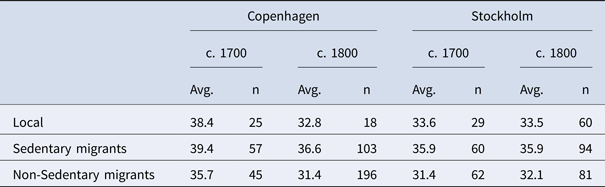
Following the compositional and geographical breakdown of migrant participation, it is necessary to examine further characteristics of the participants in the shipping sector. Besides geo-political and economic reasons for working in either Copenhagen or Stockholm, life cycles and tradition also influenced mariners’ mobility.
The non-sedentary migrant type became more dominant in Copenhagen, while the ratio remained the same in Stockholm. Examining the average age of the mariners illustrates a similar story. Table 2 shows some clear differences between the two capitals and the two workforces. Mariners on Copenhagen ships across all three categories were considerably older in the beginning of the century compared to those in Stockholm in the same period. The relatively high ages of Danish mariners could be due to the Great Northern War and the disturbances in the markets it created. That the Swedish were younger should be seen in the light of the inactivity of the Swedish navy in the same period, meaning more sailors were free to join the mercantile fleet.Footnote 36 In a sample of the sailors in Copenhagen in 1787, H. C. Johansen found that 75 per cent of the sailors were below the age of 30, and argued that this should be seen as an indication of it being normal to retire from the sea around the age of 40.Footnote 37 These findings are in line with Jaap Bruijn's, who concluded that during the period 1570–1870 the average European sailor was below the age of 30.Footnote 38 Our findings, by contrast, indicate a particular Scandinavian variation of work cycles, and Table 2 adds geographical and periodical nuance to these existing studies. Again, it is clear that the two Scandinavian capitals developed differently from one another and diverged from other European patterns.
Average ages of mariners according to the Prize Papers Database, c. 1700 and c. 1800.

Source: Prize Papers Dataset.
The relatively high age of sedentary migrants was a common feature for both cities. This indicates that the migrants’ decision to move permanently was done later in life. Moreover, the age alludes to the possibility that they had previously been non-sedentary migrants. It is very likely that they participated in the labour market in the town where they settled before they moved there permanently. Similarly, the non-sedentary migrants were younger on average in both cities, in particular in the latter part of the century, suggesting that they were elsewhere in their life cycles and not able to settle down.Footnote 39 The age differences demonstrate the multi-faceted nature of the labour markets in Stockholm and Copenhagen, and points to similarities in the two labour markets. Towards the end of the century, when Copenhagen prospered and Stockholm stagnated, the participants in the all-important shipping sector showed similar tendencies regarding age and distance travelled. Mariners’ average age was related to both marital status and skill level, which explain any major divergences between the cities and between the different types of mariners.
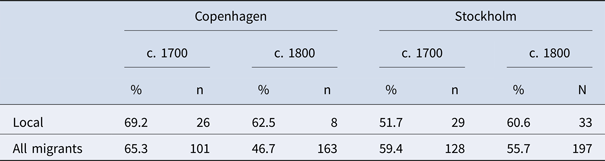
Jürgen May, the 30-year-old steersman of the St Maria of Stockholm, was interrogated alongside his crew by the British in 1704. At this point in his life, Jürgen was married and lived with his family in Lübeck, but the other crewmembers presented themselves as single. Despite this, the common archetype of the single sailor is not supported by our data. Rather, Table 3 nuances the image, showing how a large percentage of mariners were married during the eighteenth century.Footnote 40 This is an important insight into a vital labour force in early modern Europe. A trend that stands out in the table concerns the relationship between migrant and native. In both capitals, the trends seemed similar, though the change was more dramatic in Copenhagen.Footnote 41 There was very little difference between native and migrant in Copenhagen around 1700; both were likely to be married, indicating little difference between the different participants in the labour market at this point.Footnote 42 By the beginning of the eighteenth century, native sailors were the most likely to be married in both cities, but migrants were not far behind. This seems to indicate that there was a somewhat negative correlation between mobility and nuptiality. Marriage fell later in the rural migrant's life cycle than their native urban counterparts in the beginning of the century, or they did not marry at all.Footnote 43
Proportions of mariners in the Prize Papers Database who were married, c. 1700 and c. 1800.

Source: Prize Papers Dataset.
The difference between native and migrant changed notably towards the end of the century. Both natives and migrants were less likely to be married than had been the case earlier in the century. The decrease in married native mariners, however, was more dramatic than that of the migrants. The lower nuptiality rate is connected to the lower average ages of the mariners at the end of the century, but the decrease seems proportionally larger than the mariners’ lower ages explored in Table 2. Changes in both the rural and urban, or, sending and receiving economies, could facilitate these differences, but it is unclear exactly why the percentages of married sailors drops so drastically in the latter half of the century.Footnote 44 At the end of the century there was little difference regarding nuptiality between Stockholm and Copenhagen. Mariners in both cities were less likely to be married, which, to some extent, corresponded to the lower average age. Similarly, the shift in hinterland can also be an important reason for the change in marriage patterns.
As we saw in Figure 2, at the beginning of the seventeenth century Copenhagen relied heavily on migrants from Bornholm, while at the end of the eighteenth century it had come to rely more on migrants from Southern Jutland. Similarly, Stockholm changed from drawing migrants from a number of places to attracting sailors originating from the area surrounding Gothenburg. The changes in primary hinterlands were central in changing other patterns as well. Even though the differences between Gothenburg and the towns in Southern Jutland were palpable, they had one thing in common during the latter part of the eighteenth century: a booming economy.Footnote 45 This seems to indicate a link between the ages of mariners, their geographical origin and positive economic development. The story of Stockholm and Copenhagen cannot be understood without also acknowledging changes in the hinterland, and general investments in human capital in Sweden and Denmark.Footnote 46
6. Migration and human capital
Commentators and economists were acutely aware of mariners’ importance in furthering the shipping sector and thus the economy at large. The English commercial commentator John Bland, writing in the 1650s, noted that all of England would benefit from investing in trade and exploration. An increase in exploratory voyages would ‘infinitely improve the Art of Navigation and knowledge of Sea men and Sailors’ and ‘It will breed most able knowing Mariners.’Footnote 47 When returning from the Netherlands, William Temple, statesman and former English ambassador to the Netherlands, observed that the Dutch success was not built on native commodities, but rather on industriousness. Like so many other commentators, he heralded Dutch shipping and their seamen or, as they were commonly called by contemporaries ‘the common Carriers of the World’ as the driving force of the Dutch economy.Footnote 48 Later, in his 1680 Miscellanea, Temple noted that Sweden was growing ever stronger in northern Europe. According to Temple the fundamental change was a Swedish ‘Application of late years to trade’, which increased their shipping and improved their seamen, something that had previously been their weak side.Footnote 49 Temple saw a clear link between prosperity and the development of their shipping sector, especially the improvement of their sailors. A few years later, when underlining the importance of increasing shipping, the English mercantilist Josiah Child remarked that sailors were highly mobile ‘Inhabitants of the Universe’ and would ‘resort to the best Pay and most constant Employment’.Footnote 50 Thus, in order to prosper commercially it was necessary to attract the best sailors available.
The economic significance of having a skilled pool of seafarers was of course also recognised in Scandinavia. For instance, Frederick I of Sweden's government issued the statement that all mariners in the navy should submit a list of merits in 1732, so that the Admiralty could choose the most capable persons for the vacant positions.Footnote 51 The acknowledgement of the importance of skills and experience favoured sailors with high levels of human capital. The importance of human capital on board the ships was also underlined by the educational mechanisms in place on board the vessels. It was not uncommon to receive education aboard the ships – the Danish East India Company even offered an economic reward to the crewmember who was charged with teaching the boys.Footnote 52 In order to rise through the ranks in the merchant marine, it was necessary to be able to read the compass, make calculations of time based on the sun and keep a journal correctly. In both the Netherlands and Denmark, membership of the navigators’ or skippers’ guild could further a career considerably and both literacy and numeracy were important to achieve this membership.Footnote 53 Among the many documents confiscated by the English and British privateers were a large number of educational texts and handwritten copies of the most widespread contemporary textbooks on navigation. Dutch books and technical manuals on navigation spread throughout northern Europe from the 1660s and onwards when Claes Hendricksz Gietermaker published a manual on navigation and later, in 1702 with Klaas de Vries's Schatkamer of Konst der Stierlieden.Footnote 54 The ability to read and write was of great importance in the mercantile fleet, and as such, it was a sought-after trait among mobile migrant sailors.
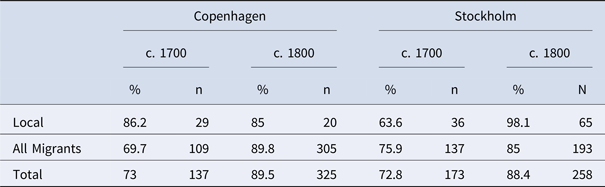
To measure human capital levels we have used mariners’ signatures on legal documents (the interrogations) as a proxy for literacy.Footnote 55 In Table 4, ‘local’ refers to the people born in either city, while ‘all migrants’ refers to both sedentary and non-sedentary migrants. Table 4 illustrates an increase in literacy for both local and migrant sailors between the beginning and the end of the eighteenth century. Compared to other sailors, migrant mariners in Stockholm did not improve as markedly across the century, but levels increased nonetheless. In particular the local sailors improved in Stockholm, which, given that the migrant labour force dwindled in the latter part of the eighteenth century, should be seen as a result of investments in human capital.Footnote 56 The literacy rate was generally at a quite high level from the beginning of the century, and remained high across the century.
Proportion of sailors in the dataset who could sign their names.

Source: Prize Papers Dataset.
Two features of the table indicate the different economic trajectories of the capitals: migrants’ improvement in Copenhagen, and the locals’ improvement in Stockholm. In both cases they improved significantly, but from apparently very low starting points. The use of marks instead of signatures is one of the explanations for the apparently low levels of literacy early in the century for migrants in Copenhagen and natives in Stockholm. Instead of an actual signature, the sailor would put down a mark more elaborate than a mere cross (could be an anchor, a cannon, a house), which was traditional in much of Scandinavia at the time.Footnote 57 The use of a mark declined over the course of the eighteenth century, but it was not drastic enough to explain the improvements in percentage of people signing. In other words, the increasing frequency of signatures cannot be explained by a decrease in the use of marks alone and suggests that more sailors were in fact able to sign their names as well as choosing to do so.
The levels of human capital of Copenhagen sailors increased more than their Stockholmian counterparts across the eighteenth century. When Table 4 is combined with Table 1 (depicting the percentage of migrants in the workforce), it is clear that the quality of Copenhagen migrant sailors improved the most across the century. Ninety-four per cent of mariners in Copenhagen around 1800 were migrants, on average 90 per cent of these were literate, while in Stockholm 74 per cent were migrants with a literacy rate of 85 per cent. Taking into account earlier research that showed a clear positive link between human capital levels of crews, and the level of productivity of the ships they sailed on, suggests that the improvement in human capital of Copenhagen crews was central in enhancing the local shipping industry, and is thus likely to have contributed to the economic boom in the Danish golden age or florissante periode in the latter part of the century.Footnote 58
The changing migration patterns in the Copenhagen labour market confirm research on the Dutch maritime labour market, which relied to a large extent on German, but certainly also Scandinavian (in particular Danish), seamen. Contrary to the Copenhagen experience, human capital levels of immigrants fell during the latter part of the eighteenth century in the Rotterdam and Amsterdam labour markets. This was chiefly the result of labour markets like that of Copenhagen being able to retain potential migrants to the Dutch Republic.Footnote 59 Increasingly, instead of migrating internationally, qualified seamen chose to move within the national labour market or, in the case of international migrants, chose Copenhagen over a city like Amsterdam. Although Dutch core cities such as Rotterdam and Amsterdam, like Copenhagen, relied on migrant workers, the Dutch hinterland had always been much larger and therefore more international than the Copenhagen labour market would ever become. As a result, the Dutch maritime labour market was much more vulnerable than the chiefly national migration field that Copenhagen possessed by the end of the eighteenth century.
In Copenhagen, literacy levels for both natives and migrants improved by more than 10 per cent, whereas the average level (natives and migrants combined) of 89 per cent meant that the merchant marine in Copenhagen had one of the highest levels of human capital in the late eighteenth century in Europe.Footnote 60 In the wake of the Great Northern War, the Danish state and Christian VI invested in schooling and education in rural areas so that all children would be schooled until they could read a book and knew their catechisms.Footnote 61 Anecdotal evidence of the importance of these schools can be found in some of the interrogations. For instance, when the ship Jomfru Anna Maria was dragged into Newcastle-upon-Tyne in September 1794 en route from Bordeaux to Copenhagen the crew was interrogated according to the regulations. All of the crew were from Schleswig-Holstein, specifically the town of Ballum, though they were working from Copenhagen. Regarding his relationship to the master, the boatswain Hans Michelsen Brink answered that Niels Lorensen was the master ‘who he has known long, having been school fellows’.Footnote 62 The investment in education by the Danish state had increased the levels of human capital in its maritime labour force, giving Copenhagen a competitive edge in Scandinavia in the ever-changing economic landscape.
7. Conclusion
The 30-year-old master Alexander Malcolm was on his way from Königsberg, present-day Kaliningrad, to Barcelona when his ship, the Three Sisters of Copenhagen, was seized by a British privateer and dragged to London in April 1794. The nine-man strong crew was transporting grain from the Baltic to the Spanish markets, but the British authorities suspected that the vessel really was going to enemy ports in France and therefore viewed it as a lawful prize. When interrogated, Malcolm stated that all members of the crew, except one, were Danish. They had all mustered at Copenhagen six months previously. However, on closer inspection, none of the three interrogated mariners had been born in Denmark. The master, Alexander Malcolm, was born in Kirkcaldy in Scotland and had only been in Copenhagen one year. In that one year, he had managed to marry and become a burgher of Copenhagen. According to his deposition, he had married the 41-year-old Alison Bishop before leaving for this journey. Bishop was the sole owner of the vessel and a native of Leith, Scotland, but she too had resided in Copenhagen for a number of years and had in all probability married Malcolm there.Footnote 63
The Three Sisters seems to have been a Scottish concern, but the rest of the interrogated mariners represented other parts of northern Europe. The 42-year-old mate, Just Hendrick Roer, claimed to have been born in Kongsberg, Norway, a small village roughly 40 kilometres from the busy port of Drammen. He had moved to Copenhagen six years previously and viewed Copenhagen as his place of residence. The final person interrogated was the ship's carpenter, 44-year-old Franz Christian Hansen from Flensburg. According to him, he had lived there all of his life and still viewed it as his place of residence. Both mariners had known the master for six months when they were seized by the British, so it is possible that this was a one-time engagement, pointing to the ad hoc nature of some of these ventures. The shipping sector, in particular in Copenhagen, relied on highly mobile skilled migrant sailors and consisted of people from all over northern Europe.
As the cases of the Three Sisters of Copenhagen and St Maria of Stockholm indicate, Copenhagen and Stockholm depended on migrant labour, particularly in the shipping sector where individuals moving to the city for work constituted the majority of people across the eighteenth century. People migrating to the cities were integral in shaping economic growth and increased the competitiveness of both cities. The hinterlands from where the two capitals drew their sailors changed significantly across the century. The sailors in Copenhagen were younger and less likely to be married in the later period, indicating changes in the city's hinterland and in how working in the capital fitted into a sailor's lifecycle. Mariners in Stockholm were also younger by the eighteenth century, but the nupitality rates and higher reliance on local labour indicate that the sailors quite literally were more sedentary in Stockholm.
At the turn of the eighteenth century, Stockholm attracted far fewer migrants than at the beginning of the century. Conversely, ships from Copenhagen were, like the Three Sisters, almost completely manned by sailors born outside of the city. The boom Copenhagen experienced during the American War of Independence through trading under a neutral flag attracted non-sedentary mariners like never before. In both cities, migrants in the later period came from what can be referred to as the second city, or the second maritime area. This indicates a higher level of tacit maritime knowledge, but in the case of Copenhagen also an increase in measurable human capital.
The repealing of the Swedish navigation act and resulting rise of a second city, Gothenburg, conversely contributed to stagnation in Stockholm itself. Instead of attracting migrant workers, Stockholm relied on an improved native labour force. However, when keeping the high mortality levels of Stockholm in mind, that reliance could possibly create problems down the line. Both the quantity and quality of the migrants flowing to the two capitals differed slightly throughout the century; the small differences were central in improving the economy of Copenhagen. Northern European mariners generally possessed high levels of human capital, and Scandinavia had some of the highest. By the latter half of the eighteenth century, there was a clear improvement, in particular in Copenhagen, but Stockholm was not far behind. The increasing quality of migrant workers alongside the positive economic growth is suggestive, and the existing literature could indicate a strong link between the increase in skill level among the all-important migrant mariners in Copenhagen and the positive economic development during the florissante periode. Arguably, there were two ways of improving the labour force in the shipping sector. One was by state investment in human capital, which in turn could increase the level of human capital. Another was by attracting skilled workers from outside of the cities. In order to accomplish that it was necessary to pay increasingly high wages, but even that could not guarantee successful attraction of workers. A combination of the two, which Copenhagen seems to have experienced, would ensure the steadiest gain.
The economies of Denmark and Sweden consisted of multiple sectors during the eighteenth century. The shipping sector was but one of many elements shaping the economy. Regarding the shipping sector, close attention has in particular been given to the value of exports, tonnage and emerging markets, but the developing labour markets and the mobile sailors have generally been overlooked, in particular in the Scandinavian context. Recent research has shown a correlation between increasing human capital and the performance of the economy in the Netherlands, hinting at the possibility of a larger pattern in north-western Europe. Following these tendencies, this article has given an indication that there was a link between increasing human capital and economic growth and productivity in Scandinavia, just as there was elsewhere in northern Europe.
Acknowledgements
The work underlying this article was made possible by a grant from the Economic and Social Research Council (ESRC) (RES-062-23-3339: ‘Migration, human capital and labour productivity: the international maritime labour market in Europe, c. 1650–1815’) and from the Carlsberg Foundation (CF17-0377: ‘Women and the company: female agency in global trading companies, 1600–1800’).