In a mural entitled The History of Mexico at the National Palace in Mexico City, Diego Rivera depicted revolutionary Emiliano Zapata holding a long red banner that reads ‘Land and Liberty’.Footnote 1 Few realise that Zapata's famous 1911 manifesto, the Plan de Ayala, ended not with this widely popular slogan but, instead, with ‘Justice and Law’.Footnote 2 What did the famous revolutionary leader, his military chiefs, local authorities and villagers mean when they called for justice and law? What kind of society did they try to build during the brief time they were in control of Morelos, Guerrero and parts of neighbouring states? John Womack Jr's classic history Zapata and the Mexican Revolution depicted life in revolutionary Morelos as a rustic democracy where peasants peacefully cultivated the seized hacienda lands that they had distributed in an orderly fashion. Adolfo Gilly's La revolución interrumpida popularised the idea that revolutionary peasants in Morelos ‘applied an old pre-capitalist view of the world’ and ‘created an egalitarian society with communal roots’.Footnote 3 In this idyllic world, resolving land and water disputes was not necessary.
In the half century since the publication of these books, studies of the Zapatista movement have become an important subfield in the historiography of the Mexican Revolution, with scholars analysing archival sources unavailable to Womack and asking new questions.Footnote 4 Samuel Brunk's work in the 1990s is particularly important for understanding the Zapatista movement. Based on extensive archival research, Brunk challenged the idea that Zapatistas re-established a golden era of village harmony by showing widespread abuse of power by military chiefs, divisions within villages, violent disputes between neighbouring towns and tensions between political and military centralisation on the one hand and village autonomy on the other.Footnote 5 His scholarship has allowed others to question older, idealised notions of the Zapatista movement. And yet – without consulting the extensive archives that Brunk reviewed – scholars continue to characterise the Zapatista local forms of government, administration and justice as autonomous and based on the ‘traditional authority of the pueblos’ or usos y costumbres (customary justice).Footnote 6
In the last two decades, legal anthropologists have made important contributions to our understanding of how actors in rural Mexico (most often indigenous) use the judicial system and invoke the law. They find that usos y costumbres are not vestiges from the past, nor self-contained or separate systems distinguished from state law.Footnote 7 In rural Mexico, social actors move within a plural, multi-tiered and hierarchical justice system that begins with local forms of conflict resolution at the village level, followed by municipal authorities and judges, judicial district courts, superior state courts and the Supreme Court of Justice. Adopting Boaventura de Sousa Santos's concept of interlegality, these scholars show not only that customary justice and state law ‘are complexly interrelated and mutually determining’, but that people mix different norms and procedures in everyday life.Footnote 8 Social actors do not necessarily perceive the different legal systems as separate and, when they do, they do not automatically favour local forms of conflict resolution over state offices and laws. Moreover, the interchangeable use of different types of legal systems and various levels of courts applies not only to contemporary Mexico; there are also many examples of indigenous men and women in the nineteenth century taking their claims beyond the village justice system to municipal judges, first-instance (or district) courts and even the Supreme Court.Footnote 9
Social historians of nineteenth-century Mexico have also found that village leaders did not necessarily strive to preserve ‘ancestral practices’. Instead, they showed a ‘vigorous capacity to adapt to the changing reality’, appealing to whatever laws best legitimated their claims at any particular time.Footnote 10 Village authorities manoeuvred not only between local forms of justice and state offices, but also between colonial and nineteenth-century Liberal laws, such as the promotion of personal liberties and the privatisation of corporate Indian lands. We find, among many other examples, village spokespersons filing amparo suits at the district level and at the Supreme Court to challenge ‘political and judicial dispositions they found arbitrary, illegal or unfair’,Footnote 11 and pueblo representatives using Liberal laws (intended to privatise communal lands) to recover usurped pueblo lands and water resources, legalise those without titles or win boundary suits against neighbouring towns.Footnote 12
Understanding how actors mix norms and procedures in daily practice (interlegality), together with a thorough review of available archival materials, sheds new light on long-held assumptions about Zapatista village autonomy. This is the theme of this article, which is based on a detailed examination of approximately 1000 villagers’ petitions, complaints and queries sent to the General Headquarters of the Liberating Army of the South and Centre (henceforth GH), as well as GH's directives and responses to these petitions during the height of the Zapatista land reform between the end of 1914 and 1916 – the period when the Zapatistas had consolidated their military power in the region and before Venustiano Carranza's army launched debilitating attacks.Footnote 13
These requests came from the Federal District (Distrito Federal, DF) and the states of Guerrero, Hidalgo, Mexico, Morelos, Oaxaca and Puebla (see Map 1). They concerned quarrels between individuals over small and medium-sized properties, the restitution of usurped pueblo lands and water resources and boundary disputes between two or more villages. In contrast to scholars who stress the primacy of communal authority and customary justice, I show that to resolve these conflicts over land and water, Zapatista leaders blended nineteenth-century judicial procedures and civil law, limited but radical reforms to the existing justice system and new forms of village-level land and water management – all of which strengthened the authority of the GH and the Zapatista Ministry of Agriculture.
Population Centres that Recognised Zapatista Authorities between 1914 and 1916.

Justice for Small and Medium Landowners
Like Zapata himself, many villagers in the territories under Zapatista control owned small or medium-sized properties and/or urban plots. In fact, once in control of the large multi-state region of south-central Mexico, GH received hundreds of petitions seeking resolution of conflicts over inheritance, sales, unpaid loans and theft. To settle these land claims, the Zapatista leadership tried to uphold existing state laws and institutions. Just as nineteenth-century state constitutions had made municipal officials responsible for the resolution of small property claims and district courts responsible for larger claims, Zapata and his officials instructed municipal presidents, regidores (aldermen or councilmen), síndicos (attorneys general), ayudantes (sub-municipal officials in population centres that were not cabeceras, municipal head townships) and state local and district judges to resolve individual land disputes ‘with complete justice’.Footnote 14 And, without intending to, GH ended up becoming a high court, advising judges on how to rule and reviewing the lawsuits brought to Zapata as a superior authority.
The Zapatista leadership reinstated many municipal and district courts that had been shut down during the fighting. From the available archival documents, we know that there were at least 52 (and probably many more) active judges and municipal officials dealing with small claims during this period in the areas the Zapatistas controlled (see Table 1).
Municipal Officials, Local Judges and First-Instance District Judges who Reported to Zapatista General Headquarters, 1914–16

Note: States are listed in order of the number of local officials and judges identified in the archival sources. Municipal officials at the ayuntamiento level who dealt with legal matters included presidentes, regidores and síndicos. Municipal officials in smaller population centres that were not the cabecera included the autoridad local and the ayudante municipal. ‘Barrio’ refers to a city's ward or neighbourhood. Because specific names of local judges varied by state, the Spanish-language terms employed here are those used in the Zapatista files. Jueces de primera instancia were first instance or district judges. All other Spanish-language titles are identified in the text.
From early on, GH tried to promote the autonomy of judicial authorities from the armed forces. In Puebla, for example, when a Jolalpan resident complained to GH that he had received a favourable ruling by the court that was subsequently reversed by the revolutionary chief in the area, he asked Zapata for the assurance, ‘as you have ordered, that no revolutionary intervenes in judicial or criminal matters’.Footnote 15 In Guerrero, GH told Xochihuehuetlán plaintiffs that ‘it is the juez menor who must resolve the matter of the land parcel, because he has jurisdiction over the matter’.Footnote 16 And in Morelos, when two Jojutla de Juárez residents fought over a land parcel, GH instructed the military chief to ‘entrust the case to the appropriate authorities’ and told the plaintiffs to take the matter to the court of first instance because ‘when civil authorities are operational, GH cannot hear matters within the court's purview’.Footnote 17
With GH's support, some judges defended their turf even against powerful Zapatista generals. In Puebla, for example, one Acatlán judge contradicted a sentence issued by General Dolores Damián. The case involved widow María Micaela López, who claimed to have inherited from her deceased husband a few irrigated and rainfed plots, which she had registered at the notary public as his surviving spouse. However, when General Damián's brigade took over the Acatlán region, two daughters and a son from the deceased husband's first union asked the general to grant them provisional titles, which he did. In response, López took her titles to Juan Olea, the Acatlán municipal judge, who certified her titles and marked the properties’ boundaries with neighbouring owners present, as ‘required by articles 1356 and 1362 of Puebla's Civil Code Procedures’. Olea then informed Zapata that he had ‘granted possession in the name of the Revolution headed by you [Zapata] and of the laws related to the matter’, arguing that ‘according to the Tribunals’ Organic Law, municipal judges could rule on voluntary and contentious matters when the amount did not exceed 100 pesos’. In this struggle between military and civil officials, GH backed the judge by responding that it approved his verdict and ‘all rulings that follow the Plan de Ayala in letter and in spirit’.Footnote 18
One reason why the Zapatista leadership tried to uphold civil law is that the Plan de Ayala's agrarian clauses incorporated key elements of nineteenth-century Liberal laws.Footnote 19 Article 6 allowed not only pueblos, but also ‘citizens’ who had titles to fields, woodlands (montes) and water resources whose properties had been unjustly seized to immediately reclaim them.Footnote 20 As in nineteenth-century civil law, under the Plan de Ayala property belonged to the person holding the title. For instance, in a dispute in Taxco (Guerrero) the municipal judge explained to GH that he had ruled in favour of the plaintiff because the defendant had ‘not presented the will of his deceased father, nor any document that could justify his legitimate claim to the property’.Footnote 21 Likewise, when Zapata ordered the Ozumba (State of Mexico) municipal judge to resolve a long-standing family dispute over a land parcel, he instructed the judge to follow Article 6 and rule ‘in favour of the party with legitimate titles’.Footnote 22 And when GH ordered the Xochihuehuetlán (Guerrero) judge, mentioned above, to act ‘with strict justice’ regarding a family conflict over an inheritance, justice meant respecting the private property of those with ‘legitimate titles’.Footnote 23
Villagers, most of whom were illiterate, employed scribes, tinterillos (legal agents without formal law accreditation) or knowledgeable neighbours (such as school teachers or former municipal officials) to compose their petitions to Zapata.Footnote 24 Women were the plaintiffs in at least half of the petitions involving individual property found in the archives consulted for this article. One question is whether the now-famous soldaderas (women in the military), who played multiple roles in the popular armies of the Mexican Revolution, influenced women's roles as plaintiffs. However, any connection between women's roles in the revolutionary armies and the empowerment of rural women regarding small property rights is difficult to substantiate.Footnote 25 Rather, women's active role as plaintiffs during this period was probably due to a combination of two historical precedents. First, as Robert Knowlton points out, the role of women as property owners in nineteenth-century Mexico ‘is a striking feature in both rural and urban real estate transactions … Although not always the case, women frequently obtained property by inheritance – from a parent, a spouse, even a deceased son.’Footnote 26 The archives are filled with examples of rural women (single, married or widowed) buying and selling both private and communal land parcels (previously privatised or not).Footnote 27
Second, as with nineteenth-century pensions for soldiers’ families, widows and orphans (fatherless minors) were part of the Zapatista consciousness.Footnote 28 The Plan de Ayala had justified nationalising the properties of the ‘enemies of the Revolution’ by promising to pay for war indemnifications and pensions for the widows and orphans of those who died fighting. These protections seem to have extended to property disputes. In the State of Mexico, for example, the Zacualpan municipal president informed GH that widow Carmen Cornejo was being dispossessed of a parcel by José Trinidad Rodríguez, her deceased husband's son from an earlier union. As Cornejo had two small daughters and Rodríguez identified himself as the legitimate son, the municipal president was ‘undecided as to what should be done, given that neither side has a property title in their name’. In response, GH instructed him ‘to resolve in favour of the minors, with the widow as the administrator; this would be fair because the son had received some property from the father in life, and because he has better chances of subsistence than the minors’.Footnote 29 Similarly, when war widow Rosario Pérez from Coatetelco, Morelos, told GH that her brother-in-law, Manuel Rojas, had taken what was legitimately hers and, when drunk, threw stones at her house, GH not only instructed the municipal president ‘to return to [the widow] a land plot with an adobe house, a bull, an ox and a small fraction of land situated next to the pueblo's lagoon’, but also ordered the Yautepec military commander ‘to set Manuel Rojas straight’.Footnote 30
Like the women mentioned above, villagers understood the Plan de Ayala to be compatible with existing civil laws and state institutions. Writing about Indian towns in late twentieth-century Mexico, Teresa Sierra points out that ‘Many aspects of life are affected by official laws, such as those on inheritance, land tenure registration, private contracts, formal elections, civil registration and civil marriage. Official laws constitute a frame of reference that people incorporate or manipulate in their daily lives.’Footnote 31 This also held for individuals seeking justice in the Zapatista regions in the early twentieth century, as illustrated in the next three cases.
In Morelos, for example, Nicolasa Puebla from San Andrés de la Cal combined her right under the Plan de Ayala to have her unjustly seized lands returned to her with the concept of civil marriage found in the civil codes. Puebla had inherited her deceased husband's lands and allowed her son to till them. But when her son also died, her daughter-in-law, Paula Cortés, refused to return the land titles. When Puebla's appeal to the municipal authorities in Tepoztlán failed, she sought the support of the new revolutionary authorities and sent a petition to GH's secretary, Manuel Palafox.Footnote 32 ‘In the name of the cause you defend’, Puebla asked for ‘justice against the aforementioned Paula Cortés’ and the restitution of her properties. In the appeal, she noted that her son and daughter-in-law had contracted an ‘ecclesiastical marriage’, thereby probably hoping to discredit her daughter-in-law given that at that time only a civil law marriage gave spouses inheritance rights.Footnote 33
In Guerrero, Manuela Beltrán from Achichintla combined the Plan de Ayala's land restitution principles with the legal position of legitimate and illegitimate offspring found in the civil codes. Beltrán explained to GH that she had inherited 34 pesos from her late father in 1879 and, with that money, she and her husband had bought an urban lot. When her husband passed away, she took a job as a live-in domestic servant, leaving her home and the titles to the property in the care of her brother-in-law. When her brother-in-law died, however, his ‘bastard grandson’ claimed that the property was his. In her letter to Zapata, she hailed ‘the dispositions found in Article 6 of the Plan de Ayala and your worthy and fair justice’ while also trying to discredit the grandson by characterising him as a ‘bastard’, aware that illegitimate offspring had fewer rights in civil law.Footnote 34
Finally, also in Guerrero, a petition from Margarita and Merced Alvarado from Tepecoacuilco combined Zapatista protections for the poor and downtrodden with the civil code concept of sociedad conyugal (marital community property). The Alvarado sisters informed GH that their father had passed away. As a widower, he had remarried, and his second wife had allegedly pawned his properties and livestock. Because the property had originally been brought to the sociedad conyugal by their mother, the sisters asked Zapata for the return of the property titles, ‘appealing to your renowned kindness in providing protection and help to all of us who have suffered’.Footnote 35
It is uncertain how these cases were finally settled. However, what is clear about small and medium-sized property disputes is that, rather than promoting local usos y costumbres, GH upheld civil law and the existing judicial system in the form of municipal and district courts and, in doing so, inadvertently became the final court of appeal in the Zapatista multi-state region.
Conflicts over Land Distribution
The Zapatista GH restored municipal and first-instance courts and upheld the civil codes to settle individual property disputes, but when it came to pueblo claims against haciendas, the leaders of this armed revolutionary movement sought to transform radically what they perceived to be an unfair and corrupt justice system that they believed had always favoured landowners. In the nineteenth century, village representatives taking neighbouring haciendas to court had to produce substantiating evidence that would shift proof of ownership away from the legal default position, according to which the defendant was the legal owner. In marked contrast, the Plan de Ayala inverted the burden of proof, allowing citizens and pueblos with land titles immediately to reclaim their property ‘weapons in hand’ (‘con las armas en la mano’).Footnote 36 The Plan de Ayala also anticipated that the claims of those previously in possession of the lands would be heard only ‘at the triumph of the Revolution’, once the Zapatistas could set up special tribunals.Footnote 37
Another way in which the Plan de Ayala challenged the existing judicial system was by stripping it of its longstanding jurisdiction over land restitution suits. In independent Mexico, pueblo land restitutions became a judicial matter and remained so until the 1910 Revolution. Early in the Zapatista multi-state region, villagers had to petition the Revolutionary Junta of the State of Morelos (GH's predecessor) for the restitution of their pueblo lands and produce their ancestral titles. The Revolutionary Junta would study the titles, issue a verdict and, when favourable, grant villagers permission to ‘enter into possession of the lands, woodlands and water resources that belong to them and have belonged to them since colonial times, upheld by the legitimate colonial titles of New Spain, today Mexico’.Footnote 38 However, as problems and challenges mounted and as the Zapatistas joined the Aguascalientes Convention government, the Ministry of Agriculture under Zapatista Minister Manuel Palafox began to take over land restitution suits.Footnote 39 Starting in late 1914, Palafox began hiring engineering students and graduates of the National School of Agriculture in Mexico City to staff agrarian commissions.Footnote 40 These commissions would review pueblos’ land titles and judge whether they had the right to land restitution.Footnote 41 The Ministry of Agriculture issued the final verdict.
Before issuing court-like sentences on property rights, the Zapatista leadership had to differentiate between pueblo land restitutions and grants made from expropriated hacienda lands.Footnote 42 In February 1914, Zapatista officials circulated a set of directives that began by explaining that ‘the lands will be returned to the villages and citizens who have the corresponding titles to their properties, as indicated by the Plan de Ayala, and the rest – the lands that are not the legitimate property of the enemies of the Revolution – will be subdivided and distributed in parcels to the pueblos which need them’.Footnote 43 Palafox explained that land distribution would be conducted according to ‘la costumbre y usos’ of every pueblo, depending on whether the pueblo preferred the ‘communal system’ or small private lots.Footnote 44 This is the famous statement that persuaded some scholars that villagers in the Zapatista region managed their land based on their customary justice. However, as much as the Zapatista leadership might have wanted to grant villages autonomy over the way in which they chose to administer restituted agricultural lands, pasturelands, woodlands and water resources, the situation turned out to be more complicated in practice. Restitutions (the return of former communal lands) and grants (the distribution of expropriated hacienda lands as individual parcels) were difficult to differentiate and became conflated in the term reparto (distribution). In Puebla, for example, workers on the Texcalapa hacienda in Santiago Petlalcingo identified themselves as ‘heirs to these lands’, but because they had no titles, Zapatista chiefs distributed land according to the hacienda's property perimeter rather than according to the pueblo's old boundaries – leaving it unclear whether this had been the division of expropriated property into individual plots or the restitution of usurped pueblo lands that could be managed in whatever way the petitioners chose.Footnote 45
In response to these uncertainties, the Ministry of Agriculture designed different policies for agricultural lands, woodlands and water resources. When it came to agricultural land (both irrigated and rainfed), Palafox's goal was to distribute property ‘with complete justice’, without favouritism (absentee fighters were also considered, so they too could receive land) ‘until the Ministry of Agriculture has placed in the hands of each one of these new landowners the title to their corresponding parcel’.Footnote 46 In order to do so, he issued instructions that echoed nineteenth-century Liberal privatisation guidelines almost to the letter. Land parcels had to be of equal value (in both size and quality) to achieve fair distribution; the distribution of parcels (repartos) had to be conducted by raffle in order to avoid favouritism; no one could acquire more than one parcel for the sustenance of a nuclear family; and those in charge of land distribution had to draw up a map of the allotted parcels with the names of the beneficiaries so that GH could inspect and authorise them. Once GH approved the map and declared that the distribution had been conducted justly and without favouritism, Zapatista officials would give each beneficiary a title. Titles would be provisional until ‘the Supreme Government that emanates from the Revolution’ (the federal government) confirmed them. Moreover, just as the nineteenth-century Liberal repartos contained temporary protections for Indians and the poor, the revolutionary repartos in Zapatista regions contained safeguards for villagers: land granted to villages or individuals could not be sold, all future sales contracts would be void, and property rights over land parcels granted by the government could be bequeathed only to a family member.Footnote 47
When it came to woodlands, Zapata was adamant about granting municipal authorities total autonomy. For example, in early February 1915 he reproached General Genovevo de la O for having meddled in the management of woodlands:
Under no circumstance should you prohibit the Ocotepec [Morelos] pueblo and its surroundings from cutting wood to sell to the railroad, because the objective of the Revolution is precisely to give possession to the pueblos of the lands, woodlands and water resources they were despoiled of, and if you now forbid them to make whatever use of these resources that they deem appropriate, not allowing them to cut wood and use its product for the sustenance for their families, that is equal to betraying the Revolution by trampling on its ideals.Footnote 48
Palafox, on the other hand, wanted the Ministry of Agriculture to control excessive tilling and preserve woodlands for future generations. In one instance, in response to news that in many pueblos villagers had destroyed the montes, he instructed Metepec's (Morelos) municipal authorities to inform villagers they should utilise the woodlands ‘with moderation, meaning those engaged in felling should cut only mature and well-developed trees, protecting younger ones, and replanting new ones so that the monte is not destroyed’.Footnote 49 Moreover, the 26 October 1915 agrarian law declared montes national property, ‘of which the Ministry of Agriculture will be in charge of inspection in the form it determines and which will be exploited in communal form by the pueblos to whose jurisdiction they belong’.Footnote 50
The management of water resources, which were often as important as land, also became centralised.Footnote 51 At first, military chiefs and municipal officials oversaw the administration of water resources. The task was complicated because municipal officials had to share water resources not only with all population centres within their territorial jurisdiction with some level of equality, but also with the haciendas operated by the Zapatista chiefs. In Morelos, for example, when General de la O gave the Miacatlán municipal president access to water ‘for all villagers’, the local official had not only to manage three different water resources, but also to share them with the Miacatlán hacienda.Footnote 52 Similarly, when the Cuentepec municipal auxiliary petitioned the Miacatlán municipal president to grant the villagers land, he replied that it would not be possible because he had already distributed most of the lands to the cabecera and there was not enough water to irrigate more land parcels. If he were to distribute more lands, he would have to take water from the Miacatlán cabecera, leaving most residents there without enough water to irrigate their reparto lands.Footnote 53 As problems such as these mounted in the Zapatista region, the Ministry of Agriculture issued a ruling declaring ‘all water resources national property regardless of their use.’Footnote 54 Yet equitable distribution of water was still difficult even for trained engineers. For instance, when the agrarian commission distributed water from the Popocatépetl volcano's annual ice thaw to several villages, they sidestepped the Nepantla (Mexico State) and Atlatlahucan (Morelos) pueblos, whose representatives then complained to Palafox.Footnote 55
Because of ongoing complaints about favouritism, corruption and abuse of power in the management of repartos, the Zapatista leadership wanted to ‘create a special authority with well-defined faculties and obligations to be exclusively in charge of representing and defending the pueblos’ rights to lands, woodlands and water resources’.Footnote 56 What kind of authorities would these be? We know that these representatives had to be elected in an assembly at the municipal or village (sub-municipal) level. In Morelos, when in April 1915 Colonel Félix Pacheco asked permission to distribute land temporarily in Cuautla – until the agrarian commission arrived – GH responded that ‘the pueblo or pueblos should name in an assembly the person or persons in charge of distributing tillable land that agricultural year, to avoid difficulties with the residents and so that revolutionary chiefs do not favour specific persons and fellow soldiers’.Footnote 57 And in Metepec (Morelos), the municipal agent brought together residents to nominate the ‘representative of the pueblo for all agrarian matters’ – if possible, one who could read and write so that he (and they were all men) could personally sign the required paperwork.Footnote 58
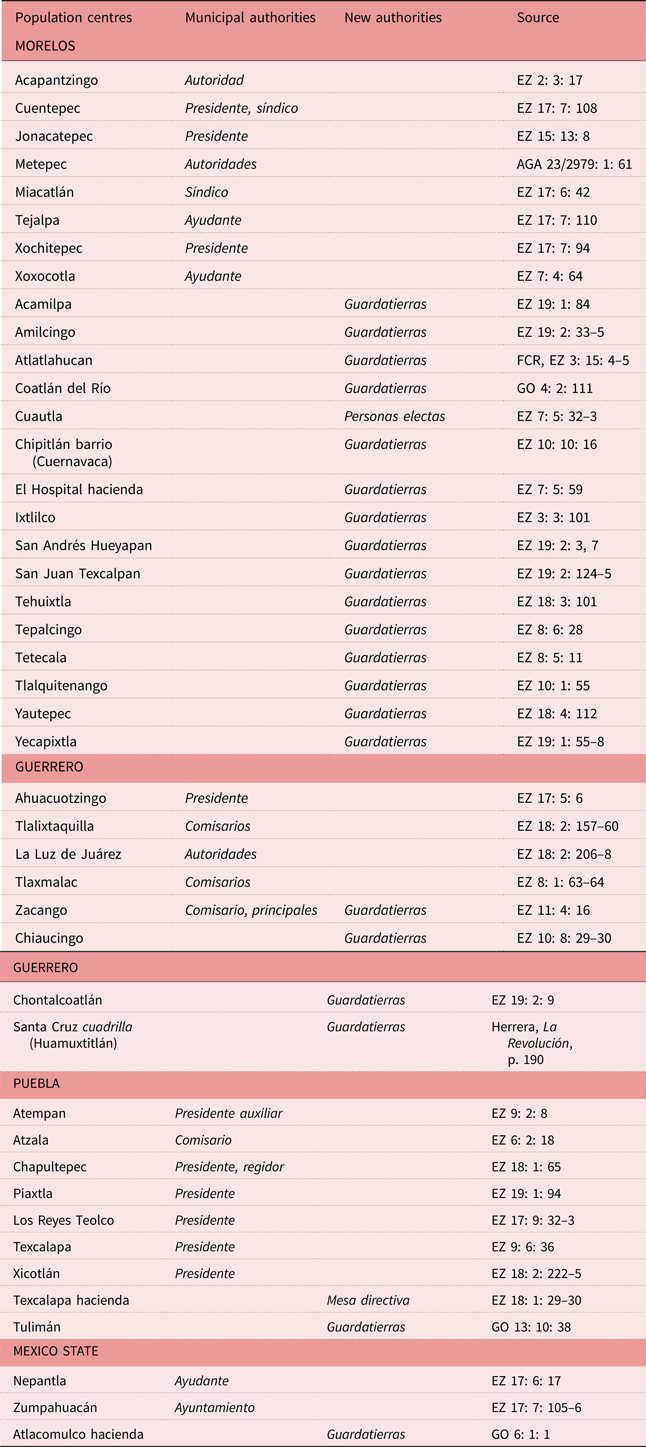
Before the Revolution, Zapata's home town of Anenecuilco (Morelos) had a village council of elders safekeeping their pueblo's old titles, and in 1909 Zapata had been elected ‘president of the representatives of the Anenecuilco pueblo’ – a title he kept even as the revolutionary movement's supreme leader.Footnote 59 Jesús Sotelo Inclán called this elected village leader a calpuleque and in so doing, JoAnn Martin explains, ‘Emiliano Zapata is transformed from a cacique, a political boss who rules through personalistic ties, into a calpuleque, a Nahuatl term that recontextualizes the revolutionary leader into a line of respected indigenous rulers who control rights to land.’Footnote 60 And it was the term calpuleque that led so many scholars to portray the Zapatista land reform as a revival of ancient practices. Yet none of the archival documents examined in this study mentions the term calpuleque. Rather, GH appropriated from the hacienda system the term guardatierras, which referred to mounted guards who ‘patrolled the fields armed with guns and made sure bandits and other marauders did not burn or disrupt the harvest’.Footnote 61 Guardatierras would now be villagers elected to manage reparto lands. Zapatista intellectual Antonio Díaz Soto y Gama would later describe guardatierras as the ‘village-appointed defenders of communal lands’, but these were mainly village-appointed managers of temporary repartos.Footnote 62 There were Zapatista guardatierras (by order of incidence) in Morelos, Guerrero, Puebla and Mexico State (see Table 2).
Authorities in Charge of Reparto Lands in Zapatista Territories, 1914–16

Note: Comisarios and ayudantes were sub-municipal officials. Personas electas (elected persons) and mesas directivas (village boards), together with guardatierras, were new Zapatista authorities in charge of reparto land management. An autoridad could be a municipal or a sub-municipal authority. See also notes to Table 1.
As the Zapatista leadership created new forms of local land administration, it centralised authority over land distribution. Rather than promoting local usos y costumbres, the Zapatista leadership strengthened municipal authorities or created new forms of local administration. In Morelos, provisional Zapatista Governor Lorenzo Vásquez issued circular no. 4, instructing municipal presidents to name guardatierras to distribute provisionally the lands reclaimed by the various pueblos. After the provisional reparto, agrarian commissions comprising students from the National School of Agriculture would be in charge of accurately conducting the boundary measurements.Footnote 63 And in one circular, the Ministry of Agriculture explained that because the planting season for irrigated crops would arrive soon and the agrarian commissions were finishing their preliminary subdivision of ejidos that had been returned to the pueblos, Ministry officials would provisionally grant parcels to residents, which would then be distributed by elected guardatierras in each locality.Footnote 64
The Impossible Resolution of Boundary Disputes
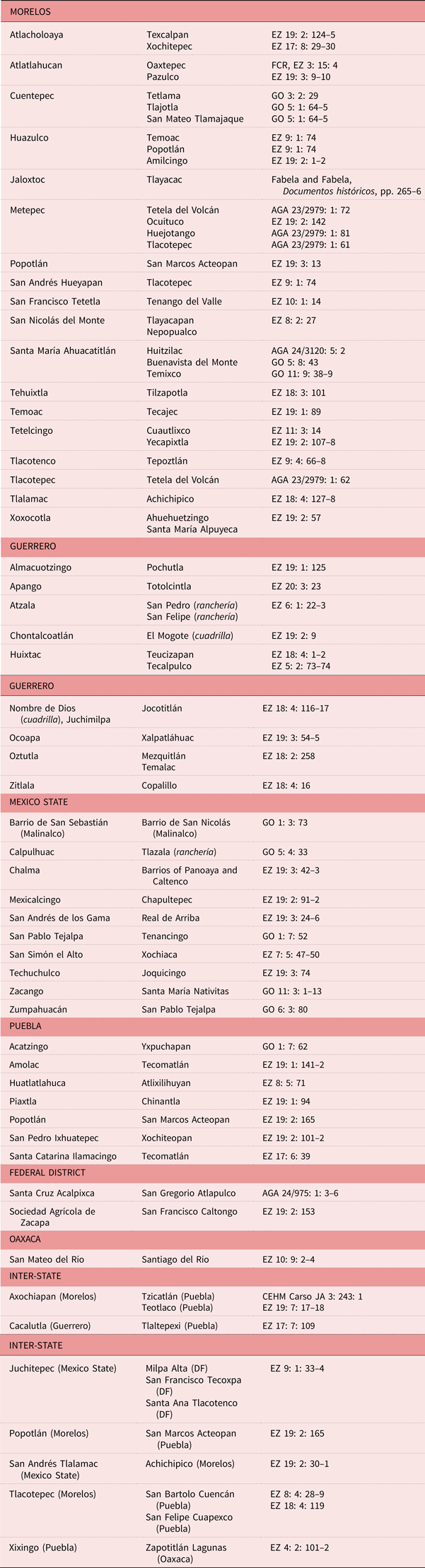
Almost all population centres in the Zapatista multi-state region had some type of border dispute with their neighbours (which could go back decades or even centuries), and many had taken these conflicts to state and federal courts – with at least one of the parties almost never satisfied with the judge's sentence.Footnote 65 Repartos often revived these disputes when revolutionary chiefs or agrarian commissions distributed hacienda lands that two or more population centres claimed as their own.Footnote 66 In the State of Mexico, for example, Acatzingo representatives explained to General de la O that they had successfully defended their lands against the potentially encroaching Tenería hacienda, only to have them invaded by neighbouring villagers after the former hacienda owners had fled.Footnote 67 In fact, in Zapatista-controlled territories between 1914 and 1916 there were boundary conflicts involving at least 112 population centres within a particular state, and at least eight border disputes across state lines involving some 18 villages (see Table 3).Footnote 68
Inter-village Boundary Conflicts in Zapatista Territories, 1914–16

Notes: Pueblos are presented in order of inter-village boundary conflicts in Zapatista territories, 1914–16. Pueblos are grouped in the first or second columns according to the principal loci of inter-village border conflicts. A ranchería has the political status of a small town or hamlet. See also notes to Table 1. Sources are given in col. 3.
Before the Revolution, boundary disputes had to be resolved in the courts in the form of a survey suit (juicio de apeo y deslinde) in which judges of first instance, titles and maps in hand and accompanied by pueblo representatives, walked the boundary lines to identify old markers and place new ones. During the Revolution, the Zapatista leadership remained committed to evidence-based rulings on boundary lines, but they sidestepped the courts. Early on, Zapatista military chiefs, acting as first-instance judges, conducted boundary measurements, assessed the evidence and issued verdicts. For instance, when the military chief of the Zaragoza (Morelos) district, Colonel Trinidad A. Paniagua, surveyed the Totolapa pueblo boundaries based on their colonial titles, he announced: ‘I have a special appointment to verify the survey, boundary marking and measurement of lands disputed between pueblos in the district.’Footnote 69 Soon, however, military chiefs ran into problems. Most villages had their own armed militias which, when unhappy with new borderlines, simply redrew them. In the State of Mexico, for example, after General Francisco Pacheco granted land to San Simón el Alto according to its titles’ boundaries, neighbouring San Juan Xochiaca residents allegedly asked their local chief to assassinate San Simón el Alto's local chief.Footnote 70 And in Puebla, the Acatlán municipal president complained that, when General Francisco García ordered him to conduct a reparto for Piaxtla villagers, neighbouring Chinantla residents and their local chiefs threatened them ‘with bullets’, a threat they took seriously given that the Chinantla residents had already shot and killed one of Piaxtla's soldiers.Footnote 71
In response to these conflicts, the Zapatista leadership issued instructions stating that boundary conflicts between pueblos should be studied by the agrarian commissions and ruled on by the Ministry of Agriculture.Footnote 72 In Guerrero, for instance, when the Oztutla comisarios (sub-municipal officials) and principales (village elders) complained about a boundary dispute with neighbouring Mezquitlán and Temalac, GH informed them that soon there would be a district agrarian commission to resolve such difficulties.Footnote 73 A few months later, GH instructed the Mogote cuadrilla (hamlet) leaders to resolve their boundary disputes with Chontalcoatlán at the Taxco agrarian commission, ‘given that it is the only [office] competent to resolve these matters, hearing the pueblos’ residents, as is just’.Footnote 74
Although their skills were mostly technical, surveyors were charged with organising meetings to draw boundary lines between two or more neighbouring pueblos, thereby becoming mediators and arbitrators between pueblos and their armed factions.Footnote 75 In general, however, surveyors had little authority to settle these conflicts, which were unending because one or another faction was always dissatisfied with the outcome. In Morelos, when the head of the Cuautla agrarian commission tried to negotiate a boundary agreement between Tetela del Volcán and Metepec, the pueblos flatly refused to cooperate.Footnote 76 And when he tried to resolve the boundary dispute between Ocuituco and Metepec, armed villagers from Ocuituco simply disregarded the commission's recommendations.Footnote 77 Likewise, when one surveyor drew boundary lines between Amilcingo and Huazulco, Huazulco residents just redrew the boundaries as soon as the commission left.Footnote 78 And in Xoxocotla, villagers ‘refused to attend meetings called by their commission and occupied the lands of their neighbours by force of arms’.Footnote 79
In fact, the surveyors’ role was so challenging that when the chief of the Yautepec (Morelos) agrarian commission, Gabriel Rubio, failed to work out an agreement between Atlatlaucan and Oaxtepec, he complained to Zapata that ‘only the Ministry can resolve such disputes because the commissions are in charge only of the surveys and information gathering’.Footnote 80 But officials from the Ministry of Agriculture would not manage much better. For instance, in the boundary dispute between Cacalutla (Guerrero) and Tlaltepexi (Puebla), the best ministry officials could do was to have pueblo representatives sign an agreement promising not to cultivate the contested lands ‘until the triumph of the Revolution, [when] the one with most rights will receive the lands’.Footnote 81 And when villagers broke agreements like this one, the Ministry of Agriculture had no choice but to rely on Zapatista generals. In one case, Palafox had to ask General Francisco Mendoza to intervene in a conflict that raged across state lines, involving land and water rights between Axochiapan (Morelos) and Tzicatlán and Teotlaco (Puebla).Footnote 82
Why was the resolution of village boundary conflicts so difficult? In nineteenth-century inter-village boundary suits, plaintiffs and defendants had the same burden of proof, and the party with the strongest evidence in the form of land titles would in principle prevail.Footnote 83 The Zapatista leadership followed this precedent, relying on evidence in the form of colonial titles. However, in many instances there was simply no way to determine which party had the strongest evidence in a country with diverse and overlapping land possession, use and ownership rights.Footnote 84 What villagers called ‘primordial titles’ were ‘indigenous-language, municipal histories containing extensive descriptions of the communities’ territorial boundaries and landholdings [but] not formal deeds in any sense of the term’, nor ‘historical sources providing reliable, detailed information on boundaries’.Footnote 85 This situation created endless problems.
In Zapatista Morelos, both Amilcingo and neighbouring Huazulco had land titles, but Huazulco's did not define boundaries, whereas Amilcingo's did.Footnote 86 San Andrés Hueyapan had titles demarcating boundary lines ‘as legally required’; Tlacotepec's titles did not.Footnote 87 And when the Yautepec agrarian commission was unable to draw boundary lines between Atlatlaucan and Oaxtepec, Chief Surveyor Rubio commented, ‘These problems continually surface, given the differences in boundaries that the primordial titles indicate.’Footnote 88 In fact, Brigadier General Fortino Ayaquica argued that ‘if we recognise each pueblo's vice-regal maps or titles, one would have to disappear several modern pueblos’.Footnote 89 Writing about the incident many years later, agronomist Marte R. Gómez remembers coming to the same conclusion: Tlacotepec (Morelos) villagers had primordial titles granting the pueblo 1,000 varas from the church in the four cardinal directions, but had the surveyors followed these measurements they would have had to include half the plaza of neighbouring Zacualpan de Amilpas. Gómez declares that ‘Marking boundaries that corresponded with present-day reality was a triumph’, and surveyors did so by ‘reducing the lands of Tlacotepec, so that Zacualpan was not left without anything’.Footnote 90 What Gómez does not say is that the other village affected by the Tlacotepec titles was San Felipe Cuapexco – across the border in Puebla – where residents complained that the surveyors were invading their lands, for which they also had titles. In response, GH ordered the agrarian commission to demarcate Tlacotepec's boundaries only in Morelos, not in Puebla.Footnote 91
When it came to hacienda property, Palafox had suggested that land restitution would be based on land titles issued prior to 1856, thus voiding all transactions based on Liberal privatisation laws.Footnote 92 In the case of inter-village boundary disputes, however, 1856 would not prove to be a useful marker because there were many subsequent court decisions affecting boundary demarcation. For example, San Juan Xochiaca (State of Mexico) representatives complained to General de la O that San Simón el Alto residents had invaded their farmlands, pasturelands and woodlands. They claimed that this invasion reversed an 1872 court decision ‘that protected their fundo legal [town site] and additional lands’.Footnote 93 In Guerrero, Colonel Juan Flores asked GH for permission to restitute Huixtac lands that had been usurped by neighbouring Teucizapan and Tecalpulco. As evidence in support of his request, he stated that he had ‘personally seen the documents in their possession that include the just and equitable jurisprudence, according to a 13 February 1908 Supreme Court decision’.Footnote 94 And in the Federal District, when the representative of the Zacapa Agrarian Society complained to GH that General M. Iriarte had distributed their properties to the San Francisco Caltongo barrio, he cited several late nineteenth-century court decisions in the pueblo's favour.Footnote 95
Because of the extraordinary difficulty that Zapatista leaders encountered in their attempts to resolve boundary disputes, they agreed that they would leave final resolutions for after the end of the Revolution. In the meantime, as with repartos, they proposed temporary arrangements. In Morelos, when the Yautepec agrarian commission failed to draw boundary lines between Atlatlaucan and Oaxtepec, the Ministry of Agriculture ordered villagers temporarily to cultivate land parcels on a first-come, first-served basis.Footnote 96 One surveyor reported that he had settled the conflicts between Tlacotepec and San Andrés Hueyapan and between San Bartolo and Temoac by negotiating agreements among them, ‘on the understanding that these are only for this present year and that next year they will recognise the boundaries drawn by this commission, in accordance with the titles and needs of each pueblo’.Footnote 97 And General Brigadier Marcelino Rodríguez reported from his Zacualpan de Amilpas revolutionary camp that
when the agrarian commission drew the [Morelos] pueblos’ boundaries, they had to augment or subtract part of their lands, whereas pueblos from neighbouring Puebla did not get any lands and will be unable to farm. Therefore … so as not to worsen the existing maize shortage, I have ordered that to avoid difficulties all pueblos should continue cultivating on the lands they farmed last year and, when the land division (fraccionamiento) is completed and the distributed plot titles are issued, this temporary provision will cease to have effect.Footnote 98
Quite by accident, then, the Ministry of Agriculture took over judicial functions for addressing inter-village boundary conflicts, but neither the old laws nor the new Zapatista offices would resolve their greatest challenge: how to determine which contesting party had the strongest evidence in a country with diverse and overlapping land possession, use and ownership rights. As a result, the Zapatistas promoted temporary arrangements under the authority of the Ministry of Agriculture.
Concluding Remarks
The Zapatista justice system responsible for addressing land, woodlands and water rights conflicts was legally plural (i.e. different types of norms coexisted), multi-tiered and hierarchical, and it became more centralised over time in response to mounting challenges. It is hard to say what the justice system would have looked like had the Zapatistas not been defeated militarily, but, based on the 1914–16 experience, we can draw several tentative conclusions. If the Zapatistas had continued to follow their original plan of distributing reparto lands as individual private plots with titles (possibly after a safeguard period like that included in some nineteenth-century privatisation laws), then small private properties would have flourished, and municipal and district courts would have continued to settle disputes over inheritance, sales, unpaid loans and theft.Footnote 99 When it came to pueblo land restitutions, Zapata and Montaño had initially planned on creating ‘special tribunals established after the triumph of the Revolution’ where landowners could be heard.Footnote 100 One indication that triumphant Zapatistas might have pursued this goal is that they had already tried to re-establish some of the higher courts that had shut down during the revolutionary fighting.Footnote 101 And with regard to the resolution of inter-village land and water conflicts, the Ministry of Agriculture could have continued to try to settle these disputes or, because these issues were entangled in questions of land restitution, the Zapatista leadership might have delegated this matter to the ‘special tribunals’ as well.
How did the Zapatista justice system compare to the one created by the victorious Constitutionalists?Footnote 102 The greatest difference between the two movements was that the Zapatistas’ ideas of law and justice regarding land conflicts were comprehensive: they aimed at resolving individual property claims, pueblo–hacienda land disputes and inter-village boundary suits – even if they were not successful in practice. In contrast, the Constitutionalists focused only on pueblo–hacienda land conflicts, leaving all individual and inter-village land claims separate from their land reform programme.Footnote 103
As Emilio Kourí explains, the Zapatista movement served as a political catalyst for the Constitutionalist agrarian programme, but Zapatismo was not its ideological inspiration because the rival projects had different intellectual roots.Footnote 104 In terms of procedures, however, they had at least two things in common. First, they both needed to find practical, expedient ways to resolve pueblo restitution claims against large property owners in a country where legal and illegal transactions blended throughout the decades and even centuries. Under Palafox, the Zapatistas, who had taken over most haciendas (at least in Morelos), might have made permanent their seasonal reparto arrangements and further developed their expropriation laws, ultimately distributing most arable hacienda lands in the form of individual private parcels (with pasturelands under some form of village management and water resources and woodlands also under local administration, albeit under the Ministry of Agriculture's directives). For their part, the Constitutionalists created the dotación (grant) as an alternative to restitutions when land petitioners did not have titles, when their titles failed to delimit clear boundaries, when they could not prove when or which lands had been seized, or when restituted lands were inadequate for their needs. Because of the difficulties in restituting pueblo lands, the dotación (with its sui generis and evolving constitutional provisions) became the centrepiece of what we now know as the Mexican post-revolutionary agrarian reform.Footnote 105
The second commonality between the Zapatistas and the Constitutionalists is that they both disavowed the existing federal judiciary and allowed the executive branch of government to assume judicial functions for restitution matters. The Zapatistas might have created special courts to address these claims, but the Constitutionalist Convention delegates did not. A ministry within the executive branch was responsible for restitution claims and dotación petitions until 1992, when President Carlos Salinas de Gortari (1988–94) overhauled the entire agrarian reform sector and created a new agrarian court system (also within the executive branch).Footnote 106
How does this new interpretation of Zapatismo compare to the received history of the Mexican Revolution? First, contrary to historical stereotypes, Zapata's Revolution was not a movement against nineteenth-century Liberal legal principles and institutions. Rather, with a few important exceptions, it was profoundly based on them. Second, by highlighting the importance of individual property in revolutionary Mexico and by demonstrating that inter-village land conflicts were as important, complex and violent as were those between villages and haciendas, this article challenges in new ways the myth of a ‘bipolar rural world that the Revolution would blow apart’.Footnote 107
Acknowledgements
I wish to thank Antonio Escobar Ohmstede, Kevin J. Middlebrook and three anonymous JLAS reviewers for their insightful comments that greatly contributed to improving this article. Many thanks to Emilio H. Kourí for our ongoing conversations, from which I always learn so much. I also thank Beatriz Montes Rojas and Karen Verdejo Ramírez for their invaluable assistance with the archival research.