Introduction
Weak analgesics, in particular non-opioid types such as paracetamol (acetaminophen) and salicylates, are probably the most frequently used medications worldwide and in many countries they can be purchased over the counter without a physician's prescription. This is likely to be an important contributor to self-poisoning with weak analgesics, a steadily increasing problem during the past three decades in parallel with increasing sales figures of the drugs (Gunnell et al. Reference Gunnell, Murray and Hawton2000). Massive overdose of paracetamol can cause fatal acute liver failure, and overdose of salicylates or other non-steriodal anti-inflammatory drugs (NSAIDs) can cause severe metabolic disturbance (Dargan et al. Reference Dargan, Wallace and Jones2002; Wallace et al. Reference Wallace, Dargan and Jones2002). Because of the ready availability of the drugs and their expected sedative effect (Hawton et al. Reference Hawton, Simkin, Deeks, Cooper, Johnston, Waters, Arundel, Bernal, Gunson, Hudson, Suri and Simpson2004), overdose with weak analgesics is often chosen as a method for attempting suicide, particularly in connection with impulsive intent to die. In Denmark, both the amount of paracetamol consumed and the number of paracetamol poisonings have been increasing since the 1970s (Ott et al. Reference Ott, Dalhoff, Hansen, Loft and Poulsen1990; Danish Medicines Agency, 1999, 2003; Moller et al. Reference Moller, Nielsen, Olsen, Thulstrup, Mortensen and Sorensen2004), and most paracetamol poisonings were with suicidal intent (Clemmesen et al. Reference Clemmesen, Larsen, Ott and Hansen1995). Although all discovered cases of analgesic poisoning are admitted for hospital treatment in Denmark, the influence of non-fatal analgesic poisoning on completed suicide later in life remains unknown. Available studies in the literature, using both retrospective data from suicide victims and longitudinal data from clinical samples of self-poisoning patients, have consistently demonstrated that persons with a history of non-fatal self-poisoning are at increased risk for fatal repetition of self-harm, and that the increased risk is associated with factors such as repetition status, suicide intention and psychiatric status (Nordentoft et al. Reference Nordentoft, Breum, Munck, Nordestgaard, Hunding and Laursen Bjaeldager1993; Isometsa & Lonnqvist, Reference Isometsa and Lonnqvist1998; Conwell et al. Reference Conwell, Duberstein and Caine2002; Hawton et al. Reference Hawton, Zahl and Weatherall2003). Non-fatal poisoning with weak analgesics is frequent, usually minor at the time and neglected; however, the prognostic impact on subsequent suicide is not well documented with data from a large-scale population sample. In this population-based case-control study using data from Danish longitudinal medical and administrative registers, we aimed to investigate the risk for subsequent suicide following hospital admission for non-fatal poisoning with weak non-opioid analgesics. We also examined whether the risk for subsequent suicide varied by clinical phase after poisoning and by subjects' psychiatric history.
Method
Setting and data sources
This study was based on the entire population of Denmark (5.2 million persons) (Pedersen et al. Reference Pedersen, Gotzsche, Moller and Mortensen2006), a country where hospital treatment is free of charge for all residents. Individual data were retrieved from several national longitudinal registries and merged using the unique personal identification number (CPR number) given to all Danes at birth and to new residents of Denmark.
The Cause-of-Death Registry (Juel & Helweg-Larsen, Reference Juel and Helweg-Larsen1999), part of the Danish Vital Statistics Registries, records the causes and dates of all deaths in Denmark and has been computerized since 1969. The Danish National Hospital Registry (Andersen et al. Reference Andersen, Madsen, Jorgensen, Mellemkjoer and Olsen1999) contains records of all in-patients treated in Danish non-psychiatric hospitals since 1977. It includes each patient's personal identifier, diagnosis codes, and dates of admission and discharge. The Danish Psychiatric Central Registry (Munk-Jorgensen & Mortensen, Reference Munk-Jorgensen and Mortensen1997), covering all psychiatric facilities in Denmark, cumulatively records all admission and discharge information and has been computerized since 1969. Diagnoses of illness or cause of death in Danish national medical registries were coded according to ICD-8 until the end of 1993 and according to ICD-10 thereafter. ICD-9 has not yet been introduced in Denmark.
The IDA database (a Danish acronym for the Integrated Database for Labour Market Research) (Danmarks Statistik, 1991) contains longitudinal information on labour market conditions and socio-demographic information for all individuals living in Denmark, and is updated annually. Individual data on socio-economic status for a given calendar year are complete only for persons who lived in Denmark on 31 December of that year.
Study design and participants
Using the Cause-of-Death Registry, we identified all definite suicides (codes E950–959 in ICD-8 and X60–84 in ICD-10) occurring during the period from 1981 to 1997. We excluded the deceased who were not residing in Denmark on 31 December of the year prior to the year of suicide because their socio-economic data in the IDA database were incomplete. We finally included 21 169 suicide cases, accounting for 99.64% of the total suicides occurring in Denmark during the study period.
We used a nested case-control design (Clayton & Hills, Reference Clayton and Hills1993) to recruit up to 20 live controls per suicide case, matched for sex, age and date of suicide. The rationale for using 20 controls per case was that it would allow us to study in detail some uncommon exposures, for example weak analgesic poisoning, in the general population with reasonable statistical power. To make the selection process manageable and to minimize the computational burden, we drew matched controls from a 5% representative sample of the national population using a risk set sampling procedure, that is sampling the controls from individuals who were alive and therefore at risk for suicide at the time when the individual became a case. A total of 423 128 population controls were enrolled. For a few cases over 93 years old, less than 20 eligible controls could be found.
Data on hospital admissions and confounding variables
We retrieved personal data on hospital admissions for poisoning with weak non-opioid analgesics from the Danish National Hospital Registry. In this registry, poisoning with weak analgesics was coded using the ICD-8 classification until 1993, and thereafter it was coded according to ICD-10 together with a supplementary diagnosis using the Anatomical Therapeutic Chemical (ATC) classification to specify the main compound ingested (Sundhedsstyrelsen, 2008). We examined whether cases and controls had been hospitalized with one of the following diagnoses until the date of suicide or index date for controls: paracetamol poisoning (ICD-8: 965.49; ICD-10: T39.0+N02B E01), salicylate poisoning (ICD-8: 965.19; ICD-10: T39.0+N02B A01), or NSAID poisoning (ICD-8: 965.99; ICD-10: T39.0+M01A). If a case or control had been admitted with one or more of these diagnoses, we recorded the date(s) of admission and discharge. Out-patient visits to hospitals, including emergency room visits, were not considered because this information was not available until 1995. For study purposes, ‘history of weak analgesic poisoning’ refers to an initial non-fatal poisoning with a weak non-opioid analgesic resulting in a hospital admission. In 72 instances, completed suicides resulted from a first-time poisoning with weak non-opioid analgesics, and for these cases the fatal poisoning was not considered as an ‘exposure’. Time since poisoning was computed according to the time elapsed from the first hospitalization for weak non-opioid analgesic poisoning to the suicide date or index date.
We extracted individual data on socio-economic status from the IDA database based on records 1 year prior to the year of suicide. Variables included marital status (single or cohabitating versus married), annual gross income (first, second or third quartile versus the highest quartile according to the annual 5-year age-sex-specific distribution in the general population), place of residence [capital (referring to the Copenhagen and Frederiksberg municipalities), suburb of the capital, provincial city (with >100 000 inhabitants), or provincial town (with >10 000 inhabitants) versus rural areas]. We also retrieved personal information on history of psychiatric hospitalization updated to the suicide or index date from the Danish Psychiatric Central Registry. We defined history of psychiatric hospitalizations in terms of three categories: hospital admission within the past year or more than 1 year ago versus never admitted. We chose these variables for data adjustment because they are highly associated with suicide in Denmark (Mortensen et al. Reference Mortensen, Agerbo, Erikson, Qin and Westergaard-Nielsen2000; Qin et al. Reference Qin, Agerbo and Mortensen2003).
Statistical analysis
We constructed contingency tables for the main study variables and computed the relative risk of suicide using conditional logistic regression with the phreg procedure available in SAS version 8 (SAS Institute, 1999). Because we sampled controls from individuals at risk for suicide at the time (i.e. risk set sampling), the estimated odds ratios in this study are unbiased estimates of incidence rate ratios (IRRs). The Wald test was used to determine the variation in risk estimates between paracetamol poisoning and other analgesic poisoning. The interaction between history of analgesic poisoning and history of psychiatric illness was examined using the likelihood ratio test.
Ethical approval
Approval for this study was obtained from the Danish Data Protection Agency.
Results
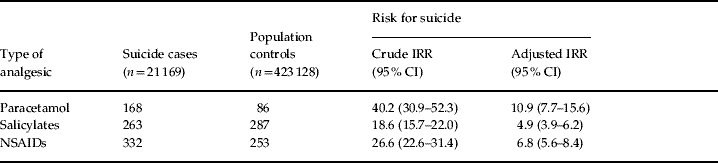
We found that 712 (3.4%) of 21 169 suicide cases had been hospitalized at least once for non-fatal poisoning with weak analgesics. A history of hospitalization for paracetamol poisoning was present in 168 cases, a history of salicylate poisoning was identified in 263 cases, and a history of NSAID poisoning was evident in 332 cases. Of the 712 cases, 49 (6.9%) had been admitted for non-fatal poisoning with different types of weak analgesics on two or more occasions.
Conditional logistic regression analyses showed that a history of non-fatal weak analgesic poisoning was a significant risk factor for an eventual completed suicide [crude IRR 24.7, 95% confidence interval (CI) 22.1–27.6] that could not be fully explained by personal socio-economic status and psychiatric history (adjusted IRR 7.7, 95% CI 6.7–8.9). More specifically, persons with a history of non-fatal paracetamol poisoning had a 40.2-fold higher risk of dying from a subsequent completed suicide than persons without such a history, and the corresponding risk was 18.6- and 26.6-fold for those with a history of salicylate poisoning and NSAID poisoning, respectively (Table 1). Although controlling for differences in socio-economic and psychiatric status lowered these risks, they remained significantly elevated. A history of paracetamol poisoning increased the risk significantly more than a history of poisoning with salicylate or NSAIDs (χ2=14.10, p<0.001).
Poisoning with weak non-opioid analgesics and risk for subsequent suicide

NSAID, Non-steriodal anti-inflammatory drug; IRR, incidence rate ratio; CI, confidence interval.
Crude IRRs were adjusted for age, sex and calendar date through matching. Adjusted IRRs were further adjusted for place of residence, marital status, annual income and psychiatric history.
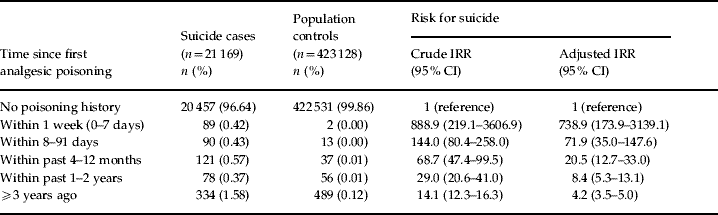
When the time elapsed since the first hospital admission for weak analgesic poisoning was introduced into the analysis (Table 2), we found that, for persons with a history of non-fatal weak analgesic poisoning, the risk of dying from a subsequent suicide was particularly high during the first 7 days following the admission (adjusted IRR 738.9, 95% CI 173.9–3139.1). The elevated risk declined over time following the poisoning, but remained more than four times higher even 3 years after the first weak analgesic overdose (adjusted IRR 4.2, 95% CI 3.5–5.0).
Time elapsed since first weak analgesic poisoning and risk for subsequent suicide

IRR, Incidence rate ratio; CI, confidence interval.
Crude IRRs were adjusted for age, sex and calendar date through matching. Adjusted IRRs were further adjusted for place of residence, marital status, annual income and psychiatric history.
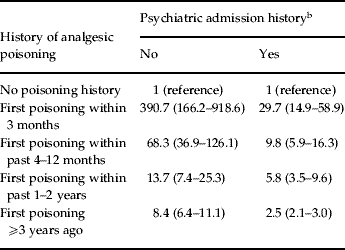
Moreover, we noted that the impact of analgesic poisoning on suicide varied significantly by a person's psychiatric status (test of interaction for psychiatric history: χ2=152.8, p<0.001). After controlling for the main effect of psychiatric history, a history of poisoning with weak analgesics elevated risk for subsequent suicide substantially stronger among persons without a history of psychiatric illness than among persons with a psychiatric history. Table 3 shows that this association held after adjustment for other confounders.
Adjusted incidence rate ratiosFootnote a for suicide associated with time elapsed since analgesic poisoning, by history of psychiatric hospital admission

IRR, Incidence rate ratio; CI, confidence interval.
a Adjusted IRRs were adjusted for the main effect of psychiatric history, place of residence, marital status and annual income in addition to age, sex and calendar date through matching.
b The IRR associated with a history of psychiatric admission is 13.2 (95% CI 12.7–13.6).
Discussion
This large population-based study indicates that a history of hospital admission for non-fatal poisoning with weak non-opioid analgesics was associated with a significantly increased risk for subsequent suicide, and that the effect of paracetamol poisoning was substantially stronger than that of poisoning with salicylates or NSAIDs, even after adjustment for differences in socio-economic and psychiatric status. The elevated risk was particularly high during the first week after the non-fatal weak analgesic intake. It then declined over time, but still remained more than four times higher 3 years later. Moreover, the impact of analgesic poisoning interacted strongly with a person's psychiatric status. It increased the risk for subsequent suicide substantially more for persons without a history of psychiatric hospitalization than for persons with such a history.
These results should be interpreted in the context of the study's strengths and limitations. Danish register data are collected systematically and uniformly, and without specific research purposes, which can reduce the risk of differential misclassification bias. All Danish residents have equal access to hospital care and treatment is free of charge, so care is not affected by socio-economic differences in access. Physicians' evaluations solely determine whether a patient should be hospitalized. These advantages allow us to obtain accurate, cumulative information on history of poisoning and psychiatric admissions. At the same time, variables available for study depend on the data in source registries. As a result, some important information, such as overdose with weak analgesics beyond discovery for hospitalization or psychiatric illness not leading to hospital treatment, could not be considered. Another shortcoming is lack of adjustment for the confounding effects of physical illnesses (e.g. cancer) that require large doses of analgesics for pain control. Nevertheless, this study is, to our knowledge, the first to use empirical data from a whole national population to document risk for subsequent suicide following hospital admission for non-fatal poisoning with weak analgesics with regard to clinical phase after poisoning and subjects' psychiatric history.
Our finding that a history of weak analgesic poisoning is a strong predictor for completed suicide is consistent with literature on non-fatal self-poisoning as a risk factor for completed suicide (Nordentoft et al. Reference Nordentoft, Breum, Munck, Nordestgaard, Hunding and Laursen Bjaeldager1993; Hawton et al. Reference Hawton, Zahl and Weatherall2003). This study, on a population level, further indicates that the elevated risk remained significantly high 3 years after the first overdose and after the adjustment for socio-economic and psychiatric factors. The general effect of overdose may reflect a combined effect of unfavourable socio-economic and health conditions that are not considered in the analyses. It may also be an indicator of genetic components related to impulsivity or other personality traits that increase vulnerability to suicidal behaviour.
For impulsive suicidal behaviour, the accessibility of lethal methods is of great importance. In Denmark, weak analgesics (paracetamol and salicylates) could be procured only with a physicians' prescription before 1984. Since then, these analgesics have been available over the counter in pharmacies with no limitation in packet size. Since October 2000, it has been possible to purchase small packets of 10 tablets in numerous shops including supermarkets and petrol stations. As a consequence, hospitalizations for paracetamol poisonings in Denmark have increased from about 300 cases in 1990 to about 2000 cases in 1999, according to the National Patient Registry. In the present study population, there were 72 suicide cases that in fact died from their first poisoning with weak non-opioid analgesics. Easy access to a large amount of these drugs undoubtedly plays an important role in these cases. Recently, a few countries have implemented legislation restricting availability of weak analgesics as a part of suicide prevention strategies (Jenkins & Singh, Reference Jenkins, Singh, Hawton and and van Heeringen2000; Bateman et al. Reference Bateman, Gorman, Bain, Inglis, House and Murphy2006). In the UK the numbers of severe overdose with weak analgesics declined after the package size of over-the-counter paracetamol and salicylates was reduced and blister-packs were made mandatory (Hawton et al. Reference Hawton, Simkin, Deeks, Cooper, Johnston, Waters, Arundel, Bernal, Gunson, Hudson, Suri and Simpson2004; Hawkins et al. Reference Hawkins, Edwards and Dargan2007). Our study indicates support for the recommendations for having a similar legislation in Denmark and other countries with similar settings (Sundhedsstyrelsen, 1998; Nordentoft, Reference Nordentoft2004). Although it is impossible to prevent a person from amassing a large supply of the drugs, such legislation could reduce the number of analgesic tablets easily accessible for impulsive self-poisoning and/or the severity of poisoning, thus providing a time window for possible interventions.
To our knowledge, this study is the first to demonstrate a significant interaction between analgesic poisoning history and psychiatric history. In practice, it is common for physicians to refer patients for psychiatric evaluation after a poisoning episode. A few studies have demonstrated that psychiatric illness is a risk factor for analgesic poisoning (Skegg, Reference Skegg2005) and, at the same time, weak analgesic poisoning could be a strong risk marker for subsequent psychiatric disorders (Jepsen et al. Reference Jepsen, Qin, Norgard, Agerbo, Mortensen, Vilstrup and Sørensen2005). Our observation of the interaction between analgesic poisoning history and psychiatric history is evidence of the strong relationship between these two exposures. It is likely that psychiatric illness is a more fundamental risk factor for subsequent suicide than is poisoning history. People with psychiatric illness are already at many times higher risk for suicide than the general population, and taking a non-fatal overdose will only serve to further increase the risk, albeit by a relatively small amount. This may partly explain our finding of a less strong influence of analgesic poisoning history on subsequent suicide among persons with a psychiatric history, compared with the effect among those without a psychiatric history, after controlled for the main effect of psychiatric history. Another explanation could be that, for persons without a psychiatric history, it is easier to amass weak analgesics than other prescribed compounds such as antidepressants, whereas this is not the case for persons with a psychiatric history. Therefore, the observed effect differences by personal history of psychiatric illness may be induced by differences in accessibility of compounds available for poisoning. At the same time, the prevalence of underdiagnosed or untreated psychiatric disorders may underlie the substantially elevated risk for suicide among persons with no recorded history of psychiatric illness. For individuals with hitherto no previous psychiatric history, an episode of self-poisoning suggests both underdiagnosed psychiatric illness and a propensity to self-harm. Our results therefore underscore the importance of subsequent psychiatric evaluation and follow-up treatment for patients with overdoses.
This study adds to the existing evidence indicating that patients with a history of non-fatal weak analgesic poisoning form a well-defined high-risk group for a fatal suicide attempt, particularly during the first few weeks after the intake. We suggest that appropriate management of patients hospitalized for non-fatal poisoning and intensive psychiatric care at the time of poisoning and in the following few years are essential to reduce subsequent suicides among this group of people.
Acknowledgements
This study was funded by the Danish Health Insurance Foundation and the Danish Ministry of Social Affairs on the recommendation of the National Committee on the Prevention of Suicidal Behaviour.
Declaration of Interest
None.