

In my first two addresses, I sought to explain the causes, extent and pace of expanding educational opportunity in Britain since the Second World War, in secondary and higher education.Footnote 1 I argued that expansion was powered not by expert opinion or technocratic demands or even by political calculation, but rather by the spread of a democratic political discourse which held that all citizens deserved ‘the best’ education much as they deserved the best health care in a welfare state based on universal (or the maximum possible) provision; and that the power of this discourse has not yet diminished even as expectations of the welfare state have in other respects shrivelled. In this address, I turn from the causes of expansion to its effects, and in particular to the politically charged questions of who benefits from educational opportunity and what effect (if any) it has on social mobility, which has become one of the shibboleths that keeps popular (and political) faith in education alive.
There is a folk wisdom about the history of education and social mobility over the last fifty or sixty years that goes something like this. First, there was a ‘golden age of social mobility’ in the decades after the Second World War, in which the grammar school played the leading role, promoting through the practice of meritocracy great swathes of bright working-class boys (the folk wisdom assumes they were boys) into the salariat, and indeed into the elite. Then in the 1970s and 1980s something happened to bring this golden age to a close – it might have been the famous ‘destruction of grammar schools’ or it might have been stuttering economic growth or it might have been growing inequality (depending on your political views). But then expansion of higher education in the 1990s and noughties seemed to have opened up again avenues of opportunity. Finally, according to this folk wisdom, they may now be threatened again with closure, either by the over-supply of graduates or by the rising cost of education to the consumer. Poor Britain languishes at the bottom of the international league table for social mobility, where it will stay until some new educational panacea is devised to address its sorry state.
Now nearly every aspect of that fable is either demonstrably false or rests upon a conceptual confusion – particularly the assumption that education and social mobility are pretty nearly synonymous. To explain why this story is false and why people cling to it nonetheless will be the twin goals of my argument. In order to start telling an alternative story, however, I have to begin with some pretty forbidding technical issues, in order to clarify what social mobility means and what changes in economy, society and politics affect it.
I
The study of social mobility took off in a serious way in the 1950s and for a long time remained the province of sociologists, in this country led by a group at Oxford sometimes known as the Nuffield School.Footnote 2 The Nuffield School defined social mobility as movement between occupational categories across generations, using John Goldthorpe's famous seven-class schema as the basis for these occupational categories. Because movements between contiguous classes have limited descriptive or explanatory value, sociologists tend to simplify the schema into three classes – a salariat (classes I and II), a working class (classes VI and VII, and sometimes V as well), and a rather mixed bag of intermediate classes in between. To measure movement between these three ‘big’ classes, sociologists employ a variety of datasets – large, representative samples they collect themselves (notably the 1949 survey led by David Glass and the 1972 Oxford Mobility Study led by A. H. Halsey); Footnote 3 representative samples from the 1946, 1958, 1970 and 2000 birth-cohort studies; and representative samples taken from other social surveys that were conducted for other purposes but which provide the requisite occupational and educational data, such as the British Election Surveys, the Labour Force Surveys and the British Household Panel Surveys and their successors. The grouping of specific occupations within these classes is regularly updated to ensure that new occupations are accommodated and changes in income and status registered. All in all, the sociologists hold that this seven-class (and the simplified three-class) hierarchy continues to work well as a proxy not only for the income hierarchy but also for the status hierarchy and for differences in autonomy and job security which neither income nor status can fully measure. Since the 1990s, however, the economists have challenged this sociological monopoly.Footnote 4 The economists prefer to measure social mobility instead by intergenerational movement between income deciles (or, using their own simplifications, quartiles or quintiles). On the whole, I will be using the sociologists’ definitions and measures, because for most of the period they form the bulk of the evidence at hand; but for the most recent period, I will be comparing them to the different findings of the economists.
To make matters worse, sociologists make a clear distinction between two quite distinct types of social mobility – absolute and relative. Absolute social mobility is perhaps the common-sense understanding; it assesses raw movements up and down the social scale, how many and who are going up or down, from which class (‘outflow’) and into which class (‘inflow’). In a post-war world characterised by greater affluence and generally progressive upskilling, absolute social mobility is dominated by upward mobility out of the working class and into the intermediate classes and the salariat. Relative social mobility is, in contrast, a measure of equality. It assesses deviations from ‘perfect’ equality of opportunity, in which every child born into any one class has an equal chance of ending up in any other class. Relative social mobility can tell you how unequal a society is and whether it is getting more or less equal. In these terms, downward mobility from the salariat is just as important as upward mobility from the working class – both are necessary to achieve ‘equality of opportunity’. In what follows, I pay much more attention to absolute than to relative mobility, principally because it is what both people who experience mobility and politicians who sponsor it are most aware of and care most about. Not only do people in lower classes not notice so much when they are joined by downwardly mobile exiles from the upper classes, they do not care about them so much either – not as much as they care about their own opportunities for upward mobility. Politicians are surely right to regard those priorities. When people speak about ‘equality of opportunity’, they almost always mean equal chances to rise, not equal chances to fall. While sociologists frequently squeal that politicians are not paying attention to the sociologists’ definition of social mobility, they might pay more attention themselves to the perfectly good reasons why politicians (and their constituents) prefer definitions of their own.
Finally, the sociologists are rightly concerned to fathom the extremely arcane interactions between education and social mobility, which are not nearly as straightforward as they appear. Schematically these interactions can be figured in terms of the OED triangle, a schema representing the relationship between class origins, education and class destinations. If social mobility were simply a function of education, as the folk wisdom so often has it, then the triangle would not be a triangle but a straight line, with E playing a straightforward mediating role between O and D. But it is not. At least three interactions have to be considered. First, how strong is the association between O and E? If strong, then education is simply reproducing social class, and inhibiting rather than promoting social mobility. Second, how strong is the association between E and D? If strong, then education may be performing a meritocratic function in guiding high educational achievers to the best jobs. But if OE and ED are both strong, then the independent role of education is reduced: only advantaged children are getting the educational qualifications that allow them to be guided into the best jobs, employers may only be using educational qualifications as proxies for class, and social mobility may not be promoted. For education to promote social mobility, you need weak OE association and strong ED association. But, to complicate matters further, even in cases of weak OE association and strong ED association, there is still plenty of room for a direct OD association that bypasses education altogether. That is, where you end up in the class structure may still have more to do with your class origins than your educational attainment – if, for example, employers use selection criteria that are more to do with your class than your education, or if your class gives you other benefits in job attainment regardless of education, or if educational qualifications just do not matter for the job at hand. As we will see – disappointingly, perhaps, for an educator such as myself – education rarely plays as much of a role in social mobility as we like to think.
As I did last time, I will slice the now seventy post-war years into three sections. First, the ‘golden age of social mobility’ from the late 1940s to the early 1970s; then the troubled period between the early 1970s and the early 1990s; and finally the last twenty years, not so troubled (at least to 2008) but plagued with conflicting verdicts from the sociologists and economists. For each period, I will both try to characterise the extent and nature of social mobility and the role education did or did not play, and try to say something about how far these different mobility regimes were actually appreciated in contemporary discourse: that is, what role they played in shaping the democratic discourse of education and the course of educational expansion.
II
First, the golden age of social mobility: there seems little question that the period from the late 1940s to the early 1970s was a golden age of social mobility, during which large proportions of the population experienced upward mobility from their class of birth, and the traditionally pyramid-shaped social structure began to turn into a diamond or an hourglass (itself a topic for debate).Footnote 5 In fact, despite its reputation as a particularly closed class society, even pre-war Britain had been more fluid than most other European countries, in large part because it had long before made its transition from an agricultural to an urban and industrial economy.Footnote 6 The true caste societies were those – which still included Germany, France and Italy in the early twentieth century – that retained a large peasantry, impervious to social mobility. In the post-war period, while these societies urbanised and became more mobile, Britain's long-urban society experienced a different kind of mobility, out of the working class and into the intermediate and salariat classes. Most strikingly, while fewer than 20 per cent of men entering the labour market just before the Second World War could be found in the salariat, by the 1970s over 40 per cent of men could be found there, and by the 1970s men entering the labour market were equally likely to be found in the salariat and the working class. A similar trend applies to women, though with less movement into the salariat and more movement into the intermediate classes, reflecting women's over-representation in routine non-manual work in the retail and office sectors.Footnote 7 All in all, Britain is rapidly becoming in this period a less manual society and therefore a more upwardly mobile society – about half of all labour market entrants in the 1950s and 1960s end up in a higher class than their parents.Footnote 8
This does not mean it is becoming a more equal or even a more meritocratic society. There is, as the sociologists put it nicely, more ‘room at the top’ – room for everyone. So salariat parents may be getting better at preserving their children's status – better at averting downward mobility – at the same time as working-class parents are getting better at promoting their children's status – better at promoting upward mobility. Relative mobility would remain static – which is exactly what the Nuffield School contends for this period.
Another effect of ‘room at the top’ is to limit the impact that education has on upward mobility. Although qualification for the salariat usually requires education, if the salariat is growing more rapidly than educational opportunity, then employers will simply recruit whomever they can, on grounds other than educational, to fill the vacant spaces. This could mean recruitment of working-class youths straight to the salariat or, more likely, it could mean staged mobility, with working-class youths entering intermediate jobs at school-leaving age, and then moving up to salariat jobs later in their careers. Again, this is exactly what the Nuffield School found. Only 4 per cent of working-class sons in this period were recruited directly to salariat jobs, but 20 per cent were recruited to intermediate jobs. By age 35, 17 per cent had reached the salariat and 34 per cent had reached intermediate classes. Over half the working class had left it, but by stages. The 4 per cent recruited to the salariat directly may have had an educational boost to get there, but almost everyone else did not need it and probably did not get it: after all, half of the working class were upwardly mobile, but only about a fifth had any experience of grammar school.Footnote 9
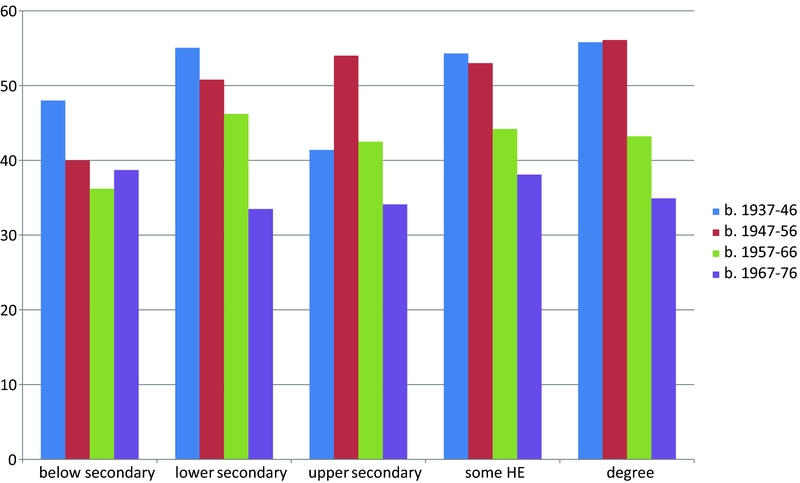
In the age of the bipartite system, this stands to reason. Grammar school selection was palpably not growing rapidly enough to provide sufficient new recruits. In fact, after the initial expansion in response to the Butler Act after 1944, it did not grow at all but shrank. Of those selected, a third were drawn from existing salariat families, so they could not by definition provide the new recruits. Although a growing proportion were recruited from intermediate families, this class fell far short on its own in supplying the necessary number of new salariat recruits.Footnote 10 And as we have seen, the form that upward mobility took tended to bypass educational qualifications altogether. Women went straight into the intermediate classes at school-leaving age, into clerical and retail jobs that did not require educational qualifications of any kind. Men similarly moved into the intermediate classes at school-leaving age, acquired new skills and aspirations on the job and were then available for recruitment into the salariat based on these life skills rather than their increasingly distant educational experience. As Paterson and Iannelli have shown, with the exception of the small numbers who had no secondary education at all, upward mobility in this period was experienced almost equally by people at all levels of educational attainment (Figure 1). Even a university degree did not really improve your chances of upward mobility very much, because if you got a university degree in this period you were likely to be from a salariat background already.Footnote 11 In terms of the OED triangle, the association between origin and education became less meritocratic; for this reason, the stronger association between education and destination benefited already advantaged classes more and so, on balance, was actually also less meritocratic; while the direct association between origin and destination, taking into account all mediating factors, was weaker and therefore was more meritocratic. In other words, ‘decreasing merit selection in the education system’ was offset by ‘increasing merit selection in the labour market’.Footnote 12 The result – more upward mobility, but on balance no more equality of opportunity.
Proportions of birth cohorts who were upwardly mobile (by level of educational attainment): entry into labour market 1952–92
What relationship did this experience of social mobility bear to the prevailing political discourses of the period? As such, ‘social mobility’ hardly figured. It was entering the language of social scientists but not of politicians, still less of voters.Footnote 13 Before the Second World War, the social imagination of most politicians was still surprisingly limited. There was some interest in social and political leadership – recruitment to a tiny elite – but Conservatives were happy with the existing elite and trade union leaders saw themselves as a counter-elite, if anything threatened by mobility out of the working class. Radical-liberal and revisionist-socialist intellectuals, lacking firm commitments to existing social strata, were an exception. R. H. Tawney and J. A. Hobson were unusual in advocating and setting out a practical plan for achieving ‘a broad, easy stair’ out of the working class.Footnote 14
Even after the war, when ‘social reconstruction’ was an avowed aim of both parties, it remains striking how limited was the social imagination of the political leaderships of both main parties. Renewed attention was paid to education for economic efficiency, but much of this effort was still focused on an elite, though now a technocratic rather than a social or political elite. A discourse of ‘equality of opportunity’ became more fashionable across both major parties, based on the assumption that the goal of education ought to be the better use of ‘wasted talent’, both socially unfair and economically inefficient.Footnote 15 Depending on your political preferences, this could be achieved by greater investment in schools, with or without reorganisation, or better testing of ability, or more places in grammar schools and universities. It did not necessarily require or envisage more social mobility for most people.
It was only when Tony Crosland and his followers encountered the Nuffield School in the mid-1950s that social mobility began to move to the centre of some politicians’ agenda, with a commitment to equality, not just of opportunity but to some extent of outcomes as well. In the initial stages, this first explicit acknowledgement of social mobility was framed almost entirely in terms of education, which was still seen as the sole route out of the working class. The sociologists Jean Floud, A. H. Halsey and their colleagues were able to convince Crosland that academic selection only reproduced existing inequalities in society. ‘Equality of opportunity’ at the very least required something more than equal opportunity to demonstrate intelligence – it also required equal opportunity to acquire intelligence. For Floud and Halsey, this approach dictated an end to academic selection at so early an age as 11 and the development of comprehensive schools that might to some degree level the playing field for children of different classes. Crosland certainly took up this cause and in government after 1964, with Halsey as a close adviser, he pursued comprehensivisation determinedly.Footnote 16 But there were other arguments in revisionist circles that placed less emphasis rather than more on education. Michael Young's Rise of the Meritocracy worried that equal opportunity to acquire intelligence might only cement further the rule of an educated elite, with privilege now given greater sanction as merit rather than inheritance.Footnote 17 As the sociologists put it, ‘apparent justice may be more difficult to bear than injustice’.Footnote 18 One solution would be to change the value structure of education and society to shift aspiration away from traditional occupations in the salariat to more technological pursuits – which both Tories and Labour did attempt through promotion of technological education and manpower planning.Footnote 19 Another, which only Labour would pursue, would be to reduce the advantage of privileged origins through redistribution. Equality of outcome, achieved by redistribution, was just as important to the revisionists as to the traditional left. As Crosland himself confirmed, a just society could not have an aristocracy, not even an aristocracy of talent. Social mobility would be best achieved not by competition but by equality – ‘an immensely high standard of universal provision’.Footnote 20 These new emphases on manpower planning and redistribution at least showed some awareness that social mobility was not all about education.Footnote 21
As I argued in my first address, public opinion was in many respects actually ahead of political opinion. Aspirations to social mobility were already high in the interwar working class. The grammar school had rightly been identified as the best available avenue out of manual labour and into ‘clean’ jobs in the retail and office sectors. Before the growth of the non-manual classes took off in the post-war period, the more limited stock of such ‘clean’ jobs was indeed supplied by the grammar schools. One study of interwar grammar schools found that over half of their graduates became clerks and shop assistants, that is, intermediate rather than salariat occupations.Footnote 22 Unsurprisingly, this understanding of the labour-market role of grammar schools persisted into the post-war period, even though as we have seen upward mobility no longer required it. If anything, public opinion became more and more fixated on access to grammar schools, especially among those families most aspirational and most likely to be frustrated by selection. The association of education with the welfare state fortified people's determination to get a high universal standard of education just as they expected to get a high universal standard of health care. This pressure pushed politicians in both parties to advocate ‘grammar schools for all’, and gave the Croslandites their moment in the 1960s.
At the same time, however, most parents whose children had failed to secure grammar-school places did not remain frustrated for long. They did not blame their children for their failure to pass the 11+, especially when, soon enough, many more of those children achieved upward mobility than their parents had expected, and even those who did not experience upward mobility still reaped the rewards of affluence. So while there was general public support for comprehensivisation, there was also general public satisfaction with labour-market outcomes without comprehensivisation – as we might expect, given the buoyant state of the labour market through the early 1970s.Footnote 23
III
This happy state of affairs – improving labour-market prospects for half the working class, even without educational reform – could not and did not last forever, as we find as we move into my second period, starting in the early 1970s. It may be useful to take the life-cycle experiences of the 1958 birth cohort as exemplary (it happens to be one of the best studied cohorts, and also mine). This cohort ended compulsory education in 1974, a boomtime for manual working-class employment (one reason, as I argued last year, why higher-education growth halted in the 1970s), though also a period of continuing growth in ‘room at the top’. Those fortunate enough to enter the labour market then did well, whatever class they were joining. By 1981, 60 per cent of the cohort reported that they had already reached their career objectives, at 23 years of age.Footnote 24 Unfortunately, at just about that time the labour market collapsed. Unemployment levels were high throughout the 1980s, especially for younger people. A lot of people fell out of work, and those who stayed in work often had to accept downward mobility in order to do so. A relatively large proportion of this cohort entered the salariat early in their careers and then fell out of it.Footnote 25 When the labour market recovered in the 1990s, many of these people were on the move yet again – well into their 30s. So tracking experiences and expectations alike is very difficult for this turbulent generation. But taking the whole period through the early 1990s as a whole, for this period including but not limited to those born in 1958, we can safely say that there is still plenty of room at the top, ergo plenty of upward mobility, though also more downward mobility, at unpredictable stages of the life cycle. Precarity starts to become a fact of life, and this will make an impact on the political discourse.
What role did education play in this generation? Again, there are many confusing factors, some of which I have considered in previous addresses. The school-leaving age was raised to 16 just in time to catch the 1958 cohort. Comprehensivisation was at its peak. Higher education was stagnating. Furthermore, this is the generation in which women began to move towards parity with men in labour-market participation and in educational attainment. The gap between men and women in the attainment of any tertiary education was quite wide for all classes in the 1946 cohort, but the gap had completely disappeared by the 1958 cohort, again for all classes.Footnote 26 This extraordinary change in gender roles and experiences makes all longitudinal comparisons more complicated: for earlier cohorts, sociologists were mostly content to track fathers’ and sons’ occupations, but for these cohorts they now found themselves puzzled as to how to identify class of origin (father's or mother's occupation?) and whether to track offspring separately by gender or together.
Nevertheless, oversimplifying grandly, we can try to make some comprehensible longitudinal comparisons. Though by definition upward mobility must in this period be diminishing – precisely because we start out with a larger proportion of the population already at the top – nevertheless, there is still considerable ‘room at the top’ for those below it: something like 38 per cent of this cohort is now in the salariat. Though less common for all, upward mobility is still a more or less equally common experience for people with all levels of education (Figure 1).Footnote 27 However, different effects are operating at each of these different levels of education. First of all, at the bottom, comprehensivisation seems to have made little difference one way or the other. Children of all abilities had about the same chance of achieving O-Levels in grammar and comprehensive schools. Working-class children of high ability did have a better chance of achieving A-Levels in grammar schools, but this temporary advantage is reversed by the time they achieve occupational maturity, and as a result ‘selective-system schools considered as a whole appear to confer no significant absolute or relative class mobility advantage of any kind on anybody’. Of course, the corollary of this is that neither do comprehensive-system schools – another blow to those of us who want to think that social mobility has something (or even a great deal) to do with education.Footnote 28
However, though school-type has little or nothing to do at this stage with social mobility, at the higher levels educational achievement probably does. Though people with a degree are not more likely to be upwardly mobile than people without, they are more likely to be mobile because of their degree. In other words, the education–destination association is stronger for people at the higher levels of attainment.Footnote 29 The salariat is still expanding and now a degree is your best guarantee of getting into it. About 90 per cent of all people of salariat origins with degrees remained in the salariat; but, extraordinarily, about 89 per cent of all people of working-class origins with degrees ended up in the salariat too. At this level, therefore, the ED association is strong – a degree gets you into the salariat, whatever your origins. At lower levels, however, the ED association is weaker. There are still far too few people with degrees to satisfy employers’ demand for salariat positions. And when they dip down below degree-level to recruit, they are far more likely to recruit people of salariat background, whatever their qualifications – perhaps they like their clothes or their accent or just the cut of their jib. Even for people of salariat origins with almost no educational qualifications, their chance of staying in the salariat is up to 1 in 3. In contrast, for working-class people with almost no educational qualifications, the chance of getting into the salariat is not zero but still low – under 10 per cent.Footnote 30 Overall, parents of salariat origins are getting better at keeping their children in the salariat, whatever their educational qualifications; even if they started out lower, hit perhaps by high unemployment in the 1980s, they were still far more likely to end up in the salariat. In other words, despite continuing upward mobility, there are no improvements in equality of opportunity – and education, unless you are one of the lucky few with a degree, is no help.Footnote 31
The economic ups-and-downs of this period from the early 1970s to the early 1990s further obscured what was already pretty obscure to contemporary policymakers, the extent and causes of social mobility. Attention remained fixed instead – if anything, more fixed – on economic performance. Thatcherism, it is true, introduced a new language of aspiration, but it did not connect aspiration to public policy – rather the contrary. It adopted a practically Social-Darwinist approach to social mobility which encouraged competition between individuals and families for social position, based on hard work and other forms of self-help.Footnote 32 At its most Social-Darwinist, for example in Keith Joseph's 1979 book on equality, it accepted in-born or inherited social position as a just basis for inequality.Footnote 33 Joseph praised state education not for any contribution it made to social mobility but simply for defusing class tensions. But this stance proved unpopular with Thatcherism's core constituency, as I argued in my second address. Attempts to scale back investment in education or to introduce fees or to reintroduce selection were firmly rebuffed by public opinion and by backbench Tory MPs. Thatcher turned to the more emollient Kenneth Baker, who sought instead to expand educational opportunity, both as a strategy for economic growth and also to some extent as a response to anxiety about downward mobility, now a growing risk.Footnote 34 This shift to a closer association between education and social mobility in the Conservative mentality became even clearer under John Major, who emphasised his own upward mobility more than Heath and Thatcher had done, and although he had little education was happy to play up the contribution that education might make. The language of social mobility, both explicit and implicit, undoubtedly begins to rise in prominence in political discourse in the early 1990s, as opportunities for upward mobility evidently begin to slow, and anxieties about downward mobility sharpen.Footnote 35
IV
This brings me to my final phase, the period since the early 1990s. Recent experiences notwithstanding, the past twenty years have been a period of more stable labour markets and, mostly, continued economic growth and upskilling. As a result, there continues to be ‘room at the top’. However, the rate of growth at the top has slowed, and who gets there has changed. Upward mobility into the salariat has decelerated for men but accelerated for women, benefiting from new educational and labour-market opportunities.Footnote 36 Parents in the salariat continue to be good at keeping their children in the salariat, though this tends to mean keeping men in the higher salariat (class I) and women in the lower salariat (class II). Still, there is sufficient room at the top to keep upward mobility into the salariat flowing from below. This despite the fact that more parents are now competing with their children for these salariat positions – such large proportions of the population are now in or near the salariat that competition for these positions becomes increasingly fierce. And this changing composition of the entire labour market necessarily implies that, while upward mobility continues, the risks of downward mobility are growing too. Just on the probabilities, a society with lots of people at the bottom – say, the society we began with, immediately after the war – is less exposed to downward mobility than the society we are ending up with, with lots of people at the top. Statistically, these are known as composition effects. And sure enough, for men at least downward mobility is increasing.Footnote 37 The most recent finding – still by a team that includes Goldthorpe! – takes us up to the birth cohort of the early 1980s, who have not yet reached occupational maturity today, but for whom it is suggested that men are now equally likely to fall as to rise (whereas during the ‘golden age’ they were two or three times more likely to have risen); that is, the authors observe, ‘the balance of men's upward and downward mobility is now tending to move in quite the opposite direction to that which prevailed in what has become known as the “Golden Age” of mobility in which social advancement predominated’. Note that in a top-heavy labour market, more downward mobility is not only likely but also indicates more rather than less equality of opportunity – if you are at the top and your origins and your destinations are only loosely connected, then you should be more likely to move down.Footnote 38 Not that that is any consolation to those moving down – a point to which I will return.
In this period, education still does not appear to play a more prominent role in determining social mobility. As we track the cohorts into the labour market of the 1990s, we see that the tendency to upward mobility has dropped, but that level of education is still not a great determinant of your likelihood of upward mobility (Figure 1).Footnote 39 This does not mean that education is irrelevant. The trend towards a stronger association between education and destination at the higher levels of education may be continuing, now especially among women. It may be their much better access to higher education that allows the upper salariat to keep their offspring in the upper salariat. They are not upwardly mobile, but their access to higher education protects them from downward mobility. And yet if you control for education, men from upper salariat backgrounds still have twice the chance of reaching an upper salariat position as men from working-class backgrounds with the same levels of education.Footnote 40 Even those diminishing numbers of men from salariat backgrounds with few educational qualifications were finding their way into the salariat, with a little help from their social and cultural capital, entering positions in sales and personal services that did not require much formal education but for which ‘soft skills’ and savoir-faire were quite potent.Footnote 41
At this point, with about half the population in the salariat, logic suggests that this ‘big class’ schema is of diminishing utility in measuring social mobility. Even if the sociologists continue to calibrate occupation accurately, and even if occupation is easier to characterise and track, it seems less useful to use these categories when so many people are at the top, and when compositional effects suggest that ‘upward’ and ‘downward’ mobility have become mere artefacts of our categories. Why not develop a different measure that assesses better differences within the 50 per cent of the population now in the salariat?
Enter the economists. They began to play more of a role in debates over social mobility in the early 1990s, in part because of their increasingly imperial drive to colonise all areas of social policy, but in part, too, because the data for income were improving, because income inequality was obviously growing, and so it seemed both desirable and possible to assess social mobility in terms of income rather than occupation. Among the advantages were the ability to create income deciles or quartiles which divide the population up evenly and therefore eliminate some (though not all) of the compositional effects, and also to make distinctions within the 50 per cent of the population that had reached the salariat. Among the disadvantages were the continuing inadequacy of the data – actually not as easy to adjust for changes in the gendering of the workforce as occupational data – and, as the sociologists insisted, the inability of income to tell you much about job autonomy or status.Footnote 42
Nevertheless, the economists did start generating distinct conclusions about social mobility from the early 1990s, and in 2005 they burst into the public debate in a most spectacular way. A report for the Sutton Trust by economists Jo Blanden, Paul Gregg and Stephen Machin, which achieved wide public currency, argued that intergenerational mobility based on income quartiles gave a much grimmer picture of social mobility in Britain than did occupational data, and in fact put Britain near the bottom of the international mobility tables. Furthermore, they argued, much of the advantage enjoyed by top-quartile families in Britain derived from their better access to educational qualifications – in other words, the origin–education association was too strong. Although they echoed the sociologists in acknowledging that non-educational factors (such as the widening gaps between income deciles) were also important, they drew particular attention to the widening gap at higher levels of education as a factor in worsening the prospects of upward mobility, consistent with the interests of their sponsors, the Sutton Trust, which itself certainly focused attention on the education gap.Footnote 43
I will come to the impact these findings had on public debate in a moment, but for now I will confine my comment to the ensuing to-and-fro between the economists and the sociologists over whether social mobility was actually declining or not and what role education might play. The sociologists held quite firmly that while upward mobility was in decline, that was a reflection of compositional effects, not equality of opportunity, and that since downward mobility was increasing, equality of opportunity might even be improving. Overall, they thought, relative mobility in Britain was pretty stable and not much different from other developed nations. And while the association between education and destination may have become stronger at the higher levels, they did not believe there was a strengthening association between origin and education, so that overall educational change had not affected upward mobility much one way or the other. Ill-tempered exchanges ensued – which had perhaps as much to do with the attention the economists were getting in public-policy circles as with anything else. But in fact the economists began to back off from their claims. A follow-up study for the Sutton Trust, which got very little publicity, found that the increasingly unequal access to higher education previously detected for the period of the late 1980s and early 1990s had not persisted into the later 1990s. As higher education expanded very rapidly in the 1990s, access equalised somewhat, and, Blanden and Machin concluded in December 2007, ‘It seems that the oft-cited finding of a fall in intergenerational mobility between the 1958 and 1970 cohorts appears to have been an episode caused by the particular circumstances of the time.’Footnote 44 They still held, however, that income inequality was making it more difficult to clamber up income deciles, thus introducing a composition effect of their own to explain declining upward mobility.Footnote 45 Other researchers, however, have found better income mobility in Britain, closer to the Nordics than to the United States.Footnote 46
The historian will find it very difficult to choose between the claims of the economists and the sociologists, but here I want to conclude with some reflections on why this debate became so politically significant, after years when social mobility as discussed by sociologists was largely ignored both by policymakers and public opinion. As we have seen, social mobility was already becoming a matter of palpable public concern in the early 1990s, as upward mobility began to slow and downward mobility threatened. The advent of New Labour in the later 1990s dramatically raised the stakes, partly for political and partly for sociological reasons. Sociologically, all classes were finding that they had a social mobility problem. Mobility into the salariat was slowing. Downward mobility from the intermediate classes and from the lower salariat was growing. The upper salariat was maintaining its position but only with difficulty, using all the educational and non-educational tools at its disposal. New Labour saw here a political opportunity, one that fitted neatly with its ‘One Nation’ orientation. Upward mobility for all was the new mantra. This meant addressing problems of ‘social exclusion’ for the working class, but also emphasising new educational opportunities – through higher standards in schools and widening participation in higher education – for the intermediate classes and the salariat.
It is important to note that these policies were not necessarily aimed at greater equality of opportunity. Upward mobility for all, even if achieved, would not necessarily address the disparities between classes – it might simply upscale the whole labour market, as we have seen happened during the post-war ‘golden age’. This might restore the growth of absolute mobility – more ‘room at the top’ – but, as the sociologists pointed out with increasing irritation, to achieve improvements in relative mobility – that is, true ‘equality of opportunity’ – would mean inciting downward mobility from the salariat as well as upward mobility from lower classes.Footnote 47 While an intellectually coherent position, the requirement for more downward mobility seems to ask of politicians more than they can conceivably deliver, and more than their constituents would have asked of them. Even the revisionists, who believed in equality of outcome, had made their biggest impact through educational reform, which extended opportunity to lower groups without, as it turns out, reducing the privileges of higher ones. New Labour did believe in some limited redistribution, but the purpose of higher taxation was not principally to incite downward mobility among the wealthy, rather it was to invest in childcare, education and community services that would enhance upward mobility among the poor – ‘predistribution’ as it has recently been called.Footnote 48
It was into this febrile environment of hope (for renewed upward mobility) and anxiety (about growing downward mobility) that the economists entered and made their formidable impact. As late as 2001, a government report that had used the sociologists’ findings to warn about possible future declines in ‘room at the top’ had gained little traction in public opinion. But the Sutton Trust report of 2005, by alleging an already established trend in declining social mobility, dating back to the 1980s, comparing Britain badly to other nations, and drawing attention to possible educational explanations, struck a media chord.Footnote 49 For some Conservatives, it was a stick with which to beat the comprehensives and call for a return to grammar schools – though Blanden, Gregg and Machin had not mentioned grammar schools, and had focused their recommendations on universities.Footnote 50 For the Sutton Trust, it was all about widening access to higher education. For New Labour, it was a rallying cry to redouble their efforts at ‘predistribution’, with an ever-widening gamut of policies from early years investment to community-building to standards in schools to vocational training to widening participation in higher education.
‘Social mobility’ entered the language of all parties. There has been a succession of ‘social mobility’ czars appointed by governments of all three main parties over the past ten years, more or less intoning the same mantra, of upward mobility without downward mobility, and of education and training as the route upwards, while, understandably, skipping over those factors (which may in fact be the most important) which social policy cannot easily fix: rising income inequality, the ability of privileged groups to retain their privilege even controlling for education, the export of high-skilled jobs due to globalisation, the polarisation of the labour market between a large high-skill salariat and a large (though smaller) low-skill working class, and the need for as much downward as upward mobility if true equality of opportunity is to be attained.Footnote 51
V
Taking the long view, finally, what can we as historians conclude about the history of social mobility over the last half century or more that might shed light on the present predicament? First, it is important to be clear how modest an effect educational policy has had on social mobility, both in the periods when it was high and in the present period when it may be in decline. After the war, Britain led a standard trajectory which shrank the working class and grew the salariat, based on the requirements of all developed twentieth-century economies, which has resulted in considerable convergence between all these developed economies in the present day. Though British politicians felt they were stimulating this development – whether by extending grammar schools, or comprehensivising them, or by seeking to channel young people into science and engineering careers – in fact none of these initiatives was very decisive; neither grammars nor comprehensives changed the course of social mobility very much, and as I argued last year young people refused to follow instructions to take up science and engineering careers, with no evident impact either on economic growth or on social mobility. Public opinion wanted social mobility, and most people got it, but educational policy does not deserve the credit. Nor, before the 1990s, did politicians really even conceptualise their initiatives in terms of social mobility – their focus was on economic growth, and rising levels of consumption for all, rather than any reengineering of the social structure. So, although social mobility was spoken of in terms of equality of opportunity (when it was spoken of at all), there was in fact no improvement in equality of opportunity – and no real pressure for it, as people were satisfied with upward mobility and affluence.
As upward mobility slowed, and downward mobility loomed, social mobility did rise up the political agenda. But what, realistically, could public policy do to make a difference? Thatcherism at least had an anti-interventionist ideology that justified inaction, while endorsing the struggle of individuals and families to improve their own lives. But anti-interventionism could not be sustained in the 1990s and after, even among Conservatives. Frustrations and anxieties in all classes were mounting. Self-help was clearly not enough. And there were other, novel considerations to take into account. Rampant income inequality and globalisation, possibly connected, posed problems that politicians could not easily address. Social mobility for all seemed a more realistic proposition, especially after the entry of the economists and the suggestion in the Sutton Trust report that education after all did make a difference. For all the inadequacies of ‘predistribution’, it has to be said that the joined-up effort made by New Labour came closer to a realistic public policy programme for social mobility than any of its predecessors even attempted. ‘Sure Start’, ‘Excellence in Cities’ and other community-building programmes at least understood that educational reform alone could not overcome the social and cultural capital deficits of less advantaged families. And New Labour's educational reforms, notably the introduction of the educational maintenance allowance (EMA), had some modest sociological impact that went beyond the mantra of ‘standards’ in weakening the association between origins and educational attainment, although even here it is salutary to recall the verdict of a recent sociological assessment of New Labour's educational reforms: ‘the biggest story is really the over-claiming from both sides’.Footnote 52 Nevertheless, it seems in retrospect like quite a political achievement to yoke a whole series of programmes aimed at only about 15 per cent of the population to the interests of a majority of the population under the banner of ‘social mobility for all’ – especially in light of the war of all against all into which we appear to have lapsed since.Footnote 53
What is the alternative? The obvious answer, the one the revisionists supplied in the 1950s, is redistribution, which would not only enforce some downward mobility for privileged groups (at least as measured by income), but by bringing the income deciles closer together ought to facilitate upward mobility for the less privileged. Redistribution of income does not directly redistribute social and cultural capital, which will still be used by privileged groups to game the labour market, but it probably facilitates the acquisition of social and cultural capital by those to whom income is distributed. The countries in Europe that have been most successful in using social policy to build equality of opportunity have been the Nordics, with both a relatively egalitarian education system and a relatively flat income hierarchy.Footnote 54 The problem is that it is more difficult to sell politically a redistributive policy than it was in the 1950s, for the same reason that downward mobility is more of a threat today – there are too many people in the middle. The Nordics were able to sell equality of opportunity when very few people had opportunity, and very few people were threatened with its loss. Today, in Britain, after three generations of upward mobility, most people have experienced it already and are understandably reluctant to abandon it. In that sense, Britain is already a more equal society. It is true that there is more income inequality. But that income inequality is very unusually distributed. Most of it sits in the top few percentiles.
Redistribution that focused on those top few percentiles would not go very far in fostering social mobility.Footnote 55 (It might have other advantages.) Redistribution that went much further again asks too many people to give up privileges that they may rightly feel have been hard won by themselves and their parents. The golden age of social mobility was almost certainly a one-off. We cannot go there again. Perhaps we ought to return to the idea that the purpose of education is not so much to foster equality of opportunity as to educate.Footnote 56



