Introduction
Cancers of the head and neck affect 9000 people per year in the UK and 700 000 worldwide.1, Reference Schache, Powell, Cuschieri, Robinson, Leary and Mehanna2 Although geographical variation exists in incidence patterns for the various primary sites, cancers of the oropharynx are the most common in the UK. Oropharyngeal malignancies have become more common over the past 20 years, widely believed to be due to human papillomavirus. Oral cancers have also increased 30 per cent over this time, although five-year survival rates have significantly improved.1, Reference Schache, Powell, Cuschieri, Robinson, Leary and Mehanna2 Those affected and treated for these cancers are younger and more active than past generations of survivors. Neck dissections are commonly performed in the management of this pathology.
Post-operative complications are common following neck dissection surgery. Early complications, often presenting during the in-patient stage, include shoulder pain, infection and thrombosis.Reference Guru, Manoor and Supe3 Additionally, late complications such as shoulder dysfunction may not present until three months post-operatively.
Shoulder dysfunction is the most reported physical complication following neck dissection surgery, affecting 50–100 per cent of patients after neck dissection.Reference Shone and Yardley4 It presents as impaired joint mobility, reduced strength and pain, and is associated with the development of further pathologies including adhesive capsulitis (frozen shoulder), which has been shown to be present in up to 40 per cent of patients.Reference Rogers, Ferlito, Pellitteri, Shaha and Rinaldo5
An estimated 30 per cent of patients continue to experience shoulder dysfunction and pain 12 months after surgery.Reference Guru, Manoor and Supe3 The sequelae of these complications include reduced ability to work and reduced quality of life. Up to 46 per cent of patients are unable to return to work post-operatively because of shoulder dysfunction alone.Reference Shone and Yardley4 Given the rising numbers of head and neck cancers in the younger age group, facilitation of return to work in survivors is increasingly important. Additionally, psychosocial outcomes of fatigue and depressed mood affect up to 100 per cent and 35 per cent of patients respectively post-operatively, substantially affecting their quality of life.Reference Rieke, Boilesen, Lydiatt, Schmid, Houfek and Watanabe-Galloway6
There are no conclusive current national standards or guidelines for best practice management of shoulder dysfunction following head and neck cancer. The National Institute for Health and Care Excellence (NICE) produced guidelines in 2016 for upper aerodigestive tract cancer in those aged 16 years and over.7 Whilst the guideline recommends that progressive resistance training be considered for people with impaired shoulder function as soon as possible after neck dissection, national evidence gathering meetings, supported by the relevant stakeholders, have failed to identify a professional consensus for this problem.Reference Robson and Paleri8 Additionally, no current national standard exists for best practice in the delivery of physiotherapy for the prevention or rehabilitation of shoulder dysfunction following neck dissection.
This survey study aimed to determine how UK head and neck cancer centres currently manage shoulder dysfunction in patients following neck dissection surgery. Results of the survey will be used to aid development of the content and delivery of a rehabilitation intervention for post-operative patients.
Materials and methods
Nine regional centres were selected as part of the survey. These centres were selected because of the high volume of neck dissections they perform.9 The survey was sent to key members of the multidisciplinary team and they were asked to comment on unit practice. The survey was completed by seven ENT surgeons and two regional extended scope practitioner in-patient physiotherapists. There is currently no national database for extended scope practitioner physiotherapists involved with head and neck cancer rehabilitation, and therefore these centres represent a large volume of collective UK experience.
The 14-item survey included questions on the current provision of in-patient and out-patient options for post-operative rehabilitation, the types of patients referred for physiotherapy, and the route of referral (Table I). The survey was delivered via SurveyMonkey® online survey software, and accessed via a link in the invitation e-mail.
Survey questions

Results
Demographics
All nine centres completed and responded to our survey (100 per cent response rate). Respondents represented seven geographically and socio-economically diverse regions of the UK, including the North East, North West, West Midlands, London, South East, South West, and Yorkshire and the Humber. The estimated number of neck dissections performed annually in each region ranged from 70 to 400 (mean = 152, standard deviation = 114).
Pre-emptive physiotherapy
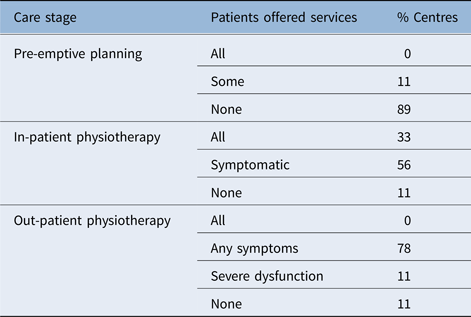
In light of the sequelae known for neck dissection, centres were asked whether they pre-emptively arranged courses of physiotherapy for patients to undergo after their dissection, for shoulder dysfunction. Of the nine centres, eight (89 per cent) never arranged pre-emptive physiotherapy for their patients and one (11 per cent) arranged pre-emptive physiotherapy for select patients only.
Post-operative in-patient physiotherapy
Three of the nine centres (33 per cent) indicated that patients were routinely seen for shoulder physiotherapy when an in-patient on the ward, regardless of symptoms. In five centres (56 per cent), only in-patients with symptoms of shoulder dysfunction were seen. In one centre (11 per cent), patients were never seen for physiotherapy relating to shoulder dysfunction.
Eight of the centres (89 per cent) had ward physiotherapists employed by their trust; the remaining centre (11 per cent) referred patients to their general physiotherapy department. Of the ward physiotherapists, only two centres (22 per cent) had specialist head and neck or cancer physiotherapists.
Six centres (66 per cent) routinely gave written information to all patients as an aid to recovery, one centre (11 per cent) only gave written information to selected patients and two centres (22 per cent) never dispensed any literature.
Out-patient follow up
During post-operative out-patient follow up, six respondents (66 per cent) routinely asked their patients about symptoms of shoulder dysfunction (including both extended scope physiotherapists), two (22 per cent) sometimes asked patients and one (11 per cent) rarely asked patients.
No centres offered out-patient physiotherapy for all patients regardless of symptoms. Seven centres (78 per cent) offered physiotherapy for patients with any symptom of shoulder dysfunction, one centre (11 per cent) offered physiotherapy for those with severe dysfunction only and one centre (11 per cent) never offered physiotherapy for any dysfunction.
Of the eight centres that did refer patients for physiotherapy, two (25 per cent) revealed they had departmental physiotherapy services which saw the patients they referred and six (75 per cent) referred to general hospital physiotherapy.
All nine respondents, including the extended scope in-patient physiotherapists, were unaware of the type of physiotherapy or course received if patients were offered it in the out-patient setting.
An overview of services offered is summarised in Table II.
Services offered to patients

Discussion
Synopsis of new findings
Findings from this national survey suggest that despite national guidelines and the recognition of the potential significant morbidity of shoulder dysfunction following neck dissection, rehabilitation options are limited in the UK. The majority of symptomatic in-patients have services available to them, and both surgeons and physiotherapists recognised the importance of enquiring about dysfunction and referring for therapy at out-patient follow up. However, nationally, there appears to be a proportion of patients who do not have access to these services either as in-patients or out-patients, based on respondents indicating that only those patients with severe dysfunction were treated at their centres. Survey responses also indicate that none of the represented centres routinely offered or arranged rehabilitative out-patient physiotherapy, either pre-emptively or at follow up.
Study strengths
We believe that our purposive sample of regional centres, which perform a high volume of neck dissections, is representative of UK practice, as our clinical experience indicates that the provision of physiotherapy services is relatively homogeneous across UK regions. In addition to providing new data on national practice in this area, results from this survey highlight areas for future research and management guidance for this complex pathology.
We recognise that this study does not cover all UK centres; however, following the 2004 Improving Outcomes in Head and Neck Cancers NICE guidelines,10 more centralisation of head and neck surgical services has taken place across the UK, after NICE suggested that patients should only be treated in centres with at least 100 new cancers per year. However, it is recognised that parts of their treatment, such as neck dissection, may be carried out in smaller units. The centres surveyed as major head and neck units in the UK are best placed to provide appropriate allied healthcare expertise, such as physiotherapists with experience in treating such cases. Indeed, the results from this survey may in fact overestimate the services patients receive in smaller units. It is also recognised that within centres there may be some practice variability. The lack of unit-agreed protocols highlights the need for further work in this area.
Comparisons with other studies
There are no widely available data in the UK on the national practice of shoulder rehabilitation after neck dissection. This study represents the first published data of this nature.
• Neck dissection is often associated with post-operative shoulder dysfunction, affecting quality of life and return to work
• Guidelines suggest early intervention to prevent shoulder dysfunction, but are unclear on how and when this should occur
• This national survey indicates that rehabilitation with physiotherapy is not available to all patients, in in- or out-patient settings
• Physiotherapy provision is commonly reactive rather than proactive, and usually driven by patient request
• There is little evidence of pre-arranged physiotherapy for shoulder dysfunction treatment or prevention in the UK
Study's clinical applicability
There is no current national standard practice or widely accepted guidelines for the management of shoulder dysfunction in the UK. Furthermore, there is little evidence regarding the effectiveness of pre-emptive or reactive physiotherapy for this pathology. This study adds to the literature regarding the national practice for shoulder dysfunction rehabilitation, by demonstrating the absence of standardised practice. These findings highlight the requirement for further research in this area, to determine effective treatment pathways, and facilitate the development of best practice guidelines for this common and debilitating post-operative condition.
Conclusion
There remains no national standard practice or sufficient evidence regarding the rehabilitation of shoulder dysfunction resulting from neck dissection performed for head and neck cancer. Nationally, no patients have such rehabilitation organised before surgery, and rehabilitation for all patients is lacking post-operatively. Research into the best practice for rehabilitation of this common post-operative condition is required to improve patient outcomes following neck dissection for this increasingly common form of cancer.
Competing interests
None declared.