Background
Interstage mortality between the first and second (superior cavopulmonary connection) palliative procedures remains high in the hypoplastic left heart syndrome population.Reference Ohye, Sleeper and Mahony 1 Intensive home monitoring programmes have been successful in reducing interstage mortality in some centres;Reference Ghanayem, Hoffman and Mussatto 2 – Reference Hansen, Furck and Petko 4 however, other centres have reported no reduction in interstage mortality after implementation of home monitoring.Reference Petit, Fraser, Mattamal, Slesnick, Cephus and Ocampo 5 The National Pediatric Cardiology Quality Improvement Collaborative, which strongly advocates for home monitoring, reported a reduction in interstage mortality rate from 9.5 to 5.3% in patients with hypoplastic left heart syndrome.Reference Anderson, Beekman and Kugler 6 Despite this reduction in mortality, the aetiology for most interstage deaths remains unclear. Previous studies have examined demographic, anatomic, and perioperative risk factors for mortality after the Norwood operation for hypoplastic left heart syndrome,Reference Hehir, Dominguez and Ballweg 7 , Reference Ghanayem, Allen and Tabbutt 8 but the relationship between clinical data at the time of discharge and interstage outcome has not been fully explored.
In 2010, the Children’s Hospital of Philadelphia established the Infant Single Ventricle Management and Monitoring Program for all infants who underwent placement of a systemic to pulmonary artery shunt with the intention to pursue univentricular palliation. As part of the programme, inpatient and outpatient clinical care pathways were developed to standardise care for these infants. Given the uncertain aetiology of most interstage deaths and the suggestion that residual lesions such as recoarctation may not be detected early enough in the interstage period,Reference Hill, Rhodes and Aiyagari 9 we theorised that haemodynamic catheterisation might be more sensitive than non-invasive imaging modalities as a mechanism to detect anatomic issues following either the systemic to pulmonary shunt or Norwood procedure and, thus, could be an important addition to a multi-faceted quality improvement-based approach to improving interstage outcomes. Furthermore, intervening on these anatomic issues prior to discharge could potentially decrease the risk of interstage morbidity and mortality in addition to the benefits conferred by home monitoring. Therefore, for a period of time, the clinical care pathway included a recommendation to perform a screening cardiac catheterisation prior to discharge for those patients who had not previously had a cardiac catheterisation due to clinical concerns. Before discharging a patient home, inpatient attending physicians decided whether to follow the screening cardiac catheterisation recommendation; therefore, some patients received usual care (i.e., discharge echocardiogram and cardiac catheterisation only if clinically indicated) during this time period despite the recommendation.
The purpose of this retrospective chart review was to determine whether infants with shunt-dependent univentricular cardiac defects who underwent a screening haemodynamic catheterisation prior to neonatal discharge had improved interstage outcomes as compared to those infants who had usual care screening with physical examination and echocardiography (i.e., catheterisation only if clinical concerns).
Materials and methods
This retrospective, single-centre study was approved by the Institutional Review Board at The Children’s Hospital of Philadelphia.
Study population
The Infant Single Ventricle Management and Monitoring Program began enrolling patients in December, 2010 with a programme modelled on the home monitoring programme at the Children’s Hospital of Wisonsin.Reference Ghanayem, Hoffman and Mussatto 2 Infants were eligible for the programme if they underwent placement of a systemic to pulmonary artery shunt in the neonatal period with the intention to pursue univentricular palliation. Eligible infants were identified shortly after their neonatal surgical procedure, consisting of either the Norwood procedure or isolated aortopulmonary shunt placement (e.g., Blalock–Taussig shunt). In addition to the screening catheterisation, the inpatient clinical care pathway recommended biweekly post-operative echocardiograms prior to discharge home. Prior to pathway creation, catheterisations were typically done for clinical reasons if infants were unable to maintain saturations consistently >75% on room air, developed a change in lower extremity pulses or perfusion, or had concerning echocardiography findings (i.e., peak isthmus velocity >2.5 m/second, decreased ventricular function, or increased degree of atrioventricular valve regurgitation).Reference Wellen, Glatz, Gillespie, Ravishankar and Cohen 10 Inpatient attending physicians caring for an enrolled infant were aware of the inpatient clinical care pathway recommendations and responsible for the final decision regarding referral for catheterisation prior to discharge, which was typically made near the time of discharge. Thus, the inpatient attending physician determined whether an infant was assigned to the usual care or screening catheterisation groups. Regardless of indication for catheterisation, the catheterisation physician used haemodynamic data to make a clinical decision about performing any interventions in conjunction with the inpatient attending physician and/or surgeon.
Following discharge, infants were managed primarily by outpatient cardiologists and monitored closely by nurse practitioners and cardiologists dedicated to the Infant Single Ventricle Management and Monitoring Program. At a minimum, the nurse practitioner contacted families on a weekly basis to record caloric intake, oxygen saturations, and weights obtained at home. Additionally, clinical information gathered from regular primary care or cardiology visits was recorded in a specific clinical database. Families were provided with a list of “red flags” or indications to call for medical advice, such as irritability, desaturation, or vomiting. The nurse practitioner reviewed enrolled infants’ clinical data on a weekly basis with one or more of the cardiologists. Prior to the stage 2 procedure, each patient’s primary cardiologist determined whether the patient should undergo a haemodynamic catheterisation or cardiac MRIReference Brown, Gauvreau and Powell 11 in conjunction with the interstage team.
All infants enrolled in the home monitoring programme from 1 December, 2010 to 30 June, 2012 who were discharged following neonatal surgery and completed the interstage period before 18 December, 2012 were eligible for inclusion. Completion of the interstage period was defined as admission for stage 2 palliation, listing for transplant, or death. Patients who underwent a hybrid procedure or were lost to follow-up during the interstage period were excluded from the study.
Study design
Clinical data were obtained from the Infant Single Ventricle Management and Monitoring Program clinical database and the electronic medical record from birth through stage 2 discharge. Comorbidities diagnosed before neonatal discharge were recorded, including arrhythmia, tracheostomy, placement of a percutaneous feeding tube, necrotising enterocolitis, bacteraemia or culture-negative sepsis, and mediastinitis. Results from the last echocardiogram prior to discharge and cardiac catheterisation if performed during the admission were included in the dataset. Cardiac catheterisation data were not included if the procedure took place on the same day as the neonatal surgical procedure or while on extracorporeal membrane oxygenation as these haemodynamic data would not represent the discharge haemodynamics. Echocardiography and cardiac catheterisation reports were used to document findings from these studies except for the echo-derived coarctation index as this measurement is not typically documented in either study report. The echocardiography coarctation measurements were performed by a single member of the study team (S.N.) using Syngo Dynamics. The coarctation index was calculated as the ratio of the narrowest diameter to the diameter of the descending thoracic aorta or to the abdominal aorta depending on quality of the images.Reference Wellen, Glatz, Gillespie, Ravishankar and Cohen 10 Angiographic coarctation measurements were performed by a single reviewer (J.J.R) in Horizon TCS.
Risk factor composites
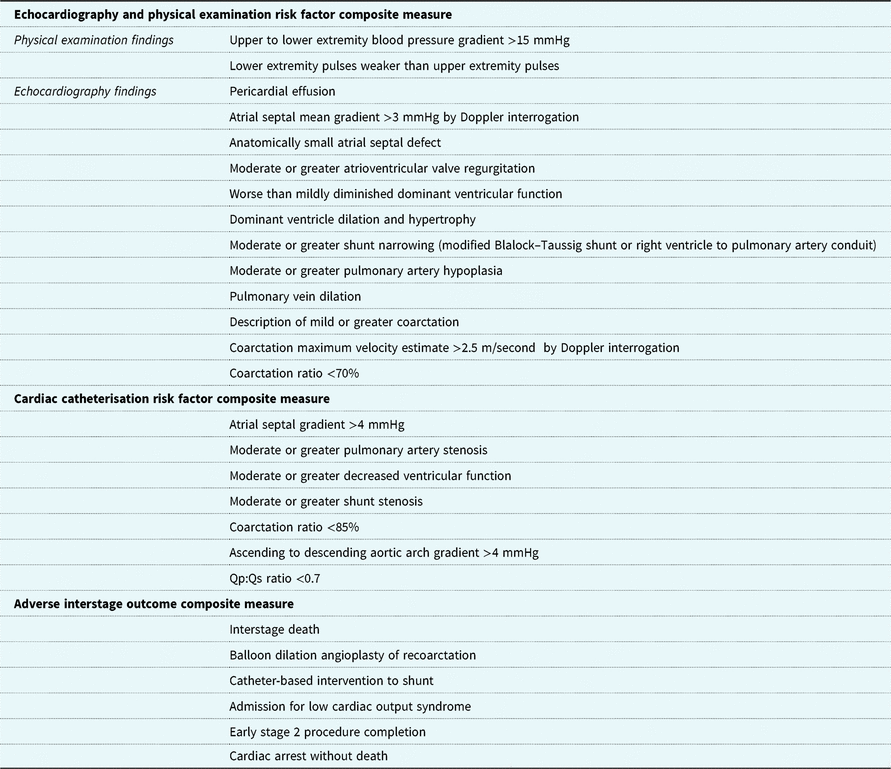
To assess whether the screening catheterisation added important information to previous standards for clinical evaluation prior to discharge, we created TWO SEPARATE composite measures using risk factors identified by physical examination or echocardiography (physical exam/echo) and cardiac catheterisation. The cardiac catheterisation composite was calculated for all patients who had a cardiac catheterisation prior to discharge regardless of whether it was a screening catheterisation or clinically indicated catheterisation. Patients were considered to have a positive composite risk measure for either physical exam/echo or catheterisation if they met any of the criteria listed in Table 1. These composite risk measures were based on evidence where availableReference Ghanayem, Allen and Tabbutt 8 , Reference Wellen, Glatz, Gillespie, Ravishankar and Cohen 10 but otherwise were based on group consensus as to anatomic risk factors. Missing variables did not affect composite scores as they were presumed to represent normal findings.
Risk factor and interstage adverse event composite score components

Interstage adverse event outcome
Given the small numbers of patients in the programme and the relative rarity of interstage mortality, we combined all interstage adverse events into one composite measure (Table 1). Interstage adverse events were defined as those events thought to be specifically related to shunt-dependent univentricular physiology. Other events, such as readmission for a surgical site infection, were not included in this analysis. Events that were secondary to medical procedures (e.g., elective sedated echocardiogram or catheterisation prior to scheduled stage 2 procedure) with resultant side effects were not counted as an interstage adverse event.
Analysis
Demographic and outcome information was summarised using standard descriptive statistics, including means and standard deviations for normally distributed continuous variables, medians and ranges for skewed continuous variables, and percentages for categorical variables. The characteristics of patients who underwent a screening catheterisation were compared to those who had the usual care using unpaired t-test, Wilcoxon rank-sum test, or Pearson chi-square test as appropriate. The ability of each surveillance strategy (“usual care” versus “screening cath”) to predict interstage outcomes was assessed by first creating a composite risk score based on echocardiographic and/or physical examination findings (“usual care”) as well as by cardiac catheterisation (“screening cath”). The ability to discriminate interstage adverse events of each composite risk score, both alone and in combination, was assessed by generating sensitivity and specificity tables, as well as receiver operator characteristic curves. All statistical analyses were performed using STATA v10 (College Station, TX, United States of America).
Results
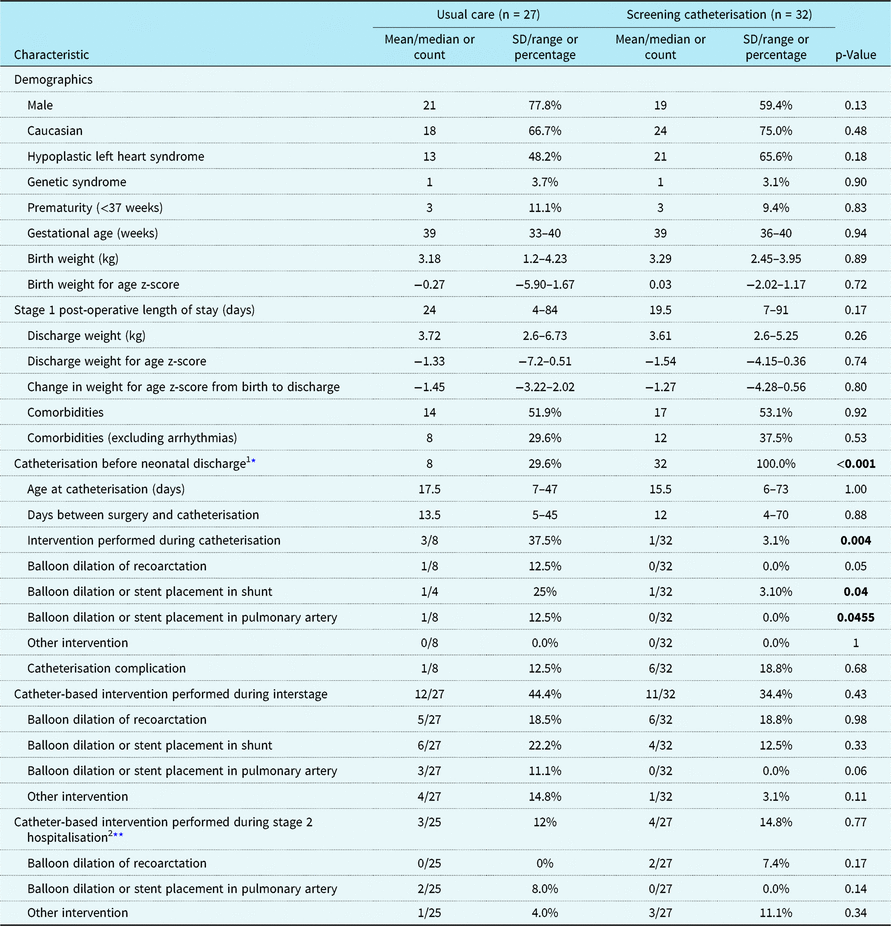
There were 59 eligible patients, of whom 27 had usual care and 32 underwent a screening catheterisation. There were no significant differences between groups in demographics, weight, incidence of comorbidities prior to discharge, or post-operative length of stay (Table 2). Of the cohort, 52/59 patients were admitted to our centre for the stage 2 procedure. In the usual care group, there were no deaths and one patient was determined to be ineligible for stage 2. In the screening catheterisation group, there were three interstage deaths, one patient admitted to another centre for stage 2, and two patients deemed ineligible for stage 2.
Patient characteristics and catheterisation interventions according to group

SD = standard deviation
* Does not include any catheterisations performed on the same day as neonatal surgical procedure. Denominator includes only those infants who had a catheterisation before discharge
** Infants who were not admitted for a stage 2 procedure are not included in denominator.
Bolded values indicate that p <0.05.
Catheterisation before neonatal discharge
Forty patients underwent catheterisation prior to neonatal discharge, including 8/27 (29.6%) usual care patients due to clinical concerns (Table 2). There were no significant differences in age at catheterisation or days between operation and catheterisation. Overall, 4/59 (6.8%) of the total study cohort had a catheter-based intervention before discharge. Usual care patients who underwent catheterisation had a higher frequency of intervention before discharge than screening catheterisation patients: [3/8 (37.5%) versus 1/32 (3.1%), p = 0.004] as well as higher rates of both shunt and pulmonary artery interventions. In the usual care group, three patients who received interventions, respectively, underwent stent placement in a modified Blalock–Taussig shunt, stent placement in the left pulmonary artery, and both a balloon dilation of the aorta and stent placement in the modified Blalock–Taussig shunt. Of note, one usual care patient who had a balloon dilation of recoarctation before neonatal discharge required two additional balloon dilations during the interstage period. Only one patient who underwent a screening catheterisation had an intervention, which was stent placement in the modified Blalock–Taussig shunt. All patients who had a catheter-based intervention prior to discharge had hypoplastic left heart syndrome. Rates of catheterisation complications did not differ between groups [1/8 for usual care (12.5%) versus 6/32 screening (18.8%), p = 0.68]. The lone complication in the usual care group was a femoral artery occlusion. In the screening catheterisation group, complications consisted of two femoral artery occlusions and four arrhythmias. Of the three mortalities in the screening catheterisation group, only one patient had a catheterisation complication which was intermittent self-resolving supraventricular tachycardia during the case.
Catheterisation intervention rate during the interstage period
During the interstage period, 12/27 (44.4%) usual care and 11/32 (34.4%) screening catheterisation patients underwent catheterisation intervention (p = 0.43). The groups had similar rates of balloon dilation of recoarctation [5/27 (18.5%) usual care versus 6/32 (18.8%) screening catheterisation, p = 0.98]. There were no significant differences in the rates of shunt intervention [6/27 (22.2%) usual care vs 4/32 (12.5%) screening catheterisation, p = 0.33] or pulmonary artery interventions [3/27 (11.1%) usual care versus 0/32 (0%) screening catheterisation, p = 0.06]. Additionally, 4/27 (14.8%) of usual care patients and 1/32 (3.1%) of screening catheterisation patients had another type of catheter-based intervention, such as balloon dilation of the innominate artery (p = 0.11).
Catheterisation intervention rate during the stage 2 hospitalisation
During the stage 2 hospitalisation, 3/25 (12%) usual care and 4/27 (14.8%) screening catheterisation patients underwent catheter-based intervention (p = 0.77). Balloon dilation of recoarctation was performed in two screening catheterisation patients, both of whom had previously undergone balloon dilation during the interstage period. Interventions on a pulmonary artery were performed on 2/25 (8%) of usual care and 0/27 (0%) of screening catheterisation patients (p = 0.14). Other interventions, such as coil embolisation of venous collaterals, were performed in 1/25 (4%) of usual care and 3/27 (11.1%) of screening catheterisation patients (p = 0.34).
Risk factor composites
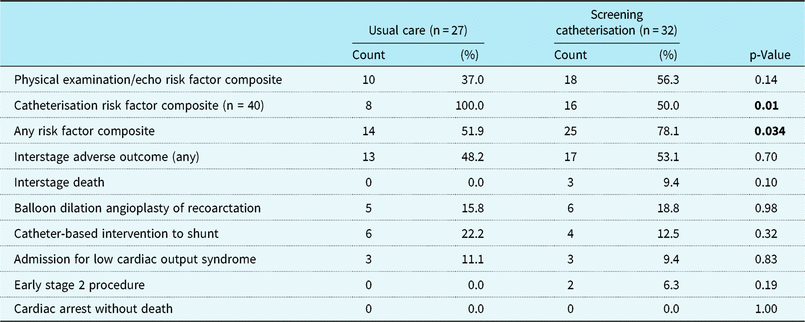
There was no difference between groups in the incidence of the physical exam/echocardiography risk factor composite [usual care 10/27 (37.0%) versus screening catheterisation 18/32 (56.3%), p = 0.14]. As expected, the usual care group had a higher rate of positive catheterisation risk factor composites: 8/8 (100%) of the usual care patients who underwent catheterisation due to clinical concerns had a positive catheterisation risk composite versus 16/32 (50%) of patients who underwent the screening catheterisation (p = 0.01). When considering both risk factor composites, 14/27 (51.9%) of the usual care versus 25/32 (78.1%) of the screening catheterisation were positive for one or both risk factor composites (p = 0.034).
Interstage adverse events outcome
Overall, half of the cohort had at least one event included in the interstage adverse event composite measure, which was not significantly different between groups [usual care 13/27 (48.2%) versus screening catheterisation 17/32 (53.1%), p = 0.7, Table 3]. There was no significant difference in mortality between groups [usual care 0/27 (0.0%) versus screening catheterisation 3/32 (9.4%), p = 0.1] although all three patients who died were in the screening catheterisation group. After neonatal discharge, there were no differences in the rates of catheter-based interventions for recoarctation or shunt issues as stated above. Similarly, there were no differences in admission for low cardiac output syndrome, early completion of stage 2 procedure, or cardiac arrest without death between groups (Table 3).
Risk factor and interstage adverse event composite score frequency by group

Bolded values indicate that p <0.05.
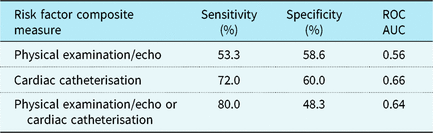
For prediction of the interstage adverse event composite, sensitivity was 53.3% for the physical exam/echo risk factor composite, 72.0% for the catheterisation risk factor composite, and 80% for either. Specificity was 58.6% for the physical exam/echo risk factor composite, 60.0% for the catheterisation risk factor composite, and 48.3% for either. The area under the receiver operating characteristic curve was 0.56 for the physical exam/echo risk factor composite, 0.66 for the catheterisation risk factor composite, and 0.64 for either (Table 4).
Risk factors composite scores area under the receiver operating characteristic curve for prediction of interstage adverse event

ROC AUC = receiver operating characteristic area under the curve
Discussion
We compared patients receiving usual post-operative care to those who underwent a screening catheterisation to determine whether screening catheterisation before discharge improved interstage outcomes in infants with univentricular cardiac defects. The two groups were similar in demographics and the frequency of the physical exam/echo risk factor composite. The only significant difference between groups was overall lower rates of catheterisation before discharge in the usual care group. As expected, in contrast to the screening catheterisation group, those usual care patients who underwent catheterisation due to clinical concerns had higher rates of cardiac intervention and positive catheterisation composite risk scores. As compared to the physical examination and echocardiography risk factor composite score, we found that adding a screening catheterisation before neonatal discharge provided slightly increased sensitivity and specificity to predict interstage adverse events, although neither score alone or in combination had a high area under the receiver operating characteristic curve. Despite this improved detection of risk factors, we did not identify significant differences in the interstage adverse event composite between the usual care and screening catheterisation groups, suggesting that usual care screening practices are sufficient for identifying anatomic risk factors for interstage adverse events at our centre. Given our findings and the known risks of catheterisation, particularly in neonates, we concluded that the screening catheterisation did not offer significant advantage over usual care at our centre and we, therefore, abandoned the practice.
Catheterisation before neonatal discharge
Our finding that a significant portion of the usual care group underwent a catheterisation for clinical concerns with a high rate of interventions prior to discharge illustrates that our centre had relatively consistent usual care practices during this time, in large part due to efforts focused on standardising interstage care. For example, it was generally accepted practice that any patient who could not maintain oxygen saturations >75% on room air in the absence of anaemia or poor cardiac function would undergo a catheterisation prior to neonatal discharge, and that an intervention would be performed if it was deemed safe and clinically indicated. Overall, our rates of catheter-based intervention before neonatal discharge in this small cohort are similar to those reported in the Single Ventricle Reconstruction trial: 5% (3/59) of our study cohort had a balloon dilation or stent placement in shunt or pulmonary artery versus 6.4% (35/549). Similarly, 2.9% (1/34) of patients with hypoplastic left heart syndrome in our study cohort underwent catheter-based intervention on the neoaorta versus 3.6% (20/549) who required either catheter-based or surgical intervention on the neoaorta.Reference Ohye, Sleeper and Mahony 1 The rate of complications related to catheterisation in this cohort was similar to other published rates.Reference Goldstein, Holzer and Trucco 12
Interstage mortality
The mortality rate of 5.1% (3/59) for this home monitoring cohort early in our centre’s experience is lower than historically reported interstage mortality ratesReference Hehir, Dominguez and Ballweg 7, Reference Ghanayem, Allen and Tabbutt 8 and comparable to the most recently published rate for the National Pediatric Cardiology Quality Improvement Collaborative,Reference Anderson, Beekman and Kugler 6 although it is higher than some single-centre reports.Reference Dobrolet, Nieves and Welch 3, Reference Anderson, Beekman and Kugler 6, Reference Ghanayem, Allen and Tabbutt 8
Catheterisation intervention rate during the interstage and stage 2 hospitalisation
Our rates of intervention on systemic-to-pulmonary artery shunts/pulmonary arteries and recoarctation during the interstage period are consistent with those reported in the Single Ventricle Reconstruction trial,Reference Ohye, Sleeper and Mahony 1 although our cohort may have had an intervention at an earlier age. Both patients in our cohort who underwent a balloon dilation of recoarctation during the stage 2 hospitalisation had previously undergone the same procedure, meaning that their first interventions occurred during the interstage. Diagnosing and intervening upon recoarctation earlier during the interstage have been proposed as a solution to further decrease interstage mortality, although the timing has remained unclear.Reference Hill, Rhodes and Aiyagari 9 Our results indicate that recoarctation was not evident at the time of neonatal discharge but can be detected before the stage 2 procedure through close clinical follow-up, including regular echocardiograms.Reference Wellen, Glatz, Gillespie, Ravishankar and Cohen 10 Our findings, therefore, may suggest that catheterisations should be performed when indicated by clinical concerns, whether those concerns occur during the neonatal hospitalisation, the interstage period, or after the stage 2 procedure. Standardisation efforts should focus on indications for cardiac catheterisation, such as unexplained low saturations or concern for coarctation on physical examination or echocardiogram, rather than a specific time interval.
Limitations
One significant limitation of this study is its non-randomised allocation to treatment group. Because attending physicians made the ultimate decision about whether infants underwent a screening catheterisation as recommended, it is possible that lower risk patients were in the usual care group, which may have affected our results. The small size of the cohort as well as the relative rarity of some adverse outcomes such as mortality may have obscured true differences between the usual care and screening catheterisation groups. Finally, because this was a single-centre study, these findings may not be generalisable to other sites.
Conclusion
In conclusion, we found that although the addition of a catheterisation composite risk score increased sensitivity and specificity for predicting interstage adverse events before neonatal discharge in shunt-dependent patients with univentricular cardiac defects, there was no difference in interstage adverse events between the usual care and screening catheterisation groups. Given this small advantage versus known risks, screening catheterisations appear not to render added benefit. Recognising the current lack of strong predictors of risk for interstage adverse events, continued close monitoring of these fragile, shunt-dependent single-ventricle infants through home monitoring programmes remains important to prevent interstage mortality.
Acknowledgement
None.
Financial Support
This research received no specific grant from any funding agency, commercial or not-for-profit sectors.
Conflicts of Interest
None.