Introduction
Although the link between stress and individual fitness costs remains a prominent area of investigation, relatively few experimental studies have examined the relationships between multiple stressors, especially those related to parasites. Both infestation with ectoparasites and various types of social contact with conspecifics are common sources of stress that many gregarious animal species encounter in nature (Stockley and Bro-Jorgensen, Reference Stockley and Bro-Jorgensen2011; Robertson et al., Reference Robertson, Muir, Hurd, Hing and Quinn2017; Culbert et al., Reference Culbert, Gilmour and Balshine2018). Indeed, group-living and parasitism (Beldomenico et al., Reference Beldomenico, Telfer, Gebert, Lukomski, Bennett and Begon2008; Beldomenico and Begon, Reference Beldomenico and Begon2010) both generate potential sources of stress in wild animals and increased risk of parasitism is often referred to as a fitness cost of group-living (Brown and Brown, Reference Brown and Brown1986; Cote and Poulin, Reference Cote and Poulin1995; Godfrey et al., Reference Godfrey, Bull, James and Murray2009; Kappeler et al., Reference Kappeler, Cremer and Nunn2015). The cost of repeatedly maintaining physiological stability in a manner that appropriately corresponds with the environment during stressful situations is known as allostatic load (Sterling and Eyer, Reference Sterling, Eyer, Fisher and Reason1988; McEwen, Reference McEwen1998; Juster et al., Reference Juster, McEwen and Lupien2010). Individuals holding social positions, dominant or subordinate, that have the higher allostatic load would experience more physiological stress (Creel, Reference Creel2001; Goyman and Wingfeld, Reference Goymann and Wingfield2004). In some species of group-living mammals, dominant individuals actually have higher levels of physiological stress than subordinates (Creel et al., Reference Creel, Monfort, Creel, Wildt and Waser1995, Reference Creel, Creel, Mills and Monfort1997; Arnold and Dittami, Reference Arnold and Dittami1997; Cavigelli, Reference Cavigelli1999; Sands and Creel, Reference Sands and Creel2004; Fichtel et al., Reference Fichtel, Kraus, Ganswindt and Heistermann2007). However, in other mammalian species, subordinates experience more physiological stress than dominants. For example, subordinate lab mice (Louch and Higginbotham, Reference Louch and Higginbotham1967), baboons (Sapolsky, Reference Sapolsky1992), and hyenas (Goymann et al., Reference Goymann, East, Wachter, Honer, Mostl, Van't Hof and Hofer2001) experience a higher allostatic load than their dominant counterparts. In addition, individuals of different social ranks could have different stress responses depending on the type of interaction involved (Stocker et al., Reference Stocker, Munteanu, Stöwe, Schwab, Palme and Bugnyar2016).
Parasitism could either be a cause of increased stress or increased physiological stress could increase the likelihood of an individual becoming parasitized (e.g. Beldomenico et al., Reference Beldomenico, Telfer, Gebert, Lukomski, Bennett and Begon2008). For example, increased social stress in the large vesper mouse (Calomys callosus) was associated with higher levels of Trypanosoma cruzi infection (Santos et al., Reference Santos, Toldo, Levy and Prado2008) and mice with chronically elevated corticosterone levels are more susceptible to parasitic nematodes (Malisch et al., Reference Malisch, Kelly, Bhanvadia, Blank, Marsik, Platzer and Garland2009). This suggests that increasing stress also increases host susceptibility to parasites. On the other hand, infection with nematodes (Anguillicola novaezelandiae) increased glucocorticoid (GC) levels in European eels, suggesting that parasites can directly increase host physiological stress (Dangel et al., Reference Dangel, Keppel, Tabujew and Sures2014). Similarly, St. Juliana et al. (Reference St Juliana, Khokhlova, Wielebnowski, Kotler and Krasnov2014) found that flea infestation can be physiologically stressful to rodent hosts. In this case, the type of host exploitation used by different flea species as well as the evolutionary history between host and flea species contributed significantly to host faecal GC metabolite concentrations (St. Juliana et al., Reference St Juliana, Khokhlova, Wielebnowski, Kotler and Krasnov2014). Thus, parasitism can be thought of as a potentially important biotic stressor in nature that could interact with other stressors, such as those encountered in social contexts. Indeed, physiological stress associated with social hierarchy position (e.g. Kokko, Reference Kokko2003; Dalerum et al., Reference Dalerum, Creel and Hall2006; Young et al., Reference Young, Carlson, Monfort, Russell, Bennett and Clutton-Brock2006; Cook et al., Reference Cook, McConnachie, Gilmour, Hinch and Cooke2011) and parasitism (e.g. Hare et al., Reference Hare, Hare and Cree2010; Koop et al., Reference Koop, Owen, Knutie, Aguilar and Clayton2013; González-Warleta et al., Reference Gonzalez-Warleta, Castro-Hermida, Regidor-Cerrillo, Benavides, Alvarez-Garcia, Fuertes, Ortega-Mora and Mezo2014; Hurtado et al., Reference Hurtado, Castro and Giraldo-Rios2016) are both considered possible causes of reproductive failure and therefore, both could substantially affect an individual's fitness. However, little is known about the relative contributions of each of these factors to the physiological stress that an individual experiences. Correlations between GCs and intestinal parasite species richness, but not dominance rank, have been found in male chimpanzees (Muehlenbein et al., Reference Muehlenbein, Watts and Whitten2004). However, experimental manipulations that simultaneously test the relative amount of physiological stress in reproductive animals caused by group-living and by parasitism, as well as possible interaction effects between these two stressors, have never been performed.
Both biotic and abiotic stressors impose various fitness costs on individuals belonging to a wide range of taxa (e.g. Sapolsky, Reference Sapolsky1986; Svensson et al., Reference Svensson, Raberg, Koch and Hasselquist1998; Persons et al., Reference Persons, Walker and Rypstra2002; Eccard and Ylönen, Reference Eccard and Ylonen2003; Meyer et al., Reference Meyer, Smith, Winston and Di Giulio2003; Creel et al., Reference Creel, Winnie and Christianson2009; Wingfield, Reference Wingfield2013). Ultimately, short-term elevation of GCs is adaptive because it shifts energy from some physiological processes, such as digestion, toward others that provide more immediate mechanisms to cope with acute stressors (Munck et al., Reference Munck, Guyre and Holbrook1984; Wingfield et al., Reference Wingfield, Maney, Breuner, Jacobs, Lynn, Ramenofsky and Richardson1998). However, long-term increases in GC levels are correlated with higher mortality rates in the wild (Pride, Reference Pride2005) while elevation of GC levels due to chronic stressors can impact immunity (e.g. McEwen, Reference McEwen1998; Marketon and Glaser, Reference Marketon and Glaser2008; Tort, Reference Tort2011), behavior (e.g. Conrad et al., Reference Conrad, Galea, Kuroda and McEwen1996; de Quervain et al., Reference de Quervain, Roozendaal and McGaugh1998; Roozendaal, Reference Roozendaal2002), and reproduction (e.g. Dobson and Smith, Reference Dobson and Smith2000; Tilbrook et al., Reference Tilbrook, Turner and Clarke2000). Reproductive effects, including delay in age of first reproduction (Crespi et al., Reference Crespi, Williams, Jessop and Delehanty2013), reduction in the number of reproductive bouts (Hackländer et al., Reference Hackländer, Möstl and Arnold2003), decreases in offspring quantity (Hayward et al., Reference Hayward, Bowles, Ha and Wasser2011), and decreases in offspring quality (Schreck et al., Reference Schreck, Contreras-Sanchez and Fitzpatrick2001), are significant fitness costs associated with chronic increases in GC levels.
Here, we used an experimental rodent-flea system to test the effects of social contact and parasitism, both alone and in combination, on physiological stress, as measured by GCs. We used Egyptian spiny mice, Acomys cahirinus, for this study as they are gregarious rodents that form group-living colonies in nature. These colonies typically consist of one male with several females and their pups (Fraňková et al., Reference Fraňková, Palme and Frynta2012). Although A. cahirinus breeds cooperatively, one female will take a dominant position and behave more aggressively toward subordinate females within the colony, especially when pups are present (Porter and Doane, Reference Porter and Doane1978). As Egyptian spiny mice are considered the principal hosts for Parapulex chephrenis fleas and this flea species is rarely found on rodents other than Acomys spp. in nature (Krasnov et al., Reference Krasnov, Hastriter, Medvedev, Shenbrot, Khokhlova and Vatschenok1999), we used P. chephrenis for our experimental infestations. We non-invasively measured GCS via faecal glucocorticoid metabolite (FGCM) concentrations (Palme, Reference Palme2019), in pregnant females experiencing different social and infestation statuses. Based on St. Juliana et al. (Reference St Juliana, Khokhlova, Wielebnowski, Kotler and Krasnov2014), we hypothesized that GCs would be higher in parasitized females when compared to uninfested females and thus, parasitized females would have higher FGCM levels. Since high allostatic load is linked with lower social rank in rodent species (e.g. Louch and Higginbotham, Reference Louch and Higginbotham1967), we also hypothesized that subordinate females would have higher FGCM levels thereby using FGCM as an indicator of allostatic load. Given that GC levels increase during pregnancy (e.g. Atkinson and Waddell, Reference Atkinson and Waddell1995), we expected that pregnant females would have higher FGCM concentrations; however, we also hypothesized that individuals with higher allostatic loads would exhibit higher levels of FGCM during pregnancy when compared to individuals with lower allostatic loads. Thus, we predicted that an interaction between the stressors of flea infestation and social contact would occur with FGCM levels being highest in infested, subordinate females during pregnancy.
Materials and methods
Study animals
We used rodents and fleas originating from our laboratory colonies and specific details regarding the maintenance of these colonies are available elsewhere (e.g. Krasnov et al., Reference Krasnov, Khokhlova, Fielden and Burdelova2001, Reference Krasnov, Khokhlova, Fielden and Burdelova2002; Khokhlova et al., Reference Khokhlova, Serobyan, Krasnov and Degen2009a, Reference Khokhlova, Serobyan, Krasnov and Degen2009b). Prior to experiments, rodents were individually housed in plastic cages (28 cm × 20 cm × 13 cm at 25 °C ± 1 °C and 12:12 D:L) with wood shavings as bedding material. They were fed whole millet seeds ad libitum and fresh alfalfa daily as a water source. Animals also received commercial cat chow (Nestlé Purina, Société des Produits Nestlé S.A., Switzerland) once a week as a protein source.
Female cohabitation and social hierarchy position
We used nulliparous female A. cahirinus between five and eight months of age. Although age has not been shown to have a significant effect on FGCM levels in this species (Nováková et al., Reference Nováková, Palme, Kutalova, Jansky and Frynta2008), we used animals that were considered young, sexually mature adults. In addition, none of these females had been previously exposed to flea infestation. Prior to experiments, females were randomly assigned to either solitary or group-living treatment groups and were placed in 33 cm × 26 cm × 16 cm plastic cages. Those females who were assigned to group-living treatments were then randomly assigned a full-sibling sister, who was not a littermate and thus never encountered prior to the experiment, with which to cohabitate. Females were then weighed and the larger female was marked with nontoxic dye on its dorsal pelage to differentiate between individuals. Next, females were allowed a 2 week acclimation period (Fraňková et al., Reference Fraňková, Palme and Frynta2012) during which they were allowed to interact and self-determine their social hierarchy position. During this time, the females were placed in a designated experimental room (25 °C ± 1 °C and 12:12 D:L) to minimize external disturbance and their behaviour was recorded using closed-circuit video camera setup (8 CH 1 TB H.264 Security DVR System + Sony Color CCD IR Cameras, Sony Corporation, Tokyo, Japan). Each individually-numbered cage of two females had its own camera channel and cameras were equipped with motion sensors that would initiate video recording whenever the rodents moved around the cage. Recording then continued for 5 min after movement ceased. These cameras are capable of recording in low light conditions; therefore, nocturnal interactions between females were easily observable. After the 2 week acclimation period, recordings were analysed in order to determine which female could be considered dominant and which could be considered subordinate. We used a scoring method similar to that of Chelini et al. (Reference Chelini, Palme and Otta2011) to determine social hierarchy. In short, aggressive behaviours (e.g. attacking, guarding food dish) and defensive behaviours (e.g. fleeing, submissive posturing) were recorded with one point given to females for every instance of aggressive behaviour (Chelini et al., Reference Chelini, Palme and Otta2011). After the observation period, females with a higher score in each pair were considered dominant (See Supplemental Table SX for summary data). Although females were acclimated for 2 weeks, after approximately 1 week each pair of females had defined their social position and instances of aggression dramatically decreased. This type of behaviour is consistent with published records of how this species acclimates to unknown individuals within a laboratory setting (Fraňková et al., Reference Fraňková, Palme and Frynta2012).
Experimental design
After the acclimation period, A. cahirinus individuals or pairs were randomly assigned to be either infested with fleas or remain uninfested as part of the control groups. Thus, an individual rodent could belong to one of six treatment groups: control and solitary (C0), control and dominant (C1), control and subordinate (C2), infested and solitary (I0), infested and dominant (I1), or infested and subordinate (I2). Each treatment group was comprised of 12 animals in total. Fleas were randomly selected from laboratory colonies and released into home cages of rodents belonging to infested treatment groups (100 fleas for group-living cages, 50 fleas for solitary cages). As rodents were free to groom, approximately 50% of fleas per week were expected to be dislodged and killed by a host (Hawlena et al., Reference Hawlena, Bashary, Abramsky and Krasnov2007). Therefore, every week new fleas (100 fleas for group-living cages, 50 fleas for solitary cages) were added to each cage to keep flea pressure more or less constant. Female rodents were weighed every day during the experimental period.
Two weeks after initial infestation, a male was added to all female cages. For infested treatment groups, enough fleas were added so that a sufficient number of fleas could infest all three animals in the cage (150 fleas for group-living cages, 100 fleas for solitary cages). Males were housed with females for 2 weeks to allow successful copulation. One week after introducing a male, another set of fleas (150 fleas for group-living cages, 100 fleas for solitary cages), was added to each cage for infested treatment groups. After 2 weeks, we removed male rodents and collected all fleas from their bodies via brushing their coat with a toothbrush. Then, males were returned to their respective laboratory colony while females were placed in new cages and again infested with fleas (100 fleas for group-living cages, 50 fleas for solitary cages) until shortly before parturition (approximately the 35th day of pregnancy as determined by pattern of female mass gain; Nováková et al., Reference Nováková, Vašáková, Kutalová, Galeštoková, Průšová, Šmilauer, Šumbera and Frynta2010). Fleas were also removed from females using a toothbrush and females were transferred to individual, flea-free cages before giving birth. Females that were previously in pairs were moved to individual cages to ensure that no alloparental care of pups occurred. All animals belonged to uninfested or infested treatment groups experienced the same handling procedures (i.e. either cleaning or sham cleaning, respectively). Supplemental Fig. S1 provides a conceptual diagram summarizing the steps that occur during the experimental period before parturition occurs. All experimental protocols met the requirements of the 1994 Law for the Prevention of Cruelty to Animals (Experiments on Animals) of the State of Israel and were approved by the Ben Gurion University Committee for the Ethical Care and Use of Animals in Experiments (Permits IL-72-10-2012 and IL-36-07-2017).
Analysis of FGCMs
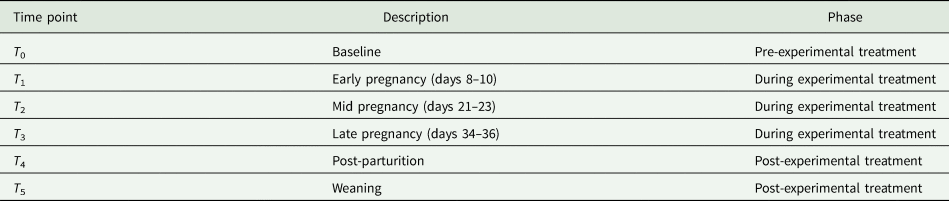
Faeces collection procedures followed those of Frynta et al. (Reference Frynta, Novakova, Kutalova, Palme and Sedlacek2009). In short, females were isolated from each other and placed into individual faecal collection cages following the experimental time point schedule (Table 1). The bottom of these collection cages had a paper liner with three wire screens placed over it. Thus, faecal pellets would fall to the floor of the cage and be separated from the animal itself. Animals were allowed to move freely around the collection cage for 2 h. As FGCM concentrations in rodents can significantly vary with time of day (Sipari et al., Reference Sipari, Yloenen and Palme2017), all experimental collections occurred within the same 3 h window of time (i.e. 13:00–16:00), with the exception of faecal collection after birth (T 4) because the collection time depended on when pups were born, which did not follow a set schedule. After parturition, faecal pellets were obtained from adult females between ~2 and 4 h after pups were born (T 4). Faecal pellets were also obtained from adult females within a 2 h window immediately after weaning (T 5). After the collection period, animals were placed in their experimental cages (T 0–T 2), cleaned and moved to flea-free cages (T 3), returned to clean cages (T 4), or returned to the main rodent colony (T 5).
Schedule of time points for faecal collection along with a description of corresponding events and the phase of the study in which the time point takes place

Faecal pellets were removed from collection cages and placed in 1.5 mL SafeLoc microcentrifuge tubes (Eppendorf, Hamburg, Germany). Tubes were then placed with their lids open in a drying oven overnight at 60 °C to remove any moisture from faeces. After drying, the lids were closed and tubes were temporarily stored in a freezer at −20 °C until the end of the experimental period. After the last experimental time point, faeces were removed from cold storage and FGCM were extracted and measured using protocols outlined by Touma et al. (Reference Touma, Sachser, Möstl and Palme2003, Reference Touma, Palme and Sachser2004) with minor modifications. In short, pellets from each tube were ground with a clean mortar and pestle. Ground faeces were weighed and 0.05 g transferred to a clean 1.5 mL SafeLoc microcentrifuge tube, then 1.0 mL of 80% methanol was added to the tube. Next, samples were mixed on a QSD 0S20 orbital shaker (QSR Technologies International, Keysborough, Australia) for 30 min and subsequently centrifuged at 2500g for 15 min in a CN-2000 microcentrifuge (Hsiang Tai Machinery Industry Co, Ltd., Taipei, Taiwan). After centrifugation, 500 µL of the resulting supernatant were transferred to clean SafeLoc microcentrifuge tubes. To ensure safe storage these tubes were then again placed with their lids open in a drying oven overnight at 60 °C to allow methanol to evaporate. The resulting tubes were completely dry with residue containing FGCMs lining the interior. The lids of these tubes were then closed and the tubes stored at room temperature until FGCM analysis.
To perform FGCM analysis, the residue was reconstituted by adding 500 µL of 80% methanol to each tube and vortexed for 1 min. Aliquots of the reconstituted supernatant were then diluted 1:10 with assay buffer (Tris/HCl 20 mm, pH 7.5) in new titer tubes and frozen at −20 °C until analysed in an established group-specific enzyme immunoassays (5α-pregnane-3β,11β,21-triol-20-one EIA). This EIA, measuring metabolites with a 5α-3β,11β-diol structure, was originally developed for laboratory mice. Details of the EIA, as well as cross-reactions with different steroids, can be found in Touma et al. (Reference Touma, Sachser, Möstl and Palme2003). The intra- and interassay coefficients of variation were below 10.0 and 12.0%, respectively. Note that unlike most laboratory rodents, cortisol is the major stress hormone for the genus Acomys and the above protocols were validated for A. cahirinus via adrenocorticotropic hormone challenge test (Nováková et al., Reference Nováková, Palme, Kutalova, Jansky and Frynta2008).
Statistical analyses
Our focus was female stress hormone levels during pregnancy; therefore, only those females who gave birth were included in the statistical analyses. However, we also tested the null hypothesis that there would be no difference between FGCM concentrations at T 0 between females that did and did not give birth using a Welch test comparing two groups with unequal sample sizes. We used T 0 as this was the baseline FGCM for each female that was not influenced by pregnancy for both groups. We analysed the effects of infestation status (infested or uninfested), social contact type (solitary, dominant, or subordinate), and experimental time point (T 0–T 5) on FGCM concentrations via a mixed effects model with an autocorrelation structure in the model using package ‘nlme’ (Pinheiro et al., Reference Pinheiro, Bates, DebRoy and Sarkar2018) in the R statistical environment (R Core Team, 2015) of all females who gave birth to pups. This way we were able to take repeated measures of FGCM concentration for each individual into account. Infestation status, social contact, and time were coded as categorical variables. Because A. cahirinus that lose body mass during flea infestation have higher FGCM levels than those that do not (St. Juliana et al., Reference St Juliana, Khokhlova, Wielebnowski, Kotler and Krasnov2014), both total mass change over the course of the experiment (i.e. body mass at T 5–body mass at T 0; Supplementary Table A1) and animal identity were included as random factors. To parameterize the model, we first needed to find the first-order temporal autocorrelation structure (corAR1) using the ‘correlation’ statement and the ‘ACF’ function in package ‘nlme’ (Mangiafico, Reference Mangiafico2016). The resulting correlation structure (ACF = −0.0627) was then built into the mixed effects model. Deviations from homoscedasticity or normality were not revealed during a visual inspection of residual plots. This mixed effects model was then subjected to analysis of deviance (Type II test) using function ‘Anova’ in package ‘car’ (Mangiafico, Reference Mangiafico2016) to determine the significance of any main effects or interaction terms. We then calculated Cohen's d to quantify the effects size of each term. In addition, as number of births varied in each treatment group, we used an x 2 test of association to ensure that the number of births observed in each group did not significantly differ.
Results
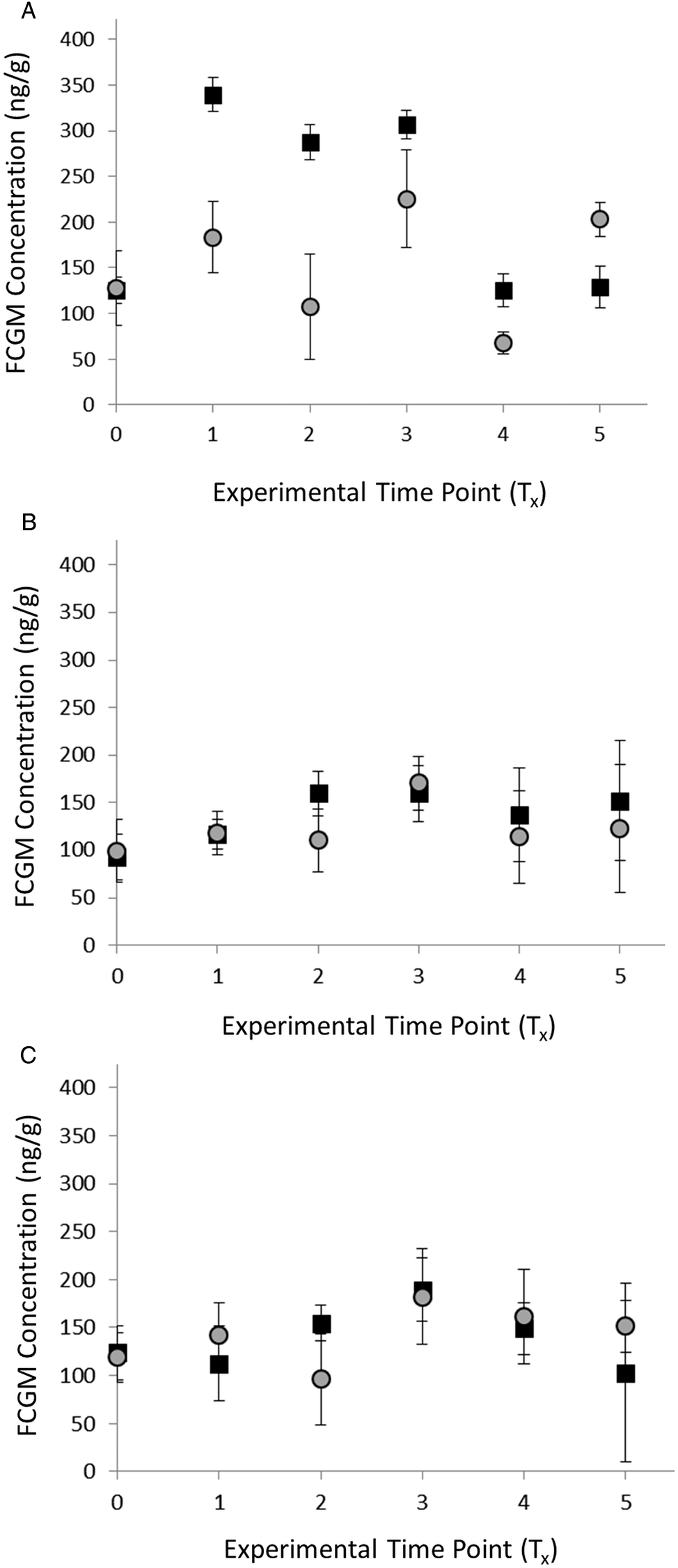
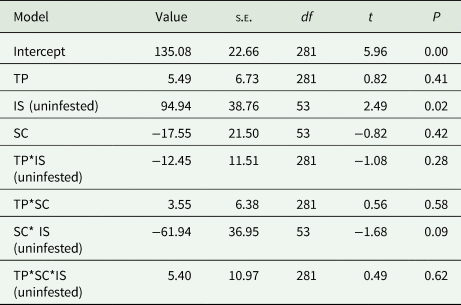
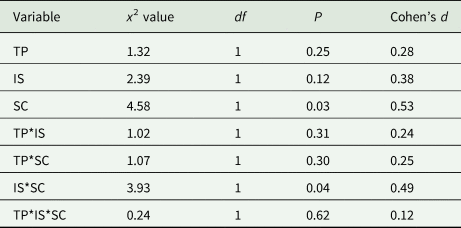
The number of females who gave birth ranged from a maximum of 10 out of 12 females (groups C0 and I0) to a minimum of six out of 12 females (C2) per treatment group (Supplementary Table S2); however, the difference between groups was not significant (x 2 = 0.06, df = 2, P = 0.97). Additionally, baseline FGCM concentrations did not significantly differ between those females who did or did not give birth (t = 0.26, df = 53, P = 0.79; Supplementary Table S3). In general, for those females that gave birth, FGCM levels slightly increased over the course of gestation until birth, followed by a decrease after parturition, and then a slight increase at weaning (Fig. 1A). GC levels differed between treatment groups, with solitary females exhibiting the most dramatic changes in FGCM levels. Solitary females had the highest peaks and the lowest nadirs in FGCM concentration of all treatment groups with control group females exhibiting the highest FGCM concentrations during pregnancy (Fig. 1A). Dominant (Fig. 1B) and subordinate (Fig. 1C) females belonging to each treatment group generally had similar FGCM concentrations during the course of the experiment. However, the general pattern of rise in GCs during gestation and fall after parturition remained consistent for all treatment groups. The mixed-effects model of FGCM concentration with the variables of time point, infestation status, and social contact type suggested that infestation status and the interaction between infestation status and social contact type were key terms when assessed via consideration of P values and Cohen's d (Tables 2 and 3). Subsequent analysis of deviance (type II test) revealed that social contact type, as well as the interaction between infestation status and social contact type, significantly affected GC levels. Cohen's d indicated that both of these terms had moderate effects sizes while all others had small effects sizes (Table 3).
(A) Changes in mean faecal cortisol metabolite (FGCM) concentration for solitary treatment groups for each time point (T 0 through T 5) in the experiment. Black squares represent control females (group C0) and grey circles represent infested females (group I0). (B) Changes in mean faecal cortisol metabolite (FGCM) concentration for dominant treatment groups for each time point (T 0 through T 5) in the experiment. Black squares represent control females (group C1) and grey circles represent infested females (group I1). (C) Changes in mean faecal cortisol metabolite (FGCM) concentration for subordinate treatment groups for each time point (T 0 through T 5) in the experiment. Black squares represent control females (group C2) and grey circles represent infested females (group I2). Error bars are included for each group at each time point.

Summary of the mixed-effects model of female A. cahirinus faecal FGCM levels for variables time point (TP), infestation status (IS), and social contact type (SC)

Note that the reference category for infestation status is ‘uninfested’.
Summary of Analysis of Deviance (Type II test) for the model of time point (TP), infestation status (IS), and social contact type (SC) on female A. cahirinus faecal FGCM levels

Cohen's d is a measure of effect size (0.20 ⩾ small, 0.50 ⩾ moderate, 0.80 ⩾ large).
Discussion
We hypothesized that flea infestation would increase GC levels in A. cahirinus females, regardless of their social interactions. We also hypothesized that GC levels would be highest in females with lower social rank. Thus, we predicted that an interaction between the stressors of flea infestation and social contact would occur with FGCM levels highest in infested, subordinate females and lowest in uninfested, solitary females. However, our results only partly supported these predictions. In general, we uncovered three trends related to FGCM concentrations during our investigation of stress, social status, parasitic infestation, and reproduction. First of all, GC levels changed during pregnancy and birth, albeit not significantly. As expected, these levels rose as pregnancy progressed, then fell after females gave birth. However, FGCM concentrations did not rise more sharply in either infested or subordinate females and FGCM levels also rose slightly during lactation until weaning in all treatment groups. Secondly, social hierarchy, where females were either dominant or subordinate, did not necessarily impact GC levels. Rather unexpectedly, solitary females had significantly higher FGCM levels than females housed in pairs. Finally, contrary to our predictions, flea infestation alone did not have a significant effect on female GC levels. We found evidence for a significant interaction between the stressors of parasitism and social contact; however, the relationship was the opposite of what was expected. Solitary, uninfested females had the highest FGCM levels of any treatment group and this result was consistent throughout the reproductive period.
Changes in stress hormone levels during pregnancy are well-documented in various mammalian taxa (Edwards and Boonstra, Reference Edwards and Boonstra2018), including rodents (Atkinson and Waddell, Reference Atkinson and Waddell1995). Gestation is considered an important physiological stressor. Stress hormone levels typically increase steadily over each trimester of pregnancy and then drop sharply after parturition (Edwards and Boonstra, Reference Edwards and Boonstra2018). Proximally, high GC concentrations likely help meet metabolic demands during gestation (Foley et al., Reference Foley, Papageorge and Wasser2001; Soma-Pillay et al., Reference Soma-Pillay, Nelson-Piercy, Tolppanen and Mebazaa2016). From an evolutionary perspective, high maternal GC levels have several, more ultimate benefits. Corticosteroids can promote foetal brain and lung development during the last trimester of pregnancy (Mendelson, Reference Mendelson2009) and influence the start of mechanisms behind the process of labour (Valenzuela-Molina et al., Reference Valenzuela-Molina, Atkinson, Mashburn, Gendron and Brownell2018). Higher prenatal GC levels in pregnant females have also been linked to more attentive maternal responses after birth (Bardi et al., Reference Bardi, French, Ramirez and Brent2004). In addition, high maternal levels of circulating GCs promote a decreased response to acute stress during late-stage pregnancy allowing for, in essence, a desensitization effect on the mother that is protective to the foetus (de Weerth and Buitelaar, Reference de Weerth and Buitelaar2005).
This same pattern of FGCM levels increasing over pregnancy then dropping after birth occurred in our study animals as well, although this pattern was not significant. However, this could be because we also observed that FGCM levels rose again between birth and weaning in all treatment groups. Such a pattern occurs in some other mammals, such as domestic pigs (Sus domesticus), where GCs rise approximately 24 h after birth and increase to a peak at approximately 18 days post-weaning that corresponds to estrus (Ash and Heap, Reference Ash and Heap1975). Given that lactation is energetically demanding (e.g. Butte and King, Reference Butte and King2005; Speakman, Reference Speakman2008), it is logical that GC levels might increase due to increased physiological demands over the course of lactation.
Contrary to our predictions, solitary females had higher FGCM levels than either dominant or subordinate females. This is likely because isolation is more stressful than social contact between two individuals for a social species like A. cahirinus. Thus, no matter the social hierarchy position, living in a group decreases allostatic load for gregarious species when compared to solitary living. Indeed, when female laboratory mice are solitary for short periods of time (7 days), they begin to exhibit a slight increase in corticosterone levels as compared to females grouped with either siblings or unfamiliar females for the same amount of time (Bartolomucci et al., Reference Bartolomucci, Parmigiani, Gioiosa, Ceresini and Palanza2009). Similarly, female tuco-tucos (Ctenomys sociabilis), which are colonial, communally breeding rodents, exhibited higher FGCM concentrations when living alone rather than when living in groups (Woodruff et al., Reference Woodruff, Lacey, Bentley and Kriegsfeld2013). Unlike group-living animals, solitary tuco-tucos did not experience an afternoon decline in FGCM concentration and their corticosterone concentrations remained elevated throughout the day (Woodruff et al., Reference Woodruff, Lacey, Bentley and Kriegsfeld2013). Thus, the challenge of living a solitary lifestyle was more stressful than managing social interactions. In this way, our results follow those of Ebensperger et al. (Reference Ebensperger, Ramírez-Estrada, León, Castro, Tolhuysen, Sobrero, Quirici, Burger, Soto-Gamboa and Hayes2011) which showed that sociality in the communally-breeding rodent, Octodon degus, had no effect on mean circulating GC levels and that they were instead linked to reproductive effort rather than social conditions. This implies that individual rodents belonging to gregarious species could respond in a similar manner to environmental or social challenges, so long as they are housed in a manner consistent with the group-living context in which these species evolved.
Unexpectedly, females that were both solitary and unparasitized had the highest GC levels. These results somewhat contradict the earlier results of St. Juliana et al. (Reference St Juliana, Khokhlova, Wielebnowski, Kotler and Krasnov2014) that generally found increased FGCM in rodents, including A. cahirinus, infested with fleas, particularly so-called ‘body fleas’ like P. chephrenis. However, St. Juliana et al. (Reference St Juliana, Khokhlova, Wielebnowski, Kotler and Krasnov2014) also found that the evolutionary relationship between flea and host species was critical. Thus, A. cahirinus, the principal host for P. chephrenis, had a lower physiological stress response to this flea species when compared to other rodents that did not have a tight evolutionary association with this flea (St. Juliana et al., Reference St Juliana, Khokhlova, Wielebnowski, Kotler and Krasnov2014). In addition, St. Juliana et al. (Reference St Juliana, Khokhlova, Wielebnowski, Kotler and Krasnov2014) did not test infestation in the context of social contact and used only a small number of nonparous females. Considering that females, particularly pregnant females, can have varied GC production depending on reproductive status (Ash and Heap, Reference Ash and Heap1975), the results of our investigation and those of St. Juliana (Reference St Juliana, Khokhlova, Wielebnowski, Kotler and Krasnov2014) might not be directly comparable. In addition, several other physiological mechanisms that were not measured can be responsible for regulating an individual's return to homeostasis following exposure to a stressor. For instance, the autonomic nervous system reacts to a stressor by increasing the levels of catecolamines in plasma (Mastorakos et al., Reference Mastorakos, Pavlatou, Diamanti-Kandarakis and Chrousos2005). Additionally, corticotrophin-releasing hormone is the principle regulator of the HPA axis itself and experiences negative feedback from GCs (Jeannetaeu et al., Reference Jeanneteau, Lambert, Ismaili, Bath, Lee, Garabedian and Chao2012). However, these plasma hormones can be difficult to measure without invasive procedures that could themselves act as stressors and thus, FGCMs represent a useful non-invasive method of assessing an individual's response to a stressor (Palme et al., Reference Palme, Rettenbacher, Touma, El-Bahr and Möstl2005).
Instead of causing more stress to solitary animals, flea infestation could have had a mitigating effect on isolation by promoting grooming and thus decreased the physiological stress experienced by solitary animals in the experiment. Grooming has been shown to mitigate physiological stress in several species of mammals, most frequently primates (Boccia et al., Reference Boccia, Reite and Laudenslager1989; Gust et al., Reference Gust, Gordon, Hambright and Wilson1993, Aureli et al., Reference Aureli, Preston and de Waal1999, Shutt et al., Reference Shutt, MacLarnon, Heistermann and Semple2007, Aureli and Yates, Reference Aureli and Yates2010). Like positive social interaction with conspecifics (Pinelli et al., Reference Pinelli, Leri and Turner2017), autogrooming in rodents plays a role in reducing stress (Smolinsky et al., Reference Smolinsky, Bergner, LaPorte, Kalueff and Gould2009, Denmark et al., Reference Denmark, Tien, Wong, Chung, Cachat, Goodspeed, Grimes, Elegante, Suciu and Elkhayat2010). It is well-recognized that rodents groom in both low-stress (i.e. comfort grooming) and high-stress (i.e. anxiety grooming) situations and that the types of grooming behavior differ in each of these situations (Kalueff and Tuohimaa, Reference Kalueff and Tuohimaa2004, Smolinsky et al., Reference Smolinsky, Bergner, LaPorte, Kalueff and Gould2009, Kyzar et al., Reference Kyzar, Gaikwad, Roth, Green, Pham, Stewart, Liang, Kobla and Kalueff2011). However, rodents also groom in response to outside factors, such as having water on their pelage. Although this so-called artificial grooming is unrelated to the levels of stress they experience (Smolinsky et al., Reference Smolinsky, Bergner, LaPorte, Kalueff and Gould2009), rodents engaging in artificial grooming, such as after being misted with water, exhibit lower levels of depressive behavior (Shiota et al., Reference Shiota, Narikiyo, Masuda and Aou2016). In the absence of positive social interactions with conspecifics, infestation with fleas could have decreased physiological stress via stimulation of artificial grooming and thus lead to lower FGCM levels in infested vs uninfested rodents in solitary treatment groups.
Finally, we were only able to test a simple social interaction between two females and could not include more complex social groupings. Various combinations of social contact, such as varying numbers of individuals per experimental group, and infestation with other stressors, such limited resource availability, could lead to different outcomes. Indeed, A. cahirinus that lose body mass during flea infestation has higher FGCM levels than those that do not (St. Juliana et al., Reference St Juliana, Khokhlova, Wielebnowski, Kotler and Krasnov2014). Thus, unlike the animals that were fed ad libitum in our experiments, individuals experiencing food scarcity and infestation could have different levels of stress that might or might not be mitigated by social contact. Thus, although our laboratory experiment might be missing some elements found in natural populations (e.g. potential for larger colony sizes, food scarcity), it can nonetheless provide empirical data that can inform future hypotheses and provide a basis for the development of further experiments in the laboratory and in the field. In any case, additional experiments combining parasitism with other stressors animals commonly experience in nature can greatly improve our understanding of the relative effects of parasites and other potential environmental stressors along with the types of sub-lethal fitness effects that parasitized animals might incur in nature due to these stressors.
In conclusion, we found that although flea infestation and social contact have significant effects on FGCM levels in reproductive A. cahirinus, these potential stressors produced unexpected results in our experiment. Instead of having the lowest levels of stress hormones, uninfested, solitary females had the highest FGCM concentrations of any treatment group. This suggests that both social contact and infestation mitigate stress in pregnant rodents. Thus, although increased risk of parasitism might be a cost of group-living, some gregarious host species seem to developed effective techniques for minimizing this cost, as in the Egyptian spiny mice used in our experiment. Further, when examining control groups, solitary living appears to be an even greater stressor than flea infestation, likely because infestation elicits artificial grooming that reduces GC levels. Thus, for A. cahirinus colonies in nature, the increased risk of infestation that accompanies group living could be outweighed by the positive aspects of social contact within the colony. However, the effects of this stress on offspring quality or quantity, and thus parental fitness, remain poorly understood.
Supplementary material
The supplementary material for this article can be found at https://doi.org/10.1017/S0031182019001185
Acknowledgements
The authors extend their gratitude to E. Klobetz-Rassam and S.A. Summerfield for their technical assistance. We also wish to thank B.P. Kotler for use of camera equipment. This is publication number 1037 of the Mitrani Department of Desert Ecology.
Financial support
This study was partly supported by the Israel Science Foundation (Grant number 149/17 to BRK and ISK). EMW received financial support from the Blaustein Center for Scientific Cooperation, the Company of Biologists (Traveling Fellowship), the Keren Embar Memorial Foundation, and Ben Gurion University of the Negev. LVDM received financial support from the Blaustein Center for Scientific Cooperation and the French Associates Institute for Agriculture and Biotechnology of Drylands. ENS received the Scholarship of the President of the Russian Federation for short-term studies abroad.
Conflict of interest
The authors declare that they have no conflict of interest.
Ethical approval
All applicable institutional and/or national guidelines for the care and use of animals were followed.