I. FORMAT, DATES, AND ATTENDANCE
The 71st Annual Conference on Applications of X-ray Analysis, more commonly known as the Denver X-ray Conference or DXC, returned as an in-person event after two virtual conferences. The weeklong conference, held on 1–5 August 2022, visited a brand new East Coast location, the Bethesda North Marriott Hotel & Conference Center. X-ray and materials scientists gathered at the conference to discuss various techniques, applications, software, instruments, and products for XRD and XRF analysis. The combination of attendees and exhibitors brought the attendance to over 300 X-ray scientists, with over 25% from outside the United States.
II. DXC WORKSHOPS
The technical program began with 15 half-day tutorial workshops held on Monday and Tuesday of conference week. Topics were categorized as either XRD, XRF, or Special Topic and focused on both beginner and advanced levels. Forty specialists were invited to participate as workshop instructors, and many provided handouts that were posted on a private website for attendees only. Topics included:
Machine Learning Techniques in X-ray Analysis
XRD Sample Preparation
Sample Preparation of XRF
Layered Structures
2D Detectors
X-ray Absorption Spectroscopy
Basic XRF
Handheld XRF
X-ray CT in Laboratory Settings
Stress Analysis
Micro XRF
Rietveld Analysis for Phase Quantification
Small-angle X-ray Scattering
Multimodal XRF Microscopy Fitting Tools
Trace Analysis
III. PLENARY SESSION AND DXC AWARDS
The Plenary Session, Geology In & Out of This World, was held on Wednesday morning as the opening session for the oral talks that would be presented during the next 3 days of conference week. Tom Blanton, International Centre for Diffraction Data, chaired the plenary; it began with an awards presentation.
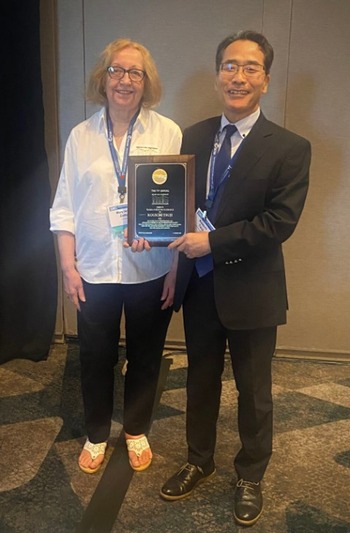
The Birks Award, given biennially to recognize outstanding contributions to the field of X-ray spectrometry, was presented to Kouichi Tsuji of Osaka Metropolitan University, Japan (Figure 1). Dr. Tsuji received the award for his contributions to the development and applications in the field of X-ray fluorescence spectrometry including depth profiling using confocal XRF, full field WDXRF imaging, micro XRF, TXRF; and for his commitment to his students and to the international XRF community.
Birks award winner Kouichi Tsuji of Osaka metropolitan University, Japan, pictured with Mary Ann Zaitz, IBM Retired, USA.

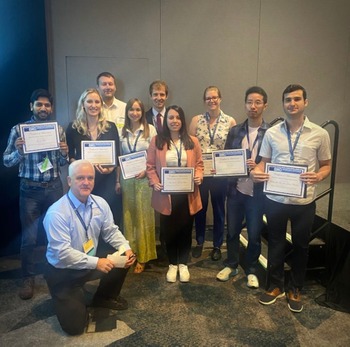
Eleven outstanding young scientists received the 2022 Robert L. Snyder Student Grant Award (Figure 2). The awardees and the works they presented at the conference were:
Paola Cirelli, University of Brescia, Italy, X-ray Fluorescence under Grazing Incidence Analysis of Particulate Matter Filters: Understanding the Effect of Beam Footprint
Adam Corrao, Stony Brook University, USA, What Happens When Nanoparticles Are Not Spherical?
Sarah Gosling, Cranfield University, United Kingdom, Identifying Disease Biomarkers through X-ray Diffraction of Breast Calcifications
Gaurav Gupta, University of Delhi, India, Microstructural Analysis of ZnO Nanoparticles Using Rietveld Refinement of X-ray Diffraction Data
Sven Hampel, Clausthal University of Technology, Germany, Picoliter Derived Artificial Samples and Their Investigation with Gracing Incidence XRF & Gracing Incidence X-ray Diffraction Analysis of Picoliter Derived Specimen & Picoliter Derived Micro Deposits as Tool to Understand Thin Film Sample Preparation & 3D Printing of Metal Containing Polymer Layers as Reference Samples in Micro XRF Analysis
Otavio Jose Bandeira Jovino Marques, Illinois Institute of Technology, USA, Operando XAS Studies of High-Entropy Oxides in Li-ion Batteries & Operando PDF Studies of High-Entropy Oxides in Li-ion Batteries
Ana Cecilia Murrieta Muñoz, Tecnológico de Monterrey, México, Inversion Degree and Microstructure Evaluation of ZnFe2O4 Ferrispinel
Sahar Shadman, Illinois Institute of Technology, USA, High-Entropy Oxide Bronzes as Tunable Li-ion and Na-ion Anode Materials
Chloe Skidmore, Pennsylvania State University, USA, High Temperature X-ray Diffraction of Thermite Reactive Nanolaminates
Ning Su, Illinois Institute of Technology, USA, In Situ EXAFS Studies of Pd@Ni(OH)2&C Catalyst for Ethanol Oxidation
Karel Trojan, Czech Technical University in Prague, Czech Republic, Microstructure Parameters, Residual Stresses, and Preferred Orientation of Laser Additive Manufactured H13 Tool Steel
2022 Robert L. Snyder student grant award winners, pictured with Tom Blanton, ICDD, USA.

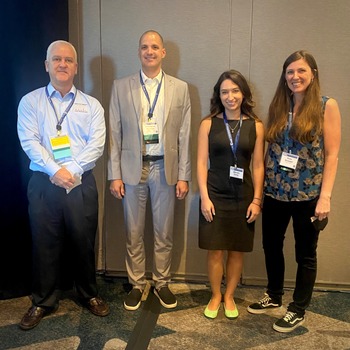
Following the awards presentation, the plenary session continued with three fascinating talks by keynote speakers Gabriela Farfan, Smithsonian Institution, USA, Erica Suosaari, Smithsonian Institution, USA, and Christopher Heirwegh, Jet Propulsion Laboratory, California Institute of Technology, USA (Figure 3). Dr. Farfan presented the talk, Unlocking How Biomineral Crystals Record Their Environments. Next was Dr. Suosaari's presentation on, From Western Australia to the Atacama Desert: Lessons about the Past from Modern Microbialites. Dr. Heirwegh presented on PIXL's Recent X-ray Data and Findings from the Red Planet. The session was well attended and received many positive comments from attendees.
2022 plenary speakers (L-R) – Tom Blanton (session chair), Christopher Heirwegh, Gabriela Farfan, Erica Suosaari.

IV. SPECIAL SESSIONS
From Wednesday afternoon through Friday morning, 14 half-day oral sessions were held. Nearly one hundred presentations were organized in the oral sessions, with 20 presentations given by invited speakers, experts in their respective fields. Topics included:
New Developments in XRD & XRF Instrumentation
General XRD
X-ray Absorption Spectroscopy
Industrial Applications of XRD
Cultural Heritage
Quantitative Analysis of XRF
Machine Learning Techniques in X-ray Analysis
Non-ambient Analysis
Stress Analysis
Trace Analysis
Micro XRF using Imaging
Small-angle X-ray Scattering
Applications of Rietveld Analysis
Industrial & General XRF
V. POSTER SESSIONS
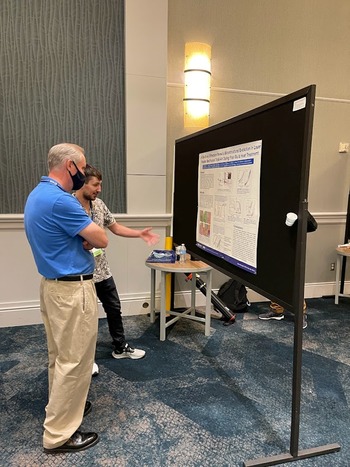
Posters were presented on Tuesday and Wednesday evenings during the XRD and XRF poster sessions (Figure 4). Two E-poster stations were also set up in the exhibit hall. Attendees were given the opportunity to study electronic copies of the posters at the E-poster stations or through the mobile app, Whova. Esteemed judges chose the best posters, and the competition was strong.
Organizing committee member Conal Murray, IBM T.J. Watson Research Center, USA speaking with Lucas Ravkov, Queen's University, Canada during the XRD poster session.

Ultimately, the following presenters were named winners:
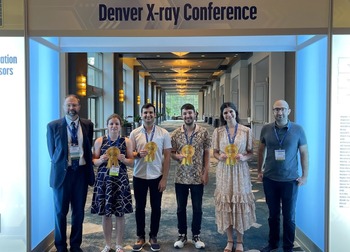
XRD Best Poster Awards (Figure 5):
Alyssa Thornton*, J. Swift, Georgetown University, USA
T. Fawcett, ICDD, USA
G. Schuett, Chiricahua Desert Museum, USA, for their work:
Microstructural Characterization of Ball Python Urates
Jen Werner*, J. Swift, Georgetown University, USA, for their work:
Desolvation Pathways of Variable Composition Solvates
Otavio Jovino Marques*, E. Timofeeva, C. Segre, Illinois Institute of Technology, USA
K. Wiaderek, Argonne National Laboratory, USA, for their work:
Operando PDF Studies of High-Entropy Oxides in Li-ion Batteries
Lucas Ravkov*, L. Balogh, Queen's University, Canada
D. Brown, V. Anghel, B. Clausen, N. Johnson, R. Martinez, E. Zepeda-Alarcon, Los Alamos National Laboratory, USA
D. Pagan, Penn State University, USA
M. Strantza, Lawrence Livermore National Laboratory, USA
G. Rafailov, Nuclear Research Center of the Negev, Israel, for their work:
Evolution of the Microstructure of Laser Powder Bed Fusion Ti-6Al-4V during Post-Build Heat Treatment
XRD poster session award winners (L-R) – Tom Watkins (poster judge), Jen Werner, Otavio Jovino Marques, Lucas Ravkov, Alyssa Thornton, Ercan Cakmak (poster judge).

XRF Best Poster Award:
Jamie Vargeson*, E. Fanning, A. Nached, Corning RDC, USA, for their work:
Glass Composition Control by Micro-XRF
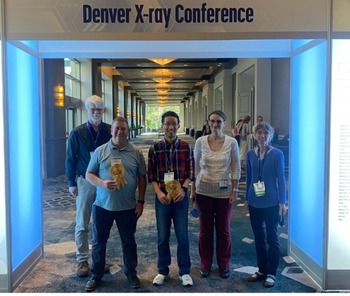
XRF Best Student Poster Award (Figure 6):
Ning Su*, E.V. Timofeeva, C. Segre, Illinois Institute of Technology, USA, for their work:
In Situ EXAFS Studies of Pd@Ni(OH)2&C Catalyst for Ethanol Oxidation
XRF poster session award winners (L-R) – Andy Drews (poster winner announcer), Jamie Vargeson, Ning Su, Diane Eichert (poster judge), Martina schmeling (poster judge).

VI. EXHIBITS AND SPONSORSHIPS
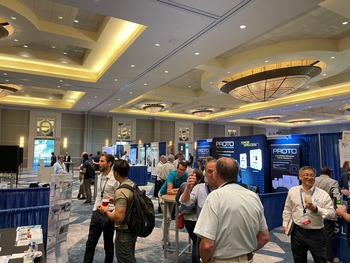
The exhibit hall accommodated 30 companies with displays of products and services for the X-ray community (Figure 7). See a complete listing of exhibitors and their product descriptions in the 2022 Onsite Program located at www.dxcicdd.com. The Denver X-ray Conference is very appreciative of their support this year.
2022 DXC exhibit Hall.

Many of the exhibitors also supported the conference as sponsors, including KETEK GmbH, ICDD, Materials Data, MOXTEK Inc., and Proto Manufacturing, Inc. The generosity of our sponsors helps to keep attendee costs low, and the quality of the conference high. We are grateful for their support!
VII. WEBSITE AND PROCEEDINGS
To view the complete DXC Program, please visit the ‘Past DXC’ page of the conference website, located under the ‘About DXC’ tab at www.dxcicdd.com. The conference proceedings, Advances in X-ray Analysis, Volume 66, will be published in the summer of 2023. Select papers will also be published in Powder Diffraction Journal. Please also visit the ‘Resources’ tab on the ICDD website: www.icdd.com for free full access to manuscripts published in Volumes 40 through 65 of Advances in X-ray Analysis.
VIII. THANK YOU
The Conference Services team at ICDD would like to thank the many people who volunteered their time and efforts to organize this event. Members of the DXC Organizing Committee, Session Chairs, Workshop Instructors, Invited and Contributed Speakers, and Exhibitors all played a role in bringing the community together again. Special thanks also to the attendees who joined us in-person. It was truly wonderful to see everyone again. The success of the event is attributed to each and every individual who participated, and we send our genuine thanks to all of you!
IX. 2023 MEETING
Save the date! In 2023, DXC will return to the Chicago area, 7–11 August, at, The Westin Lombard Yorktown Center, Lombard, IL, USA.