

Election predictions come from experts, polls, prediction markets, and theoretically driven forecasting models (Graefe Reference Graefe2019; Stegmaier and Norpoth Reference Stegmaier, Norpoth and Valelly2017). These models have proliferated in the United States and the United Kingdom, but modeling efforts in multiparty systems with regular coalition governments—such as Germany—have just begun to pick up the pace.
Election forecasting models are rooted in theories of voting behavior. Long-term factors such as partisanship orient voters’ political perspectives, whereas economic evaluations and candidate evaluations change more easily and explain electoral shifts (Stegmaier, Lewis-Beck, and Brown Reference Stegmaier, Lewis-Beck, Brown and Redlawsk2021). At the aggregate level, the vote and popularity function (VP-function) literature has shown that the electorate focuses on the incumbent’s performance, rewarding in good times and punishing in bad (Stegmaier, Lewis-Beck, and Park Reference Stegmaier, Lewis-Beck, Park, Arzheimer, Evans and Lewis-Beck2017). With this understanding of electoral behavior, scholars have adapted these models to issue ex ante forecasts.
First, however, forecasters must decide what they want to predict. The proportional nature of Germany’s electoral system and its multiple parties make it difficult for one party to win a majority of seats. With the exception of the 1957–1961 term, postwar Germany has always had a coalition government. Therefore, the question is: Should the model predict the vote share for the incumbent coalition, potential coalitions, or each party?
This article is a chronological review of published ex ante forecasting models for Bundestag elections. From election to election, I discuss how scholars refined their models to account for challenges such as changing coalition-formation patterns, parties failing to pass the 5% threshold, and the emergence of new parties.
From election to election, I discuss how scholars refined their models to account for challenges such as changing coalition-formation patterns, parties failing to pass the 5% threshold, and the emergence of new parties.
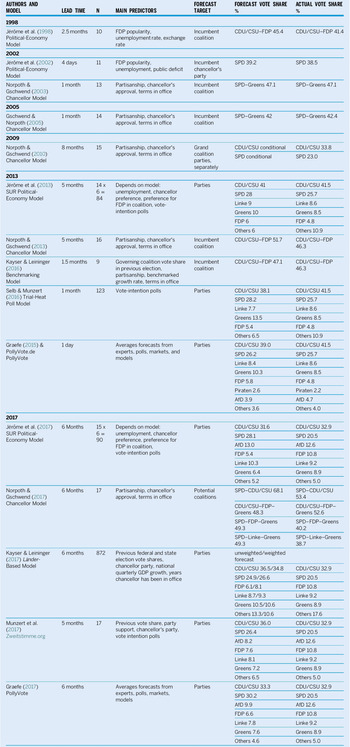
Table 1 is an overview of the forecasting models. Some articles were published after the election but were based on pre-election forecasts. If the same team published articles in different languages, I review the one in English for its accessibility to a wider audience. The lead time is what the authors report in the text; if this is not mentioned, then it is based on the publication date. Due to different forecasting targets across models, I simply report on the vote-share forecasts according to each publication. For comparison, the actual election result for that party/combination appears in the final column.
Ex Ante Model Forecasts of German Bundestag Elections

1998
Jérôme, Lewis-Beck, and Jérôme-Speziari (Reference Jérôme, Lewis-Beck and Jérôme-Speziari1998) published the earliest ex ante Bundestag model-based forecast. Informed by the VP-function literature and reward–punishment voting theory, their Political-Economy Model predicted the governing coalition’s vote share. The model’s key predictors included the previous quarter’s unemployment rate, the exchange rate, and the popularity of the kingmaker party—the Free Democratic Party (FDP). They predicted a 45.37% vote share for the incumbent Christian Democratic Union/Christian Social Union (CDU/CSU)–FDP, which they correctly predicted would not be sufficient for a majority of seats. The Social Democratic Party (SPD) ultimately joined forces with the Greens to form a government.
2002
In 2002, Jérôme, Jérôme-Speziari, and Lewis-Beck (Reference Jérôme, Jérôme-Speziari and Lewis-Beck2002) tweaked their model by replacing the exchange rate with the public deficit as a percentage of gross domestic product (GDP) and adding a measure for the impact of Germany qualifying to join the euro currency. Their reported SPD prediction was within 1 point of the result, but they underestimated the coalition partner—the Greens—and suggested that the CDU/CSU–FDP would win the majority. The election, however, resulted in the reelection of the SPD–Green coalition.
Norpoth and Gschwend (Reference Norpoth and Gschwend2003) debuted their ex ante Chancellor Model forecast in the 2002 election. It forecasted the incumbent coalition vote share, which they justified based on the stable nature of German coalition patterns and the straightforward application of the reward–punishment logic. Their model had three predictors: (1) national partisanship measured as the average vote for the governing parties during the last three Bundestag elections; (2) the chancellor’s approval rating averaged one and two months before the election; and (3) the number of terms the governing parties have been in office. The number of terms in office captures the decline in support often observed the longer that a government is in office. The forecast accurately predicted a 47.1% vote share for the incumbent SPD–Green coalition, which Norpoth and Gschwend correctly assessed as sufficient to stay in power.
2005
In 2005, Gschwend and Norpoth (Reference Gschwend and Norpoth2005) accounted for the increased strength of the Left Party—that is, the Party of Democratic Socialism (PDS)–Linke—by adjusting the 2005 SPD chancellor candidate’s approval downward by the amount of PDS–Linke support. They predicted 42% for the incumbent SPD–Green coalition—not sufficient to maintain control in the Bundestag. After the election, a grand coalition led by CDU/CSU Chancellor Angela Merkel came to power.
2009
In 2009, Norpoth and Gschwend (Reference Norpoth and Gschwend2010) made two adjustments. Due to the incumbent grand coalition—only the second in postwar Germany—they separately forecasted CDU/CSU and SPD support. Also, this time, they accounted for the strength of the Linke by measuring SPD partisanship for only the most recent Bundestag election while keeping CDU/CSU partisanship as the last three elections. Because this forecast was issued eight months before the election, the team provided conditional predictions based on chancellor candidate approval levels (Norpoth and Gschwend Reference Norpoth and Gschwend2010, 51). The election resulted in a CDU/CSU–FDP coalition government.
2013
The 2013 election featured the incumbent CDU/CSU–FDP coalition, but it was unclear whether the FDP would pass the 5% threshold, which created uncertainty for modelers. The election resulted in the FDP winning only 4.76% of the vote—the first time it failed to win seats. Germany’s third grand coalition, under the leadership of Chancellor Merkel, was formed.
The 2013 election featured the incumbent CDU/CSU–FDP coalition, but it was unclear whether the FDP would pass the 5% threshold, which created uncertainty for modelers.
In 2013, Jérôme, Jérôme-Speziari, and Lewis-Beck (Reference Jérôme, Jérôme-Speziari and Lewis-Beck2013)Footnote 1 began predicting each party’s result to reflect the changing role of smaller parties in coalition formation and the growing importance of the Linke–PDS. Their Seemingly Unrelated Regression (SUR) models for the chancellor’s party and the main opposition party used the Political-Economy Model approach with unemployment and chancellor-preference variables. They argued that the smaller parties should be insulated from the reward–punishment calculus; therefore, these models account for coalition preferences, party vote intentions, and political dummies. This forecast, issued five months in advance, predicted that the CDU/CSU would have the largest vote. The FDP prediction was 6% with a +/-1.24 margin of error, indicating that it might not pass the 5% threshold.
Norpoth and Gschwend’s (Reference Norpoth and Gschwend2013) Chancellor Model continued to predict the incumbent coalition vote share with the same predictors but with terms in office logged. Five months before the election, they predicted 51.7% for the coalition.
Three new forecasting models also entered the scene in 2013. Kayser and Leininger (Reference Kayser and Leininger2016) presented an Economic Benchmarking Model to predict the governing coalition’s vote share. Their model included the coalition vote share in the previous election, partisanship measured as the proportion of the population identifying with one of the governing parties, a log of the number of terms in office, and a novel economic performance measure—a benchmark measure. The premise of benchmarking is that citizens compare their country’s economy to other countries and reward or punish the government accordingly. For this forecast, Kayser and Leininger benchmarked German economic growth against growth in the United Kingdom, France, and Italy. They predicted 47.05% for the CDU/CSU–FDP coalition.
The media often focus on “trial-heat” polls in campaign coverage. However, poll accuracy can be compromised by nonresponses, undecided voters, and nonvoters. Selb and Munzert (Reference Selb and Munzert2016) addressed systematic errors with a model based on historic election results and polls. Their analysis of polls beginning in 1998 found that the lowest forecasting error occurred eight to 10 months before the election. Their 2013 Trial-Heat Model was based on 123 polls from that time frame. This approach predicted well for a few parties; for others, however, the forecasts were off. This was likely due to the eight- to 10-month window that could not capture changes throughout the campaign and polling firms overcorrecting for previous bias.
Another forecasting strategy combines predictions from four different forecasting methods: polls, models, experts, and prediction markets. The PollyVote approach, which averages the forecasts across these four methods, was first applied in Germany in 2013 (Graefe Reference Graefe2015). This approach takes advantage of the fact that certain forecasting methods work well in some years and others do well in other years; thus, averaging the forecasts reduces error. The final PollyVote forecast,Footnote 2 published the day before the election, predicted 39.0% for the CDU/CSU and 5.4% for the FDP. Notably, the combined forecast improved accuracy compared to the four separate forecasting components.
2017
In 2017, more modelers began accounting for the rise of the right-wing Alternative für Deutschland (AfD). In the 2013 election, the AfD failed to pass the 5% threshold; in 2017, it won 12.64%. The 2017 election resulted in the continuation of the incumbent grand coalition—the fourth grand coalition in postwar Germany and the third since 2005.
In 2017, more modelers began accounting for the rise of the right-wing Alternative für Deutschland (AfD).
Jérôme, Jérôme-Speziari, and Lewis-Beck (Reference Jérôme, Jérôme-Speziari and Lewis-Beck2017) modified their SUR Political-Economy Model to account for the AfD’s rise by extracting an AfD forecast from the “other parties” forecast using current polling data. In addition to party-vote and seat-share forecasts, they analyzed coalition possibilities and, six months before the election, correctly predicted that a CDU/CSU–SPD grand coalition would be the most feasible outcome.
With an incumbent grand coalition, Norpoth and Gschwend (Reference Norpoth and Gschwend2017) forecasted the chances of coalition combinations led by the CDU/CSU and the SPD. They used the same predictors but shifted back to the unlogged number of terms. Their prediction, six months in advance of the election, pointed to a new coalition government led by the SPD, a result driven by the early popularity of SPD chancellor candidate Martin Schulz—popularity that fizzled as the September election neared.
In 2017, Kayser and Leininger (Reference Kayser and Leininger2017) developed a new model focused on separately predicting votes for the parties based on state (Länder)-level elections. In addition to substantially increasing the sample size, these elections also occur at different times on the electoral calendar and serve as referenda on the national government’s performance. In this sense, they might foreshadow future results. Kayser and Leininger predicted each party’s vote share at the state level, accounting for the previous federal- and state-election vote share, chancellor’s party, national quarterly GDP growth, and chancellor’s years in office. They generated two models—one unweighted and the other weighted to give greater importance to state elections that are closer to the federal election. The state-level predictions were aggregated to produce Bundestag vote-share forecasts for the parties. Six months before the election, their model predicted that the CDU/CSU would win the plurality of votes, with the SPD a distant second. Of the Reference Kayser and Leininger2017 models, this one came closest to predicting the low showing of the SPD.
Scholars also have innovated by using information from both structural models and trial-heat polls. Munzert et al. (Reference Munzert, Stötzer, Gschwend, Neunhoeffer and Sternberg2017) developed a structural-dynamic model of party vote-share forecasts that are updated on Zweitstimme.org. The structural model anchors the forecast and is based on three predictors: previous vote share, average poll-based party support 200 to 230 days before the election, and chancellor’s party. The structural model prediction then is updated with vote-intention polls in a way that reduces the weight of the structural forecast as the election gets closer. This gives greater weight to polls that are capturing new information as the campaign unfolds. Table 1 presents Munzert et al.’s predictions 158 days before the election.
The PollyVote forecast used the same method as in 2013, with daily updates on the PollyVote.de website. Table 1 presents Graefe’s (Reference Graefe2017) forecast, which was generated six months before the election. It overestimated the SPD vote share because all four forecasting components were overestimating their result. The final online PollyVote forecast captured the decline in SPD support, with a forecast of 24%.Footnote 3
CONCLUSION
The evolution of German forecasting models demonstrates how forecasters have learned from their model’s past performance and updated their approaches to reflect party-system dynamics more accurately. Modelers face new challenges in 2021: Chancellor Merkel’s retirement after 16 years in power, the government’s handling of the COVID-19 pandemic, and the party-system shift seen in the rise of the Greens and the decline of the SPD. These factors will be captured in economic and approval predictors; however, in many forecasting models, they are measured well in advance of Election Day. How these static models fare will depend on the stability of conditions heading into the election. Given the new chancellor candidates and the pandemic-induced uncertainty, dynamic forecasting models that update as the campaign unfolds may have a significant advantage this year.