Railroad nationalizations are one of the most visible examples of government intervention in the economy between 1860 and 1913. States in Russia, Sweden, Denmark, the Netherlands, Belgium, France, Switzerland, Italy, Austria, Hungary, Bulgaria, Serbia, Japan, Mexico, Costa Rica, Brazil, Argentina, Germany, India, Australia, and New Zealand nationalized more than 50,000 railroad miles, or around 10 percent of the miles constructed by 1910. In some cases, states expropriated the assets of several private companies through laws or decrees, and in other cases the state purchased individual railroads that were bankrupt or distressed.
Nationalizations were linked with a broader debate about whether the state should own and operate railroads and whether it should subsidize private railroads with land grants or guarantees on bonds and equity. Nationalizations were controversial because they represented an abrupt change in policy, and in some cases a violation of private property rights. They also touched upon deep political divisions within societies. In Japan, the nationalization bill of 1906 led to shouting and wrestling matches between supporters and opponents in the parliament.Footnote 1 In Italy, the Minghetti government fell after the furor over the nationalization of the Upper Italy Railway Company in 1875.Footnote 2
There are several hypotheses about which factors influenced the likelihood or extent of nationalizations. Many scholars have emphasized the role of military and fiscal factors, particularly in the European context. The argument is that nationalizations were desirable because they improved military effectiveness in times of war, and it was easier to extract income directly from state-owned railroads rather than through regular taxation. Others have argued that nationalizations were also driven by the poor financial performance of private railroads, especially in Latin America. Poor financial performance has been linked with a variety of factors such as ruinous competition, low demand, and high operating costs. Politics has figured prominently in the history of most railroad nationalizations, but the focus has been on individual leaders, like Otto von Bismarck in Prussia. The burgeoning literature on political institutions suggests that weak constraints on the power of the state could also contribute to nationalizations by making it easier to expropriate private property. The origin of the legal system (i.e., common law vs. civil law) could also influence expropriation, in this case through the ability of the state to intervene in judicial matters relating to nationalizations.
Another unresolved question in the literature is whether nationalizations slowed railroad network expansion. One possibility is that nationalizations slowed mileage growth by reducing the investment incentives of private companies. States may have also delayed their own railroad investments following nationalizations. Yet another possibility is that mileage growth would have been similar in the absence of nationalizations, and therefore they had no causal effect on network expansion.
In this article, I examine these hypotheses using new data on the number of track miles owned by companies or the state in 35 countries or colonies between 1860 and 1912. The data reveal many aspects of railroad ownership, including the number of miles owned by companies or the state in each country and year. Here I use the data to identify the incidence and extent of nationalizations across more than 1200 country-year pairs. I also incorporate cross-country data, including constraints on the executive branch of government, the degree of democracy, legal origin, population density, real GDP per capita, indicators for the military capability of neighboring countries, and a host of other variables. The first part of the article identifies which factors increased the incidence of nationalizations and their extent, as measured by the fraction of miles nationalized. The main results are that nationalizations were more likely or extensive in countries with French and German civil law legal systems, with weak constraints on the executive branch, and where neighboring countries had high military capability.
The second part of the article tests whether nationalizations reduced railroad mileage growth. It documents that mileage growth was lower in the four years following nationalizations compared to the preceding four years. It also uses a two-stage least squares model, which assumes that the fraction of miles nationalized in each country is endogenous. The key exclusion restriction is that political and legal institutions influenced the cost of implementing nationalizations, but had no permanent effect on mileage growth after controlling for spillover channels like higher GDP per capita. The two-stage estimates show that greater nationalizations reduced mileage growth, suggesting that state takeovers did indeed slow network expansion.
The last part of the article compares the results with the historiography on railroad nationalizations in several countries. The results are consistent with case-study evidence that some states nationalized for military reasons, some to perpetuate the operation of unprofitable railroads, and others in the hopes of extracting greater revenues. The case-study evidence also indicates that the process of nationalization was more protracted or difficult in countries where the executive had to convince the legislature or the electorate to support nationalizations. Finally, there is some evidence that courts in civil law countries were ineffective in preventing states from forcing companies to sell their shares at below market prices.
The findings relate to the literature examining state ownership and regulation of infrastructure.Footnote 3 Most studies reach a similar conclusion that ownership and regulation policies affect the investment and pricing behavior of private companies. They also point to the multiplicity of factors which determined policies as well as to the investment and pricing behavior of the state. This article adds to this literature by quantitatively examining the determinants of nationalizations and addressing endogeneity concerns.
In addition, the article speaks to the broader literature on the role of political and legal institutions in economic development.Footnote 4 It provides evidence that institutions, which placed fewer limits on the powers of presidents, monarchs, or prime ministers, indirectly slowed network expansion by lowering the costs of implementing nationalizations. As such, it suggests one mechanism by which institutions contributed to differences in infrastructure investment across countries.Footnote 5
The article begins by discussing hypotheses about the determinants and consequences of nationalizations. The following section introduces the data, while the next three present the econometric results and discuss their connection with the case-study literature. The last section takes up the larger implications.
HYPOTHESES
The Determinants of Nationalizations
One of the literature's main hypotheses is that military considerations affected the incidence or extent of nationalizations.Footnote 6 This argument builds on the view that the primary concern of the nation state was to provide protection against the military aggression of its neighbors.Footnote 7 Armies were much more effective if troops and supplies could be moved by rail rather than by wagons. In times of conflict, states could use their own railroads or they could enter into negotiations with private railroad companies, but in most cases, it was more costly to negotiate with companies. States therefore had an incentive to nationalize railroads if they faced significant military threats from their neighbors or recently experienced war.
A second hypothesis argues that nationalizations were common in countries where private railroads experienced financial difficulties. In general, states might have an interest in buying bankrupt railroads and continuing their operation because their constituencies are dependent on railroad services. States might also operate unprofitable railroads because they believe it will generate spillovers and promote economic development.Footnote 8 Low population density is one factor that contributes to poor financial performance because the demand for railroad services is spread across a larger spatial area, while the operating costs are higher. High railroad miles per square mile can also contribute to poor financial performance because competition is likely to be greater between railroads in close proximity. These arguments imply that nationalizations should have been more common or extensive in countries with low population density or high railroad density.
A related argument is that low real GDP per capita reduced the demand for railroad services and therefore decreased railroad profits. The state then found it necessary to nationalize unprofitable railroads to ensure their continued operation. The testable implication is that nationalizations should have been more common or extensive in countries with low real GDP per capita.
The hypothesis that states nationalized to extract greater revenues implies a potentially different relationship between real GDP per capita and nationalizations. Higher real GDP per capita meant a higher demand for railroad services, and given there was imperfect competition or restrictions on the supply of railroad services, higher demand would imply there were greater profits or rents that could be extracted by the state through direct ownership.Footnote 9 Therefore, if extraction was the main motivation, then nationalizations may have been greater in rich countries where the state could earn more from railroad customers.
The effects of higher real GDP per capita might also depend on the level of railroad density. When railroad density is high, there are greater sunk investments in the network which can be expropriated. In such cases, greater GDP per capita might increase nationalizations because the combination of higher demand for services and greater sunk investments would increase the profits that could be extracted through nationalizations.Footnote 10 On the other hand, when railroad density is low, greater GDP per capita might decrease the necessity of nationalizations because the combination of higher demand and less competition improved the financial performance of companies.
The costs of implementing nationalizations suggest other determinants. There is a large literature arguing that states are less likely to expropriate private property if they are constrained by formal political institutions.Footnote 11 In the nineteenth century, several countries experienced constitutional changes that reduced the powers of the executive (i.e., the president, prime minister, emperor, or monarch) vis-à-vis the legislature. Nationalizations may have been rare in such countries because the executive had to gain the consent of the legislature, which was costly in terms of time and resources. A related argument suggests that greater democracy may have reduced nationalizations because the executive or the legislature had to spend more time and resources convincing the electorate to accept nationalizations.
Legal systems may have also influenced the costs of nationalizing railroads. Legal systems are usually defined by their codes, modes of thought, and ideologies. A series of authors, including Rafael La Porta, Florencio Lopez-de-Silanes, and Andrei Shleifer and Paul Mahoney argue that countries with civil law legal systems tend to have greater government ownership and regulation compared to countries with common law systems.Footnote 12 The differences between civil and common law countries are sometimes attributed to differences in the capacity of the executive to interfere in judicial matters.Footnote 13 This argument would imply that nationalizations were greater in civil law countries because the executive could manipulate judicial decisions, which might otherwise slow down or prevent nationalizations. La Porta et al. also argue that differences in laws, tools, and attitudes imply that governments in civil law countries are more likely to repress or replace the market system when challenges emerge.Footnote 14 These arguments suggest that civil law countries were more prone to nationalizations.
The Effects of Nationalizations on Network Expansion
In discussing the effects of nationalizations on network expansion, it is revealing to start with assumptions about the objectives of the state and how the private sector might respond. If the state nationalized railroads in order to extract greater revenues, then it would have an incentive to limit competition from private railroads. One way of limiting competition is to raise barriers to entry for private railroads, which should reduce network expansion. Network expansion might also be lower because the private sector believes there is a greater risk of expropriation. The private companies' fears will make them reluctant to start new railroad projects because they anticipate that they may be forced to sell their assets at below-market prices.Footnote 15
Nationalizations can also change the incentives of a profit-maximizing state as it considers the expansion of its own network. The key issue is whether the state has greater monopoly power following railroad nationalizations. Knick Harley has developed a model of investment incentives for competitive and monopolistic railroads, in which a monopolist can earn higher rents by avoiding construction ahead of demand, while under competition building ahead of demand is the only way to capture rents.Footnote 16 Harley's model implies that if nationalization increased monopoly power, then network expansion should proceed more slowly than if the market was competitive.
Network expansion could also decrease if the state nationalizes private railroads that were financially unsuccessful. The need to subsidize struggling railroads could limit the state's ability to finance additional construction of state-owned railroads, or to guarantee debt issued for new private construction. If the railroad network is overdeveloped relative to the income level of the country, then the state may try to rationalize the railroad sector by limiting the construction of additional lines. Notice that in this latter scenario nationalizations may have been socially beneficial, because the state was addressing the problem of overinvestment by the private sector.
DATA
To test hypotheses about nationalizations, this article makes use of new cross-country data on the number of railroad miles owned by the state and private companies between 1860 and 1912. Most of the data on ownership comes from the Statistical Abstract for the Principal and Other Foreign Countries and the Statistical Abstract for the Several Colonial and other Possessions of the United Kingdom, both of which are published by the Board of Trade in Great Britain. For some countries, the Statistical Abstracts do not distinguish between miles owned by companies and the state.Footnote 17 I use several additional sources to identify railroad ownership in such cases. In most, it was straightforward to fill the gaps by identifying state-owned and operated lines and privately owned and operated lines. When track miles were state-owned, but privately operated, I chose to assign ownership to the state because it retained control over extensions to the network, and it was the ultimate residual claimant.Footnote 18
Figure 1 shows the fraction of miles owned by private companies for the sample of all countries that reported ownership information between 1860 and 1912. Private ownership was predominant up to the 1870s, but afterwards there was a gradual shift towards greater state ownership. By 1912, 70 percent of all railroad miles were owned by companies as compared with over 90 percent in 1860.
The shift to greater state ownership was driven by construction of new state-owned railroads and the nationalization of private railroads. Unfortunately, the Statistical Abstracts do not provide information on the number of railroad miles that were nationalized in each country and in each year, but I can approximate the number of miles nationalized by the absolute reduction in railroad miles owned by private companies. Specifically, I assume that miles nationalized in year t equals (private milest –1 – private milest) if private milest –1 > private milest and 0 otherwise.
This measure of the number of miles nationalized is biased upwards in some cases because a decrease in private miles can be due to companies shutting down tracks. The measure is also biased downwards in some cases because companies may have completed new miles between t–1 and t, which would reduce the observed decline in private miles. Despite these drawbacks, it is clear that nationalizations account for most of the reductions in private miles because they usually correspond with large increases in state-owned miles. For example, in 1894 Russia had 9,480 private miles and 11,218 state miles for a total of 20,698 miles. In 1895 it had 8,421 private miles and 13,527 state miles for a total of 21,948 miles. It is implausible that private companies shut down more than 1,059 miles of track between 1894 and 1895, while the Russian state completed more than 2,309 miles of track. Instead, it is more likely that the state nationalized around 1,059 miles and completed around 1,250 new state-owned miles.
Estimated Fraction of World's Railroad Miles Owned by Private Companies, 1840–1912

The measure of nationalizations can also be checked using secondary sources, such as the Board of Trade report, State Railways. Table 1 lists all country-year pairs, where the number of miles nationalized exceeds a threshold of 2 percent of the total number of railroad miles in that year. For several cases, I can document a correspondence between measured nationalizations and documented nationalizations. For example, the Board of Trade reports that the Belgian government purchased 19 private lines, and in 1897 it purchased three large lines, the Ghent Ecloo, the Belgian Great Central, and Plateaux de Herve. In 1898 I estimate that 453 miles of private railroads were nationalized in Belgium, which clearly reflects these purchases.
MAJOR NATIONALIZATIONS, 1860–1912

Note:
Major nationalizations exceed 2 percent of the total railroad network.
Sources:
Board of Trade, State Railways; Thorner, “Pattern”; and Lewis, British Railways.
After identifying the number of miles nationalized in each year t, I construct three variables of interest. First, for each country and year, I calculate the cumulative number of miles nationalized in all previous years and divide it by the total number of miles in year t. I label this variable the fraction of railroad miles nationalized by year t. It measures the extent of nationalizations.Footnote 19 Second, I construct a nationalization dummy variable if the country had at least 2 percent of its railroad miles nationalized by 1910. The 2 percent threshold is useful because it separates countries with minor nationalizations from those with moderate or substantial nationalizations. Lastly, I calculate the annual percentage change in total railroad miles for each country. Railroad mileage comes from the Statistical Abstracts or International Historical Statistics.
The data on nationalizations and mileage growth is combined with information on the characteristics of countries or colonies, including real GDP per capita, population, land area, government bond yields, exchange rates, consumer price indices, the price of railroad capital goods, an index for constraints on the executive branch, an index for the degree of democracy, legal origin, the military capability of neighboring countries, and whether the country has gone to war. Most of the real GDP per capita and population figures are from Angus Maddison's work.Footnote 20 Full details on the sources for bond yields, price indices, and exchange rates are provided in appendix 1.
The Polity IV data set is the source for many of the institutional variables.Footnote 21 The “polity2” variable is an index for the degree of democracy versus autocracy. The lowest value of −10 corresponds to complete autocracy (i.e., Russia before 1904), and the highest value of 10 corresponds to the greatest degree of democracy (i.e., the United States after 1871). The “constraints on the executive” variable quantifies whether a country has effective checks on the authority of the executive, such as the monarch, emperor, or president. The lowest value of one implies there are no checks on the executive (i.e., China before 1910). The highest value of seven implies that the ruler is strongly limited by a well-functioning constitution (i.e., Japan after 1868). Many scholars have used the polity IV variables for democracy and constraints on the executive as a measure of political checks and balances.Footnote 22 In most cases, they analyze the cross-sectional variation, but in the 1860 to 1912 period it is possible to exploit the variation over time because there was a shift towards more constraints and democracy in some countries, while in others there was little change or even a loss of democracy and constraints on the executive.
As for legal systems, most of them were transplanted (in part or whole) through colonization and the military conquests of Napoleon in the early nineteenth century. Therefore, legal origins are constant for most countries between 1860 and 1912. La Porta et al. distinguish between common law, French civil law, German civil law, and Scandinavian civil law.Footnote 23 I use their classifications to identify countries with common law and Scandinavian civil law systems.Footnote 24 I group together all the countries with French and German civil law classifications because the distinctions were not so sharp in the early twentieth century.Footnote 25
The Correlates of War database provides dates for interstate wars, intrastate wars, and extrastate wars starting in 1815.Footnote 26 I use this data to code to a war dummy variable, which identifies whether a country was in any type of war in each year. The Correlates of War database also provides military capability data for each country.Footnote 27 It includes an average of six indicators: military expenditure, military personnel, energy consumption, iron and steel production, urban population, and total population. Military capability has been used in international relations research to predict the onset of war.Footnote 28 I build on this research and define the military capability of neighboring countries as the population-weighted average of the military capability index among contiguous countries.Footnote 29
THE DETERMINANTS OF NATIONALIZATIONS
There were 18 countries or colonies that experienced significant nationalizations between 1860 and 1912. Switzerland, Austria, and Japan had the highest fraction of miles nationalized, exceeding 0.5 by 1912. The state took over miles in Switzerland and Japan after the passage of nationalization laws in 1898 and 1906 respectively. Italy, Belgium, Germany, Mexico, Hungary, and Russia also had a significant fraction of miles nationalized, exceeding 0.25 at some point between 1860 and 1912. Many of these countries experienced several nationalizations in this period. India, Denmark, Bulgaria, Brazil, and France are a third group with a fraction nationalized between 0.1 and 0.25. Holland, New Zealand, Austria, and Serbia are a fourth group with a fraction nationalized between 0.02 and 0.1.Footnote 30 The countries or colonies with no (or very minor) nationalizations include Australia, Finland, Norway, Sweden, Portugal, Spain, Romania, Egypt, Greece, the United States, Chile, Uruguay, Argentina, China, the United Kingdom, and Canada.Footnote 31
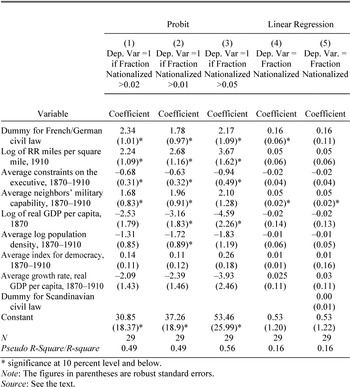
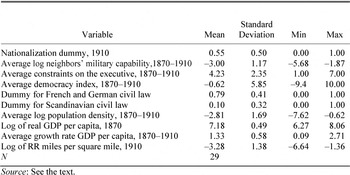
What was different about countries with nationalizations? Table 2 addresses this question using cross-sectional variation in the incidence or extent of nationalization in 1910. Columns 1, 2, and 3 show estimates from a multivariate probit model, where the dependent variable is 1 if the country had at least 1, 2, or 5 percent of their miles nationalized by 1910 and 0 otherwise. Summary statistics for all the variables are reported in appendix table 7. The results show that the dummy variable for French and German civil law systems and railroad miles per square mile in 1910 are positively and significantly associated with the incidence of nationalizations in all the probit specifications. Average constraints on the executive between 1870 and 1910 is negative and significant in all the probit models. Several variables were significant in some specifications, but marginally insignificant in others. The coefficient for average military capability of neighboring countries between 1870 and 1910 is positive and significant in columns 1 and 2. GDP per capita in 1870 is negative and significant in columns 2 and 3, while average population density is negative and significant in column 2 only. Average democracy and the average growth rate in GDP per capita are not significantly related to nationalizations in any specification.
THE DETERMINANTS OF RAILROAD NATIONALIZATIONS: CROSS-SECTIONAL ESTIMATES IN 1910

* significance at 10 percent level and below.
Note:
The figures in parentheses are robust standard errors.
Source:
See the text.
The estimated marginal effects for column 1 imply that French and German civil law countries were 65 percent more likely to have nationalizations than the omitted group, which is common law or Scandinavian civil law countries. A one-unit increase in constraints on the executive reduces the probability of nationalization by 27 percent. A one-unit increase in the log military capability of neighboring countries, which is around a one-standard-deviation increase, raises the probability by 67 percent. Lastly, a one-unit increase in log railroad miles per square mile increases the probability of nationalization by 89 percent.
The dependent variable in columns 4 and 5 is the fraction of miles nationalized by 1910. Least squares estimates show that average military capability is positively and significantly associated with the extent of nationalizations. French and German civil law countries have a greater extent of nationalizations than common law or Scandinavian civil law countries, but there is little difference between the latter two groups.
The extent of nationalizations can also be analyzed using panel data methods. The sample includes cross-country data on the fraction of miles nationalized in 1860, 1865, and every year from 1870 to 1912. Variation over time can reveal whether the fraction of miles nationalized increased in a country when the military capability of neighboring countries or railroad density increased. Similarly it can identify whether the fraction of miles nationalized decreased when constraints on the executive, population density, or GDP per capita increased.Footnote 32 The following regression model describes a linear relationship between the fraction of miles nationalized in country i by year t (fracnat it) and several variables dated in t–5

αi is a country fixed effect and δt are year dummies for 1865 and every year between 1870 and 1912 (the dummy for 1860 is omitted). They control for country-specific unobservable factors that do not change over time and for year-specific factors that affect all countries. The main explanatory variables are set in year t–5 to avoid simultaneity and to allow for a lagged response to economic, political, and military changes.
The vector institutions it-5 includes indices for constraints on the executive and democracy. It is not possible to include dummy variables for legal origin because they do not change over the sample period and thus they cannot be estimated with country fixed effects. However, it is possible to estimate whether countries with particular legal origins had a different trend in the fraction of miles nationalized over time by including a variable for the time trend, an interaction between the time trend and the dummy for French and German civil law systems, and an interaction between the time trend and the dummy for Scandinavian civil law systems. The coefficient for the time trend captures the average annual increase or decrease in the fraction of miles nationalized in countries with common law systems. The interactions capture the differential average increase or decrease for countries with French and German civil law or Scandinavian civil law systems compared to countries with common law systems.Footnote 33 Including the time trend implies that one of the year dummies must be dropped to avoid perfect colinearity. I dropped the dummy for 1865 and so differing unobservable factors in 1860 and 1865 are not accounted for in this specification. If legal origins have no influence, then the coefficients on the trend variable and its interactions should be insignificant, as the time effects will be captured by the year dummies between 1870 and 1912.
The vector development it-5 includes the log of population density, the log of GDP per capita, and the log of railroad miles per square mile. An interaction between the latter two variables is also included to capture the differential effect of higher railroad density in rich or poor countries and the differential effect of higher GDP per capita in high or low railroad density countries. The vector military it-5 includes the log military capability of neighboring countries and a dummy variable if the country was at war.
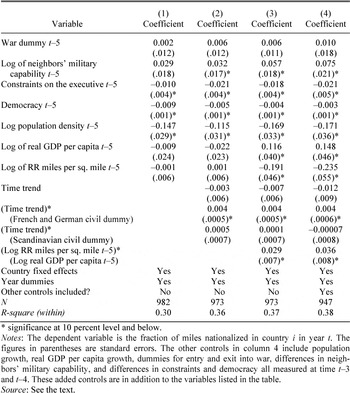
The panel results generally reinforce the cross-sectional results and suggest several conclusions regarding the determinants of nationalizations. The first column in table 3 shows estimates for a specification without the time trend and the other interaction variables. One main finding is that the fraction of miles nationalized decreased when constraints on the executive or democracy increased. These results hold in all other specifications and are consistent with the argument that it was more costly for presidents, prime ministers, or monarchs to nationalize railroads in countries where they had to gain the consent of an independent legislature or the electorate. Another finding in column 1 is that the fraction of miles nationalized decreased when population density increased. This result also holds in all specifications and suggests that nationalizations were less appealing when the demand for railroad services was concentrated in a smaller spatial area.
Column 2 in table 3 shows a specification with the time trend and its interaction with dummies for civil law systems. The results show there was a higher average annual increase in the fraction of miles nationalized for countries with French and German civil law systems compared
THE DETERMINANTS OF THE EXTENT OF NATIONALIZATIONS: PANEL ESTIMATES, 1860–1912

* significance at 10 percent level and below.
Notes:
The dependent variable is the fraction of miles nationalized in country i in year t. The figures in parentheses are standard errors. The other controls in column 4 include population growth, real GDP per capita growth, dummies for entry and exit into war, differences in neighbors' military capability, and differences in constraints and democracy all measured at time t–3 and t–4. These added controls are in addition to the variables listed in the table.
Source:
see the text.
to common law systems. They also imply that the separate trend for French and German civil law systems can account for some of the variation in the fraction of miles nationalized, even after including dummy variables for each year after 1870. One explanation for the difference is that nationalizations were more frequent in countries where the executive could manipulate judicial decisions or where laws and attitudes made countries more prone to state ownership.
The coefficient on the military capability of neighboring countries increases and becomes significant in the specification with the time trends. It becomes even larger in specifications, which add additional control variables. This implies that external military threats contributed to nationalizations once other factors are accounted for. Interestingly, the insignificance of the war dummy suggests that the incidence of war mattered little.
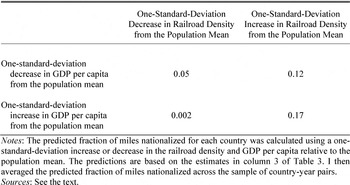
The results in the third column of table 3 show that railroad density and real GDP per capita influenced nationalizations only where they are interacted. A simple way to gauge the economic impact of these results is to assign each country-year pair a one-standard-deviation increase or decrease in railroad density and GDP per capita relative to the overall population mean, and then calculate the average fraction of miles nationalized over all countries in the sample (table 4). The calculation suggests that higher railroad density always increased the extent of nationalizations. Higher GDP per capita increased nationalizations when railroad density was high, but when railroad density was low, it was associated with a significantly smaller fraction of miles nationalized. The latter finding suggests that states nationalized more when high demand was combined with greater sunk investments in the network, and they nationalized less when high demand was combined with lower competition between railroads. Later I discuss how this result is consistent with case-study evidence that some states took over profitable railroads to increase their own revenues, while others nationalized railroads that were experiencing financial difficulties.
As a robustness check, column 4 in table 3 shows a specification which includes economic growth, population growth, differences in political institutions, and differences in military factors in t–3 and t–4 as additional controls. The estimates for the main variables are qualitatively similar. None of the added variables is statistically significant with the exception of differences in constraints on the executive in t–4, which had a negative effect on nationalizations.
THE CONSEQUENCES OF NATIONALIZATIONS FOR NETWORK EXPANSION
Railroad mileage growth differed substantially across countries between 1860 and 1912. Mileage growth was generally higher in Australia, the United States, Canada, and parts of Western Europe, while it was generally lower in Eastern Europe, Asia, and parts of Latin America. Mileage growth differed because of a variety of factors, including initial network size, economic performance, and the state of financial markets. Nationalizations may have also influenced mileage growth by reducing the investment incentives of private companies. The private sector may
AVERAGE PREDICTED FRACTION OF MILES NATIONALIZED FOR A ONE STANDARD INCREASE OR DECREASE IN REAL GDP PER CAPITA AND RAILROAD DENSITY

Notes:
The predicted fraction of miles nationalized for each country was calculated using a one-standard-deviation increase or decrease in the railroad density and GDP per capita relative to the population mean. The predictions are based on the estimates in column 3 of table 3. I then averaged the predicted fraction of miles nationalized across the sample of country-year pairs.
Sources:
see the text.
have been hesitant about investing in railroads following nationalizations because of fears that the state would expropriate their investments. The state might have also limited network expansion following nationalizations in order to increase its own profits from state-owned railroads, or to curtail railroad development until economic growth made expansion financially viable.
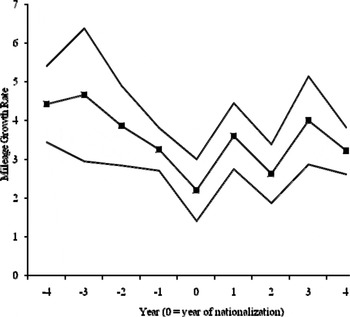
An examination of the change in mileage growth before and after nationalizations provides a useful starting point for analyzing their effects on network expansion. Figure 2 plots the average mileage growth rate for four years before and after a country experienced a nationalization of at least 2 percent of its railroad network. The surrounding band shows a 90 percent confidence interval for the mean growth rate. Zero on the x-axis corresponds to the year when nationalization occurred and −1 corresponds to the year before. There are several features to point out. First, the average growth rate was 0.92 percent lower from years 0 to 4 compared to years −4 to −1. In other words, mileage growth decreased in the immediate years following nationalizations.
Second, figure 2 shows that the downward trend in mileage growth starts in year −2, continues in year −1, and is lowest in year 0. In other words, the downward trend in mileage growth begins just before the nationalization. The patterns are similar for the difference in mileage growth between countries that had large nationalizations and the entire sample of countries in a given year. In years when a country had a nationalization above the median size, its mileage growth was 4.6 percent lower on average compared to all other countries. In the year before the nationalization, its mileage growth was 3.2 percent lower on average compared to all other countries. One explanation is that companies or the state anticipated nationalizations and began building fewer lines. For instance, in Japan and Switzerland, nationalization bills underwent a lengthy debate years before they were passed. It is likely that companies and government officials could foresee these laws. Another explanation is that nationalizations were themselves a response to the factors which reduced mileage growth.
AVERAGE MILEAGE GROWTH FOR FOUR YEARS BEFORE AND AFTER A COUNTRY HAS A NATIONALIZATION

The effects of nationalizations can be further examined by studying the relationship between mileage growth and the fraction of miles nationalized. For the reasons just discussed, a fixed-effects regression of mileage growth on the fraction of miles nationalized is likely to yield a biased estimate because the state chose to nationalize based on a variety of considerations, including its expectations about mileage growth. I address this endogeneity problem by estimating a two-stage least squares model. The second-stage equation for mileage growth is given by

mileagegrowth it is the log difference in railroad miles for country i between year t and t–1 and francat it is the fraction of miles that were nationalized in country i by year t.Footnote 34x it-j is a vector of control variables dated in t–j, α2i is a country fixed effect, δ2t is a dummy variable for year t, and ε2it is an error term.
The control variables capture several factors in years t–3, t–4, and t–5 that influence mileage growth in t. The time lag reflects the fact that it often took several years to complete a railroad project.Footnote 35 The log of real GDP per capita in t–5, the log of railroad miles per square mile in t–5, and an interaction between GDP per capita and railroad density in t–5 are among the most important control variables. Higher GDP per capita should increase mileage growth by raising the level of demand for railroad services. Higher railroad miles per square mile should reduce mileage growth because the returns to building new lines are lower when the network is already dense. The interaction term allows for the possibility that higher GDP per capita increases mileage growth by more in low railroad density environments.
Other important control variables are the growth rate of real GDP per capita, the log of the real yield on British government bonds, the risk premium on government bonds, and the log difference in the exchange rate for country i in years t–3 and t–4. Higher real GDP per capita growth should increase mileage growth because it signals greater demand for railroad services in the future. Higher real yields on British government bonds should reduce mileage growth because it proxies for real interest rates in the world economy. A higher risk premium on government bonds indicates that investors believe there are greater risks from investing in the country, and therefore, it should be negatively associated with mileage growth. An increase in the exchange rate reflects currency depreciation, which should reduce mileage growth because it signals that railroad revenues in the home currency have less value on international markets.Footnote 36
Several variables are excluded from the mileage growth equation and are used as instruments for the fraction of miles nationalized in the first-stage equation. In all specifications, the level of constraints on the executive and democracy in t–5 are excluded. The time trend and its interaction with the two sets of civil law countries are also excluded because they explain part of the variation in the fraction of miles nationalized, even after including dummy variables for each year after 1870. The key assumption is that legal origins and constraints on the executive or democracy influenced nationalizations, but they did not have a long-run effect on mileage growth.Footnote 37 It is possible that greater democracy or constraints on the executive increased the security of all property rights in the economy, which might then have a positive spillover effect on the railroad sector. This is less of a concern in my model because I control for many of the spillover channels from legal and political institutions, such as government bond spreads and GDP per capita.
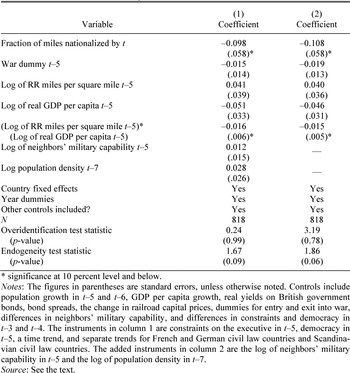
Table 5 reports the key coefficient estimates for the mileage growth equation.Footnote 38 The main finding in column 1 is that the fraction of miles nationalized has a negative effect on mileage growth. The coefficient is statistically significant at the 10 percent confidence level, but it is more economically significant. The coefficient implies that a one-standard-
THE EFFECT OF NATIONALIZATIONS ON MILEAGE GROWTH: TWO-STAGE LEAST SQUARES ESTIMATES

* significance at 10 percent level and below.
Notes:
The figures in parentheses are standard errors, unless otherwise noted. Controls include population growth in t–5 and t–6, GDP per capita growth, real yields on British government bonds, bond spreads, the change in railroad capital prices, dummies for entry and exit into war, differences in neighbors' military capability, and differences in constraints and democracy in t–3 and t–4. The instruments in column 1 are constraints on the executive in t–5, democracy in t–5, a time trend, and separate trends for French and German civil law countries and Scandinavian civil law countries. The added instruments in column 2 are the log of neighbors' military capability in t–5 and the log of population density in t–7.
Source:
see the text.
deviation increase in the fraction of miles nationalized in year t (0.13) would reduce mileage growth by approximately 1.3 percent in year t, which is equivalent to 22 percent of the standard deviation for mileage growth.Footnote 39
The bottom of table 5 shows the results for an overidentification test.Footnote 40 The high p-value indicates that we cannot reject the hypothesis that constraints on the executive in t–5, democracy in t–5, and separate trends for common law and civil law countries are uncorrelated with the error term in the second stage after including all the other controls. Therefore, there is additional statistical evidence that legal and political institutions did not affect mileage growth outside of their influence on nationalizations.Footnote 41
The results in column 1 imply that population density in t–7 and neighbors' military capability in t–5 do not have a significant effect on mileage growth in year t, but they did have a significant effect on the fraction of miles nationalized in year t. Column 2 of table 5 shows estimates when these two variables are also excluded from the second stage and used as instruments. The estimated effect of nationalizations on mileage growth is slightly larger in this case (–0.108 vs. −0.098). The overidentification test also implies that the assumption of no correlation between the instrumental variables and the error term in the second stage cannot be rejected. Thus, the conclusions are similar when additional instruments are included.Footnote 42
CASE-STUDY EVIDENCE
Cross-country regressions are useful in identifying the effects of factors that vary across countries such as institutions and external military threats, but it is important to check whether they are consistent with the case-study evidence. Although it is impossible to provide a comprehensive discussion of each country here, it is worth examining a few cases that illuminate the econometric results.
Several case studies suggest that military threats were an important determinant of nationalizations. In Russia, Germany, and Austria-Hungary, the prospects of a two-front war made nationalizations more attractive to the state, especially the military establishment.Footnote 43 France also faced threats from multiple neighbors, particularly Prussia, but it did not respond by nationalizing its eastern railroads. Instead, it nationalized its western railroads because of their perceived military value.Footnote 44 Many scholars have also emphasized the importance of the Russian conflict in the Japanese nationalization of 1906/07. Steven Ericson points out that the army consistently advocated state ownership and was an important player in the Japanese nationalization movement.Footnote 45
The military factor was also present in the purchase of foreign-owned railroads. Foreign investment played an important role in many countries, and in some there was substantial foreign ownership. In Italy, Switzerland, Mexico, and Japan there were concerns that foreigners were extracting high profits, but the military implications were also widely expressed and seem to have contributed to railroad nationalizations.Footnote 46
With respect to the economic motivations of nationalization, several case studies provide evidence that states purchased private railroads that were experiencing financial difficulties. For instance, in Mexico, the state gained a controlling stake in the Mexican Central after its financial position became so weak that it could not repair its lines and in Brazil, the state of Sao Paulo purchased the Compahnhia Uniao Sorocabana in 1905 after it went bankrupt.Footnote 47 The financial problems of these and other private companies may have been associated with overinvestment. In Latin America, Mexico and Brazil had substantial nationalizations, while Argentina, Uruguay, and Chile did not. If these five countries are ranked by their ratio of railroad density to GDP per capita in 1910, then Mexico is first, followed by Uruguay, and then Brazil. Thus, the countries with nationalizations in Latin America generally had a denser railroad network relative to their income level.
On the other hand, there is also evidence that states nationalized profitable railroads. For example, in Italy there were several private railroads operating in the early 1870s. The Upper Italy Railway Company was the first to be nationalized in 1875 and by most accounts, it was the most profitable. The company had been forced to pay substantially higher taxes in the three years before it was nationalized, and Albert Schram argues that the rationale was to bring the company into financial trouble in order to take it over.Footnote 48
There are other case studies which suggest that states had fiscal motivations for nationalizing railroads. Prussia is the most famous example of a government that earned substantial profits. By most estimates, state-owned railroads contributed nearly 20 percent of all government revenue in Prussia and yielded a rate of return 2 to 3 percentage points higher than the interest rate on government bonds.Footnote 49 Other states cited Prussia's fiscal surpluses when they were considering their own nationalizations. Communications ministers and various members of Parliament in Japan frequently invoked the substantial profits from Prussia's state-owned railroads and said that they expected similar results if Japan nationalized its railroads.Footnote 50
The Netherlands is also an interesting case of a financial motive because state-owned (but privately operated) railroads competed vigorously with two privately owned and operated railroads in the 1880s: the Holland Iron Railway Company and the Dutch Rhenish Railway company. Few of the railroads were earning high returns, and in 1890 the state purchased the Rhenish Railway Company. This purchase made the state the dominant owner of track mileage in the Netherlands and effectively increased its market power in railroad services.Footnote 51 Finally, there is evidence that Brazilian officials were swayed by the fiscal benefits of nationalizations. One minister in particular argued that nationalization was desirable because private railroads were capturing external benefits that were generated by state-owned railroads.Footnote 52
The econometric results suggest that nationalizations were more costly to implement if the president, prime minister, or monarch had to gain the approval of an independent legislature. The nationalization in Japan would seemingly run counter to this argument because it scores highly in terms of its constraints on the executive. However, an examination of the Japanese case shows how an independent legislature could make the process of nationalization lengthy, costly, and difficult. In 1891 the Masayoshi cabinet introduced a nationalization bill in the House of Representatives, but it was rejected.Footnote 53 The second nationalization bill was initiated by the Saionji cabinet in 1905. There was a contentious debate in the lower house and the cabinet was forced to use a wide range of carrots and sticks to convince members to support the bill. The bill was then sent to the upper house, where again there was substantial debate. Finally, the two houses had to agree on amendments amidst shouting matches between various supporters and opponents. Throughout this process it was not clear that the nationalization bill would pass, especially since an earlier nationalization bill failed.Footnote 54
The Italian case provides more evidence that legislatures could make it very difficult for ministers to nationalize railroads. The proposal to purchase the Upper Italy Railway Company was initiated by the Minghetti government. One of its proposals for buying the company implied in effect the nationalization of the whole Italian railroad network. The Italian parliament then “revolted” against this proposal and the Minghetti government eventually fell.Footnote 55 The Upper Italy Company was still nationalized, but the rest of the network remained privately owned for several more years.
Democracy is another factor that influenced nationalizations. Switzerland provides some insights here because it witnessed several referendums on whether to nationalize railroads. In 1888 the executive body, known as the Federal Council, made its first attempt to nationalize a private railroad company, but it provoked substantial opposition and was subsequently dropped. In 1891 the Federal Council initiated another proposal to nationalize a private railroad company and managed to gain the approval of the legislature, the Federal Assembly. The issue did not end there because the opponents of nationalization were successful in requiring a referendum on the law, as permitted by the Swiss Constitution. The subsequent vote went against nationalization and the law was nullified. In 1897 the Federal Council introduced a more ambitious plan to nationalize five major private railroads. The proposal passed through the Federal Assembly and was again challenged by a referendum. There was a vigorous debate, which included public meetings and the publication of pamphlets for and against nationalization. In the end, the law was ratified by a fairly large margin.Footnote 56
The Swiss case shows that the electorate sometimes supported nationalizations. However, it also shows that the state might have to engage in several campaigns to convince the electorate to support its policy. As a result, leaders in some democratic countries may have dropped plans for nationalization because it was too costly.
Legal institutions have received less attention in the literature on railroad nationalizations, but there are indications of their importance. The judiciary can play an important role in nationalizations if companies can sue the state when it tries to expropriate their railroad. In common law countries, courts have traditionally required that expropriations satisfy a “public use” and that owners receive “just compensation.” The public use requirement might have made it more difficult for public officials to nationalize railroads because they had to explain why state ownership satisfied a public benefit. Moreover, the just compensation clause might have prevented the state from imposing a low price on companies.
In civil law countries, railroad companies could also appeal to courts, but they would not be as effective if the state could intervene and ensure that decisions went in their favor. Here the Swiss nationalization provides evidence that states in civil law countries sometimes intervened in judicial matters relating to nationalizations. The original concessions granted to private companies created a special board of arbitrators, who would settle disagreements between companies and the state in the event of a proposed nationalization. The arbitrators were separate from the federal court system, and they presumably provided some assurance that decisions would be made independently. In 1896 one year before the nationalization law was passed, the Federal Council and Assembly passed a law nullifying the authority of arbitrators and requiring that disputes be settled in federal courts. The law was controversial, but it was upheld through a referendum.Footnote 57
After the nationalization was approved, there are some indications that the Federal Council of Switzerland exploited its influence in the federal courts by offering a below-market price to the railroads. Horace Micheli shows that the Federal Council offered to pay an average of 406 francs per share for the five largest private railroads, but the average market value of these shares was 445 francs just before the nationalization law was passed.Footnote 58
This brief review reveals that nationalizations could be quite controversial. Many contemporaries tried to assess the effects of nationalizations in order to condone or condemn them. The early-twentieth-century economist, Ernest Dewsnup, was perhaps the most vocal critic of nationalizations. He argued that the Japanese nationalization produced few economic benefits. He also claimed that the expansion of the railroad network in Japan proceeded more slowly after nationalization because the state was unwilling to secure funds for subsidiary railroads that would likely produce little revenue.Footnote 59
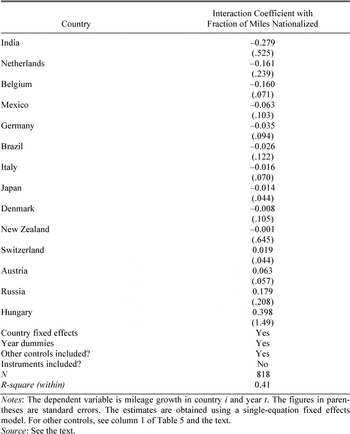
What does the modern case-study literature reveal about the effects of nationalizations on railroad mileage growth? Most scholars have not addressed this question, probably because it is difficult to answer without making cross-country comparisons. One would have to identify whether some routes were constructed more slowly or not at all, and then compare the pattern of growth with similar countries that did not have nationalizations. The cross-country data analyzed here can provide a guide to such studies. Table 6 presents coefficients for interaction terms between country dummies and the fraction of miles nationalized in a single equation model for mileage growth that includes country fixed effects, year dummies, and all the other variables listed in column 1 of table 5. These coefficients do not identify the causal effects of nationalizations in each country, but they do reveal where there was a large negative relationship between nationalizations and mileage growth after controlling for other factors. For example, there is evidence that in India, the Netherlands, and Belgium nationalizations were associated with a large decrease in mileage growth. Future research should investigate why nationalizations have a large negative relationship with mileage growth in these economies.
CONCLUSIONS
Although most railroads were owned by private companies in the mid-nineteenth century, by 1913 governments owned around 30 percent of the railroad miles in the world. State ownership increased in part because there were significant nationalizations of privately owned railroads. This article explores which factors influenced nationalizations and how nationalizations affected network expansion. I find evidence that nationalizations were greater in countries with French and German civil law legal systems, with lower constraints on the executive, with dense railroad networks, with low population density, and where neighboring countries had higher military capability. I also find evidence that railroad mileage growth was lower in countries that experienced greater nationalizations, and that nationalizations caused part of the decrease in mileage growth.
The results suggest that greater military threats, along with greater competition and diffuse demand, increased the necessity of nationalizations, while legal and political institutions limiting the power of the state raised the costs of nationalizing railroads. The results also suggest that following nationalizations, the state limited expansion of the railroad network for fiscal reasons or to rationalize the industry, while private companies were hesitant about investing because of fears of expropriation.
COEFFICIENT ESTIMATES FOR AN INTERACTION TERM BETWEEN A COUNTRY DUMMY AND THE FRACTION OF MILES NATIONALIZED BY YEAR T

Notes:
The dependent variable is mileage growth in country i and year t. The figures in parentheses are standard errors. The estimates are obtained using a single-equation fixed effects model. For other controls, see column 1 of table 5 and the text.
Source:
see the text.
As a final remark, it is important to recognize that social welfare was not necessarily reduced if nationalizations decreased network expansion. Their impact depends on the difference between the social rate of return on additional railroad mileage and the social rate of return on other investments. Studies on low to middle income countries have found evidence of high social returns from railroads in the nineteenth and early twentieth century. For example, William Summerhill estimates that the marginal social rate of return for Brazilian railroads may have been as high as 8 percent before 1913.Footnote 60 Findings such as this suggest that nationalizations lowered welfare in poor countries by reducing socially valuable investments. In rich countries, however, the welfare implications are not so clear. The literature in the 1960s and 1970s argued that the social savings from railroads were relatively modest in the United States, Britain, and Western Europe, but more recent findings suggest that the social savings could be quite large when time savings are incorporated.Footnote 61 It is possible, therefore, that nationalizations also lowered welfare in rich countries when the broader effects of railroads are considered.
Appendix 1: data sources and methods
Sources for Railroad data
Data on railroad miles owned by companies or the state comes from several sources. I use several reports and series published by the British Board of Trade. They include the Statistical Abstract for the Principal and Other Foreign Countries, the Statistical Abstract for the Several Colonial and other Possessions of the United Kingdom, the Statistical Abstract for the Several British self-governing dominions, colonies, possessions, and protectorates, the Statistical Abstract for British India, Report on State Railways, British Possessions and Foreign Countries, and Railways, Foreign Countries and British Possessions. I also use other sources. For Italy, I consulted Sviluppo delle ferrovie italiane dal 1839 al 31 dicembre 1926 published by the Direzione generale delle ferrovie dello Stato. For Chile, I used the Annuario Estadistico de la Republica de Chile published by Oficina Central de Estadistica. For Brazil, I used the ministerial reports: Industrias, Viacao e Obras Publicas and Viacao E Obras Publicas. For Argentina, I used Estadistica de los Ferrocarriles en Explotacion published by the Ministerio de Obras Publicas. For China, I consulted Huenemann, The Dragon and the Iron Horse. Throughout I also checked for consistency with railroad mileage figures in Mitchell, International Historical Statistics.
Sources and Methods for real GDP per capita
Maddison, World Economy, provides real GDP per capita estimates in 1990 International Geary-Khamis dollars for several countries and British colonies in 1820, 1850, 1860, and every year after 1870. Whenever possible, I use Maddison's estimates. In some cases, however, Maddison provides real GDP for 1913 and benchmark dates earlier. To fill the gaps, I use other sources to construct an annual real GDP per capita index with base year 1913. I then multiplied the real GDP per capita index by Maddison's 1913 estimate of real GDP per capita in 1990 International Geary-Khamis dollars. The sources for annual real GDP per capita include Paul Gregory, Russian National Income; Max-Stephan Schulz, “Patterns of Growth”; Tarik Yousef, “Egypt's growth”; Juan Braun-Llona et al., “Economia Chilena”; and Gerardo della Paolera and Alan Taylor, New Economic History for Argentina. I also use Sumru Altug Koc et al., “Sources of Long-term Growth,” for estimates of real GDP per capita in Turkey in 1880 and 1913.
Sources for Population
Whenever possible, I used population data from Maddison. However, Maddison's figures did not always apply to boundaries in the nineteenth century. I supplemented Maddison's figures with Jan Lahmeyer, Populstat, and the Statistical Abstracts published by the Board of Trade.
Sources and Methods for railroad capital prices
As the British were one of the main exporters of capital goods for the railroad sector, I use Charles Feinstein and Sidney Pollard's series on British railroad capital prices as my estimate of railroad capital prices throughout the world. I then convert the British price into a domestic price for each country using exchange rates from the Global Financial Database (GFD). Finally, I deflate the domestic capital price using a consumer price index for the country again taken from GFD.
Sources and Methods for Bond yields, Bond Spreads, and exchange rates
All bond yield and exchange rate data come from GFD. To calculate the real yield on British government bonds in year t, I subtract the average of the percentage change in the British consumer price index in year t, t+1, and t+2 from the bond yield in year t. Government bond spreads equal the yield on government bonds in country i minus the yield on British government bonds.
Appendix 2: additional results
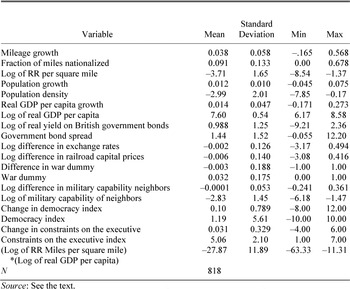
Appendix Table 7 reports summary statistics for the variables in the cross-sectional analysis of nationalizations in 1910. Appendix Table 8 reports summary statistics for the variables in the equations for the extent of nationalizations and mileage growth.
SUMMARY STATISTICS FOR THE CROSS-SECTIONAL ANALYSIS OF NATIONALIZATIONS IN 1910

Source:
see the text.
SUMMARY STATISTICS FOR ANALYSIS OF NATIONALIZATIONS AND MILEAGE GROWTH

Source:
see the text.