Psychiatric disorders in children co-occur at rates much higher than would be expected by chance (Angold & Costello, Reference Angold and Costello1993; Bird, Gould, & Staghezzi, Reference Bird, Gould and Staghezzi1993) and codevelop at high rates as well (Kovacs, Paulauskas, Gatsonis, & Richards, Reference Kovacs, Paulauskas, Gatsonis and Richards1988). Even among seemingly minimally related disorders that involve distinctly different symptoms, such as conduct disorder and depression, comorbidity rates are high. This co-occurrence of disorders across similar and different domains has been termed homotypic and heterotypic comorbidity (Angold, Costello, & Erkanli, Reference Angold, Costello and Erkanli1999). A meta-analysis on this topic revealed that individuals with depression were 8.2 times more likely to be diagnosed with an anxiety disorder (an example of homotypic comorbidity), while individuals with a conduct disorder were 6.6 and 3.1 times more likely to be diagnosed with a depressive or anxiety disorder, respectively (examples of heterotypic comorbidity; Angold et al., Reference Angold, Costello and Erkanli1999). The heterotypic comorbidity of externalizing and internalizing problems could be summarized as “bad things are related to other bad things,” and it has been quite difficult to untangle why individuals develop primarily externalizing problems, internalizing problems, or co-occurring problems. Our objective was to examine the heterotypic codevelopment of children's externalizing and internalizing symptoms within individuals and investigate whether children's membership in codeveloping externalizing–internalizing trajectories can be differentially predicted by sex and biological risk and protective factors as indexed by parasympathetic nervous system (PNS) activity.
Codevelopment of Symptoms
Researchers have continued to investigate the seeming puzzle of why disorders with such different symptoms co-occur. These efforts have emphasized moving beyond the descriptive to the use of theory-driven longitudinal studies in conjunction with putative risk factors to uncover the etiology of co-occurring and codeveloping externalizing and internalizing problems (Angold et al., Reference Angold, Costello and Erkanli1999; Boylan, Vaillancourt, Boyle, & Szatmari, Reference Boylan, Vaillancourt, Boyle and Szatmari2007; Zahn-Waxler, Shirtcliff, & Marceau, Reference Zahn-Waxler, Shirtcliff and Marceau2008). Our recent search of the literature revealed more than 60 published manuscripts since 1990 that focused on the development of both externalizing and internalizing symptoms in childhood and adolescence. The vast majority of these papers also included environmental characteristics such as peer relations (e.g., Brendgen, Vitaro, Bukowski, Doyle, & Markiewicz, Reference Brendgen, Vitaro, Bukowski, Doyle and Markiewicz2001; Dekovic, Buist, & Reitz, Reference Dekovic, Buist and Reitz2004; Fanti & Henrich, Reference Fanti and Henrich2010; Galambos, Barker, & Almeida, Reference Galambos, Barker and Almeida2003; Keiley, Bates, Dodge, & Pettit, Reference Keiley, Bates, Dodge and Pettit2000), parent–child relations (e.g., Dekovic et al., Reference Dekovic, Buist and Reitz2004; Galambos et al., Reference Galambos, Barker and Almeida2003; Gilliom & Shaw, Reference Gilliom and Shaw2004; Hollenstein, Granic, Stoolmiller, & Snyder, Reference Hollenstein, Granic, Stoolmiller and Snyder2004), and individual psychological characteristics such as emotion regulation, trait emotionality, and impulsivity (e.g., Eisenberg et al., Reference Eisenberg, Valiente, Spinrad, Cumberland, Liew and Reiser2009; Gilliom & Shaw, Reference Gilliom and Shaw2004) as correlates or predictors of the development of externalizing and internalizing symptoms. Physiological regulatory systems also play an important role in the expression of externalizing and internalizing symptoms (Beauchaine, Reference Beauchaine2001; Thayer & Lane, Reference Thayer and Lane2009), but relatively few studies have evaluated the impact of physiological systems on change in symptoms over time and none have investigated how physiological systems are related to codeveloping externalizing and internalizing symptoms within individuals.
Respiratory Sinus Arrhythmia (RSA)
The study of physiological stress response systems has facilitated understanding of the development of psychopathology (Cicchetti & Gunnar, Reference Cicchetti and Gunnar2008; van Goozen & Fairchild, Reference van Goozen and Fairchild2008). One particularly informative area of study has emphasized investigations of autonomic nervous system (ANS) activity, and a substantial literature has developed around the study of the parasympathetic branch of the ANS. Both branches of the ANS (PNS and sympathetic nervous system) are grounded in and controlled by central nervous system activity and can be traced through hierarchical, bidirectional connections to multiple brain structures (Berthoud & Neuhuber, Reference Berthoud and Neuhuber2000; Saper, Reference Saper2002; Ulrich-Lai & Herman, Reference Ulrich-Lai and Herman2009).
The PNS is responsible for “rest and digest” bodily functions but also has an important role in how the body copes with stress (Porges, Reference Porges2003, Reference Porges2007). It is a first-response coping system that can respond very quickly to environmental cues, on the order of milliseconds, as compared to the sympathetic nervous system, which operates on the order of seconds (Saul, Reference Saul1990). Research delving into psychophysiology and bioregulatory processes has offered critical insights into how PNS activity is related to symptoms of psychopathology (Beauchiane, 2001; Porges, Reference Porges2007; Thayer & Lane, Reference Thayer and Lane2009). Porges's polyvagal theory explains the important role of PNS function as part of a hierarchical stress response system wherein (evolutionarily) older stress response systems are activated when more recently developed stress response systems (i.e., the PNS) are insufficient for coping. This most recent evolutionary development of the body's stress response system includes the ventral vagal complex and facilitates engagement with the environment by promoting incremental changes in heart rate to support attentional control, emotion regulation, and the of use appropriate social strategies.
PNS influence through the vagus is commonly assessed via RSA. RSA is the variability in heart rate owing to respiration (heart rate increases during inspiration and decreases during exhalation) and, when specific conditions are met, reflects parasympathetic–vagal influence (Berntson, Cacioppo, & Grossman, Reference Berntson, Cacioppo and Grossman2007). Where appropriate, from this point forward we use RSA to refer specifically to the operationalized assessments of PNS influence on the heart that are used in relevant studies. Consistent with functional PNS–hypothalamic–limbic connections, RSA both at rest and in response to stress is associated with emotion and emotion regulation (Kreibig, Reference Kreibig2010; Lane et al., Reference Lane, McRae, Reiman, Chen, Ahern and Thayer2009; Mauss & Robinson, Reference Mauss and Robinson2009; Vasilev, Crowell, Beauchaine, Mead, & Gatzke-Kopp, Reference Vasilev, Crowell, Beauchaine, Mead and Gatzke-Kopp2009). Higher baseline RSA (RSA-B) is thought to index the physiological capacity to engage in and cope with environmental stress (Porges, Reference Porges1995) and trait positive emotionality (Oveis et al., Reference Oveis, Cohen, Gruber, Shiota, Haidt and Keltner2009). RSA reactivity (RSA-R; indicated by changes in RSA from baseline) is thought to index active and adaptive physiological engagement with the environment, with greater RSA withdrawal (i.e., decreases in RSA from baseline) being positively associated with attentional, emotional, and behavioral self-regulation at a wide range of ages (Calkins & Keane, Reference Calkins and Keane2004; Gentzler, Santucci, Kovacs, & Fox, Reference Gentzler, Santucci, Kovacs and Fox2009; Graziano, Keane, & Calkins, Reference Graziano, Keane and Calkins2007; Suess, Porges, & Plude, Reference Suess, Porges and Plude1994). For the sake of simplicity, we specify RSA-R as being stronger RSA-R (greater than average RSA withdrawal) or weaker RSA-R (less than average RSA withdrawal or increases in RSA from resting levels, sometimes termed RSA activation) when referring to results of studies.
RSA-B and RSA-R have consistently been linked to children's and adolescents' externalizing and internalizing symptoms (for a review see Beauchaine, Reference Beauchaine2001), though longitudinal studies in this area are scarce. Lower RSA-B appears to function as a nonspecific risk factor for externalizing and internalizing symptoms (Beauchaine, Gatzke-Kopp, & Mead, Reference Beauchaine, Gatzke-Kopp and Mead2007; Calkins & Dedmon, Reference Calkins and Dedmon2000; El-Sheikh & Hinnant, Reference El-Sheikh and Hinnant2011; Forbes, Fox, Cohn, Galles, & Kovacs, Reference Forbes, Fox, Cohn, Galles and Kovacs2006; Hinnant & El-Sheikh, Reference Hinnant and El-Sheikh2009) in both clinical and community samples. The relation between lower RSA-B and adjustment problems may be mediated by deficits in attention and social engagement mechanisms, emotion regulation problems, and low positive emotionality; null findings of associations between RSA-B and adjustment have also been reported, however (Calkins, Graziano, & Keane, Reference Calkins, Graziano and Keane2007).
Whereas RSA withdrawal to multiple cognitive challenges has been associated with social competence and adaptive self-regulation in community samples (e.g., Graziano et al., Reference Graziano, Keane and Calkins2007), excessive RSA withdrawal to simulated peer rejection has also been associated with internalizing problems and social exclusion (Gazelle & Druhen, Reference Gazelle and Druhen2009). Thus, the nature of the stressor (e.g., cognitive vs. social) may play a role in the prediction of adjustment. Beauchaine and colleagues (Beauchaine, Reference Beauchaine2001; Beauchaine et al., Reference Beauchaine, Gatzke-Kopp and Mead2007) proposed and tested the hypothesis that lower RSA-B in combination with excessive RSA withdrawal may serve as a physiological index of lowered trait capacity for self-regulation and emotional lability in response to stress, with the final result being the physiological dysregulation partially underlying panic, anxiety, and reactive forms of aggression. Consistent with allostatic load theory (McEwen & Stellar, Reference McEwen and Stellar1993), the depletion of resources in physiological stress response systems that is driven by chronic exposure to stress may be reflected in decreases in function of stress response systems in a resting state (e.g., decreased RSA-B over time; El-Sheikh & Hinnant, Reference El-Sheikh and Hinnant2011).
Recent research supports the importance of interactions between RSA-B and RSA withdrawal in the prediction of psychopathology symptoms. For example, lower RSA-B in combination with greater RSA withdrawal to a social stressor (hearing a staged argument between adults) predicted increased internalizing symptoms over time (controlling for prior externalizing and internalizing symptoms); however, lower RSA-B in combination with weaker RSA withdrawal to a cognitively frustrating stressor (tracing an outline of a star while looking in a mirror) predicted increased externalizing symptoms (controlling for prior symptoms; Hinnant & El-Sheikh, Reference Hinnant and El-Sheikh2009). Similar longitudinal results have been found in another study and sample; boys with lower RSA-B and weaker RSA-R evidenced increasing delinquency symptoms over time while symptoms for other children were stable or declining (El-Sheikh, Hinnant, & Erath, Reference El-Sheikh, Hinnant and Erath2011). Collectively, these findings highlight the importance of contemporaneous assessments of RSA during resting and reactivity conditions, and examinations of interactions between them, in the prediction of psychopathology symptoms. Results also suggest that the particular laboratory tasks used to elicit RSA withdrawal are pertinent for the prediction of child outcomes. We believe that, in combination with lower RSA-B (which is tied to poorer potential for emotion regulation and trait negative emotionality), strong RSA withdrawal promotes a physiological state related to emotion dysregulation, hypervigilance, and internalizing symptoms in which high levels of anxiety are a core characteristic. Lower RSA-B and weaker RSA withdrawal, in contrast, may promote a physiological state related to emotional disengagement, callous behavior, and externalizing symptoms such as increased instrumental aggression, bullying, and delinquent acts.
A few studies with community samples have evaluated the relations between RSA and co-occurring externalizing and internalizing symptoms within individuals. Boyce et al. (Reference Boyce, Quas, Alkon, Smider, Essex and Kupfer2001) used mother- and teacher-reported child symptoms to define groups of children who were normative, high internalizers, high externalizers, or high on both. They found that children with higher internalizing symptoms exhibited stronger RSA withdrawal to a range of social, cognitive, physical, and emotional tasks (RSA-R was composited) than did control children. Children with higher externalizing symptoms exhibited weaker RSA withdrawal than did control children, and children higher on both types of symptoms were not differentiated from control children by RSA-R. Calkins and colleagues (2007) employed a larger sample and used clinical risk t scores to define three groups of children: low risk for problems, risk for externalizing problems, and risk for internalizing–externalizing problems. Consistent with the findings of Boyce and colleagues, children at risk for externalizing problems exhibited weaker RSA withdrawal across a range of self-regulatory, attentional, and emotional tasks than did children at risk for internalizing–externalizing problems. Differences between the low-risk group and the other groups were marginally significant, with the overall pattern indicating weaker RSA withdrawal in the externalizing only group, stronger RSA withdrawal in the internalizing–externalizing group, and the low-risk group between the two with moderate RSA withdrawal. However, both of the studies were cross-sectional, leaving open the question of how RSA-B and RSA-R are related to the codevelopment of externalizing and internalizing symptoms.
Sex, RSA, and Psychopathology Symptoms
Theoretical reviews (Beauchaine, Klein, Crowell, Derbridge, & Gatzke-Kopp, Reference Beauchaine, Klein, Crowell, Derbridge and Gatzke-Kopp2009; Zahn-Waxler, Reference Zahn-Waxler1993; Zahn-Waxler et al., Reference Zahn-Waxler, Shirtcliff and Marceau2008) and longitudinal studies have underscored the importance of evaluating sex differences in the development of psychopathology. There are clear sex differences in young adolescents' levels and change over time in externalizing and internalizing symptoms (e.g., Dekovic et al., Reference Dekovic, Buist and Reitz2004; Hankin, Wetter, & Cheely, Reference Hankin, Wetter, Cheely, Abela and Hankin2008), though this evidence is less clear in middle to late childhood. In models in which codeveloping externalizing and internalizing symptoms within individuals are measured, boys are more likely to be members of developmental trajectories that include more pure externalizing symptoms (Fanti & Henrich, Reference Fanti and Henrich2010) and externalizing and internalizing symptoms, and trajectories of these symptoms have been found to be more highly correlated for girls than for boys (Wiesner & Kim, Reference Wiesner and Kim2006). In studies using person-centered analyses similar to those in the current study, Wiesner and Kim (Reference Wiesner and Kim2006) found four codeveloping internalizing and externalizing trajectories for boys (n = 472) and three for girls (n = 513). Fanti & Henrich (Reference Fanti and Henrich2010) identified 11 profiles of codeveloping externalizing and internalizing symptoms with a sample of over 1,200 children; although boys were more likely to be in profiles of pure externalizing problems, the profiles were not analyzed separately by sex.
Overall, these studies demonstrate that throughout childhood and adolescence initial levels and change over time in internalizing symptoms are positively related to initial levels and change over time in externalizing symptoms; there are important sex differences in the relations between externalizing and internalizing symptoms and their codevelopment; there is significant heterogeneity in developmental trajectories of externalizing and internalizing symptoms; and putative risk factors provide important insights into how externalizing and internalizing symptoms develop.
Further, some research indicates that relations between RSA and symptoms of psychopathology may depend upon child sex. Negative relations between RSA-B and externalizing problems may be stronger for boys (Beauchaine, Hong, & Marsh, Reference Beauchaine, Hong and Marsh2008; Calkins & Dedmon, Reference Calkins and Dedmon2000; El-Sheikh & Hinnant, Reference El-Sheikh and Hinnant2011). Some studies with community samples have found that weaker RSA withdrawal to frustration is related to higher levels of externalizing problems for boys (e.g., El-Sheikh et al., Reference El-Sheikh, Hinnant and Erath2011). Conversely, other studies have found no sex differences in relating RSA-R in response to a battery of emotional and problem-solving tasks to externalizing problems (e.g., Calkins & Dedmon, Reference Calkins and Dedmon2000) or have found the opposite effect when RSA-R is measured in response to free-play in social groups (Hastings, Nuselovici, Utendale, Coutya, & Sullivan, Reference Hastings, Nuselovici, Utendale, Coutya and Sullivan2008). Possible explanations for these sex differences lie outside the scope of the this study but include a stronger genetic influence on externalizing behavior for boys (Sildberg et al., Reference Sildberg, Rutter, Meyer, Maes, Hewitt and Loeber1996), a stronger link between internalizing and externalizing symptoms for girls (Wiesner & Kim, Reference Wiesner and Kim2006) that may blur relations between autonomic function and symptoms, or differential effects of socializing influences on emotion regulation strategies and self-regulatory behaviors based on sex (Zahn-Waxler et al., Reference Zahn-Waxler, Shirtcliff and Marceau2008). In addition, it is worth noting that findings for boys with clinically diagnosed externalizing problems do not differ from healthy control children in their RSA withdrawal to reward (Beauchaine et al., Reference Beauchaine, Gatzke-Kopp and Mead2007, Reference Beauchaine, Hong and Marsh2008) but do have lower RSA-B, which suggests that there may be some key differences in what RSA withdrawal means for physiological regulation of boys in clinical versus community samples. Finally, and relevant to the current study, it is difficult to discern the pattern of effects regarding sex as a moderator in the relations between RSA-R and externalizing or internalizing symptoms when so many different types of stressor tasks have been used. Thus, we attempted to clarify these relations using RSA-R to two specific types of stressors (social stress and cognitive frustration).
The Current Paper
Overall, the literature that has used primarily community samples and cross-sectional analyses indicates that lower RSA-B is a risk factor for both externalizing and internalizing symptoms in both clinical (Beauchaine et al., Reference Beauchaine, Gatzke-Kopp and Mead2007) and community samples (Hinnant & El-Sheikh, Reference Hinnant and El-Sheikh2009), weaker RSA withdrawal may indicate risk for primarily externalizing problems, and stronger RSA withdrawal in response to stress may indicate risk for internalizing symptoms or co-occurring internalizing–externalizing symptoms (Boyce et al., Reference Boyce, Quas, Alkon, Smider, Essex and Kupfer2001; Calkins et al., Reference Calkins, Graziano and Keane2007). Our objective was to study the codevelopment of externalizing and internalizing symptoms in a community sample during middle childhood in order to shed light on how the codevelopment of symptoms is tied to sex and patterns of RSA activity.
We used a large community sample (combined from two independent studies) with longitudinal data from middle to late childhood to examine initial levels, change over time, and variability in children's externalizing and internalizing symptoms through the use of multiple domain latent growth modeling (e.g., Keiley et al., Reference Keiley, Bates, Dodge and Pettit2000). These analyses allowed us to derive indicators for a growth mixture model that captures codeveloping patterns of externalizing and internalizing symptoms within and across groups of children. We also investigated whether sex, RSA-B, RSA-R, and their interactions are predictive of membership in profiles of codeveloping externalizing and internalizing symptoms. We expected to find three to five codeveloping trajectories of psychopathology symptoms encompassing some combination of normative externalizing/internalizing, low externalizing/low internalizing, high externalizing/low internalizing, low externalizing/high internalizing, and high externalizing/internalizing. Controlling for demographics (race and socioeconomic status [SES]) and study (Study 1 and Study 2), we also expected that profile membership would be predicted by RSA-B, RSA-R to the two laboratory stress tasks, and interactions among sex, RSA-B, and RSA-R.
Consistent with evidence supportive of relations between parasympathetic hypoarousal and psychopathology, we hypothesized that low RSA-B and/or weak RSA-R, especially for boys, would predict membership in a profile of children who are high on externalizing symptoms and relatively low on internalizing symptoms. We also hypothesized that children with lower RSA-B and stronger RSA-R would be more likely to fall into a profile of high externalizing/internalizing symptoms or low externalizing/high internalizing symptoms. This hypothesis is more fitting with evidence relating dysregulated parasympathetic withdrawal to psychopathology, especially co-occurring or codeveloping externalizing–internalizing symptoms. Investigations of the moderating roles of sex and RSA-R to different types of tasks are largely exploratory and are consistent with calls for additional research in these areas to augment limited existing knowledge (Beauchaine et al., Reference Beauchaine, Hong and Marsh2008; Obradovic, Bush, & Boyce, Reference Obradovic, Bush and Boyce2011).
Method
Participants
Data for the current study come from two independent, three-time-point longitudinal data sets used to examine relations between familial stress and children's development. Participants in both studies included school-recruited children residing in two-parent homes. To minimize potential confounds, families with children diagnosed with a chronic illness, a learning disability, mental retardation, or attention-deficit/hyperactivity disorder were not eligible to participate. Further information on recruitment procedures can be found in El-Sheikh et al. (Reference El-Sheikh, Kouros, Erath, Cummings, Keller and Staton2009). For Study 1, 165 children participated during the first wave of data collection (T1), 132 participated in the second wave (T2; 80% of the original sample), and 113 participated in the third wave (T3; 86% of those who participated at T2). For Study 2, participants were 248 children at T1, 217 at T2 (86% of the original sample), and 183 at T3 (84% of those who participated at T2). In Study 1 there was a 2-year lag between Waves 1 and 2 and a 3-year lag between Waves 2 and 3. For Study 2, there was a 1-year lag between consecutive waves. Reasons for attrition in both studies included the inability to be located, hectic schedules, lack of interest, and geographic relocation.
Due to similarity in sample characteristics and study designs, the two samples were aggregated to create a larger sample and one additional time point of measurement (i.e., a total of four time points). Such combined-sample, accelerated designs have been found to approximate true longitudinal designs (Duncan, Duncan, & Hops, Reference Duncan, Duncan and Hops1996; Stanger, Achenbach, & Verhulst, Reference Stanger, Achenbach and Verhulst1994). The total sample comprised 390 children (180 boys and 210 girls) who had data available for externalizing and internalizing symptoms for at least one time point along with physiological data. Similar to community demographics, 67% of children were European American and 33% were African American. Families were from a wide range of socioeconomic backgrounds, based on Hollingshead (Reference Hollingshead1975) criteria, and the median family income was in the $35,000 to $50,000 range. In analyses, we controlled for any differences that may be due to the particular study features in which children participated, that is, we created a variable with two levels, Study 1 (coded as 0) and Study 2 (coded as 1), and included it as a control in all analyses. Studies 1 and 2 corresponded to the same studies described in El-Sheikh et al. (Reference El-Sheikh, Kouros, Erath, Cummings, Keller and Staton2009).
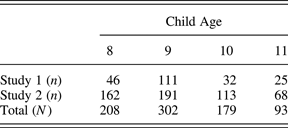
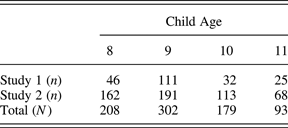
Because each study consisted of three waves, each child could contribute data at up to three time points (see Table 1). Children's data were sorted based on their chronological age, rather than each study's data collection wave. This approach minimized variability in age within time points and maximized the measurement of true developmental change (Mehta & West, Reference Mehta and West2000). Children who contributed information between the ages of 7.50 and 8.50 were sorted into the first assessment (age 8; M = 8.13, SD = 0.33), children between the ages of 8.51 and 9.50 were sorted into the second assessment (age 9; M = 8.98, SD = 0.28), children between the ages of 9.51 and 10.50 were sorted into the third assessment (age 10; M = 10.05, SD = 0.31), and children who contributed information between the ages of 10.51 and 12.50 were sorted into the fourth assessment (age 11; M = 11.03, SD = 0.45). Because of the small subsample size available for children 13 years and older and the increased variability in age that adding these children would create, we did not include data from children older than 12.50 in the fourth assessment (n = 82; M age = 13.65, SD = 0.48). Sixty-seven children had data for one time point, 166 had data for two time points, and 157 had data for three time points.
Longitudinal data contributed from two studies
Procedure
Approval from the university's internal review board was granted for both studies. Procedures are nearly identical across both studies unless otherwise indicated (for more information on each study's procedures, see El-Sheikh et al., Reference El-Sheikh, Kouros, Erath, Cummings, Keller and Staton2009). Families visited our university-based research laboratory during each study wave. Mothers and fathers self-reported on questionnaires while children completed the questionnaires via interview with a trained researcher. In addition, children's physiological responses (i.e., RSA) were assessed while being presented with two independent mildly stressful tasks. After attaching electrodes, a 6-min adaptation period occurred followed by a 3-min baseline assessment. The researcher then presented the child with two laboratory tasks, each lasting 3 min, with a recovery period between conditions. In the first task, children listened to an audiotape recording of an argument between two adults. This task is considered a mild social stressor that successfully elicits significant variability in physiological stress responses (El-Sheikh, Harger, & Whitson, Reference El-Sheikh, Harger and Whitson2001).
Following the argument, a 3-min recovery period occurred followed by a second 3-min baseline for both studies, with one exception; at T1 in Study 1, a 12-min recovery period (vs. 6-min) occurred between the argument task and the star-tracing task. Children were then presented with the star-tracing task, which is a frustrating and well-established cognitive stressor (Matthews, Rakaczky, Stoney, & Manuck, Reference Matthews, Rakaczky, Stoney and Manuck1987; Matthews, Woodall, & Stoney, Reference Matthews, Woodall and Stoney1990) and has been linked with individual differences associated with family risk and child adjustment (El-Sheikh et al., Reference El-Sheikh, Kouros, Erath, Cummings, Keller and Staton2009). For the star-tracing task, a sheet of paper that contained the outline of a star was placed in front of the child on a writing tray. Children traced the star for 3 min while only looking through a mirror (Mirror Tracer, Lafayette Instrument Company, Lafayette, IN); the star was blocked from direct view but was visible through the mirror. The examination of children's responses to both social and nonsocial stressors can provide greater specificity about psychophysiological responses (Chen, Matthews, Salomon, & Ewart, Reference Chen, Matthews, Salomon and Ewart2002).
Measures
RSA data acquisition and reduction
During each study wave, children's RSA was assessed following standard guidelines (Berntson et al., Reference Berntson, Bigger, Eckberg, Grossman, Kaufmann and Malik1997). Two electrocardiography (ECG) electrodes were placed on the rib cage, about 10 to 15 cm below the armpits. To ground the signal, a third electrode was placed on the center of the chest. A pneumatic bellows was firmly placed around the chest to measure respiratory changes. The ECG signal was digitized at a sampling rate of 1,000 readings per second using bandpass filtering with half power cutoff frequencies of 0.1 and 1000 Hz and a gain of 500. An interbeat interval (IBI) analysis system from the James Long Company (Caroga Lake, NY) was used to process the ECG signal. To minimize phase or time shifts in the assessment of respiration, a pressure transducer with a bandpass of DC to 4000 Hz was used with the bellows.
Identification of R-waves was provided via an automated algorithm. In the rare case that it was needed, an interactive graphical program was used for manual correction of misidentified R-waves. R-wave times were then converted to IBIs and resampled into equal time intervals of 125 ms. All IBIs that spanned the 125-ms interval were prorated. The program prorates at every eighth of a second. The prorated IBIs were stored for computation of the mean and variance of heart period as well as assessing heart period variability due to RSA. The first RSA-B prior to the challenge tasks (i.e., the interparental argument, or RSA-R argument; and the star-tracing task, or RSA-R star tracing) was calculated for the entire epoch. RSA was calculated using the peak-to-valley method, which is an acceptable approach for quantifying RSA (Bernston et al., 1997). RSA was computed by using the difference in IBI readings from inspiration to expiration onset.Footnote 1 RSA-R was calculated by subtracting RSA during the relevant task from RSA during the first baseline. Thus, lower values for RSA-R are indicative of stronger RSA withdrawal in response to either of the challenge conditions.
Children's internalizing symptoms
Depressive symptoms
Children's depressive symptoms were assessed via the 27-item Children's Depression Inventory (CDI; Kovacs & Beck, Reference Kovacs and Beck1977), which has established reliability and validity. One item assessing suicidal ideation was not administered in both studies. The overall scale score was used in analyses, and higher scores reflect more depressive symptoms. For Study 1, T1, T2, and T3 internal consistencies for the CDI were α = 0.89, 0.77, and 0.81, respectively. For Study 2, internal consistencies for the CDI were α = 0.95, 0.85, and 0.83 for the three study waves. Sorting based on chronological age indicated that at ages 8, 9, 10, and 11, the proportion of children having scores in the borderline or clinical range (scores ≥ 20) was 3%, 6%, 3%, and 1%, respectively.
Anxiety symptoms
Children's symptoms were derived from the 28 items of the Revised Children's Manifest Anxiety Scale (RCMAS; Reynolds & Richmond, Reference Reynolds and Richmond1978). The RCMAS has demonstrated good psychometric properties (James, Reynolds, & Dunbar, Reference James, Reynolds, Dunbar, Ollendick, King and Yule1994). For Study 1, internal consistencies for the RCMAS were α = 0.86, 0.89, and 0.86 during the three study waves. For Study 2, reliabilities for the RCMAS were α = 0.92, 0.90, and 0.92. Sorting based on chronological age showed that at ages 8, 9, 10, and 11, the following percentages of children had scores in the borderline or clinical range (scores ≥ 20): 14%, 10%, 9%, and 2%, respectively.
Children's depressive symptoms were highly correlated with anxiety symptoms at all time points for both studies (rs =.41–.62 in Study 1 and .40–.75 in Study 2) and were averaged at each time point to capture internalizing symptoms broadly.
Children's externalizing symptoms
Both mothers and fathers reported on children's externalizing behaviors using the Personality Inventory for Children—II (PIC2; Lachar & Gruber, Reference Lachar and Gruber2001). The PIC2 has demonstrated discriminant and construct validity, interrater reliability, and test–retest reliability (Lachar & Gruber, Reference Lachar and Gruber2001; Wirt, Lachar, Klinedinst, & Seat, Reference Wirt, Lachar, Klinedinst and Seat1990). We examined children's symptoms on the externalizing scale, which consists of 47 items that assess children's impulsivity, aggression, disruptive behavior, noncompliance, and delinquency.
Mother and father reports of children's externalizing symptoms were highly correlated at each time point for both studies (rs = .37–.71 in Study 1 and .39–.84 in Study 2) and were averaged at each time point. For Study 1, internal consistency for the externalizing scale raw scores were α = 0.88, 0.92, and 0.93 across the three waves. After sorting children based on their chronological age, proportions of children with borderline or clinical levels of externalizing symptoms (T ≥ 60) at ages 8, 9, 10, and 11 were 8%, 11%, 10%, and 7%, respectively.
In latent growth modeling, repeated measures must have a common metric (i.e., they must have the same meaning at each time point; Singer & Willett, Reference Singer and Willett2003). Because the PIC2 T scores are age and sex corrected, raw scores were used to assess growth of externalizing symptoms. Unfortunately, this precluded the use of the established clinical risk cutoff values (i.e., T scores) as comparisons in the growth models. However, as a comparison, Lachar and Gruber (Reference Lachar and Gruber2001) reported a mean externalizing raw score of 6.4 for their standardization (i.e., normative) sample of over 2,000 children, adolescents, and young adults and a mean externalizing raw score of 16.5 for their referred (i.e., clinical) sample of approximately 1,500 children, adolescents, and young adults.
Plan of analysis
Based on our hypotheses and the results of prior studies modeling the codevelopment of externalizing and internalizing symptoms (Fanti & Henrich, Reference Fanti and Henrich2010; Wiesner & Kim, Reference Wiesner and Kim2006), we sought to identify different patterns of psychopathology over time. We used a form of growth mixture modeling (GMM) to capture profiles of individuals who display similar patterns of development. GMM is part of a new generation of person-centered analyses that are being used increasingly when researchers expect that a sample distribution may be composed of unobserved but distinct groups of individuals on similar developmental trajectories (profiles), each with its own distribution (McLachlan & Peel, Reference McLachlan and Peel2000; Muthen, Reference Muthen and Kaplan2004). One clear advantage to this approach is that it gives freedom to model developmental trajectories in multiple domains (externalizing and internalizing symptoms) within individuals; a traditional latent growth model approach would be limited to predicting levels and change in one domain from levels and change in another domain or from covariates (e.g., Curran, Stice, & Chassin, Reference Curran, Stice and Chassin1997). It is important to note that there are different forms of person-centered growth analyses, and one difference between a GMM approach and more restrictive forms such as latent class or profile analysis is the assumption made about within-profile variance (Muthen, Reference Muthen and Kaplan2004; Sterba & Bauer, Reference Sterba and Bauer2010; see also Nagin, Reference Nagin1999). In our GMM analyses within-profile variances were freely estimated and reflect that even within profiles individuals may be different in terms of development.
We derived the codevelopment profiles from four indicators: factor scores of initial (intercept) levels of externalizing and internalizing symptoms and change over time (slope) in externalizing and internalizing symptoms that were created from a multiple domain growth model. Although we addressed and tested quadratic growth in this multiple domain growth model,Footnote 2 linear trajectories of externalizing and internalizing symptoms provided the best fitting and most parsimonious summary of the data, and so growth in the multiple domain model was limited to a linear form. Covariances among the latent growth variables were freely estimated in this original model.
One important component of building support for multiple trajectories for individuals involves the use of theoretically derived predictors to correctly classify individuals (Bauer & Curran, Reference Bauer and Curran2003; Muthen, Reference Muthen2003, Reference Muthen and Kaplan2004). In this study, sex, RSA-B, and RSA-R were the primary predictors. Each profile predictor estimate is a logistic regression coefficient and indicates the relation between the predictor and membership in one profile versus a comparison profile. These logistic regression coefficients are translated into probabilities of membership in a profile (which can vary between 0 and 1) or odds ratios to aid in interpretation (see Peng, Lee, & Ingersoll, Reference Peng, Lee and Ingersoll2002, for an overview). As in linear regression, significant interactions take precedence over main effects. Interactions were assessed by plotting the predictor against probability of membership in profile at standard levels of the moderator (i.e., ±1 SD). A macro provided by Hayes and Matthes (Reference Hayes and Matthes2009) was used to assess the simple slopes and derive values for plotting. Plotted probabilities do not necessarily have a linear form (Flom & Strauss, Reference Flom and Strauss2003).
There are no hard and fast rules for when it is best to interpret interactions because the creation of interaction terms reduces power (Whisman & McClelland, Reference Whisman and McClelland2005). Our rule of thumb was to interpret interactions that were significant at traditional alpha levels (p < .05) as well as more liberal alpha levels (p < .10) for the Wald chi-square statistic. This is because the Wald statistic indicates that the predictor variable differentiated the other profiles from the comparison (dummy coded) profile overall but not which specific profile was differentiated from the comparison profile (much like in analysis of variance and its post hoc comparisons). Thus, it is possible for the Wald statistic to not reach traditional significance while the interaction for a specific logistic regression was significant. Traditional p values were used for the more specific predictions of profile membership (i.e., the comparison profile compared to a specific other profile).
Statistical Package for the Social Sciences was used to derive overall descriptive statistics and values for plotting significant interactions. The original multiple domain latent growth model used to derive factor scores was created in AMOS. All GMM analyses were conducted with Latent Gold (a program designed for mixture modeling). Missing data in the original latent growth model and subsequent GMM were handled with full information maximum likelihood estimation. This procedure does not impute missing data but uses all available information to estimate model parameters (Acock, Reference Acock2005). Following recommended best practices, the best fitting model and number of profiles was directed by bootstrapped comparisons (described below).
Results
Missing data
We evaluated associations between demographic characteristics (race, sex, and SES) and the number of time points at which children contributed data (one time point, n = 67; two time points, n = 166; three time points, n = 157). Chi-square analyses indicated no sex, χ2 (2) = 0.94, p = .63, or race, χ2 (2) = 3.92, p = .14, differences for children who contributed data at one, two, or three time points. A one-way analysis of variance indicated no differences based on SES, F (2) = 1.80, p = .17. Thus, missing data was not based on these demographic characteristics.
Descriptive statistics
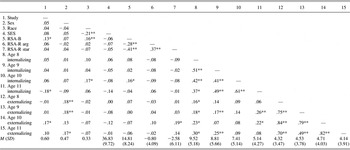
Means, standard deviations, and correlations among all study variables are shown in Table 2. Single sample t tests indicated that children exhibited significant RSA withdrawal to the argument, t (400) = –3.92, p < .001, and the star tracing, t (393) = –8.36, p < .001, tasks. As shown in Table 2, RSA-B was negatively related to RSA-R to the argument and the star tracing; children with higher RSA-B show greater RSA withdrawal to the two tasks. Further, the two measures of reactivity were positively associated. The RSA measures were generally not directly correlated with the repeated measures of externalizing and internalizing symptoms. Repeated measures of externalizing and internalizing symptoms were correlated within and across domains.
Descriptive statistics and correlations among study variables

Note: Study was coded 0 for Study 1 and 1 for Study 2. Sex was coded 0 for girls and 1 for boys. Race was coded 0 for European American and 1 for African American. Correlations are pairwise, which explains why some weaker correlations have a lower p value than stronger correlations; the sample size differs based on time. SES, socioeconomic status; RSA, respiratory sinus arrhythmia; -B, baseline; -R, reactivity.
*p < .05. **p < .01.
Overall growth of externalizing and internalizing symptoms
We first defined an overall unconditional dual trajectory latent growth model for externalizing and internalizing symptoms. As stated earlier, trajectories were constrained to estimate linear growth and time was coded so that intercepts represent initial levels of symptoms and slopes represent change over time from that point.2 This dual trajectory model had acceptable fit statistics, χ2 (93.94)/df (28) = 3.36, root mean square error of approximation = 0.076. The average initial level of externalizing symptoms was 4.53 and the average slope was –0.07. This slope was not significantly different from zero (i.e., on average, there was no significant change in externalizing symptoms over time). The average initial level of internalizing symptoms was 9.87 and the average slope was –1.14, indicating a significant decrease in internalizing symptoms over time (p < .001). In addition, there was significant variability in intercepts and slopes for both types of symptoms (all ps < .01). Intercepts for externalizing and internalizing symptoms were positively correlated (r = .29, p = .002); no other correlations were significant. Factor scores for intercepts and slopes of externalizing and internalizing symptoms were output from this analysis into the Statistical Package for the Social Sciences to be used as the indicators for the GMM.
Number of profiles
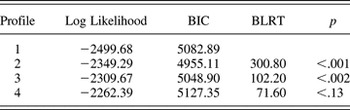
We tested a series of models, with each successive model estimating an additional profile to find the number of profiles that provided the best fit to the data (Nylund, Asparouhov, & Muthen, Reference Nylund, Asparouhov and Muthen2007). Five hundred random starts were used for each model to avoid local maxima (an incorrect and nonreplicable convergence), and all analyses were estimated twice to ensure that results were replicated (which would be highly unlikely if the first solution was due to arriving at a local maxima; McLachlan & Peel, Reference McLachlan and Peel2000). We evaluated the models using recommended indices of fit: the Bayesian information criterion and the bootstrap likelihood ratio test (BLRT; McLachlan & Peel, Reference McLachlan and Peel2000; Nylund et al., Reference Nylund, Asparouhov and Muthen2007). The BLRT is a formal test of whether a bootstrapped log likelihood difference distribution between a model with k profiles is a significant improvement over a model with k – 1 profiles. Our models bootstrapped 500 samples. The BRLT provides a p value with significant values, indicating that the addition of a model with k profiles fits better than a model with k – 1 profiles. A nonsignificant p value indicates that a model with k profiles does not fit better than a model with k – 1 profiles (i.e., it would indicate that the simpler model with fewer profiles should be accepted). We used the BLRT as our first choice in determining the number of profiles because of its superior performance in a simulation study (Nylund et al., Reference Nylund, Asparouhov and Muthen2007).
The indicators (intercepts and slopes of externalizing and internalizing symptoms) were allowed to covary within profiles in our models. As indicated by the BLRT model comparisons (shown in Table 3), we found that the best fitting model contained three profiles of individuals. This model and all subsequent analyses were based on children who had data available from all predictor and indicator variables (n = 390).
Nested model comparisons for trajectories of externalizing and internalizing symptoms

Note: BIC, Bayesian information criterion; BLRT, bootstrap likelihood ratio test.
Profile indicators
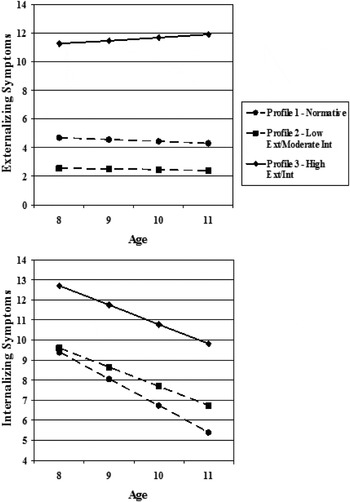
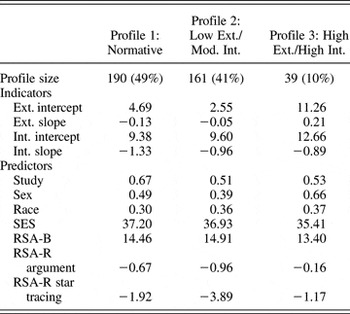
Descriptive statistics of the three profiles are provided in Table 4. Figure 1a and b present the trajectories for the three profiles. The first profile of individuals was termed “normative” because of its size (49% of the sample) and similarity to the levels and change over time in externalizing and internalizing symptoms of the overall dual trajectory identified in the latent growth model. Children in this profile exhibited moderate levels of RSA-B and RSA withdrawal to the argument and the star-tracing tasks.
Profile trajectories of externalizing and internalizing symptoms.

Profile descriptive statistics for indicators and predictors

Note: Estimates for dichotomous variables are proportions. Study was coded 0 for Study 1 and 1 for Study 2. Sex was coded 0 for girls and 1 for boys. Race was coded 0 for European American and 1 for African American. SES, socioeconomic status; RSA, respiratory sinus arrhythmia; -B, baseline; -R, reactivity.
The second profile was also quite large (41%) and was termed “low externalizing/moderate internalizing” because it had children with the lowest levels of externalizing symptoms initially and over time. While initial levels of internalizing symptoms for children in the second profile were similar to those in the normative profile, children in this second profile showed less steep declines in internalizing slopes, which resulted in higher internalizing symptoms over time (in comparison to the normative trajectory profile). Children in the second profile had the highest RSA-B and the strongest RSA withdrawal to the argument and the star-tracing tasks. Formal comparisons of indicator variables to the normative profile revealed that children in the low externalizing/moderate internalizing profile had lower initial externalizing symptoms, t (346) = –13.66, p < .001, and a less steep decline in internalizing symptoms over time, t (346) = 7.52, p < .001. No other differences in indicator variables were significant.
The third profile was termed “high externalizing/internalizing” and was relatively small (10%). Children in the high externalizing/internalizing profile had the highest initial levels of externalizing and internalizing symptoms, a positive slope for externalizing symptoms, and the least steep decline in internalizing symptoms (slope). Children in this profile had the lowest RSA-B and the weakest RSA withdrawal to the argument and the star-tracing tasks. Formal comparisons to the normative profile indicated that children in the high externalizing/internalizing profile were significantly different on all indicator variables: Initial externalizing and internalizing symptoms were significantly higher, t (227) = 12.65, p < 001 and t (227) = 7.36, p < .001, respectively; the externalizing slope was significantly higher (i.e., a positive slope), t (227) = 2.75, p = .006; and the internalizing slope was higher (i.e., a less negative slope), t (227) = 3.06, p = .004.
Posterior probabilities indicated that individuals were correctly classified in the majority of cases: The mean probability of correct classification was .88 for the normative profile, .84 for the low externalizing/moderate internalizing profile, and .95 for the high externalizing/internalizing profile. Average probabilities greater than .70 typically imply satisfactory fit (Nagin, Reference Nagin2005). Finally, there was significant variability on all of the indicator variables within profiles (all ps < .01), which suggests that even within profiles, children differ somewhat in their initial levels and change over time in externalizing and internalizing symptoms. The latent profile variable accounted for a total of 62% of the variance in initial levels of externalizing symptoms, 4% of the variance in change over time in externalizing symptoms, 13% of the variance in initial levels of internalizing symptoms, and 11% of the variance in change over time in internalizing symptoms.
Profile predictors
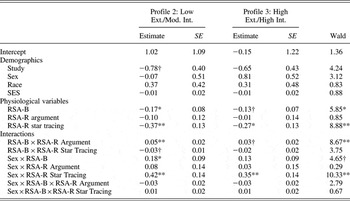
Table 5 presents estimates for predicting profile membership with the normative profile as the comparison. Wald chi-square tests for demographics and study were not significant (race, SES, and Study 1 vs. 2 did not differentiate membership in either the low externalizing/moderate internalizing or the high externalizing/internalizing profiles from the normative profile). Overall, two main effects involving RSA-B and RSA-R to the star-tracing task were significant. In addition, two interactions were significant: RSA-B × RSA-R to the argument and Sex × RSA-R to the star-tracing task. A third interaction between sex and RSA-B was marginally significant. Neither of the three-way interactions were significant.
Estimates for predictors of profile membership: Normative profile as comparison

Note: Estimates are logistic regression coefficients. Wald is the Wald chi-square statistic. Study was coded 0 for Study 1 and 1 for Study 2. Sex was coded 0 for girls and 1 for boys. Race was coded 0 for European American and 1 for African American. SES, socioeconomic status; RSA, respiratory sinus arrhythmia; -B, baseline; -R, reactivity.
†p <.10. *p < .05. **p < .01.
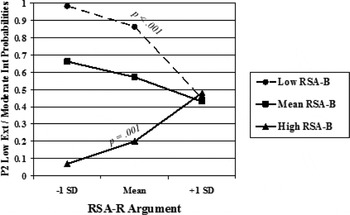
In comparison to Profile 1 (normative), Profile 2 (low externalizing/moderate internalizing) membership was predicted by RSA-B and RSA-R to the star-tracing tasks. Both of these main effects were subsumed by significant interactions. Plotting the interaction between RSA-B and RSA-R to the argument (Figure 2) indicates that RSA-R to the argument was negatively related to the probability of membership in the low externalizing/moderate internalizing profile for children who are lower in RSA-B (z = –4.31, p < .001) while the relation was positive for children higher in RSA-B (z = 3.24, p = .001). The odds of membership in the low externalizing/moderate internalizing profile versus the normative profile was 41 for individuals with lower RSA-B and stronger RSA-R to the argument (greater withdrawal), meaning that children with these characteristics were 41 times more likely to be in the low externalizing/moderate internalizing profile as opposed to the normative profile. These are very high probabilities by any standard. Conversely, individuals with higher RSA-B and stronger RSA-R to the argument had very low odds of membership in this profile (odds ratio = 0.06).
The interaction between baseline respiratory sinus arrhythmia and respiratory sinus arrhythmia reactivity argument significantly predicts probability of membership in Profile 2 (low externalizing/moderate internalizing). The comparison profile is Profile 1 (normative).

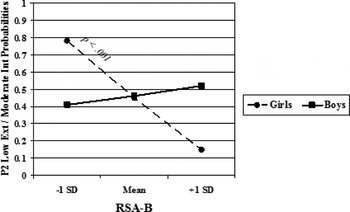
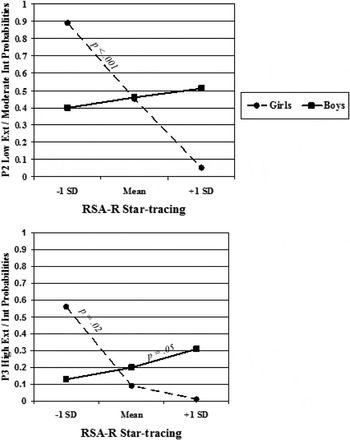
The interaction between sex and RSA-B is depicted in Figure 3. The relation between RSA-B and the probability of membership in the low externalizing/moderate internalizing profile was negative for girls (z = –5.16, p < .001), and there was no relation for boys (z = 0.95, p = .34). Girls with lower RSA-B were 3.5 times more likely to be in the low externalizing/moderate internalizing profile. The interaction between sex and RSA-R to the star-tracing task was similar (Figure 4a); RSA-R was negatively related to the probability of membership in this profile for girls (z = –5.53, p < .001). Girls with stronger RSA withdrawal to the star-tracing task had increased odds of being members of the low externalizing/moderate internalizing profile (odds ratio = 8.1), while there was no relation for boys (z = 0.81, p = .42).
The interaction between sex and baseline respiratory sinus arrhythmia significantly predicts probability of membership in Profile 2 (low externalizing/moderate internalizing). The comparison profile is Profile 1 (normative).

The interaction between sex and respiratory sinus arrhythmia reactivity star tracing significantly predicts probability of membership in Profile 2 (low externalizing/moderate internalizing) and Profile 3 (high externalizing/internalizing). The comparison profile is Profile 1 (normative).

In comparison to the normative profile, membership in the high externalizing/internalizing profile was predicted by RSA-B (this relation was marginally significant) and RSA-R to the star-tracing task. RSA-B was negatively related to probability of membership in this profile; as RSA-B increased, probability of membership in the profile decreased (z = –1.75, p = .08), and for every one unit increase in RSA-B, odds of membership in the profile decreased by 0.12. The main effect of RSA-R to the star-tracing task was subsumed by an interaction between sex and RSA-R to the star-tracing task. This interaction is presented in Figure 4b and indicates that the relation between RSA-R to the star-tracing task and odds of membership in the high externalizing/internalizing profile was negative for girls (z = –2.39, p = .02) and positive for boys (z = 1.92, p = .05). The odds of membership in this profile for girls who exhibited stronger RSA withdrawal to the star-tracing task was higher (1.27) but was much lower at either average or weak RSA withdrawal (0.10 and 0.01, respectively). As can be seen in the figure, boys did not have a high probability of being in the high externalizing/internalizing profile at any plotted level of RSA-R to the star-tracing task but exhibited a clear positive slope, indicating increasing risk of being in this profile. At high levels of RSA activation (as opposed to RSA withdrawal), boys had increased odds of being in this profile (1.42 at +3 SD). Thus, only boys with unusually high levels of RSA activation were likely to be in the high externalizing/internalizing profile.
Discussion
We examined the codevelopment of externalizing and internalizing symptoms in relation to child sex and PNS function, measured by RSA, at rest (RSA-B) and in response to lab challenges (RSA-R), with a large longitudinal sample assessed from middle to late childhood. Findings make two important contributions to the literature on the codevelopment of symptoms of psychopathology. The first contribution relates to addressing inconsistencies in how PNS activity is related to the codevelopment of externalizing and internalizing symptoms. Studies with community samples have indicated that lower RSA-B or weaker RSA withdrawal, especially in response to cognitive challenge, are related to externalizing problems, while excessive RSA withdrawal may be related to emotional lability, internalizing problems, and aggression driven by emotion dysregulation (Boyce et al., Reference Boyce, Quas, Alkon, Smider, Essex and Kupfer2001; Calkins et al., Reference Calkins, Graziano and Keane2007; Hinnant & El-Sheikh, Reference Hinnant and El-Sheikh2009). Our results indicate that RSA-B and RSA-R are important physiological characteristics that can help differentiate children's normative developmental trajectories from more maladaptive trajectories characterized by higher levels of externalizing and/or internalizing symptoms. Current findings also contribute to the literature on sex differences in psychopathology. In most of our analyses, the relation between RSA and probability of membership in a trajectory profile of externalizing–internalizing symptoms was dependent upon sex. In the second contribution, we illustrate that when researchers are interested in understanding the co-occurrence or codevelopment of symptoms within individuals, it may be informative to consider person-centered analyses strategies because they offer some advantages over more traditional latent growth modeling techniques. We expand on these points below.
We used multiple domain latent growth modeling to evaluate overall trajectories of externalizing and internalizing symptoms. Estimates from these models were then used to construct a growth mixture model that captured change in both externalizing and internalizing symptoms simultaneously within individuals. Fit indices indicated that a three-trajectory profile model provided the best fit to the data. This number of profiles is fairly consistent with what is reported by a study using a community sample with a similar sample size that analyzed boys and girls separately (Wiesner & Kim, Reference Wiesner and Kim2006). Levels of externalizing and internalizing symptoms in our profiles also matched reasonably well with those of Wiesner and Kim's (2006) study. We found a large normative trajectory group (49% of the sample), a low externalizing/moderate internalizing trajectory group (41%), and a high externalizing/internalizing trajectory group (10%). It is important to remember that levels of symptoms for the high externalizing/internalizing group were high for a community sample, but overall there were relatively few individuals who exceeded clinical risk cutoffs for either set of symptoms. A hypothesized trajectory group of children high in externalizing symptoms and low in internalizing symptoms did not emerge. In retrospect, this finding should not be surprising given the rarity of trajectories of pure externalizing problems and the strong association between externalizing and internalizing symptoms in studies with community samples (e.g., Fanti & Henrich, Reference Fanti and Henrich2010).
The results from the current study help to extend findings from community samples relating RSA to psychopathology over time. The normative profile had moderate RSA-B and RSA-R to the argument and the star-tracing tasks. The low externalizing/moderate internalizing profile had the highest RSA-B and the greatest RSA withdrawal to the tasks, whereas the high externalizing/internalizing profile had the lowest RSA-B and the weakest RSA-R. Our findings supported the hypotheses that interactions among sex, RSA-B, and RSA-R play a role in predicting membership in profiles of codeveloping externalizing and internalizing symptoms. Our first hypothesis that lower RSA-B in combination with weaker RSA-R, especially for boys, would predict membership in a high externalizing/low internalizing profile was not supported; we found no evidence for a profile with these levels of symptoms in our sample. However, these combinations of RSA-B and RSA-R for boys did predict membership in the high externalizing/internalizing trajectory profile; interpretations of these findings are discussed in the next paragraph. Our second hypothesis that lower RSA-B and stronger RSA-R would predict membership in a trajectory profile of low externalizing/high internalizing or high externalizing/high internalizing symptoms was largely supported, but with some caveats. A significant interaction indicated that probability of membership in the low externalizing/moderate internalizing trajectory profile was especially high for children with lower RSA-B and stronger RSA-R to a social stressor (listening to an interadult argument). Children with higher RSA-B and stronger RSA-R, however, were much less likely to be in this profile. Sex-related interactions indicated that girls with lower RSA-B or girls with stronger RSA-R to a cognitively frustrating stressor (the star-tracing task) had a higher probability of being in the low externalizing/moderate internalizing profile. For boys, no simple slopes for any of the physiological variables (RSA-B, RSA-R argument, or star tracing) predicted increasing probability of membership in this profile. These findings support theories relating lower levels of RSA at rest and/or a strong RSA withdrawal response to internalizing symptoms (Beauchaine, Reference Beauchaine2001; Gazelle & Druhen, Reference Gazelle and Druhen2009; Hinnant & El-Sheikh, Reference Hinnant and El-Sheikh2009), although at least one other study has found the opposite with an at-risk sample (Gentzler, et al., Reference Gentzler, Santucci, Kovacs and Fox2009). Consistent with prior recommendations for further investigation of sex differences in relations between ANS activity and psychopathology (Beauchaine, Reference Beauchaine2009), our results suggest that girls may be especially at risk for developing elevated levels of internalizing symptoms when they also exhibit lower RSA-B or excessive RSA withdrawal to cognitive stress.
The probability of children's membership in the high externalizing/internalizing trajectory profile was predicted (marginally) by RSA-B and (significantly) by an interaction between sex and RSA-R to the cognitively frustrating star-tracing task. Children with lower RSA-B were marginally more likely to be in this profile as compared to the normative profile. This tendency toward lower RSA-B in both nonnormative trajectory profiles seems to support lower RSA-B as a common but nonspecific risk factor for psychopathology. This finding also fits with theories that view RSA-B as a physiological index of emotionality and the capacity to attend to and deal with stress (e.g., Oveis et al., Reference Oveis, Cohen, Gruber, Shiota, Haidt and Keltner2009; Porges, Reference Porges1995). Additional support for causal relations might be found longitudinally; if RSA-B is causally related to adjustment, then changes in RSA-B should be related to alterations in adjustment. Evidence for changes in RSA-B in relation to psychopathology or emotion regulation comes from only a very few sources. Using an at-risk sample, Vasilev et al. (Reference Vasilev, Crowell, Beauchaine, Mead and Gatzke-Kopp2009) found that later emotion regulatory abilities predicted increases in RSA-B over time, whereas El-Sheikh and Hinnant (Reference El-Sheikh and Hinnant2011) found that higher initial levels of RSA-B (but not changes in RSA-B over time) predicted decreases in externalizing problem trajectories for boys. Both of these longitudinal studies were of fairly short duration, and the proposed allostatic shifts may occur over an extended period of time.
Girls with stronger RSA-R to the star-tracing task were slightly more likely to be in the high externalizing/internalizing profile as were boys with weaker RSA-R. Weaker RSA-R or RSA activation to cognitively demanding or frustrating tasks has previously been related to increased externalizing and delinquency problems, but these studies did not account for, or only controlled for, internalizing problems (El-Sheikh et al., Reference El-Sheikh, Hinnant and Erath2011; Hinnant & El-Sheikh, Reference Hinnant and El-Sheikh2009). The two cross-sectional studies of RSA and co-occurring symptoms have not found that children with high externalizing and internalizing problems are differentiated from other groups of children based on RSA-R (Boyce et al., Reference Boyce, Quas, Alkon, Smider, Essex and Kupfer2001) or have found stronger RSA-R (Calkins et al., Reference Calkins, Graziano and Keane2007). However, neither of these studies investigated interactions with sex.
The observed sex-related interactions point to potentially different processes by which boys and girls use self-regulatory processes to integrate physiological stress and arousal into behavior (e.g., Calkins, Dedmon, Gill, Lomax, & Johnson, Reference Calkins, Dedmon, Gill, Lomax and Johnson2002; Zahn-Waxler, Reference Zahn-Waxler1993). Given the sex differences in the manifestations of internalizing symptoms (with boys who later show severely depressed mood being more likely to be aggressive and undercontrolled; Crick & Zahn-Waxler, Reference Crick and Zahn-Waxler2003), the physiological underarousal associated with failure to engage may be especially related to high levels of externalizing and internalizing symptoms for boys, potentially through disengagement of attentional and emotional systems that are necessary for building healthy social relationships. Ties between physiological stress response system activity and codeveloping symptoms may be different for girls: in this study, high levels of parasympathetic withdrawal to stress (stronger RSA-R) were related to increased likelihood of internalizing or externalizing–internalizing problems, which points to increased feelings of stress to environmental challenges, with emotion overarousal or dysregulation serving as possible mediators.
It is important to interpret the findings of this study in light of its strengths and weaknesses, which point to directions for future investigations. First, a first key limitation is that we do not have the data that would illuminate the behavioral or psychological constructs (e.g., emotion regulation, effortful control, fearlessness, and impulsivity) mediating the links between physiological responses and symptoms of psychopathology (e.g., Eisenberg et al., Reference Eisenberg, Valiente, Spinrad, Cumberland, Liew and Reiser2009; Gilliom & Shaw, Reference Gilliom and Shaw2004). In addition, although we found important sex differences in how RSA was linked to externalizing and internalizing symptoms, we can only speculate on how these mediators may be sex specific. Relevant to this shortcoming, other research groups are actively investigating these intervening or mediating processes (e.g., Blandon, Calkins, Keane, & O'Brien, Reference Blandon, Calkins, Keane and O'Brien2008; Butler, Wilhelm, & Gross, Reference Butler, Wilhelm and Gross2006; Gentzler et al., Reference Gentzler, Santucci, Kovacs and Fox2009).
Second, task specificity in RSA-R played a role in our findings; reactivity to the socially stressful argument task was most relevant to predicting membership in the low externalizing/moderate internalizing trajectory profile and suggests some specificity to internalizing symptoms. However, reactivity to the frustrating star-tracing task was relevant to predicting membership in both of the profiles termed nonnormative. It seems likely that as research in this field progresses, it will become increasingly important to select laboratory stressors (that are preferably standardized and validated) to elicit physiological reactivity that are conceptually and empirically relevant to the outcomes under consideration (Hinnant & El-Sheikh, Reference Hinnant and El-Sheikh2009; Obradovic et al., Reference Obradovic, Bush and Boyce2011). If, for example, researchers are interested in understanding the role of physiological stress response systems in the development of social anxiety, it would be important to employ a laboratory stressor that is validated as a physiologically stressful social task. Related to this, symptom specificity will also be an important topic of future research. In the current study, we averaged children's self-reported anxiety and depressive symptoms to index overall internalizing symptoms, an important first step in understanding how PNS activity is related to the codevelopment of symptoms. In order to apply this research to intervention and prevention efforts, however, it will be necessary to examine symptoms with an eye toward greater specificity.
Third, environmental characteristics were not considered in the relations between RSA and symptoms of psychopathology. Prior research has shown that these relations are also dependent upon environmental characteristics such as familial marital conflict, with higher RSA-B or stronger RSA-R acting as protective factors in risky environments. For example, children with lower RSA-B may still function well and may not exhibit significant psychopathology symptoms in homes with lower levels of parent marital conflict (El-Sheikh et al., Reference El-Sheikh, Hinnant and Erath2011). Clearly, biology by environment interactions are important for understanding individual differences in adjustment trajectories (Beauchaine et al., Reference Beauchaine, Hong and Marsh2008; Steinberg & Avenevoli, Reference Steinberg and Avenevoli2000). Environmental stressors shape the development of physiological stress response systems through allostatic processes (McEwen & Stellar, Reference McEwen and Stellar1993; see also the recent 2011 special issues on allostatic load in this journal) that push systems toward vigilant or withdrawn profiles of function (Del Giudice, Ellis, & Shirtcliff, Reference Del Giudice, Ellis and Shirtcliff2011; Del Giudice, Hinnant, Ellis, & El-Sheikh, Reference Del Giudice, Hinnant, Ellis and El-Sheikh2012).
Fourth, our sample was community based; children diagnosed with attention-decficit/hyperactivity disorder, a learning disability, or a chronic illness were excluded. This limits generalizability and leaves open the possibility that relations investigated in this sample may be different in clinical samples. A guiding principal of developmental psychopathology is that development in normative samples should be contrasted with development in individuals with clinical disorders (Beauchaine, Reference Beauchaine2001; Cicchetti & Rogosch, Reference Cicchetti and Rogosch2002). Large-scale, longitudinal studies that assess normative children and children with clinical disorders will be important for understanding how these processes operate across the full spectrum of symptoms of psychopathology. Such large-scale studies are imperative for understanding the role of physiological systems in complex, multilevel influences on the development of psychopathology, its treatment, and efficacious intervention efforts (Cicchetti & Gunnar, Reference Cicchetti and Gunnar2008).
Fifth, while the growth mixture approach we used is very promising because it can elucidate complex patterns of development in multiple domains within and across individuals, there are still some issues to be resolved in this new generation of data analysis methods (for reviews see Bauer & Curran, Reference Bauer and Curran2003, Reference Bauer and Curran2004; Sterba & Bauer, Reference Sterba and Bauer2010). It is important to note that our choice of analytic techniques was driven by the research questions and the desire to capture developmental trends in multiple domains simultaneously. We do not claim that we are capturing “true” latent profiles. For example, true latent classes or profiles may sometimes be found in clinical research (as in the presence of specific disorders like schizophrenia, which result in qualitative differences in function over multiple domains). The developmental trajectories presented here are almost certainly capturing quantitative differences in normative trends rather than qualitative differences. Despite this shortcoming, however, we think that this approach provided useful information about codeveloping symptoms.
To summarize, this is the first study to investigate how physiological systems are related to codeveloping externalizing and internalizing symptoms. We tested how interactions between sex and PNS activity as indexed by RSA-B and RSA-R predict probability of membership in three trajectory profiles (normative, low externalizing/moderate internalizing, and high externalizing/internalizing) in middle to late childhood. Relations between RSA and trajectory profiles were largely dependent upon sex, but they consistently pointed to RSA as an important measure of the body's stress response system that is predictive of codeveloping patterns of psychopathology symptoms. Continued study in the area of codeveloping symptoms is of great importance because high levels of co-occurring or codeveloping symptoms are related to persistence in symptoms over longer periods of time and less optimal long-term function (Angold et al., Reference Angold, Costello and Erkanli1999). Our hope is that this study will contribute to a better understanding of physiological systems that underlie symptoms of psychopathology and the identification of children that are most at risk for developing externalizing and internalizing disorders.