Implications
The fundamentals of animal feeding at pasture are often based on the extrapolation of results obtained indoors. However, some factors appear to be specific to the forage grazed. This study aimed to test the hypothesis that differences in intake and digestibility exist between animals fed indoors and at pasture when the same forage is offered. A quantification of the extent of these differences and a better understanding of their origin will allow us to develop new evaluation systems that include additional criteria specific to nutrition at pasture, and essential to manage feeding in this environment.
Introduction
Grazing is the main way of feeding ruminants in the tropics (Steinfeld et al., Reference Steinfeld, Gerber, Wassenaar, Castel, Rosales and Haan2006), and interest in pasture management is increasing as global issues related to overgrazing and deforestation increase in importance. However, the fundamentals of animal feeding at pasture are often based on the extrapolation of results obtained indoors, although some differences may exist between these two ways of feeding. Hence, although a positive correlation between intake and digestibility has been reported indoors (Minson, Reference Minson1990; Ketelaars and Tolkamp, Reference Ketelaars and Tolkamp1992; Archimede et al., Reference Archimede, Boval, Alexandre, Xande, Aumont and Poncet2000), other studies have reported the opposite at pasture (Hitchcock et al., Reference Hitchcock, Muntifering, Bradley, Wahab and Dougherty1990; Van Soest, Reference Van Soest1996; Boval et al., Reference Boval, Archimede, Cruz and Duru2007). However, these results were produced in studies carried out with different forage species, under different climatic and management conditions. In the same way, in direct comparisons between animals fed indoors and animals fed at pasture, the animals fed indoors often received a high proportion of supplements, whereas animals at pasture did not (Keane and Allen, Reference Keane and Allen1998; Zervas et al., Reference Zervas, Hadjigeorgiou, Zabeli, Koutsotolis and Tziala1999; Moniruzzaman et al., Reference Moniruzzaman, Hashem, Akhter and Hossain2002; Raghuvansi et al., Reference Raghuvansi, Prasad, Tripathi, Mishra, Chaturvedi, Misra, Saraswat and Jakhmola2007). In addition, the forage on offer was not the same indoors and at pasture. A recent study comparing intake and digestibility of sheep fed with the same forage either indoors or at pasture showed that differences may occur between these two feeding systems at various levels of herbage allowances (Fanchone et al., Reference Fanchone, Archimede, Baumont and Boval2010). Moreover, these differences were related to parameters such as herbage quality and sward characteristics. Excluding the impact of the herbage allowances, regrowth stage is another major factor influencing both the herbage quality and the sward characteristics (Aumont et al., Reference Aumont, Caudron, Saminadin and Xande1995; Marais, Reference Marais2001) and may discriminate intake and digestibility of animals fed both indoors (Archimede et al., Reference Archimede, Boval, Alexandre, Xande, Aumont and Poncet2000) and at pasture (Boval et al., Reference Boval, Archimede, Cruz and Duru2007).
The aim of this study was to evaluate the differences in organic matter intake (OMI) and organic matter digestibility (OMD) between animals fed with the same forage indoors and at pasture at two different stages of regrowth. This comparison was carried out during two simultaneous experiments to test the constancy of these differences.
Material and methods
This study was carried out in October 2006 at the experimental station at the ‘Institut National de la Recherche Agronomique’ in the French West Indies (Guadeloupe, latitude 16°16′N, longitude 61°30′W). The average daily temperature during the experiments was 23.7 (±0.12)°C; the average daily air humidity was 87.9 (±0.48)%; and the daily average rainfall was 5.3 (±1.07) mm. The care and use of the animals were carried out according to the national regulations governing the care and use of laboratory animals.
Two parallel experiments were carried out in this work. In Experiment 1, 10 adult Martinik rams weighing, on average, 50.5 (±0.9) kg were randomly allocated to two groups according to a 2 × 2 Latin Square design. The treatments included two feeding systems (indoors and at pasture) used during two successive experimental periods. The rams received a 21-day regrowth of Pangola grass (Digitaria decumbens). In Experiment 2, 10 other Martinik rams weighing, on average, 45.5 (±0.9) kg were randomly allocated to two groups according to a 2 × 2 Latin Square design. Again, the treatments included two feeding systems (indoors and at pasture) during two successive experimental periods; however, in this experiment, the rams received a 35-day regrowth of Pangola grass diet. In both experiments, each group included two animals fitted with rumen cannula (6.0 cm internal diameter) made of polyamide and polyvinyl chloride (Synthesia, Nogent-sur-Marne, France). Each experimental period lasted 28 days and included 14 days of adaptation to the diet and 14 days of measurement. Both experiments were carried out in the same period, but Experiment 2 was started 2 weeks later than Experiment 1.
Pasture management and harvesting
For each stage of regrowth, two plots were used. In Experiment 1, one of the 21-day plots, which measured 2400 m2 (I21), was subdivided into 21 subplots that were cut daily to feed the five rams indoors. The second 21-day plot, measuring 2600 m2 (P21), was subdivided into 22 subplots for 24 h of grazing by five different tethered rams. In Experiment 2, one of the 35-day plots, which measured 2500 m2 (I35), was subdivided into 35 subplots and were cut daily to feed five other rams indoors. The second 35-day plot, measuring 2800 m2 (P35), was subdivided into 36 subplots for grazing by five different tethered rams. The first subplots of I21, P21, I35 and P35 were cut 21, 22, 35 and 36 days before the beginning of the experiment, respectively. In each plot, one subplot was cut each day, and the same subplot was cut every 21 and 22 days for I21 and P21, respectively, and every 35 and 36 days for I35 and P35, respectively. Consequently, the regrowth stage of the subplots cut daily on I21 and I35 was exactly 21 and 35 days, respectively, and the regrowth stage of the subplots grazed daily on P21 and P35 was exactly 21 and 35 days, respectively.
For the indoor animals, grass was cut daily to a level of 3 cm above the ground using a mowing machine (BCS S.p.A., Milan, Italy). The mowing was conducted at 0700 h and at 0715 h on one subplot of I21 and I35, respectively. The forage was collected and chopped into 5 cm length using an electric chopper (DESSERTINE-HUPIN S.A., Buxière les Mines, France) before being offered to the animals. To homogenize regrowth of grass, the grazed subplots were cut at a mowing height of 3 cm after removal of animals. A measure of 1 kg/ha of mineral fertilizer (27 N, 9 P, 18 K; SCIC Guadeloupe, Baie Mahault, Guadeloupe, France FWI) per day of regrowth (21 days for I21 and P21, and 35 days for I35 and P35) was applied to each subplot after mowing. Thus, 5.67 kg N/ha, 1.89 kg P/ha and 3.78 kg K/ha were applied to each subplot of I21 and P21, and 9.45 kg N/ha, 3.15 kg P/ha and 6.3 kg K/ha were applied to each subplot of I35 and P35.
Animal and feeding management
Indoors, rams used were kept in individual cages. The metabolic cages were positioned in an open building at the experimental farm. The cages were raised 1 m above ground and were 120 cm long and 80 cm wide. A door on the right side of each cage allowed rumen sampling, and a rack fixed under each cage allowed separation and total collection of feces and urine. Troughs were placed in front of each cage. Grass was offered in two meals per day, one at 0800 h and one at 1300 h. The animals received an amount of forage 1.3 times higher than their voluntary intake. The voluntary intake of the animals fed indoors was measured during their 14 days of adaptation to the diet. All animals had free access to water at all times.
The length of the tether delimited the circular area in which to graze within the subplot. Circular areas were adjusted at the beginning of each experimental period to obtain the required herbage allowance.
The rams were moved to a fresh subplot each day at 0800 h and had free access to water. Grazing animals received 20% more forage than animals fed indoors to account for sward trampling by the animals. To provide the same grass quality both indoors and at pasture, the amount of forage allocated to grazing animals was based on forage above 3 cm from ground level. The herbage mass above 3 cm was measured by weighing the amount of forage harvested to feed rams indoors during the 14-day adaptation period. The total amount of feces excreted was collected daily per ram in individual bags attached to each animal.
Forage characterization
From the grass collected for indoor feeding, 200 g of fresh forage was sampled on days 15 to 28 for dry matter (DM) determination and chemical analysis. The total bulk density of the forage was calculated by dividing the amount of grass offered per meal by the volume occupied by the grass in the trough.
At pasture, the sward height, extended tiller length and herbage mass of the grass offered were measured on days 16 and 17 of each experimental period within each of the circular grazing areas. Sward height was measured using a rising-plate meter (Michell, Reference Michell1982) at five sites per circular area. Extended lengths of 10 random tillers per circular area were measured using a sliding ruler. Herbage mass was estimated at the same sites by cutting the herbage under the plate in an area of 0.09 m2 with hand-held electric clippers at ground level. Measurements were made at ground level because it was not known to what depth the rams would graze. Each of the five herbage samples was weighed fresh and the samples were then pooled per circular area. A subsample of 200 g was kept to determine DM and chemical composition. The total herbage bulk density before grazing was calculated by dividing the total herbage mass by the mean height of the pasture (expressed in m).
Estimation of OMI and OMD
Indoors, in vivo OMD was determined by total collection of feces. OMI was measured from days 15 to 19. In addition to the samples of fresh herbage collected for forage characterization, one subsample (200 g) of refused herbage was collected daily per ram on days 15 to 28. The DM contents of the fresh forage and refusals were determined daily by drying for 72 h at 60°C (Cochran and Galyean, Reference Cochran and Galyean1994). The total amount of feces excreted was collected daily per ram in individual bags on days 17 to 21. The OMI measurements started 2 days before feces collection in order to take into account the amount of time required for the digesta to pass through the digestive tract, according to Fanchone et al. (Reference Fanchone, Archimede, Baumont and Boval2010). A representative subsample of feces was obtained by pooling 10% of the daily amount of feces excreted per animal. Subsamples of feces were stored at −20°C until DM content determination. The DM content of the fecal subsamples was determined as described for fresh forage and refusals. Dried samples of forage and feces were then ground through a 0.75-mm screen using an SK 100 (Retsch, Hann, Germany) cross beater mill. In addition to the in vivo measurement, OMD was estimated for each ram based on the fecal CP (CPf) content (OMDCPf). These estimations were carried out using a local equation established by Fanchone et al. (Reference Fanchone, Archimede and Boval2009) with Martinik rams fed Pangola grass for CPf values ranging from 79 to 203 g/kg OM:

OMI was estimated using OMDCPf and total fecal output according to Streeter (Reference Streeter1969). The digestible OMI (DOMI) estimated using the CPf method (DOMICPf) was calculated by multiplying OMDCPf and OMICPf. In vivo OMD and OMI were then compared with OMDCPf and OMICPf.
At pasture, the processing of fecal samples, estimation of OMDCPf and calculations of OMICPf and DOMICPf were carried out as previously described for the indoor animals. Further, OMDCPf, OMICPf and DOMICPf were used to compare animals fed indoors v. animals fed at pasture.
Feeding behavior
Feeding behavior was determined via the continuous, simultaneous observation of the rams fed indoors and at pasture for 24 h on day 18. The observers recorded the current activity of each ram at 5-min intervals (Hodgson, Reference Hodgson1982). The categories of activity were eating (head down in the trough or in the pasture, searching for or biting herbage), ruminating and idling. At night, the rams were observed with the aid of a flashlight. The eating index (min/g OMI), defined as the time needed to eat 1 g of forage, was calculated by dividing the time spent eating (minutes) by the amount of forage eaten (grams). Similarly, the ruminating index (min/g OMI), defined as the time needed to ruminate 1 g of forage, was calculated by dividing the time spent ruminating (minutes) by the amount of forage eaten (grams).
Rumen measurements
On days 22 and 23, ∼200 g of rumen content was collected from each ram fitted with a rumen cannula just before the morning meal and at 3, 6 and 12 h afterwards. Rumen liquid was extracted by squeezing the sample of rumen content through a nylon filter with a pore size of 150 μm. The pH of the rumen liquid was recorded immediately after the collection of the liquid, after which samples were preserved for 24 h at 4°C until NH3 determination was completed. The rumen was emptied manually (once on day 25 and once on day 28) 3 and 24 h after the morning meal for each ram fitted with a rumen cannula. These times were chosen because previous observations (H. Archimede, unpublished results) have indicated (1) that 3 and 24 h after the morning meal are the hours when the maximum and the minimum amounts of rumen filling occurs, respectively, and (2) that the mean of these two values is equivalent to the weighted mean of the rumen fill at 3, 6, 12 and 24 h after the morning meal. The total content was weighed and thoroughly mixed by hand, and three subsamples were taken: two of 200 g for DM determination and one of 250 g that was preserved at −20°C until it was freeze-dried and ground into 0.75-mm particles for chemical analysis. After sampling, the remaining digesta was returned into the rumen. The rumen turnover rate was estimated by the ratio: (daily excretion of lignin in feces (g))/(amount of lignin in rumen 3 h post feeding (g) × 24).
Laboratory analysis
Chemical analyses (ash, CP, NDF, ADF and ADL) were carried out on air-dried ground samples of forage offered, refusals, feces and rumen content collected indoors and at pasture. DM, N and ash contents were analyzed according to the standard methods 935.29, 990.03 and 942.05 of the Association of Official Analytical Chemists (AOAC, 1990), respectively. The CP content of the samples was calculated by multiplying the N concentration by 6.25. The NH3 content of the rumen liquid was estimated by distillation and titration as described by Archimede et al. (Reference Archimede, Boval, Alexandre, Xande, Aumont and Poncet2000). NDF, ADF and ADL contents were determined using an Ankom 2000 Fiber Analyzer (Ankom Technology, Macedon, NY, USA). NDF content was determined according to the procedure presented by Van Soest et al. (Reference Van Soest, Robertson and Lewis1991) without utilizing heat-stable alpha-amylase and sodium sulfite, as tropical forages are known to be low in CP and starch contents (Leng, Reference Leng1990). ADF was determined by boiling samples in an acidic solution and then conducting filtration (973.18; AOAC, 1990). ADL was determined by using the direct acid method (Robertson and Van Soest, Reference Robertson and Van Soest1981). The determination of NDF, ADF and ADL was sequential, and included residual ash.
Statistical analysis
All variables were averaged to obtain period means for each ram and feeding system for statistical analysis. Forty observations (20 per experiment) were obtained for all variables except those with repeated measures, including ruminal pH and NH3 (n = 16), and those measured exclusively indoors or at pasture (20 values). Because no statistically significant differences were observed between the fistulated and nonfistulated animals in terms of OMICPf, OMDCPf, DOMICPf and feeding behavior, data from the fistulated animals were included in further statistical analysis.
Data collected in Experiment 1 were analyzed as two different 2 × 2 Latin Squares using the MIXED procedure of SAS (SAS Institute Inc., Cary, NC, USA). The models included the fixed effects of period and feeding system, with the repeated subject being the animal nested within the period. Compound symmetry was used instead of unstructured and autoregressive symmetry because it provided the best fit to the data. Samples collected at fixed times after feeding (i.e. to determine ruminal pH and NH3) were analyzed using the REPEATED statement within the MIXED procedure of SAS. This model included the effects of period, feeding system and time (expressed as 0 to 12 h of collection) and feeding system × time. Each ram was used as the subject, and compound symmetry was used instead of unstructured and autoregressive symmetry because it provided the best fit to the data. The statistical relationships between OMICPf, OMDCPf and DOMICPf and the forage characteristics were determined using the CORR procedure of SAS. Statistical analyses of data collected in Experiment 2 were performed using the same models previously described for Experiment 1.
Results
Herbage characteristics
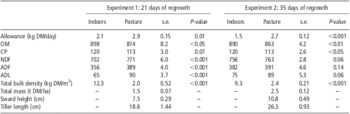
Table 1 presents the daily allowance, chemical composition and herbage characteristics of the grass offered indoors and at pasture in both the experiments. In Experiment 1, the amount of forage offered indoors was 2.1 kg DM/day, which was 28% lower (P = 0.01) than the allowance at pasture. The total bulk density measured indoors was 12.3 kg DM/m3 and was 6.2 times (P < 0.001) that registered at pasture. No significant difference was found in the CP content of the grass (P = 0.07) between the two systems of feeding, whereas the NDF, ADF and ADL contents recorded indoors were 0.91, 0.91 and 0.71 times, respectively, those recorded at pasture (P < 0.001).
Allowance, chemical composition (in g/kg DM) and herbage characteristics of 21- and 35-day regrowth of Digitaria decumbens grass offered to rams indoors or at pasture

DM =dry matter; OM = organic matter.
In Experiment 2, the amount of forage offered indoors was 1.5 kg DM/day and was 43% lower (P < 0.001) than that registered at pasture. The total bulk density measured indoors was 3.9 times (P < 0.001) that registered at pasture. Indoors, the CP content of the grass was 120.3 g/kg DM and was 1.07 times that at pasture. No significant difference was found in the NDF (P = 0.06), ADF (P = 0.14) and ADL (P = 0.06) contents of the grass between the two feeding systems.
Estimates of OMD and OMI
Correlations of 0.49 and 0.77 were found between in vivo OMD and OMDCPf (P < 0.05; data not shown) and between OMI and OMICPf, respectively (P < 0.001; data not shown).
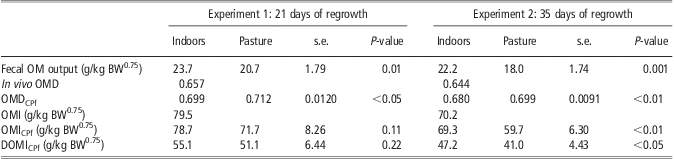
In Experiment 1, OMDCPf indoors was lower (P < 0.05; Table 2) than at pasture. Neither OMICPf nor DOMICPf differed between the two feeding systems (P = 0.11 and P = 0.22, respectively). In Experiment 2, as in Experiment 1, the OMDCPf registered indoors was lower (P < 0.01; Table 2) than at pasture. In contrast, OMICPf and DOMICPf were higher indoors than at pasture (P < 0.01 and P < 0.05 for OMICPf and DOMICPf, respectively).
In vivo OMD, OMI, DOMI, measured indoors and estimated indoors and at pasture by fecal CP method
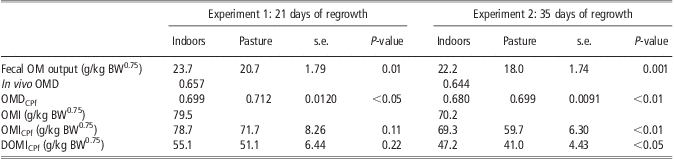
OMD = organic matter digestibility; OMI = organic matter intake; DOMI = digestible organic matter intake; OM = organic matter.
OMDCPf, OMD estimated using the fecal CP equation of Fanchone et al. (Reference Fanchone, Archimede and Boval2009) OMDCPf = 88.4–26.39/fecal CP; OMICPf, OM intake estimated from fecal OM output and OMDCPf; OMICPf = fecal OM output/(1−OMDCPf); DOMICPf, digestible OM intake estimated from OMDCPf and OMICPf; DOMICPf = OMDCPf × OMICPf.
Animal feeding behavior and rumen characteristics
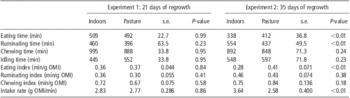
Table 3 presents the feeding behavior of animals fed indoors and at pasture. In Experiment 1, at 21 days of regrowth, no parameter of feeding behavior differed between animals fed indoors as compared with those fed at pasture. In Experiment 2, at 35 days of regrowth, the eating time was lower (P < 0.01) indoors than at pasture, whereas the ruminating time was higher indoors (P < 0.01). Simultaneously, the eating index was lower indoors than at pasture (P < 0.01).
Feeding behavior of rams fed 21- and 35-day regrowth of Digitaria decumbens indoors and at pasture

OMI = organic matter intake.
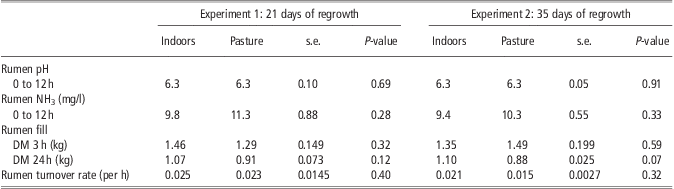
In both the experiments, rumen pH, rumen ammonia, rumen fill (i.e. the amount of DM in the rumen 3 and 24 h after the morning meal) and rumen turnover rate did not differ between the two feeding systems tested (Table 4).
Average rumen pH and rumen NH3 content measured just before (0 h) and 3, 6 and 12 h after the morning meal, and rumen fill 3 and 24 h after the morning meal, of rams fed 21- and 35-day regrowth of Digitaria decumbens indoors and at pasture
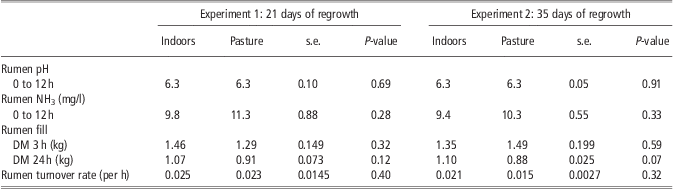
DM = dry matter.
Discussion
Characteristics of Pangola grass
The chemical composition of the Pangola grass measured in this study is consistent with that reported by other authors for the same forage at similar regrowth stages (Archimede et al., Reference Archimede, Boval, Alexandre, Xande, Aumont and Poncet2000; Assoumaya et al., Reference Assoumaya, Boval, Weisbecker, Saminadin and Archimede2007). The differences in grass quality between the two feeding systems at the same regrowth stage (i.e. lower CP content at pasture at 35 days of regrowth and higher fiber content at pasture at 21 days of regrowth) may be a result of the method used to sample grass in the two situations. Grass fed indoors was cut to a height of 3 cm, whereas grass samples from pasture were cut at ground level, which included more stems, senescent and dead material. Stems, senescent and dead material have a lower CP and a higher NDF content than the more leafy material fed indoors (Minson, Reference Minson1990; Moreira et al., Reference Moreira, Prado, Cecato, Wada and Mizubuti2004). However, in these experiments, sward heights after grazing were 3.0 and 6.5 cm at 21 and 35 days of regrowth, respectively. This suggests that rams at pasture have access to grass that had the same chemical characteristics as that fed to the rams indoors, where mowing height was 3 cm.
Estimation of OMD and OMI
To compare intake and digestibility between indoor feeding and pasture grazing, the CPf method was used, because previous studies showed that this method can provide consistent estimates of in vivo OMD at pasture (Boval et al., Reference Boval, Archimede, Fleury and Xande2003; Lukas et al., Reference Lukas, Südekum, Rave, Friedel and Susenbeth2005; Schlecht and Susenbeth, Reference Schlecht and Susenbeth2006). Moreover, the range of variation in CPf in the dataset used to derive the CPf equation (from 7.9% to 20.3%; Fanchone et al., Reference Fanchone, Archimede and Boval2009) was similar to that observed in our study for both indoor animals (from 14.2% to 18.0% and from 13.2% to 16.2% at 21 and 35 days of regrowth, respectively) and grazing animals (from 14.3% to 17.5% and from 17.7% to 18.2% at 21 and 35 days of regrowth, respectively; data not shown).
However, in both experiments, small but significant differences emerged between the two feeding systems. Low variability in CPf within the same feeding system would explain these results.
Comparison of nutrition indoors and at pasture
In both experiments, a higher OMDCPf was measured at pasture than indoors. In Experiment 2, OMICPf and DOMICPf measured at pasture were lower than indoors. These results are consistent with those of Fanchone et al. (Reference Fanchone, Archimede, Baumont and Boval2010), comparing feeding Pangola grass indoors and at pasture at 28 days of regrowth.
The higher OMDCPf measured at pasture has usually been related to the ability of grazing animals to select better-quality forage (Minson, Reference Minson1990; Van Soest, Reference Van Soest1996).
Higher values of ruminal concentration of ammonia, rumen turnover rate and lower values of ruminating index at pasture compared with indoors advocate for a better OMDCPf at pasture, although these differences were not significant.
In Experiment 2, OMICPf was higher indoors than at pasture, whereas in Experiment 1 only a numerical difference in favor of animals fed indoors was obtained. In a previous experiment with Pangola grass (Fanchone et al., Reference Fanchone, Archimede, Baumont and Boval2010), parameters such as time spent eating, intake rate, bite mass and forage bulk density were expected to be responsible for the higher OMI registered indoors than at pasture. In Experiment 1, only the forage bulk density differed between the two feeding systems. These results suggest that the higher bulk density observed indoors, as compared with that observed at pasture, increased bite mass indoors. In turn, this higher bite mass, coupled with similar periods of time spent eating, would explain the higher OMICPf observed indoors. In addition, in Experiment 2, the forage bulk density indoors was higher than at pasture. Moreover, the animals at pasture spent 22% more time eating than did those indoors. However, this longer period spent eating did not induce higher OMICPf at pasture, suggesting that the time spent searching increased to the detriment of that spent on prehension (Hutchings and Gordon, Reference Hutchings and Gordon2001). In Experiment 2, the combination of higher bite mass with time strictly devoted to prehension would explain the higher OMICPf measured indoors.
The divergent evolution of OMDCPf and OMICPf between the two feeding systems as observed in these studies illustrates the concept of trade-off between diet quality and forage intake discussed by various authors studying feeding behavior at pasture (Parsons et al., Reference Parsons, Thornley, Newman and Penning1994; Thornley et al., Reference Thornley, Parsons, Newman and Penning1994; Wilson and Kerley, Reference Wilson and Kerley2003). It would appear that when animals graze selectively, search time increases substantially and may limit intake rate, in addition to the lower bite mass at pasture linked to lower bulk density. In many studies of feeding behavior, intake rate is estimated for short periods, and neither intake over days nor digestibility is measured. Thus, the real nutritional implications of such a trade-off between diet quality and forage intake for nutrition at pasture are unknown. Indeed, Chapman et al. (Reference Chapman, Parsons, Cosgrove, Barker, Marotti, Venning, Rutter, Hill and Thompson2007) have highlighted the shortage of experiments to explain the nutritional basis of diet selection for temperate pastures, such as perennial ryegrass (Lolium perenne L.) and white clover (Trifolium repens L.) mixtures. This is especially true for tropical pastures. However, this nutritional approach is essential because different feeding strategies may lead to similar digestible OMI. In fact, in Experiment 1, the combination of a higher digestibility and a lower intake at pasture did not induce a significant difference in DOMICPf between the two feeding systems. In contrast, in Experiment 2, higher digestibility combined with a lower intake at pasture induced a 15% lower DOMICPf at pasture than indoors. Therefore, it would seem that differences between feeding indoors and at pasture vary according to the quality of the herbage on offer and the diet selection made by the rams. Cutting the forage to a length of 5 cm indoors artificially increases the bulk density of the forage, and selection capacity of the animal decreases in such an environment. We cut the grass indoors to allow animals to collect small pieces of fodder, which would be impossible with entire stalks, that are not fixed to the ground as it is the case at pasture.
Conclusion
This study confirms the previous observation of Fanchone et al. (Reference Fanchone, Archimede, Baumont and Boval2010) showing differences in intake and digestibility between animals fed indoors and at pasture when the same forage is offered. Irrespective of the regrowth stage of the grass, there were small differences between the OMDCPf values, with higher values found for the animals fed at pasture. In contrast, OMICPf and DOMICPf levels were higher indoors, although only at 35 days of regrowth. The lack of constancy of these differences, given variations in herbage quality, suggests that care must be taken when generalizing results obtained indoors to grazing conditions. Moreover, grass prehensibility appears to be the main factor limiting the intake of Pangola grass by grazing sheep. Optimum grass prehensibility requires sward characteristics, which maximize bite mass, whereas minimizing masticatory weakness.
Acknowledgements
We gratefully acknowledge F. Periacarpin and F. Pommier for their great technical participation. This study has been supported by the “Region Guadeloupe”.