1. Introduction
From the last four decades, several studies of robotic manipulation have motivated researchers to replicate the manipulation property of human arms [Reference Koivo and Bekey1, Reference Caccavale and Uchiyama2]. Moreover, the need for multitasking, cost-effectiveness and flexible automation led to the development of cooperative dual-arm manipulators with human-like distinctive features [Reference Smith, Karayiannidis, Nalpantidis, Gratal, Qi, Dimarogonas and Kragic3]. These cooperative manipulators open up a wide range of applications from assembly tasks in the manufacturing processes to outer space exploration [Reference Zhou, Luo and Wang4, Reference Peng, Xu, Hu, Liang and Wu5], transporting large objects [Reference Ambar and Sagara6], and household tasks [Reference Liu, Chen, Zhang and Chen7]. Moreover, the development of cooperative robots makes a significant impact on the medical field. Therefore, it can help the nurses in patient-transferring tasks and monitor the patients’ statistics [Reference Mukai, Hirano, Nakashima, Kato, Sakaida, Guo and Hosoe8]. Moreover, it can be devoted to perform medical surgeries with less time and cost for the patients [Reference Talasaz, Trejos and Patel9].
The need to design robust control strategies to coordinate the cooperative manipulators draws the robotic researchers’ attention, and a crucial development has been achieved in the past two decades. The pure motion control approach is one of the basic control schemes utilized to achieve an acceptable tracking performance for several dynamical systems such as bicycle robots [Reference Chen, Liu, Wang, Hu, Zheng, Ye and Zhang10] and steer-by-wire vehicles [Reference Zhang, Wang, Zheng, Cao, Man, Yu and Chen11]. This approach is extended to coordinate the motion of dual-arm manipulators in the task space. However, the closed kinematic chain formulated by the manipulators and the object generates mechanical stresses (internal forces/moments) at the object level. These internal forces, if not controlled, may affect the performance of the system and damage the manipulators or the object. Therefore, the adoption of pure motion control is not sufficient for the control of cooperative dual-arm manipulators. According to the literature, the control of cooperative dual-arm manipulators can be classified into four categories, i.e., master/slave approach [Reference Huang, Zheng, Wang, Ota and Zhang12, Reference Wu, Li, Qi, Hu, Li and Zhang13], hybrid position-force control [Reference Hsu14, Reference Li, Hsu and Sastry15], impedance control [Reference Chunting, Xiong, Han and Xiaojie16–Reference Lee, Chang and Jamisola18], and synchronization approach [Reference Sun and Mills19, Reference Rodriguez-Angeles, Nijmeijer and Syst20].
In the hybrid position-force approach, the velocities and forces at the manipulators’ end-effector should be mapped to their counterparts at the manipulated object. Several control strategies were developed considering the known dynamical model of the coordinated manipulators [Reference Hsu14, Reference Li, Hsu and Sastry15]. However, the dynamic uncertainties may lead to a degradation in the control performance and affect the stability of the system [Reference Villalobos-Chin and SantibÁÑez21]. Therefore, many researchers have considered the parametric uncertainties in the design of robust control strategies (see refs. [Reference Hu, Wang, He, Zheng, Ping, Shao, Cao and Man22, Reference Hu and Wang23] for vehicle components and [Reference Sarikaya, Burkan and Uzmay24–Reference Korayem, Nekoo and Korayem30] for cooperative manipulators). Sarikaya et al. [Reference Sarikaya, Burkan and Uzmay24] and Ren et al. [Reference Ren, Chen, Liu, Gu, Jin and Liu25] designed an adaptive control scheme to deal with the dynamic and kinematic uncertainties in the cooperative manipulation tasks. Monfaredi et al. [Reference Monfaredi, Rezaei and Talebi26] presented a combination of proportional derivative and adaptive sliding mode controllers to handle a common object with unknown inertia and geometry. In work presented by Jimenez J and Perez [Reference Pliego-Jimenez and Arteaga-Perez27], the adaptation law is combined with the hybrid control approach to ensure the stable grasp of the manipulated object during the cooperative task. Gueaieb et al. [Reference Gueaieb, Al-Sharhan and Bolic28] extended the work presented by Parra-Vega et al. [Reference Parra-Vega, Arimoto, Liu, Hirzinger and Akella29] where the sliding mode-based hybrid control scheme is proposed to control the motion of the object and attain the internal forces at the desired level.
Moreover, the intelligent control presented using the fuzzy and neural network (NN) systems has been exploited to overcome the dynamic uncertainties in the cooperative tasks [Reference Zhang, Lei, Dong and He31]. Rani and Kumar [Reference Rani and Kumar32] presented a model-based control strategy with a radial basis function NN to handle the unmodeled dynamic and external disturbances during tracking desired trajectory and internal forces. The traditional backstepping control scheme [Reference Krstic, Kokotovic and Kanellakopoulos33] can be improved by introducing a new state variable and adopting a fuzzy approximator during the controller design process. Baigzadehnoe et al. [Reference Baigzadehnoe, Rahmani, Khosravi and Rezaie34] exploited the state augmented backstepping approach with an adaptive fuzzy logic approximator to estimate the dynamics of the cooperative manipulators under external disturbances. Pham et al. [Reference Pham, Van Nguyen, Le, Nguyen, Thai, Phan, Pham, Duong and Bui35] introduced the dynamic surface-based sliding mode control and NN principles to deal with the uncertainties of cooperative manipulators. The above strategies could achieve adequate behavior through motion and internal force tracking control. Nevertheless, they are limited by the complexity of the model and many adaptation parameters to guarantee the stability of a cooperative dual-arm system.
Most of the previously discussed control schemes are implemented by a central control unit which provides high performance during cooperative manipulation. However, the high communication requirements debilitate the robustness of these control strategies. The communication between the control unit and the robotic manipulators can be achieved over a limited bandwidth network channel. The requirement of a high sampling rate, 1 kHz, or high in most control strategies, imposes a high load on the network channel. This increased load causes the overcrowding of the network, packet loss, and delay. Therefore, to deal with the network’s constraints and decrease the communication load, an ET mechanism is developed by Tabuada [Reference Tabuada36]. Xing et al. [Reference Xing, Wen, Liu, Su and Cai37] presented a novel ET mechanism based on the combination of fixed [Reference Pan, Sun, Zhang, Yan and Lin38] and relative thresholds for the nonlinear systems. Furthermore, it is utilized to decrease the transmissions over the network channel in the robotic domain (see refs. [Reference Kumari, Behera and Bandyopadhyay39–Reference Abbas, Al Issa and Dwivedy42] for single-arm manipulators and [Reference Al Issa, Sharma and Kar43, Reference Al Issa and Kar44] for mobile robots). The ET scheme with the multiple networked Euler–Lagrange systems is recently exploited [Reference Liu, Du, Lu and Yang45–Reference Hu and Liu48]. However, a few studies have implemented the ET strategy in the field of cooperative dual-arm manipulators [Reference Dohmann and Hirche49, Reference Ngo and Liu50].
Based on the preceding discussion, the control problem of uncertain cooperative dual-arm manipulators communicated over a limited bandwidth network channel is attempted in this paper. To the best of the authors’ knowledge, the cooperative manipulation problem has not been addressed in the literature within the framework of the adaptive backstepping design approach under the Lyapunov-based triggering rule. The contributions of this work are summarized as follows.
-
(1) An improved adaptive position-force controller based on the backstepping approach is developed to control the motion and the internal forces during the cooperative manipulation of a common object in the presence of uncertainties and external disturbances. Unlike the traditional and state augmented adaptive backstepping control strategies [Reference Krstic, Kokotovic and Kanellakopoulos33, Reference Baigzadehnoe, Rahmani, Khosravi and Rezaie34], the performance of the proposed control scheme is improved by integrating a positional error-based state variable and the nonlinear damping term in the design of the controller.
-
(2) Different from the existing triggering conditions such as fixed, relative, and switching thresholds [Reference Xing, Wen, Liu, Su and Cai37, Reference Pan, Sun, Zhang, Yan and Lin38, Reference Bu, Li, Yang and Yi41], a systematic Lyapunov-based ET mechanism is derived to reduce the network burden. Further, Zeno’s behavior is eliminated from the proposed ET mechanism.
-
(3) A comparative analysis with the different robust and adaptive control strategies is carried out to investigate the effectiveness of the designed control algorithm using the TrueTime network simulator. Furthermore, the designed triggering rule is compared with two triggering conditions presented in the literature. The validation of the proposed control approach is executed in the virtual robot experimentation platform (V-REP) during the transportation of a common object.
The remainder of this paper is organized as follows. The problem formulation is given in Section 2. The dynamic model of the cooperative robotic manipulators is formulated in Section 3. The adaptive controller design is elaborated in Section 4, along with the formulation of an ET mechanism. Section 5 shows the simulation results, comparative study, and the validation of the designed control strategy in the V-REP platform. The conclusion and the future scope of work are highlighted in Section 6.
2. Problem Formulation
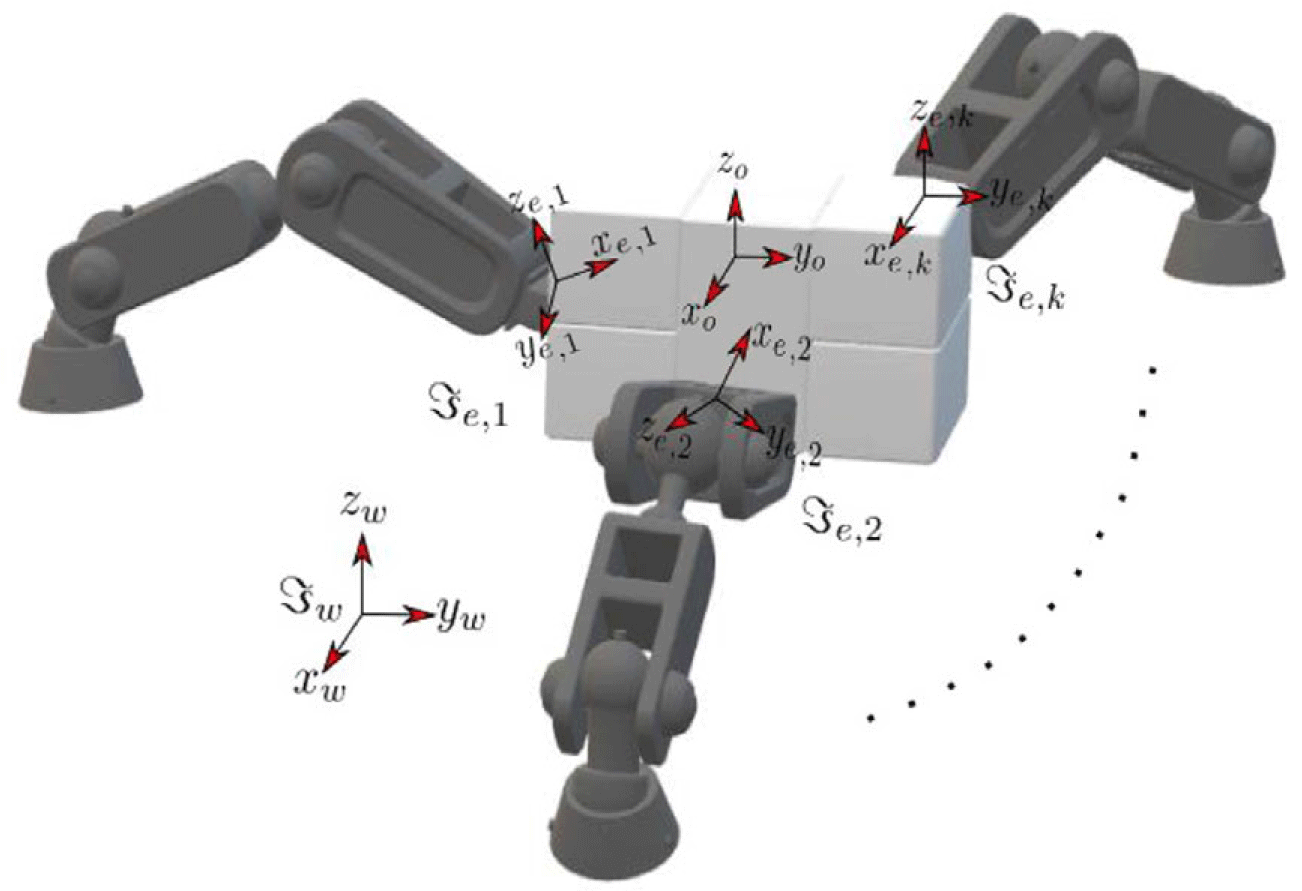
In this paper, a cooperative manipulator system is considered, consisting of k single-arm manipulators securely handling a common rigid object, as illustrated in Fig. 1. The manipulators consist of n joints with a stationary base. The object is immense and beyond the carrying capacity of single-arm manipulators. Moreover, there is no relative motion between the manipulators’ end-effector and the grasped object. Let
 ${\Im _w} - ({x_w},\;{y_w},{z_w})$
denotes the world reference frame,
 ${\Im _{e,i}} - ({x_e}_{,i},\;{y_{e,i}},{z_{e,i}});1 \le i \le k$
represents the coordinate frame fixed at the center point of the
 ${i^{th}}$
manipulator’s end-effector, and
 ${\Im _o} - ({x_o},{y_o},{z_o})$
is the coordinate frame attached to the object’s center of mass. The dynamic model of k robotic manipulators can be combined in the following compact form [Reference Caccavale and Uchiyama2]:
 \begin{align}{{\textbf{M}}_r}({\textbf{q}})\ddot{\textbf{q}} + {{\textbf{C}}_r}({\textbf{q}},\dot{\textbf{q}})\dot{\textbf{q}} + {{\textbf{G}}_r}({\textbf{q}}) + {{\textbf{B}}_r}(\dot{\textbf{q}}) &= {{{{\bar{\boldsymbol\tau} }}}_a} - {{\boldsymbol{\tau}}_{int}} + {{\boldsymbol{\tau}}_d}({\textbf{q}},\dot{\textbf{q}}){\textbf{; }}{{\boldsymbol{\tau}}_{int}} = {{J}^T}({\textbf{q}})\textbf{F}\nonumber\\{{\textbf{M}}_r}({\textbf{q}}) &= {\textbf{G}}{{e}^{\textbf{2}}}{\textbf{I}_m} + {{\textbf{M}}_\textbf{l}}({\textbf{q}}) \end{align}
where for
 ${\rm{i = 1, }} \ldots {\rm{, k}}$
,
 ${\textbf{q}} = {[{{\textbf{q}}_1}^{\rm{T}},{{\textbf{q}}_2}^{\rm{T}}, \ldots ,{{\textbf{q}}_k}^{\rm{T}}]^{\rm{T}}}{ \in {\mathbb{R}}^{kn}}$
represents the vector of joint variables,
 ${{\textbf{M}}_r}({\textbf{q}}) = {\rm{blockdiag}}[{{\textbf{M}}_{r,1}}({{\textbf{q}}_1}),{{\textbf{M}}_{r,2}}({{\textbf{q}}_2}), \ldots ,{{\textbf{M}}_{r,k}}({{\textbf{q}}_k})]{ \in {\mathbb{R}}^{kn \times kn}}$
expresses the total inertia matrix,
 ${{\textbf{C}}_r}({\textbf{q}},\dot{\textbf{q}}) = {\rm{blockdiag}}[{{\textbf{C}}_{r,1}}({{\textbf{q}}_1},{\dot{\textbf{q}}_1}),{{\textbf{C}}_{r.2}}({{\textbf{q}}_2},{\dot{\textbf{q}}_2}), \ldots ,{{\textbf{C}}_{r,k}}({{\textbf{q}}_k},{\dot{\textbf{q}}_k})]{ \in {\mathbb{R}}^{kn \times kn}}$
denotes the Coriolis and centrifugal forces,
 ${{\textbf{G}}_r}({\textbf{q}}) = {[{{\textbf{G}}_{{{r}},{\rm{1}}}}{({{\textbf{q}}_{\rm{1}}})^{\rm{T}}},{{\textbf{G}}_{{{r}},{\rm{2}}}}{({{\textbf{q}}_{\rm{2}}})^{\rm{T}}}, \ldots ,{{\textbf{G}}_{{{r}},{\rm{k}}}}{({{\textbf{q}}_{\rm{k}}})^{\rm{T}}}]^{\rm{T}}}{ \in {\mathbb{R}}^{kn}}$
expresses the gravitational effect,
 ${{\textbf{B}}_r}(\dot{\textbf{q}}) = {[{{\textbf{B}}_{{{r}},{\rm{1}}}}{(\dot{\textbf{q}})^{\rm{T}}},{{\textbf{B}}_{{{r}},{\rm{2}}}}{(\dot{\textbf{q}})^{\rm{T}}}, \ldots ,{{\textbf{B}}_{{{r}},{{k}}}}{(\dot{\textbf{q}})^{\rm{T}}}]^{\rm{T}}}{ \in {\mathbb{R}}^{kn}}$
is the friction effects,
 ${\bar{\boldsymbol\tau}_a} = {[{\bar{\boldsymbol\tau}_{a,1}}^T,{\bar{\boldsymbol\tau}_{a,2}}^T, \ldots ,{\bar{\boldsymbol\tau}_{a,k}}^T]^T}{ \in {\mathbb{R}}^{kn}}$
symbolizes the vector of the actuator torques,
 ${{\boldsymbol\tau} _{{\mathop{\rm int}} }} = {[{{\boldsymbol\tau} _{{\mathop{\rm int}} ,1}}^T,{{\boldsymbol\tau}_{{\mathop{\rm int}} ,2}}^T, \ldots ,{{\boldsymbol\tau} _{{\mathop{\rm int}} ,k}}^T]^T}{ \in {\mathbb{R}}^{kn}}$
are the torques work against the constraint,
 ${\textbf{J}}({\textbf{q}}){\rm{ = blockdiag}}[{{\textbf{J}}_{\rm{1}}}({{\textbf{q}}_{\rm{1}}}),{{\textbf{J}}_{\rm{2}}}({{\textbf{q}}_{\rm{2}}}), \ldots ,{{\textbf{J}}_{{k}}}({{\textbf{q}}_{{k}}})]{ \in {\mathbb{R}}^{km \times kn}}$
denotes the Jacobian matrix,
 ${\textbf{F}} = {[{{\textbf{F}}_1}^T,{{\textbf{F}}_2}^T, \ldots ,{{\textbf{F}}_k}^T]^T}{ \in {\mathbb{R}}^{km}}$
is the vector which represents the interaction forces applied from the end-effector of the manipulators to the manipulated object,
 ${{\boldsymbol{\tau}}_d}({\textbf{q}},\dot{\textbf{q}}) = {[{{\boldsymbol{\tau}}_{d,1}}{({{\textbf{q}}_1},{\dot{\textbf{q}}_1})^T},{{\boldsymbol{\tau}}_{d,2}}{({{\textbf{q}}_{2,}}{\dot{\textbf{q}}_2})^T}, \ldots ,{{\boldsymbol{\tau}}_{d,k}}{({{\textbf{q}}_k},{\dot{\textbf{q}}_k})^T}]^T}{ \in {\mathbb{R}}^{kn}}$
defines the vector of external disturbances,
 ${\textbf{Ge}}$
is the ratio of the motor gears,
 ${{I}_m}$
symbolizes the inertia of the motor, and
 ${{\textbf{M}}_l}$
is the inertia matrix for the link of the manipulators.
Cooperative manipulator system.

The following assumptions are introduced for the simplification of the subsequent derivation [Reference Baigzadehnoe, Rahmani, Khosravi and Rezaie34]:
-
1. The operation of each manipulator is away from the singularity condition. Therefore, the Jacobian matrix has a full-row rank.
-
2. The external disturbances are bounded and satisfy
 $\left\| {{{\boldsymbol{\tau}}_d}({\textbf{q}},\dot{\textbf{q}})} \right\| \le {{\boldsymbol{\tau}}_D}$
, where
${{\boldsymbol{\tau}}_D}$
is a positive constant.


Remark 1. The communication between the cooperative manipulators and the control unit is over a network channel. Therefore, the cooperative manipulators are not actuated by the actual control signal
 $({{\boldsymbol{\tau}}_a})$
due to communication constraints. Instead, they are driven by
 $({{{\bar{\boldsymbol\tau}}}_a})$
, which is defined as
 ${{{\bar{\boldsymbol\tau}}} _a} = {{\boldsymbol{\tau}}_a} - {\textbf{e}_{\textrm{m}}}$
. This control signal
 ${{{\bar{\boldsymbol\tau}}}_a}$
is generated by the ET mechanism based on the violation of a predetermined triggering condition to be designed in Section. 4.2.
The objective of the control is to design an improved ET adaptive control for the uncertain cooperative manipulators. This strategy is devoted to control the motion and the internal forces of the manipulated object in the presence of external disturbances. Moreover, it is utilized to attain a good tracking performance with minimum transmissions over the network.
3. Dynamic Model of Cooperative Robotic Manipulators
Here, the task space dynamical model of the cooperative manipulators’ system is obtained by combining the dynamics equation of the manipulators (1) with the equations of motion of the object (2). For this purpose, the forces at the end-effector level
 $\textbf{F}$
are derived from the dynamics of the object and replaced in Eq. (1). After that, the joint space variables are mapped into the object’s position and orientation vector using the forward kinematics equations.
The dynamics of the object can be formulated in the Cartesian space as follows:
 \begin{align}{{\textbf{M}}_o}({{\textbf{x}}_o}){{\ddot{\textbf{x}}}_o} + {{\textbf{C}}_o}({{\textbf{x}}_o},{{\dot{\textbf{x}}}_o}){{\dot{\textbf{x}}}_o} + {{\textbf{G}}_o}({{\textbf{x}}_o}) = {\textbf{F}_{ex}}\end{align}
where
 ${{\textbf{X}}_o}{ \in {\mathbb{R}}^m}$
denotes the position and orientation of the manipulated object,
 ${{\textbf{M}}_o}({{\textbf{x}}_o}),{{\textbf{C}}_o}({{\textbf{x}}_o},{{\dot{\textbf{x}}}_o}),{\rm{ and }}\ {\textbf{G}_o}({{\textbf{x}}_o})$
represent the inertia matrix, the matrix of centrifugal and Coriolis effects, and the vector of gravitational forces, respectively,
 ${{\textbf{F}}_{ex}} = \sum\limits_{i = 1}^k {{{\textbf{W}}_i}\,{{\textbf{F}}_i} = {\textbf{W}}\,{\textbf{F}}{ \in {\mathbb{R}}^m}}$
expresses the resultant forces developed at the manipulated object, and
 ${\textbf{W}} = [{{\textbf{W}}_1},{{\textbf{W}}_2}, \ldots ,{{\textbf{W}}_k}]{ \in {\mathbb{R}}^{m \times km}}$
is the grasp matrix. The matrix
 $\textbf{W}$
is non-square and full row-rank with nontrivial null space. Therefore, the formulation of the interaction forces at the end-effector level can be obtained as follows [Reference Baigzadehnoe, Rahmani, Khosravi and Rezaie34]:
 \begin{align}\textbf{ F} = {\textbf{W}^\dagger }({{\textbf{M}}_o}({\textbf{x}_o}){{\ddot{\textbf{x}}}_o} + {{\textbf{C}}_o}({\textbf{x}_o},{{\dot{\textbf{x}}}_o}){{\dot{\textbf{x}}}_o} + {{\textbf{G}}_o}({\textbf{x}_o})) + {\textbf{F}_I}\end{align}
where
 ${{\textbf{W}}^\dagger }{ \in {\mathbb{R}}^{km \times m}}$
is the pseudoinverse matrix of
 $\textbf{W}$
,
 ${{\textbf{F}}_I} = {[{{\textbf{F}}_{I,1}}^T,{{\textbf{F}}_{I,2}}^T, \ldots ,{{\textbf{F}}_{I,k}}^T]^T}{ \in {\mathbb{R}}^{km}}$
is the internal forces in the null space of
 $\textbf{W}$
, i.e., (
 $\textbf{W}{\textbf{F}_I} = 0$
), and
 ${\textbf{F}_{I,i}}$
represents the internal forces of the
 ${i^{th}}$
manipulator. These internal forces do not cause any motion; however, they develop mechanical stresses at the object level and satisfy
 $\sum\limits_{i = 1}^k {{\textbf{F}_{I,i}}} = 0.$
The relationship between the velocity of the object and the
 ${i^{th}}$
end-effector velocity is given by:
 \begin{align}{{\dot{\textbf{x}}}_{e,i}} = {\textbf{W}_i}^{\textbf{T}}{{\dot{\textbf{x}}}_o}\end{align}
where
 ${\dot{\textbf{x}}_{e,i}} = {{\textbf{J}}_i}({\textbf{q}}){\dot{\textbf{q}}_i}{ \in {\mathbb{R}}^m}$
denotes the velocity of the
 ${i^{th}}$
end-effector. Therefore, based on Assumption 1 and substituting
 ${{\dot{\textbf{x}}}_{e,i}}$
on the left side of the Eq. (4), the joint velocity is mapped into the task space object’s velocity.
 \begin{align}\dot{\textbf{q}} = {{\textbf{J}}^{ - 1}}{\textbf{(q)}}{{\textbf{W}}^{\textbf{T}}}{\dot{\textbf{x}}_o} = {{\boldsymbol{\unicode{x03B7}} \textbf{(q)}}}{\dot{\textbf{x}}_o},{{\boldsymbol{\unicode{x03B7}} (q)}}{ \in {\mathbb{R}}^{km \times m}}\end{align}
By differentiating (5) with respect to time, one can find:
 \begin{align}{\ddot{\textbf{q}}} = {\textbf{J}^{ - 1}}{\textbf{(q)}}{\textbf{W}^{\textbf{T}}}{{\ddot{\textbf{x}}}_o} + \frac{d}{{dt}}({\textbf{J}^{ - 1}}{\textbf{(q)}}{\textbf{W}^{\textbf{T}}}){{\dot{\textbf{x}}}_o} = {\boldsymbol{\unicode{x03B7}} \textbf{(q)}}{{\ddot{\textbf{x}}}_o} + \boldsymbol\iota {\textbf{(q)}}{{\dot{\textbf{x}}}_o}\end{align}
The overall dynamical model of the cooperative manipulator system is achieved by substituting (3), (5), and (6) in (1):
 \begin{align}{{\textbf{M}}_t}({\textbf{x}_o}){{\ddot{\textbf{x}}}_o} + {{\textbf{C}}_t}({\textbf{x}_o},{{\dot{\textbf{x}}}_o}){{\dot{\textbf{x}}}_o} + {{\textbf{G}}_t}({\textbf{x}_o}) + {{\textbf{B}}_t}({{\dot {\textbf{x}}}_o}) = {{{\bar{\boldsymbol\tau}}}_a} - {\textbf{J}_{t}}^{\textbf{T}}({\textbf{x}_o}){\textbf{F}_I} + {{\boldsymbol{\tau}}_d}({\textbf{x}_o},{{\dot{\textbf{x}}}_o})\end{align}
where
 ${{\textbf{M}}_t}({{\textbf{x}}_o}) = {{\textbf{M}}_r}({\textbf{q}}){{\boldsymbol{\unicode{x03B7}} }}({\textbf{q}}) + {{\textbf{J}}^T}({\textbf{q}}){{\textbf{W}}^\dagger }{{\textbf{M}}_o}({{\textbf{x}}_o}){ \in {\mathbb{R}}^{kn \times n}}$
,
 ${{\textbf{C}}_t}({{\textbf{x}}_o},{\dot{\textbf{x}}_o}) = {{\textbf{M}}_r}({\textbf{q}})\,\boldsymbol\iota({\textbf{q}}) + {{\textbf{C}}_r}({\textbf{q}},\dot{\textbf{q}})\,{{\boldsymbol{\unicode{x03B7}} }}({\textbf{q}}) + {{\textbf{J}}^T}({\textbf{q}})$
 ${{\textbf{W}}^\dagger }{{\textbf{C}}_o}({{\textbf{x}}_o},{\dot{\textbf{x}}_o}){ \in {\mathbb{R}}^{kn \times n}}$
,
 ${{\textbf{G}}_t}({{\textbf{x}}_o}) = {{\textbf{G}}_r}({\textbf{q}}) + {{\textbf{J}}^T}({\textbf{q}}){{\textbf{W}}^\dagger }{{\textbf{G}}_o}({{\textbf{x}}_o}){ \in {\mathbb{R}}^{kn}}$
,
 ${{\textbf{B}}_t}({\dot{\textbf{x}}_o}) = {{\textbf{B}}_r}(\dot{\textbf{q}}){ \in {\mathbb{R}}^{kn}}$
,
 ${{\textbf{J}}_{\textbf{t}}}^T({{\textbf{x}}_o}) = {{\textbf{J}}^T}({\textbf{q}}){ \in {\mathbb{R}}^{kn \times kn}}$
,
 ${{\boldsymbol{\tau}}_d}({{\textbf{x}}_o},{\dot{\textbf{x}}_o}) = {{\boldsymbol{\tau}}_d}({\textbf{q}},\dot{\textbf{q}}) = {{\boldsymbol{\tau}}_d}({\textbf{q}},{{\boldsymbol{\unicode{x03B7}} }}({\textbf{q}}){\dot{\textbf{x}}_o}){ \in {\mathbb{R}}^{kn}}$
.
To design the adaptive backstepping position-force controller, the dynamical model of the cooperative manipulator systems should satisfy the following properties [Reference Baigzadehnoe, Rahmani, Khosravi and Rezaie34]:
Property 1. For all
 ${\textbf{q}}{ \in {\mathbb{R}}^{kn}}$
and
 ${{\textbf{x}}_o}{ \in {\mathbb{R}}^m}$
, the matrix
 ${\boldsymbol{{\unicode{x03B7}} }^{\rm{T}}}{\textbf{(q)}}{{\textbf{M}}_t}({\textbf{x}_o})$
is symmetric and positive definite.
Property 2. The matrix
 $\frac{d}{{dt}}({{\boldsymbol{\unicode{x03B7}} }^{\rm{T}}}{\textbf{(q)}}{{\textbf{M}}_t}({\textbf{x}_o}{\rm{)) - 2 }}{{\boldsymbol{\unicode{x03B7}} }^{\rm{T}}}\textbf{(q)}{{\textbf{C}}_t}({\textbf{x}_o},{{\dot {\textbf{x}}}_o})$
is skew-symmetric and satisfies the following:
 ${\ell ^T}\left( {{d \over {dt}}({{{\boldsymbol{\unicode{x03B7}} }}^T}({\textbf{q}}){{\textbf{M}}_t}({{\textbf{x}}_o})) - 2{{{\boldsymbol{\unicode{x03B7}} }}^T}({\textbf{q}}){{\textbf{C}}_t}({{\textbf{x}}_o},{{\dot{\textbf{x}}}_o})} \right)\ell = 0,\,\forall \ell { \in {\mathbb{R}}^m}$
.
4. Controller Design
In this section, an adaptive backstepping hybrid position-force control strategy is obtained to control the motion and the internal force of the object during cooperative manipulation in the presence of uncertainties and external disturbances. The state augmentation approach is exploited to introduce a new state variable in the controller design process. This augmented state depends on the weighted integral of the object position error and is utilized to improve the robustness of the cooperative system under parametric uncertainties and external disturbances [Reference Su and Fu51]. Thereafter, the nonlinear damping term, implemented in the design process of the control strategy for a general class of uncertain nonlinear systems [Reference Al Issa, Chakravarty and Kar52], is extended to the cooperative manipulators’ system. The employment of this term improves the transient performance and reduces the number of transmitted signals over the communication channel.
To design the adaptive backstepping controller, the new state-space variables are generated based on the object positional error, i.e., position and orientation. These state variables are combined with the weighted integral of the object positional error and introduced as follows:
 \begin{align}{\textbf{x}_1} = {\boldsymbol\delta }\int\limits_0^t {{\textbf{E}_{{x_o}}}dt} ,{\textbf{x}_2} = {\textbf{E}_{{x_o}}},{\textbf{x}_3} = {{\dot{\textbf{E}}}_{{x_o}}}\end{align}
where
 ${{\boldsymbol\delta }} \in {\mathbb{R}}$
is a positive constant,
 ${\textbf{E}_{{x_o}}} = {\textbf{x}_{o,d}} - {\textbf{x}_o}$
is the error of object position and orientation, and
 ${{\textbf{x}}_{o,d}}{ \in {\mathbb{R}}^m}$
is the desired position and orientation of the manipulated object. By differentiating the previous equations, the new system of equations is presented as follows:
 \begin{align}{{\dot {\textbf{x}}}_1} = {\boldsymbol\delta }{\textbf{E}_{{x_o}}} = {\boldsymbol\delta }{{x}_2},{{\dot{\textbf{x}}}_2} = {{\dot{\textbf{E}}}_{{x_o}}} = {\textbf{x}_3},{{\dot {\textbf{x}}}_3} = {{\ddot{\textbf{E}}}_{{x_o}}} = {{\ddot{\textbf{x}}}_{o,d}} - {{\ddot{\textbf{x}}}_o}\end{align}
4.1 Adaptive backstepping controller
The error variables are defined as follows:
 \begin{align}{{\textbf{e}}_1} = {{\textbf{x}}_1},{{\textbf{e}}_2} = {{\textbf{x}}_2} - {{{\boldsymbol\alpha }}_1},{{\textbf{e}}_3} = {{\textbf{x}}_3} - {{{\boldsymbol\alpha }}_2}\end{align}
where
 ${{{\boldsymbol\alpha }}_j}(1 \le j \le 2)$
are the virtual controllers. These virtual controllers are intended to stabilize the subsystems based on the Lyapunov function. Therefore, the adaptive backstepping controller is designed by the following systematic recursive steps.
Step 1: The Lyapunov function candidate can be selected as
 ${V_1} = \frac{1}{{2{\boldsymbol\delta }}}{{\textbf{e}}_1}^T{{\textbf{e}}_1}$
. Therefore, the derivative of the Lyapunov function can be obtained as:
 \begin{align}{\dot V_1} = \frac{1}{{\boldsymbol\delta }}{{\textbf{e}}_1}^T{\dot{\textbf{e}}_1} = {{\textbf{e}}_1}^T{{\textbf{e}}_2} + {{\textbf{e}}_1}^T{{{\boldsymbol\alpha }}_1}\end{align}
The virtual control law is designed as
 \begin{align}{{{\boldsymbol\alpha }}_1} = - {{\textbf{c}}_1}{{\textbf{e}}_1} = - {{\textbf{c}}_1}{\boldsymbol\delta }\int\limits_0^t {{\textbf{E}_{{x_o}}}dt} \end{align}
where
 ${{\textbf{c}}_1}$
is a positive gain matrix. Therefore, the derivative of the first Lyapunov function becomes
 \begin{align}{\dot V_1} = - {{\textbf{e}}_1}^T{{\textbf{c}}_1}{{\textbf{e}}_1} + {{\textbf{e}}_1}^T{{\textbf{e}}_2}\end{align}
Here, if
 ${{\textbf{e}}_2} = 0$
, then the negative definiteness of the first Lyapunov function
 ${\dot V_1}$
is guaranteed.
Step 2: At this step, the Lyapunov function candidate is chosen as
 ${\bar V_2} = {V_1} + {V_2} = \frac{1}{{2{{\boldsymbol\delta }}}}{{\textbf{e}}_1}^T{{\textbf{e}}_1} + \frac{1}{2}{{\textbf{e}}_2}^T{{\textbf{e}}_2}$
. Therefore, by differentiating the second error variable in Eq. (10), the derivative of the second Lyapunov function can be expressed as
 \begin{align}{\dot{\bar{V}}_2} = - {{\textbf{e}}_1}^T{{\textbf{c}}_1}{{\textbf{e}}_1} + {{\textbf{e}}_1}^T{{\textbf{e}}_2} + {{\textbf{e}}_2}^T{{\textbf{e}}_3} + {{\textbf{e}}_2}^T{{{\boldsymbol\alpha }}_2} + {{\textbf{e}}_2}^T{{\textbf{c}}_1}{{\boldsymbol\delta }}{{\textbf{x}}_2}\end{align}
The second virtual controller is designed as follows:
 \begin{align}{{{\boldsymbol\alpha }}_2} = - {{\textbf{e}}_1} - {{\textbf{c}}_2}{{\textbf{e}}_2} - {{\textbf{c}}_1}{\boldsymbol\delta }{{\textbf{x}}_2}\end{align}
where
 ${{\textbf{c}}_2}$
is a positive gain matrix. The derivative of the second Lyapunov function becomes
 \begin{align}{\dot{\bar{{V}}}_2} = - {{\textbf{e}}_1}^T{{\textbf{c}}_1}{{\textbf{e}}_1} - {{\textbf{e}}_2}^T{{\textbf{c}}_2}{{\textbf{e}}_2} + {{\textbf{e}}_2}^T{{\textbf{e}}_3}\end{align}
Step 3: By exploiting property 1, the Lyapunov function candidate is proposed as follows:
 \begin{align}{\bar V_3} = {\bar V_2} + {V_3} = {\bar V_2} + \frac{1}{2}{{\textbf{e}}_3}^T{{\boldsymbol{\unicode{x03B7}} }^{\rm{T}}}\textbf{(q)}{{\textbf{M}}_t}({\textbf{x}_o}){{\textbf{e}}_3}\end{align}
The derivative of the third Lyapunov function is formulated based on (10) and property 2 as
 \begin{align}{{\dot{\bar V}}_3} &= {{\dot{\bar V}}_2} + {{\textbf{e}}_3}^T{{\boldsymbol{\unicode{x03B7}} }^{\rm{T}}}\textbf{(q)}{{\textbf{M}}_t}({\textbf{x}_o}){{\dot{\textbf{e}}}_3} + \frac{1}{2}{{\textbf{e}}_3}^T\frac{{d\left( {{{\boldsymbol{\unicode{x03B7}} }^{\rm{T}}}\textbf{(q)}{{\textbf{M}}_t}({\textbf{x}_o})} \right)}}{{dt}}{{\textbf{e}}_3}\nonumber\\[3pt] &= {{\dot{\bar{V}}}_2} + {{\textbf{e}}_3}^T{{\boldsymbol{\unicode{x03B7}} }^{\rm{T}}}\textbf{(q) }\left( {{{\textbf{M}}_t}({\textbf{x}_o})\left( {{{\ddot{\textbf{x}}}_{o,d}} - {{{{\dot{\boldsymbol\alpha }}}}_2}} \right) + {{\textbf{C}}_t}({\textbf{x}_o},{{{\dot{\textbf{x}}}}_o})\left( {{{\dot{\textbf{x}}}_{o,d}} - {{{\boldsymbol\alpha }}_2}} \right)} \right.\nonumber\\[3pt] &\quad + {{\textbf{G}}_t}({{\textbf{x}}_o})\left. + {{\textbf{B}}_t}({{{\dot{\textbf{x}}}}_o}) + {\textbf{J}_{t}}^T({{\textbf{x}}_o}){\textbf{F}_I} - {{\boldsymbol{\tau}}_d}({{\textbf{x}}_o},{{{\dot{\textbf{x}}}}_o}) - {{{{\bar{\boldsymbol\tau}}}}_a}) \right)\end{align}
However, the dynamical parameters of the cooperative manipulators are unknown; therefore, the direct adaptation law is employed to estimate the nonlinear dynamic terms and complete the design of the controller. The unknown parameters in Eq. (18) can be rewritten in the following expression:
 \begin{align}{{\textbf{M}}_t}({{\textbf{x}}_o})\left( {{{\ddot{\textbf{x}}}_{o,d}} - {{{{\dot{\boldsymbol\alpha }}}}_2}} \right) + {{\textbf{C}}_t}({{\textbf{x}}_o},{{\dot{\textbf{x}}}_o})\left( {{{\dot{\textbf{x}}}_{o,d}} - {{{\boldsymbol\alpha }}_2}} \right) + {{\textbf{G}}_t}({{\textbf{x}}_o}) + {{\textbf{B}}_t}({{\dot{\textbf{x}}}_o}) = {\Phi }({{\textbf{x}}_o},{{\dot{\textbf{x}}}_o},{{\ddot{\textbf{x}}}_o}){\boldsymbol\Lambda }\end{align}
where
 ${{\boldsymbol\Phi }}{ \in {\mathbb{R}}^{kn \times p}}$
is a known function acquired by the sensors and
 ${{\boldsymbol\Lambda }}{ \in {\mathbb{R}}^p}$
represents the vector of unknown parameters to be estimated. A new Lyapunov function that includes the estimation errors is defined as
 $V = {\bar V_3} + \frac{1}{2}{{\tilde {\boldsymbol\Lambda} }^T}{{\boldsymbol\Omega }^{ - 1}}{\tilde {\boldsymbol\Lambda} }$
. where
 ${\tilde {\boldsymbol\Lambda} } = {\boldsymbol\Lambda } - {\hat {\boldsymbol\Lambda} }$
is the estimation error,
 ${\hat {\boldsymbol\Lambda} }$
is the estimated vector of the unknown parameters
 ${\boldsymbol\Lambda }$
, and
 ${\boldsymbol\Omega }$
is a positive definite matrix.
By using
 ${{{\bar{\boldsymbol\tau}}}_a} = {{\boldsymbol{\tau}}_a} - {\textbf{e}_{\textbf{m}}}$
from Remark 1 and based on (18) and (19), the derivative of the last Lyapunov function
 $V$
is derived as
 \begin{align}\dot V = {\dot{\bar{V}}_2} + {{\textbf{e}}_3}^T{{\boldsymbol{\unicode{x03B7}} }^{\rm{T}}}\textbf{(q)}\left( {\boldsymbol{\Phi \Lambda } - {{\boldsymbol{\tau}}_a} + {\textbf{e}_{m}} + {\textbf{J}_{t}}^T({\textbf{x}_o}){\textbf{F}_I} - {{\boldsymbol{\tau}}_d}({\textbf{x}_o},{{{\dot{\textbf{x}}}}_o})} \right) - {{\tilde {\boldsymbol\Lambda} }^T}{{\boldsymbol\Omega }^{ - 1}}{\dot{\hat{\boldsymbol\Lambda}} }\end{align}
Adding and subtracting the term
 ${{\textbf{e}}_3}^T{{\boldsymbol{\unicode{x03B7}} }^{\rm{T}}}{\textbf{(q)}\boldsymbol\Phi \hat{\boldsymbol\Lambda} }$
and taking the transpose of
 ${{\textbf{e}}_3}^T{{\boldsymbol{\unicode{x03B7}} }^{\rm{T}}}{\textbf{(q)}\boldsymbol\Phi \tilde{\boldsymbol\Lambda} }$
,one gets
 \begin{align}\dot V = {\dot{\bar{V}}_2}{ + }{{\tilde {\boldsymbol\Lambda} }^T}{}({{\boldsymbol\Phi }^T}{\boldsymbol{\unicode{x03B7}} \textbf{(q)}}{{\textbf{e}}_3} - {{\boldsymbol\Omega }^{ - 1}}{\dot{\hat{\boldsymbol\Lambda}} )} + {{\textbf{e}}_3}^T{{\boldsymbol{\unicode{x03B7}} }^{\rm{T}}}\textbf{(q)}\left( { - {{\boldsymbol{\tau}}_a} + {\textbf{e}_{m}} + {\textbf{J}_{t}}^T({\textbf{x}_o}){\textbf{F}_I} + {\boldsymbol\Phi \hat{\boldsymbol\Lambda} } - {{\boldsymbol{\tau}}_d}({\textbf{x}_o},{{{\dot{\textbf{x}}}}_o})} \right)\end{align}
If Assumption 2 is exploited and Young inequality is applied on the last term of the right-hand side of Eq. (21), the derivative Lyapunov function satisfies the following:
 \begin{align}&\dot V \le - {{\textbf{e}}_1}^T{{\textbf{c}}_1}{{\textbf{e}}_1} - {{\textbf{e}}_2}^T{{\textbf{c}}_2}{{\textbf{e}}_2} + {{\textbf{e}}_3}^T{{\boldsymbol{\unicode{x03B7}} }^{\rm{T}}}\textbf{(q)}\nonumber\\[3pt]&\quad \times\left( {{\boldsymbol{\unicode{x03B7}} \textbf{(q)}}{{\left( {{{\boldsymbol{\unicode{x03B7}} }^{\rm{T}}}\textbf{(q)}{\boldsymbol{\unicode{x03B7}} \textbf{(q)}}} \right)}^{ - 1}}{{\textbf{e}}_2} - {{\boldsymbol{\tau}}_a}{ + }{\textbf{e}_{m}} + {\textbf{J}_{t}}^T({\textbf{x}_o}){\textbf{F}_I} + {\boldsymbol\Phi \hat{\boldsymbol\Lambda} } + \frac{1}{2}{\boldsymbol{\unicode{x03B7}} \textbf{(q)}}{{\textbf{e}}_3}} \right){ + }\frac{1}{2}{{\boldsymbol{\tau}}_D}^2\end{align}
The overall control law
 ${{\boldsymbol{\tau}}_a}$
comprises two parts, i.e., position control law
 ${{\boldsymbol{\tau}}_p}$
and force control law
 ${{\boldsymbol{\tau}}_f}$
. Therefore, the overall controller and the adaptation law can be designed in the following equations to complete the stability analysis.
 \begin{align}{{\boldsymbol{\tau}}_a} = \overbrace {{\boldsymbol{\unicode{x03B7}} \textbf{(q)}}{{\left( {{{\boldsymbol{\unicode{x03B7}} }^{\rm{T}}}{\textbf{(q)}}{\boldsymbol{\unicode{x03B7}} \textbf{(q)}}} \right)}^{ - 1}}{{\textbf{e}}_2} + (\boldsymbol\kappa {{\left\| {\boldsymbol\Phi } \right\|}^2} + {\textbf{c}_{3}} + \frac{1}{2}\textbf{I}){\boldsymbol{\unicode{x03B7}} \textbf{(q)}}{{\textbf{e}}_3}{ + \boldsymbol\Phi \hat{\boldsymbol\Lambda} }}^{{\rm{Position\ controller }(}{{\boldsymbol{\tau}}_p})}{ + }\overbrace {{\textbf{J}_{t}}^T({\textbf{x}_o})\bigg( {{\textbf{F}_{I,d}} + {\textbf{k}_{f,p}}{{\textbf{e}}_{{F_I}}} + {\textbf{k}_{f,i}}\int\limits_0^t {{{\textbf{e}}_{{F_I}}}dt} } \bigg)}^{{\rm{Force\ controller }(}{{\boldsymbol{\tau}}_f})}{ }\end{align}
 \begin{align}{\dot{\hat{\boldsymbol\Lambda}} } = {\boldsymbol\Omega }{{\boldsymbol\Phi }^T}{\boldsymbol{\unicode{x03B7}} \textbf{(q)}}{{\textbf{e}}_3}\end{align}
where
 $\boldsymbol\kappa ,{\textbf{c}_{3}},{\textbf{k}_{f,p}},{\rm{ and }}\ {\textbf{k}_{f,i}}$
are positive constants,
 ${{\textbf{e}}_{{F_I}}} = {\textbf{F}_{I,d}} - {\textbf{F}_I}$
is the internal forces errors, and
 ${{\textbf{F}}_{I,d}}{ \in \mathbb{R}^{km}}$
is the desired internal forces to be achieved. The non-linear damping term
 $\boldsymbol\kappa {\left\| {\boldsymbol\Phi } \right\|^2}{\boldsymbol{\unicode{x03B7}} \textbf{(q)}}{{\textbf{e}}_3}$
is added to the controller equation (23) to improve the transient response during the cooperative manipulation task. The following equation is derived based on the fact that the internal forces are in the null space of the grasp matrix
 $\textbf{W}$
, and by using (5)
 \begin{align}{\boldsymbol{{\unicode{x03B7}} }^{\rm{T}}}\textbf{(q)}\left( {{\textbf{J}_{t}}^T({\textbf{x}_o}){\textbf{F}_I} - {\textbf{J}_{t}}^T({\textbf{x}_o}){\textbf{F}_{I,d}} - {\textbf{k}_{f,p}}{\textbf{J}_{t}}^T({\textbf{x}_o}){{\textbf{e}}_{{F_I}}} - {\textbf{k}_{f,i}}{\textbf{J}_{t}}^T({\textbf{x}_o})\int\limits_0^t {{{\textbf{e}}_{{F_I}}}dt} } \right) = 0\end{align}
By substituting Eqs. (23)-(25) in (22), the derivative of Lyapunov function becomes
 \begin{align}\dot V \le - {{\textbf{e}}_1}^T{{\textbf{c}}_1}{{\textbf{e}}_1} - {{\textbf{e}}_2}^T{{\textbf{c}}_2}{{\textbf{e}}_2} - {{\textbf{e}}_3}^T{{\boldsymbol{\unicode{x03B7}} }^{\rm{T}}}\textbf{(q)}{{\textbf{c}}_3}{\boldsymbol{\unicode{x03B7}} \textbf{(q)}}{{\textbf{e}}_3} - {{\textbf{e}}_3}^T{{\boldsymbol{\unicode{x03B7}} }^{\rm{T}}}\textbf{(q)}\boldsymbol\kappa {\left\| {\boldsymbol\Phi } \right\|^2}{\boldsymbol{\unicode{x03B7}} \textbf{(q)}}{{\textbf{e}}_3} + {{\textbf{e}}_3}^T{{\boldsymbol{\unicode{x03B7}} }^{\rm{T}}}\textbf{(q)}{{\textbf{e}}_m} + \frac{1}{2}{{\boldsymbol{\tau}}_D}^2\end{align}
Remark 2. It can be noted that the existence of the overall control law (23), depending on the presence of the Jacobian inverse in
 ${\boldsymbol{\unicode{x03B7}} \textbf{(q)}} = {\textbf{J}^{ - 1}}\textbf{(q)}{\textbf{W}^{\textrm{T}}}$
, can be ensured if the manipulators are working away from the singular configuration (Assumption 1). However, in the case of limited workspace manipulators, the singularity should be considered in the controller’s design to avoid the unpredictable behavior of the robot following the probable development of large velocities in the joint space. In mathematical terms, the Jacobian matrix degenerates and the solution of Eq. (5) becomes poorly conditioned in the neighborhood of the singular configuration. Therefore, an exponentially damped least square strategy [Reference Carmichael, Liu and Waldron53] is adopted in this work. Based on this strategy, Assumption 1 can be relaxed, and a well-conditioned Jacobian matrix can be maintained during the operation near singularity configuration. The inverse of the Jacobian matrix
 ${\textbf{J}^{ - 1}}\textbf{(q)}$
can be replaced by the following damped inverse matrix:
 \begin{align}{\textbf{J}^*}\textbf{(q)} = \sum\limits_{{i = 1}}^{m} {\frac{{{s}({{\lambda }_{i}}{)}}}{{{{\lambda }_{i}}}}} { }{{v}_{i}}{{u}_{i}}^{T}\end{align}
 \begin{align}{s}({{\lambda }_{i}}{) = }\left\{ \begin{array}{l@{\quad}l}1 - {\varsigma ^{\left[ {\frac{{{{\lambda }_{i}} - {{\lambda }^{ - }}}}{{{{\lambda }^ + } - \;{{\lambda }^{ - }}}}} \right]}},&{\rm{ if }}\ {{\lambda }_{i}} \gt {{\lambda }^{ - }}\\[3pt] 0&{\rm{ Otherwise}}\end{array} \right.\end{align}
where
 ${\textbf{J}^*}\textbf{(q)} $
is the pseudoinverse of the Jacobian matrix,
 ${{\lambda }_{i}}$
is the singular value of the Jacobian matrix
 $\textbf{J(q)}$
,
 ${{v}_{i}}$
and
 ${{u}_{i}}$
are the
 ${i^{th}}$
output and input singular vector,
 $\varsigma $
is a predefined constant with
 ${\rm{1 \gt \gt }}\varsigma \gt 0$
,
 ${{\lambda }^ + }$
and
 ${{\lambda }^{ - }}$
are utilized to parametrize the scaling function
 ${s}({{\lambda }_{i}}{)}$
with
 ${{\lambda }^ + } \gt {{\lambda }^{ - }} \ge 0$
.
4.2 Event-triggered mechanism
To eliminate the unnecessary transmission of the control signal over the network channel, which results in more efficient utilization of the network resources and decreases the network burden, an ET mechanism is addressed in this section. This mechanism is based on the design of a triggering condition placed at the control end to maintain the stability of the cooperative system. The violation of the triggering condition causes the transmission of a new control input over the communication network. Otherwise, the last transmitted signal is preserved and utilized to guide the cooperative robotic system. The triggering time instants are expressed as
 \begin{align}{{{{\bar{\boldsymbol\tau}}}}_a}(t)& = {{\boldsymbol{\tau}}_a}({t_j}),\;\forall t \in \left[ {{t_j},{t_{j + 1}}} \right)\nonumber\\[3pt] {t_{j + 1}} &= \inf \left\{ {\left. t \right|t{\rm{ \gt }}{t_j},\Psi ({{\textbf{e}}_m}{\rm{) \gt 0}}} \right\},\end{align}
where
 $\Psi ({{\textbf{e}}_m})$
is the triggering threshold to be inferred in the subsequent derivation.
By applying Cauchy-Schwarz and Young inequalities to (26), it yields
 \begin{align}\dot V &\le - (1 - \xi )\left( {{{\textbf{e}}_1}^T{{\textbf{c}}_1}{{\textbf{e}}_1} + {{\textbf{e}}_2}^T{{\textbf{c}}_2}{{\textbf{e}}_2} + {{\textbf{e}}_3}^T{{\boldsymbol{\unicode{x03B7}} }^{\rm{T}}}{\textbf{(q)}}\left( {{{\textbf{c}}_3}{\boldsymbol{\unicode{x03B7}} \textbf{(q)}}{{\textbf{e}}_3} + \boldsymbol\kappa {{\left\| {\boldsymbol\Phi } \right\|}^2}{\boldsymbol{\unicode{x03B7}} \textbf{(q)}}{{\textbf{e}}_3}} \right)} \right) - \boldsymbol\xi \left( {{{\textbf{e}}_1}^T{{\textbf{c}}_1}{{\textbf{e}}_1} + {{\textbf{e}}_2}^T{{\textbf{c}}_2}{{\textbf{e}}_2}} \right.\nonumber\\ &\quad \left. { + {{\textbf{e}}_3}^T{{\boldsymbol{\unicode{x03B7}} }^{\rm{T}}}{\textbf{(q)}}\left( {{{\textbf{c}}_3}{{\unicode{x03B7}} \textbf{(q)}}{{\textbf{e}}_3} + \boldsymbol\kappa {{\left\| {\boldsymbol\Phi } \right\|}^2}{\boldsymbol{\unicode{x03B7}} \textbf{(q)}}{{\textbf{e}}_3}} \right)} \right) + \frac{{{{\left\| {{{\textbf{e}}_3}^T{{\boldsymbol{\unicode{x03B7}} }^{\rm{T}}}{\textbf{(q)}}} \right\|}^2}}}{2} + \frac{{{{\left\| {{{\textbf{e}}_m}} \right\|}^2}}}{2} + \frac{1}{2}{{\boldsymbol{\tau}}_D}^2\end{align}
Remark 3. The last transmitted control input is preserved and utilized to actuate the cooperative manipulator system provided the negative definiteness of the Lyapunov function derivative. However, the violation of this condition updates/generates a further control signal to maintain the stability and the performance of the cooperative manipulators during the manipulation task.
Then, the triggering condition can be derived based on Remark 3 as follows:
 \begin{align}\frac{{{{\left\| {{{\textbf{e}}_3}^T{{\boldsymbol{\unicode{x03B7}} }^{\rm{T}}}\textbf{(q)}} \right\|}^2}}}{2} + \frac{{{{\left\| {{{\textbf{e}}_m}} \right\|}^2}}}{2} \le \xi \left( {{{\textbf{e}}_1}^T{{\textbf{c}}_1}{{\textbf{e}}_1} + {{\textbf{e}}_2}^T{{\textbf{c}}_2}{{\textbf{e}}_2} + {{\textbf{e}}_3}^T{{\boldsymbol{\unicode{x03B7}} }^{\rm{T}}}\textbf{(q)}\left( {{{\textbf{c}}_3}{\boldsymbol{\unicode{x03B7}} \textbf{(q)}}{{\textbf{e}}_3} + \boldsymbol\kappa {{\left\| {\boldsymbol\Phi } \right\|}^2}{\boldsymbol{\unicode{x03B7}} \textbf{(q)}}{{\textbf{e}}_3}} \right)} \right) - \frac{1}{2}{{\boldsymbol{\tau}}_D}^2\end{align}
If the triggering condition (31) holds and the user-defined parameter
 $\xi $
is chosen as
 $0 \lt \xi \lt 1$
, then the derivative of the Lyapunov function (30) is ensured to be negative semi-definite, and the triggering threshold in (29) is defined as follows:
 \begin{align}\Psi ({{\textbf{e}}_m}) &= {\left\| {{{\textbf{e}}_m}} \right\|^2} - 2\xi \left( {{{\textbf{e}}_1}^T{{\textbf{c}}_1}{{\textbf{e}}_1} + {{\textbf{e}}_2}^T{{\textbf{c}}_2}{{\textbf{e}}_2} + {{\textbf{e}}_3}^T{{\boldsymbol{\unicode{x03B7}} }^{\rm{T}}}\textbf{(q)}\left( {{{\textbf{c}}_3}{\boldsymbol{\unicode{x03B7}} \textbf{(q)}}{{\textbf{e}}_3} + \boldsymbol\kappa {{\left\| {\boldsymbol\Phi } \right\|}^2}{\boldsymbol{\unicode{x03B7}} \textbf{(q)}}{{\textbf{e}}_3}} \right)} \right)\nonumber\\[3pt] &\quad + {{\boldsymbol{\tau}}_D}^2 + {\left\| {{{\textbf{e}}_3}^T{{\boldsymbol{\unicode{x03B7}} }^{\rm{T}}}\textbf{(q)}} \right\|^2}\end{align}
In view of the previous analysis, the following theorem can be concluded.
Theorem 1. All the signals of the uncertain cooperative manipulators (7) actuated by the control input (23) along with the adaptation law (24) and ET condition (32) are ultimately bounded. The convenient selection of the controller parameters can ensure the convergence of motion and internal forces tracking errors to small bounded values. Moreover, a lower bound of inter-event time between two successive triggering moments is guaranteed during the cooperative manipulation task.
Proof. Based on the previous analysis in section 4.2, the derivative of the Lyapunov function can be represented as
 \begin{align}\dot V \le - \Theta V + \Xi \end{align}
where
 $\Theta = \min \left\{ {2{\boldsymbol\delta }{{\lambda }_{\min }}({\textbf{c}_1}),2{{\lambda }_{\min }}({\textbf{c}_2}{\rm{), }}\frac{{2\left( {{{\lambda }_{\min }}({\textbf{c}_3}) + \boldsymbol\kappa {{\left\| {\boldsymbol\Phi } \right\|}^2} - \frac{1}{{2\xi }}} \right){{\boldsymbol\lambda }_{\min }}\left( {{{\boldsymbol{\unicode{x03B7}} }^{\rm{T}}}{\textbf{(q)}\boldsymbol{\unicode{x03B7}} \textbf{(q)}}} \right)}}{{{{\lambda }_{\max }}\left( {{{\boldsymbol{\unicode{x03B7}} }^{\rm{T}}}\textbf{(q)}{{\textbf{M}}_t}({\textbf{x}_o})} \right)}}} \right\}$
is a positive constant,
 $\Xi = \frac{1}{2}{{\boldsymbol{\tau}}_D}^2 + \frac{\xi }{2}{\left\| {{{\textbf{e}}_m}} \right\|^2}$
is a class of
 $\boldsymbol\kappa$
functions,
 ${{\lambda }_{\min }}(.)$
, and
 ${{\lambda }_{\max }}(.)$
are the minimum and maximum eigenvalues of (.), respectively. To ensure
 $\Theta \gt 0$
, the parameters of the proposed controller should satisfy the following conditions
 ${\boldsymbol\delta }{\rm{ \gt 0}}$
,
 ${{\lambda }_{\min }}({\textbf{c}_1})\gt 0$
,
 ${ }{{\lambda }_{\min }}({\textbf{c}_2})\gt 0$
,
 ${{\lambda }_{\min }}({\textbf{c}_3})\gt 0$
,
 $\boldsymbol\kappa \gt 0\,$
,
 $\ 0 \lt \xi \lt 1$
, and
 ${{\lambda }_{\min }}({\textbf{c}_3}) + \boldsymbol\kappa {\left\| {\boldsymbol\Phi } \right\|^2} \gt \frac{1}{{2\xi }}$
.
Multiplying both sides of (33) by
 ${e^{\Theta t}}$
, following equation can be obtained:
 \begin{align}\frac{d}{{dt}}(V{e^{\Theta t}}) \le \Xi {e^{\Theta t}}\end{align}
The integration of (34) over
 $t = [0,t]$
yields:
 \begin{align}0 \le V \le \left( {V(0) - \frac{\Xi }{\Theta }} \right){e^{ - \Theta t}} + \frac{\Xi }{\Theta }\end{align}
By defining
 $\mathord{\buildrel{\lower3pt\hbox{$\scriptscriptstyle\frown$}} \over V} = \max \left\{ {V(0),\frac{\Xi }{\Theta }} \right\}$
, the following inequalities can be achieved:
 \begin{align}\left\| {{{\textbf{e}}_1}} \right\| \le \sqrt {2{{\boldsymbol\delta }}\mathord{\buildrel{\lower3pt\hbox{$\scriptscriptstyle\frown$}}\over V} } ,\left\| {{{\textbf{e}}_2}} \right\| \le \sqrt {2\mathord{\buildrel{\lower3pt\hbox{$\scriptscriptstyle\frown$}}\over V} } ,\,{\rm{and}}\,\left\| {{{\textbf{e}}_3}} \right\| \le \sqrt {2\mathord{\buildrel{\lower3pt\hbox{$\scriptscriptstyle\frown$}}\over V} } \end{align}
This implies the ultimate boundedness of the closed-loop signals under the proposed control scheme [Reference Krstic, Kokotovic and Kanellakopoulos33], and Eq. (33) satisfies the definition of input to state stability, where the measurement errors
 $\left\| {{{\textbf{e}}_m}} \right\|$
are considered input.
Remark 4. It can be observed from the Eq. (36) that the error signals can be ensured to converge to small values by increasing
 $\Theta $
and reducing
 $\Xi $
. Therefore, the increase in the position controller gains
 ${\textbf{c}_1}$
,
 ${\textbf{c}_2}$
,
 ${\textbf{c}_3}$
, and
 $\boldsymbol\kappa $
leads to improve the tracking performance of the proposed control strategy during the cooperative manipulation task. The steady-state error is reduced by introducing the integral action to the proposed control scheme using the new augmented state variable, and the
 ${\textbf{c}_1}$
gain is usually selected to be a small constant. The faster convergence to the estimated parameters is guaranteed by choosing a higher adaptation gain
 ${\boldsymbol\Omega }$
. On the other hand, the increase in the adjustable parameter
 $\xi $
of the proposed ET mechanism causes a higher reduction in the transmissions over the network. However, this may degrade the performance of the closed-loop system and increase the tracking errors. Therefore, a trade-off between tracking performance and network utilization should be maintained while choosing the controller parameters. Furthermore, the dynamics error equation of the internal force tracking can be obtained by substituting the control law (23) in the overall dynamical model of the cooperative manipulators (7) as follows:
 \begin{align}{{J}_{t}}^T({{x}_o})\bigg(\! {{{\textbf{e}}_{{F_I}}} + {\textbf{k}_{f,p}}{{\textbf{e}}_{{F_I}}} + {\textbf{k}_{f,i}}\int\limits_0^t {{{\textbf{e}}_{{F_I}}}dt} } \!\bigg) &= {{\textbf{M}}_t}({\textbf{x}_o}){{{\ddot{\textbf{x}}}}_o} + {{\textbf{C}}_t}({\textbf{x}_o},{{{\dot{\textbf{x}}}}_o}){{{\dot{\textbf{x}}}}_o} + {{\textbf{G}}_t}({{\textbf{x}}_o}) + {{\textbf{B}}_t}({{{\dot{\textbf{x}}}}_o}) - {\boldsymbol{\unicode{x03B7}} \textbf{(q)}}{\left( {{{\boldsymbol{\unicode{x03B7}} }^{\rm{T}}}{\textbf{(q)}}{\boldsymbol{\unicode{x03B7}} \textbf{(q)}}} \right)^{ - 1}}{{\textbf{e}}_2}\nonumber\\ &\quad - (\boldsymbol\kappa {\left\| {\boldsymbol\Phi } \right\|^2} + {{\textbf{c}}_{3}} + \frac{1}{2}\textbf{I}){\boldsymbol{\unicode{x03B7}} \textbf{(q)}}{{\textbf{e}}_3} - {\boldsymbol\Phi \hat{\boldsymbol\Lambda} + }{{\textbf{e}}_m} - {{\boldsymbol{\tau}}_d}({{\textbf{x}}_o},{{{\dot{\textbf{x}}}}_o})\end{align}
Based on the previous Eq. (37) and since the signals of the closed-loop system are uniformly bounded, the selection of high internal forces controllers’ gains (i.e.,
 ${\textbf{k}_{f,p}}$
and
 ${\textbf{k}_{f,i}}$
) guarantees a better tracking of the desired internal forces with minimum tracking error.
The proof of the presence of a lower bound for the inter-event time is obtained based on the work done by Xing et al. [Reference Xing, Wen, Liu, Su and Cai37] as follows. The measurement error is described as
 ${{\textbf{e}}_m}(t) = {{\boldsymbol{\tau}}_a}(t) - {{{\bar{\boldsymbol\tau}}}_a}(t)$
. Therefore,
 $\frac{{\rm{d}}}{{{\rm{dt}}}}\left| {{{\textbf{e}}_m}} \right| = {\rm{sign}}({{\textbf{e}}_m}){\dot{\textbf{e}}_m} \le \left| {{{\dot{\boldsymbol{\tau }}}_a}} \right|$
. Based on the fact that
 ${{\boldsymbol{\tau}}_a}$
is a bounded and differentiable signal, one can write
 $\left| {{{\dot {\boldsymbol{\tau }}}_a}} \right| \le \sigma $
for any
 $\sigma \gt 0$
. Moreover, With the implementation of
 ${{\textbf{e}}_m}({t_k}) = 0$
and
 ${\lim _{t \to {t_{k + 1}}}}{{\textbf{e}}_m}(t) = \boldsymbol\omega $
, the inter-event time
 $({t_{k + 1}} - {t_k})$
is limited with a lower bound, which is defined as
 $\omega /\sigma$
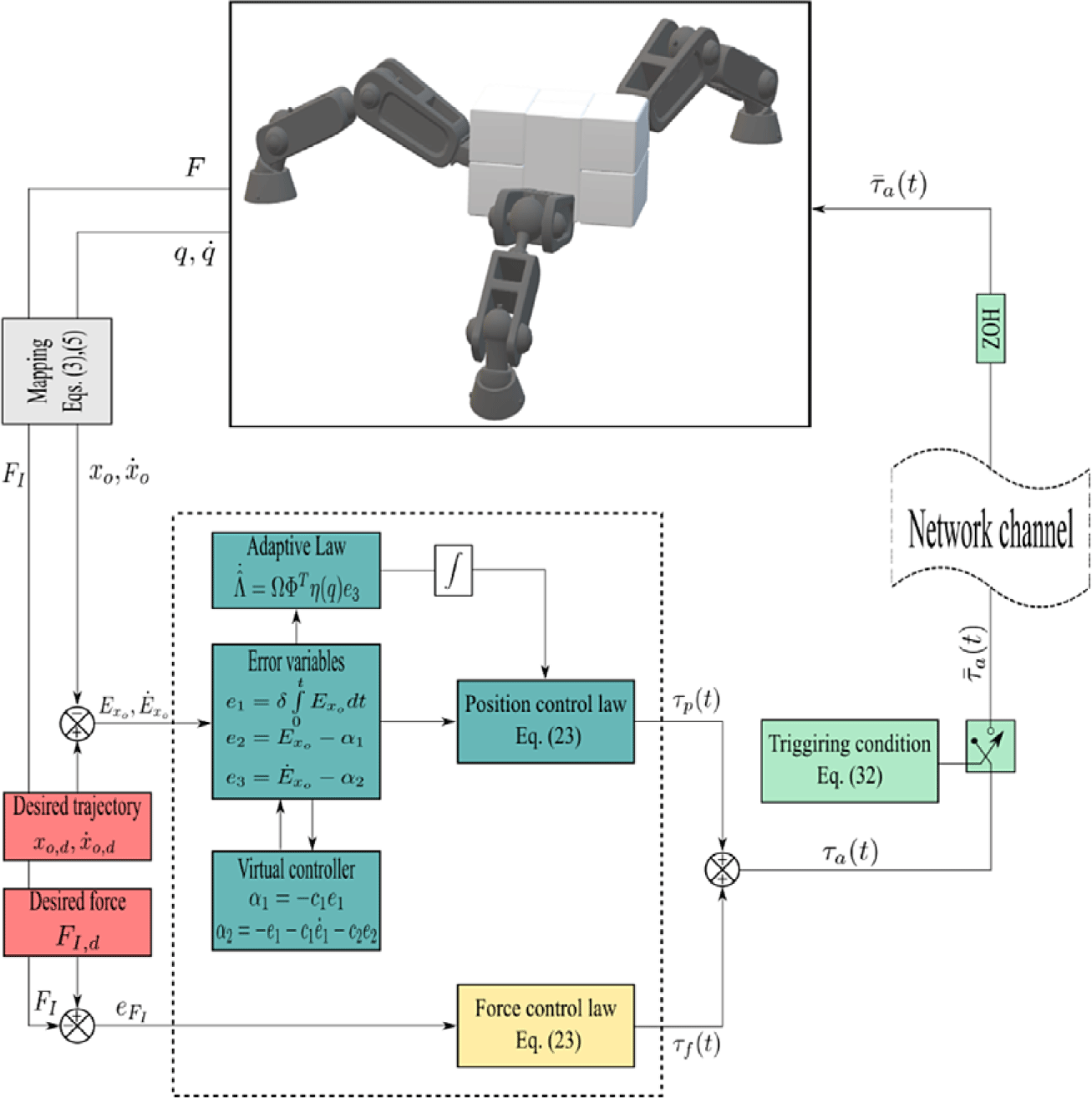
. The block diagram of the designed control strategy is presented in Fig. 2.
Block diagram of the proposed event-triggered control strategy.

5. Simulation Results and Comparative Study
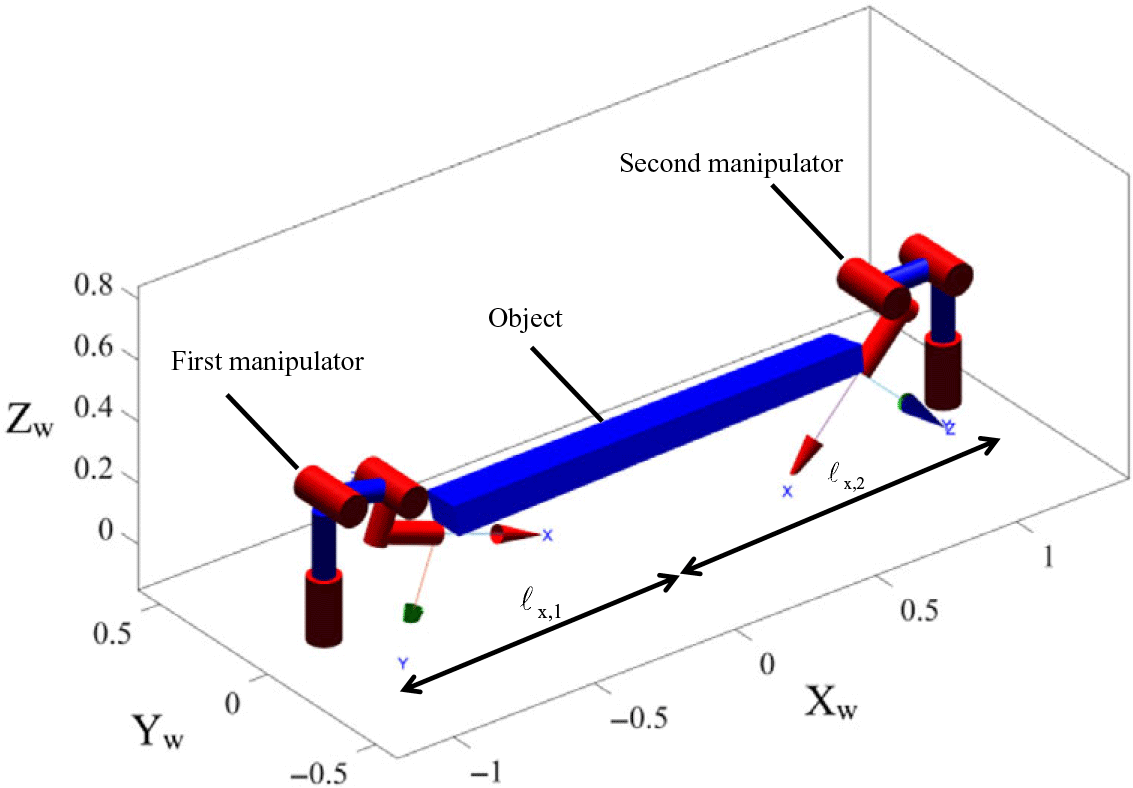
To demonstrate the effectiveness of the proposed control strategy, the simulation runs have been carried out using uncertain cooperative dual-arm manipulators. The TrueTime network simulator is utilized to implement the proposed control scheme and mimic the real-time control scenario over a network channel [Reference Cervin, Henriksson, Lincoln, Eker and Arzen54]. Three computer kernel blocks are constructed to represent the sensor, actuator, and controller nodes in the TrueTime-based simulation model. The control signal is generated based on the Simulink model of the proposed control scheme called by the controller node during the simulation runs. Moreover, a wireless communication network is placed at the controller-to-actuator channel using the network block of the TrueTime toolbox. The network protocol is chosen to be IEEE 802.11b (WLAN). An additional random interfering traffic is generated over the network using an interference node. The dual-arm system consists of two 3-degrees of freedom (DOFs) manipulators transporting a common object through a predefined trajectory. The manipulators have a revolute joint type with a stationary base. The world reference frame is assumed to be between the dual-arm manipulators with a distance of
 ${\ell _{{\rm{x,1}}}} = \,1{\rm{ m}}$
and
 ${\ell _{{\rm{x,2}}}}{\rm{ = 1}}{\rm{.2 m}}$
from the first and second manipulator, respectively, as illustrated in Fig. 3. The dynamic model of the implemented dual-arm manipulators can be expressed by (1) in which the vectors of joint angles
 ${{\textbf{q}}_i} = {{\boldsymbol{\theta }}_i} = {[{{{\theta }}_{i,1}},{{{\theta }}_{i,2}},{{{\theta }}_{i,3}}]^T}{ \in {\mathbb{R}}^3}$
for
 $i = 1,2$
, the inertia matrix
 ${\textbf{M}_{r,i}}({{\boldsymbol{\theta }}_i}){ \in {\mathbb{R}}^{3 \times 3}}$
, the matrix of Coriolis and centrifugal forces
 ${{\textbf{C}}_{r,i}}({\theta _i},{\dot{\boldsymbol\theta} _i}){ \in {\mathbb{R}}^{3 \times 3}}$
, the vector of the gravitational effect
 ${{\textbf{G}}_{r,i}}({\boldsymbol\theta _i}){ \in \mathbb{R}^3}$
, the friction effects
 ${{\textbf{B}}_{r,i}}({\dot{\boldsymbol\theta} _i}){ \in {\mathbb{R}}^3}$
, and the Jacobian matrix
 ${{\textbf{J}}_i}({\boldsymbol\theta _i}){ \in{\mathbb{R}}^{3 \times 3}}$
are described in detail in Appendix A. The dynamic model of the handled object is represented by (2) where
 ${{\textbf{M}}_o}(\textbf{x}_0) = \textrm{diag}\left( {{m_0},{m_0},{{\rm{I}}_0}} \right)$
,
 ${{\textbf{C}}_o}({{\textbf{x}}_o},{{\dot{\textbf{x}}}_o}{\rm{) = 0}}$
,
 $\textbf{G}_o({\textbf{x}}_o) = \left[ 0,\ 0,\ {\textrm{m}}_0g \right]^T$
, and
 $g = 9.8\frac{{\rm{m}}}{{{{\mathop{\rm s}\nolimits} ^2}}}$
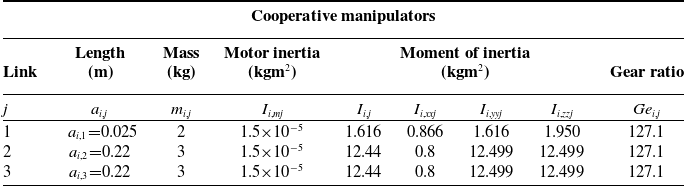
. The physical parameters of the robotic manipulators are consistent with the SCORBOT-ER VPlus manipulator [Reference Abbas, Narayan and Dwivedy55], with no motion at the fourth and fifth joints, as given in Table I.
Dynamic parameters for cooperative robot.

Cooperative dual-arm manipulators.

The performance of the proposed control scheme is investigated during the cooperative manipulation task with the consideration of three different cases as follows.
Case 1. The proposed ET control strategy is compared with two different time-triggered (TT) control approaches, i.e., traditional adaptive backstepping strategy (TT-AB) [Reference Krstic, Kokotovic and Kanellakopoulos33] and the state augmented adaptive backstepping control (TT-AUAB) [Reference Baigzadehnoe, Rahmani, Khosravi and Rezaie34].
Case 2. The designed Lyapunov-based triggering rule is extended for the aforementioned TT algorithms to investigate the effect of the new state variable and nonlinear damping term on the tracking accuracy and the number of transmissions. Moreover, the proposed control scheme is examined under the assumption of packet dropout during the transmission over the network.
Case 3. An additional comparative study is carried out between the designed triggering mechanism and the various triggering rules presented in the literature [Reference Xing, Wen, Liu, Su and Cai37, Reference Kumari, Behera and Bandyopadhyay39]. These triggering rules are integrated with the sliding mode control scheme (ET-SMC) [Reference Kumari, Behera and Bandyopadhyay39] and with adaptive control (ET-AC) [Reference Xing, Wen, Liu, Su and Cai37].
All the above cases are implemented in the TrueTime network simulator during the transportation of a common object through a lemniscate trajectory while maintaining a constant orientation in the x-z plane. Further, the internal forces developed at the manipulated object are controlled to eliminate the internal stresses and avoid the damage of the manipulators and\or the object. The position and orientation of the object frame with respect to the world reference frame
 ${\Im _o}$
can be selected as
 ${{\textbf{x}}_o} = {\left( {{p_{x,o}},{p_{z,o}},{p_{{\varphi },o}}} \right)^T}$
. The generation of the desired lemniscate trajectory is expressed as
 ${{\textbf{x}}_{o,d}}(t) = \left[ {0.1 + \frac{{0.05\sin (t)}}{{1 + {{\sin }^2}(t)}};0.1 + \frac{{0.05\sin (t)\cos (t)}}{{1 + {{\sin }^2}(t)}};{\rm{ 0}}} \right]$
. The desired internal forces are defined to be zero, that is,
 ${\textbf{F}_{I,d}} = \left[ {0;{\rm{ 0; 0; 0; 0; 0}}} \right]$
, and the vector of external disturbances and the unmodelled dynamic is given by
 ${{\boldsymbol{\tau}}_{d,i}}({{\textbf{q}}_i},{{\dot{\textbf{q}}}_i}) = {\left[ {2 + \cos (2t),\sin (t) + \cos (t),2 + \sin (2t)} \right]^T}$
. The joint friction is not taken into account during the simulation runs (
 ${{\textbf{B}}_{r,i}}({\dot{\boldsymbol\theta} _i}{\rm{) = 0}}$
). The simulation tests are conducted in a MATLAB environment for a total time of
 $t = 6.28{\rm{ s}}$
with a sampling rate of
 $dt = 0.01{\rm{ s}}$
. The initial location (position and orientation) and velocity of the manipulated object are chosen as
 ${{\textbf{x}}_o} = {\left( {0.15{\rm{ m}},{\rm{ 0}}{\rm{.1 m, }}{{\rm{0}}^ \circ }} \right)^T}$
and
 ${{\dot{\textbf{x}}}_o} = {\left( {0\frac{m}{\rm{ sec}},0\frac{\rm{ m}}{\rm{sec}},0\frac{\circ}{\rm{sec}}} \right)^T}$
, respectively. The initial conditions of the vector of parameter estimation
 $\hat \Lambda (0)$
are chosen to be zero. The object’s physical parameters are chosen as follows: the object mass
 ${m_o} = 5{\rm{ kg}}$
, the object moment of inertia
 ${I_o} = 0.1{\rm{ kg}}{\rm{.}}{{\rm{m}}^{\rm{2}}}$
, and the object dimensions are
 $1.5{\rm{ m}} \times 0.05{\rm{ m}} \times 0.1{\rm{ m}}$
for the length, width, and height, respectively. The Jacobian matrices from the end-effector frame
 ${\Im _{e,i}}$
of the
 ${i^{th}}$
manipulator to the frame attached at the object’s mass center
 ${\Im _o}$
are expressed as
 ${\textbf{W}_1}^T = \left[ {\begin{array}{c@{\quad}c@{\quad}c}1&0&{\frac{{{l_o}}}{2}{\rm{sin}(}{p_{{\varphi },o}})}\\0&0&1\\0&1&{\frac{{{l_o}}}{2}{\rm{cos}(}{p_{{\varphi },o}})}\end{array}} \right]$
and
 ${\textbf{W}_2}^T = \left[ {\begin{array}{c@{\quad}c@{\quad}c}1&0&{\frac{{{l_o}}}{2}{\rm{sin}(}{p_{{\varphi },o}})}\\0&0&1\\0&1&{ - \frac{{{l_o}}}{2}{\rm{cos}(}{p_{{\varphi },o}})}\end{array}} \right].$
5.1 Simulation results
Case 1. The designed ET control scheme is implemented in the TrueTime-based simulation environment considering uncertainties, external disturbances, and limited communication. The dual-arm robotic system is exploited to transport the common object through a lemniscate trajectory and maintain the internal forces at the desired level. A comparison study with two variations of the TT backstepping strategy, i.e., traditional adaptive backstepping (TT-AB) [Reference Krstic, Kokotovic and Kanellakopoulos33] and the state augmented adaptive backstepping control (TT-AUAB) [Reference Baigzadehnoe, Rahmani, Khosravi and Rezaie34], is conducted. These approaches are exploited to carry out the same transportation task. The TT-AB and TT-AUAB control laws and the choice of the parameters are presented in Appendix B. The parameters of the proposed controller are chosen based on the heuristic method as follows:
 ${{\textbf{c}}_1} = {\textrm{diag}}(0.1,{\rm{ 0}}{\rm{.1}},0.1),\ {{\textbf{c}}_2} = {\textrm{diag}}(30,{{ 30}},{{ 30}})$
,
 ${{\textbf{c}}_3} = 8.5{I_6}$
,
 ${\boldsymbol\delta } = 50$
,
 $\boldsymbol\kappa = 81{I_6},$
 ${\boldsymbol\Omega } = 6500{I_6}$
,
 $\boldsymbol\xi = 0.9$
,
 ${\textbf{k}_{f,p}} = 0.1{I_6}$
, and
 ${{k}_{f,i}} = 20{I_6}$
.
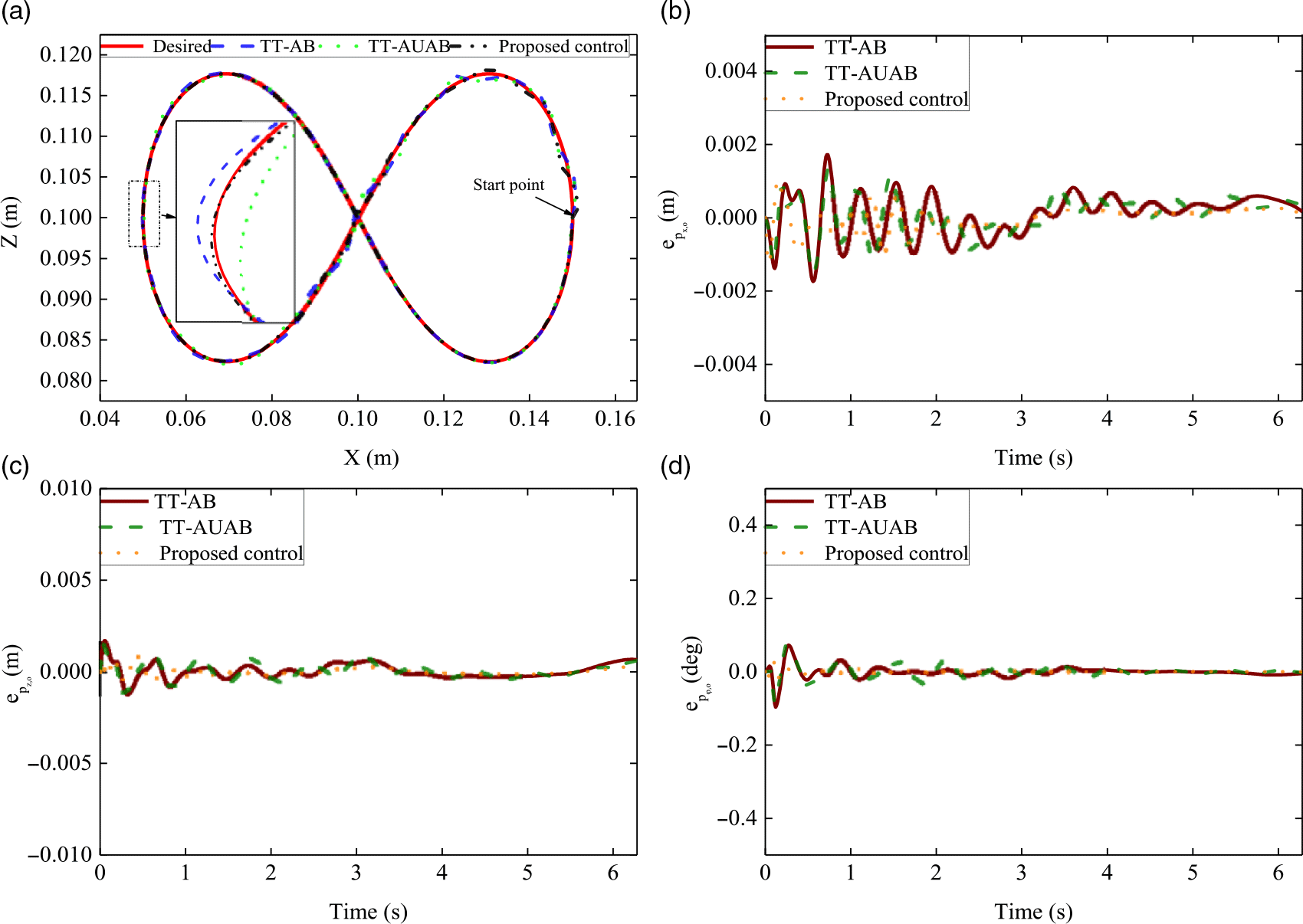
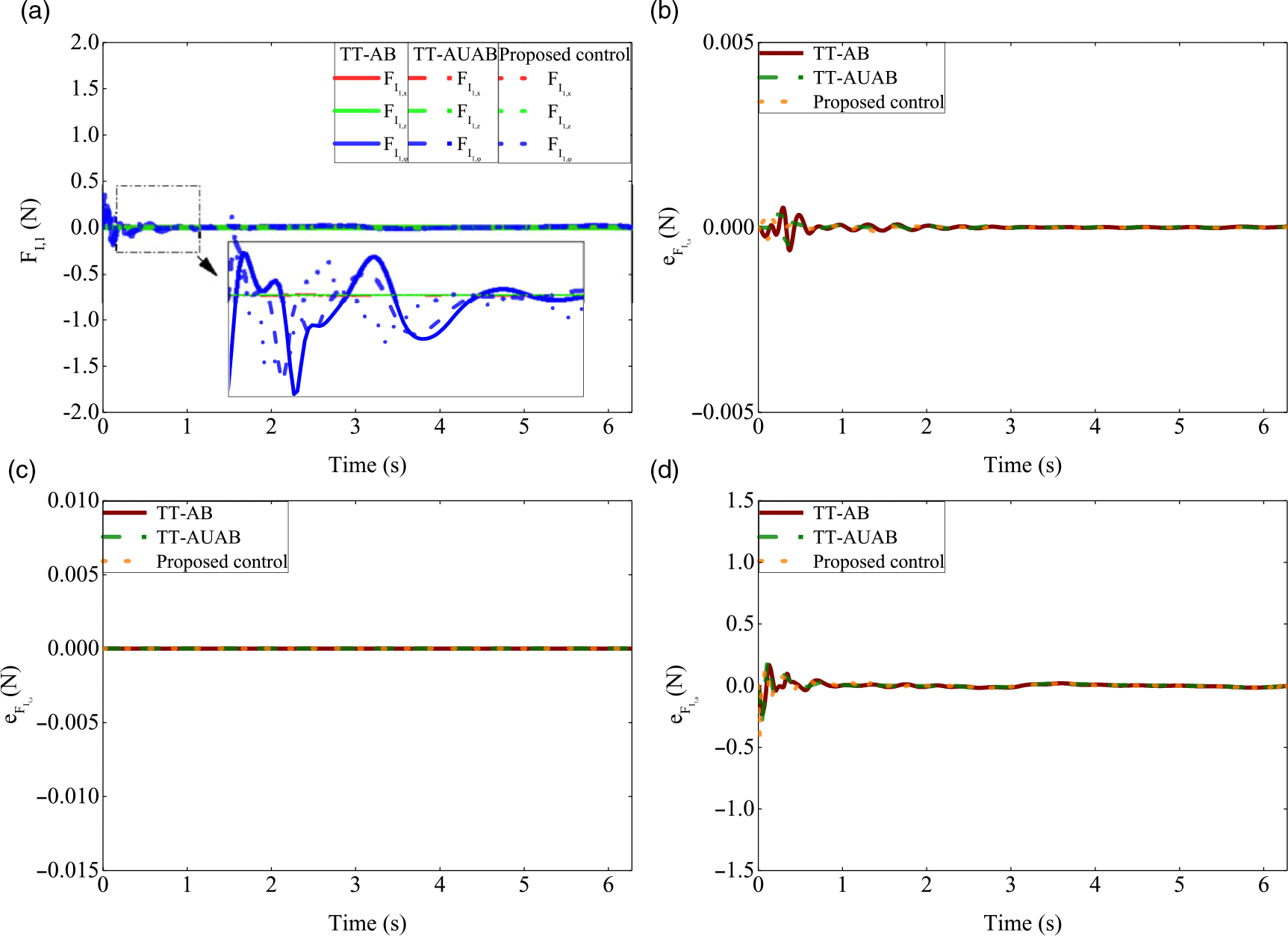
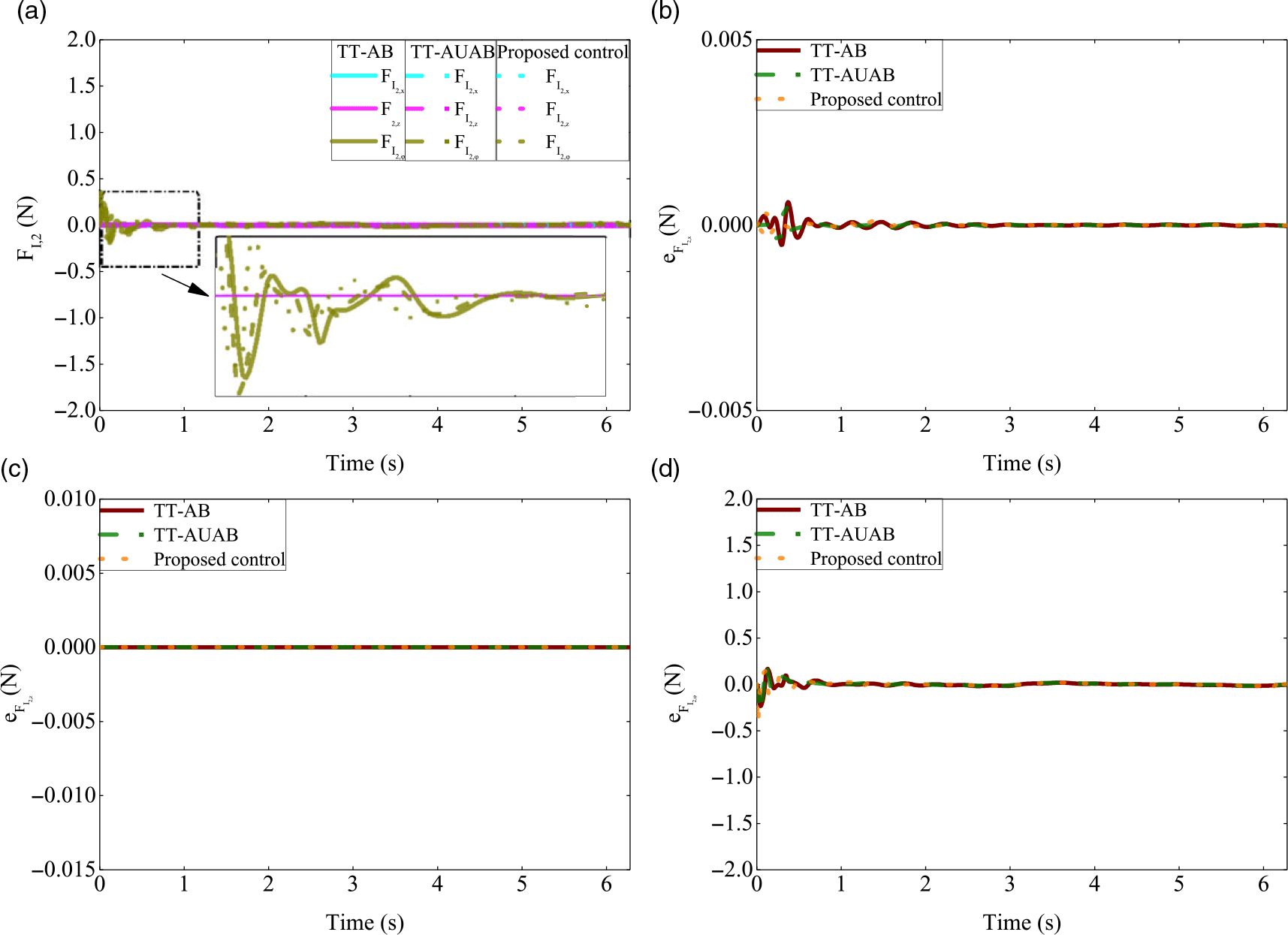
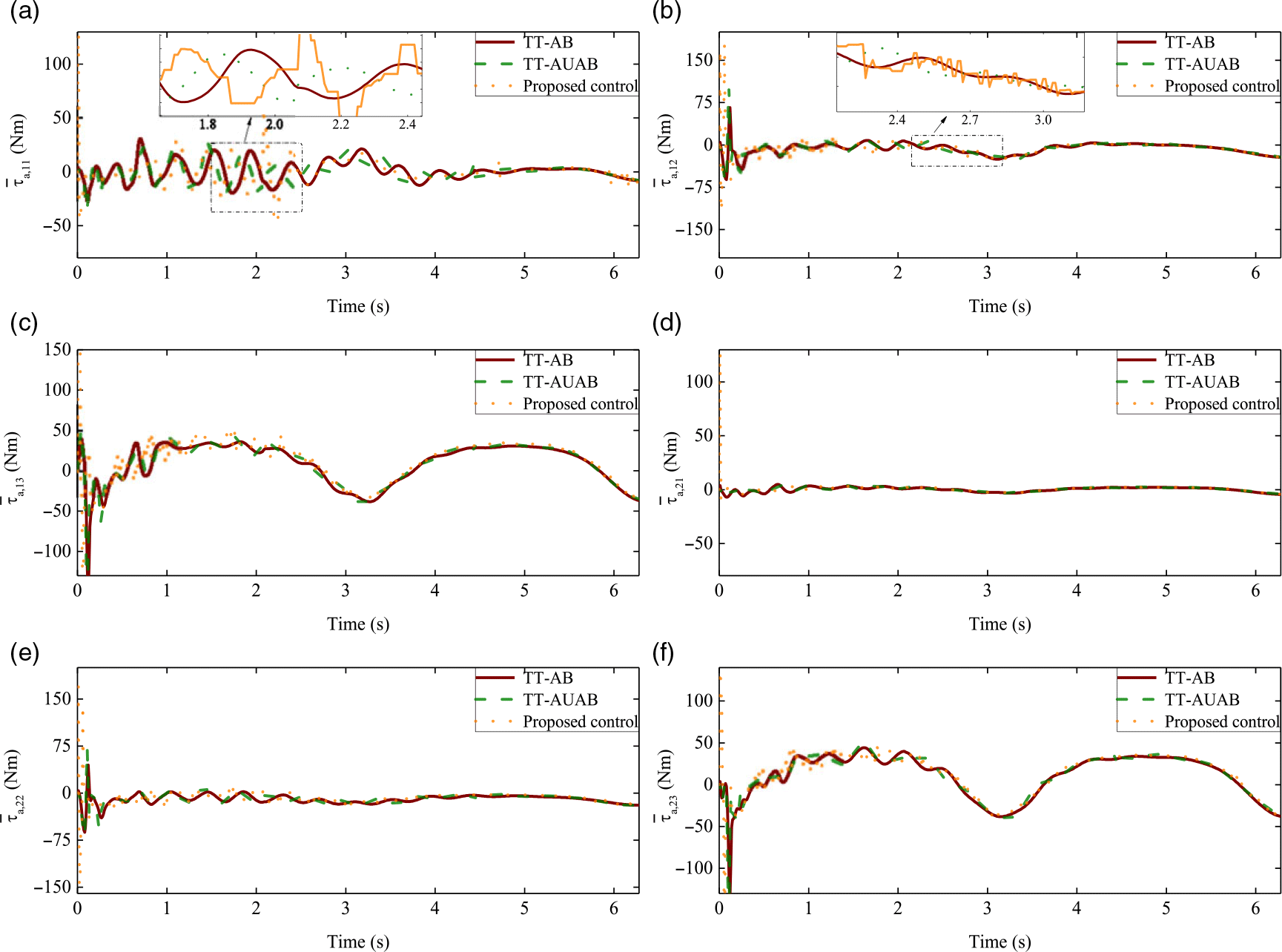
Discussion 1. The tracking performance along with position and orientation tracking errors of TT-AB, TT-AUAB, and proposed ET control strategies is illustrated in Fig. 4. It is noted from the enlarged view of Fig. 4(a) that the designed control approach and TT-AUAB provide a better tracking performance as compared with TT-AB. However, a smaller position and orientation tracking errors with faster convergence to zero are achieved by implementing the proposed control strategy as depicted in Fig. 4(b, c, d). The tracking of desired internal forces for the first and second robots is presented in Figs. 5 and 6, respectively. The desired internal forces are assumed to be zero to avoid internal mechanical stresses at the manipulated object. It can be observed that a sufficient force tracking performance can be realized by implementing the different control schemes. However, the proposed ET control approach shows a faster response and smaller force tracking errors than TT-AB and TT-AUAB control strategies. Fig. 7(a, b, c, d, e, f) depicts the control signals of the first and second manipulators, respectively. The control signals for the proposed ET control scheme are not transmitted continuously over the network, as observed from the enlarged view. Instead, it is updated after a time gap based on the violation of the predesigned triggering condition. Therefore, a smaller number of transmissions over the network are transmitted while maintaining a better position and force tracking performance during the cooperative manipulation task.
Trajectory tracking of the manipulated object for Case 1. (a) Desired and actual trajectories on X-Z plane. Tracking error in (b) X-direction, (c) Z-direction, and (d) object orientation.

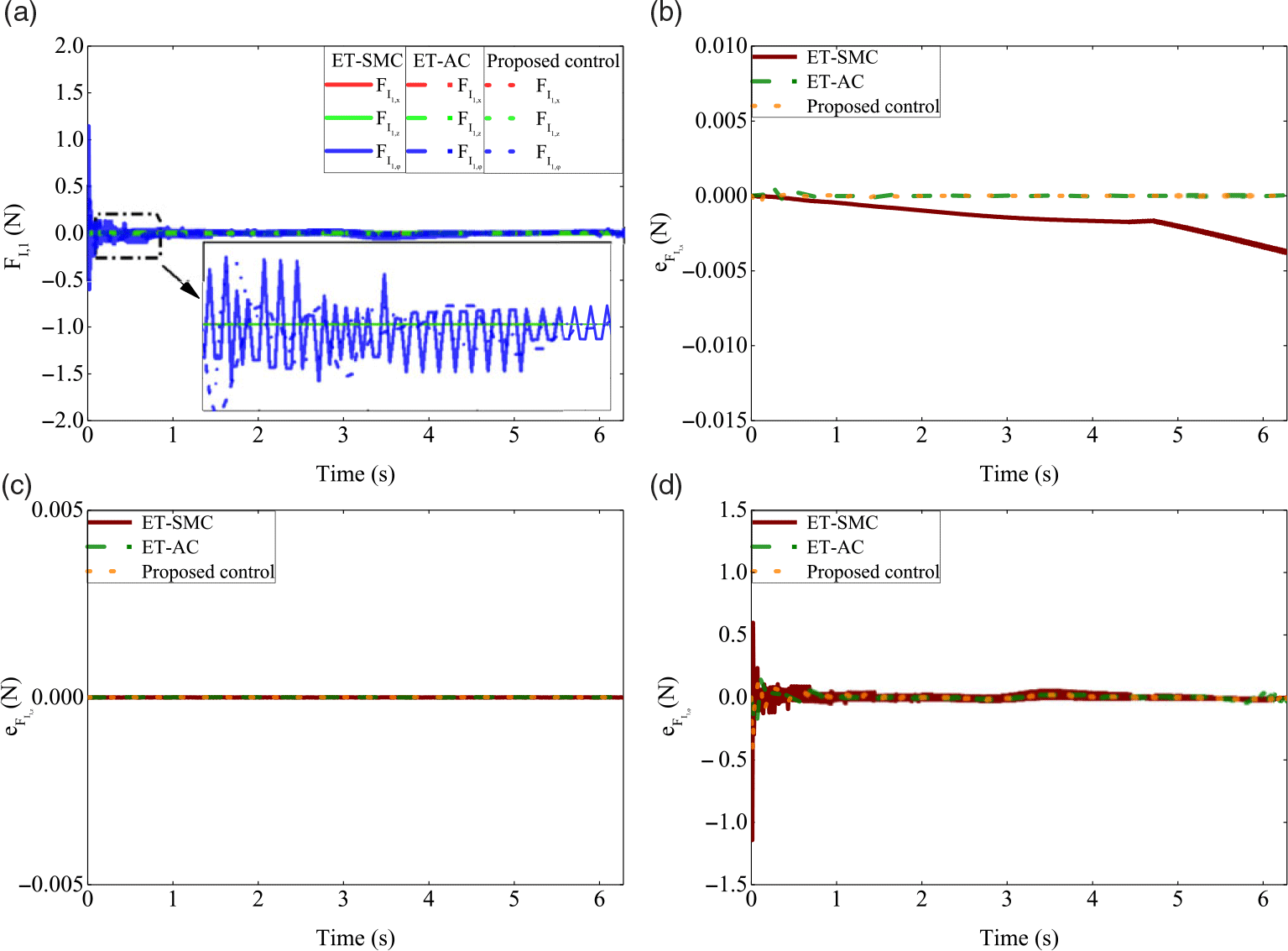
Tracking of internal forces for the first manipulator in Case 1. (a) Force trajectory tracking. Force error in (b) X-direction, (c) Z-direction, and (d) orientation.

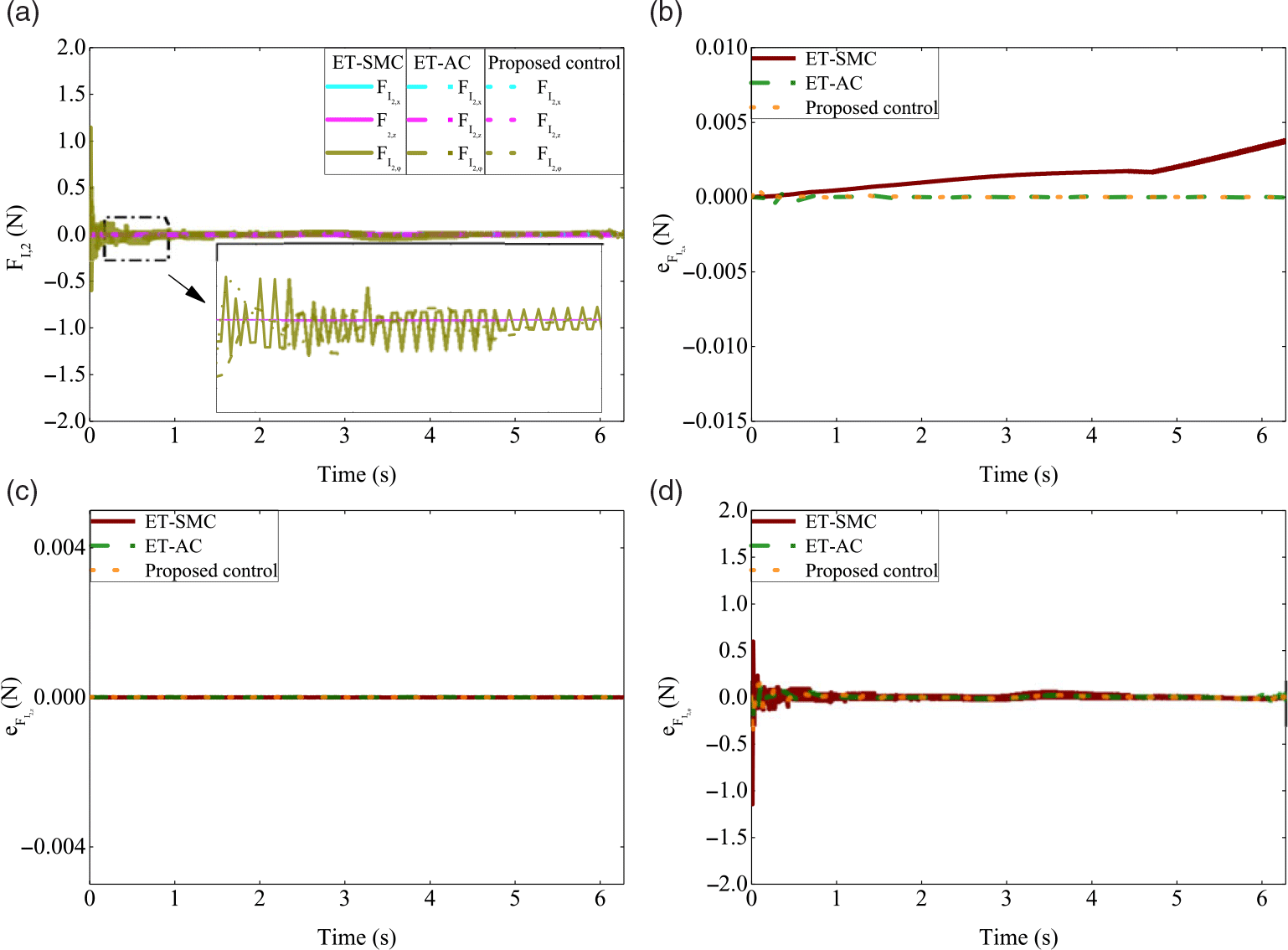
Tracking of internal forces for the second manipulator in Case 1. (a) Force trajectory tracking. Force error in (b) X-direction, (c) Z-direction, and (d) orientation.

Control signals for the first and second robots in Case 1. First robot: (a) first joint, (b) second joint, and (c) third joint. Second robot: (d) first joint, (e) second joint, and (f) third joint.

Case 2. The proposed Lyapunov-based triggering threshold is designed for the same control schemes presented in Case 1 (i.e., AB and AUAB). This implementation is conducted to examine the effect of integrating the new state variable and nonlinear damping term on the number of transmissions over the network compared with ET-AB and ET-AUAB control strategies. For a fair comparison, the parameters of ET-AB and ET-AUAB are chosen similar to the parameters of Case 1 as given in Appendix B.
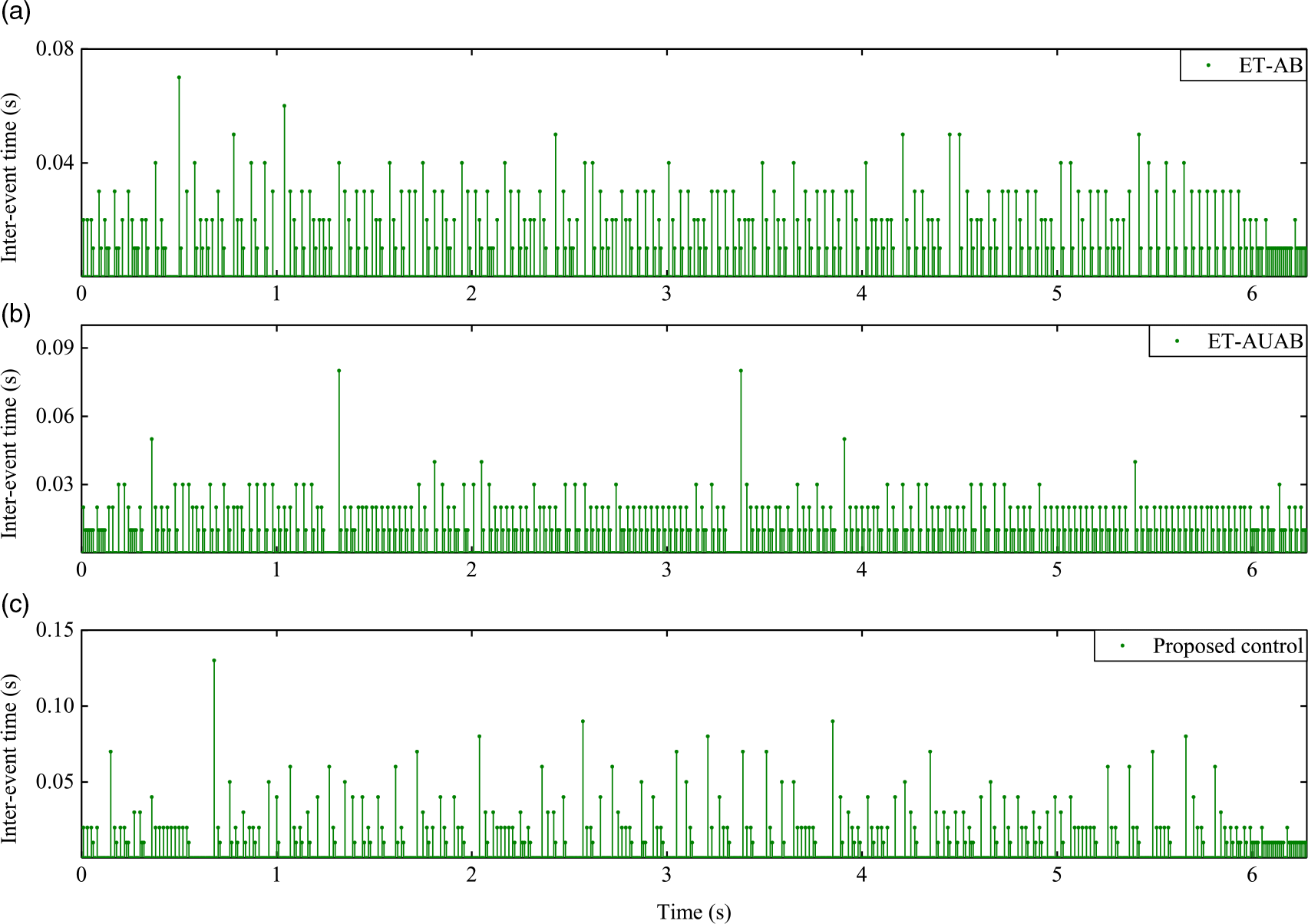
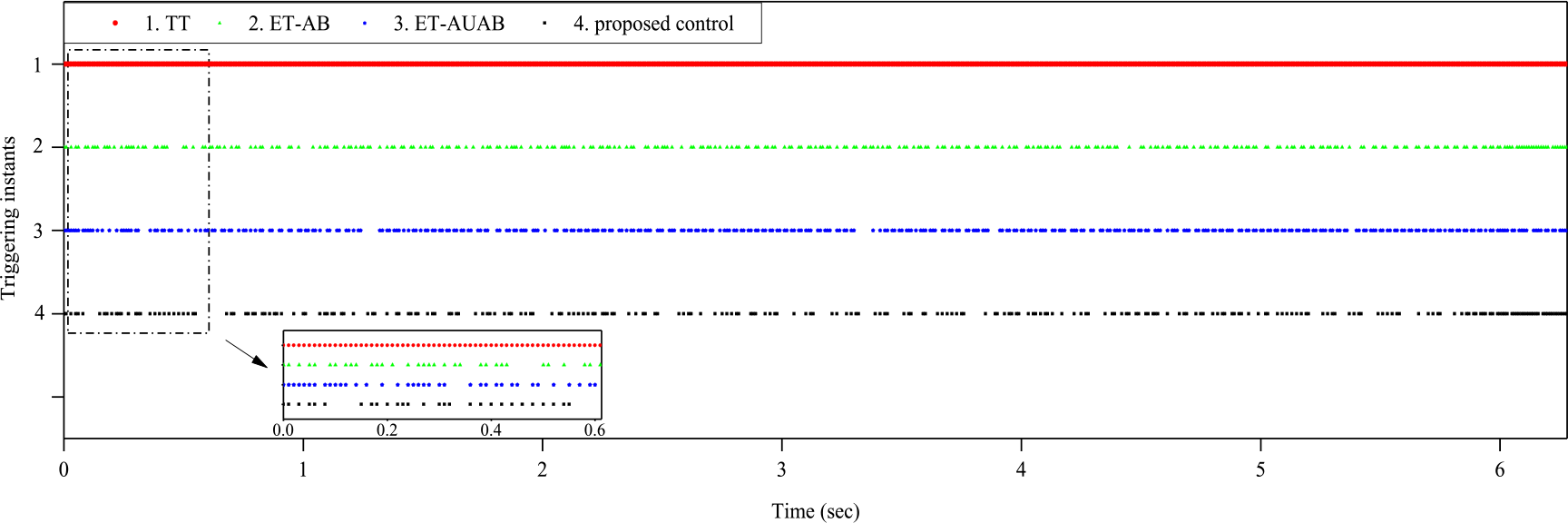
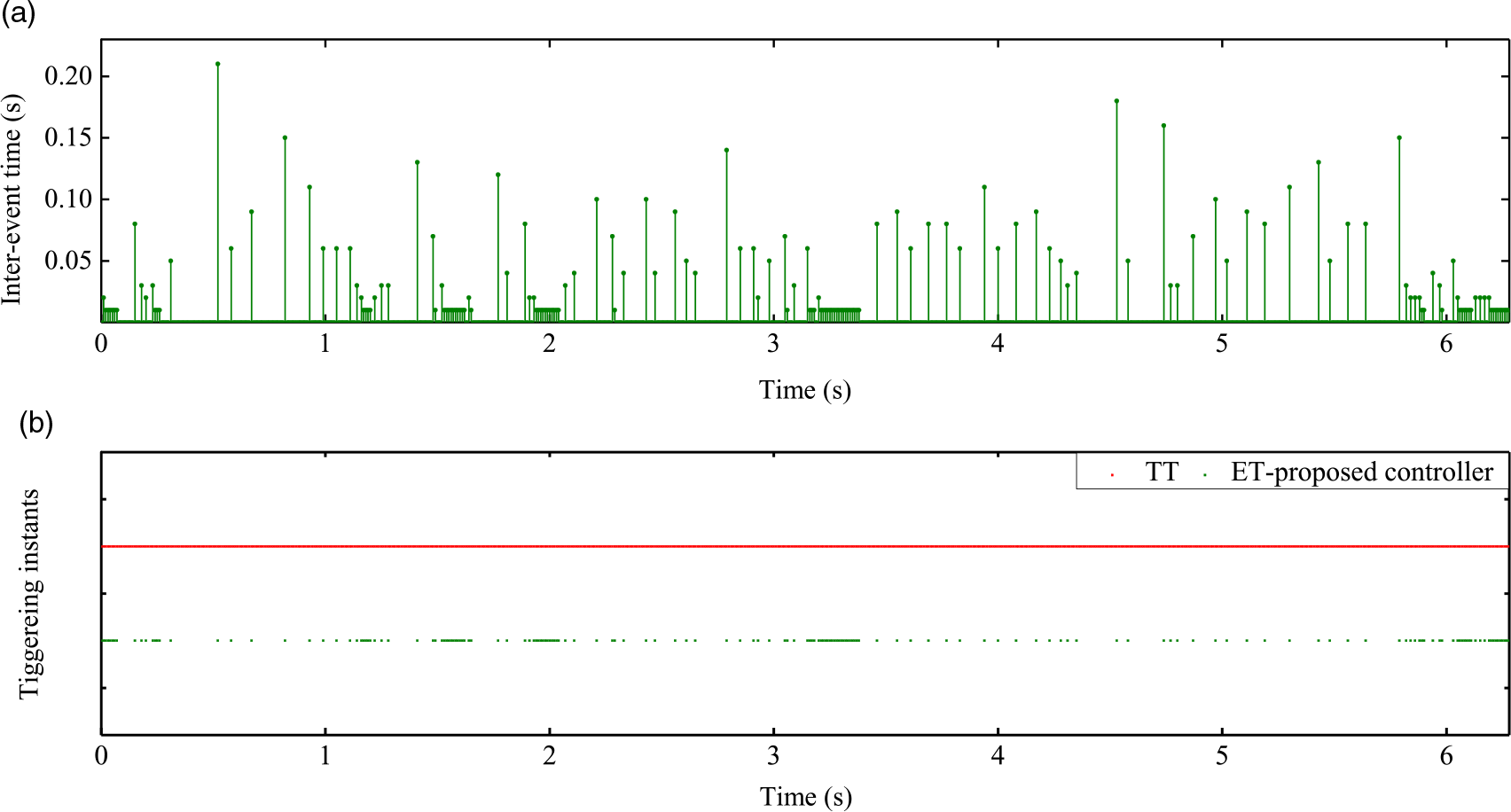
Discussion 2. The inter-event time and triggering events of the ET-AB, ET-AUAB, and the proposed ET control scheme are illustrated in Figs. 8 and 9, respectively. It can be noted from Fig. 8 that a longer inter-event time is achieved in the case of the proposed control scheme. Moreover, a smaller number of transmissions over the network are guaranteed using the proposed approach, as depicted in Fig. 9. Therefore, it is evident that the integration of the state variable and the nonlinear term in the controller design process improves the performance of the controller and leads to a significant saving in the network resources compared with ET-AB and ET-AUAB control algorithms.
Inter-event time for (a) ET-AB and (b) ET-AUAB. (c) Proposed control scheme in Case 2.

Triggering events for time-triggered, ET-AB, ET-AUAB, and proposed ET control scheme in Case 2.

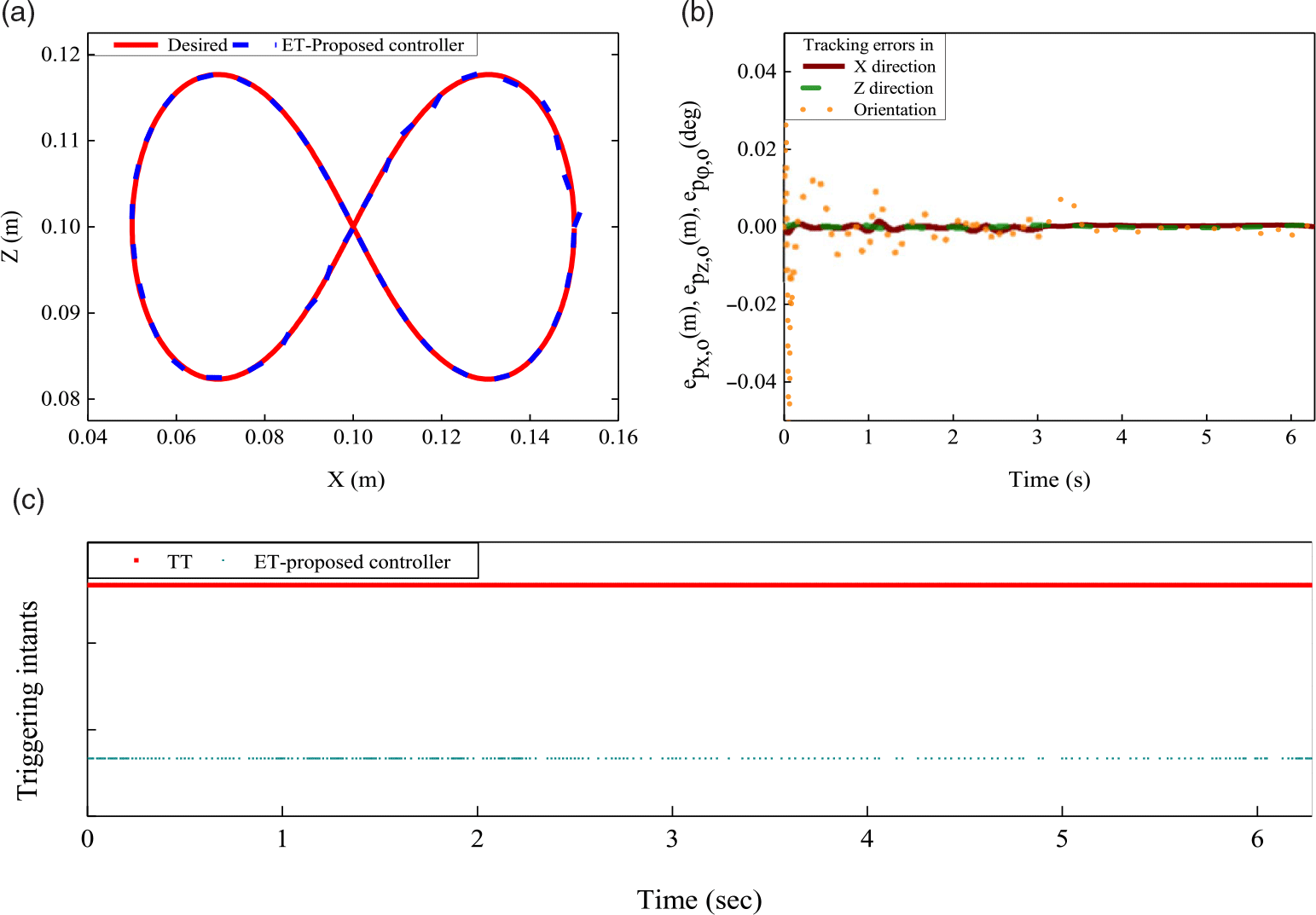
The packet loss problem is not addressed during the controller design and stability analysis process. However, this problem is inevitable in the networked control system and significantly affects the system performance driven by ET control strategy. Therefore, this issue is examined in the TrueTime-based simulation runs to emphasize the robustness of the proposed control approach in handling the packet losses problem. The probability of dropping a packet during the transmission over the network is assumed to be 0.4. Beyond this value, the cooperative dual-arm robotic system is found to be unstable. The simulation results for the lemniscate trajectory tracking under the designed ET control scheme are presented in Fig. 10. The desired trajectory is tracked precisely with small tracking errors, as shown in Fig. 10(a, b). The number of triggering events is slightly increased to compensate for the lost packet and maintains an acceptable performance of the system, as depicted in Fig 10(c). These results exhibit that the proposed control strategy can still control the motion of the handled object over the network and guarantees a reduction in resource utilization in the presence of external disturbances and packet loss.
Trajectory tracking for proposed ET controller with packet loss. (a) Desired and actual trajectories on the X-Z plane. (b) Tracking errors in X-direction, Z-direction, and orientation. (c) Triggering events.

Case 3. An additional comparative study is carried out with two existing results in the literature [Reference Xing, Wen, Liu, Su and Cai37, Reference Kumari, Behera and Bandyopadhyay39]. The ET mechanism is integrated with the sliding mode control (ET-SMC) in ref. [Reference Kumari, Behera and Bandyopadhyay39] and with adaptive control (ET-AC) in ref. [Reference Xing, Wen, Liu, Su and Cai37] for nonlinear systems. This comparison is conducted to prove the effectiveness of the proposed ET control strategy for cooperative manipulation in the presence of uncertainties, external disturbances, and limited communication. The control approaches are devoted to perform the same transportation task through the lemniscate trajectory. For ease of reference, the ET-SMC control law and the selected gains of the controller are presented in Appendix B.
Remark 5. Different from the switching condition that combines the fixed and relative threshold in a unified framework [Reference Xing, Wen, Liu, Su and Cai37], the proposed ET condition is designed more systematically based on the Lyapunov analysis to guarantee the stability of the cooperative manipulator system. This condition leads to a significant decrease in the transmissions over the network during the cooperative manipulation task. Moreover, superior tracking performance is still attained in tandem with the reduction of triggering events due to the new state variable and nonlinear damping term added to the proposed control scheme. Compared with the ET sliding mode control approach [Reference Kumari, Behera and Bandyopadhyay39], the proposed control strategy causes no chattering in the generated control signals and has no restrictions on the dynamic nonlinearities to be a Lipschitz function.
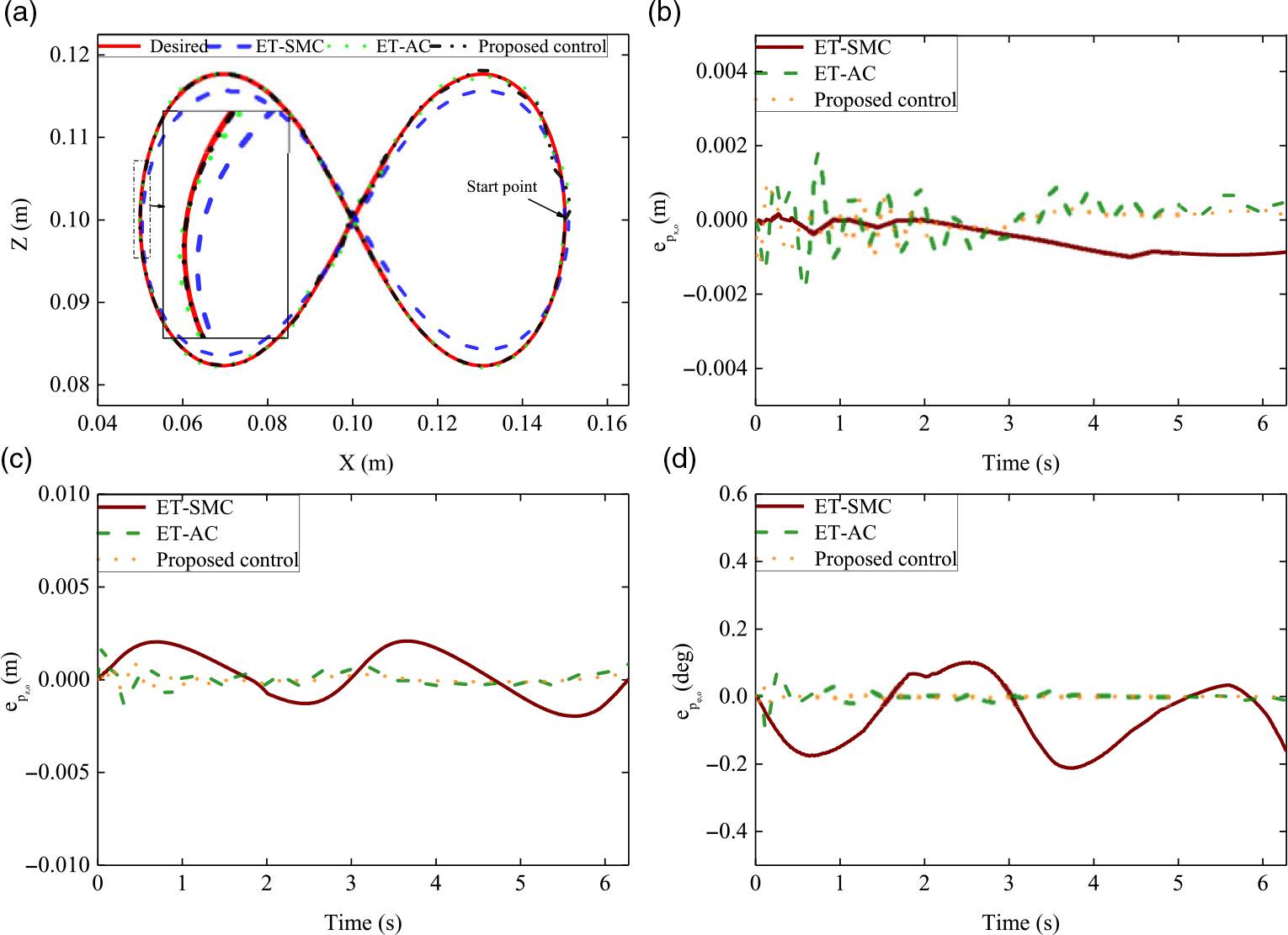
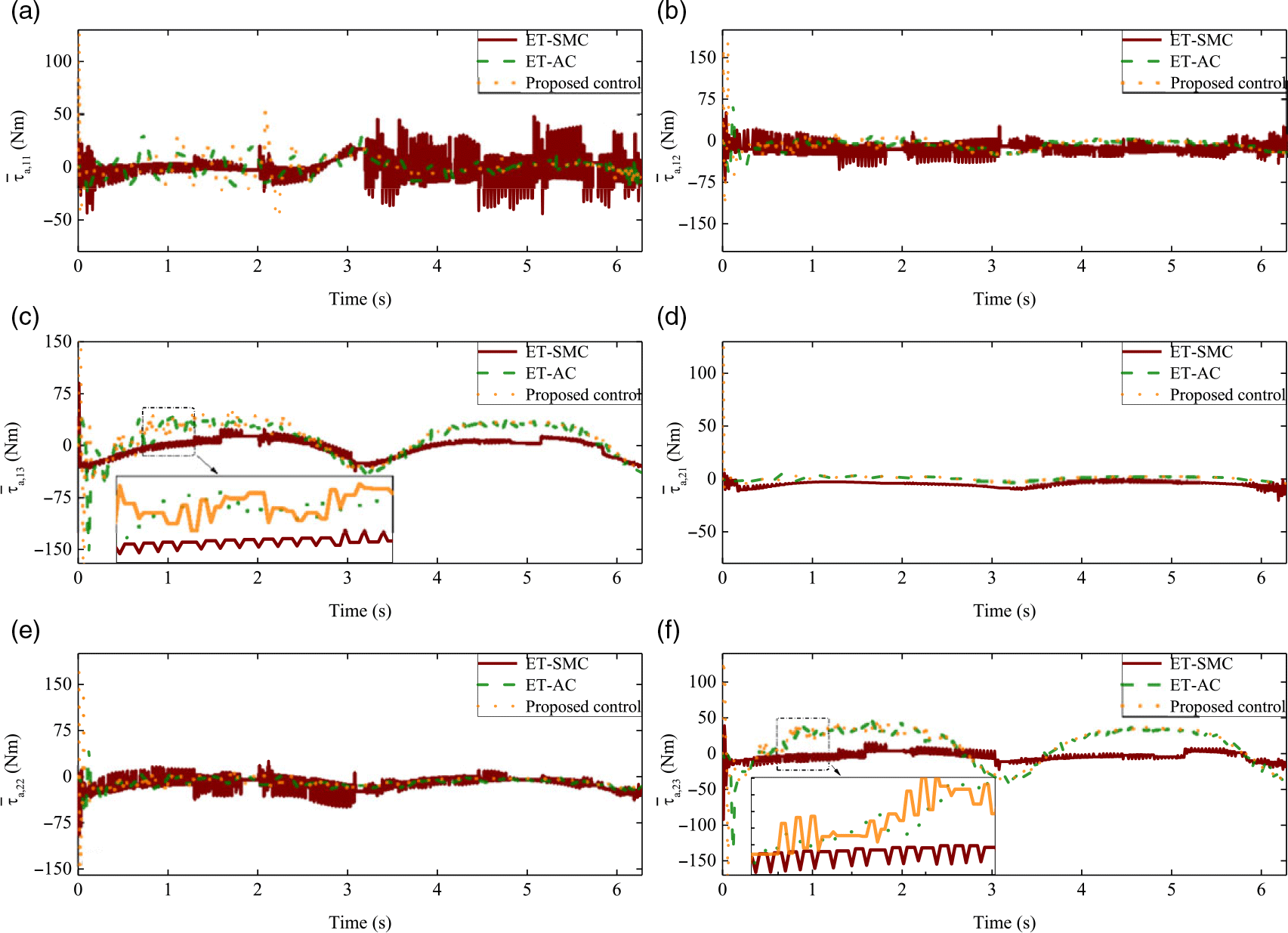
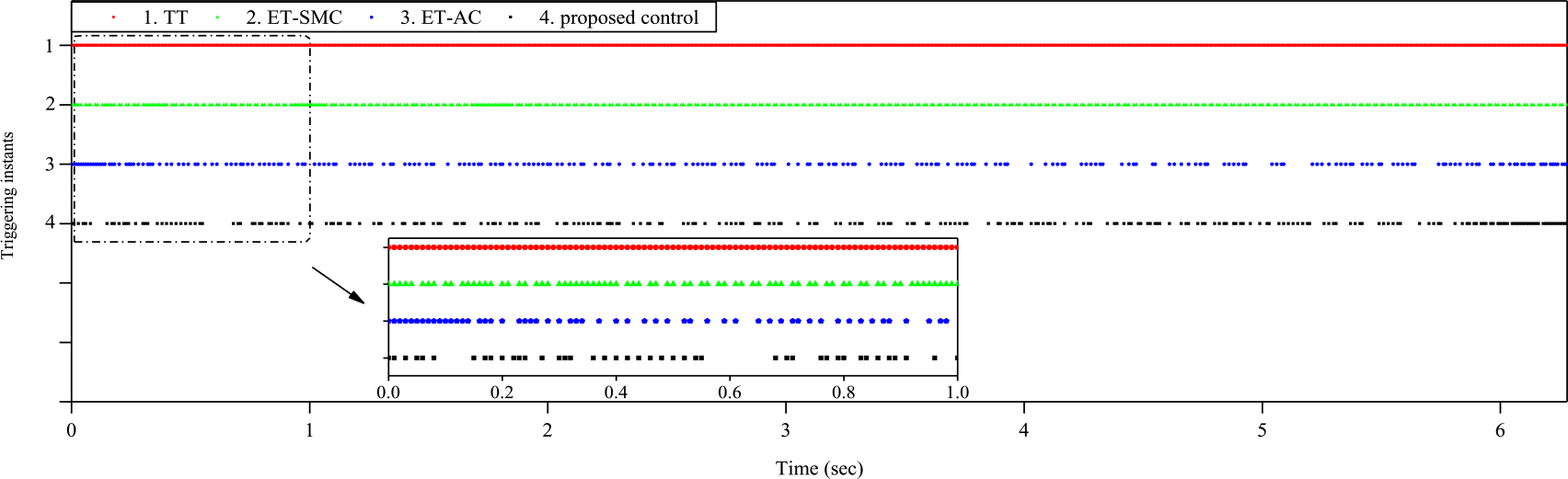
Discussion 3. The tracking performance along with tracking errors for ET-SMC, ET-AC, and proposed ET control schemes is depicted in Fig. 11. Moreover, the tracking of internal forces during the cooperative manipulation task is presented in Figs. 12 and 13. It is evident from Figs. 11, 12, and 13 that ET-SMC does not lead to the convergence of tracking errors to zero and causes a chattering in the internal force tracking profile. This chattering does not exist in the case of ET-AC and proposed ET control schemes. On the other hand, the proposed ET scheme delivers a superior tracking performance with smaller position and force tracking errors than ET-SMC and ET-AC. The control signals for the first and second manipulators are depicted in Fig. 14. It can be noted that the chattering phenomena associated with SMC cannot vanish with the implementation of the ET mechanism. Moreover, the ET-SMC exhibits a shorter inter-event time and relatively higher triggering instants than ET-AC and the proposed ET control scheme, as depicted in Fig. 15. However, the proposed control scheme presents a noticeable reduction in the transmission over the network in tandem with a good position and force tracking accuracy during the cooperative transportation task compared with ET-SMC and ET-AC.
Trajectory tracking of the manipulated object for Case 3. (a) Desired and actual trajectories on X-Z plane. Tracking error in (b) X-direction, (c) Z-direction, and (d) object orientation.

Tracking of internal forces for the first manipulator in Case 3. (a) Force trajectory tracking. Force error in (b) X-direction, (c) Z-direction, and (d) orientation.

Tracking of internal forces for the second manipulator in Case 3. (a) Force trajectory tracking. Force error in (b) X-direction, (c) Z-direction, and (d) orientation.

Control signals for the first and second robots in Case 3. First robot: (a) first joint, (b) second joint, and (c) third joint. Second robot: (d) first joint, (e) second joint, and (f) third joint.

Triggering events for time-triggered, ET-SMC, ET-AC, and proposed ET control scheme in Case 3.

5.2 Comparative Study
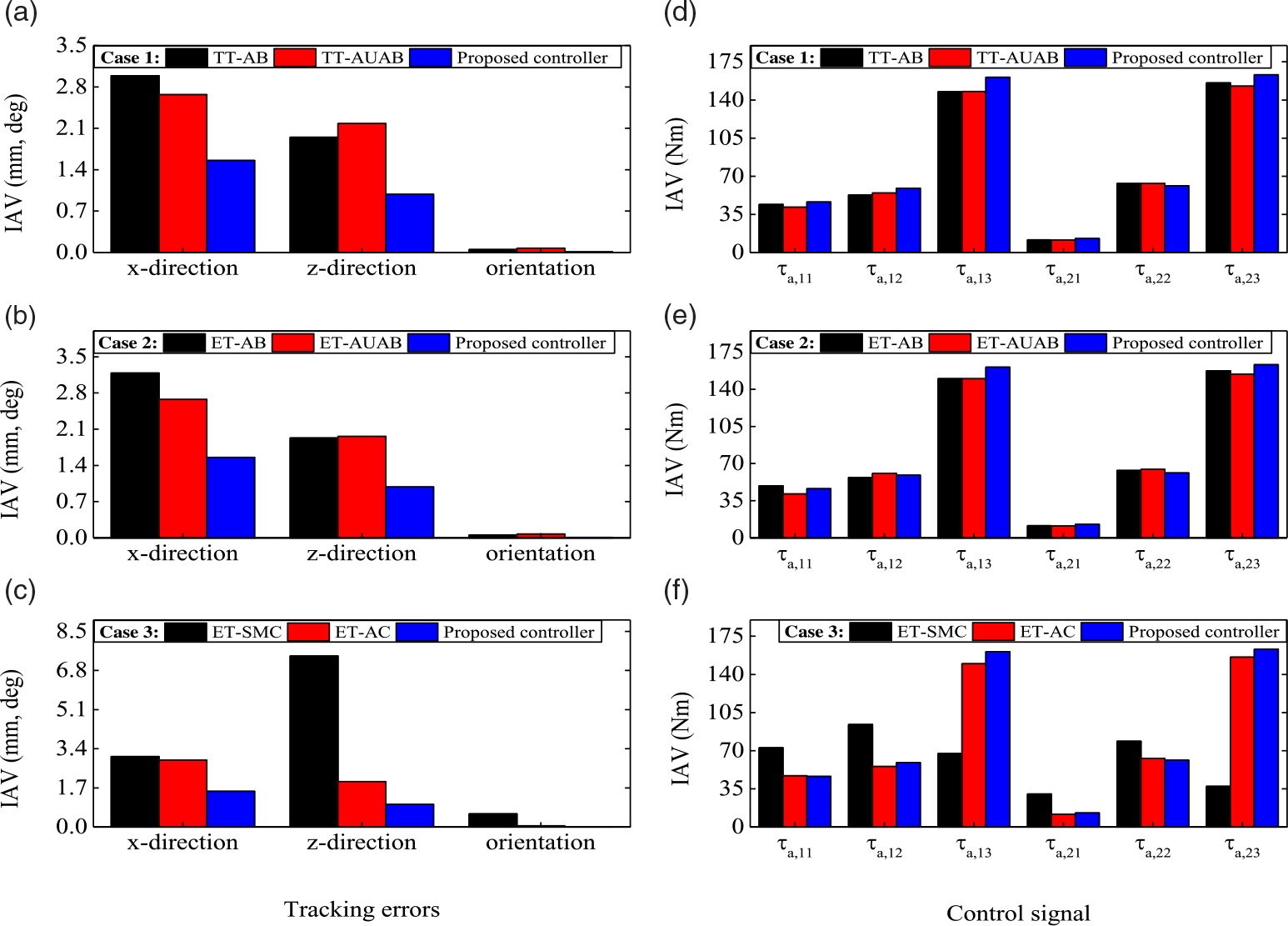
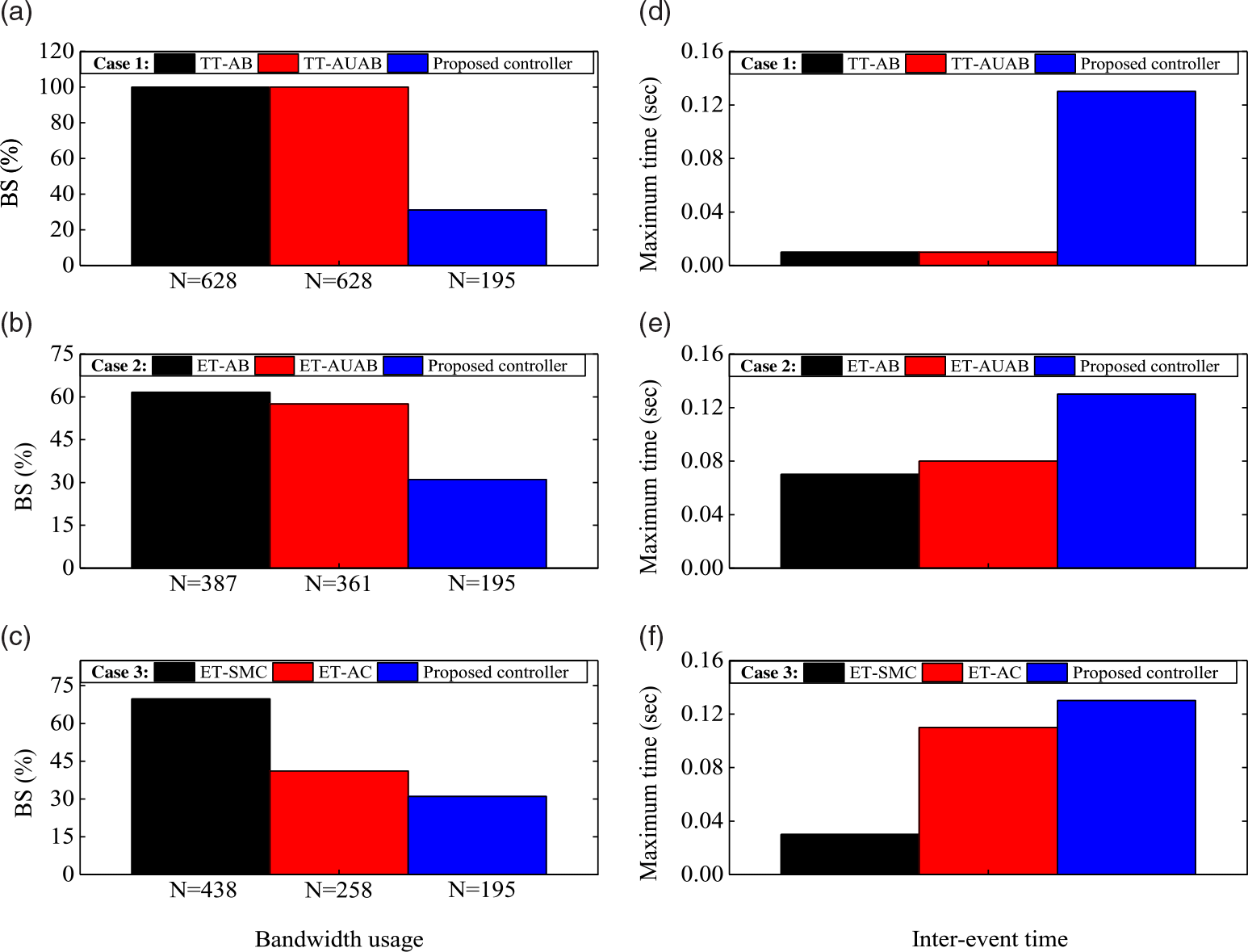
To further investigate the tracking performance of the different control strategies in the various cases, the integral absolute value (IAV) of the position tracking errors and control inputs are calculated during the cooperative manipulation task as given in (38) and summarized in Fig. 16. On the other hand, the bandwidth usage (BS) and the number of transmissions (N) for the controllers are quantified and brought in Fig. 17. It is to be mentioned that the transmissions over the network for the TT control scheme occur at every sampling time. Therefore, the number of transmissions is equal to
 $\frac{t}{{dt}} = \frac{{6.28}}{{0.01}} = 628$
.
 \begin{align}{\rm{IAV}} = \int {\left| {{x_l}} \right|} ,BS = 100 \times N \times \frac{{dt}}{t}\end{align}
where
 ${x_l}:{e_{{p_{x,o}}}}$
, is position tracking error in X-direction;
 ${e_{{p_{z,o}}}}$
, is tracking error in Z-direction;
 ${e_{{p_{{\varphi },o}}}}$
, is orientation tracking error,
 ${{\rm{\tau }}_{a,ij}}$
, is the control input at the desired joint,
 $t$
is the total simulation time,
 $dt$
is the sampling time, and
 $N$
indicates the number of transmissions. It can be observed from Fig. 16(a, b, c) that the proposed control approach provides a superior tracking performance with a minimal IAV of the tracking errors in the three different cases. Moreover, the control efforts are not significantly increased by implementing the proposed control approach, and relatively small control efforts are still guaranteed at some joints compared with the other control schemes, as illustrated in Fig. 16 (d, e, f). On the other hand, the proposed ET mechanism leads to a notable saving in the network resources for AB and AUAB control schemes with similar tracking performance as presented in Case 2. However, it is evident from Fig. 17 that the designed ET control strategy has the least number of triggering instants and the longest inter-event time compared with the other control strategies. Thus, it can be understood that the proposed control approach exhibits an outstanding tracking performance in tandem with a significant saving in the network resources during the cooperative manipulation task.
Comparison of tracking errors and control efforts for the three cases.

Comparison of proposed ET mechanism with different TT and ET control schemes in the three cases.

5.3 Validation on cooperative dual-arm manipulators in V-REP
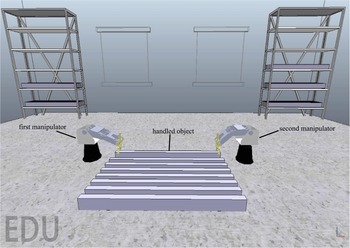
To examine the validity of the proposed ET control strategy, a dual-arm robotics system is constructed to perform the cooperative transportation of a common object in the V-REP. This platform presents a more realistic simulation environment with a user-friendly interface and various functions that can be integrated through different embedded scripts and a detailed application interface (API) [Reference Freese, Singh, Ozaki and Matsuhira56]. A factory-like environment is built in the V-REP platform in which the cooperative dual-arm robotic system consists of two 5-DOFs SCORBOT-ERVPlus manipulators, as illustrated in Fig. 18. The model of the manipulators is designed in SolidWorks software and imported to V-REP through URDF Plugin. The cooperative task is designed to transport a common object through a lemniscate trajectory. The object is immense and beyond the carrying capacity of each robotic arm (i.e., 5 kg). The proposed ET control strategy is implemented in MATLAB software and transferred into the V-REP platform through an external API.
V-REP setup for cooperative manipulator system.

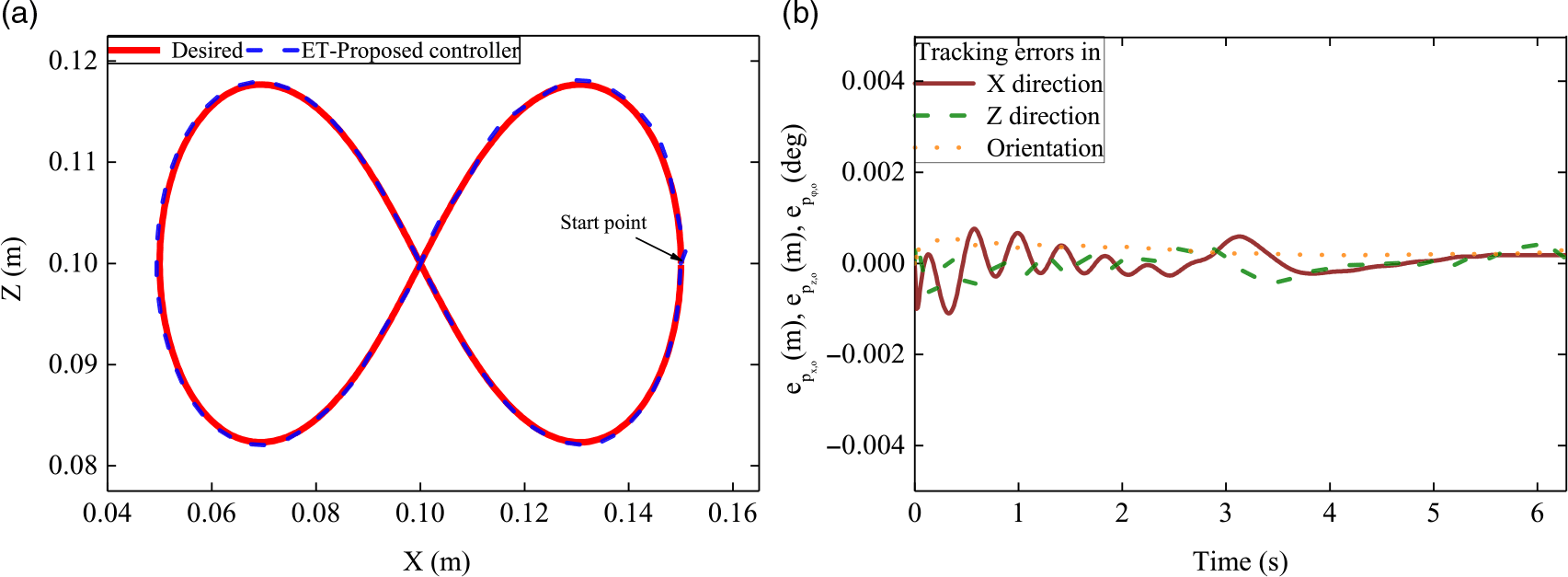
The trajectory tracking results of the lemniscate trajectory using the cooperative dual-arm SCORBOT-ER VPlus manipulators are presented in Fig. 19. As illustrated in Fig. 19 (a), the dual-arm manipulator system with the implementation of the proposed ET control strategy transports the object successfully through the desired trajectory. In addition, the errors in the X direction, Z direction, and the object orientation are quite small, with a maximum absolute value of 1mm, as depicted in Fig. 19(b). It can be noticed from Fig. 20 that the proposed ET mechanism results in high inter-event time (0.21 s) with a considerable saving in the bandwidth utilization (around 75%) as compared with the traditional TT implementation. Based on the abovementioned discussion, the effectiveness of the proposed ET control scheme can be further verified for the dual-arm manipulator system during the cooperative manipulation task.
Trajectory tracking with proposed ET control scheme during V-REP validation. (a) Desired and actual trajectories on the X-Z plane. (b) Tracking errors in X-direction, Z-direction, and object orientation.

Inter-event time and triggering events for proposed ET control scheme during V-REP validation.

6. Conclusion
In this work, the coordination control problem of uncertain cooperative robotic manipulators under limited resources has been investigated. For this purpose, an improved adaptive backstepping position-force controller has been developed. This controller has been devoted to control the motion of the handled object through a predefined trajectory while attaining constant internal forces in the presence of uncertainties and external disturbances. Moreover, a Lyapunov-based ET mechanism has been designed to reduce the network load and maintain the stability of the system. A comparative study between the designed control scheme and various control strategies and triggering conditions has been carried out in the TrueTime network simulator. Additional validation of the designed controller has been conducted using dual-arm SCORBOT-ERVPlus manipulators in the V-REP platform. Based on the simulation runs, the proposed algorithm presents promising results for position and force tracking with a significant reduction in the number of transmissions over the network during the cooperative task. The future work will be dedicated to perform the experimental validation of the proposed control scheme during different real-time cooperative tasks. Moreover, the packet loss and time delay challenges in the networked system will be considered.
Acknowledgments
The first author would like to thank Al-Baath University, Ministry of Higher Education, Syrian Arab Republic for their support during the higher studies.
Conflict of Interests
The authors declare none.
A. Appendix
The dynamic model for each robotic manipulator is realized with the help of the recursive Newton-Euler algorithm. The components of the inertia matrix can be derived from Eqs. (A1–A6). The components of Coriolis and centrifugal forces are given in Eqs. (A7–A11). The gravitational and friction forces are presented in Eqs. (A12–A15). The Jacobian matrix is obtained by Eqs. (A16–A20).
The inertia matrix can be given as
 \begin{align}{{M}_{r,i}}({{\textbf{q}}_i}{\rm{,}}{\dot{\textbf{q}}_i}) = \left[ {\begin{array}{c@{\quad}c@{\quad}c}{{M_{i,11}}}&{{M_{i,12}}}&{{M_{i,13}}}\\{{M_{i,21}}}&{{M_{i,22}}}&{{M_{i,23}}}\\{{M_{i,31}}}&{{M_{i,31}}}&{{M_{i,33}}}\end{array}} \right]\end{align}
with
 \begin{align}\begin{array}{l}{M_{i,11}} = G{e_{i,1}}^2{I_{i,m1}} + {I_{i,1}} + \frac{{({I_{i,23}} \,+\, {I_{i,xx2}} \,+\, {I_{i,xx3}})}}{2} + {a_{i,1}}^2(\frac{{{m_{i,1}}}}{4} + {m_{i,23}}) + ({m_{i,2}} + 4{m_{i,3}})\frac{{{a_{i,2}}^2}}{8}\\ + {m_{i,3}}\frac{{{a_{i,3}}^2}}{8}(m{}_{i,2} + 2{m_{i,3}}){a_{i,1}}{a_{i,2}}C{\boldsymbol\theta _{i,2}} + \frac{{{m_{i,3}}}}{2}{a_{i,2}}{a_{i,3}}C{\boldsymbol\theta _{i,3}} + (\frac{{{I_{i,2}} - {I_{i,xx2}}}}{{{a_{i,2}}^2}} + \frac{{{m_{i,2}}}}{4} + {m_{i,3}}){a_{i,2}}^2\frac{{C2{\boldsymbol\theta _{i,2}}}}{2}\\ + {m_{i,3}}{a_{i,1}}{a_{i,3}}C{\boldsymbol\theta _{i,23}} + [\frac{{{I_{i,3}} - {I_{i,xx3}}}}{{{a_{i,3}}^2}} + \frac{{{m_{i,3}}}}{4}]{a_{i,3}}^2\frac{{C2{\boldsymbol\theta _{i,23}}}}{2} + \frac{{{m_{i,3}}}}{2}{a_{i,2}}{a_{i,3}}\cos (2{\boldsymbol\theta _{i,2}} + {\boldsymbol\theta _{i,3}})\end{array}\end{align}
 \begin{align}{M_{i,12}} = {M_{i,21}} = 0,{M_{i,13}} = {M_{i,31}} = 0\end{align}
 \begin{align}{M_{i,22}} = {I_{i,23}} + G{e_{i,2}}^2{I_{i,m2}} + (\frac{{{m_{i,2}}}}{4} + {m_{i,3}}){a_{i,2}}^2 + \frac{{{m_{i,3}}}}{4}{a_{i,3}}^2 + {m_{i,3}}{a_{i,2}}{a_{i,3}}C{\boldsymbol\theta _{i,3}}\end{align}
 \begin{align}{M_{i,23}} = {M_{i,32}} = {I_{i,3}} + \frac{{{m_{i,3}}}}{4}{a_{i,3}}^2 + \frac{{{m_{i,3}}}}{2}{a_{i,2}}{a_{i,3}}C{\boldsymbol\theta _{i,3}}\end{align}
 \begin{align}{M_{i,33}} = {I_{i,3}} + G{e_{i,3}}^2{I_{i,m3}} + \frac{{{m_{i,3}}}}{4}{a_{i,3}}^2\end{align}
The Coriolis and centrifugal matrix is given as
 \begin{align}{{C}_{r,i}}({{\textbf{q}}_i}{\rm{,}}{\dot{\textbf{q}}_i}) = \left[ {\begin{array}{c@{\quad}c@{\quad}c}{{C_{i,11}}}&{{C_{i,12}}}&{{C_{i,13}}}\\{{C_{i,21}}}&{{C_{i,22}}}&{{C_{i,23}}}\\{{C_{i,31}}}&{{C_{i,31}}}&{{C_{i,33}}}\end{array}} \right]\end{align}
 \begin{align}\begin{array}{l}{C_{i,11}} = - \{ ({m_{i,2}} + 2{m_{i,3}}){a_{i,1}}{a_{i,2}}S{\boldsymbol\theta _{i,2}} + (\frac{{{I_{i,2}} - {I_{i,xx2}}}}{{{a_{i,2}}^2}} + \frac{{{m_{i,2}}}}{4} + {m_{i,3}}){a_{i,2}}^2S2{\boldsymbol\theta _{i,2}} + {m_{i,3}}{a_{i,1}}{a_{i,3}}S{\boldsymbol\theta _{i,23}} + {m_{i,3}}\\ + {a_{i,2}}{a_{i,3}}sin(2{\boldsymbol\theta _{i,2}} + {\boldsymbol\theta _{i,3}}) + (\frac{{{I_{i,3}} - {I_{i,xx3}}}}{{{a_{i,3}}^2}} + \frac{{{m_{i,3}}}}{4}){a_{i,3}}^2S2{\boldsymbol\theta _{i,23}}\} \frac{{{{\dot{\boldsymbol\theta}}_{i,2}}}}{2} - \{ \frac{{{m_{i,3}}}}{2}{a_{i,2}}{a_{i,3}}S{\boldsymbol\theta _{i,3}} + {m_{i,3}}{a_{i,1}}{a_{i,3}}S{\boldsymbol\theta _{i,23}}\\ + \frac{{{m_{i,3}}}}{2}{a_{i,2}}{a_{i,3}}sin(2{\boldsymbol\theta _{i,2}} + {\boldsymbol\theta _{i,3}}) + (\frac{{{I_{i,3}} - {I_{i,xx3}}}}{{{a_{i,3}}^2}} + \frac{{{m_{i,3}}}}{4}){a_{i,3}}^2S2{\boldsymbol\theta _{i,23}}\} \frac{{{{\dot{\boldsymbol\theta}}_{i,3}}}}{2}\end{array}\end{align}
 \begin{align}\begin{array}{l}{C_{i,12}} = - {C_{i,21}} = - \{ ({m_{i,2}} + 2m{}_{i,3}){a_{i,1}}{a_{i,2}}S{\boldsymbol\theta _{i,2}} + (\frac{{{I_{i,2}} - {I_{i,xx2}}}}{{{a_{i,2}}^2}} + \frac{{{m_{i,2}}}}{4} + {m_{i,3}}){a_{i,2}}^2S2{\boldsymbol\theta _{i,2}} + {m_{i,3}}[{a_{i,1}}{a_{i,3}}S{\boldsymbol\theta _{i,23}}\\ + {a_{i,2}}{a_{i,3}}sin(2{\boldsymbol\theta _{i,2}} + {\boldsymbol\theta _{i,3}})] + (\frac{{{I_{i,3}} - {I_{i,xx3}}}}{{{a_{i,3}}^2}} + \frac{{{m_{i,3}}}}{4}){a_{i,3}}^2S2{\boldsymbol\theta _{i,23}}\} \frac{{{{\dot{\boldsymbol\theta}}_{i,1}}}}{2}\end{array}\end{align}
 \begin{align}\begin{array}{l}{C_{i,13}} = - {C_{i,31}} = - \{ \frac{{{m_{i,3}}}}{2}{a_{i,2}}{a_{i,3}}S{\boldsymbol\theta _{i,3}} + {m_{i,3}}{a_{i,1}}{a_{i,3}}S{\boldsymbol\theta _{i,23}} + \frac{{{m_{i,3}}}}{2}{a_{i,2}}{a_{i,3}}sin(2{\boldsymbol\theta _{i,2}} + {\boldsymbol\theta _{i,3}})\\ + (\frac{{{I_{i,3}} - {I_{i,xx3}}}}{{{a_{i,3}}^2}} + \frac{{{m_{i,3}}}}{4}){a_{i,3}}^2S2{\boldsymbol\theta _{i,23}}\} \frac{{{{\dot{\boldsymbol\theta}}_{i,1}}}}{2}\end{array}\end{align}
 \begin{align}{C_{i,22}} = - {m_{i,3}}{a_{i,2}}{a_{i,3}}S{\boldsymbol\theta _{i,3}}\frac{{{{\dot{\boldsymbol\theta}}_{i,3}}}}{2},{C_{i,23}} = - {m_{i,3}}{a_{i,2}}{a_{i,3}}S{\boldsymbol\theta _{i,3}}\frac{{{{\dot{\boldsymbol\theta}}_{i,23}}}}{2},{C_{i,32}} = \frac{{{m_{i,3}}}}{2}{a_{i,2}}{a_{i,3}}S{\boldsymbol\theta _{i,3}}{\dot{\boldsymbol\theta} _{i,2}},{C_{i,33}} = 0\end{align}
the gravitational forces is given by
 \begin{align}{{G}_{r,i}}({{\textbf{q}}_i}) = \left[ {\begin{array}{*{20}{c}}{{G_{i,1}}}\\{{G_{i,2}}}\\{{G_{i,3}}}\end{array}} \right]\end{align}
with
 \begin{align}{G_{i,1}} = 0,{G_{i,2}} = - [(\frac{{{m_{i,2}}}}{2} + {m_{i,3}}){a_{i,2}}C{\boldsymbol\theta _{i,2}} + \frac{{{m_{i,3}}}}{2}{a_{i,3}}C{\boldsymbol\theta _{i,23}})]g,\,\;{G_{i,3}} = - \frac{{{m_{i,3}}}}{2}{a_{i,3}}C{\boldsymbol\theta _{i,23}}g\end{align}
The friction forces can be obtained as follows:
 \begin{align}{{B}_{r,i}}({\dot{\textbf{q}}_i}) = \left[ {\begin{array}{*{20}{c}}{{B_{i,1}}}\\{{B_{i,2}}}\\{{B_{i,3}}}\end{array}} \right]\end{align}
 \begin{align}{B_{i,1}} = G{e_{i,1}}^2{b_{i,1}}{\dot{\boldsymbol\theta}_{i,1}},{B_{i,2}} = G{e_{i,2}}^2{b_{i,2}}{\dot{\boldsymbol\theta}_{i,2}},{B_{i,3}} = G{e_{i,3}}^2{b_{i,3}}{\dot{\boldsymbol\theta} _{i,3}}\end{align}
The Jacobian matrix is defined as
 \begin{align}{\textbf{J}_i}({{\textbf{q}}_i}) = \left[ {\begin{array}{c@{\quad}c@{\quad}c}{{J_{i,11}}}&{{J_{i,12}}}&{{J_{i,13}}}\\{{J_{i,21}}}&{{J_{i,22}}}&{{J_{i,23}}}\\{{J_{i,31}}}&{{J_{i,31}}}&{{J_{i,33}}}\end{array}} \right]\end{align}
 \begin{align}{J_{i,11}} = - S{\boldsymbol\theta _{i,1}}({a_{i,1}} - 0.135S{\boldsymbol\theta _{i,23}} + {a_{i,3}}C{\boldsymbol\theta _{i,23}} + {a_{i,2}}C{\boldsymbol\theta _{i,2}})\end{align}
 \begin{align}{J_{i,12}} = C{\boldsymbol\theta _{i,23}}C{\boldsymbol\theta _{i,1}}({a_{i,2}}S{\boldsymbol\theta _{i,3}} - 0.135) - {a_{i,3}}S{\boldsymbol\theta _{i,23}}C{\boldsymbol\theta _{i,1}},{J_{i,13}} = - 0.135C{\boldsymbol\theta _{i,23}}C{\boldsymbol\theta _{i,1}} - {a_{i,3}}S{\boldsymbol\theta _{i,23}}C{\boldsymbol\theta _{i,1}}\end{align}
 \begin{align}{J_{i,21}} = 0,{J_{i,22}} = - S{\boldsymbol\theta _{i,23}}C{\boldsymbol\theta _{i,1}}({a_{i,2}}S{\boldsymbol\theta _{i,3}} - 0.135) - C{\boldsymbol\theta _{i,23}}({a_{i,3}} + {a_{i,2}}C{\boldsymbol\theta _{i,3}}),{J_{i,23}} = 0.135S{\boldsymbol\theta _{i,23}} - {a_{i,3}}C{\boldsymbol\theta _{i,23}}\end{align}
 \begin{align}{J_{i,31}} = C(conj{\boldsymbol\theta _{i,2}} + conj{\boldsymbol\theta _{i,3}})S{\boldsymbol\theta _{i,23}}S{\boldsymbol\theta _{i,1}} - S(conj({\boldsymbol\theta _{i,2}}) + conj({\boldsymbol\theta _{i,3}}))C{\boldsymbol\theta _{i,23}}S{\boldsymbol\theta _{i,1}},{J_{i,32}} = C{\boldsymbol\theta _{i,1}},{J_{i,33}} = C{\boldsymbol\theta _{i,1}}\end{align}
 \begin{align*}\begin{array}{l}{\rm{where }}\ C{\boldsymbol\theta _{i,j}} = \cos ({\boldsymbol\theta _{i,j}}),S{\boldsymbol\theta _{i,j}} = \sin ({\boldsymbol\theta _{i,j}}),C{\boldsymbol\theta _{i,jk}} = \cos ({\boldsymbol\theta _{i,j}} + {\boldsymbol\theta _{i,k}}),S{\boldsymbol\theta _{i,jk}} = \sin ({\boldsymbol\theta _{i,j}} + {\boldsymbol\theta _{i,k}}),{m_{i,jk}} = ({m_{i,j}}\\ + {m_{i,k}}),{I_{i,jk}} = ({I_{i,j}} + {I_{i,k}}),{{\dot{\boldsymbol\theta}}_{i,jk}} = ({{\dot{\boldsymbol\theta}}_{i,j}} + {{\dot{\boldsymbol\theta}}_{i,k}})\end{array}\end{align*}
where
 ${a_{i,1}}$
,
 ${a_{i,2}}$
and
 ${a_{i,3}}$
denotes the length of the first, second, and third link, respectively for the
 ${i^{th}}$
manipulator,
 ${m_{i,j}}$
is the mass of the defined link for the
 ${i^{th}}$
manipulator,
 ${I_{i,j}}$
is the moment of inertia for the respected link,
 $g$
is the gravitational acceleration,
 $G{e_{i,j}}$
is the ratio of the motor gears and
 ${b_{i,j}}$
is the coefficient of joint friction.
B. Appendix
In this section, the traditional and state augmented adaptive backstepping control laws utilized in Section 5 are stated. Moreover, the event-triggered sliding mode control law and triggering condition are given for the cooperative manipulator system based on the results reported in ref. [Reference Kumari, Behera and Bandyopadhyay39]. The force controller is designed to be the same in all three cases.
For traditional adaptive backstepping control (AB):
 \begin{align}{{\boldsymbol{\tau}}_a} = {\boldsymbol{\unicode{x03B7}} \textbf{(q)}}{\left( {{{\boldsymbol{\unicode{x03B7}} }^{\rm{T}}}{\textbf{(q)}}{\boldsymbol{\unicode{x03B7}} \textbf{(q)}}} \right)^{ - 1}}{{z}_1} + {\textbf{k}_2}{\boldsymbol{\unicode{x03B7}} \textbf{(q)}}{{z}_2} + {\boldsymbol\Phi \hat{\boldsymbol\Lambda} + }{\textbf{J}_{t}}^T({\textbf{x}_o})\left( {{\textbf{F}_{I,d}} + {\textbf{k}_{f,p}}{{\textbf{e}}_{{F_I}}} + {\textbf{k}_{f,i}}\int\limits_0^t {{{\textbf{e}}_{{F_I}}}dt} } \right);\nonumber\\[3pt]{{z}_1} = {\textbf{x}_2}{\rm{ and }}{{z}_2} = {\textbf{x}_3} - {\textbf{k}_1}{\textbf{z}_1}\end{align}
For state augmented adaptive backstepping control (AUAB):
 \begin{align}{{\boldsymbol{\tau}}_a} = {\boldsymbol{\unicode{x03B7}} \textbf{(q)}}{\left( {{{\boldsymbol{\unicode{x03B7}} }^{\rm{T}}}{\textbf{(q)}}{\boldsymbol{\unicode{x03B7}} \textbf{(q)}}} \right)^{ - 1}}{{\textbf{e}}_2} + {{\boldsymbol{\upsilon }}_3}{\boldsymbol{\unicode{x03B7}} \textbf{(q)}}{{\textbf{e}}_3} + {\boldsymbol\Phi \hat{\boldsymbol\Lambda} + }{\textbf{J}_{t}}^T({\textbf{x}_o})\left( {{\textbf{F}_{I,d}} + {\textbf{k}_{f,p}}{{\textbf{e}}_{{F_I}}} + {\textbf{k}_{f,i}}\int\limits_0^t {{{\textbf{e}}_{{F_I}}}dt} } \right);\nonumber\\[3pt]{{\textbf{e}}_3} = {{\textbf{x}}_3} - {{\textbf{e}}_1} - {{\boldsymbol{\upsilon }}_1}{\boldsymbol\delta }{{\textbf{x}}_2} - {{\boldsymbol{\upsilon }}_2}{{\textbf{e}}_2}\end{align}
For the sake of fair comparison and to illustrate the effect of the non-linear damping term on the controller performance, the parameters of AB and AUAB control schemes are chosen similar to the proposed control scheme. For AB:
 ${\textbf{k}_1} = {{\textbf{c}}_2} = {\textrm{diag}}(30,{{ 30}},{{ 30}})$
,
 ${{\textbf{k}}_2} = {{\textbf{c}}_3} = 8.5{I_6}$
,
 ${\boldsymbol\Omega } = 6500{I_6}$
,
 ${\textbf{k}_{f,p}} = 0.1{I_6}$
, and
 ${\textbf{k}_{f,i}} = 20{I_6}$
,
 $\xi = 0.9$
and for AUAB:
 ${{\boldsymbol{\upsilon }}_1} = {{\textbf{c}}_1} = {\textrm{diag}}(0.1,{\rm{ 0}}{\rm{.1}},0.1),{{\boldsymbol{\upsilon }}_2} = {{\textbf{c}}_2} = {\textrm{diag}}(30,{{ 30}},{{ 30}})$
,
 ${{\boldsymbol{\upsilon }}_3} = {{\textbf{c}}_3} = 8.5{I_6}$
,
 ${\delta } = 50$
,
 ${\Omega } = 6500{I_6}$
,
 ${{k}_{f,p}} = 0.1{I_6}$
,
 ${{k}_{f,i}} = 20{I_6}$
, and
 $\xi = 0.9$
.
For sliding mode control (ET-SMC), the sliding manifold is expressed as
 \begin{align}S_{i}=\{{\tilde{\textbf{x}}_{i}}\in\mathbb{R}^{6}: \textbf{s}_{i}=\textbf{c}_i\tilde{\textbf{x}}_i=0\} \end{align}
where for
 $i = 1,2$
,
 ${{\textbf{c}}_i} = [{{\textbf{c}}_{i,1}} I]$
with
 $i = 1,2$
,
 $\textbf{c}_{i,1}\in{\mathbb{R}}^{3\times3}$
,
 ${\tilde{\textbf{x}}_i} = \left[ \begin{array}{l}{{\tilde{\textbf{x}}}_{i,1}}\\{{\tilde {\textbf{x}}}_{i,2}}\end{array} \right] = \left[ \begin{array}{l}{{\textbf{q}}_i} - {{\textbf{q}}_{d,i}}\\{{\dot{\textbf{q}}}_i} - {{\dot{\textbf{q}}}_{d,i}}\end{array} \right]$
, and
 ${\dot{\textbf{q}}_{r,i}} = {\dot{\textbf{q}}_{d,i}} - {{\textbf{c}}_{i,1}}{\tilde {\textbf{x}}_{i,1}}$
. The sliding mode control law can be derived as follows.
 \begin{align}{{\boldsymbol{\tau}}_{a,i}} = {{\textbf{M}}_{r,i}}({{\textbf{q}}_i}){\ddot{\textbf{q}}_{r,i}} + {{\textbf{C}}_{r,i}}({{\textbf{q}}_i},{\dot{\textbf{q}}_i}){\dot{\textbf{q}}_{r,i}} + {{\textbf{G}}_{r,i}}({{\textbf{q}}_i}) - {{\textbf{K}}_i}{\rm{sign}}({{\textbf{s}}_i}){ + }{{J}_i}^T({{\textbf{q}}_i})\left( {\textbf{F}_{_{I,d}}^i + \textbf{k}_{_{f,p}}^i{\textbf{e}}_{_{{F_I}}}^i + \textbf{k}_{_{f,i}}^i\int\limits_0^t {{\textbf{e}}_{_{{F_I}}}^idt} } \right)\end{align}
with the following triggering rule:
 \begin{align}{L_i}\left\| {{{\textbf{c}}_i}} \right\|\left\| {{{\textbf{e}}_i}} \right\| \lt {{\beta }_{i}}{{\rho }_{i}}\end{align}
where
 ${{\textbf{e}}_i} = {\tilde {\textbf{x}}_i}({t_j}) - {\tilde {\textbf{x}}_i}(t)$
for
 $t \in \left[ {{t_j},{t_{j + 1}}} \right)$
. The parameters of the event-triggered sliding mode controller are chosen to obtain an acceptable tracking performance with a minimum number of transmissions over the network. These parameters are defined as follows: for
 $i = 1,2$
 ${{\textbf{c}}_{i,1}}{\rm{ = diag}}(150,{\rm{ 150}},150)$
,
 ${{\textbf{K}}_i}{\rm{ = diag}}(5,{\rm{ 5}},5)$
,
 ${{\beta }_{i}}{\rm{ = 0}}{\rm{.5}}$
,
 ${{\rho }_{i}} = 0.1$
,
 ${L_i} = 0.5$
,
 $\textbf{k}_{_{f,p}}^i = 0.1{I_3}$
, and
 $\textbf{k}_{_{f,i}}^i = 20{I_3}$
.