1. Introduction
Famines, defined as extreme scarcity of food, can be caused by multiple reasons including war, disasters, crop failures, population imbalance, widespread poverty, economic recession and government policies. According to the World Food Programme, there are currently more than 50 million people on the verge of famine and risk of starvation, up from 27 million in 2019 (WFP, 2021). Earlier demographic and epidemiological studies have predominantly focused on the mortality effects of famine (Meng and Qian, Reference Meng and Qian2009), whereas more recent studies on their long-term effects are mostly focused on countries such as the Netherlands, China and Greece for which good quality datasets are available (e.g., Neelsen and Stratmann, Reference Neelsen and Stratmann2011; Ampaabeng and Tan, Reference Ampaabeng and Tan2013; Scholte et al., Reference Scholte, van Den Berg and Lindeboom2015). For developing countries with repeated occurrences of famine such as Bangladesh and Ethiopia, only a limited number of studies are available on their long-term effects (e.g., Razzaque et al., Reference Razzaque, Alam, Wai and Foster1990; Arage et al., Reference Arage, Belachew, Hajmahmud, Abera, Abdulhay, Abdulahi and Abate2021). Moreover, previous studies have ambiguous results on the effect of in utero and early childhood famine exposure on adulthood health outcomes, therefore requiring further case-specific investigations rather than generalization of policies and remedial measures based on earlier findings. Since the mismatch between the growth in rice price and agricultural wages, which defines the local level entitlement failure and therefore causes the famine (Sen, Reference Sen1980, Reference Sen1981), is a local level phenomenon (e.g., Reardon, Reference Reardon1997; Fink et al., Reference Fink, Jack and Masiye2020), identifying the long-term effects of famine requires a difference-in-difference setup which was absent in existing studies on famine in Bangladesh. Against this backdrop, we contribute to academic and policy literature by providing the first empirical research using nationally representative survey data to investigate the long-term health effects of the 1974–75 Bangladesh famine.
Right after its independence in 1971, Bangladesh experienced a series of major natural and political events that adversely impacted the lives and livelihoods of its citizens. The worst post-independence event occurred in 1974, when the northern regions of Bangladesh were severely affected by the monsoon flood of June, triggering the now infamous 1974–75 Great Bangladesh famine which may have been responsible for 0.45–1.5 million deaths (Alamgir, Reference Alamgir1980).Footnote 1 Although the causes and immediate consequences of the famine have been explored thoroughly (e.g., Sen, Reference Sen1981), the long-term impacts of the famine on the well-being of children who survived has received very little attention. We fill this gap by investigating the long-term health effects of the 1974–75 Bangladesh famine on those children born and raised during this event and its immediate aftermath.
This paper joins the growing literature investigating the ‘fetal origin’ hypothesis that states that adverse environmental, political, or economic events in early childhood affect adulthood achievements including health outcomes (Almond and Currie, Reference Almond and Currie2011; Almond et al., Reference Almond, Edlund and Palme2018). Affected households, especially from developing countries, often adopt coping strategies that are intended for immediate survival, such as reducing food intakes, sending children to paid work, early marriage of daughters, and selling of productive assets. Household expenditures on such coping strategies usually come at the expense of longer term investments, such as health care and education for children. Consequently, children from affected households are raised with less investment in their human capital development, resulting in a lower human capital endowment during their adulthood.
To explore this linkage between early-life adversity and later-life outcomes for the case of the 1974–75 Bangladesh famine, we hypothesize that children born and raised during the famine in affected regions will have lower health outcomes than children born and raised during non-famine years in unafffected regions. We adopt a difference-in-difference framework, where historic data were used to classify famine-affected and unaffected regions and cohorts. All outcome and socioeconomic data come from three waves of the Bangladesh Household Income and Expenditure (HIES) survey.
We make a number of novel contributions to the literature exploring the fetal origin hypothesis. First, to our knowledge, our analysis is the first to apply and test this hypothesis with respect to the 1974–75 Bangladesh famine by employing a natural experiment frameork. We use nationally representative repeated cross-section data to identify the long-term effects of the 1974–75 famine. In earlier literature, Razzaque et al. (Reference Razzaque, Alam, Wai and Foster1990) used the Matlab DHS dataset to identify the adverse impacts of the famine on households. However, the Matlab DHS data cover only the Chandpur district of Bangladesh. Not only was this region largely outside the area most impacted by the famine, but also a single-region study prohibits comparison with non-affected regions. In contrast, our analysis and approach are able to investigate the long-term effects of the 1974–75 famine using a difference-in-difference framework.
Second, understanding the long-term consequences of famine and similar adversities is important for formulating and implementing effective policy measures during such emergencies and their aftermath. Our results indicate that children exposed to famine have significantly lower health outcomes, and this human capital effect could have important implications for the long-term economic growth of the economy. Considering that Bangladesh is undergoing significant rural transformation, whereby it is reducing its reliance on agricutlure and diversifying its economy, such a human capital impact could be substantial. Therefore, public policies aimed at ameliorating the harms of famine must also account for long-lasting health effects that are detrimental to human capital development, especially in rural areas.
The outline of the paper is as follows. Section 2 briefly reviews related literature. Section 3 provides background of the 1974–75 famine in Bangladesh. Section 4 develops the empirical strategy and describes the data and variables. Section 5 reports and analyzes the main results. Section 6 provides additional results and robustness tests. Finally, section 7 draws on policy implications and concludes.
2. Literature review
Existing literature on the fetal origin hypothesis in reference to famines provides evidence of different adversities that the affected people may face in their later life. Examples of such adversities include increased risk of diabetes (van Abeelen et al., Reference van Abeelen, Elias, Bossuyt, Grobbee, van der Schouw, Roseboom and Uiterwaal2012; Finer et al., Reference Finer, Iqbal, Lowe, Ogunkolade, Pervin, Mathews, Smart, Alam and Hitman2016; Liu et al., Reference Liu, Chen, Shi, Qu, Zhao, Xuan and Sun2020; Abate et al., Reference Abate, Arage, Hassen, Abafita and Belachew2022), obesity (Ravelli et al., Reference Ravelli, Stein and Susser1976; Finer et al., Reference Finer, Iqbal, Lowe, Ogunkolade, Pervin, Mathews, Smart, Alam and Hitman2016; Zhou et al., Reference Zhou, Zhang, Xuan, Fan, Yang, Hu, Bo, Wang, Sheng and Wang2018), cardiometabolic non-communicable disease (Grey et al., Reference Grey, Gonzales, Abera, Lelijveld, Thompson, Berhane, Abdissa, Girma and Kerac2021), dyslipidemia in female adults (Yao and Li, Reference Yao and Li2019), chronic diseases (Hu et al., Reference Hu, Liu and Fan2017), cardiovascular and metabolic diseases (Veenendaal et al., Reference Veenendaal, Costello, Lillycrop, de Rooij, van Der Post, Bossuyt, Hanson, Painter and Roseboom2012; Xu et al., Reference Xu, Li, Zhang and Liu2016), psychological disorders in adulthood (Neugebauer et al., Reference Neugebauer, Hoek and Susser1999; Brown et al., Reference Brown, van Os, Driessens, Hoek and Susser2000; Hulshoff Pol et al., Reference Hulshoff Pol, Hoek, Susser, Brown, Dingemans, Schnack, van Haren, Ramos, Gispen-de Wied and Kahn2000), and glucose intolerance (Ravelli et al., Reference Ravelli, van der Meulen, Michels, Osmond, Barker, Hales and Bleker1998). Adversities also vary by different attributes such as gender (Koenig and D'Souza, Reference Koenig and D'Souza1986; Deng and Lindeboom, Reference Deng and Lindeboom2021) and location (Li and Lumey, Reference Li and Lumey2017).
Most studies of the long-term impact of famine on survivors have focused on the 1944–45 Dutch famine and 1959–61 Chinese famine. Existing studies provide ambiguous results in terms of the directions and magnitudes of effects. On one hand, there is some evidence from epidemiological studies on the long-term adverse effects of the Dutch Famine. For example, Scholte et al. (Reference Scholte, van Den Berg and Lindeboom2015) found that the people affected by the 1944–45 Dutch Hunger Winter during their first trimester of gestation experience negative labor market outcomes and higher hospitalization 53 or more years after birth. For China, Xu et al. (Reference Xu, Zhang, Li and Liu2018) found that children exposed to China's 1959–61 Great Leap Forward famine during prenatal and early postnatal life have significantly lower cognitive abilities. Moreover, there are also increased risks of mental illness (Huang et al., Reference Huang, Phillips, Zhang, Zhang, Shi, Song, Ding, Pang and Martorell2013) and obesity and depression (Cui et al., Reference Cui, Smith and Zhao2020) due to exposure to the 1959–61 Chinese famine.
In contrast, as Xu et al. (Reference Xu, Li, Zhang and Liu2016) concluded, existing evidence does not establish an unambiguous relationship – not only because of data limitations and modeling flaws but also because of differences in the severity and extent of different famines, the existing socioeconomic, financial, and political environment, and the appropriateness of emergency responses. Stanner et al. (Reference Stanner, Bulmer, Andres, Lantseva, Borodina, Poteen and Yudkin1997) did not find any evidence of long-term adversity from the 1941–44 Leningrad siege, whereas Luo et al. (Reference Luo, Mu and Zhang2006) found very little evidence of adversities from exposure to the Chinese famine.
Most related literature on developing countries is focused on Sub-Saharan Africa and South Asia. Ampaabeng and Tan (Reference Ampaabeng and Tan2013) found that the survivors of the 1983 famine in Ghana who were under two years of age during the famine had significantly lower intelligence scores. On the other hand, Arage et al. (Reference Arage, Belachew, Hajmahmud, Abera, Abdulhay, Abdulahi and Abate2021) examine the impact of early life famine exposure on adulthood anthropometry among survivors of the 1983–85 Ethiopian great famine. Their results indicate that decreased adult height and increased waist-to-height ratio were associated with early life exposure to famine, particularly prenatal and postnatal exposure.
Relevant literature on the 1974–75 great Bangladesh famine mainly focuses on the causes and immediate consequences with scarce focus on long-term effects. Alternative explanations behind the causes of the famine were portrayed in Sen (Reference Sen1981) and Muqtada (Reference Muqtada1981), among others. While Sen (Reference Sen1981) proposed the lack of entitlement as the key reason behind the famine, Muqtada (Reference Muqtada1981) critically assessed different sources and concluded that while the lack of entitlement is a more complete explanation, there can be multiple reasons behind the occurrence of the famine. Incomplete yet important explanations include damages to standing crops due to the June 1974 flood, lower per capita food availability, unequal growth in food prices and agricultural wages, and increased competition for land between highly labor-intensive jute and less labor-intensive rice cultivation (Muqtada, Reference Muqtada1981).
Studies on the consquences of the 1974–75 famine almost always used different waves of the Matlab Health and Socioeconomic Survey (MHSS). For example, Hernández-Julián et al. (Reference Hernández-Julián, Mansour and Peters2014) used the 1996 MHSS whereas Razzaque et al. (Reference Razzaque, Alam, Wai and Foster1990) used the 1974–79 waves of the MHSS. Razzaque et al. (Reference Razzaque, Alam, Wai and Foster1990) investigated the sustained effects, including mortality and migration rates, of the 1974–75 famine using a two-stage approach where they adopted a bivariate analysis in the first stage to identify the crude effects of different factors such as assets owned, gender and mothers' age during pregnancy and birth, and then the second stage adopted a multivariate logistic regression model to identify their net effects of famine, controlling for other factors. Results identify significantly higher mortality among the famine-born than the non-famine born cohorts for the overall sample and also for both males and females separately.
Hernández-Julián et al. (Reference Hernández-Julián, Mansour and Peters2014) used the 1996 MHSS and adopted different probit and ordinary least squares (OLS) regression specifications for children born between 1970 and 1980 to estimate the effect of famine exposure on neonatal and postneonatal mortality. Their key findings include significantly higher mortality due to in utero exposure to the 1974–75 famine.
In related research, Razzaque (Reference Razzaque1989) used household-level socioeconomic information from the 1974 census and registration data on births, deaths, and migrations from the 1974–79 MHSS and found that mortality rates that can be attributed to the 1974–75 famine are higher among the poorer than the richer households. Bairagi (Reference Bairagi1986) used the 1975–76 MHSS data and employed an OLS regression framework to indicate that the famine had significant adverse effects on child nutrition and these adversities vary by gender, seasonality, and different socioeconomic attributes. On the other hand, Finer et al. (Reference Finer, Iqbal, Lowe, Ogunkolade, Pervin, Mathews, Smart, Alam and Hitman2016) used the MHSS dataset to investigate effects of in utero famine exposure on increased risk of adulthood prevelance of type 2 diabetes and obesity. Using a cohort analysis, they found that the younger an adult was during exposure to the famine, the greater were the risks of diabetes and obesity during their adulthood.
However, despite providing a detailed longitudinal account of health and socioeconomic status of surveyed households, MHSS data only covers a certain region of Bangladesh whose population was not the primary or direct victims of the famine. Therefore, existing studies actually provide a measure of spillover effects of the famine on a less affected or unaffected region. Notable exceptions include Shabnam et al. (Reference Shabnam, Ulubaşoğlu and Guven2022) who investigated the educational impacts of early life exposure to the 1974–75 famine. We differ by first investigating the long-term health adversities of the 1974–75 famine using nationally representative survey data which allowed us to adopt the standard difference-in-difference estimation strategy.
3. The 1974–75 Bangladesh famine
Bangladesh has a long history of widepsread famines including the great famines of 1770, 1943, and 1974. In addition, there were several smaller famines in between these larger events. The 1770 famine (known as ‘Chhiyattarer Manvantar’ or ‘The Great Famine of 1176 Bangla Year’) was a consequence of severe drought in 1769 followed by excessive rainfall in 1770, resulting in damages to standing crops. The East India Company, the revenue collector on behalf of the colonial British government, did not ease up on revenue collection, thereby further adding to people's sufferings. Consequently, about 10 million people, or one-third of the total Bengal population, died from starvation.
During World War II, the Bengal was struck by the Great Bengal Famine of 1943 which followed from a series of crop failures from 1938. Essential supplies of foodgrains from Myanmar (then named Burma) were interrupted due to the war. Together with scarcity of food, influx of war refugees and rising food prices, the British government's policy to reallocate foodgrains to meet the demand of the army was at least partly responsible for the extent and severity of the 1943 famine. An estimated total of 3.5 million people died as a consequence.
Bangladesh experienced another famine in 1974–75 which was a consequence of, among others, internal and external political problems, a poor world food situation and, most importantly, a devastating flood that damaged two successive rice crops (Bairagi, Reference Bairagi1986). Soon after independence in 1971, Bangladesh faced serious economic challenges, such as rising prices for essential commodities, and political conflicts related to its liberation war (Eskander and Barbier, Reference Eskander and Barbier2022). The situation worsened when a major famine struck the northern regions of Rangpur and Mymensingh, combined with severe monsoon flooding of the Brahmaputra River during June to September in 1974. There was significant crop damage, which led to a further escalation in rice prices, a spike in unemployment and reduced purchasing power for households (Alamgir, Reference Alamgir1980; Sen, Reference Sen1981; Razzaque et al., Reference Razzaque, Alam, Wai and Foster1990). The severity of the situation forced the government to open around 5,825 langarkhanas Footnote 2 that fed about four million poor and famine affected people from September to December 1974 (Muqtada, Reference Muqtada1981).
However, direct causes include a combination of natural disasters, food availability decline and fluctuation in entitlements (Muqtada, Reference Muqtada1981). In this regard, figure 1 explores the growth rates of monthly rice price and agricultural wages.
Price of rice and farm wage rate, 1972–76.
Notes: Data on price of coarse rice and agricultural wages come from Alamgir and Salimullah (Reference Alamgir and Salimullah1977), where the latest data are available for July 1976. Panel A plots monthly average price of coarse rice expressed in taka per maund (where 1 maund = 37.3242 kg). Panel B plots monthly average agricultural wages in taka per day. Following Ravallion (Reference Ravallion1982), panel C plots percentage deviation from respective mean values for price of coarse rice per maund and daily agricultural wages. Finally, panel D plots kilograms of rice that can be bought by daily wage.

The famine spanned almost two years: it began in March 1974 when the price of coarse rice (taka per maundFootnote 3) started to increase (panel A in figure 1) at much faster rates than daily agricultural wages (panel B in figure 1) and reached its peak between July and October of that year (Alamgir and Salimullah, Reference Alamgir and Salimullah1977; Razzaque et al., Reference Razzaque, Alam, Wai and Foster1990; Hernández-Julián et al., Reference Hernández-Julián, Mansour and Peters2014). Sen (Reference Sen1981) also identified that the 1974–75 famine was due to lack of entitlement of food, especially for the agricultural wage workers, and not due to a shortage of food production.
Moreover, relative lack of connectivity with Dhaka also added to the woe. In fact, before the completion of the construction of Bangabandhu Bridge in 1998, northern districts of Bangladesh were less connected to the capital city of Dhaka which is the principal destination of seasonal migrants. The bridge linked the east and west sides of the river Jamuna, and in the process significantly reduced travel time and cost of transportation from northern districts to Dhaka (e.g., Jenkins and Shukla, Reference Jenkins and Shukla1997).
Although the famine subsided later in 1974, farm wage earners continued to face soaring prices in comparison to their daily agricultural wage (panels C and D in figure 1). Khan (Reference Khan1984) and Palmer-Jones (Reference Palmer-Jones1993) emphasize the importance of real wages of agricultural workers, which have strong empirical links with rice prices (Palmer-Jones and Parikh, Reference Palmer-Jones and Parikh1998). In addition, Ravallion (Reference Ravallion1982) empirically established that there was a significant structural break in short-run response of agricultural wages to rice prices at the time of the 1974–75 famine. In keeping with this finding, panel C confirms that the percentage deviation from the mean value was much higher for rice prices than agricultural wages up until September 1975, and then ultimately went back to pre-famine levels. Market failures and price speculation in food grains also played a substantial role in the famine (Ravallion, Reference Ravallion1982, Reference Ravallion1985). Altogether, the 1974–75 famine caused an estimated 0.45–1.5 million deaths through starvation and diseases such as cholera and diarrhea (Alamgir, Reference Alamgir1980).
4. Empirical strategy
4.1 Fetal origin hypothesis applied to the 1974–75 Bangladesh famine
The fetal origin hypothesis establishes the causal relationship between in utero exposure to adversities and adulthood health outcomes including diabetes, hypertension, and long-term disabilities (e.g., Barker, Reference Barker1990). Moreover, comprehensive reviews of medical evidence from selected developing countries by Walker et al. (Reference Walker, Wachs, Gardner, Lozoff, Wasserman, Pollitt and Carter2007) and Victora et al. (Reference Victora, Adair, Fall, Hallal, Martorell, Richter and Sachdev2008) show that early childhood in addition to in utero exposure can result in later life health adversities. Together, the fetal origin hypothesis implies that exposure to in utero or early infancy adversities will result in adulthood health adversities or lower health outcomes.
Common sources of such adversities, as identified in the public health, epidemiology, and economics literature, include disasters such as floods and storms, famine, war, and economic crises. The 1974–75 famine is an example of such adversities, especially for a newly independent country like Bangladesh with a huge population and population growth. Food scarcity affected a large population from northern regions of Bangladesh, especially pregnant women and children in their early infancy who are typically more vulnerable to food scarcity (e.g., Sparén et al., Reference Sparén, Vågerö, Shestov, Plavinskaja, Parfenova, Hoptiar, Paturot and Galanti2004), mostly due to their lower mobility and lack of income earning capabilities.
There are many undesirable consequences of famine. For example, using the 1996 Matlab MHSS, Hernández-Julián et al. (Reference Hernández-Julián, Mansour and Peters2014) found that the 1974–75 famine resulted in greater infant mortality among the in utero children, lower birth of male children, and greater number of stillbirths. Moreover, Razzaque et al. (Reference Razzaque, Alam, Wai and Foster1990) found that infant mortality was higher among the in utero children and infants during the 1974–75 Bangladesh famine.
Against this backdrop, for our analysis of the effects of the 1974–75 Bangladesh famine, we hypothesize that children born and raised during the famine in affected regions will have lower health outcomes than children born and raised during non-famine years in unaffected regions.
4.2 Famine regions and cohorts
Based on the literature (e.g., Alamgir, Reference Alamgir1980; Razzaque et al., Reference Razzaque, Alam, Wai and Foster1990; van Schendel, Reference van Schendel2009) and newspaper reports, the greater districts of Rangpur, Mymensingh, Bogra, and Pabna in northern Bangladesh are identified as the famine affected regions. Fifteen current administrative districts, which are parts of these four historical greater districts,Footnote 4 form the famine regions. Of them, Rangpur is the primary famine affected region, and the neighboring regions of Mymensingh, Bogra, and Pabna are secondary famine affected districts. On the other hand, the rest of the country forms the unaffected regions that include 49 current administrative districts. Online appendix figure A1 shows the locations of famine regions.
However, four greater districts – the Chittagong Hill Tracts (CHT), Chittagong, Dhaka, and Sylhet – may require special attention. Of them, the mountainous region of CHT is population scarce and was mostly inhabited by various indigenous communities up until 1975. These distinct features make CHT incomparable to the rest of the country. On the other hand, unlike other regions, the Dhaka and Chittagong regions were highly urban even in 1970s where alternative means of livelihoods are more available that can at least partially reduce some of the harms of famine. Moreover, the Sylhet region is highly dependent on remittance receipts from the Sylheti diaspora mainly in the UK, and is therefore relatively secure from domestic fluctuations in food prices. Therefore, we additionally consider regressions where we exclude these four regions from our estimation sample.
Next, we include newborns and early infants during the famine in the famine affected cohorts. This classification of famine affected cohorts directly follows from figure 1. Panel C shows that daily farm wage rates were keeping pace with the increasing wholesale price of rice except for the famine months in 1974 and 1975. In particular, panels C and D confirm that the famine spanned the period from March 1974 (i.e., when the price level started to go up from its long-term level) to June 1975 (i.e., when the price level started to go back to pre-famine levels). Therefore, children born in the years 1973, 1974, and 1975 are directly affected by this famine either during their prenatal or neonatal, or both, periods. That is, they experienced the adversities caused by the famine that can have detrimental effects on their adulthood outcomes. Consistent with the literature, we include newborns during 1973–75 in our famine affected cohorts.
In the years preceding the 1974–75 famine, Bangladesh was pummeled by a series of natural and political adversities including the 1970 cyclone and the 1971 liberation war of Bangladesh (see Eskander and Barbier (Reference Eskander and Barbier2022) for a detailed account). Therefore, we do not include earlier years in the unaffected cohorts to avoid any overlapping effect of those earlier events. In addition, we also exclude the years 1976 and 1977 to rule out the possibility of any remaining hardship the famine affected households were still experiencing. The unaffected cohorts are formed of newborns during 1978–81 who were not affected by the 1974–75 famine. Panel D in figure 1 further confirms that the purchasing power of daily wages went back to pre-famine levels in those years.
Altogether, there are 1,235 and 1,489 respondents that are included in our unaffected and famine cohorts, respectively, whereas there are 2,019, 531, and 174 individuals from unaffected, other famine regions, and the Rangpur region (shown in online appendix table A2). Moreover, there are a total of 374 individuals in our estimation sample who were born in famine-affected regions during 1973–75. Following the fetal origin hypothesis, we expect them to have lower health outcomes during their adulthood than the 904 individuals that were born in unaffected regions during 1978–81.
4.3 Identification strategy
We exploit the variations in timing and geography of the 1974–75 famine, as discussed above, in identifying variations in adulthood health outcomes. For this purpose, we use health outcomes that were included in the Bangladesh HIES which contains data on the incidence and duration of chronic illness. Surveyed individuals self-report whether they suffered from any chronic illness in the previous year. Common examples of such illnesses include injuries, disabilities, chronic heart disease, breathing problems, chronic dysentery, ulcers, blood pressure, arthritis, rheumatism, eczema, diabetes, cancer, leprosy, paralysis, and hysteria. HIES also reports the duration of any such chronic illness over an individual's lifetime. We extract our first health outcome variable, Healthy lifetime, i.e., an individual's total life-years without any chronic illness, as the difference between current age and lifetime duration of illness. Our second measure of health outcome is the ‘% of healthy lifetime’, i.e., percentage of lifetime without any chronic illness.
For the outcome variable y, the long-term impacts of the 1974–75 famine in Bangladesh is estimated by

for a household i. R and C denote the famine regions and cohorts, respectively. We expect famine exposure to result in lower long-term health outcomes, implying the long-term adverse effects of in utero or early childhood famine exposure. Therefore, we interact region and cohort dummies which yields the parameter of interest, $\beta$ . The vector of controls, $x^{\prime}$
 , includes household and regional level variables. In addition, ${\tau _{yob}}$
 , ${\Delta _{pob}}$
 and ${H_{yos}}$
 represent the vectors of birthyear, birthplace (i.e., subdivision) and survey year indicators, respectively.
Within the famine cohort, long-term effects of exposure to the 1974–75 famine should be common to all households and individuals born in the same locality (e.g., Almond et al., Reference Almond, Currie and Duque2009; Maccini and Yang, Reference Maccini and Yang2009). Therefore, variations in children's adulthood outcomes resulting from the variations in their time and place of birth should be absorbed by the full set of birthyear $({\tau _{yob}})$ and birthplace $({\Delta _{pob}})$
 fixed effects. In particular, ${\tau _{yob}}$
 controls for all other year-specific influences on children's adulthood outcomes, whereas ${\Delta _{pob}}$
 controls for persistent effects of disaster exposure on the regions and households where the children are born. Finally, since data comes from three different survey years, we include a vector of survey year indicators, ${H_{yos}}$
 , to control for any variations in adulthood outcomes specific to the survey year. These fixed effects control for unobserved time-varying factors that are common across the regions.
Parameter $\beta$ allows for differential effects of regions on disaster cohorts and we hypothesize that $\hat{\beta } < 0$
 . We assume that

That is, our identifying assumption is the independence between the disturbances and the measure of exposure to a disaster, conditional on permanent differences between the districts of birth and other control variables. However, ${\epsilon _i} = {\eta _{id}} + {u_i}$ , where ${u_i}$
 is the white noise error term, but ${\eta _{id}}$
 may be correlated across i within d. We cluster the standard errors at the district level to overcome this problem, allowing for correlation in the error terms of observations within the same thana (i.e., subdivision).
The HIES dataset does not report birthplaces. Therefore, we assume that the respondents were born in their respective location of current residence. To explicitly account for this issue, we additionally investigate by excluding four qualitatively different regions of Bangladesh from our estimating sample to reduce the potential discrepancy between birthplace and current residence: the densely populated and highly urban greater districts of Dhaka and Chittagong, the remittance-heavy Sylhet, and the population-scarce and mountainous CHT.
Finally, migration is a natural response to famine. The 1974–75 famine was a rural phenomenon, and many affected people migrated either temporarily or permanently to different urban centers across the country. Although Razzaque et al. (Reference Razzaque, Alam, Wai and Foster1990) and Razzaque (Reference Razzaque1989) did not find any statistically significant migration response to famine exposure, their analyses were based on only a single region, and they did not adopt a difference-in-difference framework to draw on causal inference. Instead, consistent with Sen (Reference Sen1981), we postulate that those who are primarily non-farmers and have lower landholding may be more vulnerable to the harms of famine due to their lack of entitlement to food. If this is true, then the estimated adverse effects of famine should be higher among the non-farmers. We, therefore, additionally employ specification (1) on the sample of non-agricultural households.
4.4 Data and variables
Health outcome and household-level control variables come from three waves of the HIES dataset, which is the principal source of household-level socio-economic data in Bangladesh. We extract an estimation sample of 2,724 observations using the HIES datasets from the survey years 2000, 2005, and 2010.
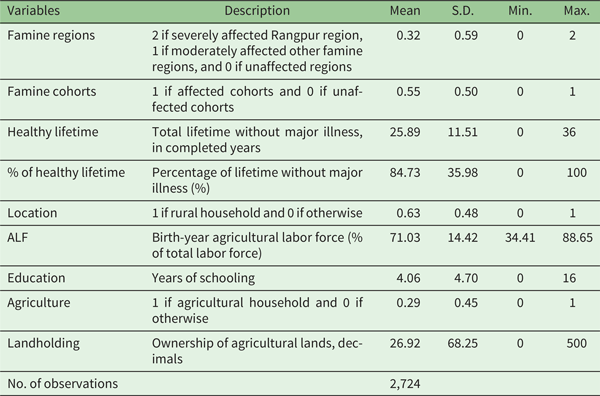
The vector $x^{\prime}$ is a vector of controls for current household characteristics, and labor market conditions during the birthyear to control for selection into fertility (Almond et al., Reference Almond, Currie and Duque2009). Measures of household and individual characteristics include location and education. We control for ‘location’ defined as 1 if the household lives in a rural area and 0 if otherwise, and ‘Education’ measured as years of schooling. In addition, we use ‘ALF’ (i.e., percentage of labor force employed in agriculture during the birth year) as a measure of regional labor market conditions and its dependency on agriculture during the birth year. We also control for ‘landholding’ which is a measure of entitlement in this context. We use inverse hyperbolic sine transformation for both the ALF and landholding variables to reduce potential skewness in their respective distribution. Data on ALF comes from the Statistical Yearbook of Bangladesh (BBS, various years) and the Population and Housing Census of Bangladesh (BBS, 2011). All other control variables come from the HIES datasets. Table 1 reports the summary statistics of all the variables used in our empirical analysis.
Variable description and summary statistics

Notes: Summary statistics consider birth cohorts 1973–75 and 1978–81, so that the number of valid observations is 2,724. Landholding is expressed in decimals where 1 acre = 100 decimals.
5. Main results
We start by investigating the parallel trends assumption that is necessary for validating a difference-in-difference specification. For this purpose, we employ the regression ${y_i} = {\alpha _0} + \vartheta R + {\epsilon _i}$ for the unaffected cohorts, where R denotes famine regions. Results in online appendix table A3 confirm that other famine regions have similar health outcomes, whereas Rangpur region had significantly better health outcomes in comparison to unaffected regions when unaffected (i.e., over the years 1978–1981). Therefore, statistically significant negative values for our coefficients of interest will necessarily portray causal relationships.
Table A4 (online appendix) reports the balancing properties: whether important explanatory and other variables vary across famine regions and cohorts. There is mixed evidence; for example, some variables that we control for in regressions according to equation (1), such as ALF, have statistically significant variations, whereas location is similar across famine regions and cohorts. Overall, these results justify the inclusion of these control variables in our regression models.
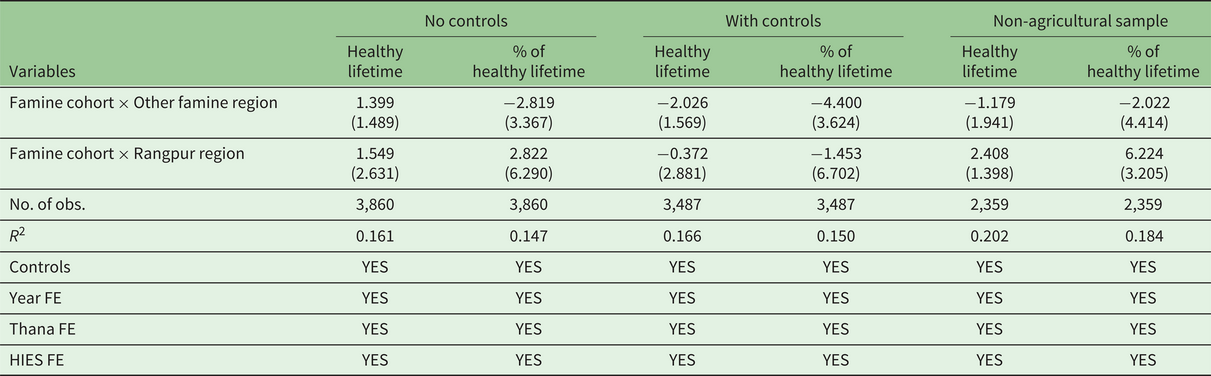
Table 2 reports the results on the long-term health adversities of the 1974–75 famine. For both the outcome variables ‘Healthy lifetime’ and ‘% of Healthy lifetime’, we report our results using the entire sample of 2,685 respondents and a sample of 1,852 respondents from non-agricultural households, as specified in the column headings. Control variables are reported, but we confine our discussion only to the parameter of interest, $\hat{\beta }$ , given by the coefficients of ‘Famine Cohort × Famine Region’. Famine regions and cohorts follow the definitions in section 4.2, whereas all regressions include the indicator variables for year of birth, subdivision/thana of birth, and survey year.
Health adversities of the 1974–75 famine

Notes: Standard errors clustered at the district level are shown in parentheses. The table presents estimates from regressions of whether exposure to the 1974–75 famine induces long-term health adversities, according to the empirical specification (1). All the variables follow their respective definitions in table 1. All regressions include the indicator variables for year of birth, subdivision/thana of birth, and survey year. The parameter of interest, $\hat{\beta }$ , is given by the coefficients of ‘Famine cohort × Famine region’. Famine regions and cohorts follow the definitions in section 4.2.
In all cases, results confirm $\hat{\beta } < 0$ for both the health outcome variables. However, estimated coefficients are statistically significant only for the severely affected Rangpur region. Therefore, we identify significant long-term health adversities for the 1973–75 cohorts from Rangpur region. Estimated effects are similar with and without the control variables but we will focus only on our main results where we include the controls. When compared to the 1978–81 cohorts from the unaffected regions, the 1973–75 cohorts from Rangpur region have 1.8 less years of good health, which is equivalent to 6.3 per cent of their entire lifetime.
Table 2 also reports the regression results for the non-agricultural sample, which serves as a robustness check. Overall, results are consistent with our main specification, but as expected, estimated impacts are greater for respondents from non-agricultural households. We find that for the selected non-agricultural sample, 1973–75 cohorts from famine regions have 3.3 fewer years of good health which is equivalent to 11.42 per cent of their entire lifetime. Moreover, results in online appendix table A5 confirm that our findings are similar even when we exclude CHT, Chittagong, Dhaka, and Sylhet regions from our estimation.
The related literature supports our evidence from the 1974–75 famine in Bangladesh. For example, both the 1959–61 Chinese famine and the 1941–42 Greek famine affected the younger children more adversely. Chen and Zhou (Reference Chen and Zhou2007) found significant long-term negative effects of China's 1959–1961 famine on the health and economic status of the survivors, especially for those in early childhood during the famine. Neelsen and Stratmann (Reference Neelsen and Stratmann2011) identified significant long-term education and labor market effects of early-life exposure to the 1941–42 Greek famine. In addition, Razzaque et al. (Reference Razzaque, Alam, Wai and Foster1990) found higher infant mortality among the in utero children and infants during the 1974–75 famine in Bangladesh.Footnote 5
Our results hold despite concerted efforts to mitigate the immediate harms of the famine. The government of Bangladesh provided food supports to the victims of the famine, hence lowering the severity of famine exposure in the severely affected regions, which may have mitigated some of the long-term adversities. Such food supports were extended to some neighboring districts, where many famine-affected people from Rangpur district took refuge. As Sen (Reference Sen1981) pointed out, most of the recipients of public food supports from the Dinajpur district were originally from Rangpur, indicating a large out-migration of famine affected people. Although related literature (e.g., Razzaque, Reference Razzaque1989; Razzaque et al., Reference Razzaque, Alam, Wai and Foster1990) does not identify any significant sustained or permanent out-migration of people from the famine affected regions, larger magnitudes of our estimated coefficients from the non-agricultural sample implies that our results are underestimated if not corrected for selection into migration and, therefore, we cannot rule out the possibility that permanent migration was a response to exposure to the 1974–75 famine.
6. Additional results and robustness check
6.1 Selective mortality and fertility
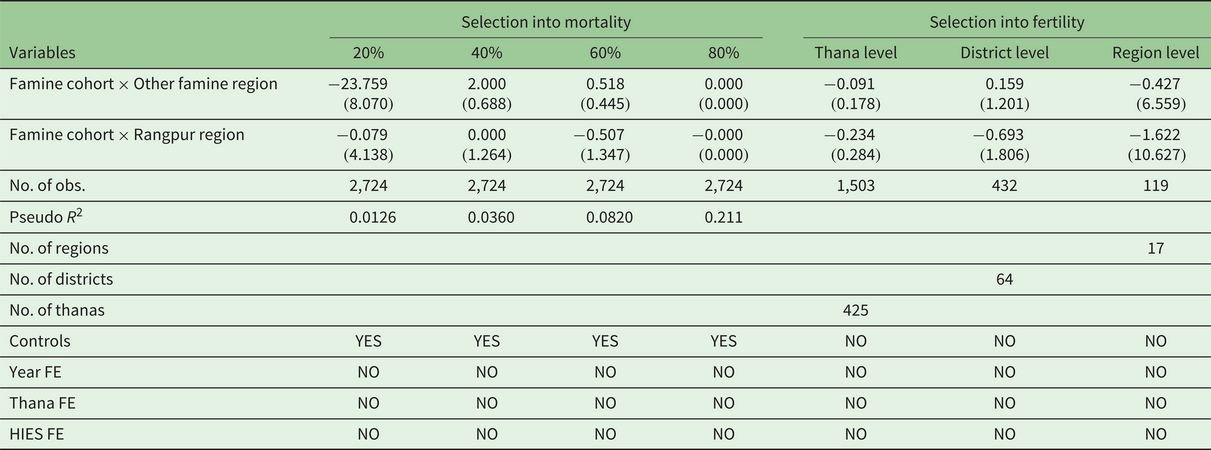
As has been found by Razzaque et al. (Reference Razzaque, Alam, Wai and Foster1990), infant mortality was higher among the in utero children and infants during the 1974–75 Bangladesh famine. Therefore, it is possible that those who survived the famine might have stronger immune systems and, therefore, may not exhibit long-term health adversities. In addition, Xu et al. (Reference Xu, Li, Zhang and Liu2016) cautioned about the choice of method and health measures to identify the long-term effects of famine, especially due to the presence of mortality selection among the survivors. This can be true if there is a systematic pattern in health outcomes by percentile groups. That is, such selective mortality may result in the surviving 1973–75 cohorts from famine regions belonging to higher health percentiles. To check for this possibility, we run quantile regressions on the 20th and 70th percentiles for ‘healthy lifetime’. Results in table 3 confirm that there is no such selection into mortality – estimated coefficients for all the regressions are statistically insignificant. This is consistent with Kannisto et al. (Reference Kannisto, Christensen and Vaupel1997) who did not find any significant difference between mortality among the affected and unaffected cohorts for the 1866–68 famine in Finland.
Selection into mortality and fertility

Notes: Robust standard errors are shown in parentheses. Regressions for selection into mortality are estimated using quantile regressions at 20, 40, 60, and 80 percentile levels, where the dependent variable is ‘healthy lifetime’. We do not include the fixed effects in quantile regressions. Regressions for selection into fertility are estimated using the specification ${f_i} = {\alpha _0} + \theta C + \vartheta R + \beta \times ({R \times C} )+ {\varepsilon _i}$ , where the outcome variable ${f_i}$
 . denotes fertility. Famine regions and cohorts follow the definitions in section 4.2.
Similarly, women may select their fertility and decide not to give birth during the famine. If this is the case, there will be significantly lower incidences of birth for the famine cohorts. To check this possibility, we collapse data to the district-birthyear level and count the total number of children born in a particular year in each locality. We then use these locality-birthyear panels to regress total number of children born in that year on exposure to famine. Results in table 3 confirm that neither of the exposure coefficients are significant, offering no evidence of selective fertility or selective child mortality. While this finding is in stark contrast to the findings of Razzaque et al. (Reference Razzaque, Alam, Wai and Foster1990) and Razzaque (Reference Razzaque1989), those earlier studies did not implement a difference-in-difference framework to retrieve any causal inference.
6.2 Placebo falsification test
We perform a falsification test by repeating the analysis using the individuals born during 1960–69, who were never been exposed to the 1974–75 famine during their childhood. We backdate the actual event by 13 years so that the placebo cohorts become: 1960–62 for famine and 1965–69 for unaffected cohorts.
We then rematch the actual famine regions to generate our placebo variable. Results in table 4 show that placebo famine groups do not experience any significant long-term health adversities. Therefore, this falsification test confirms that our main results are not driven by unobserved time-persistent regional heterogeneity connected with exposure to the 1974–75 famine. While this is the case, our main specification in equation (1) includes thana, birthyear, and survey year fixed effects to account for any unobserved time-persistent regional heterogeneity that is not already absorbed by the control variables in $x^{\prime}$ .
Health adversities of the 1974 famine – Placebo test

Notes: Standard errors clustered at the district level are shown in parentheses. Placebo regressions follow the empirical specification (1). Outcome variables, as identified in headers, and control variables follow their respective definitions in table 1. Famine regions and placebo cohorts follow the definitions in section 6.2.
6.3 Effects of per capita income
Finally, our estimated effects might vary by income levels. If so, then our main results in table 2 will be biased. To investigate whether per capita income further exacerbates or mitigates the long-term adverse health effects of the 1974–75 famine, we estimate the following equation for the outcome variable $y$ :

for a household i. R and C denote the famine regions and cohorts, respectively, whereas Y denotes per capita income of the household. All other variables are as defined in equation (1) and table 1.
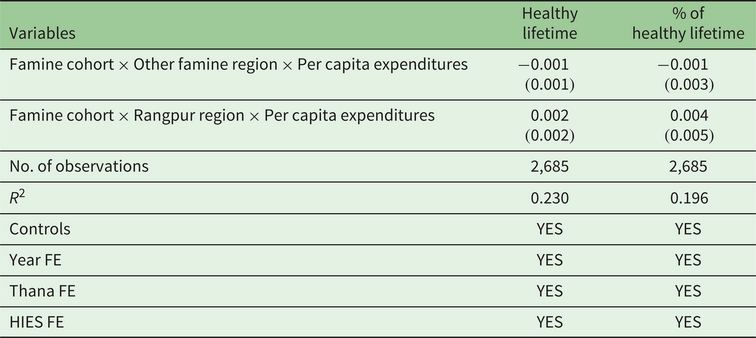
Results in table 5 confirm that per capita expenditure, a measure of economic solvency, does not affect the estimated health adversities induced by exposure to the 1974–75 famine since all the estimated coefficients are statistically insignificant.
Effects of per capita expenditure

Notes: Standard errors clustered at the district level are shown in parentheses. The table presents estimates of whether the long-term health adversities induced by exposure to the 1974–75 famine are further accentuated or mitigated by per capita income, according to the empirical specification (3). All the variables follow their respective definitions in table 1. All regressions include the indicator variables for year of birth, subdivision/thana of birth, and survey year. Parameter of interest is given by the coefficients of ‘Famine cohort × Famine region × Per capita expenditure’. Famine regions and cohorts follow the definitions in section 4.2.
7. Conclusion
Following the fetal origin hypothesis framework, we empirically estimate the long-term health effect of the 1974–75 famine in Bangladesh using a difference-in-difference specification. Our results indicate that the relative scarcity of essential foods, measured by the difference between growth in rice price and agricultural wages, during their pre-natal and neonatal periods saw the famine cohorts from famine regions in Bangladesh achieve significantly lower health outcomes during their adulthood. As the first such investigation for Bangladesh, our findings are consistent with similar studies on the Netherlands and China, among others, where in utero and early childhood famine exposures have resulted in significant health adversities including chronic diseases (e.g., Hu et al., Reference Hu, Liu and Fan2017).
Immediate effects of the 1974–75 famine including deaths, hunger, and malnutrition were reduced but not completely eliminated by the concerted efforts of the government to help the famine affected people to overcome the food scarcity. Consequently, as our results show, relatively malnourished survivors with in utero or early childhood exposure to the famine have significantly lower healthy lifetime. In fact, this research reinforces the need for keeping prices of rice and other essential commodities within the reach of rural poor, especially during mass hardships like famine and the ongoing Covid-19 pandemic and Ukraine war. In related literature, Ahmed (Reference Ahmed1988) reviews the rationale of rice price stabilization for Bangladesh for the period of 1960–84, and suggests that a combination of public procurement, import, rationing and open market operations will be necessary to keep rice prices within the desired level. Importantly, our findings and policy suggestions can be generalized for other developing countries and events. Due to their sustained effects, public service facilitations during and after a similar emergency event should aim at prioritizing consumption by vulnerable groups.Footnote 6
Drawing on the lack of entitlement to foodgrains for daily wage laborers (Sen, Reference Sen1981), Muqtada (Reference Muqtada1981) argued that the 1974–75 famine must be seen as an extension of poverty. In particular, the government needs to give special attention to reducing the gap between food price and wages, which was the primary reason behind the 1974–75 Bangladesh famine. Poor and vulnerable people who now have fewer means to maintain their sustenance will need public support to ensure better health outcomes, and better adulthood productivity as a consequence, for their children. Relevant examples include the food assistance programs in the US, especially the Supplemental Nutrition Assistance Program (SNAP, or food stamps) which has successfully reduced food insecurity among low-income children, reduced poverty, improved birth outcomes and children's health generally, and increased survival among low-weight infants (Gundersen, Reference Gundersen2015). By reducing childhood hunger, the SNAP program has also reduced obesity (Ludwig et al., Reference Ludwig, Blumenthal and Willett2012).
In addition, other OECD countries have even better food security and health for children due to their higher investments in children (Fernald and Gosliner, Reference Fernald and Gosliner2019). For developing countries, Glewwe and Miguel (Reference Glewwe, Miguel, Schultz and Strauss2007) have found that nutrition and child health are positively related to educational outcomes. Consistent with this, Jomaa et al. (Reference Jomaa, McDonnell and Probart2011) have found that school feeding programs in developing countries have positive effects on children's health and educational outcomes, whereas Fang and Zhu (Reference Fang and Zhu2022) have identified that early exposure to the school meal program significantly improved children's long-term cognitive and health outcomes, especially among low-income children. Therefore, it is essential that public policies aim at ensuring food security, especially during times of food scarcity, for the long-term welfare of the future generation. For an agricultural country like Bangladesh which is going through economic transformation, such public supports can have long-lasting human capital and growth benefits.
Despite its unique contributions, our paper has some limitations which might open up avenues for future research. First, we resort to a small sample size due to unavailability of panel data from Bangladesh covering such historical events that took place long ago. Next, similar to Eskander and Barbier (Reference Eskander and Barbier2022), we made a restrictive assumption that people were born where they currently live, again due to unavailability of data. Although we adopted some measures to reduce the possibility of mismatch between birthplace and residence, future research can benefit from using a better dataset with information on birthplace. Finally, it is possible that in addition to famine-induced food shortages, some of the coping strategies that the affected households adopted may have also contributed to the adulthood health adversities of their children. Common coping strategies include, but are not limited to, reducing food intake, borrowing from family and friends, and dietary changes. While the estimated total effects might be a combination of both direct exposure to the famine and consequent coping strategies, we could not decouple these effects due to data limitations.
Supplementary material
The supplementary material for this article can be found at https://doi.org/10.1017/S1355770X24000305.
Competing interest
The authors declare none.