For right or wrong, the WTO accession process offers members a unique opportunity to leverage issues against the applicant country to a degree which they will probably not be able to do again. Members, whose primary concern at the WTO is to promote, advance and defend their own national economic interests, would not be faithfully fulfilling their mandate to the people they govern if they failed to avail themselves of this opportunity. (Lacey, Reference Lacey, Streatfield and Lacey2008: 96).
1. Introduction
Accession to the WTO is unlike accession to any other international organization (IO) of global reach. To become a member in other global IOs, it is often sufficient for countries to express an interest in membership, show some vaguely defined good-will, commit to a few, often non-binding, policy measures, have their request superficially discussed by existing members and their accession request invariably accepted. In other words, global IOs are typically built on the premise that states have a ‘presumptive right of membership save intractable and difficult political problems’ (Bienen and Mihretu, Reference Bienen and Mihretu2010: 14).
Not so with accession to the WTO: submitting an application is only the first step in a ‘rigorous and complicated admission process’ (Kavass, Reference Kavass2007: 453) that often takes many years, sometimes more than a decade to conclude and can fail altogether. A Working Party (WP) is formed, consisting of self-selected existing WTO members, which scrutinizes the trade regime of the applicant country and whose members engage in bilateral negotiations. At the end of the process, the acceding country will have enacted or at least credibly committed to a very large number of policy measures curtailing its sovereignty and providing benefits to existing WTO members, which are enforceable under the WTO's trade dispute resolution mechanism.Footnote 1
Self-selection into the Working Party of applicant countries gives existing members the option to do one of two things (or both): to strategically delay the entrance of the newcomer and/or to extract concessions beneficial to themselves. This article argues that existing WTO members opt into the Working Party of applicant countries if the accession of the applicant country will strongly affect their trade interests. In some sense, this is entirely unsurprising and amounts to an almost trivial hypothesis and I am of course far from the first one to argue that trade interests matter for the self-selection of countries into Working Parties (e.g., Kennett et al., Reference Kennett, Evenett and Gage2005; Kraft, Reference Kraft2006a, Reference Kraft2006b; Lacey, Reference Lacey, Streatfield and Lacey2008; Williams, Reference Williams2008: 29). However, the article's contribution lies in separating three specific facets of trade interests that should matter most and in empirically estimating the substantive importance of each one. Specifically, I argue that existing WTO members are more likely to become Working Party participants if their bilateral trade with the applicant country represents a large share of their income, unless both already share a preferential trade agreement (PTA) with each other, or if they strongly compete with the applicant country in terms of the products and services they export and the markets to which they export to. Conversely, there is less incentive to join a Working Party the more existing PTAs with third countries of large economic size the member and applicant have in common. I put these three hypotheses to an empirical test by studying the self-selection of existing members into the Working Parties of accession cases to the WTO and its predecessor, the General Agreement on Tariffs and Trade (GATT), for the period 1968 onwards. No previous study has quantitatively analyzed the determinants of Working Party composition in accession negotiations.
The remainder of this article is structured as follows: Section 2 describes the details of the accession process to the GATT/WTO. Section 3 shows that existing members have considerable leeway to delay the entrance of new members and to extract concessions from newcomers. They reserve the option to engage in such strategic delaying and concessions extraction via selecting themselves into the Working Party of an accession country. Three testable hypotheses are formulated about who, other than the always participating developed countries, will join a specific Working Party. Section 4 explains the empirical research design chosen to empirically test these hypotheses. Section 5 presents the results, while Section 6 concludes with a discussion on why applicant countries are willing to submit to this arduous accession process. It also considers whether a reform of the process would be beneficial to the multilateral trade regime and if it is likely to happen.
2. The accession process to the GATT/WTO
There have historically been three modes of acceding to the GATT/WTO after it was created in 1947 by its 23 founding members. First, in the very early years of its existence up until 1951, 14 states joined the GATT without separate protocols of accession (Cattaneo and Braga, Reference Cattaneo and Braga2009). Second, a provision in GATT Article XXVI:5(c) allowed previous colonies of existing GATT members to join straightforwardly upon gaining national independence without any need for making concessions beyond the willingness to obey by the then existing GATT rules at the time. Sixty-four countries in total made use of this provision (ibid.). The creation of the WTO in 1995 put an end to this accession route. Not surprisingly, there was a rush toward the end of the GATT era for eligible countries to take this easy way in before the gate closed, with 22 countries joining under this provision between 1990 and 1994.Footnote 2
This article's analysis is concerned with the third mode of acceding, which applied to countries which could not or did not want to invoke Article XXVI:5(c) during the GATT period and applies to all applicants to the GATT's successor, the WTO. Of the 157 members (as of December, 2012), 56 had to take this third accession route and a further 27 countries are currently negotiating their accession this way.Footnote 3 This third accession route is in many ways the exact opposite of the easy way in that Article XXVI:5(c) previously offered to former colonies.Footnote 4
The simple provision in WTO Article XII that countries may accede ‘on terms to be agreed between it and the WTO’, provided that a two-thirds majority of WTO members in the Ministerial Conference approve, does not do justice to the complex, protracted and costly process that applicant countries need to undergo in order to become a member of the club. There is no ‘WTO Agreement on Accession’ that would specify substantive requirements of accession or membership criteria or even guidance on what the ‘terms to be agreed’ can or cannot be. There are no measures or rules that would protect applicant country's interests other than the general guidelines on accession of LDCs (WTO, 2003), which request restraint from existing members in their dealings with applicant countries from this poorest group of states and vaguely promise LDC applicants the same treatment as existing LDC members. In fact, the accession terms of the first two LDCs to enter the WTO – Nepal and Cambodia – enshrined commitments ‘that even exceed the commitments that have been made by some of the most advanced countries’ (UNCTAD, 2004: 61). Note, however, that the 2003 guidelines were strengthened by an addendum passed by the WTO General Council in July 2012, which specifies certain benchmarks on goods and on services, calls for greater transparency in accession negotiations of LDC applicants, reaffirms special and differential treatment provisions, promises favorable consideration of requests for additional transition periods, and calls for more technical assistance provided to these poorest of applicant countries (WTO, 2012). There are also procedural guidelines (WTO, 1995) and a technical note (WTO, 2001) applicable to all accession cases, which spell out the temporary order of the various steps of accession negotiations, but that is all, prompting some critics to remark that ‘for an organization which prides itself on being ‘rules-based’, the accession process is remarkably vague’ (Stiglitz and Charlton, Reference Stiglitz and Charlton2006: 159).
In brief and skipping over some of the minutiae of the procedures (see Williams, Reference Williams2008, for a detailed description), the admission process roughly works as follows: upon formal notification of its will to accede,Footnote 5 the WTO Secretariat informs all WTO members of this intention.Footnote 6 A Working Party is formed, in which all WTO members can participate if they so wish. Following the submission of a memorandum by the applicant country on its foreign trade regime, the members of the Working Party will meet repeatedly to scrutinize the document and start the process of questioning the applicant, which can cover any and every aspect of the applicant country's trade regime, with the purpose of seeking clarifications (Kavass, Reference Kavass2007). This question and answer process can take several rounds leading to further and further revisions of the memorandum. Pelc (Reference Pelc2011: 643) reports that for the case of Saudi-Arabia's accession negotiation, the country had to answer some 3,500 questions by WTO members and submitted 7,600 pages of documentation over ten years. At some stage, the applicant country will submit an offer on the maximum tariff it intends to impose on imports from WTO member countries, thus legally binding itself to impose no larger tariff than this one (and possibly resulting in an actual smaller tariff), and an offer on the extent to which it intends to open its services sector. The Working Party will review and question the offers, which often leads to revised offers.
The WTO Secretariat sends the offers made by the applicant to WTO members who can then engage in bilateral trade negotiations with the applicant country. While multilateral negotiations at the Working Party level typically focus on the compatibility of the applicant country's trade regime with WTO rules and on agricultural issues, the bilateral negotiations focus on market access for goods and services, i.e. on ‘obtaining commercial benefits for existing members in return for opening the doors of the organization’ (Milthorp, Reference Milthorp2009: 103). No minutes are taken in these negotiations and little is publicly known about them (Kennett et al., Reference Kennett, Evenett and Gage2005). Some of the results from these negotiations may remain secret, known only to the two negotiating countries. More often, however, tangible outcomes will form part of the accession terms of the acceding countries, which are then subject to the most-favored-nation rule and potential enforcement via the dispute resolution mechanism upon WTO accession (Jones, Reference Jones2009).
The bargaining is entirely asymmetrical as existing WTO members need not concede anything beyond what is already codified under WTO rules or their own accession terms. Changes to its trading regime and concessions, which often go further than existing WTO rules, exclusively fall upon the applicant country (Kennett et al., Reference Kennett, Evenett and Gage2005), which cannot demand any additional benefits, concessions, or commitments from existing members.Footnote 7 Given these asymmetries, the principle of reciprocity is effectively suspended in accession negotiations (Pelc, Reference Pelc2011). Acceding countries had to accept many more commitments than existing members are bound to (so-called WTO-plus commitments) and had to forego some of the benefits in terms of special and differential treatment existing members at comparable levels of low economic development enjoy (so-called WTO-minus commitments).Footnote 8 Thus, WTO accession allows existing WTO members to extract concessions from the newcomers on a case-by-base (discriminatory) basis (Cattaneo and Braga, Reference Cattaneo and Braga2009; Bienen and Mihretu, Reference Bienen and Mihretu2010). This has at times caused resentment amongst applicants. As Samoa's senior trade consultant has remarked: ‘They [existing members] can ask for all sorts of commitments which Samoa isn't in a position to offer. If they insist, there are two options: we will never become a member or we have to give in to that request’ (cited in Stiglitz and Charlton, Reference Stiglitz and Charlton2006: 159). Members have sometimes requested far-reaching commitments from applicants relevant to their actual trading portfolio and at times far-reaching irrelevant commitments unrelated to the applicant's trade, the latter with a view toward creating a precedent that could be applied in future negotiations with other applicant countries (Grynberg and Joy, Reference Grynberg and Joy2000). Whilst the process of WTO accession is the same for all newcomers and the basic procedural rules are clear and fixed, the substance or terms of WTO accession are thus not rule-based and will often differ from one WTO applicant to another.
There are no specified time limits on any of the stages of questioning and negotiation. Working Parties operate on the basis of consensus, which means that the process is stalled until every Working Party member is satisfied (Milthorp, Reference Milthorp2009). Only after the questioning is over and no further requests for bilateral negotiations are received will the WTO Secretariat start drafting a factual summary, eventually resulting in a final report of the Working Party, which has to be approved by all Working Party members. This report, which contains the concessions and commitments made by the applicant country, is then sent to the WTO General Council for its acceptance. Upon acceptance of the accession package by the General Council and the applicant, the applicant country can finally become a member of the WTO. The Protocol of Accession becomes part of the acceding country's trade obligations and alleged violations of the commitments undertaken in the Protocol can be cited in dispute settlement cases. By December 2012, there had been nine disputes in total, in which complainants cited the Protocol of Accession, all involving China. Three of these have so far resulted in panel and appellate body decisions.Footnote 9
In principle, non-Working Party members can also engage in bilateral trade negotiations with the applicant country. However, the reality is that such negotiations are exclusively undertaken by members of the Working Party and that, conversely, anyone wishing to undertake such negotiations also becomes a member of the Working Party. In theory, the WTO General Council can challenge the final report by the Working Party, but has never done so in practice (Kavass, Reference Kavass2007: 468). What these two points amount to is that ‘decisions on accession are for all practical purposes made at the Working Party level’ (Kavass, Reference Kavass2007: 468). Given that everything of interest has previously been decided at the Working Party level, it is not surprising that in practice the WTO General Council decides on accession unanimously, even though decisions could be taken by a two-thirds majority vote according to WTO rules (WTO Article XII). The next section suggests three factors determining existing members’ decision to self-select into specific Working Parties of applicant countries.
3. Self-selection into Working Parties
The US, Canada, the EU countries, Japan, and Australia always join the Working Party of any applicant country and play a dominant role therein due to their long experience with Working Parties. These developed countries are rich enough to shoulder the costs of active Working Party membership on all occasions, which also means they benefit from high legal and administrative capacity allowing them to have a major substantive impact on negotiations within Working Parties. Other countries may to some extent free-ride on these ‘permanent’ Working Party member's efforts to scrutinize the applicant's trade regime. They will therefore opt into selected Working Parties, but not others. This paper's analysis is concerned with the decision-making by these ‘non-permanent’ potential Working Party members. They do not opt into all Working Parties since meaningful participation is costly in terms of mustering the resources necessary to extensively engage in reviewing, discussing and scrutinizing the applicant's trade regime. Of course, poorer WTO members may also have narrower trade interests, which all other things equal lowers the cost of meaningful participation in any Working Party. In the empirical estimation, I try to control for such heterogeneity across existing WTO members with a comprehensive set of control variables.
Appendix 1 shows the total number of Working Parties that countries have participated in together with the year of their own GATT/WTO accession. Note that this list is not fully comprehensive as information for a few of the very early Working Parties could not be established. There is substantial variation across member countries' propensity to participate in a Working Party as well as substantial variation in the composition of Working Parties from one applicant country to another.Footnote 10 Even with the WTO members that always participate in Working Parties included in the statistic, the standard deviation of participation by existing members is well above the mean participation rate (0.48 to 0.35), demonstrating substantial variation. If the permanent participants are not included, then the standard deviation becomes almost double the mean participation rate (0.41 to 0.22).
It is the central argument of this article that for those countries which are not members in every Working Party, the decision to participate in a specific Working Party is driven by their trade interests being strongly affected upon accession of the applicant country. Participating in the Working Party allows existing WTO members to protect and promote these interests. It gives member countries the option to strategically delay the accession of the applicant by asking more questions and insisting on more clarifications. Such stalling gives countries time to adjust to the new situation (after accession) and, where this is not possible, to at least delay the inevitable as long as possible (Kraft, Reference Kraft2006a, Reference Kraft2006b). Sometimes existing WTO members use their veto power bestowed onto them as a member of the Working Party of an applicant country to pressure the applicant into making concessions that are at least in part politically motivated. For example, in 2006 Georgia's foreign and economic development ministries conceded that Russia joining the WTO was in their interests, but threatened that ‘the process of Russia's accession to the WTO will be suspended’ (BBC, 2006) unless Russia not only lifted what Georgia regarded as a trade blockade, but also reduced prices charged by Gazprom, the Russian state-owned gas giant. After war broke out between the two countries in 2008, Georgia again threatened to veto Russian accession to the WTO. Absent Western pressure on Georgia to be more compromising (Schneider and Urpelainen, Reference Schneider and Urpelainen2012: 291), in the end the road for Russian WTO membership in 2012 was freed only after month-long negotiations between the two countries in Switzerland as a result of which Russia essentially gave in to all Georgian demands. As Georgia's then President Saakashvili put it: ‘Our position was crystal-clear – either this, or Russia will not become a WTO member’ (Deutsche Welle, 2011).
More importantly perhaps than strategic delaying, selecting oneself into the Working Party for a specific accession case also gives existing WTO members the option to promote their trade interests by extracting concessions from the applicant country via bilateral negotiations, as explained in the previous section. Even concessions extraction has limits of course. Demanding too high a price risks putting off the applicant from joining altogether, which would mean foregoing the expected trade benefits from expanded WTO membership. Even if this is very unlikely (only Vanuatu has ever broken off negotiations – discussed in Gay, Reference Gay, Gallagher, Low and Stoler2005 – only to re-start negotiations in 2008 and acceding in 2012), demanding too high a price from applicants also risks over-stretching their commitment capacity such that they would increasingly resort to bypassing their formal commitments, one way or the other, upon becoming a member.
Importantly, I do not argue that every participant in a Working Party will engage in strategic delaying of the accession or engage in concessions extraction from the applicant. What matters is that Working Party participation gives existing members the option to do so. My argument is that they will make sure this option is open to them if their trade interests are strongly affected by the potential accession. Existing member countries will regard their trade interests as strongly affected if they have a major trading stake in the applicant country itself. This could be in the form of substantial exports to the applicant country, which it does not want to see diminishing and ideally would like to see increasing, or substantial imports from the applicant country, which it might fear would increase further still upon accession. This would lead one to expect that members, for whom bilateral trade with an applicant country represents a larger share of their GDP, have a stronger incentive to join the Working Party of the applicant. However, this expectation needs to be qualified. If the member and the applicant country already have a preferential trade agreement (PTA) with each other, then it is likely that its bilateral trade with the applicant will only be modestly affected, if at all, upon accession of the applicant country to the WTO since bilateral trade is already subject to preferential status. This reasoning results in the first testable hypothesis:
Hypothesis 1: Existing GATT/WTO members with more bilateral trade with the applicant country as a share of their GDP are more likely to self-select into its Working Party, unless a PTA already exists between them.
Trade interests are not only affected by a member's importance of bilateral trade with the applicant as a share of its GDP, however. Because of the most-favored nation principle, accession of new members does not merely affect bilateral trade between an existing member and the applicant country, but also trade with third countries. Once a member of the GATT/WTO, the new entrant will benefit from the multilateral trade concessions undertaken in the past and from further trade liberalizations in the future. Kraft (Reference Kraft2006a, Reference Kraft2006b) therefore plausibly argues that existing members are also concerned about losing market shares in other countries to the new entrant. Competition with the applicant in global markets is therefore likely to incentivize existing members to self-select into the Working Party of an applicant country. Existing members will regard applicants as greater competitors the more similar are the products they export and the more similar the markets they export to. This reasoning results in a second testable hypothesis:
Hypothesis 2: Existing GATT/WTO members are more likely to self-select into a specific Working Party the greater their structural export similarity with the applicant, i.e. the more they compete with the applicant country in terms of export product and market structure.
This second hypothesis relates to the protection of existing export interests. But a potential new applicant can also affect future export interests in third markets as well as affect broader trade interests (e.g., trade-related investment measures) which are not captured by existing structural export similarity between the member and the applicant country. These interests that are more diffuse are hard to capture, but one would expect that an existing member faces fewer incentives to join a Working Party if both are members of existing PTAs with more other third countries and the larger these third countries’ economies are as a share of the world economy. This is because if the applicant country already has access to economically important key third country markets via PTAs with these third countries and the existing member is also part of these PTAs, then there is little point in strategically delaying access by the applicant and most potential concessions should already have been extracted as part of the negotiations to the existing PTAs. This reasoning leads to the third testable hypothesis:
Hypothesis 3: Existing GATT/WTO members are less likely to self-select into a specific Working Party the greater the economic size of third countries with which both the member and the applicant have a PTA in common.
In the remainder of this article, I put these three hypotheses to an empirical test.
4. Empirical research design
The couple of existing systematic analyses of GATT/WTO accession have focused on the time delay between a country's independence (Copelovitch and Ohls, Reference Copelovitch and Ohls2009) or between its application to the GATT/WTO (Wong and Yu, Reference Wong and Yu2007) and eventual accession. Yet, there are many reasons for such a delay that relate to insufficient administrative resources in the applicant country, exaggerated expectations, domestic problems, the growing size and complexity of GATT/WTO rules (Milthorp, Reference Milthorp2009) and the like; and even where strategic delaying takes place the time elapsed to eventual accession does not tell us much about who is responsible for the delay. This article therefore examines the determinants of self-selection of GATT/WTO members into Working Parties instead of analyzing the time it takes to accede. Any country wanting to delay accession and/or extract concessions from the applicant country would have to self-select into the relevant Working Party.
The dependent variable is therefore a dichotomous one, indicating whether an existing GATT/WTO member has selected itself into the Working Party of a specific applicant country. The unit of observation is the existing GATT/WTO member country for each specific Working Party in the year of its establishment and all data for the explanatory variables stem from the year in which the Working Party was established. Whilst information on the composition of Working Parties and the date of their establishment is not confidential and is in principle publicly available, it is not easily assembled as it requires sifting through a large number of GATT/WTO documents. I am very grateful to the WTO Secretariat, which has kindly provided me with the results of this time-consuming search. Data on the dependent variable thus stem mainly from direct communication with the WTO Secretariat, complemented with information contained in Kennet et al. (2005: 35f.). GATT/WTO membership information, which is needed to establish the correct sample (logically, only existing GATT/WTO members can become parties to a Working Party for new applicants), was taken from the WTO website.
The variables of main interest were coded as follows. First, to measure the importance of bilateral trade for existing GATT/WTO members on applicant countries, I take the value of bilateral trade between the applicant country and an existing GATT/WTO member relative to the existing GATT/WTO member's gross domestic product (GDP).Footnote 11 Recall that the first hypothesis states that a larger share in GDP of bilateral trade will only affect self-selection into Working Party membership if the existing member and applicant country do not have a pre-existing PTA with each other. I therefore create two variables, namely bilateral trade for country dyads in which both member and applicant have a PTA with each other and bilateral trade for dyads in which this is not the case.Footnote 12 This is the exact equivalent of an interaction effect between bilateral trade and a PTA dummy, but renders it easier to directly assess the differential effect of bilateral trade in both types of dyads (with and without a PTA between them).
Second, to construct a measure of structural similarity in terms of export products and export markets, an approach suggested by Finger and Kreinin (Reference Finger and Kreinin1979) is adopted, using data form UN (2009):
 $${\rm Similarity}\;({\rm ij}_{\rm t} ) = \left\{ {\sum\limits_k {Min\left[ {X_{it}^k, \,X_{\,jt}^k} \right]}} \right\}$$
where i and j are two countries exporting product group k and Xitk and Xjtk are the share of exports in product group k of the total exports of countries i and j in year t. The similarity of countries i and j in terms of export product structure is thus the sum of the minima of the shares of a certain product group of the total exports of i and j, respectively.Footnote 13 The resulting index ranges (in principle) from 0 to 1 and takes the value of 0 if the two countries export completely different groups of products and the value of 1 if both countries export an identical basket of goods. A measure of export market similarity is constructed similar to export product similarity. Instead of k representing a specific commodity, k now represents a specific export market.Footnote 14 The resulting index again ranges from 0 to 1 and takes the value of 0 if the two countries export to entirely different markets and the value of 1 if both countries export identical shares of their total exports to identical markets. Both similarity measures are then multiplied with each other such that two countries are only considered similar in their export structure if they simultaneously export similar products and export to similar markets. Ideally, one would want to combine export product and export market similarity directly into one single overall measure which would measure whether countries simultaneously exported similar products to similar markets, but data that are both sectorally and bilaterally dis-aggregated at the same time have too many missing values for which it is not clear whether they represent a value of 0 or lack of reporting.
Third, to test the final hypothesis I have calculated the number of PTAs with third countries the existing member and the applicant country have in common. To account for the economic size of third countries, I weight each PTA with the share of the third country's economy relative to the world economy in the relevant year. I then sum up the GDP share-weighted common PTAs.
It is important to include relevant control variables such that the results do not suffer from omitted variable bias, which would follow if the main variables of interest were correlated with omitted control variables and had an effect on the dependent variable. I include GDP and GDP per capita of existing member countries to control for the possibility that larger and richer countries are more likely to become Working Party members. I control for the existing GATT/WTO member's general importance of trade relative to her GDP (total trade divided by GDP) to make sure that the variable measuring bilateral trade to GDP does not simply pick up a general importance of trade in the existing member's GDP. I also include GDP, GDP per capita, and general trade relative to GDP of the applicant country to control for the possibility that larger and richer applicant countries, as well as those for whom trade forms a larger share of their GDP, may draw a larger Working Party membership due to their greater significance as a potential new member. I take the natural log of all continuous economic variables to reduce the skewness typically found in such variables; for example, some countries are orders of magnitude larger in economic size than others.Footnote 15 To ensure that the variables of main interest do not function as a proxy for neighborhood effects between the two countries, I include a dummy variable, which is set to 1 if the applicant and existing GATT/WTO member countries are contiguous (or separated by sea with a distance of less than 150 miles).Footnote 16 Including the year of GATT/WTO accession of existing members controls for the possibility that members that are more established might be more likely to select themselves into Working Parties than newcomers. Lastly, I include year-specific fixed effects to control for the size of Working Parties changing over time for reasons other than those captured by the substantive explanatory variables.
The sample contains all Working Parties from 1969 onwards for which their composition could be known by December 2012. The composition only becomes known once the Working Party for an applicant country has met for the first time. Thus, whilst Working Parties have already been established for Iran, Libya, São Tomé e Principe, Comoros, and Equatorial Guinea, they have not yet met and their composition is thus not yet known. The Working Party for Liberia, which has already met, is not in the sample because the WTO restricts the list of Working Party members for unknown reasons. The Working Parties for some applicant countries are not included because no data on the explanatory variables are available (e.g., Afghanistan, Iraq, Samoa, Tonga).Footnote 17 Appendix 2 lists the applicant countries included in the sample, the year of Working Party establishment, the number of countries which have selected themselves into membership of each Working Party, and the year of accession (where the applicant country has already acceded). Given the dichotomous nature of the main dependent variable, I use a logit estimator. Standard errors are adjusted for the clustering of observations on GATT/WTO members.
5. Results on Working Party composition
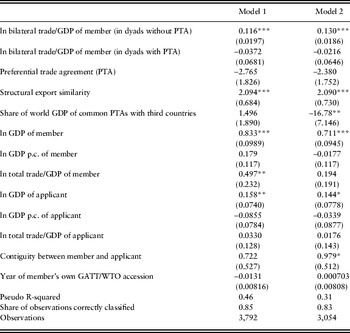
Table 1 presents the estimation results. Model 1 is based on all existing WTO members in the sample, including the ones that always participate in all Working Parties. Model 2 excludes these ‘permanent’ participants, namely the US, Canada, the EU countries, Japan, and Australia.Footnote 18 The higher pseudo R-squared value of model 1 (0.46 compared to 0.31 for model 2) and the slightly higher share of observations that are correctly classified by the estimation model (0.85 as opposed to 0.83) suggest that the estimation model is compatible with (in the sense of correctly predicting) some members always opting into all Working Parties. The pseudo R-squared measures of model fit and the shares of correctly classified observations for both models are fairly good, considering these are essentially cross-sectional models.
Logit estimation results on Working Party composition

Notes: Model 1 includes the ‘permanent’ Working Party members (US, Canada, the EU countries, Japan, and Australia), whereas model 2 excludes them. Standard errors clustered on existing GATT/WTO member countries in parentheses. Year-specific fixed effects included, but coefficients not reported. * Statistically significant at 0.1 level, ** 0.05 level, *** 0.01 level.
With two notable exceptions, both models produce results that are statistically indistinguishable from each other and thus robust to each other. Model 2, my main model, provides corroborating evidence for the three hypotheses formulated above. Existing WTO members are the more likely to select themselves into the Working Party of a specific applicant country the higher their bilateral trade with the applicant country relative to their GDP, but only if they do not already have a PTA with the applicant. This can be discerned from the positive and statistically significant coefficient of the bilateral trade in dyads without a PTA variable. In contrast, the coefficient of the bilateral trade in dyads with a PTA variable is not only statistically insignificant, but also significantly differs from the other bilateral trade coefficient, which indicates that the presence of a PTA between member and applicant statistically significantly conditions the effect of bilateral trade on Working Party composition. Other than via its conditioning impact on the effect of bilateral trade, the existence of a PTA between an existing member and the applicant does not statistically significantly affect self-selection. The more the existing member and the applicant compete in terms of similar export products and markets, the more likely the member will join the Working Party. Finally, the larger the economic size of PTAs that both member and applicant have in common with third countries, the less likely the member will join the Working Party. Note, however, that this effect is not robust to the inclusion of the ‘permanent’ Working Party members in the sample, as model 1 shows. The reason for this difference in results is that the permanent Working Party members are also those with some of the highest values of ‘share of world GDP of common PTAs with third countries’ for most applicants, but their permanent participation in all Working Parties renders this variable, which was negative and statistically significant in model 2, positive, but with large standard error and thus statistically insignificant in model 1. It thus seems that the specific aspect of trade interests captured by hypothesis 3 is relevant for those WTO members that are self-selecting into some, but not all, Working Parties, but not for the US, Canada, the EU countries, Japan, and Australia.
As concerns control variables, member countries of greater economic size are more likely to become members of a Working Party. Interestingly, a member country's per capita income does not have a significant effect, i.e. conditional on the other explanatory variables included in the estimation model, richer countries are not more likely to select themselves into a Working Party. The same holds for members which have a larger share of total trade to their GDP, but this effect is only statistically insignificant in model 2. If all existing WTO members enter the estimation sample, then members with higher total trade to GDP share are more likely to participate in a Working Party, as one would expect. Applicant countries of greater economic size draw a larger membership into their Working Party, but neither per capita income nor a larger share of total trade to the GDP of applicant countries matters. A GATT/WTO member country which is geographically contiguous to the applicant country is more likely to become a Working Party member, but this effect is only marginally statistically significant in model 2 and statistically indistinguishable from no effect in model 1. Older members are not more likely to join than members that are more recent.
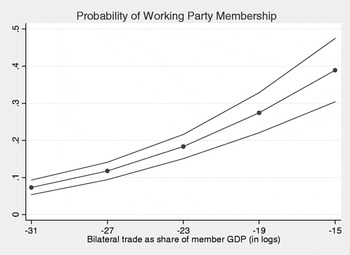
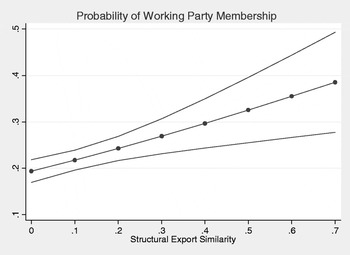
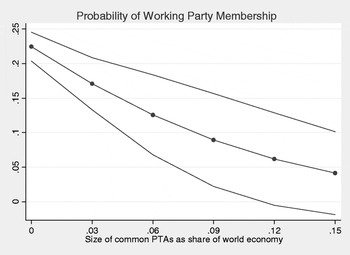
Logit coefficients have no intuitive meaning. To gauge the substantive importance of the main variables of interest, figures 1 to 3 therefore plot the predicted probability that an existing GATT/WTO member joins a Working Party together with a 90% confidence interval for changes from the in-sample minimum to the maximum in these three variables, keeping all other variables at mean values. Note that these figures are based on the estimation results from model 2. With the exception of figure 3, the substantive results would look similar if based on the estimation results from model 1 instead. As noted above, the effect of the ‘Share of world GDP of common PTAs with the third countries’ variable is negative and statistically significant in model 2, but positive and statistically insignificant in model 1.
Starting with bilateral trade in dyads, in which the member and applicant do not already have an existing PTA (figure 1), the predicted probability for a WTO member to select itself into a Working Party is just below 15% at very low levels of the share of bilateral trade to the GDP of existing WTO member. This rises to just above 40% if trade between the existing member and the applicant country forms a large share of the member's GDP. At very low levels of structural export similarity, the predicted probability of self-selection is almost 20%, rising to almost 40% close to the in-sample maximum value (figure 2). Finally, the predicted probability drops substantially from just above 20% in the case where the member and the applicant country have no PTA with third parties in common to below 5% when both countries have in common PTAs with third countries of substantial economic size relative to the world economy. What all three figures show is that the central explanatory variables are not only statistically significant, but also substantively important predictors of self-selection into Working Parties. But what is their relative substantive importance? Of the three specific facets of trade interests, the effect of increasing the relative economic importance of common PTAs with third countries is strongest,Footnote 19 followed by bilateral trade as a share of the member country's GDP in dyads without a PTA in place. The least important variable is structural export similarity, but a move over the full range of this variable nevertheless almost doubles the likelihood of Working Party membership.
The effect of increasing bilateral trade share of GDP (in dyads without a PTA)

The effect of increasing structural export similarity

The effect of increasing the relative economic importance of common PTAs with third countries

6. Conclusions
Accession negotiations to the GATT/WTO present existing members with an opportunity to strategically delay the entry of new members as well as to extract concessions from them if they select themselves into the Working Party of the applicant country. This article has argued that existing GATT/WTO members are more likely to become Working Party members, thus providing them with the option to take advantage of this opportunity if their trade interests are strongly affected by the potential accession. Their trade interests will be strongly affected if their bilateral trade with the applicant country represents a large share of their GDP, unless they already have a PTA with the applicant, or if they are structurally similar to the applicant in the sense of competing strongly in terms of both export product and export market structure with the applicant. Where they have PTAs with third countries of large economic size in common with the applicant, they are less likely to enter the Working Party.
I have put these three hypotheses to an empirical test and found that they are substantively important determinants of the self-selection of existing GATT/WTO members into the Working Parties of new applicants. PTAs with third countries of large economic size in common has the largest substantive effect, but one should keep in mind that this effect disappears once the countries that always participate in all Working Parties are included in the sample, for reasons explained in the previous section. Bilateral trade with applicants as a share of member's GDP, but only in dyads with no existing PTA between the two countries, is the second most important aspect of trade interests influencing countries' self-selection into Working Parties. But even structural export similarity, the least substantively important factor of the three, nevertheless exerts a major influence on Working Party composition.
One of the questions that arise from this paper's analysis is why applicant countries are willing to submit to the stringent, far-reaching, and asymmetrical requirements of the GATT/WTO accession process. Of note, only one applicant country (Vanuatu) has so far broken off its accession negotiations, only to come back to the table seven years later and eventually acceding on 24 August 2012. As mentioned in Section 2, 56 countries have gone through this process and another 27 are currently negotiating their way in, if with various vigor and differential prospects of gaining eventual access. Logically, the answer is that applicant countries must expect more benefits from membership than the costs they are willing to incur. As Cambodia's Minister of Commerce and Chief WTO Accession Negotiator has put it succinctly: ‘This is a package of concessions and commitments that goes far beyond what is commensurate with the level of development of an LDC like Cambodia. Nonetheless, we do accept the challenges, because we see the benefits of joining the world trading system’ (UNDP, 2004: 8).
One interpretation is that benefits from increased trade (Goldstein et al., Reference Goldstein, Rivers and Tomz2007),Footnote 20 as well as benefits from reduced trade volatility and greater predictability (Mansfield and Reinhardt, Reference Mansfield and Reinhardt2008), access to the dispute settlement process (Davis and Bermeo, Reference Davis and Blodgett Bermeo2009) and improved market access (Pelc, Reference Pelc2011) are likely to compensate for the pain inflicted by the accession process. Joining the WTO also allows acceding countries to pursue and lock-in trade policy reforms under the banner of complying with international agreements that because of distributional consequences would be difficult to achieve without such a credible external commitment device, even if aggregate welfare improves (Staiger and Tabellini, Reference Staiger and Tabellini1999; Basu, Reference Basu2008). If Tang and Wei's (2009) finding is correct that developing countries which joined subject to the rigorous accession process (rather than via the easy way in through GATT's Article XXVI:5(c)) saw their economic growth rates increase relative to other developing countries, then the bitter pill of making large-scale concessions may prove to be beneficial medicine in the end.
Alternatively, however, applicant countries may either systematically overestimate the benefits and underestimate the costs of accession, as Drabek and Woo (Reference Drabek, Woo and Drabek2010) suggest, or may regard WTO accession as the lesser of two evils for ‘fear of being left behind’ (Gruber, Reference Gruber2000: 253), despite the costly and asymmetrical admission process. In a world in which an overwhelming majority and increasing share of countries have agreed on a multilateral preferential trade agreement, outsiders may see little alternative than to join as well, even if there were an absolute welfare loss, since the cost of remaining outside may be even higher and rising with an increasing number of members in the international organization.
A related follow-on question is what, if anything, should be done to reform the WTO accession process. Some have called for a kind of ‘WTO Agreement on Accession’, which would spell out not only binding procedural rules that are more detailed, but also the substantive requirements that can legitimately be expected from applicant countries by WTO Working Party members (Stiglitz and Charlton, Reference Stiglitz and Charlton2006; Bienen and Mihretu, Reference Bienen and Mihretu2010). On the one hand, such a move would appear beneficial, bringing the institution closer in line with the WTO's self-proclaimed objective of providing a rule-based multilateral trade system. As Grynberg and Joy (Reference Grynberg and Joy2000: 173) have put it: if the accession process remains power-based, ‘this will only serve further to undermine the credibility of the rule-based system’. Any beneficial economic effects from a rigorous accession process, in which applicant countries make commitments they would otherwise find hard to achieve purely domestically, could still be accomplished in an accession process that is more rule-based. On the other hand, to the extent that the possibility to extract concessions from applicants, which are not in the interest of the applicants, and to delay their accession provide existing members with the necessary flexibility mechanism required for them to accept deep co-operation, major reforms which take away this option from existing members may prove counter-productive to the WTO's overall objective of further and deeper trade liberalization.
In some sense, reform to the WTO's accession procedures is a moot point. Firstly, as Grynberg and Joy (Reference Grynberg and Joy2000: 173) have argued, ‘only those who are extraordinarily naïve would believe that the system of accession will be reformed’. Those benefiting from reform (non-members) have no say in the institution that could bring about reform, while those benefiting from the status quo (existing members) have nothing to gain from reform. Second, with the passage of time and more and more of the few remaining countries still outside the WTO eventually joining the institution, the problem will solve itself. Death by exhaustive success is the most likely scenario for the power-based process regulating accession to the otherwise rule-based WTO.
Appendix 1. Participation in Working Parties

Appendix 2. Working Parties in sample