The fatty acid (FA) profiles of milk and dairy products, aside from their importance in relation to sensory properties and volatile organic compounds (Collins et al. Reference Collins, McSweeney and Wilkinson2003; Mannion et al. Reference Mannion, Furey and Kilcawley2016), also affect human health. In recent years, medical research has criticised official guidelines on food recommendations regarding this issue (Hoenselaar, Reference Hoenselaar2012). Fatty acid categories, like saturated (SFA), monounsaturated (MUFA), and polyunsaturated fatty acids (PUFA), but also n-3 and n-6 PUFAs, and trans FAs (TFA), are not considered useful, especially in explaining cardiovascular health (Chowdhury et al. Reference Chowdhury, Warnakula, Kunutsor, Crowe, Ward, Johnson, Franco, Butterworth, Forouhi and Thompson2014). The effects of TFAs on health are very complex (Gebauer et al. Reference Gebauer, Chardigny, Jakobsen, Lamarche, Lock, Proctor and Baer2011). Many are potentially harmful, especially those of industrial origin, while others (notably vaccenic acids and some isomers of conjugated linoleic acid, CLA) seem to be beneficial in countering cardiovascular diseases, cancer and obesity (Dilzer & Park, Reference Dilzer and Park2012), especially when present in milk and dairy products (McCrorie et al. Reference McCrorie, Keaveney, Wallace, Binns and Livingstone2011). The FA composition of milk and dairy products may be influenced by several factors, such as the diet, stage of lactation, health, and breed of lactating females (Palmquist et al. Reference Palmquist, Beaulieu and Barbano1993; Woods & Fearon, Reference Woods and Fearon2009). Feeding systems based on herbage (Hurtaud et al. Reference Hurtaud, Dutreuil, Coppa, Agabriel and Martin2014), especially highland pasture (Romanzin et al. Reference Romanzin, Corazzin, Piasentier and Bovolenta2013), have been shown to yield milk and dairy products with FA profiles more beneficial to human health.
Gas-chromatography (GC) is a powerful instrument for separating and identifying FAs (Petrović et al. Reference Petrović, Kezić and Bolanča2010), but is unable to separate completely the mixture of FAs frequently present in dairy products, particularly the minor FAs, like those that often have biological importance (e.g. margaric, eicosapentaenoic, docosapentaenoic, docosahexaenoic, and arachidonic acids) (Chowdhury et al. Reference Chowdhury, Warnakula, Kunutsor, Crowe, Ward, Johnson, Franco, Butterworth, Forouhi and Thompson2014). Introduction of the two-dimensional GC technique (GC × GC) has permitted generation of a more detailed chromatographic profile of highly complex samples such as milk (Vlaeminck et al. Reference Vlaeminck, Harynuk, Fievez and Marriott2007), improving our ability to study the effects of different sources of variation (Manzano et al. Reference Manzano, Arnáiz, Diego, Toribio, García-Viguera, Bernal and Bernal2011).
As far as we know, no studies have been published dealing with the evolution of detailed FA profiles across the entire cheese- and ricotta-making processes from milk to fresh and ripened products, and by-products, especially in the case of pasture-fed cows. The aim of this research was to obtain by GC × GC detailed FA profiles of milk and dairy products and by-products made during the summer period while cows were on highland pastures, and, in particular to: (i) examine the effects of time of milking (am or pm), skimming, and mixing milk in the vat; (ii) characterise the FA profile of fresh products obtained from the cheese- and ricotta-making processes (cream, fresh cheese, and ricotta); (iii) analyse the partition of FAs between product and by-product during each processing step; (iv) study the evolution of the FA profile during cheese ripening.
Materials and methods
Field data
The experiment was carry out on a temporary summer farm at 1860 m above sea level (Malga Juribello, Trento, Italy) conducted by the Breeder Federation of the Trento Province (Trento, Italy). The dairy systems of the area are described in Sturaro et al. (Reference Sturaro, Marchiori, Cocca, Penasa, Ramanzin and Bittante2013). The main characteristics and management strategies of temporary farms on highland pastures, ‘Malga Juribello’ included, are described by Zendri et al. (Reference Zendri, Ramanzin, Bittante and Sturaro2016, Reference Zendri, Ramanzin, Cipolat-Gotet and Sturaro2017) while details of the pasture and animals are reported in Bergamaschi et al. (Reference Bergamaschi, Cipolat-Gotet, Stocco, Valorz, Bazzoli, Sturaro, Ramanzin and Bittante2016). Briefly, available grass on pasture (on average 0·93 t/Ha) increases until mid-July and decreases thereafter. The percentages of dray matter, crude protein, and ether extract of the grass were 29·5, 12·7, 2·5, respectively. A total of 148 cows, mainly Brown Swiss and dual-purpose breeds (Simmental, Rendena), grazed day and night on highland pastures from late June to early September. During this period, the cows were given a concentrate supplement (5·0 ± 1·5 kg/d) composed of corn, wheat bran, soybean meal, and sugarcane molasses twice daily during milking, in quantities relative to their milk production. At the beginning of summer pasture grazing, the daily milk yield of the cows was 23·6 ± 5·7 kg/d, the number of lactations per cow was 2·4 ± 1·7, and the days in milk was 233 ± 90 d. No other cows joined or left the summer pasture and about the 25% of the initial cows were dried off before the end of pasture season.
Cheese and ricotta making
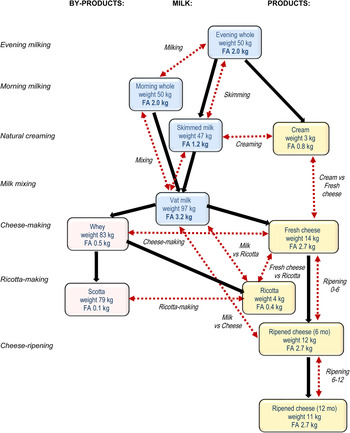
Cheese and ricotta were made every 2 weeks in the dairy on Malga Juribello according to traditional procedures. Both processes are described in detail by Bergamaschi et al. (Reference Bergamaschi, Cipolat-Gotet, Stocco, Valorz, Bazzoli, Sturaro, Ramanzin and Bittante2016) and are schematised in Fig. 1. Briefly, 250 l of raw whole milk from the evening milking was kept at about 15 °C overnight in an open flat tank to permit partial skimming through natural creaming. The separated cream represented 6·3 ± 1·6% w/v of the evening milk. The partially skimmed milk was then mixed with 250 l of whole raw milk from the following morning's milking (vat milk). Cheeses were manufactured by adding 250 g of full fat yogurt composed of pasteurised milk, Streptococcus thermophilus, and Lactobacillus bulgaricus (Latte Trento, Trento, Italy) to the vat at 27 °C, then adding 25 g of commercial rennet (Naturen extra 1030 |NB, 1030 IMCU/g; Chr. Hansen A\S, Hørsholm, Denmark). The resulting curd was cut to maize grain size, turned to facilitate draining, and gradually heated to 45 °C. The curd was put into cylindrical moulds, pressed, and salted. Fresh cheese yield was 14·2 ± 0·8% w/v. The cheeses were ripened for 6 or 12 months in a ripening cellar until analysis. The resulting ‘Malga cheese’ is a cooked paste, pressed, hard cheese made from raw cow's milk. In addition, 250 l of the whey was used for making ricotta by heating to 90 °C and adding 0·750 l of vinegar. The ricotta was separated, weighed, and transferred to perforated moulds to drain the scotta. The quantity of ricotta obtained was 5·0 ± 0·7% w/v of the whey processed.
Flow (represented by solid black arrows) of milk volume and fatty acids (FA), expressed in kg for every 100 kg of milk processed, through different dairy products and by-products obtained from creaming, cheese- and ricotta-making (the red dashed arrows represent the statistical contrasts between fatty acid profile of different dairy products reported in tables).

Sampling
A total of 11 dairy products (Fig. 1) were collected from each of the 7 cheese-making sessions over the summer (June to September). In this experiment, 4 types of raw milk (whole evening milk, partially skimmed evening milk, whole morning milk, and milk in the vat obtained by mixing partially skimmed milk with whole morning milk), 3 fresh products (cream, fresh cheese, ricotta), 2 by-products (whey, scotta), and 2 ripened cheeses (6 and 12 months) were sampled. All the samples were stored at −20 °C until analysis.
Lipid extraction and esterification
Lipid extraction of the dairy products was performed according to Hara & Radin (Reference Hara and Radin1978) and Chouinard et al. (Reference Chouinard, Corneau, Barbano, Metzger and Bauman1999) using hexane : isopropanol (3 : 2, vol/vol) as a solvent solution at room temperature. After evaporation of the solvent, the resulting extracted fat material was weighed. Lipid extraction from the cream, curd, ricotta, and cheese was completed using a Soxtec extraction apparatus (ST 255; Foss Electric) according to ISO Methodology (2001). All samples were trans esterified and methylated according to Jenkins (Reference Jenkins2010).
GC × GC analysis
Detailed fatty acid profiles were determined using a GC × GC (Agilent 7890A, Agilent Technologies, Santa Clara, CA, USA) with two columns in series and fitted with a modulator (G3486A CFT, Agilent Technologies), equipped with an automatic sampler (7693, Agilent Technologies) and a flame ionisation detector connected to the chromatography data system software (Agilent Chem Station, Agilent Technologies) at DAFNAE, University of Padova (Legnaro, Padova, Italy). Operating conditions, oven temperature programme, valves and flame-ionisation detector and gas flows were reported in detail by Schiavon et al. (Reference Schiavon, Cesaro, Cecchinato, Cipolat-Gotet, Tagliapietra and Bittante2016a, Reference Schiavon, Pellattiero, Cecchinato, Tagliapietra, Dannenberger, Nuernberg, Nuernberg and Bittanteb). The resulting two-dimensional chromatograms were analysed with the comprehensive GC × GC software (GC Image Software, Zoex Corp., Houston, TX, USA) to calculate the cone volume of each FA. An example profile is shown in online Supplementary Fig. S1.
Identification and quantification of FAs
Identification was carried out according to two methods. Firstly, by comparing the cone positions in the chromatogram with those obtained from various GC reference standards containing a mixture of pure FAs. The reference standards used were #674 and #463 (Nu-Chek Prep, Elysian, Minnesota, USA), plus 5 CLAs: 18 : 2cis-9,trans-11 (#UC-60M; Nu-Chek Prep, Elysian, Minnesota, USA), 18 : 2trans-10,cis-12 (#UC-61M; Nu-Chek Prep, Elysian, Minnesota, USA), 18 : 2cis-9,cis-11 (#1256; Matreya LLC., Pleasant Gap, Pennsylvania, USA), 18 : 2trans-9,trans-11 (#1257; Matreya LLC, Pleasant Gap, Pennsylvania, USA) and 18 : 2cis-11,trans-13 (#1259; Matreya LLC, Pleasant Gap, Pennsylvania, USA). Additional FAs were identified by comparing the elution order with the position of each FA in the 2-dimensional chromatogram produced by the comprehensive GC × GC software (GC Image Software, Zoex Corp.). Each FA was quantified in terms of the cone volume of each FA peak as a percentage of the volume of all FAs. The FAs identified through standards underwent separate statistical analyses, whereas MUFAs and PUFAs identified by position were summed into groups according to the length of their carbon chain and degree of unsaturation, as shown in online Supplementary Table S1. We tentatively quantified FAs across the cheese- and ricotta-making processes by weighing all products (milk, cream, ricotta, fresh cheese, ripened cheese) and by-products (whey, scotta) collected during the 7 experimental sessions, with the values expressed per 100 kg of milk (Fig. 1).
Statistical analysis
Fatty acid proportions (g/100 g FA), and FA categories and indices of the 11 dairy products collected from each of the 7 cheese-making sessions were analysed using SAS PROC MIXED (SAS Inst. Inc., Cary, NC) with the following statistical model:
 $$Y_{ijk} = \mu + {\rm DP}_i + {\rm date}_j + e_{ijk} $$
where y ijk is the individual FA content or FA category content or FA index; μ is the overall mean; DP i is the fixed effect of the ith dairy product (i = 1–11); datej is the repeated effect of the jth cheese-making session (j = 1–7); e ijk is the residual random error term ~N (0, σ 2). To meet the objectives of this study, orthogonal contrasts were used to investigate: (i) the effects of milking (whole evening vs whole morning milk; CvsA in the tables), skimming (whole evening milk vs partially skimmed evening milk; BvsA), and mixing (vat milk vs the average of skimmed evening milk and whole morning milk; DvsB + C); (ii) the effects of processing on FA partition between product and by-product (cream vs partially skimmed milk, fresh cheese vs whey, ricotta vs scotta; EvsB, FvsJ, and GvsK, respectively); (iii) differences among the fresh products (cream vs fresh cheese, fresh cheese vs ricotta; FvsE and GvsF, respectively); and (iv) the effects of cheese-ripening period (fresh vs 6-month ripened; 6-month vs 12-month ripened; HvsF, and IvsH, respectively) (see Fig. 1 and Tables). Moreover, two supplementary contrasts were calculated as the overall effect of cheese-making (vat milk vs 12-month ripened cheese) and of ricotta-making (vat milk vs ricotta).
Results
SFAs
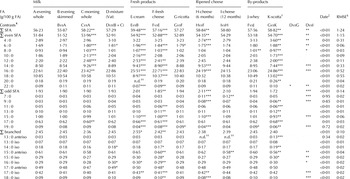
Table 1 reports the results regarding the effects of cheese and ricotta making on 26 individual SFAs, and the sums of the even linear-, odd linear- and branched-chain SFAs. Each group or individual SFA is listed as a percentage of the sum of all FAs. Comparisons of the 4 types of milk sampled revealed a significant effect of milking (CvsA in Table 1), with more even short/medium chain FAs (6 : 0–16 : 0), even Σ SFAs, and Σ SFAs, and fewer odd linear chain 17 : 0 in the morning whole milk than in the evening whole milk. None of the SFAs was affected by skimming (BvsA); with a few modest exceptions they were found in vat milk in quantities intermediate between the 2 milks mixed (mixing contrast not significant, DvsB + C: Table 1). Comparisons between each of the 3 products (cream, fresh cheese, and ricotta) and their residual fluid by-products (skimmed milk, whey, and scotta, respectively) revealed some interesting differences. The cream had greater contents of even long-chain SFAs, all even short- and medium-linear-chain FAs (6 : 0–16 : 0), 2 odd-chain FAs (15 : 0 and 17 : 0) and some branched-chain FAs (10 : 0 iso and 17 : 0 iso) and their sum than skimmed milk. Conversely cream had a significant lower concentration of long-chain FAs 18 : 0 to 22 : 0, 20 : 0 being below the limit of detection estimated by Schiavon et al. (Reference Schiavon, Pellattiero, Cecchinato, Tagliapietra, Dannenberger, Nuernberg, Nuernberg and Bittante2016b), and of 19 : 0 (EvsB). Cheese-making (FvsJ) did not affect any individual even FA in the product (fresh cheese) compared with the by-product (whey), except for a small effect on 8 : 0 and 19 : 0. Ricotta making (GvsK) had a significant effect on all individual even SFAs (except 22 : 0) and their sums, on almost all the odd linear-chain SFAs, and on 4 branched-chain SFAs (Table 1) compared to scotta, although it should be noted that scotta has a very low fat content (0·01%). Comparison of the 3 fresh products showed fresh cheese and ricotta (GvsF) to have very similar concentrations of all SFAs, with a few exceptions (6 : 0 and 19 : 0), whereas cream was very different from fresh cheese (FvsE), confirming the results from the comparison between cream and skimmed milk. The first period of cheese ripening (HvsF) increased the cumulative proportions of the SFAs and even-chain SFAs, and the individual proportions of 14 : 0 and 16 : 0, and lowered those of 4 : 0 and 6 : 0. The proportions of 7 : 0 and 9 : 0 increased dramatically, 15 : 0 increased moderately, and 19 : 0 was halved. Prolonging ripening to 1 year (IvsH) resulted only in a further increase in 7 : 0.
Effect of cheese- and ricotta-making on the proportions of milk saturated FA, even-, odd-, and branched-SFA of 11 dairy products

† Scotta = residual liquid.
‡ P-values of the repeated factor cheese-making date.
§ Root mean square error.
¶ P < 0·05; **P < 0·01; ***P < 0·001.
†† n.d. = not detectable because below the limit of detection estimated by Schiavon et al. (Reference Schiavon, Pellattiero, Cecchinato, Tagliapietra, Dannenberger, Nuernberg, Nuernberg and Bittante2016b).
MUFAs
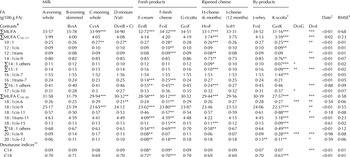
Differences between the FA profiles of the 11 dairy matrices with respect to 14 individual MUFAs (31–36% of total FAs), 7 groups of MUFAs and 2 desaturation indices are reported in Table 2. Regarding milk types, morning whole milk contained significant lower percentages of total MUFAs, long-chain MUFAs, and 18 : 1cis-9, and a slightly greater percentage of 10 : 1. Partial skimming of evening milk did not alter the proportions of MUFAs, and milk mixing had minor effects. Comparing each product with its corresponding by-product, cream had far fewer MUFAs than evening skimmed milk due to fewer long-chain MUFAs, and, in particular, 18 : 1cis-9, 18 : 1trans-11, 18 : 1cis-15, and ∑18 : 1 others, and slightly more short/medium-chain MUFAs due entirely to 16 : 1 isomers, of which there were more ∑16 : 1 others and fewer 16 : 1trans-7. Cheese-making did not affect total and individual MUFAs as there were no significant differences in these between fresh cheese and whey, while ricotta-making modified total MUFAs and many individual MUFAs, with ricotta having more medium-chain MUFAs than scotta. Comparing products, cream had more ∑16 : 1 others and 16 : 1cis-7, and fewer total MUFAs from C18 to C20 than fresh cheese, which was no different to ricotta. Fresh cheese generally had a higher content of MUFAs from C10 to C20 than 6-month-ripened cheeses, but further ripening did not affect MUFAs.
Effect of cheese- and ricotta-making on the proportions of monounsaturated FA (MUFA) and desaturase indices of 11 dairy products

† Scotta = residual liquid.
‡ P-values of the repeated factor cheese-making date.
§ Root mean square error.
¶ P < 0·05; **P < 0·01; ***P < 0·001.
†† Computed according to Kelsey et al. (Reference Kelsey, Corl, Collier and Bauman2003).
PUFAs
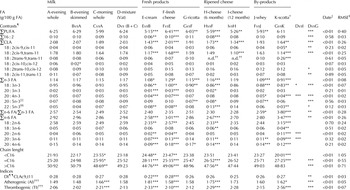
The effects of the cheese- and ricotta-making processes on 16 individual PUFAs (representing 5–7 g/100 g FA), 6 sums of PUFAs, 3 categories of FAs according to their chain length, and 3 indices are presented in Table 3. The 4 types of milk sampled had proportions of individual PUFAs and PUFA groups, which were not significantly affected by milking, skimming or mixing in the vat, except only for a minor isomer of CLA (18 : 2cis-10,cis-12), which was lower in evening milk after skimming. Regarding the effects of the 3 processes on the total PUFA content, creaming yielded cream with fewer PUFAs than skimmed milk (significant differences in the large majority of individual PUFAs), cheese-making yielded fresh cheese with more PUFAs than whey, especially n-3 FAs (the opposite was found for some n-6 FAs), and ricotta-making yielded ricotta with more CLA and n-3 FAs and far fewer n-6 FAs than scotta. As a result, cream had far fewer PUFAs and ricotta slightly fewer PUFAs than fresh cheese.
Effect of cheese- and ricotta-making on the proportions of polyunsaturated FA (PUFA), and on some desaturase (DI) and health indices of 11 dairy products

† Scotta = residual liquid.
‡ P-values of the repeated factor cheese-making date.
§ Root mean square error.
¶ P < 0·05; **P < 0·01; ***P < 0·001.
†† n.d. = not detectable because below the limit of detection estimated by Schiavon et al. (Reference Schiavon, Pellattiero, Cecchinato, Tagliapietra, Dannenberger, Nuernberg, Nuernberg and Bittante2016b).
‡‡ EPA = Eicosapentaenoic acid.
§§ DPA = Docosapentaenoic acid.
¶¶ Computed according to Kelsey et al. (Reference Kelsey, Corl, Collier and Bauman2003).
††† Computed according to Ulbricht & Southgate (Reference Ulbricht and Southgate1991).
Ripening cheese for 6 months lowered the content of the large majority of PUFAs, and prolonging ripening to 1 year further decreased the sum of PUFAs, particularly the CLA isomers.
Discussion
Fatty acid profiles of dairy products from a highland pasture
On the whole, the content of the major FAs and the categories of dairy products reported here are consistent with previous studies on pasture-based systems (Ferlay et al. Reference Ferlay, Martin, Pradel, Coulon and Chilliard2006; Khanal et al. Reference Khanal, Dhiman and Boman2008). Little is known, however, about the effect of summer transhumance to highland pastures on the detailed FA profile of milk and dairy products (Collomb et al. Reference Collomb, Bisig, Bütikofer, Sieber, Bregy and Etter2008; Coppa et al. Reference Coppa, Verdier-Metz, Ferlay, Pradel, Didienne, Farruggia, Montel and Martin2011).
Ferlay et al. (Reference Ferlay, Martin, Pradel, Coulon and Chilliard2006) reported a decrease in the percentage of medium-chain FAs in milk from cows fed on pasture. In contrast, the proportion of 18 : 1cis-9 increased (+7·3/100 g) when the cows were fed on pasture compared with indoor diets. Moreover, Leiber et al. (Reference Leiber, Kreuzer, Wettstein and Scheeder2005) observed that the 18 : 2 trans-9,cis-11 and 18 : 3n-3 concentrations in milk increased when cows were on pasture, whereas the de novo synthesised FA decreased. A study carried out on a mountain pasture, Coppa et al. (Reference Coppa, Ferlay, Borreani, Revello-Chion, Tabacco, Tornambé, Pradel and Martin2015) showed that the milk from fresh herbage at an early phenological stage had higher proportion of 18 : 1trans-11 and 18 : 2cis-9,trans-11, than those from mature herbage diet.
Effects of milking, partial skimming, and mixing on the FA profile of milk
The major differences between the FA profiles of milk from the evening milking and from the morning milking regard the percentages of total SFAs, de novo synthesised FAs, and 18 : 1cis-9, results that are consistent with Ferlay et al. (Reference Ferlay, Martin, Lerch, Gobert, Pradel and Chilliard2010). The increase in de novo synthesised FAs cannot be directly related to the milking interval, which was 12 h. A possible explanation could be differences in grass intake, time of feeding, and botanical composition of herbage consumed by grazing cows, which may affect the percentages of FAs in milk (Coppa et al. Reference Coppa, Verdier-Metz, Ferlay, Pradel, Didienne, Farruggia, Montel and Martin2011; Hurtaud et al. Reference Hurtaud, Dutreuil, Coppa, Agabriel and Martin2014). In fact, the cows can assume a different grazing behaviour (and herbage intake) during the day and the night that could affect the ruminal bacteria. Regarding this, Vlaemink et al. (Reference Vlaemink, Fievez, Tamminga, Dewhurst, van Vuuren, De Brabander and Demeyer2006) found a positive association between milk odd- and branched-chain FA and rumen bacteria metabolites.
Although almost 40% of milk fat was removed during natural overnight creaming, there were minor differences in the milk FA profiles of whole and partially defatted evening milk. Creaming can change the fat globule size which is correlated with the milk fat content. Differences in the globule size of cream and skimmed milk has reported in the past by Mulder & Walstra (Reference Mulder and Walstra1974). In a study on multiparous cows, Couvreur et al. (Reference Couvreu, Hurtaud, Marnet, Faverdin and Peyraud2007) found that milk with small fat globules (3·44 µM) compared to larger fat globules (4·53 µM) have more significant FA elongation and desaturation. The FA profile of vat milk was, as expected, intermediate between those of the evening partially skimmed milk and the morning whole milk for the large majority of individual FAs, and their groups and indices. The differences in some minor FAs, such as 6 : 0, 14 : 0 iso, 16 : 0 iso, 17 : 0 anteiso, 10 : 1, and 18 : 1cis-6, have not been studied before and may have to do with the time interval between the sampling of the milk in the skimming tank (evening milk) and in the milk parlour tank (morning milk) and the sampling of the milk in the cheese-making vat, and the associated mechanical treatments (pouring, agitation with stirrer) and microbial activity.
Effects of creaming, and cheese and ricotta making on the FA profile
Progressive depletion of milk nutrients, especially fat and protein, during cheese and ricotta making affected the FA profiles, in particular, several SFAs and PUFAs. Comparisons have previously been made between the FA profiles of cheese and the processed milk (Buccioni et al. Reference Buccioni, Rapaccini, Antongiovanni, Minieri, Conte and Mele2010; Schiavon et al. Reference Schiavon, Cesaro, Cecchinato, Cipolat-Gotet, Tagliapietra and Bittante2016a), but to our knowledge no research has compared the FA profiles of fresh cheese vs whey and of ricotta vs scotta. Differences in the FA profiles across the ricotta-making process could be related to the relationship between the FAs and whey proteins, and the effect of the high processing temperature (about 90 °C). The link between long-chain FAs and the major protein fractions in ricotta (β-lactoglobulins) should protect the FAs against isomerisation and oxidation reactions during the ricotta-making process (Pérez & Calvo, Reference Pérez and Calvo1995). The unusual FA profile of scotta could also be due to the very low quantity of fat remaining in this final by-product (Bergamaschi et al. Reference Bergamaschi, Cipolat-Gotet, Stocco, Valorz, Bazzoli, Sturaro, Ramanzin and Bittante2016).
Effects of cheese ripening on the FA profile
We found the FA profile was affected by cheese ripening, especially during the first phase from 0 to 6 months, with more than half the individual FAs and several categories affected. It is well known that the quality of cheese is influenced by various factors, mainly attributable to the quality of the initial milk, the cheese-making process and ripening conditions (Bittante et al. Reference Bittante, Cecchinato, Cologna, Penasa, Tiezzi and De Marchi2011a, Reference Bittante, Cologna, Cecchinato, De Marchi, Penasa, Tiezzi, Endrizzi and Gasperib; Lobos-Ortega et al. Reference Lobos-Ortega, Revilla, González-Martín, Hernández Hierro, Vivar-Quintana and González-Pérez2012). Several lipases are present in milk or can be released by microorganisms during ripening, and these can release short- and medium-chain FAs from triglycerides (Collins et al. Reference Collins, McSweeney and Wilkinson2003), which have a significant impact on the development of the characteristic flavour of the cheese. The literature contains various, sometime contradictory, reports of the effects of cheese-making conditions and length of cheese ripening on the cheese FA profile (Laskaridis et al. Reference Laskaridis, Serafeimidou, Zlatanos, Gylou, Kontorepanidou and Sagredos2013).
Conclusions
In this study, we examined for the first time the detailed fatty acid profiles of milk, dairy products and by-products obtained during creaming, and cheese and ricotta making during summer grazing on highland pastures. To summarise, our study reveals that the fatty acid profile of evening milk had fewer de novo synthetised fatty acids than morning milk. The natural creaming of milk differentiated the FA profile of cream from that of skimmed milk and fresh cheese (greater contents of all de novo fatty acids, and lower contents of many MUFAs, CLA isomers, and n-3 and n-6 fatty acids). The cheese-making process did not affect partition FAs between cheese and whey, whereas the ricotta-making process affected partition between ricotta and the residual scotta. We also found that ripening markedly affected the detailed FA profile of cheese, especially during the first 6 months (an increase in medium-chain SFAs, and a decrease in many PUFAs).
Supplementary material
The supplementary material for this article can be found at https://doi.org/10.1017/S0022029917000450.
The authors would like to thank Luca Grigoletto, Erika Pellattiero, Roberto Ducati (DAFNAE Department, University of Padova, Legnaro, Italy) for technical assistance and GC analysis.