Introduction
An aspect of language skills that is particularly important in the construction of a mental model of the text overall is the understanding of anaphors such as pronouns. The interpretation of pronouns is dependent on the quality of the mental representation that is constructed incrementally in the course of reading or listening (e.g., Almor, Reference Almor, Pickering, Clifton and Crocker2000; Ariel, Reference Ariel1990; Garnham, Reference Garnham2001). Most empirical studies in children have explored how personal pronouns are interpreted when the antecedent is a noun phrase (NP) (e.g., Juliet had to sell her guitar to Paul. She bought a new one; she and one referring respectively to Juliet and to a guitar) (e.g., De Cat, Reference De Cat, Serratrice and Allen2015; Järvikivi, Pyykkönen-Klauck, Schimke, Colonna, & Hemforth, Reference Järvikivi, Pyykkönen-Klauck, Schimke, Colonna and Hemforth2014).
Some pronouns can have either an NP antecedent or a propositional antecedent (e.g., Juliet had to sell her guitar to Paul. She is very sad about it; the antecedent of it is ‘having to sell her guitar’) (Asher, Reference Asher, Higginbotham, Pianesi and Varzi2000; Consten, Knees, & Schwarz-Friesel, Reference Consten, Knees, Schwarz-Friesel, Schwarz-Frisel, Consten and Knees2007; Gundel, Hedberg, & Zacharski, Reference Gundel, Hedberg, Zacharski, Branco, McEnery and Mitkov2005). Consten et al. (Reference Consten, Knees, Schwarz-Friesel, Schwarz-Frisel, Consten and Knees2007) named anaphors with a propositional antecedent ‘complex anaphors’ because they are introduced by a high-order entity that is a non-nominal expression (at least a clause). In such cases, pronouns do not only serve as a means of continuity but, as noted by the authors, “Referents of complex anaphors are established as discourse objects during the anaphoric process by (re-)activating entities at the text-semantic level” (p. 82). For Gundel et al. (Reference Gundel, Hedberg, Zacharski, Branco, McEnery and Mitkov2005), pronouns with an NP antecedent potentially have an address in memory that could be identifiable or inferable from the available cues. They are more likely to be brought into focus and thus are relatively accessible to subsequent reference. In contrast, for higher-order entities that are introduced by clauses, no address in memory is directly available. Consequently, the referent has to be conceptually (re)constructed at the semantic–text level (the so-called “complexation process”; Consten et al., Reference Consten, Knees, Schwarz-Friesel, Schwarz-Frisel, Consten and Knees2007). Thus, Gundel et al. (Reference Gundel, Hedberg, Zacharski, Branco, McEnery and Mitkov2005; see also Gundel, Hedberg, & Zacharski, Reference Gundel, Hedberg and Zacharski1993) assumed that the cognitive status of antecedents in discourse representations is lower for pronouns with a propositional antecedent than for pronouns with an NP antecedent.
Pronouns with a propositional antecedent are very common in oral and in written French, but also in English, Portuguese, Spanish, Arabic, etc. In French, the ‘adverbial’ pronouns en or y (Grévisse, Reference Grévisse and Goosse1993) can have either an NP antecedent or a propositional antecedent (in English, it, them, one, ellipsis, fulfil this role). In the case of NP antecedents in French, these pronouns could denote inanimate referents (rarely animate ones) and/or a location. The grammatical function of the pronoun is, thus, either an object complement or a locative complement. In the case of a propositional antecedent, the grammatical function of the pronoun is an object pronoun. Another pronoun that is particularly interesting for our purpose is cela ‘that, this’, because its main function is to refer to a whole proposition describing an idea. Rarely, it can be used with an NP antecedent. The pronoun cela is a demonstrative pronoun (Grevisse, Reference Grévisse and Goosse1993) and, like en and y, cela is invariable. It can appear in subject or in object position.
In French schools, children are taught about the functions of different types of personal pronouns, but are not taught about how to use the pronouns y, en, and cela. What is explicitly taught to children is that pronouns can replace nouns (designated by “a word that substitutes for a noun”), but they are not taught that pronouns can have a broader function. The lessons in school mainly use texts with animate referents (humans and animals) (see the website MEN, 2017). Children can easily assume that all pronouns, whatever their type, are used to substitute for a noun.
To our knowledge, there is only one study that has investigated children's understanding of the pronouns y and en. Elbro, Oakhill, Megherbi, and Seigneuric (Reference Elbro, Oakhill, Megherbi and Seigneuric2017) assessed whether they were good predictors of reading comprehension skill. The authors asked French children to read short texts and to perform two tasks: a completion task in which the pronoun was missing and children had to choose the correct pronoun between en and y, and a referent specification task in which children had to explicitly specify the referent of the pronoun from the previous context. Results supported the hypothesis that these two aspects of pronoun processing independently predict variance in reading comprehension over and above other common predictors. Elbro et al. argued that the ability to specify referents for such pronouns taps the quality of the reader's mental model of the preceding text, whereas the ability to complete sentences utilizes more basic knowledge of the functions of pronouns with regard to semantic and syntactic context. Nevertheless, the authors did not explore the difference between pronouns with an NP antecedent and pronouns with a propositional antecedent. In fact, they used only pronouns with NP antecedents in the completion task and pronouns with a wide scope of reference in the specification task (animate and inanimate nouns, locative, whole proposition).
The aim of the current study was to explore how French children aged eight years process pronouns with either an NP antecedent or a propositional antecedent. We explored how children specify the referents of pronouns that place high demands on the quality of the mental model of the previous part of the text (Experiment 1). The requirement to specify the referents allows us to analyze the content of the mental model, particularly in the cases of pronouns with a propositional antecedent since the referent has to be re-conceptualized. By asking children to complete texts with en or y (Experiment 2), we will test their knowledge of the context in which these pronouns are appropriate: the completion task can be effected by using local semantic and syntactic knowledge alone, whatever the nature of the referent.
Experiment 1
The aim of Experiment 1 is to study French children's ability to specify the referents of pronouns en, y, and cela when they have either an NP antecedent or a propositional antecedent. Two types of antecedent were used: texts in which the pronoun had an NP antecedent and texts in which the pronoun had a propositional antecedent. It is likely that pronouns with propositional antecedents are more difficult for children that those with NP antecedents, but a supplementary aim is to investigate how the types of error that children make can throw light on their difficulties. This allows us to tap the quality of the reader's mental model of the preceding text. Thus, quantitative and qualitative analyses will be carried out to shed light on the processes and strategies that children are using to process these pronouns. In terms of the errors, we predict that children expect pronouns to have a noun phrase as a referent. The errors they make when presented with pronouns with a propositional antecedent will tend towards those that focus on smaller units (noun phrases), rather than other propositions. In these cases, children might also select a fragment of the correct proposition: in particular, the noun phrase.
Method
Participants
One hundred and twenty-five third-grade children participated in the experiment. The data from 18 children were discarded (see ‘Results’ section). The analyses were conducted on 107 children (55 boys and 52 girls). Their average age was 8;7 (SD = 3 months). Children attended schools that recruit students from a wide range of socioeconomic backgrounds. They came from classes in five primary schools (Paris and Nantes) and were all exposed to the French language from birth. In addition, 14% of the participants had been exposed to another language (mostly Arabic, Turkish, Portuguese, and African languages). They had no behavioural or language difficulties according to their teachers.
Materials and procedure
Referent specification task
The material was the same as that used in the referent specification task of Elbro et al. (Reference Elbro, Oakhill, Megherbi and Seigneuric2017). It consisted of twenty texts each containing two sentences (length from 19 to 39 words). The first sentence supplied the context and the second one contained a pronoun (en, y, or cela). Two types of antecedent were manipulated: eleven texts in which the pronoun had an NP antecedent (example 1) and nine texts in which the pronoun had a propositional antecedent (example 2). For NP antecedents, the entities were all inanimate (e.g., ‘a story’ in example 1). For each text, the pronoun was highlighted and children were invited to read the text, and then to specify the referent of the pronoun. The task required them to find “the word or words that could take the place of the pronoun”. Children had to write their response on a dotted line that was just below the text. If children had doubts about spelling words, they were encouraged to write their response as they thought the words were spelled. They were not penalized for spelling errors.
Examples of texts (see ‘Appendix' for details):
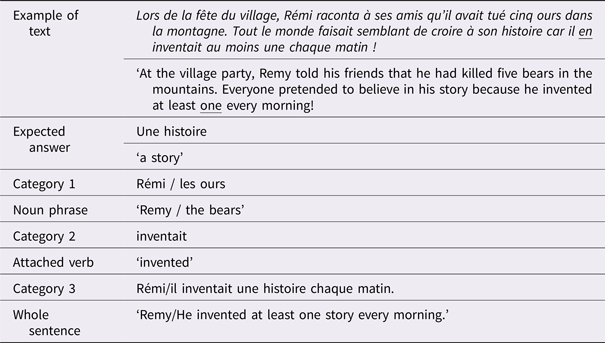
1. Lors de la fête du village, Rémi raconta à ses amis qu'il avait tué cinq ours dans la montagne. Tout le monde faisait semblant de croire à son histoire car il en inventait au moins une chaque matin!
‘At the village party, Remy told his friends that he had killed five bears in the mountains. Everyone pretended to believe in his story because he invented at least one every morning!’
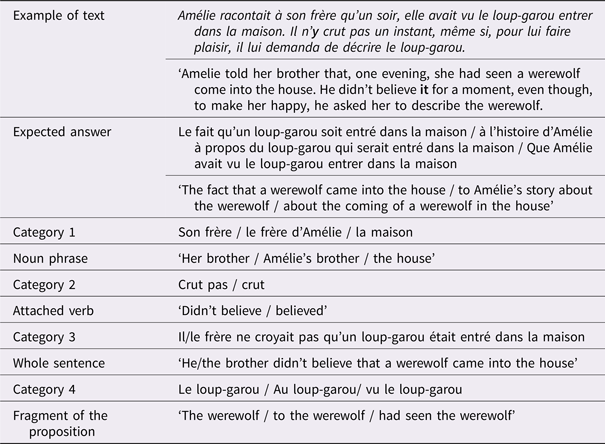
2. Amélie racontait à son frère qu'un soir, elle avait vu le loup-garou entrer dans la maison. Il n’y crut pas un instant, même si, pour lui faire plaisir, il lui demanda de décrire le loup-garou.
‘Amélie told her brother that, one evening, she had seen a werewolf come into the house. He never believed it, even though, to make her happy, he asked her to describe the werewolf.’
In addition, to ensure that potential difficulty was not due to the specification task, children were invited to do the same task with personal pronouns (‘he’, ‘she’, ‘they’) for which the processing is assumed to be mastered by this age. The processing of these pronouns was made easy as only one referent matched in number and gender (e.g., Depuis que Pierre est à Paris, il est inscrit au conservatoire ‘Since Pierre has been in Paris, he has signed up at the conservatory’). Six texts containing such pronouns were used as a control measure, to ensure that participants understood the nature of the task.
Children were tested in small groups of between five and eight in a session lasting 40 minutes. Three different booklets were produced with the 20 texts in different random orders. The session began with six training examples, for which correct answers were provided.
Word reading
A word identification task was administered to make sure that all children selected for the analyses had no problems with decoding. A one-minute test (50 words) was administered (used by Elbro et al., Reference Elbro, Oakhill, Megherbi and Seigneuric2017, and Seigneuric, Megherbi, Bueno, Lebahar, & Bianco, Reference Seigneuric, Megherbi, Bueno, Lebahar and Bianco2016). Children were tested individually. A score based on the number of words read correctly in one minute was computed for each child.
Results
First, we discarded the data from 18 children for two reasons: 13 participants were not able to perform the task even for simple pronouns: they had a score of zero for subject pronouns (some had also a low level of word reading). We also discarded the data from 5 children who performed more than 1.5 SD below the mean on the word reading test. Thus, the analyses were conducted on 107 children. The correlation between the reading score and performance on the pronoun task was significant (r(107) = .40, p < .001).
Accuracy: percentage of correct responses
The percentage of correct responses across all items was 52.55% (SD = 22.46). As can be seen from Table 1, the subject pronouns (‘he’, ‘she’, ‘they’) were significantly easier to process than the pronouns en, y, and cela (80.37% vs. 44.21%; t(106) = 15.91, p < .0001). In the case of pronouns that differ in scope of antecedents (en, y, cela), it was considerably easier for participants to process pronouns with an NP antecedent than those with a propositional antecedent (59.39% vs. 25.99%); the difference was highly significant (t(106) = 14.57, p < .0001). Thus, this task was difficult for children, and their performance dropped dramatically when the referent was not simply an NP.
Specification accuracy (%) for subject pronouns and for pronouns with an NP antecedent and pronouns with a propositional antecedent

Qualitative analysis of errors
Four judges – all specialists working in the language domain – categorized the children's errors. Once the categories had been decided, two judges coded the errors made by children. The two other judges were consulted in the case of disagreements. Three main categories of errors were identified for the pronouns with an NP antecedent, and an additional one for the pronouns with a propositional antecedent. Tables 2a and 2b provide examples of these error categories. Category 1 comprised answers corresponding to noun phrases present in the text, which were more frequently taken from the context sentence. Category 2 comprised the verb in the proposition containing the pronoun regardless of the morphological aspect of the verb's conjugation. Category 3 comprised the production of a whole sentence. Even though this response suggests that children understood the text, this response is not accepted as a correct response since the instructions and the training specified that the child should select the referent. For the texts with a propositional antecedent, another category of error emerged: production of a fragment of the correct proposition (category 4). This response suggests that children identified a relevant part of the correct response but that they failed to produce the full proposition. Some other wrong responses were difficult to categorize, mostly ‘copied single words’ with heterogeneous grammatical functions (e.g., adverbs, pronouns, adjectives), and some words that were not present in the context or that had nothing to do with the correct answer. Finally, there were some ‘don't know’ responses.
Expected answer and examples of wrong answers for the error categories with a text containing a pronoun with an NP antecedent

Expected answer and examples of wrong answers for the error categories with a text containing a pronoun with a propositional antecedent

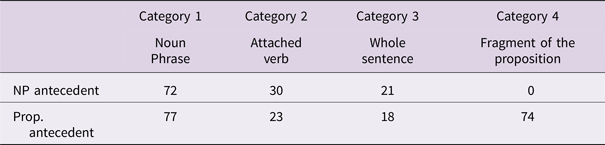
We reported in Table 3 the number of children who made each type of error at least once for the pronouns en, y, and cela with an NP antecedent and pronouns with a propositional antecedent. About 70% of the children produced at least one error of type NP for both types of antecedent (an NP antecedent or a propositional antecedent). For texts containing pronouns with a propositional antecedent, more than 70% of children produced at least one fragment of the proposition. Finally, the proportion of children who made at least one error type Attached verb was relatively high for both types of antecedent.
Number of children who made each type of error at least once for pronouns with an NP antecedent and for pronouns with a propositional antecedent

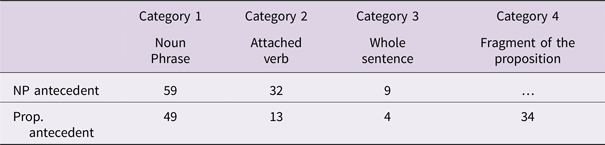
Table 4 presents the percentages of errors observed in each category and for each type of antecedent. For NP antecedents, most errors fall into category 1: that is an NP other than the one that was expected (59%). Within this category, errors were distributed as follows: 64% animate nouns, 36% inanimate nouns (less than 1% were location complements). Category 2 (Attached verb) was the next most frequent category, with almost 35% of the errors. There were few whole sentence errors (only 9%).
Distribution of errors (%) for pronouns with an NP antecedent and for pronouns with a propositional antecedent

Note. We report the percentages that have been calculated on the basis of the total of the categorized responses (‘Don't know’ and ‘non-categorized errors’ have been discarded).
For the propositional antecedents, 49% of errors were due to the choice of an incorrect NP (category 1). Within that category, errors were distributed as follows: 74% for animate nouns, 26% for inanimate nouns (less than 3% location complements). The second most dominant error type (34%) was category 4 (production of a fragment of the correct proposition), which is specific to this type of antecedent. Within this category, 75% of errors were NPs (‘the werewolf’), and 25% were verb phrases (‘has seen the werewolf’). Interestingly, no child responded with a different proposition. There were 13% of category 2 errors (Attached verb). Finally, category 3 (whole sentence) represented only 4% of the errors.
Further analysis of Attached verb errors
Errors that fell into the category Attached verb (category 2) were unexpectedly frequent and they were not confined to some texts. There are two possible explanations for this phenomenon: either some children did not attempt to understand the pronoun and they misunderstood the instructions to mean “replace the dotted line with what comes afterwards” (in the case of pronouns of all types), or this error occurred because of an attempt to make a link between the pronoun (of whatever type) and the verb that followed. One of the characteristics of French is that pronouns occur before the verb of which they are the subject (Il a vu Marie ‘He saw Mary’) or object (Peter l’a vue, literally: ‘Peter her saw’), thus reinforcing the idea that there is a structural link between pronouns (whatever their type) and the verb that follows (Bybee, Reference Bybee, Givon and Malle2002).
The first explanation is unlikely, because all of the children included in the analyses had achieved a good score on the simple pronoun task, which indicates that they did understand the task requirements. Furthermore, a supplementary analysis of the children who produced at least one Attached verb error (37 children: 35% of the sample – a number that has been calculated on the basis of the total score whatever the type of pronoun) was carried out. Among these children, only 5 made this error with a proportion equal to or greater than 50% of their error response (maximum was 75%). The others made this error to a much lesser extent (from 3% to 35%). Children who made the error type Attached verb did not show any consistency across the two pronoun types (y, en, cela vs. subject pronouns). Eleven children produced at least one Attached verb error on the en, y, and cela task, and at least one for the subject pronouns; 22 children produced at least one Attached verb error but only on the en, y, cela task, and not on the subject pronoun task. In addition, four children produced an Attached verb error type only on the subject pronoun task. Finally, this type of error was not confined to a few items.
In summary, children had difficulty in processing pronouns that can have a wide scope of reference. Both predictions were supported: children had more difficult in specifying the referents of pronouns with propositional antecedents than pronouns with NP antecedents. The qualitative analysis showed that the most common error was to select an inappropriate NP (more usually animate). The Attached verb error was not restricted to only a few children or a few items. A third of the participants gave this response, but not systematically, and it occurred across all items.
Experiment 2
The aim of Experiment 2 was to study the basic knowledge of uses of the pronouns with regard to syntactic and semantic contexts. We tested the ability to complete texts with en or y using the same materials as in Experiment 1. We predicted that the ability to complete sentences with the pronouns en or y would be easier for pronouns with an NP antecedent than pronouns with a propositional antecedent. Based on the results of Elbro et al. (Reference Elbro, Oakhill, Megherbi and Seigneuric2017), we predicted that performance would be higher in this task than in the specification task, at least for pronouns with an NP antecedent.
Method
Participants
Forty-five children from the third grade, who did not take part in the previous experiment, were recruited. Two were discarded because of reading difficulties. The final sample comprised 43 children (21 boys and 24 girls) with an average age of 8;9 (SD = 4 months). They attended one of two classes from a school in Paris that recruits students from a wide range of socioeconomic backgrounds. They were all born in France and were exposed to the French language from birth. Nevertheless, exposure to French does not guarantee that children were not exposed to one or more other languages. They had no behavioural or language difficulties according to their teachers.
Materials and procedure
The materials were the same as those used in Experiment 1, except that we removed three texts containing the pronoun cela. Indeed, whereas en and y can be used with the same syntactic structure, cela cannot (Grévisse, Reference Grévisse and Goosse1993). The total number of texts was 17: 10 containing a pronoun with an NP antecedent and 7 with a propositional antecedent. The procedure was close to that used in Experiment 1. The instruction was “For each text, a word is missing. Complete it by choosing en or y”. The session lasted 20 minutes.
Results
The percentage of correct responses for pronouns with an NP antecedent was 79.5% (SD = 12.33) and it was 63.5% (SD = 24) for pronouns with a propositional antecedent. Both scores were significantly greater than chance (both ps < .0001). It was more difficult to choose between y or en when the pronoun has a propositional antecedent than an NP antecedent; the difference was significant (t(42) = 4.82, p < .001).
Discussion
To our knowledge, this is the first study in children that addressed the interpretation and use of pronouns that have an NP vs. a propositional antecedent. Taken together, the results of Experiments 1 and 2 support the hypothesis that children would experience more difficulty in the interpretation of pronouns with a propositional antecedent than pronouns with an NP antecedent. The results are in line with the linguistic views that stress the greater complexity of processing in the case of propositional antecedents (Asher, Reference Asher, Higginbotham, Pianesi and Varzi2000; Consten et al., Reference Consten, Knees, Schwarz-Friesel, Schwarz-Frisel, Consten and Knees2007; Gundel et al., Reference Gundel, Hedberg and Zacharski1993, Reference Gundel, Hedberg, Zacharski, Branco, McEnery and Mitkov2005). In Experiment 1, where children had to specify the referent, in the case of propositional antecedents the referents had to be conceptually (re-)constructed. Thus, we suggest that the cognitive cost required for the specification of the antecedent is higher when it is a proposition than when it is an NP.
The texts used in the experiment in the cases of the pronoun en with an NP antecedent included a numeral (une in example 1). In such cases, this could have facilitated the performance for that pronoun. This variable – with and without a numeral – could be investigated in a further research to study its impact on performance. We could expect a better performance in the cases of texts containing two indicators (en and a numeral) compared to texts containing only the pronoun en.
The qualitative analysis from the referent specification task (Experiment1) showed a pattern of results that qualify the content of the participant's mental model constructed during text reading. Error types for NP and for propositional antecedents were rather similar. Indeed, other NPs from the text were often erroneously selected as referents for the pronoun en, y, and cela whether they have an NP or a propositional antecedent. During reading or listening, nouns are more likely to be in the mental model and are, thus, relatively more accessible for subsequent reference. According to Trueswell and Tanenhaus (Reference Trueswell, Tanenhaus, Clifton, Frazier and Rayner1994; see also Van den Broek, Risden, Fletcher, & Thurlow, Reference Van den Broek, Risden, Fletcher, Thurlow, Britton and Graesser1996), individual character representations are particularly highly activated. In our study, faced with poor understanding of the functions of en, y, and cela, children may assign a readily accessible referent to complete the task. This pattern of responding could also reflect their application of the rule that they have learnt at school, i.e., that a pronoun substitutes for a noun.
It is possible that, because the experimental task was similar to that in school exercises, it introduced a bias towards choices of responses from the text itself, which would have disadvantaged performance on pronouns with a propositional antecedent. Despite the fact that the instructions did not give information about whether or not the words were in the text, and feedback following training examples, it is possible that the children had the expectation that the words required could be taken directly from the text. However, the training texts also served to show children that a reformulation was required in the case of propositional antecedents.
In the case of the texts with propositional antecedents, production of a ‘proposition fragment’ was the second most frequent error response. This response can show that it is difficult for children to come up with a complete specification of the referent, either because of the cognitive load (because the majority of such responses required a reconstruction and/or because this type of response was more demanding to write). Children mainly produced noun phrase errors and few verb phrase errors. The distribution of errors underlines once again the children's overriding preference to choose an NP.
Errors that fell into the category Attached verb were also quite common. An initial explanation is that children would have an implicit knowledge that pronouns en and y are particularly linked to the verb that follows, and so they complete the task by choosing the words that follow the pronoun. However, this type of error was not associated only with the pronouns en and y, which maintain close ties with the verb in the French language. The pronoun cela also produced errors of this type, and even more surprisingly, the analysis of the errors for subject pronouns (‘he/she/they’) also showed that the choice of the verb that followed the pronoun was the most frequent type of error for subject pronouns. These errors were not confined to some texts and they were observed in more than a third of children. This pattern of responding does not suggest that these children simply misunderstood the task, because none of them systematically applied this strategy/rule (attached verb). The presence of this error category thus tends to show that children create links between pronouns (whatever their type) and verbs. Elements such as pronouns and verbs co-occur in language (Bybee, Reference Bybee, Givon and Malle2002). In addition, since children had to complete the task by writing their response on a dotted line, we suggest that when they were unsure, children completed the gap with the word following the pronoun.
A small proportion of errors arose because children produced the whole sentence containing the antecedent. Even though we classified these answers as wrong, they should not be considered wrong to the same degree as the others. In these cases, it could be argued that children understood the texts. Such responses could be a result of a didactical practice, since teachers usually require children to answer with full sentences even if the answer is one word.
Finally, as found by Elbro et al. (Reference Elbro, Oakhill, Megherbi and Seigneuric2017), it was easier to perform the completion task than the referent specification task. To better understand the strategies underlying the completion task, we carried out an assessment on 15 adults (mean age: 28 years; SD = 6, 19 to 40 years; 5 men and 10 women, employees or students). They performed the completion task and then they explained how they had arrived at their choice of pronoun. All adults stated that they had done the task naturally or intuitively by trying out which word fitted better in the sentence. None of them sought to find the referent of the pronoun. Indeed, to perform the completion task, processing the clause containing the pronoun was sufficient. In line with Gordon and Hendrick (Reference Gordon and Hendrick1997), we argue that children were applying implicit knowledge of sentence structure to perform the completion task. In contrast, the specification task requires the construction and integration of different types of information across sentences at a text level. In addition, this differential difficulty may well have arisen because the specification task requires metalinguistic processes.
In sum, this study showed that, for children, the pronouns that have different scope of reference are difficult to specify. This is particularly true when they require a propositional antecedent to be reconstructed; a process that requires integration of information across sentences. In our materials, the semantic properties were different across the texts, so we cannot be sure that these results would be invariable across different texts and different genres. It is also possible that longer texts might give different results. For example, it is surprising that location errors (and especially for y) were not produced more frequently. In fact, we did not vary the semantic roles of the potential antecedents. Thus, it would be interesting to test how children specify the referent when several potential referents that vary in their semantic/thematic roles are inserted in longer texts.
Acknowledgements
This work was supported by the Program of Visiting Professor of the University Paris 13 Sorbonne Paris Cité (Jane Oakhill) and by the French National Agency (ANR-DEVCOMP 10-blan-1907-01). We thank Maryse Bianco, Pascale Colé, and Liliane Sprenger-Charolles for their collaboration to the DEVCOMP project and especially for providing the word minute identification test. We are grateful to the inspectors, directors, teachers, children, and their parents for their participation to the experiment (IEN Rueil Malmaison, IEN of Paris 11ème, and IEN of Nantes). We also thank Amandine Herbelin, Anais Joly, Sarah-Lee Salas, Océane Marchand, and Morgane Pouget for their assistance in data collection.
Appendix
Examples of texts containing a pronoun with an NP antecedent
Text 1
Lors de la fête du village, Rémi raconta à ses amis qu'il avait tué cinq ours dans la montagne. Tout le monde faisait semblant de croire à son histoire car il en inventait au moins une chaque matin!
‘At the village party, Remy told his friends that he had killed five bears in the mountains. Everyone pretended to believe in his story because he invented at least one every morning!’
Text 2
Caroline, après avoir déménagé plusieurs fois au cours des dix dernières années, a finalement acheté une maison en Provence. Elle compte y habiter plusieurs années.
‘Having moved several times over the last ten years, Caroline finally bought a house in Provence. She plans to live there for several years.
Text 3
Il était difficile pour les enfants de croquer dans les pommes car leur peau était très épaisse. La maman décida d’en peler quelques-unes afin qu'ils puissent les manger plus facilement.
‘It was difficult for the children to bite into the apples as they had very thick skins. Their mother decided to peel some of them, so that they could eat them more easily.
Examples of texts containing a pronoun with a propositional antecedent
Text 4
Amélie racontait à son frère qu'un soir, elle avait vu le loup-garou entrer dans la maison. Il n’y crut pas un instant, même si, pour lui faire plaisir, il lui demanda de décrire le loup-garou.
‘Amélie told her brother that, one evening, she had seen a werewolf come into the house. He never believed it, even though, to make her happy, he asked her to describe the werewolf.
Text 5
Marie a vendu sa guitare à Juliette. Marie en était très triste mais elle n'avait pas le choix.
‘Mary sold her guitar to Juliette. Marie was very sad about it but she had no choice.
Text 6
Un jour, la mère avoua à son fils Jojo qu'elle avait peur d'aller chez le dentiste. Mais Jojo n’y accorda aucune importance.
‘One day, the mother confessed to her son Jojo that she was afraid to go to the dentist. But Jojo did not mind.
Examples of texts containing a subject pronoun
Text 7
Depuis que Pierre est à Paris, il s'est inscrit au cours de piano du conservatoire et il a découvert la musique classique.
‘While Pierre was in Paris, he signed up at the piano conservatory and he discovered classical music.
Text 8
Son seau à la main, la pauvre femme alla au puits chercher de l'eau. Elle se pencha.
‘Her bucket in her hand, the poor woman went to the well to fetch water. She leaned over.