Trichotillomania (TTM) is characterised by repetitive removal of one's hair resulting in hair loss (American Psychiatric Association [APA], 2013). Hair is commonly removed from the scalp, eyebrows and eyelashes (du Toit, van Kradenburg, Niehaus, & Stein, Reference du Toit, van Kradenburg, Niehaus and Stein2001; Woods, Flessner et al., Reference Woods, Flessner, Franklin, Keuthen, Goodwin, Stein and Walther2006). TTM has a profound negative impact upon the self-esteem and social, educational and vocational functioning of those afflicted (du Toit et al., Reference du Toit, van Kradenburg, Niehaus and Stein2001; Flessner, Woods, Franklin, Keuthen, & Piacentini, Reference Flessner, Woods, Franklin, Keuthen and Piacentini2009; Woods, Flessner et al., Reference Woods, Flessner, Franklin, Keuthen, Goodwin, Stein and Walther2006). Despite this, TTM remains underdiagnosed and undertreated.
TTM is a poorly understood disorder, with early clinical conceptualisations ranging from a ‘nervous habit’ akin to onychophagia (nail biting; Azrin & Nunn, Reference Azrin and Nunn1973), to an impulse-control disorder akin to pathological gambling (APA, 1987, 2000). Common to these conceptualisations is the view that the onset and maintenance of hairpulling is largely a result of behavioural and situational factors. The comprehensive behavioural model of TTM (Mansueto, Stemberger, Thomas, & Golomb, Reference Mansueto, Stemberger, Thomas and Golomb1997) suggests that hairpulling is reinforced via classical and operant conditioning processes. Given that a substantial proportion of hairpulling occurs beyond the individual's awareness (i.e., ‘automatic’ hairpulling), this model is particularly suited to behavioural therapy (BT) interventions such as habit reversal therapy (HRT), which increase the individual's awareness of their actions and surroundings, then modifying those factors to counteract the automaticity of hairpulling. BT has been found more effective than pharmacotherapies (Bloch et al., Reference Bloch, Landeros-Weisenberger, Dombrowski, Kelmendi, Wegner, Nudel and Coric2007) and supportive group therapy (Diefenbach, Tolin, Hannan, Matby, & Crocetto, Reference Diefenbach, Tolin, Hannan, Matby and Crocetto2006), and is regarded the first-line treatment for TTM (Franklin, Zagrabbe, & Benavides, Reference Franklin, Zagrabbe and Benavides2011).
However, BT does not sustain long-term symptom reduction for the majority of individuals (Keijsers et al., Reference Keijsers, van Minnen, Hoogduin, Klaassen, Hendriks and Tanis-Jacobs2006). There is growing evidence to suggest that hairpulling also serves an emotion-regulation function (Begotka, Woods, & Wetterneck, Reference Begotka, Woods and Wetterneck2004; du Toit et al., Reference du Toit, van Kradenburg, Niehaus and Stein2001; Diefenbach, Mouton-Odum, & Stanley, Reference Diefenbach, Mouton-Odum and Stanley2002; Roberts, O’Connor, & Bélanger, Reference Roberts, O’Connor and Bélanger2013; Shusterman, Feld, Baer, & Keuthen, Reference Shusterman, Feld, Baer and Keuthen2009). Hairpulling within the individual's awareness (i.e., ‘focused’ hairpulling) is believed to regulate negative internal experiences such as emotions, cognitions and sensations (Flessner, Conelea et al., Reference Flessner, Conelea, Woods, Franklin, Keuthen and Cashin2008; Flessner, Woods, Franklin, Cashin, & Keuthen, Reference Flessner, Woods, Franklin, Cashin and Keuthen2008). It is likely that BT fails to target the complete phenomenological picture of the antecedent and maintaining factors that contribute to TTM. Indeed, TTM's diagnostic reconceptualisation as an obsessive-compulsive related disorder (OCRD; APA, 2013) extends a challenge to behaviourally focused models and treatments in particular. For the first time, TTM has been recognised as related to, but distinct from, disorders such as obsessive-compulsive disorder (OCD) and body dysmorphic disorder (BDD), in which cognitive processes are strongly implicated, and explicitly targeted during treatment (e.g., Clark, Reference Clark2004; Veale & Neziroglu, Reference Veale and Neziroglu2010).
Although contentious (see Phillips et al., Reference Phillips, Stein, Rauch, Hollander, Fallon, Barsky and Leckman2010), viewing TTM as an OCRD presents an opportunity to investigate an under-studied element of its phenomenology: cognitions and beliefs. Beliefs about hair qualities and desire for symmetry have been reported anecdotally (Mansueto et al., Reference Mansueto, Stemberger, Thomas and Golomb1997) or described phenomenologically (Duke, Bodzin, Tavares, Geffken, & Storch, Reference Duke, Bodzin, Tavares, Geffken and Storch2009). Negative self-evaluations were proposed by Franklin and Tolin (Reference Franklin and Tolin2007) to contribute to hairpulling episodes, reflecting the low self-esteem and shame reported in TTM samples (Casati, Toner, & Yu, Reference Casati, Toner and Yu2000; Diefenbach, Tolin, Hannan, Crocetto, & Worhunsky, Reference Diefenbach, Tolin, Hannan, Crocetto and Worhunsky2005). Gluhoski (Reference Gluhoski1995) proposed a cognitive model of TTM based upon cognitions relevant to substance abuse; specifically, beliefs that the maladaptive behaviour is uncontrollable, valuing the behaviour as a coping strategy, and permission-giving beliefs that facilitate the behaviour. However, this model has instigated little systematic research into the role of cognitions and beliefs in TTM. To our knowledge, only a single empirical investigation has been conducted: Norberg, Wetterneck, Woods, and Conelea (Reference Norberg, Wetterneck, Woods and Conelea2007) discovered that self-rated TTM symptom severity was positively associated with cognitions regarding shame, dysfunctional beliefs about physical appearance, and fear of negative evaluation by others. However, the magnitude of these relationships was small, and when controlling for the influence of experiential avoidance these relationships diminished or disappeared.
Despite this paucity of research, the addition of cognitive therapies to BT protocols is increasing. Pelissier and O’Connor (Reference Pelissier and O’Connor2004) proposed that a cognitive model of habit and tic disorders (O’Connor et al., Reference O’Connor, Brault, Robillard, Loiselle, Borgeat and Stip2001; O’Connor, Garcau, & Borgeat, Reference O’Connor, Gareau and Borgeat1997) could be utilised to guide cognitive-behavioural therapy (CBT) for a 23-year-old woman with TTM. The CBT protocol was tailored to address her perfectionistic beliefs about personal organisation and task management, as these beliefs typically preceded her hairpulling. Pelissier and O’Connor reported that following 18 weekly sessions, the participant's hairpulling decreased from an average 24 hairs pulled each day to an average one hair pulled each week. Brief relapses were reported at 12 and 18 months follow-up. Alternatively, acceptance and commitment therapy (ACT) has been combined with HRT (Crosby, Dehlin, Mitchell, & Twohig, Reference Crosby, Dehlin, Mitchell and Twohig2012; Twohig & Woods, Reference Twohig and Woods2004; Woods, Wetterneck, & Flessner, Reference Woods, Flessner, Franklin, Keuthen, Goodwin, Stein and Walther2006). Incorporating ACT interventions such as defusion from thoughts, Crosby and colleagues (Reference Crosby, Dehlin, Mitchell and Twohig2012) reported an 88.9% reduction in hairpulling frequency after eight treatment sessions in their five participants. However, three participants had lost 50% or more of treatment gains at 3 months post-treatment. Taking an emotion-regulation approach, dialectical behaviour therapy (DBT) combined with CBT has also demonstrated significant TTM symptom reductions post-treatment, which have been generally maintained at 6-month follow-up (Keuthen et al., Reference Keuthen, Rothbaum, Fama, Altenburger, Falkenstein, Sprich and Welch2012).
No research has investigated cognitions in TTM in order to identify the core beliefs, attitudes or appraisals that may facilitate or exacerbate hairpulling episodes in a way analogous to the research that has identified influential beliefs domains in OCD (e.g., importance/control of thoughts, perfectionism/certainty, responsibility/threat estimation; Obsessive Compulsive Cognitions Working Group [OCCWG], 1997, 2001, 2005). Systematic evaluation of beliefs in OCD has led to the development of reliable psychometric measures, such as the Obsessive Beliefs Questionnaire (OCCWG, 2001, 2005), which has facilitated the development and evaluation of cognitive models and treatments of OCD with a view to advancing our understanding of change mechanisms (e.g., Wilhelm, Berman, Keshaviah, Schwartz, & Steketee, Reference Wilhelm, Berman, Keshaviah, Schwartz and Steketee2015). Indeed, experts have called upon research on change mechanisms in TTM in order to identify the specific cognitive-affective components that may be responsible for the promising treatment outcomes observed in ACT- and DBT-enhanced therapies (Franklin et al., Reference Franklin, Zagrabbe and Benavides2011; Woods et al., Reference Woods, Flessner, Franklin, Keuthen, Goodwin, Stein and Walther2006).
As Franklin and Tolin (Reference Franklin and Tolin2007) suggest, ‘the available treatments [for TTM] are only as good as the empirical model upon which they are based’ (p. 15). There is strong potential for a systematic evaluation of cognitions and beliefs in TTM to advance development of psychometric measures that can be used to empirically evaluate theoretical models and improve treatments. As part of a wider research project to develop a psychometric measure of cognitions associated with TTM, the aim of this initial exploratory study was to explore and describe the cognitions and beliefs that individuals with TTM experience, and how these act as antecedent and/or maintaining factors across the hairpulling cycle.
Method
Design
This study employed a qualitative research design in which Interpretative Phenomenological Analysis (IPA; Smith, Reference Smith1996; Smith & Osborn, Reference Smith, Osborn and Smith2008) was used to analyse and interpret participant's interview data. IPA is committed to making a detailed and multifaceted examination of how a relatively homogeneous, small group of individuals (i.e., <10 participants) perceive, appraise and ‘make sense’ of the phenomenon under question. In this sense, IPA is phenomenological; however, it is also interpretative in that psychological concepts and theory may be drawn upon by the researchers to make sense of the participant's experiences. IPA emphasises theoretical as opposed to empirical generalisability (Smith & Osborn, Reference Smith, Osborn and Smith2008).
Participants
Eligibility criteria included: (1) diagnosis of TTM (DSM-IV-TR; APA, 2000), (2) age 18 years or older, (3) willing and available to participate in an electronically recorded clinical and qualitative interview, and (4) English-language proficiency. Participants were ineligible if they had experienced current high suicide risk or past/current psychotic illness. Participants were recruited through advertisements to mental health organisations and online peer support forums. Between February and October, 2012, 12 individuals (all females) contacted the researchers about participating, of whom eight consented to participate. No participants were excluded on the basis of exclusion criteria. The majority of participants (n = 5) were recruited from the same non-profit TTM peer support group.
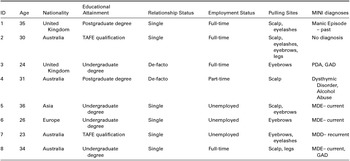
Participants’ ages ranged from 23 to 36 (M = 29.88, SD = 5.05). Demographics are summarised in Table 1. All participants were unmarried and had completed higher education, in contrast with characteristics of other TTM samples with greater variability in relationship and educational status (e.g., Christenson et al., Reference Christenson, Mackenzie and Mitchell1991; Woods, Flessner et al., Reference Woods, Flessner, Franklin, Keuthen, Goodwin, Stein and Walther2006). Consistent with other samples, most participants experienced comorbid depressive psychopathology (n = 5). Six participants reported that they primarily pulled hair in an automatic style, with on average 88.2% of their hairpulling episodes being automatic (range = 80–99%). For the two remaining participants, one (P3) reported that her hairpulling episodes were 50% focused, and the other (P7) reported that her primary hairpulling style was 70% focused.
Participant Demographics

Note: GAD = generalised anxiety disorder; MDE = major depressive episode; MDD = major depressive disorder; PDA = panic disorder with agoraphobia. DSM-IV-TR (APA, 2000) criteria.
Measures
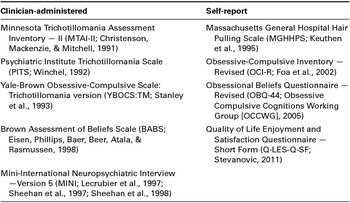
Several clinician-administered and self-report symptom measures were used to establish DSM-IV-TR (APA, 2000) diagnosis of TTM and comorbid psychiatric disorders, TTM symptom severity, obsessive-compulsive symptom severity and associated phenomenology, and quality of life ratings (refer to Table 2). These measures provided important descriptive information about the sample.
List of Measures

A semi-structured qualitative interview was developed by the authors to explore participants’ experiences before, during and after hairpulling episodes. As per the qualitative approach of IPA (Smith, Reference Smith1996; Smith & Osborn, Reference Smith, Osborn and Smith2008), a small set of standard questions and prompts were used, and inquired about: (1) the context in which hairpulling occurs, (2) the experience of urges, (3) associated physical sensations, (4) associated affect, thoughts and behaviours, and (5) the participant's reflections on the function of hairpulling. Participants were encouraged to consider the beliefs, explanations, and meaning they attributed to each element of the hairpulling process.
Procedure
Prior to participating in electronically recorded clinical and qualitative interviews, consenting participants completed a battery of self-report surveys, as listed in Table 2. At the clinical interview, participants were administered the PITS, YBOCS:TM, BABS, MTAI-II, and MINI. Clinical interviews were administered by a trained provisional psychologist (first author) under the supervision of a clinical psychologist (second author). Participants then engaged in the qualitative interview. Total participation time was approximately 150 minutes. The study protocol was approved by a university human research ethics committee.
Analysis
Recorded qualitative interviews were transcribed verbatim by the first author and analysed according to the qualitative methodology of IPA (Smith, Reference Smith1996; Smith, & Osborn, Reference Smith, Osborn and Smith2008). Complete and detailed idiographic analysis of each participant's transcript occurred before moving onto the next case. The process commenced with each transcript being read by the first author several times, with detailed notes regarding significant points made by the participant made on the side of the transcript. These notes were then further developed to incorporate psychological concepts (i.e., interpreted) in a separate table. Upon completing this process separately for each participant, several themes connected across cases were identified. A new table was created to collect these superordinate themes and was elaborated by subthemes identified within and across participant's individual transcripts. Following credibility guidelines for qualitative research (Elliott, Fischer, & Rennie, Reference Elliott, Fischer and Rennie1999), clean interview transcripts and the table of superordinate and subordinate themes were supplied to the third author, who has research expertise in behavioural addiction and qualitative methodology. This allowed for themes to be checked against the transcripts for their perceived relevance, importance, prevalence, and interpretation. After discussion between the first and third authors, themes were discarded if they had low prevalence within transcripts, were not supported by rich evidence, or could be subsumed under other themes. Contrasting opinions were resolved with the input of the second author, who has research and clinical expertise in OCRDs, after review of clean transcripts.
Results
Sample Characteristics
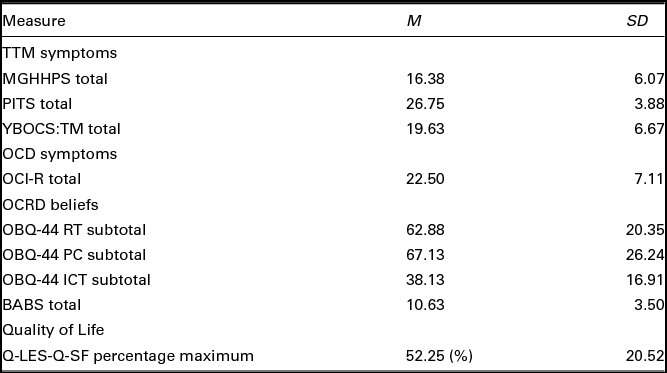
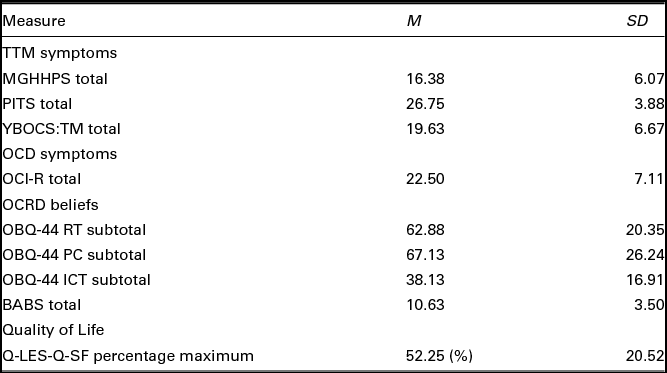
On average, participants reported moderately severe TTM symptoms as measured by the MGHHPS (Keuthen et al., Reference Keuthen, O’Sullivan, Ricciardi, Shera, Savage, Borgmann and Baer1995) and PITS (Winchel et al., Reference Winchel, Jones, Molcho, Parsons, Stanley and Stanley1992), and moderately severe functional impact due to TTM-related thoughts and behaviours as measured by the YBOCS:TM (Stanley, Prather, Wagner, Davis, & Swann, Reference Stanley, Prather, Wagner, Davis and Swann1993; Table 3).
Means and Standard Deviations for Quantitative Measures of OCRD Phenomena
Note: M = mean, SD = standard deviation.
On average, participants began hairpulling at age 15.13 (SD = 4.70), and experienced an estimated average of 6.13 months (SD = 7.51) symptom-free since disorder onset. Participants estimated engaging in an average of 18.25 separate hairpulling episodes (SD = 12.36) per week over the past 3 months, each lasting an average of 51.25 minutes (SD = 43.98). Of the eight participants, seven reported that they had sought treatment for TTM from a mental health professional at least once in their lifetime and reported that treatment yielded no symptom improvement. On average, the sample experienced clinically significant symptoms of OCD (Foa et al., Reference Foa, Huppert, Leiberg, Langer, Kichic, Hajcak and Salkovskis2002) as measured by the OCI-R. Six of the eight participants achieved a total OCI-R score of 21 or more, indicating the presence of clinically significant obsessive-compulsive symptomatology. The sample's mean scores on the OBQ-44 subscales revealed similar levels of obsessive-compulsive beliefs as reported elsewhere by a sample of participants with OCD: responsibility/threat estimation (RT; M = 64.5, SD = 22.4), perfectionism/certainty (PC; M = 69.9, SD = 22.1), and importance/control of thoughts (ICT; M = 39.8, SD = 16.3; OCWCG, 2005). No participants of the current study cited beliefs about their hairpulling that met Eisen and colleagues’ (Reference Eisen, Phillips, Baer, Beer, Atala and Rasmussen1998) criteria for pathological delusionality. Finally, participants reported living at 52.25% of their maximum quality of life, on average, as measured by the Q-LES-Q-SF (Stevanovic, Reference Stevanovic2011). This clinical profile is comparable with that of other TTM samples (e.g., Christenson et al., Reference Christenson, Mackenzie and Mitchell1991; Woods, Flessner et al., Reference Woods, Flessner, Franklin, Keuthen, Goodwin, Stein and Walther2006).
Qualitative Results
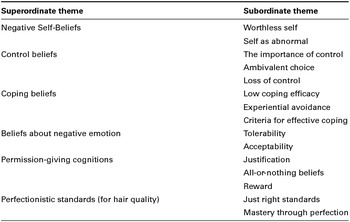
Six superordinate themes reflective of influential beliefs and cognitions across the hairpulling cycle were identified (Table 4). These cognitions played antecedent and maintaining roles at different points before, during and after hairpulling episodes.
Superordinate and Subordinate Themes Identified with IPA

Negative self-beliefs
All participants experienced negative self-beliefs at some point during a typical hairpulling episode. One participant attributed her development of TTM to ‘insecurity and self-esteem issues — a large part of it stems from that’ (P5). Two subthemes underlying negative self-beliefs were identified: worthless self and abnormal self.
Worthless self
At its most extreme this included a chronic sense of worthlessness encompassing the belief that one's own needs are burdensome. This was the experience of participant 7, whose hairpulling episodes typically commenced upon rumination about ‘worthlessness and not having a job, and feeling a bit useless to the community’. Participant 4 described how her hairpulling episodes were often triggered by a similar pattern of rumination, reflecting her perceived low self-efficacy:
I guess the things that happen are that I don't know what to do in the situation or um, I don't feel that I can get out of the situation or change the situation how I’d like it to be changed, or um, kind of feeling a bit helpless and frustrated and annoyed about something. (P4)
Participants described how their negative self-beliefs dissipated as their hairpulling intensified because their attention was drawn solely onto the process of selecting, plucking, and manipulating hair strands. However, beliefs of worthlessness, ‘guilt’ (P6) and ‘embarrassment’ (P8) returned once hairpulling urges waned:
It makes me feel regret and sadness that I’ve done this to myself. It makes me feel, in a way, less worthy as a person because I’ve done this, you know — that I couldn't find a better way to deal with my problems. (P5)
Self as abnormal
Having TTM was perceived by several participants to indicate that they were fundamentally flawed or defective:
I feel like it's the kind of thing that, you know, 100 years ago people would’ve been locked up for. I feel like it's mental. (P3)
After completing her participation in the present study, participant 7 later wrote to the researchers: ‘I’ve always dreamed of having a nice little family of my own but with trich it makes me feel crazy if I even think about it because my brain knows no one could ever love someone with a hair pulling syndrome.’
Participants appraised the quality of their hair as a reflection of their personal qualities. Given that all participants had reportedly caused permanent physical damage to their hair over years of repeated pulling, those who related their sense of self to their hair quality described themselves as damaged:
I wanna pride myself on my hair and I wanna have nice, beautiful hair, you know. Most girls do. So yeah, it sort of makes — it lowers my self-esteem, you know. Of course you want your family to like your hair but my family don't like my hair. (P5)
I guess that I’ve known myself without my brows and whatever for so long that I, it's just a whole new person you have to look at and, um, when I grew them back for three months a few years ago I wasn't a mean person but, sort of, I felt free more to judge people on just whatever, whereas now I try and accept absolutely everything just ‘cause I’m worse. I feel worse than them. (P7)
Control beliefs
All participants identified control as an issue—particularly, the meaning of control, and the way in which control was achieved, relinquished or reinstated via the act of hairpulling.
The importance of control
Several participants described engaging in rumination prior to the onset of a hairpulling episode that reflected the importance of obtaining control over one's thoughts, emotions, behaviour and situations:
If there is something that is kind of frustrating or annoying, the fact that you can't change it makes you stressed — me stressed — and then, um, I take the stress out on my hair. (P4)
I think that I, I must use it as a mechanism to help me cope with other things that aren't going right in my life, so I turn to that [hairpulling] to try and control those things. I, if I don't have control over those bad things, I’ll do this [pull] and I have control over this. (P8)
This perceived lack of control was rectified by engaging in hairpulling. One participant explained that ‘being a routine behaviour is calming’ because ‘I don't need anyone else or thing to do it’ (P4). Hairpulling offered her a sense of self-sufficiency and predictability. For others, procuring hair strands with a particular physical quality and manipulating those strands was experienced as ‘success and achievement’ (P4) or ‘victory’ (P3). One participant explained that she had mastered the ability to cease pulling ‘in the middle’ of a hairpulling episode, which she perceived to be an indication of her self-control: ‘that would be a real achievement, possibly more than not doing it in the first place’ (P3). She reflected, ‘that's kind of the ultimate control’.
Ambivalent choice
Participants frequently described the process of commencing, continuing and ending a hairpulling episode as a result of negotiating a series of decision-points:
Prior to commencing a hairpulling episode: ‘I can either decide to leave it or see if have time or energy, and then I just pull some out’ (P7); ‘I dare you to do it and then not, and then stop’ (P3).
Once hairpulling had commenced: ‘I don't stop myself from doing it’ (P5).
During a hairpulling episode: ‘You know you should stop but you just don't want to, you just want to keep going’ (P4).
Toward the end of a hairpulling episode: ‘If I’ve had enough relief I will physically stop myself’ (P5).
On reflection at the end of a hairpulling episode: ‘I wasn't gonna let that happen again for so long, or at all’ (P3).
However, interspersed with these decision-points, participants simultaneously described their perceived lack of choice over their actions:
I think it's more automatic. Yeah, just like a reflex. (P7)
They [urges] kind of take a hold of you, and in a way you’re kind of like, possessed. (P5)
It does its own thing and I can't control it. (P1)
Loss of control
All participants described a disconnection from themselves and their values, motivations and goals through a state of diminished awareness while hairpulling. Some participants described this experience as an ‘other reality’ (P4 and P2). It was during this dissociative-like state that all participants described losing control over their cognitions and behaviour, which was typically described in terms of defeat and resignation:
In a real, um, involved episode then that can pretty much be it, and it would almost be a sense of resigning myself to ‘I’m just going to do it until I stop’ because I just feel so powerless to do anything about it. The only thing I can do is do it — do the damage — and then once there's nothing left then I’ll stop. Kind of just submitting myself to what's going to happen. (P1)
To retain or regain one's sense of awareness and control during a hairpulling episode was perceived to require a strength of willpower deemed almost unattainable:
If I were able to overcome this hairpulling I would feel like I could overcome anything, really. I would feel like a better person, I could help the world. (P5)
You can pull one out but it takes a lot of courage to stop there. (P7)
Beliefs that served the overvaluation of the importance of control, a sense of ambivalence as to the level of choice in one's own actions, and the appraisal of loss of control representing defeat in the face of unattainable self-expectations combined in an overall sense of powerlessness over hairpulling behaviour.
Coping beliefs
When asked about the purpose of their hairpulling, all eight participants responded that it functioned as a coping strategy for distress and was frequently likened to abuse of drugs or alcohol, or overeating. Three beliefs were found to underlie the reinforcement of hairpulling as a coping strategy: low coping efficacy, experiential avoidance, and ideas underpinning what makes a coping strategy effective.
Low coping efficacy
Several participants reported limited coping strategies to draw upon in times of stress and low self-efficacy regarding their overall coping ability:
I can't deal with it, I can't deal with that emotion. It's [hairpulling] my first response in me being able to, in a way, deal with it, but of course not in an appropriate way but I don't know any other way of dealing with it. (P5)
I don't know how to cope with life, and it gets me emotional and anxious, and I guess I turn to this [hairpulling]. It doesn't work but it's what, I guess, turn to. (P8)
The knowledge that one's primary coping strategy (i.e., hairpulling) was ‘ultimately not fixing it in the long term’ (P1) compounded participants’ low efficacy for their coping abilities.
Experiential avoidance
After commencement of a hairpulling episode, all participants experienced a dissociative-like state that was referred to as ‘the trich-trance frame of mind’ (P4):
I completely zone out once I’m actually in the moment, yeah. So there's no thought processes, um, you don't even recognise anything really going on around you at all. (P2)
The primary goal of hairpulling as a coping strategy was to distract from, minimise or avoid the experience of negative internal experiences, particularly anxiety: ‘It is almost like a sedative’ (P2). Participants also repeatedly described the way hairpulling helped to distract from rumination:
It's almost a break from thinking about anything else. (P1)
I almost think that it's so I don't focus on what I don't like in my life. (P8)
One participant likened her adolescent experiences of deliberate self-harm to the experience of pulling her eyelashes:
That real focus on a sort of physical sensation, um, kind of pushes out emotional sensations so you can only focus on that. And that's kind of easier to deal with than thoughts about emotional things. (P1)
Criteria for effective coping
Implicit in participants’ statements about coping with negative internal experiences were several criteria for what makes a coping strategy effective. As reviewed above, the goal of hairpulling was to facilitate experiential avoidance. Therefore, hairpulling was viewed as an effective coping strategy because it achieved this goal with automaticity and self-sufficiency:
I guess it's because it's something I can do, um, kind of alone. I don't need anyone else or thing to do it. [. . .] you could be sort of self-sufficient ‘cause you can just do it alone. Um, and it's familiar just because it's something that you’ve been doing for so long, um, that I’ve been doing since I was 12. So, nearly 20 years, so it's like a, it's like a familiar habit or activity of something that you know you can do. (P2)
This sentiment was repeated when participants explained their consideration of using alternative coping strategies:
I read about keeping a diary or something, like, I haven't really looked into it, like how to prevent it or change. I know you can change your environment or behaviour but I’m not really dedicated. (P6)
Overall, participants preferred hairpulling as a coping strategy because it provided reliable, immediate, accessible and easily attained short-term relief from negative internal experiences, while supporting a sense of self-sufficiency.
Beliefs about negative emotion
At every stage of the hairpulling cycle, emotions were appraised as either ‘good’ or ‘bad’. Negative emotion was further appraised by participants as intolerable and/or unacceptable. Hence, these appraisals were intricately connected to the aforementioned coping beliefs.
Tolerability
Participants repeatedly identified that anxiety, frustration and anger triggered the onset and/or maintenance of a hairpulling episode:
The first reason to pull will be stress. (P2)
I do it as a response to feeling frustrated and anxious. (P3)
I do think about the problems, I do think about the hurt and I do think about the anger and resentment as I’m pulling out my hair. And the more intense the feelings I have when I’m thinking about it, the harder I pull. (P5)
Participants also identified boredom and guilt as triggering or maintaining hairpulling:
[. . .] underlying boredom or restlessness and then the hairpulling acts as a stimulus for that. (P2)
I guess it helps me, I don't know — not feel normal, but stop feeling guilty, maybe. (P7)
Although few participants directly stated that they found negative emotions difficult to tolerate, this was implied by participants’ descriptions of how they responded to them:
You’re also thinking about how bad you are. I guess it, um, I guess that's a feeling you want away, so you want to pull and take that feeling away. (P7)
[. . .] it's not the end of the world [feeling irritated] but really, would rather get rid of it. (P1)
Acceptability
Beliefs regarding the acceptability of these emotions appeared to underpin participant's low tolerance for them. Repeatedly, participants referred to unpleasant emotional experiences as bad;
I guess just thinking about the bad emotions that come out when you pull it out and then your anger's gone at whoever I was angry at. (P7)
Rising tension, kind of too much energy just needs to come out. But not good energy, bad energy. (P2)
Thus, labelling emotional experiences as bad implied their inherent unacceptability. For some participants the only appropriate way to express these emotions was through the physical representation that hairpulling afforded:
I do like to have a physical response to feeling frustrated and anxious, like proof almost. Gives, like, a physical representation of how anxious I am at the time, so it's more tangible. (P3)
I take the stress out on my hair. [. . .] it's when you feel a lot of emotion and you need to channel them onto something or somewhere. (P2)
Permission-giving thoughts
Most participants described thoughts that elicited their permission to commence, continue or resume hairpulling: ‘You might try bargaining with yourself and say, “okay, you can pull just one hair”, so you do that and then you say, “oh well, I’ll just pull one more”’ (P8). Three subthemes were identified to comprise these permission-giving thoughts: justification (of pulling), all-or-nothing beliefs, and reward.
Justification
Prior to commencement of a hairpulling episode, some participants engaged in a ruminative thought process associated with the urge to pull. One participant described how her hairpulling episodes typically occurred within the context of checking that her thinning hair remained concealed by her hairstyle:
I don't know, maybe I’m telling myself I’m just checking to see that the hair is still covering up the bald patch but it's almost like, in checking that it's still okay, that triggers off the urge. (P1)
Other participants similarly described various ‘excuses’ (P7 and P3), ‘reasons’ (P2) and ways to ‘bargain with yourself’ (P8) that occurred when justifying the commencement of hairpulling. One participant explained that she often justified pulling a single eyebrow hair to test her ability to refrain from pulling out more hairs:
I can just do it and then stop doing it rather than not even start doing it, that's even more — if I can do that then there's really no problem. But what it also does is give me an excuse to do it. (P3)
All-or-nothing beliefs
Participants volunteered several thoughts that they had before, during and after hairpulling episodes that permitted them to pull hair, which were reflective of an underlying all-or-nothing mentality:
Thinking that it's going to allow me to not do it for the rest of the evening, which it doesn’t, but thinking in that moment, thinking like, it's unfortunately just something I have to do. (P3)
Many participants believed that because their hairpulling had become habitual there was little use in attempting to stop once a hairpulling episode had commenced:
Like I say, every day I think ‘that's it’ and I genuinely think I won't do it again ‘cause, like, now, why would I do it? It seems like such a bizarre thing to do but almost certainly in the next few days I’ll do it again. (P1)
The belief that hairpulling episodes could not be avoided was also associated with the belief that once commenced, a hairpulling episode should be completed to its fullest extent:
[. . .] when you’ve been at it for two hours or something and, and let's say there's just 20 [eyelashes] left and you start with 100 and you just think, ‘I’ve just messed up so badly, I might as well go back to the start’. (P7)
Reward
Several participants described the way selecting and pulling out target hairs provided a sense of pleasure and gratification despite its negative consequences:
It just feels like an addiction, like a — something that you probably know you should stop but you just don't want to, you just want to keep going. So, you know that really, what you’re doing is being destructive but there is some pleasure in doing it [. . .] looking at the hair that you want and finding it, and touching it, and playing with it, that all — that the sensory parts of it are pleasurable. (P2)
This participant often selected target hairs of a certain tactile quality based upon the different kind of emotional reward she was seeking. She, and others, described an escalating sense of urgency to achieve gratification as the hairpulling episode continued:
Kind of like, each one that you do that was not the one you’re looking for will get you closer to the one you were looking for. It’ll lead you to — you’ll get closer to getting the good one. (P2)
You don't think about the consequences. You only think about the consequences after you do it but in that moment all you can think about is just getting the relief. (P5)
Perfectionistic standards (for hair quality)
Most participants reported a preference for pulling hairs that they perceived to have a displeasing physical composition; ‘fuzzy’ (P8), ‘kinky’, ‘grey’, (P2), ‘too thick’, ‘rough’ (P3), ‘split’ (P5), ‘not just nice and even’ (P7), or ‘going in the wrong direction’ (P1). Removing these hairs was perceived to improve symmetry or achieve a ‘just right’ standard in the aesthetic of their hair. In doing so, several participants described the reinforcing consequences of achieving a sense of mastery by striving for perfection in their hair quality.
Just right standards
Participants reported feeling anxious and physically tense until they could begin creating more symmetry by removing hairs that felt ‘out of place’ (P7). One participant explained that as she searched her scalp for target hairs to remove she would ask herself, ‘[are] there any other bumps there, anything that doesn't feel exactly right?’ (P1). She compared them to ‘normal hairs [which] have kind of a tapered end to them, whereas a broken hair just has that blunt edge, which isn't quite right’. For many participants, becoming aware of imperfect hair strands was an uncomfortable experience that was poorly tolerated:
It's kind of like having all these splinters and you just need to pull them all out, but they’re there all the time and you don't notice them, but once you notice them then you want to do something about them. (P1)
I just notice that it's different from all the others. And so it's not right. And so it's different and I want it to go because it's not perfect and the rest of them are perfect, and this one isn’t. It's kinky, it's rough, it's weak, it's thick or it's coarse, and it's not correct. It's just not meant to be there. (P8)
Mastery through perfection
Just as imperfect hairs created distress and discomfort, part of the relief and satisfaction experienced while hairpulling could be attributed to pulling out these imperfect hairs:
Just touching my eyebrows a lot and then actually pulling it feels like quite, quite a clean thing to do. Like, ‘that's the hair that shouldn't be there but I can take it out’. And then it's kind of cleaner that it's not there. (P3)
I don't know why it feels wrong to me, there's something about it that's faulty, false, wrong, imperfect, not like the rest of the hair, and I need to get rid of it. There's a need to dispose of it. Um, but there's also pleasure in finding it, ‘ooh, I do have one’! (P8)
For these participants, the undesirable tactile sensations were associated with positive outcomes such as relief, pleasure, gratification, and even mastery by removing an element of oneself that was appraised as intolerable or unacceptable.
Discussion
This study qualitatively explored the role of cognitions and beliefs in TTM. Six superordinate beliefs were identified as relevant antecedent and/or maintaining factors: negative self-beliefs, control beliefs, coping beliefs, beliefs about negative emotion, permission-giving beliefs, and perfectionistic standards. Many of these beliefs have been previously postulated to play a role in TTM (e.g., Duke et al., Reference Duke, Bodzin, Tavares, Geffken and Storch2009; Franklin & Tolin, Reference Franklin and Tolin2007; Gluhoski, Reference Gluhoski1995; Norberg et al., Reference Norberg, Wetterneck, Woods and Conelea2007). However, this study provides the first in-depth exploration of the content and role of cognitions in TTM, without presupposing those cognitions are based upon purportedly related disorders. The beliefs identified in our study are similarly implicated in disorders that feature elements of compulsivity (e.g., OCRDs; OCCWG, 2005) and impulsivity (e.g., substance use disorders; Beck, Wright, Newman, & Liese, Reference Beck, Wright, Newman and Liese1993). With further quantitative research in larger, demographically diverse samples, these findings could suggest a greater role for the influence of cognitions and beliefs in this disorder than is currently acknowledged.
In their biopsychosocial model of TTM, Franklin and Tolin (Reference Franklin and Tolin2007) proposed that negative self-evaluations initially arise as a result of the adverse consequences of repeated hairpulling. Over time, these thoughts become cues that independently prompt hairpulling episodes. Our findings provided support for Franklin and Tolin's hypothesis, having demonstrated that negative self-beliefs facilitated hairpulling episodes. However, at least one participant attributed her development of TTM to premorbid low self-esteem. Cognitive models of OCD and BDD have suggested that maladaptive self-construals may precipitate the development of those disorders (Doron, Kyrios, Moulding, Nedeljkovic, & Bhar, Reference Doron, Kyrios, Moulding, Nedeljkovic and Bhar2007; García-Soriano, Clark, Belloch, del Palacio, & Castaneiras, Reference García-Soriano, Clark, Belloch, del Palacio and Castaneiras2012; Phillips, Moulding, Kyrios, Nedeljkovic, & Mancuso, Reference Phillips, Moulding, Kyrios, Nedeljkovic and Mancuso2011). Although the direction of the relationship between negative self-beliefs and the development of TTM cannot be defined given the current study's methodology, participants identified that hairpulling helped minimise negative self-evaluations by redirecting their attention toward the goal of extracting and manipulating hairs.
Participants explained that their attention was particularly drawn to the goal of achieving perfectionistic hair qualities, which encouraged a sense of mastery and self-efficacy. From the perspective of behavioural models, this serves a positively reinforcing function. However, given the element of control that was also derived from targeting imperfect hairs (e.g., ‘that's the hair that shouldn't be there but I can take it out’ — P3), the function of striving for perfectionistic hair standards in TTM may also be to attain a sense of control similar to the proposed function of compulsions in OCD (e.g., Moulding & Kyrios, Reference Moulding and Kyrios2006). Participants’ descriptions of the hairpulling process reflected the importance of maintaining control over the hair itself, oneself, and life more generally. Sense of loss of control was associated with negative affect and appraisals. High desire for control but low sense of control has been associated with OCD symptoms and related beliefs among analogue and clinical OCD samples (Moulding & Kyrios, Reference Moulding and Kyrios2006; Moulding, Doron, Kyrios, & Nedeljkovic, Reference Moulding, Doron, Kyrios and Nedeljkovic2008, Reference Moulding, Doron, Kyrios and Nedeljkovic2009). In the case of TTM, as has been suggested in OCD models, a discrepancy between desire for and sense of control may generate distress, which fuels one's motivation to engage in compulsive acts (i.e., hairpulling) to increase perceptions of control. This is an as-yet unexplored theory in TTM.
Currently, focused hairpulling is specifically believed to facilitate emotion regulation while automatic hairpulling is conceptualised as more akin to a stereotypic motor habit (e.g., Begotka et al., Reference Begotka, Woods and Wetterneck2004; Flessner, Woods et al., Reference Flessner, Conelea, Woods, Franklin, Keuthen and Cashin2008; Mansueto et al., Reference Mansueto, Stemberger, Thomas and Golomb1997). However, of the eight participants in the current study, only one described her primary hairpulling style as focused, despite all participants having articulated a range of beliefs identified to trigger and/or maintain their hairpulling. Given that Flessner, Conelea and colleagues (Reference Flessner, Conelea, Woods, Franklin, Keuthen and Cashin2008) reported that less than 0.01% of their 1,545 participants with clinically significant hairpulling did so exclusively according to one style, our findings may suggest that regardless of an individual's primary hairpulling style, cognitions and beliefs are likely to play a significant role in TTM. It therefore may not be necessary to dichotomise treatment according to an individual's ‘primary’ hairpulling style (e.g., Flessner, Woods et al., Reference Flessner, Conelea, Woods, Franklin, Keuthen and Cashin2008), providing further support for the importance of treatment approaches that simultaneously target the hypothesised functions of both hairpulling styles, such as augmenting BT with ACT or DBT (e.g., Crosby et al., Reference Crosby, Dehlin, Mitchell and Twohig2012; Keuthen et al., Reference Keuthen, Rothbaum, Fama, Altenburger, Falkenstein, Sprich and Welch2012; Woods, Wetterneck et al., Reference Woods, Wetterneck and Flessner2006). Nevertheless, it is of interest to note that beliefs reminiscent of both OCD (e.g, control beliefs, perfectionism) and impulse-control/addiction disorders (e.g., permission-giving beliefs) were identified in this study. Given suggestions that there may exist an ‘addiction’ subtype and an OCD-like subtype of TTM (Grant, Odlaug, & Potenza, Reference Grant, Odlaug and Potenza2007), future research may benefit from investigating if certain beliefs domains are more common among discrete impulsive-compulsive TTM phenotypes, should these be identified (for a review, see Flessner, Knopick, & McGeary, Reference Flessner, Knopik and McGeary2012).
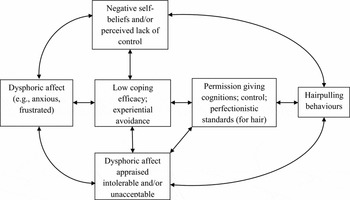
As Gluhoski (Reference Gluhoski1995) proposed, the current study identified that beliefs regarding self-control, expectations for the value of hairpulling as a coping strategy, and permission-giving thoughts perpetuated TTM symptoms. However, the current study also identified a complex interaction of other beliefs that serve to expand this addiction-based model to incorporate concepts from models of anxiety, OCRDs and emotion regulation. We propose a new model (Figure 1) that may be integrated with behavioural models of TTM, although further research will be necessary to validate such suggestions.
Preliminary model of identified cognitions and beliefs in TTM. Some possible relationships between constructs have been noted but directions of effects are preliminary.

Initially, negative self-beliefs and/or a perceived lack of control precipitate hairpulling episodes. These cognitions elicit distressing emotions such as anxiety and frustration, which are automatically appraised as unacceptable and/or intolerable. Beliefs about negative emotions perpetuate the individual's low coping efficacy and reluctance to use alternative coping strategies. In part, this reluctance is a result of appraising hairpulling behaviour as beyond one's control. Through diminished self-efficacy, individuals enter into a permission-giving narrative that justifies or rationalises hairpulling. Focusing on removing hairs of particular tactile/aesthetic qualities distracts from unpleasant internal experiences and is reframed as a pursuit for achieving perfectionistic hair standards. Hairpulling behaviours facilitate immersion in tactile sensations and a sense of relief, serving an emotion regulation function via experiential avoidance. Upon completion of the hairpulling episode, negative self-beliefs return and perpetuate hairpulling in the absence of inhibitory factors.
This study is subject to several limitations. First, the sample in this study consisted of eight well-educated, unmarried women with TTM. Use of small, homogenous samples is a feature of IPA to allow for a fine-grained analysis of complex psychological phenomena, particularly in areas that have been subject to limited research and would benefit from an exploratory, hypothesis-generating approach (Smith & Osborn, Reference Smith, Osborn and Smith2008). The sample size of this study is similar to other studies using IPA methodology (e.g., Cunningham, Timms, Holloway, & Radford, Reference Cunningham, Timmes, Holloway and Radford2011; Wood, Cupitt, & Lavender, Reference Wood, Cupitt and Lavender2015). Further, TTM predominantly affects women and other studies have similarly used female-only samples to explore its phenomenology, trajectory and impact (e.g., Flessner et al., Reference Flessner, Woods, Franklin, Keuthen and Piacentini2009); however, it is possible that men with TTM espouse different beliefs. It is also important to acknowledge that the clinical characteristics of this sample (i.e., disorder age of onset, treatment seeking history, symptom severity, comorbidity) were representative of other TTM samples (e.g., Christenson et al., Reference Christenson, Mackenzie and Mitchell1991; Woods, Flessner et al., Reference Woods, Flessner, Franklin, Keuthen, Goodwin, Stein and Walther2006). Nevertheless, it will be valuable for future studies to determine whether the cognitions and beliefs identified here are represented in other groups of individuals with TTM, particularly in light of possible discrete phenotypes (Grant et al., Reference Grant, Odlaug and Potenza2007; Flessner et al., Reference Flessner, Knopik and McGeary2012) and given that previous studies have reported greater demographic variation (e.g., Christenson et al., Reference Christenson, Mackenzie and Mitchell1991; Flessner, Conelea et al., Reference Flessner, Conelea, Woods, Franklin, Keuthen and Cashin2008; Woods, Flessner et al., Reference Woods, Flessner, Franklin, Keuthen, Goodwin, Stein and Walther2006).
Second, the high level of comorbidity in this sample (particularly of depression) raises issues about the specificity of these cognitions to TTM. The cognitive content (e.g., worthlessness) and styles (e.g., black-and-white thinking) identified in this study have long been established in, and assumed specific to, depression (Beck, 1976, Reference Beck, Rush, Shaw and Emery1979). However, several cognitive-affective processes, including perfectionism, experiential avoidance and self-focused attention, are increasingly being recognised as transdiagnostic maintenance mechanisms shared among various psychological disorders (e.g., Egan, Wade, & Shafran, Reference Egan, Wade and Shafran2011; Harvey, Watkins, Mansell, & Shafran, Reference Harvey, Watkins, Mansell and Shafran2004). Additionally, with comorbidity rates in TTM exceeding 80% (Christenson et al., Reference Christenson, Mackenzie and Mitchell1991) and evidence that pretreatment depression severity may moderate long-term TTM treatment outcomes (Keijsers et al., Reference Keijsers, van Minnen, Hoogduin, Klaassen, Hendriks and Tanis-Jacobs2006), the identification of maladaptive cognitions in TTM, whether disorder-specific or transdiagnostic, has the potential to enhance treatment effectiveness. Indeed, the modulating effects of comorbid disorders on all aspects of TTM phenomenology, psychobiological markers and treatment outcomes will be essential for ongoing research to delineate.
Third, given that the majority of participants originated from the same support group, these individuals were likely to have greater insight and confidence in discussing their condition than others with TTM. And fourth, implicit beliefs are unlikely to have been accessed via the qualitative methodology of this study, but could be particularly relevant to the onset and maintenance of automatic hairpulling episodes. Given the significant automaticity of TTM symptomatology, it will be important that future research investigates the role of cognitive processes that are beyond conscious control, as has commenced in BDD research (e.g., Buhlmann, Teachman, Naumann, Fehlinger, & Rief, Reference Buhlmann, Teachman, Naumann, Fehlinger and Rief2009).
As noted earlier, a quantitative measure is being developed on the basis of beliefs identified within this exploratory study. Trialling this measure within large, diverse clinical and non-clinical samples will assist in judging the generalisability of these beliefs beyond the sample in which they were identified, as well as more clearly judging the interrelationship and potential overlap between themes identified as distinct within the qualitative analysis (i.e., the distinction between related constructs such as an inability to cope and general views of low perceived control). Limitations notwithstanding, it is hoped that this analysis will lead to greater investigation of the role of cognitions in TTM, and act as a catalyst towards a greater usefulness and utilisation of second and third-wave cognitive therapies in its treatment.
Acknowledgments
The authors wish to acknowledge the Anxiety Recovery Centre of Victoria for their support with participant recruitment.
Declaration of Interest
None. This research received no specific grant from any funding agency, commercial or not-for-profit sectors.