


Political science is generally characterized as a “borrower” discipline due to its tendency to appropriate concepts like class, capital, and even power from other fields of inquiry. “Ideology” is one of few terms to have originated in political science, having apparently been invented by Count Antoine Destutt de Tracy, who survived the revolution to publish Elements d'Ideologie in 1817 (Hart 2002; Head 1985). The term has been controversial almost from its birth, and more than one call has been issued to desist from its profligate use (Sartori 1969).
I use the occasion of the centennial of the American Political Science Review to trace understandings of the term “ideology” among political scientists over the last century. My primary resource is the Review itself, which serves as a yardstick to help measure transformation in political scientists' thinking about the subject. The Review has the advantage of consistency over time and an arguable but clear disciplinary imprimatur. My approach of counting and categorizing research articles that have paid attention to ideology causes me to leave many questions unanswered, but provides the opportunity for a broad overview of developments over time.
Notwithstanding Daniel Bell's (1960) contention that ideology “ended” in the 1950s, the second half of the twentieth century turned out to be an age of ideology.1
With apology to Reinhard Bendix (1964), whose “Age of Ideology” encompasses all of the post-Enlightenment era.
While building upon several prior considerations of the concept of ideology (Kinder 1983, 2003; Luskin 1987; Merelman 1969; Minar 1961; Mullins 1972; Putnam 1971; Sartori 1969), I lean heavily on Gerring's (1997) “Definitional Analysis.” I use these accounts as a foundation from which to comment on streams of political science research involving ideology. Previous reviews of the concept have inventoried differences in usage. Putnam, for example, identified 14 different ways in which political elites might use the term. Gerring proposed a cure for this apparent “semantic promiscuity”: strip the concept to the single attribute upon which all users can agree, and concluded (1997, 980) that “the importance of coherence is virtually unchallenged… Ideology, at the very least, refers to a set of idea elements that are bound together… One might add, as corollaries, contrast and stability—the one implying coherence vis-à-vis competing ideologies and the other implying coherence through time.” This understanding accords well with Converse's (1964) interpretation in “The Nature of Belief Systems in the Mass Publics.”
In broader terms, ideology can be defined as the way a system—a single individual or even a whole society—rationalizes itself. Ideologies may be idiosyncratic (Lane 1962), impractical, or even delusional, but they still share the characteristics of coherence and temporal stability. The characteristic of contrast, or differentiation between alternative principles and their implications for government, is frequently implicit in analytic treatments of the term. At minimum, contrast requires two alternatives and some means to distinguish between them. Contrast may lead to controversy or conflict, which tends to stimulate further attention (Schattschneider 1960). When two objects or groups are in contention, it is simple to describe the nature of that conflict in terms of a single spatial dimension or continuum. There is no requirement that ideology remain unidimensional (Jacoby 1995; Stimson 1975), but as we shall see, a linear conceptualization has become common across the discipline.
IDEOLOGY IN ITS FIRST HUNDRED YEARS
The nineteenth century was only a few years old when the remaining “ideologues” earned Napoleon's wrath for their principled support for “the rights of man” in opposition to his dictatorship. Ever after, Napoleon used “ideologue” as an epithet indicating irrational dedication to democratic principle. By the mid-nineteenth century, the core principle of the ideologues—popular sovereignty—was attacked from both the right (“divine right”) and the left (“dictatorship of the proletariat”). Marx challenged liberal democratic ideology, castigating it as a rationale for class oppression, and called Destutt de Tracy a “fish-blooded bourgeois.” The negative implication of ideology was later reinforced by Karl Mannheim, who argued that ideology was inherently conservative because it derived its ideal model of society from the past and who contrasted it with utopian thinking, which he defined as future-oriented (Geoghegan 2004; Mannheim 1936). Although it is impossible here to encompass the immense literature that has evolved following this perspective, it is worthy of note that the implication of a bias in worldview, whether conscious or not, is still consistent with a definition of ideology as a coherent and stable set of attitudes.
IDEOLOGY IN THE TWENTIETH CENTURY
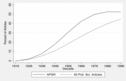
As the twentieth century began, the term ideology was rarely employed beyond limited references concerning political philosophy. This obscurity was apparent in the pages of the Review. Where references to ideology averaged only 2.6 per year in its first half-century, and never exceeded 10 per year. After World War II, though, references to ideology mushroomed, averaging 20.3 per year and never dropping below 10 per year.
Figure 1 charts articles mentioning ideology as a percentage of all articles published in the Review by decade2
I used Sigelman's (2006) decade cut points to maximize comparability.
Here I entered the search terms “ideology, ideologies, ideological, ideologue, ideologues or(s)” in JSTOR, selected all political science journals, and filtered with the “articles” option. To obtain the decade count for the denominator I filtered the same way and searched on “the.”

Percentage of Research Articles Employing the Term Ideology, Ideologies, Ideological, Ideologue, or Ideologues by Decade.
During the Review's first decade, only one author used the term “ideological,” referring to a rule in the Swiss constitution against referenda that had only symbolic impact (Rappard 1912). Just three research articles mentioned ideology during the Review's second decade, each using it to refer to a psychologically based attribute of groups. For example, Benedict (1924, 278), comparing the socialist movements in Great Britain and the United States, attributed “differences in ideology and strategy” to differences in “mental processes” between the British labor movement and American socialists.
The Review was not alone in devoting scant attention to ideology, for the two earliest political science journals, Political Science Quarterly and the Annals of the American Academy, did likewise. The first reference to ideology in a political science journal was in Edwin Seligman's “The Economic Interpretation of History,” in Political Science Quarterly in 1901. That piece was intended to introduce Marx's theory to American scholars, and reading it today conveys a wonderful sense of the state of political science awareness of issues that were soon to overtake the world.
COMPONENTS OF INCREASE IN THE ATTENTION TO IDEOLOGY
Communism and Fascism
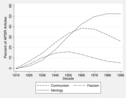
The Russian Revolution of 1917 and the consolidation of the Soviet state during the 1930s produced increased attention to communism among political scientists. Figure 2 compares the percentage of articles in the Review4
The graph represents three independent counts of articles mentioning “communist” “fascist,” and “ideological” terms. For comparability, articles are defined by the “article” filter in JSTOR and the denominator obtained as above. I did further analyses of the co-occurrence of the sets of terms not reported in detail here.

Percentage of Articles in the Review Mentioning Ideology, Communism, or Fascism and Related Terms by Decade.
Communism and Anticommunism
References to communism, Marx, Marxism, and associated concepts peaked in the two decades following World War II. A preoccupation with communism and anticommunism is evidenced by the fact that nearly 70% of the articles in the immediate post-war decade (1947–1956) that referred to ideology also made reference to communism, Marx, or related concepts. During that period, treatments of ideology as a sinister force were particularly evident. For example, Zbigniew Brzezinski (1956, 751–52) remarked that “We find among 19th century European reformers a readiness to use violence for the sake of postulated reforms, much like the ideological intolerance and brutality of the Rosenbergs or Zudanovs of our age.”
Even as the ideological era of communism and fascism faded away, political scientists' attention to ideology increased. The decade or so after World War II was critical in the transformation of the concept in political science. The period coincided with the anti-communist crusade exemplified by the congressional investigations of McCarran, Dies, and McCarthy. A second major “happening” of this period was the beginning of the behavioral revolution. The third impetus propelling increased attention to ideology was, ironically, Daniel Bell's announcement of its demise. This occurred initially at a conference in Milan in 1955, but did not really penetrate until the publication of The End of Ideology in 1960. Critical attention to problems in the conceptualization and measurement of ideology also, albeit inadvertently, led to a much greater use of the term.
“THE END OF IDEOLOGY”
The “end of ideology” that Bell (1960) proclaimed represented disillusionment with a philosophic attitude toward government variously embodied in notions of communism, socialism, and “social welfare liberalism.” The end-of-ideology debate was carried on primarily in journals of opinion, but it penetrated mainstream political science in several ways, primarily during the Review's sixth decade. First, it stimulated attention to the need to define terms. This was evident in the Review as early as 1957, when Samuel Huntington stipulated that “By ideology I mean a system of ideas concerned with the distribution of political and social values and acquiesced in by a significant social group.” The debate also penetrated political science as a rejection of “isms” that was part of a drive toward a rational and empirical discipline. David Apter (1964) put it directly as a choice between “vulgar ideologies” and the “ideology of science”—and at that point, the “science” side was winning. The idea that ideology was at an end also had a third, more subtle, influence on the generation recovering from World War II and faced with a seemingly interminable Cold War. It provided a way to contrast “them” and “us” (Bawn 1999). “We” knew “the truth” and had not been misled by ideology the way “they” had.
THE TRANSFORMATION OF IDEOLOGY
By 1967, references to ideology in the Review began to exceed references to communism and fascism combined; clearly something new was happening in the way political scientists were using the concept. Part of this change resulted from the “end of ideology” debate and from intensified efforts to define the concept. The coincidence of this debate with the emergence of behavioral political science resulted not so much in a transformation of the core meaning of the term, as in a transformation in the implications and expectations associated with it.
Ideology among “Elites”
Behavioralists generally bypassed the “end of ideology” debate, and in the process further domesticated the concept. Early roll-call studies had identified a dimension beyond partisanship that was useful in explaining political behavior. When speaking of legislators, judges, and other political practitioners, political scientists had little trouble inferring that the second dimension was left-right ideology, with the continuum defined by the policies and rationale for government of the “New Deal” mode. In the first article published in the Review that analyzed ideology quantitatively, Duncan MacRae (1952) referred to “ideological divergence” between the parties in roll call votes in the Massachusetts House of Representatives. In 1954, Ralph K. Huitt published an innovative study of Senate committee assignments in which he “ranged all Senators… along a ‘liberal/conservative’ continuum” on pertinent roll call votes (325). Indices tapping ideology in elite behavior were extended to the other branches of government as early as Glendon Schubert's (1958) scalogram analysis of judicial decisions. Since then, roll-call and other institutional decision-making data have become staples of quantitative political science research (see, e.g., Poole and Rosenthal 1997; Segal and Spaeth 1993). Emphasis on the coherence of behavior along an underlying spatial dimension (or dimensions) purged ideology of its pejorative connotations. With few exceptions (e.g., McClosky 1958), behavioral research on ideology among elites has treated it as a relatively benign “organizing device.”
Ideology in the Mass Public
At the mass level, the initial expectation was that ideology would show up in consistent issue preferences just as it did in legislators' voting behavior. Early mass surveys asked people to identify themselves as liberal or conservative. When issue preferences did not accord with “ideological identification,” the latter was considered suspect (Free and Cantril 1967). At the “Michigan school,” the authors of The American Voter (Campbell et al. 1960, 202–205) did not consider ideology a decisive factor in voting decisions. Even so, Michigan's surveys routinely included questions tapping liberal/conservative orientations through “feeling thermometers” as early as 1964. Although contributions from the nascent field of political psychology were more prominent (e.g., Rosenberg et al. 1960), the influence of Anthony Downs (1957) is also evident in The American Voter (Campbell et al., 549). By 1972, the spatial formulation of ideology had been wholeheartedly adopted in the issue scales of the Michigan election studies. Interviewees were asked to place themselves and other political objects and actors on a continuum labeled as running from “extremely liberal” to “extremely conservative.” It is difficult to imagine a more explicit definition of ideology, which presumably is universally understood by readers of the Review, even if not by some members of the public.
ELITE—POPULIST DEBATE
The findings of The American Voter (Campbell et al. 1960) provoked a controversy that can, in much oversimplified terms, be called the “elite-populist debate.” Although most of the debate has been carried on in methodological terms, at its heart is the question of whether citizens are competent to understand and act on policy debates. From this standpoint, ideology, or the ability to think ideologically, becomes entangled with political sophistication. Converse's “The Nature of Belief Systems in Mass Publics” (1964) was the most prominent contribution to this debate, but the arguments were begun in The American Voter (Campbell et al. 1960) and continued in “Attitudes and Non-Attitudes: Continuation of a Dialogue” (1971) and well beyond. The two Converse articles were subsequently invoked in 174 articles in the Review alone.
Converse's argument about information in the mass public and its importance for electoral accountability has been internalized by more than a generation of political scientists (see, e.g., Ferejohn and Kuklinski 1990; MacKuen and Rabinowitz 2003). Converse entered the debate over ideology by extending the proposition, first developed in The American Voter, that to be an “ideologue” in the United States a member of the mass public needed to be able to conceptualize the differences between the candidates and parties in terms of a liberal-conservative continuum. In “The Nature of Belief Systems in Mass Publics,” he proposed several less stringent tests of the ability to think ideologically, including the degree of constraint in one's issue positions, the stability of one's issue preferences over time, and the ability to say which political party was more conservative. He set a “maximum estimate of reasonable recognition” of ideological considerations by the mass public of “slightly more than fifty percent” (Converse 1964, 222), but categorized much smaller proportions of the American public as “ideologues” (2% or 3%) or even “near ideologues” (9%).
It is important to see Converse's contribution in the context of the times. By proposing that ideology was reflected in the representation of preferences on a liberal-conservative continuum, the spatial definition removed the negative implications of bias or false consciousness. Ideology became a beneficial characteristic and a mark of sophistication. An “ideologue” would have a reasonably well organized set of attitudes and preferences that were stable across time and informed by knowledge of what the government was doing. This led to an intense controversy over whether the American public was “ideological” (e.g., Nie, Verba, and Petrocik 1979; Smith 1989).
The progression of concerns over ideology across the decades clearly reflects the press of historical events, but it also suggests the development of an underlying consensus over the definition of ideology within political science. This consensus is reflected in the “core definition” of coherence; regardless of what other conceptual baggage might be imposed on the concept, the notion of ideology remains a relatively stable set of interrelated ideas. Beyond this, the crucial element of contrast—the notion that one set of beliefs competes against another—is implicit in discussion of party ideologies, “ists,” and “isms.” Furthermore, a substantial part of the discipline has converged on an essentially Downsian conception of ideology—an understanding of politics in terms of spatial location on a left-right (or liberal-conservative) dimension. This “spatial convergence” may well have been driven by the ascension of formal and quantitative methodology over the last half of the twentieth century. It may also represent a significant simplification of the concept, but it has made the term ideology more intelligible and has contributed to its increased use as a term of political science discourse.
EVIDENCE OF THE SPATIAL CONVERGENCE IN CONCEPTUALIZING IDEOLOGY
Having laid the groundwork for understanding the progression of ideology as a concept, I now consider the degree to which definitional convergence has been reflected in the pages of the Review over time. I coded all 1,148 pertinent research articles (through May 2006) according to the most explicit way in which “ideology” was used in each.5
I established a coding scheme identifying major uses of the terms and then read enough of each research articles (as defined by Sigelman 2006) to determine the most explicit way the term ideology was employed. The 18 categories in the original coding scheme have been grouped into six summary categories reflecting increasingly abstract and comprehensive use of the term. Please contact me directly for the detailed coding scheme and data set.
Ideology as a Generic Term
What makes the term ideology so useful in political science is that it can communicate a broad, abstract concept efficiently. In 356 articles the term was just used in passing, usually only once, and sometimes only in a footnote or single reference. Even in these passing comments, the core definition of ideology as a set of beliefs was evident. General or passing references to the term increased as attention to ideology did, reaching 20% of all articles in the 1970s, dropping sharply thereafter, and then climbing again to more than 20% in the most recent decade.
The Content of the Definitions
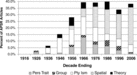
Figure 3 excludes articles that employed only a passing reference to ideology in order to focus on explicit definitions of the terms. It arrays these definitions in five broad categories from the most specific or concrete example to the most abstract theoretical treatment offered. The bottom category in Figure 3 consists of references defining ideology with a specific example. This category encompasses references to particular individuals and politicians identified as ideological, or as ideologues, but not to philosophers or political theorists. Named individuals included the “usual suspects” (Hitler, Stalin, Khrushchev, Mao, Ronald Reagan, and Jesse Helms; some lesser known Russians; and various third-world leaders) plus some nonideological exemplars. This category also includes references to psychological traits and emotions, and to descriptions of historical eras as ideological.

Percentage of Articles in the Review According to Most Explicit Definition ofIdeology by Decade (through May 2006).
References to ideology as a psychological trait display some intriguing movement over time. Characterizations of ideology and ideological behavior as being driven by unrealistic principle, unwillingness to compromise, and emotional volatility abounded in the early years of the Review, faded during the 1930s and 1940s, and returned with a vengeance in the postwar years. By the Review's sixth decade, references to psychological traits defined ideology in nearly 10% of all research articles. The tendency to define ideology as a character trait faded over time, but did not entirely disappear—showing up recently, for example, in a formal model as unwillingness to compromise (e.g., Laver 2005).
The next category contains articles referring to ideology as a characteristic of a group. In the early years of the Review, there were some references to ideology as an element of national character, but as time progressed, authors addressing ideology in terms of groups also used one of the more abstract definitions of ideology. For example, interest group ratings of members of Congress appear in the spatial category because they employ a left-right continuum; similarly, discussions of class and ideology explicitly referring to Marx would be represented in the fifth category. After the 1960s, references to the ideology of a group became more likely to have racial content (e.g., Aberbach and Walker 1970; Cohen and Dawson 1993).
The third level of abstraction, identified by the shorthand of “party/isms,” captures conceptualizations of ideology that imply contrast or conflict between one set of beliefs and another. This includes descriptions of parties as ideological and references to the “ideology of” an abstract political tendency, most commonly communism, liberalism, or nationalism. This understanding of ideology dominated from the 1930s through the 1960s. More recently, interest in parties and their ideology has not diminished, but the dominant way of thinking about it changed with the behavioral revolution. Partisanship became party identification, also frequently represented as a continuum—a story of dimensionality much too long to begin here (see, e.g., Weisberg 1999).
Figure 3 documents a massive increase in conceptualizations of ideology in explicitly spatial terms. The spatial category started out small in the 1950s but eventually came to dominate the way ideology is used in the Review. It is used across subdisciplines and unifies by the simple idea that units of analysis can be arrayed on a left-right continuum. In addition to spatial representations in formal theory (e.g., Enlow and Hinich 1982), three major operationalizations fall into this category. The most familiar is the liberal-conservative or left-right continuum used in mass surveys. In addition to its regular use in research on American politics, it has diffused to survey-based research in many other nations. A second well-known spatial conceptualization of ideology involves elite behavior, based on either survey or roll-call or similarly based data. The third subcategory has experienced the greatest recent growth. It involves the use of aggregate data to infer the ideological leanings of a collectivity (e.g., Ames 1994; Huber 1998; Przeworski and Soares 1971) particularly in comparative politics and international political economy. Also included in this category are articles involving aggregated indicators from mass U.S. survey data in comparative state politics (Erikson, Wright, and McIver 1989) and in dynamic analyses of “policy mood” (Stimson 1991; Stimson, Erikson, and MacKuen 1995) Overall, 28% of all research articles published in the last decade of the Review used a spatial conceptualization of ideology.
The top, most abstract, category reflects theoretical and philosophical discussions that do not conceptualize ideology in spatial terms or subject it to empirical tests. It includes theoretical discussions of ideology that employ multiple definitions, like the reviews of the concept cited at the beginning of this essay. An additional quarter of the articles in this category deal with ideology as understood by Marx. There have also been multiple references to Weber, Mannheim, Habermas, and Hobbes, but otherwise the theorists referred to in discussions of ideology have been an eclectic lot, unified by the notion that ideology represents a coherent set of ideas.
CONCLUSION: THE RESURGENCE OF IDEOLOGY?
More than half of the research articles in the Review over the last 50 years have made some use of the term “ideology” or its variants. Of course, the fact that the term is in common use does not guarantee that it is universally understood. However, the foregoing analysis suggests that political scientists who have used the term have not built a tower of babble. Almost all usages, even the general ones, pass the “core definition” test of referring to a set of ideas (coherence). Moreover, the usage of ideology that carried the least implication of coherence (psychological traits) has faded. Definitions of ideology that refer to parties, groups, and “isms” imply not only coherence, but also contrast one abstract group, or its beliefs, with another. Finally, formal theory and empirical measurement of ideology have converged on a spatial conceptualization of ideology as a matter of location on a left-right or liberal-conservative continuum.6
The content of the continuum and whether it is really a continuum, as manifested by attempts at measurement, is taken up in Knight 1999.
Although the core definition of ideology as a coherent and relatively stable set of beliefs or values has remained constant in political science over time, the connotations associated with the concept have undergone transformation. In the nineteenth century, ideology connoted attachment to values of liberal democracy, and to be an “ideologue” was to support “the rights of man” against an absolutist state. The implication of being unrealistically dedicated to those ideas was added by Napoleon and later by Marx. In the first half of the twentieth century, as the fights against fascism and communism took center stage, ideology came to connote any belief system. Democratic ideology was contrasted with totalitarianism, as good against evil. The image of Hitler and his followers as ideologues extraordinaire was imprinted in the public mind, perhaps to be resurrected at the opportune moment. But, at least as apparent in the pages of the Review, the connotation of irrational commitment to a set of ideas faded with the internal anticommunist crusade and the (academic) furor over the “end of ideology.” The behavioral revolution reinforced the concept of ideology as a “belief system” and relieved the concept of remaining negative connotations.
As political scientists have become comfortable with the use of the term, a new round of research has arisen that portrays the American public as becoming more “ideological” (Abramowitz and Saunders 1998; Hetherington 2001; Layman 2001; MacKuen et al. 2003). New interpretations have been offered to suggest that the public is able to respond to ideological cues as heuristics (Brady and Sniderman 1985) and new perspectives have been offered about the core values structuring ideology (Barker and Tinnick 2006; Feldman 1988). There has been great progress in the ability of political scientists to communicate on the basis of a shared understanding of a central concept. Yet it seems worthwhile to reconsider two major questions that have been raised about ideology in the past: is it a benign influence on democratic politics? And how far does it really penetrate into the public at large?
I wish to thank Nell Dillon-Ermers and the Department of Political Science at Barnard College for funding; Adelle Tilebalieva, Lewis J. Edinger, Donald Hale, Robert S. Erikson, for technical and editorial assistance; and the editor of the Review. I am responsible for any remaining errors.



Comments
No Comments have been published for this article.