Introduction
Recurrent disasters constitute a widespread phenomenon around the globe.1, 2 Among recurring disasters, seasonal floods are most common.Reference Aron and Patz3 After decades of disaster research, it is well known that one-time occurring disasters can have a vast impact on mental health and functioning.Reference Galea, Brewin and Gruber4-Reference Briere and Elliott7 This enormous body of literature on one-time occurring disasters stands in contrast with the lack of empirical evidence on the impact of recurrent floods.Reference Choudhury, Quraishi and Haque8 This study aims to address the gap in knowledge with regard to the impact of recurrent floods on mental health.
Several scholars claim that recurrent floods are less destructive, because repeatedly affected individuals may develop adaptive coping strategies.Reference Few and Matthies9 For example, individuals in flood-prone regions may build their houses on poles above the ground, or they may cultivate crops that have a short time span which would enable harvesting in between floods. Such adaptive individual coping strategies buffer against the development of mental health problems. Yet in contrast to this optimistic perspective, HobfollReference Hobfoll10 warns that disasters—and especially recurrent disasters—may have a devastating effect on mental health, because these events create individual “resource loss cycles.” Namely, repeatedly affected individuals run a high risk of losing their homes and of their agricultural land becoming infertile over time due to the cyclical nature of recurrent floods.Reference Galea, Brewin and Gruber4, 11, Reference Wiesenfeld and Panza12 This post-disaster material mayhem is excessively demanding for individual psychosocial resources (ie, individual coping efforts and social support),Reference Wind and Komproe13 and the strain on material and psychosocial resources over time induced by recurrent disasters evokes substantial mental health problems among affected individuals.Reference Hobfoll10, Reference Wind and Komproe13-Reference Sattler, Preston, Kaiser, Olivera, Valdez and Schlueter16
Beyond this loss of resources on the individual level, disasters also affect the habitat of individuals. That is, the post-disaster situation in repeatedly affected areas is often characterized by social structures that do not provide meaningful jobs and a decent living.Reference Horwitz17 Further, post-disaster communities typically reveal symptoms of social erosion. Weems and colleagues,Reference Weems, Watts and Marsee18 for instance, showed increased civil unrest—in terms of discrimination and looting—in the wake of disasters. This erosion of the social context is by itself associated with a plethora of mental health problems.Reference Wind and Komproe13
To make matters worse, it is often the poor segment of society that may be forced to find alternative types of abode, and ends up living in already impoverished places that are prone to recurrent natural disasters.Reference Wiesenfeld and Panza12 And although the relatively predictable character of recurrent disasters creates a possibility for prevention, reality shows that the necessary resources for prevention might not be accessible under poor living circumstances.1, 2 Thus especially this poor and marginalized segment of society will bear the brunt of the material and social erosion, and its inherent negative psychological sequelae.
This study examines the impact of seasonal floods in northern India. It is noteworthy that most disaster mental health research has relied on screening instruments because of their practical applicability.Reference Connor, Foa and Davidson19 Yet, the Diagnostic and Statistical Manual of Mental Diseases, Fourth Edition (DSM-IV) requires a link of mental health symptoms with impaired functioning in order to establish actual mental health “problems” or pathology.20 Narrow and Rae further showed that mental health symptoms alone will vastly overestimate treatment need.Reference Narrow, Rae, Robins and Regier21 Hence, this study examines mental health screening outcomes, functioning, and the relationship between these two to obtain a more reliable estimate of the metal health status after recurring floods. Floods are a recurrent phenomenon in the Bahraich district, Uttar Pradesh. In 2008, the Bahraich district was struck by major floods twice, first in the month of July and again in the month of September.
Method
Participants
The present study took place as part of the MICRODIS research project. MICRODIS is a European Community funded research project on the impact of natural disasters. Within the scope of this project, a study was conducted in Uttar Pradesh, India, with a research focus on the impact of natural disasters on mental health.
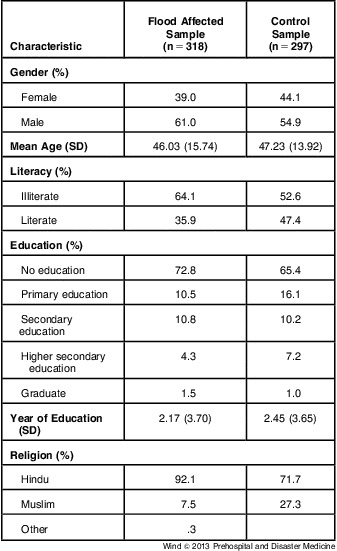
The Bahraich district, in Uttar Pradesh, India, is hit by floods annually, as in July and August 2008. In this region, a disaster-affected group was compared with a nonaffected group in October 2008. The affected region is situated between the river and a dam. The region on the other side of the dam was unaffected and identified as a nonaffected group. A multistage, random sampling procedure was used to first select four “Gram Panchayats” (smallest political units in the region) in the affected and the nonaffected regions, and then a sample of households. The sampling procedure resulted in the following data structure: households, Gram Panchayats, and region (affected versus nonaffected). The sample included 380 households in the affected group and 330 households in the non-affected group. The instrument was administered to 318 (84%) and 304 heads of household (92%) in the affected group and the non-affected group, respectively. The demographics of the samples are depicted in Table 1.
Demographics of Affected and Non-affected Groups

Instruments
Symptoms of anxiety and depression were assessed by the Hopkins Symptom Checklist-25 (HSCL-25). The HSCL-25 is composed of a 10-item subscale for anxiety and a 15-item subscale for depression, with each item scored from “not at all” (1) to “extremely” (4).Reference Derogatis, Lipman, Rickels, Uhlenhuth and Covi22, Reference Lipman, Covi and Shapiro23 An item concerning sexual interest was preventively omitted because of the taboo associated with talking about sexual issues. The period of reference is the past month. The HSCL-25 has been used widely in both western and non-western settings.Reference Winokur, Winokur, Rickels and Cox24-Reference Ventevogel, de Vries and Scholte26 In the vicinity of North India, the HSCL has been used among Tibetan refugees in India and among Nepalese internally displaced persons.Reference Crescenzi, Ketzer, van Ommeren, Phuntsok, Komproe and de Jong27, Reference Thapa and Hauff28 The HSCL-25 has been used previously in disaster research.Reference Souza, Bernatsky, Reyes and de Jong29 Although the cutoff score of 1.75 has become widely accepted for screening in cross-cultural research, the HSCL-25 has never been validated as a screening instrument for depression and anxiety in India.Reference Thapa and Hauff28, Reference Mollica, Cardozo, Osofsky, Raphael, Ager and Salama30 Therefore, mean scores of anxiety and depression were reported, rather than prevalence rates. Two scores were calculated; the anxiety score was the average of the 10 anxiety items and the depressive symptoms score was the average of the 14 depression items. In the affected sample, the Cronbach's alphas of anxiety and depression score were respectively 0.81 and 0.69. In the control sample the Cronbach's alphas of anxiety and depression were respectively 0.90 and 0.89.
Functioning was assessed by using the Short Form-12, a shortened version of the Medical Outcome Study 36-Item Short Form Health Survey (SF-36), one of the most extensively used assessments of functioning worldwide.Reference Ware, Gandek and Kosinski31, Reference Ware32 The SF-12 assesses respondents’ functioning during the previous four weeks, using 12 items along two summary scales (Mental Health component and Physical Health component), each comprising four subscales. The Mental Health summary measure encompasses items on the subscales role—emotional functioning, mental health, vitality, and social functioning (eg, feeling calm and peaceful). The Physical Health summary score consists of items focusing on physical functioning, role-physical functioning, pain, and perceived general health (eg, how much pain interfered with normal work, including both work outside the home and housework, over the preceding four weeks). Following recommended scoring algorithms, the items were converted into z-scores, weighted, and summed to form Mental Health and Physical Health summary scales.Reference Ware32 This algorithm was designed so that scales would range from approximately 0 (worst health) to approximately 100 (best health), have a mean close to 50, and have a standard deviation close to 10. In the affected sample, the Cronbach's alphas of the Mental Health component and the Physical Health component were respectively 0.68 and 0.80. In the control sample the Cronbach's alphas of the Mental Health component and the Physical Health component were respectively 0.73 and 0.71.
Procedures
Students of the University of Delhi and the Lucknow University familiar with the local sociocultural context and dialect administered the survey under the close supervision of the local principal investigator (PJ). They received two days of training in the administration of the instrument. All respondents gave their informed consent prior to their inclusion in the study. If possible, written informed consent was obtained. In each case of illiteracy, verbal informed consent and a thumb impression was obtained and recorded by a witness.
Although the HSCL-25 is already available in many languages, it had not yet been translated into the local language spoken in Northern India (Hindi). The questionnaire was translated by means of back-translation. This involved translation from English into Hindi. The Hindi version was then taken to the field and adapted according to the local dialect and use of words. Thereafter, the Hindi version was translated to the original English by back-translation. Finally, the original English version was compared with the back-translated English version. No differences between the original and the translated version were found.
The ethical clearance for the study was obtained from the ethical committee of the Department of Anthropology, University of Delhi. The study has been performed in accordance with the ethical guidelines of the Declaration of Helsinki.33
Analysis
Eleven respondents within the comparison group had a substantial amount of missing values which rendered analyses of their results useless (for these respondents approximately half or more of the values were missing). These 11 respondents were excluded from the analyses. It is noteworthy that these respondents did not differ on the demographic variables from the respondents included in the analyses. Among the remaining respondents, individual scale scores were obtained by computing the average of the completed items pertaining to the subscale, on the condition that no more than two items were missing.
Student t-tests were conducted to test differences between the affected and comparison group in means scores on the mental health outcomes specified above. Additionally, effect sizes were calculated. According to Cohen, effect sizes of <.10 are close-to-zero, of .11-.35 are small, .36-.65 are moderate, of .66-1.00 are large and of >1.00 are very large.Reference Cohen34
Hierarchical regression analyses were performed separately for the affected and the comparison group to identify predictors of the two measures of functioning: the Mental Health component and the Physical Health component. Relevant demographics (gender, age, literacy, education, years of education, and religion) were added in step 1, and anxiety and depression in step 2. To check that the data met the assumptions of linearity, homoscedasticity, and normality of residuals, the plots of the standardized residuals against the standardized predicted values, and the P-P plot of the residuals were inspected for each multiple regression model tested. Data were analyzed in SPSS for Windows (version 16.0, Armonk, New York, USA).
Results
There were no significant differences in sociodemographic variables between the affected and the comparison groups except for religion (X 2(1) = 43.16; P < .001; Table 1).
Differences in Mental Health Outcomes Between the Affected and Comparison Groups
Table 2 shows that the affected group scored significantly higher than the comparison group on the scales Anxiety (M = 2.52; SD = .63 and M = 1.92; SD = .67, respectively; t 623 = 11.43; P < .001), and Depression (M = 2.48; SD = .40 and M = 1.89; SD = .56, respectively; t 529 = 13.77; P < .001). The effect sizes show a large difference for Anxiety (D = .92), and very large differences for Depression (D = 1.22) between the affected group and the comparison group. The affected group scored higher than the comparison group on all symptoms (data not shown).
Mean and Standard Deviations of Anxiety and Depression in the Affected and Comparison Groups

aP < .001.
Differences in Functioning Between the Affected and Comparison Groups
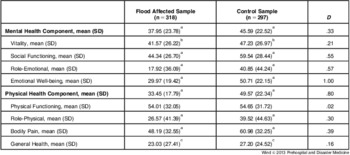
Table 3 shows the means, standard deviations, and effect sizes for the summary measures and subscales of functioning for the affected and the comparison groups.
Mean and Standard Deviations of Functioning Subscales in the Affected and Comparison Groups

aP < .001.
bP < .01.
cP < .05.
The affected group scored significantly lower on the Mental Health component as an indicator of functioning (M = 37.95; SD = 23.78) than the comparison group (M = 45.59; SD = 22.52) (t 611 = 9.91; P < .001). The subscales of the Mental Health summary scale revealed significant differences between the affected and the comparison groups on Vitality (M = 41.57; SD = 26.22 for the affected group and M = 47.23; SD = 26.97 for the comparison group; t 612 = 2.64; P < .01); Social Functioning (M = 44.34; SD = 26.70 for the affected group and M = 59.54; SD = 28.44 for the comparison group; t 612 = 6.83; P < .001); Role-Emotional (M = 17.92; SD = 36.09 for the affected group and M = 40.85; SD = 44.24 for the comparison group; t 611 = 7.05; P < .001), and Emotional Well-being (M = 29.97; SD = 19.42 for the affected group and M = 50.71; SD = 22.15 for the comparison group; t 612 = 12.36; P < .001).
The difference between the flood-affected and the comparison groups was small for the summary measure Mental Health component (D = .33). For the subscales of the Mental Health component the difference between the flood-affected group and the comparison group was small for vitality (D = .21), moderate for Social Functioning (D = .55) and Role-emotional (D = .57), and large for Emotional Well-being (D = 1.00).
The affected group scored significantly lower on the Physical Health component as an indicator of Functioning (M = 33.45; SD = 17.79) than the comparison group (M = 49.57; SD =22.34) (t 612 = 4.08; P < .001). The subscales of the Physical Health component revealed no significant difference between the affected and the comparison group on Physical Functioning, and significant differences between the affected and the comparison groups on Role-Physical (M = 26.57; SD = 41.39 for the affected group and M = 39.52; SD = 44.63 for the comparison group; t 612 = 3.73; P < .001); Bodily Pain (M = 48.19; SD =32.55 for the affected group and M = 60.98; SD = 32.25 for the comparison group; t 612 = 4.89; P < .001); and General Health (M = 23.03; SD = 27.41 for the affected group and M = 27.20; SD = 24.52 for the comparison group; t 612 = 1.98; p < .05). The difference between the flood-affected and the comparison groups was large for the summary measure Physical Health component (D = .80). For the subscales of the Physical Health component the difference between the flood-affected group and the comparison group was close-to-zero for physical functioning (D = .02), small for Role-Physical (D = .30) and General Health (D = .16), and moderate for Bodily Pain (D = .39).
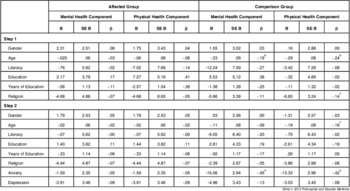
Hierarchical Regression Analyses of Mental Health on Functioning
The data met the assumptions of hierarchical linear regressions (linearity, homoscedasticity, and normality of residuals).
For the affected group, the hierarchical regression analyses (Table 4) showed there were no significant predictors of the Mental Health component and the Physical Health component of Functioning: neither sociodemographic variables nor mental health outcomes (anxiety and depression) predicted the Mental Health component (R 2 = .03, F(8, 207) = .73, ns) and Physical Health component of Functioning (R 2 = .04, F(8, 209) = .79, ns).
Hierarchical Regression Analyses on Two Measures of Functioning for the Affected and the Comparison Groups

R 2 is n.s. step 1; ΔR 2 is n.s. for step 2 of the Mental Health Component in the Affected Group;
R 2 is n.s. step 1; ΔR 2 is n.s. for step 2 of the Physical Health Component in the Affected Group;
R 2 = .06 for step 1, p < .05; ΔR 2 = .29 for step 2 p < .001 of the Mental Health Component in the Affected Group;
R 2 = .07 for step 1, p < .05; ΔR 2 = .22 for step 2 p < .001 of the Physical Health Component in the Affected Group.
aP < .001.
bP < .01.
cP < .05.
For the comparison group, the hierarchical regression analyses revealed that in the first step in which the sociodemographic variables were included, Age was a significant predictor of the Mental Health component of Functioning. Higher Age was associated with lower Mental Health Functioning. In the second step, in which Anxiety and Depression were added, Anxiety predicted Mental Health Functioning. Higher Anxiety was associated with lower Mental Health Functioning. With the inclusion of Anxiety and Depression, the contribution of Age decreased substantially. Further, in the comparison group Age and Religion predicted Physical Functioning in the first step. Higher age was associated with lower Physical Health Functioning and Muslims reported less Physical Functioning than Hindus. In the second step, Age continued to be significant and, in addition, Anxiety predicted Physical Functioning. Higher Age and higher Anxiety was associated with lower Mental Health Functioning. After the second step, with all independent variables in the equation, the explained variance (R 2) was .35, F(8, 209) = 13.76, P < .001, for the regression with Mental Health Functioning as the outcome and the explained variance (R 2) was .29, F(8, 210) = 10.55, P < .001, for the regression with Physical Health Functioning as the outcome (Table 4).
Discussion
There is an enormous amount of research on post-disaster mental health, but scholars have largely neglected recurrent disasters.Reference Choudhury, Quraishi and Haque8 The present study shows that recurrent disasters have a severe impact on mental health and functioning. The results are notably higher than most studies on natural disasters,Reference Norris, Friedman, Watson, Byrne, Diaz and Kaniasty5, Reference Norris, Friedman and Watson6, 11, Reference Knight, Gatz, Heller and Bengtson35, Reference Van Griensven, Chakkraband and Thienkrua36 and equal results from studies on “type II traumas,” defined as “the result of long-standing or repeated ordeals.”Reference Terr37
Whereas the relationship between mental health problems and impaired functioning is a requisite for pathology, neither observed anxiety nor depression symptomatology explained the level of functioning of individuals in the affected group.20 In contrast, mental health symptomatology in the unaffected group explained more than a quarter of the outcome of psychological functioning and slightly less than a quarter of the variance of physical functioning. How can this absent relationship between mental health and functioning be explained?
In a qualitative study conducted in Bahraich, Kattri and colleagues showed that economic deprivation and increased poverty evoked by the floods are related to mental health problems.Reference Kattri, Joshi, Wind, Komproe and Guha-Sapir38 Based on these findings, it is likely that the relationship between mental health and functioning is masked, because the adverse context evokes both mental health problems and functioning.Reference Wind and Komproe13 In other words, the relationship between mental health and functioning in this context is not a simple bivariate relationship, but is moderated by the adverse context. Namely, repeatedly affected individuals are confronted with the consequences on several domains of their existence ranging from individual victimhood, via the high risk of losing their homes and properties, to structural changes in the social and physical environment such as the loss of fertile agricultural land.11, Reference Wiesenfeld and Panza12, Reference Horwitz17, Reference Kattri, Joshi, Wind, Komproe and Guha-Sapir38 Under such harsh circumstances, anxiety, for instance, may reflect an adequate survival mechanism that alerts individuals to realistic dangers in the environment, such as recurring floods, rather than pathology. Further, such dire circumstances impair the ability of individuals to function properly. The idea that the adverse context likely moderates the relationship between mental health problems and impaired functioning refrains from interpreting the mental health problems in this study as indicators of pathology.
In general, therapeutic trauma interventions are directed at the individual trajectory of re-establishing a sense of a safe base in relationship with others and the individual environment.Reference Terr37, Reference Van der Kolk39 However, what are the opportunities to return to a sense of safety within an unstable context with recurrent catastrophes? There is a need to adopt a different and elaborated approach than allocating sheer mental health services to the affected region of Bahraich to alleviate mental health symptoms.Reference Hobfoll, Watson and Bell40 The study findings indicate substantial distress and encumbered functioning, for which it is more appropriate to adopt a multidimensional intervention approach that also addresses the erosion of the social and environmental context.Reference Van Ommeren and Wessels41 An example is to implement livelihood projects tailored to the circumstances, such as empowerment projects to grow crops in between floods.Reference Hobfoll, Watson and Bell40 Interventionists may also reconstruct society in such a way that bolsters resilience against the destructive power of recurrent floods. For instance, building houses higher above the ground not only protects against material damage from the flood, but also against animal hazards, such as snake bites. These community interventions will promote the functioning of affected individuals and decrease the mental health symptoms related to survival, such as feelings of anxiety that a new flood will occur.Reference Wiesenfeld and Panza12, Reference Horwitz17 Yet, interventions that address the context will not be a panacea for all. In fact, for a small group of severely traumatized individuals, there may still be an additional need for psychiatric interventions, because for these severely traumatized individuals altering the conditions may not be sufficient to alleviate suffering.Reference Hobfoll, Watson and Bell40, Reference Van Ommeren and Wessels41
Limitations
The study has some limitations that may have confounded the findings. First, the results pertain to those who continued to live in the flood area, but there were no data on those who moved out of the area after the flood. Second, the affected and the non-affected samples differ significantly on religion, as the affected group comprises fewer Muslims. Religion—as well as the context—may create a source of nested variance across groups. Third, within the time slot to implement the study, there was insufficient time to validate the HSCL-25 in the northern Indian context. Yet, within the given time, the translation procedure was thorough and accurate, and a possible systematic bias as a result of the lack of validation would have likely influenced the outcomes of both the disaster group and the non-affected group. Fourth, all measures used were self-report measures, which, although they have the advantage of tapping the respondent's perception, are not always consistent with more objective measures.Reference Esdaile and Greenwood42
Conclusion
The strength of the study is to provide empirical evidence for the impact of recurrent disasters on mental health. The study showed a large impact of seasonal floods on symptoms of depression and anxiety. The findings indicate a need to implement psychosocial context-oriented interventions to address the erosion of the context, rather than specific mental health interventions. Yet, the present study is merely a first step in providing the empirical evidence needed to expand knowledge on the impact of recurrent floods on mental health. As such, this study may inspire other scholars to conduct research on recurrent disasters.