Introduction
Background information
Use of draft animals is an ancient practice that has persisted to the present times and its importance in developing countries as a source of power for carrying out farm operations is likely to continue in the foreseeable future. Draft animal power (hereafter referred to as DAP) has been identified as an environmentally friendly technology that is based on renewable energy and encompasses integration of livestock and crop production systems. Research work has linked the benefits of using DAP to several aspects such as: enhanced timeliness of carrying out farming operations, increased yield through improved seedbed preparation, deeper plowing, possibility of labor savings, reduced drudgery and possibility of income generation through off-farm transport and hiringReference Starkey, Starkey, Mwenya and Stares1.
Compared to the other parts of the world, sub-Saharan Africa (excluding Ethiopia) has had a shorter history of using draft animalsReference Starkey, Starkey, Mwenya and Stares1. In much of Africa, crop farming and cattle herding tended to be separate activities carried out by different tribal groups. In Kenya the use of oxen for cultivation was introduced in the 1920s by European settlers from South AfricaReference Oudman, Kanali, Okello, Wasike and Klapwijk2. The main draft animals used in Kenya include oxen, donkeys and, to a limited extent, camels. The use of draft animals for carrying out farm operations has been spreading rapidly in some areas and slowly in others in AfricaReference Starkey, Starkey, Mwenya and Stares1. The extent to which animal traction is used in Kenya is relatively low. It is estimated that only about 12% of smallholder farms (smallholder farms are here defined as farms whose total size is less than 10 ha) are using it, compared to 3% who were using tractors while over 80% were using hand toolsReference Mutahi, Kanali, Okello, Wasike and Klapwijk3. This observation is also mirrored in other parts of Africa where DAP is adopted; for example in Uganda the contribution of animal power is estimated at approximately 8–9%Reference Odogola and Kibalama4 while in West African semi-arid tropics DAP is employed on less than 15% of total area sownReference Spencer5. Since its introduction in Kenya, little attention was given to introducing DAP to smallholder farmersReference Onyango, Starkey and Faye6. On the contrary, the government tried to promote tractor mechanization which could have led to degrading of animal traction to a somewhat ‘backward technology’. Further, the acquisition and maintenance of the animal traction package may require credit, veterinary and extension services and after sale services of the implements, which may not be readily available to the farmers. Other constraints to the use of animal traction that have been cited include lack of know-how by the farmers, limited availability of appropriate implements such as plow and weeders, potentially high cost of keeping and foddering draft animals and maintenance and repair of the implements.
In the first two decades after independence, the government promoted motorized mechanization through state-sponsored tractor hire schemes and tractor credit schemes. The thrust of these initiatives was to enable smallholder farmers to access tractors either through hire or purchase respectively. However, these efforts had limited success and proved unsustainableReference Starkey, Starkey, Mwenya and Stares1, Reference Kosura-Oluoch7. The government-managed tractor schemes were bureaucratic and were bogged down by tractor breakdowns that took too long repair. More importantly, in the small farms, use of tractors has proved not to be economically viable because most small-scale farmers cannot afford the initial cost of purchase, maintenance and operation (fuel) cost due to financial constraints. Furthermore, the farm sizes are small, scattered and have irregular shapes which make tractor operations difficult and in turn increase the operation costs. Subsistence nature of most small-scale farming is also unlikely to economically justify use of expensive tractors. Due to the limited success of the government-sponsored tractor hire services and tractor credit schemes, the use of animal traction for small farm mechanization has received somewhat more attention in the past two decades; for example, some government economic planning documents have highlighted the government's concern for the need for more research on the use of DAP8. However, there have not been significant practical efforts by the government to promote the adoption and widespread use of DAP, but stakeholders in the private sector have formed a national network for the promotion of animal draft technology known as KENDAT (Kenya Network for Draft Animal Technology).
Kenya's smallholder agriculture sector is very significant both in terms of volume and value of domestic production. According to the national development plan (2002–2008), the share of small-scale production was projected to average 54% of total agricultural production by the year 20089. It is estimated that there are 3 million smallholder farms in Kenya with an average land size of 2 haReference Odhiambo, Nyangito and Nzuma10. The dominance of the small farms is bound to continue as sub-division of larger farms continues due to prevailing land inheritance patterns. Therefore, given its relative importance, any strategy for stimulating agricultural growth in Kenya must inevitably target the smallholder sub-sector. Smallholder farmers generally use manual labor combined with low level technologies to carry out their agricultural production. In the past two decades a decline in agricultural productivity was shown among the smallholder farmers in Kenya11. Draft animal technology offers a viable potential to increase agricultural productivity using environmentally friendly and locally available resources.
Yield, profitability and efficiency effects of using DAP
The technical aspects of using animal draft technology are well documented but the user aspects of the technology have received less attentionReference Marshall, Sizya, Starkey, Mwenya and Stares12, Reference Sylwander, Starkey, Mwenya and Stares13. In Kenya, for example, several appropriate animal-drawn implements and accessories such as plows, cultivators, a variety of animal-drawn carts and harnesses have been developed and released to farmers but studies on profitability aspects of DAP are not commonplace. The overall low level of use of animal traction in sub-Saharan Africa has led to doubts being raised about its profitability and sustainable use. Actually there is no consensus among researchers on how the application of animal traction affects productivity or profitabilityReference Kosura-Oluoch7. This arises partly from the methodologies used in the studies, and partly due to the differences between the various study areas with regard to technical and socio-economic factors. The effects of mechanization on yields can be viewed as direct effects (higher yields, everything else being constant) and indirect effects, i.e., increased timeliness of carrying out farm operations, application of manure from draft animals. Direct effects of mechanization have not shown consistent results. The indirect effects of mechanization are less disputed, for instance timeliness of carrying out farm operations. Mechanization is seen as facilitating a more effective use of high yielding inputs.
Some research findings suggest that DAP is only profitable when socio-economic conditions permit a high level of utilization of animals and equipmentReference Jaeger and Matlon14, Reference Williams15. Some studies have shown that use of DAP increased acreage without having significant impact on yieldsReference Mettrick16, while others indicate that DAP increased economic profitability of crop enterprises by smallholder farmersReference Kosura-Oluoch7, Reference Mutebwa17–Reference Simalenga, Belete, Mzeleni, Jongisa, Kaumbutho, Pearson and Simalenga19. Therefore, there is need to carry out a case-by-case study to ascertain how use of DAP affects farm profitability. In many areas where DAP is used in Kenya, it is applied predominantly for primary tillage, with little or no application in subsequent operations. When it is applied for primary tillage, DAP has the potential of achieving expansion of cultivated area compared to the use of hand tools. Increased acreage implies that more labor would be needed in subsequent operations such as planting, weeding and harvesting. Although, in the context of small and declining farm sizes in Kenya the potential for significantly increasing acreage is limited, the profitability of DAP in a setting of declining land sizes would still warrant investigation. As noted by StevensReference Stevens, Starkey, Mwenya and Stares20, animal traction is rarely applied for weeding in Africa, even where plowing has been practiced for generations, mainly due to lack of affordable and readily available weeding implements and inadequate training of both the draft animals as well as the users. Weeding is recognized as a critical factor in determining crop yields; uncontrolled weed growth could reduce crop yields by up to 60%Reference Mwanda, Starkey and Simalenga21. Weeding operation is cost intensive especially in terms of labor requirements. In many cases, farm labor available for weeding determines the final area that can be harvested. Given the potential of DAP in increasing farm profitability, this study attempts to shed light by comparing two groups of farmers: those using DAP and those using hoes for growing maize in central Kenya.
Materials and Methods
Study area
The study was conducted in Kirinyaga district, which is one of the six districts of the Central Province in Kenya. The district occupies an area of 1478 km2 with 457,105 inhabitants distributed in four divisions within the district (Ndia, Gichugu, Mwea and Kerugoya Kutus). The district has a tropical type of climate with two rainfall seasons, i.e., the long rains (March to May) and the short rains (October to December). Usually planting of food crops is done during these two rainfall seasons because there is adequate rainfall that makes the district self-reliant in production of various types of food crops. The general landscape of the district rises from an elevation of 1480 m above sea level (ASL) in the south to over 6800 m ASL at the Mount Kenya peak. Farmers in the upper regions of the district put large portions of their farms under cash crops such as coffee and tea and also keep dairy animals for milk production. Farmers in the lower region do not produce tea or coffee due to unfavorable climate. Maize–bean intercrop is common in both the upper and lower regions. Maize is the main food crop in the larger part of the district and a household without maize grain is considered food insecureReference Ouma, De Groote and Gethi22. The district has a relatively high intensity of use of DAP especially for tillage operations. However, the use of DAP in Kirinyaga district closely follows a regional pattern. Most farmers who use DAP to carry out farm operations are concentrated in the lower parts of the district because it is relatively flat, hence more appropriate for using draft animals, and land sizes are also larger than in the upper areas. The traditional zebu oxen are predominantly used for tillage operations. A pair, or in some few cases two pairs, of oxen are used to pull a moldboard plow. DAP is predominantly applied in land preparation with limited application in weeding operations. There are, however, many farmers in Kirinyaga district who do not apply DAP to carry out agricultural operations, with many using hand tools and very few using tractors. Hiring out traction animals is a common practice in the study area, hence farmers who do not own oxen can access DAP through hiring.
Data sources
Farm level data for this study were collected using structured questionnaires covering the long rains period of 2001. Information gathered included household characteristics: acreage under maize, amounts of labor used in production, cost of hired labor, amounts of fertilizers used in maize production and their prices, family and hired labor input into maize production and inter-gender labor time allocation for farm work, home work and market work. A combination of multi-stage random and purposive sampling procedures was applied to obtain a sample of 80 farmers that were interviewed in this study. First, three divisions out of the four divisions were randomly selected, namely: Gichugu, Mwea and Ndia. In the next stage, two locations were randomly selected in each division. The selected locations were Baragwi and Karumandi in Gichugu division, Mutithi and Murinduko in Mwea division and Mutira and Inoi locations in Ndia division. At the location level, purposive sampling was applied to obtain a sample containing both ‘traction’ and ‘hoe’ groups. A total of 80 farmers were sampled for interview with 43% in the ‘hoe’ group and 57% in the ‘DAP’ group.
The concept of economic efficiency and its measurement
Efficiency is an elusive concept, defined and therefore measured differently by different disciplines. The economist, the engineer and the policy-maker, for example, all define efficiency differently. Policy implications arising from economic efficiency are important to both micro- and macro-level decision-making. Efficiency, as defined by FarrelReference Farrel23 in his pioneering work on the subject, is the ability to produce a given level of output at the lowest cost. Two concepts of efficiency, technical and price or allocative efficiency, are clearly distinguished by FarrelReference Farrel23. A producer is said to be technically efficient if there is no possibility of producing the same amount of output with fewer inputs or producing more output with the same amount of inputs. Price efficiency (or allocative efficiency), on the other hand, refers to the proper choice of input combinations given the prevailing market prices. Economic efficiency combines both. It is possible for a firm to be either technically or allocatively efficient but be economically inefficientReference Adesina and Djato24. Technical and allocative efficiencies are necessary conditions, and when they occur together they are sufficient for achieving economic efficiencyReference Yotopolous and Nugent25.
Many researchers have used the production function (a mathematical expression that attempts to capture the relationship between inputs combination and resulting output) as a tool to study economic efficiency. Some researchers have used the production function to separately estimate technical efficiency and allocative efficiency. The production function approach assumes that all firms have identical ratios of inputs and outputs, hence only one point on the production plane would be observable. However, as noted by Ali and FlinnReference Ali and Flinn26, a production function approach may not be appropriate when estimating the economic efficiency of individual firms because they face different prices and have different factor endowments. Due to these differences the firms will have different best practice production functions and, thus, different optimal operating points. Production function methods to test for allocative and economic efficiency have been criticized as suffering simultaneity bias because input levels are endogenously determinedReference Ali and Flinn26. Problems of endogeneity can be avoided by estimating profit or cost function instead of production functionsReference Quisumbing27.
A firm's profit is a function of prices of inputs, price of output and the level of fixed inputs, which are all exogenous from the firms’ point of view. A study by Yotopoulos and LauReference Yotopoulos and Lau28 applied a profit function to compare efficiency of small and large farms in India. They further suggested that the same reasoning could be applied to compare different groupings such as owners versus share tenants or adopters of a new technology versus non-adopters. As noted by Khan and MakiReference Khan and Maki29 differences in economic efficiency among groups of farms (say users of a given technology and non-users) may result from variations in technical efficiency (larger output with equal amounts of inputs) and price efficiency (higher profits). Profit maximization is implied if the value of marginal product of each variable input is equal to its price. Thus we test the relative economic efficiency of the two groups of firms by comparing their actual profit functions.
Apart from differences in farm power sources, farms also differ in fundamental aspects of production such as differences in input application levels. This causes a difficulty in interpreting results. All other factors are not held constant. To overcome this problem two approaches could be applied: covariance analysis or before and after mechanization yields comparison. The latter method is inappropriate most of the time due to lack of data for comparison. Covariance analysis is a way of testing whether there are significant differences in the behavioral relationships between sets of observations. ‘Covariance’ analysis was carried out to isolate the direct effects of using animal traction, i.e. to test whether there are significant differences in the behavioral relationships between ‘hoe’ group and ‘DAP’ group. The results of the analysis showed that the two groups are statistically different from each other in the way the included independent variables explain variation in the profits from maize production.
The profit function model
In this study a restricted Cobb–Douglas Unit-Output-Price (UOP) profit frontier was applied in testing the relative economic efficiency of the effect of using DAP on economic efficiency of the sample farms in the study area because it was found to have the best fit of data despite there being other more flexible functions such as translog and quadratic functions. Profit functions (like their underlying production functions) can either be deterministic or stochastic in natureReference Coelli, Rao and Battese30. Stochastic functions, unlike deterministic functions, incorporate producer-specific random shocks besides the common shock that is allowed for all the producers in deterministic functions. The stochastic profit function is defined as:

where π i is normalized profit of the ith farm defined as the gross revenue less variable cost divided by farm-specific output price; P ij is the price of the jth variable input faced by the ith farm divided by output price; Zik is the level of the kth fixed factor on the ith farm; D ik is the dummy for farm mechanization (D=0 if hoe was used and D=1 if DAP was used); μ is an error term; and i=1, …, n, is the number of farms in the sample.

where v i's are assumed to be independently and identically distributed two-sided random errors, independent of the u i's which are non-negative errors representing profit inefficiency.
The empirical model
The general form of the UOP profit frontier, dropping the ith subscript for the farm, is defined as:

where Π is normalized profit in Kenya Shillings (in the year 2001, one US dollar ($) was approximately equal to Ksh 75) defined as total revenue less total variable costs normalized by the price of maize. ANTRAC is a dummy variable with value 1 for ‘traction’ farms and 0 for ‘hoe’ farms. WAGE is wage rate in Ksh per person day normalized by the price of maize and FERTZ is the price of fertilizers in Ksh normalized by the price of maize. MACR is the acreage under maize in hectares and MSEED is the price of seeds in Ksh normalized by the price of maize. While v is the error term assumed to be independently and identically distributed two-sided random errors, independent of the u which is non-negative error representing profit inefficiency, βi's are the regression coefficients.
Relative efficiency involves comparing efficiencies of two or more firms. As noted by Knox et al.Reference Knox, Blankmeyer and Stutzman31, if two classes of firms have different degrees of technical and price efficiency and face similar prices in input and output markets, the firm class with higher profits is considered to be more economically efficient. The approach is that, given comparable endowments, identical technology, and normalized input prices, the UOP profit of two firms should be identical if they both maximized profits. If one firm is more price efficient, or more technically efficient, than the other, the UOP profits will differ even for the same normalized input prices and endowments of fixed inputs.
Results and Discussion
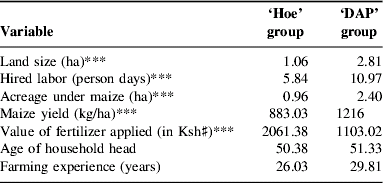
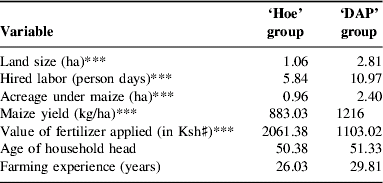
There was a significant difference on the land sizes, amount of hired labor, acreage under maize and value of fertilizers applied between ‘DAP’ and ‘hoe’ groups (Table 1). But there was no significant difference on age of the household head, years of formal schooling, years of farming experience and the family sizes between the two. Farmers who used DAP obtained significantly higher profits than those that used the hoe, as shown in Table 1.
Descriptive statistics for the sample farmers.
*** Significant at 1% level.
# Ksh=Kenya Shillings where 1 US $=Ksh 75.
The land sizes in the area of study are generally small regardless of whether one is in the ‘DAP’ or the ‘hoe’ group. Therefore, there is need to intensify land use through land augmenting technologies such as using fertilizers, high yielding crop varieties, nitrogen fixing legumes, cover crops, conservation tillage and such others. Use of draft animals could enhance land use intensification through cheap production and easy transporting of manure on the farm. Draft animals can also provide power for a wide range of labor intensive land management and erosion control systems, such as establishment of ridges along the contours in hilly areas. As noted by Noodwijk et al.Reference Van Noordwijk, Hairiah, Partoharjono, Labios and Garrity32 many renewable practices such as use of compost and green manures, use of cover crops, pruning of foliage from alley legumes and bushes are labor intensive, but DAP could help relieve scarce labor in the farms to perform these practices. The mean acreage under maize was 1.78 ha for the whole sample. This means that farmers in the study area on average put about 74% of their land holdings under maize, indicating the relative importance of maize crop in the study area. The average maize yield for the whole sample was 1074.20 kg ha−1. There was a significant difference in the maize yield between the two groups of farmers. ‘DAP’ group on average obtained 1216 kg of maize ha−1 while the ‘hoe’ group obtained 883.08 kg of maize ha−1. For the ‘hoe’ group yield varied between 441 and 1323 kg ha−1 while for ‘DAP’ group the maize yield varied between 2190.3 and 1852.2 kg ha−1. The above results seem to concur with the proposition that DAP facilitates timeliness in land preparation and planting, as well as ensuring deeper plowing at the onset of rains which later translates to higher crop yields, all else being constant. The average value of fertilizers used in the sample farms was Ksh 811.92. The value ranged from Ksh 0.00 to Ksh 6250 with a median of Ksh 655. The ‘hoe’ group applied more fertilizers for maize production than the ‘DAP’ group on average. The mean value of fertilizers was Ksh 2061.38 and Ksh 1103.02 for the ‘hoe’ and the ‘DAP’ group respectively. ‘DAP’ group on average used less fertilizer than ‘hoe’ group but they still obtained higher yields on average. There is no straightforward explanation for this observation but there is a possibility that the yield increasing effect of using DAP overshadowed those of using fertilizers. Farmers in the ‘DAP’ group had a ready source of manure from the draft animals that they applied in their farms. Furthermore, crop rotation was more possible among ‘DAP’ farmers because some areas of the farm were set apart as non-cropped fallow for grazing the animals.
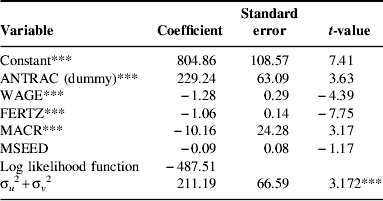
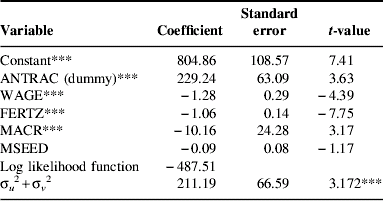
Regression analyses of the profit function are summarized in Table 2.
Maximum likelihood estimates (MLE) of stochastic profit function regression.
*** Significant at 1% level.
σu2, σv2, variance of the error term components u and v.
The signs of coefficients and their significance are consistent with the expectations of the profit function apart from the land size. As expected, the prices of variable inputs (wage rate, seeds and fertilizers) had a negative coefficient in the profit function. It is expected that the higher the price of variable inputs of production the less the profit that a farmer can attain. All the prices of variable inputs are significant in the model. This result to a large extent concurs with those of several othersReference Adesina and Djato24, Reference Ali and Flinn26, Reference Yotopoulos and Lau28, Reference Khan and Maki29. The coefficient of land is negative and significant, which implies that farmers with larger pieces of land were less efficient than those with smaller pieces of land. This observation could be attributed to the fact that farmers with smaller farm tend to intensify their production thereby making better use of inputs than those with larger farmers. The coefficient of mechanization was found to be positive and significant. This result indicates that use of animal traction had a significant effect on increasing maize enterprise profits. Testing whether the coefficient of a dummy variable that differentiates the two groups of farms, is significantly different from zero we can test the hypothesis of relative economic efficiency. The results indicated that the coefficient of the dummy variable was significantly different from zero.
Conclusions
The present study examined profitability aspects of using animal traction as a strategy for small farm mechanization in Kirinyaga district in Kenya. The results indicated that use of animal traction (both owned and hired) all else being equal, increased both the yield and profits in maize production. This observation seems to concur with the proponents of use of DAP who say that if applied in farm operations animal traction can facilitate a more efficient use of other production inputs. DAP has a potential to enhance farmer's ability to adopt and use renewable practices such as use of animal manure, crop rotation, ridging and other renewable practices. Therefore, government and other stakeholders should promote use of animal traction as a way of increasing farm efficiency. For effective promotion of DAP as a source of farm power and its uptake by farmers various constraints that farmers face in adoption of animal traction, such as lack of capital and know-how, should be addressed. This is particularly important given the current status of low levels of adoption of a seemingly profitable technology.
Acknowledgements
The authors gratefully acknowledge the International Food Policy Research Institute (IFPRI) who provided the funds to carry out this research under the MSc. Competitive grant of 2001. The support received from the Principal and other staff members of Kamweti Farmers Training Centre, Kirinyaga, during the fieldwork is greatly appreciated. The authors are fully responsible for the contents of the paper.