Introduction
Terahertz (THz) radiation has attracted wide attention in last few decades for its wide-ranging applications, e.g., characterization of molecules, nondestructive testing, and explosives detection (Han et al., Reference Han, Cho and Zhang2000; Davies et al., Reference Davies, Linfield and Jonston2002; Kohler et al., Reference Kohler, Tredicucc, Beltram, Beere, Linfield, Davies, Ritchie, Iotti and Rossi2002; Hirata et al., Reference Hirata, Kosugi, Takahashi, Yamaguchi, Nakajima, Furuta, Ito, Sugahara, Sato and Nagatsuma2006; Wallace et al., Reference Wallace, Anthony, Pickwell, Pye, Taday, Flanagan and Thomas2006; Tonouchi, Reference Tonouchi2007). The THz lies in the region of the electromagnetic spectrum between high-frequency microwaves and the far-infrared region. This has led to a variety of new techniques for the generation of THz radiation. Currently, the high-power THz radiation sources are accelerated-based sources. These sources using ultra-relativistic electron bunches to generate THz radiation by various mechanisms like coherent synchrotron radiation, coherent undulator radiation, and free-electron laser. For modest power applications one may employ electronic (semiconductor antennas) and photonic (nonlinear optical crystals)-based sources for THz generation. For higher powers, one may employ high-power laser plasma interactions (Houard et al., Reference Houard, Liu, Prade, Tikhonchuk and Mysyrowicz2008; Huang et al., Reference Huang, Nagashima, Hsu, Juodkazis and Hatanaka2018).
Hamster et al. (Reference Hamster, Sullivan, Gordon, White and Falcone1993) obtained megawatt picosecond THz radiation from the interaction of high-power laser (~10 TW) with the gas (helium), as well as solid density targets (Al-coated glass slides) via ponderomotive nonlinearity. D'Amico et al. (Reference D'amico, Houard, Franco, Prade, Mysyrowicz, Couairon and Tikhonchuk2007) produced THz from the plasma filament by a high-power femtosecond laser pulse in its wake. Dai et al. (Reference Dai, Karpowicz and Zhang2009) observed coherent THz by the optical color mixing of two-color laser pulses in gaseous plasmas.
Wu et al. (Reference Wu, Sheng, Dong, Xu and Zhang2007) have studied (by theory and PIC simulations) the mechanism of the coherent broadband (0.1–3 THz) THz pulse emission (of the order of MV/cm) from laser wakefields in the presence of the externally applied magnetic field. Bhasin and Tripathi (Reference Bhasin and Tripathi2009) have studied the resonant THz radiation excitation by both nonlinear mixing of lasers and optical rectification of a short-pulse X-mode (extra-ordinary mode) laser in magnetized plasma with density rippled. It is observed that the generated THz wave field is strongly affected by the magnitude and direction of the externally applied dc magnetic field. Singh and Sharma (Reference Singh and Sharma2013) have proposed a model for THz generation by decay of high-power X-mode laser into magnetosonic wave (MSW) (frequency lies in the THz range) and upper hybrid wave (UHW), in the presence of background magnetic field.
The generated THz radiation is sensitive to the spatial and temporal intensity profile of laser pump and the density profile of plasma (Sharma and Singh, Reference Sharma and Singh2014; Singh et al., Reference Singh, Singh, Rajouria and Sharma2017). A plasma density helps in quasi phase matching and strongly enhances the THz yield. An alternate way is to employ an electrostatic mode with desired frequency and wave number which can fulfill the phase-matching condition. Kumar et al. (Reference Kumar, Singh, Sharma, Uma and Sharma2018) have proposed a model for an MSW wave (spectrum lies in THz frequency range) excitation by the coupling of high-power X-mode laser with the seed MSW via ponderomotive nonlinearity. Wang and Lin (Reference Wang and Lin2003) also proposed the generation of nonlinear MSW and Alfvén wave by the beam–plasma interaction.
In this paper, we study resonant THz generation by the nonlinear interaction of two co-propagating X-mode laser beams in the presence of pre-existed MSW in magnetized plasma. The MSW and the lasers propagate perpendicular to the applied dc magnetic field. The plasma density is modulated by the MSW at frequency (ω m) and wave number (k m). The laser beams on the electrons exert a ponderomotive force at the beat frequency. The density perturbation due to the MSW couples with the ensuing nonlinear electron drift to produce a nonlinear current, drives THz radiation.
In “Theoretical model”, we study MSW wave-assisted resonant THz emission by the nonlinear mixing of lasers in the magnetized plasmas. We obtain the quasi phase-matching condition. In “Results and discussion” and “Conclusion”, discussion of results and the summary are included.
Theoretical model
Consider magnetized plasma of unperturbed electron density, n 0 having a static transverse magnetic field, $B_0\hat{z}.$ A MSW of frequency ω m and wave vector $k_{\rm m} \hat{x}$
 propagates through it with the electric field

where ${{\rm \omega}} _{\rm m}^2 = k_{\rm m}^2 c^2(c_{\rm s}^2 + v_{\rm A}^2 /c_{}^2 + v_{\rm A}^2 )$ , $v_{\rm A}\left( { = B_0/\sqrt {{{\rm \mu}}_0n_im_i}} \right)$
 is the Alfvén velocity, $c_{\rm s}\left( { = \sqrt {(T_{\rm e} + T_i)/m_i}} \right)$
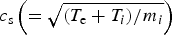 is the sound speed, n i is the ion density, and m i is the ion mass.
The electron density perturbation due to the MSW is

where, ${{\rm \beta}} = -\lpar {{{\rm \varepsilon}}_0k_{\rm m}{{\rm \omega}}_{\rm p}^2 {{\rm \omega}}_{\rm c}/e{{\rm \omega}}_{\rm m}\lsqb {{{\rm \omega}}_{\rm m}^2 \lpar {1-(k^2v_{{\rm th}}^2 /{{\rm \omega}}_{\rm m}^2 )} \rpar -{{\rm \omega}}_{\rm c}^2} \rsqb } \rpar$ , ω c(=eB 0/m e) is the electron cyclotron frequency, ${{\rm \omega}} _{\rm p} \big( { = \sqrt {{{n_0e^2} / {{{\rm \varepsilon}}_0m_{\rm e}}}}} \, \big)$
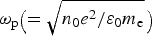 is the plasma frequency, $v_{{\rm th}} = \sqrt {T_{\rm e}/m_{\rm e}}$
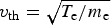 is the electron thermal velocity, m e is the electron mass and ε 0 is the permittivity of free space.
The electric fields of two co-moving X-mode laser beams propagate in the plasma

where, j (=1, 2) is running index, ${{\rm \varepsilon}} _{\hskip-1pt jxy}\lpar { = -{{\rm \varepsilon}}_{\hskip-1pt jxy}} \rpar = {{-i{{\rm \omega}} _{\rm c}{{\rm \omega}} _{\rm p}^2} / {{{\rm \omega}} _j\lpar {{{\rm \omega}}_j^2 -{{\rm \omega}}_{\rm c}^2} \rpar }}$ and ${{\rm \varepsilon}} _{\hskip-1pt jxx}\lpar { = {{\rm \varepsilon}}_{\hskip-1pt jyy}} \rpar = {{1-{{\rm \omega}} _{\rm p}^2} / {\lpar {{{\rm \omega}}_j^2 -{{\rm \omega}}_{\rm c}^2} \rpar }}$
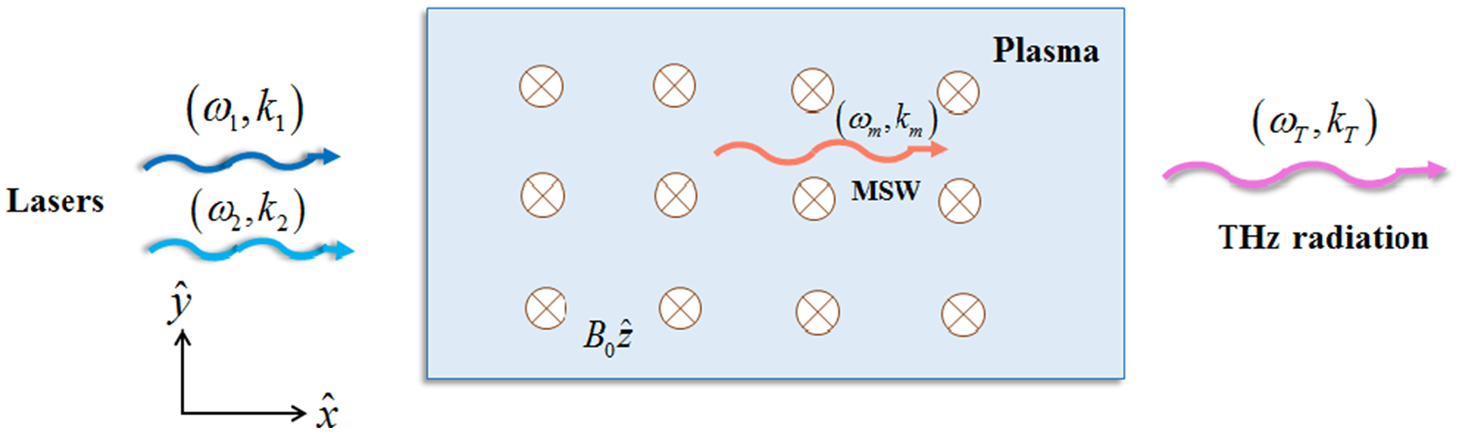
 . Figure 1 shows the schematic diagram of THz generation by the two-color laser beam in transversally magnetized plasma. For ω 1, ω 2 ≫ ω p, ω c, E jx ≪ E jy, k 1 = ω 1/c, and k 2 = ω 2/c, the laser beam on the electrons exerts a ponderomotive force $(\vec{F}_{\rm p})$
 at frequency ω′ = ω 1 − ω 2 and wave number ${\vec{k}}^{\,\prime} = \vec{k}_1-\vec{k}_2$


where, ${\rm \Phi} _p\lpar { = -(e^2E_{1y}E_{2y}^* /2m_{\rm e}{{\rm \omega}}_1{{\rm \omega}}_2)} \rpar$ is the ponderomotive potential. It gives rise to nonlinear drift velocity and density perturbation, which on solving with the equations of motion and continuity results into

and

The density perturbation further leads to the generation of a space-charge field $\vec{E}^{\prime}\lpar { = -\nabla {{\rm \varphi}}^{\prime}} \rpar$ at the beat wave frequency. Due to this self-consistent field, it also produces a density perturbation as follows:

Hence, the total perturbed density at the beat wave frequency is written as

The potential (φ′) at the beat wave frequency can be obtained from the Poisson's equation $\lpar {\nabla^2{{\rm \varphi}}^{\prime} = en_{{{\rm \omega}}^{\prime}}/{{\rm \varepsilon}}_0} \rpar$ as follows:

where ${{\rm \chi}} _e = {{-{{\rm \omega}} _{\rm p}^2} / {\lpar {{{{\rm \omega}}}^{\prime 2} -{{\rm \omega}}_{\rm c}^2} \rpar }}$ . The total electron drift velocity at the beat wave frequency due to the self-consistent field $(-\nabla {{\rm \varphi}} ^{\prime})$
 and ponderomotive force will be written as

Schematic of laser beat wave THz generation aided by a MSW of frequency ω m. $B_0\hat{z}$ is the static transverse magnetic field.

The electron x and y drift velocity components will be written by using Eq. (10) as follows:

and

where, ${{\rm \omega}} _{{\rm UH}} \big( { = \sqrt {{{\rm \omega}}_{\rm p}^2 + {{\rm \omega}}_{\rm c}^2}} \big)$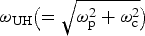 is upper hybrid frequency.
The perturbation in plasma density due to the MSW couples with the electron drift velocity results into a nonlinear current density at frequency, ω T = ω′ − ω m and wave number, $\vec{k}_{\rm T} = {\vec{k}}{}^{\prime}-\vec{k}_{\rm m}$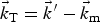 ,

The governing wave equation of the THz wave can be written as (Ginzburg, Reference Ginzburg1970)

where the nonzero components of $\underline{\underline{{{\rm \varepsilon}}}} _{\rm T}$ are ${{\rm \varepsilon}} _{{\rm T}xy}\lpar { = -{{\rm \varepsilon}}_{{\rm T}yx}} \rpar = {{-i{{\rm \omega}} _{\rm c}{{\rm \omega}} _{\rm p}^2} / {{{\rm \omega}} _{\rm T}\lpar {{{\rm \omega}}_{\rm T}^2 -{{\rm \omega}}_{\rm c}^2} \rpar }}$
 and ${{\rm \varepsilon}} _{{\rm Txx}}\lpar { = {{\rm \varepsilon}}_{{\rm Tyy}}} \rpar = {{1-{{\rm \omega}} _{\rm p}^2} / {\lpar {{{\rm \omega}}_{\rm T}^2 -{{\rm \omega}}_{\rm c}^2} \rpar }}$
 and ${{\rm \varepsilon}} _{{\rm T}zz} = 1-{{{{\rm \omega}} _{\rm p}^2} / {{{\rm \omega}} _{\rm T}^2}}$
 On writing the solution, $\vec{E}_{\rm T} = \vec{A}\,(x)\;e^{-i({{\rm \omega}} _{\rm T}t-k_{\rm T}x)}$
 , the y component of Eq. (14) takes the form,

For exact phase matching,

where, k T = k 1 − k 2 − k m = (ω 1 − ω 2)/c − k m and the second term on the LHS of the Eq. (15) vanishes and one obtains the normalized THz amplitude as follows:

where $n_{{\rm m}_0} = {{\rm \beta}} E_{{\rm m}0}$ and |v 2| = eA 2/m eω 2.
The THz wave generation efficiency can be obtained from the ratio of energy flux of the THz wave and the laser pump.

Results and discussion
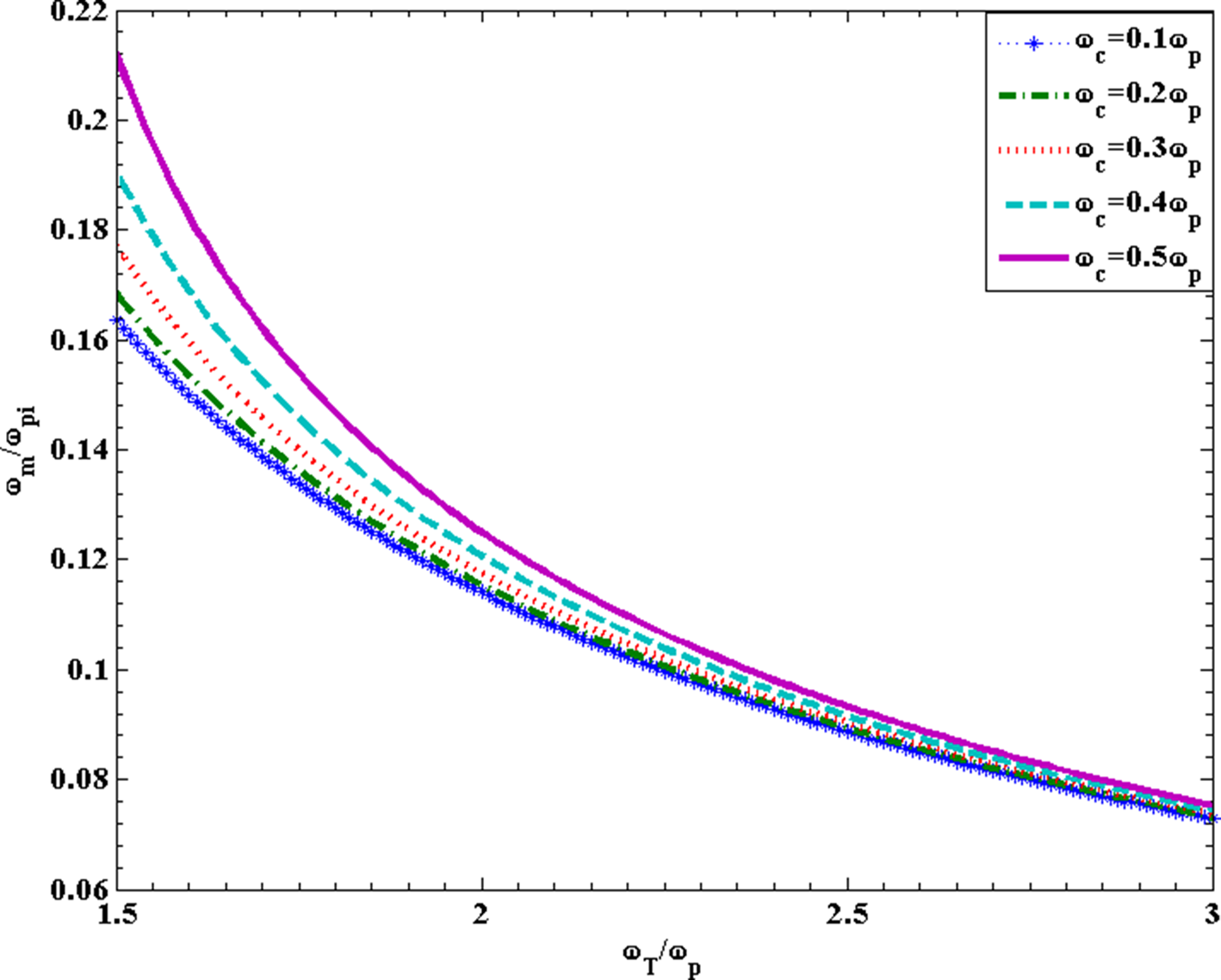
In the present scheme, MSW plays a key role in resonant excitation of the THz wave. The density perturbation associated with the MSW beats with the electron velocity due to the laser beat wave ponderomotive force to produce a nonlinear THz current. The MSW compensates for the momentum mismatch in the nonlinear mixing process. The electrons experience a strong nonlinear ponderomotive force at the beat wave frequency in the propagation direction of the laser beam. However, the nonlinear drift velocity arises in axial as well as transverse direction due to the externally applied magnetic field. This drift velocity couples with the density modulation due to the MSW, giving rise to a nonlinear current and THz generation. The quasi phase matching demands, ${{{{\rm \omega}} _{\rm m}} \over {{{\rm \omega}} _{{\rm p}i}}} = {{{{\rm \omega}} _{\rm T}} \over {{{\rm \omega}} _{{\rm p}i}}}\left\{ {1-{\left( {1-{{{{\rm \omega}}_{\rm p}^2} \over {{{\rm \omega}}_{\rm T}^2}} {{{{\rm \omega}}_{\rm T}^2 -{{\rm \omega}}_{\rm p}^2} \over {{{\rm \omega}}_{\rm T}^2 -{{\rm \omega}}_{{\rm UH}}^2}}} \right)}^{1/2}} \right\}\left\{ {1 + \sqrt {{{\lpar {c^2 + v_{\rm A}^2} \rpar } \over {\lpar {c_{\rm S}^2 + v_{\rm A}^2} \rpar }}}} \right\}^{-1}$ . We have carried numerical calculations for the following parameter: ω p/2π = 1 THz, ω 1 = 1.963 × 10¹⁴ rad/s, and ω 2 = 1.778 × 10¹⁴ rad/s (CO2 laser) and laser intensities of I L1(= I L2) = 2 × 10¹⁵ W/cm2. In Figure 2, we have plotted the normalized MSW frequency (ω m/ωpi) as a function of the normalized THz frequency (ω T/ω p) for different values of electron cyclotron frequency ω c = 0.1ω p, 0.2ω p, 0.3ω p, 0.4ω p, and 0.5ω p, corresponding to the magnetic field of 35.7, 71, 107, 142, and 178 kG. The MSW frequency found to be decreased monotonically with the THz frequency(ω T/ω p).
Plot of normalized MSW (ω m/ω pi) as a function of the normalized THz frequency (ω T/ω p) for different values of ω c/ω p = 0.1, 0.2, 0.3, 0.4, and 0.5 respectively.

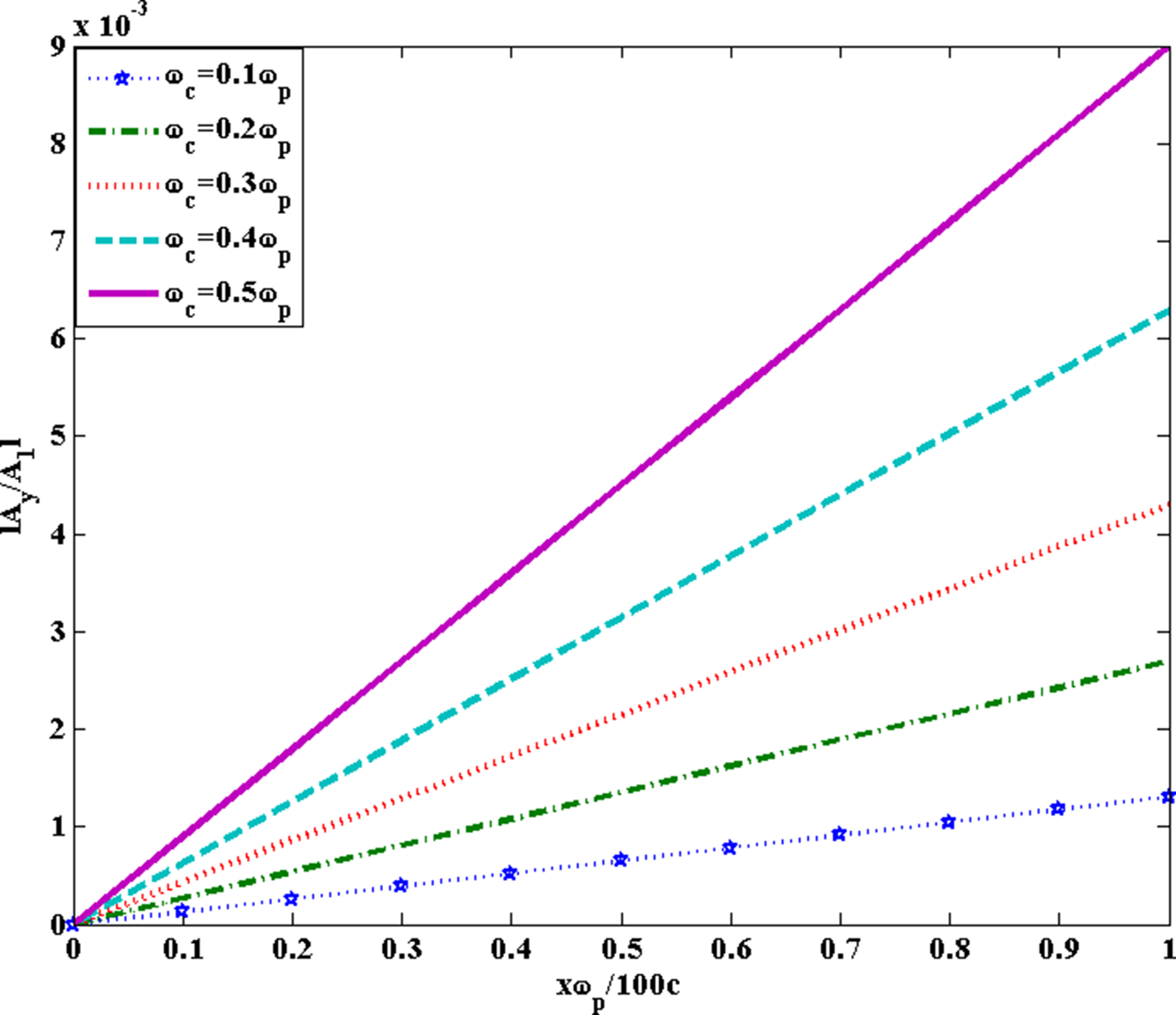
The transversally magnetized plasma supports an electromagnetic wave (i.e., X-mode wave). It can propagate in plasma if its frequency either in between left-hand cutoff to upper hybrid oscillation frequency or larger than the right-hand cutoff frequency. In the numerical simulation, THz wave frequency has been taken larger than the right hand cutoff oscillation frequency. The THz amplitude acquires a large value as THz frequency around the upper hybrid frequency (ωUH) and falls off as ωT increases. In Figure 3, we plotted the normalized terahertz wave amplitude |A y/A 1| w.r.t. the normalized distance of propagation, x(ω p/100 c) for v 2 = 0.1c, ω T = 1.5ω p, and $n_{{\rm m}_0}/n_0 = 0.1$ at different values of ω c/ω p = 0.1, 0.2, 0.3, 0.4, and 0.5. It is observed that the normalized amplitude of THz wave increases with the normalized distance and with increasing externally applied strength of the static magnetic field.
Plot of normalized amplitude of THz radiation, |A y/A 1| as a function of normalized distance, x( ω p/100 c) for v 2 = 0.1c, ω T = 1.5ω p, and $n_{{\rm m}_0}/n_0 = 0.1$ at different values of at ω c/ω p = 0.1, 0.2, 0.3, 0.4, and 0.5, respectively.

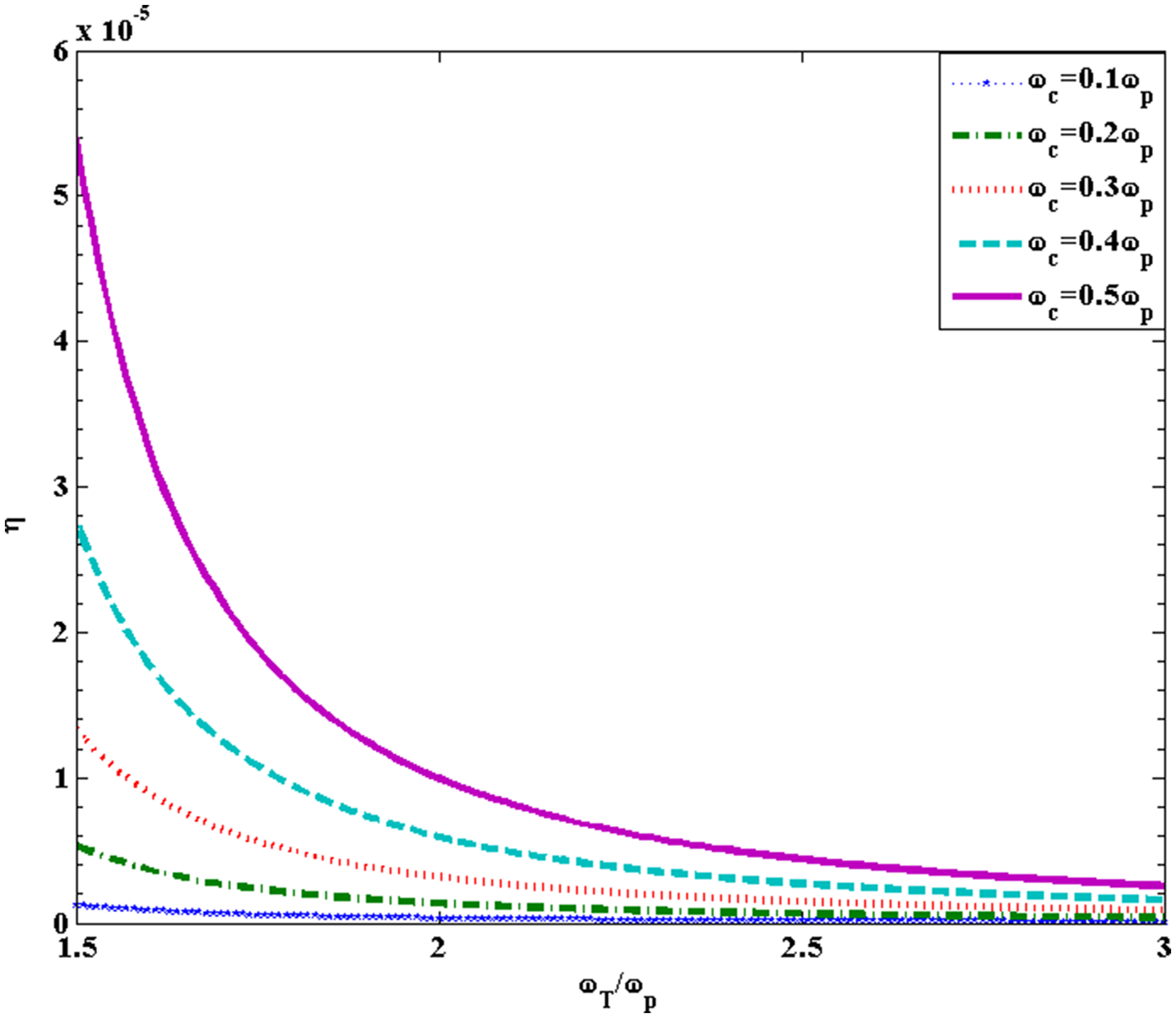
In Figure 4, we plotted the efficiency of THz wave generation w.r.t. the normalized THz frequency (ω T/ω p) for v 2 = 0.1c, x = 100ω p/c, and $n_{{\rm m}_0}/n_0 = 0.1$ at different values of ω c/ω p = 0.1, 0.2, 0.3, 0.4, and 0.5. It is observed that efficiency η of THz decreases with the normalized THZ frequency (ω T/ω p). It is also shown from the figure that the efficiency increases with the strength of the background magnetic field.
The efficiency of the THz radiation generation as a function of a normalized THz frequency (ω T/ω p) for v 2 = 0.1c, x = 100ω p/c, and $n_{{\rm m}_0}/n_0 = 0.1$ at different values of ω c/ω p = 0.1, 0.2, 0.3, 0.4, and 0.5, respectively.

It is observed that the laser beat wave excitation of THz radiation in under-dense plasma is enhanced due to coupling with the MSW. The efficiency of the generated THz wave falls off with the normalized THz frequency due to the weakening coupling with the MSW. Here, we neglect the effects of the finite spot size of the lasers; hence, this generation mechanism is valid when the spot size of the laser is larger than the wavelength of THz wave.
Conclusion
The pre-existed plasma mode, e.g., an MSW, can be utilized for resonant excitation of an electromagnetic THz wave by beating two lasers. A low-frequency MSW modulates the density of plasma and creates a periodic structure which also varies with time. This density modulation helps in the exact phase-matching condition. There is a linear relation between the generated THz wave amplitude with the distance of propagation. Also, the strength of the background magnetic field controls the THz yield.
Acknowledgments
This work was partially supported by Department of Science and Technology (DST), India.