INTRODUCTION
Social scientists have debated the significance of U.S. Latina/o racial identification, given that this implicates 1) the extent and nature of the group’s integration into American society and 2) the extent to which this country’s racial hierarchy will change given this population’s growth. However, existing social science research on Latina/o racial identification provides contradictory findings regarding the factors that influence the selection of racial categories on census surveys by Latinas/os.Footnote 1 Reasons behind these contradictory findings may include regional variation (Dowling Reference Dowling2014) and the context and history masked in national aggregations. Thus, as we do in this article, it is crucial to focus on specific locations while being mindful of historical context when examining Latina/o racial identification.
While addressing U.S. Latinas/os’ racial identification and questions germane to assimilation and racial hierarchy is crucial, it is equally important to scrutinize the assumptions behind the use of such concepts. First, we must interrogate the utility of the implications drawn from a group’s national patterns of integration. How meaningful are national-level statistics when evidence of substantial state and regional variation in patterns of racial identification are shown to exist? Second, we must question the validity behind the assumption that panethnic Latina/o racial identification may affect racial hierarchy at the national level. We contend that it is best to examine Latina/o racial identification by subgroup given their varying racialized histories, cultures, and modes of incorporation (Cobas et al., Reference Cobas, Duany and Feagin2009). Above all, analyses of group patterns of assimilation and racial identification must account for state and historical contexts and their distinctive racial histories, especially if researchers are to draw relevant inferences about potential changes to racial hierarchy.
Despite much empirical survey literature and theoretical debate related to Latina/o racial identification, the comparative influence of state-level racial identity dynamics has been largely ignored. Thus, in this paper, we bring large-scale population data to bear on questions regarding Latina/o racial identification and on the racial identification of Mexicans in California and Texas to better understand how state and historical dynamics influence racial identification. We also explore how indicators of social and economic integration are related to White racial identification among these populations. In line with Michael Omi and Howard Winant (Reference Omi and Winant2015) we view racial categories and their meanings as contingent across time and social contexts. Moreover, given the continuous discrimination and racialization that Mexicans and other Latinas/os experience (Ballinas Reference Ballinas, Smith and Thakore2016, Reference Ballinas2017; Cobas et al., Reference Cobas, Duany and Feagin2009; Dowling Reference Dowling2014; Telles and Ortiz, Reference Telles and Ortiz2008) and the long history of Mexican Americans asserting Whiteness to counter the racial discrimination they face (Foley Reference Foley1997; Gomez Reference Gomez2007), we join Julie Dowling (Reference Dowling2014) and challenge the notion that racially identifying as White on federal surveys signifies assimilation and integration for the Mexican-origin population. This paper relies primarily on historical literature in combination with insights from theories of integration to derive a tentative set of testable propositions.
We focus on those of Mexican descent because this population is the largest subgroup of Latinas/os. Much of the extant research examining Latina/o racial identification focuses on Dominicans and Puerto Ricans (Golash-Boza and Darity, Reference Golash-Boza and Darity2008). Thus, little is known about how the Mexican-origin population identifies racially in official government surveys, whether these identifications vary by nativity, and—our major emphasis here—whether and how racial identification varies across contexts. This last emphasis, understanding contextual variation in racial identification, is of growing importance given the recent large-scale geographic dispersion of the Mexican-origin population to “newer destinations” (Zuñiga and Hernandez-Leon, Reference Zuñiga and Hernandez-Leon2005). Racial dynamics, racial history, and other social contexts influencing racial identification among the Mexican-origin population have not accrued over time in “newer destinations” to the same extent as they have in traditional destinations such as California and Texas. To the extent that our analysis uncovers distinctive patterns of racial identification in these two traditional states, this may signal to researchers the importance of attending to the specific regional- or state-level racial dynamics facing the Mexican-origin population in newer areas.
We focus on California and Texas for several reasons. Most importantly, these two states have been traditional settlement sites for this group since the mid-nineteenth century when the United States annexed what is now the American southwest. Thus, there is more historical context to draw from in trying to understand contemporary patterns in the Mexican-origin population’s racial identification. As elaborated below, Texas developed similar racial dynamics to the U.S. South in part because many slaveholders moved there (Foley Reference Foley1997), and as a result segregation was institutionalized in the state until around 1950 (Gomez Reference Gomez2007; Montejano Reference Montejano1987). California developed antislavery ideals in part because most persons settling there came from the Northern and Western United States (Almaguer Reference Almaguer1994), and the progressive movement of the early twentieth century was highly influential in California (Molina Reference Molina2006), but carried little influence over the political economy shaping racial dynamics in Texas (Black Reference Black1997).
Below we review the relevant literature from several areas regarding the racial identification of U.S. Latinas/os. Given Mexicans’ long and continued presence in the southwest, it is vital to first briefly discuss their history there before extrapolating what implications these dynamics might have for processes of contemporary racial formation since historical and regional dynamics influence the ways in which individuals construct their racial identities (Almaguer Reference Almaguer1994; Foley Reference Foley1997; Gomez Reference Gomez2007).
HISTORICAL CONTEXTS
From their respective inceptions, California and Texas had distinct racial contexts within which Mexicans were racialized and constructed their identities. Although California joined the United States as an anti-slavery state in 1850, this “reflected a common belief that the presence of blacks or any nonwhite group associated with unfree labor posed a real or symbolic threat to the status of free white labor” (Almaguer Reference Almaguer1994, p. 36). Differing from the rest of the United States, nineteenth century California had sizeable numbers of Asians, Blacks, Mexicans, and Native Americans who were racialized in relation to one another, but all beneath Whites in the racial hierarchy (Almaguer Reference Almaguer1994). Here too, discrimination against Mexicans existed (Menchaca Reference Menchaca1995). The so-called “Zoot Suit Riots” in 1943 were only a part of the hostile racist environment that Mexicans faced in Southern California (Sanchez Reference Sanchez1993). Still, relative to other non-White groups in California, Mexicans “occupied a qualitatively different ‘group position’” (Almaguer, Reference Almaguer1994, p. 45). Anglos perceived less social distance between themselves and Mexicans than with other non-White groups given that Mexicans practiced Christianity, had Spanish ancestry, spoke a romance language, and possessed European features (Almaguer Reference Almaguer1994).
Texas joined the United States as a slave state in 1845, where most Texan Anglos descended from resettled Southerners who fought to maintain the “color line” and to extend it to Mexicans (Foley Reference Foley1997). Still, Mexicans were White enough to escape the Jim Crow South’s worst dimensions (Foley Reference Foley1997). However, racial discrimination against Mexicans was so prominent that Mexico banned Texas from receiving Mexican workers under the Bracero Program (Foley Reference Foley2010). To persuade Mexico that discrimination against Mexicans would not be tolerated, Texas officials passed the Caucasian Race Resolution in 1943 (Foley Reference Foley1997). Although this assumed that Mexicans were White, almost no Texans viewed Mexicans as White (Foley Reference Foley1997). Indeed, second- and later-generation middle-class Mexican Americans established the League of United Latin American Citizens (LULAC) in 1929 and the American G.I. Forum (AGIF) in 1948 as groups seeking “to end discrimination mainly by insisting on their loyalty and patriotism as American citizens and their Caucasian racial status” (Foley Reference Foley2010, p. 34). Many middle-class Mexican-Americans identified as “Latin Americans” to avoid the stigma of the label Mexican (Foley Reference Foley2010). These organizations, which explicitly advocated for the classification of Mexicans as “White,” were more prominent in Texas than in California (Telles and Ortiz, Reference Telles and Ortiz2008). Such strategies follow the long history of Mexican Americans asserting Whiteness to counter the racial discrimination they have met (Foley Reference Foley1997; Gomez Reference Gomez2007).
While Texas had LULAC to battle discrimination, California had organizations such as the Congress of Spanish Speaking Peoples, formed in 1938, which explicitly denounced LULAC’s anti-immigrant and assimilationist agenda (Telles and Ortiz, Reference Telles and Ortiz2008). Texas organizations tended to be more conservative, strove for assimilation, deemphasized anti-Mexican racism, distanced themselves from African Americans, and sought Whiteness (Foley Reference Foley2010; Telles and Ortiz, Reference Telles and Ortiz2008). California-based organizations tended to be more radical, denounced racial discrimination, and emphasized a Chicano identity (Telles and Ortiz, Reference Telles and Ortiz2008). When viewed through a contemporary lens, California was certainly no “racial paradise” (Foley Reference Foley2010), yet Texan Mexicans faced more rigid racial boundaries based on a historical Black-White binary (Foley Reference Foley1997; Montejano Reference Montejano1987; Telles and Ortiz, Reference Telles and Ortiz2008). This is partially due to most of the Mexican population living in southern Texas and nearby San Antonio with almost no other non-Whites to impede Mexicans being at the bottom of a full-blown two-caste racial system (Montejano Reference Montejano1987).
These are some of the key historical circumstances to consider in examining the contemporary racial formation of California’s and Texas’ Mexican-origin population. These historical circumstances point to Whiteness having an added social value among Texas’ Mexican-origin population given the more intense racial stigmatization of Mexicans there in comparison to California. However, emphasis on regional and historical context tends to be absent in existing Latina/o racial identification research.
LATINA/O RACIAL IDENTIFICATION RESEARCH
Our main argument in this paper is that the distinctive ethno-racial histories of California and Texas have given rise to differences in the way that present-day Mexican-origin persons identify racially on census surveys. This is consistent with a robust literature suggesting that one’s racial identification is determined, at least in part, by contextual factors. However, existing research on Latinas/os’ racial identification provides inconsistent findings regarding which factors influence a large majority to identify their race as White or some other race.Footnote 2 Mixed findings stem from researchers using data sets that differ over time and place (Pastor and Pulido, Reference Pastor and Pulido2013) as well as the regional variation (Dowling Reference Dowling2014) and histories masked in national aggregations.Footnote 3
We must also recall that Latina/o subgroups have unique histories influencing their racialization and identity construction.Footnote 4 Racial diversity exists within and between each subgroup (Bonilla-Silva Reference Bonilla-Silva2013; Ennis et al., Reference Ennis, Rios-Vargas and Albert2011; Frank et al., Reference Frank, Akresh and Lu2010; Pastor and Pulido, Reference Pastor and Pulido2013; Rodriguez Reference Rodriguez2000; Rumbaut Reference Rumbaut, Cobas, Duany and Feagin2009). Racial identification also varies by region (Frank et al., Reference Frank, Akresh and Lu2010; Logan Reference Logan2003; Rumbaut Reference Rumbaut, Cobas, Duany and Feagin2009; Tafoya Reference Tafoya2005). For example, in the 2000 Census 48% of Latinas/os identified as racially White and 43% identified as “other” (Rumbaut Reference Rumbaut, Cobas, Duany and Feagin2009). Dominicans and Puerto Ricans were most likely to identify as Black, about 13% and 8% respectively, while about 85% of Cubans identified as White (Logan Reference Logan2003). In this same census, 40% of Mexicans identified as White and 53% as other in California, while 60% of Mexicans identified as White and 36% as other in Texas (Rumbaut Reference Rumbaut, Cobas, Duany and Feagin2009). In the 2010 Census, 53% of Latinas/os identified as White and about 37% as other, while 53% of Mexicans identified as White and about 40% as other (Ennis et al., Reference Ennis, Rios-Vargas and Albert2011). However, as geographer Manuel Pastor (Reference Pastor2014) has eloquently pointed out, the increase in the percentage of Latinas/os identifying as racially White in the 2010 Census can mostly be attributed to the inclusion of a line, in bold type, “For this census, Hispanic origins are not races” not present in the 2000 Census. Thus, it is crucial to point out that the substantial percentages of Latinas/os identifying as racially White in the 2000 Census and 2010 Census are not comparable.
Furthermore, as we do here, it is crucial to analyze specific groups while being mindful of context and history when examining racial identification. Studies analyzing Latina/o racial identification in specific regions find that location is a highly significant factor. Telles and Ortiz’s (Reference Telles and Ortiz2008) intergenerational study examines random samples of Mexican-American families in Los Angeles and San Antonio. Among the study’s respondents only location significantly explained who identifies as racially White; San Antonio respondents were five times more likely than those in Los Angeles to identify as racially White. Edward Telles and Vilma Ortiz (Reference Telles and Ortiz2008) suggest that this is a result of the 1960s Chicano political movement’s emphasis on a racialized non-White identity being more prevalent in California than in Texas. Examining Southern California, the largest concentration of Latinas/os in the country, Manuel Pastor and Laura Pulido (Reference Pastor and Pulido2013) use 2008–2010 ACS data to analyze their racial identification. The authors find that older, more educated, higher-earning Latinas/os are more likely to identify as racially White. Moreover, Latinas/os living in Southern California’s most suburbanized parts are the most likely to identify as White, while the more Latina/o and segregated the neighborhood that Latinas/os live in, the more likely they are to identify as some other race (Pastor and Pulido, Reference Pastor and Pulido2013).
Other studies point to individual factors influencing the racial identification of native-born and immigrant Latinas/os—income level (Michael and Timberlake, Reference Michael, Timberlake and Gallagher2008; Tafoya Reference Tafoya2005), length of residence in the United States (Golash-Boza and Darity, Reference Golash-Boza and Darity2008; Rodriguez Reference Rodriguez2000; Tafoya Reference Tafoya2005), generation (Rodriguez Reference Rodriguez2000; Rumbaut Reference Rumbaut, Cobas, Duany and Feagin2009; Tafoya Reference Tafoya2005), and English language proficiency (Golash-Boza and Darity, Reference Golash-Boza and Darity2008; Michael and Timberlake, Reference Michael, Timberlake and Gallagher2008; Rodriguez Reference Rodriguez2000; Tafoya Reference Tafoya2005). However, these and other studies do not consider the influence of state-level racial identity dynamics on Latinas/os’ racial identity choices. One exception is Dowling’s (Reference Dowling2014) seminal research on the influence of racial ideology on how Mexican-Americans and Mexican immigrants in Texas identify racially on census surveys and in social contexts. Dowling (Reference Dowling2014) posits that identification with Whiteness reflects Mexican individuals’ efforts to resist racial othering and gain acceptance as American, especially among Mexican-Americans who live along the Texas-Mexico border, “where Mexican Americans find themselves under more scrutiny, as they are confronted with assumptions that they are ‘Mexican [immigrants]’ and not “American” (p. 119). These findings will be discussed in relation to our work in the concluding section.
In the following section, we discuss our approach in comparing the racial identification responses of the Mexican-origin population residing in California and Texas, the two states with the largest and most established Mexican-origin populations. Beyond the sheer number of Mexican-origin persons residing there, limiting our analyses to California and Texas provides a more parsimonious test of our primary theoretical concern, understanding the degree to which the specific historical contexts of ethno-racial identity formation in the Mexican-origin population continue to shape contemporary expressions of identity. Owing to each state’s distinctive context of reception, especially prior to the civil rights era, we argue that California and Texas represent ideal cases for such a theoretical investigation.
PROPOSITIONS
Based on the respective histories of California and Texas, we have derived a tentative set of propositions to guide our research design and analyses of racial identification in the American Community Survey (ACS). These propositions flow logically from the premise that the ethno-racial histories of California and Texas, respectively, have given rise to a present-day racial context in those states that lead to differences in the way that Mexican-origin persons, on average, view themselves and thus answer questions about racial identification on census surveys. Specifically, the complex array of social, political, and economic mechanisms that developed over the course of history in Texas, we predict, produces a context in which “Whiteness” carries relatively more social value, making it more likely that Mexican-origin respondents will assert White racial identity in federal surveys. Mexican-origin individuals in Texas have claimed White racial identification, both historically (Foley Reference Foley1997) and in recent times (Dowling Reference Dowling2014), to combat racial discrimination and take advantage of the rights and privileges of being American. Formally stated, this proposition is as follows:
P1: Mexican-origin persons in Texas will be more likely to identify as White on the ACS than their peers in California.
All else being equal, we expect that the elevated social premium on Whiteness in Texas will lead to a greater likelihood of identifying oneself as White if residing in Texas.
Previous research using U.S. Census data finds that the U.S.-born children of Latina/o immigrants are more likely to identify as White than are their parents (Rodriguez Reference Rodriguez2000; Tafoya Reference Tafoya2005). Using the region-specific Children of Immigrants Longitudinal Study (CILS), however, Ruben G. Rumbaut (Reference Rumbaut, Cobas, Duany and Feagin2009) finds that 60% of Latina/o immigrant parents and only 20% of their children racially identify as White, while 65% of the children and only 6% of the parents chose some other race.Footnote 5 Additionally, Mexican immigrant parents in Los Angeles and San Antonio were also more likely to identify as White than their U.S.-born children (Telles and Ortiz, Reference Telles and Ortiz2008). Yet, in Texas, a higher percentage of Mexican-Americans (43%) than Mexican immigrants (24%) identified as racially White (Dowling Reference Dowling2014). Our second proposition is premised on the racial histories detailed above. State-specific racial contexts represent a set of norms. Because Mexican-Americans are socialized entirely within the set of norms that reflect and reinforce the American racial hierarchy, and sub-national variations based on their specific state or region of residence, they should be more likely than their immigrant peers to identify as White. It follows, therefore, that if there is a greater premium on Whiteness in Texas, the California-Texas difference in the probability of identifying as White in the ACS should be larger among Mexican-Americans than it is among Mexican immigrants.
P2: The California-Texas difference in the likelihood of White racial identification will be larger among Mexican-Americans than it is among Mexican immigrants.
Existing scholarship confirms both that longer residence in the United States makes it more likely that Latinas/os identify as White (Rodriguez Reference Rodriguez2000; Tafoya Reference Tafoya2005) and that they identify as some other race (Golash-Boza and Darity, Reference Golash-Boza and Darity2008; Logan Reference Logan2003; Pastor and Pulido, Reference Pastor and Pulido2013; Telles and Ortiz, Reference Telles and Ortiz2008). As a result, using a parallel line of reasoning established in P2, if state contexts are predictive of racial identities on the U.S. Census we would expect, for example, those respondents who spend their entire life in Texas to have the highest probability of identifying as White. Recall the historical and current emphasis of Mexicans claiming Whiteness as a tool against racial discrimination in Texas (Dowling Reference Dowling2014; Foley Reference Foley1997, Reference Foley2010; Telles and Ortiz, Reference Telles and Ortiz2008). The ACS does not allow analysts to construct detailed migration histories of respondents over the life course.Footnote 6 Rather, it allows one to determine persons’ state of birth and current state of residence, and thus this proposition rests on the assumption that, for example, Texas-born residents of Texas will have constructed a racial identity overwhelmingly or entirely in Texas. Conversely, Texas-born residents of California have been exposed to both state racial contexts to some unknown degree.
P3: The California-Texas difference in the likelihood of White racial identification, among Mexican-Americans, will be the largest when comparing California-born residents of California to Texas-born residents of Texas. Conversely, the smallest California-Texas difference in White racial identification among Mexican-Americans will be observed when comparing Texas-born residents of California to California-born residents of Texas.
Despite the inability to measure the life-course timing of inter-state migration(s), we nevertheless expect to find the gradients articulated in P3.
P4: The effects of social and economic integration on White racial identification will vary between California and Texas, such that measures of integration are more strongly associated with the likelihood of identifying as White in Texas, relative to California.
Our fourth proposition is derived from the long-established finding that ethnic and racial minorities tend to “improve” their racial standing and economic mobility through sociocultural integration into the “mainstream” (Alba and Nee, Reference Alba and Nee2003; Bean and Stevens, Reference Bean and Stevens2003; Gordon Reference Gordon1964). More recently, theory and research on the contextual determinants of integration suggest that dimensions of integration (e.g., sociocultural, economic, racial identity, etc.) are more independent of one another in more “multiculturalist” integration contexts (Bean et al., Reference Bean, Brown, Bachmeier, Fokkema and Lessard-Phillips2012; Bean et al., Reference Bean, Brown and Bachmeier2015; Bloemraad and Sheares, Reference Bloemraad and Sheares2017). Conversely, in more “assimilationist” contexts, dimensions of integration are more strongly correlated with one another, as, for example, economic integration is conditioned to a much greater degree on sociocultural integration and social acceptance in more restrictive integration contexts. It follows then, to the extent that California has historically been a more multiculturalist context, whereas Texas is more restrictionist that measures of integration should be more strongly associated with the likelihood of identifying as White among Mexicans residing in Texas, relative to their peers in California. A restrictionist social context may be partially due to the historical presence and embeddedness of political organizations such as LULAC, that tended to be more conservative, strove for assimilation, deemphasized anti-Mexican racism, distanced themselves from African Americans, and sought Whiteness (Foley Reference Foley2010; Telles and Ortiz, Reference Telles and Ortiz2008).
Moreover, if the state context is the primary contextual determinant of racial reporting on the ACS, when measuring the average probability of White racial identification at the sub-state level (e.g., metropolitan areas), all California local areas will cluster together at the lower end of the distribution, while all Texas areas will cluster together at the high end of the distribution, and there will be little or no overlap between the two. Thus, our fifth proposition is as follows:
P5: State-differences in the likelihood of White racial reporting will not be explained by geographic variation within states.
DATA AND METHODS
Data and Analytical Sample
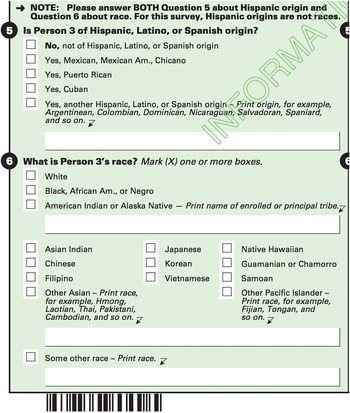
To test these propositions, we analyze pooled annual samples from the 2008–2016 American Community Surveys (ACS). The ACS is the largest federal nationally representative survey sample comprising roughly 1% of the entire U.S. population, and is an ideal data source for these analyses insofar as it provides a large sample necessary to perform multivariate analyses of racial identification among Mexicans in California and Texas, partitioned by nativity. We limit the analyses to the years 2008–2016 because of a change in instruction preceding the ACS question on Hispanic ethnicity from 2007 to 2008 that had notable impacts on how American Latina/os answered the question about their race.Footnote 7 The wording from the questionnaire beginning with the 2008 ACS is shown in Figure 1.
Question-Wording of the Hispanic Ethnicity and Race Questions in the 2008 American Community Survey (ACS)

Our analytical sample is limited by several important criteria:
-
1. Mexican-origin (U.S.- and Mexican-born)
-
2. Adult, aged eighteen and older
-
3. Resides in either California or Texas
-
4. Does not have a Census-allocated response to the ACS race question about racial identification
With respect to the first criterion, there are multiple ways in which one might be identified as having Mexican origin. First, Mexican immigrants are those who are born in Mexico and are either naturalized citizens or non-citizens (thus, persons born in Mexico to U.S. citizen parents are not Mexican immigrants). Second, among U.S.-born persons there are multiple ways in which one might be defined as being of Mexican origin. One can claim Mexican origin on the aforementioned Hispanic/Latino ethnicity question. In addition, one can claim Mexican heritage on the ancestry question in the ACS, which is an open-ended question (i.e., with no offered response choices) that reads: “What is this person’s ancestry or ethnic origin?” Thus, a native-born individual can be identified as Mexican-origin either via the Hispanic/Latino ethnicity question or the ancestry question.
The age and state of residence restrictions are straightforward, but the fourth one listed above requires explanation. For all ACS questions, it is possible that respondents fail to properly respond, don’t know, or refuse, thus producing missing data. In publicly released micro-data, the Census Bureau “fills in” this missing data using a set of allocation procedures along with allocation flags indicating whether an individual’s response to a given item is allocated or not. Nationally, 5.3% of ACS observations among Mexican-origin adults in the 2008–2016 ACS had allocated race information (the figure is 6.0% in California and 4.1% in Texas).Footnote 8 Because we are interested in actual reports of racial identification on the ACS, we exclude persons with allocated race information.
When these restriction criteria are applied to the 2008–2016 pooled sample, it yields an analytical sample size of 461,640 Mexican immigrants and 568,317 U.S.-born persons of Mexican-origin.
Measurement
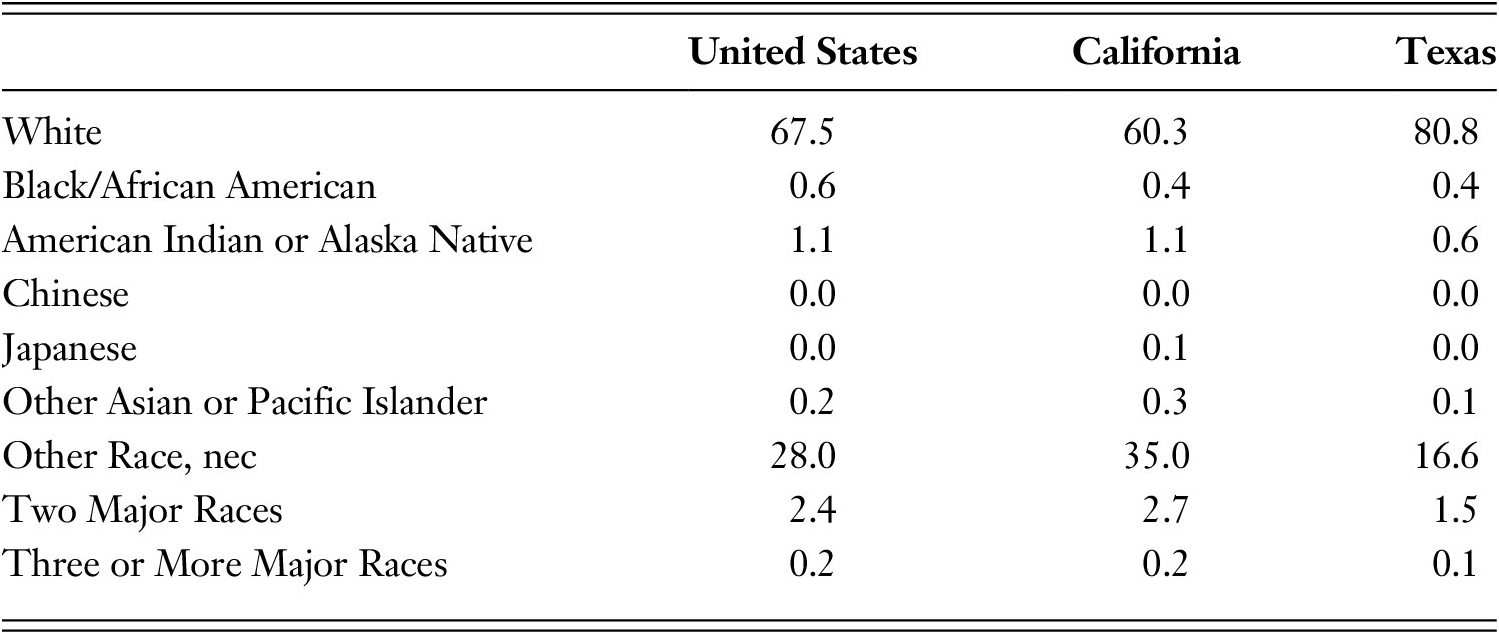
The dependent variable examined here is racial identification, as reported on the ACS. As depicted in Figure 1, ACS respondents are given several racial categories to choose from, may choose multiple races, and may fill in other races. About two-thirds, of the Mexican-origin population in the United States selects “White” on the ACS (see Table 1). This share varies widely, however, when comparing California, where 60% select White, to Texas, where fully 80% of the Mexican-origin population identifies as White. The overwhelming majority of non-White Mexicans select some “other” race. To facilitate interpretation of the results presented below, we dichotomized the race variable such that 1 equals “White” and 0 equals “non-White”.
Distribution (%) of Racial Identification among Mexican-Origin Adults in the United States, California, and Texas, American Community Survey (ACS), 2008-2016

Our third proposition posits that White racial identification will be more closely tied to sociocultural and economic integration among Mexican-origin persons in Texas compared to their peers in California. Stated differently, we expect to find that the likelihood of identifying as White in Texas will increase significantly in tandem with increased sociocultural and economic integration, and conversely, will do so to a lesser degree or not at all in California.
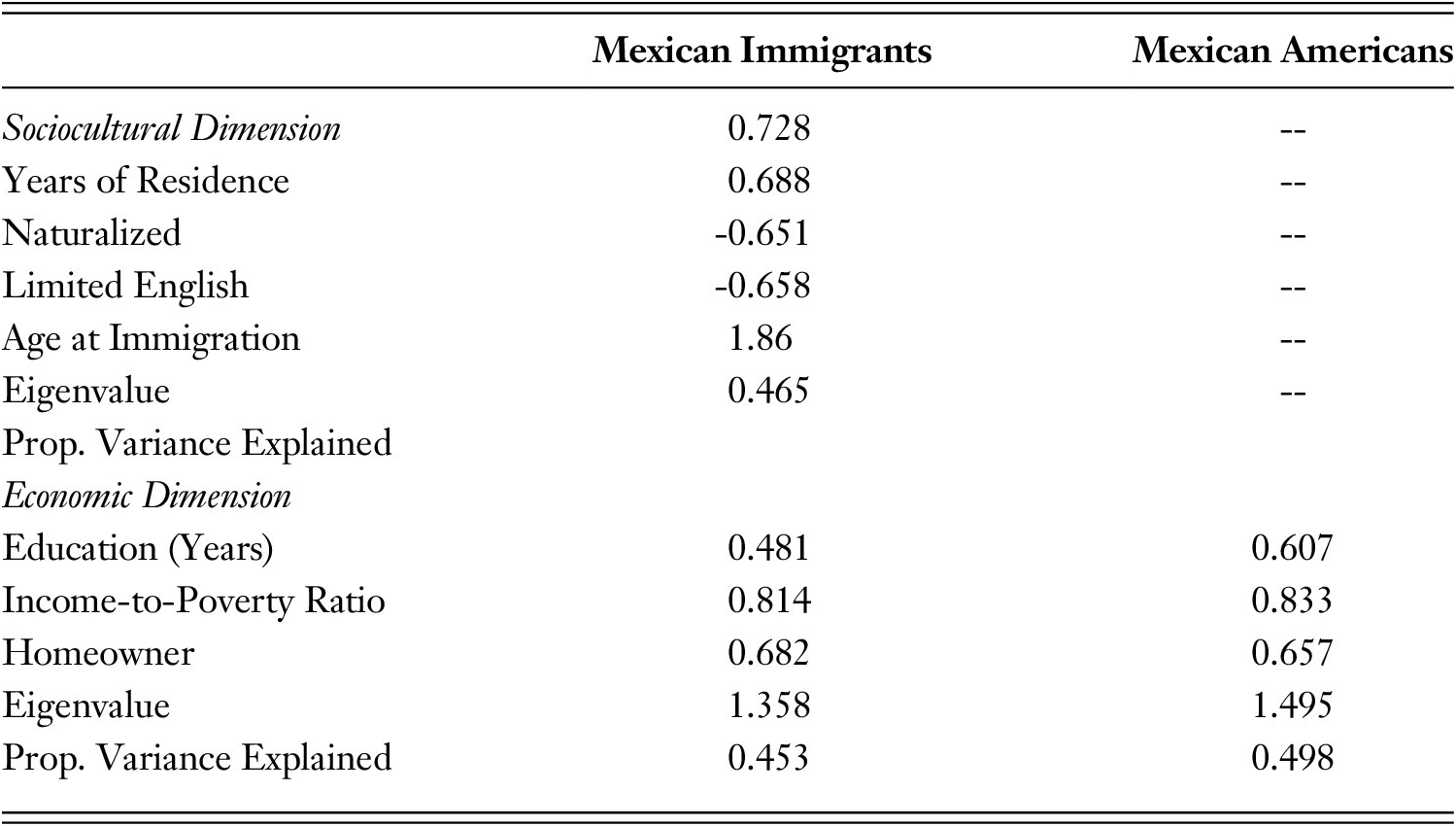
Among immigrants, we employ a multi-dimensional measure of sociocultural integration that includes duration of U.S. residence (in years), age-at-immigration, English language proficiency (0=limited; 1=proficient), and naturalization (0=non-citizen; 1=naturalized citizen). We included these measures in a principal components analysis (PCA) conducted only among immigrants. The main objective behind this is to reduce the four measures to a single-item measure of sociocultural integration. We nevertheless present component loadings and eigenvalues for all PCAs in Appendix Table A1. The appealing aspect of measuring sociocultural integration in this way is that it allows one to easily summarize the overall effect of integration on White racial identification rather than having to interpret and discuss each component item individually. And while interpretations of the measure’s effects are rendered somewhat vague, principal component scores have a desirable statistical property in that they have a mean of zero and a standard deviation of one.
One drawback of the ACS is that it does not provide multiple approximations of sociocultural integration among Mexican-Americans, for whom the items duration of residence, age-at-immigration, and naturalization are rendered meaningless since they are U.S.-born. Thus, rather than employing a corresponding sociocultural integration measure for Mexican-Americans, we simply include, in models for Mexican-American racial identification, a limited-English proficiency variable as our lone adjustment for sociocultural integration.
We also constructed a parallel economic integration measure using PCA as a data reduction technique, including educational attainment (measured in years of schooling), income-to-poverty ratio (measured as a percentage, relative to the federal poverty threshold), and homeownership (homeowner=1). We constructed separate economic integration measures for Mexican immigrants and Mexican-Americans, respectively. We have created these measures in such a way that they can be correlated with one another (i.e., they are not orthogonal).
To the extent that racial identity is linked to ethnic identity and/or ancestry we include controls for both in multivariate models. As discussed above, there are two questions (besides country of birth among immigrants) on the ACS where one might identify as being of Mexican origin; one provides “ethnicity-based” definition whereas the other serves as an “ancestry-based”. Ethnic identity is measured using a series of four dummy-coded variables comparing those who report Mexican, Puerto Rican, Cuban, or Other Hispanic to those who report their ethnicity as non-Hispanic (the reference category). Similarly, ancestry is measured using four dummy-coded variables. The reference (omitted) ancestry is “Mexican”, which is compared to those indicating that they are of “Mexican American”, “Chicano(a)”, “Nuevo Mexicano”, or “Other” ancestry. To be clear, there is considerable overlap between “ethnicity-based” and “ancestry-based” definitions of Mexican-origins. That is, the overwhelming majority of persons who claim Mexican ancestry also claim Mexican ethnicity, and vice versa. The primary objective of including these two indicators in models of racial identification is to account for state-differences in ethnicity or ancestry composition that might account for differences in racial reporting.
Multivariate models of White racial identification also include a series of demographic controls including gender, marital status, and householder status. Householder status is especially important since one household member tends to report information on the ACS on the behalf of multiple household members. Since the Census Bureau does not provide a flag in the micro-data identifying the informant person within the household, and insofar as the householder is most likely to be this person, we distinguish between the householder (coded 1) and all other household members.
Finally, we include technical and contextual controls that may be related to racial identification among Mexican-Americans. Metropolitan residence status distinguishes between those living in non-metro areas, suburban, and center city neighborhoods. We also adjust for response mode. The ACS is administered in multiple ways: including mail, internet, and in-person. To the extent that racial identification responses may vary depending on whether one is answering in the presence of a Census Bureau data collector, it is important to account for this in multivariate models, and we do so by including a dummy-coded variable that compares those who respond by mail or internet (coded 0), to those who respond to a Census Bureau representative (coded 1). And lastly, to account for any secular trends in racial identification among Mexicans, we include survey-year dummies.
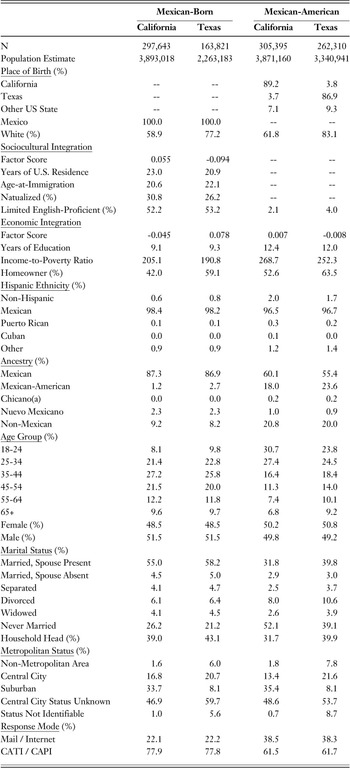
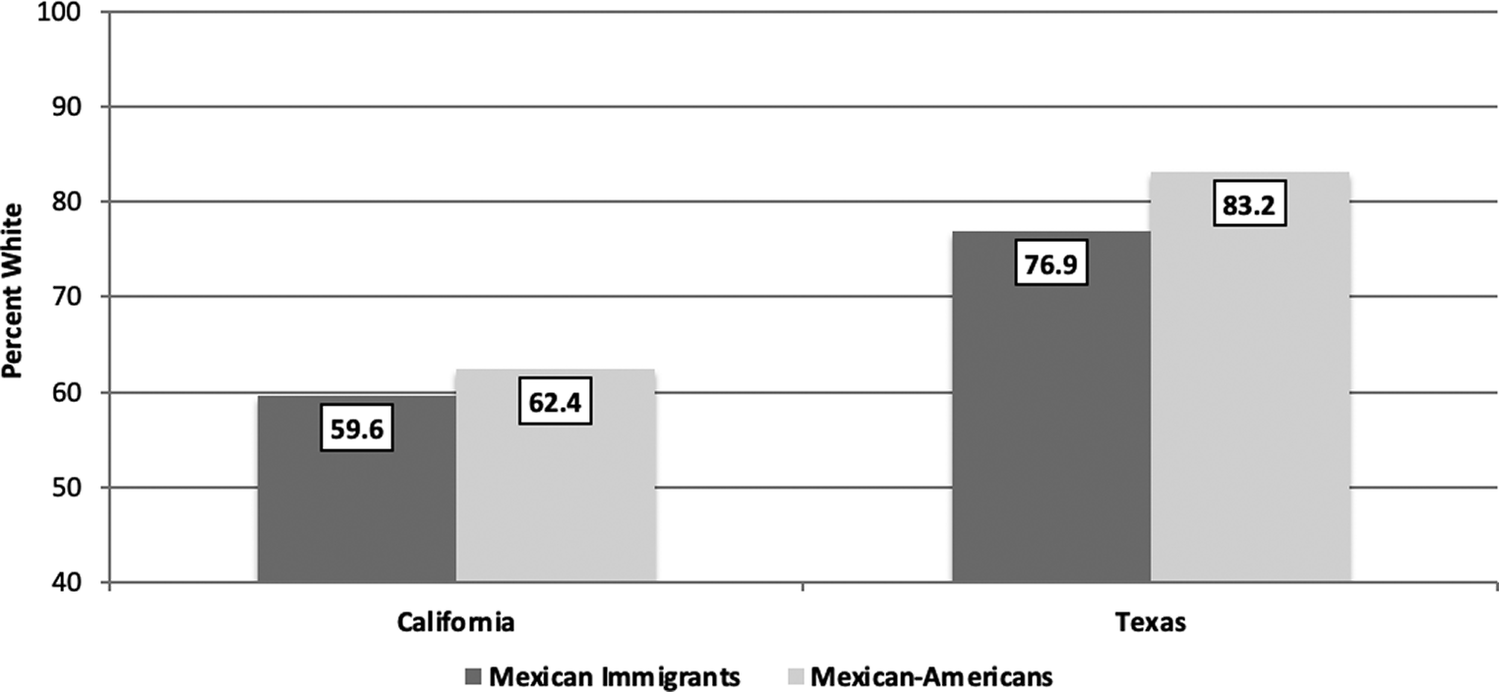
These measures are described, separately for Mexican immigrants and Mexican-Americans in California and Texas, in Table 2. Among Mexican-Americans, 89% of those residing in California were born in that state. Similarly, 87% of Mexican-Americans residing in Texas were born in Texas. Also, and consistent with Proposition 1, Table 2 reveals large differences between Mexicans in California and their peers in Texas, with respect to the likelihood of reporting as White in the ACS. Thus, 59% of Mexican immigrants in California report as White compared to 77% in Texas. Among Mexican-Americans, the gap between the two states is even larger, as 61% of those in California compared to 83% in Texas identify as White. Table 2 also lends support for the second proposition, as in both states Mexicans-Americans are more likely to report White racial identity than their Mexican-born peers.
Means and Percentages of Variables Used in Analyses of White Racial Identification among Mexican-Origin Adults in California and Texas, 2008-2016

Among the covariates that might explain the large difference in racial reporting between California and Texas, few stand out in Table 2 as potential candidates. Among immigrants, Mexicans in California are somewhat more socioculturally integrated by virtue of a higher naturalization rate. Conversely, Mexican immigrants in California are less integrated economically due entirely to higher rates of homeownership among those residing in Texas. The obverse is true among Mexican-Americans as those in California are slightly more economically integrated due to higher education and income-to-poverty ratio, and despite a disadvantage in homeownership.
Not surprisingly, the overwhelming majority of Mexicans report Mexican ethnicity, regardless of state of residence or nativity. Similarly, 87% of Mexican immigrants in both California and Texas report Mexican ancestry. Mexican-Americans in California, however, diverge somewhat from their U.S.-born peers in Texas with respect to ancestry. Mexican-Americans in California are more likely to report “Mexican” ancestry than their Texas-born peers (60% versus 55%) and less likely to report their ancestry as “Mexican-American” (18% versus 23%). There are few discernible differences between Mexican immigrants in California and Texas in terms of demographic characteristics. Among Mexican-Americans, however, those in California are somewhat younger and less likely to have married than their counterparts in Texas.
Analytical Approach
We estimate logit models to test the first proposition that the significant difference between California and Texas in Mexican-origin racial identification, already observed above, holds when adjusting for state-level differences in characteristics. The formal specification of the model is as follows:
 $$ logit{(Wh)}_i=\alpha +{\beta}_1{STATE}_i+{\beta}_2{SCI}_i+{\beta}_3{ECI}_i+{\boldsymbol{\beta}}_{\boldsymbol{k}}{\boldsymbol{X}}_{\boldsymbol{k}} $$
The probability of White racial identification is modeled as a function of state of residence (
 $ {STATE}_i $
), sociocultural integration (
 $ {SCI}_i $
), economic integration (
 $ {ECI}_i $
), and the vector of control variables (
 $ {\boldsymbol{X}}_{\boldsymbol{k}} $
). This model is estimated separately for Mexican immigrants and Mexican-Americans, and among the latter, the sociocultural integration measure is dropped from the model.Footnote
9 The third proposition is tested by interacting each of the integration measures (just the economic integration measure among Mexican-Americans) with the state dummy in order to assess whether the effects of integration vary by state context.
The fourth proposition is tested—only among Mexican-Americans—by replacing the state of residence dummy with a series of dummy-coded indicators that combine state of residence and state of birth (displayed above in Table 2) as follows: 1) California resident born in California (the reference category); 2) California resident born outside of California in a state other than Texas; 3) California resident born in Texas; 4) Texas resident born in California; 5) Texas resident born outside of Texas in a state other than California; and 6) Texas resident born in Texas. To the extent that state-level mechanisms shape racial identification in the manner theorized above, one would expect to find that the probability of White racial identification will be the lowest in the first category (California resident born in California) and increase with each successive category such that Texas-born residents of Texas will have the highest probability of identifying as White.
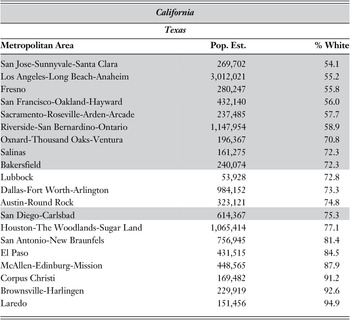
The analysis testing the fifth proposition moves away from the model above and relies on a simple comparison of rates of White racial identification within the ten largest concentrations of Mexican settlement within each state. If state-specific mechanisms are at play in shaping respondents’ racial identification on the ACS, one would expect to find little state overlap among these residential centers. If, instead, we find that all major concentrations of Mexicans in California cluster at the lower end of the percentage White distribution and all major centers in Texas are concentrated at the higher end of the distribution, this pattern would be consistent with the notion that state-specific mechanisms, rather than local ones, play a major role in influencing Mexicans’ racial identification on the ACS.
RESULTS
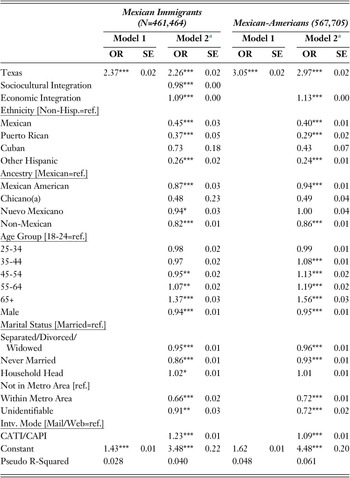
We begin our discussion of our multivariate findings in Table 3, where we test the first and second propositions that state, respectively, that Mexicans in Texas will be more likely to identify as White than their peers in California (P1), and that this state difference will be larger among Mexican-Americans than among Mexican immigrants (P2). Table 3 presents odds ratios from logistic regression models predicting White racial identification among Mexican immigrants and Mexican-Americans, separately. The first model for each nativity group tests the zero-order difference in White racial identification between Californians and Texans. The coefficient for the Texas dummy variable confirms that the wide difference between the two states, shown in previous descriptive results, are highly statistically significant. Among Mexican immigrants, those in Texas are 2.4 times more likely to identify as White compared to those in California and among U.S.-born Mexicans, this state difference in odds increases to 3.1. State differences in individual covariates account for virtually none of the difference in White racial reporting as the odds-ratios are largely unaffected by the introduction of the covariates in Model 2. The covariates do, however, contribute to the predictive power of the models, as measured using the pseudo R-squared statistic, which increases by about 43% (from 0.028 to 0.040) among Mexican immigrants and by 27% (from 0.048 to 0.061) among Mexican-Americans.
Odds Ratios from Models of White Racial Identification among Mexicans in California and Texas

*** p < .001; ** p < .01; * p < .05
a Models include Survey-Year dummies
To facilitate interpretation of the results in Table 3, we graphed predicted probabilities of White racial identification, based on Model 2, separately for Mexican immigrants and Mexican-Americans, and for California and Texas, respectively, in Figure 2. The graph illustrates support for both propositions 1 and 2. Regardless of nativity, there are wide differences in the likelihood of identifying as White in the ACS between persons of Mexican origin in California and their peers in Texas. Among Mexican immigrants, the predicted probability of White racial identification is about 60% in California, compared to 77% among their statistically similar peers in Texas. Corroborating previous research (Dowling 2004; Rodriguez Reference Rodriguez2000; Tafoya Reference Tafoya2005), Mexican-Americans in both states are more likely to identify as White. But importantly, the gap between those in California and those in Texas widens relative to the difference observed among immigrants. About 62% of U.S.-born Mexican-origin adults in California identify as White, compared to 83% of their statistical peers in Texas.
Predicted Probability of White Racial Identifcation among Mexicans in California and Texas, by Nativity, 2008–2016

Returning to Table 3, and while of secondary importance relative to our propositions, the effects of the covariates themselves are worth noting and may be of interest toward future research. First, among Mexican immigrants (recall that we did not measure sociocultural integration among the U.S.-born), sociocultural integration is negatively associated with the likelihood of identifying as White, a statistically significant, if modest, effect. A standard deviation increase in the sociocultural integration factor score is associated with two percent lower odds of identifying as White on the ACS. Conversely, economic integration is positively associated with White racial identification and the magnitude of this association is similar among immigrants and the U.S.-born. Thus, with each standard deviation increase in economic integration, the odds of White racial identification increase by 9% among Mexican immigrants and by 13% among Mexican-Americans.
Not surprisingly, and among both immigrants and the U.S.-born, individuals who do not identify as having a Hispanic/Latino ethnicity are far more likely to racially identify as White than those who identify as being of Mexican (or other Latino/Hispanic) ethnicity. And interestingly, persons claiming an ancestry of “Mexican” on the ancestry question are more likely to identify as White than those claiming some other Mexican-origin ancestry (e.g., “Mexican-American”, “Chicano”, etc.) or a non-Mexican-origin ancestry.
Demographically, older cohorts are more likely to identify as White than younger ones and this age cohort effect varies considerably between Mexican-Americans and immigrants. Among immigrants, persons aged fifty-five and above are significantly more likely than the youngest cohort (18–24) to identify as White. Among Mexican-Americans, the age cohort difference emerges much earlier, as 35–44-year-olds are 8% more likely to identify as White compared to the reference cohort, and the relative odds increase to 13%, 19%, and 56% among the 45–54, 55–64, and 65+ cohorts, respectively. Of course, it is unclear whether this pattern results from an increased tendency to identify as White as individuals age, or whether it is a true cohort effect. With respect to sex, men are only about 95% as likely as women to identify as White. Married persons are more likely than those who are not married to identify as White, and household heads are more likely to identify as White than other types of household residents.
Finally, metropolitan context and survey context also serve as significant determinants of White racial identification. Individuals residing within metropolitan areas are substantially less likely to identify as White relative to those living outside of metro areas. Among immigrants, metropolitan residents are only about 66% as likely to identify as White, while Mexican-Americans in metro areas are only 72% as likely to identify as White as their non-metro peers. And those responding in the presence of a census interviewer (either in person or via phone) are significantly more likely to identify as White compared to those completing the ACS via the mail or the internet. Specifically, among Mexican immigrants, CATI/CAPI respondents have 23% higher odds of White racial identification than those completing the ACS questionnaire themselves. Among Mexican-Americans, the difference in odds by survey response mode is smaller at 9%, but still statistically significant.
The third proposition follows closely from the second and accentuates previous research where more exposure to U.S. racial stratification leads Latinas/os to select non-White racial identities (Golash-Boza and Darity, Reference Golash-Boza and Darity2008; Michael and Timberlake, Reference Michael, Timberlake and Gallagher2008). Proposition 3 maintains that if the racial context of Texas places a relatively high premium on Whiteness, this context should operate most strongly on those Mexican-Americans who were exposed at an early age and for a longer duration of time. The same logic holds for those in California where Mexicans are far less likely to report White racial identity. By this logic, our third proposition posits that the largest gap in White racial reporting should be observed between Mexican-Americans who are California-born residents of California, on the one hand, and their Texas-born Mexican-American peers residing in Texas on the other. Conversely, the smallest gap should be that between Mexican-Americans exposed to both racial contexts over the course of their lives, namely Texas-born residents of California and California-born residents of Texas.
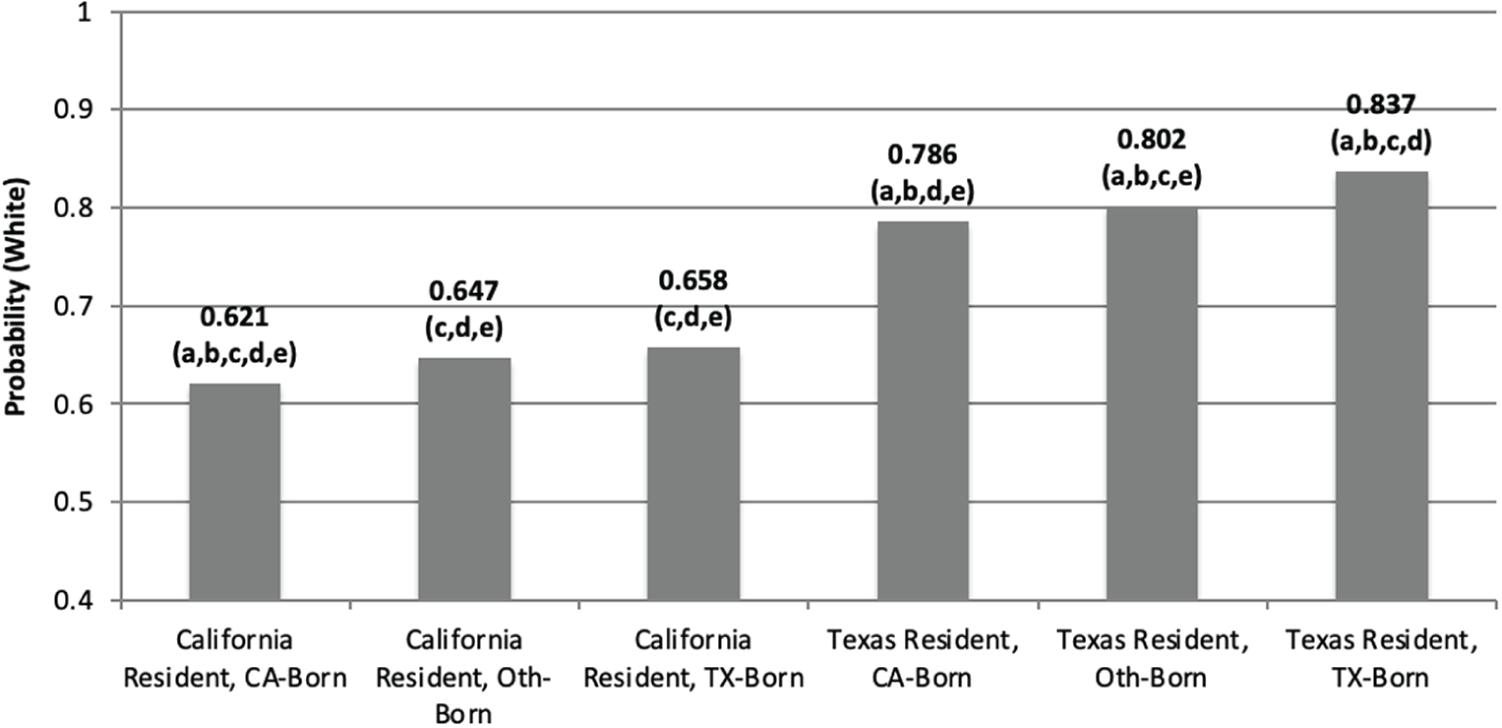
We test this proposition by substituting for the state dummy in equation 1 a six-category state-of-birth/state-of-residence set of dummy variables as defined above. From this model (logit coefficients not presented but available upon request), we derived predicted probabilities of White racial identification for each category, as presented in Figure 3. The pattern depicted is entirely consistent with the logic motivating P3. Mexican-American residents of California born in California are the least likely of the six groups to report as White on the ACS (62%). Mexican-American residents of California who were the most likely to report as White were those born in Texas (66%). Conversely, Mexican-Americans residing in Texas who were also born in that state have the highest predicted probability of reporting as White (84%). Those born in California were the least likely Texas residents to report as White in the ACS (79%). Thus, consistent with the third proposition, the largest difference between Mexican-Americans in California and those in Texas is between those born in their respective states, whom we assume to be the individuals with the most prolonged exposure to state racial contexts. Also consistent with P3 is the fact that the smallest difference between Mexican-Americans in California and Texas exists between those born in the opposite state from the one in which they reside.
Predicted Probability of White Racial Identification among U.S.-Born Mexican-Origin Adults, by State of Residence and State of Birth, 2008–2016.
Notes: a. Significantly different from CA-Res, Oth-Born at p < 0.01.
b. Significantly different from CA-Res, TX-Born at p < 0.01.
c. Significantly different from TX-Res, CA-Born at p < 0.01.
d. Significantly different from TX-Res, Oth-Born at p < 0.01.
e. Significantly different from TX-Res, TX-Born at p < 0.01

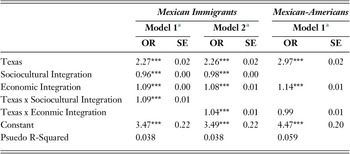
Results presented in Table 4 serve as a test of our fourth proposition positing that the effects of measures of integration on racial identification should vary by state context. Table 4 reports odds ratios from logistic regression models predicting White racial identification, all of which add interaction models to Model 2 from Table 3. In Table 4, we test two interaction models, one for sociocultural integration and one for economic integration (Models 1 and 2) among Mexican immigrants, and one interaction model for economic integration (Model 1) among Mexican-Americans. The results in Table 4 lend partial support to Proposition 4. Specifically, the significant interaction terms for sociocultural integration and economic integration among Mexican immigrants suggest that the effects of these two dimensions of integration on racial identification vary by state. Inconsistent with P4 is the fact that there is no significant state variation in the effect of economic integration on the likelihood of White racial identification among Mexican-Americans.
Odds Ratios from Interaction Models Predicting White Racial Identification among Mexicans in California and Texas

*** p < .001; ** p < .01; * p < .05
a Models include the full set of control variables described in Table 2
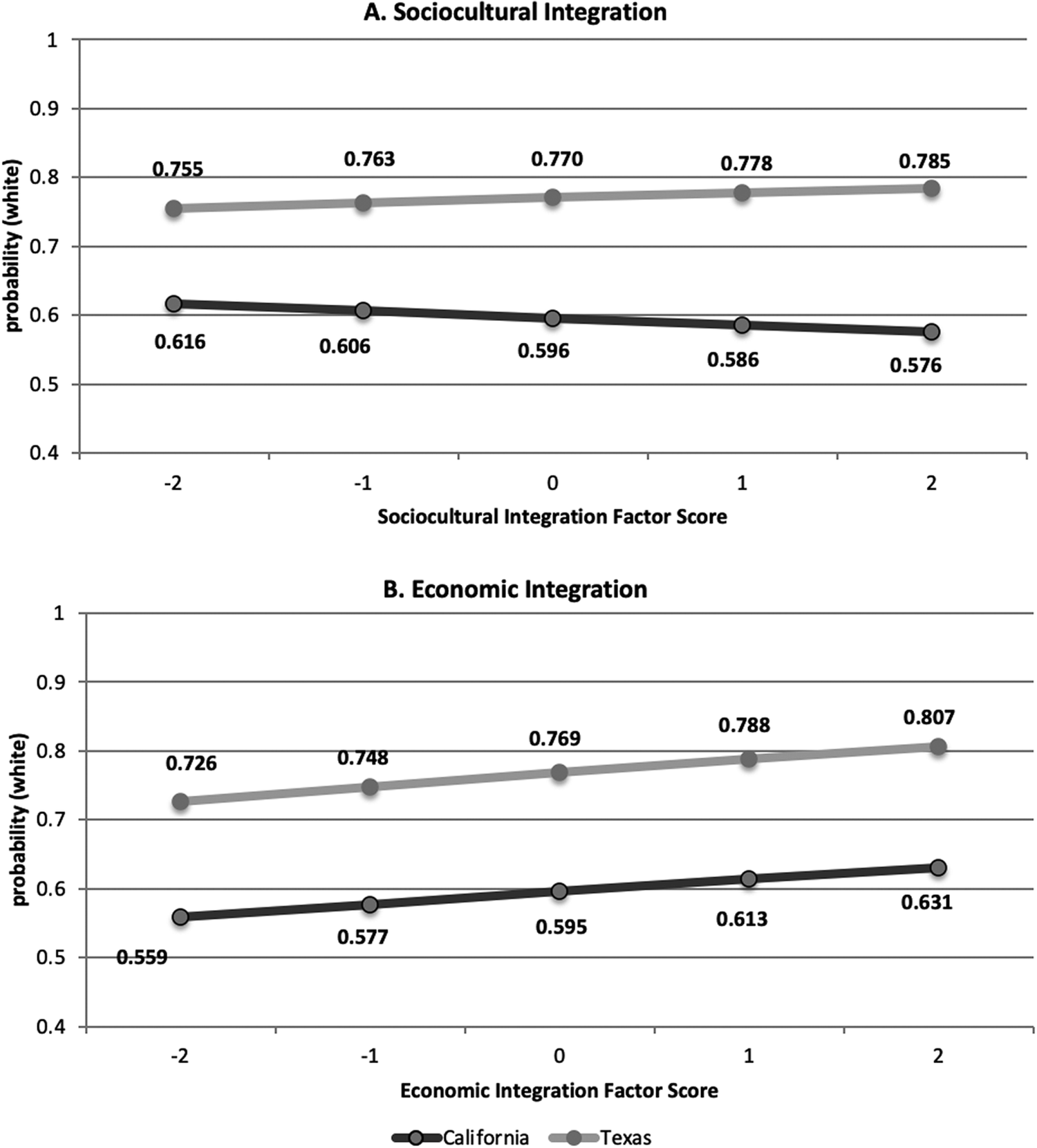
To facilitate interpretation of the results from Table 4, we have graphed the predicted probabilities from the two models for Mexican immigrants where the state-by-integration interaction was statistically significant in Figure 4. Panel A reflects the state variation in the association between socioeconomic integration and White racial identification. Socioeconomic integration operates in opposite directions in California and Texas and the state-gap in the predicted probability of White racial identification widens as immigrants become more socioculturally integrated. Thus, among the least integrated—those with a factor score two deviations below the mean—75.5% of immigrants in Texas identify as White compared to 61.6% of those in California, a percentage point difference of 13.9. This difference widens to 17.4 percentage points among those with average levels of sociocultural integration (factor score = 0), as 77% of Texas immigrants identify as White compared to just 59.6% of those in California. And the widest percentage point gap, 20.9, is found among those who are the most socioculturally integrated (factor score = 2) where in Texas, 78.5% identify as White compared to just 57.6% of the immigrants in California.
Probaility of White Racial Identification among Mexican Immigrants in California and Texas at Varying Levels of Sociocultural (A) and Economic (B) Integration

Turning to Panel B, we can see that despite the significance of the state-by-economic integration coefficient in Table 4, the magnitude of the interaction effect is quite small. In contrast to sociocultural integration, the effects of economic integration on White racial identification operate in the same direction in both California and Texas and are just slightly weaker among immigrants in the latter. Thus, the state percentage-point difference in White racial identification among the least economically integrated immigrants (factor score = -2) is 16.7 (72.6% of Texas immigrants identify as White compared to 55.9% of those in California). This state percentage-point difference increases slightly to 17.4% among immigrants of average economic integration (factor score = 0) and again to 17.6 percentage-points among the most economically integrated (factor score = 2).
We turn now to an examination of our fifth proposition which holds that when focusing on smaller geographic aggregations within California and Texas, if state context is the predominant factor shaping racial identity among Mexican-origin persons, we should find that all local geographies in California have a lower aggregate probability of White racial identification than the local geographies in Texas.
This proposition is tested in Table 5 where we present the percentage of Mexican-origin adults (immigrants and U.S.-born combined) for the ten metropolitan areas in each state with the largest Mexican-origin populations. The general pattern presented in Table 5 is consistent with the fifth proposition as nine of the ten metro areas with the smallest percentages of those identifying as White are in California. The one exception is San Diego, thirteenth on the list, where three-quarters of the 614,000 Mexican-origin residents identify as White, which is a percentage that is higher than three Texas metros. Across the twenty metropolitan areas listed in Table 5, the range of percentage identifying as White is quite staggering; 54% of the Mexican-origin population in San Jose reports their race as White compared to 95% of their Mexican-origin peers in Laredo.
Percentage of Mexican-Origin Adults Identifying as White on the American Community Survey, 10 Metropolitan Areas with the Largest Mexican-Origin Populations in California and Texas, 2008-2016

DISCUSSION AND CONCLUSIONS
The findings reported here are overwhelmingly consistent with the motivating theory that the distinctive ethno-racial context in Texas, vis-à-vis California, has given rise to state-specific processes of racial identity formation among Mexican-origin persons. Evidence of these contextual effects, we argue, can be observed in Texas-California differences in how Mexican-origin respondents identify themselves racially in federal surveys. We examined five propositions derived from the fundamental notion that the historical evolution of the political-economy of race in Texas has engendered a present-day context in which, relative to California, “Whiteness” carries an especially high social premium.
First, we find that Mexican-origin individuals in Texas are significantly more likely than their California peers to report their race as “White” in the American Community Survey (ACS). This difference is large in magnitude and cannot be explained by differences in characteristics between the respective Mexican-origin populations in the two states. Second, this state difference in White racial identification is larger among U.S.-born Mexicans, consistent with the notion that greater exposure to and socialization within these distinctive contexts yields more pronounced contextual effects. These outcomes can be attributed to Mexican Americans in Texas claiming White racial identification in order to take advantage of the rights and privileges of being American, to combat racial discrimination, and to distance themselves from Mexican immigrants they perceive to be at fault for reinforcing stereotypes of all Mexicans as poor (Dowling Reference Dowling2014; Foley Reference Foley1997).
Third, following the logic from the second finding, we find that the largest difference among U.S.-born Mexicans is among those born and raised in their respective states (i.e., the two groups identifiable in the ACS who are the most likely never to have moved out of California and Texas and thus experienced the most sustained exposure to their state racial contexts). In Texas, the racial context specifically includes asserting Whiteness to avoid the stigma of being Mexican (Dowling, Reference Dowling2014; Foley Reference Foley2010). Fourth, consistent with the idea of a greater social premium attached to Whiteness in Texas, the likelihood of White racial identification among Mexican immigrants in Texas increases with increased sociocultural integration whereas sociocultural integration in California is unrelated to the likelihood of identifying oneself as White. Such findings follow more recent research suggesting that dimensions of integration (e.g., sociocultural, economic, racial identity, etc.) are more strongly correlated with one another in more “restrictionist” locations and more independent of one another in more “multiculturalist” locations (Bean et al., Reference Bean, Brown, Bachmeier, Fokkema and Lessard-Phillips2012; Bean et al., Reference Bean, Brown and Bachmeier2015; Bloemraad and Sheares, Reference Bloemraad and Sheares2017). However, contrary to our expectations—and the only point in our analysis in which the data are inconsistent with our propositions—we find no evidence that the same state-level variation exists with respect to the association between economic integration and White racial identification.
Fifth, we find that these state-level differences cannot be explained by local level factors that may differ between the two states, such as the share of population that lives in proximity to the border or in large metropolitan areas. Similar to Dowling’s (Reference Dowling2014) analysis of 2010 Census data, where over 80% of Latinas/os in Texas’ border counties identify as White, at least 85% of the Mexican-origin population in Texas’ largest metropolitan areas on the border identify as White. However, to reiterate, the higher prevalence of White racial identification among Texas’ Mexican-origin population over their Californian peers is not attributable to border dynamics. Instead, as we have argued throughout this paper, we attribute such differences to state-level historical mechanisms. Table 5, which presents the percentage of Mexican-origin adults (immigrants and U.S.-born combined) for the ten metropolitan areas in each state with the largest Mexican-origin populations, supports our claim in that nine of the ten metro areas with the smallest percentages of those identifying as White are in California.
Our analyses and the conclusions we draw from them are, of course, not without limitations (also see note 1). The most notable is that, given the nature of ACS data, we are unable to conclude that these state-level differences in racial identification do not derive from factors originating in Mexico, rather than the racial contexts of California and Texas. Thus, it is possible that the differences observed are explained by a spurious, unobserved factor, such as skin color. If Mexican immigrants to Texas have historically had objectively darker skin than Mexican immigrants in California, the results reported here may simply derive from that fact. While we know of no data that could be brought to bear on this alternative possibility, we nevertheless find it unlikely, given what we know about the historical evolution of Mexican immigration to the Southwestern United States. During the first half of the twentieth century, Texas was the dominant destination for Mexican immigrants who originated overwhelmingly in what Douglas S. Massey and colleagues (Reference Massey, Rugh and Pren2010) refer to as historical sending states located in Central and Western Mexico (Massey et al., Reference Massey, Alarcon, Durand and Gonzalez1987). As California became the predominant destination beginning in the 1960s and 1970s, the dominant source region of Mexico did not change as the overwhelming share of Mexican immigrants to California—including many who made onward moves from Texas—originated in the historical region.
These findings also carry many important implications for future research and theoretical considerations regarding Latina/o racial identification and this country’s shifting racial landscape. Mainly, they call into question the utility of national-level statistics on the racial identification of Mexican-origin individuals, and perhaps other individuals, in the United States. That a Mexican-origin person identifies himself/herself as “White” may say more about the racial context in which they reside than it does about their degree of integration into the American mainstream.
While this investigation emphasized the influence of state-level historical mechanisms on White racial identification, it appears that an even more localized analysis is warranted for future consideration. Table 5 presents the ten metropolitan areas with the largest Mexican-origin populations in California and Texas. Although the percentage of the Mexican-origin population identifying as White in all ten metros in Texas is higher than all but one metro in California, the range of percentage White varies significantly within each state. While we echo Dowling’s (Reference Dowling2014) call for analysis of multiple locations within a state, we contend that state-level analyses are still useful for highlighting important theoretical factors in the study of racial identification. Given that 77% of Mexican immigrants and 83% of Mexican-Americans identified as racially White in Texas, analyses of the difference in White racial identification between these two groups in border areas is also warranted. Such analyses could also be used to test Dowling’s (Reference Dowling2014) seminal research across time.
Further, while theoretical debates regarding Latina/o’s racial identification patterns focus on potential changes to the “color line”, such debates do not consider the state variation and historical context behind different Latina/o subgroups’ patterns of integration and racial identification. Despite their merits, research positing a Black/non-Black divide (Alba and Nee, Reference Alba and Nee2003; Gans Reference Gans and Lamont1999; Lee and Bean, Reference Lee and Bean2007), White/non-White divide (Portes and Rumbaut, 2001; Telles and Ortiz, Reference Telles and Ortiz2008), and/or a Latin America-like racial hierarchy (Bonilla-Silva Reference Bonilla-Silva2013) assume a unitary national hierarchy. Given the state racial histories and the analyses of White racial identification among Mexican-origin persons detailed above, it appears that racial hierarchy may also differ by location.
Since we continue to live in an anti-Black society, one particularly fruitful direction for immigration and race researchers to consider is examining the factors that influence Latinas/os to disassociate from Whiteness. Moreover, besides California, where do Mexicans and other Latina/o groups tend to identify as some other race in higher percentages than the national average? Such inquiries are crucial considering the recent increase in the openness of anti-Latina/o and anti-immigrant hostility throughout this country. Context will become only more imperative to consider in this type of scholarship given that Latinas/os will comprise an even larger percentage of the U.S. population, and as the U.S. population is predicted to become majority-minority soon. Above all, it will be crucial to complement quantitative inquiries with qualitative case studies that can further our understanding of racial identity formations in specific locations (Pastor and Pulido, Reference Pastor and Pulido2013).
APPENDIX
Factor Loadings from Principal Components Analyses of Indicators of Sociocultural and Economic Integration among Mexican Immigrants and Mexican Americans in California and Texas, 2008–2016