INTRODUCTION
Motor learning is one of the most fundamental process in everyday life, in which sustained practice of a movement leads to performance improvements of several relevant aspects such as accuracy and velocity. In a review, Halsband and Lange (Reference Halsband and Lange2006) described the neuronal structures involved in motor learning in detail. While tertiary motor areas include the prefrontal cortex, the cingulate cortex, and pre-supplementary motor area, the secondary motor areas consist of the supplementary motor area proper, the premotor cortex, the inferior frontal cortex, the inferior and superior–posterior parietal cortex, as well as the cerebellum. Finally the primary motor areas include the primary motor cortex (M1) and the basal ganglia (Halsband & Lange, Reference Halsband and Lange2006).
At a first glance, at least two substantially different types of motor learning can be distinguished and are implemented in partly overlapping, but nevertheless distinct, neuronal networks. While motor sequence learning (to learn a new sequence of movements, like on a piano) is represented in a cortico-basal ganglia-thalamo-cortical loop, motor adaptation (learn to adapt to environmental perturbations) relies mostly on a cortico-cerebello-thalamo-cortical loop (Doyon, Penhune, & Ungerleider, Reference Doyon, Penhune and Ungerleider2003). In addition, motor learning can be divided into distinct stages: an early, fast learning stage, followed by consolidation; a second, slow learning stage, followed by automatization; and finally, after some delay, the retention. Except within the first learning stage, the cortical regions involved are almost identical including primary motor and parietal areas. At the first stage, however, for sequence learning, M1 and the striatum are more relevant, while motor adaptation is to a greater extent based on the parietal cortex and the cerebellum (Penhune & Steele, Reference Penhune and Steele2012).
Jeuptner and Weiller (Reference Jeuptner and Weiller1998) described several different learning processes and the related brain structures in detail. They analyzed motor sequence learning, decision making and selection of movements, repetitive finger movements, overlearned motor tasks, visuo-motor co-ordination, and several additional motor learning processes. However, with respect to our study they also described the learning of fine grained movements as re-tracing a line and reported that the cerebellum but not the basal ganglia are involved.
One technique to investigate and to modulate the functionality of motor learning related areas is the transcranial direct current stimulation (tDCS). This is a non-invasive technique that allows the modulation of brain processes (Antal & Paulus, Reference Antal and Paulus2008; Nitsche & Paulus, Reference Nitsche and Paulus2000, Reference Nitsche and Paulus2001) by the application of small amounts of direct electrical current to the scalp. As a result, the activity of the neuronal tissue between anode and cathode can be altered. Depending on the specific setup of the stimulation, this induced modulation of the respective neural membrane thresholds can lead to in- or decreased signal processing efficiency (Bolognini, Pascual-Leone, & Fregni, Reference Bolognini, Pascual-Leone and Fregni2009; Liebetanz, Reference Liebetanz2002; Priori, Reference Priori2003). Even more, it has been demonstrated that anodal tDCS (atDCS) coupled with motor training (Reis & Fritsch, Reference Reis and Fritsch2011; Stagg et al., Reference Stagg, Jayaram, Pastor, Kincses, Matthews and Johansen-Berg2011) can enhance the response properties of different neuronal networks involved in motor learning.
Until recently in most studies tDCS has been applied using two large sponge electrodes (approximately 35 cm2) located on distant brain areas. However, meanwhile high definition (HD-tDCS) stimulation with smaller electrodes and multiple return positions can be used (Ruffini, Fox, Ripolles, Miranda, & Pascual-Leone, Reference Ruffini, Fox, Ripolles, Miranda and Pascual-Leone2014). For example Dmochowski, Datta, Bikson, Su, and Parra (Reference Dmochowski, Datta, Bikson, Su and Parra2011) reported that the use of small 1.2 cm diameter electrodes as compared to large (distant) pad electrodes increases focality of up to 80%. Thus, this approach allows a more focal stimulation of a targeted brain area, a methodological advantage that has recently been emphasized again by Herrmann, Rach, Neuling, and Strüber (Reference Herrmann, Rach, Neuling and Strüber2013). As outlined, standard tDCS used large electrodes at distant areas (as from parietal to prefrontal) and, thus, induced a current flow over long distances within the brain with, to some extent, unknown effects. The local stimulation approach, however, allows narrowing the area of anodal stimulation. Whether this emerging new method will lead to different and more elaborate results as compared to conventional stimulation is an open question.
As primary motor cortical areas are critically involved in motor behavior, it is self-evident that these regions are of interest for the investigation of motor learning. Several TMS-studies evaluating the size of motor evoked potentials have demonstrated that tDCS applied to the respective motor areas modulates excitability in a polarity-specific way. While in most cases, but depending on the strength of the current and stimulation duration, atDCS facilitates motor responses (Antal, Polania, Schmidt-Samoa, Dechent, & Paulus, Reference Antal, Polania, Schmidt-Samoa, Dechent and Paulus2011; Paulus, Reference Paulus2011), cathodal stimulation can reduce it (Nitsche et al., Reference Nitsche, Seeber, Frommann, Klein, Rochford, Nitsche and Tergau2005).
Furthermore, it has frequently been reported that atDCS at motor areas facilitates skill acquisition (Antal, Varga, Kincses, Nitsche, & Paulus, Reference Antal, Varga, Kincses, Nitsche and Paulus2004; Reis et al., Reference Reis, Schambra, Cohen, Buch, Fritsch, Zarahn and Krakauer2009; Vollmann et al., Reference Vollmann, Conde, Sewerin, Taubert, Sehm, Witte and Ragert2013). Positive effects have been found for different types of motor tasks. For example, in motor sequence learning Vines (Vines, Nair, & Schlaug, Reference Vines, Nair and Schlaug2006) and Nitsche et al. (Reference Nitsche, Schauenburg, Lang, Liebetanz, Exner, Paulus and Tergau2003) reported increased performance in serial reaction time tasks. However, Stagg et al. (Reference Stagg, Jayaram, Pastor, Kincses, Matthews and Johansen-Berg2011) outlined the importance of the timing of the stimulation procedure. While anodal stimulation during the learning phase led to increases in performance, the same stimulation preceding the performance led to slower learning. Similar for motor adaptation different results have been reported regarding the respective learning stage. While Antal and colleagues (Antal, Nitsche, Kincses, et al., Reference Antal, Nitsche, Kincses, Kruse, Hoffmann and Paulus2004) described increases already during the early learning phase, Galea reported this only for a later retention interval (Galea, Vazquez, Pasricha, Xivry, & Celnik, Reference Galea, Vazquez, Pasricha, de Xivry and Celnik2011).
In addition to the M1, other brain areas such as the cerebellum are substantially involved in motor performance. Although the cerebellum is important in several processes besides those related to motor control (Stoodley & Schmahmann, Reference Stoodley and Schmahmann2009), research has substantially focused on its fundamental involvement in motor execution and motor learning processes. As reported by Grimaldi (2014), it has been demonstrated that the electrical field of cerebellar atDCS can reach the cerebellum and modulate its neural activity (Grimaldi et al., Reference Grimaldi, Argyropoulos, Boehringer, Celnik, Edwards, Ferrucci and Ziemann2014).
These results are supported by the findings of Parazzini et al. (Reference Parazzini, Rossi, Ferrucci, Liorni, Priori and Ravazzani2014) who used a realistic human head model for computing the electric field and current density for cerebellar tDCS. Using atDCS, it was demonstrated that cerebellar but not motor stimulation speeds up motor adaptation (Galea et al., Reference Galea, Vazquez, Pasricha, de Xivry and Celnik2011). In addition, it has been reported that the motor performance increase is due rather to online than to offline learning and is based on a reduction in errors and not on an increase in speed (Cantarero et al., Reference Cantarero, Spampinato, Reis, Ajagbe, Thompson, Kulkarni and Celnik2015). Similarly, Jayaram et al. (Reference Jayaram, Tang, Pallegadda, Vasudevan, Celnik and Bastian2012) reported that anodal cerebellar tDCS increased the spatial but not the temporal adaptation processes. However, for cerebellar tDCS, it has to be kept in mind that, with respect to the motor domain, the cerebellum is involved to a larger extent in ipsilateral movements (as compared to the M1 which is activated contralateral).
Furthermore, fundamentally involved in motor adaptation is the parietal cortex (Doyon et al., Reference Doyon, Penhune and Ungerleider2003), which is known to be functionally related to spatial attention and sensomotoric integration (Gottlieb & Snyder, Reference Gottlieb and Snyder2010). While in older studies (Mesulam, Reference Mesulam1981), spatial attention is described as a function mainly of the right parietal cortex, recent reports draw a more detailed picture. It has been outlined (Bolognini, Fregni, Casati, Olgiati, & Vallar, Reference Bolognini, Fregni, Casati, Olgiati and Vallar2010) that visual search processes are based to a large extent on a neuronal network comprising the posterior parietal cortex.
Even more, they report that right parietal atDCS coupled with a visual search training can enhance the response properties of this network. Participants receiving atDCS showed positive effects for visual exploration and visuospatial orienting for right hemispheric stimulation only. Attempting to inhibit neuronal processing, Vicario and colleagues (Vicario, Martino, & Koch, Reference Vicario, Martino and Koch2013) used cathodal stimulation and found reduced temporal accuracy after right hemispheric stimulation. Thus, right parietal atDCS might significantly influence the performance in a visuomotor task like mirror drawing by modulating processing speed or accuracy.
The present study focusses on the changes in performance in a mirror drawing task; a task that involves exact motor performance as well as visuospatial integration. We investigate the effects of atDCS at cerebellar, right parietal and left M1 location and included a sham stimulation as control. Based on the functional importance of the cerebellum for learning of fine grained movements, we hypothesized that both anodal cerebellar and M1 stimulation will increase performance and accuracy in a mirror guided line re-tracing task. Effects of parietal stimulation with respect to performance have not been reported so far; however, the fundamental involvement of the right parietal cortex in visuospatial processing leads to the assumption that a stimulation of these area might facilitate those learning processes as well.
METHODS
Subjects
We conducted a single-session double-blind study with 90 healthy, right-handed volunteers without neurological disorders. Seven of the participants had to be excluded because they were not able to draw the picture as fast as requested (within 90 s). The remaining 83 participants (39 female) (age M=24.17 years; SD=2.19) were pseudo-randomly assigned to one of four groups receiving different stimulations at either cerebellar (CER; n=21), right parietal (PAR; n=17) or primary left motor cortex (M1; n=13) areas, as well as one control group (SHAM; n=32).Footnote 1 The double-blind design was implemented by a “double-blind mode” in the stimulation software (NIC, Neuroelectrics, Barcelona, Spain).
Before stimulation, all subjects signed an informed consent and were informed about all relevant issues of this experiment according to the Declaration of Helsinki. Ethical approval was obtained from the Deutsche Gesellschaft für Psychologie (DGPs). Furthermore, all participants were verbally screened for neurological problems, or any severe medical condition, as well as about drug intake, as described in the safety criteria for non-invasive brain stimulation (Keel, Smith, & Wassermann, Reference Keel, Smith and Wassermann2000; Rossi, Hallett, Rossini, & Pascual-Leone, Reference Rossi, Hallett, Rossini and Pascual-Leone2009). Dominant right-handedness was tested using the shortened handedness inventory with 10 items (Oldfield, Reference Oldfield1971). After the experimental session, all participants were asked to report any side-effects, but none have been reported.
Visuo-motor Tasks
Participants were seated at a table approximately 60 cm in front of a mirror sized 35×33.5 cm. A wooden board was placed between the mirror and the subject in a way that only the mirror but not the table was visible. In the task, geometrical figures printed on a white paper were placed on the table between the mirror and the board and, thus, visible only via the mirror. Participants were requested to trace the lines with a pencil held in the right hand as quickly and accurately as possible without raising the pencil from the paper. The participant could see his/her hand only via the mirror. All drawings in this experiment had to be completed with the mirror feedback only.
Besides the training pictures, two different types of drawings, a geometric pentagonal star as well as an asymmetrical figure, were used in this study.Footnote 2 These were always presented via the mirror only. First participants were instructed to draw three different figures (circle, cross, triangle) for familiarization and training with the visually mirrored feedback. Then, for the first time the picture of the star was presented in the mirror and had to be re-traced as fast and accurately as possible. This was used as baseline measure.
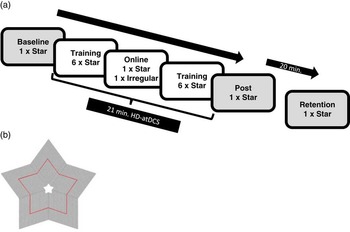
As depicted in Figure 1, a 21-min stimulation began during which the participants had to perform the following tasks. In the first 9 min of the stimulation, the star had to be traced (trained) six times with 90 s allowed to complete each trial. After these 9 min, still receiving the stimulation, an online-test for speed and accuracy, equally to baseline measurement was performed. In addition to the star, the irregular figure had to be drawn; these two online tests lasted 3 min. This was followed by again tracing of six stars in the remaining 9 min of stimulation. Immediately following the offset of the stimulation after the second series of stars, a post-test was conducted. The stimulation equipment was then removed, and 20 min after termination of the stimulation a retention test was performed.
The experimental design and the drawing accuracy evaluation. (a) After a brief familiarization period to the mirror drawing, the participants had to trace a star with the right hand receiving visual feedback only via a mirror. This was used as baseline for later comparisons. Then, while stimulated they had to train this task six times for 90 s followed by an online test of drawing the star and an irregular figure. Again and still under tDCS, the participants had to complete six further star tracings and were tested again immediately after the termination of the stimulation. Finally, 20 min after the termination of the stimulation, the retention test was performed. (b) Adjacent to the presented figure of the star, correction lines were added with 2×2 mm squares. While deviations from the original line within the first 2 mm were seen as correct, all deviation exceeding this distance were counted as errors.

High-Definition Anodal Transcranial Direct Current Stimulation (HD-atDCS)
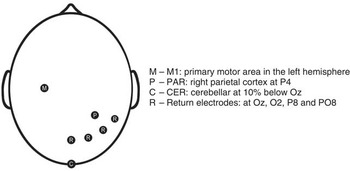
To apply the HD-atDCS, a mobile computer controlled brain stimulation device, which allows a multichannel application (Bolognini et al., Reference Bolognini, Vallar, Casati, Latif, El-Nazer, Williams and Fregni2011; Bolognini, Olgiati, Rossetti, & Maravita, Reference Bolognini, Olgiati, Rossetti and Maravita2010) was used (Starstim, Neuroelectrics, Barcelona, Spain). Electrodes were positioned in a non-conductive neoprene cap. HD-atDCS was applied by one stimulation electrode and four return electrodes (3.14 cm2 each) filled with conductive electrolyte-gel. To ensure a focal stimulation, 4×1 electrode montages were applied. As depicted in Figure 2 for CER, the anode was placed midline above the cerebellum 10% below Oz, for PAR at right parietal area P4, and for M1 at C3 covering the primary motor area of the right hand.
Positions for anodal HD-tDCS stimulation and locations of return electrodes. In the three stimulations conditions, left M1, right parietal (P4), or cerebellar positions were used as anodal stimulation locations. For all conditions, the four return positions at Oz, O2, P8 and PO8 remained the same to have comparable cathodal effects.

To exclude effects that are due to different return electrode montages, in all groups Oz, O2, P8, and PO8 were used as return sites. The montages were chosen to optimize stimulation of the target areas and selected according to a computational head model (Ruffini et al., Reference Ruffini, Wendling, Merlet, Molaee-Ardekani, Mekonnen, Salvador and Miranda2013). Direct current was delivered at an intensity of 1 mA (current density 0.319 mA/cm2) at the anodal stimulation electrode. The stimulation software (NIC, Neuroelectrics, Barcelona, Spain) offers to split the return current to the four return electrodes. Although the exact values are unknown due to different tissue resistances, this resulted in a computational intensity of approximately –0.25 mA (current density -0.080 mA/cm2) at each return electrode.
Compared to previous studies using substantially larger electrodes (e.g., Antal, Nitsche, Kincses, et al., Reference Antal, Nitsche, Kincses, Kruse, Hoffmann and Paulus2004; Antal, Nitsche, & Paulus, Reference Antal, Nitsche and Paulus2006), we induced significantly lower current density. Return sites were kept identical in all montages of our HD-tDCS protocols and for the alignment of the generated electric field to reach the target area. In the control group (SHAM), the same montage of four return-electrodes was used and the position of the fifth electrode was counterbalanced among CER, P4, and C3. The sham tDCS was applied with only 30 s of real stimulation. Each stimulation session started and closed with a 30-s ramp-up and ramp-down phase and had a duration of 21 min to ensure to complete the whole mirror drawing task.
Adaptation Measurement
For quantification of visuo-motor adaptation, two parameters were measured. While drawing time (seconds) was recorded by the experimenter, error evaluation was performed by a neutral evaluator blind to the group assignment of the subjects. Tracing time for each drawing was defined as the time taken to trace the mirrored picture from the starting point to the end point. Accuracy was evaluated after the experimental-session by using a template. This template consisted of a grid of adjacent 2×2 mm squares that were added on both sides of the star (see Figure 1b). Deviations within the first square (inside and outside the figure) were not counted as errors. Each square outside this tolerance area was counted as an error, and the errors were added up.
Statistical Analysis
All data were normally distributed as screened with Kolmogorov-Smirnov tests. To evaluate baseline differences, one-way analyses of variance (ANOVAs) were calculated for tracing time and tracing accuracy. For adaptation performance, two-way ANOVAs with TIME (Pre, Online, Post, Follow Up) and GROUP (CER, PAR, M1, SHAM) were conducted once for tracing time and once for accuracy. In the event of significant results, Bonferroni post hoc analyses were calculated for pairwise comparisons. In addition, Spearman correlations were calculated for the mean values of tracing time and accuracy separately for each stimulation group as well as for the whole sample to analyze whether a decreased tracing time is related to in- or decreased accuracy. The level of significance was set at p≤.05.
RESULTS
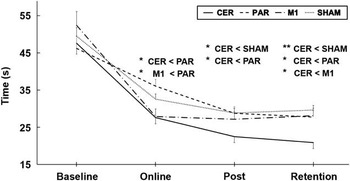
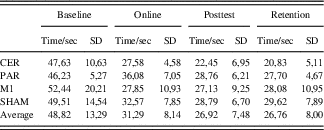
Table 1 depicts the mean and standard deviation for speed and accuracy for all recordings and stimulation conditions. Baseline measurement for tracing-time showed no differences between groups in the baseline. The two-way ANOVA for tracing time revealed a highly significant effect F(3,237)=166.16, p≤.001, η2=.678 for TIME, a significant effect for GROUP F(3,79)=2.99, p<.05, η2=.102, as well as a significant GROUP × TIME interaction F(9,237)=2.50, p=.048, η2=.087. As depicted in Figure 3 the initial decrease (baseline to online test) in tracing-time is most pronounced for CER and M1. This is followed by a further decrease for CER while M1 remains stable. PAR and SHAM, however, decrease equally and reach the values of M1 in the post-test and the retention test.
Besides the significant main effects for TIME and GROUP, there was a significant interaction of GROUP and TIME for the speed of the tracing. While there were no differences in speed at the baseline the CER group exhibited the best results as compared to the other groups. The significant differences between the groups are depicted for the respective test intervals. While an asterisk denotes significant pairwise comparison at p<.05, two asterisks indicate a p<.01.

Bonferroni post hoc tests for the main effect GROUP showed only significant differences (i.e., improvement) in tracing time between CER and SHAM (p<.05). Bonferroni post hoc comparisons for the interactions revealed that during the online-test both the results of CER (p=.006) and M1 (p=.026) were significantly lower as compared to PAR. In the post-test, CER differed significantly from PAR (p=.049) and SHAM (p=.013). Finally, in the retention test CER was significantly faster as compared to SHAM (p<.001), to PAR (p=.031), and to M1 (p=.037).
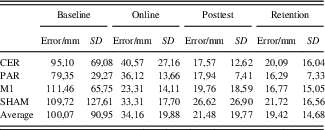
The analyses for tracing accuracy showed a highly significant effect for TIME (F(3,237)=54,697; p<.001; η2=.409), but no significant results for either GROUP or the interaction. The number of errors significantly decreases with time for all groups, but does not differ between the stimulation types.
The correlations of tracing time and accuracy resulted in positive correlations for all correlations N=4 with CER r=.995, p=.05, PAR r=.990, p=.01, M1 r=.997, p=.003, SHAM r=.995, p=.005 and for the grand average r=0.99, p=.001. This indicates that, for all types of stimulation, shorter tracing times are related to less tracing errors.
DISCUSSION
The main findings of our study are that beside the expected general learning induced decrease in tracing time and errors, cerebellar HD-atDCS resulted in the best performance in tracing speed. This is significant (in comparison to SHAM) in the post and in the retention test. However, using a more liberal approach as calculating least square difference (LSD) instead of Bonferroni contrasts, we could report significant differences (p=0.22) between CER and SHAM already in the online test. Most interestingly, in the retention test, drawing time in the CER group is significantly decreased not only in comparison to SHAM but also to PAR or M1 stimulation.
Cerebellar HD-atDCS facilitates motor adaptation, while HD-atDCS at parietal areas does not. At the first glance, these results fit well with recent findings as reported by Cantarero et al. (Reference Cantarero, Spampinato, Reis, Ajagbe, Thompson, Kulkarni and Celnik2015), in which participants performed a visuo-motor skill task in three training days with stimulation. Participants receiving anodal cerebellar tDCS yielded the best learning success already after the first day. Similarly, Galea et al. (Reference Galea, Vazquez, Pasricha, de Xivry and Celnik2011) reported best motor adaptation for cerebellar atDCS. However, this better performance was due to a reduced error rate, and the stimulation had no effect on a subsequent retention test. In contrast, our data concerning the cerebellar stimulation too indicate that performance is increased, but (i) tracing speed instead of error reduction is significantly improved and (ii) this effect is significant (with respect to SHAM) only after the stimulation or after a short retention interval of 20 min. Whether or not a longer-lasting stimulation would have led to significant differences during stimulation remains an open question.
Antal, Keeser, Priori, Padberg, and Nitsche (Reference Antal, Keeser, Priori, Padberg and Nitsche2015) have recently made clear that meta-analyses focusing on the effects of brain stimulation have to take into account the fact that different stimulation sites and durations may lead to divergent outcomes. In consequence to our results, we suggest that the use of HD-atDCS might lead to results different to those studies using conventional tDCS with less spatial resolution. A more focal stimulation using an array of pi-electrodes of 3.14 cm2 might differ substantially from the stimulation procedure with 25 cm2 sponge electrodes with return electrode placed at the right buccinators muscle (inducing an electrical current almost throughout the brain).
Galea et al. (Reference Galea, Vazquez, Pasricha, de Xivry and Celnik2011) reported a reduction in errors after cerebellar tDCS but not a reduction in movement time. Similar results have been reported by Jayaram et al. (Reference Jayaram, Tang, Pallegadda, Vasudevan, Celnik and Bastian2012), who found that the adaptation rate of only spatial but not of temporal components was altered during anodal cerebellar tDCS. This is in contrast to our findings that showed decreased tracing times for the CER as compared to SHAM. However, the correlation indicated that the decrease of tracing time is not due to less accuracy. Even more, tracing time and errors correlated positively; thus, the observed decrease in tracing time is accompanied by better performance in accuracy (i.e., less errors).
One possible explanation is that tracing speed in mirror drawing might not be comparable to movement speed per se, as assessed in other studies (Galea et al., Reference Galea, Vazquez, Pasricha, de Xivry and Celnik2011; Jayaram et al., Reference Jayaram, Tang, Pallegadda, Vasudevan, Celnik and Bastian2012). Another possible explanation, at least in part and rather speculative, could be the different stimulation applied. While the intensity and duration might be comparable, the location of the stimulation electrode and more importantly the return electrodes differed. Reporting the results of cortical tDCS, Miranda, Mekonnen, Salvador, and Ruffini (Reference Miranda, Mekonnen, Salvador and Ruffini2013) noted that the electric field induced by the stimulation could be divided in a strong normal and a weaker tangential field. The use of a more focal stimulation, however, resulted in a significant increase of the focality of the tangential but not the normally oriented component. To what extent this model is valid for cerebellar stimulation has not been reported so far. However, given the highly symmetric structure of the cerebellum the tangential component would exert stronger effects on the parallel fibers of the cerebellum. This in turn might modulate the long-term depression effects of the synapses from parallel fibers to Purkinje cells.
The encountered increase in tracing speed after cerebellar HD-atDCS is more likely due to better visuomotor integration than to pure movement speed. Thus, a stimulation of the cerebrocerebellum (lateral hemispheres of the cerebellum) should be relevant for this effect. Lesions of the cerebrocerebellum can for example lead to prolonged reaction times. We located the anode 10% below the inion and the return electrodes on the right occipital lobe (Oz, O2, P8, and PO8). Thus, the main current flow of the stimulation was on the right cerebrocerebellum, exerting the strongest effect presumably at the respective lobuli VII and VIII. Riedel et al. (Reference Riedel, Ray, Dick, Sutherland, Hernandez, Fox and Laird2015) described four functional clusters of the cerebellum.
Most importantly, cluster 4 includes the lobuli VII and VIII. This cluster is seen as a secondary motor representation and important for motor processes that require perceptive feedback and attentional control. Moreover, this cluster is described as heavily involved in motor tasks, with strong relation to the cognitive aspects necessary for execution; furthermore, it may contribute to time-based expectancies. We thus assume that the results achieved with HD-atDCS can vary substantially from standard atDCS using return electrodes at distant locations, and that more detailed studies have to be performed on this issue.
Concerning the M1 stimulation, we expected increased performance already after a short stimulation period similar to Antal, Nitsche, Kincses, et al. (Reference Antal, Nitsche, Kincses, Kruse, Hoffmann and Paulus2004). As depicted, we found a decreased tracing time during the online test after 12 min of stimulation, but the results were only significant with respect to PAR, not to SHAM. However, Antal reported these benefits already after 1 min of stimulation and lasting only for a few minutes. Thus, an earlier online-test might have replicated these findings. However, in contrast to Antal Galea and colleagues (Galea et al., Reference Galea, Vazquez, Pasricha, de Xivry and Celnik2011) reported that only cerebellar but not M1 stimulation increases motor adaptation. However, it has to be kept in mind that these were quite different experimental tasks.
Effects of parietal atDCS specifically on motor performance or motor adaptation processes have not been reported so far. Although the right parietal cortex is known to be, at least to some extent, involved in spatial processing as necessary in a mirror drawing task, the unilateral stimulation at P4 may have been insufficient, whereas a bilateral stimulation might have led to improvements. Bolognini et al. (Bolognini et al., Reference Bolognini, Vallar, Casati, Latif, El-Nazer, Williams and Fregni2011; Bolognini, Olgiati, et al., Reference Bolognini, Olgiati, Rossetti and Maravita2010), as an example reported that right parietal atDCS resulted in enhanced orienting to contralateral stimuli. Furthermore, it has been noted that both hemispheres are involved in spatial attention although left hemispheric spatial abilities are to some extent subdominant (Suchan & Karnath, Reference Suchan and Karnath2011).
Thus, our montage led to a current flow in the right hemisphere only. One might consider that stimulation of both hemispheres simultaneously might have changed these results. However, given the possible influence on left motor areas (M1), we restrained from stimulating at left parietal site (P3). Concerning the positions of the return electrodes, we decided to use the identical locations for all types of stimulations. In fact, there are some reports indicating differential effects for cathodal stimulation at visual sites. Although this is considered an inhibitory stimulation, it does not necessarily result in performance reduction (Pirulli, Fertonani, & Miniussi, Reference Pirulli, Fertonani and Miniussi2014). The behavioral effects of cathodal stimulation at visual areas are dependent on the specificity of the experimental setting and are contradictorily with some studies reporting positive and other negative effects on visuo-motor skills.
As an example, Peters and colleagues reported positive effects in an orientation discrimination task but only when cathodal stimulation at V1 was applied before task performance but not if applied during the task (Peters, Thompson, Merabet, Wu, & Shams, Reference Peters, Thompson, Merabet, Wu and Shams2013). Besides this evidence in favor of possible positive cathodal effects on visual areas, most other studies with cathodal stimulation targeted area V5 (Antal, Nitsche, Kruse, et al., Reference Antal, Nitsche, Kruse, Kincses, Hoffmann and Paulus2004; Antal, Nitsche, Kincses, et al., Reference Antal, Nitsche, Kincses, Kruse, Hoffmann and Paulus2004; Antal et al., Reference Antal, Nitsche and Paulus2006) and reported no behavioral effects with respect to a requested motor task. Nevertheless, since no directly comparable study could be consulted, we cannot definitely exclude that cathodal effects over visual areas may in part be responsible for the effects in the present approach. Furthermore, it is unresolved whether changing the current direction (cerebellar – occipital vs. parietal – occipital) might have differential effects.
Although we cannot strictly rule out an effect due to the cathodal stimulation, we strongly assume that these are negligible in our setup. First, all participants receiving real stimulation enhanced their performance as compared to the baseline; thus, we can exclude a general decrease in visual processing. Second, no significant differences in performance were observed between SHAM and PAR at online, post, or retention test. Similarly, no significant effects emerged between SHAM and M1 for these time intervals. This too suggests that basic visual processing is not deteriorated. Although, we could not control possible effects directly, as for example evaluated by VEPs induced via TMS, it seems not very likely that the low current density might have resulted in appreciable inhibitory effects at the stimulated visual areas.
All in all, our results support the earlier findings that cerebellar tDCS can evidently facilitate motor adaptation. The use of HD-tDCS might modulate these effects in a more focal way. Parietal HD-tDCS, however, yielded no positive effects, and a stimulation at M1 resulted only in a tendency to increased performance, but only during an early learning stage. This highlights the specific function of the cerebellum in motor adaptation.
Means and standard deviations (SDs) for the tracing times in seconds for all groups as well as a grand average

Means and standard deviations (SDs) for tracing errors in millimeters for all groups as well as a grand average

Acknowledgments
The authors thank F. Meud for the implementation of a pilot study and preliminary data recording. No grants nor any conflict of interest of any author has to be mentioned.