Introduction
Pitfall traps are a simple yet effective sampling tool for epigaeic Arthropoda and have been used for over a century (e.g., Dahl Reference Dahl1896; Hertz Reference Hertz1927; Barber Reference Barber1931). Pitfall traps are inexpensive to construct as materials are readily available and easy to set up and service in the field. They can sample a variety of habitat types and allow for a large number of replicate samples in which to make statistical inference regarding arthropod population patterns on the landscape.
Pitfall traps are a universally recognised method for sampling soil and litter-dwelling arthropods in forested ecosystems globally (e.g., Greenslade Reference Greenslade1964; Faragella and Adam Reference Faragella and Adam1985; Knight and Holloway Reference Knight and Holloway1990; Spence and Niemelä Reference Spence and Niemelä1994; Heliölä et al. Reference Heliölä, Koivula and Niemelä2001). In most studies traps are placed such that the top is flush with the substrate surface and is assumed to adequately sample the activity of epigaeic arthropods. However, in wet forests and peatlands there is a gradient between the lower mineral layers of soil and the often deep, porous, surface organic layers. Quantitative sampling of these wetter areas proves challenging as arthropods may be active on the surface as well as below the soil surface in the porous matrix. Few insect trap types seem appropriate to sample this fauna. Recent review papers (Skvarla et al. Reference Skvarla, Larson and Dowling2014; Brown and Matthews Reference Brown and Matthews2016) examined the factors affecting the performance of pitfall traps for collecting arthropods, with only one study reported looking at pitfall trap depth (Pendola and New Reference Pendola and New2007). Another recent paper by Bergeron et al. (Reference Bergeron, Spence, Volney, Pinzon and Hartley2013) in upland forests concluded that surface pitfall traps were more efficient at collecting litter-dwelling arthropods.
Increasingly industrial exploration (for forestry, oil, and gas) is moving into landscapes that have not previously been developed and include lower productivity forest stands, fens, peatlands, and other semi-aquatic habitats. Little is known about the arthropod biota of wetter, lower productivity stands and their responses to potential long-term habitat disruption. Adequate biomonitoring requires methods with which to create a reliable baseline database of the organisms present. To this end, we looked at the effectiveness of pitfall trap sampling in subhygric to hydric ecosites in the lower foothills of Alberta, Canada, and whether employing pitfall traps sunk deeper into the substrate would affect the abundance and diversity of beetles (Coleoptera) sampled.
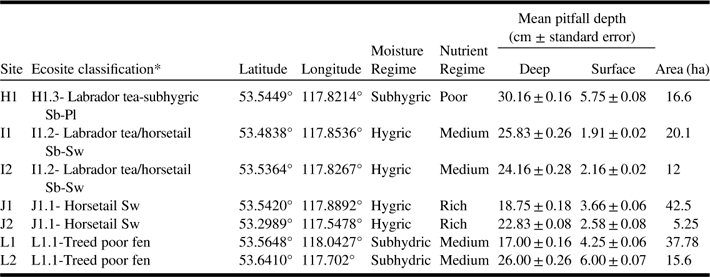
All study sites were located in the Upper Foothills Ecoregion of west-central Alberta, centred around the town of Hinton (Table 1). Sites were >5 ha and represented subhygric to hydric ecosites (ecosites h, i, j, l; Beckingham et al. Reference Beckingham, Corns and Archibald1996), and dominated by lodgepole pine (Pinus contorta var. latifolia Engelmann) (Pinaceae), white spruce (Picea glauca (Moench) Voss) (Pinaceae), black spruce (Picea mariana (Miller) Britton, Sterns, and Poggenburg), or tamarack (Larix laricina (Du Roi) Koch) (Pinaceae). Understorey plant communities were dominated by Labrador tea-feather moss (Rhododendron groenlandicum (Oeder) Kron and Judd (Ericaceae), Hylocomium splendens (Hedwig) Schimper (Hylocomiaceae), Pleurozium schreberi (von Bridel) Mitten (Hylocomiaceae), and Ptilium crista-castrensis (Hedwig) De Notaris (Hypnaceae)) in the drier stands to willow-birch-sedge-golden moss (Salix Linnaeus (Salicaceae) species, Betula pumila Linnaeus (Betulaceae), Carex Linnaeus (Cyperaceae) species, and Tomenthypnum nitens (Hedwig) Loeske) in the wettest stand (Table 1).
Summary of study sites where surface and deep pitfall traps were installed to sample epigaeic beetles in subhygric to hydric sites in the upper foothills ecoregion near Hinton, Alberta, in 2005.
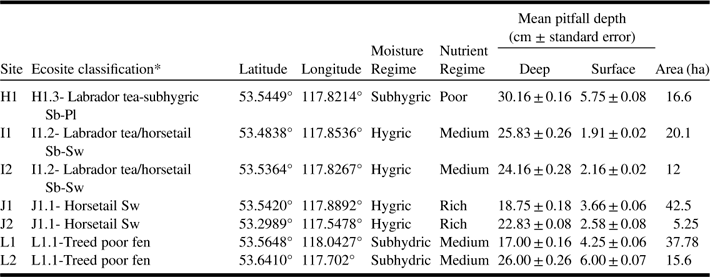
* Based on Beckingham et al. (Reference Beckingham, Corns and Archibald1996).
Sb, black spruce (Picea mariana), Pl, lodgepole pine (Pinus contorta var. latifolia); Sw, white spruce (Picea glauca); Labrador tea (Rhododendron groenlandicum), horsetail (Equisetum Linnaeus (Equisetaceae) species).
Epigaeic beetles were sampled using pitfall traps consisting of a 250-mL white plastic inner cup nested within a 500-mL white plastic outer sleeve, and sheltered by a 10×10 cm elevated plywood cover. Approximately 100 mL of propylene glycol (Prestone Low Tox Coolant, Danbury, Connecticut, United States of America) was used as a specimen preservative. Pitfall traps were installed within each site with the lip of the outer sleeve within 6 cm of the substrate surface (surface trap) or with the lip of the outer sleeve 20–30 cm below the substrate surface (deep trap, Table 1). Six surface and six deep traps were randomly installed with >40 m between adjacent traps, for a total of 84 pitfall traps (42 surface, 42 deep). Traps were checked every 10 days between 24 May and 16 September 2005.
Carabidae and Staphylinidae (Coleoptera) were subsequently sorted and identified to species or the lowest taxonomic level possible. Within the Aleocharinae (Staphylinidae) we identified Liogluta Thomson and Lypoglossa Fenyes to genus and pooled the remaining species lumped under Aleocharinae species; Pselaphinae (Staphylinidae) were identified to genus. Voucher specimens are deposited in the Northern Forestry Research Collection (Natural Resources Canada) in Edmonton, Alberta, Canada.
Raw species abundance from each trap was standardised to 700 trap days (raw abundance×(700/actual number of trap days) to account for differences in sampling effort among traps due to trap installation and disturbances such as wildlife or site flooding. The package vegan (Oksanen et al. Reference Oksanen, Blanchet, Kindt, Legendre, Minchin and O’Hara2015) within the statistical program R version 3.2.3 was used to calculate pairwise Bray-Curtis similarity matrices (a measure of the species present and their relative abundance) among all of the combination of traps within a site for Carabidae and Staphylinidae and rarefaction estimates of species diversity (Simberloff Reference Simberloff1978). Overall catch (pooled samples) and mean pairwise per cent similarity of Carabidae and Staphylinidae trap catches were compared using a two factor design with proc glm in SAS/STAT software (version 9.4 of the SAS system for Unix; SAS Institute, Cary, North Carolina, United States of America), with site, trap depth and their interaction as main effects. Indicator species analysis (Dufrêne and Legendre Reference Dufrêne and Legendre1997) was used to examine species-specific associations between trap depths using the multipatt function in the package indicspecies (De Cáceres and Jansen Reference De Cáceres and Jansen2015).
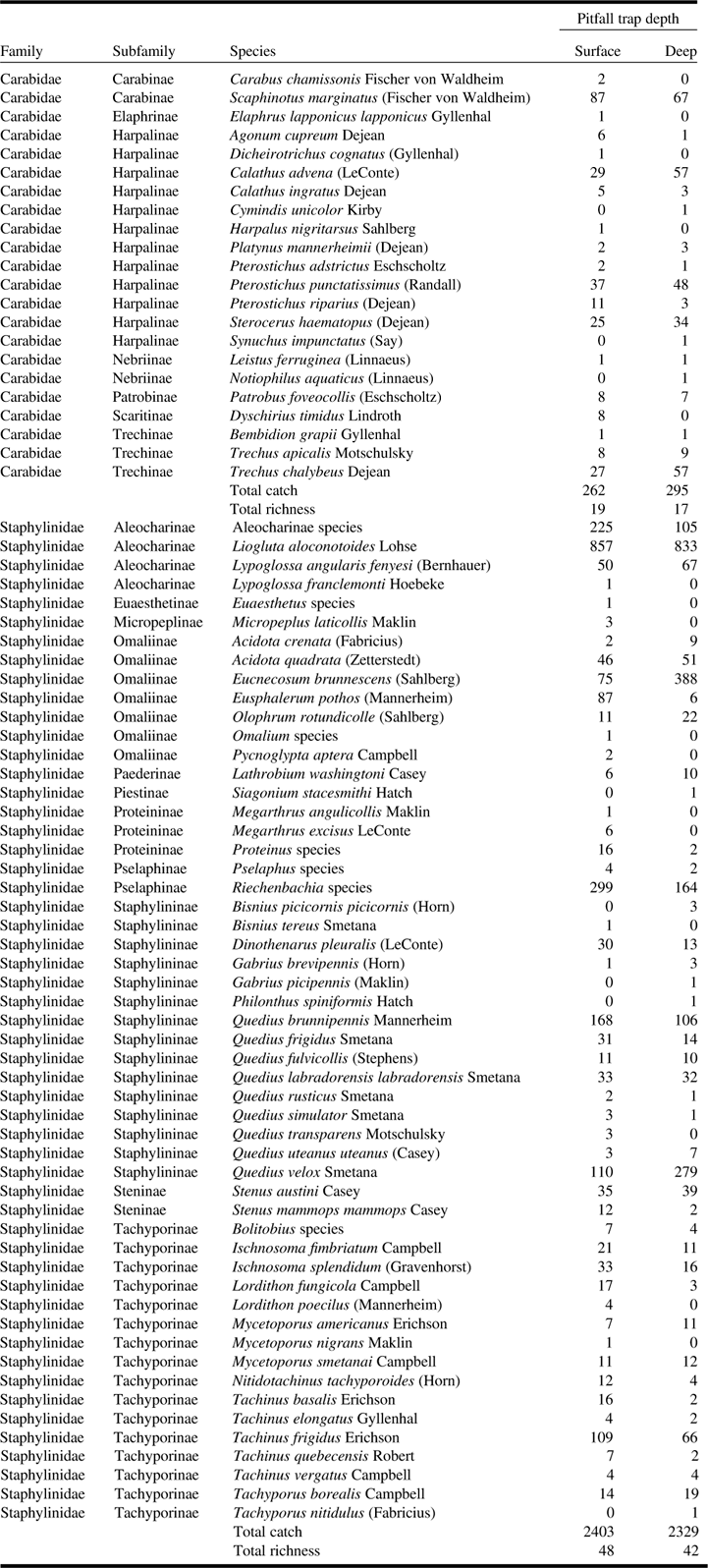
A total of 5289 beetles, representing 75 taxa, were collected (Table 2). Staphylinidae represented 80% of the catch and 63% of the taxa. Surface traps collected 19 species of carabids and 48 taxa of staphylinids. Deep traps collected 17 species of carabids and 42 taxa of staphylinids. There were five species of Carabidae and 11 species of Staphylinidae collected only in surface traps, whereas three species of Carabidae and five species of Staphylinidae were captured only in deep traps. Of the eight species collected only in deep traps, seven were singletons and one represented by three specimens; of the 15 species collected only in surface traps, 10 were singletons or doubletons and Dyschirius timidus Lindroth (Coleoptera: Carabidae) was represented by eight specimens and Megarthrus excisus LeConte (Coleoptera: Staphylinidae) by six (Table 2).
Carabidae and Staphylinidae species collected by surface and deep pitfall traps in subhygric to hydric sites in the upper foothills ecoregion near Hinton, Alberta in 2005.
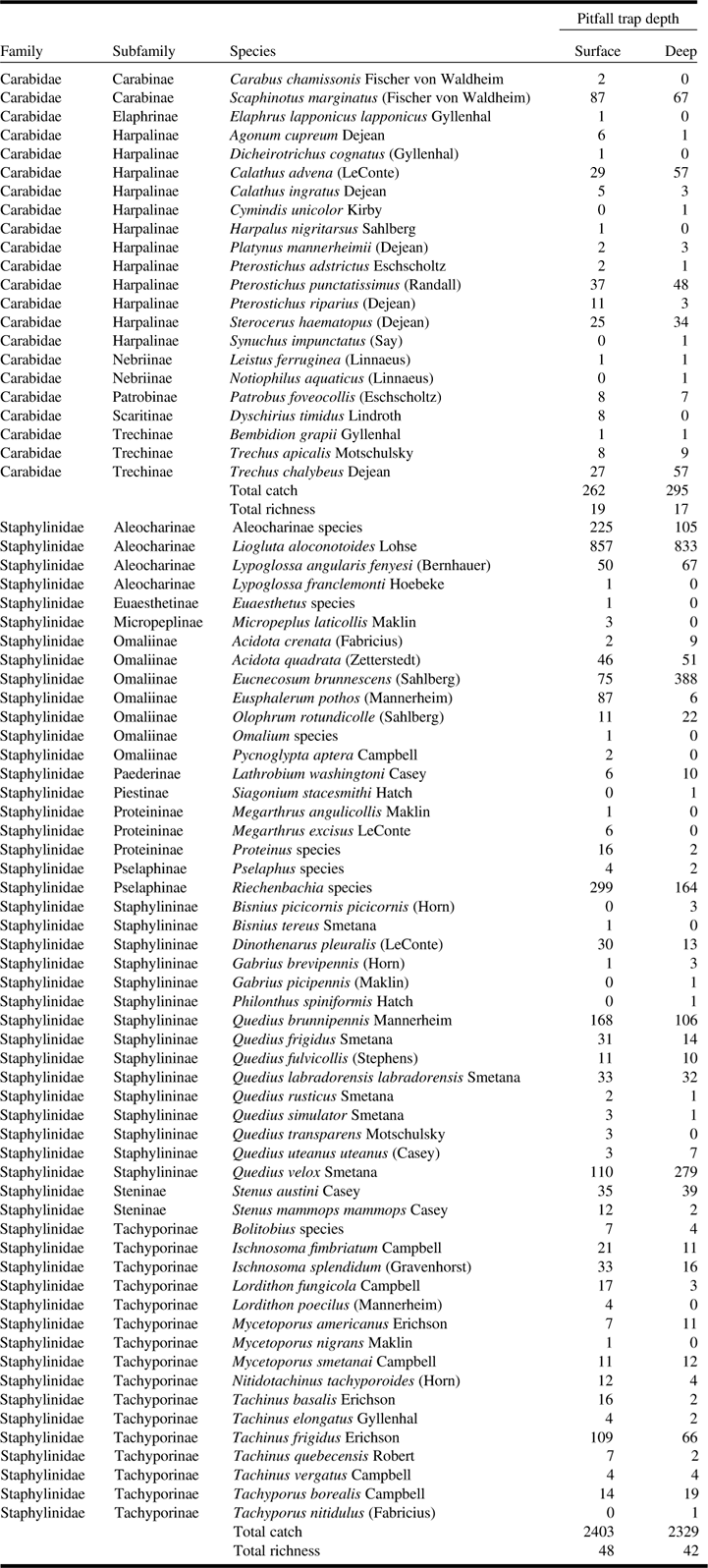
Note: Numbers represent the number of adult specimens collected.
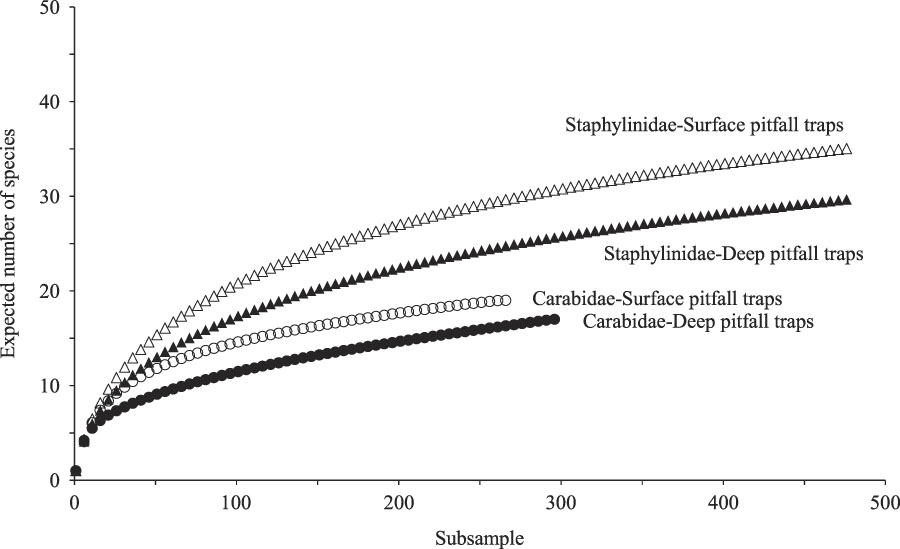
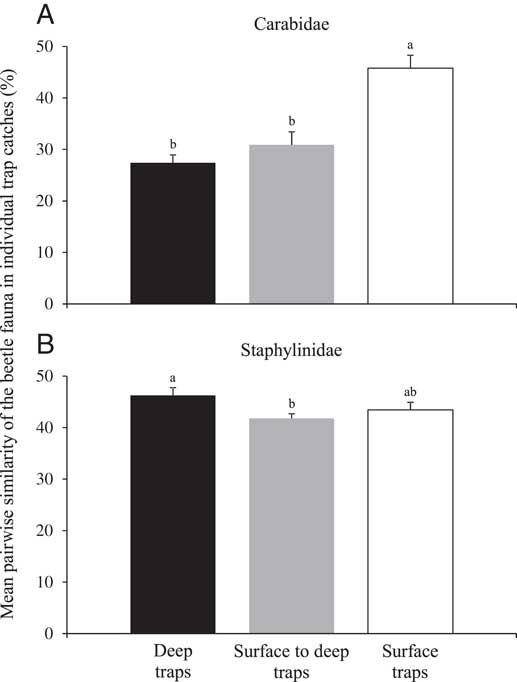
Rarefaction analysis indicated that for both taxa species richness was higher in surface pitfall traps than in deep traps (Fig. 1). There were no significant differences in the mean standardised catch of beetles between surface and deep pitfall traps. Pooled trap samples from all sites indicated that the two trap depths were 76 and 74% similar, respectively, for the Carabidae and Staphylinidae fauna. Tukey multiple means tests indicated that for Carabidae the different sites sampled with surface pitfall traps were significantly more similar to each other than were deep traps or when compared with deep traps (honest significant difference test, t=3.328, P<0.001) (Fig. 2); whereas, for Staphylinidae the different sites sampled with deep pitfall traps were significantly more similar to each other when compared to surface traps (honest significant difference test, t=3.325, P<0.013) (Fig. 2).
Individual based rarefaction for Carabidae and Staphylinidae sampled with surface and deep pitfall traps in subhygric and fen sites in the upper foothills of Alberta in 2005. Circles represent Carabidae species, triangles represent Staphylinidae species, open symbols represent surface pitfall traps and solid symbols represent deep pitfall traps.

Mean (± standard error) per cent similarity of (A) Carabidae and (B) Staphylinidae based on individual trap catches. Per cent similarity was calculated for each pairwise combination of traps within each trap type within a site (surface versus surface (n=15); deep versus deep (n=15)), and between each trap type within a site (surface versus deep (n=36)) for each site. Means with the same letter not significantly different at α=0.05.

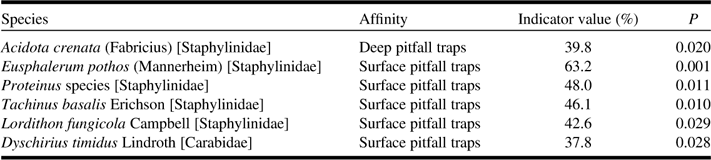
Six species were identified as significant indicators of a particular trap depth (Table 3); only one species, Acidota crenata (Fabricius) (Coleoptera: Staphylinidae), was identified as a significant indicator of deep pitfall traps, whereas five species showed a significant affinity for surface traps.
Beetle taxa showing a significant affinity for either surface or deep pitfall traps, based on indicator species analysis.
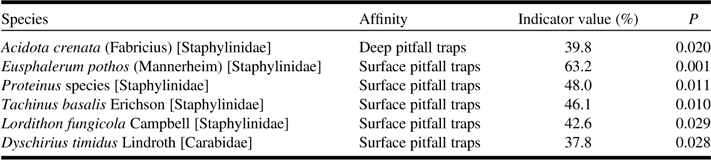
Trap depth had little significant overall influence on standardised species abundance of catches of epigaeic beetles in these wet forested ecosites. The vast majority of the fauna was sampled with the surface traps. Although nine species were collected only with deep traps, only Bisnius picicornis picicornis (Horn) (Coleoptera: Staphylinidae) had an abundance greater than one individual (Table 2). However, we consider the presence of these species only in deep traps to be incidental as all of these species were collected in surface traps during other studies in the area (D.W.L., unpublished data). One species of Staphylinidae, A. crenata, was a significant indicator of deep traps. This genus is associated with wet environments, both in forests as well as in swamps and mires, however, little is known about the life habits of this species (Campbell Reference Campbell1982).
As a large number of species (15) were collected only in surface traps, including several represented by less than two specimens, it is clear that surface traps collect a larger cross-section of the fauna than deep traps. The strongest indicator of surface traps was Eusphalerum pothos (Mannerheim) (Coleoptera: Staphylinidae), which are anthophilous as adults, however, larvae are frequently found in litter and moss in riparian areas (Zanetti Reference Zanetti2014). Of the other significant indicators of surface traps D. timidus frequents wet habitats such as marshes and ponds (Larochelle and Larivière Reference Larochelle and Larivière2003). The genus Proteinus Latreille (Coleoptera: Staphylinidae) is often collected from decaying mushrooms (Frank Reference Frank1979) and dung (D.W.L., unpublished data), and the genera Tachinus Gravenhorst and Lordithon Thomson (Coleoptera: Staphylinidae) are often associated with decaying vegetation or mushrooms, but it is unclear whether they are saprophagous or predatory on Diptera larvae.
Our findings agree with other studies that examined the influence pitfall trap depth. Pendola and New (Reference Pendola and New2007) found there were no differences in ant diversity and capture among shallow and deeper pitfalls in open grassy woodlands in southeastern Australia. A study from northwestern Alberta found three species (two Carabidae and one Staphylinidae) that were best sampled by deep pitfall traps, but concluded that surface traps were more efficient at collecting litter-dwelling arthropods (Bergeron et al. Reference Bergeron, Spence, Volney, Pinzon and Hartley2013). They attributed the higher catch rate of invertebrates in surface traps to the ability of some taxa to escape the deep trap by their ability to find holdfasts before falling into the trap and therefore climbing out and escaping. This may be especially so in our study as our sites had predominately deep organic soil layers with a thick moss matt, which provided a very textured lining to the pitfall trap hole allowing even heavily bodied beetles to “snag” on the side of the hole and not end up in the trap.
Another possibility for more insect activity at surface pitfall traps in peatlands may have to do with the inherent characteristics of deep organic soils. Heinselman (Reference Heinselman1963) showed that forested peatlands had soil temperatures much colder than adjacent forest stands due to the higher specific heat needed to warm the organic soil due to the high water content, the insulating effect of moss, and the overall cooling effect due to evaporation by Sphagnum Linnaeus (Sphagnaceae). It has also been demonstrated that during summer there can be more than a 4–5 °C drop in temperature between 20 and 50 cm below the peat surface (Moore Reference Moore1987; McKenzie et al. Reference McKenzie, Siegel, Rosenberry, Glaser and Voss2007). Clearly, surface pitfall traps are a better alternative to deeper set pitfall traps for sampling epigaeic beetles in wet forest stands.
Acknowledgements
The authors thank Geoff Williams for his help in setting up, collecting, and sorting pitfall trap samples. Greg Pohl assisted with Carabidae and Staphylinidae beetle identifications. We would also like to thank Lynn Bergeron and Stacey Griffin, with Weldwood of Canada-Hinton (now West Fraser Forest Products), and Christian Weik of the Foothills Model Forest, for providing GIS ecosite information for the Hinton and Switzer Provincial Park forest management units.