Introduction
The circadian clock is an evolutionary highly conserved feature of bacteria, plants and animals; it allows organisms to adapt their physiological processes to the time of day and season in an anticipatory fashion (Daan and Aschoff, Reference Daan and Aschoff1982; Pittendrigh, Reference Pittendrigh1993). Circadian rhythms reflect extensive programming of biological activity that meet and exploit the challenges and opportunities offered by the periodic nature of the environment (Pittendrigh, Reference Pittendrigh1993). They have been observed at all levels of organization, from the behaviour of mammals to the specific activity of enzymes (Brown and Schibler, Reference Brown and Schibler1999; Gachon et al., Reference Gachon, Nagoshi, Brown, Ripperger and Schibler2004).
In mammals, circadian rhythms are driven by a timing system comprising a master pacemaker in the suprachiasmatic nuclei (SCN) of the anterior hypothalamus and of peripheral oscillators in most body cells (Yoo et al., Reference Yoo, Yamazaki, Lowrey, Shimomura, Ko, Buhr, Siepka, Hong, Oh, Yoo, Menaker and Takahashi2004; Saper et al., Reference Saper, Scammell and Lu2005). At the molecular level the circadian clock mechanism consists of interacting positive and negative transcriptional/translational feedback loops that operate in a cell-autonomous and self-sustained manner (Gachon et al., Reference Gachon, Nagoshi, Brown, Ripperger and Schibler2004).
While the core of the circadian molecular clock has been defined in mammals, the knowledge in the regulation of the circannual (annual) clock is very poor (Davis, Reference Davis1976; Gwinner, Reference Gwinner2003). A recent study on sheep suggests an anatomical substrate of circannual clock based in the pituitary gland in which melatonin-receptor-containing cells may operate as key calendar cells, transmitting seasonal temporal information to the endocrine system (Lincoln et al., Reference Lincoln, Clarke, Hut and Hazlerigg2006).
A pervasive feature of endogenous circadian oscillators is the capacity to synchronize (entrain) rhythms to environmental synchronizer (zeitgeber, from German Zeit, ‘time’; geben, ‘to give’) including light, temperature and food availability (Pittendrigh, Reference Pittendrigh1993). The daily light–dark cycle is the major entraining agent for the mammalian circadian system. In temperate zones, the photoperiod markedly changes across seasons and affects mammalian physiology and behaviour (Sumova et al., Reference Sumová, Bendová, Sládek, Kováčikova and Illnerová2004). For instance, in nocturnal rodents, the duration of locomotor activity reflects the photoperiod as being shorter on long summer than on short winter days (Puchalski and Lynch, Reference Puchalski and Lynch1991; Elliott and Tamarkin, Reference Elliott and Tamarkin1994). The rhythmic production of the pineal hormone melatonin, which is a part of the timekeeping system, is also highly photoperiod-dependent, both in nocturnal and in diurnal animals; the high nocturnal melatonin production is shorter on long summer than on short winter days (Illnerová, Reference Illnerová1991). Food availability for only a limited time each day is also a zeitgeber signal for mammalian circadian rhythms (Stephan, Reference Stephan2002; Mendoza, Reference Mendoza2007). Interestingly, recent evidence indicates that clock gene expression in the liver and some other peripheral tissues become entrained to periodic meals whereas clock gene expression in the SCN does not appear to be affected by timed feeding (Damiola et al., Reference Damiola, Le Minh, Preitner, Kornmann, Fleury-Olela and Schibler2000; Stokkan et al., Reference Stokkan, Yamazaki, Tei, Sakaki and Menaker2001).
In domestic mammals, many biochemical, physiological and behavioural processes are under circadian control (Piccione et al., Reference Piccione, Caola and Refinetti2005; Refinetti, Reference Refinetti2006). Daily rhythms of locomotor activity have been documented in a large number of species of mammals such as rodents, rabbits, cats, dogs and sheep (Refinetti, Reference Refinetti2006), whereas few investigations have been conducted in horses (Gill, Reference Gill1991; Berger, 1993; Scheibe et al., Reference Scheibe, Berher, Langbein, Streich and Eichhorn1999). Seasonal variations of locomotor activity in livestock have been poorly investigated. For instance, previous investigation showed the existence of seasonal variations of locomotor activity in the Przewalski horse (Equus ferus przewalskii) maintained under semi-reserve conditions (Berger et al., Reference Berger, Scheibe, Eichhorn, Scheibe and Streich1999; Arnold et al., Reference Arnold, Ruf and Kuntz2006).
It is difficult to describe circadian rhythms in variables relevant to exercise, while at the same time provide information on their underlining mechanisms. Not surprisingly therefore, most researches (Atkinson and Reilly, Reference Atkinson and Reilly1996) have concentrated on describing the various rhythms and discussing the impact on real sports competitions, rather than elucidating the root causes of circadian rhythmicity in sport performance (Drust et al., Reference Drust, Waterhouse, Atkinson, Edwards and Reilly2005). The present investigation was aimed at testing whether there are seasonal variations of daily activity rhythms in athletic horses and whether they are influenced by feeding schedule. For this purpose, we recorded total activity of athletic Thoroughbred horses maintained under stabled conditions at four different times of the year (vernal equinox, summer solstice, autumn equinox and winter solstice). Knowledge about the daily and seasonal organization of behaviour in athletic horses could have important implications on the planning of their training schedules and competitions.
Material and methods
Five Thoroughbred horses (female, 5 year old, mean body weight 410 ± 40 kg), clinically healthy and not pregnant were used. Body condition score assessments were used to select mares with the same amount of fatty deposits (Martin Rosset, Reference Martin Rosset1990). Animals were housed in Sicily (Italy; latitude 38° 7′ N; longitude 13° 22′ E) under natural photothermoperiodic conditions in individual boxes (4.5 × 4.5 m) with paddock (3.65 × 10 m) devoid of grass. Horses had free access to the paddock. The shell of the boxes and paddocks allowed the visual isolation of each horse from co-specifics avoiding the social entrainment of circadian behavioural rhythms (Davidson and Menaker, Reference Davidson and Menaker2003). Boxes and paddocks were located far away from the centre of the farm to limit the influence of normal human activity. Hay and water were available ad libitum in the paddock area. Horses were also fed, one time a day at 0800 h, with 1 kg of a mix of cereals (oats and barley).
Horses underwent fitness training 6 days/week with a rest day on Sundays. Training lasted 2 h each day and included walking, trotting, galloping and obstacle jumping. Fitness training and general animal care were carried out by professional staff not associated with the research team. All work presented here comply with current regulations covering animal experimentation in Italy.
In 2006, the total activity of horses (following the definition of Aschoff, 1962) was continuously recorded for 14 days during four different times of the year: vernal equinox from 14th to 27th March 2006 (sunrise at 0526 h to 0546 h, sunset at 1828 h to 1841 h), summer solstice from 15th to 28th June 2006 (sunrise at 0402 h to 0404 h, sunset at 1953 h to 1956 h), autumn equinox from 16th to 29th September 2006 (sunrise at 0512 h to 0523 h, sunset at 1812 h to 1833 h) and winter solstice from 15th to 28th December 2006 (sunrise at 0635 h to 0643 h, sunset at 1707 h to 1713 h). Activities were recorded during the scheduled times of rest between the different fitness training seasons.
Thermal and hygrometric records were carried out inside the box for the whole study by means of a data logger (TH-2500; Gemini Tinytag, Dundee, Scotland). Both temperature and humidity varied during the year (vernal equinox: 17°C, 12°C, 70%; summer solstice: 28°C, 23°C, 68.5%; autumn equinox: 24°C, 21°C, 71%; winter solstice: 15.5°C, 10.5°C, 73%; maximum and minimum temperatures and mean humidity, respectively).
Actiwatch-Mini® (Cambridge Neurotechnology Ltd, Cambridge, UK), actigraphy-based data loggers that record a digitally integrated measure of motor activity were placed on each mare. This activity acquisition system is based on miniaturized accelerometer technologies. It is currently used for human activity monitoring but also tested for activity monitoring in small non-human mammals (Munoz-Delgrado et al., Reference Munoz-Delgrado, Corsi-Cabrera, Canales-Espinosa, Santillan-Doherty and Erket2004; Mann et al., Reference Mann, Williams, Pearce and Scott2005; Piccione et al., Reference Piccione, Bertolucci, Caola and Foà2007). Actiwatch-Mini® utilizes a piezo-electric accelerometer that is set up to record the integration of intensity, amount and duration of movement in all directions. The corresponding voltage produced is converted and stored as an activity count in the memory unit of the Actiwatch-Mini®. The maximum sampling frequency is 32 Hz. It is important to realize that due to this improved way of recording activity data, there is no need for sensitivity setting as the Actiwatch unit records all movement over 0.05 g. Actigraphs were placed by means of headstalls that were accepted by horses without any obvious disturbance. Previous investigations showed that the behaviour parameters of activity were correctly identified by collars (Berger, 1993). In the present investigation total activity recorded was the result of all movements, which include different behaviours such as feeding, drinking, walking, grooming and small movements during sleep, independent of the animal’s position, such as lying or standing. Activity was monitored with a sampling interval of 5 min. Actograms, a type of graph commonly used in circadian research to plot activity against time, were drawn using Actiwatch Activity Analysis 5.06 (Cambridge Neurotechnology Ltd).
Each data series of total activity was subjected to several analyses. The amount of activity (as sum of all activity counts recorded in each sampling interval of 5 min) either during the whole day or during photophase and scotophase was calculated using Actiwatch Activity Analysis 5.06.
The length of daily period of total activity was calculated by means of χ 2 periodogram analysis (Sokolove and Bushell, Reference Sokolove and Bushell1978). The photic entrainment was evaluated by visual inspection (Pittendrigh and Daan, Reference Pittendrigh and Daan1976a and Reference Pittendrigh and Daan1976b). The acrophase of daily rhythm (that is, estimated time of day at which peak of rhythm occurs) was computed by cosinor rhythmometry (Nelson et al., Reference Nelson, Tong, Lee and Halbrg1979) as implemented in the Actiwatch Activity Analysis 5.06.
The Student’s t-test and two-way analysis of variance (ANOVA) for repeated measures were used to determine significant differences. P < 0.05 was considered statistically significant. Scheffé’s test was applied for post hoc comparison.
Results
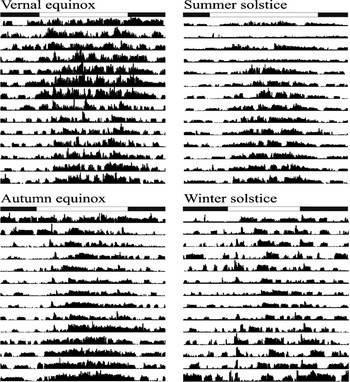
Visual inspection of actograms showed that athletic Thoroughbred horse total activities were not evenly distributed over the day, but they were mainly diurnal during the year (Figure 1). These observations are supported by the statistically significant difference in the amount of activity between photophase and scotophase (t 279 = 27.03, P < 0.0001, paired Student’s t-test).
Total activity recorded in an athletic Thoroughbred horse exposed to natural photoperiodic and thermoperiodic conditions during vernal equinox, summer solstice, autumn equinox and winter solstice. The example is representative of the seasonal differences in daily rhythms of activity in the horse. Each horizontal line is a record of 1 day’s activity, and consecutive days are mounted one below the other. Total activity recorded during consecutive 5-min periods is indicated by vertical black markings. White and black bars at the top of record indicate photophases and scotophases.

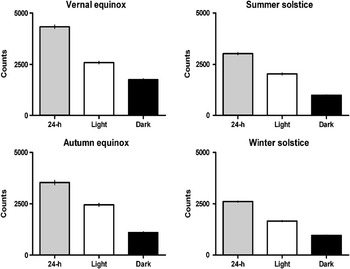
Two-way ANOVA for repeated measures showed that the daily amount of activity changed during the year (F (3,260) = 79.4, P < 0.0001; Figure 2), but not among horses (F (4,260) = 1.2, P > 0.3). The highest daily amount of activity was found during the vernal equinox (4325 ± 95.7; mean ± s.e., Figure 2), whereas the lowest amount was found during the winter solstice (2609 ± 37.8; P < 0.01, Scheffé’s post hoc test; Figure 2).
Mean ± s.e. of the daily amount of behavioural activity measured either across the 24-h or in photophase and scotophase at different times of the year.

The amount of activity either during photophase or during scotophase significantly changed throughout the year (Photophase: F (3,260) = 46.3, P < 0.0001; Scotophase: F (3,260) = 77.9, P < 0.0001; two-way ANOVA for repeated measures; Figure 2). Post hoc tests showed the highest amount of activity in the photophase during vernal and autumn equinoxes (2583 ± 66.7 and 2447 ± 83.3, respectively; Figure 2) and the lowest during winter solstice (1656 ± 31.5, P < 0.01, Scheffé’s post hoc test; Figure 2). The amount of activity in the scotophase did not change during summer solstice, autumn equinox and winter solstice (991 ± 23.4, 1088 ± 53.7, 953 ± 25.3, respectively; P > 0.17, Scheffé’s post hoc test, Figure 2), whereas during vernal equinox it significantly increased (1742 ± 56.7, P < 0.01, Scheffé’s post hoc test; Figure 2).
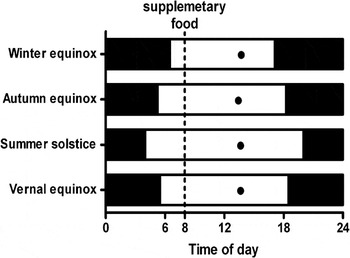
During all four times of the year, activity rhythms of the athletic horses showed a period length of 24 h (χ 2 periodogram analysis). Acrophases were comprised between 1210 h and 1510 h (1337 ± 0006 h, mean ± s.e.) in the vernal equinox; 1350 h and 1445 h (1335 ± 0003 h) in the summer solstice; 1225 h and 1500 h (1324 ± 0006 h) in the autumn equinox and 1315 h and 1440 h (1340 ± 0003 h) in the winter solstice (Figure 3). Two-way ANOVA for repeated measures showed that acrophases did not change either among horses (F (4,260) = 0.08, P > 0.9) or during all times of the year (F (3,260) = 1.53, P > 0.2).
Acrophases of total activity rhythms during vernal equinox, summer solstice, autumn equinox and winter solstice. White and black bars indicate photophases and scotophases. Dotted line indicates hour of supplementary food administration. Note that throughout the year, acrophases always occurred around the middle of photophases.

Discussion
Our results showed the existence of clear daily rhythms of activity during all four times of the year investigated in athletic Thoroughbred horses kept in stabled conditions. Actograms and the distribution of activity over the 24 h underlined the mainly diurnal activity of athletic horses. Our previous investigation in sedentary horses always kept inside their stalls with no physical activity showed robust diurnal activity rhythms (Piccione et al., Reference Piccione, Caola and Refinetti2005). The present results also confirmed studies in Przewalski horses maintained under semi-reserve, in free-living Camargue and in domestically managed Dutch Warmblood foals in which behavioural activities occurred primarily during daylight time (Boy and Duncan, Reference Boy and Duncan1979; Berger et al., Reference Berger, Scheibe, Eichhorn, Scheibe and Streich1999; Kurvers et al., Reference Kurvers, van Weeren, Rogers and van Dierendonck2006).
Athletic Thoroughbred horses had the highest daily amount of activity during the vernal equinox and the lowest during the winter solstice. The highest daily amount of activity during the vernal equinox would depend on the environmental factors such as the increase of photoperiod (Berger et al., Reference Berger, Scheibe, Eichhorn, Scheibe and Streich1999; Arnold et al., Reference Arnold, Ruf and Kuntz2006) and the ambient temperature comprised in the thermoneutral zone (Morgan, Reference Morgan1998). The lowest amount of horse activity during the winter solstice could be related both to the shortest photoperiods and to the lowest temperatures of the year. In winter, horses face away from wind and seek shelter particularly in raining and wet weather (Duncan, Reference Duncan1985; Boyd and Houpt, Reference Boyd and Houpt1994). Furthermore, the reduction of total activity could be part of an over-wintering hypometabolic strategy (Arnold et al., Reference Arnold, Ruf, Reimoser, Tataruch, Onderscheka and Schober2004 and Reference Arnold, Ruf and Kuntz2006).
The highest daily amount of activity in the photophase during vernal and autumn equinoxes could be due to the long photoperiod (≈13 h). Interestingly, the daily amount of activity in the photophase during the summer solstice, time of the year with the longest photoperiods (≈15 h), is lower than during vernal and autumn equinoxes. This result is probably due to the fact that in summer, horses shifted their search for food to the night to avoid disturbance by flying insects and high temperatures (Kaseda, Reference Kaseda1983; Mayes and Duncan, Reference Mayes and Duncan1986; Boyd et al., Reference Boyd, Carbonaro and Houpt1998). Furthermore, in summer, to avoid direct solar radiation, horses often stand in the shade during the warmest parts of the day (Crowell-Davis, Reference Crowell-Davis1994).
The significant increase of activity in the scotophase during the vernal equinox could be due to the oestrous behaviour mainly present in the mares between February and June (Evans, Reference Evans1990). Mares’ reproductive performance shows a seasonal trend. It is influenced by photoperiod, through light stimulation that inhibits the synthesis of melatonin and indolic compounds derived from the pineal gland (McDonald, Reference McDonald1989). In the cow, the oestrous behaviour affects the daily activity rhythm, intensifying the frequency of activities at night (Mattner et al., Reference Mattner, George and Braden1974; Hurnik et al., Reference Hurnik, King and Robertson1975; Esslemont and Bryant, Reference Esslemont and Bryant1976).
In the scotophase, cycles of sleep were interrupted by short activity bouts. As previously observed, these activity bouts had low intensity and ranged from 2 to 15 min (average 7 to 8 min) during which horses lay down in lateral recumbency (Ruckebusch, Reference Ruckebusch1970). Actograms did not give exact information concerning the sleep of the horse or whether it rests in a standing or lying down position (Gill, Reference Gill1991).
Taken together, our results showed that daily and seasonal variations of total activity rhythms in athletic Thoroughbred horses kept in stabled conditions were similar to those previously found either in sedentary horse or in Przewalski horses (E. f. przewalskii) maintained under semi-reserve conditions (Berger et al., Reference Berger, Scheibe, Eichhorn, Scheibe and Streich1999; Piccione et al., Reference Piccione, Caola and Refinetti2005; Arnold et al., Reference Arnold, Ruf and Kuntz2006).
Circadian analysis of horse activities showed that the acrophase, the estimated time at which the peak of the rhythm occurs, did not change during the year. They always occurred in the middle of photoperiod. This result indicates no relationship between the acrophase of activity rhythm and the time of sunrise, which significantly changes during the year. The peak of the rhythm would be determined by the supplementary food always given to the horses one time a day at 0800 h throughout the year. Time of feeding is a potent zeitgeber for peripheral oscillators with only weak synchronizing influence on the SCN clockwork (Damiola et al., Reference Damiola, Le Minh, Preitner, Kornmann, Fleury-Olela and Schibler2000). Under periodic food-availability conditions, this prediction is manifested in anticipatory bouts of locomotor activity and body temperature (Mistlberger, Reference Mistlberger1994; Challet et al., Reference Challet, Pevet, Vivien-Roels and Malan1997; Stephan, Reference Stephan2002). This process seems to be driven by a food-entrainable oscillator independent of the main, light-entrainable clock located in the SCN (Stephan, Reference Stephan2002; Mendoza, Reference Mendoza2007). Our previous investigation in a domestic species, the sheep, demonstrated the strong impact of the periodic food availability on the daily rhythms of total activity (Piccione et al., Reference Piccione, Bertolucci, Caola and Foà2007). However, the present experimental protocol cannot permit to verify whether activity rhythms can be differentially entrained according to distinct, sometimes conflicting, temporal (time of sunrise and feeding) cues. Further researches in horses will point to test the impact of timed restricted feeding on the behavioural circadian organization.
In horses, the time spent grazing depends on the structure and dispersion of patches on which animals prefer to eat. This behaviour occupies the majority of its time and it consists of locomotor activity as well as feeding. In horses, the amount of time spent grazing varies with season, age, sex and herbage availability (Houpt et al., Reference Houpt, Houpt, Johnson, Erb and Yean2001). The daily pattern of grazing is altered when it is necessary to adjust for climatic conditions, and to maintain grazing time and thus food intake. Changes in the daily pattern of grazing, and time spent grazing, are the behavioural response of the animal to the physiological effects of climate and to the amount of feed available (Arnold, Reference Arnold1985).
Our data can be seen as baseline data for athletic Thoroughbred horse management and, possibly, for other breeds managed in a similar manner. Analysing the time structure of long-term and continuously measured activity and feeding could be a useful method to critically evaluate athletic horse management systems in which spontaneous locomotor activity and feeding are severely limited. Circadian rhythms are present in several elements of sensory motor and psychomotor functions and these would be taken into consideration to plan the training schedules and competitions in athletic horses.
Acknowledgements
This work was supported by research grants of the Università di Messina (FF and GP) and of the Università di Ferrara (CB).