Rheumatic heart disease remains one of the leading causes of acquired heart disease worldwide, affecting ~32.9 million people – the majority of whom are young children and adolescents living in low-income countries. 1 Early detection of rheumatic heart disease is critical, as monthly penicillin prophylaxis has been shown to be effective at halting disease progression and limiting further valve damage.Reference Carapetis, Steer and Mulholland 2 – Reference Majeed, Batnager and Yousof 4 Unfortunately, primary screening by patient history and auscultation of rheumatic fever is unreliable and has been shown to have low sensitivity.Reference Marijon, Tafflet and Jouven 5 , Reference Zhang, Mondo and Okello 6 Echocardiography has emerged as a highly sensitive means to detect latent rheumatic heart disease or rheumatic heart disease that has not yet come to clinical attention.Reference Remenyi, Carapetis and Wyber 7 , Reference Beaton, Okello and Lwabi 8 Early models suggest that echocardiographic screening may also be a cost-effective way to detect latent rheumatic heart disease.Reference Zachariah and Samnaliev 9 , Reference Manji, Witt and Tappia 10 The World Health Organisation currently supports early detection of rheumatic heart disease through echocardiography in high-prevalence regions.Reference Carapetis, Paar and Cherian 11 How best to implement widespread echocardiographic rheumatic heart disease screening, however, has not yet been established.Reference Roberts, Colquhoun and Steer 12
School-based echocardiographic rheumatic heart disease screening programmes have been trialled as a means to capture large numbers of asymptomatic children who are at the highest risk for rheumatic heart disease.Reference Beaton, Okello and Lwabi 8 , Reference Webb, Gentles and Stirling 13 Although school-based screening has now occurred on almost every continent, there are scant data on the impact this screening may have on involved communities. Wark et alReference Wark, Hodder and Woods 14 assessed the long-term sequelae of echocardiographic rheumatic heart disease screening by assessing caregiver report of quality of life in an Australian population. They found that caregivers reported a decreased quality of life among children with an abnormal echocardiogram. Perilini et al also examined parental perceptions of screening in New Zealand.Reference Wark, Hodder and Woods 14 They reported that parents showed strong positive support for such programmes. How children and their teachers – people directly affected by the screening process – perceive school-based echocardiographic screening is not known. Answering this question will be critical to identify key strengths and areas for improvement as school-based screening programmes expand. The aim of our study was therefore to assess what students and teachers experience by participating in a school-based echocardiographic screening programme in Northern Uganda.
Materials and methods
A school-based echocardiographic screening programme to determine the prevalence of rheumatic heart disease and the performance of handheld echocardiography machines was conducted in Gulu, Uganda, in October, 2013.Reference Beaton, Lu and Aliku 15 In total, five schools were selected for participation, and research nurses provided classroom-based rheumatic heart disease education to all students attending these schools. Parents of children <8 years of age and teachers provided informed consent, and children >8 years of age provided informed assent as per local standards. A total of 4773 students, aged 5–15, underwent echocardiographic screening. A total of 1412 students had paired standard and handheld echocardiograms, with 1234 being classified as normal (87.4%), 133 as borderline rheumatic heart disease (9.4%), and 47 as definite rheumatic heart disease (3.3%).Reference Beaton, Lu and Aliku 15 Screening results were communicated to the students and to the teachers of younger students immediately following the screening in a private setting, and the head teacher called the parents of these children to report results. Children with borderline or definite rheumatic heart disease were referred for care at the local hospital.
After 8 months, a planned secondary study was conducted to determine student and teacher understanding and perception of the rheumatic heart disease screening programme. The headmaster of each school consented for school participation. Individual consent for participation in this secondary study, as interviews were conducted and results were recorded through de-identified means, was waived through the institutional review board approval from Makerere University, Kampala, Uganda, and Children’s National Medical Center, Washington, District of Columbia.
Each participating school organised a list of children by classroom, age, and gender who had undergone rheumatic heart disease screening the previous October. An age- and gender-stratified sample was then randomly selected to include 5% of the participating students. When a randomly selected child was not present on the scheduled interview day, the master list was consulted and a comparable replacement was selected at random.
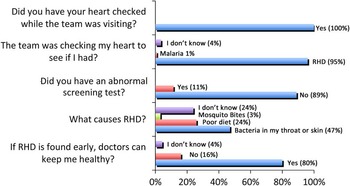
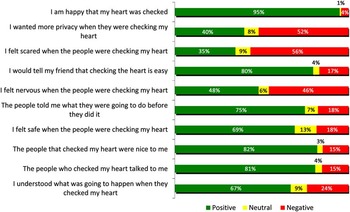
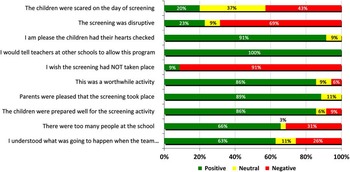
As there were no validated questionnaires to assess rheumatic heart disease knowledge or perceptions of echocardiographic screening, our research team developed three tools for structured interview of patients. The first questionnaire consisted of a five-question multiple-choice assessment to confirm that the interviewee participated in the rheumatic heart disease screening, whether they were found to have a normal or abnormal screening evaluation, and whether they understood the purpose of the screening programme (Fig 1). The second questionnaire used a five-point Likert scale, with 1 indicating a strongly negative response and 5 indicating a strongly positive response, and 10 questions to assess the experience and perceptions of children who had undergone screening (Fig 2). The final component consisted of three open-ended questions aimed at capturing children’s thoughts on rheumatic heart disease screening – the best part, the worst part, and what they would change. Structured interviews were completed in-person by trained community volunteers who were proficient in both English and the local language, Acohli, and responses were recorded verbatim. All teachers who were present for the rheumatic heart disease education and screening were also invited to participate and provide feedback. A similar study tool was developed and distributed to teachers for self-completion and anonymous return (Fig 3). Questions were phrased in lay terms aimed at ease of understanding for children and teachers. Questions were not validated or piloted before use.
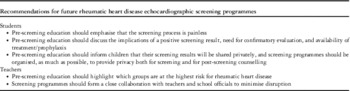
Summary of recommendations obtained from student and teacher survey responses. RHD=rheumatic heart disease.

Students’ experience of school-based echocardiographic screening for rheumatic heart disease (n=255).

Students’ experience of school-based echocardiographic screening for rheumatic heart disease (n=255).

Study data were collected and managed using REDcap – a secure, web-based, electronic data capture tool hosted at Children’s National Health System.Reference Harris, Taylor and Thielke 19 Objective data for both groups were collated and summarised. Responses to multiple-choice questions were reported by percentage. The five-point Likert scale responses were categorised as positive (4, 5) neutral (3) or negative (1, 2) and were reported by percentage. Content analysis was conducted independently by two authors (C.G. and A.D.), looking for keywords and phrases to identified common themes.Reference Meyer, Ritholz and Burns 16 , Reference Perelini, Blair and Wilson 17 A third independent coder (M.P.) adjudicated any disagreement between identified themes. Selected student and teacher comments were chosen to highlight each theme.
Results
A total of 255 children – 4.8% of the originally screened population – were surveyed. The mean age of the study population was 10.7 years (SD 2.5) and 48% were male. Of these children, 224 (87.7%) reported having normal screening echocardiograms, whereas 29 (11.3%) had abnormal screening echocardiograms. Overall, the children had good understanding of the purpose of the screening programme, with 94.5% of them responding that the screening was for rheumatic heart disease, but they had less understanding of the cause and likely prognosis of latent rheumatic heart disease (Fig 1).
Survey questions overwhelmingly showed that rheumatic heart disease screening was well received by students. Almost 95% reported that they were “happy that their heart was checked” and 80% mentioned that they would tell their friends that checking the heart is easy. Questions that asked about feelings related to screening were more mixed, with around half of the students reporting being nervous (48%) or scared (35%) during screening. Only two-thirds of the students (67%) reported understanding of what was going to happen during screening (Fig 2).
Among all, one-third of the teachers who had been present for the school-based screening returned the surveys (n=35). Teachers from every grade level were represented. In total, 94% of the teachers correctly identified that the programme was targeted at rheumatic heart disease, but only 46% correctly identified the cause, with 49% selecting “I don’t know”. Almost one-third (29%) reported that they knew someone with rheumatic heart disease, with similar numbers reporting that they did not (35%) and that they were not sure (36%). Survey responses were universally positive regarding the existence of the screening programme, with 91% reporting that they were “pleased the children had their hearts checked” and 100% answering that they would “tell teachers at other schools to allow this program”. The positivity regarding the specific conduct of the screening was slightly less with only 63% reporting understanding of what would happen during screening, 23% reporting that the screening was disruptive, and 66% reporting that there were too many people at the school during screening days (Fig 3).
Open-ended responses by students and teachers were examined by question to identify key themes.
What was the best part of getting your heart checked/of having the children’s hearts checked?
Overwhelmingly, the most frequent comments from students focussed on joy stemming from confirmation of heart health, or for children who were screened positive the opportunity to find out about rheumatic heart disease before becoming ill (69%). A similar theme emerged from the teachers – with 86% of the responses focussing on the opportunity for screening, particularly that it was free, available to all, and had good follow-up for positive cases.
“I was very happy my heart was checked, and that I know it is working well” (Student, age 9).
“I was happy to know I have rheumatic heart disease, and now remain well and getting treatment” (Student, age 8).
“The thing that was best was that the children found to have disease were brought to the hospital for treatment. It also created awareness in our school about rheumatic heart disease” (Teacher).
“All pupils were screened. The program was for free which helped a lot of parents who do not have money to go to hospital” (Teacher).
The other most common theme that emerged from this question was that children enjoying the process of being screened (16%), particularly the opportunity to “see my heart”, and that they appreciated receiving education and enjoyed interacting with the screening team (9%).
What was the worst part of getting your heart checked/of having the children’s hearts checked?
Despite multiple attempts to elicit responses, 109 out of 255 children (43%) had no specific comment to this question. Those that did respond mostly reported fear and/or anxiety regarding screening (38%), most commonly regarding fear of rheumatic heart disease diagnosis and fear of pain.
“I was scared of the machine they were going to use to check me … that it would hurt” (Student, age 12).
“I thought the doctor was going to tell me that I had rheumatic heart disease” (Student, age 11).
The other theme that emerged from student responses to this question was that they desired more privacy during the screening process (8%), with both anxieties over unrobing and teasing from friends during screening being commonly cited. Interestingly, the students who expressed concerns were equally divided between sexes (23.0% males versus 28.2% females) and ages (26.6% of 6- to 11-year-olds versus 24.6% of 12- to 15-year-olds).
“I was fearing that my friend would see my check” (Student, age 12).
“The worst thing was that my friends were laughing at me” (Student, age 7).
Among children who had positive screening studies, 31% (nine) reported that “having rheumatic heart disease” was the worst part of the screening. Teachers also echoed this sentiment with 25% reporting the worst part of the screening was having children who were diagnosed with rheumatic heart disease.
“Some children who were found to be having the disease were very scared because they thought they were going die” (Teacher).
Teachers also emphasised two unique themes – the long waiting times for children during screening days (23%) and their dissatisfaction that the screening was not offered to teachers or the broader community (26%).
“Children were many, and the doctors were few” (Teacher).
“The community and the teachers was very much interested in the examination but not allowed” (Teacher).
If I could change something about the way my heart was checked/the way the screening was conducted it would be…
Again, a substantial proportion of children (62%) and teachers (37%) did not have any suggested changes. Among those who gave ideas, similar themes emerged, with students and teachers most commonly emphasising greater inclusion – citing a desire for more widespread screening of the population, more frequent screening, and addition of screening for other health conditions (students 17%; teachers 45%).
“I liked the way they check us but they should keep on checking us” (Student, age 13).
“Extending the screening to every member of the community, teachers, schools around, and other institutions” (Teacher).
A summary of recommendations for screening programme improvements is provided in Table 1.
Summary of recommendations obtained from student and teacher survey responses.

Discussion
Rheumatic heart disease has long been a target of community-based screening programmes, as there is commonly a substantial latent period between the first episode of acute rheumatic fever or rheumatic heart disease and presentation with advanced rheumatic heart disease. 18 In the last decade, there has been a shift away from clinical screening programmes, which have shown to have poor sensitivity and specificity,Reference Carapetis, Steer and Mulholland 2 and increased focus on echocardiographic screening.Reference Beaton, Okello and Lwabi 8 , Reference Roberts, Colquhoun and Steer 12 Data on the echocardiographic prevalence of rheumatic heart disease now exist from over a dozen countries, and in 2012 the first evidence-based criteria for echocardiographic screening were published.Reference Remenyi, Carapetis and Wyber 7 In a detailed analysis in 2013, Roberts et alReference Roberts, Colquhoun and Steer 12 concluded that echocardiographic screening for rheumatic heart disease met most of the criteria set forth by the 1994 Council of Europe criteria for selecting diseases suitable for screening. Nevertheless, one specification – that the screening test, in this case echocardiography, be “acceptable to the person screened” – has received little formal evaluation.
In this study, we assessed the experience of echocardiographic rheumatic heart disease screening through the eyes of the children and teachers who participated in a large, school-based screening programme in Gulu, Uganda. This study was a planned follow-up to our larger screening programme and intended to understand student and teacher experience with rheumatic heart disease screening.Reference Beaton, Lu and Aliku 15 Our ultimate goal with this analysis was to gain insight into what echocardiographic screening was like for a child living in a low-resource, rheumatic heart disease endemic area and to use this knowledge to improve future screening protocols.
Overall, both teachers and students perceived school-based echocardiographic rheumatic heart disease screening positively. Over 80% of the students mentioned that they would recommend screening to a peer and 100% of the teachers mentioned that they would recommend participation to other schools. These findings are similar to parental perception of screening, recently published by Perilini et al, which found that there were no negative comments from parents or caregivers of children with both normal and abnormal screening echocardiograms.Reference Zhang, Mondo and Okello 6 , Reference Perelini, Blair and Wilson 17 Furthermore, in that study, all parents and caregivers were supportive of ongoing screening efforts. Although these did not include an assessment of the reasons for positive perception, such as access to free medical care or approval for a specific screening approach, future studies into acceptability may benefit from including this variable in their assessment.
The opportunity to interact with screening staff and receive education regarding rheumatic heart disease was seen as a highlight by both teachers and students. An overwhelming majority (94.5%) of students correctly identified that the goal of the echocardiographic screening was to identify rheumatic heart disease; however, there was less understanding regarding the cause of rheumatic heart disease and its long-term prognosis. In addition, a few teachers understood the cause of rheumatic heart disease, revealing that teacher education – not just student – should be included in future screening programmes. The study published by Zapka et al regarding follow-up of abnormal cancer screening results highlighted that the importance of clear communication regarding risks, test choice, and results was key to ensuring adequate follow-up.Reference Zapka, Taplin and Price 20 Future programmes could likely be strengthened by expanding pre-screening education regarding risk factors for the development of rheumatic heart disease and long-term sequelae of disease. Furthermore, many students and teachers expressed altruistic desire to include other community members in the screening programme. Improving education regarding who is at the highest risk for rheumatic heart disease could help address these concerns.
Our data revealed multiple opportunities for improvement and refinement of the pre-screening educational curriculum. Although many students were happy to have participated in the screening process, there were still students who reported feeling fearful or nervous about participating. Improved education, targeted at children’s specific identified fears, such as pain, implications of diagnosis, etc., could help prevent such pre-test anxiety and may reduce the peer-to-peer teasing that was reported. Another common fear was surrounding the implications of a positive screening result. In the open-ended questions, some students were fearful that having a positive echocardiogram screen meant that they were going to die. This clearly is an opportunity for improved education before undergoing screening and/or during patient counselling after disclosing screening results.
In addition, concerns surfaced related to the speed and size of the studied screening programme. Despite efforts to separate boys and girls and to give results in a confidential manner, children identified a lack of privacy as a significant concern. In the case of a large-scale screening (almost 5000 patients in 1 week), privacy was largely limited by practical issues such as space, speed of screening, and the physical environment. Ongoing school-based screening programmes would likely occur on a smaller scale, creating the space for improved privacy, which should be emphasised. Similarly, a small proportion of teachers felt that screening was disruptive, which may have been a factor of the size and intensity of the studied programme. Future programmes should work closely with teachers and school administrators to organise screening in a manner that minimises disruption.
Limitations
Our study does have several limitations. The questionnaire was administered in a single population, which may have unique cultural and social beliefs regarding disease screening, and therefore may not be applicable to broader populations. Almost half of the students and slightly more than half of the teachers responded “nothing” or “none” to the two open-ended questions regarding the negative aspects of the study, limiting our ability to truly assess their feelings on this subject. This low response rate occurred despite eliminating any language or cultural barriers by having community volunteers conduct the surveys. Future studies would benefit from exploring why there was a decreased response rate to open-ended questions. In addition, only 35 teachers, or one-third, responded, and this group may contain some selection bias, as all were invited to participate. The study was not powered to detect differences between children who were screen positive and those who were screen negative, and specific follow-up questions regarding the counselling and referral process for positive screens would be helpful in future programme planning. Finally, the questionnaire was conducted 8 months after the initial screening. Although, on the positive side, this may allow for more careful reflection of the experience, this interval could also introduce substantial recall bias.
Summary
Echocardiography-based screening programmes for rheumatic heart disease offer the opportunity for early disease detection, but the perception of screening to those closest to the process has not been studied. We found that both students and teachers reported positive experience with school-based echocardiographic rheumatic heart disease screening, with a majority responding that they would recommend participating in screening to their peers. This study identified several important topics such as fear of the screening and diagnosis of rheumatic heart disease, which could effectively be addressed through improved pre-screening education, and showed that education of the school faculty, in addition to the students, could improve screening perception and help establish realistic expectations as to the scope of screening. As echocardiographic rheumatic heart disease screening programmes evolve, it will be important to integrate these findings and to study the perceptions of screening in diverse populations and screening models, as well as investigate issues specific to a screen-positive population.
Acknowledgements
The authors acknowledge their rheumatic heart disease study nurses, schoolchildren, teachers, and parents of Gulu, Uganda, for their participation and dedication to the completion of this study.
Financial Support
This work was supported by the National Institutes of Health National Center for Advancing Translational Sciences (grant numbers UL1TR000075 and KL2TR000076). Its contents are the responsibility of the authors and do not necessarily represent the views of the National Center for Advancing Translational Sciences or the National Institutes of Health. This work was also completed through the support of General Electric, who provided the echocardiography equipment used for initial study completion.
Conflicts of Interest
None.
Ethical Standards
The authors assert that all procedures contributing to this work comply with the ethical standards of the Belmont Report and with the Helsinki Declaration of 1975, as revised in 2008, and has been approved by the institutional committees of Children’s National Health System (Washington, District of Columbia, United States of America) and Makerere University (Kampala, Uganda).