INTRODUCTION
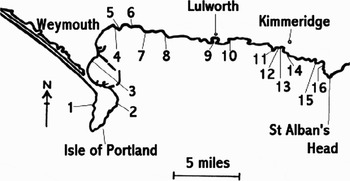
The loss of Osilinus populations in 1963 from East Dorset and, with the exception of Clay Ope (Site 1, Figure 1) on West Portland, from westwards into Devon, was the result of a single event: the extreme cold period with easterly winds of the early months of that year (Hawthorne, Reference Hawthorne1964, Reference Hawthorne1965). Subsequently, a sparse population, similar to that before 1963, was established in East Dorset as populations recovered west of the Isle of Portland (Hawthorne, Reference Hawthorne1971). More recently an increase in some East Dorset populations at the turn of the century led Hawthorne & Wiffen (Reference Hawthorne and Wiffen2007) to assess population sizes at East Dorset sites in 2004. They concluded that the increases in populations between Portland Harbour and White Nothe (Site 8, Figure 1) were the result of the establishment of a breeding population at Western Ledges (Site 3, Figure 1) in Portland Harbour.
Location of sites recorded in this report. Identification of the sites is given in Table 1.

This paper documents the continued population rise between Portland Harbour and White Nothe as assessed in 2008.
MATERIALS AND METHODS
The tidal regime between the Isle of Portland and Chapman's Pool (Site 16, Figure 1) gives a first low water of spring tides at about noon GMT and a second low approximately three and a half hours later. Surveys took advantage of this long period of exposure of the shores, most being made during the low spring tide period in the months of June and August of 2008. Searches for 2008 cohort juveniles were made from August 2008 through to January 2009. Kimmeridge shores (Sites 11–13, Figure 1) were surveyed in the mid-day period a few days before spring tide. The western Lulworth Cove beach (Site 9, Figure 1) was surveyed in October 2008. The site at Folly Pier, East Portland (Site 2, Figure 1) was surveyed in July 2009; those at Egmont Point (Site 15, Figure 1) and Chapman's Pool in September 2009 and that at Redcliff Point (Site 5, Figure 1) in November 2009. Any juveniles from the 2008 cohort in 2009 surveys were not included in the results except as evidence of breeding.
East Dorset beaches that support Osilinus populations are variable in nature. A method of recording that is appropriate at one site may not be for another. Methods have been chosen to allow repeat counts to be made at each site to show population changes with time per site. Large populations have been assessed by using 0.25 m2 quadrats and the results converted to numbers per m2 to give ACFOR scores (Southward & Crisp, Reference Southward and Crisp1954). Scattered populations as at White Nothe and most smaller populations have been counted by timed searches. Searches were generally of three minutes duration but the time periods varied according to the nature of local habitats and the status has been recorded as the average number of individuals found per minute. At the eastern limit of range the total number found was recorded.
The age of some individuals was assessed by counting shell growth checks and measuring maximum basal diameter as in Hawthorne & Wiffen (Reference Hawthorne and Wiffen2007). Annual growth rings were counted on the opercula where possible. East Dorset juvenile snails typically show four fine circular lines on the operculum at one year. The fourth of the innermost fine rings at about 4 mm diameter was therefore taken as Year 1 for individuals where rings were clear enough to be counted.
On most search days significant numbers of the Osilinus were tucked under stones and rocks. Turning was necessary to get reasonably accurate counts. The differing nature of the shores caused the number found in three minutes to be affected by the amount of turning. Scores reflect the density of populations and are directly comparable on repeat counts at particular sites but are not necessarily valid parameters to compare different sites. Potential nursery areas were included in searches to identify the presence of juveniles which were most frequently found underneath small stones and rocks. The sites referred to in this report are shown in Figure 1.
Two criteria were used to identify breeding populations. In the late summer and autumn of years since 2004, newly settled Osilinus of 10 mm or less in basal diameter were common in shallow upper shore pools at Western Ledges. These pools are the nursery areas for Osilinus at Western Ledges. Finding 2007 cohort juveniles of 10 mm maximum basal diameter or less in three-minute searches at other sites has been used as one criterion of a breeding population at those sites. Hawthorne & Wiffen (Reference Hawthorne and Wiffen2007) discussed the role of clustering in stimulation of gamete release, referring to the work of Desai (Reference Desai1966). Fretter & Graham (Reference Fretter and Graham1962) referred to female spawning in trochids being stimulated by males. Groups of four or more adult snails each of which is at most 5 cms from another were recorded as clusters and indication of the possibility of reproductive activity. Clustering in the months of May to August has been used as a second criterion of a breeding population.
RESULTS
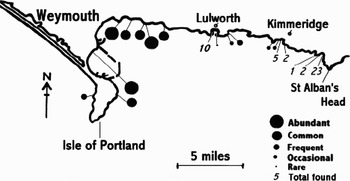
The assessments of the status of the 2008 populations of Osilinus are summarized in Figure 2.
Status of Osilinus lineatus populations in East Dorset, 2008.

The relatively small area of suitable habitat at Redcliff Point was not visited in 2008. When visited in November 2009 it had a dense population of snails of mixed age groups with Year 1 individuals (2008 cohort) common. There were opportunities for clustering, suitable habitat for nurseries for first year development and juveniles were found easily.
In 2004 the Osmington Mills population (Site 7, Figure 1), although of mixed age groups, was too small to allow clustering and it was difficult to find juvenile individuals in the autumn. Since 2006 the population has become large enough to give clusters of up to ten individuals. In July 2008, clustering of six or more individuals in contact or closer than 5 cms, was observed on the tops of small boulders protruding above the fresh water of the stream at low tide. In November 2008, Year 0 Osilinus were found at the rate of two per minute in nursery areas.
The large population at White Nothe was scattered over an extensive field of boulders and most Osilinus were at least one metre away from their nearest neighbour when assessed in June 2008. Three-minute counts were made in areas where there were age groups from Year 1 to Year 7 to record Year 1 frequency. These yielded 1 of 114; 4 of 92 and 4 of 88. A one hour search in September 2008 including probable nursery habitat yielded only two Year 0 Osilinus. Large numbers of Littorina littorea of less than 5 mm basal diameter indicated good local settlement conditions.
Twenty-three individuals at Chapman's Pool were reported by other observers in February 2009. They were of mixed ages and were in an area of relatively small boulders to the east of the slipway. The author found only four of these Osilinus on visits which were made in September 2009 after significant onshore wave action. The size of the boulders was too great to be able to search for dislodged specimens. These four were assessed as belonging to the 2006, 2004 and 1998 cohorts according to maximum basal diameter, growth checks and in two specimens, operculum rings. Some of the individuals now recorded were not seen in the limited search made at Chapman's Pool for the 2004 survey. Two Osilinus on a small amount of suitable habitat on the west side of Chapman's Pool were assessed as cohorts of 1998 and 2003 by basal diameter, growth checks and operculum rings. An Osilinus at Egmont Point was assessed to be of the 2003 cohort by the same methods.
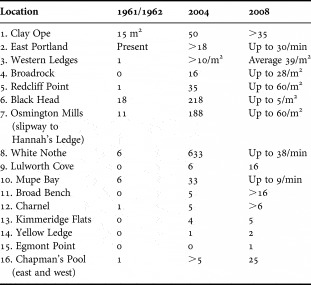
Increase in the numbers recorded between 2004 and 2008 of most of the East Dorset populations, compared to the numbers recorded in 1961 and 1962 is shown in Table 1.
Minimum numbers of Osilinus lineatus assessed at East Dorset locations. The position of each site is indicated by a number as shown in Figure 1. Large populations were assessed using 0.25 m2 quadrats. The scattered White Nothe population and smaller populations were assessed in timed counts; mostly of three minutes but averaged to individuals per minute. Single figures indicate the maximum number found.

min, minute.
DISCUSSION
Isolated groups of Osilinus have shown that suitable conditions for their growth and survival have existed on shores east of the Isle of Portland since before 1963 (Hawthorne, Reference Hawthorne1965). The limiting factors for Osilinus in East Dorset have been the relatively small areas of shore with suitable Osilinus habitat and the difficulty for larvae to survive the journey past Portland Bill and then get swept in to suitable shores. The eastern distribution limit of small groups of individuals in 1961 was Chapman's Pool. The most easterly breeding population was at Clay Ope, Isle of Portland. The pattern of small numbers of larvae settling along the east shores of Dorset to give the distribution of adults recorded before the 1963 winter has been repeated following recovery of populations. In recent times (Hawthorne, Reference Hawthorne2002) wind and tidal conditions are believed to have been suitable for small numbers to settle in most years as is shown by the small populations east of White Nothe.
The oldest individuals at the new site in the Fleet were assessed as of the year 2000 cohort (Hawthorne & Wiffen, Reference Hawthorne and Wiffen2007). Osilinus first breed at two years old (Desai, Reference Desai1966) and the 1998 cohort is the oldest cohort found at Western Ledges. This cohort is represented as far as Chapman's Pool in the populations sampled for 2008.
The population at Western Ledges in Portland Harbour is the first breeding population of Osilinus recorded east of the Isle of Portland (Hawthorne & Wiffen, Reference Hawthorne and Wiffen2007). The increase in population size of Osilinus at its eastern English Channel limit has been described as being a result of climate warming (Mieszkovska et al., Reference Mieszkovska, Hawkins, Burrows and Kendall2007). In their account of the distribution of Osilinus on East Dorset shores in 2004, Hawthorne & Wiffen (Reference Hawthorne and Wiffen2007) described the increase in the local populations as being the result of a single event; the establishment of the Western Ledges breeding population. Hawthorne & Wiffen (Reference Hawthorne and Wiffen2007) suggested that the build up of the population size at Osmington Mills and White Nothe would give rise to other breeding populations.
It was demonstrated in the 2004 study (Hawthorne & Wiffen, Reference Hawthorne and Wiffen2007) that recruitment to White Nothe and other populations between White Nothe and Weymouth was statistically different from that of the populations further to the east. It was concluded that the unprecedented rise in Osilinus populations between Portland Harbour and White Nothe was due to spread of larvae from the new breeding site at Western Ledges in Portland Harbour. Periods of slack tide and the generally low tidal currents of Weymouth Bay (Bruce & Watson, Reference Bruce and Watson1998) enable westerly and south-westerly winds to drift Portland Harbour larvae eastwards. Two new breeding sites have been identified in this study, one of which is Osmington Mills. There was no evidence in 2008 that the White Nothe population had achieved a density that would allow breeding.
The upper shore nursery habitats of most Dorset rocky beaches are periodically affected by mud from landslides and cliff collapse. At these times recruitment to these beaches is not possible. In 2008 the Western Ledges site was affected by deposition of sand which made some past nursery areas unsuitable for small gastropods. Persistent mud at Egmont Bight east of Chapman's Pool appeared responsible for the rocky beach being an algal haven with even winkles and limpets being absent.
A review of the factors affecting the dispersal of Osilinus larvae past Portland Bill and then to East Dorset shores, explaining how the recent population changes have occurred, is in hand.
CONCLUSIONS
Hawthorne & Wiffen (Reference Hawthorne and Wiffen2007) proposed that further increase of the Osmington Mills and White Nothe populations of 2004 would lead to the establishment of more breeding populations on East Dorset shores. This survey of the East Dorset Osilinus populations of 2008 recorded densities up to 60 m2 at the sites of Redcliff Point and Osmington Mills. The density of adults allowing clustering and the numbers of juveniles that can be found in three-minute searches of nursery areas, justify adding these two sites as East Dorset breeding populations to the first breeding colony of Western Ledges.
The manner of the continued increase of numbers on shores east of the Isle of Portland as recorded in this study, suggests that this increase is the result of the establishment of the breeding population at Western Ledges in Portland Harbour. The distribution of small groups of Osilinus east of White Nothe as illustrated by Hawthorne & Wiffen (Reference Hawthorne and Wiffen2007) is the same as before 1963.
The population at White Nothe has continued to increase but there is no evidence that it achieved breeding status by 2008. Recruitment to sites east of White Nothe has remained low and shows that in some years small numbers of Osilinus larvae have continued the long standing pattern of small numbers of larvae travelling from Lyme Bay sites quickly enough to reach East Dorset sites before metamorphosis.
ACKNOWLEDGEMENTS
Thanks are due to Lin Baldock; Katherine Dawson and staff at the Fine Centre, Purbeck Marine Wildlife Reserve for reports of Purbeck Coast Osilinus and to Laura Wiffen with assistance in shore surveys and the production of this paper. The author is most grateful to two anonymous referees for their care and attention to an early and subsequent drafts and whose advice was much appreciated. Any shortcomings in this report are entirely the responsibility of the author.