Introduction
The clam, Tapes decussata (L.), a common lamellibranch of the Mediterranean coast, has been for centuries a very desirable species of high market value. Accordingly, it has been the subject of many investigations, in particular in parasitology. This bivalve can shelter various species of Protozoa and metazoan parasites. Among the Metazoa, digenean parthenitae are the most frequent parasites. This mollusc play, a very important role in the life cycle of several of these platyhelminths (Bartoli, Reference Bartoli1965, Reference Bartoli1972, Reference Bartoli1973, Reference Bartoli1981, Reference Bartoli1982, Reference Bartoli1983, Reference Bartoli1984; Hanafy et al., Reference Hanafy, Gab-Alla and Hassanine1997, Gargouri Ben Abdallah, Reference Gargouri Ben Abdallah2001; Gargouri Ben Abdallah & Maamouri, Reference Gargouri Ben Abdallah and Maamouri2001, Reference Gargouri Ben Abdallah and Maamouri2005; Trigui El Menif et al., Reference Trigui El Menif, Gargouri Ben Abdallah and Le Pennec2004). Tapes decussata represents the first intermediate host and also, in certain cases, the second host.
During our research on the digenean parthenitae in bivalves found on the Tunisian coasts, we collected four species belonging to four distinct families from T. decussata: sporocysts and cercariae of Bucephalus labracis Paggi and Orecchia, 1965 (Bucephalidae) and Cercaria lata Lespés, Reference Lespés1857 (Faustulidae); and metacercariae of Lasiotocus longicystis Bartoli, Reference Bartoli1965 (Monorchiidae) and Gymnophallus fossarum Bartoli, Reference Bartoli1965 (Gymnophallidae). In this paper, we limit our study to the sporocysts and cercariae of C. lata. As indicated in the literature, this cercaria has been generally believed to be the same as the others collected from various bivalve hosts. We carried out a comparative study with another faustulid cercaria found in Donax trunculus which has a strong morphological similarity to C. lata.
Materials and methods
The study was conducted on T. decussata from the Bizerte (4460 specimens) and Tunis (3790 specimens) lagoons (north-eastern Tunisia) and the gulf of Gabes (1546 specimens) (south-eastern Tunisia). Samples were collected at approximately monthly intervals. The lagoon of Bizerte, which is of sandy-clay to clay-silt-sandy facies, is rather deep (12 m) (Soussi et al., Reference Soussi, Levy and Zaouali1983). The lagoon of Tunis, where bottom sediments consist of muddy fine sand, shelly particles and organic matter, is variable in depth (1–4.5 m) (Jouirou, Reference Jouirou1982). The annual mean water temperature of these two lagoons is 18.2°C. Annual mean salinity is 37.7‰ for the lagoon of Tunis and 34‰ for the lagoon of Bizerte. The gulf of Gabes is characterized by sandy-muddy bottom sediments (Amari, Reference Amari1984), an annual mean temperature of 20.5°C and an annual mean salinity of 38.68‰.
The lamellibranchs collected were placed in small aquaria, which were examined daily with a binocular microscope to detect spontaneous cercarial emergence. Each infected mollusc was then kept in its own aquarium. The number of cercariae produced daily was counted. The experiment was subjected to natural lighting conditions only, except during the period when cercariae were counted under artificial light. If these examinations appeared negative, after 15 days the molluscs were dissected to detect the possible presence of young sporocysts. The parasites collected were studied directly in vivo under a stereomicroscope.
The nomenclature used in the analysis of the frequencies of the larval-stage parasites according to the seasons and collecting sites follows Margolis et al. (Reference Margolis, Esch, Holmes, Kuris and Schad1982) and Bush et al. (Reference Bush, Lafferty, Lotz and Shostak1997).
In order to compare C. lata collected from T. decussata with another faustulid found in D. trunculus, we examined 2062 specimens of the latter bivalve collected from Kalâat El Andalous (situated at 35 km to the north-east of Tunis, with sandy facies, mean salinity of 37‰ and mean temperature of 18.9°C (El Arrim, Reference El Arrim1996)).
The following features of the cercariae were measured (μm): body length (BL), body breadth (BB), tail length (TL), setae bundles length (SBL), length of oral sucker (LOS), breadth of oral sucker (BOS), length of ventral sucker (LVS), breadth of ventral sucker (BVS), pharynx length (PL), pharynx breadth (PB), length of oesophagus (OEL), length of caeca (CL). All measurements were transformed by being divided by the body length to remove the effect of the size. Length itself was not used as a variable in the final analysis.
To determine the multivariate relationship between 12 variables on 60 cercariae (30 from T. decussata and 30 from D. trunculus) a principal components analysis (PCA) was applied.
Results
Sporocysts
Mother sporocysts
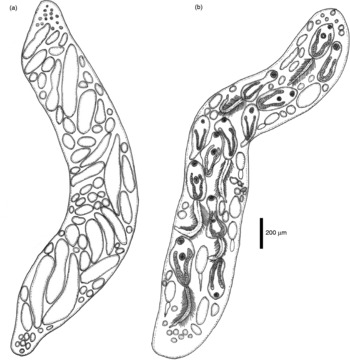
White sporocysts, sausage-shaped, measuring 2600 μm (2100–3800 μm) in length and 361 μm (245–463 μm) in width, were observed in the gonads of T. decussata. Each sporocyst harboured 20–26 immature daughter sporocysts and some germinal balls located at the periphery. No birth pore was observed in the mother sporocysts (fig. 1a).
Mother (a) and daughter (b) sporocysts of Cercaria lata.

Daughter sporocysts
Sporocysts, 2359 μm (1450–3600 μm) long and 337 μm (200–420 μm) wide, enclosing cercariae, infected gonadal tissues and sometimes the digestive gland. The number of cercariae varied according to the maturation of the sporocyst. Small sporocysts contained 4–8 cercariae and large sporocysts contained 11–17 cercariae. The colour of these sporocysts varied. The brown young sporocysts changed into an orange colour when the cercariae complete their development. No birth pore was observed in these sporocysts. However, on one side of the daughter sporocyst, a lysed area was detected, the opposite side being perfectly intact (fig. 1b). The emergence of the cercariae is affected, undoubtedly, by the rupture of the lysed wall of the daughter sporocyst. The number of daughter sporocysts, which was often very high (exceeding 500 specimens), caused severe disruption, such as the castration or death of the mollusc. The heavily parasitized gonads were completely invaded by the sporocysts and, lacking sexual cells, the determination of the sex of the host was not possible. The death of parasitized molluscs occurred before the total emergence of the cercariae. The development of the larval stages was, therefore, achieved at the expense of the parasitized host. The parasite diverts the metabolic activities of the mollusc for its own gain. Théron et al. (Reference Théron, Mone and Gerard1992) showed that the parasitism of the mollusc Biomphalaria glabrata by Schistosoma mansoni Sambon, 1907 is not accompanied by an increase of the trophic activity of the mollusc, since the high quantity of energy consumed by the parasite is appropriated from the mollusc. This capture of energy prevents the survival of the mollusc.
Similar results were found with Dresseina polymorpha (Pallas, 1771) following their colonization by the sporocysts of Bucephalus polymorphus Baer, 1827 (Vom Scheidt, Reference Vom Scheidt1984). In the same way Coustau et al. (Reference Coustau, Renaud, Delay, Robbins and Mathieu1991) showed that the sporocysts of Prosorhynchus squamatus Odhner, 1905 caused the castration of the mollusc Mytilus edulis Lamark, 1919 by releasing a factor that stimulates the mobilization of glycogen and inhibits the division of sexual cells.
The spatio-temporal distribution of the sporocysts
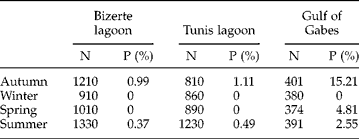
In the north-east of Tunisia, molluscs containing sporocysts were collected in summer and autumn. In the gulf of Gabes, they were absent only in winter. The highest prevalence of infection was recorded in autumn for the all stations (table 1). However, these larval stages were more frequent in the gulf of Gabes and appeared more precociously (table 1). This may be due to the temperature of the water, which is slightly higher in the south of Tunisia. However, the higher summer temperature in this area can limit the longevity of the free larval stage (miracidia) and consequently reduce the rate of infestation of molluscs. Salinity also seems to influence the prevalence of these sporocysts. Indeed, there is a clear correlation between the increase in salinity and the increase in the rate of parasitism. The lowest prevalence was observed in the lagoon of Bizerte, prevalence was greater in the lagoon of Tunis and was greatest in the gulf of Gabes, the area with the highest salinity. The hydrodynamism of this locality can also have an impact on the variation of these values. This factor, more important at sea than in the lagoons, plays a fundamental role in the displacement and the dispersion of the infesting stages and thus in their contact with the host. This variation can also be the result of the availability, in the prospected areas, of the second intermediate host and the susceptible final host.
Seasonal frequencies of Cercaria lata Lespés, Reference Lespés1857 from the three collecting sites.
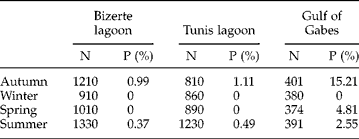
N, Number of molluscs examined; P(%), prevalence.
Cercaria
Morphology
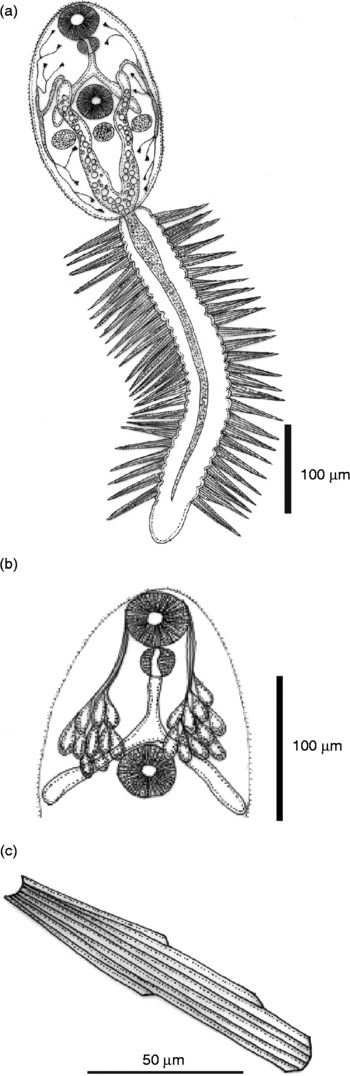
A fully developed cercaria released from a sporocyst, with oval body and trichocercous tail, is shown in fig. 2a. The tegument is armed with spines arranged on the entire surface of body; dense spines covering the forebody become more sparsely distributed on the hindbody.
Cercaria lata from Tapes decussata (a) showing cephalic glands (b) and bundle of setae (c).

Spherical oral sucker subglobular; ventral sucker, slightly smaller than oral sucker, approximately in middle of body. Cephalic glands (fig. 2b), 8–10 pairs, on each side of oesophagus, reaching anterior margin of ventral sucker; ducts run laterally to pharynx and opening beside oral sucker. Digestive system including mouth located at base of oral sucker, muscular ovoid pharynx followed by oesophagus bifurcating anterior to acetabulum. Cylindrical caeca reaching to level of testes.
Testes symmetrical postacetabular. Spherical ovary situated postacetabular and on median axis of body.
Excretory vesicle Y-shaped with long arms reaching anterior to intestinal bifurcation. Two lateral collecting ducts opening into anterior extremity of bladder. Bladder containing up to about 60 excretory corpuscles immersed in clear liquid. Flame cell formula: 2[(2+2)+(2+2)] = 16.
Tail tubule communicating with bladder. Surface of tail lacking spines provided with annular folded membranes. Twenty-five pairs (24–27) of setae bundles arranged laterally along the tail. Each bundle (fig. 2c) generally bearing 7–8 rib-like supports (rarely 9) joined by a fine membrane. Tail lacking flame cell.
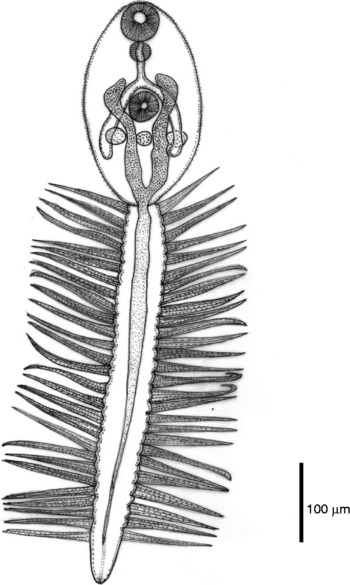
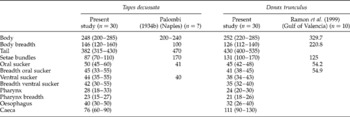
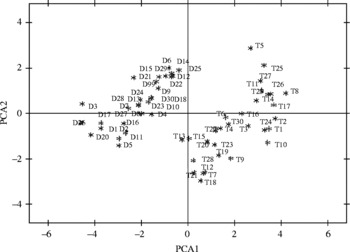
Cercaria lata appears to be closest to the faustulid cercaria found in D. trunculus (fig. 3). In order to determine whether or not these forms were distinguishable morphologically, a principal components analysis (PCA) was carried out using metrical data (table 2) from 60 specimens. The results of the first two components (fig. 4), which explain 70.76% of the variance, indicate that the cercariae separated out clearly on the second axis (PCA2). There was also a slight separation between specimens on the first axis (PCA1). PCA of the characters analysed shows that those which had the highest coordinates, and therefore contributed most to the first axis were: body breadth (BB), length of oral sucker (LOS), breadth of oral sucker (BOS), length of ventral sucker (LVS), breadth of ventral sucker (BVS), pharynx length (PL), pharynx breadth (PB), and oesophagus length (OEL). The characters that contributed to the second axis (PCA2) were body length (BL), tail length (TL), setae bundles length (SBL), and caeca length (CL). This PCA shows that multivariate morphological features of the cercariae indicate that there are two types in Tunisian waters.
Cercaria pectinata from Donax trunculus.

Measurements (μm) of cercariae harvested from Tapes decussata and Donax trunculus collected from Tunisian coast and other localities; all measurements are lengths unless stated; the numbers in brackets are ranges.

Principal components analysis using metrical data of 60 cercariae (30 from Tapes decussata (T) and 30 from Donax trunculus (D)).

Behaviour
Emerged cercariae (200–300/day) are characteristically positively phototactic. Changing the position of the light source generates a new regrouping of the cercariae. After emergence from the mollusc, these larvae quickly leave the bottom of the container to reach the surface of the water then plunge again. These vertical movements, between the bottom and the surface of the water, seem to be related to the search for the second intermediate host, probably a planktonic animal. The powerful tail propelling the body of the cercaria moves in a spiral. Swimming is intermittent and during the pauses the tail is folded along the ventral face of the body. The life-span of the cercariae is approximately 5–6 h at 15°C. An increase of temperature (to 20–22°C) shortens their survival to a few minutes. Cercariae sink to the bottom of the container. The cercarial body shows slow contractions, the tail stops moving and in a few minutes is detached. The body then rests on the bottom and dies without encysting.
Discussion
The non-oculate C. lata developed in T. decussata (Bivalve, Veneridae) extracted from the lagoons and the gulf of Gabes, possessing a spined tegument, a trichocercous tail without furcae, provided with bundles of setae described as being rib-like, with about 7–8 setae joined by a membrane, and a Y-shaped excretory system, belongs to subfamily Baccigerinae (sensu Bray, Reference Bray1988). On the basis of molecular, morphological and life cycle data, Hall et al. (Reference Hall, Cribb and Barker1999) removed the subfamily Baccigerinae from the Fellodistomidae and promoted it to familial status. The Baccigerinae Yamaguti, 1959 was considered as the junior synonym of the Faustulidae, Poche, 1926.
Cercaria lata was first described by Lespés, Reference Lespés1857 in the same mollusc taken from the basin of Arcachon. The original description of this cercaria, limited to the digestive system and some elements of the excretory system, lacks any relevant information on the cephalic glands, the reproductive system, the number of flame-cells, the setae bundles and the rib-like supports of C. lata.
Later, Palombi (Reference Palombi1934a) found in T. decussata, collected from Naples, a ‘Steringophoridae’ cercaria and considered it Bacciger bacciger. This was based only on the morphological similarity of the larval stage with the adult, and the life cycle of this species was described as: cercariae after escaping from sporocysts parasitizing the first intermediate host, T. decussata, penetrate and encyst as metacercariae in the Amphipoda Erichthonius difformis, and develop into adults in the alimentary tract of Atherina spp. Later, Palombi (Reference Palombi1934b, Reference Palombi1940) and Dolgikh (Reference Dolgikh1968) reported cercariae which appear to be the same species in other bivalve hosts (Venerupis aurea (Veneridae), Chamelea gallina (Veneridae), Donax vittatus (Donacidae) and Barnea candida (Pholadidae)) and also attributed them to Bacciger bacciger. Recently, Ramon et al. (Reference Ramon, Gracenea and Gonzalez-Moreno1999) reported sporocysts and cercariae of Bacciger bacciger in D. trunculus (Donacidae). The number and variety of bivalves recorded as first intermediate host casts some doubt on the conspecificity of all these cercariae.
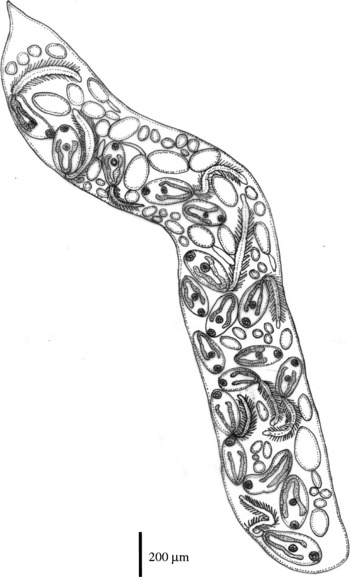
On the Tunisian coasts, in addition to finding C. lata in T. decussata, we have found another faustulid cercaria in D. trunculus. This cercaria presents a strong morphological similarity to C. lata but it differs in some measurements, in particular those of the tail, the setae bundles and the caeca. To test the significance of these differences, we submitted the morphometric features to principal components analysis. This analysis has demonstrated that the cercariae of T. decussata and D. trunculus are distinct. Another difference worthy of notice regards the spherules in the excretory vesicle. With about 60 in C. lata, these spherules are more numerous and much smaller than in the other cercariae. The number of cercariae within the sporocyst, their emergence behaviour, the size and seasonal incidence are also different. In fact, fewer cercariae (varying from 4 to 17) are found in the sporocysts of C. lata than in the sporocysts from D. trunculus (8–22) (fig. 5). In addition, the size of the sporocysts from Tapes (at 1450–3600 μm) is slightly smaller than those from Donax (at 1700–4200 μm). Cercaria lata emerges from the sporocyst by the rupture of the lysed wall; however, cercariae of the other species leave the sporocyst via the birth pore. The highest prevalence of infection was recorded in autumn in T. decussata and in summer in D. trunculus. Parasites were absent in winter and spring from T. decussata and only in winter from D. trunculus.
Sporocyst of Cercaria pectinata from Donax trunculus.

The strong similarity between these two cercariae caused Pelseneer (Reference Pelseneer1906) to attribute them to the same species. However, the strict specificity of the trematodes to the first intermediate host is reflected in the previously cited differences which confirm the distinctness of C. lata emerging from T. decussata from the cercaria from D. trunculus. This latter cercaria presents the same morphology as the C. pectinata described by Huet (Reference Huet1891), Pelseneer (Reference Pelseneer1906) and Matricon-Gondran (Reference Matricon-Gondran1966), in particular, the oral sucker being slightly larger than the acetabulum, narrow caeca, the excretory system with two main collecting vessels prolonged by a caudal tubule, a tail about twice as long as the body and having 27 pairs of setae bundles composed by 7–8 rib-like supports. The synonymy between C. pectinata and B. bacciger according to Palombi (Reference Palombi1933a, Reference Palombib) is not justified since the experimental life cycle was not determined. During our research on the life cycle of species of Bucephalus (Gargouri Ben Abdallah, Reference Gargouri Ben Abdallah2001) and on the digenean fauna diversity in sparid fish from Tunisian coasts (Gargouri Ben Abdallah & Maamouri, Reference Gargouri Ben Abdallah and Maamouri2008) we have found two adult faustulids, B. bacciger in Atherina boyeri and Bacciger israelensis in Boops boops. Only experimentally completed life cycles or molecular analysis will allow the attribution of each cercaria to an adult stage.
Cercaria lata shows many affinities with Cercaria plumosa Sinitzin, 1911, redescribed by Bayssade-Dufour & Maillard (Reference Bayssade-Dufour and Maillard1975), collected from Abra ovata (Bivalve, Semelidae) from the coastal ponds of the Mediterranean littoral of Languedoc. These two cercariae have, in particular, the same number of flame cells (16); but C. plumosa, in addition to its greater size, is characterized by a higher number of rib-like supports (22–28) of the setae bundles and cephalic glands (12–15 pairs) distributed on either side of the median plane. The excretory tubule in the tail, prolonging the excretory vesicle, observed in C. lata is replaced by two lines of large vacuoles in C. plumosa.
Cercaria lata also resembles Cercaria caribbea Cable, 1963 collected from Tellina martinicensis (Bivalve, Tellinidae) and Cercaria laevicardii Cable, Reference Cable1954 taken from Laevicardium mortoni (Bivalve, Cardiidae). However, these two cercariae are distinguished from C. lata by a higher number of flame cells (24) (Cable, Reference Cable1954; Yamaguti, Reference Yamaguti1975). The cephalic glands, composed of 8–10 pairs in C. lata, are absent in C. caribbea and C. laevicardii. The number of rib-like supports of the setae bundle also constitutes a discriminating character between the three species. This number, varying from 7 to 9 in C. lata and C. caribbea, is usually 10 in C. laevicardii.
Acknowledgements
We are grateful to R.A. Bray for relevant comments on the original manuscript and to F. Hasan for his help in correcting the English text.