Introduction
It has been known for a long time that the Virgin of the Annunciation appears in most cases on the right field of a picture. McManus found that in Berenson’s eight-volume catalogue of Renaissance pictures, of 209 Annunciations, 96.7% show Gabriel on the left.Reference McManus2 These Annunciations will be called normal and the others, with Gabriel on the right, variant. We have very much extended this work, by constructing a database that contains 1120 Annunciations, each with a bibliographical reference, a picture, and a complete description of the setting, the iconographic symbols, and all necessary details to describe the behaviour represented for the two protagonists. This is done century by century from the third century to the eleventh century (henceforth C11) and then every 50 years until 1750 and each entry contains 152 fields that record every possible detail of the picture. It must be stressed that this database deals with 1120 pictures and carvings from museums and churches from most major European and American countries, but no works on paper have been included to avoid possible problems of inversion. Carvings and sculptures will only be discussed in the final section.
We shall now briefly discuss the question of variance in the pictures, as follows from our database. Of 1090 Annunciations from C3 to 1750, 848 are normal and 225 (21%) are variant. This figure is much larger than the 3.3% that follows from the results quoted above, but this is understandable, since the sample previously considered covered a smaller period and a very restricted region, Italy. On the other hand we found that from C3 to 1400, there are 102 Annunciations, with only five variant (4.9%). We consider this period as the germinal one where the pictorial traditions of the Annunciation become stable and provide a basic approach for later times. In the first half of C15 there are as many Annunciations, 102, as in all previous centuries combined. It is only in the second half of C17 that this figure declines, even more so in the first half of C18, and the proportion of variants reaches a maximum, 39.5% in the first half of C17. El Greco alone contributing 15 pictures in this period, of which only one is normal. (Two other Annunciations by El Greco are earlier, from the second half of C16, and both variant.)
In discussing the Annunciation pictures, it is important to recognize that the subject depicted in them is not unique but rather that there are seven distinct scenes, which were classified by the Venetian monk Giovanni Marinoni (1490–1562) in accordance with the various stages of the Annunciation given in Luke 1: 26–38.Reference Battisti3 They are as follows, with the numbers given by Marinoni, followed by an extract of the corresponding verse from Luke and, when available, the names of the scenes given by this monk:
(1) Angel salutation: ‘Ave gratia plena…’ (28)
(2) Virgin perturbed thinks: ‘what manner of salutation this should be’ (29, Conturbatio.)
(3) Angel speaks: ‘Fear not, Mary’ (30)
(4) Angel speaks: ‘thou shall conceive in thy womb’ (31)
(5) Virgin speaks: ‘How shall this be, seeing I know not a man’ (34, Cogitatio.)
(6) Angel speaks: ‘The Holy Ghost shall come upon thee’ (35)
(8) Virgin speaks: ‘Ecce ancilla Domini’ (38, Umiliatio.)
(The seventh scene is the Annunciation to Elizabeth.)
Luke is the only reference to the Annunciation in the gospels, but there is another source from the Protoevangelium of James, a C2 non-canonical gospel. The author writes: ‘And she took the pitcher and went forth to draw water, and behold, a voice said: “Hail Mary, full of grace, you are blessed among women”.’ This is not a frequent subject: we have only one example, a C11 mosaic (Annunciation at the Well) in the Basilica di San Marco, Venice.
It must be clearly understood that the classification of the Annunciation scenes is not watertight; with artists, especially after 1400, sometimes taking liberties in order to enhance the emotional impact of the pictures, as we shall illustrate later. In addition, it is sometimes not easy to establish beyond doubt which scene is being depicted. There are various ways in which this might be done. First, it is extremely desirable to have the commission documented, but we have only one example of this, coming from Velázquez’s father-in-law, Francisco Pacheco:Reference Pacheco4
Tenga Nuestra Señora las manos puestas, o cruzados los brazos, como diciendo las últimas palabras: ecce ancilla Domini, pues acabadas de pronunciar, se obró el sacrosanto misterio de hacerse Dios hombre en sus entrañas. [Let our Lady have her hands extended, or her arms crossed, as if saying the last words: ecce ancilla Domini, since when they were finally pronounced, the sacred mystery of God becoming man in her body took place.]
Not having the commission available, inscriptions in the picture or its frame (if it is the original) may be useful. Philacteries, which often appear, are no great help since almost always they carry the Angel’s salutation Ave gratia plena irrespective of the scene. A case where an inscription is very useful is the Annunciation by Masolino, 1423–1424, in the National Gallery of Art, Washington, DC. Here, the Virgin has an open book on her lap and the curators of the Gallery were able to read the text in it, from Isaiah 7:15: ‘concipiet et pariet filium’, which corresponds to Scene 4.
There is only one case where there is a clear iconography given for the scene, and it comes from the C13 Leggenda Aurea:Reference da Voragine5 ‘Then [after the Angel speaks in Luke 1:36–37] Mary extended her arms, lifted her eyes and said …’ This is of course Scene 8, where the Virgin is often represented in an orant position, as suggested in this quotation.
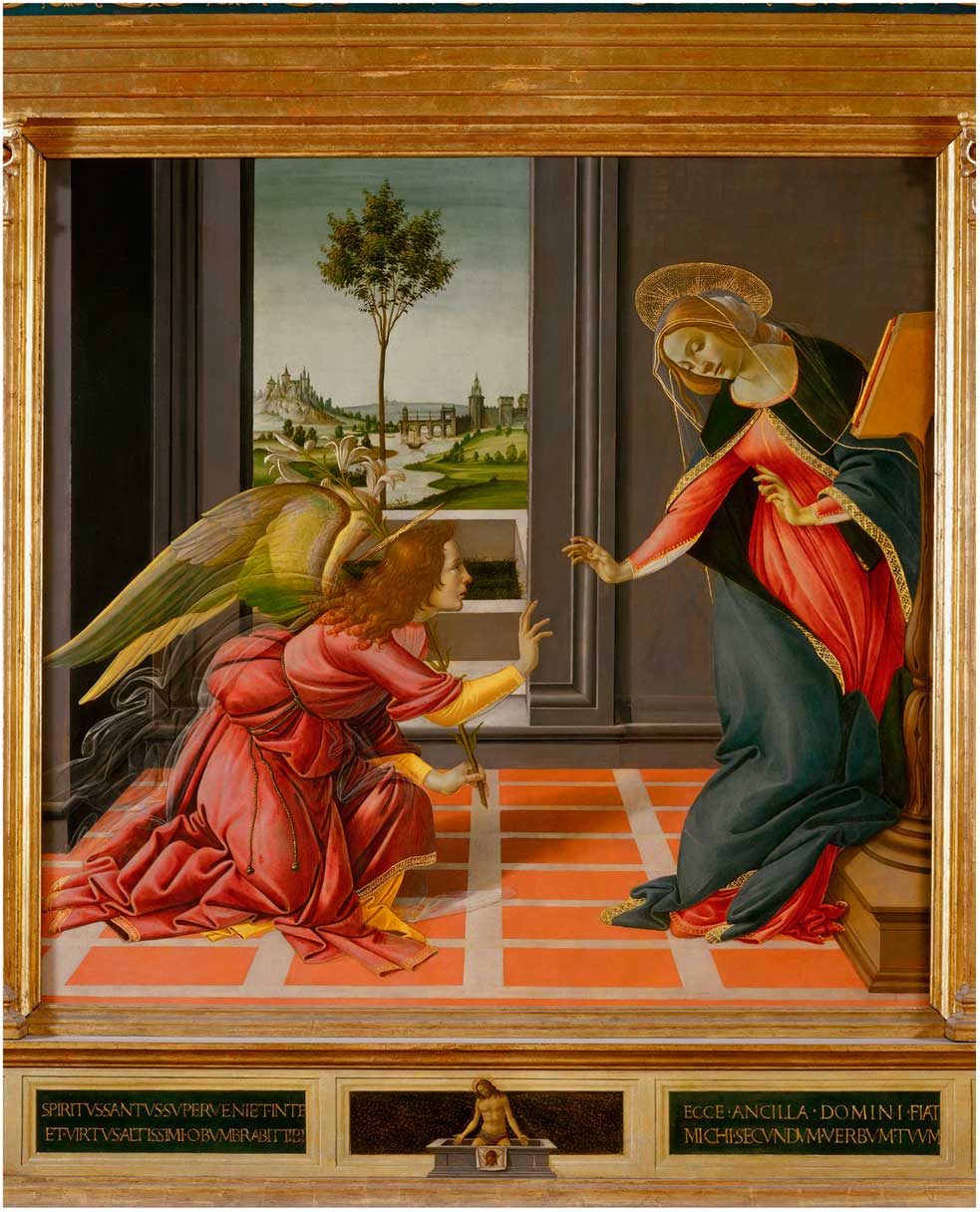
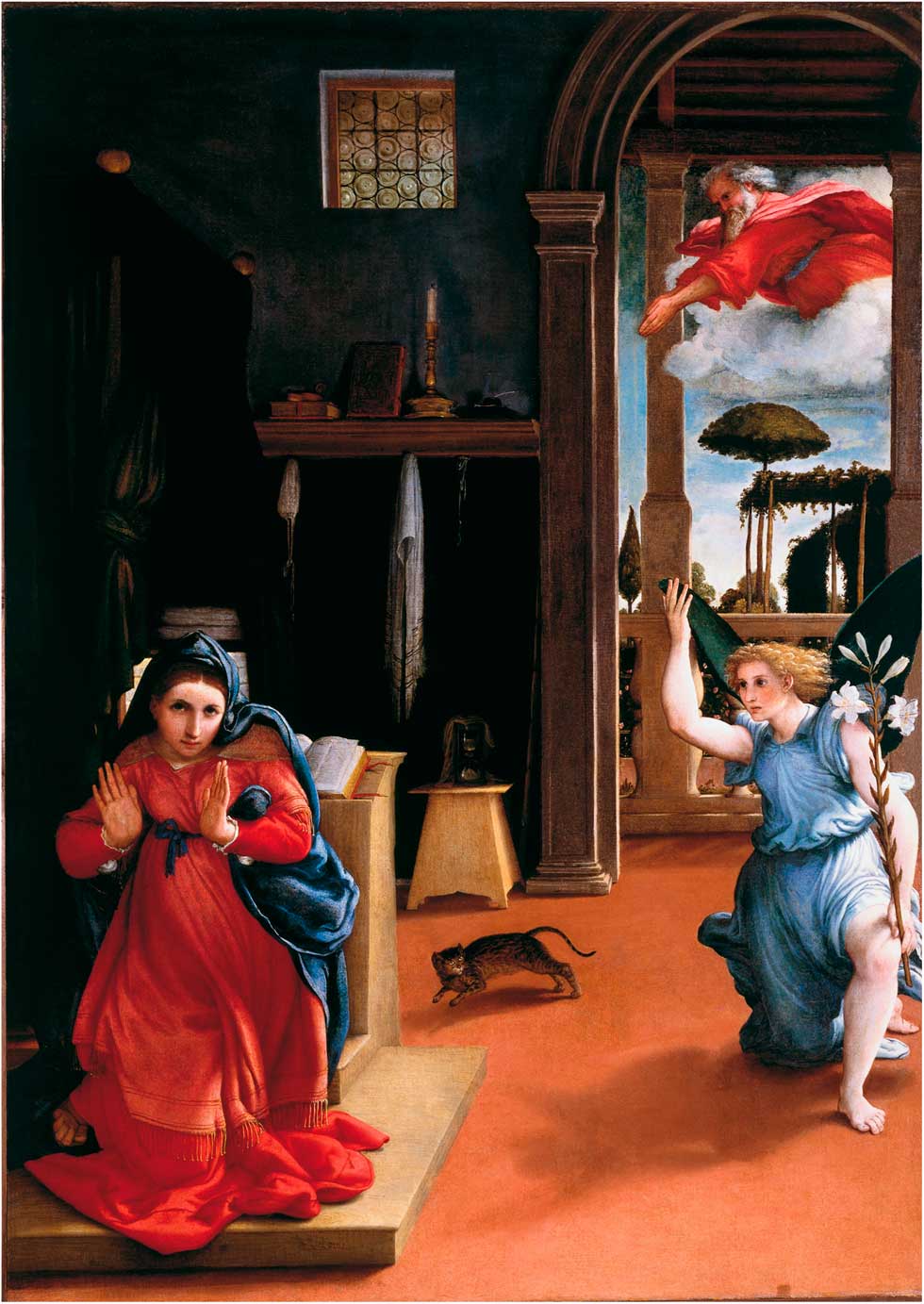
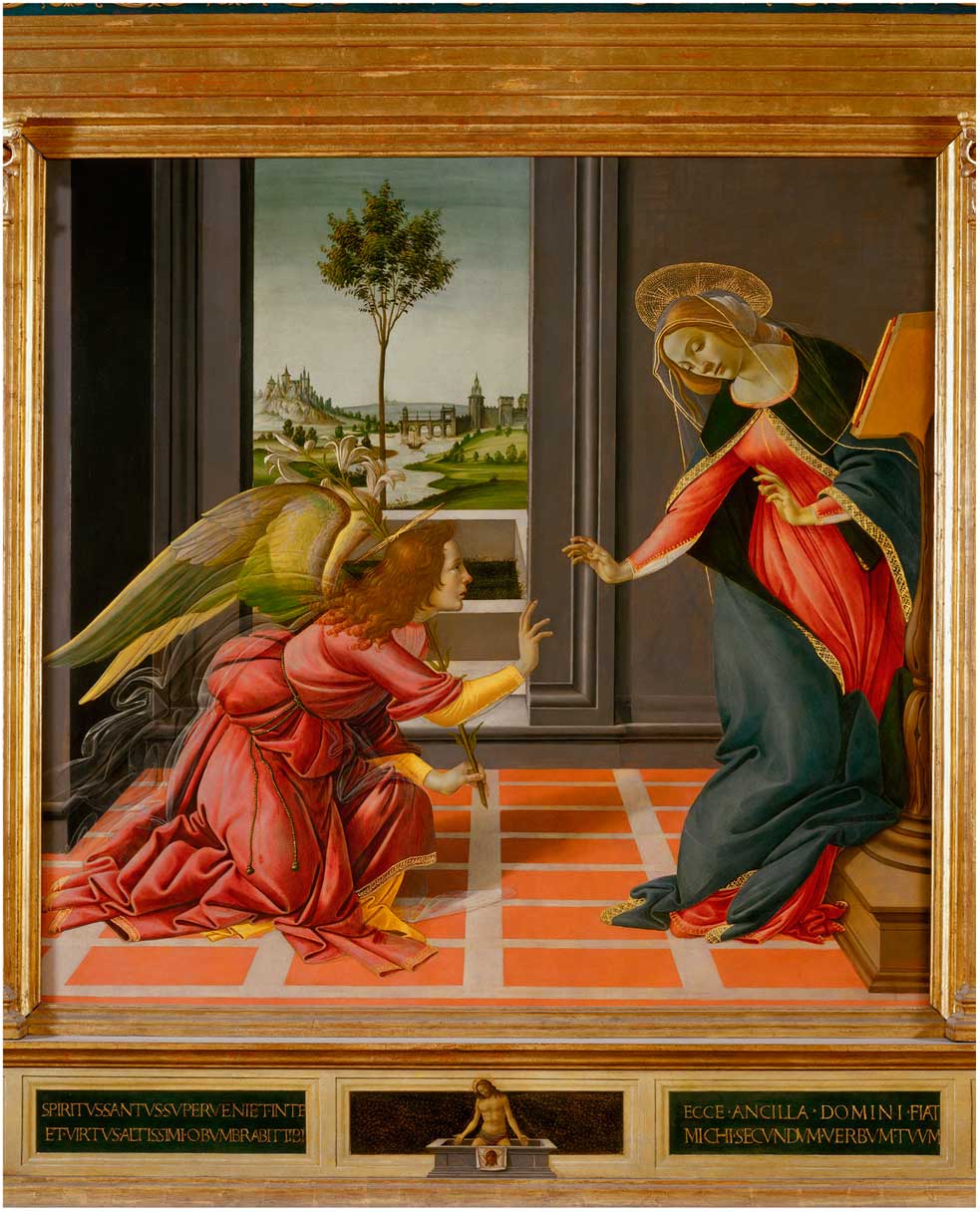
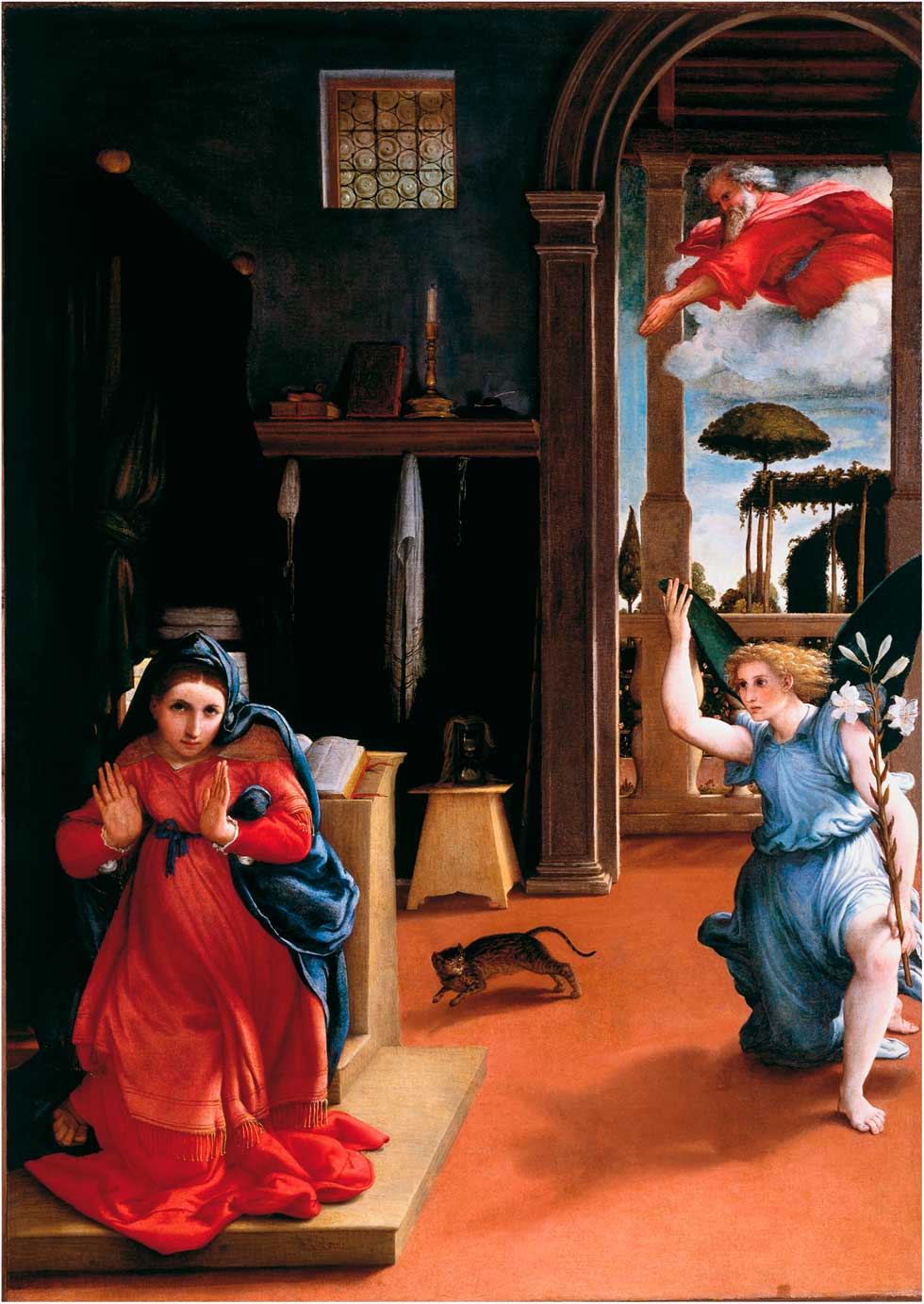
Two famous Annunciations show the cleverness of the artist in mixing scenes in order to increase the pathos of the scene. In the frame of the Cestello Annunciation by Botticelli, 1490, at the Uffizi, shown in Figure 1, there is a clear quotation for Scene 6, where the Angel speaks announcing to the Virgin that she will be visited by the Holy Spirit. Most unusually, the Angel is even shown with his mouth open (never done except for genre pictures). The position of the Virgin, pushing away the Angel with her right hand, is nevertheless clearly from Scene 5. Likewise, in the magnificent Annunciation by Lorenzo Lotto (1534) at Recanati (Figure 2), the Virgin is on the left, hands up in worry, clearly a Scene 2, whereas the Angel on the right has his right arm raised pointing to the Holy Spirit, as in Scene 6, when he announces that the Virgin will be visited by the Paraclete. The protagonists’ gestures are not always clear and there is no choice in order to identify the scene except by understanding its semiotics through body or facial language.
Sandro Botticelli: Cestello Annunciation. Florence, Galleria degli Uffizi. © 2017. Photo Scala, Florence. Courtesy of the Ministero Beni e Atti Culturali.
Lorenzo Lotto: Annunciation, 1527. Recanati, Museo Civico Villa Colloredo Meis. Photo Wikimedia Commons.
We shall now briefly discuss the results obtained from our database. Until 1400 the most popular scene was Scene 1, with 54 examples, out of a total of 102, whereas the least frequent were Scene 5, the rejection of the Angel, with only one example, and Scene 3 (‘do not be afraid’) with two examples. It is clear that until 1400 the simplest types of scene were preferred, setting a fairly standard iconography. After 1400, the full impact of the Renaissance and, soon after, of Mannerism, permitted artists to extend their scope. The fairly standard Scene 1 is replaced in popularity by Scene 6, the first gaining 197 examples after 1400 and the second 434. It is noticeable that in these periods fashion replaces tradition. The static kneeling angel on the left is replaced by a full height dynamic one with an arm pointing to the Paraclete in the sky. This device becomes the main feature, especially after the influential composition by Titian from 1537 (now lost but with an engraving extant in the British Museum, shown in Figure 3). Almost 50 years later, in 1582, the Gaetan painter Scipione Pulzone, whose picture now hangs in the Museo Nazionale di Capodimonte, Naples, acknowledged his debt to the Venetian master, and there are dozens of pictures repeating the same composition.
Jacopo Caraglio, after Titian: The Annunciation, 1527–1537. © Trustees of the British Museum.

The Iconography of the Annunciation: Theological and other Sources
There are a number of elements that appear in the composition of the Anunciation that must be understood. We shall consider only the most important: first of all, the manner by which the Paraclete enters the body of the Virgin, then the lilies, the Hortus Conclusus, the closed door (Porta Clausa), and the Corinthian column.6 The conception of the Virgin, which takes place in Scene 8, was probably first discussed in mid C4, by St Efren the Siriac (307–373) who asserted that it took place through the Virgin’s ear, thus cancelling Eve’s sin, through whose ear the devil’s word had entered. This conceptio per aurem was also at about the same time postulated by S. Zeno of Verona (c. 300–371) and later by Proclus of Constantinople (deceased 446). The lilies are well-known symbols of the Virginity of Mary, sometimes associated with a red carnation as a memento of the Passion. Lilies, either presented by Gabriel or in a vase, often come in threes, to represent Mary’s virginity before, during and after conception. A very well-known iconographic element is the Hortus Conclusus, which comes from the Song of Songs, ‘Hortus conclusus soror mea’ (‘A garden enclosed is my sister’), involving the tradition of identifying Solomon’s bride with the Virgin, strongly advocated by St. Bernard de Clairvaux (1090–1153).
As stressed by González when discussing the porta clausa,6 the theological dogma of the Virgin birth is founded in Ezekiel 44:2, in relation to the East door of the Temple, which was shut: ‘This gate shall be shut … because the Lord, the God of Israel, hath entered in by it, therefore it shall be shut’. Thus, the Lord can enter or exit the Virgin without opening any of Her organs. This is the foundation of the doctrine that the Virgin was so before conception, during conception and after parturition. Correspondingly, we have the iconography of the closed door in the pictures.
Very curiously, one interesting iconographic element goes back, not to scriptural or patristic sources, but to Vitruvius, the Roman architect, whose book De architectura was rediscovered in 1414 by the Florentine humanist Poggio Bracciolini. Vitruvius, in describing the three classical orders of architecture, asserted that the first two, Doric and Ionic, were male-like, but the Corinthian one was feminine, ‘virginal’, he stated. Thus, a Corinthian column was taken as a symbol of the Virgin, Leon Battista Alberti (1404–1472) making this idea well-known in his book De re aedificatoria, c. 1450.
We shall now discuss how these elements appear in the database. As regards conceptio per aurem, preference is given to the right ear (214 hits) whereas the left ear appears only 38 times. The first instance (right ear) corresponds to Guido da Siena, 1270, Princeton Art Museum.7 The tradition, though, endures: between 1451 and 1500 there are 46 such instances and from 1551 to 1600 there are still eight examples. Lilies either offered by Gabriel or in vases are not as frequent as one might expect. They appear only 42 times in the whole range. (Of course, being Florence’s symbol, they were shunned by Sienese painters, who often replaced them with olive branches.) In only eight cases are they accompanied by red carnations, and in 28 examples the lilies appear in triplets. In 37 pictures, the lilies’ stamens are not shown, the curious idea being that they resemble male organs. The closed doors appear in 34 Annunciations, the first example being Duccio’s, c.1300, in the Siena Cathedral Museum. The Hortus Conclusus is probably the most common element, appearing 220 times. Other elements are the thallit, presumably Joachim’s, are far more rare, only seven times. A bed, instead, is very frequent, 194 times. As one would expect, the first Corinthian column had to wait until 1440, in the beautiful Annunciation by Filippo Lippi (1440) in the Frick Collection, NY. These elements are less rare than one might think, 25 in total, 10 in 1451–1500, showing the effect of Alberti’s writings.
One strange iconographic example that appears only twice in our database is snuffed candles, which are said to indicate that incarnation has already taken place, and both are shown by Robert Campin in his Annunciation of 1420 in the Musées Royaux des Beaux-Arts/Koninklijke Musea voor Schone Kunsten, Brussels and in the 1425 one, at the Cloisters, NY.
We shall discuss in the following two sections the various hypotheses that have been invoked in order to explain the positioning of the Virgin on the right of the pictures in the majority of cases. The best-established hypotheses are five in total, the first three being psychological and the last two, the compositional hypotheses, being based on the way the painter of the picture approaches his task.
The Psychological Hypotheses
The first psychological hypothesis is based on the motion by which the Angel reaches the scene which, if it is normal, would in principle be from the left. McLaughlin and Kermisch found that paintings with suggestions of left to right motion are preferred by dextrals over their mirror-reversed versions.Reference McLaughlin and Kermish8 That this is not just a result of reading habits follows from numerous well-studied instances which show that the perception of left-to-right motion is also enhanced in the animal kingdom with respect to its reversed form. This effect appears to be related to the predominance of the right hemisphere, and it is suggested that it is an evolutionarily favourable trait for all the members of a given group to belong to the same chirality, since variant subjects have advantages in fighting others, with consequential disruption of the group. Professor Anjan Chatterjee had in fact already done pioneering neurological experiments that show that normal subjects matched sentences they heard to pictures faster when the pictures depicted the agent (that is the protagonist that carries some power) on the left and with the action proceeding from left-to-right.Reference Chatterjee9 Later, this author reported studies that showed that subjects are likely to judge visual images more pleasing when any motion depicted in them is left to right, thus confirming the studies mentioned.
This hypothesis of the significance of left-to-right motion entails some problems. First of all, of the seven Annunciation scenes, only one, the first, actually entails motion of the arriving Angel: all the others are static. In fact, of 1090 two-dimensional Annunciations in our database, only 293 show movement from the left, with 82 on the right, 503 with no movement at all, and 123 with vertical motion (angels fly!). The only way in which this hypothesis can be rescued is that, by knowing the story we know that the Virgin is static in the scene and that the Angel is the newcomer, and that because of this, the implied motion that must have brought the Angel to the scene is preferred to be one from left to right. The fact that the Angel often levitates, and thus that he can arrive vertically, however, weakens this construct. (It is of some interest to remark here that of the 17 Annunciations painted by El Greco, only one is normal, and that all his Angels on the right-hand side are levitating.)
A second hypothesis is that of agency, introduced by Chatterjee,Reference Chatterjee9 which entails the representation of a physical action, such as pushing an object, or the conveying of a message, but could also be abstract, as for instance the agent being in a position of greater importance than another person related to him or her. Chatterjee reports experiments that show a preference for the agent (which in the Annunciation would be the Angel) being on the left. Some support for this hypothesis comes from the fact that of the 102 Scene 2s (where the Angel is not agent), in only 71 of them does Gabriel appear on the left. On the other hand, in Scene 5, the Virgin appears to be the agent, since she is pushing away or rejecting the Angel but the latter still appears on the left in 23 of the 30 instances of this scene.
The third psychological hypothesis, the left-cheek effect, proposed by Professor Sutherland of University College London, is very interesting. Study of portraits, male and female, show that left and right cheeks are differently displayed in accordance with the gender of the sitter. McManus and Humphrey examined 1474 portraits and found that 68% of the portraits of women show the left cheek rather than the right one.Reference McManus and Humphrey10 Such a difference was related to the fact that the left cheek, being connected to the right-brain hemisphere, is the one that best expresses emotion. There is no question that this is a very interesting result but it is highly probable that it depends on the relation between the artist and his or her sitter: Suitner and Maass found in fact that this bias depends on the gender of the artist.Reference Suitner and Maass11 And this is the problem with this theory, since most of the Virgins in the Annunciation pictures were not painted from models but are formulaic designs, probably taken from the sketch books with a variety of useful subjects that artists used to keep since their apprentice days. Moreover, female models were rarely used for a very long time. Even when Michelangelo painted the Sybils in the Sistine Chapel ceiling he used male models for the bodies (this is why the dainty Sybils have such robust arms). And although Raphael had an obvious sitter for the Fornarina, his Sybils at Santa Maria della Pace are not painted from models. It must also be recognized that the left-cheek presentation could be, rather than the determining factor of the composition, merely a consequence of positioning the Angel on the left, since the Virgin on the right, turning her head towards the Angel, as she does in most scenes, must necessarily display her left cheek.
In the next two sections we shall discuss the two compositional hypotheses, by which we try to understand the principles and constraints that guide the artist, not necessarily consciously, in establishing his or her composition. The first one, which Altmann has called the power of the first diagonal,Reference Battisti3 follows on the tradition of numerous early studies of right and left in art.Reference Wölfflin12
The Power of the First Diagonal
H. Wölfflin in 1941 was the first to attempt a study of the problem of mirror reflection in design, suggesting that pictures are read from left to right, as western script is. (We restrict ourselves to this tradition, as the only one significant for pictures of the Annunciation.) Soon after, R. Arnheim followed on from this hypothesis and adduced, appealing to the limited knowledge of brain function available at the time, that such direction of reading correlates with the domination of the right cerebral cortex (which controls the left-hand field of vision) in this context. Thus, in his view, the diagonal from bottom left to top right of a picture (which Altmann called the first diagonal) is seen as going up, whereas the second diagonal, from top left to bottom right, is seen as descending. Without entering for the time being into the validation of these views, they were reinforced by Gaffron,Reference Wölfflin12 who claimed that there is a certain fixed path that observers follow normally within the picture space, and which she called the ‘glance curve’, which moves from the left foreground to the right background (that is, basically, along the first diagonal). Gaffron, in fact, claimed that the right balance in Rembrandt’s etchings must be observed in the original plates rather than in the reversed prints.
The idea that script-reading habits determine the way in which observers read pictures, which appeared plausible at the time the work mentioned was published, has been disproved by more recent eye-tracking work, although, as we shall see, culturalization is not insignificant and some of the proposals discussed so far still have an element of validity. The early eye-tracking work of Buswell shows that viewers’ eyes follow short periods of fixation with rapid saccadic motions to other parts of the pictures.Reference Buswell13 He found, for instance, that viewers of Seurat’s La Grande Jatte fixated first on the people, irrespective of their positions in the picture, rather than the background. More recent work on eye tracking does not appear to show any distinctive initial preference for the left of the picture.Reference McLaughlin, Dean and Stanley14 It must be remembered, however, that numerous factors, such as schooling and gender,Reference Hernandez Belver15 may affect the result of eye-tracing studies.
The hypothesis of the power of the first diagonal – although it appears in some form in the old work of Arnheim and Gaffron – as a general compositional rule in art was proposed by AltmannReference Battisti3 in the light of more recent empirical studies, which, although unrelated to the Annunciation, suggest that it might be significant. Pérez González made a careful study of photographic work in the nineteenth century, when families were large and family portraits popular.Reference Pérez González16 She found that western portraits posed the families starting from the youngest on the left and ascending to the tallest on the right, that is, following the first diagonal. Iranians, who as Farsi speakers write from right to left, consistently used the opposite convention. We again have a rule largely valid for western subjects but subject to culturalization. AltmannReference Battisti3 carried out a psychological experiment in which 41 subjects were asked to align seven manikins along a line. Thirty-four did so from the shortest on the left to the tallest on the right, that is, following the first diagonal.
We can now discuss the results obtained from our database, which are very positive in support of the power of the first diagonal, particularly from the beginning of the Renaissance onwards. From C3 to 1350 there are only 49 Annunciations, 35 of which have a strong first diagonal but none have a strong second one. From 1351 to 1400 the effect of the first diagonal is more significant: of 50 Annunciations, 47 have a strong first diagonal and only one is designed on the second diagonal. And this clear preponderance of the first diagonal continues until 1500: from 1451 to 1500, of 131 Annunciations, 104 (79%) are on the first diagonal. During the Renaissance composition becomes freer and second-diagonal compositions start to appear more frequently, although they are a minority until Mannerism and Baroque: in 1451–1500 we have 104 first diagonals and 27 second ones, whereas in 1551–1600 there are 74 second diagonals and 56 first ones. From then on the balance between first and second diagonal is somewhat in favour of the second one, but never by more than 5.9%.
The hypothesis that the first and second diagonals influence the composition can be reinforced by the study of the direction of the Paraclete that, coming from the top of the pictures, goes down and would therefore be unnatural if placed along the first diagonal, which is regarded as ascending. The first appearance of the Paraclete along the first diagonal is in an Anonymous Roman fresco, from the second half of C14 at the Narthex of Santa Maria in Trastevere. No ray is shown along this diagonal until Carlo di Braccesco, 1480–1500, at the Louvre. The first appearance of the Paraclete along the second diagonal is in the C5 mosaic in the nave of Santa Maria Maggiore, Rome, where it appears just as the Dove, but no ray is shown until c. 1300, in the work of Duccio di Buoninsegna, in the Cathedral Museum of Siena. The totals of Annunciations with the Paraclete along the second and first diagonals, respectively, are 768 and 169, showing a reluctance to depict a descending first diagonal, as we would have expected.17 If the paraclete direction is preferred, as we have shown, along the second diagonal, that is from top left to bottom right, the natural position for the Virgin must be on the right field of the picture. In any case, because the angel is often kneeling or bending, the figure of the Virgin is higher, satisfying the power of the first diagonal. El Greco’s Angels are always oversize and he, with a single exception, always places them on the right, satisfying the power of the first diagonal. This is a useful feature of this hypothesis, namely that it also works for variant Annunciations.
We can now discuss a second compositional constraint, which comes from the chirality of Gabriel, which was fully discussed in the previous paper.Reference Altmann1
Chirality of Gabriel and his Positioning
AltmannReference Altmann1 notices that Gabriel is in the vast majority of cases represented as dextral in the Annunciation pictures and that this has important compositional implications, since if the Angel is placed on the left his right arm, with which he has to communicate to the Virgin, is the one nearer the observer. This was especially important in the early days when very often, for easiness of representation, the Angel was painted in profile. We have now extended this work, because we have noted that dextrals, when crossing arms on the chest, do so with the right arm over the left. This has allowed us to classify the chirality of many more angels. If we take the total range, from C3 to 1750, there are 974 dextral angels and 99 sinistrals, that is 9.2%. However, during the period when the pictorial traditions were established, from C3 to 1400, over a total of 100 pictures there are only two sinistrals. Even from 1401 to 1450 there are only 12 sinistrals over 112 Annunciations. From C3 to 1450 there are 112 angels with arms crossed on the chest and of these 40 are sinistrals. Clearly, with no need to depict a gesticulating arm, the painter is laxer, although dextrals are preferred. In any case, crossed arms appear only after 1350 and there are only 10 until 1400.
Related to the positioning of Gabriel is the fact that the Angel is often depicted kneeling. Probably the first instance of the angel kneeling, on the left of course, is by Duccio di Buoninsegna, c. 1300, in the Cathedral Museum of Siena. Another early example that deserves mention is by Ambrogio Lorenzetti, 1344, in the Pinacoteca Nazionale di Siena, the first instance of linear perspective in the drawing of the pavement. The first time that the angel kneels on the right is probably by the Master of Hellingerkreuz, 1410, in the Kunsthistorisches Museum, Vienna. It can thus be seen that the Angel kneeling, either left or right, is a late and a rarer feature than perhaps expected, especially because some of the most famous works present the Angel in this position. In fact, from C3 to 1750 there are only 310 normal and 76 variant pictures with the Angel kneeling and they mainly appear during the Renaissance and Mannerism periods.
AltmannReference Altmann1 suggests that the chirality of Gabriel is the result of syncretism, his antecedent Hermes, the messenger of the gods, always carrying a wand, the caduceus, in his left hand, so as to be free to gesticulate with the right one. Why this is so can be understood with reference to Hermes’ Roman counterpart, Mercury, the more immediate predecessor of Gabriel, who is also right-handed and also carrying the caduceus in his left hand. Romans, as is well known, were extremely devoted to rhetoric, which involved gestures as well as voice, as dictated by the greatest rhetorician of all time, Quintillian (c.35–c.100 CE) who, in Chapter 3, 114 of his Institutio Oratoria states: ‘It is never correct to employ the left hand alone in gesture’. Thus, if using only one hand, the messenger must be dextral.
Three-dimensional Annunciations
Carvings, reliefs and sculptures of the Annunciation have not yet been properly studied, but they have some interest for us, since, for instance, the first diagonal loses meaning in these cases, and it is much easier in a three-dimensional work to display Gabriel’s right arm even when he is placed on the right. Thus, if the dextrality hypothesis is correct, one should find more variant compositions in this case. Unfortunately, these representations are more rare than two-dimensional ones and we have collected only 32 in our database, of which 12 are variant and 20 normal, which gives 37.5% as the proportion of variants, almost double the proportion found for them in two-dimensional representations. This is as we had expected but given the small size of the sample this result, however, must be considered a tentative one. The earliest three-dimensional example we have is the bronze relief by Bonnano Pisano (1180), shown in Figure 4, one of the panels of the Ranieri portal in Pisa’s Duomo.
Bonnano Pisano: The Annunciation, 1180. Panel of the Ranieri Portal, Pisa, Duomo. Photo Simon Altmann.

Discussion
It is clear that a pictorial tradition had been established by 1400: up to that period out of 102 pictures only five are variant. Even from 1401 to 1450, of 111 pictures only nine are variant, and of these only two Italian. Although it is possible that during this formative period the motion-from-the-left condition may have had some, perhaps unconscious, influence, it is clear that the dextrality of Gabriel had an early guiding influence. This was so because earlier painters that used simple compositions would have found it difficult to portray Gabriel’s right arm unless the Angel was placed on the left, especially if he is in profile, as most often is the case. It must be appreciated that, fundamentally, the depiction of the Virgin in the Annunciations is simpler than that of the Angel, being very often frontal, 688 against 192 in profile. The Angel instead is mostly in profile, 774 times, rather than frontal, 193 times. Up to 1400, out of 102 pictures 85 angels are in profile: this is why their chirality is more significant in this period and induces their position on the left field.
As we have seen, this positioning of the Angel was later helped by the power of the first diagonal, which became much weaker during the Mannerism and Baroque periods, when freedom of composition was paramount. Fashion replaced tradition, with the great innovators such as Titian and Rubens creating a large number of followers imitating their compositions.
Acknowledgements
We are very grateful to Dr Paul Altmann who most patiently helped us in maintaining and improving the software for the database. No public funds were used in this work.
About the Authors
Simon Altmann is a long-retired mathematical physicist who since his retirement has published books on the philosophy of nature and the history of mathematics, and a collection of poems, Not for Poets (eBook). His Tales of Three Countries was published in 2015 by Editorial Araña, and Einstein’s Quantum Error has just been published. He has been interested in the Annunciation for some 50 years and has published three articles on it. His paper on Las Meninas was published in this journal (2013).
Gloria Martínez Leiva is an art historian specialized in the study of eighteenth-century Spanish art and its royal collections. She has published more than 20 papers, and two books, Quadros y otras cosas que tiene Su Majestad Felipe IV en este Alcázar de Madrid, 1636, in 2007 and El inventario del Alcázar de Madrid de 1666: Felipe IV y su colección artística, in 2015.