Experimental
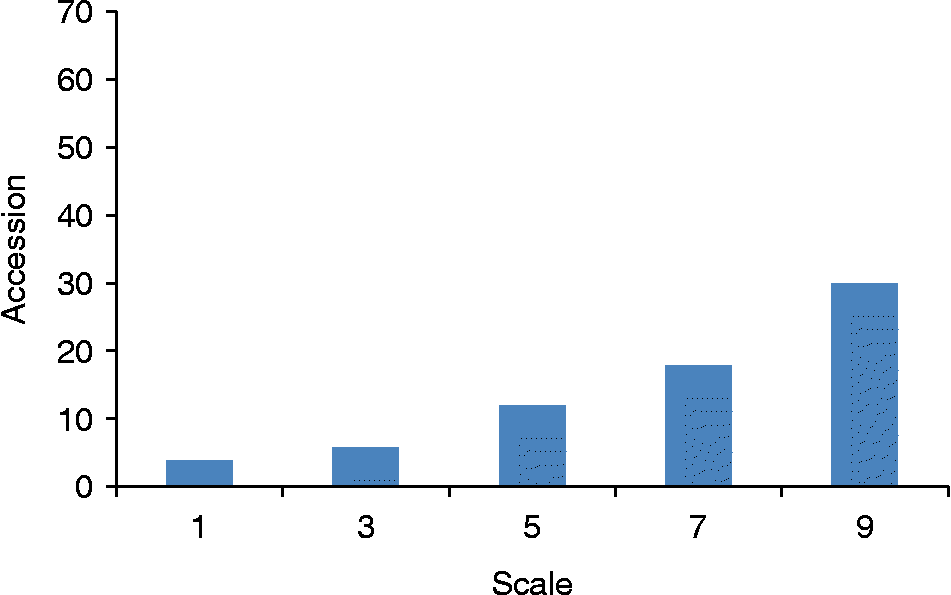
The experimental materials included in the present investigation comprised 70 agronomically elite lines of indigenous chickpea germplasm collected from various regions of the country (Table 1). These accessions were grown in a randomised block design with three replications under wilt-sick plot maintained by the Division of Genetics, Indian Agricultural Research Institute, Pusa (28°35N′ latitude, 70°18′E longitude, 226 m above mean sea level) New Delhi, India consecutively for 2 years (winter 2010–2011 and winter 2011–2012). The accessions were evaluated and screened for wilt resistance against race 4 of Fusarium along with resistant (BGD 112) and susceptible (JG 62) checks. Pathogen load was medium to high in the wilt-sick plot. A susceptible cultivar check was sown after every fifth row in the field, so that the performance of germplasm accessions could be evaluated and the disease in the plots maintained. Disease reaction on individual plants was estimated using a 1–9 rating scale at two intervals: 1 = no symptoms (highly resistant); 3 = yellowing of the basal leaves only (resistant); 5 = yellowing of 50% of the foliage (moderately susceptible); 7 = complete yellowing of the foliage along with partial drying (susceptible); 9 = the whole plant is wilted and/or dry (highly susceptible). Screening for resistance to Fusarium wilt was done during the initiation of the reproductive growth (seedling) stage and the pod-filling stage using the above-mentioned rating scale. The affected germplasm accessions showed drooping of leaflets and rachis. Of the 70 elite germplasm lines, four lines had an average score of 1 (0% of plants infested) and six lines had a score of 3 (6–10% of plants infested). However, 12 lines were scored with a rating of 5 (21–40% of plants infested) and 18 accessions were rated with a score of 7 (61–80% of plants infested). The remaining 30 accessions were rated with a score of 9 (100% of plants infested). Highly resistant accessions (IC552158, IC552274, IC553471 and IC552056) were repeated during winter 2011–2012 under the wilt-sick plot for the validation of resistance against race 4 of Fusarium wilt. The same set of germplasm was also screened for their host status to the root-knot nematode, Meloidogyne incognita. A screening test was conducted in pots under greenhouse conditions during winter 2010–2011. For this purpose, 10-cm-diameter pots were filled with 500 g field-grown tomato soil infested with M. incognita @4 juveniles (J2)/g soil, i.e. 2000 J2/pot. Each accession of the tested germplasm treatment was replicated five times. The pots were arranged in a complete randomized block design on benches in a greenhouse maintained at 25 ± 2°C. Three-week-old Pusa Ruby tomato plants (nematode susceptible) were planted in pots with the same size to verify the viability of the inoculum. At 60 d after inoculation, the plants were carefully uprooted from the pots and the root systems were washed gently with tap water and stained with phloxine B (0.15 g/litre tap water) for 15 min to stain egg masses. Based on the root gall or egg mass, host suitability was allocated, using a 1–5 rating scale, where 1 = no gall, no egg mass (highly resistant), 2 = 1–10 root galls or egg masses per root system (resistant), 3 = 11–25 root galls or egg masses per root system (moderately resistant), 4 = 26–100 root galls or egg masses per root system (susceptible) and 5 = >100 galls or egg masses per root system (highly susceptible). The experiment was repeated with those materials on which < 10 galls/egg mass per root system were recorded to reconfirm their resistance status, and only one accession (IC268903) was found resistant against M. incognita (race 1).
List of indigenous chickpea germplasm used in screening for Fusarium wilt

Discussion
Use of wilt-resistant gene sources led to the development of wilt-resistant cultivars for chickpea-growing areas where wilt is one of the major constraints to the production. However, such resistant variants are very few and are not available in different chickpea-growing areas. In the sick plot, all plants of the susceptible check died, indicating that disease incidence was sufficient for effective wilt screening and that the inoculum was homogeneously distributed in the field for maintaining the sick plot to race 4 of Fusarium wilt (Nene and Haware, Reference Nene and Haware1980). Of the 70 indigenous chickpea germplasm lines, four had a highly resistant average score of 1 and six had a score of 3, indicating different levels of resistance contributing by their genetic background of accessions within the germplasm. However, some lines exhibited moderately resistant reaction and the remaining showed susceptible and highly susceptible disease reaction to wilt, suggesting the severity of disease incidence. Four highly resistant lines (IC552158, IC552274, IC553471 and IC552056) with the score of 1 appeared to be the best sources for wilt resistance and deserve to be used for easily crossable breeding resistant chickpea cultivars (Fig. 1). Gene transfer from the cultivated gene pool is the easier way for breeders to plan effective breeding strategies; otherwise, it is only possible from the wild gene source. However, in the case of root-knot nematode screening, only one accession (IC268903) was recorded as resistant. The root-knot nematode M. incognita is one of the most important root-knot nematode species affecting chickpea in tropical and subtropical regions as well as in the Indian subcontinent (Ali and Sharma, Reference Ali and Sharma2003; Sikora et al., Reference Sikora, Greco and Veloso Silva2005). Exploitation of host plant resistance to important nematode pests has great potential. Cultivation of nematode-resistant cultivars is a simple and economical way to prevent nematode-induced damage and to avoid environmental pollution due to excessive or improper use of pesticides. Seeds of resistant accessions are maintained by the National Bureau of Plant Genetic Resources New Delhi, India and are available on request.
Average response of indigenous chickpea germplasm to race 4 of Fusarium wilt in the wilt-sick plot using the 1–9 rating scale (A colour version of this figure can be found online at http://www.journals.cambridge.org/pgr).