1. Introduction
This article deals with different inflectional classes in Icelandic (Ice.) and the moderate productivity found with some of these.Footnote 1 Specifically, it examines the different rates at which masculine (masc) forms in syncretic nominative/accusative plural (na.pl) -ur are treated as feminine (fem) due to varying degrees of phonetic and/or semantic similarity to clusters of feminines in the same ending. To account for the reanalyses that underlie this treatment, I employ the machinery of cognitive linguistics and its usage-based approaches to morphology, focusing on the relation between type frequency, schematicity, and productivity.
Type frequency and schematicity are recognised determinants of productivity in the established usage-based cognitive literature. Type frequency is equated with the number of items that follow an inflectional pattern, while schematicity is defined by the degree of phonetic dissimilarity between them (e.g. Bybee Reference Bybee2007:9, Reference Bybee2010:67). Productivity is measured as the rate at which a schema ‘attracts’ inflectional forms by analogy, defined here as the process by which existing knowledge is extended to new contexts (e.g. Gentner Reference Gentner, Gershkoff-Stowe and Rakison2005; Barðdal Reference Barðdal2008:1, 9; Bybee Reference Bybee2010:57).
Schemas are cognitive generalisations that specify the basic outline common to any number of items perceived as similar (Langacker Reference Langacker1987:132–135; Taylor Reference Taylor2003:67; Tuggy Reference Tuggy, Geeraerts and Cuyckens2007:83). The process of schematisation is gradient, yielding formally continuous schemas in taxonomies of increasing abstraction. This gradience reflects the view that schemas take account of all formal and functional attributes common to a set of items at distinct levels of complexity (e.g. Bybee Reference Bybee2001:27; Audring Reference Audring2019).
Productivity is considered to proceed via reference to schemas. Inflection classes characterised by both high frequency and high schematicity generally prove the most productive, as these impose the least phonetic constraints on membership. However, language change demonstrates that productivity is also gradient: classes of all shapes and sizes show different rates of productivity cross-linguistically (Barðdal Reference Barðdal2006, Reference Barðdal2008).
Low schematicity can mediate the constraints of low type frequency by means of a gang effect. In other words, while a low frequency class is unlikely to prove highly productive, it may show limited productivity if its members are phonetically coherent (Bybee Reference Bybee2010:69). A well-known example is the extension of the English strong schema [Xear]present ∼ [Xore]past,Footnote 2 e.g. present bear ∼ past bore, swear ∼ swore, tear ∼ tore, to the paradigm of formerly weak wear, resulting in past wore (see Axelsdóttir Reference Axelsdóttir2015 and Markússon Reference Markússon, Axelsdóttir, Óskarsson and Indriðason2021, Reference Markússon2022 for examples of the gang effect in Icelandic and Faroese).
In this connection, Icelandic exhibits significant correlation between the phonetic bases for inflection class membership and grammatical gender (Berg Reference Berg, Fabrizio and Cennamo2019), a factor generally acknowledged to determine the direction of inflection class shift and, often simultaneously, gender reanalysis (e.g. Bjorvand Reference Bjorvand1972, Reference Bjorvand1975; Bernharðsson Reference Bernharðsson2004; also Ralli Reference Ralli2002 on Modern Greek). The objective here is to account for the different rates at which masculine forms in na.pl -ur are reanalysed as feminine on account of this correlation, as betrayed chiefly by use of the feminine definite article (def) na.pl -nar, instead of expected masculine n.pl -nir, a.pl -na, but also (less frequently) by agreement with feminine modifiers.
Significantly, reanalysis associated with na.pl -ur is all but exclusively masculine to feminine, a factor attributed to dispersion: the morphological contexts in which an exponent occurs (following Gries & Ellis Reference Gries and Ellis2015). Crucially, of the 14.92% of Icelandic nouns in plural -ur, 91.89% are feminine, with most belonging to the largest weak feminine class, e.g. n.sg stelpa ‘girl’ ∼ na.pl stelpur (see Kvaran Reference Kvaran2005:239).Footnote 3 Conversely, just 8.11% in plural -ur are masculine (Svavarsdóttir Reference Svavarsdóttir1993:105). Further, syncretism in the nominative/accusative plural is exceptionless among Icelandic feminine nouns but, by contrast, relatively rare among masculines. Therefore it is argued that masculine forms in na.pl -ur pattern with the corresponding forms of feminines based on the ending alone, which has high cue validity for treatment as feminine due to properties of its dispersion.Footnote 4
It should be noted immediately that masculine forms in plural -ur are treated as feminine in the minority of instances. Based on searches conducted in the isTenTen corpus, which consists of sources including social media, plural fætur ‘feet’ is the masculine form most frequently reanalysed at a rate of 22.82%.Footnote 5 However, it is considered interesting that reanalysis occurs at all, given that corresponding forms in other endings hardly ever undergo gender reanalysis (see Þórhallsdóttir Reference Þórhallsdóttir1997, Bernharðsson Reference Bernharðsson2004; also Jónsdóttir Reference Jónsdóttir1988–1989, Reference Jónsdóttir1993 on the endings na.pl -ar and -ir, properties of their dispersion regarding gender, and schematicity).
Additionally, it is argued that treatment as feminine is significantly influenced by the phonetic similarity that a masculine form bears to clusters of feminines beyond common plural -ur. For this reason, particular attention is paid to the relatively high rate at which masculine na.pl fætur is attracted by the schemas for a small, phonetically coherent microclass of just six feminine nouns (see Dressler Reference Dressler2003:35). To demonstrate the impact of phonetic similarity, appeal is made to the net effect, illustrated as a network model interpretation of the prototype structure of inflectional classes and resultantly varying degrees of cue validity for treatment as feminine.
Section 2 provides a brief overview of Icelandic noun inflection and delineates the prototype structure of a feminine subclass in na.pl -ur. Section 3 explicates the analogical processes that facilitate the microclass’s productivity. Section 4 reports on different rates of reanalysis for masculine forms in na.pl -ur with reference to phonetic and semantic constraints imposed by individual schemas. Section 5 defines the net effect and accounts for the data presented in Section 4. Section 6 offers conclusions.
2. Prototype structure of a feminine subclass in na.pl -ur
This section delineates a subclass of strong feminines whose prototype structure centres around the inflection of six nouns: blók ‘non-entity, wretch’, bók ‘book’, bót ‘patch’, brók ‘trousers’, nót ‘(fishing) net’, and rót ‘root’, henceforth referred to as the Xó/æT-microclass. The notation ‘X’ abstracts over the various onset consonants and consonant clusters of the Xó/æT-microclass, although historically only b (bók, bót), bl- (blók), br- (brók), n- (nót), and r- (rót) occur. The notation ‘-ó/æ-’ references vocalic alternation between singular/dative and genitive plural blók-, bók-, bót-, brók-, nót-, rót- and nominative/accusative plural blækur, bækur, bætur, brækur, nætur rætur. Upper-case ‘T’ abstracts over the voiceless stops -t or -k in coda position, where this notation represents the historical fact that before the addition of borrowed blók, stem-final -t occurred in the majority of forms.
Assignment of items to a minimally schematic microclass proceeds by analogy with the relevant subclass’s most prototypical schema(s) (see Barðdal Reference Barðdal2006, Reference Barðdal2008). Experiments by Rosch (Reference Rosch1975) indicate that categorisation is a domain-general cognitive process facilitated by perceived similarity to a prototype (also Rosch et al. Reference Rosch, Mervis, Gray, Johnson and Boyes-Braem1976). The prototype is a schematically represented entity which abstracts over features common to all members of a category, though some members share more features with the prototype than others. Crucially, Lakoff (Reference Lakoff1987) has demonstrated that categorisation by prototype is evident through language use.
It should be noted immediately that the current study is not the first to posit a minimally schematic microclass of Icelandic nouns centred around a prototypical phonetic structure. Knudsen (Reference Knudsen1967) posits the feminine microclass Ice. brík ‘armrest’, flík ‘item of clothing’, tík ‘female dog, bitch’ on phonetic grounds, e.g. the rhyme sequence -ík, plural -íkur, i.e. plural bríkur, flíkur, tíkur.Footnote 6 The feminine subclass that centres around the Xó/æT-microclass subsumes Knudsen’s microclass, as is fleshed out below.
First, however, a brief overview of Icelandic noun inflection is in order, where members of the feminine subclass may serve as exemplary. Icelandic nouns are inflected for case – nominative, accusative, dative (d), genitive (g) – and number – singular (sg), plural. The inflected definite article is almost always suffixed to the inflected form of the noun. Icelandic nouns are masculine, feminine, or neuter (neut).
While gender is of major relevance for agreement (Corbett Reference Corbett1991:105), gender classes in Icelandic – as in some other Germanic languages – can be viewed as macro inflectional classes subsuming several micro inflectional subclasses (Enger Reference Enger2004; Kürschner & Nübling Reference Kürschner and Nübling2011). As noted in Section 1, developments in Icelandic have tended toward correlation between phonetic attributes and inflection class membership, where the morphophonological properties of paradigms often indicate and assist with gender assignment. This is demonstrated in (1) by the paradigms of strong fem rót, nótt ‘night’, and geit ‘goat’, shown alongside the standard paradigm of masc fótur (the masculine articles n.pl -nir and a.pl -na are in bold).Footnote 7

As is evident from (1), masculine fótur shows a similar phonetic structure and inflection to nouns of the Xó/æT-microclass beyond the ending plural -ur, namely a genitive singular in -ar, where most masculines have -s, along with stem-final -t, and (mostly) parallel alternation between -ó- and -æ-. While Ice. rót, nótt, and geit belong to the broader subclass of feminines in plural -ur (Kvaran Reference Kvaran2005:221; see Iversen Reference Iversen1972:68 for historical classification), the inflection of nótt and geit differs from that of rót in graded fashion.
The prototypical nominative/accusative/dative singular of strong feminines is syncretic and monosyllabic (though see Þórhallsdóttir Reference Þórhallsdóttir and Nussbaum2007). Among members of the feminine subclass, this form normally alternates with a disyllabic genitive singular in -ar and nominative/accusative plural in -(u)r, e.g. singular kind(ar) ‘sheep’ ∼ plural kindur, geit(ar) ∼ geitur, eik(ar, eikur) ‘oak’ ∼ eikur, flík(ar) ∼ flíkur. These occur with the feminine article na.pl -nar, i.e. kindur-nar, geitur-nar, etc. Additionally, many paradigms exhibit i-umlaut alternation, e.g. singular mörk (merkur/markar) ‘250 gr.’ ∼ plural merkur, kló (ar) ‘claw’ ∼ klær, rót(ar) ∼ rætur (Iversen Reference Iversen1972:17–20).
Members of the Xó/æT-microclass have a monosyllabic nominative/accusative/dative singular form with ó [ouː] as its nucleus and a coda in stem-final -t or -k. Similarly, the genitive singular ends in -ar, the nominative/accusative plural in -ur. The microclass also exhibits i-umlaut alternation between singular and dative/genitive plural -ó- [ouː] and nominative/accusative plural -æ- [aiː] (see above).Footnote 9
Feminine nótt is not considered prototypical for the following reasons. The vowel of the singular is short [ou] due to the nature of its coda (see Árnason Reference Árnason2005:135 on vowel length and syllabification in Icelandic). Further, its genitive singular is syncretic with na.pl nætur, as opposed to exhibiting alternation like rótar ∼ rætur. Despite this, nótt is considered closer to the prototype than other members of the wider feminine subclass, due to parallels in i-umlaut alternation: see (1).
Less prototypical are feminine geit, eik, flík, for example. While the coda of each complies with the prototype, the respective nuclei consist of [eiː] (geit, eik) and [iː] (flík), neither of which engages in i-umlaut alternation, e.g. singular geit(ar) ∼ plural geitur, flík(ar) ∼ flíkur. Existence of g.sg eikur beside more prototypical eikar further distances eik from the prototype.
Significantly, only stems in singular -ót, -ók take up the Xó/æT-microclass pattern. Note that e.g. neut flóð ‘flood’, fem dós ‘can’, neut/fem bón ‘polish/request’ never alternate with plural *flæður, *dæsur, or *bænur, respectively, while borrowed fem blók and neut/fem kók ‘Coke™’ alternate with plural blækur and (occasionally) kækur (see Markússon Reference Markússon2022; also Section 3.1). These factors provide further justification for the prototypical structure of the feminine subclass as it centres around the Xó/æT-microclass.
Consider in this connection Ice. na.pl dætur (of dóttir ‘daughter’) and mæður (of móðir ‘mother’). While the stem of the former meets the phonological definition of the prototypical rhyme, the latter contains stem-final <ð> [ð], meaning that dætur is phonetically closer to the prototype than mæður. Further, dóttir and móðir likely form a more consistent microclass with masculine bróðir ‘brother’ (plural bræður), faðir ‘father’, and feminine systir ‘sister’, on morphophonological and semantic grounds (Iversen Reference Iversen1972:66–67; Kvaran Reference Kvaran2005:406).
3. The gauge for minimal schematicity
3.1 The (limited) productivity of the Xó/æT-microclass
Due to the acknowledged causal relation between type frequency and schematicity, on the one hand, and productivity, on the other (see Section 1), it perhaps comes as no surprise that the Xó/æT-microclass has shown highly limited productivity associated with two borrowings. According to www.timarit.is, a text corpus for written Icelandic from the early twentieth century onward, feminine plural blækur was first deduced from fem blók in the 1920s; compare British English bloke (Magnússon Reference Magnússon1989: s.v. blók). Subsequently, (humorous) feminine plural kækur was first deduced from neut/fem kók around 1960.
Markússon (Reference Markússon2022) argues that the relations nad( g).sg blók(ar) ∼ na.pl(-def) blækur(-nar) and kók ∼ kækur(-nar) are unambiguously based on the model of e.g. bók(ar) ∼ bækur(-nar), as illustrated by the proportion in (2).

The case is made in subsequent sections that most instances of (innovative) feminine plural definite fætur-nar, first recorded in the sixteenth century (Þórólfsson Reference Þórólfsson1925:86), also results from analogy with the Xó/æT-microclass. The paradigm of masculine fótur from (1) is repeated in (3), this time with feminine plural definite forms in -nar (in bold).

As discussed in Section 2, Ice. fótur exhibits various points of similarity with e.g. prototypical rót. It seems, then, that the paradigm in (3) offers multiple points of phonetic alignment with the Xó/æT-microclass.
3.2 Fótur: masculine singular vs. (occasionally) feminine plural
This section argues that treatment of masculine forms in plural -ur as feminine occurs independently of the rest of the paradigm. This view is based on the fact that singular forms of fótur are masculine only. To demonstrate that such treatment can be an expression of grammatical gender, as well as of inflection class membership (Enger Reference Enger2004; Kürschner & Nübling Reference Kürschner and Nübling2011), syntactic contexts where plural (definite) fætur(-nar) agrees with feminine modifiers are considered.
A search of the isTenTen corpus returned results for adjectival phrases such as feminine stórar fætur ‘big feet’, þreyttar fætur ‘tired feet’, blautar fætur ‘wet feet’, báðar fætur ‘both feet’, fjórar fætur ‘four feet’, and others. In such examples, the attributive adjective in -ar is the feminine nominative/accusative plural form. Corresponding masculine forms end in n.pl -ir and a.pl -a.
Additional evidence comes from examples such as those in (4), where the form of both the article and modifiers is overtly feminine.

Of the 1,274 examples of feminine plural fætur-nar contained in the isTenTen corpus, these agreed with feminine modifiers a total of 85 times, or in 6.67% of instances. While this amount is not highly significant, it is argued that use of feminine fætur-nar in 22.82% of all instances of the definite form suffices to demonstrate at least moderate treatment as feminine. Indeed, the nominative/accusative plural article is inescapably suggestive of grammatical gender irrespective of the form of the preceding inflectional ending: masc n.pl -nir ∼ a.pl -na, e.g. masc hestar -nir ∼ hesta -na ‘the horses’, gestir -nir ∼ gesti -na ‘the guests’, fætur -nir ∼ fætur -na; fem na.pl -nar, e.g. rætur -nar, myndir -nar ‘the pictures’, greinar -nar ‘the branches, articles’, therefore fem na.pl-def fætur -nar.
Conversely, use of modifiers is not a compulsory property of any syntactic context. In other words, while it is true that both the form of the definite article and agreement provide evidence for the expression of grammatical gender, agreement in just 6.67% of cases does not constitute evidence against use of the plural definite article -nar as an expression of the same (see below).
Concerning gender mismatches between different forms of the same word, such dynamics are admittedly rare in Germanic. However, Ice. fræði ‘field of study, (academic) subject(s), fields of study’ offers an example of such a dynamic. Plural forms of fræði are grammatically neuter, as the example in (5) demonstrates (from www.timarit.is).

The forms Öll, þessi, and þau are neuter plural. Conversely, singular forms of fræði are treated as feminine, e.g. fem málfræði ‘grammar’, lyfjafræði ‘pharmacology’, hagfræði ‘economics’, and would be referred to collectively as neuter plural fræði, e.g. neut Öll … þessi fræði in (5). Despite this dynamic, the distinction between the singular as feminine and the plural as neuter is not clear-cut.
The nominative plural is considered a principal part in Icelandic. In other words, one of the roles of the nominative plural form, in conjunction with that of the nominative and genitive singular forms, is to indicate inflection class membership and therefore also grammatical gender (Kvaran Reference Kvaran2005:221–222; see e.g. Finkel & Stump Reference Finkel and Stump2007 on principal parts). However, irrespective of gender, the dative plural of almost all nouns ends in -um, while the most common ending in the genitive plural is -a: see the paradigms in (1).Footnote 10
Further, the inflection of all modifiers is characterised by syncretism of the dative plural form in all three genders. This applies to the genitive plural too. Therefore dative plural fræðum and genitive plural fræða, whether modified or not, can for all intents and purposes be assigned the same gender as na.pl fræði. Conversely, gender cannot be assigned on the basis of the dative and genitive plural and, consequently, these cannot impede gender reanalysis of the plural nominative and/or accusative form(s) of a given noun.
Therefore it is also impossible to discern whether some instances of d.pl(-def) fótum(-num) or g.pl(-def) fóta(-nna) betray reanalysis as feminine. In other words, dative plural -um and genitive plural -a are the antithesis of principal parts for Icelandic nouns. Conversely, the nominative/accusative plural has high cue validity for treatment that accords with the expression of grammatical gender.
The regularity of dative plural -um and genitive plural -a appears not to have exerted paradigmatic pressure on gender neutralisation in Icelandic, unlike in some Germanic languages. Indeed, the vocalic elements of the plural endings Ice. -ar, -ir, and -ur are still clearly distinguished (Árnason Reference Árnason2011:66–67). Therefore association of these phonetically distinct endings may account for the general rarity with which the relevant form(s) undergo gender reanalysis (although see Davidson Reference Davidson1990 on the loss of gender distinctions in Swedish, where plural -ar, -or, and -er are still clearly distinguished in the modern language; see also Section 4.2).
With this in mind, a search of the isTenTen corpus for the overtly feminine forms a.sg *fót-ina, d.sg *fót-inni, and g.sg *fótar-innar returned no results. This is perhaps surprising considering that the indefinite singular accusative and genitive forms, i.e. fót and fótar, pattern perfectly with the Xó/æT-microclass, e.g. rót and rótar. Indeed, given that fótur is subject to treatment as feminine at all renders the forms in question perfect candidates for participation in the process.
However, the cross-linguistic tendency towards a relation between meaning and form, as demonstrated by Bybee (e.g. Reference Bybee1985, Reference Bybee2015:106), may account for the resistance of a.sg fót and g.sg fótar to reanalysis. In this connection, the morphological structure of singular nominative fótur and dative fæti is highly suggestive of masculine grammatical gender. This is demonstrated by comparison with the singular forms of Ice. hestur ‘horse’, a typical masculine strong noun, shown in (6) (inflectional endings in bold).

Within the relational context that characterises paradigmatic structure, the endings singular -ur and -i are typical of strong masculines.Footnote 11 Indeed, the same applies to the relation between n.sg -ur, a.sg -Ø, and d.sg -i as in hestur ∼ hest ∼ hesti; see also fótur ∼ fót ∼ fæti.
Conversely, g.sg -ar is prototypical for strong feminines: see the paradigms of rót and geit in (1). Theoretically, this property of the ending’s dispersion perhaps renders genitive fótar more susceptible than accusative fót to reanalysis as feminine. However, occasional occurrence of innovative masculine d.sg-def fót(i)-num and g.sg-def fóts-ins, instead of standard fæt i-num and fót ar-ins, coupled with the non-occurrence of overtly feminine singular forms, provides evidence that the singular tends to pattern with other strong masculines.
Crucially, i-umlaut alternation in singular n fótur ∼ a fót ∼ d fæti in co-occurrence with a genitive singular in -ar has parallels in the inflection of a subclass of Icelandic strong masculines (Kvaran Reference Kvaran2005:229–230). The singular inflection of Ice. spónn ‘(wood) shaving, spinner, spoon’ and þáttur ‘act (in a play), programme, story/narrative’, fjörður ‘fjord’, and vörður ‘guard’ serve as exemplary for its individual microclasses (7).Footnote 12

Some nouns that follow the patterns represented in (7) are very common. This is true of þáttur and fjörður, while vörður occurs in the compound dyravörður ‘bouncer’ and by itself. Others include köttur ‘cat’ and völlur ‘field’ (colloquially also ‘airport, sports field’), for example. Common personal names such as Björn, Hjörtur, Hörður, and Örn are also fully inflected according to the same patterns of alternation. The token frequencies of such items serve to entrench the patterns in question, a factor that has been demonstrated by Barðdal (Reference Barðdal2008:89–96) to contribute to productivity.
The factors just listed account for the resistance that singular forms of Ice. fótur show to reanalysis as feminine. How, then, do we account for gender reanalysis of plural fætur in 22.82% of instances? In answer, this form does not pattern with any masculine class to any degree of specificity. Conversely, as argued above, plural dative and genitive fótum and fóta do not impede reanalysis of plural fætur as feminine, meaning that, for all intents and purposes, the plural patterns perfectly with the Xó/æT-microclass (see Section 2).
3.3 Reanalysis as a two-step process: A schematic approach
Here I allow for the likelihood that treatment of plural fætur as feminine is motivated by phonetic and semantic alignment with any or all of feminine plural bætur, dætur, nætur, rætur, and/or the relevant schema. Positing this cluster as the trigger for gender reanalysis implies abstraction over its respective onsets. Indeed, a minimum of two items likely provides sufficient basis for generalisation (Bybee Reference Bybee2010:64).
In light of this, it should surely also be possible for the emergent schema to encompass stem-final -k, e.g. plural blækur, bækur, brækur, kækur (Markússon Reference Markússon2022; see Ross & Makin Reference Ross, Makin and Steinberg1999 on the compatibility of both exemplar and schematic approaches). Due to the modest degree of generalisation required to abstract schemas for the forms in question, these can be represented as [XæTur] na.pl and [XæTur-nar] na.pl-def , e.g. rætur ∼ rætur-nar, bækur ∼ bækur-nar (see Section 2 on the notation employed).
Given the non-occurrence of feminine singular forms of fótur (see Section 3.2), it is unlikely that these provide the basis for the overtly feminine output fætur-nar. Therefore deduction is attributed to alignment with the sister schema [XæTur] na.pl ∼ [XæTur-nar] na.pl-def (following Booij & Audring Reference Booij, Audring and Booij2018).Footnote 13 It is argued that alignment of plural fætur with the constituent schema [XæTur] na.pl triggers reanalysis as feminine, imbuing it with cue validity for alternation with feminine definite fætur-nar as depicted in (8) (see below on the notations employed).

The opposition ræt ur : ræt ur-nar serves as an example of the grammatically feminine forms over which the sister schema [XæTur] na.pl ∼ [XæTur-nar] na.pl-def has been abstracted. On the basis of this knowledge, the grammatical attribute feminine is projected from [XæTur] na.pl onto na.pl fætur, as rendered by the symbol ↓ (see Gentner & Hoyos Reference Gentner and Hoyos2017:674–675 on projection). Subsequently, analogy facilitates phonetic and semantic alignment of the relevant forms of masculine fótur with those of the Xó/æT-microclass, i.e. the relation fætur ∼ (innovative fem) fætur-nar.Footnote 14
4. Schematicity and the rate of reanalysis
Sections 4.1 and 4.2 argue for and then posit a taxonomy of formally distinct but functionally continuous schemas in line with Audring (Reference Audring2019), for example. The relation between constituent schemas is characterised by a hierarchy of abstraction: while all constituent schemas abstract over inflectional forms in plural -ur, the gauge for schematicity is the ability to attract masculine forms of varying phonetic structure in that ending. Section 4.2 presents different rates of reanalysis for masculine forms in plural -ur and accounts for these through appeal to schematicity and semantics.
4.1 A taxonomy of graded schematicity
4.1.1 The morphological status of plural -ur in na.pl vetur, fingur
Before a schema’s affiliation with plural forms in -ur can be established, it is necessary to account for the status of the sequence in different nouns. As noted in Section 3.2, the vast majority of strong masculines has a nominative singular in -ur, which is lost elsewhere in most paradigms: see those in (6) and (7).Footnote 15 However, for a small number of strong masculines, -(u)r is present throughout the paradigm, indicating that the sequence belongs to the stem etymologically.Footnote 16
The standard paradigms of strong masculine fótur, vetur ‘winter’, fingur ‘finger’, and weak masculine eigandi are shown in (9), where a hyphen indicates a morpheme boundary between the stem and plural -ur as an ending (this notation is employed throughout the remainder of the paper; see note 7). Stem-final -(u)r is in bold.

As the paradigms for vetur and fingur show, inflectional endings occur after stem-final -(u)r, accounting for the general interpretation of the sequence as part of the stem. This is not disputed here.
However, on the basis that feminine plural definite forms such as fæt-ur-nar, vetur-nar, fingur-nar, and eigend-ur-nar occur, it is suggested that stem-final -ur in na.pl vetur, fingur is occasionally reanalysed as the ending na.pl -ur due to phonetic identity between the two sequences. Otherwise, the fact that masculine forms in plural -ur are frequently reanalysed as feminine irrespective of the sequence’s etymological status would be the result of pure coincidence. In other words, a graded rather than an all-or-nothing view of morphological structure appears to reflect more realistically what is happening in speakers’ minds in real time (e.g. Fertig Reference Fertig2013:8).
4.1.2 More on the dispersion of na.pl -ur
A detailed schematic account is provided below of the dispersion of plural -ur across masculine and feminine paradigms. Alternation between the plural nominative and accusative forms of the vast majority of Icelandic masculines can be represented schematically by the sister schema [X-V1 r] n.pl ∼ [X-V1] a.pl . The notation ‘-V1-’ indicates phonetic identity between the vowels of the respective endings, i.e. n.pl -ar ∼ a.pl -a, -ir ∼ -i, respectively; see the plural inflection of Ice. hestur and gestur ‘guest’ in (10), where the values for the relevant cells are in bold.

Crucially, the alternation **n.pl -ur ∼ a.pl -u does not occur in Icelandic and therefore provides no basis for abstraction of the sister schemas just posited. In other words, as schemas are inseparable from the phenomena over which they abstract (Bybee Reference Bybee2001:27; Lakoff Reference Lakoff2018:86–87), the notation [-V1-] represents the arbitrary subset {a, i}.
The sister schema [X-V1 r] n.pl ∼ [X-V1] a.pl is associated with masculine classes only. However, masculines in na.pl -ur demonstrate that conformity to this relation is not a prerequisite for assignment of masculine grammatical gender. Indeed, this is supported by the fact that masculine forms in plural -ur are reanalysed as feminine in the minority of cases (see Sections 1 and 4.2).
Conversely, syncretism in the nominative/accusative plural is an exceptionless attribute of Icelandic feminines, with the vast majority ending in na.pl -Vr, e.g. myndir, greinar, stelp-ur; see also syncretic na.pl kýr ‘cows’, mýs ‘mice’. Cognitive representation of this formal distinction between (the majority of) masculine and (all) feminine classes is necessarily highly abstract (see Janda Reference Janda and Shapiro2002, Reference Janda, Geeraerts and Cuyckens2007; also, below). However, at the physical level of language use, it is instantiated by masculine forms as in (11a), on the one hand, and feminine forms as in (11b), on the other. The relevant plural forms of masculine fótur, vetur, and fingur, which straddle the masculine–feminine border, are given in (11c).

The schema [X-Vr] na.pl in (11b) and its daughter [X-ur] na.pl in (11c) are chiefly associated with feminine classes. The former offers a tried and tested means of deducing forms in n.pl -ir, -ar, and -ur from a.pl -ir, -ar, and ur, respectively, and vice versa. Therefore properties of its dispersion should not facilitate projection of masculine gender on alignment. On the contrary, we should expect alignment of masculine forms in plural -ur with [X-Vr] na.pl or any daughter to facilitate reanalysis as feminine (see Section 3.3).
4.1.3 Positing a taxonomy of increasingly abstract schemas
This section posits a taxonomy of formally distinct but functionally continuous schemas for forms in nominative/accusative plural -ur, as rendered in (12).

Note that the inherent structure of the taxonomy is reminiscent of Albright’s (Reference Albright2002, Reference Albright and Good2008, Reference Albright, Blevins and Blevins2009) conception of form-to-form mapping ‘rules’ of varying specificity (also Albright & Hayes Reference Albright and Hayes2003). The schema [XæT-ur] na.pl , posited for the relevant forms of the Xó/æT microclass in Section 3.3, imposes highly specific phonetic constraints on alignment and consequently productivity (see Sections 2 and 3.1). Therefore, in line with Audring’s (Reference Audring2019) terminology, it is posited as a daughter instantiation of medially schematic [X-ur] na.pl , which, in turn, is a phonetically more specific instantiation of its own mother schema, i.e. highly schematic [X-Vr] na.pl : see (11b–c).
4.2 The interaction of form and meaning as a determinant of reanalysis
This section presents different rates of reanalysis for masculine forms in plural -ur and accounts for these through appeal to the interaction of form and meaning. As mentioned in Section 4.1.2, syncretism in the nominative/accusative plural is an exceptionless attribute of Icelandic feminine nouns. However, if syncretism in plural -ur alone accounted for the reanalysis of all relevant masculine forms, we might expect to see proportionate rates of descending frequency between innovative feminine outputs in na.pl-def -nar and corresponding masculine forms. In fact, corpus data reveal significant mismatches across the two sets.
This section focuses on token frequencies for masculine and feminine definite forms of 17 masculine nouns in plural -ur and what these reveal about different rates of gender reanalysis: see the list in (13).

Masculine bróðir and faðir belong to a small class of familial referents, also containing feminine dóttir, móðir, and systir (see Section 2). The five nouns in question are classified as r-stems in the historical–comparative literature and are considered a subclass of the broader inflectional category of consonant stems. Importantly, while assignment of these nouns to a single class is predicated on common semantics and inflectional similarity (see Iversen Reference Iversen1972:66–67), it appears futile to posit any kind of semantic link between class members as a whole and biological gender that might either facilitate or impede the rate of reanalysis.
The nouns masc fingur, fótur, and vetur are also classified by Iversen (Reference Iversen1972:67–68) within the broader class of consonant stems, as ‘other consonant stems’ (Norwegian: ‘andre konsonantstammer’). Iversen bases his classification on the fact that inflection of the three nouns accords for the most part with that of masculine u-stems in the singular: see the paradigms in (7). However, they diverge from this point of similarity in the plural, where the relevant nominative/accusative forms show the masculine consonant stem ending/have stem-final -r (> Modern Icelandic -ur) instead of u-stem n.pl -ir, a.pl -i: see the relevant paradigms in (9).
Interestingly, while fótur and fingur likely belong to a small – mostly feminine – semantic class of body part referents, fingur and vetur patterned together in both the singular and plural in terms of shared inflectional attributes, to the exclusion of fótur (see below). However, unlike fótur and vetur, Ice. fingur had the variant endings g.sg -s and -ar, i.e. fingurs and fingrar, in Old West-Nordic. In Modern Icelandic, only the s-variant occurs, fully distinguishing the inflectional attributes of the paradigms for fingur, fótur, and vetur one from another.
Masculine nouns containing the sequence -nd- and ending in n.sg -i, e.g. eigandi, are referred to in the historical–comparative literature as nd-stems (e.g. Iversen Reference Iversen1972:66). As this etymological label is still descriptive for Modern Icelandic, it will also be used here.
The nd-suffix derives agentive nouns from verbs. For example, Ice. eigandi is divisible as eig-and-i, where the verb eiga ‘own, have’ serves as root and -i is the nominative singular ending for weak masculines: see the relevant paradigm in (9). The nd-stems listed in (13) were chosen at random as representative of the largest and, likely, the only schematically definable masculine class in plural -ur. In other words, the form–meaning pairing [verbal root-(e)nd-ur]NA.PL is associated with deverbal agentive masculine nouns and therefore provides a gauge for the extent to which that association might impede gender reanalysis.
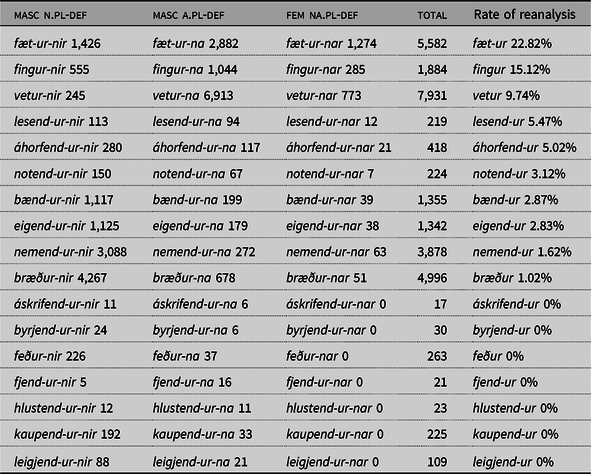
In Table 1 the token frequencies of the masculine and the feminine plural nominative/accusative definite forms are added together for each of the nouns in (13) (total). The number of feminine forms is then calculated as a percentage of that total to determine the rate of reanalysis for the plural nominative/accusative indefinite form.Footnote 17 Forms are ordered according to the rate of reanalysis, from highest to lowest, while those forms that do not undergo reanalysis as feminine are listed last and ordered alphabetically. The data presented in Table 1 are based on search results from the isTenTen corpus.
Rates of reanalysis for masculine forms in na.pl -ur

Table 1 demonstrates that plural fæt-ur, fingur, vetur, lesend-ur, and áhorfend-ur are all reanalysed as feminine at a rate above 5%. Significantly, plural fæt-ur is most frequently reanalysed at a rate of 22.82%, plural fingur in second place at 15.12%, and vetur third at 9.74%. The nd-stems lesend-ur and áhorfend-ur are reanalysed at rates of 5.47% and 5.02%, respectively. Conversely, plural bræður and nd-stem notend-ur, bænd-ur, eigend-ur, and nemend-ur undergo reanalysis at rates of 1.02%–3.12%, while plural feður and nd-stems áskrifend-ur, byrjend-ur, fjend-ur, hlustend-ur, kaupend-ur, and leigjend-ur are not subject to reanalysis at all.Footnote 18
While a top rate of reanalysis at 22.82% may seem only fairly significant on its own, it is considered highly significant when compared with a majority rate of 0–3.12%. Further, disparities in the rate of reanalysis are reflected by the frequency with which some forms in -nar agree with feminine modifiers. For example, na.pl-def fæt-ur-nar and áhorfend-ur-nar occur with feminine modifiers in 6.67% and 8.33% of cases, respctively, while those below 3.12% do not occur with feminine modifiers at all.
Conversely, Table 1 suggests no correlation between descending token frequency and the rates of reanalysis reported (though see Barðdal Reference Barðdal2008:89–96). For example, plural definite forms of fótur amount to 5,582 tokens, betraying reanalysis at 22.82%, compared with 4,996 tokens for vetur, with reanalysis at 9.74%, and 1,884 tokens for fingur with reanalysis in 15.12% of instances. These facts are taken to indicate that schematicity and semantics determine the rate of reanalysis.
This dynamic is not surprising, given the strong association of the schema [verbal root-(e)nd-ur]NA.PL with masculine agentive nouns (see above). Further, as schemas abstract over semantic function (see Sections 1 and 4.1.2), many nd-stems will have mainly referred to human males until modern times due to the more stringent prescription of traditional gender roles in past centuries. In other words, it may well be that the agency expressed by many nd-stems was mostly associated with male biological gender for a significant period of Icelandic language history.
Such supposition is perhaps substantiated by regular use of Ice. bóndakona ‘housewife at a farm’ (lit. ‘farmer’s woman’) since at least the fourteenth century, suggesting that the referent of bóndi has typically been associated with men (although this is likely changing). Similarly, association of Ice. fjandi with both the Christian concept of Satan and human enemies, who would typically have been male in the context of war, may account for the security the word exhibits in its traditional grammatical gender: see Table 1. Likewise, that Ice. bróðir refers exclusively to people of male gender likely accounts for its relatively very low rate of reanalysis despite a high degree of formal similarity to corresponding forms of Ice. móðir, e.g. bræður, mæður, with the same applying to the semantics of faðir.
Reanalysis of plural áhorfend-ur at 5.02% may appear to contradict the above assertions to a degree. However, all things are likely not equal, as corpus data reveal that singular forms of áhorfandi are 91.96% less frequent than those of the plural. Based on this disparity, it is conceivable that the plural has gained a significant degree of autonomy from the rest of the paradigm (e.g. Bybee Reference Bybee2015:104), perhaps rendering it less likely to trigger relational links with the overtly masculine singular than are the plural forms of other nd-stems. A similar interpretation likely holds for the nd-stem lesandi, whose singular forms are 75.33% less frequent than those of the plural according to the same corpus.
As noted above, plural fæt-ur is most frequently reanalysed as feminine, at a rate of 22.82%. Next, plural fingur and vetur are reanalysed in 15.12% and 9.74% of instances, respectively. In this connection, the notion of ‘all things being equal’ proves highly relevant.
Relatively frequent reanalysis of plural fingur can no doubt in part be accounted for by its semantic link to a feminine cluster containing (plurale tantum) herðar ‘shoulders’, hönd ‘hand’, löpp ‘paw, leg’, tá ‘toe’: these refer to body parts that typically come in pairs or ten. However, in terms of schematicity, it is important to note that of the feminine forms just listed, only plural hend-ur shares the sequence -ur with plural fingur. For this reason, while fingur, herðar, hönd, löpp, and tá certainly form a semantic class, it can be argued that plural -ur has only a modest association with the vocabulary for body parts.
This situation is in juxtaposition to that of a small Icelandic inflection class whose morphophonological attributes are highly associated with body parts, many of which come in pairs. The class in question contains weak neuters including auga ‘eye’, eista ‘testicle’, eyra ‘ear’, lunga ‘lung’, nýra ‘kidney’, which typically denote a pair. Others include hjarta ‘heart’, milta ‘spleen’, vélinda ‘oesophagus’, which refer to single organs, some not associated with the body, e.g. bjúga ‘(smoked) sausage’, and a scattering of loans, e.g. drama ‘drama’, paradigma ‘paradigm’, pasta ‘pasta’. Crucially, only this small class shows the ending na.pl -u, e.g. plural augu, eistu, eyru, hjörtu, etc.Footnote 19
Axelsdóttir (Reference Axelsdóttir2015) argues that the body-part weak neuters attracted vélinda and milta to the class on semantic grounds.Footnote 20 Further, she accounts for an innovative nominative/accusative plural form of Ice. hjalt ‘pommel, cross-guard’, i.e. plural hjöltu, vs. older hjölt, via reference to both phonetic similarity to hjarta, plural hjörtu, and semantic similarity with referents that come in pairs. In specific terms, the meaning of Ice. Hjalt, like the lexical gang of weak neuter pair words, is characterised by duality.
Specifically, Old Icelandic plural hjǫlt (> Ice. hjölt) referred to both a sword’s pommel and the cross-guard, i.e. to the two extremities of its hilt. Since the Old Icelandic period, hjölt has also been used in reference to the cross-guard alone, i.e. to the part of the hilt between the blade and the grip. Significantly, the cross-guard lies right-angled and points in two, i.e. opposing, directions. This is taken as further evidence for the role of schematicity and semantics in the productivity of schemas (see above).
When compared with the clear link between the phonetic structure, semantics, and – albeit limited – productivity of the weak neuter class, phonetic similarity of masculine plural fingur to the feminine lexical gang is weak. In other words, the influence of plural herðar, lappir, and tær as conducive to reanalysis of plural fingur is semantic only. But what of the different rates of reanalysis for plural fingur and fæt-ur in light of shared semantics?
Semantic association with the same subclass of feminines likely accounts for the reanalysis of masculine plural fæt-ur to a similar degree to that of plural fingur. However, it can be argued that the relative disparity between the rates of reanalysis betrays mismatched formal links to the feminine subclass and other classes, there among the feminine Xó/æT-microclass (see Section 5.2). Further, it is not inconceivable that masculine fótur and fingur exert semantic influence over one another. In this context, all things are likely not equal.
Heavy reliance on semantics alone is rendered still less credible by the practically non-existent rate at which plural definite forms of masculine handleggur ‘arm’ and fótleggur ‘leg’, which are clearly semantically related to fingur, fótur, herðar, hönd, löpp, and tá, undergo reanalysis as feminine. While the accusative plural of both words ends in -i, i.e. handleggi, fótleggi, the nominative plural has -ir; see the plural inflection of masculine gestur in (10). Significantly, the dispersion of n( a).pl -ir is high among feminine nouns. Therefore, on the premise that all things are equal, we might expect a rate of reanalysis for plural handleggir and fótleggir as feminine similar to roughly half that for plural fingur or even fæt-ur.Footnote 21 However, according to the isTenTen corpus, neither undergoes reanalysis, suggesting that all things are not equal.Footnote 22
In light of the above, the rates of reanalysis for plural fæt-ur and vetur are considered most interesting for two reasons. First, as is also true of Ice. fingur, neither paradigm patterns fully with an established class defined in terms of grammatical gender, shared semantics, and/or phonetic similarity. Secondly, while the masculine plural definite forms of fótur are 42.31% less frequent than those of vetur, feminine vetur-nar is 77.62% less frequent than feminine fæt-ur-nar. This disparity suggests rather profoundly that all things are not equal and colours the analysis presented in the next section.
5. The net effect
Given that the interaction of form and meaning impacts the rate at which masculine forms in plural -ur are reanalysed as feminine (see Section 4.2), the question in (14) arises.

In Section 5.2, the analysis presented attempts to provide answers to this question via reference to the net effect, which is first defined in Section 5.1.
5.1 Defining the net effect
The term ‘net effect’ is an intentional reference to Bybee’s network model (e.g. Reference Bybee1985, Reference Bybee2001, Reference Bybee2010), which renders emergent grammatical and/or semantic function across otherwise distinct phonetic contexts via a network of connecting lines. The network in (15) renders the emergent meanings of the English prefix un- and suffix -able in unbelievable through alignment with readable, washable, unbelievable and unwarranted, unattractive, unbelievable.

(from Bybee Reference Bybee2010:23)
Similarly, the meaning of the English past suffix -(e)d emerges through alignment with other past forms, e.g. played, spilled, spoiled, banned, and rammed, as in (16).
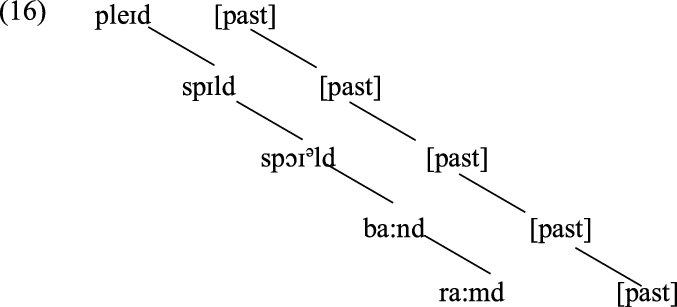
As is evident from (15) and (16), the network model renders phonetic and semantic similarity at the level of individual words, affixes, and segments. It is this dexterous property of the model that makes it highly suitable for capturing the ‘net effect’, defined as the likelihood that an inflectional form should escape alignment with a schema. Crucially, cue validity for alternation with an overtly feminine form in the plural article -nar correlates with the extent of alignment between individual segments and/or sequences. In Section 5.2, I employ innovative notation to convey this correlation.
5.2 Delineating the net effect
The descending token frequencies between masculine vetur-nir/-na and fæt-ur-nir/-na, on the one hand, and feminine fæt-ur-nar and vetur-nar, on the other, are representative of the impact of schematicity on reanalysis. The different rates of reanalysis reported in Section 4.2 are attributed below to the extent of alignment between a masculine form in na.pl -ur and two formally distinct but functionally continuous sister schemas, i.e. medially schematic [X-ur] na.pl ∼ [X-ur-nar] na.pl-def and minimally schematic [XæT-ur] na.pl ∼ [XæT-ur-nar] na.pl-def . It is argued that alignment at the minimally schematic level facilitates a gang effect and, as a result, a boost to the rate of reanalysis.
Medially schematic [X-ur] na.pl is able to attract masculine plural forms of any phonetic structure beyond na.pl -ur (see Sections 4.1.1, 4.1.2, and 4.1.3). However, due to the degree of generality associated with [X-ur] na.pl , alignment does not assign forms to a specific feminine class, as it abstracts away from several schematically distinct classes (see Sections 1 and 2). Therefore it is perhaps understandable that masculine plural fæt-ur, vetur, and fingur, whose plural forms are formally ambiguous with regard to grammatical gender, are more readily reanalysed as feminine than the plural forms of most nd-stems (see Sections 4.1.2 and 4.2).
As stated in Section 1, reanalysis is considered a property of productivity. Therefore, considering the acknowledged causal relation between type frequency, schematicity, and productivity (Barðdal Reference Barðdal2008), we might expect schemas for the Xó/æT-microclass to be unproductive (in Dressler’s Reference Dressler2003 sense). However, it is likely that a minimum of two items suffices for the abstraction of a schema (see Section 3.3).
By the same token, we might expect to attribute a higher rate of reanalysis to alignment with [X-ur] na.pl . The different frequency relations between the masculine and feminine sets mentioned above appear, then, to counter the view that productivity correlates with type frequency and schematicity – on the assumption that all things are equal (see Section 4.2). On the contrary, however, the higher rate at which plural fæt-ur is reanalysed as feminine compared to any masculine form in na.pl -ur is considered a consequence of full alignment with both medially schematic [X-ur] na.pl and minimally schematic [XæT-ur] na.pl .
As noted in Section 1, the gang effect is facilitated by a significant degree of phonetic similarity between a set of items. The network in (17) illustrates graded similarity between na.pl vetur, geit-ur, fæt-ur, and ræt-ur, as these converge incrementally on alignment with minimally schematic [XæT-ur] na.pl . Cue validity for a plural definite form in -nar correlates with the number and thickness of connecting lines according to prototype structure: see Section 2.
The notations employed in (17) are explained below.
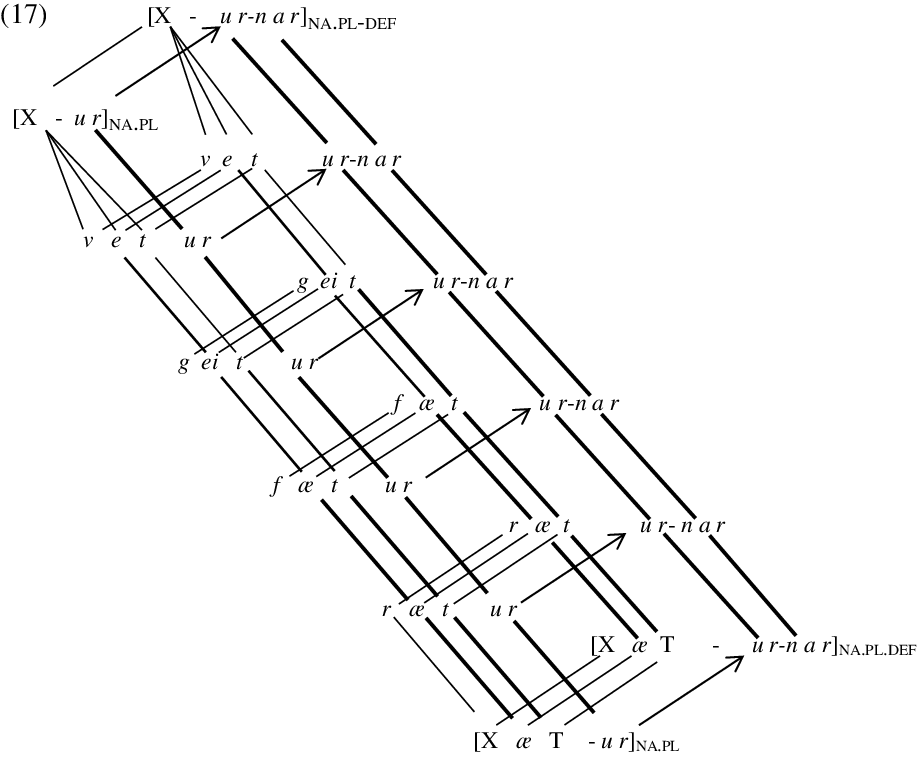
Thin connecting lines render arbitrary phonetic similarity, which alone is void of cue validity, i.e. connections between identical segments across forms of the same word and between instances of stem-final -t in vetur and geit-ur. Note that stem-final -t occurs in all of the forms in (17), irrespective of prototypical status within the feminine subclass. Therefore one-to-one connections between instances of stem-final -t only illustrate graded convergence with [XæT-ur(-nar)] na.pl(-def) in co-occurrence with other prototypical attributes of the Xó/æT-microclass, i.e. -t-ur or -æt-ur (see below).
Phonetic similarity that correlates unambiguously with grammatical and/or semantic function is depicted by thick bold lines, i.e. those between individual instances of nominative/accusative plural -ur, between instances of the feminine plural article -nar, and between instances of -æ-, which is an indication of plural in some stems, e.g. (rót ∼) rætur. Arrow-headed lines convey the cue validity of plural -ur for alternation with a form in the feminine plural article -nar.
Functional matches that emerge as a property of graded similarity are represented by thinner bold lines. According to the notation employed in (17), then, the stem-vowel e of plural vetur aligns only tentatively with the Xó/æT-microclass prototype. However, consider the connection between e [ϵ] in vetur and ei [ei] in geit-ur, on the one hand, and that between ei in the latter and the æ [ai] of fæt-ur, on the other.
It can be argued that perceived phonetic similarity between [ϵ] and [ei] – the former is front and unrounded and so is the initial element of the latter – may suffice to align plural vetur within the network through similarity of [ei] in plural geit-ur to the [ai] of fæt-ur. Concerning the status of plural geit-ur within the prototype structure, stem-final -t may bolster the form’s position on account of co-occurrence with na.pl -ur and an [i]-final diphthong (see Section 2). In other words, gradient similarity of the kind na.pl [vεt]-ur ∼ [keit]-ur - [keit]-ur ∼ [fait]-ur may facilitate alignment of plural vetur with minimally schematic [XæT-ur] na.pl to some degree, in addition to full alignment with medially schematic [X-ur] na.pl .
In terms of the rate of reanalysis as a correlate of cue validity, there are seven connections between each of the relations in (17). However, the one-to-one connections between plural vetur, geit-ur, and fæt-ur are weaker than those between plural fæt-ur and ræt-ur. This is illustrated by the seven thick bold lines that connect the latter pair, compared with four such connections between plural fæt-ur and geit-ur, while merely three connect geit-ur to vetur. Thus the network illustrates that a form’s cue validity for alternation with another in fem na.pl-def -nar is proportionate to the degree of formal and functional alignment at the minimally schematic level.
Due to the nature of form–function connections between instances of na.pl -ur, minimally schematic [XæT-ur] na.pl fulfils the function of both schemas. This is because the sequence na.pl -ur among feminines is always associated with this same function, irrespective of affiliation with either schema. Conversely, alignment at the minimally schematic level establishes additional points of similarity that strengthen the network on convergence with [XæT-ur] na.pl and therefore its cue validity for alternation of the kind [XæT-ur] na.pl ∼ [XæT-ur-nar] na.pl-def . In other words, alignment with minimally schematic [XæT-ur] na.pl constitutes default alignment with [X-ur] na.pl .
In answer to (14), masculine plural fæt-ur has higher cue validity for use as feminine than any masculine form in na.pl -ur due to the number and extent of one-to-one form–function connections with [XæT-ur] na.pl , in addition to alignment with medially schematic [X-ur] na.pl . Therefore the different rates of reanalysis reported in Table 1 are considered a function of minimal schematicity, which facilitates the gang effect of the Xó/æT-microclass.
6. Concluding remarks
The current article has sought to offer a usage-based cognitive account of the different rates at which Icelandic masculine forms in na.pl -ur, which has a 91.89% dispersion rate among feminine nouns, are treated as feminine. Such treatment is betrayed by the occurrence of traditionally masculine forms in plural -ur with the feminine article na.pl -nar, e.g. fæt-ur-nar, vetur-nar, eigend-ur-nar. The mechanism for such treatment is gender reanalysis, attributed to the high dispersion of na.pl -ur among feminines.
In Section 2, the prototype structure of a subclass of Icelandic feminines in plural -ur was delineated. The subclass’s prototype was argued to centre on phonetically coherent fem blók, bók, bót, brók, nót, and rót, with plural blæk-ur, bæk-ur, bæt-ur, bræk-ur, næt-ur, and ræt-ur, referred to collectively as the Xó/æT-microclass.
Section 3 detailed the highly limited productivity of the Xó/æT-microclass schemas, which have been extended to three paradigms only. The cue validity of native masculine na.pl fæt-ur for occasional alternation with feminine na.pl-def fæt-ur-nar was considered a function of proportional analogy with the relevant schemas. As innovation based on the Xó/æT-microclass is not associated with any other Icelandic paradigms, it is considered the gauge for limited productivity based on a minimally schematic, low type frequency inflectional pattern in na.pl -ur.
In Section 4, the interaction of a schema’s type frequency and its association with a semantically determined class of nouns was determined to affect the rate of reanalysis. For example, the Icelandic nd-stems, which constitute the largest single masculine class in na.pl -ur, are identified as overtly masculine through their agentive referents in unison with the sequence na.pl -(e)nd-ur, e.g. eig-end-ur. These formal and functional properties of the class account for reanalysis at a majority rate of 0–3.12%, as reported in Section 4.2.
In light of these data, the treatment of plural fæt-ur and vetur as feminine was considered most interesting. First, unlike the nd-stems, neither belongs to an easily definable class on both phonetic and semantic grounds. Secondly, while masculine n/a.pl-def vet-ur-nir/-na is far more frequent than masculine fæt-ur-nir/-na, feminine fæt-ur-nar is almost twice as frequent as feminine vetur-nar.
In order to demonstrate prototype effects on the rate of reanalysis as a means of explaining this inverse disparity, Section 5 employed notational conventions based on Bybee’s network model with some innovative features. The network illustrated varying degrees of cue validity inherent to different masculine forms in plural -ur for alternation with a feminine definite form in -nar. The degree of cue validity was rendered as a network of connecting lines, which, depending on number and thickness, modelled the extent of phonetic and/or functional alignment with distinct schemas.
Illustration of alignment by the means just described demonstrated the net effect of schematicity, one function of which is that na.pl vetur, fæt-ur – and any other masculine plural form in -ur – align with medially schematic [X-ur] na.pl on account of one-to-one form–function connections between instances of na.pl -ur alone. Reanalysis occurs once alignment facilitates projection of the grammatical attribute feminine onto a masculine in plural -ur. As the schema [X-ur] na.pl has cue validity for alternation with its sister [X-ur-nar] na.pl-def , alignment facilitates alternation such as na.pl vetur, fæt-ur ∼ fem na.pl-def vetur-nar, fæt-ur-nar.
Additionally, however, the schema [XæT-ur] na.pl attracts plural fæt-ur – and possibly some instances of plural vetur – at the minimally abstract level on account of one-to-one form–function connections beyond na.pl -ur. Subsequently, reference to the sister schema [XæT-ur] na.pl ∼ [XæT-ur-nar]na.pl-def, in addition to [X-ur] na.pl ∼ [X-ur-nar] na.pl-def , provides a relative boost to the cue validity of (now feminine) plural fæt-ur for alternation with feminine fæt-ur-nar.
In conclusion, the different rates of reanalysis highlighted are predicated on the degree to which a masculine form in na.pl -ur aligns with schemas at both the medially and the minimally abstract levels. Therefore the likelihood that a masculine form in na.pl -ur will escape reanalysis as feminine is viewed as a correlate of minimal schematicity. It is hoped that the current study will motivate further corpus-based study of limited productivity in Icelandic and other inflectional systems in line with the usage-based cognitive approach to linguistic innovation.
Acknowledgments
I would like to thank three anonymous reviewers for NJL and the editor, Marit Julien, for invaluable comments and feedback. I am indebted to Katrín Axelsdóttir, Þórhallur Eyþórsson, Erna Björk Gestsdóttir, Gunnar Ólafur Hansson, Alex Murphy, and Hjalmar P. Petersen, who read earlier drafts of the paper and suggested improvements. I would also like to express thanks to Peter Bakker, Kristoffer Friis Bøegh, Joshua Nash, and Jeroen Willemsen for making me feel welcome at the Department of Linguistics, Cognitive Science and Semiotics at Aarhus University, while I was conducting this research there as a guest during 2018. For the same reason, I extend my gratitude to the staff at Føroyamálsdeild, University of the Faroe Islands. This research was funded by the Icelandic Research Fund (Rannís), grant number 174253-013.