INTRODUCTION
Teotihuacan is well known for the size of its urban population, enormous monumental architecture, urban layout and axial street plan, and the use of multifamily apartment compounds to house the city's population. Teotihuacan and the Aztec capital of Tenochtitlan were the only urban centers in the New World to ever exceed 100,000 persons in size. How the urban economy was organized and how its resident population supported itself remains an important and unresolved question. The original urban survey by the Teotihuacan Mapping Project (TMP) identified a very large number of craft workshops across the city on the basis of surface remains. Foremost among these were several hundred dense concentrations of obsidian debris that project members hypothesized were evidence for obsidian craft workshops (Millon Reference Millon1973, Reference Millon and Sabloff1981:223; Spence Reference Spence1966, Reference Spence1967). A reanalysis of these materials led Spence (Reference Spence1981, Reference Spence, de Tapia and Rattray1987) to reduce the number of obsidian workshops operating at the city's Classic period zenith to 105 sites of varying sizes (Spence Reference Spence, de Tapia and Rattray1987:44). But the scale of obsidian crafting to produce obsidian blades and other tools for use within, and export from, the city seemed to far exceed any other known locale in Mesoamerica. This led some scholars to propose that Teotihuacan built its power and influence through a form of economic imperialism based on the monopolistic control of obsidian sources (Sanders and Santley Reference Sanders, Santley, Vogt and Leventhal1983; Santley Reference Santley1980, Reference Santley and Miller1983, Reference Santley and Hirth1984). From this perspective, it was trade and the desire to control the procurement of a wide variety of key resources that drove Teotihuacan's contact with, and incursions into, distant areas of Mesoamerica (Bove and Medrano Busta Reference Bove, Busto and Braswell2004:72; Cowgill Reference Cowgill2015; Parsons Reference Parsons and Pasztory1978; Sanders Reference Sanders and Pasztory1978; Santley Reference Santley1994; Santley and Alexander Reference Santley, Alexander, Mastache, Parsons, Santley and Puche1996; Zeitlin Reference Zeitlin1982).
In a seminal article, Clark (Reference Clark and Isaac1986b) challenged the accepted orthodoxy about both the scale of obsidian craft production at Teotihuacan and the importance of obsidian control in its broader geopolitical strategy. He argued that the surface data relevant to obsidian crafting collected by the TMP were flawed and did not support either of these interpretations. Clark (Reference Clark and Isaac1986b:32–33) felt that most surface concentrations of obsidian were trash dumps or refuse deposited in construction fill rather than material from in situ production areas. He stressed the need for greater analytical precision and argued that the only way to positively establish that an area functioned as a workshop was through stratigraphic excavation. He reasoned that, until such excavations were undertaken, there was no basis for assuming large-scale obsidian craft activity at the site. All of the obsidian recovered across the city, Clark argued, could reflect nothing more than a modest level of crafting oriented to supply the inhabitants of the city and communities in the Basin of Mexico with the obsidian cutting tools used in everyday activities.
In 2013, the Proyecto Arqueológico Tlajinga Teotihuacan (PATT) took up the challenge of excavating one of the surface concentrations identified by TMP surface mapping as an obsidian workshop. The goal of the excavation was twofold: to explore whether surface concentrations of obsidian production debris accurately reflected the presence of an in situ craft workshop, and if so, to identify the scope and nature of its production activities. This paper explores some of the initial results of excavations carried out at Compound 17:S3E1 (hereafter Compound 17), which had been identified by the TMP as an obsidian workshop in the Tlajinga district along the southern Street of the Dead. The discussion begins by summarizing the problems of inferring obsidian craft activity from surface material as discussed by Clark (1986). It then describes the excavation conducted at Compound 17 and the distribution of obsidian debris recovered there. Next the obsidian debris recovered during the excavations are classified using the lithic technology approach and evaluated in terms of what they indicate about the nature of obsidian craft activity. Excavation confirmed that the surface remains identified at Compound 17 did indeed reflect the presence of an in situ obsidian craft workshop. The discussion concludes with a consideration of what this single test case does, or does not, tell us about the level of obsidian craft activity at Teotihuacan.
THE TEOTIHUACAN MAPPING PROJECT OBSIDIAN MODEL
Urban survey and mapping by the TMP established the size of the city at 20–25 km2, with most population estimates ranging between 85,000–150,000 residents (Cowgill Reference Cowgill2015:144; Millon Reference Millon1973:44–45). One of the results of the urban survey was the recovery of an astonishing quantity of evidence for craft production across the site. Initial analyses of surface collections identified more than 200 ceramic workshops, almost 400 obsidian workshops, and a lesser number of lapidary, shell, basalt, mica, and groundstone workshops (Millon Reference Millon1973:45, Reference Millon and Sabloff1981:199, 223). Add to this an unknown number of craftpersons who engaged in the building trades (e.g., carpenters, plasterers, and masons) as well as artisans who worked with largely perishable materials, and the scale of crafting based on surface indications was unlike anything recorded elsewhere in Mesoamerica.
Spence (Reference Spence, de Tapia and Rattray1987) reanalyzed the TMP surface collections, reduced the number of obsidian workshops, classified them by size, and assigned them to phases within the Teotihuacan urban sequence. He identified nine workshops during the Patlachique phase and 48 during the subsequent Tzacualli phase. Thirty-eight of the Tzacualli phase workshops were grouped in seven areas while the other 10 were isolated workshops (Spence Reference Spence1981, Reference Spence and Hirth1984). The number of workshops increased to a little over 100 at the height of Teotihuacan development during the subsequent Classic period (Spence Reference Spence, de Tapia and Rattray1987). Most of these workshops occur in 29 clusters of 2–12 workshop sites (Spence Reference Spence and Isaac1986:76).
Spence classified workshops into three main types: local, regional, and precinct. Local workshops were located on the periphery of the city and were relatively small in scale. Nineteen of the 29 Classic-period workshop clusters were identified as local workshops. Artisans here were described as having produced the full range of artifact categories (cores, blades, bifaces, and scrapers) with production oriented primarily toward local consumption within the city. Regional workshops were classified as larger and more specialized production centers. They were often closer to the central zone of the city. They had a higher density of production refuse, a greater degree of sub-specialization in the products produced (blades and bifaces), and were believed to have been staffed by some full-time specialists (Spence Reference Spence1981:771). Spence classified seven of the 29 workshop areas as large-scale regional workshops. Based on their size, Spence (Reference Spence1981:780) hypothesized that professional merchants distributed the goods produced in these workshops to consumers beyond the city and across central Mexico. Precinct workshops were identified in three areas of the site located directly adjacent to major public buildings, two near the Moon Pyramid and one on the west platform of the Great Compound. Precinct workshops were described as overseen by the state and produced goods directly for state use and consumption. The toolmakers in precinct workshops were believed to have been drawn from the regional workshops as corvée labor (Spence Reference Spence1981:779).
The primary obsidian used at Teotihuacan during the Miccaotli to Metepec phases was green obsidian from the Sierra de las Navajas source near Pachuca, Hidalgo, which Spence et al. (Reference Spence, Kimberlin, Harbottle, Ericson and Purdy1984) proposed was procured and controlled by the Teotihuacan state. Santley (Reference Santley1980, Reference Santley and Miller1983, Reference Santley and Hirth1984), impressed by the scale of Classic period production activities at Teotihuacan and the presence of Sierra de las Navajas green obsidian in distant areas of Mesoamerica, proposed that Teotihuacan established a widespread economic trade network based on monopolizing the production and distribution of obsidian goods. The basis for the Teotihuacan network was the use of a discriminatory pricing policy that allowed it to control, or at least influence, obsidian exchange over a great deal of Mesoamerica (Santley Reference Santley1980, Reference Santley and Miller1983, Reference Santley and Hirth1984).
CRITIQUING THE TEOTIHUACAN URBAN SURVEY
In a provocative critique, Clark (Reference Clark and Isaac1986b) voiced strong objections to the interpretations about the scale and organization of obsidian crafting at Teotihuacan. He criticized TMP identifications of the number of obsidian workshops at Teotihuacan, their form of organization, the proposed scale of production, and, by extension, the size and extent of the proposed Teotihuacan trade network. He believed that the scale of the Teotihuacan obsidian industry was much smaller than the TMP proposed. His objections were based on two important methodological considerations: (1) lack of control over the relationship between the surface concentrations of production debris and their subsurface context, and (2) failure to evaluate the scale of production in relation to measurable parameters available through technological analysis.
Anyone who has excavated at Teotihuacan knows that artifacts in primary context are difficult to find. Organic refuse and other trash were not allowed to accumulate because of health problems they could present to residents in densely occupied urban settings. Obsidian production debris poses a special problem because its razor sharp edges are hazardous both to toolmakers and other residents living near production locales. Waste disposal would have been problematic within Teotihuacan and obsidian production debris would likely be transported and dumped away from the city, or incorporated as construction fill in architectural constructions. Because of these conditions, Clark (Reference Clark and Isaac1986b:31) concluded that,
“[i]n an urban center such as Teotihuacan, most trash visible on the surface is probably secondary debris that is not in its primary location. Therefore, one should not assume a priori that workshop debris accurately marks a workshop area.”
Clark argued that all workshop identifications based on surface indications should be viewed with skepticism without subsurface confirmation of in situ production evidence. This included both of Spence's functional identifications of production areas as local and precinct workshops. The location of local workshops in outlying areas with higher-than-normal concentrations of obsidian debris led Clark to suggest that they might simply be the result of removing production waste from workshops in the center of the city and dumping it in less densely occupied areas near the periphery. Likewise, he suggested that the presence of production debris in precinct areas might represent post-abandonment phenomena (Clark Reference Clark and Isaac1986b:32–33). Subsequent excavations in the Moon Pyramid precinct workshop have documented the in situ production of large numbers of bifaces, primarily dart points, and smaller concentrations of eccentrics (Carballo Reference Carballo2007, Reference Carballo2011; Paredes Cetino Reference Paredes Cetino2000; Paz Bautista Reference Paz Bautista1996). The most parsimonious interpretation of these remains is that, like the later Aztec (Sahagún Reference Sahagún, Anderson and Dibble1981:183) and possibly during the Epiclassic periods (Andrews and Hirth Reference Andrews, Hirth and Hirth2006:252–256), military weaponry was produced by mobilizing artisans through coatequitl labor tribute to produce weaponry to provision Teotihuacan's state armory (Carballo Reference Carballo2011:159). Nevertheless, Clark was correct in cautioning that surface workshop debris in close proximity to monuments like the Moon Pyramid is insufficient for identifying in situ production activities without subsurface contextual confirmation (Hirth Reference Hirth1995).
The second issue that Clark addressed is the need for more in-depth technological analysis to identify the scale and organization of production within workshops and across the site. Clark employed experimentally derived production estimates to argue that, instead of nearly a hundred workshops each with one or more resident craftspersons, all of the obsidian production debris recovered at Teotihuacan could have been produced by as few as six full-time artisans (Clark Reference Clark and Isaac1986b:39). Moderating the estimate a bit, Clark (Reference Clark and Isaac1986b:41) states, “[a]ll the specialized obsidian tools used at Teotihuacan throughout its history could have easily been produced by fewer than 10 full-time specialists or 20 part-time specialists.” The reduction from the 100 or more artisans implied by the TMP obsidian craft reconstructions assumes that most of the workshop locales identified in the urban survey were production refuse redeposited across the extent of the city.
Identification of the scale and organization of workshop areas depend upon addressing three dimensions of production output. These included the number of items produced in the time frame the workshop operated, the number of full- or part-time craftspersons involved in production, and determining whether the workshop was an exporter of finished lithic tools or a consumer of obsidian tools in other crafting activities (Anderson and Hirth Reference Anderson and Hirth2009). It is here that Clark's critique becomes somewhat opaque. For example, it is impossible to estimate total annual production output from workshop debris unless one has all of the production debris or a representative sample that allows researchers to estimate production output reliably, both for all of the artifacts present as well as those that left the workshop. This would be impossible if, as Clark proposes, hazardous workshop debris was removed reliably from workshop areas and deposited in multiple dumps across the city.
Estimating the level of full- or part-time specialists engaged in production is complicated and requires exact information of workshop output calibrated against estimates of annual crafting output over the length of time the workshop was in operation. In short, an estimate of output in relation to manufacturing time (Hirth and Andrews Reference Hirth, Andrews and Hirth2006a, Reference Hirth, Andrews and Hirth2006b). Production output cannot be estimated with any degree of reliability without making unrealistic assumptions about what the information represents, except under unique depositional circumstances (Hirth and Andrews Reference Hirth, Andrews and Hirth2006b). The same problem exists for accurately estimating full- or part-time craft specialization since it also involves estimating the scale of total workshop output. Differentiating between full- and intermittent (part-time) crafting (Hirth Reference Hirth and Hirth2009a, Reference Hirth and Hirth2009c) requires an independent assessment to establish the number of craftpersons involved.
Finally, Clark criticized the TMP results because many of their proposed workshops had a high incidence of blade usage that would be unexpected for workshops producing blades for export. What he ignored was that craft workshops that produced blades for their own internal use probably also were multicrafters in the Mesoamerica tradition (Hirth Reference Hirth and Hirth2009a, Reference Hirth2009b) and produced tools for use in other craft activities as well as for exchange.
Clark's critiques were timely and provocative. They were useful in that he called for greater archaeological precision in the interpretation of TMP surface collections and how they were used to estimate the size and scale of the obsidian craft industry at Teotihuacan. They were provocative in that they challenged the emerging orthodoxy of Teotihuacan economic imperialism and the conclusions of researchers working on the collections. Clark's (Reference Clark and Isaac1986b:34–35, 37, 64) own words speak for themselves:
Current estimates of the scale of Teotihuacan's obsidian industry should not be taken seriously. The whole analytical procedure has been backwards….There is no compelling empirical reason for supposing that Teotihuacan's obsidian “workshops” were producing for an outside market…All the Middle Horizon green Pachuca obsidian found outside the central Mexican plateau would only fill a couple of shoe boxes.
And, with respect to reconstructing the structure of Teotihuacan's obsidian economy, the “only way to resolve the problems mentioned here will be to collect fresh data. No amount of restudy of old collections will do” (Clark Reference Clark and Isaac1986b:42).
It was to address some of these important issues that the PATT conducted excavations at Compound 17 during the summer of 2013.
EXCAVATIONS IN COMPOUND 17
One of the goals of the PATT was to excavate a domestic obsidian workshop identified by the TMP and evaluate the relationship between surface indications of workshop activity and whether they reflected subsurface evidence for obsidian crafting. It was surprising, given the proposed importance of craft activity in the life of Teotihuacan that no one had undertaken this task in the intervening 27 years between Clark's original call for investigation in 1986 and the initiation of our excavations in 2013. As mentioned above, excavations had explored obsidian production in a precinct workshop near the Moon pyramid (Carballo Reference Carballo2007, Reference Carballo2011; Paredes Cetino Reference Paredes Cetino2000; Paz Bautista Reference Paz Bautista1996). The larger question of obsidian blade production in local or regional workshops for export or use in the city, however, had not been explored.
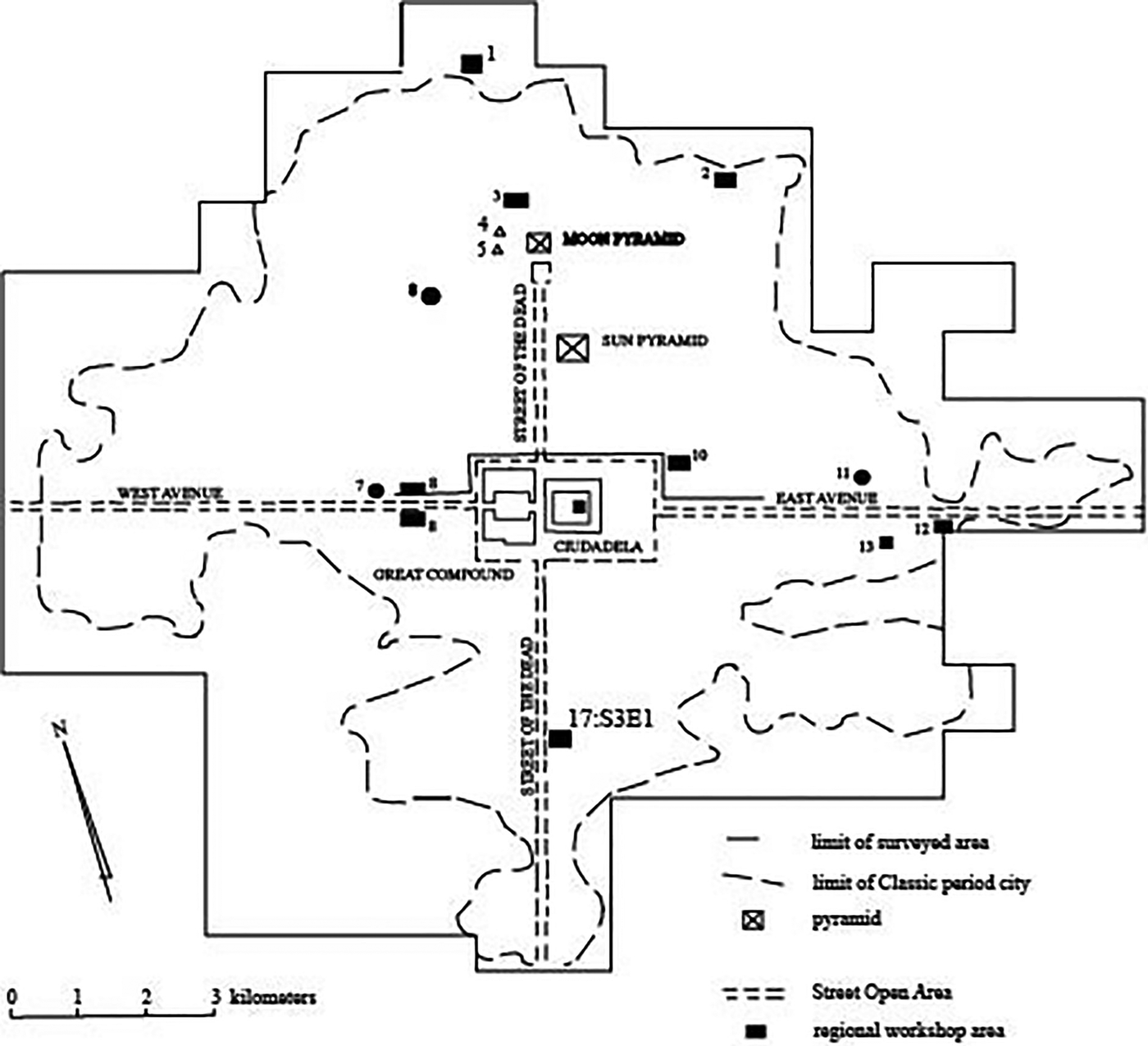
We chose the obsidian workshop identified by the TMP in the Tlajinga barrio at Compound 17 for exploration for several reasons (Figure 1). First, the Tlajinga barrio was the broader area used by the PATT to study neighborhood organization and urbanization in the southern city. Second, previous work (Sheehy Reference Sheehy1992; Widmer Reference Widmer1991) had established that crafting was carried out in the Tlajinga barrio. Third, Spence had identified Compound 17 as a Classic-period regional workshop, so this provided an opportunity to explore one of his hypothesized export-oriented production locales. Fourth and finally, the Compound 17 workshop was the only large workshop identified by Spence (Reference Spence1981:Figure 1, Reference Spence and Isaac1986:Figure 1) in the southern city. The closest other large workshops to Compound 17 were in the Ciudadela and the Great Compound 1.5–2.0 kilometers to the north. Its isolation increased the probability that it was an in situ craft area but did not rule out the possibility that it was a trash deposit where production refuse from these other workshops was dumped along the site periphery, as Clark had proposed for local workshops.
The location of Compound 17 (17:S3E1) and other major local, regional, and precinct workshops at Teotihuacan during the Classic period as identified by the Teotihuacan Mapping Project. Drawing by Nadia Johnson.

A site visit to Compound 17 by Hirth and Carballo in June of 2012 reconfirmed that it was a good place for test excavations. Obsidian pressure blades, core shaping debris, and core fragments were recovered along with domestic debris over an area of about 600 m2. Concentrations of obsidian debris were moderate, except around several ant hills where accumulations of small debitage were evident having been brought to the surface by these small excavators. Both the density of surface material was lower and the extent of the lithic distribution smaller than was expected for a large-scale regional workshop. Nevertheless, it provided an opportunity to evaluate how accurately surface remains reflected in situ workshop activity at Compound 17.
CONTEXTUALIZING THE OBSIDIAN WORKSHOP
A craft workshop is defined here as a specialized production locale used for the production of goods intended for consumption outside the production unit. An obsidian craft workshop is normally defined as a place where obsidian tools are produced for export and use elsewhere (Clark Reference Clark1986a, Reference Clark, Gaxiola and Clark1989). It is expected to have a high concentration of production related debris including microdebitage in the area of production (Clark Reference Clark1986a, Reference Clark, Gaxiola and Clark1989; Healan Reference Healan1992, Reference Healan1995; Moholy-Nagy Reference Moholy-Nagy1990). The issue with identifying obsidian craft production is complicated by two factors. First, obsidian tools in Mesoamerica were used in a wide range of other craft activities where cutting, trimming, and scraping activities were involved. Since pre-Hispanic craft specialists usually made their own tools, an artisan working in leather, wood, baskets, feathers, textiles, or some other material may also have produced obsidian blades for cutting activities that were consumed internally within the workshop.
Second, the normal pattern of Mesoamerican craft production is one of multicrafting (Hirth Reference Hirth2009b) without restrictions on who could practice specific crafts if they could obtain the training to do so. Clark focused on the difference between producing blades for export versus internal consumption, but he did not specifically consider the gradient between production and consumption of obsidian blades that can occur in multicrafting contexts. In these contexts toolmakers could produce blades for their own use, as well as for sale and distribution to outside consumers.
Obviously, this is a complicated issue and one that cannot be resolved entirely within the context of this discussion. For this reason, we consider workshops to be areas that produced blades for both external distribution and internal consumption in manufacturing activities of other craft goods intended for sale. Both cases, however, have one thing in common: they were not made on an ad hoc basis by unskilled labor. Instead, blade makers were skilled artisans who had received special training in order to produce them. The low error rates found in most areas where blades were produced attest to their high skill. Identifying variable levels of production for use can be accomplished empirically by examining the level of usewear found on broken and discarded blades within workshop contexts (Anderson and Hirth Reference Anderson and Hirth2009; Hirth and Castanzo Reference Hirth, Castanzo and Hirth2006b).
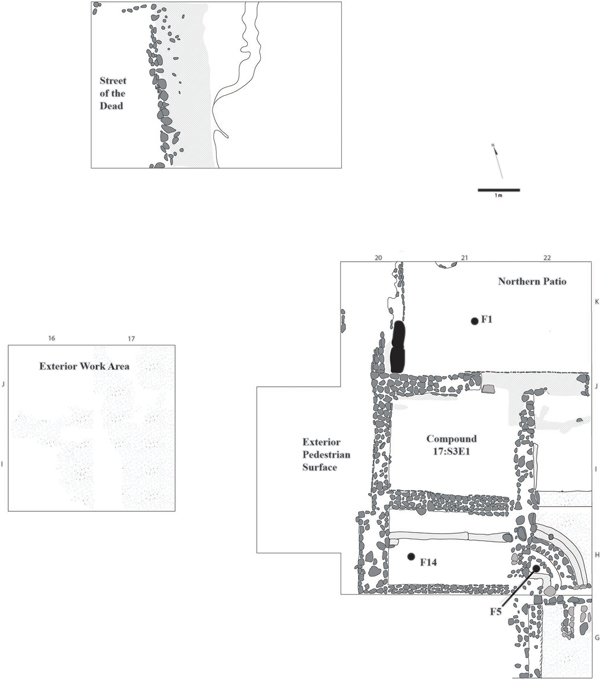
A total of 76 m2 of Compound 17 were excavated during the summer of 2013. Compound 17 is located on the east side of the Street of the Dead (Figure 1). Excavations sampled the western edge of the compound, the open hillside immediately west of the compound, and the retention wall constructed at the bottom of the slope bordering the eastern side of the Street of the Dead (Figure 2). Excavation progressed using a combination of natural and arbitrary levels with all deposits sieved for archaeological remains through 2.5–5.0 mm screens (see Carballo et al. Reference Carballo, Hirth, Sariñana, Buckley, Ramón and Kennett2019). Excavations uncovered portions of three rooms and two interior patios as well as exterior work areas and workshop refuse from the area sloping toward the Street of the Dead.
The archaeological excavations at Compound 17 (17:S3E1) in 2013. Image by the Proyecto Arqueológico Tlajinga Teotihuacan.
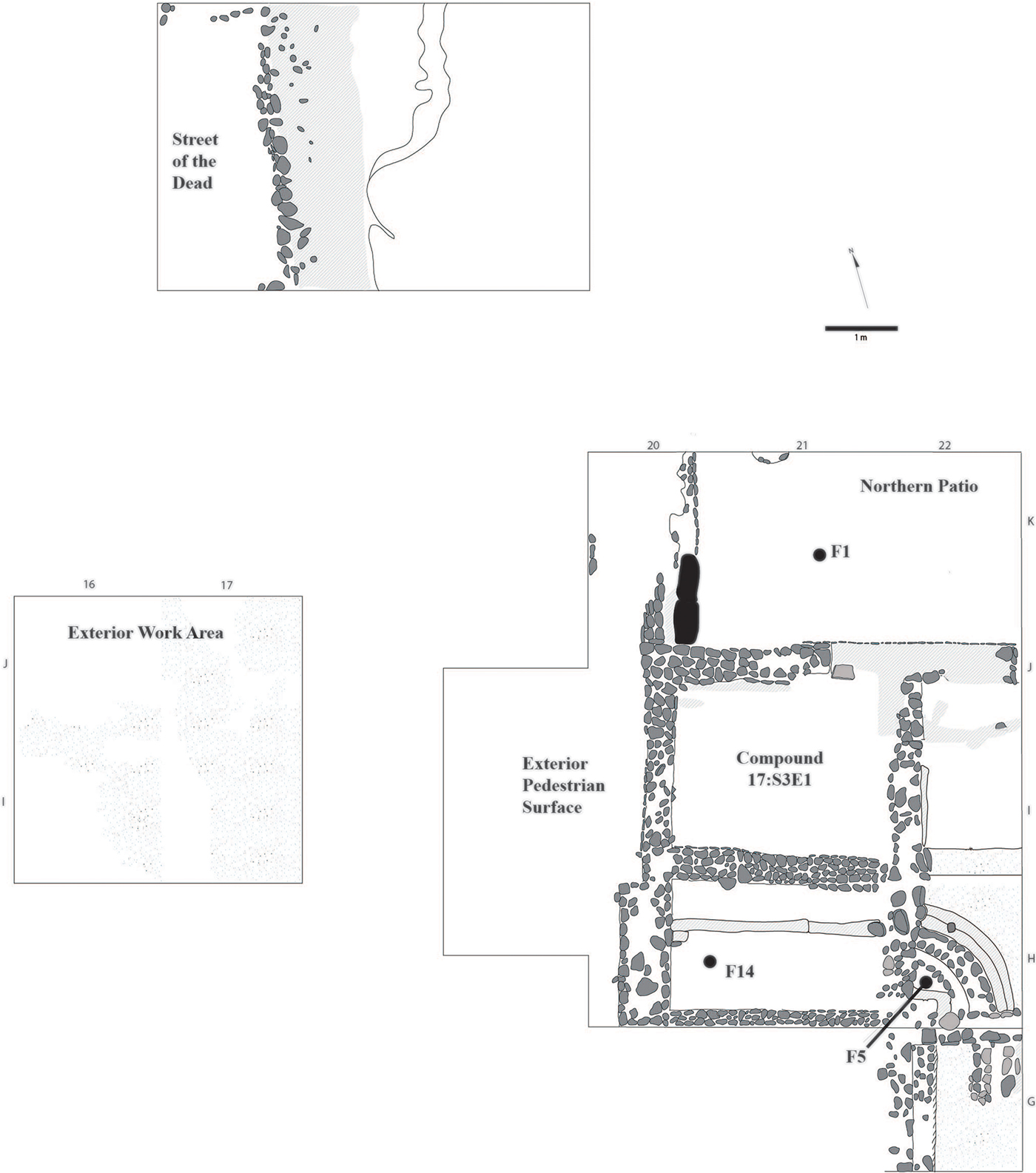
Several different types of data confirm that the residents of Compound 17 were artisans who produced obsidian artifacts for both export and internal consumption. The first of these was the recovery of a large quantity of obsidian tools and production waste from primary (in situ) and secondary (refuse) contexts. A total of 406.8 kg of obsidian and 799,384 obsidian artifacts were recovered from screened deposits in these excavations. The production debris was related primarily to the production of obsidian pressure blades, and the quantity recovered far exceeded our expectations based on surface materials. Concentrations were so dense that careful recovery of obsidian debris from excavation contexts significantly restricted the amount of area that could be excavated. Obsidian production refuse was recovered in primary context in three areas of Compound 17: the northern interior patio, the pedestrian surface adjacent to the western exterior wall of Compound 17, and on and between compact earthen work surfaces between Compound 17 and the Street of the Dead (Figure 3). The debitage recovered indicates that identical production activities were carried out in all three areas.
The Compound 17 (17:S3E1) obsidian workshop area. Image by the Proyecto Arqueológico Tlajinga Teotihuacan, modified by Hirth.
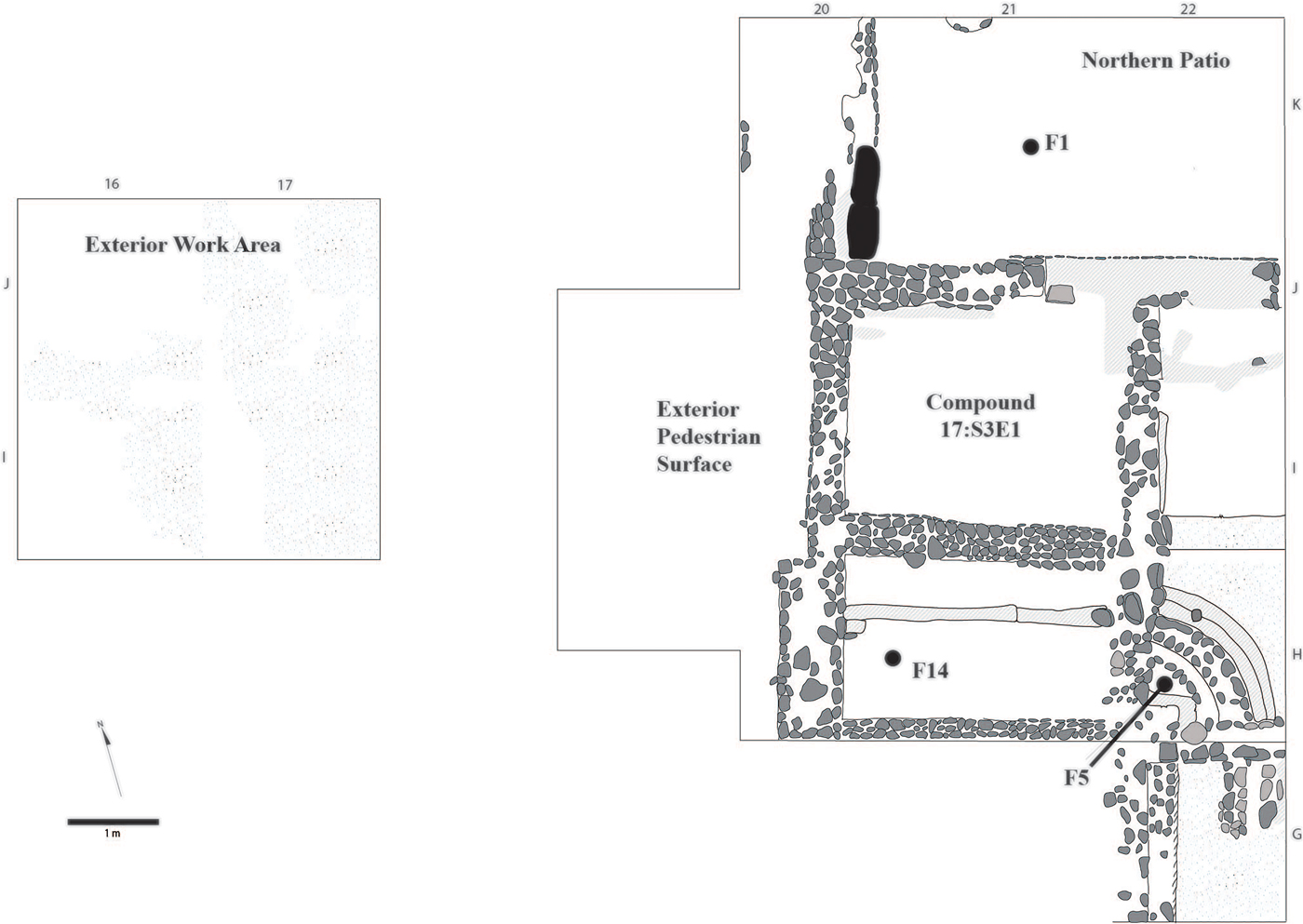
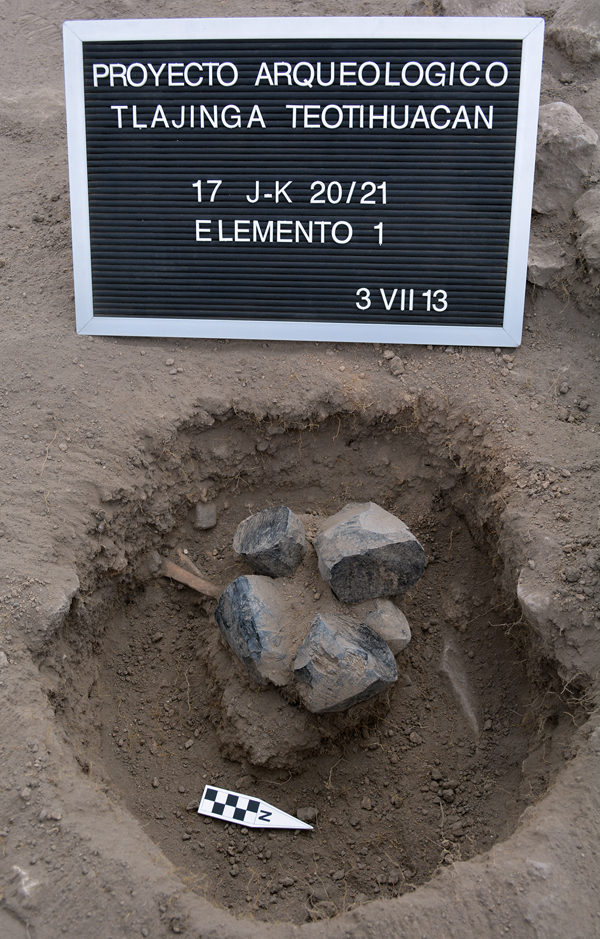
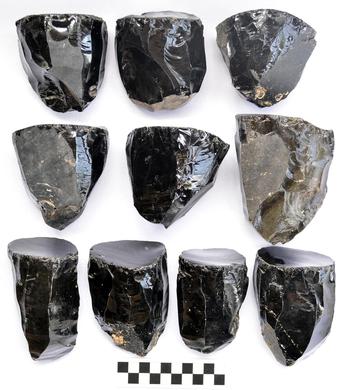
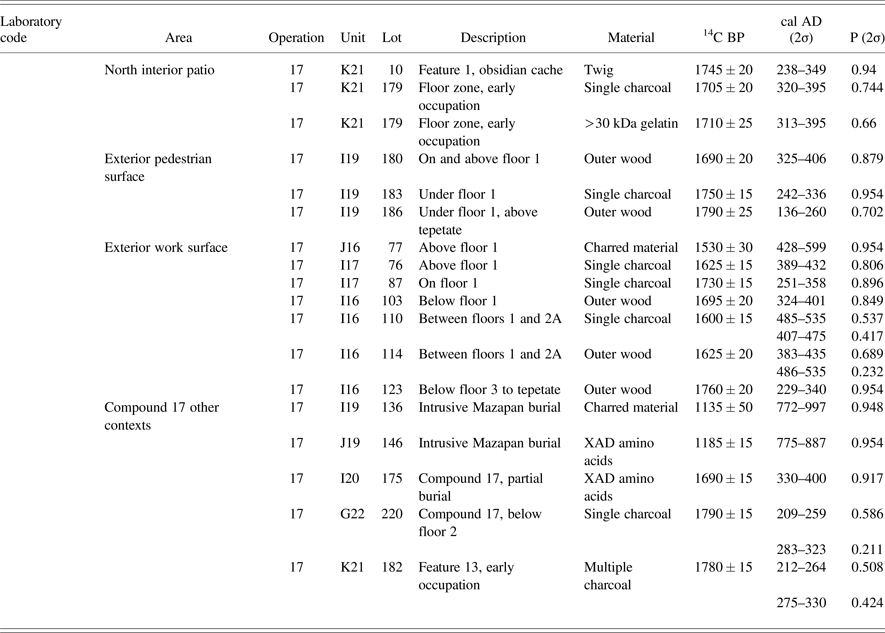
The northern interior patio had an earthen floor that allowed material from the activities conducted here to accumulate and become embedded in the floor zone over time. Although this area would have been periodically cleaned, a good amount of workshop production debris from obsidian blade production was recovered embedded in this floor zone. Furthermore, Feature 1 is a subfloor cache of 10 obsidian percussion cores (Figures 4 and 5) and was identified near the center of the patio along with a complete exhausted prismatic core that was recovered from the floor zone along its south wall. Dense concentrations of production debris also were identified along the exterior western wall of Compound 17 bordering Rooms 1, 2, and the northern interior patio. Portions of compact earthen floors helped to identify the pedestrian surface along the exterior base of the wall, which was disturbed by two burials: a Late-Tlamimilolpa-phase burial contemporary with the occupation of the compound (cal a.d. 330–400) and a later Mazapan internment dating to a.d. 775–887/997 (Table 1).
Feature 1, subfloor cache of 10 obsidian percussion cores. Photograph by Carballo.

The 10 percussion cores from Feature 1 cache. Photograph by Hirth.

Accelerator mass spectrometry radiocarbon dates from excavations in Operation 17 (17:S3E1).

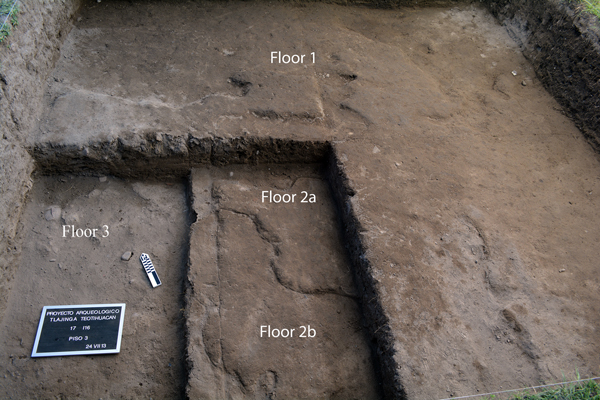
The greatest quantity and highest density of production debris were recovered from the 16-m2 excavation block located in the gently sloping open area located 5 m west of Compound 17. Four superimposed hardpacked earthen floors (1, 2a, 2b, and 3) were identified in this area and had high densities of obsidian production debris on, embedded in, and between them (Figures 3 and 6). These earthen floors appear to be continuations of the compact earthen pedestrian surface that extended westward from the exterior wall of Compound 17. Most importantly, these floors were activity surfaces on which obsidian blades were produced and used during the Late Tlamimilolpa and Early Xolalpan periods. Direct evidence for the use of these earthen floors as work surfaces was the recovery of obsidian microdebitage embedded within them (see Stahlschmidt and Carballo Reference Stahlschmidt, Carballo, Carballo and Pingarrón2015; Stahlschmidt et al. Reference Stahlschmidt, McClung de Tapia and Gutiérrez-Castorena2019). Thirty-four floors and earthen surfaces were analyzed by Stahlschmidt for Compounds 17 and 18. The only floors with obsidian microdebitage embedded within them from all analyzed contexts were from this open work area.
Superimposed hardpacked earthen floors in the exterior work area. Photograph by Hirth.

Three cache deposits were identified inside Compound 17, which link its residents to the obsidian craft activities carried out both within and adjacent to the residence. These three caches contained 33 obsidian percussion and pressure cores, 72 bifacial dart points, and two bifacial knives. Cache Feature 1 located in the northern interior patio contained seven macrocores and three polyhedral cores, all of Pachuca green obsidian ready for pressure-blade removals. Cache Feature 14 was located in Room 2 above tepetate and below the drain extending across this room: it contained four grey obsidian macrocores along with assorted marine shells. Cache Feature 5 was the largest cache recovered in Compound 17. It was located in Room 3 in a small cyst in the bend of a drain (see Carballo et al. Reference Carballo, Hirth, Sariñana, Buckley, Ramón and Kennett2019). The obsidian offerings in this cache consisted of 16 macrocores, 2 large unused pressure cores, the distal end of one exhausted pressure core, 72 bifacial dart points, and two bifacial knives. Six of the macrocores and the exhausted pressure core were of Pachuca green obsidian; the remainder were grey obsidian. Cache Feature 5 appears to have been a dedicatory offering rather than area of temporary storage where cores could have been retrieved for later use; the contexts of cache Features 1 and 14 are less clear but could have been storage areas.
Eighteen accelerator mass spectrometry radiocarbon dates were analyzed from the excavations at Operation 17 (Table 1). Thirteen of these were from contexts in association with floor zones and work surfaces. The dates indicate that the workshop was in operation from the Early Tlamimilolpa to Late Xolalpan period. Ongoing ceramic analysis confirms assignments to these phases following the typological ceramic criteria established by Rattray (2001; see also Carballo et al. Reference Carballo, Hirth, Sariñana, Buckley, Ramón and Kennett2019). Nevertheless, most of the dates fall within the 200-year period from a.d. 250–450 (Table 1). One date (Teo186) associated with production debris located directly on tepetate under the floor of the exterior pedestrian surface in unit K21 indicates that obsidian crafting began in this area during the Early Tlamimlolpa phase. Crafting occurred in the northern interior patio and in the open area west and alongside Compound 17 during the Late Tlamimilolpa to Early Xolalpan periods. The only work area where Late Xolalpan dates occur is on the western exterior work surface in Units I16 and J16 (samples Teo110 and Teo77). There is no clear indication from the available evidence that this portion of the Compound 17 workshop continued in operation after disruptions within the city at the end of the Xolalpan phase.
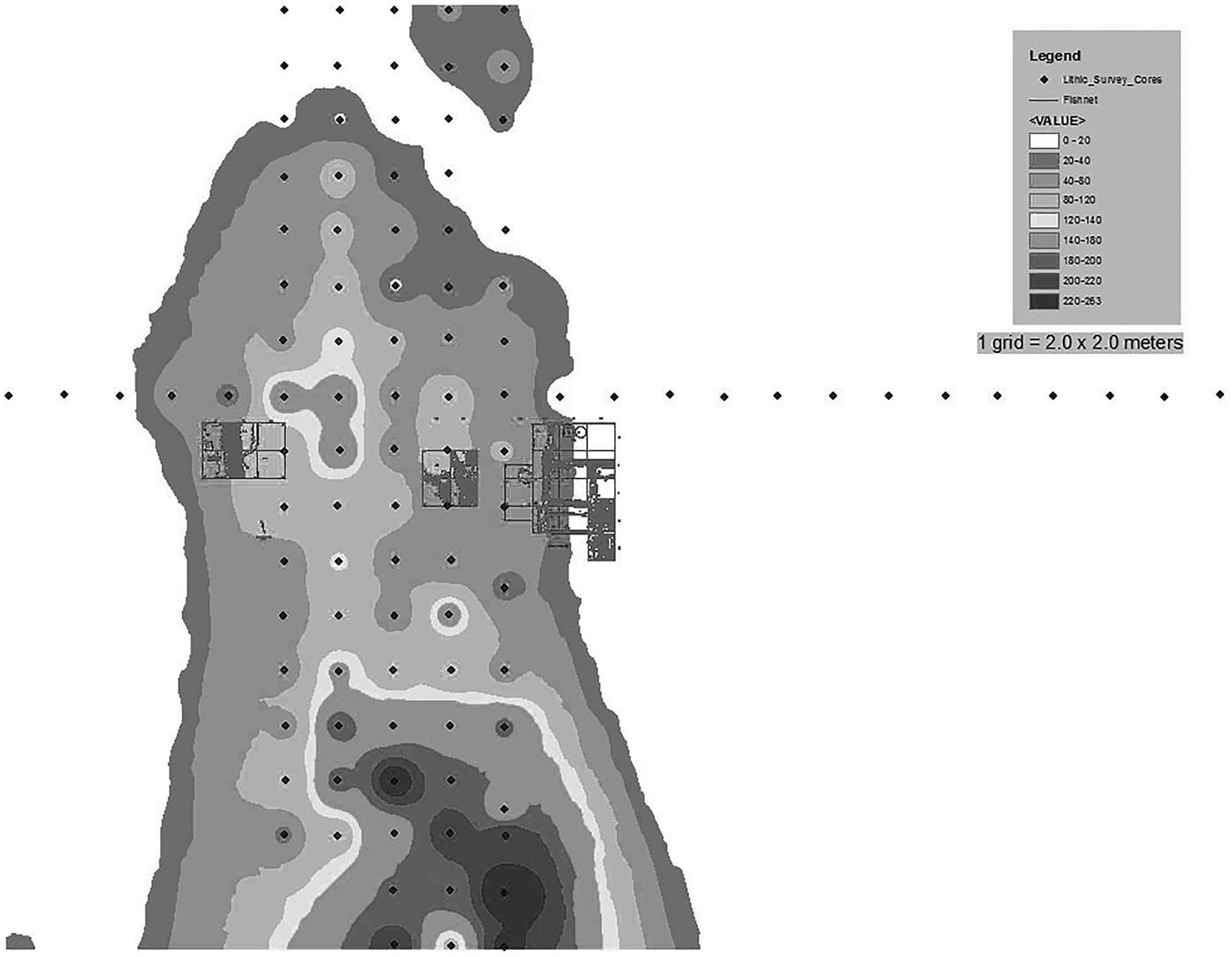
The TMP estimated that Compound 17 was a large workshop covering somewhere between 7,000–7,500 m2 (Millon et al. Reference Millon, Drewitt and Cowgill1973:115, 127). In order to estimate the extent of dense subsurface debitage, a grid of postholes probes was laid out around the excavation units. Figure 7 shows the extent of these probes. Although we did not define the complete extent of the distribution with subsurface probes, they show that all of the hillslope to the west of Compound 17 was likely used as a combination work and refuse area. The measured area extends 60 m north-south and 24 m east-west, covering slightly more than 1300 m2. This was a surprise, bordering on a shock. Very little production debris was visible on the surface of this area at the beginning of the excavation because it was covered with modern colluvial deposits. While more excavation would be required to confirm the size of the Compound 17 workshop, it clearly covered a large area as Spence (Reference Spence1981) and the TMP survey originally suggested.
Obsidian densities from subsurface probes at Operation 17. Image by Nadia Johnson.

ANALYSIS OF WORKSHOP PRODUCTION ACTIVITY
A total of 406.8 kg of obsidian and 799,384 obsidian artifacts were recovered from excavations in Operation 17. The goal of our analytical strategy was to analyze a 40 percent sample of these materials; analysis to date has been completed on 329,370 obsidian artifacts which represents a 41.2 percent sample of the macro-artifact remains. The study sample was sorted based on technological attributes and placed into one of four production sequences: core/blade, biface/uniface, direct/bipolar percussion flaking, or lapidary. For a discussion of these categories the reader can consult Hirth (Reference Hirth and Hirth2003, Reference Hirth2006; Cyphers and Hirth Reference Cyphers and Hirth2016), Carballo (Reference Carballo2011), and De León (Reference De León2008). In addition to the obsidian artifacts, 27 chert and quartzite artifacts were recovered, all of which were direct percussion flakes and are not summarized here. Although analysis is still underway, several possible pressure tools and hammerstone fragments have been identified in the non-obsidian lithics and ancillary materials.
The obsidian collection consists primarily of green obsidian (95.4 percent) from the Sierra de las Navajas source near Pachuca, Hidalgo. The remaining grey obsidian (4.6 percent) derives primarily from the nearby source of Otumba, Mexico. The initial separation of obsidian into green and grey categories was done visually. A sample of 409 grey obsidian artifacts from production contexts were subsequently analyzed by portable X-Ray fluorescence using a Bruker Tracer III-SD XRF spectrometer. Otumba obsidian constitutes 90.5 percent of the total grey sample with smaller amounts from six other sources including Paredón, Puebla; Santa Elena, Hidalgo; Tulancingo, Higaldo; Ucareo, Michoacan; Zacualtipan, Hidalgo; and Zaragoza-Oyameles, Puebla.
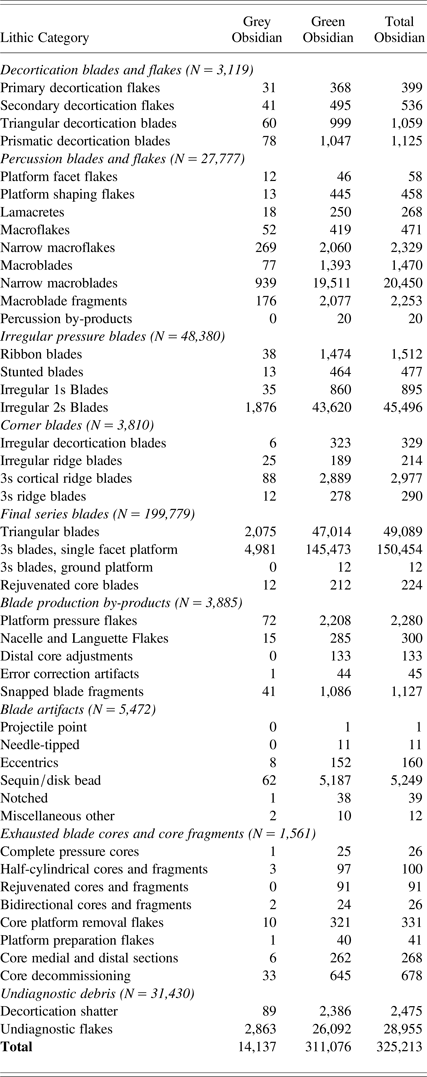
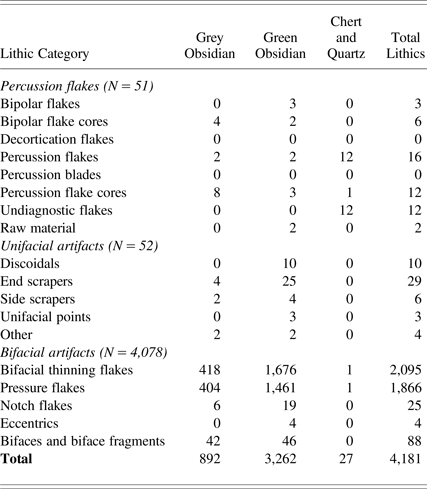
Tables 2 and 3 summarize the obsidian artifacts recovered in the Compound 17 workshop. The overwhelmingly majority of the obsidian artifacts recovered and analyzed (n = 325,213, 98.7 percent) pertain to the Mesoamerica core/blade industry (Table 2). Obsidian blade production was the primary activity conducted in this workshop. Fully 91.1 percent of these materials could be classified by their position in the production sequence. The remaining 8.9 percent could be identified as core/blade artifacts on the combination of their platform and dorsal and ventral characteristics, but were too small or fragmentary for more specific assignment and were classified as undiagnostic debris. The core/blade reduction sequence for the most part follows that described by a number of investigators in both central Mexico (Healan et al. Reference Healan, Kerley and Bey1983; Hirth Reference Hirth2006; Santley et al. Reference Santley, Kerley, Kneebone and Isaac1986) and elsewhere (Clark and Bryant Reference Clark and Bryant1997; Hay Reference Hay1978; Hirth Reference Hirth and Hirth2003; Sheets Reference Sheets1975). We follow the standard terminology proposed by Clark and Bryant (Reference Clark and Bryant1997) for describing the stages of core reduction.
Technological categories for the obsidian core/blade industry from Operation 17.

Technological categories for the obsidian percussion industries from Operation 17.

Obsidian arrived in the workshop as macrocores shaped at the quarry by percussion flaking (Figure 5). Some macrocores possessed cortex on one or more sides or on their distal ends. Much of this cortex was removed using primary and secondary decortication flakes and blades. In other cases, however, the cortex was not removed and remained on one side of the core throughout the blade reduction sequence producing a series of unique corner blades. Core platforms were shaped at the quarry, but a few platform facet flakes and small platform shaping flakes were produced in Compound 17 to adjust platform angles and other irregularities near the proximal end of the core. A range of other percussion flakes and blades were removed from the macrocores to create parallel arrises on their sides and bring them into the form of a polyhedral core ready for pressure-blade removals (Table 2).
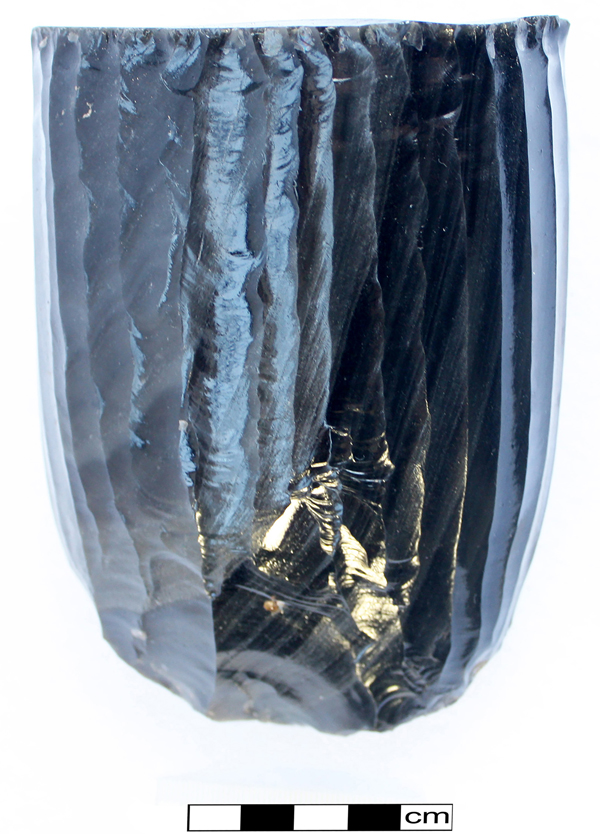
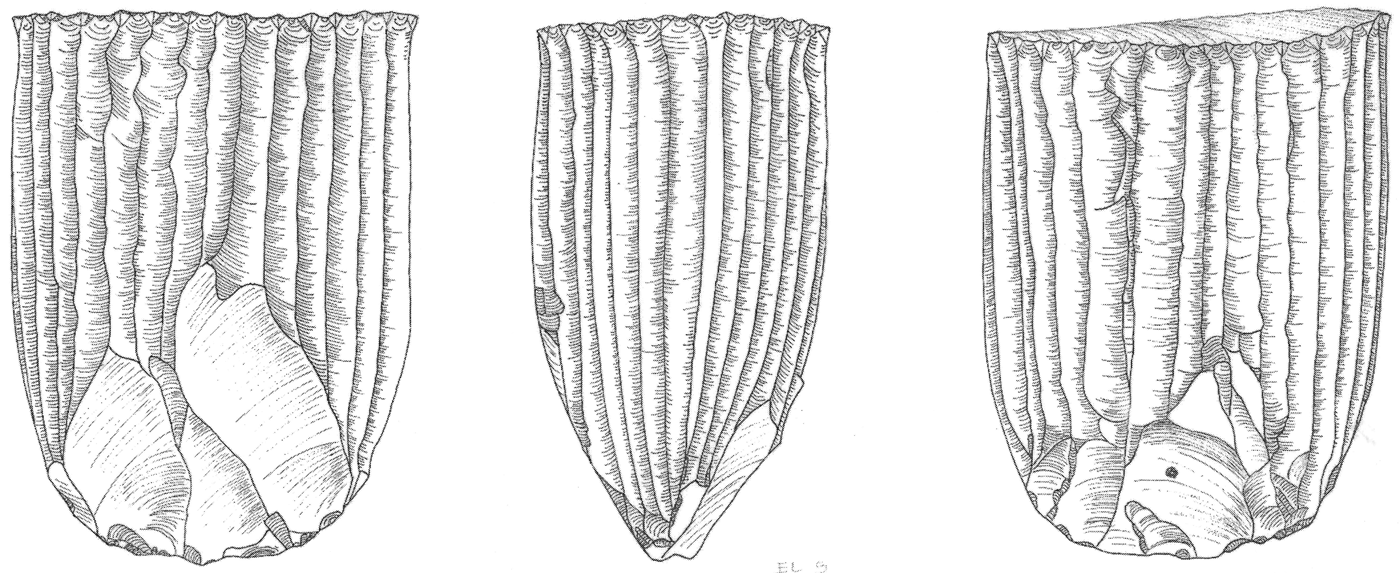
Pressure cores were shaped beginning with the removal of a series of irregular pressure blades. These included narrow ribbon blades, short stunted blades, and first- (1s) and second-series (2s) pressure blades. The goal of these initial series pressure-blade removals was to create straight parallel arrises from the proximal to the distal end of cores. They are distinct from final-series (3s) blades by a combination of traits that include their irregular shape, and/or the presence of percussion scars on one of their dorsal facets. As parallel arrises were established these pressure blades became longer. Second-series blades are those that run half way or more down the face of the core; they are characterized by parallel sides on their proximal ends that give way to irregularity at their distal ends. Figures 8 and 9 illustrate one of the two large unused pressure cores recovered in cache Feature 5. Normally these cores are not recovered in workshop contexts because they are quickly reduced to exhaustion through the removal of final 3s pressure blades. Both of the pressure cores in cache Feature 5 show a high level of skill. Thirty-three pressure blades were removed sequentially around the complete diameter of core 5-4 without creating an error (Figure 9). This obsidian core and several others were produced from grey Otumba obsidian, which is unusual given the specialization in reduction activities observed at this source. In general terms a great deal of the mining activity at the Pachuca source was oriented primarily to core/blade activities while production activities by artisans at the Otumba source were mostly those in the extraction of obsidian for the production of bifaces and bifacial preforms. For a more complete discussion of mining and production activities at these sources see Clark (Reference Clark1979), Pastrana Cruz and Domínguez (Reference Pastrana Cruz and Domínguez2009), and Spence and Parsons (Reference Spence, Parsons, Spence, Parsons and Parsons1972).
Photograph of pressure core 5-4 from Feature 5 at Compound 17. Photograph by Hirth.

Drawing of pressure core 5-4 from Feature 5 at Compound 17. Drawing by Pedro Cahuantzi Hernández.

Final-series blades with either triangular or prismatic cross-sections represent over 60 percent of all the production debitage recovered in the Compound 17 workshop. Pressure-blade reduction produced a range of platform adjustment pressure flakes, nacelle and languette flakes, and distal core adjustments as well as blade errors (hinges and truncations) and error correction artifacts. Blades were segmented, as well as being manufactured into small eccentrics and sequins or disk beads following the technology described by Pastrana and Domínguez (Reference Pastrana Cruz and Domínguez2009) for obsidian crafting at the Sierra de las Navajas obsidian source. Pressure cores continued in production for as long as possible until they were exhausted. As part of the process, cores could undergo one or more rejuvenations resulting in the creation of rejuvenated and bidirectional cores. Once exhausted, most cores were intentionally destroyed by breaking them into fragments.
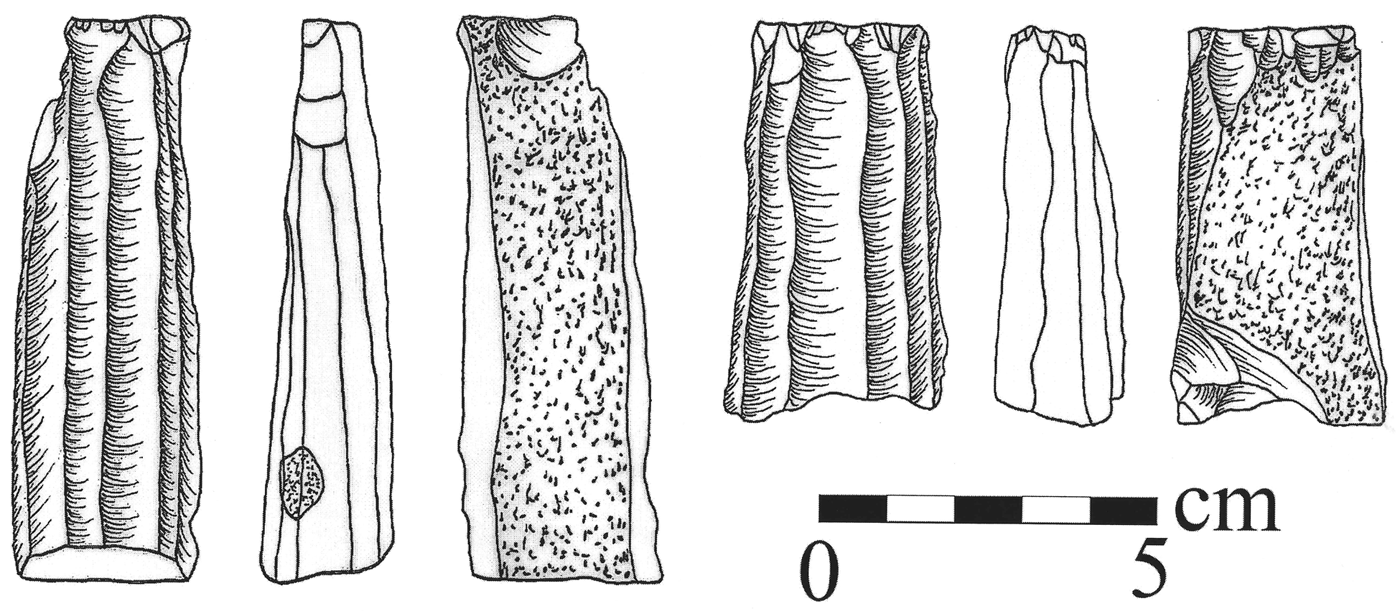
The majority of the pressure cores reduced followed the sequential core/blade reduction sequence described above involving specific stages of core shaping and blade removal, but an interesting minority did not follow this trajectory. Instead, they followed what Hirth has called a progressive blade reduction strategy, in which pressure-blade removal is initiated before the polyhedral core was completely shaped using percussion techniques (Cyphers and Hirth Reference Cyphers and Hirth2016; Hirth Reference Hirth2018). One side of the core was either left in cortex or as unmodified percussion scars, while blades were removed sequentially from the opposite side. These cores are referred to as half-cylindrical cores, two examples of which from the Compound 17 workshop are illustrated in Figure 10. The result of this form of blade reduction is the creation of a range of regular and irregular corner pressure blades with cortex or a percussion scar on one lateral facet where the blade intersects the unmodified back of the core. Half-cylindrical cores and progressive pressure-blade removals are found throughout the Mesoamerica core/blade sequence from the Early Formative period at San Lorenzo (Hirth Reference Hirth2018) up through the Aztec period (Parry Reference Parry, Hirth and Andrews2002:Figures 4.7–4.9). Careful examination reveals that many of these cores were shaped and intentionally reduced in this fashion rather than simply being a product of working around natural anomalies on one side of the core. These, however, are in the minority. The advantage of a half-cylindrical core is that it provides a flat side to help stabilize the core during blade removal. A similar technique of blade removal was practiced on nodules at the Ucareo quarry and on large flake spalls or nodules at the Las Lomas site in Michoacan during the Epiclassic period (Healan Reference Healan, Hirth and Andrews2002:Figure 3.9, Reference Healan and Hirth2003:166).
Proximal segments of two half-cylindrical cores recovered from Compound 17 (17:S3E1) by the Teotihuacan Mapping Project. Drawing from Walton Reference Walton2017:Figure 6.11.

Multicrafting was the most common form of specialized craft production found across Mesoamerica in domestic contexts (Feinman Reference Feinman, Skibo and Feinman1999; Hirth Reference Hirth and Hirth2009a, Reference Hirth2009b; Widmer Reference Widmer and Hirth2009). Multicrafting involves artisans engaging in several craft activities utilizing the same raw material or the same production technology instead of specializing in only one. It can be continuous where full-time specialists alternate between different craft activities, or intermittent where craft production is combined with seasonal agriculture. The evidence indicates that while craftpersons in Compound 17 were highly skilled blade makers, they also engaged in a range of other craft activities at different levels of intensity. In addition to making blades for export, they also processed blades into small sequins, possibly for stitching onto apparel as suggested by Pastrana and Domínguez (Reference Pastrana Cruz and Domínguez2009), and/or strung on a thread for use as disk beads. A small number of both bifacial and unifacial tools also were manufactured in the workshops (Table 3) which exceeded their internal needs and were either sold in the marketplace or used to meet internal tribute levies within the city.
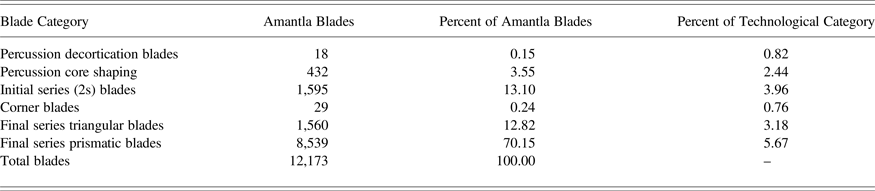
They also used percussion and pressure blades for internal craft activities within the compound. Table 4 summarizes the number and percentage of usewear found on the major blade categories in the Compound 17 assemblage, which is the only way to effectively evaluate whether artisans were producing blades for their own use. All artifacts in the analyzed assemblage (n = 329,370) were examined for visible traces of usewear in combination with high-resolution analyses on a limited sample of workshop remains (Walton Reference Walton2017). While macroscopic identification may miss light usewear, obsidian striates easy and is well suited for an assemblage-wide analysis like that used here. Usewear ranged from a low of just under 2 percent for decortication and corner blades to a high of 12.6 percent for 3s prismatic blades. The overall average for the entire blade assemblage was 9.6 percent (Table 4).
Frequency and percentage of Amantla blades in Operation 17.

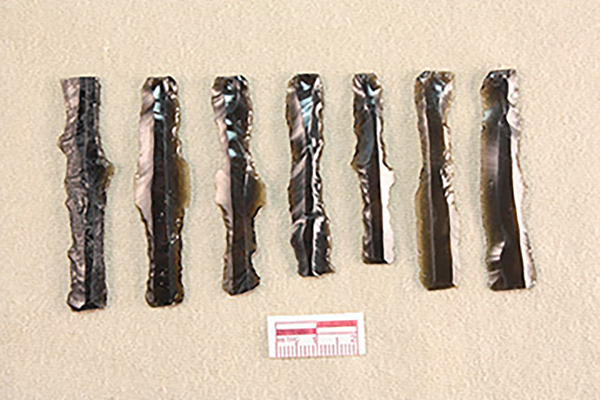
The presence of Amantla-style usewear on blades within the collection is particularly notable (Figure 11). Amantla blades represent a specific type of pattern usewear created by heavy unifacial scraping on alternative sides of the blade. Most notably, this usewear is alternatively beveled in opposite directions on either sides of the unused midpoint of the blade where it was held or hafted (Tolstoy Reference Tolstoy1971:Figure 1L). This type of usewear is found as early as the Preclassic period in the Basin of Mexico and is associated with heavy scraping activities, possibly on wood, both at Teotihuacan and at the Sierra de las Navajas obsidian source during the Classic period (Pastrana et al. Reference Cruz, Alejandro, Sterpone, Manzanilla and Hirth2011; Storey Reference Storey1985; Tolstoy Reference Tolstoy1971:275). Other types of usewear were less severe and represent light to moderate cutting, slicing, and scraping activities. Fully 70.2 percent of all the usewear in the collection occurs on 3s blades. High-magnification analysis of Amantla-style blades indicates that they were used in a range of different activities including processing durable materials including wood, shell, and bone (Walton Reference Walton2017:Table 6.4). Another hard material that Amantla blades may have been used to help process is slate, which occurs as trace material in a large number of the collections.
Amantla blades with usewear from Operation 17. Photograph by Hirth.

The overall usewear rate of 9.56 percent is low and generally conforms to Clark's (Reference Clark and Isaac1986b:31) theoretical expectations that an export workshop should not have usage rates above 1–10 percent of the total blade assemblage. These are logical limits only, however, and do not take into account use of blades in additional multicrafting activities that can occur alongside obsidian production for export. Widmer discusses the evidence for multicrafting in slate and a range of shell and semi-precious stones within Compound 17 elsewhere in this volume.
DISCUSSION
Analysis of surface remains collected by the TMP concluded that there was extensive evidence for craft production within the city with perhaps as many as 100 obsidian workshops in operation during the Classic period (Spence Reference Spence1981, Reference Spence and Isaac1986, Reference Spence, de Tapia and Rattray1987). The TMP identified three types of obsidian workshops that they believed operated at different scales and provided finished goods for different clientele. Precinct workshops produced goods consumed by the state, local workshops for consumption within the city, and regional workshops for export of obsidian goods farther abroad. Clark (Reference Clark and Isaac1986b) sharply criticized this model on two broad fronts. First, that surface concentrations alone were insufficient to identify workshop activity without confirming stratigraphic evidence for in situ production recovered from primary contexts. After all, in an urban setting like Teotihuacan, the removal of trash and curation of hazardous waste like obsidian production debris represents a significant problem that has to be dealt with (Santley and Kneebone Reference Santley, Kneebone, Santley and Hirth1993). Second, Clark argued that the evaluation of the type and scale of production activities necessitated using a technological approach. Whereas the first of these is a straightforward archaeological issue, the second is fraught with interpretive difficulties discussed above having to do with calculating independent measurements of total workshop output, number of artisans at work, and the time duration over which the workshop was in operation. For that reason, we have concentrated on documenting that the production remains recovered at Compound 17 are from primary contexts, that the technological categories reflect large-scale obsidian blade production, and that the craftpersons who produced them were the occupants of the adjacent residential compound.
The excavations have demonstrated that Compound 17 was indeed a workshop involved in the large-scale production of obsidian prismatic blades. It was not a refuse disposal area for workshops near the Ciudadela or the Great Compound, which was one possibility envisioned at the start of the project based on Clark's original critique. Moreover, the 406.8 kg of obsidian and 799,384 obsidian artifacts recovered in our limited excavations of primary activity areas was far in excess of what we anticipated finding based on the rather modest concentration of obsidian surface remains identified prior to excavation. The workshop operated throughout the length of the Classic period, during which time three or four craftpersons would have been available for work in this multi-generational household where individuals were trained in the crafting activities of their parents.
Archaeologists have always been interested in estimating total production output for workshops because it relates to questions concerning the scale of work and full- or part-time specialization. At Teotihuacan this question was fundamental to the debate over whether obsidian blades were produced on a large scale for interregional exchange (Clark Reference Clark and Isaac1986b; Santley et al. Reference Santley, Kerley, Kneebone and Isaac1986; Spence Reference Spence1981). Estimates of production output, however, are difficult to obtain and easily misleading unless data are recovered from unusually well controlled contexts (Andrews Reference Andrews and Hirth2003:214–215; Clark Reference Clark and Hirth2003:232), where the duration of production and quantity of items produced can be estimated with some precision (Hirth and Andrews Reference Hirth, Andrews and Hirth2006b). We do not attempt to estimate total output at this time because too many parameters needed to generate an accurate estimate are missing. We know the general duration over which the workshop operated. We neither know nor can we accurately estimate: (1) how much production debris was carried away from the site, (2) where the debris field produced in Operation 17 begins or ends, (3) whether there were additional craftpersons in the larger Compound 17 who also were obsidian artisans as Spence (Reference Spence1981) originally suggested, and/or (4) whether the artisans residing in Compound 17 produced all of the production debris illustrated in Figure 7.
While total output cannot be estimated with the data at hand, a number observations about production goals within the workshop can be made. First, as mentioned above, production was geared to the manufacture of prismatic blades. Final-series blades in all their forms (n = 199,779) constitute fully 61.4 percent of the entire core-blade assemblage. When only the diagnostic core-blade materials are examined and the small undiagnostic debris in Table 2 is removed from the analysis, the percentage of final series blades increases to 68 percent, fully two-thirds of diagnostic core-blade materials. Second, while some of the blades produced were used in other multicrafting activities within the workshop, the primary workshop goal was the specialized production of blades for export. This is evident when we compare the estimated capacity of blade production represented by cores recovered in the excavation to the count of blades produced and retained in the workshop. The expectation for an export workshop is that most blades would be leaving the workshop (Clark Reference Clark and Isaac1986b:31, Reference Clark, Gaxiola and Clark1989, Reference Clark1997).
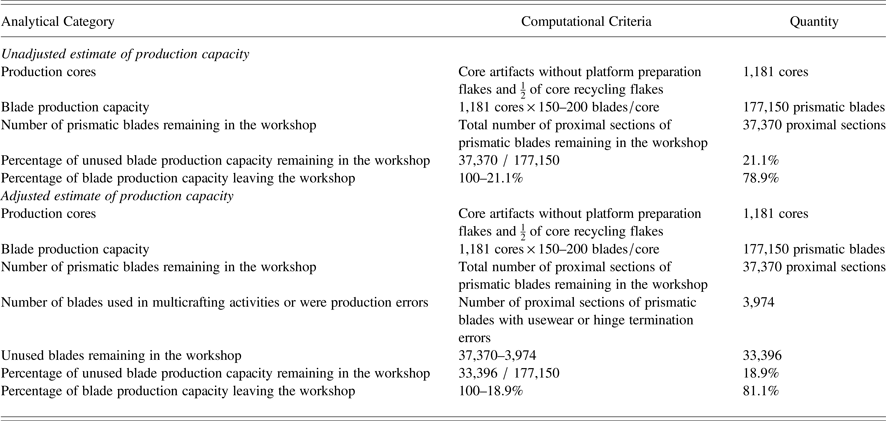
Table 5 provides a computational summary of how production-for-export was established. Production capacity was calculated using the estimate of the number of cores available for production within the workshop. This number (n = 1,181) was established from the number of whole and partial cores recovered in the excavations (n = 1,561) minus all of platform rejuvenation flakes (n = 41) and one-half of the core decommissioning flakes (n = 339 of 678) in the collection (Table 2). Clark (Reference Clark and Isaac1986b:38) estimates prismatic blade capacity at 150 blades/core, which we feel is a reasonable estimate and is used here for comparative purposes. The productive capacity of 1,181 cores is 177,150 prismatic blades.
Estimate of capacity of prismatic blade production in Compound 17 (17:S3E1).

But how many blades actually left the workshop? For this we need an estimate of the number of blades that remained in the workshop that were not used in multicrafting activities. The number of blades remaining in the workshop were estimated from the number of proximal sections of prismatic blades recovered; this represents an estimate of the minimal number of individual (MNI) blades since each blade can have only one proximal section. A total of 37,370 proximal sections from blades were recovered in the excavations, which represents 21.1 percent of the total estimated productive capacity of the workshop. By implication, 78.9 percent of all the blades produced left the workshop. We also computed an adjusted estimate, discounting the 3,974 prismatic blades that we know were used in multicrafting activities within the workshop because they have traces of usewear on their surfaces. The adjusted number of unused blades remaining in the workshop is 33,396 (Table 5). This represents 18.9 percent of the productive capacity of the workshop, which implies that 81.1 percent of the prismatic blades produced left the workshop as complete finished blades. While these estimates suggest that the majority of blades and blade products are leaving the workshop, counts of artifacts alone do not adequately characterize export production. We also need to look at the size of the blade debris remaining in the workshop, and whether it represents usable artifacts or unusable waste.
Analysis of macrocores recovered in cache deposits together with production debris suggest that the majority of cores reduced in the workshop produced blades ranging from 9–14 centimeters in length. Shorter blades also were produced later in the production sequence after cores were rejuvenated and diminished in length. Blades were exported both as whole items as well as being processed into blade segments and blade products such as sequins or small disk beads. The result was the production of a large quantity of small blade segments too small for effective use. Usewear experiments suggest that flakes 2.5 cm in length are the effective lower limit for the use as hand-held tools (Bamford Reference Bamford1991), while obsidian blades can be used down to 2.0 cm in length when obsidian is scarce if they are hafted into wooden handles (Hirth and Castanzo Reference Hirth, Castanzo and Hirth2006a). Analysis reveals that fully 90 percent of all of the prismatic blades remaining in the Compound 17 workshop assemblage (n = 199,779) are small fragments less than 2.5 centimeters in length below the threshold of what we consider usable blades.
These results confirm that Compound 17 operated as an export workshop. The estimate of production capacity indicates that most blades left the workshop (Table 5), and the majority of blade segments that remained behind were too small for use and were the waste byproduct of blade processing within the workshop. While we cannot calculate total output at this time, it is possible that one or more of the artisans in Compound 17 were engaged in crafting activities on a close to full-time basis. After all, they were multicrafting in obsidian blades, bifaces, unifaces, and sequin/disk bead production for sale outside the compound, as well as working slate artifacts and using percussion and pressure blades in other craft activities such as woodworking inside the workshop.
Clark proposed on technological grounds that all of the obsidian production debris identified across the city at Teotihuacan could have been produced by somewhere between 6–10 full-time craftpersons and 20 part-time craftpersons. Taking into account that the Compound 17 workshop is much larger than our small excavations indicate, we have to wonder how many craft specialists were involved just in the work carried out here. Using the stratigraphic profiles and the obsidian counts recovered in excavations we estimated the quantity of obsidian production debris that we would have recovered if we had excavated a 4-m wide trench across the hillslope work and refuse area between Compound 17 and the Street of the Dead (Figure 2). We estimate that between 1.3–1.4 million artifacts weighing 650–675 kg would have been removed from this trench had it been completely excavated. If we project these figures across the 46 m plotted on Figure 7, we arrive at an estimate of 16 million obsidian artifacts weighing nearly eight metric tons. Are these estimates reasonable? We believe they are and may even be low since subsurface densities appear higher to the south and the distributions extends further than we mapped with our subsurface probes.
What then have we learned from these excavations beyond the fact that Compound 17 indeed was a large workshop? While more analysis needs to be done on obsidian crafting at Teotihuacan, it appears likely that the seven large regional workshops that Spence identified were indeed large workshops. What the local workshops are is another question entirely and investigators will have to excavate them to find out. The craft specialists in Compound 17 probably followed their own individual pursuits and there is nothing at this time to suggest that artisans here or in adjacent households were part of any larger collective, supra-level form of workshop organization.
Clark's call for interpretive prudence has shown us that greater methodological rigor is a good thing. But questioning the reliability of surface remains for identifying craft production is only one side of the coin. We also must recognize that surface remains may reflect not all types of workshops operating at Teotihuacan; some may be completely buried and will require excavation just to identify them. What lies before us is the need to continue the exploration of craft production at Teotihuacan, not just with obsidian, but for all other types of materials. Teotihuacan may well represent the greatest concentration of craft activity found in any urban center in the New World. It certainly may have the greatest concentration of obsidian production debris anywhere outside of an immediate source locale.
RESUMEN
Por medio de los sondeos y la investigación que realizó el Teotihuacan Mapping Project (TMP) se registró un gran número de talleres de obsidiana localizados en diferentes puntos de la ciudad. Este cálculo se formó en base a las concentraciones superficiales, producto del desecho de producción de navajillas y otros artefactos de obsidiana, que se hicieron por medio del TMP. La validez del número de talleres ha sido cuestionada por el arqueólogo John Clark, sobre todo en un artículo seminal que fue publicado en 1986. En él, Clark (Reference Clark and Isaac1986b) exhorta a que se lleven a cabo excavaciones con control estratigráfico para confirmar la presencia de estos talleres de obsidiana y no emplear las concentraciones de desecho como únicos indicadores de estas áreas de producción. En el presente artículo resumimos los resultados de las excavaciones que se realizaron durante el 2013 en uno de estos talleres registrados por el TMP en el Complejo 17:S3E1, ubicado en el barrio de Tlajinga, al sur de la ciudad. A continuación, describimos el proceso y el método de excavación y nuestra discusión sobre la tecnología empleada para el trabajo de la lítica. Finalmente, examinamos los contextos que se recuperaron durante las excavaciones y que fueron analizados en temporadas de campo siguientes, con el objetivo de conocer, a más profundidad, la producción artesanal de obsidiana in situ.
ACKNOWLEDGMENTS
This research was supported by funding from the National Science Foundation (BCS 1321247) and Pennsylvania State University. We thank John Clark, William Parry, and one anonymous reviewer for their helpful comments. All three reviewers asked for more pictures, drawings, descriptions, and discussion on additional topics. We agree those are needed, but unfortunately, the space available in this publication does not permit expanding the discussion beyond that presented here. More discussion will be forthcoming in future work.