Introduction
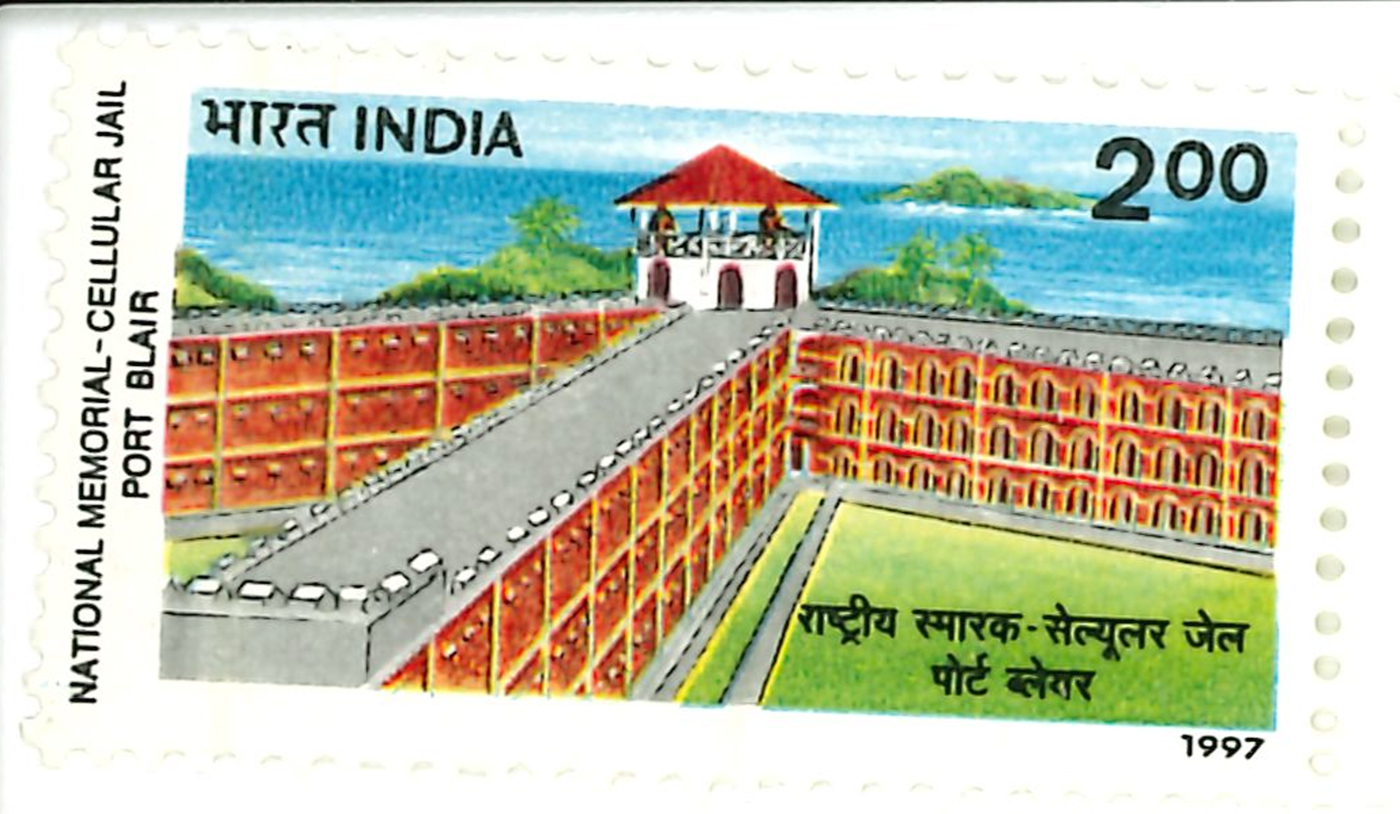
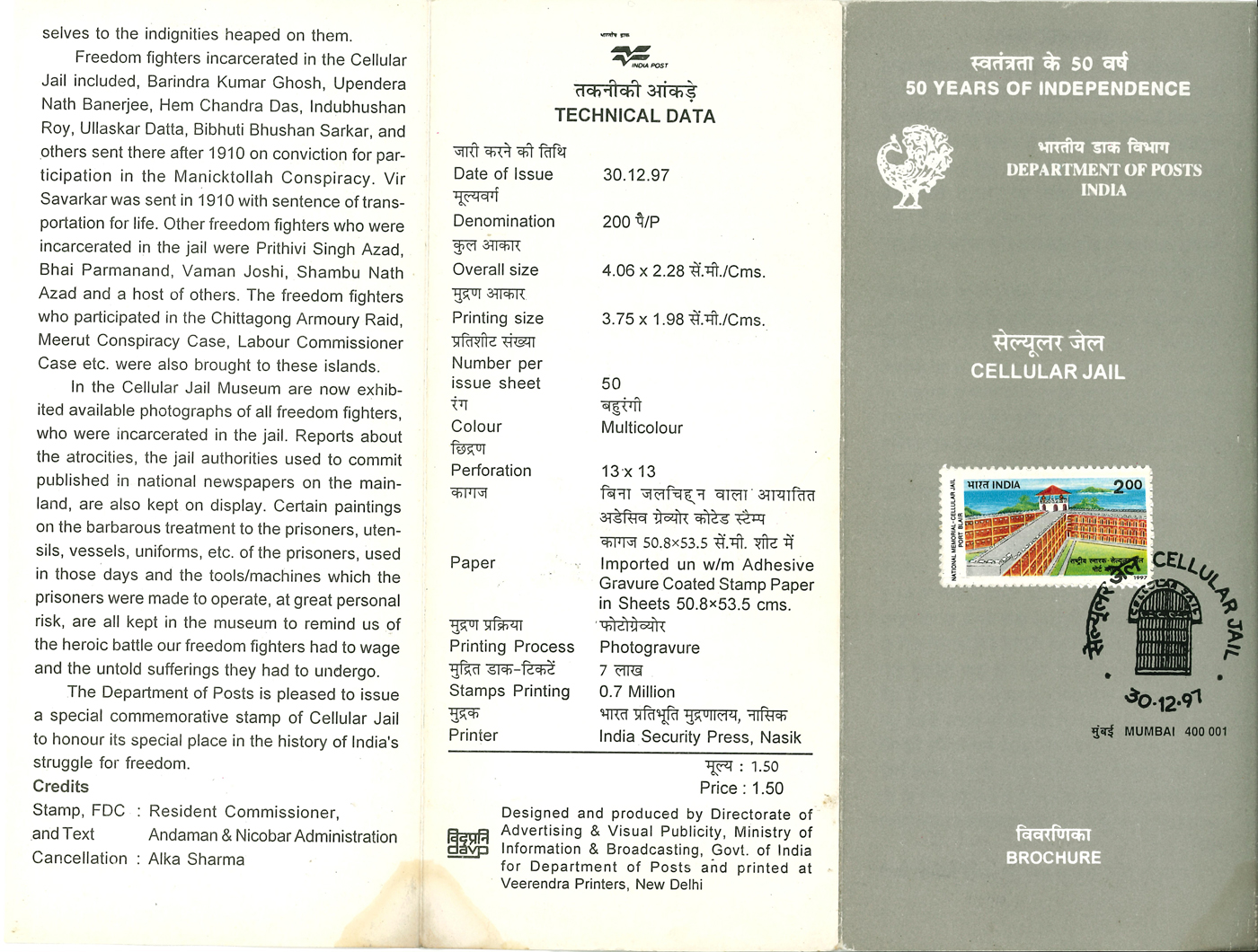
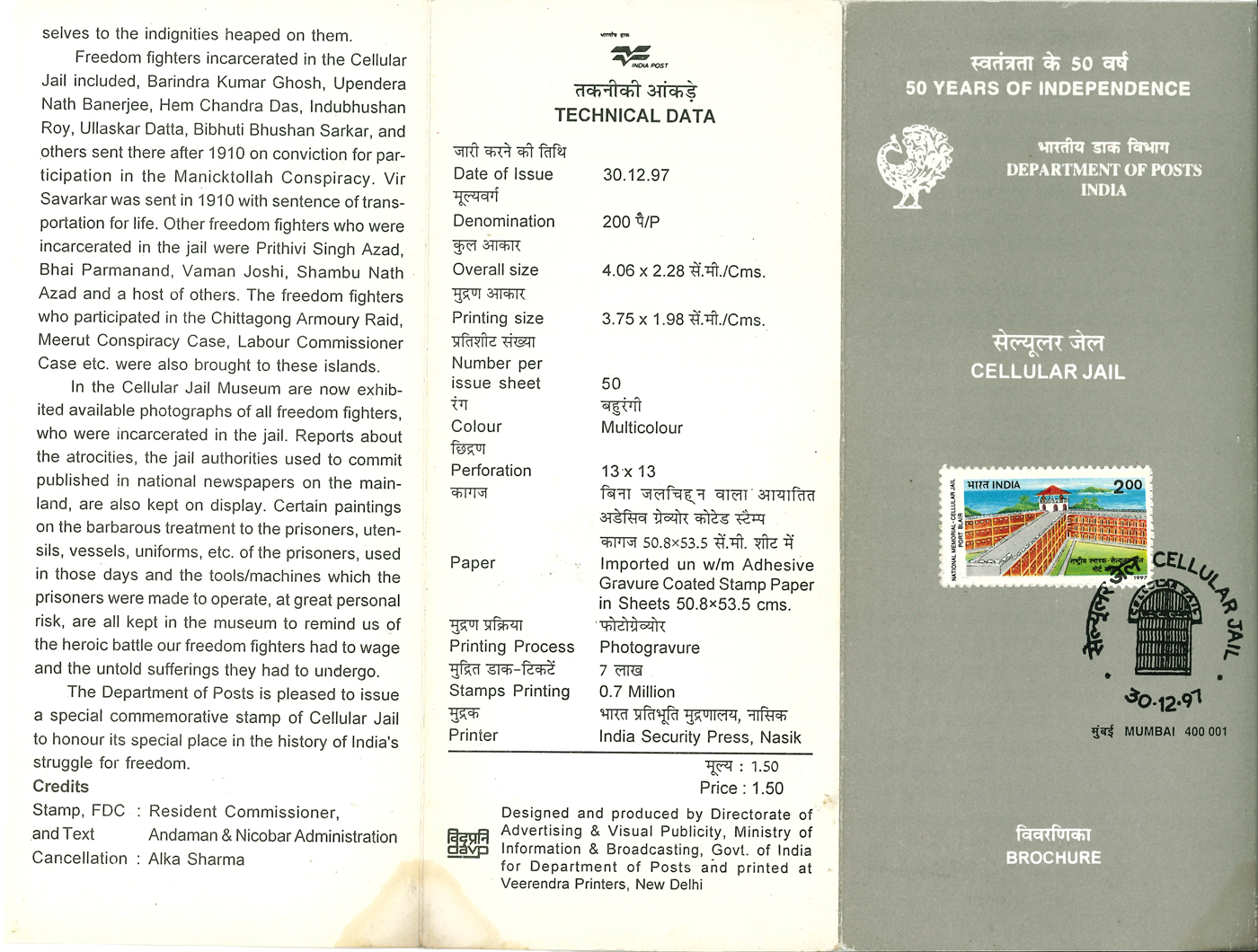
In 1997, the image of the Cellular Jail appeared on postage stamps and one-rupee coins. The aim of the coins and stamps was commemorative, honouring both the Cellular Jail's ‘special place in the history of India's struggle for freedom’ and the 53 surviving freedom fighters who had been imprisoned in the Cellular Jail (see Figures 1, 2, and 3).Footnote 1 Yet commemoration through the postal and coinage systems—the ‘most universal forms of public imagery’—simultaneously serves a function for the state.Footnote 2 The image of the Jail encourages national identification with India's freedom struggle. Both the stamps and the coins depict the wings of the Cellular Jail radiating out from the central tower, a visual reminder of the sacrifices of the freedom fighters. As with the Bastille in Paris, the prison here is a particularly evocative emblem of the nation's progress. Commissioned by President K. R. Narayanan, the coins and stamps thus established the Cellular Jail as a national symbol. This article considers how this symbol has been constructed in post-Independence India, on the basis of the sufferings of political prisoners in the Jail. International, national, and local state forces have attempted to ‘freeze’ the meaning of the Cellular Jail in order for it to serve contemporary interests.Footnote 3 The history of the Cellular Jail is inserted within a wider nationalist narrative of the freedom struggle, establishing a common heroic past for the Indian nation. This article holds that in the ‘selective amnesia’ of nationalist histories, certain voices, struggles, and continuities are omitted.Footnote 4. The voices of the Andamanese people consigned to the Cellular Jail under Japanese occupation and the experiences of ‘ordinary’ convicts incarcerated under British rule are some of those excluded in the construction of a collective national memory. Furthermore, the national symbol of the Cellular Jail obscures its original function as a colonial jail for criminals and political prisoners alike, separating it from other colonial prisons which still operate in India today. Yet although different agents attempt to fix its meaning, efforts to reclaim a local memory of the Cellular Jail demonstrate its palimpsestic nature. Recent struggles between Hindu and secular nationalists over its appropriation bring to light that the hegemonic meaning of the Cellular Jail remains fundamentally unstable, forever vulnerable to political conflicts over the nation and its past.
Commemorative issue, one-rupee coin: ‘Cellular Jail, Port Blair’, 1997.

Commemorative issue postage stamp: ‘National memorial—Cellular Jail, Port Blair’, 30 December 1997.

‘50 years of independence’ Cellular Jail brochure, Ministry of Information and Broadcasting for the Department of Posts, India, 30 December 1997, New Delhi.
The ‘outstanding universal value’ of the Cellular Jail
In April 2014, the Cellular Jail, Andaman Islands, was submitted to the UNESCO World Heritage Site Tentative List for India.Footnote 5 In order to be included on the World Heritage List, a site ‘must be of outstanding universal value’ and ‘meet at least one out of ten selection criteria'.Footnote 6 The UNESCO submission file for the Cellular Jail defines its value by two criteria: first, the design of the Jail, which ‘reinforced’ the ‘inhuman treatment’ of prisoners by the Jail officials and, second, the failure of the Jail's intended function: to ‘curb down the freedom spirit’ through the incarceration of political prisoners.Footnote 7 The submission declares that, in fact, the Jail had the reverse effect: that of contributing to the freedom struggle. The Cellular Jail is thus defined as a symbol, both of the ‘hardships forced on political prisoners’ and ‘nationalist expression’ against the British. This ‘Justification of Outstanding Universal Value’ is based on the experiences and impact of the imprisonment of political prisoners in the Cellular Jail.
The construction of the Cellular Jail on the Andaman Islands began in 1898 and was completed in 1905.Footnote 8 It had 700 cells and seven wings comprising three stories each, spanning out like a starfish from a central tower. Embodying aspects of Jeremy Bentham's Panopticon model, colonial photographs bring to light just how iconic an image the Jail was on the island—a ‘spatial trope’ of colonial domination.Footnote 9 Between its construction in 1905 and the Second World War, approximately 500 political prisoners were shipped to the Andaman Islands to be incarcerated in the Cellular Jail. In 1910, the colonial government began transporting term prisoners to the Jail, including newspaper editors charged with sedition and others charged in conspiracy cases.Footnote 10 Once there, the political prisoners were isolated, confined to their cells, and subjected to torturous labour and brutal punishments. Consequently, the Jail became infamous on the mainland for its repression of political prisoners as well as for their resistance. Press reports and memoirs of middle-class revolutionaries such as V. D. Savarkar, Barindra Kumar Ghosh, Bhai Parmanand, and Bejoy Kumar Sinha, among others, exposed the ‘inhuman treatment’ of political prisoners in the Cellular Jail and the cruelty of the British.Footnote 11 These memoirs testify to horrific torture, public floggings, punitive work on the oil mill, solitary confinement, lack of sanitation, and the cruelty of the Jail guards, all referenced in the submission to UNESCO.Footnote 12 For these reasons, conditions for political prisoners in the Cellular Jail were judged to be some of the harshest in all prisons in India at the time.
In spite of this, as the UNESCO submission file stresses, the Jail became a site and a symbol of resistance against colonial rule. In reaction against their harsh treatment, nationalist prisoners led hunger strikes, work strikes, and signed petitions for special status.Footnote 13 The ‘propaganda impact’ of the hunger strikes, combined with the publication of memoirs and press articles, meant that the Jail became infamous in colonial India for the barbaric treatment of political prisoners within its walls.Footnote 14 The iconic structure of the Cellular Jail and the imagery of ‘kala pani’, or crossing the ‘Black Waters’, contributed to the Jail's notoriety. As Sadatru Sen writes, the term ‘kala pani’ became a synonym for transportation to the Jail in memoirs, and evoked the threat of the loss of caste for high caste convicts.Footnote 15 From 1912, newspapers on the mainland caught wind of the sufferings of nationalist prisoners, with one paper, the Bengalee, denouncing their treatment as in ‘conflict with those canons of humanity’ accepted by the ‘civilized worlds’.Footnote 16 In contrast to the intended purpose of the Jail, news of the horrific treatment of political prisoners spread anger against the British.Footnote 17 Sinha's description of his journey to the Cellular Jail as a ‘pilgrimage’ to a battlefield demonstrates how the Jail became a symbol of such resistance.Footnote 18
The criteria justifying the ‘Outstanding Universal Value’ of the Cellular Jail thus ‘freeze’ the meaning of the Jail as a place where extreme repression of political prisoners failed to crush—in fact, even advanced—the freedom struggle. While the repression of political prisoners is an important part of the Jail's history, this definition notably excludes all reference to ordinary convicts imprisoned there. Approximately 10,000 convicts were sent to the Andamans between 1905 and 1920 alone, a third of them from Burma.Footnote 19 The convicts were imprisoned in the Cellular Jail for the first six months of their sentence in the settlement colony, before being rehabilitated. Those convicted of petty crimes in the settlement were also sent to the Cellular Jail. In contrast to ordinary convicts, political prisoners were never allowed to leave the Jail. Classed as ‘specially dangerous prisoners’, they were kept apart from others in the Jail. Nevertheless, the ordinary convicts were still subjected to severe punishments inside the Jail and were also the intended subjects of the cellular structure.Footnote 20
The emphases placed on certain aspects of the Jail's history situate its construction within a wider nationalist meta-narrative of the freedom struggle.Footnote 21 The submission declares that the Cellular Jail was constructed as a result of a failure to control the growing number of ‘freedom fighters’ transported to the penal colony. It is stated that cellular incarceration was advocated in order to stop the ‘exchange of ideas’ between political prisoners.Footnote 22 Yet, although the Jail was used to isolate political prisoners, the Lyall and Lethbridge report of 1890 brings to light that it was commissioned principally due to fears of an increasing ‘disparity’ between discipline in mainland Indian prisons and that in the penal settlement.Footnote 23 Transportation, in comparison with other Indian jails, was no longer seen as enough of a deterrent for all convicts. As Sen elaborates, the design of the Jail can be compared to Pentonville in England, built in 1842, which had a similar structure of separate cells and radiating wings.Footnote 24 In contrast to the dominant representation of the Jail, cellular incarceration in the nineteenth century was advocated on the basis of both punitive and reformist principles. There was a strong belief in both England and the United States that cellular jails were, ultimately, progressive and more humane than other forms of punishment.Footnote 25 Indeed, it is doubtful whether the size of the Cellular Jail's individual cells would be considered particularly barbaric in prisons throughout the world today.
As with other World Heritage monuments, the narrative of the Cellular Jail's history is structured around the current normative values of UNESCO World Heritage, reflecting how, in the words of David Harvey, the representation of the past is ‘contingent on present day requirements’.Footnote 26 Their criteria intend to facilitate ‘cultural dialogues’ and achieve peace through the ‘intellectual and moral solidarity of mankind’.Footnote 27 In this way the Cellular Jail can be compared to other prison sites on the UNESCO list, such as Robben Island in South Africa, similarly a symbol of repression and ‘triumph of the human spirit’.Footnote 28 In this vein, one would hope that the nomination of the Cellular Jail would facilitate a dialogue on colonial history. Yet, as Joost Fontein and others have brought to light, the UNESCO discourse is also problematic and political. It functions as a ‘standard setter’, prescribing an arguably reductive view of what constitutes heritage.Footnote 29 The system also gives power to the state to decide which sites to nominate. This means that it is also reflective of the way in which the nation chooses to represent itself on the international stage. We can thus situate the description of the Jail's value within a wider international projection of the progress of the Indian nation.
The submission of the Cellular Jail is also reflective of a 2012 national initiative to diversify India's Tentative List.Footnote 30 Considering that the Andaman and Nicobar Islands are one of the regions missing from the previous list, it appears that the Cellular Jail entry readdresses both a geographical and historical imbalance. Finally, initial recommendations for the nomination of the Cellular Jail outline the potential benefits of increased tourism to the Andaman Islands.Footnote 31 The submission file thus reflects site-level, national, and international concerns. While the dominant discourse of World Heritage focuses on the need to ‘preserve’ cultural and natural heritage for future generations, the past preserved, as David Lowenthal states, is simultaneously an ‘artefact of the present’.Footnote 32
The UNESCO submission brings to light several points which are central to the argument of this article. First, while the submission file's history of the Cellular Jail is rooted in the experiences of the freedom fighters, it produces its own meaning through a teleological and selective approach. This article is grounded in the wide field of studies of hegemonic patterns of thought and historical narratives as ‘semiological apparatuses that produce meanings’.Footnote 33 Secondly, framed by analyses of the relationship between the present and the representation of the past, this article considers how the selective retelling of the Cellular Jail's history serves particular present-day functions.Footnote 34
Recent works by Anderson, Sen, Philipp Zehmisch, and Aparna Vaidik address the Cellular Jail as a ‘symbolic site’, exploring how the focus on the political prisoners of the Cellular Jail has subsumed our understanding of the history of the Andaman Islands and the penal settlement.Footnote 35 The UNESCO submission provides evidence of this selective narrative. Yet it also illustrates how contemporary concerns influence the way in which the history of the Cellular Jail is portrayed. This demonstrates the importance of considering how and why the symbolic value of the Cellular Jail is constructed. Underpinned by Michel Foucault's genealogical approach to history, this article holds that moments of articulation of the national significance of the Cellular Jail are historical events in themselves.Footnote 36 As with the UNESCO submission, each interpretation produces its own meaning and serves a particular present-day function. The following two sections consider how the symbolic value of the Cellular Jail has been constructed both locally and nationally since Independence.
While recognizing certain continuities, this article seeks to challenge Vaidik's argument that the focus on the Cellular Jail as the ‘defining aspect of the Andaman's twentieth century history’ is one of the ‘rooted myths’ of the Andaman Islands’ history.Footnote 37 Vaidik stresses the ‘permanence’ of the imagery of the Jail and the Islands as a Muktirtha, or ‘site of pilgrimage’, since the colonial era.Footnote 38 Yet in 1969, the Jail was narrowly saved from demolition by the intervention of the Ex-Andaman Islands Political Prisoners Fraternity Circle.Footnote 39 Out of the three surviving wings (following an earthquake in 1941), one wing remained in use as a district jail and another as a hospital until its designation as a national memorial in 1979.Footnote 40 Thus, the Cellular Jail has not continuously held the same significance as a Muktirtha, either locally or nationally, since Independence. In lieu of this, the following section considers how the symbolic value of the Cellular Jail has been resurrected, produced, and transformed in this period.
A memorial to the nation
On 11 February 1979, the Cellular Jail was declared a national memorial and dedicated to the nation by then prime minister Moraji Desai. This declaration was born out of the struggle of the Ex-Andaman Islands Political Prisoners Fraternity Circle.Footnote 41 Following news of plans to demolish the Cellular Jail, former political prisoners founded the organization in order to preserve it as a national monument. From a glance at the webpage of the Andaman and Nicobar Administration today, the demolition of the Cellular Jail seems hard to imagine. The Jail is the defining image of Port Blair, classified as a ‘place of pilgrimage for all freedom-loving people’.Footnote 42 The transformation from local jail and hospital to venerated national monument can be seen in part as an appropriation of the symbolic value of the Cellular Jail by different local agents.
Since its declaration as a national memorial in 1979, the Cellular Jail National Memorial Complex and its surroundings in Port Blair have been transformed into a memorial to the freedom movement.Footnote 43 Within the museum, the names of the 513 freedom fighters incarcerated in the Cellular Jail are engraved in the central tower. Models of ‘patriots’ being flogged, working on the oil mill, and in chain fetters evoke their oppression.Footnote 44 In 1990, the lieutenant-governor of the Andaman and Nicobar Islands inaugurated a son et lumière show in the courtyard of the Cellular Jail. In the show, the ‘saga’ of the freedom struggle was ‘brought alive’.Footnote 45 Through this particular medium of ‘resurrection’, the Cellular Jail memorial defined itself as a site of national significance.Footnote 46
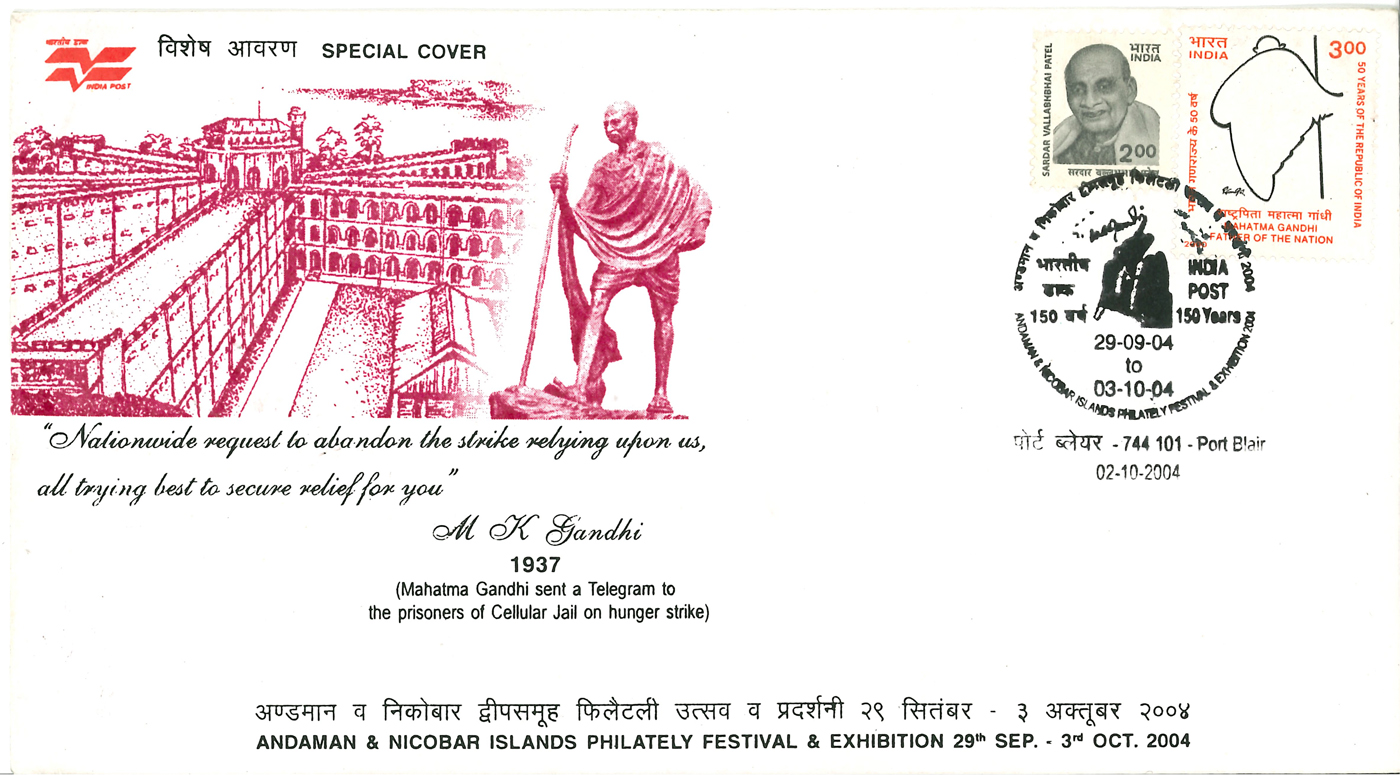
This definition is reinforced by the Andaman and Nicobar Administration. Commemorative events and celebrations on the Islands, often attended by ex-Andaman political prisoners or their relatives, pay tribute to the martyrs of the Jail. Occasions such as the centenary of the Cellular Jail in 2006 were publicized as important for the ‘entire country’.Footnote 47 The release of a special cover featuring the Cellular Jail, in celebration of the Andaman and Nicobar Islands Philately Festival of 2004, demonstrates how the symbolic value of the Jail is projected by the Administration (see Figure 4). Here, the Cellular Jail is depicted alongside an image of Gandhi and above the words of his request to hunger strikers in the Jail to end their strike in 1937. The choice to depict Gandhi associates the Cellular Jail prisoners with the mass movement for independence. However, as Kama Maclean explores, Gandhi did not support the hunger strikers and saw their violent tactics as detrimental to the freedom struggle.Footnote 48
Special cover: ‘Andaman & Nicobar Islands Philately Festival & Exhibition, 29th Sep–3rd Oct. 2004’, Port Blair, 2 October 2004.

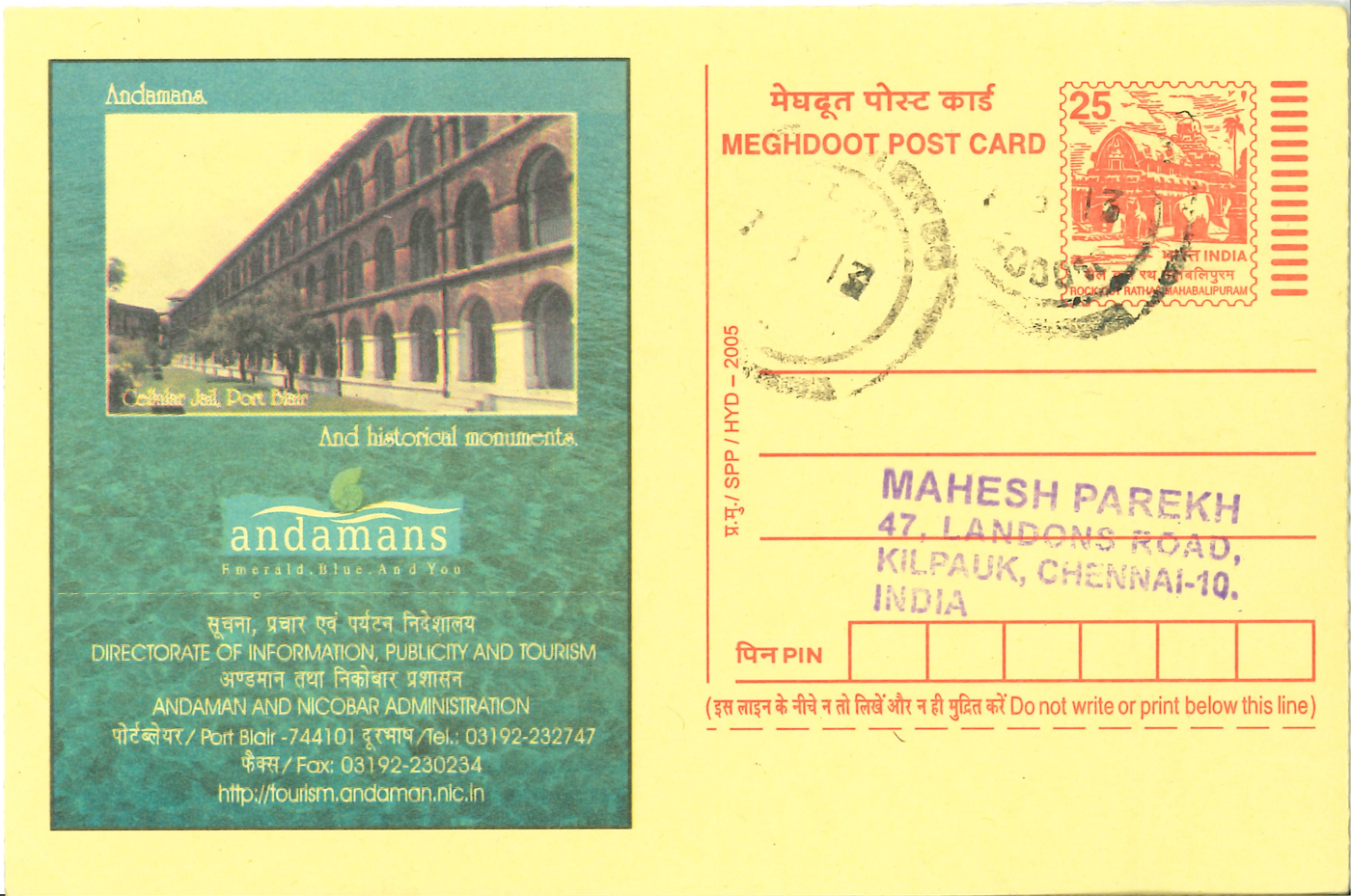
Finally, a set of Administration postcards from 2005, depicting the Cellular Jail as the historical monument of the Andaman and Nicobar Islands, also demonstrates how the visual symbol of the Jail is used to reinforce their historical importance (see Figure 5). This marks an example of the appropriation of the image of the Jail by the Andaman and Nicobar Administration in order to attract visitors to the Islands.
Andamans Meghdoot postcard: ‘Andamans—and historical monuments’, Directorate of Information, Publicity and Tourism, Andaman and Nicobar Administration, 2005.

Problems with infrastructure and lack of access have restricted visitors to the Jail and the Islands. However, recent years have seen a push for tourism in the archipelago. Local and national commentators such as Jayant Dasgupta, G. S. Pandey, and Khiran Dhingra have commented on the reconstruction of the image of the Cellular Jail as a site of pilgrimage in order to attract more tourists.Footnote 49 This is also reflected in the explosion of monuments in the town commemorating the freedom movement. The surplus of statues and memorials construct a series of links between the national freedom struggle and the Andaman Islands. Historical works by civil servants, such as the development commissioner in 1991 and the law minister of the Islands, aim to pay tribute to the ‘unsung heroes’ of the freedom movement, creating ‘goodwill and interest among people of India towards these islands’.Footnote 50 This can be contextualized within the particular relationship between the Andaman Islands, as part of the Union, and the mainland.Footnote 51 For the local administration, the production of the national significance of the Cellular Jail links the Islands to the mainland and helps to attract visitors.
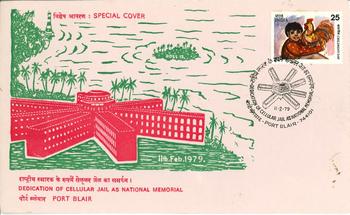
In the works and speeches of local historians, the webpages of the Administration and of the national memorial, and elsewhere, certain set phrases recur in descriptions of the Cellular Jail. Ernest Laclau's analysis of meaning serves as a framework within which to consider how the hegemonic meaning of the Cellular Jail is constructed and to evaluate the effectiveness of the discourse. According to Laclau, hegemony is created through a ‘chain of equivalences’, which carry out a ‘filling function’.Footnote 52 These chains of equivalences empty the signifier of its connection to the signified. As a result, hegemony is always unstable and ambiguous. Certain semantic trends imply consensus on the meaning of the Cellular Jail. The Jail is repeatedly defined as a ‘mute witness’ to the torture and brutal treatment inflicted upon the freedom fighters and a ‘place of pilgrimage’.Footnote 53 Within the context of Laclau's framework, the term ‘mute witness’ implies that the Jail itself was unable to speak out against the oppression of the freedom fighters. The use of personification links the Jail to the freedom fighters, suggesting it also resisted, only to be silenced and repressed, like the prisoners within its walls. The term thus empties the Jail of its attachment to the British, suggesting it was merely a witness to their oppression. By giving the Jail a role in the freedom struggle, the Andaman and Nicobar Administration define it as a local and Indian monument, rather than as a British construction. This appropriation can first be seen on the special cover issued at Port Blair on the day of the dedication of the Jail as a national memorial. On the cover, all seven original wings are boldly depicted, establishing the Jail in its original state as a landmark of the Islands (see Figure 6).
Special cover: ‘Dedication of Cellular Jail as national memorial’, Port Blair, 11 February 1979.

Yet local contestations of the hegemonic meaning of the Cellular Jail demonstrate its palimpsestic nature. Since the foundation of the national memorial, members of the local community have objected to the absence of recognition of their own ancestors’ contributions to the struggle for independence. In 1979, members of the local community protested against the absence of their ancestors from the martyrs’ gallery of the Cellular Jail. The ancestors in question were imprisoned by the Japanese during their occupation of the Andaman and Nicobar Islands between 1942 and 1945, and then shot in what became known as the Homfraygunj Massacre.Footnote 54 In 1979, the Ex-Andaman Islands Political Prisoners Fraternity Circle refused to allow their photographs to be added to the gallery, resulting in the creation of a separate gallery. Pandey's account testifies to the continued struggle for recognition of these ancestors as freedom fighters and ‘brave sons of India’.Footnote 55 Here, Pandey appropriates the Jail as a symbol of the struggle of local freedom fighters.
Furthermore, as Zehmisch has brought to light, other local Andamanese people have opposed the notion that the Cellular Jail wholly represents the freedom struggle on the Islands. Zehmisch's interviews demonstrate that the systems of representation linking the Cellular Jail to the freedom movement have distanced the monument from the local community.Footnote 56 This can be seen in the creation in 1979 of an alternative memorial site—the Homfraygunj Martyrs Memorial—commemorating the ‘state martyrs’ taken from the Cellular Jail and shot by the Japanese.Footnote 57
Notably, some local authors redefine the Cellular Jail outside of the hegemonic nationalist representation of the Jail as a ‘mute witness’ to the plight of the freedom fighters. Central to this distinction is the question of whether the locals imprisoned in the Cellular Jail by the Japanese were ‘victims or martyrs’.Footnote 58 B. B. Lall rejects the freedom fighter discourse in his account of the Japanese occupation of the Andaman Islands, describing the ‘indiscriminate arrest of innocent people’ on 21 January 1943.Footnote 59 While the national memorial now includes photographs of local members of the Indian Independence League and Indian National Army killed by the Japanese, other local people imprisoned by the Japanese under suspicion of spying are not commemorated. In Lall's work, the Cellular Jail is remembered as a site where ordinary islanders suffered greatly, but not because they were fighting for freedom. In another redefinition, T. R. Bera's book brings to light the torturous sufferings of female convicts and life term convicts in the Cellular Jail, Ross Island, and Viper Island.Footnote 60 Short stories of convicts on Viper Island, published weekly in Andaman Sheekha, similarly destabilize the focus on the Cellular Jail as the symbolic site of colonial oppression on the Andaman Islands.Footnote 61
Local contestations of the hegemonic portrayal of the Cellular Jail thus demonstrate the impossibility of imposing a singular interpretation upon a monument. This article has only been able to consider those who have made their voices heard in texts published in English. Given the Jail's function as a local jail and hospital after Independence, and the exclusion of the voices of ordinary convicts imprisoned in the Jail in the colonial era, it is evident that a multiplicity of different identifications with the Jail exists on the Andaman Islands. The voices of the Adivasi communities on the Islands and their experiences of colonization are also silent in these texts. As Gayatri Chakravorty Spivak has theorized, we cannot recreate the views of those, such as ordinary convicts and Adivasis, who were—and are—so rarely given a voice.Footnote 62 The exclusion of these voices from official memorialization suggests a dominant consensus that only a focus on the freedom fighters will draw visitors from the mainland to the Cellular Jail and the Andaman Islands.
The question remains: why is the struggle of the freedom fighters in the Cellular Jail perceived to hold such national significance in the post-Independence period? Tapati Guha-Thakura, in her study of Indian monuments, declares that ‘pasts become meaningful and usable only when they are activated by the contemporary desires of individuals and communities, and most powerfully, by the will of nations’.Footnote 63 This raises the fundamental question of what drives the ‘will to remember’ on a national level.Footnote 64
The construction of a national symbol
As noted in the introduction, the stamps and coins released in 1997 establish the Cellular Jail as part of the national iconography of independent India.Footnote 65 This leads us to consider how the political imaginary of Indian nationalism is produced and practised through the symbol of the Cellular Jail. As Bernard Cohn and Partha Chatterjee, among others, have stressed, representation of the past is central to the modern nation-building project. Chatterjee in particular has brought to light how Indian nationalism has inherited the intellectual foundations of colonialism, to which a meta-narrative of progress was central.Footnote 66 The official history of the freedom struggle demonstrates the relationship between state-building and the historical project. In 1950, the Nehruvian government established a committee to collect material on the ‘struggle for freedom’. As Tara Chand, the chairman of the committee, declared, independence was a ‘negative concept’. In contrast, the word ‘struggle’ had a ‘unique’ quality and instilled a sense of national pride.Footnote 67 National and state governments issued multi-volume histories of the freedom struggle, in which all those who had resisted colonial rule were classed as ‘freedom fighters’.Footnote 68 In 1975, R. C. Majumdar, author of the History of the freedom movement in India, was commissioned by the Government of India to write a history titled Penal settlement in Andamans. In line with the then recently published Who's who of Indian martyrs, the book included an appendix of the names of Andaman freedom fighters.Footnote 69 On the struggle to prevent the demolition of the Cellular Jail, Majumdar writes that its preservation would ‘perpetuate the memory of the fighters for freedom’.Footnote 70
The short film ‘Kala Pani—a pilgrimage’ (1985) provides a clear example of how the Cellular Jail has been inserted within the wider meta-narrative of the freedom struggle.Footnote 71 It is part of a series of 31 films titled ‘India's struggle for freedom’, commissioned by Indira Gandhi for the centenary year of the Indian National Congress in 1984. The films and the celebrations aimed to ‘educate the present generation about our struggle for freedom’.Footnote 72 In the context of Operation Blue Star and divisions in Punjab, the release of the first film in August 1984 evokes the political necessity of reinforcing an image of a united India. The other documentaries, all lasting 22 minutes, were released between 1984 and 1987. They mark an attempt to construct a ‘collective social memory’ through what Stuart Hall defines as the ‘selective canonisation’ of national history, at a time of increasing political and communal polarization.Footnote 73
‘Kala Pani—a pilgrimage’ recounts the struggle of freedom fighters brought to the penal colony and later incarcerated in the Cellular Jail. The film clearly establishes the Cellular Jail as a symbol of both brutal colonial repression and the resistance of the freedom fighters. Scenes narrating the former are accompanied by the sound of a beating drum, juxtaposed with scenes celebrating the bravery of the freedom fighters, accompanied by joyous Indian music. Aside from the narrator's own reflections on colonial injustices, the film is largely based on the memoirs and recorded experiences of Vinayak Damodar Savarkar. Through re-enactment, the director recreates some of the horrors described in his account, such as working in the oil mill.Footnote 74 Re-enactment here can be understood within the particular performativity of film, in comparison with the performativity of historical narratives.Footnote 75 Therefore, the use of re-enactment to depict the freedom fighters’ suffering in the Cellular Jail encourages the Indian spectator to identify with the plight of their common ancestors. As with other nationalist discourses, the film addresses Indian citizens as a homogenous group defined by their past. In this sense, the film is both commemorative and allegorical, promoting a vision of a united India and encouraging the quality of sacrifice in its people.
The discourse of a united past is articulated through the use of the term ‘freedom fighter’ in the film to describe all those sent to the penal colony and imprisoned in the Cellular Jail. The term both ignores the presence of ordinary convicts on the Islands and groups together members of many disparate movements in the same category. This demonstrates how the Cellular Jail as a signifier of the freedom struggle cancels out ‘difference’ between the freedom fighters it represents.Footnote 76 The camera pans across photographs of the political prisoners in the Cellular Jail Memorial, grouped by case or rebellion, such as the Alipore Conspiracy. It has been recognized that these predominantly middle-class revolutionaries did contribute to the advancement of the anti-colonial struggle through their actions.Footnote 77 Yet, considering the divisions even within the elite movement before 1919, it would be difficult to argue that the revolutionaries incarcerated in the Cellular Jail from 1905 to 1920 were part of a united Indian nationalist movement. Furthermore, the universal definition of a freedom fighter ignores diverging views on violence and the desired nation.Footnote 78 Praise for Savarkar as a freedom fighter for a secular nation, given his views on Muslims, is particularly problematic.Footnote 79 Finally, in this narrative, partition is ignored. A shot of the members of the Lahore Conspiracy case appropriates the struggles for independence in today's Pakistan for the teleological history of the Indian nation. The term ‘freedom fighter’ thus functions as an ideological obfuscation, simplifying the complexities of the freedom struggle.
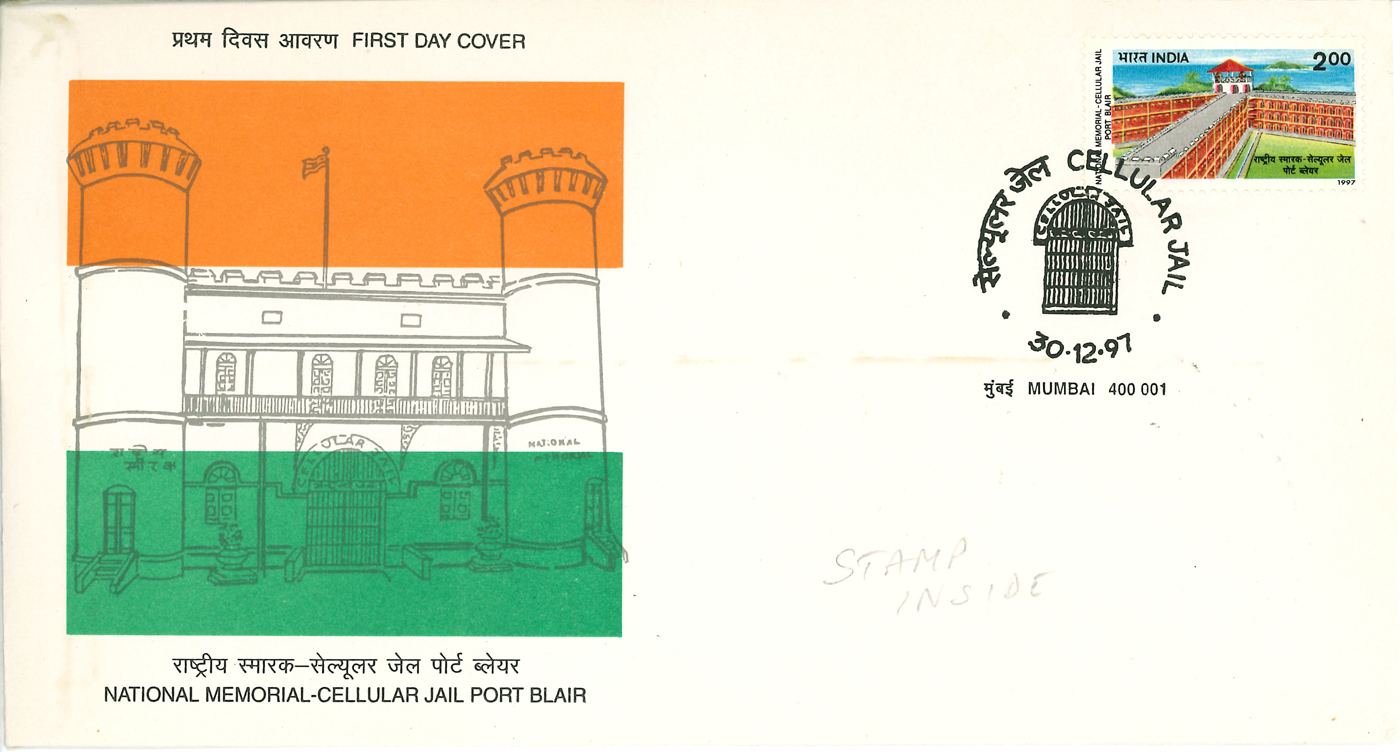
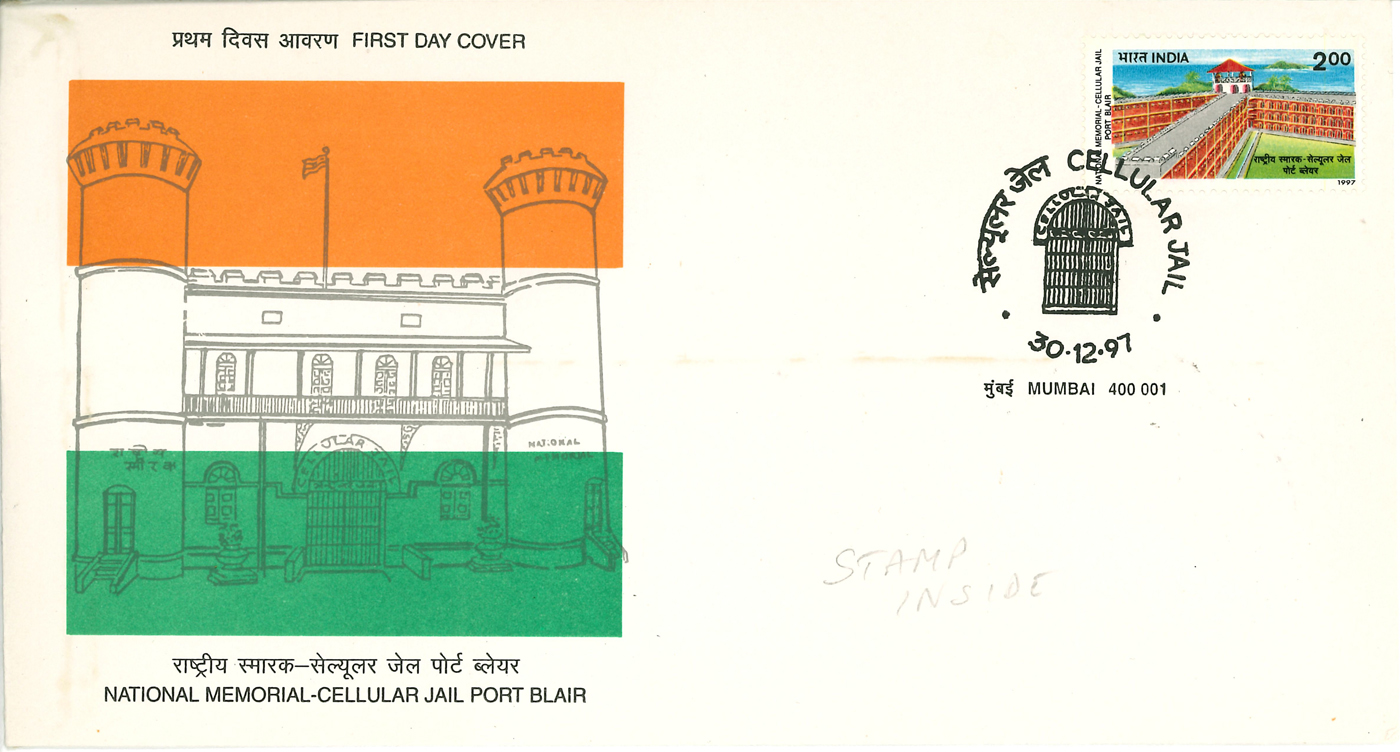
The coinage and postal services, used to spread the image of the Cellular Jail, are also themselves forms of producing meaning. The first day cover, issued by the National Department of Post, features an image of the national memorial overlaid by the Indian flag. From this, it seems the orange and green hues of the stamp were also intended to reflect the colours of the Indian flag, defining the Jail as a national symbol (see Figures 2 and 7). The stamps and coins reinforce the place of the Cellular Jail in the ‘national imaginary’, although limited access to postal services in rural areas does mean that this symbol would not have reached the whole nation.Footnote 80 Indeed, the image of ‘kala pani’ (the Black Waters), as popularized by films and recounted in history books, is often more present in the minds of Indians than the image of the prison itself.Footnote 81 Taking Robin Jeffrey's definition of coinage as ‘political communication’, we can see that the creation of stamps and coins embossed with the image of the Cellular Jail also served to legitimize the government in power by associating it with the ideals projected by the image: sacrifice for the common good, resilience, and unity.Footnote 82
First day cover, ‘Nation memorial—Cellular Jail Port Blair’, 30 December 1997, Department of Post, India, Mumbai Cancellation.
The legitimizing function of the symbol of the Cellular Jail can be noted in the visits by government officials there. In 1943, S. C. Bose first drew on the reputation of the Cellular Jail to mark the significance of raising the flag of independent India for the first time on the Andaman Islands.Footnote 83 Inaugurating the national memorial in 1979, Moraji Desai called for every Indian to be as ‘strong and bold’ as the freedom fighters of the Cellular Jail. This statement aligned the values of Desai's government with the sacrificial nature of the freedom fighters.Footnote 84 Formerly incarcerated due to his own involvement in the freedom struggle, and then by Indira Gandhi during the Emergency, Desai's commemoration of the jailing of freedom fighters thus sought to legitimize his own leadership, albeit without great success.Footnote 85 Since the monument was declared a national memorial, many government officials have visited the Jail on state-subsidized package tours.Footnote 86 Drawing on Santhi Kavuri-Bauer's analysis of monuments in India, we can see how, for state officials, monuments become a ‘national mirror of unity’, encouraging identification with the nation and its values. The Speaker of the Lok Sabha's declaration at the Cellular Jail in 2005 that it ‘is a symbol of our yearning for freedom’ demonstrates how monuments become a platform to address the Indian nation.Footnote 87 State commemoration of the freedom struggle at the Cellular Jail also serves to emphasize the value of the Andaman Islands to mainland India, given their strategic importance for maritime defence, security purposes, and tourism.Footnote 88 For example, the Indian Oil Foundation's construction of a ‘Swantantrya Jyot’ (eternal flame) on the grounds of the Cellular Jail in 2003 can be linked to the corporation's expansion to Port Blair in 2004.Footnote 89
On a national level too, the Jail is selectively portrayed as a ‘mute witness to the indescribable sufferings of the patriots’ incarcerated within it (see Figure 3). This removes the Jail of its connection to other colonial prisons which have continued to function in India since independence. As a colonial jail symbolizing oppression, however, the Cellular Jail was not entirely unique. While conditions there were particularly cruel and barbaric, David Arnold brings to light how the prison was a ‘highly visible symbol of oppression’ and an ‘arena’ for resistance throughout colonial India.Footnote 90 In the twentieth century, led by Gandhi, ‘jail-going’ became an act of resistance in itself. At a time of increasing recourse to incarceration, prisons became the ‘site for the theatrical representation of the power of the colonial state’.Footnote 91 The symbolic value of the Cellular Jail in post-independence India draws on wider anti-colonial, nationalist imagery of colonial India as a ‘vast prison’.Footnote 92 The image of the Jail is thus highly symbolic of freedom lost and freedom gained in modern India.
Yet even the Cellular Jail, as we have seen, remained a district jail until 1969. Although the struggle for independence and colonial repression are now part of the nation's past, the jail as a tool of coercion has remained central to the Indian state's modern regime of power.Footnote 93 As Chatterjee and Sudipta Kaviraj, in particular, have highlighted, the transition to independence did not mark a complete rupture with the colonial rule of governance.Footnote 94 Notably, for the purposes of this article, the Indian penal code and colonial prisons were inherited by the Indian nation. Most colonial jails, such as those in Madras, Faizabad, Ambala, and Gonda, continued to function after independence, despite being ‘alien institutions’.Footnote 95 Jails such as Alipur Central Jail, where freedom fighters were hanged, or Yerwada Jail, where Gandhi and Nehru were famously imprisoned, were not transformed into memorials.
Furthermore, as Arundhati Roy and Ujjwal Kumar Singh have brought to light, prisons still function as tools of political oppression in modern India.Footnote 96 Some campaigners argue that today India is witnessing a ‘rising intolerance of the state towards any form of dissent’, with 18 cases involving ‘sedition’ charges in the first eight months of 2016 alone.Footnote 97 Arun Ferreira's memoir of incarceration in the former colonial jail in Nagpur bears some notable similarities to the memoirs of political prisoners in the Cellular Jail. Ferreira was arrested on the charge of being a Naxalite under the Unlawful Activities (Prevention) Act 2004. Like the political prisoners of the Cellular Jail, Ferreira was a ‘marked’ prisoner, in this case by the charge of terrorism.Footnote 98 His memoir Colours of the cage recounts the horrific tortures to which he was repeatedly subjected in police custody in order to rack up more charges against him. In 2008, along with other Naxal-accused prisoners, Ferreira began a hunger strike, demanding an end to their isolation and the labelling of activists as Naxalites.Footnote 99 Another writer Anjum Zamarud Habib, who founded an organization in 1990 to give Kashmiri women a voice, recounts her own experiences of torture in jail after being falsely implicated under the Prevention of Terrorism Act 2002.Footnote 100 These narratives testify to the continued use of prisons as a means to exclude and oppress those perceived as security threats. Moreover, they also demonstrate that the prison remains a site of resistance, a prominent example being the 16-year-long hunger strike of civil rights activist Irom Sharmila.Footnote 101
There is a degree of contradiction in the fact that the Indian state curates colonial terror through the image of the Cellular Jail, while continuing programmes of incarceration elsewhere. Yet the attitude of post-colonial governments towards colonial prisons can be linked to the way in which nationalist prisoners viewed other convicts in the colonial era. Drawing on Singh's analysis, we can interpret the nationalist ‘silence on prisons’ post-Independence as a result of the “nationalist resolution”’ of the political. Singh argues that the freedom fighter discourse brought legitimacy to the ruling classes, giving them the power to classify others as criminals or anti-national.Footnote 102 The memoirs of Parmanand and Ghosh demonstrate their distance from the other ‘bad men’ in the Cellular Jail.Footnote 103 From these commentaries it does not seem that the nationalists necessarily objected to the incarceration of criminals, despite the wider symbolic meaning of the prison. Indeed, as Singh brings to light, even Gandhi approved of prisons in a certain form, despite advocating for more reformatory institutions.Footnote 104
As a national symbol, it is clear that the Cellular Jail does not challenge the practices of incarceration or political oppression in prisons. Like most other nation-states, the post-independence Indian government has embraced the prison as a necessary condition of modern society. As with other comparable UNESCO sites, the Jail is a powerful symbol of freedom lost and freedom gained, yet in itself it remains a largely unquestioned part of the coercive apparatus of the state. We can, however, question the extent to which the separation of prison-memorials and continuing programmes of incarceration are successful. In India, critiques of continuities in coercive governance suggest that the symbolic relegation of colonial jails to the ‘foreign realm’ of the past is not entirely stable.Footnote 105 Commenting on his memoir of incarceration during Indira Gandhi's Emergency, Varavara Rao states that the prison has continued to serve as a metaphor for the lack of freedom in the outside world.Footnote 106
The distinction between the Cellular Jail as a memorial and other functioning prisons further demonstrates how the national symbol of the Jail has been constructed in post-independence India. The construction of a stable national symbol presupposes the stability of the nation-state and, indeed, the concept of the nation. Laclau hypothesizes that the process of identification with the state through symbols is always ‘precarious and reversible’ in democratic societies.Footnote 107 The following section considers how the process of identification with a national symbol can be shaped and manipulated by the will of the ruling party. In 2004, the Cellular Jail became the marker of a contest over the nation's past. At its heart lies a battle over the definition of the Indian nation, to which its history is central.
A symbol for whom?
So far, this article has considered how local, national, and international bodies have attempted to fix the meaning of the Cellular Jail in order to appropriate it. However, within the national body, there lies a struggle for the ownership of national history. As it is reappropriated and rewritten, so are national symbols. The history of the Cellular Jail is thus permanently vulnerable to manipulation. An early example of this can be found in the communist struggle to gain legitimacy in the run-up to independence. In 1945, the Communist Party of India published a series of tracts on terrorist nationalist heroes, designed to prove that the Party was the ‘rightful heir of their glorious revolutionary heritage’.Footnote 108 As part of this series, Niranjan Sen's text Bengal's forgotten warriors was published in 1945; in it he recounts his experience of incarceration and resistance in the Cellular Jail in the 1930s and depicts the Jail as a university for communist revolutionary activity in this period. In the tracts, communism was portrayed as the path for the realization of the ‘successful struggle for … revolutionary dreams’.Footnote 109 Sen's text marks an attempt to define the history of the Cellular Jail in terms of the communist affiliations of some of the political prisoners. Indeed, it was reported that in 1935, 39 prisoners of the Cellular Jail formed a ‘Communist Consolidation’ group.Footnote 110 Following independence, the Cellular Jail was incorporated into the dominant nationalist narrative of the freedom struggle. Even the Moplah rebellion, largely a peasant uprising against landlords, was appropriated for the nationalist ownership of the freedom struggle.Footnote 111
In 2004, the Cellular Jail became the focal point of a battle over national history when Union Petroleum Minister Mani Shankar Aiyar ordered the removal of a plaque dedicated to Savarkar at the Jail. The plaque, featuring a quote from Savarkar translated as ‘We haven't embarked on this mission blindly’, was commissioned by Aiyar's predecessor, Ram Naik of the Bharatiya Janata Party (BJP), as part of the Swatantrya Jyot.Footnote 112 However, the structure was only finished after the defeat of the National Democratic Alliance (NDA), led by the BJP, in 2004. It was therefore inaugurated instead by Aiyar, a Congress Party minister, who replaced the plaque with one in honour of Gandhi. According to The Times of India's coverage, the removal of the plaque caused ‘pandemonium’ in parliament, disrupting both houses.Footnote 113 It was reported that the ‘Shiv Sena-BJP alliance’ inflated the conflict in order to humiliate Congress before the Maharastra elections.Footnote 114 Times News Network coverage demonstrates the speculation over reactions in Congress, with articles stating that Aiyar was asked to reinstate the plaque.Footnote 115 The Cellular Jail thus became an arena for a political contest over the representation of the past. It remained a very public controversy, as shown in 2005 when Shiv Sainiks stormed into the India Today office in Mumbai to protest against the extension of an invitation to Aiyar.Footnote 116 Recently, this contest has returned once more to the national arena under Modi's BJP government, with requests and predictions that the plaque will be reinstated.Footnote 117
This scandal can be contextualized within a far greater conflict over competing visions of national identity in India. Since the 1980s, the rapid rise of the BJP and Hindu nationalism has been marked by attempts to redefine India's history and her national symbols.Footnote 118 The place of historical monuments in this conflict was most dramatically brought to light in the demolition of the Babri Masjid. Since then, historians and commentators have reflected on the role of history in the conflict and the Ramjanmabhoomi campaign.Footnote 119 For Gyanendra Pandey, the question of ‘what constitutes the national culture, how is this to be defined, and by whom’ loomed over the campaign.Footnote 120 The nation's past was also drawn into the public arena in the battle over NCERT (National Council of Educational Research and Training) history textbooks. In 1977, Moraji Desai was the first to demand certain textbooks be withdrawn from the curriculum as they were suspected of having a Marxist influence. Then, from 1999, the BJP in the NDA coalition government began rewriting textbooks, a move that was heavily criticized by leading academics as a falsification of the truth that would only spread prejudice.Footnote 121
Central to the textbook debate and the Savarkar plaque controversy lies the question of who has a right to define the Indian nation.Footnote 122 In a political climate where the nation and its past are constantly called into question, national symbols cannot remain stable. In 2004 the Cellular Jail became a divisive rather than a unifying symbol, a stage for the BJP-Sena alliance to prove that the Congress Party were not the legitimate rulers of the Indian nation. The symbol of the Cellular Jail was redefined through challenges over who should be commemorated at this site of national significance. Although Savarkar's imprisonment in the Cellular Jail is not disputed, his significance to the collective national memory of the Cellular Jail was brought to trial. The history of the freedom fighters had been monopolized by the Congress Party in order to legitimize their right to rule the nation. For the BJP, Savarkar is one of the few Hindu nationalist freedom fighters who could serve a similar legitimizing function. According to the BJP-Sena alliance, Savarkar was a great freedom fighter to whom the nation should pay tribute. Yet, as mentioned earlier, his own vision for Indian society, and in particular his views on Muslims and Christians, mean that many Indians refuse to pay tribute to him as a father of the nation. As the inauguration of ‘Veer Savarkar airport’ in the Andamans in 2002 suggests, the BJP-Sena defence of Savarkar can be interpreted as part of a wider attempt to ‘anoint him a national hero’.Footnote 123 Through the memorialization of Savarkar, national pride is equated with Hindu nationalism. In contrast, Aiyar's choice to commemorate Gandhi at the Cellular Jail marks a clear attempt to establish the Jail as a site of secular nationalism. As Gandhi was never imprisoned at the Cellular Jail, and Savarkar was just one of many political prisoners, here the Cellular Jail becomes an ambiguous metaphor for competing visions of the nation.
In its ambiguity, the symbol of the Cellular Jail remains vulnerable to appropriation and redefinition by conflicting nationalist currents. On 21 September 2004, around a hundred or more BJP members of parliament, led by Sushma Swaraj, processed to the Cellular Jail to hold a satyagraha in protest against the removal of the plaque.Footnote 124 As with other yatras analysed by Thomas Blom Hansen and Christophe Jaffrelot, the highly symbolic journey to the Cellular Jail marked an attempt to claim the Cellular Jail and the ‘imagined national space’ for Hindu nationalism.Footnote 125 Drawing on Michael Gillan's analysis of the BJP in the years preceding 2004, we can situate the campaign to restore the Savarkar plaque within a wider push to associate the party with nationalist heritage and the freedom struggle, in order to prove their legitimacy to rule the nation.Footnote 126 As a comparable example, in 1997 the BJP led a yatra for the golden jubilee celebrations, which the then Party president L. K. Advani described as ‘honouring the sacred memory of hundreds of martyrs and heroes of our freedom struggle’.Footnote 127 In 2004, the Cellular Jail and its associations with the ideal of ‘sacrifice’ served as a symbolic arena to delegitimize Sonia Gandhi, described by Swaraj as a ‘firangi’ who ‘cannot know what freedom fighters have sacrificed for this country’.Footnote 128 Here, the appropriation of the symbol of the Cellular Jail functioned to discredit Congress and project an image of the BJP as the true defenders of the nation. Echoing this, Advani similarly declared that this was a ‘national issue’, an ‘ideological war’, and proof that the Congress leaders ‘do not understand what Indianness means’.Footnote 129 Most recently, in January 2017, the Film and Television Institute of India (FTII) created a replica of the Cellular Jail on its premises, notably depicting the imprisonment of Savarkar. The creator of the replica stated that ‘nobody can deny Savarkar's role in [the] freedom struggle’, while others deemed the replica's focus on Savarkar to be ‘politically motivated’.Footnote 130
The Savarkar plaque scandal evokes Kavuri-Bauer's description of the ‘ambivalent and conflicted process of national identification’ in India.Footnote 131 At the heart of this conflict lies the question: to whom does India's past belong? The Cellular Jail as a national symbol is thus fundamentally unstable, due to the insecurity of the ‘national’ qualifier. Subject to power relations of ruling parties, the Cellular Jail is vulnerable to battles over legitimacy of rule in contemporary India.
Conclusion
India is so diverse and so scattered and so torn in so many ways, but somehow, the past of this country never fails to bind it together. The Cellular Jail is just one example.Footnote 132
These words of an Indian teacher, whom I interviewed after her visit to the Cellular Jail, evoked in me a sense of the capacity of historical sites such as this to unite the Indian people and instil a sense of national pride. Yet, as we have seen, this process of identification is never stable and is constantly vulnerable to manipulation by changing political wills. Furthermore, while ‘monumental’ national histories can shape a strong collective national memory, this memory is selective, and certain peoples and certain uncomfortable truths are excluded.Footnote 133 Local objections to the hegemonic nationalist memory of the Andaman Islands expose the extent to which it is reductive. Ordinary prisoners of the Cellular Jail, before and after Independence, are intentionally forgotten, casting a blanket of silence over continuities in the penal system. A wider, more pluralistic, memory of the Cellular Jail holds the capacity to facilitate dialogue both on practices of incarceration in India and worldwide, and on colonial and post-colonial relations. At a time when colourful images of the British Raj in Channel 4's Indian summers in the UK seem to encourage a yearning for the imperial heyday, the realities of Britain's colonial past, left out of British textbooks, remain shockingly absent from public memory. In this context the history of the Cellular Jail could serve as a source for an inconvenient, yet important and hitherto obstructed, self-reflection for Britain.Footnote 134
This article has considered how the symbolic meaning of the Cellular Jail has been constructed in post-colonial India. Driven by contemporary concerns, different agents have attempted to fix the meaning of the Cellular Jail in order to appropriate it. The Cellular Jail, like other memorials, is a palimpsest, telling us as much about India's recent history as its colonial past. Yet, as Jacques Derrida describes, there is no outside position from which to examine the past.Footnote 135 I too have analysed the meaning of the Cellular Jail through the prism of the present, creating my own version of its history. Shaped by my own academic and personal interests, a reliance on English-language sources, and the discourse of academia, this article adds another layer to the palimpsest.