Introduction
Migrants typically move with the intention of improving their own and their families’ lives. But we still know remarkably little about how older migrants evaluate their lives and the success or otherwise of their migration project (Fernández-Ballesteros Reference Fernández-Ballesteros2011; Victor, Burholt and Martin Reference Victor, Burholt and Martin2012; Warnes et al. Reference Warnes, Friedrich, Kellaher and Torres2004). In this paper, we set out to provide some insight into the long-term consequences of migration, by comparing the life satisfaction of labour migrants who have grown old in the country to which they immigrated when they were young to that of their peers from the same contexts of origin who never left or who returned. The period of retirement, when individuals have given up the employment for which they originally emigrated, is a relevant moment to consider how they evaluate their lives, including their migration experience alongside their current material, health and social conditions, and how this is reflected in life satisfaction.
As those who formed part of the peak migration flows of the 1960s and early 1970s age, the number of older migrants in European countries is growing. Commensurate with their numerical significance and the specific conditions under which they have lived, worked and retired, there is growing scientific interest in their circumstances (Attias-Donfut, Tessier and Wolff Reference Attias-Donfut, Tessier and Wolff2005; Baykara-Krumme, Motel-Klingebiel and Schimany Reference Baykara-Krumme, Motel-Klingebiel and Schimany2012; Bolzman et al. Reference Bolzman, Poncioni-Derigo, Vial and Fibbi2004; Warnes et al. Reference Warnes, Friedrich, Kellaher and Torres2004). Particular attention has been paid to migrants from Turkey, who form a large and growing group of non-native born over the age of 65 in various European countries. A number of studies have shown that these older Turkish-origin populations experience more health problems, greater financial hardship and poorer housing when compared with their native peers in the countries of settlement (e.g. Hubert, Althammer and Korucu-Rieger Reference Hubert, Althammer and Korucu-Rieger2009; Lewinter, Gezgin and Kesmez Reference Lewinter, Gezgin and Kesmez1994; Liversage and Jakobsen Reference Liversage and Jakobsen2016; Tucci and Yildiz Reference Tucci, Yildiz, Baykara-Krumme, Motel-Klingebiel and Schimany2012; Van der Wurff et al. Reference Van der Wurff, Beekman, Dijkshoorn, Spijker, Smits, Stek and Verhoeff2004). This disadvantage is also reflected in subjective dimensions of wellbeing. Older Turks in Germany, for instance, feel lonelier and more depressed than their older native-born peers (Baykara-Krumme Reference Baykara-Krumme, Baykara-Krumme, Motel-Klingebiel and Schimany2012; Fokkema and Naderi Reference Fokkema and Naderi2013; Sahyazici and Huxhold Reference Sahyazici, Huxhold, Baykara-Krumme, Motel-Klingebiel and Schimany2012). These findings for older Turks in Germany are in line with a number of recent studies on life satisfaction of migrants of all ages and across different origin countries, which show that they are less satisfied than the native-born in the host country (Bartram Reference Bartram2011; de Vroome and Hooghe Reference de Vroome and Hooghe2014; Hendriks Reference Hendriks2015; Knies, Nandi and Platt Reference Knies, Nandi and Platt2016; Nesterko et al. Reference Nesterko, Braehler, Grande and Glaesmer2013; Safi Reference Safi2010; Verkuyten Reference Verkuyten2008).
Various authors have stressed, however, that the classical comparison with natives provides little information on the consequences of migration itself for life satisfaction, since we do not know how satisfied they started out (Bartram Reference Bartram2013a , Reference Bartram2013b ; Bayram et al. Reference Bayram, Thorburn, Demirhan and Bilgel2007; Beirens and Fontaine Reference Beirens and Fontaine2011; Voicu and Vasile Reference Voicu and Vasile2014). Rates of life satisfaction in the countries of origin are typically substantially lower on average than those in European countries. Non-migrants (or ‘stayers’) in the country of origin therefore provide a potentially more fruitful comparison group for addressing the question of whether migration and post-migration experience in the destination country brings lower levels of life satisfaction or, rather, reflects life satisfaction patterns and norms in the country of origin.
Cross-sectional comparisons between migrants and stayers are, of course, vulnerable to selection bias. Pre-migration levels of life satisfaction may systematically vary between migrants and stayers; the migration decision itself may be determined by the degree of life satisfaction, either negatively (e.g. Graham and Markowitz Reference Graham and Markowitz2011), or positively. A further potential source of selection bias in the study of older people is differential mortality between migrants and stayers. If migrants and stayers differ both in their probability of survival into older ages and in the extent to which survival is associated with underlying levels of life satisfaction, then this may also bias the estimation of the impact of migration on life satisfaction. Conclusions about the consequences of migration for individuals require panel data capturing international migrants before and after migration (Bartram Reference Bartram2013b ; Hendriks Reference Hendriks2015; Voicu and Vasile Reference Voicu and Vasile2014). However, such transnational longitudinal data are rare. Even if implemented, newly emerging longitudinal data sources on migrants cannot help with assessing the long-term impact of migration on older migrants who have had 40–50 years of exposure to the country of destination. Therefore, the best approximation to estimate the counterfactual of non-migration, and hence the impact of migration on life satisfaction, is to use careful comparisons with equivalent comparators in the country of origin, and to control as far as possible for observable factors that might be associated with selection and correlate with life satisfaction, such as educational level, health status and region of origin.
Existing migrant–stayer comparisons have produced mixed findings, but some indicate that certain groups of migrants (including Turks) experience greater life satisfaction than non-migrants in the countries of origin (e.g. Bartram Reference Bartram2013a ; Bayram et al. Reference Bayram, Thorburn, Demirhan and Bilgel2007; see also the review in Hendriks Reference Hendriks2015). Studies focusing on older migrants specifically are rare (Akbiyik et al. Reference Akbiyik, Berksun, Sumbuloglu, Sentürk and Priebe2008; Kofahl et al. Reference Kofahl, Mnich, Doğan, Doğan, Baykara-Krumme, Motel-Klingebiel and Schimany2012; Victor, Burholt and Martin Reference Victor, Burholt and Martin2012). Moreover, in these studies, the comparison group of stayers is often not sufficiently well-specified to be an adequate comparator. It is to this nascent strand of research operationalising migrant–stayer comparisons that our paper contributes. It exploits the 2000 Families Study which provides an ideal data-set for our purposes: the study randomly sampled households in five high emigration regions in Turkey with the explicit aim of providing data for migrant and stayer comparisons (Guveli et al. Reference Guveli, Ganzeboom, Platt, Nauck, Baykara-Krumme, Eroḡlu, Bayrakdar, Sözeri and Spierings2016). The data cover labour migrants who were brought up in the five regions before they left for Europe between 1961 and 1974, as well as their same-aged peers from the same neighbourhoods who stayed in Turkey. Since many labour migrants eventually returned to Turkey, we are able to include a third group of returnees. While necessarily a heterogeneous group, with different timing of (and probably motivations for) return, returnees are of interest in expanding our understanding of migrant life satisfaction, and can, for instance, shed light on the lasting consequences for life satisfaction of different durations in the destination countries.
In this paper, we address the question of whether migrants – when compared to stayers – end up with higher life satisfaction and, in that sense, reap the fruits of migration in old age. Additionally, we aim to understand how such a gain in life satisfaction might be explained, trying to open up the ‘black box’ of migration's impact on subjective wellbeing. In the next section, we develop our main hypotheses with regard to older Turkish migrants’ life satisfaction, drawing on the relevant theoretical and empirical literature. We then present the data and our main findings before concluding with a discussion of the results and their implications.
Theoretical background
Different measures are used to evaluate subjective wellbeing in contemporary research. It is now common to distinguish a feeling of pleasure or momentary mood (‘hedonic’), a more evaluative measure of satisfaction, and feelings of purpose (‘eudaemonia’; Dolan and Metcalfe Reference Dolan and Metcalfe2012). But the general aim is typically to assess ‘the degree to which an individual judges the overall quality of his/her own life as a whole favourably’ (Veenhoven Reference Veenhoven, Land, Michalos and Sirgy2012b : 66). In this analysis, we focus on the evaluative domain of life satisfaction and its determinants, building on a theoretical framework suggested by Veenhoven (Reference Veenhoven, Land, Michalos and Sirgy2012b ).
Veenhoven proposes a model in which subjective evaluation of life is determined by both life chances and lifecourse events. Life chances have two main components: societal resources (also termed ‘liveability’), and personal resources, which include both social and economic resources and psychological capacities. Life events (such as traffic accidents or occupational success) are partly due to chance, but themselves chiefly stem from differences in (early) life chances – e.g. levels of social organisation, availability of economic or social capitals or individual capacities. Expressions of life satisfaction can, for Veenhoven, be seen as the culmination of the interaction between lifecourse events and these society-level and personal dimensions of life chances.
In this paper, we develop this framework for the specific case of older migrants’ life satisfaction. We treat migration as a critical lifecourse event that both shapes and interacts with societal and personal resources to influence life satisfaction. That is, we expect migrants both to have access to different societal resources, such as health care, following migration, and that the influence of their personal resources (such as health) on their life satisfaction is shaped by their post-migration context. Furthermore, we extend Veenhoven's focus on individual-level resources by addressing the potential influence of family (i.e. children's) outcomes on older people's life satisfaction. Again, we might expect such family outcomes to differ in their impact according to migration status. This framework provides us with a series of expectations about patterns and drivers of life satisfaction among older migrants compared to non-migrants, which we elaborate in the rest of this section.
The determinants of life satisfaction
Societal resources (‘liveability’)
The role of societal resources, or what Veenhoven terms ‘liveability’, as a determinant of life satisfaction, derives from empirical research that demonstrates that individuals in more modern, affluent and liberal countries feel happier than those in less-affluent countries (Veenhoven Reference Veenhoven2012a , Reference Veenhoven, Land, Michalos and Sirgy2012b ). There is, for example, lower average life satisfaction in Turkey than in European countries (Bartram Reference Bartram2013a ; Organisation for Economic Co-operation and Development (OECD) 2014: 137; Selim Reference Selim2008: 536), even though some data suggest that since around 2005 the gap in life satisfaction between Turkey and Europe has been closing (World Values Survey Association 2016). These national differences can be linked to some extents to the poorer living conditions that still prevail in Turkey compared to North-Western European countries (OECD 2014). As a consequence, migrants living in Europe might be expected to profit from the greater liveability of their environment, and correspondingly display greater life satisfaction. We therefore hypothesise that Turkish migrants in Europe display higher life satisfaction than stayers in Turkey. If this is a societal effect, we should observe it even when we account for differences in personal resources, to which we turn next.
Personal resources
As well as bringing higher levels of societal resources, migration might also enhance migrants’ personal resources in old age, with consequences for life satisfaction (Gabriel and Bowling Reference Gabriel and Bowling2004; Knies, Nandi and Platt Reference Knies, Nandi and Platt2016; Walker Reference Walker, Dannefer and Phillipson2010). Specific personal resources associated with (higher) life satisfaction include material resources or income (Easterlin et al. Reference Easterlin, McVey, Switek, Sawangfa and Zweig2010), and social capital and social support, which directly affect wellbeing and can act as a buffer in the face of deprivation (Pinquart and Sörensen Reference Pinquart and Sörensen2000; Powdthavee Reference Powdthavee2008). Health and physical mobility are also strongly correlated with life satisfaction (Gabriel and Bowling Reference Gabriel and Bowling2004; Walker Reference Walker, Dannefer and Phillipson2010). Veenhoven (Reference Veenhoven, Land, Michalos and Sirgy2012b ) additionally emphasises the role of psychological capacity in improving life satisfaction and aiding adjustment to lifecourse events. While standard surveys have few measures of psychological fortitude, one measure of psychological resources may be found in religiosity. Religiosity is associated with greater life satisfaction in a number of studies (Lim and Putnam Reference Lim and Putnam2010; Park, Roh and Yeo Reference Park, Roh and Yeo2012). Spirituality can provide psychological-emotional support in dealing with difficult life situations, increasing adaptation competencies and emotional stability. Prayer is an individual religious practice, which can be used to represent such spirituality, and which we would therefore expect to be associated with higher life satisfaction.
To the extent that the distributions of these personal resources differ between migrants and stayers, they will result in different levels of life satisfaction. In addition, there may be different impacts of these resources depending on migration status. The interaction (or in Veenhoven's terms, ‘confrontation’) between life events, such as migration, and an individual's social resources and psychological capacities may be consequential for subsequent life satisfaction. We therefore go on to hypothesise how these resources (income, health, social resources and religiosity) might differ between migrants and non-migrants; and how the interaction with migration might mean they are associated to a different degree with life satisfaction across migrants and stayers.
Hypotheses of the effects of personal resources on life satisfaction of migrants and stayers
Migrants’ retirement incomes may be on average much lower than those of European natives (Liversage and Jakobsen Reference Liversage and Jakobsen2016; Moriarty and Butt Reference Moriarty and Butt2004; Tucci and Yildiz Reference Tucci, Yildiz, Baykara-Krumme, Motel-Klingebiel and Schimany2012; Warnes Reference Warnes, Dannefer and Phillipson2010), but they are likely to be higher than those of their peers in the rural regions of origin who stayed in Turkey. The purchasing power of European pensions is higher than average Turkish pensions, implying greater economic resources and consequently higher life satisfaction among migrants (during their temporal stays in Turkey). At the same time, the positive impact of greater income may be less clear-cut for migrants than stayers. Higher living costs in Europe should increase the relevance of higher income, but different relative deprivation perceptions in Europe may decrease it (Clark, Frijters and Shields Reference Clark, Frijters and Shields2008). In addition, changing reference points from the origin to the destination context would imply increasing comparisons with the (wealthier) natives in the host country. This ‘upward comparison’ may result in lower life satisfaction, even if objective living conditions have actually improved following migration (Bartram Reference Bartram2011). Conversely, a ‘downward comparison’ with peers in the less-wealthy home context may lead to a higher life satisfaction. Income effects on life satisfaction then become critically shaped by the reference group. We expect a higher income of migrants to mediate migrant–stayer differences in life satisfaction, and an interaction between income and migrant status, such that the income association will be less distinct for migrants than for stayers.
Former labour migrants report lower health satisfaction than natives in Europe (Fokkema and Naderi Reference Fokkema and Naderi2013), but they may again in fact be healthier than stayers. Official labour migration to Europe was restricted to healthy labourers (Akgündüz Reference Akgündüz2008); and migrants are typically positively selected on health (Razum et al. Reference Razum, Zeeb, Akgün and Yilmaz1998). Working conditions were harsh in Europe, but elderly migrants have benefited from better health care in Europe. Thus, we expect better health to explain higher life satisfaction of migrants. In addition, health may interact with migrant status such that, among migrants, poor health may have less adverse effects on life satisfaction due to better health care. Thus, we expect a stronger health gradient for stayers.
Concerning social resources, we expect few differences in marital status between Turkish migrants and stayers; but we do anticipate smaller friendship networks due to migration, as it acts as a break point in established networks (Nauck and Kohlmann Reference Nauck, Kohlmann, Wagner and Schütze1998; Ryan et al. Reference Ryan, Sales, Tilki and Siara2008). We therefore expect that stayers will have more friends and migrants will be more at risk of social isolation (Baykara-Krumme Reference Baykara-Krumme, Baykara-Krumme, Motel-Klingebiel and Schimany2012; de Vroome and Hooghe Reference de Vroome and Hooghe2014). Rather than mediating a migrant life satisfaction advantage, taking account of differences in social networks is expected to amplify the gap. In a minority situation, networks may be especially important as a resource, and lack of friends more debilitating. We therefore expect that the gradient of social resources on life satisfaction will be steeper for migrants than stayers.
For religiosity we assume that due to steady, albeit slow, processes of secularisation, migrants in the diaspora will be less religious than stayers (Guveli Reference Guveli2014). This would lower the migrant advantage in life satisfaction. However, religiosity can be expected to have more protective emotional functions in a foreign context, resulting in a stronger positive impact of religiosity on life satisfaction among migrants (e.g. Amit Reference Amit2010).
As noted, a contribution of our study is to go beyond these individual-level resources and address the fact that the personal resources may include family outcomes, such as children's success. High educational attainment and high income of sons and daughters as well as children's successful family formation should positively affect the life satisfaction of parents in later life. In the family-oriented Turkish culture, in which marriage is almost universal, organized with intense family involvement and occurring early in life, the children's marriage results in status gains for parents (Baykara-Krumme Reference Baykara-Krumme2015; Kavas and Thornton Reference Kavas and Thornton2013). Moreover, a major incentive to migration is often to ensure educational and economic success for the migrant's children: migration is regarded as a social mobility project for the family (cf. Kao and Tienda Reference Kao and Tienda1998; Phalet, Andriessen and Lens Reference Phalet, Andriessen and Lens2004), and research suggests that the children of Turkish labour migrants do achieve educational gains relative to stayers (Luthra Reference Luthra2010). Thus, family outcomes are expected to contribute towards older people's life satisfaction and help to account for any life satisfaction gap. For these very reasons, family outcomes may be particularly important for migrants who, in the highly individualised culture of Europe, have a specific investment in them (Nauck Reference Nauck2001). Accordingly, we would also expect a stronger gradient among migrants.
Alternative accounts: acculturation and selection
Overall, these hypotheses would indicate that personal resources should explain a substantial share of any raw differences in life satisfaction between migrants and stayers, and that any remaining gap could be attributed to societal resources – or ‘liveability’ of destination countries. However, we can consider two alternative reasons for observed (net) differences in life satisfaction between older migrants and stayers: acculturation and selection.
According to acculturation theory, migrants assimilate to the (higher) levels of life satisfaction in the destination contexts by adapting ‘normative guidelines’ for expressing feelings of wellbeing (Angelini, Casi and Corazzini Reference Angelini, Casi and Corazzini2015). There is some limited evidence supporting this theory, which shows that life satisfaction increases with length of stay (Angelini, Casi and Corazzini Reference Angelini, Casi and Corazzini2015; Nesterko et al. Reference Nesterko, Braehler, Grande and Glaesmer2013; Voicu and Vasile Reference Voicu and Vasile2014) or over immigrant generations (Bayram et al. Reference Bayram, Thorburn, Demirhan and Bilgel2007; Veenhoven Reference Veenhoven2012a ). However, the evidence is not consistent (Safi Reference Safi2010). We can attempt to test whether our findings are consistent with the acculturation thesis in two ways. Firstly, from acculturation arguments, we would expect processes of adaptation and acculturation to imply variation in satisfaction levels of migrants according to the average satisfaction levels of each European destination country. Second, we expect acculturation to vary with the time spent in Europe. We can capture this temporal influence by looking at return migrants who spent very different periods in Europe. The return migrants stem from the same cohorts as the migrants. They left their home region with the other migrants, but returned at some point. Similarity in (net) life satisfaction between migrants and returnees, and an impact of the length of exposure to the migration context prior to return would imply a lasting migrant acculturation effect.
Turning to selectivity, unexplained migration ‘gains’ in life satisfaction could derive from unobserved differences between migrants and stayers, including differences in capacities and personality traits linked to life satisfaction. If migrants are more likely to rank highly on internal control, extraversion and conscientiousness – which are all positively related with life satisfaction (Veenhoven Reference Veenhoven, Land, Michalos and Sirgy2012b ) – observed higher life satisfaction may in fact be a lifelong characteristic and reflect selection rather than societal context. We cannot resolve this selection issue since we do not know satisfaction levels before (potential) migration to Europe. At best, we can control for observable factors (specifically education) which are likely to be linked to positive selection (Voicu and Vasile Reference Voicu and Vasile2014). We can, however, note that personality traits are not immutable, and, unlike other studies that include migrants (and returnees), our sample has experienced many decades between the original migration decision and the current evaluation of life satisfaction, increasing the potential for adaptation to the destination context.
Comparisons with return migrants can shed further light on the issue of selectivity. Dissimilarity between stayers and migrants, and similarity in life satisfaction between migrants and returnees (and no impact of the length of exposure to the migration context prior to return) should indeed indicate that migrants are positively selected on personality traits. By contrast, if returnees are more similar to stayers, this would support the notion of situational responses to societal resources. Even here, however, the results may stem from migrant selectivity accompanied by remigration selectivity. Returnees are themselves a heterogeneous group in terms of motivations and subsequent evaluations of life (Bartram Reference Bartram2013b ; Razum, Sahin-Hodogluil and Polit Reference Razum, Sahin-Hodogluil and Polit2005). According to a study from the 1980s, about half of the former labour migrants who returned within a return scheme from Germany to Turkey regretted their decision. Among the returnees, those who had stayed in Germany for a longer time were more satisfied on their eventual return (Dustmann, Bentolila and Faini Reference Dustmann, Bentolila and Faini1996). Selective remigration of the less successful and less healthy migrants may account for greater frustration and lower life satisfaction among returnees. However, temporary migration to a wealthier country in which skills can be gained and savings accumulated may also increase social position and thereby life satisfaction after return (Dustmann and Mestres Reference Dustmann and Mestres2010). We lack pre-migration and pre-return information on living conditions and life satisfaction and thus cannot completely rule out (re)migration selectivity.
Data and method
Data
We use the 2000 Families Study which includes migrants, stayers and returnees from the same regions of origin in Turkey (‘2000 Families: Migration Histories of Turks in Europe’; Guveli et al. Reference Guveli, Ganzeboom, Platt, Nauck, Baykara-Krumme, Eroḡlu, Bayrakdar, Sözeri and Spierings2016). Data were collected in 2010 and 2011 in five regions spread across Turkey: Acıpayam (Denizli), Akçaabat (Trabzon), Emirdağ (Afyon), Kulu (Konya) and Şarkışla (Sivas). The study gathered the details of a representative sample of men born between 1921 and 1946 in these regions, who migrated as labour migrants to Western Europe between 1961 and 1974 and stayed for a minimum of five years (‘migrants’), or who could have migrated but did not (control group of ‘stayers’). Basic information about these men (the ‘ancestors’), whether they were alive or dead, and all their descendants was collected for up to four family generations. This was supplemented with more detailed information on all adult members of the families provided in a proxy interview, and with individual interviews (carried out face to face or by telephone) with the ancestors (if still alive) and up to two of their children and four of their (adult) grandchildren. We draw on the individual interview data for the ancestors, supplemented by the proxy data and individual interviews with their children, to provide information on family outcomes.
The five regions were chosen because they were known to be regions with high emigration (Akgündüz Reference Akgündüz2008), and also captured the ethnic-religious diversity of Turkey and its non-metropolitan emigrant populations. In each region, a clustered probability sample was drawn, using address registers of the Turkish Statistical Institute to identify primary sampling units, proportional to the estimated population size of the local community. Randomisation was achieved through random walk, and the non-migrant families were identified on a quota basis (one for every four migrant families screened in). In total, the data collection yielded information on 1,992 men and their families. Of these, 1,580 were migrants and 412 were non-migrants. The migrants predominantly emigrated to Germany (about 57%), France and Belgium (10%, respectively), the Netherlands and Austria (7%, respectively), and Sweden, Denmark and Switzerland. Many migrants returned with their families or after having left their families behind in Turkey when they migrated, and still live in Turkey today. While the data are not representative of all Turkish migrants in Europe they reflect the experiences of migrants and their descendants who originate from typical emigration regions, and enable comparison with their non-migrant peers from the same neighbourhoods. Our sample comprises those 1,019 out of 1,053 living respondents who provided complete information on the dependent variable and most of the independent variables. While we did not impute data when numbers of missing values were negligible, we imputed data where the share of missing values was larger, in order to retain statistical power and ensure unbiased estimates (Acock Reference Acock2005).
Measures
Our dependent variable is life satisfaction, measured by the question ‘All things considered, how satisfied are you with your life?’, with answer categories on a five-point Likert scale, ranging from 1 = ‘highly satisfied’, through 2 = ‘satisfied’, 3 = ‘neither satisfied nor dissatisfied’, 4 = ‘dissatisfied’ to 5 = ‘highly dissatisfied’. We reverse coded the variable so that the highest value indicates highest satisfaction.
Our key independent variable is migration status of the respondent. We used questions of current country of residence and whether the respondent ever left his country of birth for more than a year. Stayers never emigrated and currently live in Turkey, migrants emigrated and currently live in Europe, and return migrants emigrated for a period, but currently live only in Turkey. If more than one country (e.g. Turkey and Germany) were mentioned as current places of residence, the respondents were considered to be migrants, thus including in this category all those who are transnationally mobile. Among the migrants, at the time of the survey 35 per cent lived (at least partly) in Germany, 21 per cent in Belgium, 14 per cent in the Netherlands, 16 per cent in France, 5 per cent each in Sweden and Denmark, and the rest in other (European) countries.
Regarding the set of covariates, household income was asked in a series of bands and in the currency of the country of residence. These values were adjusted using purchasing power parities to be cross-nationally equivalent. Missing values (21%) were imputed and income dummies for the income bands were included in the models. To evaluate health status, we used the question: ‘Do you have any long-standing illness, disability or infirmity that has troubled you over a period of at least 12 months or that is likely to trouble you over a period of at least 12 months?’ Answers were coded 1 (yes) and 0 (no). Marital status and number of non-family friends comprised our measures of social resources. Respondents who were married at the time of the interview (coded 1) were compared with divorced, never married and widowed respondents (0). Number of friends was constructed from the question: ‘Let us now talk a bit about the people who are important to you and who you feel close to. Please DO NOT include your parents, your partner or your children but you can include other relatives. How many people are you thinking of?’ We categorised the answers into no friends (0), up to two close friends (1), between three and ten close friends (2) and more than ten close friends (3). As these questions were not asked in the pilot region (Şarkışla), values for these cases and for the small number of additional missing values (24 per cent overall) were imputed. Religiosity was measured as the frequency of praying with the response categories: 1 = ‘five times a day’, 2 = ‘every day’, 3 = ‘once a week’, 4 = ‘at least once a month’, 5 = ‘only on special holy days’, 6 = ‘less often’ and 7 = ‘never’. The scale was inverted and centred at 0, with a higher value indicating higher religiosity, and included as a continuous variable.
As we also wanted to capture children's outcomes, and hence the success or otherwise of the migration project, we used the proxy family data supplemented as necessary with the interviews of the main respondent's children to identify children's educational status, using the highest level of education among all the children. Education was measured on a metric scale of the highest obtained educational level, or if still in education, the one they were currently aiming to achieve, with categories ranging from 0 = ‘primary dropout’, through 1 = ‘primary’, 2 = ‘lower secondary’, 3 = ‘higher secondary’, 4 = ‘tertiary’ to 5 = ‘higher tertiary’. We imputed the values for 6 per cent of cases with missing information. We also identified, using information on children's age and marital status, whether any of the children was still never married at the age of 30 or above (coded 1, and 0 otherwise). Missing cases (6 per cent) were imputed. Children's income was available from the individual interviews and we use the levels from the child with the highest income, and impute values for those 25 per cent of cases with missing data.
We additionally controlled in all the models for respondent's own educational level (metric scale, ranging from 0 = ‘no school and illiterate’, through 1 = ‘no school but literate’, 2 = ‘primary school dropout’, 3 = ‘(extended) primary’ to 4 = ‘higher than primary’), age in bands (55–65, 66–70, 71–74, 75+), and, for those models including income, an adjustment for household size. All models control for region of origin and for interview mode (face to face versus telephone), since the literature suggests there can be differences in reporting of life satisfaction by mode of interview (e.g. Conti and Pudney Reference Conti and Pudney2008; Dolan and Kavetsos Reference Dolan and Kavetsos2012). In separate analyses, we additionally drew on migrants’ destination country life satisfaction level (based on data for 2012 of the Gallup World Poll, published in the Better Life Index by OECD 2013); and for returnees, we calculated their length of stay in Europe before return to Turkey in years. Missing values (10%) were imputed.
Methods
We estimated linear regression (ordinary least-squares (OLS)) models with life satisfaction as our dependent variable and migration status as our key independent variable. We estimated a series of nested models, with, first, only migration status and controls (Model 1). We then added personal resources, namely income, health status, marital status, friends and religiosity. While we had expected some of these resources (social networks and religiosity) to be greater among stayers than migrants, descriptive statistics, discussed below, showed that was not the case and we therefore included all the measures together (Model 2). We also tested the interaction between all these measures and migration status and retained those interactions which were statistically significant at least at the 10 per cent level, indicating that there were differences in the effects of our main variables according to migrant status (Model 3). Finally, we included family outcomes, again testing all the interactions between family outcomes and migration status (Model 4). Our full model specification (Model 4) can therefore be written for each respondent as follows:
 $${y = {\rm \alpha} + {\rm \gamma}} _1 M1 + {\rm \gamma} _2 M2 + {{\rm \lambda} ^{\prime}}X + {{\rm \rho}_1^{\prime}} X.M1 + {{\rm \rho}_2^{\prime}} X.M2 + {{\rm \beta} ^{\prime}}Z + {\rm \varepsilon} $$
where y is life satisfaction, γ1 and γ2 are the coefficients of interest on the migration status dummies M1 (migrant) and M2 (returnee), X is the vector of explanatory variables (income, health status, social resources, religiosity and family outcomes), which are interacted with M1 and M2, and Z is a vector of control variables, while ε is a random error term.
Given relatively high rates of missing values on certain of our explanatory variables, we estimated our models on multiply imputed data, imputing the data with chained equations using Stata 13.1's mi impute suite, and including all variables. We imputed complete sets of responses for 40 imputed data-sets. This number of imputations is generally considered more than sufficient for the levels of missing data in our sample, where a rule of thumb is often as many imputations as percentage missing data (White, Royston and Wood Reference White, Royston and Wood2011). Note that all proportions and means presented in the subsequent tables, as well as the significance levels mentioned in the text, refer to estimates from the imputed data.
Robustness checks
We carried out a series of robustness checks on our findings. Life satisfaction is typically treated as linear, and thus we follow conventional practice in estimating OLS models (Ferrer-i-Carbonell and Frijters Reference Ferrer-i-Carbonell and Frijters2004). However, we also estimated ordered logit models. The results were robust to this alternative specification (results available on request). Second, we estimated models excluding each European country of residence in turn from the migrant sample to test whether our results were driven by a particular country context or sub-sample of respondents. While this involved some loss of power, the results were largely robust to these alternative specifications and did not indicate our results were driven by a particular destination (results available on request). Third, we restricted our sample of returnees in the main model to, first, those who had spent more than 20 years in Europe and, second, those who had spent less than ten years in Europe. While this reduced the sample size for comparison, it enabled us to test the extent to which early returners and late returners were both comparable to migrants, or whether those with lower exposure were more similar to stayers. We found hardly any variation in the coefficients or the significance levels, suggesting that returners of whatever duration spent abroad were a consistent category, and thus included all the returners in the main models. Fourth, we used an alternative measure of religiosity (service attendance) to assess whether results were driven by the particular measure of religiosity. The results were entirely consistent across the two measures (results available on request).
Results
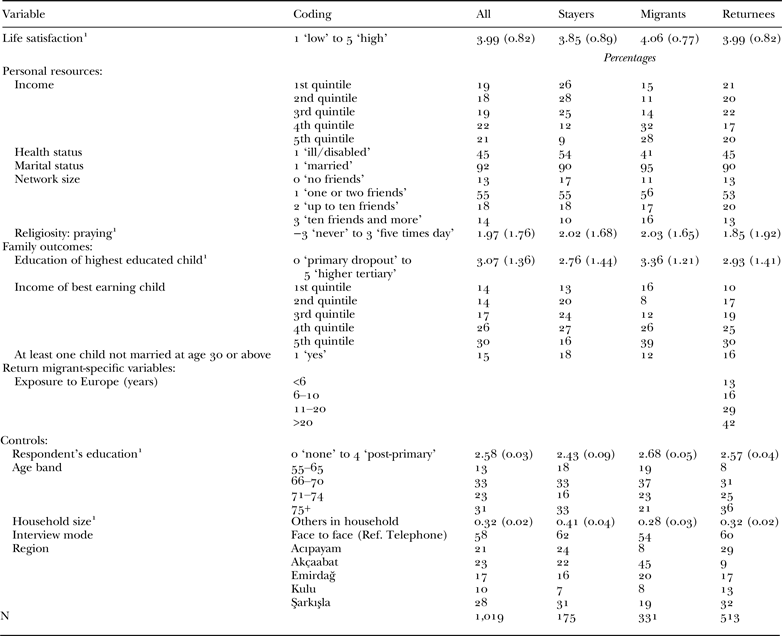
Descriptives of all variables broken down by migration status are given in Table 1. Although life satisfaction was generally high, there were statistically significant differences between the three groups: stayers were less satisfied than both migrants (p < 0.001) and returnees (p < 0.001), and returnees were significantly less satisfied than migrants (p < 0.001). The greater life satisfaction of migrants supports earlier findings and our theoretical reasoning.
Sample descriptives by migrant status

Notes: Proportions and means are based on imputed data. Ref.: reference category. 1. Mean values with standard errors in parentheses.
Source: 2000 Families Study.
In terms of the factors that we expected to account for differences in satisfaction, income and health were more favourably distributed across migrants than stayers, as we anticipated. Income levels tended to be higher among migrants than stayers, with return migrants being situated between the two (p < 0.001). More than half (54 per cent) of all stayers, but only 41 per cent of migrants, reported disability or illness. We had anticipated lower levels of social resources and religiosity among migrants. However, migrants were more socially embedded than stayers or returnees. They were more often married and had larger non-family networks. Stayers reported having no friends most frequently (17 per cent versus 11 per cent of migrants). Among migrants, by contrast, large networks, comprising ten close friends and more, were more common (16 per cent versus 10 per cent of stayers). Thus, social resources may in fact help to explain the higher life satisfaction of migrants. Frequency of praying hardly differed between migrants and stayers, but return migrants were significantly less religious (p < 0.001).
Turning to family outcomes, the educational outcome of the highest educated child was significantly higher (p < 0.001) for migrants compared to stayers, and the same advantage was evident with regard to the income of the highest earning child. In addition, the share of children who were not married by the age of 30 was highest for stayers. Again, return migrants displayed patterns between migrants and stayers. Based on these distributions and in line with our expectations, we might expect family outcomes to help account for the higher life satisfaction of migrants.
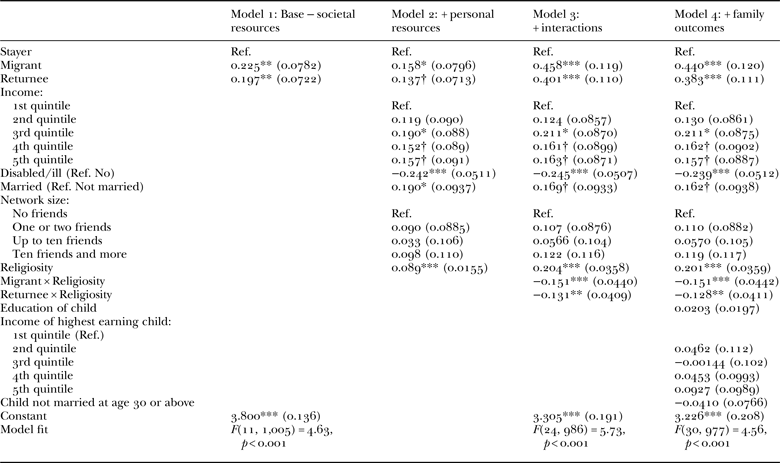
Table 2 presents the estimates from the four models. Model 1 only includes migration status, alongside the control variables. We see that the difference in life satisfaction between migrants and returnees, on the one hand, and stayers, on the other hand, is statistically significant (p < 0.01). However, while migrants appear somewhat more satisfied than returnees, this difference is no longer significant once we control for region, age, interview mode and education. Age was negatively and education was positively associated with life satisfaction, as we would expect (results not shown). Given the typically relatively compressed distribution of life satisfaction, the size of the differences between migrants and stayers is non-negligible at around 0.2 points on the five-point scale.
Estimates from ordinary least-squares models of life satisfaction

Notes: N = 1,091. Standard errors are in parentheses. All models are controlled for region of origin and, if income is considered, household composition. Ref.: reference category.
Source: 2000 Families Study.
Significance levels: † p < 0.1, * p < 0.05, ** p < 0.01, *** p < 0.001.
Model 2 shows that these differences persisted when we took personal resources into account, even if they were somewhat attenuated. In line with existing research, we see positive effects of income and negative effects of disability on life satisfaction, thus indicating that these partly mediated the migrant and returnee advantages in life satisfaction in old age. The size of the non-family network does not seem to affect the evaluation of life in the group of Turkish older men studied here, and therefore, despite the higher levels of social resources among migrants shown in Table 1, cannot mediate the life satisfaction advantage of migrants. Instead, marriage has both a positive effect and is likely to contribute to the reduced gap in life satisfaction. Religiosity shows the expected positive association with life satisfaction, but given its equal distribution, at least across the two groups of migrants and stayers, it does not mediate the migrant effect on satisfaction.
We postulated that some of these main influences on life satisfaction might differ in their effect between migrants and stayers, with, for example, migrants being less susceptible to health effects but more susceptible to the influence of social resources. We therefore interacted each of the other explanatory variables with migration status, to gauge whether there was support for these interaction effects. However, we found that only the effect of religiosity differed across migrants and stayers, and we report estimates in Model 3. While we expected religiosity to have more salience for life satisfaction in a migration context, we found that, by contrast, the association between religiosity and life satisfaction was significantly lower for migrants than stayers: a one-point rise in frequency of praying increased migrant's life satisfaction only by 0.05, compared to 0.20 for stayers. It seems that migrants are not seeking refuge and emotional stability in an alien context in their private worship, insofar as that is reflected in their life satisfaction. A similar pattern applies to return migrants who prayed less often than both migrants and stayers, and who also displayed little association between religiosity and life satisfaction.
In the final model, we added information on the children's economic and family situation. We expected children's success to influence paternal life satisfaction. However, none of our measures were significantly associated with life satisfaction. In addition, none of the interactions were statistically significant.
While not all the findings were in line with our hypotheses, the role of personal resources in contributing to life satisfaction and their partial role in mediating the gap between life satisfaction of migrants and stayers was in line with our expectations. The remaining gap was consistent with our theoretical expectation of societal resources – the greater liveability of migrant destination countries. However, this residual satisfaction gap could also be consistent with an acculturation effect. We therefore investigated whether there was any evidence that migrants’ and returnees’ life satisfaction was influenced by the destination context and their time spent in Europe, respectively, which would tend to support an acculturation argument. For migrants, we estimated models including national life satisfaction levels which, for the countries of interest, range between 6.6 and 7.8 on a scale from 0 to 10. We did not find any country-specific life satisfaction patterns (β = 0.02, not significant), providing little evidence for acculturation. For returnees, we also found that higher life satisfaction was unrelated to their duration of stay abroad (β = 0.01, not significant). Thus, even those who only spent a short time abroad still appear to have a more positive evaluation of their lives than those who never left. This may point to positive selection among migrants in terms of their underlying outlook.
Discussion
With an increasing emphasis on wellbeing as an important individual and social outcome, the extent to which migration affects migrants’ life satisfaction is subject to an increasing body of research. In this paper, we argued that studying older migrants’ satisfaction is likely to be particularly informative about this question. Older migrants have finished their working life, are at the point of evaluating their lives, and will have completed lifecycle stages such as child-rearing, which can prompt considerable variations in short-term satisfaction. Moreover, they are at a longer distance from the migration decision which was taken four or even five decades earlier, and have had more time to absorb the consequences of that decision for their lives and relationships.
We developed a framework for considering the life satisfaction of older migrants that built on and extended Veenhoven's approach (Reference Veenhoven, Land, Michalos and Sirgy2012b ). Namely, we anticipated that migrants would experience greater societal resources in Europe, and we also expected that they would have greater personal resources in terms of income and health, but disadvantages in terms of social networks. Levels of religiosity, which we used as an indicator of individual psychological resources, were expected to be linked to lower average satisfaction among migrants, but to be more protective for them where it occurred. We additionally considered family outcomes (i.e. their children's success) as a key dimension of the migration project and therefore an important potential influence on older migrants’ life satisfaction.
We found that while older Turkish migrants may be disadvantaged in objective and subjective terms when compared with the natives in the European destination contexts (Baykara-Krumme Reference Baykara-Krumme, Baykara-Krumme, Motel-Klingebiel and Schimany2012; Fokkema and Naderi Reference Fokkema and Naderi2013; Warnes Reference Warnes, Dannefer and Phillipson2010), when compared with the stayers back home they seem to fare quite well. Their personal objective living conditions were better not only in terms of income and health, but also with regard to social network resources. These advantages, however, only partly accounted for their higher levels of satisfaction. Religiosity differed less between the groups than expected and did not help to explain differences in life satisfaction. Even though migrants’ children displayed more educational, economic and marital ‘success’ than the children of stayers, this did not provide additional purchase on what drives the positive evaluations of older migrants. Over and above these positive circumstances, migrants expressed higher life satisfaction, which points to greater societal resources in European destination countries.
We also considered alternative explanations for higher migrant life satisfaction compared to stayers. Our analysis indicated that acculturation does not appear to be the mechanism by which the migration effect operates, since we neither found differences within the migrant group according to the average level of satisfaction in the European residence country nor between returnees by length of exposure abroad.
Turning to selection, we explored the experience of returnees compared to both migrants and stayers to try to disentangle some of the potential selection mechanisms at play. Our findings tend to contradict the hypothesis of an ‘unhealthy re-migration effect’ (Razum et al. Reference Razum, Zeeb, Akgün and Yilmaz1998) or a ‘reverse selection’ of returnees that would imply that ‘the worst of the best’ come back (Wong and Gonzalez-Gonzalez Reference Wong and Gonzalez-Gonzalez2010; see also Bartram Reference Bartram2013b ). The fact that both returnees and migrants showed higher life satisfaction in old age may support the conclusion that the migration experience provides some long-lasting positive impacts. However, as noted, we cannot rule out selection, even if the migration decision was made decades ago. The remaining gains are consistent with ‘migrant optimism’ and migration of happier people, with persistent trait effects over time.
One further explanation that we were not able to investigate is that migrants and returnees, when reporting high life satisfaction, may aim to present themselves and their migration endeavour in a specifically positive light (Conti and Pudney Reference Conti and Pudney2008). This may be reinforced by their reference points, a topic which has received attention in recent research on subjective wellbeing of migrants (Gelatt Reference Gelatt2013). The first-generation migrants in our study maintained strong return intentions over their lives, resulting in strong transnational ties and often circular migration in old age (Baykara-Krumme Reference Baykara-Krumme2013; Razum, Sahin-Hodogluil and Polit Reference Razum, Sahin-Hodogluil and Polit2005). Our findings may stem from a ‘downward comparison’ (Bartram Reference Bartram2011; Gelatt Reference Gelatt2013) with their stayer peers in the home context. Stayers in high-emigration regions may, on the other hand, apply ‘upward comparisons’ with returnees and migrants. Ascertaining the reference points that migrants use in their evaluations of their lives is an area that merits further study.
Additional insight into migrant life satisfaction might be achieved by using the same data to study the second and third generations and compare them to their non-migrant peers. This could give further purchase on the influence of societal resources without the likelihood of selection (since they will not have been the ones choosing to migrate), unless intergenerational transmission of happiness traits is high. However, as with other proposed approaches, such as collecting longitudinal data or exploiting quasi-experiments, this would not shed light on the existing group of ageing labour migrants that is of particular interest today. Even if we cannot specify the exact mechanisms by which migrants achieve their life satisfaction gains, this study remains a salutary reminder that the conclusions from comparisons of migrants and natives in the destination context may provide a more dismal perspective on the outcomes of migration than if the research perspective is shifted to focus on a comparison with those who stayed behind.
Acknowledgements
Financial support from NORFACE Research Program on Migration in Europe – Social, Economic, Cultural, and Policy Dynamics is kindly acknowledged.