There has always been a vast power asymmetry in the American workplace—a great imbalance between the prerogatives of employers, on the one hand, and the rights of employees, on the other. The magnitude of this imbalance has fluctuated over time, however, along with changes in the primary institutions constituting workers’ rights. At different points in American history, these institutions have provided workers with more or fewer legal protections against exploitation and wider or narrower pathways for collective action.
Prior to the 1930s, for example, the Supreme Court's adherence to the “liberty of contract” doctrine severely limited the scope and content of workers’ rights and barred many forms of collective action.Footnote 1 The National Labor Relations Act of 1935 (NLRA) transformed this institutional order by legitimizing unions and collective bargaining, allowing workers to participate in the construction and enforcement of their own rights. For a time, the collective bargaining system seemed to work roughly as intended: At its peak in the 1940s and 1950s, a third of all workers enjoyed union representation, voice in the workplace, and protection against exploitation—and millions more benefited from the upward pressure unions put on wages, hours, and other terms and conditions of employment in highly unionized regions and industries.Footnote 2 The New Deal's collective bargaining system never reached as broadly or penetrated the workforce as deeply as its designers had hoped, but for a substantial share of American workers, collective rights were a reality, protected by a stable set of labor market institutions.
But over the last half century, a confluence of economic, legal, social, and political developments has rendered labor law effectively irrelevant for the vast majority of private-sector workers. Different scholars weigh certain factors more heavily than others, but these developments are usually said to include deindustrialization and the changing composition of industries; the emergence of global supply chains and production processes predicated on subcontracting, outsourcing, and offshoring, which undermine the traditional employment relationship; technological change; capital flight from mostly pro-labor states to mostly anti-union states; a series of employer-friendly Supreme Court decisions restricting the scope of collective bargaining, allowing permanent strike replacements, and more; employers’ growing adeptness at exploiting labor law's loopholes to deter or quash unionization drives with relative impunity; the political mobilization of business and its growing clout within both parties; electoral gains by the national GOP; and the rise of partisan polarization.Footnote 3
Despite multiple attempts by workers and their advocates to update the law to better keep pace with changing conditions—including the ill-fated campaigns for the Labor Law Reform Act of 1978 and the Employee Free Choice Act of 2009—opponents have successfully leveraged institutional veto points to block those reforms and maintain the status quo. Indeed, the last significant formal revision of the law was in 1959. For sixty years, then, national labor law has remained awkwardly fixed in place, “ossifying,” “stagnating,” shrinking in “reach and significance,” and “more and more resembl[ing] an elegant tombstone for a dying institution.”Footnote 4 Labor law has thus undergone a transformation of function but not form—a process Cynthia Estlund terms “ossification,” and Jacob Hacker calls “policy drift.”Footnote 5
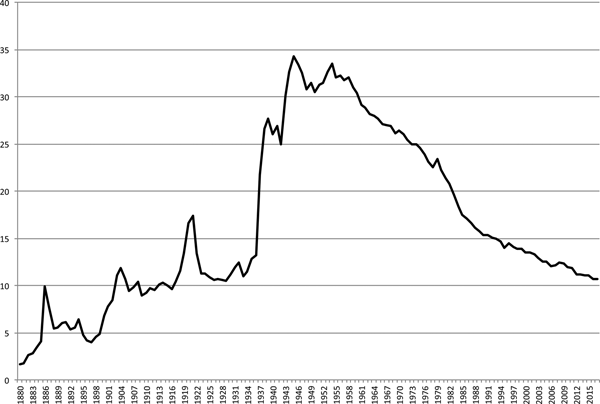
However this process is conceptualized, the consequences are plain to see. By 2017, the percentage of all unionized wage and salary workers had fallen to 10.7 percent, with only 6.5 percent unionized in the private sector.Footnote 6 Employees in all industries have become more vulnerable to exploitation and abuse, wage theft, discrimination, uncompensated workplace injuries, political pressure, and more, with those at the bottom of the income scale and the least bargaining power most at risk.Footnote 7
Workers and their advocates have responded to these urgent problems by developing a broad range of strategies to recover institutional protections and rebuild workers’ collective power. In recent years, for example, they have experimented with “social bargaining” strategies—sometimes called tripartism or corporatism—to set basic standards of employment at the sectoral, regional, or local levels, and called for its broader use;Footnote 8 proposed the wider use of wage boards as an alternative route to tripartism;Footnote 9 strategically leveraged the anti-retaliation provisions of federal employment and civil rights laws to vindicate workers’ rights and promote concerted action;Footnote 10 enacted local ordinances extending collective bargaining rights to workers excluded from national labor law (such as independent contractors and “gig” workers);Footnote 11 forged stronger partnerships between government and worker organizations in the “co-enforcement” of labor standards;Footnote 12 implemented systems of “self-regulation” in which groups of employees work with outside monitors to expose employer malfeasance, mobilize the regulatory capacities of the state, and initiate litigation to redress grievances;Footnote 13 and expanded the use of “private attorneys general” laws to circumvent mandatory arbitration clauses and enable individual employees to file lawsuits on behalf of themselves, other employees, and the state for employers’ violations of employment statutes and labor codes.Footnote 14
Notably, all such reforms share two key features. First, they all represent workaround solutions. Contending with a national labor law that is irrelevant for the vast majority of American workers but also an immovable object, they layer new forms atop old forms, exploit loopholes in existing law, and seek to scale up local experiments. Second, each envisions a central role for employment law in galvanizing, empowering, and protecting workers.Footnote 15 This, I will argue, reflects an historical-institutional development of vast significance: the gradual shift from labor law to employment law as the primary “guardian” of workers’ rights.Footnote 16
As I will document and explain more fully in the next sections, over the last six decades, states (and a growing number of cities and counties) have enacted a rich variety of employment laws aimed at raising minimum workplace standards, establishing substantive individual rights, and providing legal and regulatory pathways for workers to vindicate those rights.Footnote 17 At precisely the same time that labor law has withered, employment law has flourished, proliferating at the subnational level and expanding into new substantive domains.Footnote 18
The dramatic growth of subnational employment laws since the 1960s thus appears to represent an historic shift in the primary institutions constituting workers’ rights—one at least as consequential as the advent of collective bargaining in the 1930s, if not more so, given the larger proportion of workers affected. Of course, for most workers, employment law has long been the only institutional guarantor of rights in the workplace, given that even at the height of unionism in the United States, a majority of workers remained un-unionized. But until recently, the scope and content of those employment laws were quite limited, and in many areas of employment relations, the state was entirely silent. The expansion of these laws—in number, breadth, and depth, and across space—may therefore be said to have fundamentally altered the structure and content of workplace governance in the United States.
This institutional shift has been accompanied by an equally consequential organizational shift in the forms and strategies of workers and their advocates. Whereas unionization, collective bargaining, and concerted action in the workplace were once the primary preoccupations of the labor movement, attention has gradually shifted to the political arena: to the legislative process, to public protests and collective action in the public sphere, and to organizational innovation and coalition building among allied advocacy groups. Over the past thirty years, for example, worker centers and other nonprofit “alt-labor” groups have emerged as important organizational anchors of the labor movement. Not subject to the same restrictions as labor unions—but lacking unions’ right of exclusive representation in collective bargaining—these nontraditional worker organizations have developed a broad range of political and social-movement tactics to help improve the terms and conditions of work for many low-wage workers. They have engaged in policy campaigns, street-level protests, secondary boycotts, direct corporate campaigns, legal actions, and media strategies while forging alliances with traditional labor unions, kindred social movements, and state agencies. Although these organizational developments and strategic shifts have emerged slowly and largely escaped the attention of professional political science, they constitute a veritably new phase of U.S. labor politics.Footnote 19
Critically, however, these twin institutional and organizational developments have not emerged on a blank slate. For even as labor law has become an increasingly insufficient foundation for building worker power, it has remained fixed in place, exerting a powerful, jealous, and continuous governing authority in its expansive domain. Indeed, labor law has become almost as significant for what it prohibits as for what it allows: In addition to denying collective bargaining rights to millions of vulnerable workers by excluding key industries and occupations from coverage (domestic work, agricultural work, independent contractors), the law has been interpreted by courts as preempting any and all state and local efforts to regulate labor-management relations in the private sector.Footnote 20 Preemption thus eliminates potentially generative sources of labor law innovation and experimentation while boxing in reformers, severely limiting their range of options. Unable to start from scratch and design new institutions better suited to changing economic and political conditions, workers and their advocates have had to structure their innovations to carefully circumvent the stubbornly persistent labor law without intruding into its broad purview. In this way, labor law has insinuated itself into the new state-level employment laws that have emerged, as well as the recent workaround proposals already mentioned. As I will elaborate, the constraints that labor law imposes are evident in the new laws’ delimited substantive content, distinctive institutional forms, and alternative delivery mechanisms.
Similar effects can be observed in the constellation of political organizations working in this space. The new advocacy groups that have formed in response to the growing need for worker representation reflect labor law's constraints in both their organizational forms and in the scope of their activities. While these new groups can do some things labor unions cannot do, they cannot do other things labor unions can; and although in many areas their interests and activities align perfectly, in others they conflict. The relationship between new and old worker organizations is complex, but the historical-organizational pattern is clear: Nontraditional worker organizations—which have emerged slowly and relatively recently—have entered an arena in which many of the most significant resources (both material and ideational) are controlled by labor unions, the groups with the strongest stake in the “old” labor law regime and whose own commitments and operations remain powerfully shaped by it.
The political significance of the shift from labor law to employment law can be located precisely there, in the constraints imposed by the outmoded but persistent national labor law on the institutional and organizational responses of workers and their advocates to growing problems. My central argument is that the labor law regime—its institutional persistence as well as its organizational feedback effects—has powerfully shaped the timing, content, and form of the new institutions and organizations that have emerged. State-level employment laws now bear labor law's imprint in their limited substantive content and reach, disjointed delivery mechanisms, and high barriers to access for most workers, as well as in the new kinds of conflicts they generate. New workers’ organizations, likewise, reflect the rigid rules of labor law in their structural arrangements, delimited roles, and in the complications they add to questions of resource allocation, organizational strategy, and legally permissible pathways forward.Footnote 21 Moreover, while the new institutions and organizations that have emerged do provide new substantive rights for workers and alternative vehicles for voice and collective action, the “layering” of these new forms atop the old—without displacing the latter—has generated new problems without solving the problems produced by the ossification of labor law in the first place.Footnote 22
This is not, of course, the first study to observe that employment law has been on the rise or that new organizational developments in the labor movement are afoot. Nor has the relationship between labor law's ossification and subnational reform efforts escaped the attention of careful scholars working in the fields of history, sociology, industrial relations, and especially legal studies.Footnote 23 But a comprehensive empirical analysis of the rise of state employment laws is lacking, as is any synoptic treatment of the historical-institutional dynamics at play in its ongoing development. Using a novel data set of all state employment laws enacted between 1960 and 2014, the present study offers the first look at the rich variation in its content and takes the first steps toward explaining its politically structured emergence across space. These data, in other words, enable us to systematically analyze the contours of a historical phenomenon that astute observers have perceived qualitatively but have hitherto been unable to study empirically.
Moreover, the theoretical perspective adopted here—emphasizing the significance of historical-institutional developments in shaping substantive outcomes—enables us to zero in on the ways in which old institutions and organizations can constrain and limit the options of downstream reformers and how the early beneficiaries of a policy's feedback effects can persist and shape subsequent political developments. For example, as I discuss in greater detail in the following sections, labor unions—which thrived from labor law's feedback effects in the early years of the policy's development—were instrumental in the construction of alternative institutions (state-level employment laws) and the development of new organizations and mobilization strategies in later years. These efforts, in turn, were politically formative: Although they did not necessarily solve the main problems they sought to redress, they did generate a whole new set of complications and problems for the labor movement as a whole. As a case, then, this study offers an illustration of the “new politics” that can emerge from processes of policy feedback, institutional layering, and intercurrence, showing how old and new institutions and organizations have intersected in time to create a veritably new politics of workers’ rights.Footnote 24
Although the analysis presented here represents only the first step of what must necessarily be a broader inquiry, it proposes to reorient our thinking about the political capacities of workers left behind by major shifts in the U.S. economy over the last several decades. In recent years, scholars have linked the decline of the New Deal collective bargaining system to widening income inequality, the growth of “precarious” jobs, the declining moral economy of labor, and the increased vulnerability of American workers.Footnote 25 Complementing these findings, this study argues that there has also arisen a veritably new politics surrounding questions of workplace governance—structured by the persistence of an outmoded but powerful labor law regime and characterized by the new problems generated by the abrasion of old and new institutions and organizations operating simultaneously at different levels of the federal system.
In the next section, I provide a brief overview of labor law's early feedback effects and subsequent decline in effectiveness. The three empirical sections that follow then present evidence of the emergence of state employment laws, the role labor unions have played in the construction and deployment of those laws, and the rise of “alt-labor” groups representing workers who have been left behind or excluded from labor law's protections. In the final section, I discuss the new problems and tensions generated by the awkward juxtaposition of new and old institutional and organizational forms.
THE DEVELOPMENT AND DECLINE OF LABOR LAW
The rise and fall of U.S. labor unions and the ossification of labor law are topics that have been so carefully discussed by legal scholars, historians, sociologists, political scientists, and activists that in retreading the same ground, one runs a high risk of redundancy, committing sins of omission, or both.Footnote 26 The following sketch therefore prioritizes brevity, emphasizing only the dynamics most relevant for the ensuing analysis.
The National Labor Relations Act (NLRA or Wagner Act), enacted at the height of the New Deal in 1935, remains the primary federal law governing labor relations in the United States. Its stated purpose is to redress “the inequality of bargaining power” in the workplace by protecting the right of workers “to organize and bargain collectively” over the “terms and conditions of their employment.” If left unaddressed, the statue notes that this inequality would produce a “diminution of employment and wages,” decrease the “purchasing power of wage earners,” put downward pressure on working conditions, and threaten the flow of commerce.Footnote 27 Once the Supreme Court affirmed the constitutionality of the Act in 1937, it began to generate strong feedback effects on interest groups, government elites, and mass publics. Indeed, it offers a model case of how “new policies create a new politics.”Footnote 28
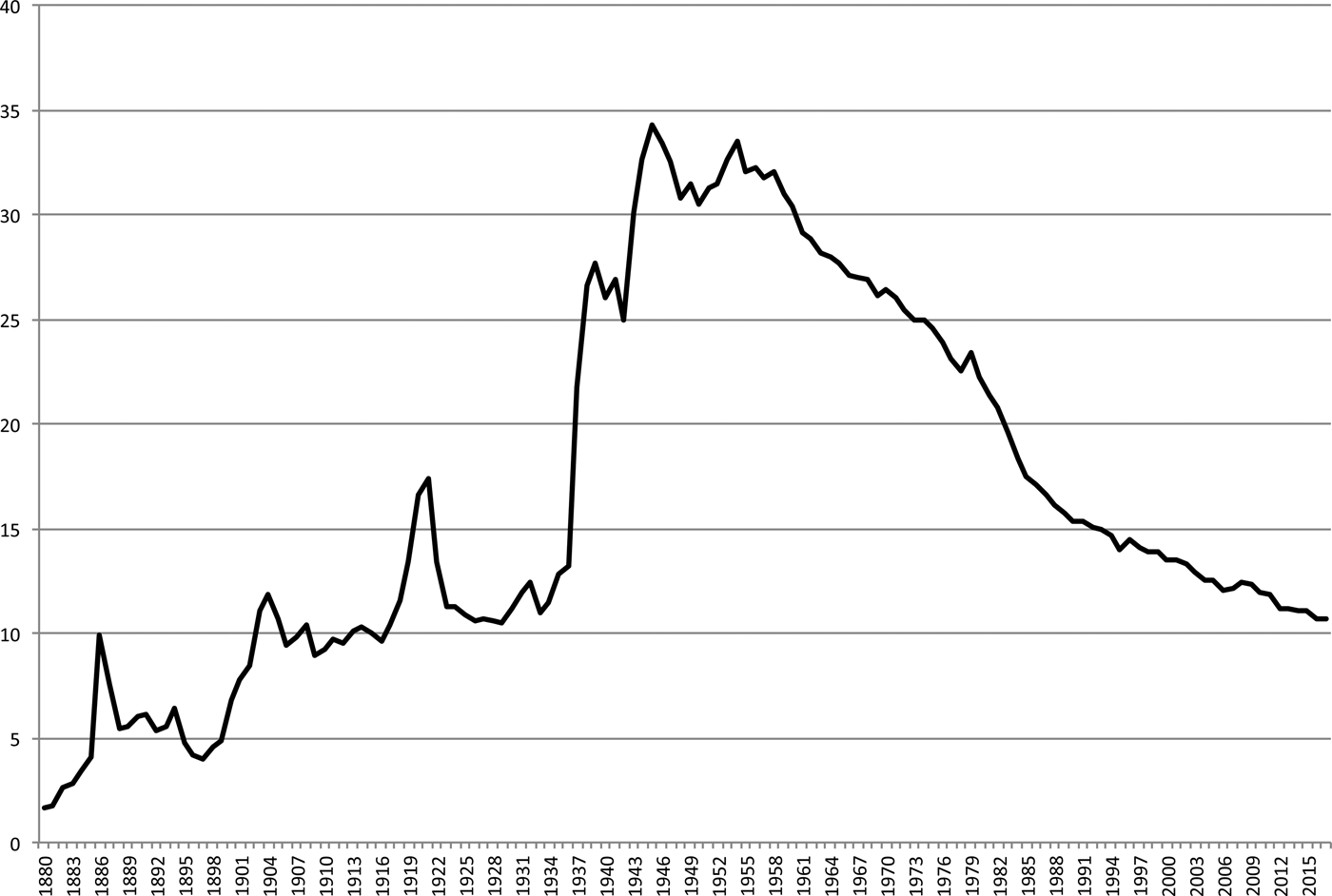
Its most significant feedback effects can be observed in the development of private-sector labor unions. Many unions, of course, were already in existence and instrumental in securing the law's passage in the first place.Footnote 29 But by formally recognizing unions as workers’ representatives and establishing procedures for union elections, the Wagner Act accelerated their growth and influenced their organizational development.Footnote 30 The share of nonagricultural private-sector workers belonging to a union more than doubled between 1936 and 1938, from 13 to 27 percent, and did not dip below a quarter of the workforce again until 1975. Despite the challenges posed by the Taft-Hartley amendments of 1947, union density remained above 30 percent for the seventeen-year stretch between 1943 and 1960 (Figure 1).
Union Density, 1880–2017.
The collective bargaining system established through national labor law also had profound feedback effects on workers’ and employers’ political capacities. As Theda Skocpol writes, policies can “affect the capabilities of various groups to achieve self-consciousness, organize, and make alliances.”Footnote 31 Labor law encouraged workers to view their interests as collective interests that could be pursued through self-organization and collective action.Footnote 32 Indeed, as the collective bargaining system matured, the range of imaginable alternatives for reform narrowed: As Nelson Lichtenstein, Ira Katznelson, and others have shown, by the early postwar period, more radical possibilities had been eliminated from the realm of possibility, and the collective bargaining regime had become largely taken for granted.Footnote 33 Both workers’ advocates and business interests structured their political activities around the new system, seeking to gain sufficient political power to control the National Labor Relations Board (NLRB) and shape its common law.Footnote 34 In these ways and more, the Wagner Act “made” labor politics in America.Footnote 35
As a legal matter, the NLRA has long maintained exclusive governing authority over an extremely broad domain. In 1959, the Supreme Court ruled in San Diego Building Trades Council v. Garmon that the NLRA barred any and all state and local efforts to legislate in the areas of labor law it covered, preempting regulation in areas even “arguably” protected or prohibited by the NLRA.Footnote 36 Unlike the Fair Labor Standards Act (FLSA) of 1938, which allowed states to enact stronger protections and set higher minimum standards than federal law provided, the “Garmon doctrine” prohibited state efforts to do anything similar in the field of labor law. Subsequent Court decisions narrowed the ability of states and localities to intervene further still—for example, the Machinists case (1976) ruled that subnational regulation was preempted even in areas Congress ostensibly meant to leave to “the free play of economic forces,” thereby “virtually banish[ing] states and localities from the field of labor relations,” with precious few exceptions.Footnote 37 States were permitted to design their own labor laws only for those workers excluded from coverage under the Wagner Act, such as public-sector and agricultural workers. If they sought to provide stronger rights and protections to a wider range of workers, they would need to find alternative routes for doing so; the Wagner Act was to be the primary, authoritative, centralized labor law in the United States that would enjoy an effective monopoly on the process of collective bargaining and unionization for the vast majority of workers.
Although the Taft-Hartley Act of 1947, the Landrum-Griffin Act of 1959, and numerous business-friendly Court decisions and NLRB rulings over the years chipped away at unions’ power, undermined workers’ right to strike, and generally enhanced employers’ prerogatives, they also served to further ratify the Wagner Act's exclusive governing authority over private-sector labor-management relations.Footnote 38 Indeed, these instances of what Kathleen Thelen might term “conversion” (the redirection of existing rules to advantage actors pursuing different purposes) did not alter the basic structure of the law or disturb its core features or mechanisms, which remain essentially as they were in 1935.Footnote 39
Consequently, despite its formal institutional persistence, national labor law became an ever more glaring “mismatch” with changing economic conditions, including the changing composition of industries, new patterns of capital investment, and the changing nature of work.Footnote 40 Amid the “bewilderingly complex proliferation of employment relationships that structure work in the modern city, college, or company” featuring “layer after layer of subcontractors and vendors,” labor law's manifold weaknesses became all the more glaring.Footnote 41 As fewer and fewer workers were able to take advantage of its procedures for establishing rights, representation, and voice in the workplace, employees in all industries became more vulnerable to exploitation and abuse. Employment became more precarious, income inequality widened, wages stagnated, and the power asymmetry in the workplace grew.
But this was no accident or oversight: Despite attempts by labor unions and their allies to update the law to better reflect changing economic conditions—by streamlining union election procedures (“card check”), increasing penalties for employer interference, eliminating the NLRA's preemption of state labor laws to allow experimentation, and more—opponents (chiefly business-funded Republicans but also some Democrats) successfully blocked reforms from advancing through the legislative process.Footnote 42
As Kate Bronfenbrenner and Tom Juravich have shown, employers benefited greatly from the status quo. Anti-union employers regularly exploited labor law's loopholes and blind spots and even blatantly violated the law in order to deter and quash unionization drives. They used “a combination of legal and illegal approaches” such as illegally discharging workers for participating in union activity, “captive-audience meetings, employer leaflets and mailings, supervisor one-on-ones, and illegal wage increases.”Footnote 43
Labor's opponents also became more politically engaged over the years, developing a multipronged approach to promoting their interests and curtailing workers’ rights. As Alexander Hertel-Fernandez has shown, the business community began in the 1970s to build a “durable ‘conservative-corporate’ subnational coalition” and a formidable organizational infrastructure to advance its legislative aims, “systematically changing the state policy landscape in ways that disadvantaged their political opponents over the long run.”Footnote 44 For example, the pro-business American Legislative Exchange Council (ALEC) developed “model bills,” many explicitly aimed at “weakening labor unions,” and was often successful, especially in states with low policy capacity and high ideological conservatism.Footnote 45
To be sure, many additional factors contributed to the growing inability of labor law to provide workers’ rights and protections to the vast majority of workers. These include the conservatism and mismanagement of union leaders, the changing attitudes of workers, the “changing relation of class forces,” and more.Footnote 46 Studies have also emphasized how institutional and ideational abrasions between the emergence of civil rights consciousness, activism, and enforcement, on the one hand, and labor rights and collective commitments, on the other, contributed to the enervation of labor law and the labor movement more broadly.
For example, as Paul Frymer has shown, as a result of a “bifurcated system of power that assigned race and class problems to different spheres of government,” the enforcement of civil rights laws “unintentionally weakened national labor law,” ultimately producing a more “diverse but weakened labor movement.”Footnote 47 Nelson Lichtenstein has similarly argued that it was the unsustainable ideational conflict between “the concept of rights and that of solidarity, between the civil rights consciousness that has proven so potent during the last half century and the collective institutionalism that stands at the heart of the union idea” which contributed to labor's decline. “As the former became a near hegemonic way of evaluating the quality of American citizenship,” he summarized, “the latter atrophied. Indeed, in its most extreme interpretation, rights consciousness subverts the mechanisms, both moral and legal, that sustain the social solidarity upon which trade unionism is based.”Footnote 48
The causes of labor's decline are thus multifaceted and complex, and its consequences are equally multiform. But for the purposes of the present analysis, two key features of labor law and its decline stand out as especially important. First, even as labor law became increasingly ineffective, its stubborn persistence, broad authority, and preemption of subnational innovation limited the options of workers’ rights activists and reformers. Efforts to promote and defend workers’ rights were (and continue to be) formulated in light of those limits; reformers must either work within or around an immobile national labor law. By cordoning off potential pathways for reform, labor law has powerfully shaped the substantive content and institutional form of the alternative policy instruments that have emerged, as I will elaborate further below.
Second, labor law's ossification and drift altered the balance of power among organized interests. Those with the greatest stake in matters of labor-management relations did not disappear, but rather came to embrace qualitatively different kinds of politics. Business interests—the “losers” in the New Deal—gradually shifted from offense to defense, and their main task became preserving the legal status quo. In the absence of formal policy change, anti-union employers could continue to exploit labor law's weaknesses to make unionization more difficult while letting changes in the broader economic context further enervate and fractionalize workers, undermining what remained of the labor movement.
Meanwhile, labor unions and their allies—“winners” in the New Deal but increasingly “losers” in the post-Taft-Hartley period—gradually shifted from defense to offense (some say too gradually).Footnote 49 Organizationally mature, resource-rich, and politically experienced, many labor unions responded to the growing problems facing workers by developing innovative organizing strategies and constructing new policy instruments in alternative venues to achieve many of the same purposes as labor law, albeit through different means and mechanisms.Footnote 50 And as new nontraditional workers’ advocacy groups gradually emerged in this organizational space to meet the needs of an increasingly fragmented and vulnerable workforce, their goals dovetailed with unions’ goals, but their approach was quite different (in part because as nonprofit, non-union groups, it legally had to be): These new organizations experimented with creative strategies to help those workers left behind by labor law's ossification while accommodating the realities of the changing legal and economic landscape. Many of the new and emergent tactics in the labor movement have thus evolved as responses to old but persistent institutional constraints and the growing obsolescence of old organizing tactics. As I will discuss further below, synergies, conflicts, and ongoing negotiations between allies new and old now constitute the labor movement.
To fully understand the political development of workers’ rights—past, present, and future—these complex institutional and organizational dynamics must be disentangled and analyzed more closely. A severely delimited institutional landscape channeled and constrained the responses of both workers and business while flipping the balance of power between them. The new institutions, organizations, and strategic repertoires that have emerged in this space have, consequently, durably altered the politics of workers’ rights. This new politics did not emerge on a blank slate, but was rather spawned from old configurations, with old problems and purposes insinuated into the new formations. New and old now operate simultaneously, sometimes in harmony and sometimes in conflict, generating complex incentives, constraints, and challenges.
THE “CHANGING OF THE GUARD” FROM LABOR LAW TO EMPLOYMENT LAW
In 1988, renowned law professor Clyde Summers observed a “changing of the guard” from labor law to employment law:
The significant fact is that collective bargaining does not regulate the labor market. Unions and collective agreements do not guard employees from the potential deprivations and oppressions of employer economic power. The consequence is foreseeable, if not inevitable; if collective bargaining does not protect the individual employee, the law will find another way to protect the weaker party. The law, either through the courts or the legislatures, will become the guardian. Labor law is now in the midst of that changing of the guard. There is current recognition that if the majority of employees are to be protected, it must be by the law prescribing at least certain rights of employees and minimum terms and conditions of employment.Footnote 51
Summers's rather functionalist perspective notwithstanding, the notion that there has been a historic shift in the primary “guardian” of workers’ rights from labor law to employment law has been confirmed and elaborated by numerous legal scholars.Footnote 52 In her influential work, for example, Katherine Van Wezel Stone writes that “the emerging regime of individual employee rights represents not a complement to or an embellishment of the regime of collective rights, but rather its replacement.”Footnote 53 Cynthia Estlund likewise affirms that “the New Deal collective bargaining system has been supplemented, and largely supplanted, by other models of workplace governance: a regulatory model of minimum standards enforceable mainly by administrative agencies and a rights model of judicially enforceable individual rights.”Footnote 54 A number of other scholars, including Kate Andrias, Nancy MacLean, and Benjamin Sachs, have helpfully brought workers back in to the story, with Sachs vividly describing this shift as a “hydraulic” process driven by workers themselves:
The deep dysfunctionality of the NLRA constitutes a blockage only of the traditional legal channel for collective action and labor-management relations. Because workers, unions, and certain employers continue to demand collective organization and interaction, this blockage has led not to ‘ossification’ but to a hydraulic effect: unable to find an outlet through the NLRA, the pressure from this continuing demand for collective action has forced open alternative legal channels.… Faced with a traditional labor law regime that has proven ineffectual, workers and their lawyers are turning to employment statutes like the Fair Labor Standards Act (FLSA) and Title VII of the Civil Rights Act of 1964 as the legal guardians of their efforts to organize and act collectively.Footnote 55
Federal employment laws represent only the tip of the iceberg, however—as several scholars have observed, most of the action has actually been at the state level. Richard Bales, for example, finds that “in addition to enacting state statutes that parallel the federal statutes … state legislatures have passed legislation protecting employees in a wide variety of other circumstances,” including in areas as diverse as wrongful discharge, whistleblowing, employee testing, and workplace safety and health.Footnote 56 Although Theodore St. Antoine's focus is on state courts’ role in reshaping the doctrine of at-will employment, he also keenly observes that “the most important and dramatic development in employment law over the last couple of decades came at the state level, not the federal.”Footnote 57
In other words, the fact that employment law has grown in volume, reach, and importance has been noted by attentive scholars. But to date, no empirical evidence has been systematically marshaled to substantiate the claim. Nor, consequently, has any existing work been able to analyze its substantive complexity or begin to hazard an explanation for its variation across space and time. Thus, while we think we know employment law has grown, we do not know what it consists of, where it has grown most, or who has pushed for it. For example, St. Antoine's claim that “part of the growth we have seen in employment law, as distinguished from labor law, is attributable to the decline of organized labor,” is an empirical question that we have yet to answer.Footnote 58
Part of the reason for this empirical lacuna is practical, given that tens of thousands of new laws are enacted every year at the state level, and systematically obtaining reliable, equivalent information on the many different types of employment laws passed in fifty states over many decades appears daunting. Luckily, the Department of Labor has continuously monitored, recorded, categorized, and summarized employment law enactments at the state level every year for many decades. Until recently, expert staff members wrote and published summary reports of all laws passed during the prior year along with short descriptions of each in the Bureau of Labor Statistics’ Monthly Labor Review (MLR).Footnote 59 The format and authorship of the reports were remarkably stable over time, with more than 90 percent of the reports issued between 1960 and 2014 authored by the same five individual authors, with some overlap between them.
With a small team of research assistants, I used these reports to construct a data set of every legislative enactment between 1960 and 2014, coded according to the categories listed in the reports (“wages,” “hours of work,” “plant closings,” “child labor,” “whistleblower,” and so on).Footnote 60 During this period, states enacted 7,336 employment laws in thirty-three categories, and the relative attention paid by state legislatures to employment law grew steadily over the years as well. As Figure 2 indicates, across all states, employment laws as a share of all enacted bills more than quintupled over those fifty-five years. At precisely the same time that national labor law atrophied and private-sector union membership plummeted, state legislatures became increasingly preoccupied with employment law.
Employment Laws as a Share of All Enacted Laws by Session.
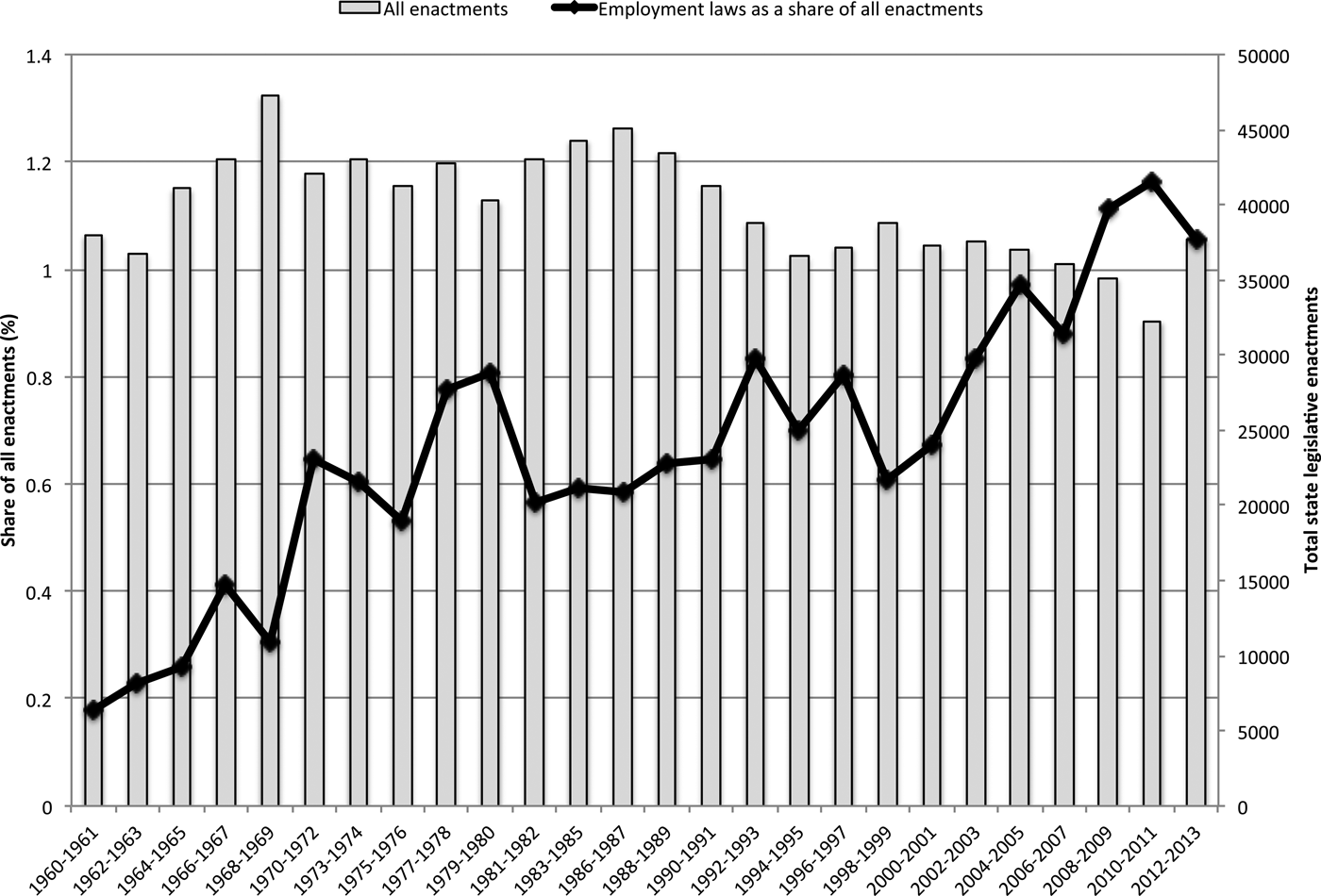
Of course, new laws are not enacted in a vacuum. Many build on extant laws, addressing weaknesses that have become apparent in the course of events, and are often designed with the state's existing administrative capacities in mind. Once a given state passes a pay equity law, for example, it need not pass another law to establish the same standard, but it may develop additional laws to bolster the enforcement of the primary law, add new categories of covered occupations, and so on. Many new laws thus build upon previous laws and alter their operation in ways both big and small. Figure 2 should therefore be interpreted as an aggregate count of laws that are actually often cumulative in nature. Still, as discussed further below, the simple measure of the volume of state employment laws enacted over time—including both minor and major enactments together—is highly correlated with multiple alternative measures of the strength of statewide protections for workers and remains quite useful in over-time analyses.
The scope of employment laws has clearly grown over time as well. New topics and issues have been added to the list of core employment laws each decade, indicating a gradually expanding issue space (Table 1). Whereas in the 1960s the vast majority of employment laws dealt principally with wages and child labor, the 1970s saw a surge of attention to discrimination and equal employment opportunity, and the 1980s saw the emergence of new employment laws pertaining to parental leave, plant closings, privacy and drug testing, whistleblower protections, and more. In the 1990s, state legislatures expanded their attention to issues of genetic testing and the complex standards for discharging employees; and in the twenty-first century, legislatures have tackled all of the traditional issues plus independent contractor issues, the eligibility of undocumented immigrants to work, workplace violence, and more.
Categories and Counts of Employment Laws Enacted by Decade
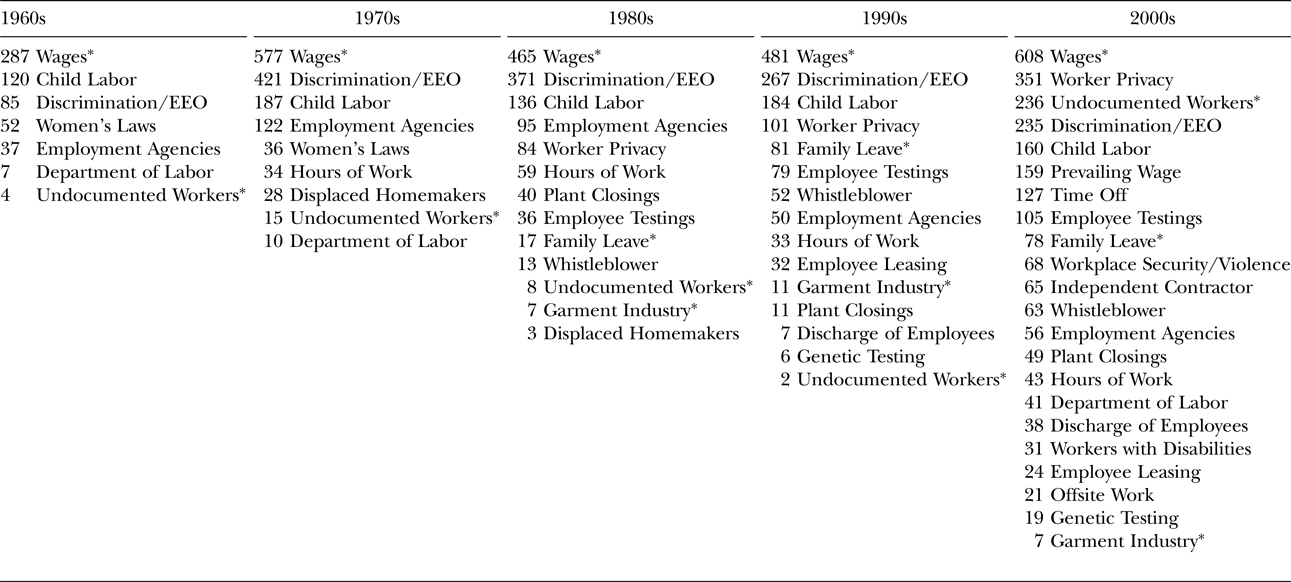
* “Wages” includes minimum wages, overtime, wages paid, and prevailing wage. “Family leave” includes parental leave and family issues. “Undocumented workers” includes protections for immigrant workers, migrant workers, and penalties for work-related human trafficking.
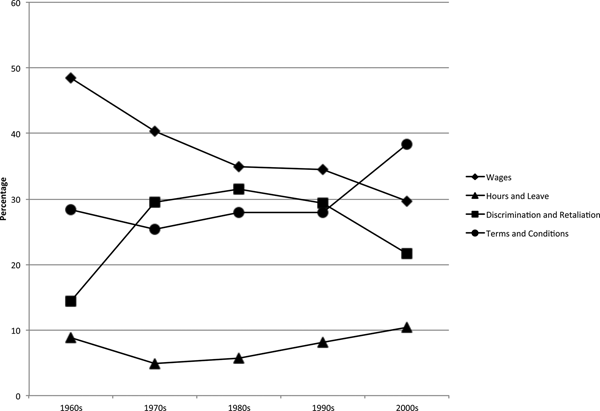
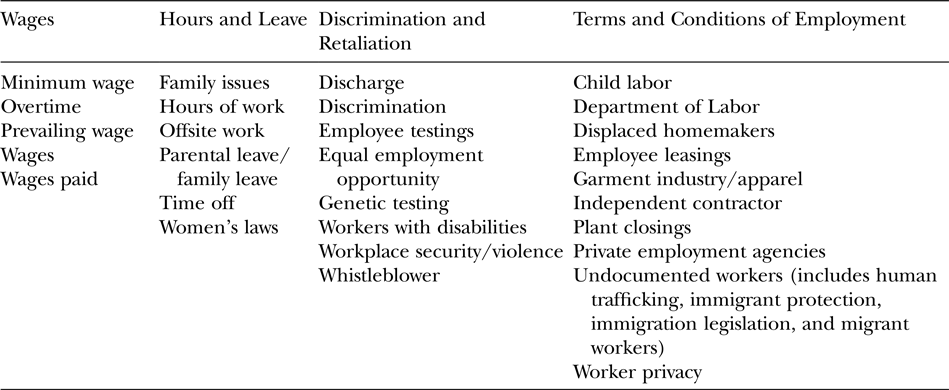
The relative attention paid to major categories of employment law also reveals instructive temporal dynamics. Placing the thirty-three types of employment laws into four relatively distinct groups—wages, hours and leave, discrimination and retaliation, and terms and conditions of employment (see Table 2)—we see that employment laws dealing with wages became less common over the years relative to other types of laws, especially those pertaining to terms and conditions of employment (Figure 3). Laws covering matters of discrimination and retaliation notably grew and then fell over the decades, consistent with the historical trajectory of the “rights revolution,” while fairly steady attention was paid to laws pertaining to hours and leave.Footnote 61
Issue Attention by Decade.

Groups of Employment Laws
These over-time trends appear to reflect the emergence of new problems and vulnerabilities in the workplace as the nature of the employment relationship changed and unions declined. Laws dealing with wages—constituting more than 40 percent of all state employment laws in the 1960s and 1970s—generally raise the floor on wages and deal with the procedural requirements of where, when, and how employees are paid. They establish a baseline above which unions could conceivably negotiate other terms and conditions of employment. But as fewer workers were represented by unions and a greater share of the workforce became vulnerable to new forms of exploitation (e.g., using genetic tests to discriminate, the rising use of independent contractors and misclassification of employees), attention shifted to more nuanced and complex issues regarding the terms and conditions of employment: who is eligible to work, how workers must be or cannot be treated, and who is considered an employee.
The content of these laws thus appears to reflect the changing nature of work in the United States and the growing need for workers’ rights and protections in areas that might have otherwise been guarded by unions and collective bargaining agreements. In addition to wages, hours, and other terms and conditions of employment, the substantive reach of state-level employment laws has extended to core rules and workplace relations such as the eligibility to work; discrimination in hiring, firing, and relations in the workplace; the supply of workers; the legal status of workers; the ability to take temporary leave; the privacy of employees at work; employers’ responsibilities to employees; the legal bases for employee discharge; and enforcement mechanisms for all of the above. The very same substantive issues that labor law was originally designed to address through union representation and collective bargaining processes are now addressed through state-level employment laws, implemented through different processes, and enforced through different mechanisms.
The powerful constraints imposed by labor law's drift are also evident in what is conspicuously absent from these state laws. Due to labor law's preemption of subnational labor laws pertaining to private-sector labor-management relations, state employment laws do not (and cannot) address issues related to unionization or collective bargaining in the private sector. If workers’ advocates had been able to enact state labor laws altering union election procedures, raising the penalties for employer interference and intimidation, allowing for industry-based unions, or constructing other alternative arrangements, they surely would have (indeed, many have tried).Footnote 62 Many states did, of course, enact a variety of extensive labor laws governing industries explicitly falling outside the Wagner Act's reach: especially in the public sector, but also in agricultural and domestic work. But as long as national labor law remained in place and exerted exclusive authority over private-sector labor relations, the possibility of regulating labor-management relations in the private sector through state-level labor laws was foreclosed. Instead, workers and their advocates turned to employment law to achieve the same substantive ends through different means.
In other words, as a practical matter, governance of the employment relationship has shifted to alternative venues (states rather than the national level), taken on alternative institutional forms (employment laws rather than labor law), and employed alternative enforcement mechanisms (regulation and litigation rather than collective bargaining). Rather than determine workers’ wages, hours, and terms and conditions of employment through union-negotiated collective bargaining contracts (as labor law seeks to do), employment laws mobilize the regulatory instruments of the state to enforce higher standards and provide workers with a private right of action. That is, they pursue the same substantive outcomes as labor law but use different institutional pathways to get there. With respect to their timing, form, and content, then, these laws reflect the delimiting force of the increasingly antiquated but still authoritative labor law.
These insights have been gleaned from a great distance and at the aggregate level, however, and many questions remain. Not least, what explains the variation in employment law activity across states? And within states, are there patterns to be observed in who was pushing for the laws and what state-level conditions were more conducive to their enactment? The next section digs deeper into the data to begin sketching out these dynamics.
LABOR UNIONS AND THE GROWTH OF STATE EMPLOYMENT LAWS
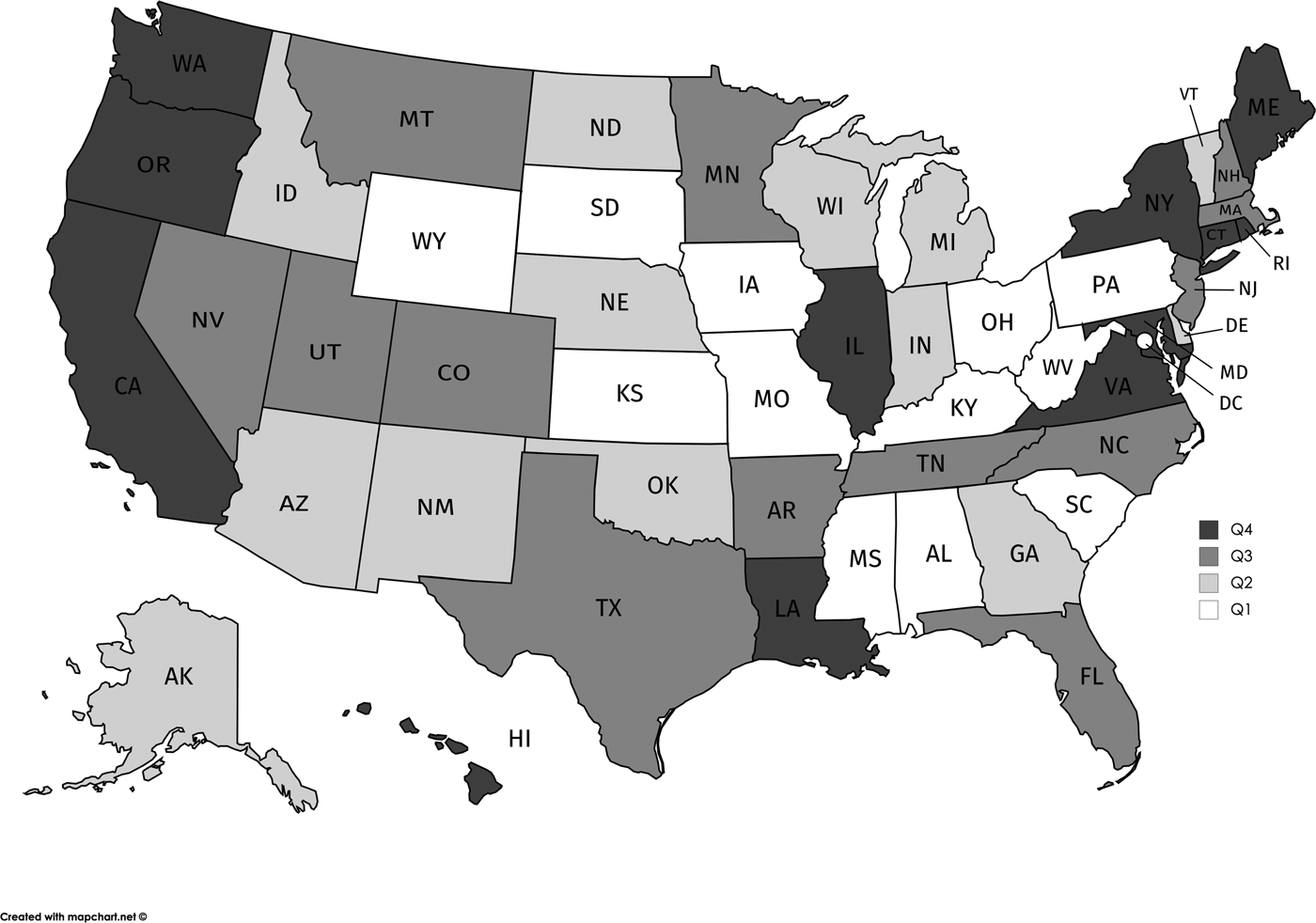
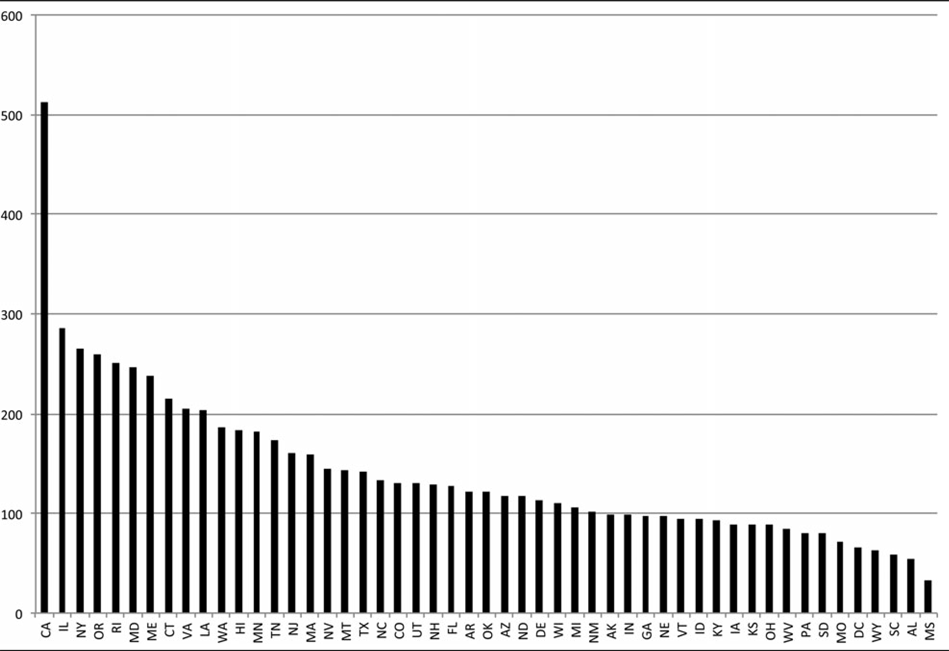
Geographically, the volume of employment law enactments varied significantly across all fifty states and the District of Columbia between 1960 and 2014 (Table 3 and Fig. 4), with California an extreme outlier, enacting 513 employment laws (compared to the median of 122). Fine-grained historical case studies are clearly needed to examine why different states produced more or less robust employment law regimes across the states—for as Margaret Weir has written, states are “political arenas with their own distinctive capacities and political logics that must be understood in terms of earlier reform efforts.”Footnote 63 Still, to begin exploring why some states enacted more employment laws than others, some theoretical possibilities can be examined statistically.
Map of Total Employment Laws Enacted by State, 1960–2014.
Total Number of Employment Laws Enacted, 1960–2014
Of particular interest here is the relationship between labor unions—the primary group beneficiaries of labor law's early feedback effects—and employment laws. Was part of the growth in employment law “attributable to the decline of organized labor,” as St. Antoine has posited?Footnote 64 If so, why and how? Were employment laws enacted as substitutes for disappearing unions, were labor unions themselves instrumental in enacting those same laws, or both?
While statistical analyses cannot answer these questions definitively, they can reveal associations that may serve as the starting point for further investigation. I build on preeminent labor economist Richard Freeman's examination of the relationship between state-level protective legislation and union density but use the state-year MLR employment law data as my dependent variable.Footnote 65 Specifically, I use a biennial measure of the total number of employment laws enacted in each state during the preceding legislative sessions (regular and special) and add three theoretically relevant political explanatory variables.Footnote 66 The modified model estimates the following equation:
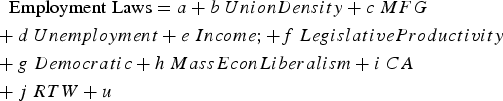 $$\eqalign{{\rm Employment}\; {\rm Laws}{\rm} & = a + b\;UnionDensity + c\;MFG \cr & \hskip-7pc + d\;Unemployment{\rm} + {\rm} e\;Income{\rm} ;+ {\rm} f\;LegislativeProductivity \cr & \hskip-7pc + g\;Democratic{\rm} + {\rm} h\;MassEconLiberalism{\rm} + {\rm} i\;CA{\rm} \cr & \hskip-7pc+ {\rm} j\;RTW + u} $$
Explanatory variables include UnionDensity, which measures the percentage of nonagricultural workers in each state who are members of unions, since a greater share of unionized workers may indicate a more politically powerful labor movement, which may push for the enactment of stronger employment laws or, alternatively, reduce their necessity.Footnote 67 MFG is the share of the state's nonagricultural workforce employed in manufacturing: As a state's manufacturing industry declines, it may be encouraged to enact stronger protections for the workforce that remains.Footnote 68 Unemployment is the level of nonagricultural unemployment in the state: When a state's unemployment rate is higher, legislators may be more reluctant to enact stronger protections for workers out of fear that such laws may deter investment in state and cause capital to flee.Footnote 69 Income measures per-capita personal income in the state, since economic modernization is related to policy innovation more generally, and states with richer populations may be more likely to enact employment laws.Footnote 70 LegislativeProductivity is the overall number of laws enacted by the state legislature during the previous two-year term (minus vetoes plus overrides), since states that typically enact more laws in general may be more likely to enact employment laws than states that are generally less legislatively productive.Footnote 71 Democratic is a dummy variable indicating Democratic control of both legislative houses in the state, since these states may be more likely to pass worker-friendly laws.Footnote 72 MassEconLiberalism is the Caughey-Warshaw state-year measure of the mass public's economic policy liberalism, included because states with more ideologically liberal populations on economic matters may also be more likely to enact worker-friendly employment laws.Footnote 73 CA dummies for the state of California because it is an extreme outlier. RTW is a dummy variable indicating whether the state adopted a “right-to-work” law, since these states may be less inclined to pass worker-friendly employment laws. Right-to-work is also sometimes used as a proxy for the political strength of business.Footnote 74
Using these variables, I conducted a time-series cross-section analysis and estimated the model with and without year and state fixed effects, since unobserved time-invariant characteristics of states—such as political culture, political history, industrial mix, demographic composition of the workforce, and the like—likely also matter. Results are reported from each specification (Table 4). The Driscoll and Kraay standard errors are heteroskedasticity- and autocorrelation-consistent and robust to general forms of cross-sectional dependence, all of which is necessary, given the structure of the data.Footnote 75 Data limitations confine the time-series cross-section analysis to the period 1976–2013.Footnote 76
Time-Series Cross-Section Models

Note. Standard errors in parentheses: *** p < 0.01, ** p < 0.05, * p < 0.1.
Model 1 in Table 4 includes both year and state fixed effects, while Models 2 and 3 include one but not the other. In all three models, union density is positive and statistically significant, meaning higher union density predicts the enactment of more employment laws. This relationship holds both within and across states, even when controlling for time trends. In addition, states that are more legislatively productive overall and states with Democratic legislative control are also positive and significant, as expected. The share of nonfarm employment in manufacturing is negative and significant in each model, suggesting that the tendency to enact more worker protections is greater when the share of manufacturing jobs in the state declines. The relationship between employment laws and both personal income and mass economic liberalism depends on whether one is looking within or across states, and right-to-work is negative and significant when looking across states. Taken all together, then, these results indicate that union density and employment law enactments are positively associated and suggest that political factors matter as well, thus recommending further examination of why (see discussion below).
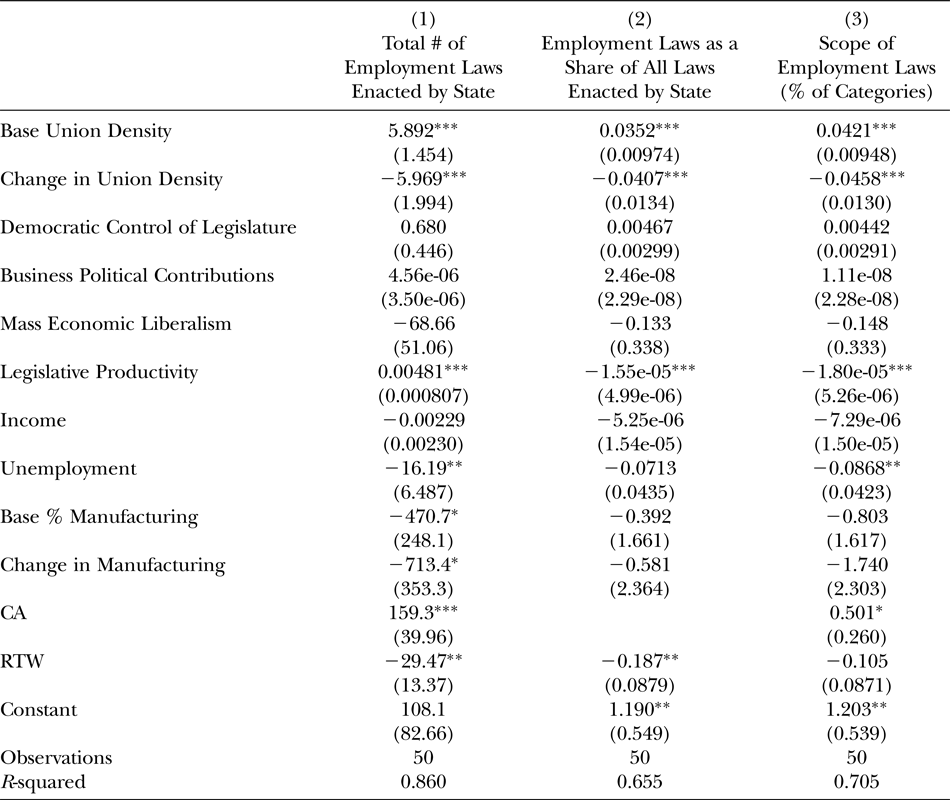
The same results obtain when we step back and consider aggregate outcomes in the states over time: Why did some states pass more laws over multiple decades than others? Why did some pay more attention to employment law relative to other items on their legislative agenda? Why did some tackle more categories of employment law than others? Using only fifty observations (for each state), I ran a similar set of models to see which factors were most correlated with a state's overall volume, relative attentiveness, and scope of employment laws (number of categories out of thirty-three possible) passed between 1974 and 2014 (Table 5). These models use the same covariates as above, but they disaggregate union density into two variables: the baseline level of union density prior to the period under investigation and the percentage point change in union density over the period (to account for the fact that the change in union density may affect states differently depending on the level at which they started). I also include baseline level and percentage point change variables for MFG for the same reason. A measure of the total contributions to state office candidates from the general business sector is also added to capture the relative political strength of business in the states, in addition to RTW.Footnote 77
Snapshot Models (50 States, 1974–2014)
Note. Standard errors in parentheses: *** p < 0.01, ** p < 0.05, * p < 0.1.
The results confirm that above and beyond all other factors, union density is strongly related to state employment laws: Both the base level of union density (average, 1969–1973) and the percentage point change in union density over the forty-year period have substantively large coefficients and are highly statistically significant. That is, the higher the starting point and the less decline in union density over time, the more laws enacted. Legislative productivity and right-to-work are also strongly related, in the expected directions.
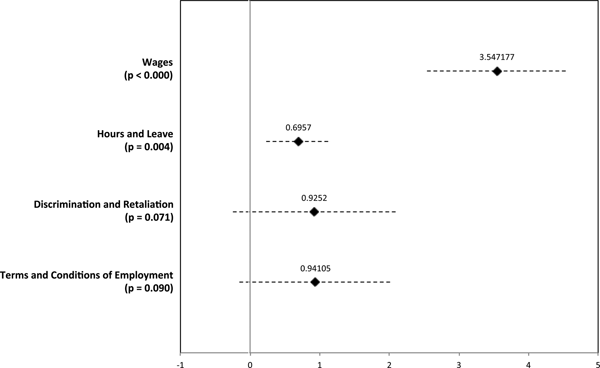
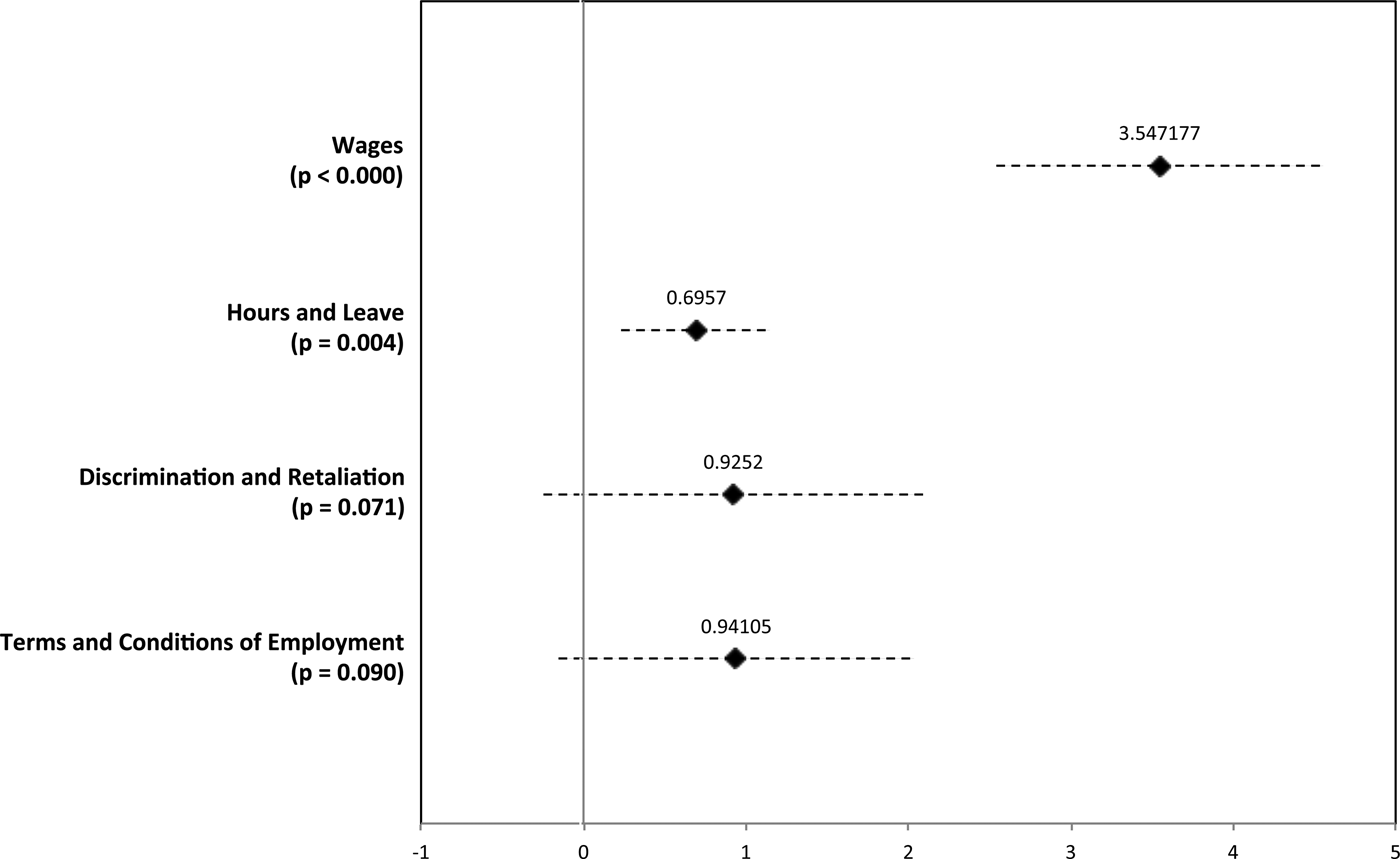
But what about different types of employment laws—have labor unions pushed for certain categories of laws more than others? Looking at the relationship between union density and groups of employment laws while including the same covariates as above, it is apparent that union density is positive and significantly related to each group, but it explains some groups better than others (Fig. 5). Specifically, when we look only at laws pertaining to wages, hours, and leave, union density is significant at the p < 0.000 level; it is significant but only at the p < 0.10 level when explaining discrimination/retaliation and terms/conditions of employment. In sum, then, the relationship between labor unions and state-level employment laws is strong, but there is still some variation that cannot be fully explained quantitatively and from a distance.
Relationship between Union Density and Groups of Employment Laws.
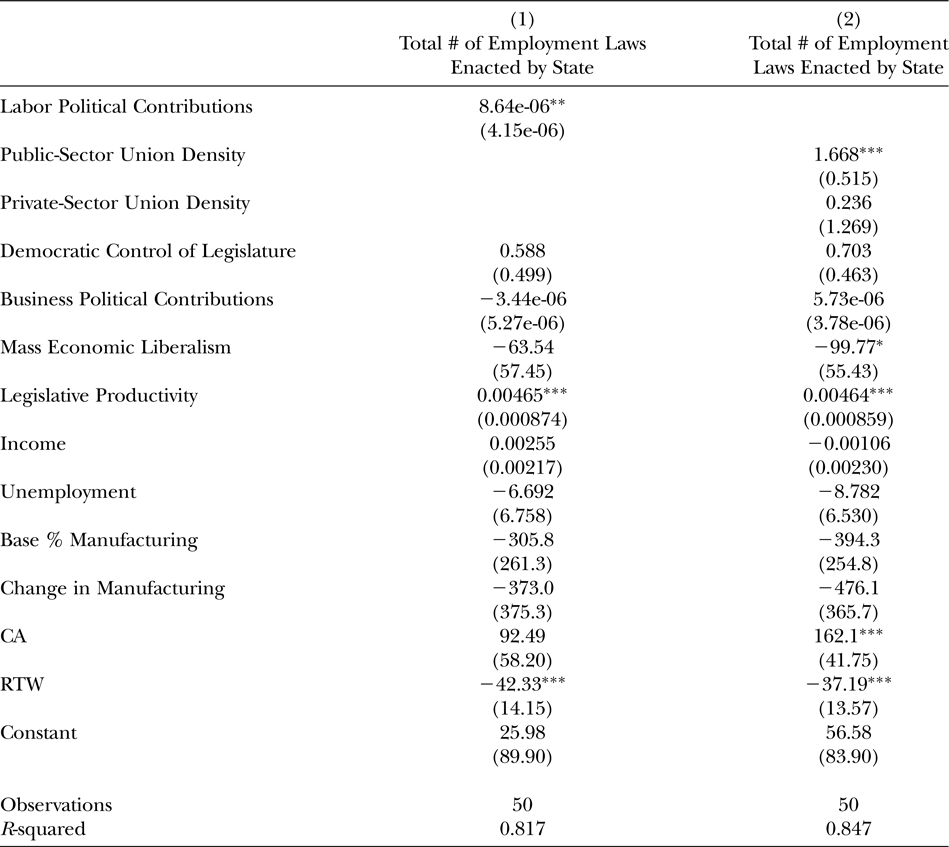
Of course, despite its ubiquitous use in the literature, the standard measure of union density provides a rather crude proxy for the political strength of the labor movement: Union density may or may not be related to the political and legislative clout of labor unions at the state level. In Table 6, the first model therefore uses an alternative measure labor union political involvement as a substitute for union density: Like the business strength measure above, labor contributions measures the total contributions to state office candidates from contributors in the labor sector for available years.Footnote 78
Alternate Measures of Labor Strength
Note. Standard errors in parentheses: *** p < 0.01, ** p < 0.05, * p < 0.1.
The standard union density measure also makes no distinction between private and public-sector unions, despite their substantial differences. This is problematic, for as Alexis Walker and others have discussed, public-sector unions are outgrowths of state labor laws and are therefore subject to, and may contribute to, different political dynamics than private-sector unions.Footnote 79 Indeed, the U.S. labor movement has long been bifurcated between the public and the private sectors, and this divide has grown increasingly consequential for the labor movement over time. In many states, public-sector unions now considerably outspend private-sector unions in electoral and lobbying activities, and their members have become increasingly engaged in political activities. Indeed, state-level anti-union conservatives, often backed by the Koch brothers’ Americans for Prosperity, have in recent years targeted public-sector unions in strategic efforts to demobilize the left.Footnote 80 Model 2 in Table 6 thus disaggregates UnionDensity into public and private-sector union density measures (state-level data available only since 1983).
The first model shows that labor unions’ political contributions are positive and significant—lending additional support to the notion that the strength of labor unions, whether measured as the percentage of unionized workers in a state or as a function of labor's campaign contributions, helps to explain employment law enactments at the state level. The second model indicates that public-sector union density is significantly related to the enactment of employment laws—and although private-sector union density is positive and significant when used alone, the inclusion of public-sector union density in the model overpowers the explanatory weight of private-sector union density. This positive and significant relationship between public-sector union density and employment laws may therefore suggest yet another reason why opponents have sought to undercut collective bargaining rights in the public sector.
Caution is warranted in interpreting the results, however, since the strength and size of public-sector unions, as well as their institutional power (such as collective bargaining rights, agency fees, dues check-off, etc.) depend on state labor laws, which are products of the same legislative process that produce state-level employment laws (our dependent variable). Including a separate measure of public unions’ strength on the right-hand side of the equation may invite endogeneity into the analysis. But this, too, is an empirical question that requires further investigation. Moreover, making strong distinctions between public- and private-sector unions may obscure more than it reveals. State AFL-CIOs are usually composed of a mix of both public- and private-sector unions and workers—as are many of the larger unions like Service Employees International Union (SEIU)—and they self-consciously represent the interests of both in the legislative arena. In Rhode Island, for example, even as public-sector workers grew into the majority of workers represented by the state AFL-CIO, the state federation's legislative agenda remained remarkably consistent over the years, suggesting that the interests of public- and private-sector union workers in state politics may not be easy to distinguish.Footnote 81 Partnerships between public-sector unions, private-sector unions, community groups, and other workers’ advocates constitute the organizational core of the labor movement, and the relative strength of each cannot easily be disentangled with quantitative measures of union density. Further investigation is clearly needed, and additional case studies should help unpack the relationships further.
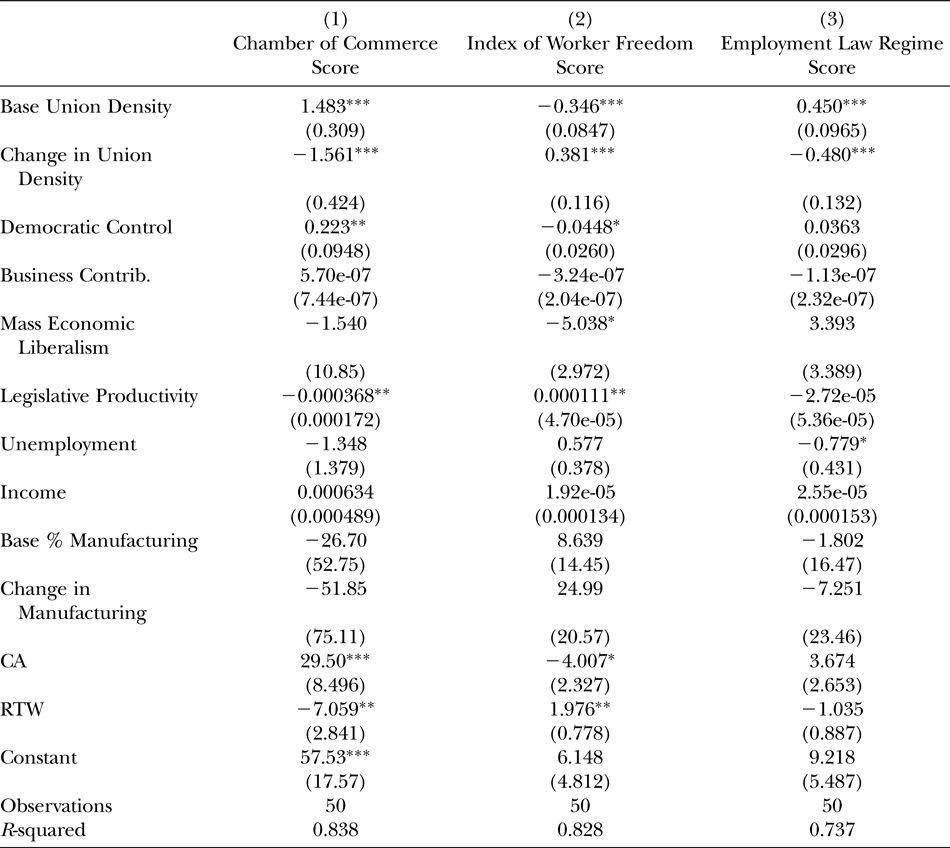
For the purposes of cross-validating the analyses above, I tested three alternative dependent variables that theoretically capture the same phenomenon of interest (variation in the strength of state employment laws), albeit in quite different ways. The first two measure the extent to which state laws are considered by employers and business advocates to be hospitable environments for investment and growth. The first uses a Chamber of Commerce study in which researchers examined thirty-four types of laws on the books in 2009 and graded each state on the extent to which its laws increased the regulatory burden on business and opened the door to litigation. The second uses the Index of Worker Freedom compiled by the conservative Alliance for Worker Freedom in 2009, which tracked fifteen laws that it claimed obstructed workers’ freedom and drove away high-quality workers.Footnote 82 Note that the sign is flipped on this measure. The third, compiled by the author, measures the number of eleven major state-level employment laws on the books in each state in 2014, as tracked by two authoritative sources: the National Conference of State Legislatures and the Department of Labor.Footnote 83 All three alternative measures are highly correlated with the employment law data examined above, and as Table 7 shows, union density is strongly related to each.
Alternate Dependent Variables
Note. Standard errors in parentheses: *** p < 0.01, ** p < 0.05, * p < 0.1.
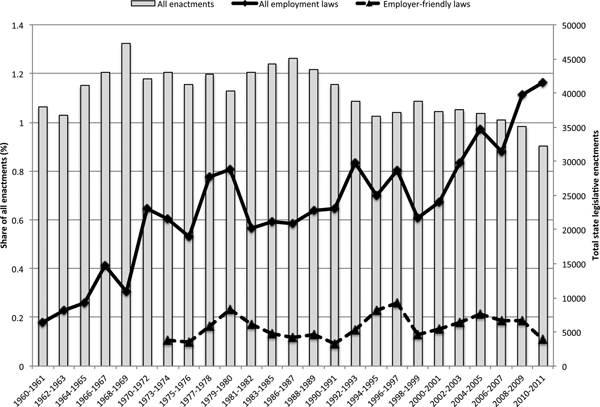
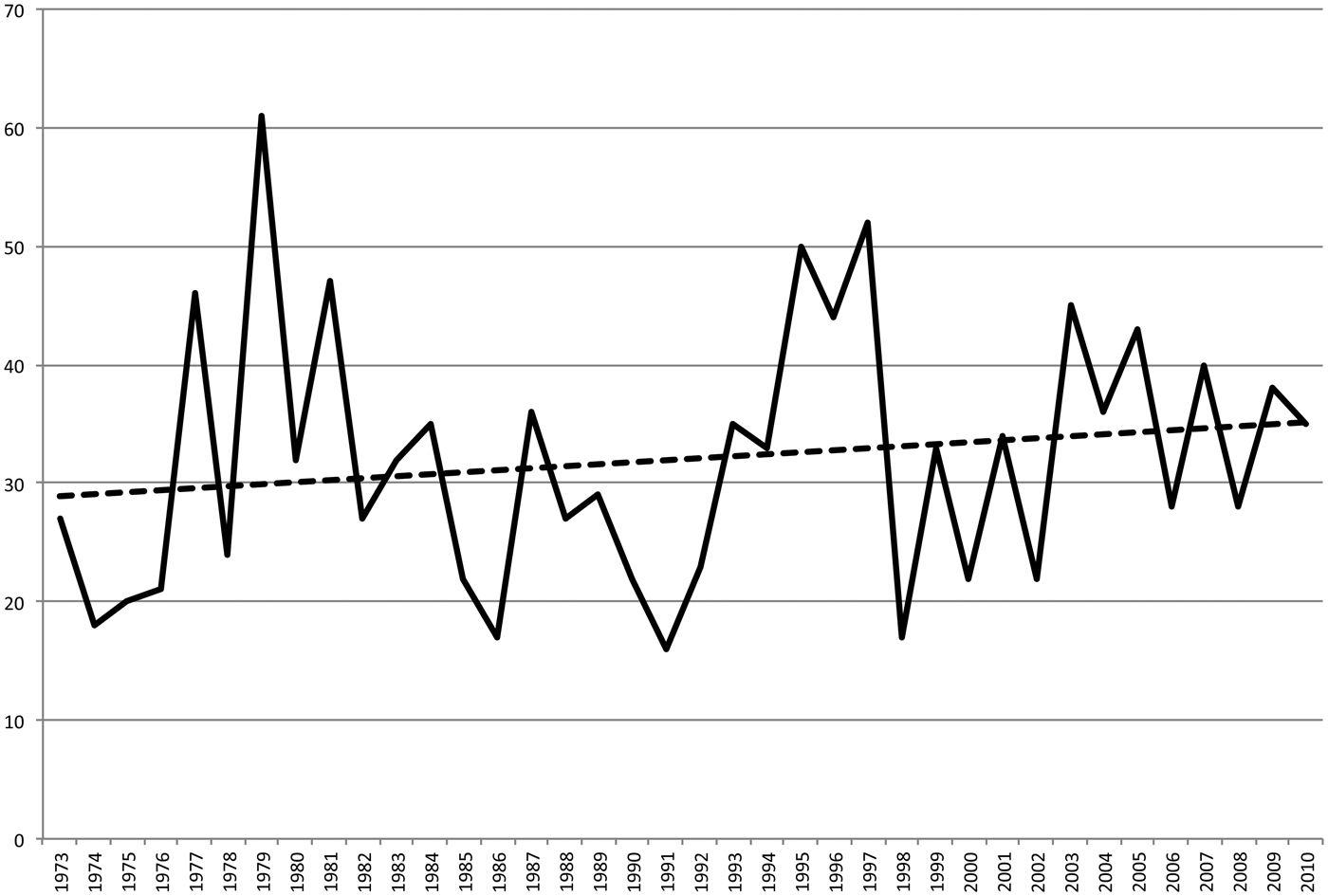
Finally, a note on the “direction” of the main dependent variable used here (the MLR-derived data set of employment laws). A plain reading of the MLR employment law summaries indicates that the overwhelming majority of the enacted laws are designed to advance workers’ rights and provide statutory protections from exploitation. Still, the purposes of some laws are difficult to discern, and some are clearly more employer friendly—aimed at reducing the regulatory burden on employers, limiting their liability, making it more difficult for workers to sue, and so on. A qualitative effort at hand-coding the summaries indicates that about 15–20 percent of the laws fall into this category.Footnote 84 As a share of all employment laws, these laws have grown slightly over time while roughly tracking partisan shifts, which is consistent with recent research on growing state-level policy polarization (see Figs. 6 and 7).Footnote 85 The peak years in the late 1970s and mid-1990s, for example, correspond to major electoral gains for the GOP at the state level (357 legislative seats in the 1978 elections, 514 seats in the 1994 elections). By state, the volume of employer-friendly laws is correlated with employee-friendly laws, however (corr: 0.79), suggesting that some states are simply more legislatively active in this area than others and may be considered more lively sites of political contestation on employment issues.
Number of Employer-Friendly Laws Enacted by Year, 1973–2010.
Employer-Friendly Laws as a Share of All Laws Enacted.
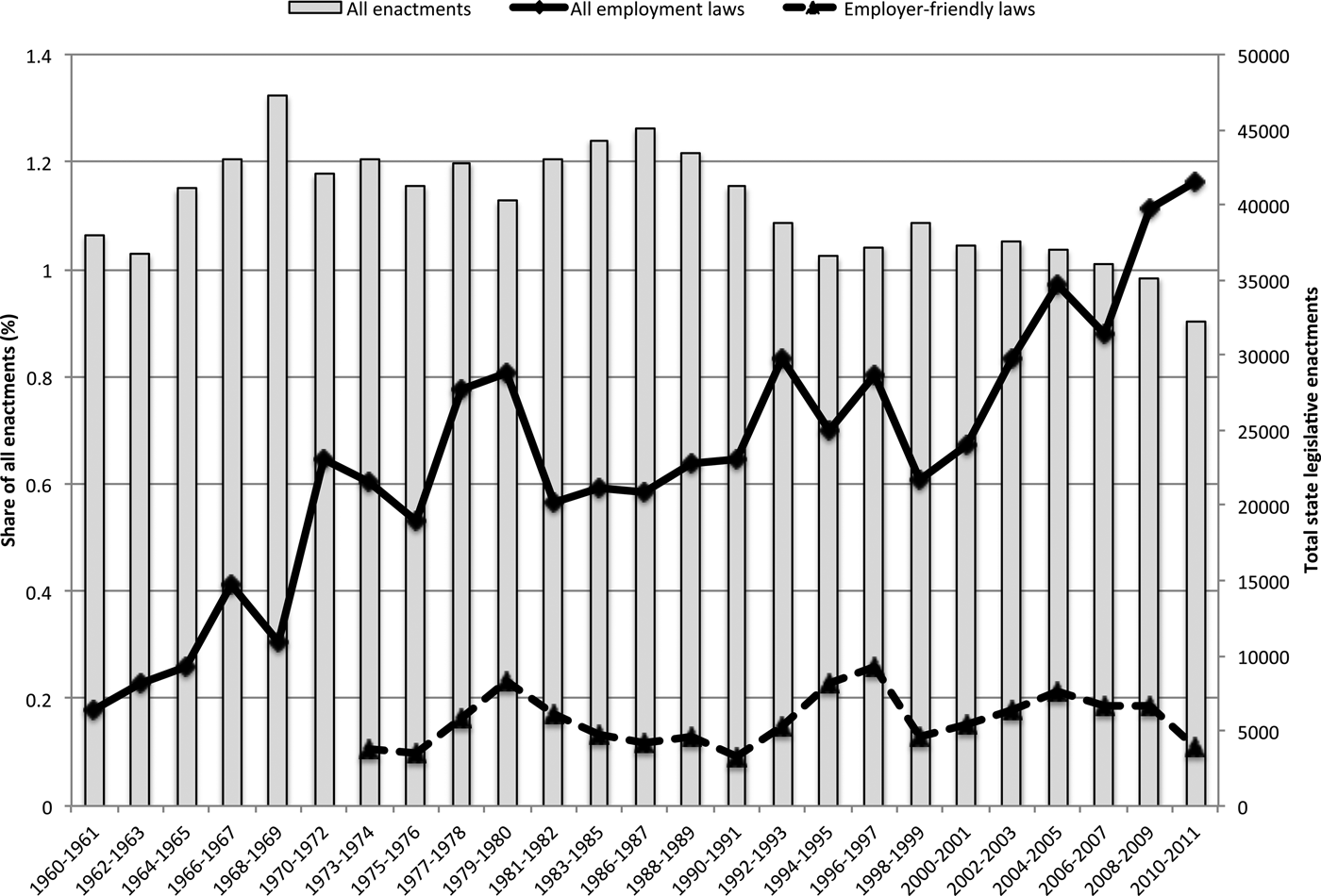
Still, to be as conservative as possible, the above analyses include all employment laws, effectively biasing the analyses against the findings that more Democratic states with stronger labor unions enacted more laws. But Table 8 provides robustness checks. The first model excludes any law that could reasonably be considered employer friendly (e.g., reducing the regulatory burden on employers, making it more difficult for workers to sue, and so on). The second model uses as its dependent variable only those laws that are highlighted in the MLR’s opening pages, in which the major trends in employment law enactments in the previous year are summarized, arguably providing a measure of “significance.” The third model uses as its dependent variable only employer-friendly laws. Union density is positive and significant in Models 1 and 2 but not in Model 3, as expected.
Robustness Checks

Note. Standard errors in parentheses: *** p < 0.01, ** p < 0.05, * p < 0.1.
It bears emphasizing that none of these cross-sectional models deal fully with unobserved heterogeneity, such as states’ deeply rooted structural or cultural attributes, which may explain both union density and employment law activity. Strategically selected case studies are clearly needed to help flesh out the nature of the relationship further. But as a first step, the robust statistical relationship deserves greater theoretical consideration. Why might there be such a strong correlation between union density and state-level employment laws, above and beyond other “usual suspect” explanations?
Why Might Labor Unions Support Employment Laws?
Unions are widely understood to be vigorous defenders of workers’ rights in general. And as John Ahlquist and Margaret Levi have shown, many unions have also exhibited a remarkable capacity to broaden their purview and expand their “communities of fate” to include “unknown others for whom the members feel responsibility.”Footnote 86 We know, for example, that they have long used their political clout to advocate for a wide range of social insurance and redistributive programs that benefit all workers.Footnote 87 But their interest in expanding the role of the state in regulating the workplace is less obvious. From Samuel Gompers's advocacy of “pure and simple unionism” to the “government substitution hypothesis” posited by economists, there has long been a question of whether state intervention helps or hurts unions and, in particular, whether the establishment of protective laws for workers undermines the incentive to unionize by providing for free what workers might otherwise get through their unions.Footnote 88
Studies have examined the relationship between union density and a wide range of state-provided “union-like” benefits, including social welfare expenditures, exceptions to at-will employment, protective employment laws, and more. Efforts to statistically demonstrate a trade-off, however, have yielded mostly null results.Footnote 89 But even if trade-offs do exist in certain contexts, unions may still view potential losses as offset by potential gains.Footnote 90 For example, on some issues, unions have undoubtedly engaged in logrolling—supporting legislation that offers little direct benefit to them in the hopes of securing reciprocal support on laws that advance their more instrumental purposes.Footnote 91 And by leveling the playing field, higher employment standards may make competitive employers more likely to bargain with unions.Footnote 92 Similarly, by taking certain issues off the bargaining table, employment law may narrow the range of issues over which unions must negotiate with employers, thereby increasing their leverage over the issues that remain.Footnote 93
But unions’ support for state employment laws may be less instrumental than constitutive of the labor movement's long and proud history of advancing workers’ rights broadly while raising the “social wage” and combating systemic economic inequality. Such deeply rooted commitments can be traced back to the Knights of Labor and are epitomized by United Automobile Workers (UAW)–led political activism in the 1960s.Footnote 94 Moreover, as seminal work by J. David Greenstone, James Q. Wilson, and others has shown, labor unions are not single-issue interest groups: not merely “interest articulators,” they are also often “interest aggregators” that view their own objectives as inextricably linked to a broader set of political and economic issues.Footnote 95 Despite the AFL's early commitment to a more apolitical “voluntarism,” political and legislative action has figured prominently in labor union activities since the New Deal.Footnote 96
Over the past two decades, scholars have observed an even more conspicuous ramping up of labor unions’ political and legislative activities. The rapid growth of the SEIU in the 1980s is usually seen as pivotal in this strategic shift. After a long struggle with business unionists, the SEIU's more insurgent, politically minded, social-movement unionism prevailed at the AFL-CIO when SEIU president John Sweeny unseated long-serving Lane Kirkland as AFL-CIO president in 1995. At that point, Nelson Lichtenstein explains, “with collective bargaining in relative eclipse and the strike weapon rarely in use, the world of politics and public policy became the vital terrain upon which the labor movement fought its most important battles … key decisions were often made not at the bargaining table, but at the ballot box and in the legislative chamber.”Footnote 97 The AFL-CIO's decision to launch Working America a few years later—a “community affiliate” composed of mostly non-dues-paying members that campaigns for workplace justice and stronger employment laws—was emblematic of the federation's self-conscious political turn.Footnote 98
Labor unions’ growing interest in political activism in general, and in employment laws in particular, may have also represented yet another instance of organizational adaptation to contextual changes, of which they have proven more capable than many assume.Footnote 99 As noted, the growth of the service sector brought an increasingly convoluted and elaborate set of employment relationships, with subcontractors, franchises, vendors, independent contractors, and ambiguous lines of authority structuring many industries.Footnote 100 In this new employment context, the firm-by-firm organizing model mandated by the NLRA became increasingly untenable. Especially in low-wage industries like fast food (characterized by franchises); janitorial and temporary staffing (characterized by subcontractors); and apparel, personal services, day labor, and domestic work (with a high proportion of immigrant workers), the prospect of self-organization and collective action was dimmed by high turnover rates, workers’ fears of deportation, and fragmented workplaces in which employees seldom had opportunities to interact with one another. In this changed world of work, using employment law to raise the floor on wages and working conditions for all workers irrespective of union membership, employer, occupation, or citizenship status is said to have become increasingly appealing.Footnote 101
With declining membership rolls presenting a veritable existential crisis, employment laws arguably also offered a new source of policy “feedbacks” to replenish the mechanisms of support that had been lost amid labor law's drift.Footnote 102 Campaigns to raise the minimum wage, deter wage theft, and ensure family and sick leave, for example, have served to bring workers in disparate occupations together in common cause and into a common space where unions could begin to convey the power of solidarity, organization, and collective action to non-union workers who would be difficult if not impossible to reach on a shop-by-shop basis. Somewhat paradoxically, then, the labor movement's core ideational commitment to the collective interest of workers has in many cases been advanced by embracing the cause of individual rights and demonstrating that despite their great diversity and heterogeneity, individual workers face similar challenges and have similar types of grievances. By associating unions with successful policy campaigns on behalf of workers, labor unions could also demonstrate to existing and potential new members that they still had political clout and could achieve tangible benefits for workers—both critical resource and interpretive effects in Pierson's classic formulation.
Again, well-selected case studies are needed to confirm or disconfirm these potential explanations for unions’ support of employment laws and to flesh out the variety of motivations, strategic concerns, and intervening processes at work. But inasmuch as we want to better understand the process, we also want to take stock of the achievement. And to the extent that labor unions were even partially responsible for the growth of state-level employment laws, these institutions might be considered some of the most significant legacies organized labor leaves behind as it continues its seemingly inexorable decline.Footnote 103
Scholars have examined the effects unions once had in boosting wages for both union and non-union workers alike and in elevating the broader “moral economy,” including putting upward pressure on “norms of fairness regarding pay, benefits, and worker treatment,” and have ably demonstrated that as unions have declined, these broader effects have disappeared as well.Footnote 104 In contrast to those more ephemeral effects, employment laws represent a far more durable (although certainly not permanent) legacy. Notwithstanding their downsides and trade-offs, discussed further below, enshrining legal rights and protections for all employees in public statutes appears to constitute a major institutional achievement indeed.Footnote 105
THE RISE OF ALT-LABOR
As the structure of the employment relationship changed and millions of low-wage immigrant workers entered the workforce between the 1990s and 2010s, labor law's fixity and stagnation left a growing number of workers either formally denied collective bargaining rights or unable to realistically access them. Filling precarious jobs that left them vulnerable to exploitation and abuse, many of these workers sought help. Traditional labor unions, however, faced significant legal and practical limits on how they could confront these problems and advocate for these workers. Into this void stepped a new generation of workers’ advocates (many of whom sought principally to aid the growing number of immigrant workers in the United States, not advance the purposes of the labor movement per se), and many community-based organizations began to grow from the bottom up. These emergent social actors began to develop new organizational forms, tactics, and strategies to advocate for workers’ rights and address other shared problems.Footnote 106 These nontraditional forms of worker organization and inchoate social movements they built, sometimes called “alt-labor,” began to multiply in locations across the country.Footnote 107
As the moniker implies, alt-labor groups are not labor unions—many of their members are forbidden from unionizing, and as nonprofit groups, they have no collective bargaining rights under the NLRA. They do sometimes receive funds from traditional unions and almost always stand shoulder-to-shoulder with unions in policy campaigns and street-level protests.Footnote 108 They include worker centers like the Restaurant Opportunities Centers United and more than 200 other community-based worker centers across the nation; workers’ alliances like the National Taxi Workers’ Alliance; employee associations like OUR Walmart (Organization United for Respect at Walmart); associate member groups formally affiliated with unions, like Working America; nonprofit organizations like the Freelancers Union; faith-based groups like Interfaith Worker Justice; digital platforms for collective action like Coworker.org; and difficult-to-characterize movements and groups like the #RedforEd teachers’ strikes and the Fight for $15.
Like the employment laws discussed above, both the substantive aims and organizational forms of these alt-labor groups reflect the constraints and opportunities imposed by the still authoritative national labor law. In terms of their substantive foci, they self-consciously target workers that have been left behind as labor law has ossified. Their primary members include workers who are either virtually impossible to organize given the nature of their occupations or their geographic dispersion (like temp workers, fast-food workers, and taxi drivers); those who are legally excluded from labor law's provisions (such as domestic workers, independent contractors, farm workers, and day laborers); and those who do not know their rights or feel unable to assert them without fear of legal trouble (such as some nonnative English speakers and undocumented immigrants). They represent workers who are “either by law or practice excluded from the right to organize in the United States.”Footnote 109
And because they are not structured nor do they claim to serve as employees’ exclusive bargaining representatives with employers (as per the rules of national labor law), their approach to protecting and promoting workers’ individual and collective rights has tended to be more confrontational, involving street-front protests, boycotts, and the generation of negative publicity for low-road employers (and favorable promotion of high-road employers). Although many worker centers do take advantage of Section 7 of the NLRA, which protects “concerted activities,” and often encourage workers to unionize, they typically focus more on assisting and empowering individual workers, helping them to navigate the bureaucratic process, connecting workers with others experiencing similar problems in similar industries or geographic locations, and pushing for the enactment and enforcement of stronger state and local employment laws, alongside many other varied activities.Footnote 110 They also emphasize connecting workers with private attorneys and building broader coalitions with other like-minded organizations. Thus in virtually every way, the structures and operations of alt-labor groups reflect the constraints imposed by the persistence of national labor law.
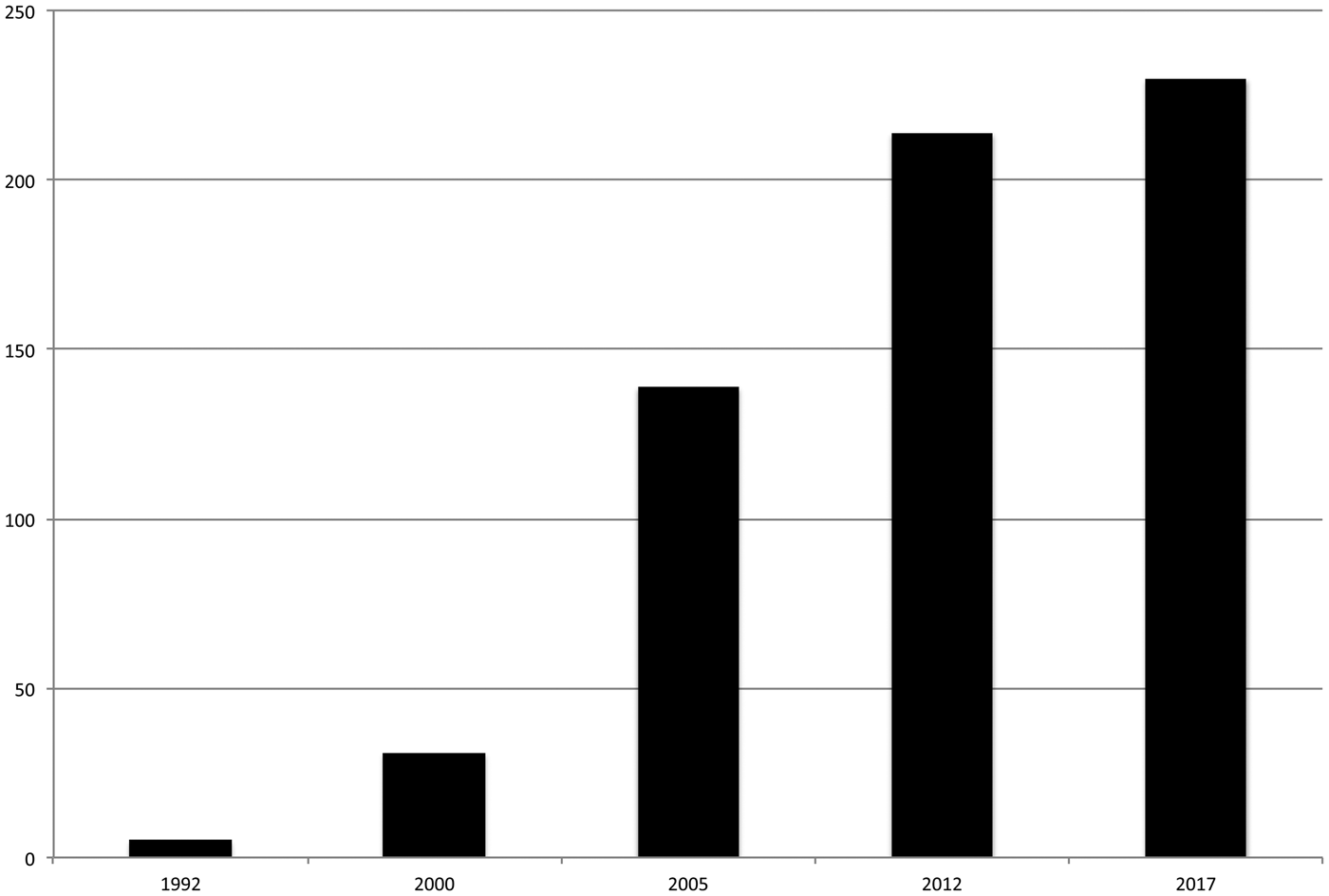
Thanks to the pioneering work of Janice Fine and her collaborators, we know that worker centers, the organizational core of alt-labor, have grown dramatically in number over the last three decades, from only five in 1992 to 139 in 2005 to approximately 214 in 2012 (see Figure 8).Footnote 111 As worker centers multiplied, they became increasingly politically active, “successfully [placing] labor standards enforcement on the public policy agenda at the state and national levels.”Footnote 112 For example, worker centers and other alt-labor groups took the lead in pushing for the enactment of major “wage-theft laws” in twelve states between 2006 and 2013.Footnote 113 In most cases, policy advocates built new coalitions composed of alt-labor groups, unions, legal clinics, and other organizations. Many continued to collaborate after the laws were passed, expanding their policy agendas to tackle new issues and continue building their coalitions. And those were only the successful cases: As a tally taken by Interfaith Worker Justice shows, dozens of other wage-theft campaigns failed or stalled in places with less favorable partisan majorities.Footnote 114 Alternative labor organizations are now central to the organizational and strategic outlook of the labor movement in the early twenty-first century.
Growth of Worker Centers.
A helpful illustration of how this new organizational innovation and political mobilization has been shaped by economic change amid labor law's inertia is found in the case of homecare workers. As Eileen Boris and Jennifer Klein detail in their magisterial study, low-wage homecare workers ineligible for NLRA's collective bargaining rights found their exclusion to be, itself, galvanizing.Footnote 115 As these disproportionately female, minority workers grew in numbers and came to see themselves as part of a broader group of workers facing the same sorts of challenges in disparate workplaces, they began to organize collectively to contest their exclusion (eventually forming the alt-labor National Domestic Workers’ Alliance in 2007). In a process akin to what Chloe Thurston describes as the work of “boundary groups” in discovering and contesting the state's role in authorizing exclusionary public-private policies, homecare workers found that although they could not change the labor laws, they could push for access to employment law protections.Footnote 116 After decades of grassroots organizing, coalition building, and a long and tortured legal process, homecare workers won Domestic Workers’ Bills of Rights (coverage under state labor and employment laws) in New York in 2010, Hawaii in 2013, California in 2014, and Illinois in 2016, and finally achieved eligibility for federal minimum wage and overtime pay in 2015.
Employment laws have also been instrumental for alt-labor groups: Campaigns for stronger laws have served as a means of generating collective action, building solidarity across disparate occupations, and awakening ordinary workers’ collective consciousness. In recent years, the Fight for $15 has been the most highly publicized alt-labor movement to raise wages for all workers and bring together those who would not necessarily have a chance to interact otherwise.Footnote 117 Although initially focused on fast-food workers, the movement quickly grew to include “home health aides, federal contract workers, childcare workers, and airport workers … employees at gas stations, discount outfits, and convenience stores,” and more, eventually morphing into a “broad national movement of all low-wage workers.”Footnote 118 The SEIU invested $2 million to support the first set of protests in New York in 2012, and by 2018 some estimated it had invested tens of millions in the growing movement.Footnote 119 Not wedded to a single tactic and led by mostly non-union workers, the Fight for $15 employed day strikes, public relations campaigns, community organizing, corporate campaigns, and legal battles to convince both public officials and employers to raise the minimum wage to $15 per hour. By 2018, the National Employment Law Project estimated that the multifaceted campaigns had resulted in $68 billion in raises for 22 million low-wage workers across the nation.Footnote 120
Despite its wide-ranging activities and myriad accomplishments to date, alt-labor's room to maneuver has been remarkably narrow. Labor law sharply delimits what non-union groups can do to influence workplace relations; tax law presents an additional set of limitations even as it affords certain political opportunities; financial resources are in short supply, and the beneficiaries of alt-labor's activities can easily free-ride; and as the Fight for $15 illustrates, many of alt-labor's hopes of moving forward and scaling up depend on the strategic choices made by already heavily resource-constrained traditional labor unions that are themselves struggling to maintain their “core competencies” in the workplace. Still further challenges and tensions are discussed in the next section.
Yet these new types of workers’ groups have managed to fill an important organizational need and are now widely recognized as important players in both the labor movement and in Democratic Party politics more broadly, with politicians and party activists often overtly seeking to curry their favor. In 2016, for example, the national Democratic Party platform adopted Fight for $15's call for a national $15 minimum wage in an unconcealed effort to harness the energy of the movement, and the runner-up for the presidential nomination, Senator Bernie Sanders, publicized the (worker center) Coalition of Immokalee Workers’ national Campaign for Fair Food in a much-discussed 5-minute campaign commercial.Footnote 121
During the Trump presidency, up-and-coming Democratic politicians and presidential aspirants continued to try to tap into the growing activism of cross-cutting workers’ movements that blur traditional boundaries between union and non-union, private sector and public sector, and economic, racial, social, and political issues—exemplified in the wave of #RedforEd teachers’ strikes in 2018 and 2019;Footnote 122 in the #MeToo strikes and walkouts at McDonald's, Google, and elsewhere to protest sexual harassment in the workplace; and in locally rooted coalition-building efforts between unions and community groups seeking to “dismantle systems of racial discrimination and oppression; reclaim our democracy; reclaim our economy; reclaim our government [and] build the power of workers and workers’ organizations.”Footnote 123 Gradually, more Democratic office seekers began to embrace the intersectional politics these movements embodied, “born out of [workers’] shared experiences of racism, sexism, poverty, and exclusion from the political process.”Footnote 124 What Sanchez Ocasio and Gertner call “common-good unionism” increasingly views issues of workplace justice as inextricably linked to social, racial, gender, and citizenship injustices and inequalities, and its policy agenda is formulated in that light, reflecting workers’ simultaneous marginalization along multiple dimensions. They write:
The demand for higher wages and safe working conditions cannot be divorced from the need to address disparities in wealth, health, housing, and education that are tied to race, gender, class, geography, and immigration status. Many low-wage worker groups such as the Fight for $15, CLEAN Carwash Initiative, and the National Domestic Workers Alliance are therefore employing an intersectional approach to addressing their members’ multiple, layered identities.Footnote 125
As one Fight for $15 worker-activist aptly summed up: “Racial justice and economic justice are really just two sides of the same coin here. As a woman of color, I've been passed up for promotions and higher-paying positions.”Footnote 126 It is important to point out, however, that politicians are not just responding to developments on the ground: The overlapping problems that galvanize these movements are increasingly constitutive of politicians’ political identities and organizing strategies—epitomized by the rise of Rep. Alexandria Ocasio-Cortez (D-NY) in 2018.Footnote 127 In a similar vein, Michelle Chen writes that the inspirational work of the Coalition of Immokalee Workers served as both a “metaphor for the Sanders’ campaign” in 2016 and spoke “to a deeper grassroots ethos of social change from which his politics emerged.”Footnote 128 In short, alt-labor and other still hard-to-define movements, forged in the shadow of an antiquated but still powerful labor law, constitute major new political developments that have altered actors’ incentives, shaped the substance of political conflicts, and reconfigured the political-organizational universe.
DISCUSSION: OLD PROBLEMS, NEW PROBLEMS
Reactions to labor law's ossification and drift thus include (1) the emergence of new employment laws at the subnational level designed to address the very same problems labor law no longer effectively addressed, but in different forms and through different mechanisms; (2) strategic efforts by labor unions to embrace employment laws and pursue their expansion; and (3) the emergence of new groups and movements to advocate for those workers who have been left behind amid the decline of the national collective bargaining regime. The persistence of national labor law has been found to powerfully shape the form, content, and timing of these institutional and organizational developments.
At the same time that labor law was stagnating, union density was falling precipitously, right-to-work laws were spreading to more states, and both private- and public-sector unions were coming under increasing attack. The developments discussed here cut in the other direction, invigorating the labor movement and creating new pathways to collective action and the assertion of workers’ rights. Yet as the new institutions and organizations emerged in parallel to old institutions and organizations, new problems emerged in the space between them. Put differently, not only were the new institutions and organizations unable to solve the problems produced by the increasingly antiquated labor law, but the coexistence of multiple institutions and organizations geared toward solving the same problems in different ways created a new set of unforeseen problems.
Institutional Frictions
Consider first the institutional frictions that have emerged between state-level employment laws and national labor law. Legal scholars have pointed out that while employment law opens alternate channels for workers to address their grievances, in practice, union members are often left out. The Federal Arbitration Act and the preemption doctrine of Section 301 of the Labor Management Relations Act, in particular, mandate arbitration for union members in most cases, thus denying aggrieved employees access to a court and “the benefit of the substantive provisions of the state employment right.”Footnote 129 “Paradoxically, non-union employees frequently have more workplace rights than their unionized counterparts,” Richard Bales writes. Employment law protections may therefore undercut workers’ incentives to join unions by making “the two models of workplace governance both practically and theoretically incompatible.”Footnote 130 Employment law thus contains “a built-in self-destruct dynamic,” writes Katherine Van Wezel Stone. “It functions to disorganize labor, to prevent the very group-formation that is necessary to retain or improve the minimal terms.”Footnote 131
Economists have suggested a similar kind of conflict between employment and labor law, as noted above. The protections afforded by employment law, George Neumann and Ellen Rissman were the first to argue, may effectively serve as “substitutes” for what unions might otherwise provide to workers, thereby deterring unionization and contributing to membership declines.Footnote 132 Although subsequent empirical analyses have failed demonstrated a clear relationship between the two developments, union leaders are sensitive to the possibility. The government substitution hypothesis thus suggests yet another way in which employment and labor law may exist in tension with one another.
Labor law and employment law are, in many ways, dichotomous institutions. The former is designed to foster workers’ collective action and collaboration and to promote the idea of “collective rights,” while the latter directs attention to individual experiences, private lawsuits, and independent, case-by-case interactions between individual employees and regulatory agencies. In fact, the two legal regimes have operated as oppositional alternatives throughout American history. In Karen Orren's canonical Belated Feudalism, for example, it was the Supreme Court's antiquated interpretation of individual rights that protected the feudal common law of master-and-servant for almost 150 years while frustrating workers’ efforts at collective action and self-organization.Footnote 133 Only after a long “succession of assaults” by labor unions were those barriers finally broken down and the liberty of contract doctrine supplanted by the New Deal's collective bargaining regime.Footnote 134 Abrasions between individual-rights and collective-rights systems likewise underpin Paul Frymer's investigation, discussed above, of how the courts’ interpretation of civil rights laws, especially Title VII of the Civil Rights Act, had an enervating effect on unions, the labor movement, and the New Deal coalition.Footnote 135
But perhaps the biggest problem with employment law is simply that it does not resolve the problems generated by labor law's stagnation and the decline of labor unions. By itself, employment law does not provide employees greater voice in the workplace or do much to redress the inequality of bargaining power. It is also a blunt instrument, seldom tailored to meet the particular needs of specific industries, workplaces, or labor force characteristics. And by incentivizing litigation, it may only exacerbate employment relations by precluding negotiation and the fashioning of more constructive relationships.Footnote 136
Moreover, for low-wage workers, employment law remedies are often much too costly to pursue.Footnote 137 Class action lawsuits involving low-wage workers are rare, and after the Epic Systems Supreme Court ruling of 2018, class actions that are deemed to abrogate arbitration clauses in employment contracts are no longer allowed. Furthermore, many states are “opt-in,” meaning exploited workers, often already fearful of termination or deportation, must publicly sign on before industry-wide problems may be contested in court. Employment law remedies thus often privilege those with resources, information, relative job security, and more leverage in the labor market—typically white-collar workers—while putting low-wage workers at an even greater disadvantage.
As is evident in the rapid growth of mandatory arbitration clauses in employment contracts in recent years, opponents have not sat idly by while employment laws have proliferated. As Alexander J. S. Colvin has found, the percentage of workers forced to sign mandatory arbitration agreements grew from about 2 percent in 1992 to almost 25 percent in the early 2000s. And through a nationally representative survey of more than 600 non-union private-sector employers in 2017, Colvin estimated the share of workers subject to mandatory employment arbitration had grown to more than 50 percent.Footnote 138 The success of this pernicious strategy by employers and their advocates to deprive workers of their statutory employment rights throws into sharp relief precisely what employment laws lack relative to labor law: mechanisms for building collective power. Without those mechanisms, the beneficiaries of employment laws have been unable to defend those very laws against their subversion by opponents.
Finally, the effective enforcement of employment laws cannot be taken for granted. While certain employment laws may, depending on their design, deter workplace exploitation on their own, most require a substantial commitment to regulatory enforcement.Footnote 139 But state enforcement capacities are inadequate everywhere, and the annual probability that a given employer will be inspected by the federal Department of Labor is less than 1 percent and less than 0.3 percent in fissured industries.Footnote 140 As such, employers inclined to violate the law have little reason to fear detection. Thus, while the expansion of employment law may offer new protections to workers and even foster collective action under certain circumstances, it also brings downsides that may exacerbate inequalities in workers’ rights.
Organizational Frictions
Organizational frictions have emerged between traditional labor unions and alt-labor groups as well. To be sure, the two are great allies: Many alt-labor groups receive funding and logistical support from labor unions, and alt-labor groups frequently champion unionization as the ultimate objective for exploited workers. But with declining membership rolls, the decision to devote scarce union resources to fund alternative labor organizations and social movements like the Fight for $15, alongside other experiments, is often questioned. These practices, which Michael Oswalt has aptly called “improvisational unionism,” have left unions susceptible to the critique: “What, exactly, are they doing?”Footnote 141 One labor official told Harold Meyerson: “SEIU is making a huge investment with no clear sense that it will ever be able to claim a fast-food worker as a member. How long can that be a sustainable model?”Footnote 142 Another said, “The money going into this is a gamble. These workers aren't paying dues; they're not financing this right now.”Footnote 143
David Rolf, a prominent SEIU leader often credited with spearheading the successful $15 minimum wage campaign in Seattle, has ruffled some feathers by likening conventional labor unions to “nurse logs” (fallen trees in the forest that provide nourishment for new plants to grow) whose role is to spawn the next generation of labor activism by transferring resources to alt-labor groups and movements.Footnote 144 Many argue that the labor movement should not be so quick to give up on the goal of reviving traditional unions.Footnote 145 “The problem with this, of course,” labor activist Mark Dudzic writes, “is that it fails to leave behind the type of organic working-class institutions that can nurture leadership and a sense of collective power. At best, the end result is hollowed-out structures like those unions created by administrative fiat to ‘represent’ home health care and family daycare workers.”Footnote 146
The growth of alt-labor has also exacerbated the free-rider problems confronting the labor movement in an increasingly right-to-work nation.Footnote 147 If hard-to-organize workers can get informational support, legal assistance, material gains, and even solidary benefits from alt-labor groups without having to pay dues, what is their incentive to unionize? But if unions continue to decline and alt-labor groups are unable to find alternative stable revenue streams (funding from private foundations, which constitutes a large share of their funding, is an equally precarious source), such organizations may find it more difficult to do even the most basic advocacy work. In sum, the contemporary labor movement is built on a precarious foundation, with new organizational forms potentially undercutting traditional labor unions in the near term without a concrete, sustainable plan for building worker power over the long term.Footnote 148
Efforts to develop a dues-paying membership base for alt-labor groups—like a recent effort in New York City to allow fast-food employees to transfer money directly from their paychecks to a nonprofit worker center—have been quickly tied up in legal challenges, but suggest one potential path forward.Footnote 149 It is notable that this effort, like so many others, relies on employment law fixes, legislative activism, and continuous engagement in political and legal processes: all constitutive components of the “new” labor politics.
A growing number of practitioners, labor law scholars, and activists have in recent years begun to develop creative strategies to address the problems generated by labor law's ossification, employment law's inadequacies, and the emergent organizational challenges within the labor movement. For example, with funding from SEIU and several foundations, David Rolf and Carmen Rojas cofounded The Workers Lab in 2014 to study and invest in start-up organizations and ideas that promise to build power for workers “at scale” and be financially self-sustaining.Footnote 150 Kate Andrias and Brishen Rogers have proposed a range of strategies to reform, broaden, and expand labor law's reach while providing workers with more options for building collective power without displacing traditional unions; alongside Andrias's other impactful scholarship, these proposals have generated a vibrant and growing discussion.Footnote 151 And at the Labor and Worklife Program at the Harvard Law School, a number of new initiatives have been launched under the leadership of Sharon Block and Benjamin Sachs to rethink labor law and prepare for future moments of political opportunity. In 2017, a conference asking “Is it Time to End Labor Preemption?” convened labor law scholars and practitioners to “explore whether experiments at the state and local level could expand collective bargaining and workers’ collective action” while weighing the trade-offs (such as the prospect of “stronger rights for some against weakened rights for others” depending on the state in which one lives—precisely what the geographic fragmentation in Fig. 4 reveals).Footnote 152 The next year, Block and Sachs launched a longer-range initiative to identify ways to unify and empower the labor movement, starting from the provocative premise that “any successful strategy must include a complete rewriting of our national labor laws in order to establish new rules of the road for organizing and collective bargaining.”Footnote 153 The “Clean Slate Project” promised to issue its findings and recommendations “to fundamentally reconstruct U.S. labor law” by 2020.Footnote 154 As Dylan Matthews writes, although ideas like these “may seem pie-in-the-sky today, they could easily become part of the next Democratic president's agenda, or become law in left-leaning states even before 2020”—as we saw with the party's embrace of a $15 minimum wage in 2016 and the attention paid by Bernie Sanders's campaign to the work of alt-labor groups.Footnote 155
There are, of course, no clean slates in politics or law.Footnote 156 But in these far-sighted reform proposals, we can observe the very same historical-institutional dynamics at play in the construction of state employment laws and in the development of alt-labor organizations. That is, to resolve emergent tensions and new problems, reformers who find themselves on the “offense” seek to repair ineffective institutions, build workaround solutions, and engage in organizational adaptation and innovation. The powerful constraints imposed by the outmoded but persistent labor law have, in these ways, been both delimiting and generative for the labor movement.
CONCLUSION
As New Deal–era labor law has remained fixed in place amid major economic change and become increasingly unable to achieve its original purposes, the primary institutions constituting workers’ rights have shifted ever more decisively to subnational employment laws. Labor unions and other workers’ rights advocates have pushed for the enactment of these laws to achieve the same purposes that might otherwise have been achieved through collective bargaining: higher standards for wages, hours, and other terms and conditions of employment. Most workers now look to employment laws for protection against exploitation, for substantive rights in the workplace, and for the procedural means of regulating employment relations. Despite the growing number of obstacles placed in their way—including, as noted, mandatory arbitration agreements that increasingly deprive workers of their statutory rights—no comparable, alternative institutional basis for workers’ rights has yet emerged. State-level employment law now stands as the primary institutional guardian of workers’ rights, feeble and inadequate as that guardian may be. This article has provided empirical evidence of this institutional shift, examined its contours, and begun to explore the links between these changes and accompanying organizational shifts in the labor movement. Taken all together, I have argued that these institutional and organizational developments have invigorated but also complicated the labor movement, generating new problems without solving the problems produced by labor law's stagnation in the first place.
While previous studies have picked up on these institutional and organizational shifts, their ability to analyze and explain them has been hampered by a lack of empirical data. Marshaling and analyzing new data, this study has examined how the ossification and drift of national labor law has channeled and constrained the reactions of key players and shaped the timing, form, and content of the new institutions and organizations that have emerged. As discussed, labor unions—the primary organizational beneficiaries of labor law's feedback effects in the early years of the policy's development—did not disappear, but rather switched from defense to offense and sought to adapt to new contextual conditions by experimenting with new strategies. Their support for state employment laws and alt-labor campaigns produced tangible results in many places, but no victory came without trade-offs. In a similar dynamic, alt-labor, scholar-activists, and other workers’ rights advocates have sought to develop workaround solutions to provide workers with more promising pathways for voice and collective action. In their creative efforts, too, we observe the powerful constraints of the outmoded but persistent labor law. Unable to discard the institutional or organizational legacies of the past and start fresh, each step forward has brought new complications and problems with which contemporary unions, workers’ advocates, and other reformers must now negotiate.
These developments, layered upon one another over time, have combined historically to create new political problems for the labor movement at the intersection of new and old, which I have referred to as a new politics of workers’ rights. This process involves what Karen Orren and Stephen Skowronek have described as a defining attribute of American political development:
When continuity and change are given their maximum play in the analysis of political history, chronology gives way to a fugue-like motion of stops and starts, with back-tracking and leapfrogging not readily captured on a calendar…It is precisely in its combination and juxtaposition of patterns that politics may be understood as shaped by time.… Put yet another way, the contours of the polity are determined in the first instance by those who seek to change it and by the changes that they make, and in the second instance, by all the arrangements that get carried over from the past during these interventions and are newly situated by them in an altered setting.Footnote 157
One can readily see this leapfrogging and historical rearranging in the gradual shift in the institutional bases of workers’ rights from labor law to employment law, in the new institutional forms and delivery mechanisms the latter offer in new venues, in the delimited substantive content of those new laws, and in their lopsided distribution across states—all producing new inequalities in workers’ rights that are geographic as well as substantive.
And the fugue-like motion continues. Where state legislatures have been reluctant to pass new employment laws, cities and counties have acted on their own; in turn, conservative state legislatures have responded by enacting preemption laws to strip them of their local governing authority.Footnote 158 Employers have further leapfrogged employment law by forcing employees to sign mandatory arbitration clauses as conditions of employment, thereby depriving them of the rights they might otherwise vindicate through litigation, further atomizing workers, and undermining one of their primary institutional mechanisms for generating collective action.Footnote 159 Workers and their advocates have responded in turn by pushing for “private attorneys general” laws—enacted in California, with similar laws proposed thus far in New York, Oregon, and Vermont—to allow aggrieved employees to act as agents of the state and file representative actions on behalf of themselves as well as other workers to recover civil penalties for violations of state employment laws.Footnote 160 Others have proposed still more elaborate workaround solutions, such as wage boards, sectoral bargaining, local labor laws for NLRA-excluded workers, works councils, and variations on the “Ghent system.”Footnote 161 If they could start over from scratch, workers’ rights advocates surely would. Because they cannot, all such proposals are designed to accommodate the changing institutional landscape, and in their design and content, they reveal the necessity of circumventing, layering, and reconfiguring.
All such proposals also reveal a glaring need for workers to develop new organizational forms that facilitate interaction and coordination across fragmented workplaces and provide new catalysts for political mobilization and collective action—which, in turn, highlights existing organizational weaknesses, presents new resource challenges, and invites strategic conflicts. And yet the search itself can be highly generative. As discussed, while labor unions have struggled to adapt, survive, and grow, relations with alternative labor organizations have become both a conspicuous flashpoint and a source of innovation and inspiration.
In all of these developments, we can observe a new politics of workers’ rights taking shape. It has moved increasingly out of the workplace and into the political arena;Footnote 162 it centrally involves legislative politics and policy campaigns to establish stronger employment law protections and regulatory capacities; it leverages the laws’ built-in protections and focuses on processes of policy enforcement to generate the resources, incentives, and interpretive effects that can facilitate further collective action;Footnote 163 it increasingly employs street-level protests and direct corporate campaigns to press for higher wages and better employment conditions at the firm and industry levels;Footnote 164 it is often fueled by new coalitions of workers’ advocates that have formed in the shadow of labor law;Footnote 165 and more and more, it views its fate as intertwined with social justice and civil rights campaigns with different proximate foci, such as immigrants’ rights, women's rights, civil rights, and criminal justice reform.Footnote 166 As in the past, the ability of workers’ advocates to navigate these political dynamics and protect workers’ rights depends on how effectively preexisting institutional and organizational arrangements are negotiated (and renegotiated) in the years ahead.