Introduction
Molecular crystalline solids include explosives, such as cyclotetramethylene tetranitramine (HMX), and inert materials, such as pharmaceutical 5-iodo-2′-deoxyuridine (idoxuridine). These materials are typically processed in particulate form due in part to their brittle nature and in part to their applications, where high surface area may be desirable (e.g., faster drug dissolution rate). While the mechanical properties of molecular crystals are not the primary concern for many pharmaceuticals, these properties impact compaction [Reference Mohammed, Briscoe and Pitt1, Reference Duncan-Hewitt and Weatherly2, Reference Jain3, Reference Luscher, Yeager, Clausen, Vogel, Higginbotham Duque and Brown4, Reference Elban and Chiarito5] and amorphization [Reference Stepanov, Patel, Mudryy and Qiu6, Reference Yu7] and contribute to composite mechanical properties when formulated with a binder [Reference Bower, Kolb and Pruneda8]. While the particulate form of materials may be more difficult to test mechanically than larger samples, a larger sample may not be representative of the mechanical behavior of the particulate, particularly in molecular crystals, where producing a larger crystal often requires altering the growth conditions that are used in precipitation of particulate matter.
Idoxuridine is a potential mock for HMX. In this context, a mock is an inert material that has certain properties in common with the explosive and can be used in place of the explosive in experiments when safety is of particular concern. Idoxuridine was initially chosen to mock HMX because of its similarity in density, thermal stability, and solubility [Reference Yeager, Higginbotham Duque, Shorty, Bowden and Stull9]. Viability as a mechanical mock was evaluated with nanoindentation of single crystals [Reference Burch, Yeager and Bahr10]. The results of this were promising, with an 8% difference between the two materials in elastic modulus and no measurable difference in hardness. When idoxuridine was evaluated in plastic bonded composites for similarity to HMX as a plastic-bonded explosive (PBX), idoxuridine performed well in Brazilian disc experiments, showing an improvement over the former HMX mock, was effectively equivalent to the former mock in thermal testing, and performed more similarly to HMX PBX in uniaxial compression tests, but was still weaker than HMX [Reference Yeager, Higginbotham Duque, Shorty, Bowden and Stull9]. This discrepancy in fracture strength of plastic-bonded formulations under compression was surprising, given the similarities in hardness and modulus between the materials.
Nanoindentation is a common method of measuring mechanical properties of molecular crystals in particulate form [Reference Taw and Bahr11, Reference Taw, Yeager, Hooks, Carvajal and Bahr12, Reference Kiran, Varughese, Reddy, Ramamurty and Desiraju13, Reference Olusanmi, Roberts, Ghadiri and Ding14, Reference Hudson, Zioupos and Gill15, Reference Ramos and Bahr16, Reference Egart, Janković, Lah, Ilić and Srčič17, Reference Mathew and Sewell18, Reference Elban, Hoffsommer and Armstrong19]. Despite limitations of molecular crystals in accommodating plasticity [Reference Ramos, Hooks and Bahr20], an indentation can generally cause a plastic deformation zone in the material around the indent with a radius approximately twice the radius of the indent impression [Reference Elban, Hoffsommer and Armstrong19, Reference Ramos, Hooks and Bahr20]. Nanoindentation can also be used to determine fracture properties [Reference Lawn and Wilshaw21, Reference Khan, Faisal and Tarefder22, Reference Jungk, Boyce, Buchheit, Friedmann, Yang and Gerberich23, Reference Cai, Xu, Zhong and Liu24, Reference Guo, Jiang, Yang and Wang25, Reference Mannepalli and Mangalampalli26, Reference Yen, Jian, Tseng and Juang27, Reference Anstis, Chantikul, Lawn and Marshall28, Reference Chantikul, Anstis, Lawn and Marshall29, Reference Fuller, Quinn and Cook30]. Given the brittle nature of molecular crystals, failure during mechanical testing is quite common. For example, the Oliver and Pharr method of calculating elastic modulus and hardness via indentation [Reference Oliver and Pharr31] is only valid for materials that did not fracture during indentation. Therefore, understanding the indentation fracture behavior of a brittle material provides confidence that measurements can be taken without causing fracture.
Most indentation fracture methods require post-indentation imaging to identify the crack, in which case particularly small or subsurface fractures may be undetected. To identify cracks without this visual inspection, Morris et al. [Reference Morris, Myers and Cook32] introduced a technique in which presence or absence of a crack is indicated by analysis of the indentation unloading traces. They showed that indenting a material multiple times using probes of varying acuity, ranging from Berkovich, with an included angle of 142.3°, to cube corner, with an included angle of 90°, and examining the similarity unloading curves when offset based on the final depth of the indentation, radial fracture could be identified. If the unloading curves were superimposable (or nearly superimposable), the material did not exhibit radial fracture. This method, which relies on the changes in the compliance due to the presence of cracks during the unloading segment, specifically detects the occurrence of radial cracks (parallel to the indentation axis and typically emanating from the corners of the indent impression) [Reference Cook and Pharr33]. Secondary radial cracks occur at an angle to the indentation axis rather than parallel and typically are adjacent to the corners of the indent impression. Lateral fractures [Reference Cook and Pharr33], which appear parallel to the material surface emanating outward in a circle below the plastic deformation zone, are not detected by unloading analysis. “Shallow” lateral cracks may appear less symmetric and closer to the indented material surface. Morris and co-workers tested both amorphous materials and crystalline solids with relatively high symmetry.
Here, nanoindentation was used to identify fracture load thresholds for HMX and idoxuridine. The method outlined by Morris et al. was used to determine if samples had fractured, followed by verification via imaging to ensure that unloading analysis is applicable for molecular crystals with significantly lower symmetry conditions and higher anisotropy ratios than materials previously tested by Morris and co-workers. Both radial fracture and lateral fracture were observed in the molecular crystals. For radial fracture, cracks appear at the sides of the indent, indicating either secondary radial fracture, which occurs adjacent to corners and at an angle to the indentation axis rather than parallel, or this crack placement may be a result of anisotropy in the crystal itself. Radial fracture was detected using unloading analysis, which was found to be subject to the occurrence of false negatives, in which unloading curves will not indicate the presence of fracture yet upon optical investigation a crack is present. The implications of these results to developing new mock options for single-crystal materials and formulated plastic-bonded composite materials are discussed.
Results and discussion
Analysis of unloading curves to detect radial fracture
Prior to presenting the results, it is necessary to note that there are four possible outcomes from performing an unloading analysis, as outlined by Morris et al., to identify fracture behavior. If the unloading analysis and optical observation agree, we choose to call the result “true,” and if they do not, it is “false.” A “positive” result is one where unloading analysis indicates radial fracture, while a “negative” result is one that does not indicate fracture. Nonsuperimposable unloading traces from tips of different acuities indicate fracture, and if this can be verified optically, it is a “true positive” result. “False positive” results are if the curves are nonsuperimposable but no fracture of any type is observed optically—this type of result was never observed either by Morris [Reference Morris, Myers and Cook32] or in this present work, as we will show. “True negative” results are typical of ductile materials or very small loads in brittle materials, wherein the unloading curves are superimposable and no fracture is observed optically. Finally, “false negative” results are when the unloading curves are superimposable but a crack is observed optically. Morris found occasional false negatives when the two tips being compared had similar acuities but stated that cube corner and Berkovich tips were different enough to avoid this issue.
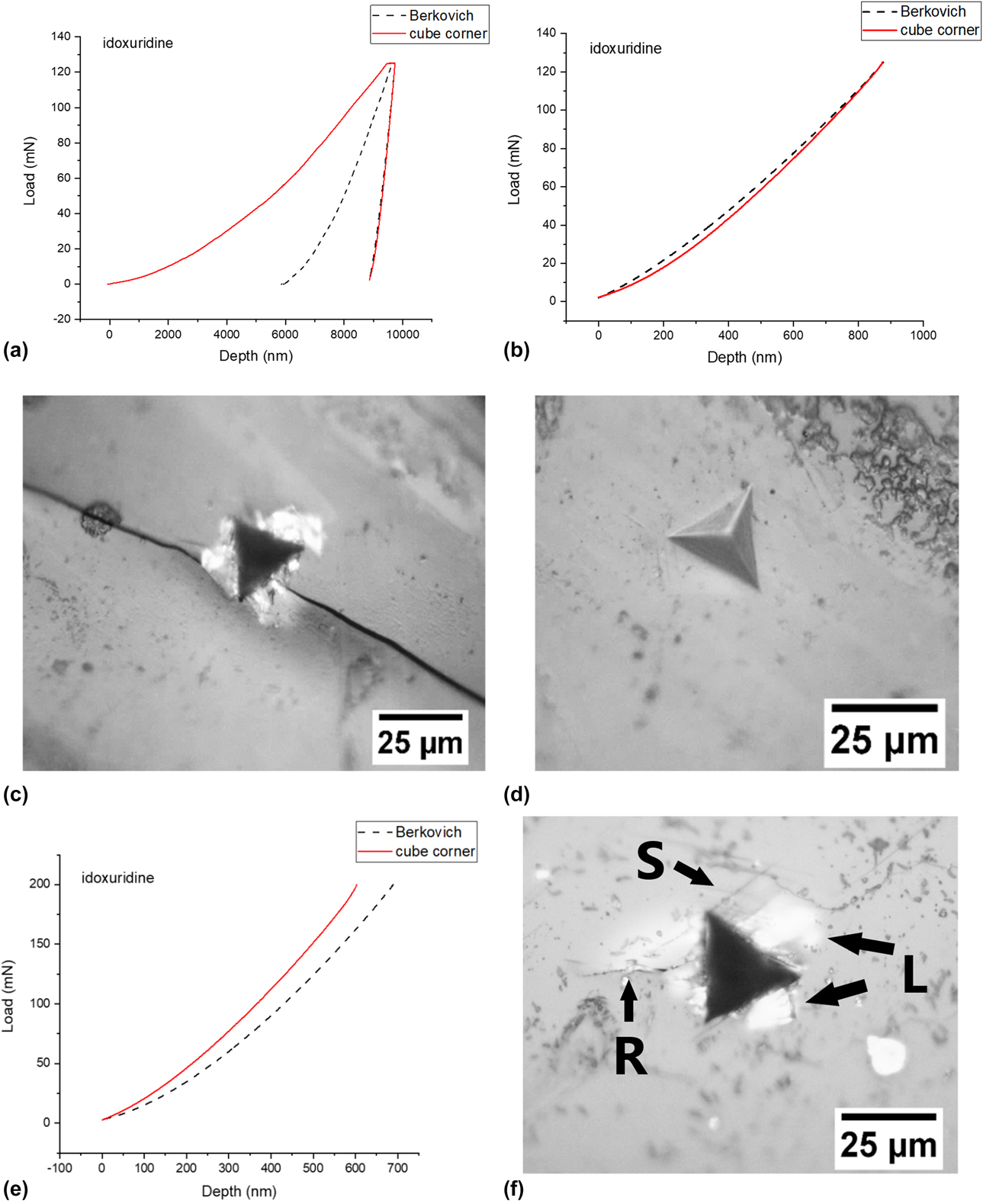
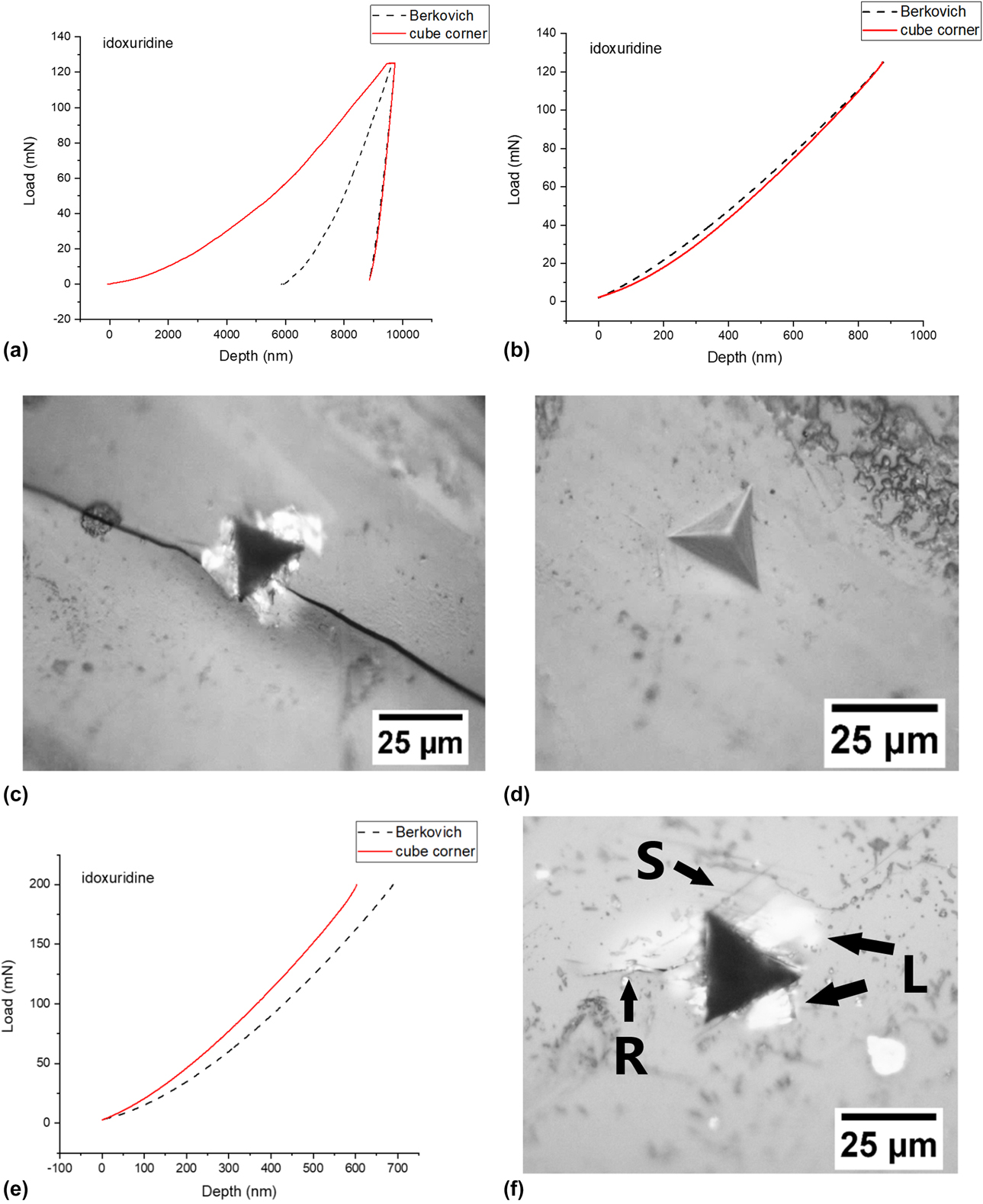
In both types of brittle molecular crystals tested here, we also found significant variation in superimposability of Berkovich and cube corner unloading curves corresponding to fractured crystals. The cube corner indenter probe is significantly sharper than the Berkovich and initiates fracture much more readily. Figure 1 compares indentation results for idoxuridine loaded to 125 mN with both tips. Here, the cube corner indentation resulted in fracture [Fig. 1(c)] but the Berkovich indent did not [Fig. 1(d)]. In Fig. 1(b) and all subsequent load–depth curves, to directly compare superimposability, the loading portion of the curve has been omitted, and the final depths of both unloading curves have been shifted to the origin to allow for direct comparison, despite the increased indentation depth resulting from the acuity of the cube corner probe. In Fig. 1, the unloading portions of the load–depth curves were nearly superimposable but exhibited slight variation in curvature, indicating that the material fractured during the experiment. This is especially notable since, at first glance, the curves do look similar. This is an example of a “true positive” result, where the unloading analysis and the optical imaging agree. Sometimes, the unloading curves are quite obviously different. Figures 1(e) and 1(f) show an example of a cube corner indent that fractured and shows a clear lack of superimposability in unloading traces—another “true positive” result.
(a) Load–depth curves for idoxuridine indented at 125 mN shifted along x-axis to align final depths of both curves. (b) Corresponding offset unloading portions of the load–depth show that the unloading slopes are nearly superimposable. (c) The corresponding cube corner indent with visible radial and lateral cracks. (d) The corresponding Berkovich indent with no evidence of fracture. (e) When the unloading portions of the load–depth curves for idoxuridine indented at 200 mN with a Berkovich indenter and with a cube corner indenter are overlayed, the unloading slopes are not superimposable. (f) The corresponding cube corner indent with visible radial fracture (R), lateral fracture (L), and slip bands (S) is indicated by arrows.
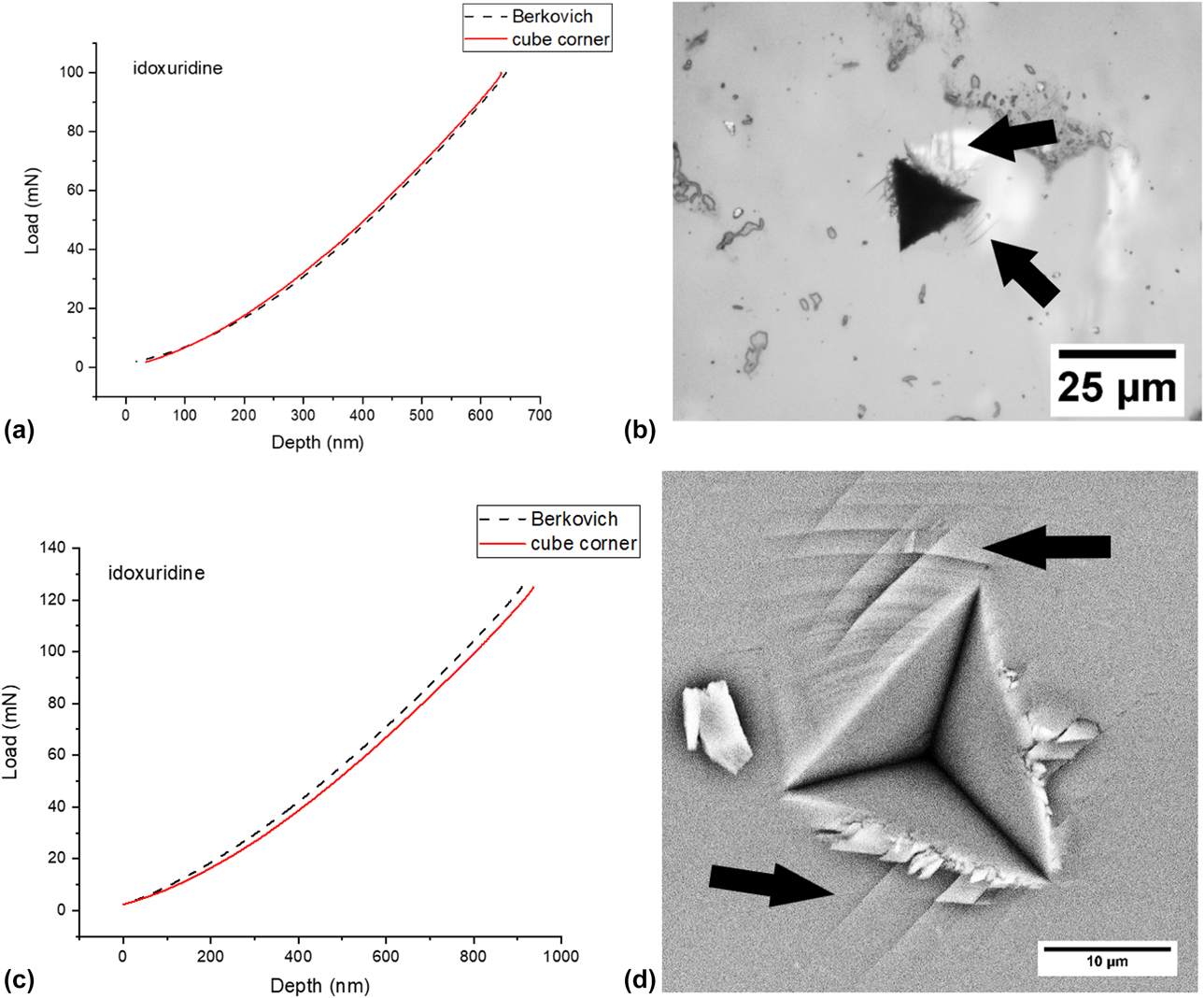
At lower loads, the analysis was generally simple because the materials did not fracture (“true negative”). Figure 2 shows cube corner indents that did not fracture, with corresponding unloading curves that are superimposable or nearly superimposable, as predicted by the Morris et al. model. Those materials that did not fracture, although slip bands were present, are indicated by arrows in Figs. 2(b) and 2(d). Clearly identifiable slip bands following indentation are common in molecular crystals such as these, which have very few, limited slip systems with which to accommodate plastic deformation [Reference Egart, Janković, Lah, Ilić and Srčič17, Reference Jing, Zhang, Blendell, Koslowski and Carvajal34, Reference Wildfong, Hancock, Moore and Morris35, Reference Morris36]. Note that the curves in Fig. 2(c) are not perfectly superimposed. This is a function of translating the entire curve along the x-axis to allow for observation of degree of superimposability; these curves can be considered superimposable because the curvature and slope of the curves are within 5% of each other, which is effectively the resolution due to thermal drift and variations in surface roughness in these materials.
(a) When the unloading portions of the load–depth curves for idoxuridine indented at 100 mN with a Berkovich indenter probe and with a cube corner indenter probe are graphed with final depth at the origin, the unloading slopes are nearly superimposable. (b) The corresponding cube corner indent with no crack, but with visible slip bands, is indicated by arrows (the bright region of the figure is due to out-of-plane deformation, not lateral fracture). (c) When the unloading portion of the load–depth curves for idoxuridine indented at 125 mN with a Berkovich indenter probe and with a cube corner indenter probe are graphed with final depth at the origin, the unloading slopes are nearly superimposable. (d) The corresponding cube corner indent with no radial cracks, but with visible slip bands, is indicated by arrows.

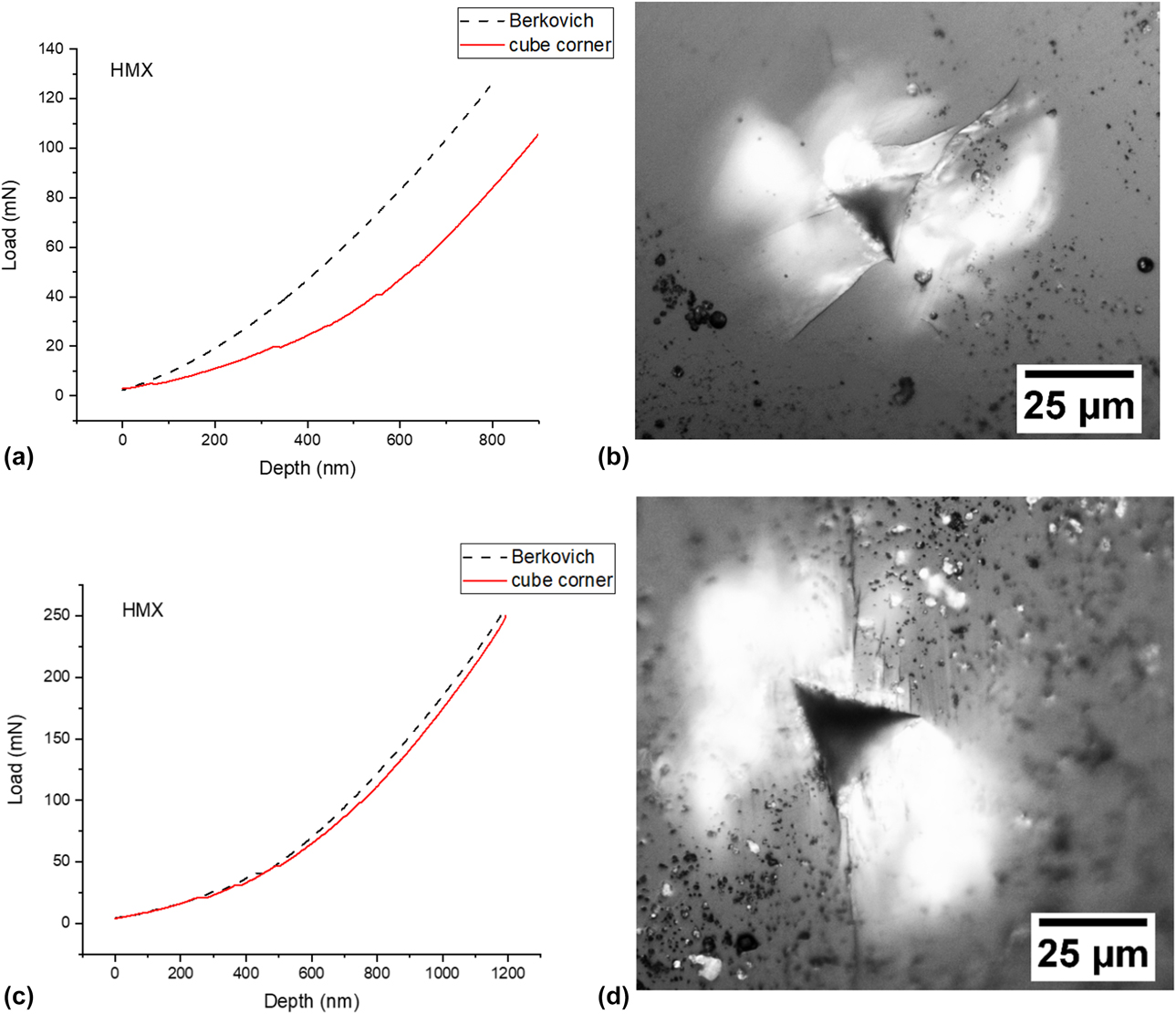
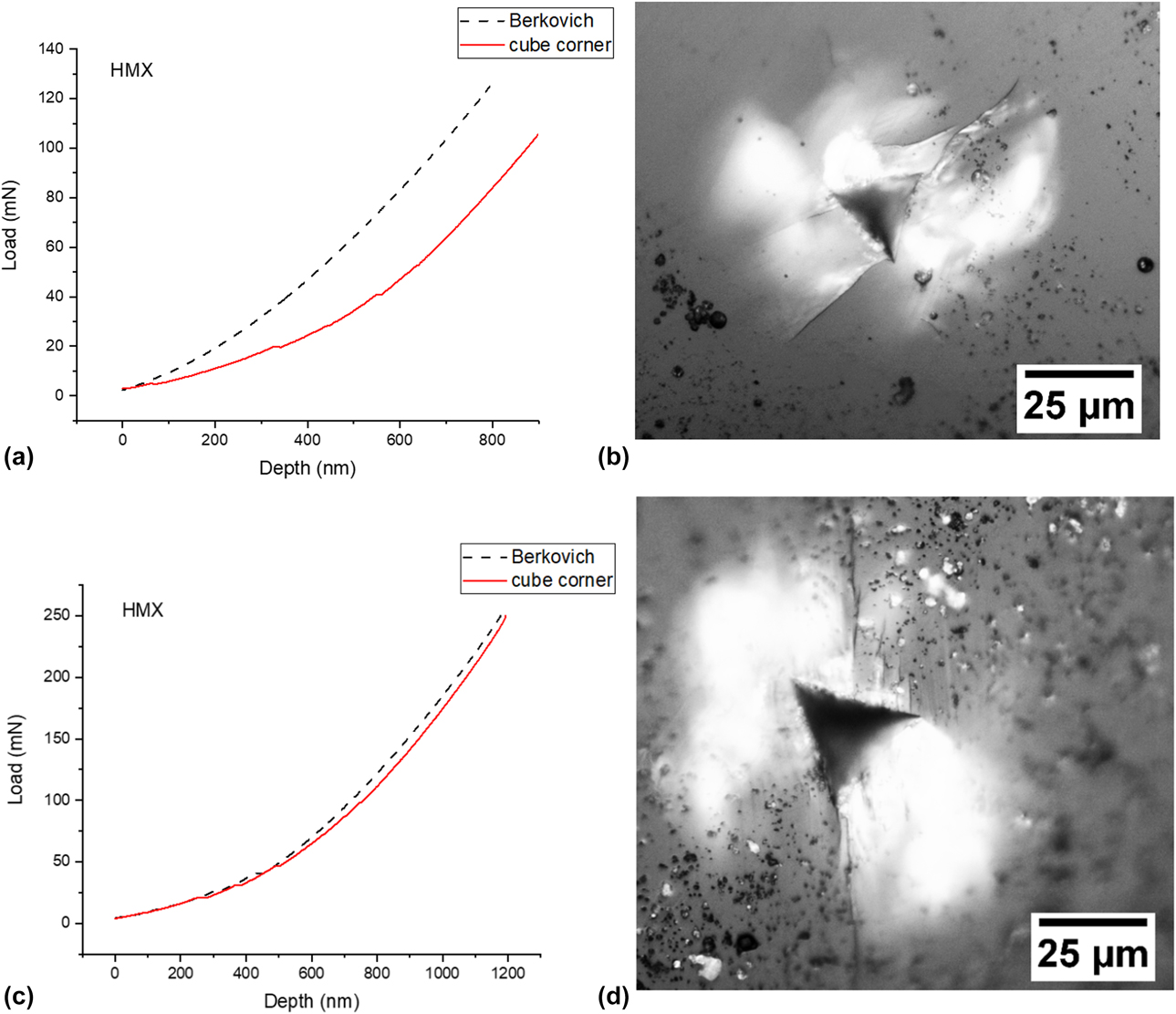
Figure 3 shows two examples of cube corner indents causing both radial fracture and significant lateral fracture; however, the accompanying unloading curves for one are nonsuperimposable [Fig. 3(a)] and the accompanying unloading curves for the other are nearly superimposable [Fig. 3(c)]. By unloading analysis alone, without optical observation, the first sample cracked, while the second did not. Figures 3(a) and 3(b) therefore are examples of a true-positive result, where unloading curves and imaging agree, while Figs. 3(c)–3(d) are examples of a false negative, where the fracture is undetected by unloading analysis but the imaging reveals fracture.
(a) When the unloading portion of the load–depth curves for HMX indented at 125 mN with a Berkovich indenter probe and with a cube corner indenter probe are graphed with final depth at the origin, the unloading slopes are not superimposable. (b) The corresponding cube corner indent with visible radial and lateral cracks. (c) When the unloading portion of the load–depth curves for HMX indented at 250 mN with a Berkovich and with a cube corner indenter probe are graphed with final depth at the origin, the unloading slopes are nearly superimposable with some slight deviation. (d) The corresponding cube corner indent with visible lateral cracks.
Discussion of false negatives and crack mechanisms
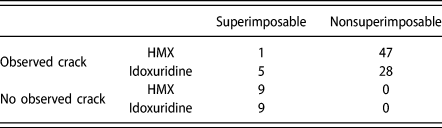
As previously mentioned, Morris et al. have shown that if a material is indented to the same maximum load with two different indenter probes of sufficient differing acuity and the unloading portions of the load–depth curves are nonsuperimposable, then the material has fractured [Reference Morris, Myers and Cook32]. This result was replicated in indentation of idoxuridine and HMX, with all nonsuperimposable unloading traces corresponding to fractured crystals. However, the converse statement was not found to be true; if the unloading portions of the load–depth curves are superimposable, the material may or may not have fractured for one of the indenter tips. Morris found this as well but said that the nonsuperimposability from cracking would be observed if probes differed enough in acuity [Reference Morris36], with Berkovich and cube corner as an example. Our study showed that even with the Berkovich and cube corner geometry, a fractured sample may still have superimposable or nearly superimposable unloading curves, although this is uncommon. The low frequency of this occurrence is shown in Table I, showing that 94% of results were “true,” and all “false” results were in the form of false negatives, where curves are superimposable yet the optical inspection shows that fracture occurred.
The number of occurrences of each of the four previously mentioned possible outcomes for each material.

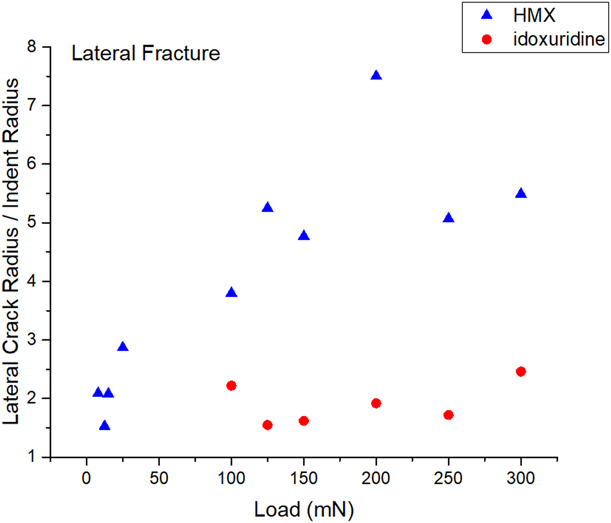
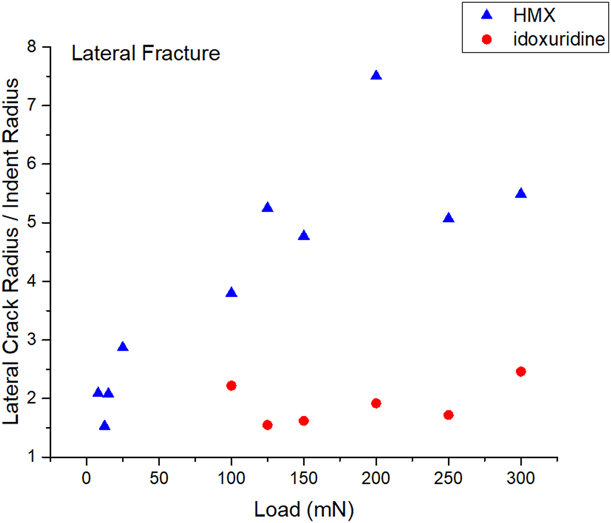
As exemplified in Figs. 1(c), 1(f), 3(b), and 3(d), significant lateral cracking was seen in many samples, where fracture is parallel to the material surface and radiates out circularly. Due to the lack of radial symmetry and apparent proximity to the surface, the lateral cracks observed around indents in these materials appear to be “shallow” lateral cracks [Reference Cook and Pharr33]. The unloading analysis technique is only sensitive to radial fracture and therefore cannot detect the occurrence of lateral fracture, possibly because lateral fracture often occurs at or near the end of the unloading cycle. Lateral fracture is also not indicated by the loading trace and was only observed by optical inspection. In instances where lateral fracture occurred, the effective radius of the lateral crack was measured and compared with the radius of the indent impression, shown in Fig. 4. This radius analysis normalizes the crack size relative to the size of the indent (treating the projected contact area as a circle to create an effective radius) and subsequently to the size of the plastic deformation zone. At loads where the material did not fracture, either at all or some of the time, the ratio of lateral crack to indent impression is nearly 2, which is approximately the radius that would be expected for the plastic deformation zone around the indent impression. Of particular note here is that the idoxuridine appears to never extend significantly beyond the plastic zone, whereas the HMX crack grows more than proportionally at increasing loads.
The radius of indent impressions are compared with the lateral cracks seen around the indent, and at loads where the material is not fracturing in all cases, the ratio is approximately 2, which is consistent with the expected size of the plastic deformation zone resulting from an indentation.
Radial fracture threshold of HMX and idoxuridine
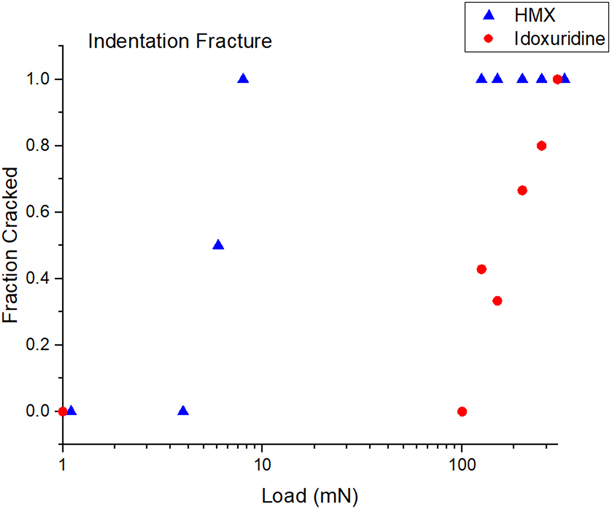
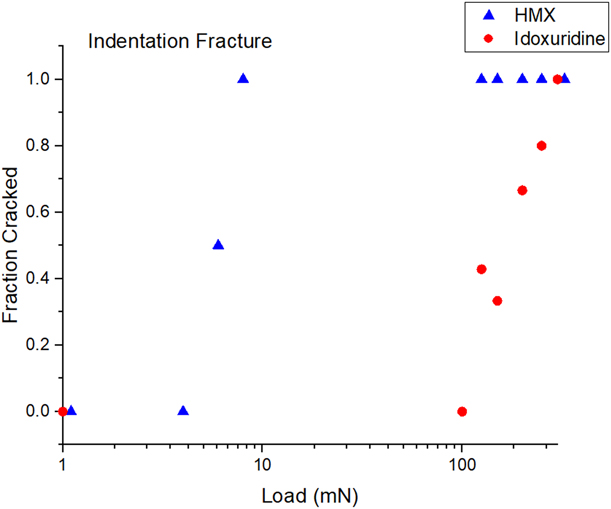
Approximately 100 crystals of HMX and idoxuridine were indented with both Berkovich and cube corner tips. In all cases, the loading rate was proportional to the maximum load with a 30 s load duration. Idoxuridine has a higher radial fracture threshold than HMX, shown in Fig. 5. Idoxuridine did not demonstrate any fracture up to or at 100 mN, fractured in every case at 300 mN, and showed a linear trend in fraction of samples fractured between those two outer boundaries. HMX did not demonstrate any fracture up to or at 4 mN, fractured in every case at 8 mN, and showed a linear trend in fraction of samples fractured between those two outer boundaries.
Fraction of crystals that cracked under quasistatic loading at various loads. Indentation fracture initiation in idoxuridine requires loads above 100 mN and all samples fracture at a load of 300 mN, whereas indentation fracture initiation in HMX requires loads above 4 mN and all samples fracture at a load of 8 mN.
A variation in the threshold for indentation fracture could be due to two primary conditions. First, it could be based on preexisting flaws and the distribution would be reflective of the flaw distribution. The other possibility would be that stochastic events in plasticity (i.e., cross slip) control this behavior. Recent studies of indentation threshold for fracture in glass [Reference Mound and Pharr37] and earlier studies on Si and Ge [Reference Jang and Pharr38] have noted that the threshold for fracture is linked to indenter angle, but Mound and Pharr conclude [Reference Mound and Pharr37] that most initiation models do not yet capture the stress field dependence, and they support the threshold concept in which indentation fracture is driven by the interactions between the plastic and elastic stress fields, in a manner similar to that of Morris et al. In our current study, there is no evidence that the defect distribution is any greater in idoxuridine than in HMX, even though the range over which the fracture events occurred is almost two orders of magnitude smaller for HMX (<4 mN range for HMX and ≈200 mN range for idoxuridine), and so we believe these data support the plastic–elastic stress field interaction model for fracture initiation during indentation. As suggested by Cook’s recent study [Reference Cook39], threshold prediction here would not be improved by “better” (quotes attributed to Cook) estimates of modulus, hardness, and toughness; we propose that subtle differences in the elastic and plastic stress/strain fields in these materials with limited slip will always lead to variation within a material. However, the significant difference in the “threshold” value (≈5 mN for HMX and ≈200 mN for idoxuridine) for materials with similar modulus and hardness values implies that the toughness of HMX is significantly less than that of idoxuridine.
Loading rate effects
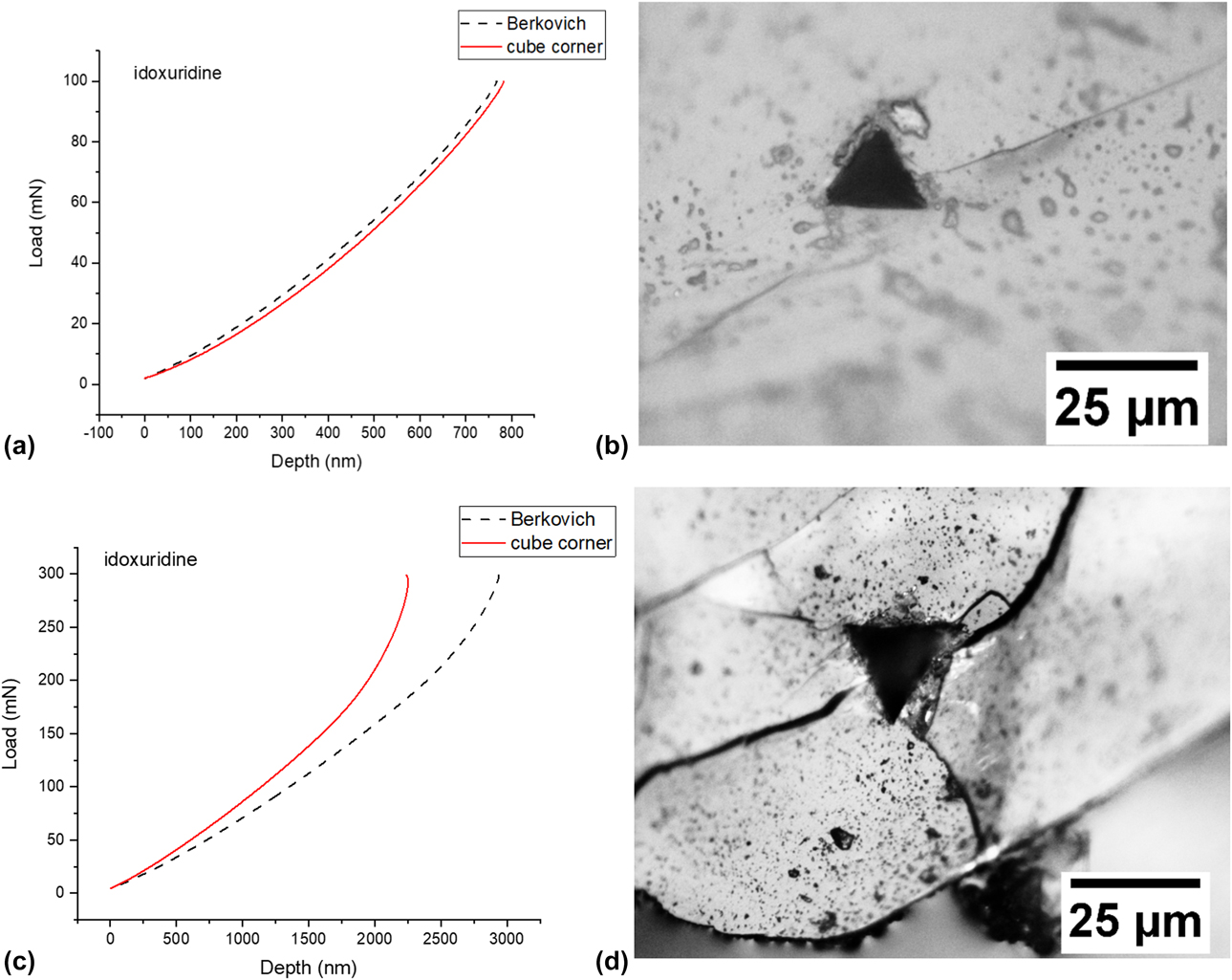
For all indent data shown in Fig. 5, the loading time was held constant at 30 s, and the only parameter that was variable was maximum applied load. As a result of this, the loading rate during indentation increased with maximum applied load, as high as to 100 mN/s for the 300 mN indents. To observe the effect of variable loading rate on indentation fracture, additional indents were performed on idoxuridine, where the loading time was variable rather than applied load. These additional tests were performed at loads of 100 and 300 mN, as shown in Fig. 6. As shown in Fig. 6(a), increasing loading rate from 3.333 to 100 mN/s for 100 mN indents continued to show superimposability in unloading traces, yet Fig. 6(b) shows that fracture occurred, meaning that this was a false-negative result in the unloading analysis. So in this case, increasing the loading rate at lower loads induces fracture that does not occur at slower loading rates. Conversely, as shown in Fig. 6(c), decreasing loading rate from 100 to 3.333 mN/s for 300 mN indents still resulted in fracture, shown in Fig. 6(d), just as in indents with higher loading rates. In this case then, decreasing the loading rate at higher loads does not prevent fracture.
(a) When idoxuridine is indented at 100 mN with a loading rate increased from 3.333 to 10 mN/s and the unloading portions of the load–depth curves for a Berkovich indenter probe and a cube corner indenter probe are graphed with final depth at the origin, the unloading slopes are nearly superimposable. (b) The corresponding cube corner indent with visible radial cracks, meaning that this was a false-negative result. (c) When idoxuridine is indented at 300 mN with a loading rate decreased from 10 to 3.333 mN/s and the unloading portions of the load–depth curves for a Berkovich indenter probe and a cube corner indenter probe are graphed with final depth at the origin, the unloading slopes are not superimposable. (d) The corresponding cube corner indent with visible radial cracks.

Estimating the toughness of idoxuridine and HMX
Indentation fracture toughness most often relies on self-similar fracture morphologies, with relationships between load (or indentation impression size) and the crack size providing a model to extract effective toughness parameters. In the case of the anisotropic molecular solids described here (and most likely in other similar molecular organic systems), the ability to create repeatable self-similar morphologies is limited. Radial, secondary radial, and lateral cracks occur stochastically. There are two basic methods in the literature to use indentation fracture to extract a toughness: analysis of when cracks start or relating the extent of the cracks to the applied loads (and stresses).
Comparing estimates of the toughness via the threshold value for fracture with those developed from crack—load relationships can help provide confidence in the material to material comparison. From Jang and Pharr [Reference Jang and Pharr38], the critical threshold load, P C is:
 $${P_C} = C{\left( {{H \over E}} \right)^2}{\left( {{T \over H}} \right)^3}T\quad ,$$
where C is an agglomeration of geometric constants that address indenter shape and the stress fields around the indenter. We choose to represent T for toughness to note we have not met the criteria for a bulk stress intensity for fracture (i.e., plane strain and crack extension, not formation). In short, the relative toughness of two materials with the same modulus and hardness, such as HMX and idoxuridine, should scale with the critical load to the 1/4 power. So, roughly we expect the toughness of idoxuridine to be 2.5 times the toughness of HMX since we know that the critical load of HMX is ≈5 mN and idoxuridine is ≈200 mN.
The more common indentation fracture toughness models consider the length of the resultant crack, most of which are based on the work of Lawn and coworkers (e.g., Ref. Reference Jungk, Boyce, Buchheit, Friedmann, Yang and Gerberich23). One of these models is by Morris and Cook [Reference Morris and Cook40], where the load and crack length ratio are related as follows:
 $${P \over {{c^{3{\rm{/}}2}}}} = {T \over {{\chi ^{\rm{R}}}}} - {{{{\rm{\chi }}^{\rm{E}}}} \over {{{\rm{\chi }}^{\rm{R}}}}}{P \over {{c^{3{\rm{/}}2}}}}{\rm{ln}}\left( {{{2c} \over {{P^{{1 / 2}}}}}{{\left( {{\rm{\alpha }}H} \right)}^{1/2}}} \right)\quad ,$$
where χE is a dimensionless stress intensity factor amplitude term, χR varies with hardness and elastic modulus as well as incorporating a geometry factor, and α relates to the projected contact area. Fewer than 10% of all indentations performed in over 100 crystals showed a self-similar fracture morphology that would allow calculation of toughness in the manner described in Eq. (2). When select indentations that did appear to meet the criteria, the average T for idoxuridine is 0.38 MPa/m1/2 and for HMX is 0.26 MPa/m1/2. This is a ratio of 1.5, compared with the ratio of 2.5, which was predicted by the Jang and Pharr method. The Morris and Cook model can be difficult to apply to HMX and idoxuridine, given that the predominant fracture mechanism is not radial, and when radial fracture does occur, it is often not at indent corners. However, based on these results, we believe an appropriate estimate of the toughness of HMX is on the order of 0.25 MPa/m1/2 and the toughness of idoxuridine is between 0.4 and 0.5 MPa/m1/2.
Implications about idoxuridine as a mock for HMX
Fracture mechanisms are similar between HMX and idoxuridine, with radial fracture often emanating from the sides of indent impressions rather than corners and with the presence of significant asymmetric lateral fracture near the surface. However, single-crystal idoxuridine is more resistant to indentation fracture, whereas in plastic-bonded composites HMX had been the more fracture resistant of the two. This could indicate that besides differences in fracture toughness of single crystals, there may also be differences in surface interactions and binder adhesion between the two materials. One goal of developing idoxuridine was to use it as a generic mock for HMX in any plastic-bonded formulation. The fracture differences seen here could limit the ability of idoxuridine to mock HMX in some formulations or test conditions. However, even with these considerations, idoxuridine still shows improved properties compared with previous mocks such as sucrose or barium nitrate.
Conclusions
Indentation fracture in different molecular organic materials can have a range of threshold fracture values, despite similar hardness and modulus properties. These materials, with significant plastic and elastic anisotropy, lead to complex stress states under contact loading. The variation that one would expect based on small variations of the in-plane rotational angles between the tip and crystal can result in both radial and secondary radial crack initiation.
Indentation fracture in idoxuridine initiated between 100 and 300 mN, with indents at loads lower than 100 mN displaying no fracture, and all indents at loads of 300 mN or higher displaying fracture. Both radial and lateral cracks were observed. Cracks often emanated from the sides of indents rather than corners, characteristic of secondary radial fracture. HMX indentation fracture also initiated over a range, but between 4 and 8 mN, with all indents at loads of 4 mN or lower displaying no fracture, and all indents at loads of 8 mN or higher displaying fracture.
First order estimates of the toughness using both load—radial crack models and a cracking threshold load suggest that the toughness of HMX is only 1/2 to 1/3 that of idoxuridine (0.25 versus 0.4–0.6 MPa/m1/2). Since idoxuridine is a potential mechanical mock for HMX, these indentation fracture results indicate that the ability of idoxuridine to simulate the mechanical behavior of HMX is best suited to those cases where elasticity and plasticity, and not fracture, are the dominant deformation and failure mechanisms.
Materials and methods
HMX and idoxuridine were fabricated at Los Alamos National Laboratory and recrystallized in acetone and water, respectively [Reference Burch, Yeager and Bahr10]. Samples were mounted according to the method described by Maughan et al. [Reference Maughan, Carvajal and Bahr41], in which a grouping of isolated single crystals are placed on a level surface and a 7 mm steel disc is glued to the crystal from above.
Nanoindentation was performed using a Hysitron Triboindenter 950 (Bruker-Hysitron, Minneapolis, MN) with a high-load transducer for indentation loads above 12 mN and a standard transducer for indentation loads at and below 12 mN. Each material was indented at its respective load with both a Berkovich and a cube corner indenter probe, which had diameters of approximately 600 and 140 nm, respectively. Due to the limited size of the crystals (≈0.3 mm), not all indents are in the same crystals, but each complete pairing (Berkovich and cube corner) at a given load are within one single crystal. Single crystals of each material were indented a minimum of six times, each at each of the following maximum loads: 1, 100, 125, 150, 200, 250, and 300 mN. HMX single crystals were also indented a minimum of six times at each of the following maximum loads: 4, 6, 8, 12, 15, and 25 mN. Most indents were performed using quasistatic load control mode with a 30 s load, 5 s hold, and 5 s unload. Two additional sets of indents on idoxuridine used a maximum load of 100 mN with 10 s loading time and a maximum load of 300 mN with the loading time extended to 90 s.
The unloading portions of the load–depth curves for both indents, one Berkovich and one cube corner per crystal, were plotted on the same graph with indentation depth h f moved to the origin. Because of this, with curves translated along the x-axis to more easily observe superimposability, the position on the x-axis is somewhat arbitrary and can be adjusted as needed to compare degree of superimposability. Unloading was analyzed using the method described by Morris et al. [Reference Morris, Myers and Cook32]. Indents were imaged using optical microscopy and scanning electron microscopy.
Fracture thresholds defined here are for indentation with cube corner indenters, which are sharp relative to other common indenter probes such as Berkovich. Because of this, any probe that is less sharp will likely result in a higher indentation fracture threshold.
Acknowledgments
The authors thank Amanda Duque (LANL) and Steve Son (Purdue) for assistance with preparing the crystal samples. This work was supported by the Delivery Environments program within the U.S. Department of Energy through the Los Alamos National Laboratory. The Los Alamos National Laboratory is operated by Triad National Security, LLC, for the National Nuclear Security Administration of the U.S. Department of Energy (Contract No. 89233218CNA000001).