Device closure of perimembranous ventricular septal defect is increasingly popular in small and moderate size perimembranous ventricular septal defect. It offers a less invasive treatment of perimembranous ventricular septal defect without the need for cardiopulmonary bypass surgery. Nevertheless, complete atrio-ventricular block as a serious complication has made device closure of this defect a contentious procedure especially in the western world.
Case report
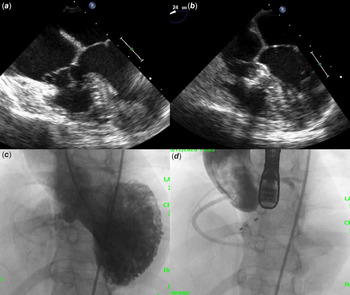
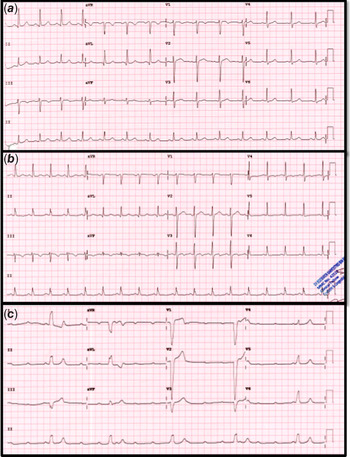
A 26-year-old woman with a moderate size perimembranous ventricular septal defect underwent transcatheter closure. Clinically, she was asymptomatic but since there was volume loading to the left heart chambers, the ventricular septal defect occlusion was undertaken. The procedure was performed under general anaesthesia. A pre-procedural echocardiogram showed a moderate size perimembranous ventricular septal defect with an aneurysmal pouch. The pouch has a diameter of 15 mm and a solitary exit, measuring 6.2 mm (Fig 1). The aortic cusp did not prolapse into the defect. Qp:Qs = 1.6:1, while the pulmonary vascular resistance was 1.2 Woods unit. A Konar-MF ventricular septal defect Occluder size 10–8 (Lifetech Scientific, Shenzhen, China), which has a 10 mm body diameter at the left ventricular end and an 8 mm body diameter at the right ventricular end, was implanted retrogradely via a 6 F delivery sheath. The procedure was smooth and intra-procedure, no rhythm disturbance was noted. However, post procedure there was a new onset of partial right bundle branch block (Fig 2). The patient was discharged well the next day. However, 1 week later, the patient complained of being unwell, having bouts of vomiting which finally culminated in a syncope episode. Electrocardiogram captured during the episode revealed a complete atrio-ventricular block (Figure). The device was removed and the ventricular septal defect was patched surgically. At the time of writing, there has not been any recurrence of complete atrio-ventricular block.
Transoesophageal echocardiogram and angiographic profiling of the VSD before and after device occlusion. ( a ) Perimembranous inlet VSD with an aneurysmal sac which has a diameter of 15 mm and a much smaller exit of 6.2 mm; ( b ) the 10–8 device that has a body of 10 mm at the LV end and a retention disk of 2.5 mm on the sides was placed within the sac; ( c ) ventriculogram profiling of the VSD and aneurysmal sac, and ( d ) the device was away from the aortic valve, while the body of the device was not significant squeezed.

Change of ECG over time (a) Normal sinus rhythm prior to the procedure. The QRS axis showed left superior axis (QRS −15°) inconsistent with a perimembranous VSD with inlet extension, which is away from the aortic valve. Device closure of this VSD has a higher risk of CAVB but a lower risk of impingement onto the aortic cusp; (b) Partial right bundle branch block shortly after the procedure; and (c) Complete atrio-ventricular block 1 week after the procedure.

Discussion
Transcatheter closure of the perimembranous ventricular septal defect is commonly performed outside of western countries due to its proximity to the conduction bundle and its association with complete atrio-ventricular block during device closure. However, being overwhelmingly the commonest ventricular septal defect has driven the quest to find a suitable device to close this defect. The first being the Amplatzer membranous ventricular septal defect occluder. The device has been discontinued due to its high risk of complete atrio-ventricular block. The emergence of the newer devices, which are made up of softer nitinol mesh and hence less radial tension onto the adjacent septal wall tissue and its underlying conduction bundle, and the improved technical know-how has led to a lower procedural risk and an exponential increase in the number of device perimembranous ventricular septal defect closures. Currently, the Amplatzer Ductal Occluder I, Amplatzer Occlude II, Amplatzer Vascular Plug, the Nit-Occlude Le Coil, the Konar device, and the Occlutech Ventricular Septal Defect Occluder were the more popularly used devices. Sans the ductal occluder I, these devices have softer device architecture that better conforms to the morphology of the ventricular septal defect, causing a lesser impingement to the adjacent septal wall tissue. Despite these qualities, the incidence of a complete atrio-ventricular block is not eliminated.
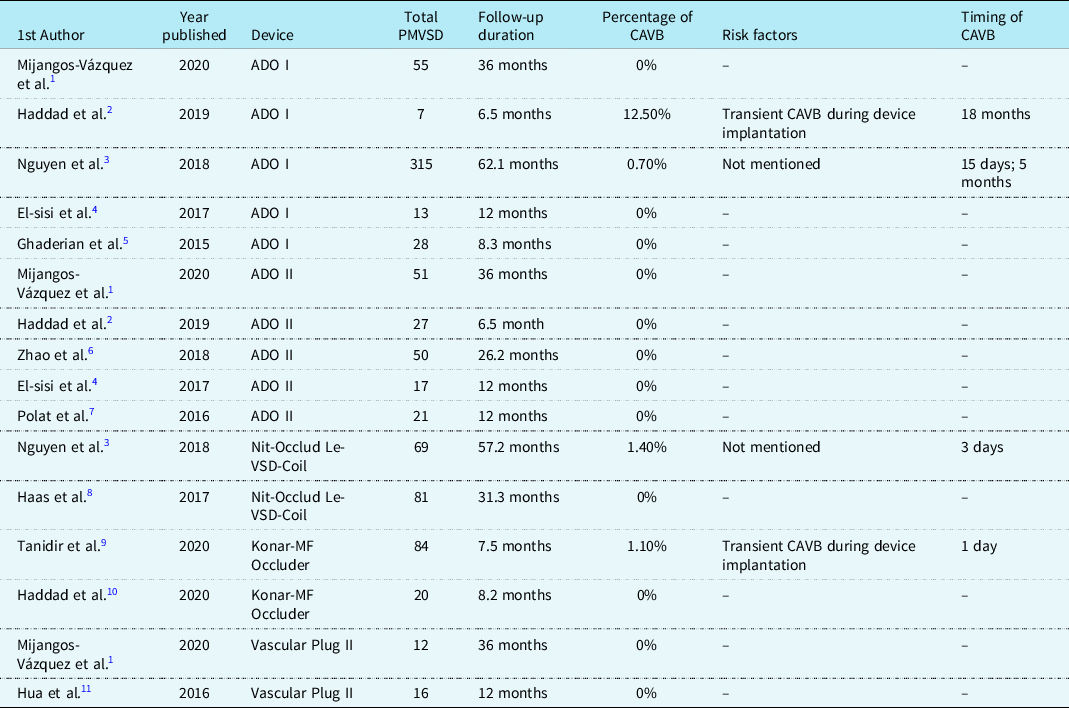
Table 1 summarises the available data on the occurrence of complete atrio-ventricular block in these newer perimembranous ventricular septal defect occluders. Among these devices, only Amplatzer Ductal Occluder II and the Amplatzer Vascular Plug II have yet to have any history of complete heart block. However, the follow-up durations in most of these studies are short and hence may not be sufficient to draw a concrete conclusion. Complete atrio-ventricular block has been reported to appear as late as 9 years after closure. Reference Bai, Xu and Li12 In our patient, complete atrio-ventricular block occurred early after the procedure, and one may argue that the use of corticosteroids to reduce inflammation at the closure site may revert the heart rhythm back to normal sinus rhythm. However, a previous literature reported a 50% recurrence of complete atrio-ventricular block after a temporary resumption of normal sinus rhythm. Reference Bai, Xu and Li12 The timing of recurrence of complete atrio-ventricular block is unpredictable that brings the fear of out-of-hospital sudden cardiac death.
Incidence of complete heart block in the “newer” ventricular septal defect occluders

ADO I = Amplatzer Ductal Occluder I; ADO II = Amplatzer Ductal Occluder II; CAVB = complete atrio-ventricular block; PMVSD = permemberanous ventricular septal defect
The appearance of an electrocardiogram change, even subtle, should raise the suspicion of an impending complete atrio-ventricular block. The progression to a complete atrio-ventricular block is unpredictable. It may occur early or late and even recur late after its initial presentation. Once a complete atrio-ventricular block occurs, early surgical removal of the device is recommended before established fibrosis takes place, precluding the recovery to rhythm normalcy. A late complete atrio-ventricular block would signal the need for a pacemaker. The possibility of a complete atrio-ventricular block should be explained to the patient prior to the procedure.
Conclusion
Complete atrio-ventricular block remains a concerning complication even in the presence of the newer occluders. The appearance of a new electrocardiogram changes should raise the suspicion of its possibility.
Acknowledgements
The authors would like to thank the Research Department of Institut Jantung Negara for its assistance in the preparation of the manuscript.
Financial Support
This research received no specific grant from any funding agency, commercial or not-for-profit sectors.
Conflict of Interest
None.