1. Introduction
1.1 Background
The rapid urbanization and industrialization experienced in China after the economic reform in the 1970s have caused a significant resurgence in economic growth. China is one of the fastest growing economies in the world. Economic growth in China has averaged about 10 per cent per annum (World Bank, 2017). Nonetheless, this economic fate has occurred at the expense of the environment and China is now the major world polluter. Locally, the rapid industrialization has increased industrial wastewater emission in the country, and this has consequently increased water pollution. Total emission of sewage is estimated to be more than 60 billion tons per year (Lu et al., Reference Lu, Song, Wang, Liu, Meng, Sweetman, Jenkins, Ferrier, Li, Luo and Wang2015). According to the first national census of pollution sources released in 2010, total industrial wastewater discharge hit 24 billion tons. Nearly 40 per cent of the rivers in China are severely polluted, and about 20 per cent of the rivers have become too toxic to be used (Jian, Reference Jian2012). About 71.8 per cent of the people in China are confronted with the threat of water pollution (Miao et al., Reference Miao, Tang, Wang and Zang2015). It is estimated that more than 1,700 outbreaks of water pollution incidents occur every year in China (Xie, Reference Xie2011).
The severe situation with regard to pollution has limited the availability of quality water for home, industrial, recreational and agricultural use in the country. About 17.2 per cent of the river sections, 24.7 per cent of the lake areas and 4.5 per cent of the reservoirs have been rendered useless by water pollution (Hu and Cheng, Reference Hu and Cheng2013). Particularly, in Northern China, water shortage is a major concern. As a consequence, more than 300 million people in China live with hazardous drinking water (Lu et al., Reference Lu, Song, Wang, Liu, Meng, Sweetman, Jenkins, Ferrier, Li, Luo and Wang2015). This has increased water-related diseases in China, posing a significant health risk to human life. As noted by Wang and Yang (Reference Wang and Yang2016), water pollution increases health risk in China. Every year in China about 190 million people fall victim to water-related diseases and about 60,000 people lose their lives from water-related diseases (Qiu, Reference Qiu2011; Tao and Xin, Reference Tao and Xin2014). The situation also poses a significant risk to food production in China. As revealed in an assessment of 17.6 × 10⁴ km long rivers in China in 2010, 17.7 per cent of the length of the rivers could not be used for irrigation purposes. Moreover, due to the hazardous nature of the content of wastewater, soil quality is degraded and this affects the quality of grain negatively (Hassan et al., Reference Hassan, Mahmood, Waseem, Irshard and Pervez2013).
Thus, in order to improve upon the availability of quality water and mitigate against the risk factors in health and agricultural production in China, a deeper understanding of the driving causes of wastewater pollution – in particular in the industrial sector as more than 40 per cent of the 58.9 billion tons of wastewater emission in 2010 originated from industries – is critical. Therefore, this article analyses the drivers of industrial wastewater pollution in China.
1.2 Wastewater management regulation in China
Since 1979 the Chinese government has implemented several environmental policies aimed at improving upon the quality of the surface water in China. However, the 11th and 12th Five-Year plans represented a significant paradigm shift in wastewater management efficiencies in China. In both policy documents, the focus of environmental policy related to wastewater management was on chemical oxygen demand (COD) and ammonia nitrogen (NH3-N) (Fujii and Managi, Reference Fujii and Managi2017). In the period of the 11th Five-Year Plan, the central government enacted a total quantity administration target for COD discharge, which was to control the aggregate emissions demand, diminishing it from 14.14 million tons to 12.73 million tons against that of 2005 (The State Council, 2006). Subsequently, in the 12th Five-Year Plan, for example, the national government set binding targets to reduce the nationwide total discharge of NOx, COD, SO2 and CO2 by 8, 10, 8 and 17 per cent, respectively, by the close of 2015. At the beginning of 2012, the Chinese Government implemented a stringent water management policy, dubbed the ‘three red lines’. The policy sets targets for total water use, water use efficiency and surrounding water quality for particular benchmark years to 2030. Specifically, the ‘red line’ target for controlling pollution is that 60 per cent of water achieves the standard water quality with the help of technical indicators support (Global Water Partnership, 2015).
1.3 Literature review and our contributions
Although there are a large numbers of studies that have analyzed the causes of environmental quality in China, few studies have considered industrial wastewater emission, which is the major contributor to water toxicity in China. Geng et al. (Reference Geng, Wang, Sarkis, Xue, Zhang, Fujita, Yu, Zhang and Dong2014) apply the Logarithmic Mean Divisia Index (LMDI) technique to analyze the driving forces of industrial wastewater emissions in 31 provinces in China for the period 1995–2010. Their results reveal that regional economic development, regional industrial structure and population increase industrial wastewater emissions, but technological improvement decreases industrial wastewater emissions. Regional economic development emerged as the major contributor to industrial wastewater emissions, followed by technological improvement, regional industrial structure and population.
Cole et al. (Reference Cole, Elliot and Zhang2011), Liu et al. (Reference Liu, Zhou and Wu2015) and Liu et al. (Reference Liu, Wang, Zhang, Zhan and Li2018) instead apply econometric-based techniques to make inferences on statistical causality and effects to avoid the major limitation of the LMDI technique. Cole et al. (Reference Cole, Elliot and Zhang2011) investigate the relationship between economic growth and industrial pollution emission in Chinese cities. The study uses two indicators of water pollution – wastewater and petroleum-like matter – and four air pollution indicators. Their result also confirms that a higher income increases industrial air and water pollution in China. Furthermore, they find that a higher industry output increases wastewater emissions. The effect of the share of output funded by domestic and foreign firms and from firms in Hong Kong, Taiwan and Macau (HTM) on wastewater is negative but significant for domestic and HTM sources. Liu et al. (Reference Liu, Zhou and Wu2015) apply an extended STIRPAT model and provincial panel-based data to analyze the effects of human activity on energy consumption and three industrial pollutants – exhaust gases, wastewater and solid waste. Their results show that higher population density, industrial energy intensity and industrial output increase industrial wastewater pollution. Liu et al. (Reference Liu, Wang, Zhang, Zhan and Li2018) use a spatial econometric-based approach to analyze the link between foreign direct inflows (FDI) and the environment, taking into account the spatial effects. The authors use three pollutants including waste soot and dust, sulphur dioxide and wastewater. The results show that FDI has differential impacts on pollutants. While FDI decreases waste soot and dust, it increases wastewater and sulphur dioxide.
Our main contribution to the literature is to provide one of the first analyses on investigating the drivers of industrial wastewater pollution in China based on a time series econometric approach. In particular, the current study makes the following important distinctions from previous attempts in the literature.
Firstly, this article estimates the effect of environmental regulation on wastewater discharge in China and identifies through which channel the regulation affects the pollution level. In the literature, there are different channels, but with differential effects, by which such national environmental regulations could affect environmental outcomes. As a result, an evaluation of the overall impact of such environmental regulations on environmental outcomes becomes an empirical exercise. First, strict environmental regulation imposes a higher additional cost on producers, which can restrict entry and negatively affect employment and production and hence the associated emission levels (Zhou et al., Reference Zhou, Zhu and He2017). Second, strict environmental regulation can induce investment in innovation, which could boost employment and production and allow new entry (Zhou et al., Reference Zhou, Zhu and He2017). The overall effect on environmental outcomes may depend on the extent of economies of scale enjoyed by the industry in providing environmental services. Third, foreign direct inflows via the scale effect increase the energy requirement in the host economy, and this could worsen environmental outcomes. However, strict environmental regulation – apart from determining the relocation of industries – could induce significant behavioral change in the host economy to avert the high energy requirement imposed by the scale effect of FDI. Consequently, regulation helps reduce the energy-related emissions in the host country induced by FDI. It is not straightforward to deduce whether strict national environmental regulation improves environmental outcomes or not. This article examines the direct effect and the structural break-induced effect of national environmental regulation on industrial wastewater emissions.
Secondly, the national government has heightened efforts to reduce emission levels in the country by increasing the investment in environmental treatment. Such investments cover equipment engineering and manufacturing and environmental services. In 2015, a total of RMB880.3 billion, which represents 1.3 per cent of GDP, was invested in environmental treatment (Hong Kong Trade Development Council (HKTDC), 2017). Although these investments are crucial in mitigating water pollution, an economic analysis into the marginal effects of real investment in environmental treatment on industrial wastewater emission is missing in the literature. This article measures the long-run marginal effect of real investment in environmental treatment on industrial wastewater emissions, providing a quantitative support for future investment decision making.
The paper is organized as follows. Section 2 presents the method and data. Section 3 discusses the main findings of the study. Section 4 concludes the paper with some implications for policy.
2. Method and data
2.1 Theoretical framework
The theoretical model is based on the ‘pollution demand-supply’ theory applied in Cole et al. (Reference Cole, Elliot and Wu2008). This theory treats environmental services as a direct input in the production process. Pollution demand equals the total industrial demand for environmental services. Several factors affect pollution demand, including the size of the economy or industry, the expected price of pollution, total energy use or energy use structure, input efficiency and vintage.
Size refers to the extent of scale economies in a country. Two alternative proxies are used, namely real per capita GDP (GDPpc) and real per capita industrial value added (IVApc), to measure the aggregate economy and industrial counterpart, respectively. As discussed in Cole et al. (Reference Cole, Elliot and Wu2008), pollution demand is perceived to decline as the economies of scale increases. Larger industrial sectors benefit from the size extension in pollution abatement and resource use. Conversely, larger industrial sectors are deemed to be pollution intensive, which are more visible targets for public authorities, triggering a higher penalty. Consequently, the positive economies of scale in abatement may be offset. The effect of scale on industrial pollution demand is therefore indeterminate.
Since industrial wastewater will ruin the ecological environment, a higher level of wastewater emissions is associated with imposing a higher price. Therefore, the demand for wastewater in the industrial sector diminishes as the expected price of pollution increases. The structure of energy use in China's industrial sector is dominated by coal consumption, in which the process discharges a mass of wastewater. Industrial wastewater is of two forms: inorganic industrial wastewater and organic industrial wastewater. The former mainly originates from the coal and steel industry and the non-metallic minerals industry. Therefore, a higher use of coal energy in the industry will lead to an increase in the demand for industrial wastewater. To capture the energy use structure, this paper uses the share of coal energy consumption in total energy consumption (SCOALC).
In order to capture the input efficiency and vintage effects, this article incorporates three measures: real investment in environmental treatment (RITE), foreign direct inflows (FDI) and trade openness (TOP). While real investment in environmental treatment promotes input efficiency and the technological base of the production process, trade liberalization induces technological and knowledge transfers that enhance the technical processes of industries. The amount of industrial wastewater discharged is driven by the nature of the technical processes of production in the industrial sector. With an improvement in input efficiency and production technologies, the amount of industrial wastewater emitted should decline. The fundamental mathematical representation of pollution demand is:

where S t denotes the size of the economy or industry, P t denotes the expected price of pollution, E t denotes total energy use or energy use structure, IEt denotes input efficiency and V t denotes vintage (new production process).
On the other hand, pollution supply shows the total allowable emissions within the sector or economy, which is determined by the government's environmental regulation policy. The expected price of pollution is the inherent price paid for emitting more. Thus, more emissions are allowed at a higher price and vice versa. This implies that the identification of the expected price of pollution is dependent on the stringency of the government's environmental policies and total emissions. This is derived as:

where ERt denotes environmental regulation and $e_t^s$ is total emission. Substituting equation (2) into equation (1), and with the condition that pollution demand ($e_t^d$
 ) equals pollution supply ($e_t^s$
 ) in the equilibrium, the equilibrium total emissions (e t) is thus derived as

2.2 Empirical model
The empirical model to be estimated originates from equation (3). As suggested in Cole et al. (Reference Cole, Elliot and Wu2008) and Ang (Reference Ang2009), a linear transformation of equation (3) is able to directly estimate how different factors affect the pollution level. The empirical equation is:

where ε t captures the unexplained random component of the model.
This article uses industrial wastewater as the indicator for emissions. In order to capture the effect of environmental regulation and confirm its validation, this study uses a binary indicator at the beginning – environmental regulation dummy (ERD) – that takes the value of 1 from 2006 onwards and 0 for periods before. Although there have been several government attempts to deal with the environmental problem in the country in the past, the launch of the 11th Five-Year Plan in 2006 represents an important milestone in China's commitment to reduce emission levels. The 12th Five-Year Plan was also strict on environmental outcomes. In both the 11th and 12th Five-Year Plans, the government set binding targets to improve upon industrial wastewater management in the country.
Incorporating all the drivers of aggregate industrial wastewater above, equation (4) is modified as:

Equation (5) estimates the direct marginal effect of the government's environmental regulation on environmental outcomes. Though these regulations are standalone policies, their effect on environmental outcomes is more indirect. For example, the policy may directly determine the location and type of FDI or redefine the input-use behavior by causing firms to shut down inefficient plants, reduce the use of the inefficient input or invest in technology to improve the input-use efficiency. In this study, we examine the direct effect that the regulation could have on energy-use behaviors in the industrial sector.
Foreign direct inflows via the scale effect increase the energy requirement in the host country and hence higher pollution. Without stricter environmental regulation, location of inefficient foreign energy-intensive firms could amplify the pollution via the scale effect of FDI and improve environmental outcomes. However, strict governmental environmental regulations can induce a significant behavioral shift in the use of coal energy and hence avert the possible high energy requirement imposed by the scale effect of FDI. Moreover, stricter regulations on the environment can propel direct reductions in coal energy use or improvement in coal energy use technology by local firms. Consequently, the effect of energy on emissions experiences a significant structural break that differentiates the energy-use impact on environmental outcomes in different periods. To capture this effect, this study estimates a modified equation, where the interactions of environmental regulation dummy and share of industrial coal energy consumption are included as an additional regressor.Footnote 1 Equation (6) shows the effect that stricter environmental regulations have on environmental outcomes via the channel of energy-use:

2.3 Econometric strategy
This article applies three long-run cointegrating models – the fully modified ordinary least squares (OLS) or FMOLS by Phillips and Hansen (Reference Phillips and Hansen1990), the canonical cointegrating regression or CCR by Park (Reference Park1992), and the dynamic OLS or DOLS by Stock and Watson (Reference Stock and Watson1993) – to estimate equations (5) and (6). These three techniques use different transformation of the data and the estimates to modify long-run equations to mimic strict exogenous regressors. Compared to the OLS estimator and other cointegrating approaches, these three long-run estimators provide consistent and efficient estimates of the long-run estimates by correcting for serial correlation in errors and simultaneity bias in regressors. Though these three techniques use different correction mechanisms, asymptotically they provide qualitatively similar estimates.
In the case of the FMOLS, the data is first transformed and then the least squares estimates are modified to remove the nuisance in parameter estimates. The CCR first transforms the data and then proceeds to select among the class of canonical regression models, a canonical regression that depicts the same cointegrating regression. The DOLS introduces the lead and lags of the first difference of the regressors as additional covariates in the long-run model. All three techniques have desirable finite sample properties.
The estimation in this article proceeded as follows. We first estimate a simplified version of equation (5) as the baseline model, where we excluded the effects of governmental environmental regulation. We then estimate equations (5) and (6), where we include the role of governmental environmental regulation. At this stage of the work, we use real per capita GDP as the measure of size. Following this, we conduct several rounds of robustness checks on the results obtained: firstly, we use the real per capita industrial value added as the measure of size; secondly, we test for the presence of structural break in the share of coal energy consumption and relate it to the environmental regulation policy dummy. We then re-estimate the model using the structural break dummy (SBD). Thirdly, we consider the change in stringency of environmental regulation over time by adopting a continuous policy indicator. Specifically, the amount of COD removed in the industrial wastewater (RCOD) is used to measure the stringency and effect level of environmental regulation over time. We also address the potential endogeneity of our policy variable with an instrumental variable approach.
2.4 Data description and source
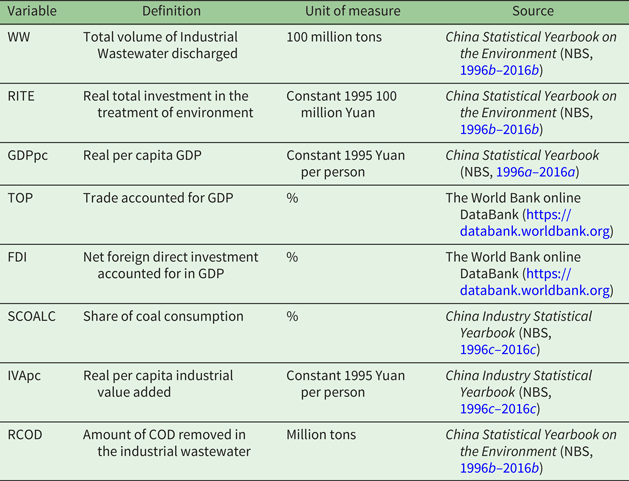
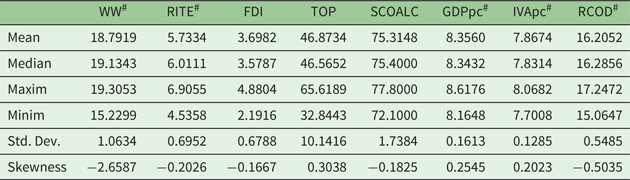
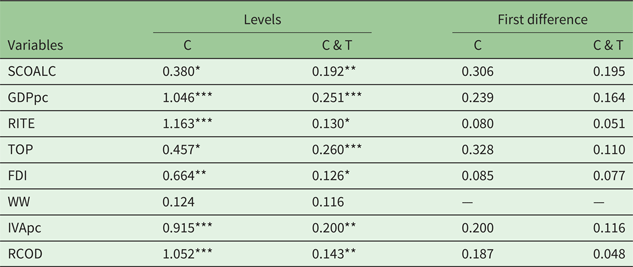
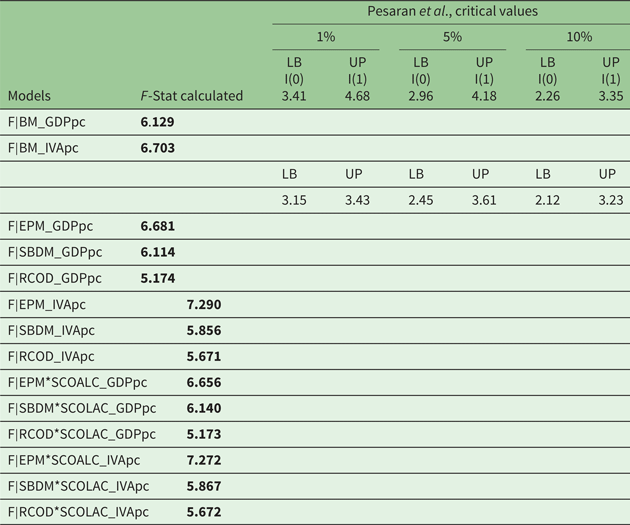
This study uses quarterly time series data from 1995Q1 to 2015Q1. The variable definitions, measurements and data sources are shown in table 1, while table 2 contains the descriptive statistics of the variables. All the variables are converted into log form except for the variables measured in percentage (%). A preliminary unit root test based on the Kwiatkowski–Phillips–Schmidt–Shin (KPSS) test shows that the variables contain unit root in levels but become stationary after first differencing. Thus, we have I (1) variables (see table A1 in the appendix for the results). We then applied the Bounds cointegrating technique to test for evidence of long-run relationships for all the models we estimate. For all the models, the test shows rejection of the null hypothesis of no cointegration in favor of the alternative hypothesis of cointegration (see table A2 in the appendix for the results), which confirms that there exists a long-run equilibrium relationship.
Variable definition, measurement and source

Descriptive statistics

Note: #: in log form
3. Discussion of results
3.1 Long-run drivers
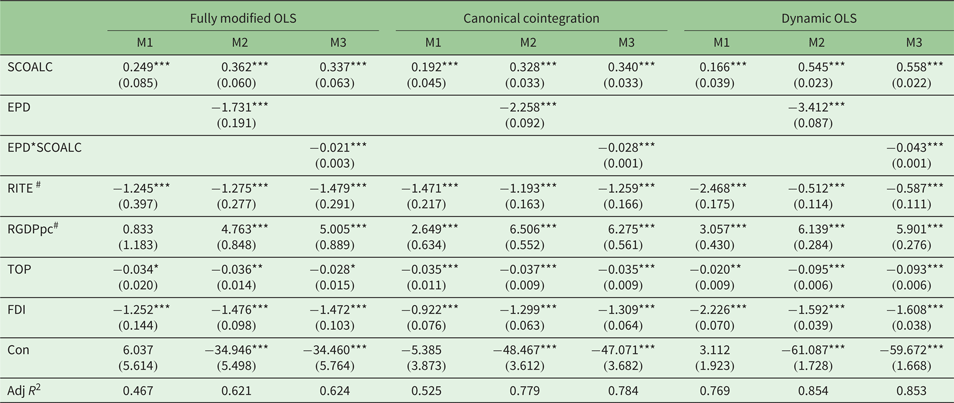
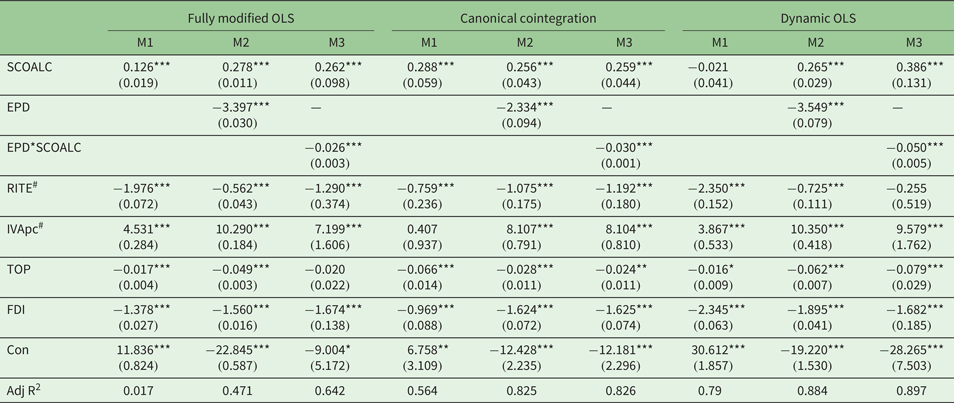
Table 3 shows the long-run estimates of the drivers of industrial wastewater emission. Model 1 is the baseline model. According to this model, the effect of share of coal on industry wastewater pollution is positive and statistically significant for all three estimators. The effect of trade openness is significantly negative within the 10 per cent level for all three estimators. The effect of real per capita GDP is consistently positive and statistically significant for all three estimators. According to the estimate, industrial wastewater emission is expected to increase between 2.65 and 3.06 per cent for every 1 per cent increase in real per capita GDP, holding other factors constant. Though a higher income induces both scale and technical effects, the positive effect of income on industrial wastewater emission suggests that the scale effect dominates. This might suggest the absence of scale economies in environmental services in the sector. The positive effect of income on industrial wastewater pollution confirms the results of Cole et al. (Reference Cole, Elliot and Zhang2011).
Long-run estimates

Notes: Automatic lead and lag selected based on AIC.
#: in log. ***, **, * denote 1%, 5% and 10% significance levels, respectively.
The effect of both investment and FDI are consistently negative and statistically significant. In the case of investment, industrial wastewater emissions will fall, holding other factors constant, by between 1.25 and 2.47 per cent, if real investment in treatment of the environment increases by 1 per cent. As mentioned earlier, the amount of industrial wastewater discharge depends on the technical processes of the industrial sector. Improvement in the technical process of the industrial sector induced by investment in environmental treatment and FDI is expected to reduce the amount of industrial wastewater discharged. Geng et al. (Reference Geng, Wang, Sarkis, Xue, Zhang, Fujita, Yu, Zhang and Dong2014) also confirm that improvement in technology reduces industrial wastewater emissions in China. Cole et al. (Reference Cole, Elliot and Zhang2011) also confirm the negative effect of output of foreign-owned firms and firms from HTM (used as a measure of FDI) on industrial wastewater emissions.
Next, in model 2, we include the effects of governmental environmental regulatory policy. For all three estimators, we observe that the standard errors for all the parameter estimates decrease, which is an indication of: (1) model efficiency improvement, and (2) omission of an important variable. Consequently, the statistical significance of the model parameters improves greatly. The share of coal energy in total energy consumption has a consistent and significant positive effect on industrial wastewater emissions. Increasing the share of coal energy consumption raises industrial wastewater emissions, all things being equal. As mentioned earlier, inorganic industrial wastewater discharge primarily originates from the coal and steel industry. Moreover, in the separation process of coal from rock, water is primarily used in coal transportation and washing, and this accumulates coal and rock particles in the water. Cole et al. (Reference Cole, Elliot and Zhang2011) also find that increasing industrial energy intensity in China increases industrial wastewater pollution. Coal energy is the dominant energy type used in Chinese industrial sectors. Therefore, the results of Cole et al. (Reference Cole, Elliot and Zhang2011), compare with the results of the current study.
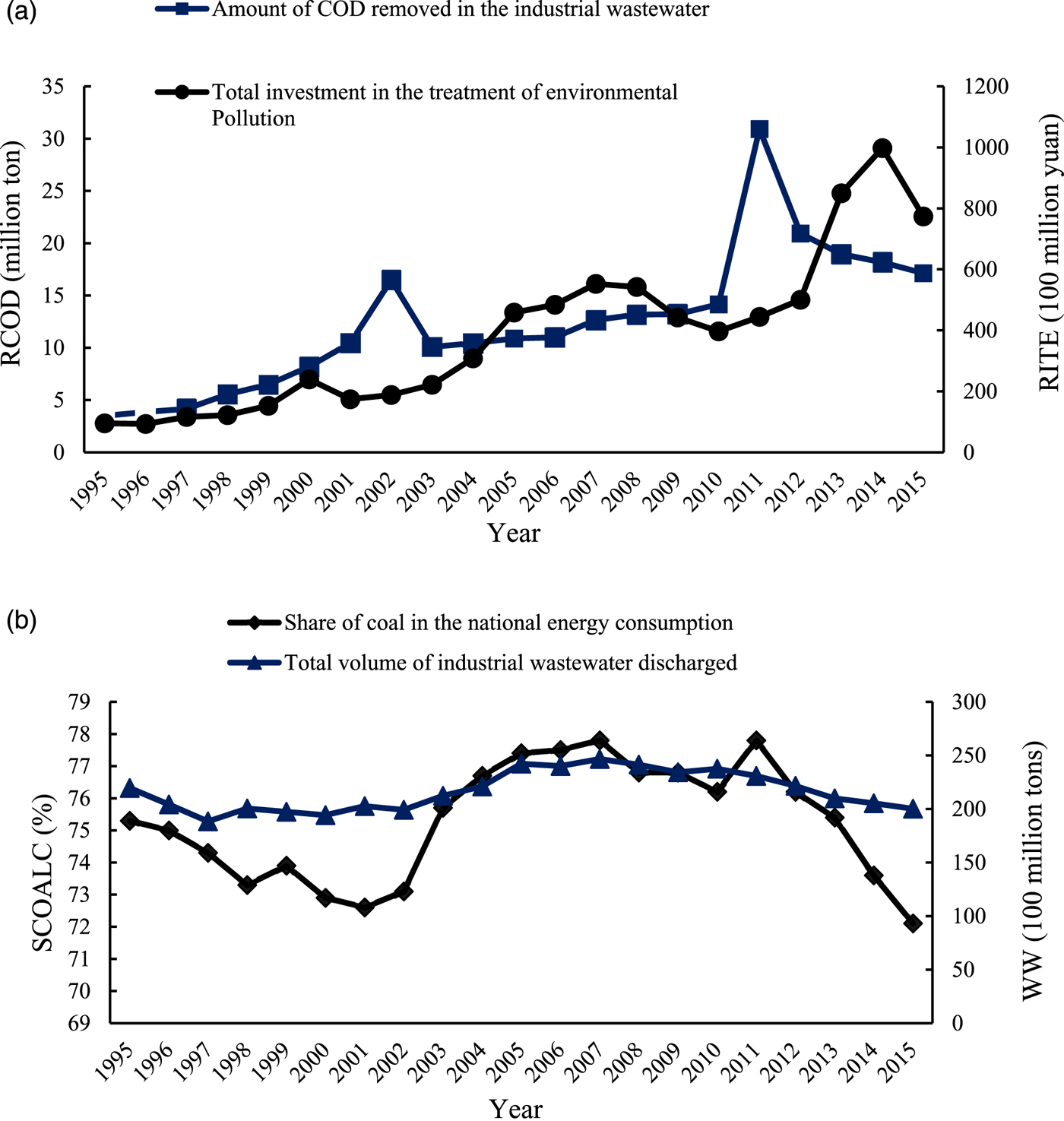
The effect of real investment in treatment of the environment has a consistent negative effect on industrial wastewater emission. According to the estimates, holding other factors constant, an increase in investment for environmental treatment by 1 per cent will cause industrial wastewater emission to fall by between 0.51 and 1.28 per cent. Figure 1(a) shows that investment in the treatment of environmental pollution increased steadily before 2000, while there were declines after 2000, particularly from the 11th Five-Year Plan; a growing trend is observed overall. Investment in the treatment of environmental pollution enhances the equipment, machinery and engineering efficiencies of the industrial sector, and this helps improve the technical processes of the industrial sector, and thus reduce industrial wastewater emission. As figure 1(a) demonstrates, the amount of COD removed in the industrial wastewater has a similar volatility trend as investment in the treatment of environmental pollution, which illustrates the positive effect of the investment in the treatment. Similarly, the effect of trade liberalization (measured by trade openness and FDI) on industrial wastewater emission is consistently and significantly negative. Trade liberalization enhances the technical processes of the industrial sector via technological and knowledge transfer.
Trends in industrial wastewater emission and control in China. (a) Trends in industrial wastewater control variables, (b) Trends in industrial wastewater emission-related variables.
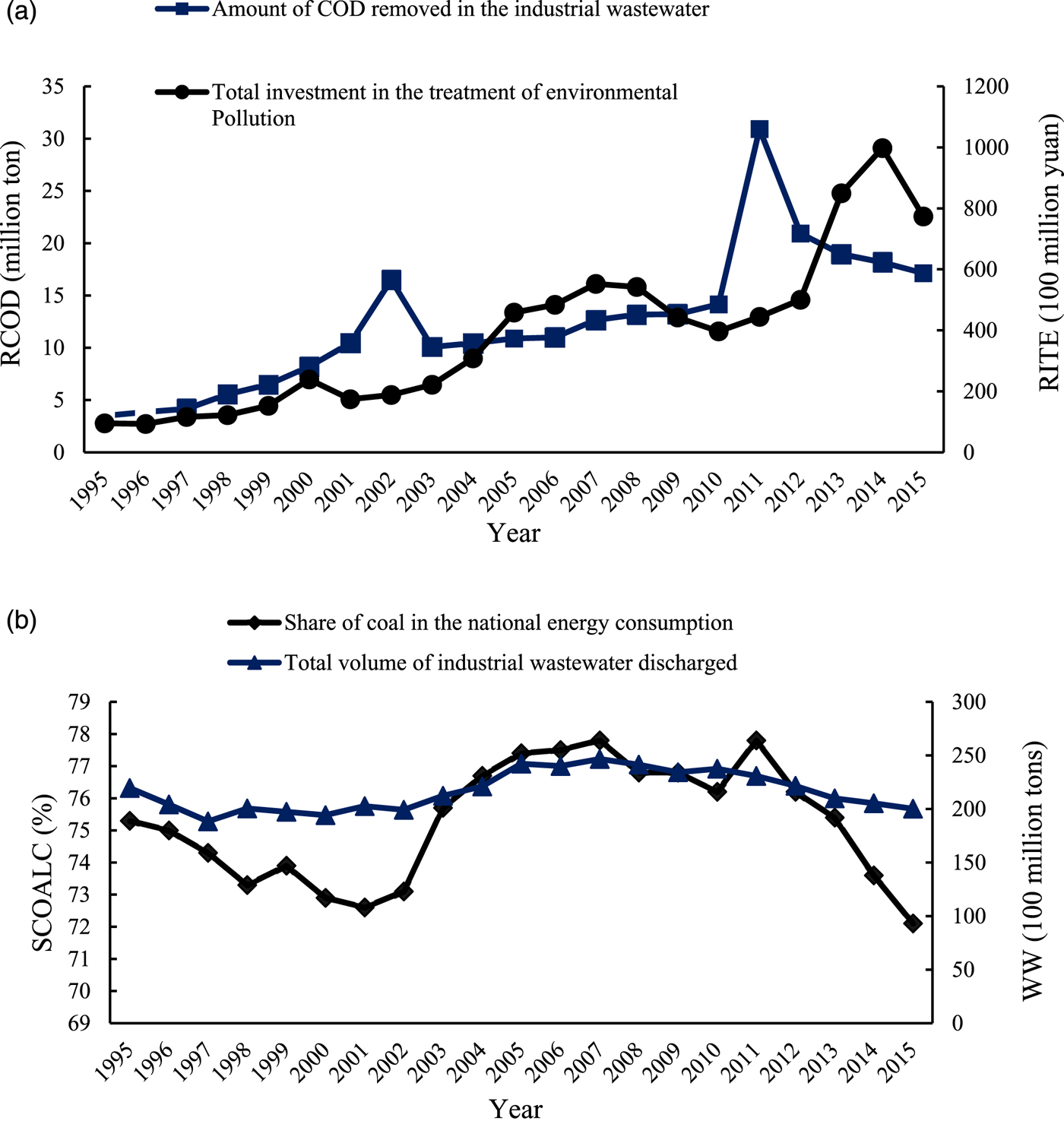
Governmental environmental regulation significantly reduces industrial wastewater emission. Strict environmental regulation imposes additional cost on producers, and this limits new entry, and lowers employment and production. Consequently, the associated emissions are minimized. In the 11th Five-Year Plan, the government set reduction targets for wastewater emissions. The implementation of strict environmental regulation to improve wastewater management in the country has successfully reduced industrial wastewater. Figure 1(b) shows the time plot of industrial wastewater. It can be observed that, while industrial wastewater discharged remained high in 1995, it decreased between 1996 and 1997. It rather increased from1998 and remained relatively stable until in 2006, when it fell again. Since then, industrial wastewater emission has consistently declined, which could be partially attributed to the strict environmental regulation on wastewater management spelled out in the 11th −12th Five-Year.
Final, in model 2, real income has a consistent and significant positive effect on industrial wastewater emission. The elasticity suggests that an increase in real income by 1 per cent, holding other factors constant, will cause industrial wastewater emission to rise between 4.8 and 6.1 per cent. The positive effect of income on industrial wastewater emissions indicates the dominant nature of the scale effect of income over the technical effect, and the absence of scale economies in the provision of environmental services in the Chinese industrial sector. This finding is consistent with Cole et al. (Reference Cole, Elliot and Zhang2011) and Geng et al. (Reference Geng, Wang, Sarkis, Xue, Zhang, Fujita, Yu, Zhang and Dong2014), who found income to be a dominant factor driving industrial wastewater emissions.
Finally, in model 3, we examine the interaction effect of governmental environmental regulation and the share of coal energy used in the industrial sector. As discussed earlier in this article, strict regulation can offset the high energy requirement imposed by the scale effect of FDI in the host country. Moreover, it can induce behavioral change to positively impact on coal technology efficiency and switch to clean energy sources. If this claim is true, the effect of the share of coal energy on industrial wastewater emission conditioned on stringent environmental regulation should be significantly negative. The result presented in model 3 of table 3 confirms the argument above. As shown in model 3, the coefficient of the interaction term is consistently and significantly negative. From figure 1(b), it appears that the share of coal in the national energy consumption was 75 per cent in 1995, but dropped to about 72.5 per cent in 2001. It began increasing again from 2002, reaching 78 per cent in 2007, before falling again. Since then, the share of coal in the national energy consumption has continuously declined, reaching 72 per cent in 2015.
This implies that stringent environmental regulation induces behavioral change and leads to less dependence on coal energy consumption. However, strict environmental regulation only partially offsets the energy-induced effect on industrial wastewater emissions of around 0.02–0.04 per cent. Wang and Shen (Reference Wang and Shen2016) find that environmental regulation positively affects clean production industries in China. Two important things could be deduced from this result. First, governmental environmental regulations have the desired intended effects in the case of improving upon the wastewater management system in the industrial sector. Secondly, however, the government should impose much stricter regulation in order to achieve greater gains in wastewater management efficiency in the industrial sector, to fully offset the positive effects of coal use on pollution emissions.
Further results in model 3 show that investment in the treatment of the environment and trade liberalization has a consistent negative effect on industrial wastewater emission. This confirms the earlier result that investment in treating the environment and trade liberalization enhance the technical processes of the industrial sector by improving the technological and knowledge base and input efficiency in the industrial sector. These reduce the amount of industrial wastewater discharged in the country. The effect of real income is also consistently and significantly positive, which confirms the earlier result that the scale effect of income dominates the technical effect of income. Consequently, there is an absence of economies of scale in the provision of environmental services in Chinese industrial sector.
3.2 Further studies
3.2.1 Use of real per capita industrial value added as size measure
In section 3.1, real per capita income is used as the measure of size. However, this relates more to the general economy of which the industrial sector is one part. By using the real per capita GDP variable, we might not capture the true extent of the scale effect of output in the industrial sector, and this could bias the results. Therefore, in this section, we include real per capita industrial value added as the measure of size and reproduce the results in table 3. Table 4 contains these results.
Long-run estimates

Notes: Automatic lead and lag selected based on AIC.
#: in log. ***, **, * denote 1%, 5% and 10% significance levels, respectively.
The baseline results presented in model 1 are very consistent with the results in table 3. The share of coal energy has a positive effect on industrial wastewater emission, but investment in environmental treatment and trade liberalization have a consistent negative effect on industrial wastewater emission.
As before, we include the effects of environmental regulation in the model. This is shown in model 2. Again here, the inclusion of this variable has reduced the standard errors of the model parameters significantly and, consequently, improved the model efficiency, the overall significance of the model parameters, and the explanatory power of the model. The share of coal energy and real per capita industrial value added have consistent and significant positive effects on industrial wastewater emission. However, compared to table 3, we see here that the size of the output elasticity is very elastic, which is an indication of the dominant nature of the scale effect of output over the technical effect of output in the industrial sector. The results again point to the absence of scale economies in providing environmental services in the industrial sector in China. Geng et al. (Reference Geng, Wang, Sarkis, Xue, Zhang, Fujita, Yu, Zhang and Dong2014) and Cole et al. (Reference Cole, Elliot and Zhang2011) confirm the positive effect of industry output on industrial wastewater emissions.
Investment in treating the environment and trade liberalization have consistent negative effects on industry wastewater emission. This confirms the earlier claim that increasing the investment amount devoted to treating the environment and trade liberalization enhance the technical processes of the industrial sector and hence limit the amount of industrial wastewater discharged. Also, the effect of strict environmental regulation is consistently and significantly negative. This also confirms the earlier claim that strict environmental regulation minimizes industrial wastewater emissions in China.
Model 3 shows the effect of interacting the regulation dummy and the share of coal energy used in the industrial sector. The claim that strict environmental regulation could offset the higher energy requirement imposed by the scale effects of FDI and cause a positive behavioral switch to clean energy sources and clean technologies cannot be rejected. However, as previously found in table 3, this offset provided by strict environmental regulation is partial and thus requires a much stricter regulation to generate greater gains in improving upon industrial wastewater management in China. The other results remain consistent. The results are insensitive to the measure of size used in this study and hence robust.
3.2.2 Use of structural break dummy
We introduced a dummy variable to capture environmental regulation in section 3.1 and presumed that this has led to a significant structural break in coal energy consumption in a manner that worked to improve wastewater management in the industrial sector. This approach had a realistic background and no statistical background as to whether, indeed, statistically, the introduction of the regulation caused a significant structural break in industrial coal energy consumption. This section deals with this problem.
To deal with this issue, we estimate model 1 in table 3 and test for the presence of a structural break in coal energy consumption, and then match that to see if it coincides with the period when the government launched the 11th Five-Year Plan in China. If this is true, we can claim that the introduction of the governmental environment regulation has induced a significant structural break in coal energy consumption by causing a behavioral shift in the way the industry uses coal energy.
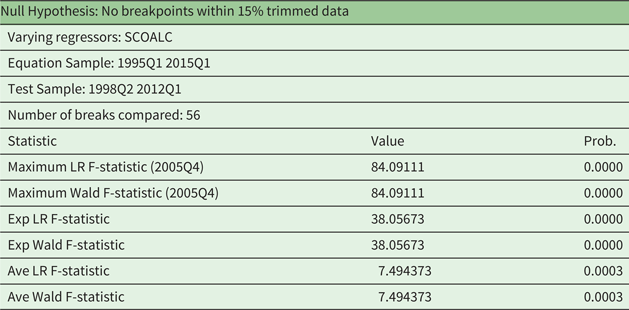
We apply the Quandt–Andrews unknown breakpoint test. The advantage of this approach is that the researcher is not required to impose the period assumed to represent a significant breakpoint location in the history of the economy. Furthermore, the approach tests for multiple structural break locations and then chooses the maximum breakpoint location. Thus, several periods are given equal consideration in this test. The test shows that the period 2005Q4 represents the maximum significant structural breakpoint location in coal energy consumption (see table A3 in the appendix for the results). This coincides well with our policy dummy, which commenced in the first quarter of 2006. Thus, we cannot refute the claim that the introduction of the strict environmental regulation has caused a significant structural break in coal energy consumption.
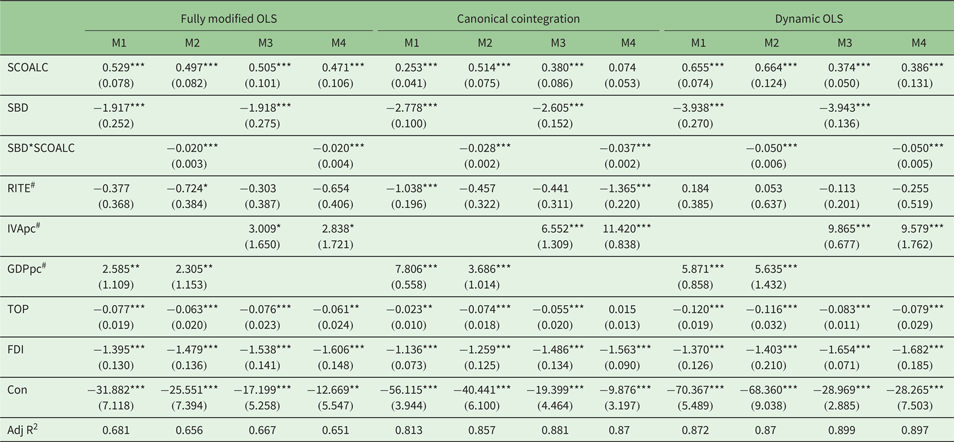
Based on the above, we reproduce the results in tables 3 and 4, using the structural break dummy to replace the regulation policy dummy. Table 5 shows these results. Consistently, the share of coal energy directly increases industrial wastewater emission, while environmental regulation reduces it. The interaction of both variables, however, shows that strict environmental regulation could offset the energy-induced effects imposed by the scale effect of FDI and caused significant behavioral responses in a manner that limits coal usage, improves coal usage technologies and increases the dependence on clean energy sources, albeit the extent of the offset is only partial. Real per capita income and real per capita industrial value added have consistent and significant positive effects on industry wastewater emission. However, the elasticity for the latter is greater. The positive effect denotes the absence of scale economies in the provision of environmental services in the Chinese industrial sector.
Long-run estimates

Notes: Automatic lead and lag selected based on AIC.
#: in log. ***, **, * denote 1%, 5% and 10% significance levels, respectively.
Trade liberalization, measured by FDI and trade openness, shows a consistent and significant negative effect on industrial wastewater emissions. Thus, trade liberalization improves wastewater management in the industrial sector. The transmissions channels are via effective foreign competition that induces local investment, the opportunities to learn from and imitate foreign technologies and skill transfers. Generally, investment in treating the environment also has a negative effect on industry wastewater emission. The results, on the average, remain similar even when we use the structural break dummy.
3.3.1 Continuous proxy of wastewater policy
In section 3.1, we examined the direct and the structural break-induced effect of national environmental regulation on industrial wastewater emissions using the dummy environmental policy variables. Nevertheless, the dummy variables might not be a perfect proxy for environmental regulation to identify the effect of policy precisely.
This section introduces a continuous environmental regulation indicator to capture the change in stringency of environmental regulation over time. Since the 11th Five-Year Plan, the government has enacted a total quantity control target for COD discharged. COD is one of the main pollutants which is administrated by the central authority. Therefore, the amount of COD removed in the industrial wastewater could measure the stringency and effect level of environmental regulation over time.
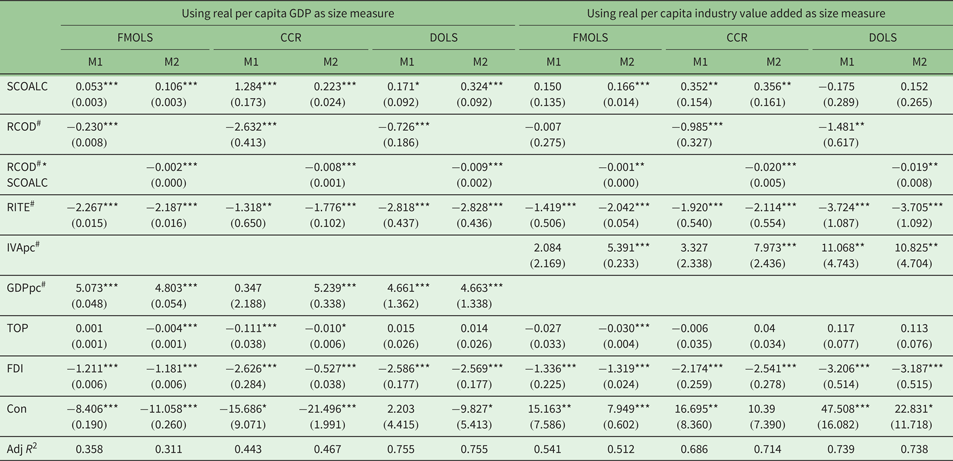
We re-estimate the model by replacing the previous dummy variables with the log of amount of COD removed in the industrial wastewater and table 6 demonstrates the results. The results consistently show that, while increasing the share of coal increases the amount of industrial wastewater emissions, strict regulations indicated by increasing amount of COD removed in the industrial wastewater reduce the amount of industrial wastewater emissions. Their interaction has a negative effect on total industrial wastewater emissions. This verifies the results of using dummy environmental policy estimations and implies that government regulation of the total quantity control target for COD discharge since the 11th Five-Year plan could offset the energy-induced effects imposed by the scale effect of FDI and has induced positive behavioral changes that have reduced the emission-inducing effect of using coal.
Long-run estimates
Dependent variable: Total industrial wastewater emission

Notes: Automatic lead and lag selected based on AIC.
#: in log. ***, **, * denote 1%, 5% and 10% significance levels, respectively.
Furthermore, real per capita GDP and industrial value-added show a positive effect on industrial wastewater emissions, which confirms the earlier claim that there is an absence of scale economies in the provision of environmental services in Chinese industrial sectors. Both FDI and trade openness have negative effects on total industrial wastewater emissions. Overall, this confirms the earlier result that globalization has helped improve the technical processes of industries in China, which has resulted in lower wastewater emissions. Real investment in environmental treatment displays a negative effect consistently. The main findings are similar to what we have discussed above. Notwithstanding, generally the results of this article remain robust even when we use the amount of COD removed in the industrial wastewater as a continuous policy measure instead of dummy variables.
3.3.2 Addressing endogeneity issue
Another issue that should be taken into consideration in the long-run estimation is the potential endogeneity problem of environmental policy stringency. To address this issue, we follow the strategy of a two-stage residual inclusion approach (2SRI hereafter), which is suggested by Terza et al. (Reference Terza, Basu and Rathouz2008) and Terza (Reference Terza2018). We consider the potential endogeneity problem for the policy variable RCOD and the interaction term RCOD*SCOALC.
In the first stage, we identify the proper instrumental variables and regress endogenous variables RCOD against instrumental variables as well as exogenous variables. The instrumental variables we chose are demographic indicators including the number of people under the age of 15 and the share of employed persons with senior secondary educational attainment. Younger people or employed persons with higher educational attainment will be more concerned about environmental issues and better placed to lobby against industrial firms emitting pollution, thus these groups strengthen the regulation stringency and indirectly influence the industrial wastewater discharge. Such informal environmental regulation channels influence environmental policy stringency.
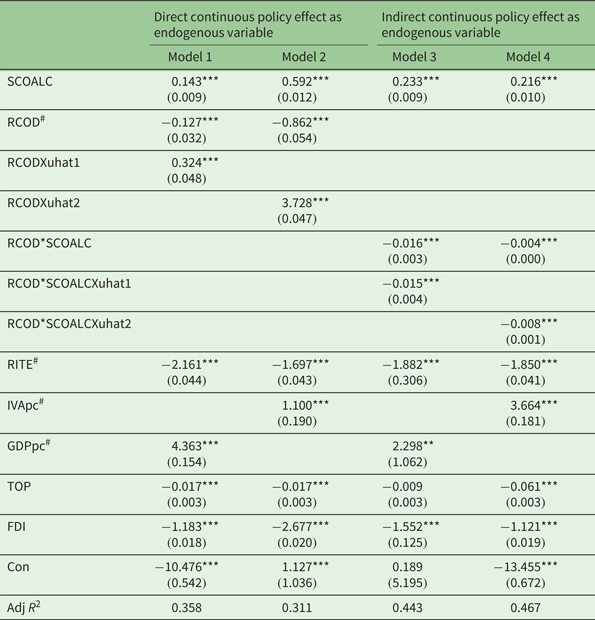
Two necessary tests were used for verification of the choice of instrumental variables. One is the Cragg–Donald Wald F test statistic which is used to test for weak instruments, and the other is the Hansen J statistic for testing the validation of instruments. The values of the Cragg–Donald Wald F test for the four models displayed in table 7 are 47.277, 60.173, 46.49 and 58.918, respectively, higher than the critical value at the 10 per cent significance level of 19.930. We therefore reject the hypothesis that the instrumental variables are weak. The Hansen J statistics for overidentification are, respectively, 0.775, 1.124, 0.781 and 1.134 (with p-values all higher than 0.1). This implies that the instrumental variables we selected are valid. In the second stage, the original equations are estimated by incorporating the residuals we got in the first stage. The FMOLS regression results are presented in table 7 and indicate that the long-run estimations are consistent with the original ones. Hence, we confirm that our results are accurate and convincing.
Long-run estimates when endogeneity is considered

Notes: Evaluation based on FMOLS estimator.
#: in log. ***, ** denote 1% and 5% significance levels, respectively.
4. Conclusion
This study contributes to the scarce literature by providing an economic analysis into the long-run driving factors of industrial wastewater discharged. Industrial wastewater emission is the primary cause of water pollution in China. Therefore, a deeper understanding into the driving causes would provide policy guidance to mitigate the amount of wastewater discharged and help mitigate against the risk factors of water pollution in water availability, health and production. We adopt time series based techniques to deal with both the second-order bias and non-centrality bias problems, which are often associated with the least square estimator and other cointegrating models. The following results emerge from the study.
Increasing the share of coal in total energy consumption raises the amount of industrial wastewater discharged, while stringent environmental regulation limits the amount of industrial wastewater discharged. However, the interaction of the share of coal energy and strict environmental regulation reveals that strict environmental regulation can offset, although only partially, the energy-induced effects imposed by the scale effect of FDI and also cause positive behavioral responses that either limit coal energy usage or improve upon coal use technologies and shift towards cleaner energy sources. Therefore, strict environmental regulation generates positive environmental outcomes.
Higher income induces more scale effect than technical effect and hence increases the amount of industrial wastewater discharged. There is an absence of scale economies in the provision of environmental services due to the poor nature of the technical aspects of production processes in the industrial sector. This can be alleviated through investment in treating the environment and trade liberalization, as both enhance the technical processes of the industrial sector to limit the amount of wastewater discharged by the industrial sector. We therefore highlight that: first, increasing the investment amount dedicated to treating the environment is very critical; second, the government should embrace trade liberalization policies and create the political and economic environment for foreign capital investment in China; and furthermore, the government should continue its efforts in wastewater management as the policy implemented has proved to be effective in reducing wastewater for Chinese industry.
Acknowledgements
The work described in this paper was fully supported by a grant from the Research Grants Council of the Hong Kong Special Administrative Region, China (Project No. CityU 21603917).
Appendix
Unit root Test KPSS

Bounds cointegrating test

Quandt–Andrews unknown breakpoint test