Introduction
Helminthiases affect 20% of the Latin-American population and are considered to be neglected diseases, with approximately 3800 million people infected worldwide (Acuña et al., Reference Acuña, Calegari, Cuto, Lindner, Rosa and Salvatella2003). These infections are frequent in rural populations and in overcrowded areas, which are characterized by having deficient structural conditions and poor sanitation, and by suffering the effects of environmental pollution (Zonta et al., Reference Zonta, Navone and Oyhenart2007).
Hymenolepiasis is a worldwide parasitosis caused by cestodes of the genera Hymenolepis and Rodentolepis (Hymenolepipidae: Cyclophyllidea). The life cycles of these parasites involve humans, rats and mice as definitive hosts, and arthropods as intermediate hosts. The disease is more common in warm and humid areas, and causes clinical symptoms mostly in children (Acha & Szyfres, Reference Acha and Szyfres1986; Llop et al., Reference Llop, Valdés and Zuazo2001; Hernández Mazariegos, Reference Hernández Mazariegos2016). Rats and mice act as definitive hosts of Hymenolepis diminuta (Rudolphi, 1819) (Mikhail et al., Reference Mikhail, Metwally, Allam and Mohamed2009; Martinez-Barbabosa et al., Reference Martínez-Barbabosa, Gutiérrez-Cárdenas, Aguilar-Venegas, Shea, Gutiérrez-Quiroz and Ruíz-González2012) and it is found in humans only occasionally, since it needs an arthropod to complete its life cycle (Martinez-Barbabosa et al., Reference Martínez-Barbabosa, Gutiérrez-Cárdenas, Aguilar-Venegas, Shea, Gutiérrez-Quiroz and Ruíz-González2012). Rodentolepis nana (Von Siebold, 1852) is a human parasite, even though it can be found in other mammals. It is estimated that 20 million people in the world are parasitized with this cestode species (Incani et al., Reference Incani, Aguilar, Dávila and Pacheco2003; Rossomando et al., Reference Rossomando, Márquez, Prado and Chacón2008) mainly due to direct transmission. However, both parasitoses share some epidemiological characteristics, such as higher prevalence in children of marginalized areas with poor hygiene habits and sanitary conditions, and overcrowding (Martinez-Barbabosa et al., Reference Martínez-Barbabosa, Gutiérrez-Cárdenas, Aguilar-Venegas, Shea, Gutiérrez-Quiroz and Ruíz-González2012).
Argentina possesses a wide variety of climate types. Buenos Aires is a province characterized by having a temperate climate and the Gran La Plata is particularly humid due to its proximity to three streams (El Gato, Pérez and Maldonado) running east to west and north to south (Auge et al., Reference Auge, González and Nagy1995). It is estimated that there are 118 shanty towns with 18,500 homes on the periphery of the Gran La Plata (pers. comm.). This seems to be a favourable scene for urban rodents, which are mostly the house mouse (Mus musculus Linnaeus, 1758), the black rat (Rattus rattus Linnaeus, 1758) and the Norway rat (Rattus norvegicus Berkenhput, 1769). Both R. rattus and R. norvegicus are considered to be hosts of parasite species that pose a sanitary risk (Stojcevic et al., Reference Stojcevic, Mihaljevic and Marinculic2004; Waugh et al., Reference Waugh, Lindo, Foronda, Ángeles-Santana, Lorenzo-Morales and Robinson2006; Easterbrook et al., Reference Easterbrook, Kaplan, Vanasco, Reeves, Purcell, Kosoy, Glass, Watson and Klein2007; Gómez Villafañe et al., Reference Gómez Villafañe, Robles and Bush2008; Hancke et al., Reference Hancke, Navone and Suárez2011). Moreover, these species of Rattus are the main definitive hosts of H. diminuta (Mafiana et al., Reference Mafiana, Osho and Sam-Wobo1997; Battersby et al., Reference Battersby, Parson and Webster2002; Zain et al., Reference Zain, Behnke and Lewis2012; Hancke & Suárez, Reference Hancke and Suárez2016) and sometimes of R. nana (Hernández Mazariegos, Reference Hernández Mazariegos2016; Tresnani et al., Reference Tresnani, Wayan Sauna and Hadi2016).
Morphological studies of H. diminuta and R. nana are scarce, especially considering that these parasite species are cosmopolitan and widely distributed in anthropogenic environments.
The aim of this study was to analyse Hymenolepididae species found in R. rattus and R. norvegicus, to evaluate the factors that favour their presence in the environment and to detect possible sanitary risks.
Materials and methods
The Gran La Plata is formed by three departments: La Plata, Ensenada and Berisso, and has approximately 799,523 inhabitants. The study was conducted in five peripheral areas of La Plata: Malvinas (34°56′43″S, 58°00′36″W), El Retiro (34°57′51″S, 58°00′17″W), La Latita (34°58′31″S, 57°58′30″W), La Isla (34°53′28″S, 57°59′25″W) and Abasto (34°58′05″S, 58°01′47″W). Part of the City of La Plata (34°55′16″S, 57°57′16″W) and the area comprising the neighbourhood El Carmen (34°55′33″S, 57°53′09″W) of Berisso were also included. All studied areas registered high levels of garbage concentration, except for the City of La Plata where there is an organized rubbish collection system. Moreover, most households lack fresh water, having instead an elementary water supply system called ‘black hose’, and have no sewage system, with the exception of the City of La Plata and El Carmen. In addition, El Retiro, La Isla and El Carmen are crossed by highly contaminated streams.
Samples were collected between September 2014 and August 2015, and divided into two periods: spring–summer, with monthly temperatures equal to or above 16°C and precipitation averaging 100 mm; and autumn–winter, with monthly temperatures below 16°C and precipitation below 100 mm.
The specimens were obtained using methods for live capture and were sacrificed. They were studied in the Centro de Estudios Parasitológicos y de Vectores (CEPAVE) of La Plata. Both viscera and faecal samples were fixed in 10% formalin. Cestodes were removed from their infection site and were preserved in 70% alcohol. Specimens were overstained with acid carmine, dehydrated through an alcohol series, diaphanized in eugenol and mounted in Canada balsam. The identification of Hymenolepididae was based on specific bibliography. Faecal samples were processed using a sedimentation technique which included homogenization, filtration and microcentrifugation in 1.5-ml Eppendorf tubes for 2 min at 3000 rpm, in order to concentrate the largest amount of eggs in the minimum possible volume for their identification.
Prevalence (P), mean intensity (MI) and mean abundance (MA) indices were calculated (Bush et al., Reference Bush, Lafferty, Lotz and Shostak1997) for each host species in relation to sex, area and sampling period. A test of difference of proportions and a Fisher test were used to evaluate P differences, while a Bootstrap test (97.5% confidence limits) was performed to compare MI and MA differences (Quantitative Parasitology 3.0 software; Rózsa et al., Reference Rózsa, Reiczigel and Majoros2000).
Parasites were deposited in the Colección Helmintológica del Museo de La Plata (He-MLP 7397, 7398, 7399, 7400), La Plata, Buenos Aires, and hosts in the Colección de Mastozoología del Centro Nacional Patagónico, Puerto Madryn, Chubut (R. rattus CNP 5919, CNP 5925; R. norvegicus CNP 5906, CNP 5908, CNP 5917 – a total of 79 (analysed) specimens were deposited).
Results and discussion
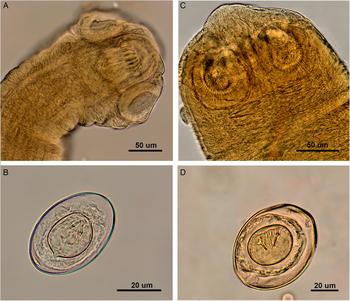
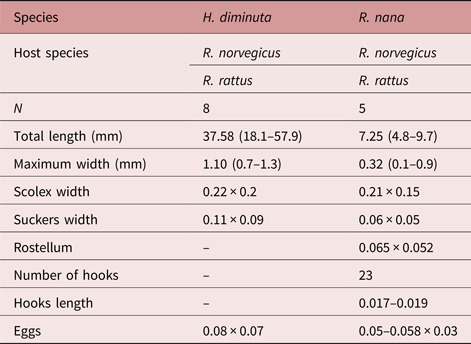
A total of 49 rodents were analysed for this study: 21 R. rattus and 28 R. norvegicus. Two species of Hymenolepididae highly related to urban rodents and with associated sanitary risk were identified: H. diminuta and R. nana. Specimens were mostly found in the anterior portion of the small intestine. Morphological and biometric characters of both parasite species were compared to support their identification (fig. 1). Measurements are given in table 1.
Rodentolepis nana: (A) scolex of a specimen from R. norvegicus, (B) detailed view of an egg with polar thickenings. Hymenolepis diminuta: (C) scolex of a specimen from R. rattus, (D) detailed view of an egg without polar thickenings.

Morphometric description of H. diminuta and R. nana. N, number of host specimens captured.

Hymenolepis diminuta has a scolex with four rounded suckers and an unarmed rostellum (fig. 1A). Moreover, it shows the typical characteristics of the reproductive organs and gravid proglottids, containing a large number of eggs with a diameter of 0.08 × 0.07 mm. With six hooks, the oncosphere is covered with a striated outer membrane and a thin inner membrane. No polar filaments extend between the oncosphere and the outer shell (fig. 1B).
Rodentolepis nana has a scolex with four small, rounded suckers and a rostellum armed with a crown of 20–30 hooks (fig. 1C). Moreover, it shows the typical characteristics of the reproductive organs and gravid proglottids, with a large number of eggs with a diameter of 0.05–0.058 × 0.03 mm. With six hooks, the oncosphere is covered with a thin, hyaline, outer membrane and an inner, thick membrane with polar thickenings that bear several filaments (fig. 1D).
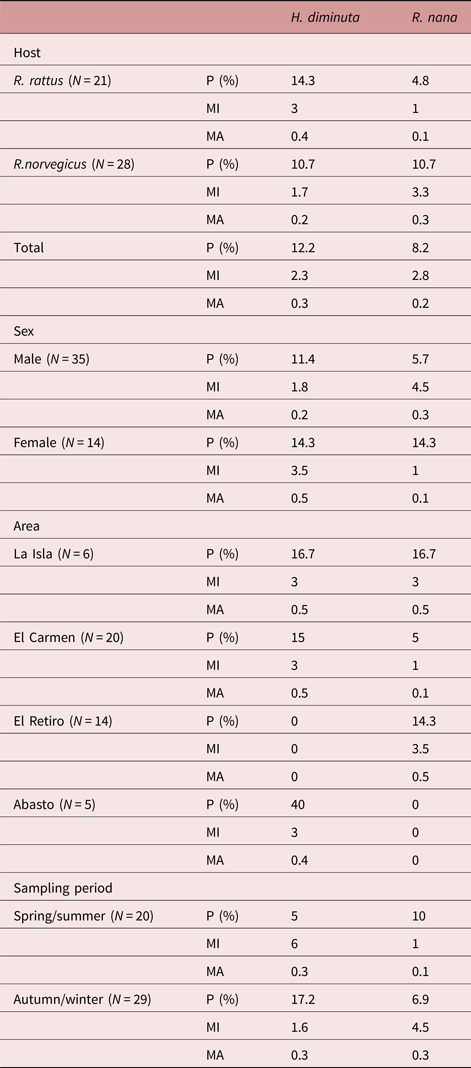
Of all analysed rodents, ten individuals were parasitized with at least one cestode, representing 20.4% total prevalence. Total values of prevalence (P), mean intensity (MI) and mean abundance (MA) were: H. diminuta P = 12.2%, MI = 2.3, MA = 0.3; and R. nana P = 8.2%, MI = 2.8, MA = 0.2 (table 2). In either case, both parasite species were found in the same host individual.
In relation to host species, R. norvegicus revealed the highest infection indices with P, MI and MA values of 21.4%, 2.5 and 0.5, respectively; while the values for R. rattus were 19.1%, 2.5 and 0.5, respectively. Total values of P, MI and MA were 28.6%, 2.25 and 0.6 for females; and 17.1%, 2.7 and 0.5 for males.
Concerning the sampling locations, Hymenolepididae specimens were found in four of the seven surveyed areas with the following P, MI and MA values: 33.3%, 3 and 1 in La Isla; 20%, 2.5 and 0.5 in El Carmen; 14.29%, 3.5 and 0.5 in El Retiro, and 40%, 1 and 0.4 in Abasto.
As to the sampling periods, the highest value of total prevalence was recorded in autumn–winter (24.1%), while in spring–summer it was 15%. MI and MA values for autumn–winter were 2.4 and 0.6; while for spring-summer they reached 2.7 and 0.4, respectively.
The values of these indices for each parasite species are given in table 2. No significant differences between host species, sex, area or sampling period were found for P, MI or MA.
Total values of prevalence (P), mean intensity (MI) and mean abundance (MA) for each parasite species. N, Number of host specimens captured.

Although there have been other studies concerning these parasite species (e.g. Llop et al., Reference Llop, Valdés and Zuazo2001; Incani et al., Reference Incani, Aguilar, Dávila and Pacheco2003; Hernández Mazariegos, Reference Hernández Mazariegos2016), only a few of them provide morphological and biometric descriptions. It was observed in the present study that the diagnostic measurements of H. diminuta and R. nana agree with those of Wardle & McLeod (Reference Wardle and McLeod1952) and Guerreiro Martins et al. (Reference Guerreiro Martins, Robles and Navone2014).
Both species of cestodes are cosmopolitan parasites that have a wide range of prevalence values, ranging from 80% to close to zero. These species have been recorded in R. rattus and R. norvegicus in different environments, but mostly in urban areas (Mafiana et al., Reference Mafiana, Osho and Sam-Wobo1997; Battersby et al., Reference Battersby, Parson and Webster2002; Iannacone Oliver & Alvariño Flores, Reference Iannacone Oliver and Alvariño Flores2002; Abu-Madi et al., Reference Abu-madi, Behnke, Mikhail and Lewis2005; Easterbrook et al., Reference Easterbrook, Kaplan, Vanasco, Reeves, Purcell, Kosoy, Glass, Watson and Klein2007; Kataranovski et al., Reference Kataranovski, Mirkov, Belij, Popov, Petrović, Gačić and Kataranovski2011; Zain et al., Reference Zain, Behnke and Lewis2012, Hancke & Suárez, Reference Hancke and Suárez2016).
Hymenolepiasis is more frequent in areas where structural and socio-environmental conditions are poor and where there is close contact between rodents and humans. High prevalence values of R. nana in R. norvegicus are therefore indicators of this coexistence between this host and humans, who are the principal definitive hosts. A 10.7% prevalence of this parasite species was observed in R. norvegicus and 4.8% in R. rattus. In contrast, the prevalence of H. diminuta was higher in R. rattus than in R. norvegicus (14.3% vs. 10.7%), in agreement with the results provided by other studies (Mafiana et al., Reference Mafiana, Osho and Sam-Wobo1997; Battersby et al., Reference Battersby, Parson and Webster2002; Zain et al., Reference Zain, Behnke and Lewis2012; Hancke & Suárez, Reference Hancke and Suárez2016).
Concerning the sampling locations, the number of rodents captured was higher in areas adjacent to water bodies, such as La Isla, El Retiro and El Carmen. Both H. diminuta and R. nana were found in La Isla (P = 16.7% for both) and El Carmen (P = 15% and 5%, respectively) in significant proportions and, therefore, represent possible foci of infection, whereas only R. nana was recorded in El Retiro (P = 14.3%). On the other hand, no parasites were registered in sites with no nearby associated water bodies, with the exception of Abasto where two out of the five host specimens captured (40%) were infected with H. diminuta. This could indicate the presence of other conditions that favour the life cycle of this parasite.
Although these tendencies were not reflected in the statistical analyses performed, the results allow us to advance in the study of factors related to hosts (e.g. sex and reproductive period, among others) and to the environment (e.g. seasons and relation with water bodies, among others), to evaluate the effects of actions tending to reduce the population density of rodents and, as a consequence, the parasites that might pose a sanitary risk.
This study shows that structural and environmental conditions of certain areas on the periphery of the Gran La Plata favour the existence of rodents, inside and outside houses. In this context, synanthropic rodents act as sentinels of zoonotic diseases and this reveals the need to take action to minimize their presence by, for example, installing appropriate water and sewage systems, adopting new waste management practices and outlining different educational programmes, with the aim of reducing the risk they entail to human and animal health.
Acknowledgements
We offer thanks to Kevin Steffen, Juliana Sanchez, Macarena Zarza, Paola Cociancic and Lorena Zonta for collecting hosts; to Carlos Galliari and Pablo Teta for the identification of hosts; to Graciela Minardi for supervision concerning statistical analysis; and to the reviewer for suggestions.
Financial support
This study was funded by Proyectos de Investigación Orientados (PIO), Consejo Nacional de Investigaciones Científicas y Tícnicas (CONICET), Universidad Nacional de La Plata (UNLP). J.M.U. is a member of UNLP; B.F., M.R.R., A.D. and G.T.N. are members of Consejo Nacional de Investigaciones Científica y Técnicas (CONICET).
Conflict of interest
None.
Ethical standards
This study was supported by the Dirección de Flora y Fauna, Ministerio de Asuntos Agrarios de la Provincia de Buenos Aires (File no. 22500-7981/10) and was carried out in accordance with the recommendations in the Guide for the Care and Use of Laboratory Animals of the National Institutes of Health. The specimens were studied and sacrificed following the procedures and protocols approved by the national laws and the Ethics Committee for Research on Laboratory Animals, Farm and Obtained from Nature of the National Council of Scientific and Technical Research (CONICET). No endangered species were involved.