Introduction
Parkinson's disease is a progressive, neurodegenerative disorder caused by loss of dopamine-producing neurons in the brain.Reference Sammii, Nutt and Ransom1 It affects 0.3 per cent of the general population worldwide, and afflicts approximately 1 per cent of individuals aged 60 years or older.Reference De Rijk, Launer, Berger, Breteler, Dartigues and Baldereschi2, Reference De Lau, Giesbergen, de Rijk, Hofman, Koudstaal and Breteler3 The cardinal symptoms of Parkinson's disease are bradykinesia, muscle rigidity, tremor and postural instability.Reference Lew4 Non-motor manifestations of Parkinson's disease include neuropsychiatric and cognitive disturbances and autonomic dysfunction.Reference Lew4
It is well known that Parkinson's disease can affect the larynx, leading to dysarthria, swallowing dysfunction and aspiration pneumonia.Reference Pinto, Ozsancak, Tripoliti, Thobois, Limousin-Dowsey and Auzou5, Reference Ramig, Fox and Sapir6 Nearly 90 per cent of patients with Parkinson's disease suffer from dysphagia during the course of their disease, and 70 per cent complain of speech and voice disorders.Reference Ramig, Fox and Sapir6, Reference Stelzig, Hochhaus, Gall and Henneberg7 Common videostroboscopic findings include laryngeal tremor, vocal fold bowing, abnormal phase closure and phase asymmetry.Reference Perez, Ramig, Smith and Dromey8 Other findings include pooled hypopharyngeal secretions, decreased sensation, diminished cough reflex and aspiration.Reference Merati, Heamn-Ackah, Abaza, Altman, Sulica and Belamowicz9
However, reports of stridor in Parkinson's disease are rare. We present a case of a patient with Parkinson's disease who presented with stridor secondary to prolonged laryngospasm. We also review the literature pertaining to the aetiology and mechanism of stridor in Parkinson's disease.
Case report
A 73-year-old Chinese man had first been diagnosed with Parkinson's disease in 1999, with features of severe bradykinesia, cogwheel rigidity and lack of facial expression. In August 2006, he had been commenced on Madopar (levodopa plus benserazide; F. Hoffmann-La Roche Ltd, Basel, Switzerland), initially at 125 mg thrice daily and subsequently increased to 250 mg thrice daily, due to worsening bradykinesia.
The patient presented to the emergency department of Singapore General Hospital in August 2006 with a one-day history of difficulty breathing.
On examination, the patient was tachypnoeic and stridorous. Initial nasoendoscopic assessment in the emergency department showed copious secretions pooling around the larynx. Both vocal cords appeared immobile and fixed in the paramedian position, resulting in upper airway compromise.
The patient was intubated and monitored in the intensive care unit. Magnetic resonance imaging of the patient's brain showed an acute infarct in the right corona radiata and lentiform nucleus. A computed tomography scan of his neck and chest showed no signs of tumour.
The patient was commenced on anti-platelet medication and underwent bedside percutaneous tracheostomy performed by the intensivist. He was weaned off the ventilator three days later. A nasogastric feeding tube was inserted for severe dysphagia.
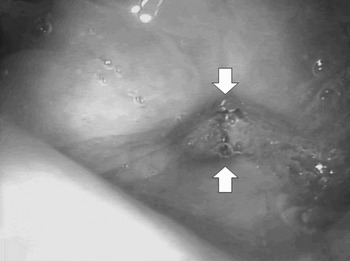
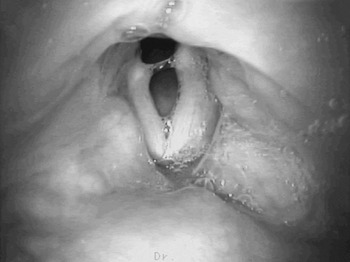
On review in the clinic a month later, flexible nasoendoscopy showed persistent, large amounts of saliva pooling around the larynx. Careful examination showed that the vocal folds were mobile but that ‘guarding’ occurred when the patient appeared at risk of aspirating his saliva during inspiration, giving the impression of bilateral vocal fold palsy. The patient periodically suffered prolonged laryngospasm when there was significant penetration of the glottis by saliva (Figures 1 to 3).
Sequential frames from stroboscopic recording of expiration (frames 1 to 6) and inspiration (frames 7 to 16). At the start of inspiration, saliva overlying the left vocal fold is sucked into the glottis (indicated by curved arrow in frame 7). Instead of abducting during inspiration (as normal), the vocal folds assume a paramedian position which could easily be mistaken for bilateral vocal palsy. This appears to be a ‘guarding’ effect, possibly to minimise aspiration of saliva. Note that the patient is not phonating. The examination was carried out with the tracheostomy tube occluded so that air passed through the larynx rather than the tube.

Stroboscopic view showing full laryngospasm involving the false vocal folds, which occasionally developed when secretions became overwhelming. The glottis is outlined by the two arrows.

Stroboscopic view demonstrating vocal fold abduction, and thus excluding bilateral vocal fold palsy. This examination required the patient to clear most of his secretions, necessitating much coaxing and patience.

Plans to inject the patient's salivary glands with botulinum toxin to reduce secretions in the larynx were considered, but were later abandoned as his secretions diminished spontaneously a week later. The patient self-decannulated two months post-tracheostomy, and had no further episodes of stridor.
Discussion
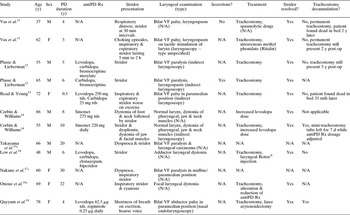
Stridor is uncommon in Parkinson's disease. A literature search was undertaken on this topic, using the Medline database and the search terms ‘Parkinson's disease’ and ‘stridor’ or ‘airway obstruction’ or ‘laryngospasm’ or ‘laryngeal dystonia’ or ‘bilateral vocal cord palsy’. Ten relevant publications were identified. One article was only available in Japanese and was thus omitted.Reference Yasuda and Yanagi10 The remaining nine publications reported 12 patients with stridor and Parkinson's disease (Tables I and II).Reference Vas, Parsonage and Lord11–Reference Qayyum, Mierzwa, See, Sharma and Montgommery19 In three of these articles, information was derived from the abstracts. The full article was not attainable in one English articleReference Takayama, Sato, Ota, Nishizaki and Ogawa15, while two articles were in Japanese with English abstracts.Reference Nakane, Motomura, Furuya, Shirabe and Nakamura17, Reference Onoue, Yukitake, Kurohara, Takasima and Kuroda18 No additional relevant reports were identified from the reference lists of the English language publications.
Reported cases of stridor in Parkinson's disease patients

*In Japanese with English abstract. Y = years; PD = Parkinson's disease; antiPD Rx = anti-Parkinson's disease medication; M = male; F = female; N/A = information not available; bilat VF = bilateral vocal fold; min = minutes; h = hours; post-op = post-operatively; tds = thrice daily; mth = months
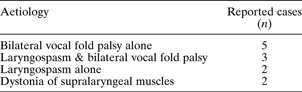
Common aetiologies of stridor in Parkinson's disease

The average age of Parkinson's disease patients presenting with stridor was 56.2 years, and the onset of stridor ranged from six months to 30 years after diagnosis of Parkinson's disease. Reported aetiologies of stridor were bilateral vocal fold palsy (eight cases), laryngeal spasm (five), and dystonia of the pharyngeal, jaw and neck muscles (two).
Bilateral vocal fold palsy is the commonest cause of stridor in patients with Parkinson's disease, although Parkinson's disease is a rare cause of such palsy. In Huppler and colleagues' series, only two out of 633 patients with unilateral and bilateral vocal fold paralysis had Parkinsonism.Reference Huppler, Schmidt, Devine and Gage20 Holinger et al. also found a low incidence, with only four Parkinson's patients out of 389 patients with partial or complete bilateral vocal fold paralysis.Reference Holinger, Holinger and Holinger21 The pathogenesis of vocal fold palsy in Parkinson's disease patients is not well understood but may involve degeneration of the nucleus ambiguus, which has been demonstrated in cadaver studies in patients with multiple system atrophy.Reference Isozaki, Matsubara, Hayashida, Oda and Hirai22 Multiple system atrophy is a related neurodegenerative disease characterised by varying degrees of Parkinsonism and cerebellar and autonomic dysfunction.Reference Blumin and Berke23 Vocal palsy can occur in up to 48 per cent of patients with this condition.Reference Isozaki, Miyamoto and Osanai24
The second cause of stridor in Parkinson's disease patients is laryngospasm. This is characterised by forceful, sustained apposition of the glottis and supraglottis, impeding ventilation.Reference Obholzer, Nouraei, Ahmed, Kadhim and Sandhu25 Only five cases of Parkinson's disease with stridor secondary to laryngospasm have been described in the literature.Reference Vas, Parsonage and Lord11, Reference Plasse and Lieberman12, Reference Lew, Shindo, Moskowitz, Wilhelmsen, Fahn and Waters16, Reference Onoue, Yukitake, Kurohara, Takasima and Kuroda18 As with bilateral vocal fold paralysis, laryngospasm in Parkinson's disease is likely to be centrally mediated via the basal ganglia and nucleus ambiguus. Vas et al. postulated a mechanism similar to that causing proximal oesophageal spasm, which also occurs in Parkinson's disease.Reference Vas, Parsonage and Lord11 As the laryngeal and oesophageal musculature both come under the influence of the basal ganglia and nucleus ambiguus, disease involving these nuclei may lead to laryngeal spasm in the same manner that it causes oesophageal spasm. Vas and colleagues observed alleviation of both Parkinsonism and stridor in one of their patients following administration of intravenous methylphenidate, supporting the theory of a common origin for the two phenomena.
Recently, Zarzur et al. demonstrated hypertonicity of the thyroarytenoid and cricothyroid muscles on laryngeal electromyography in 73 per cent of Parkinson's disease patients with voice disorders, compared with 23 per cent of controls.Reference Zarzur, Duprat, Shinzato and Eckley26 Laryngeal hypertonicity may predispose to laryngospasm and is also seen in laryngeal dystonia of other causes.Reference Grillone and Chan27 Given that laryngeal hypertonicity is relatively common in Parkinson's disease patients, the low prevalence of laryngeal dystonia seems unusual. Perhaps the level of tonicity is not sufficient to initiate spasm, or an external trigger is needed. In our patient, laryngospasm was triggered by copious secretions around the larynx, periodically spilling over and entering the glottis. Copious secretions are common in Parkinson's disease, and can lead to airway obstruction and aspiration pneumonia. However, the concurrence of excessive secretions, laryngospasm and stridor has not previously been described in a Parkinson's disease patient. Prolonged laryngospasm leading to hypoxia is somewhat analogous to ‘dry drowning’, in which asphyxiation occurs without aspiration of fluid into the lung.Reference Green, Franklin and Tanz28
Apart from secretions, another potential contributing factor to laryngospasm is laryngopharyngeal reflux (LPR).Reference Obholzer, Nouraei, Ahmed, Kadhim and Sandhu25 This may cause chronic mucosal inflammation and hypersensitivity, encouraging the development of a mal-adapted reflux arc and predisposing the patient to laryngospasm.Reference Obholzer, Nouraei, Ahmed, Kadhim and Sandhu25 This process could perhaps account for the laryngospasm observed in Vas and colleagues' second patient, with hypersensitivity to tactile stimulation.Reference Vas, Parsonage and Lord11
Several factors may have contributed to the development of laryngospasm in our patient. Progression of Parkinson's disease may have directly impaired the coordination and tone of the laryngeal musculature, rendering the patient's larynx more susceptible to spasm. Disease progression and bradykinesia may have also acted indirectly by reducing the patient's ability to cough out secretions and by causing difficulty in swallowing saliva, thereby increasing pooled secretions. Coincidental acute lacunar infarcts may have further reduced the patient's control over his breathing and swallowing. Careful, patient observation of the larynx is needed to make the association between secretion overspill and laryngospasm, and this may have led to the condition being under-reported. In three early reports of stridor in Parkinson's disease, managed before the advent of fibre-optic laryngeal examination, both bilateral vocal palsy and laryngospasm were reported in the same patient.Reference Vas, Parsonage and Lord11, Reference Plasse and Lieberman12 It is possible that these reported patients suffered a condition similar to our patient, although excessive secretions was mentioned in only one of these cases.Reference Plasse and Lieberman12 In addition, the observation of resolution of symptoms following reduction and alteration of anti-Parkinsonian medication, reported by Onoue et al., suggests that laryngeal dystonia may also be a side effect of chronic anti-Parkinsonian drug usage.Reference Onoue, Yukitake, Kurohara, Takasima and Kuroda18 It is known that dystonia in the limbs and the head and neck region is not uncommon after chronic levodopa usage, and the same mechanism may perhaps be responsible for laryngeal dystonia in some Parkinson's disease patients.Reference Tolosa and Compta29
Stridor in Parkinson's disease patients may not necessarily be due to laryngeal pathology. Corbin and Williams demonstrated this in two cases in which stridor occurred during the dystonic phase of Parkinson's disease.Reference Corbin and Williams14 Stridor was preceded by dystonia of the foot, neck and face muscles. Examination of the larynx in both patients showed a full range of vocal fold movement. In one patient, forcefully pulling the jaw forward relieved the stridor. Dystonia and stridor were alleviated when the levodopa dosage was increased. The mechanism of stridor in these patients appears different from that in our patient. Airway obstruction was at the supralaryngeal level, as a result of dystonia of the pharyngeal, jaw and neck muscles.
• Stridor is uncommon in patients with Parkinson's disease
• The authors present a rare case of stridor due to prolonged laryngospasm, triggered by entrance of surrounding secretions into the glottis
• This mechanism is similar to ‘dry drowning’
• It is important to recognise the different causes of stridor in Parkinson's disease, as this can affect management
Management of stridor in Parkinson's disease depends on the cause. When the patient's airway is compromised, endotracheal intubation may be required. Tracheostomy should be considered if the cause of stridor is likely to persist, for example in bilateral vocal fold palsy. However, maintaining a tracheostomy can pose difficulties for patients with Parkinson's disease, due to tremor, dyskinesia and poor coordination. To overcome this, Qayyum et al. performed laser arytenoidectomy in a Parkinson's disease patient with stridor and bilateral vocal fold palsy.Reference Qayyum, Mierzwa, See, Sharma and Montgommery19 Successful decannulation was achieved six weeks later, with a weaker voice but no aspiration. When stridor is periodic, for example in laryngospasm, extrinsic causes should be sought and managed, including excessive secretions and LPR. Botulinum toxin injection of the thyroarytenoid muscles can reduce laryngospasm, but this must be balanced against worsening an already weak voice and increasing the risk of aspiration pneumonia.Reference Grillone and Chan27 Weakening the vocal folds is not advisable if laryngospasm is induced by secretions spilling into the larynx, as occurred in our patient. Excessive secretions in Parkinson's disease may result from excessive salivation, or from difficulty clearing secretions because of dysphagia.Reference Nobrega, Rodrigues, Torres, Enzo and Melo30 Excessive secretions in Parkinson's disease typically manifests as drooling, and can be reduced by botulinum toxin A injection into the parotid and submandibular glands.Reference Nobrega, Rodrigues, Torres, Enzo and Melo30, Reference Mancini, Zangaglia, Cristina, Sommaruga, Martignoni and Nappi31 It is interesting that a spontaneous reduction in secretions eliminated our patient's laryngospasm, allowing him to self-decannulate two months after tracheostomy. This coincided with an increase in his anti-Parkinsonian medication dose, emphasising the importance of managing the patient's underlying medical condition.
Conclusion
Stridor is rare in Parkinson's disease patients. Underlying aetiologies include bilateral vocal fold palsy, laryngospasm and dystonia of the supralaryngeal muscles. Often, these patients require tracheostomy. Treatments to widen the airway, such as laser arytenoidectomy (in cases of bilateral vocal fold palsy) and botulinum toxin injection (in cases of laryngospasm), may allow decannulation but this must be balanced against an increased risk of weak voice and aspiration. Managing the underlying cause, for example controlling excessive secretions in patients with laryngospasm, may enable some patients to be decannulated or even to avoid tracheostomy. Laryngospasm secondary to spillage of secretions into the glottis is akin to ‘dry drowning’, and has not previously been described in Parkinson's disease. This case demonstrates the importance of recognition of the different mechanisms of stridor in Parkinson's disease when managing patients with this condition.