INTRODUCTION
By draining resources from their hosts, parasites develop at the potential expense of the fitness of their hosts (Price, Reference Price1980; Loye and Zuk, Reference Loye and Zuk1991; Clayton and Moore, Reference Clayton and Moore1997; Fitze et al. Reference Fitze, Tschirren and Richner2004) . The harm caused by the parasites (i.e. virulence) is largely determined by the relative amount of resources that parasites extract, as well as the host's defence mechanisms counteracting exploitation by the parasite (Lehmann, Reference Lehmann1993; Sheldon and Verhulst, Reference Sheldon and Verhulst1996; Wakelin, Reference Wakelin1996). Many parasites have developed adaptations allowing them to exploit the most profitable host and/or at the most profitable time to optimize their fitness. Among the components that contribute to profitability, host resistance and host nutritional status are assumed to be of major importance in most systems (Bize et al. Reference Bize, Jeanneret, Klopfenstein and Roulin2008). Other characteristics are known to affect host exploitation as well, such as host body size (Duffy and Campos de Duffy, Reference Duffy and Campos de Duffy1986; Valera et al. Reference Valera, Hoi, Darolova and Kristofik2004), skin thickness and body temperature (Elliott et al. Reference Elliott, Blandford and Thomas2002). Since parasite species and hosts greatly differ in ecological requirements and life-history traits (Roulin et al. Reference Roulin, Brinkhof, Bize, Richner, Jungi, Bavoux, Boileau and Burneleau2003; Reckardt and Kerth, Reference Reckardt and Kerth2009), establishing general rules that determine host selection is difficult; nevertheless, it is crucial for the understanding of the evolution of host-parasite interactions.
In many parasites, maximizing temporal overlap with the host and synchronizing infection to the host's reproductive cycle are common adaptations in order to complete their life cycle and to optimize their transmission (Moore, Reference Moore2002; Poulin, Reference Poulin2007). Nidicolous ectoparasites inhabiting nests of fast-growing vertebrates are faced with potential hosts that go through large physiological changes over a relatively short period of time. The development of host resistance (Edman and Scott, Reference Edman and Scott1987; Davison et al. Reference Davison, Kaspers and Schat2008) and the changing morphology and physiology (Olsen, Reference Olsen1974; Perrins, Reference Perrins1979; Harrison and Harrison, Reference Harrison and Harrison1986; Burtt et al. Reference Burtt, Chow, Babbitt, Loye and Zuk1991; Gosler, Reference Gosler1993) result in strongly changing conditions that challenge parasites to fine-tune their timing of infestation. Although the timing of ectoparasite infestation in the host's development is critical for the parasite's success, only few studies in vertebrate-ectoparasite systems have integrated this aspect in the search for factors explaining parasite burden and host preference (Bize et al. Reference Bize, Jeanneret, Klopfenstein and Roulin2008; Vaclav et al. Reference Vaclav, Calero-Torralbo and Valera2008). Optimizing timing of infestation is all the more important and indeed crucial in the case of nidicolous ixodid ticks, as each instar feeds only once during a non-stop period of several days and invests considerable amounts of resources in the attachment process (Balashov, Reference Balashov1972; Sonenshine, Reference Sonenshine1991). Thus, the choice of a single host has a decisive influence on parasite fitness. In addition, ixodid tick life cycles often strongly exceed the duration of the hosts' reproductive cycle. Therefore we expect the timing of attachment to the host to be under much more stringent selection compared to intermittently feeding and fast developing ectoparasites that can produce several generations within the hosts' reproductive cycle such as the hen flea (Ceratophyllus gallinae, Schrank) (Harper et al. Reference Harper, Marchant and Boddington1992; Tripet and Richner, Reference Tripet and Richner1999) and the tropical fowl mite (Ornithonyssus bursa, Berlese) (Reference MøllerMøller, 2002).
In this study we examine the temporal pattern of attachment to the host in a bird tick (Ixodes arboricola, Schulze and Schlottke) throughout the growth of one of its most important and commonest hosts, the great tit (Parus major, L.) (Hudde and Walter, Reference Hudde and Walter1988; Hillyard, Reference Hillyard1996). Both host and parasite are widely distributed throughout the Palearctic region (Gosler, Reference Gosler1993; Liebisch, Reference Liebisch, Mitchell, Horn, Needham and Welbourn1996). The great tit is a small hole-breeding songbird (body mass: 15–20 g). This bird attains its full-grown body size 3 weeks after hatching, during which its body mass increases 10-fold and its naked body gets covered with feathers. Nestlings fledge when they are approximately 21 days old (Gosler, Reference Gosler1993). So, in the breeding season (April–June) parents and nestlings occupy the tree holes for a relatively short time-period (approximately 42 days for a single reproductive cycle (Gosler, Reference Gosler1993)), after which they leave the tree-holes for several months. From early autumn onwards, great tits start re-occupying tree holes by using them as roosting sites (Perrins, Reference Perrins1979; Gosler, Reference Gosler1993).
Ixodes arboricola is a haematophagous ectoparasite with an entire life-cycle restricted to natural tree-holes where it infests birds that roost and breed (Arthur, Reference Arthur1963; Hillyard, Reference Hillyard1996). As in all ixodid ticks, every instar (larva, nymph, adult female) typically takes a single bloodmeal lasting several days before detachment and moulting to the next development stage, and thus spends at least 90% of its life off-host (Hillyard, Reference Hillyard1996). The 3 instars greatly differ in size and the amount of blood required for continuation of the life cycle. Engorgement weights of the adult females (38·5 mg; body length unfed: 2·5 mm) are on average 20 times greater than that of nymphs (1·9 mg; body length: 1·3 mm) and more than 150 times greater than that of larvae (0·25 mg; body length: 0·5 mm) (Hillyard, Reference Hillyard1996; Heylen and Matthysen, Reference Heylen and Matthysen2011a) fed on great tits. Immediately after feeding, the engorged immature tick instar (larva or nymph) detaches inside the tree-hole and starts to moult to the next instar (nymph or adult, respectively). Since the moulting to next instar may occur within 2 weeks after detachment (see Materials and Methods section) the immature instars can feed more than once on great tits within a single breeding event (D. Heylen, unpublished data). This contrasts with the time duration between female engorgement and the emergence of larvae, which is longer than the great tits' breeding cycle (see Materials and Methods section). Adult male ticks do not feed, and copulate off-host after the female has completed her bloodmeal (Liebisch, Reference Liebisch, Mitchell, Horn, Needham and Welbourn1996; Heylen, Reference Heylen2011).
The seasonal activity pattern of the different developmental stages has been partly determined by analysing data on tick infestations of full-grown tits and records of engorged ticks inside tit nest boxes of our Belgian study population (Heylen, Reference Heylen2011). Ixodes arboricola can be found on the birds throughout the year, even during the coldest winter months (Literak et al. Reference Literak, Kocianova, Dusbabek, Martinu, Podzemny and Sychra2007). Lowest numbers of infested birds are registered during the summer months, when tits roost in the open (Hinde, Reference Hinde1952) and nestlings have fledged, which is confirmed by the low numbers of recently engorged ticks inside nest boxes during summertime (Heylen, Reference Heylen2011). The highest numbers of unfed I. arboricola inside nest boxes have been found during early autumn, when up to 800 larvae emerge from a single batch of eggs. Full-grown tits are generally infested by the immature developmental stages only. Most of the larval infestations have been registered during autumn and winter, when birds roost inside cavities. Most of the nymphal infestations are observed during the birds' pre-laying period (end of February-start of April) and breeding season. Several hundreds of fed larvae inside nest boxes have been observed during the nestling phase, despite that the incidence of larval-infested nests during this time of the year is much lower compared to the other tick developmental stages. Larvae and nymphs are likely the most important stages for the colonization of new tree holes when birds change roosting site and/or prospect potential breeding sites. By delayed detachments in response to unsuitable environmental conditions, both larvae and nymphs have the capacity to bridge long periods of several weeks when full-grown birds move between successive home ranges and spend one or more nights outside cavities (Heylen and Matthysen, Reference Heylen and Matthysen2010; White et al. Reference White, Heylen and Matthysen2011). Remarkably few records of adult female ticks have been registered on adult and fledged birds (Walter et al. Reference Walter, Liebisch and Streichert1979; Hudde and Walter, Reference Hudde and Walter1988; Heylen, Reference Heylen2011). Full-grown great tits seem not that suitable for female infestations, as is suggested in previous laboratory and field experiments in which the attachment success of adult female ticks is remarkably lower than that of the immature instars (Heylen and Matthysen, Reference Heylen and Matthysen2010) due to host-induced tick mortality or ticks that did not want to attach. This contrasts with great tit nestlings, in which experimental infestations have shown high readiness in each tick instar to attach on 8-day-old nestlings (Heylen and Matthysen, Reference Heylen and Matthysen2011a). Under natural conditions, tit nestlings can be infested with any of the parasitic instars; however, nymphs and adult females are far more often observed on nestlings than larvae (Walter et al. Reference Walter, Liebisch and Streichert1979; Hudde and Walter, Reference Hudde and Walter1988; Hillyard, Reference Hillyard1996; Heylen, Reference Heylen2011). Nestlings are the most important host type for adult female ticks, which is suggested by the high number of newly engorged females found inside nest boxes during the nestling phase (Heylen, Reference Heylen2011; Marcel Lambrechts, unpublished data). Adult female ticks seldom infest great tit parents during the pre-nestling phase. When present in nest boxes, they delay infestations until nestlings have hatched, as is suggested by field observations and findings of experimentally exposed nests at the start of the breeding cycle (D. Heylen, unpublished data).
The timing of attachment according to the host's development is particularly relevant to I. arboricola for 2 main reasons. Firstly, I. arboricola can choose among nestlings of different ages with contrasting morphology and physiology. Secondly, the tick instars may experience different constraints imposed by their development durations, morphology and the seasonal activity of the host. Here we report the results of 2 experiments, in which tick attachments were monitored throughout the growth of great tit nestlings. In Exp. 1, we exposed clutches at hatching to a mix of the 3 instars with tick burdens within the natural exposure range, and registered the number of ticks found attached to the nestlings in relation to the brood's age. We hypothesized that the observed number of attached ticks of each of the instars differ in accordance to the instars' nutritional needs, the availability of anti-grooming refuges (see Roulin et al. Reference Roulin, Brinkhof, Bize, Richner, Jungi, Bavoux, Boileau and Burneleau2003 and references therein) and their capability to get through more life stages when hosts are available. In particular, we predict that the large adult females are more often found attached to older nestlings, because these provide better resources and have better developed feathers under which ticks can be sheltered. Due to the long duration between female engorgement and the emergence of larvae, adult females gain no advantage in attaching to recently hatched nestlings. On the other hand, the smaller instars that attach early in the development of the nestlings have the opportunity to get through more life stages while hosts are still available (cf. life cycle of I. lividus (L.) infesting bank swallows (Riparia riparia, L.) (Balashov, Reference Balashov1972; D. Heylen, unpublished data)). Because of their smaller body size and lower nutritional needs, larvae and nymphs may find sufficient shelter and amounts of blood in the early nestling stages. In a complementary experiment (Exp. 2) we focused on the attachment of adult females – the largest instar and most significant for the species' reproduction – by releasing them at different moments in the nestlings' development. If the observed I. arboricola female attachments are independent of the birds' developmental status, we expect no correlation between the time delay until attachment and nestling age at the time of tick release. If the observed tick attachments depend on the nestlings' developmental status, we expect to detect attached I. arboricola females sooner when being exposed to older and larger nestlings than when being exposed to recently hatched nestlings.
MATERIALS AND METHODS
The fieldwork was carried out in the breeding seasons (April–June) of 2009 and 2010, in a study site consisting of several woodlots in the north of Belgium (for description of study area see Matthysen et al. Reference Matthysen, Adriaensen and Dhondt2001). Woodlots had been provided with nest boxes, which are readily accepted as surrogates for the tree holes in which great tits naturally breed and roost. Inside the boxes we frequently observe unfed and engorged I. arboricola ticks belonging to the 3 instars. The removable nest box lids allow easy access to the nest cup, the nestlings, and the ticks that typically move towards the top of the nestbox after feeding (Heylen, Reference Heylen2011). All nest-boxes used in this study were checked for naturally occurring ticks from the start of the breeding season (end of March) until hatching, and any ticks found were removed.
All tree-hole ticks used in this study were originally collected during the winter of 2007–2008 from nestboxes in which great tits and blue tits (Cyanistes caeruleus, L.) breed and roost. They developed to the next developmental stages after experimental infestations of great tits during the breeding season and the autumn of 2008 and 2009. Throughout the year, except for the birds' breeding season, tick individuals were kept at the outside temperature and 85% relative humidity in the dark. However, the second half of April, when great tit females start breeding, ticks were maintained in the dark at 20°C until use. At the beginning of March, we assembled the adult tick developmental stages in a few vials (10 females with 10 males).
Experiment 1: Attachment by different instars
In Exp. 1, which took place from the 29 April to the 22 May (2009), the apparent timing of tick attachments was studied in relation to the brood's age by exposing recently hatched great tit nests to a fixed number of ticks. Immediately after hatching (within 24 h) we added in each of the 15 randomly chosen nests: 150 unfed larvae, 40 unfed nymphs, 4 unfed adult females and 2 unfed adult males obtained from a laboratory colony (see above). The ticks were evenly distributed in the nest cup after nestlings were briefly removed (6 – 11 nestlings per nest). The parasite load is consistent with the natural range in different great tit populations: up to 10 nymphs per nestling have been found in a German population (Walter et al. Reference Walter, Liebisch and Streichert1979). Furthermore, in our study population up to 30 nymphs, up to 10 adult females and several hundreds of larvae per nest have been observed during the breeding cycle. We decided to place I. arboricola adult males (which do not feed) in the nest with the females, to be sure that the females would attach and engorge. In some ixodid tick species, adult females tend not to attach to animals unless males of the same species are present (Rechav et al. Reference Rechav, Goldberg and Fielden1997; Sonenshine, Reference Sonenshine2004).
At 2, 6, 10 and 14 days after tick exposure, we counted the number of newly attached ticks to the nestlings (inspection time on average 4 min per nestling). We recorded the attachment sites and the engorgement status on schematic drawings such that ticks could be individually followed up. This enabled us to distinguish newly attached ticks from ticks that had already attached at a previous check, and hence multiple observations of the same tick individuals in the survival analyses could be avoided (see below). With a 4-day interval between each check, we assume that the number of non-detected ticks was low, given that 4 days approximates the time to tick engorgement (larvae: 3·6±0·2 (mean±standard error), nymphs: 3·8±0·1; adult females: 5·3±0·2 days; Heylen and Matthysen, Reference Heylen and Matthysen2011a). In addition, we counted the newly detached and engorged I. arboricola individuals found in the upper zone of the nest box, and removed them at every nestling check and at a final nest box check 18 days after tick exposure. Comparison of the proportion of attached and engorged ticks provides an indirect way to assess the number of ticks that may have attached on the parents instead of on the nestlings. A direct estimate of parent infestation by I. arboricola was obtained on the 8th day in the chicks' development, when parents were captured with nest traps as a standard field procedure, and were thoroughly checked for ticks by blowing and brushing the birds' feathers apart. Additional information of parental infestations was obtained in 3 breeding female tits that were opportunistically caught at the first nestling check (i.e. 2 days after tick exposure).
The sum of the feeding duration (see above) and development duration (duration until egg deposition and emergence of the newborn larvae: 51·6±1·3 (mean±standard error) days; moult to next instar: 12·8±0·2 days in larvae; 13·3±0·1 days in nymphs; all under 25°C and 83% relative humidity; Heylen, Reference Heylen2011) exceed the inspection period of the nestlings. Therefore it is very unlikely that an attached tick that is not collected will be registered for the second time when feeding in its subsequent developmental stage.
Experiment 2: Attachment of adult female ticks in relation to nestling age
In Exp. 2, which took place from 28 April to the 14 June (2010), 15 randomly chosen nests were exposed (as in Exp. 1) to 4–6 adult female ticks as well as 2–3 adult male ticks. A great tit nest consists of a cohort of chicks that are approximately the same age. Nest ages ranged from 2 to 17 days. At 2, 4, 6, 8, 10 and 14 days after tick exposure we counted the total number of attached adult female ticks on the nestlings, and collected the engorged ticks from the nest box wall and lid. As in Exp. 1, drawings enabled us to distinguish newly attached ticks from ticks that had already attached at a previous check.
Statistical analysis
The duration until tick attachment was modelled by a marginal cox proportional hazards model for clustered data at the level of the nest box (procedure PROC PHREG in SAS v 9.2, SAS Institute, Cary, North Carolina), with either the tick instar (for Exp. 1), or the brood age at tick exposure (for Exp. 2) added into the models. Those ticks that did not attach, were handled as right-censored data. For general information about modelling time-to-event data we refer to Cox and Oakes (Reference Cox and Oakes1984). Generalized estimation equations (GEE) were fitted (PROC GEE, logit-link, and binomial distributed residuals) when modelling the proportion of ticks that successfully engorged and were harvested in relation to the same exploratory variables as in the cox models, taking into account the statistical dependence of measurements on the same nest. Also a GEE (cumulative logit-link, and multinomial distributed residuals) was fitted when modelling the tick instar – which is considered as an ordinal response variable based on their size (see Introduction section) – against the moment when the maximum number of each of the tick instars was observed. All estimates are reported as mean±standard error, unless otherwise mentioned. α=0·05 was chosen as the lowest acceptable level of significance.
RESULTS
Experiment 1: Attachment by different instars
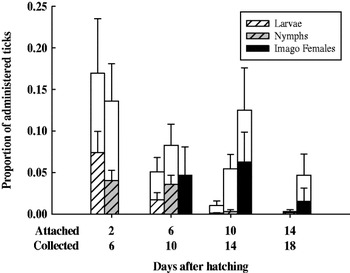
The proportion of administered ticks that we found attached on nestlings was 12·5±0·4% for adult females, 8·1±2·1% of the nymphs and 9·2±3·3% of the larvae. The average time until attachment was 9·1±1·1 days in adult female ticks, 4·3±0·4 days in nymphs and 2·8±0·1 days in larvae, with a high proportion of nymphs and larvae attaching within 6 days after their release (Fig. 1). The estimated hazard to attach of adult female ticks (i.e. the likelihood of an adult female tick to be found attached to a nestling at the next nestling check) was 101·5% (95% – confidence interval: 56·6−159·3%; χ 2=26·72; d.f.=1; P<0·0001) lower than in nymphs, and 180·9% (95% – confidence interval: 110·6−274·5%; χ 2=38·37; d.f.=1; P<0·0001) lower than in larvae. In addition, the estimated hazard to attach in nymphs was significantly lower (39·4%; 95% – confidence interval: 24·6−56·0%; χ 2=26·97; d.f.=1; P<0·0001) than in larvae. When fitting the GEE, we found a positive association between the size order of the 3 tick instars, and the time in the birds' development when their maximum number was observed (cumulative logit: 0·52±0·09; Z-score: 5·82; P<0·001).
The proportion of the ticks administered at hatching that attached to great tit nestlings (filled bars) and the proportion of the ticks collected 4 days later inside the nest box (open bars) in relation to the age of the brood. Mean values (bars) over the 15 nests+1 standard errors (whisker) are shown. The proportion and standard error of the attached imago female ticks at day 6 equalled the proportion of the collected ticks four days later.

When the upper zone of the nest boxes was checked, in total 21·8±6·4% of the administered adult females, 27·6±7·2% of the nymphs and 23·1±8·2% of the larvae had engorged and were collected (Fig. 1). The pattern of collected ticks proved to be highly similar to the pattern of ticks attached to the nestlings: relative to the immature tick developmental stages, the adult female ticks fed late in the nestlings' development (hazard ratio adult females vs. larvae: 2·93; 95% – confidence interval: 2·13−4·06; χ 2=42·58; d.f.= 1; P<0·0001; hazard ratio adult females versus nymphs: 2·07; 95% – confidence interval: 1·60−2·68; χ 2=30·13; d.f.=1; P<0·0001), and the engorged nymphs were found significantly later in the nestlings' development than the larvae (hazard ratio nymphs versus larvae: 1·42; 95% – confidence interval: 1·25−1·62; χ 2=27·95; d.f.=1; P<0·0001).
Neither in adult females (logitcollected – attached: 0·69±0·38; Z-score: 1·44; P=0·07), nor in larvae (logitcollected – attached: 0·72±0·43; Z-score: 1·68; P=0·09) was there a statistically significant difference between the proportion of ticks that attached to the nestlings, and the proportion of ticks that were collected inside the nestbox. In the nymphs, however, significantly less ticks were found attached to the nestlings than collected from the nest box (logitcollected – attached: 1·51±0·43; Z-score: 3·49; P=0·0005) indicating that an important number of nymphs had been overlooked, or had detached from the parents inside the nest boxes. The latter was confirmed by the observation of ticks attached to parents at day 8 in the nestlings' development (1·3±0·4 nymphs, and 0·8±0·2 larvae per adult bird), as well as in the three females opportunistically caught whilst brooding 2-day-old nestlings (7·3±5·4 nymphs, and 6·6±6·6 larvae per adult bird). The capture data show that several larvae had fed on the parents as well. This was not detected in the comparison between larval collected and attached ticks, likely due to low statistical power.
Experiment 2: Attachment of adult female ticks in relation to nestling age
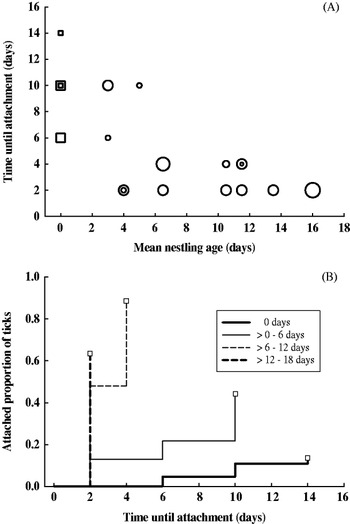
During the course of the experiment, 49·4±10·1% of the adult ticks were found attached to the nestlings, while only 18·9±7·9% were collected as engorged individuals in the upper zone of the nestbox. The attached proportion (logit transformed) showed an increase with nestling age at the time of tick release (age: 1·1±0·4/day; Z-score: 3·23; P=0·001; age*age: −0·06±0·02/day2; Z-score: −3·03; P=0·003). The time delay between tick release and attachment was significantly reduced in nests with older nestlings (Fig. 2), as shown by a significant increase in attachment hazard with nestling age (estimated increase in hazard: 13·6%/day; 95% – confidence interval: 3·4−24·8%/day; χ 2=7·02; d.f.=1; P=0·008).
(A) Duration of time between the day when adult female ticks were released and the first observation of attachment to the great tit nestlings in relation to the mean nestlings' age at which the ticks were released in the nest. Each symbol represents a single nest, with size proportional to the proportion of ticks that attached (maximum size: 75%; minimum size: 16%). Circles are nests from Exp. 2, squares are nests from Exp. 1. (B) Cumulative proportion of attached adult female ticks that were released at different moments in the nestlings' development. Ticks released at 0 days are from Exp. 1. Open boxes represent censored ticks.

DISCUSSION
In line with our expectations, the tick attachment in great tit nestlings revealed an overall positive association between the size of the tick instar, and the age of the brood at which the tick attached. In particular, both experiments provided complementary evidence that adult female ticks are less likely to be found attached to recently hatched nestlings than the smaller-sized tick instars (larvae and nymphs). In Exp. 2, in which adult ticks were introduced to nestlings as young as 2 days old, none attached to nestlings less than 6 days old. The time delay between tick release and attachment was significantly reduced in nests with older nestlings, suggesting that adult female ticks adopt a strategy based on the nestlings' developmental status.
There are several potential explanations for the observed patterns in our study. A first and proximate explanation for the delayed attachment in the larger tick instars may be a decrease in grooming effectiveness of hosts, and/or decrease in immunological resistance with the broods' age, rather than an attachment strategy by the tick. However, it is generally believed that the nestlings' grooming skills (Moore, Reference Moore2002) and immune function improve with age (Apanius, Reference Apanius and Starck1998; Davison et al. Reference Davison, Kaspers and Schat2008) which would result in a decrease – and not an increase as observed in the adult females – in successful attachments. It is important to stress that in natural ixodid tick-host interactions, however, acquired immunological resistance commonly does not occur (Randolph, Reference Randolph1979; Ribeiro, Reference Ribeiro1989; Fielden et al. Reference Fielden, Rechav and Bryson1992) and has not been observed in songbirds (Heylen et al. Reference Heylen, Madder and Matthysen2010). This implies that hatchlings are unlikely to receive maternally derived anti-tick immunoglobulines in the eggs (e.g. Staszewski et al. Reference Staszewski, Gasparini, McCoy, Tveraa and Boulinier2007) that could have affected the attachment patterns in some way. A factor that could potentially facilitate tick attachment is feather development. Better developed feathers provide shelter to the larger, more conspicuous tick instars (see Roulin et al. Reference Roulin, Brinkhof, Bize, Richner, Jungi, Bavoux, Boileau and Burneleau2003 and references therein), and therefore may reduce host-induced tick mortality via grooming and preening. From day 8 onwards, the great tits' feathers start to become conspicuous (Winkel, Reference Winkel1970) which could allow the largest tick instars of I. arboricola to shelter.
Tick mortality may play an important role in our observations, as is suggested by the low infestation successes in both experiments. Besides potential anti-tick resistance mechanisms in the nestlings, host-induced mortality may occur via parents that eliminate ticks that have gone onto their body through self-preening or allo-preening, or they might eliminate the ticks that are in the nest through nest sanitation. However, one should note that in great tits we have very seldom found damaged ticks or ticks that failed to engorge once attached to nestlings, and scratches or injuries on the nestlings' bodies at the ticks' attachment sites (D. Heylen, personal observations), indicating that preening and grooming during the nestling phase is likely to be of little importance. Furthermore, to the best of our knowledge, parental allopreening has never been recorded in the paridae family. It is likely that the low visibility inside the dark tree-hole environment makes the detection of ectoparasites difficult for the birds. Nest sanitation behaviour in female great tits has been described as “a period of active search with the head dug into the nest material” (Christe et al. Reference Christe, Richner and Oppliger1996) but it is unclear whether this kills or simply disperses ectoparasites (Clayton et al. Reference Clayton, Jennifer, Koop, Harbison, Brett, Moyer and Bush2010). Therefore, although it is possible that the temporal tick attachment patterns are the result of parent-induced tick mortality, there is no clear evidence supporting this.
A second and ultimate explanation is that the ticks monitor the developmental status of the hatchlings, and delay attachment until the nestlings have developed to their most profitable status. Since ixodid ticks normally obtain only a single bloodmeal per instar and are therefore less able to sample different hosts by feeding, attraction stimuli, e.g. host vibrations, body heat, or odour (Steullet and Guerin, Reference Steullet and Guerin1992; Yunker et al. Reference Yunker, Peter, Norval, Sonenshine, Burridge and Butler1992; Osterkamp et al. Reference Osterkamp, Wahl, Schmalfuss and Haas1999 ; Donze et al. Reference Donze, McMahon and Guerin2004), can be used by I. arboricola as identification cues for the most profitable host types. The idea that tick attachment patterns may reflect strategic choices in I. arboricola is further supported by choice experiments under controlled conditions showing that nymphs attach preferentially to the more developed nestling when exposed for a short time-period to pairs of siblings with contrasting developmental status (Heylen and Matthysen, Reference Heylen and Matthysen2011b).
We propose that older nestlings are more profitable to larger tick instars in different ways. Firstly, they are heavier, and hence may be of higher nutritional value and provide more accessible food resource for the higher food demands (Christe et al. Reference Christe, Giorgi, Vogel and Arlettaz2003; Hawlena et al. Reference Hawlena, Abramsky and Krasnov2005). In addition, by selecting hosts in relation to the required amount of blood, the relative harm to nestlings may be reduced (i.e. virulence) which in turn increases the chance of chick survival and the reuse of the tree holes by the same hosts and/or their offspring. Secondly, the improvement of thermoregulation with nestling development – in great tits believed to start from day eight after hatching (Perrins, Reference Perrins1979) – may play a role in host profitability as well, since high body temperatures can facilitate blood acquisition in ixodid ticks (Balashov, Reference Balashov1972). Thirdly, as already suggested above, better-developed feathers provide better shelter against grooming for the larger tick instars. In addition they may better protect the ticks against the mechanical disturbances when the nestlings rub their bodies against the nest material. This may explain the higher infestation success of adult female ticks in Exp. 2, in which more ticks were exposed to older nestlings. Due to their body size, the smaller immature tick stages may find refuges from early onwards, which may explain their high readiness to attach to recently hatched nestlings as well as older birds like the parents and the full-grown birds during autumn and winter (Hudde and Walter, Reference Hudde and Walter1988; Literak et al. Reference Literak, Kocianova, Dusbabek, Martinu, Podzemny and Sychra2007; Heylen and Matthysen, Reference Heylen and Matthysen2010).
From a life-history perspective, we expect that the relation between delayed attachment and fitness may be counteracted by selection on early attachment. The relatively short occupancy of the tree holes by the breeding great tits (approximately 42 days for a single reproductive cycle (Gosler, Reference Gosler1993)) strongly temporally constrains tick survival and reproduction, and therefore, engorgement and detachment within the breeding cycle of the birds should optimize I. arboricola's fitness. After fledging, tree holes are left unoccupied by great tit parents and their offspring for many months until they are used again for roosting during autumn and winter (Hinde, Reference Hinde1952). This, and the fact that the mortality rate of great tits in the first weeks after fledging is very high (Naef Daenzer et al. Reference Naef Daenzer, Widmer and Nuber2001) imply that if I. arboricola ticks are still attached after fledging, they will end in unfavourable habitats for survival and reproduction (cf. Pellonyssus reedi, Zumpt and Patterson (Szabo et al. Reference Szabo, Szalmas, Liker and Barta2008)). This also indicates that the fledging period is unfavourable in terms of dispersal success. Successful colonization of other cavities probably occurs during autumn, winter and early spring when great tits use cavities on a regular basis for roosting (Literak et al. Reference Literak, Kocianova, Dusbabek, Martinu, Podzemny and Sychra2007; Heylen and Matthysen, Reference Heylen and Matthysen2010).
We speculate that instar-specific differences in development explain part of the observed attachment patterns, since they lead to different temporal constraints. For the adult females, due to the long period needed for emergence of the newborn larvae (see Materials and Methods section) the fitness gain of attaching early in the birds' breeding cycle is low, since the offspring has no opportunity to engorge in the same great tit breeding cycle. The time constraint on attachment should therefore be relatively low in adult female ticks. On the other hand, in the immature instars the development to the next instar is short with respect to the length of the birds' breeding season (see Materials and Methods section), enabling them to optimize their fitness by reaching the reproducing adult instars within the nestling phase (cf. life cycle of I. lividus infesting bank swallows (Balashov, Reference Balashov1972; Ulmanen et al. Reference Ulmanen, Saikku, Vikberg and Sorjonen1977)). Moreover, since second broods are uncommon (less than 10% of first brood parents) and have strongly decreased in our study area (Husby et al. Reference Husby, Kruuk and Visser2009), opportunities for ticks to continue their life-cycle after the first brood are highly reduced, further reinforcing the time constraints on larvae and nymphs in particular. To summarize, we hypothesized there may be a trade-off between the benefit of delaying attachment until nestlings grow larger, and time pressures to complete the life cycle in I. arboricola. For larvae and nymphs the benefit of large nestlings is relatively small while the time pressure to proceed to the next instar is high, leading to the optimal strategy of attaching immediately. For adults, the benefit to attach to older nestlings is large while the time pressure to proceed to egg deposition and larval development is low (probably due to developmental constraints) and therefore the optimum is to delay attachment.
In conclusion, our experiments demonstrate that an important trait in an ectoparasite, the timing of attachment to the host, is related to the host's developmental stage. The proposed hypotheses imply that the host's development sets no lower limit on the attachments of the immature tick instars, while this limit is likely set in adult female ticks. Further experimental research will reveal to what extent the attachment strategies are driven by the birds' physiology and development, and/or the hosts' anti-tick resistance mechanisms.
ACKNOWLEDGMENTS
We appreciate the thoughtful comments of Frank Adriaensen and two anonymous referees on a previous version of the manuscript. Experiments were carried out under license of the Flemish Ministry (Agentschap Natuur en Bos) and the experimental protocol was approved by the Ethical Committee of the University of Antwerp. D. H. and J. W. are supported by the FWO-Flanders. This study was funded by FWO-project G.0049.10 awarded to E. M.