1. An introduction to a quaternary framework based on sound-images
1.1. Listening in acousmatic situations
Our experience of sound in general is conditioned by the circumstances that determine and frame what we hear (a sound’s source) and where we hear it (the place in which it sounds and reverberates). The tight integration of source and place is central to our listening experience. The advanced technology of the twentieth century, however, introduced new ways in which to experience a sound’s source and place. With the introduction of audio recording technology and its ability to capture the making of sound and the space in which it is made, source and place have been decoupled, inviting listeners to challenge their integration and become engaged with the perceptual, acousmatic circumstances of their original coupling. As the result of the decoupling process, sounds in recorded media are both dis-embodied – sounds have, literally, been robbed of their body by the act of recording and playing them back – and dis-placed – the very act of recording sound offers the opportunity to present (recorded) sound in a different place, thereby ‘unplacing’ it.
The dis-embodied and dis-placed sounds have the potential to create acousmatic situations in which listeners, denied the visual cues that would verify the source of the sounds they hear, actively seek to identify the sound’s source and place through imaginative aural inference. One of the primary concerns of electroacoustic music listening, thus, is to recognise and observe the relation between the source-place decoupling of recorded sounds, its process and design, and the listener’s process of engaging with dis-embodied and dis-placed sounds. To investigate this relation, the paper must ask the following questions: what potential do the dis-embodied and dis-placed sounds of electroacoustic music hold for listeners? How does their potential emerge and unfold within the music? And how do listeners, engaged in various kinds of listening, identify and make use of this potential? Perhaps we should begin our discussions by listening to a few electroacoustic compositions, staring with Alvin Lucier’s I Am Sitting in a Room (1970). This brief survey of these compositions will offer us inroads into these daunting (but fascinating) questions.
1.2. Emergence of sound-images and their negations in electroacoustic music listening
1.2.1. Body vs. Not-Body
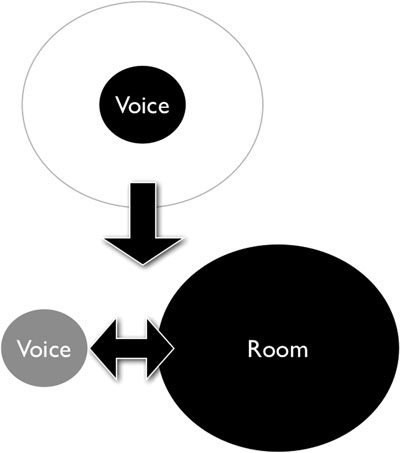
Alvin Lucier’s I Am Sitting in a Room is an investigation of the relationship between the sound we hear and the place we hear it. As the piece goes through many iterations of replaying and re-recording his voice in the room, it takes only a few minutes for us to begin to hear the sound of the room pitted against the original clarity of his voice; at about forty minutes, the voice becomes a memory set apart from the room in which it now only resonates. The process slowly replaces the sound of the voice with the colour of the room, as shown in figure 1, decoupling them from their original (albeit hidden) integration.
Decoupling of voice and room. The voice and the room are gradually decoupled in I Am Sitting in a Room.

But this decoupling of room and voice also causes our sense of the voice to change drastically. For as the energy of the voice is turned toward revealing the resonances of the room, the original voice gradually disappears into the overwhelming reverberation of the room. In the end, only traces of the voice remain, recognisable in the rhythm of the resonant reverberations only to those who have followed the piece from the beginning. As a result, the voice loses its identity, becoming less and less voice-like, until we might finally call it Not-Voice, as shown in figure 2.
Voice vs. Not-Voice in I Am Sitting in a Room. In the process of decoupling voice and room, the voice also loses its identity.

A human voice implies a human body. When we hear Lucier’s voice in the beginning of I Am Sitting in a Room, we immediately imagine his body and flesh ‘sitting’, as he says, or, better, existing in a room. Similarly, we recognise, almost as quickly, the quality of the Not-Voice, which we assign to the sounds heard at the end of Lucier’s piece; the sound at that point is ghostly because we cannot imagine a person, with flesh and blood, sounding like that – our attempt at projecting a bodily image fails.
Clearly, the use of vocal materials in electroacoustic pieces can be suggestive of a human body. However, the voice is not the only sound capable of such suggestion. In Klang by Jonty Harrison (Reference Harrison1982), we hear sounds that suggest someone playing with a metallic object, either by hitting or rolling it. Even though these sounds do not readily offer clues as to the identity of their sources, it is not difficult for listeners to imagine a human agent behind them, for sounds that suggest performance, or performative agency, embody the performer by suggesting his actions. However, as the piece progresses, the sounds move past the realm of possible human action. Slowly, the listener is faced with an image that becomes the Not-Performer, as seen in figure 3.
Performer vs. Not-Performer in Klang.

1.2.2. Place vs. Not-Place
A similar operation of negation, if you will, can be applied to matters of place in electroacoustic music. In Kits Beach Soundwalk by Hildegard Westerkamp (1989), listeners are first introduced to familiar sounds, all of which help them imagine a beach-like place. However, as they continue to listen, this beach-like place gradually disappears as the sounds, once familiar, change.
What the composer does to create this illusion is not too complicated: mainly the filtering, layering or de-layering of sounds. The effect on listeners, however, is remarkable, for with the composer’s careful filtering of particular frequencies, the identity of the beach is transformed; it is as if Westerkamp gradually peels off the semiotic layers from which the listener’s image of the beach was originally formed. For listeners, the progression suggests a kind of travel from one place, recognisable as a beach, to another that is clearly Not-Beach, as shown in figure 4.
Beach vs. Not-Beach in Kits Beach Soundwalk.

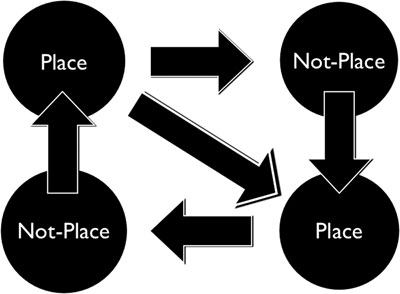
Listeners can similarly listen to Empty Vessels by Denis Smalley (Reference Smalley1997) and hear the composer playing with our sense of place through the negation of place-ness. In Empty Vessels, the composer creates (or gives listeners the opportunity to construct) a sense of place by presenting sounds that corroborate a particular place. As the composer manipulates certain sounds, or injects new ones, the collection signifying place is changed and distorted, leaving listeners reconsidering what they hear. Interestingly, listeners, once in doubt as to the identity of a sound or a collection of sounds, often shift their attention to its more spectromorphological aspects, in part because they want to discover more about what they are hearing, but also, and more importantly, because the piece encourages them to do so. As illustrated in figure 5, the operation that shifts the listener from place to place through non-place is one easily followed.
Place vs. Not-Place in Empty Vessels.

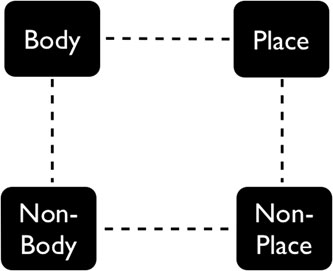
One thing unites the listening processes found in the electroacoustic works I have briefly addressed: their concern with the process of deconstruction. When challenged, listeners effectively deconstruct the integration of body and place through the manipulation of the everyday sounds heard in the pieces; this integration gives us the ‘body/place’ axis. Furthermore, the identity of body and place in these pieces is often challenged, so much so that their identity breaks down into something else, something we can nominally identify as Not-Body or Not-Place. The two operations, in combination with the ‘body/place’ axis, give birth to the four poles, Body, Place, Non-Body and Non-Place, which serve to define a quaternary framework for electroacoustic music listening, as shown in figure 6.
Four poles of a quaternary framework for electroacoustic music listening.

In this preliminary design, I have changed not-body and not-place to Non-Body and Non-Place in order to identify the total negation of body and place. For listeners, body and place are negated when critical semiotic features or sound properties signalling body or place are distorted, omitted, placed in conflict with others, or made discontinuous.
The emergence of the quaternary framework based on my listening experiences of these selective compositions is a result of my intentional focus on the phenomena that appear in listening – that is, the result of a phenomenological approach to listening. In fact, phenomenological approaches to electroacoustic music listening are not new. As Kane (Reference Kane2007) observed, Schaeffer’s theory of the sound object is much dependent upon Husserlian phenomenological methods – that is, the phenomenological reductions and bracketing. But, as opposed to Schaeffer’s ‘teleological’ application of the phenomenological reduction to sound objects (Kane Reference Kane2007), the phenomenological approaches in this paper can be thought of as what Ihde calls ‘a second phenomenology’, a Heideggerian approach to phenomena, in which as the intention discovers sound objects through the phenomenological reductions, ‘the way is also opened “outward” toward limitations and horizons’ (Ihde Reference Ihde2007: 18). As the paper will argue, this outward listening of ranging on limitations and reaching horizons results, among others, in sound-images of which the four poles are a part.
1.3. Imagining as a key procedure in the quaternary framework
Before we examine these four poles of the quaternary framework, however, we need to visit an important topic critical to the quaternary framework of electroacoustic music listening: the act of listening itself. Listening is an everyday practice and, like any everyday task, ‘depends on a vast ensemble which is difficult to delimit but which we may provisionally designate as an ensemble of procedures’ (Certeau Reference de Certeau1984: 43). There is a specific procedure that we commonly perform when listening to music, especially, I argue, electroacoustic music. What is this procedure? Katharine Norman’s documentary-style notes about her listening experience of Petit jardin by Magali Babin reveal that she is naturally bringing into play mental images, and using them to devise a type system through which she can bring meaning to what she hears. In fact, her main tool is the image of the human body – see: ‘movements she is making’, ‘I can hear her listening’, ‘somebody who waits’ or ‘a record of “a performance”’ – which she creates through her imagining of it; as she writes, ‘so I have to make a fiction of it’ (Norman Reference Norman2004: 9–10).
Imagining is a powerful practice that is at work in the quaternary framework proposed in this paper. Imagining is an indispensable part of the framework, as it connects and relates its four poles to the arena of electroacoustic music listening. In fact, the four poles share many of the properties listeners conjure in their imaginative listening. Therefore, with the framework introduced, it is appropriate that the paper examine the role of imagining in electroacoustic music listening.
2. Imaginal listening in electroacoustic music
2.1. Imagining a listener
Discussing music presupposes a listener. The way one approaches and talks about it depends on who is doing the listening. Understandably, however, identifying the listener in analysis is not a simple task, as discussed by Sloboda (Reference Sloboda1986) and Cross (Reference Cross1998). And electroacoustic music confounds this task even further as listeners are engaged in more than musical listening. Thus, separating musical from everyday listening, as in Gaver (Reference Gaver1993), raises a thorny question in electroacoustic music listening because electroacoustic music often invites listeners back to the everyday world through the capturing and suggestive presentation of everyday sounds. However, the absence of visual and tactile information, through which listeners often confirm their perceptions, makes the experience less complete than everyday observation; the information needed to make the affordance of everyday things and experiences is, as a whole, inadequate and the experience difficult to accept.
Gibson argues that, when faced with inadequate information, our ‘perceptual system hunts’ (Gibson Reference Gibson1966), and the unsuccessful hunt for additional information leads to a suspension of judgement and, furthermore, to a decision to cease hunting. Instead, assumptions, inferences or guessing come into play.
Although what Gibson proposes may be in accord with the way we cope with the everyday world, it seems that what the listener does while listening to music is more than an assumption, an inference or a guess. The electroacoustic listener is engaged with the music, not out of a search for truth or survival, but for the pleasure of the process; consequently, I argue that this difference makes of listening a different task, one more intentionally creative in which the listener imagines.
2.2. Imagining as a phenomenological probe into electroacoustic music
A thorough and passionate account of imagining is given by Edward Casey. In his book Imagining, Casey recognises that imagination is an unpopular, if not controversial, subject that has either been unfairly criticised and summarily dismissed by the quantitative disciplines, or celebrated by disciplines such as psychology and philosophy for the mysteries it might reveal. But this is not what Casey and I mean by imagination. Imagining, as the process of imagination, is distinguished from hallucinations or illusions by the way it immediately connects our experience to phenomena, and, in turn, works to direct our mental activities back to what is happening around us.
The aural experience that I Am Sitting in a Room creates depends entirely on technology; specifically, the process that progressively changes the sound we hear. But the effect is a result of more than technology, for what we experience is the result of two human processes: one concerned with perceiving and another with imagining. Even though we perceive the sound of Lucier’s voice gradually disintegrating into the reverberant sound of the room, it is our imagining that leads us back to the work’s opening voice and allows us to establish a relationship between the growing reverberance of the room and the voice we eventually only remember.
To perceive is like recognising dots, while imagining – which builds upon our perceptions – connects them (or changes the connections held together by conventional assumptions). Once connected by imagining, however, what we have perceived can take other turns, which we witness when listening to I Am Sitting in a Room. As Casey argues:
Imagining is not only capable of linking up with preceding acts of perceiving: it carries on their work in a different modality. Qua paraperceptual, imagining is an act by which the inherent partialness of perceptual experience is momentarily suspended – though not, of course, overcome. Through such paraperceiving, perceived and imagined components become interwoven as conjoint elements of a perceptual object or event which we are striving to apprehend more fully than we could by perception alone. (Casey Reference Casey1976: 139–40)
As such, electroacoustic music listening engages the interworking of perceived and imagined elements. But what, one may ask, does the interworking of perception and imagination produce? And to what should listeners be listening?
3. Sound-image in Electroacoustic Music
Listeners engage with electroacoustic music by imagining a relational and developmental process among the sounds they hear. In fact, the use in many electroacoustic compositions of everyday sounds (and the characteristics we associate with them) naturally guides listeners into a process of imagining relations. The everydayness of the sounds emboldens them to ‘picture’ what they are hearing as they take cues from the way the sounds sit, move, integrate, disintegrate, or generally relate to one other. If image is ‘the mode of givenness pertaining to the total imaginative presentation’ (Casey Reference Casey1976: 55), then sound-image can be understood as a mode of givenness initiated and led primarily by aural presentation that, nonetheless, constructs the totality of the imaginative presentation through the act of imagining.
Sound-image is a puzzling word, as it suggests that sounds are somehow seen. Yet the term is commonly used by listeners probing their first experiences with electroacoustic music. Moreover, sound-image is a concept often used by composers, particularly as they imagine those aural objects suggestive of things listeners might imagine touching or feeling, or places into which they might imagine listeners venturing. That listeners and composers alike characterise electroacoustic music in terms of sound-images suggests evidence of a common, shared framework based on qualities inherent to the activities of both. As Young (Reference Young2007) observes, if sounds in electroacoustic music have, to a varying degree, a recognisable everydayness to them associated with their realism, then realism, and the degree to which composers desire it and listeners perceive it, could possibly serve as a framework through which key features of electroacoustic music composition and listening might be mapped.
3.1. Sound-images in electroacoustic music: what do we imagine?
Having explored the idea of perceiving and imagining using I Am Sitting in a Room, and after looking closely at the idea and importance of imagining in electroacoustic music, two important questions emerge: what do imaginative listeners imagine and how do they imagine it?
It is noted that certain electroacoustic music compositions – often called acousmatic music – focus on certain types of sounds or images that encourage listeners to, at the outset, listen out of a desire to fill in the gaps created by what is missing or hidden by the creative use of sound. The making of a listening framework may propose or at least suggest an answer to the first question: that is, listeners imagine what is missing in order to complete the representation. Humans do this daily when faced with partial perception of events. For example, while I am writing this sentence in my study, I hear a series of loud sounds – beeps, sharp scratching, thumping and cranking – but I cannot see their source; nonetheless, I create, out of past experience, a visual image of a garbage truck just outside my apartment. I can even picture, almost exactly, what it does (and even guess at its next movements). The typically partial nature of our perceptual experiences is likely due to ‘the fact that the perceiver is always anchored in some specific position in a particular spatio-temporal field’ (Casey Reference Casey1976: 136–7); nevertheless, we somehow succeed in grasping experiences as completely as is useful. Furthermore, the principal element initially missing from the listener’s experience of electroacoustic music is often the visual appearance of the sound source, though listeners quickly learn to imagine the source as simply out-of-view. Therefore, it seems natural for listeners of electroacoustic music to express their experience in visual terms despite the fact that there is typically nothing to see.
As such, for listeners and composers, the interplay between what is given (perceived) and what is not (and must therefore be imagined) is the very playground of electroacoustic music.
3.2 Sound-images in electroacoustic music: how do we imagine?
The interflow of image and sound becomes subject to perceptual ecology’s processes of ‘hunting’ and ‘imagining’ and the way they interact. In particular, when exposed to a certain set of sensory data, the ecological hunting process may still look for other physical qualities that our body can actually sense, whereas the process of imagining may not. How then does the process of imagining fulfil the goals of the perceiver who seeks to experience things as a whole? Casey notes that we ‘intend more than is given’ (1976: 137). It is our intention to perceive things in their wholeness that initiates the process of imagining. Furthermore, we tend to move freely between what is perceived, which is given, and what is imagined, which is not given, so as to finally form an integrated whole.
In the eight-channel electroacoustic work Out of Breath by Paul Koonce (Reference Koonce2000), for example, I hear the sound of short and long inhaled and exhaled breaths; some stutter while others are prolonged; all sound as though directed into a tube whose timbre I soon recognise as that of a flute. A series of similarly pitched flute-like sounds – not the sounds of a flute in a strict sense because, most of the time, I hear only groups of partials – tend to be heard first from the mid-front speaker, although the overall sound soon spreads outward to include the left-front and right-front speakers, followed by the side speakers. Also, I hear the reverberated sounds of the pitched flute-like sounds lingering on in the speakers at the sides and the back. As I hear the sound again and again, in different variations yet with a constancy of shape and presentation, I imagine (as the sound-image appears) a performer in a space, exploring the sound of her instrument in the space as it somehow, fantastically, resonates certain partials of the instrument she holds. The piece seems to play with different configurations of the frequency spectrum of the flute, which are set in motion by the imaginary performer who, initially hesitant and nervous about playing, gradually comes to accept what comes out of it. At the same time, the sound of the flute slowly opens up not only its own property as an instrument, but also the quality of the space in which it is played.
It is important to note that my experience of the piece is the product of what I am actually hearing and what I am projecting onto the sound – what I am imagining. I could say that all I heard were a series of flute-like sounds – some reverberated, some dry – with added breaths and some additional hard attacks. However, my experience of the piece is much more; as I hear and follow the work, I begin to imagine things – a performer, a flute, the lips of the performer that touch the flute, and even the partials of the flute sounds as they fly about, bouncing back and forth between the walls of the space I am in. My imagining is inevitable, and in fact, the piece encourages it and the sound-images that result. Yet the experience is disconcerting, for while I know that, in listening to the work, I both perceive and imagine, it is difficult to determine where my perceiving of the piece ends and my imagining of it begins; I move between the two domains freely and immediately.
Casey argues that there are three primary ways in which we can image: imaging, imagining-that, and imagining-how (1976: 41), and if we examine closely the way I was imagining while listening to the piece, we can discover these three ways of imagining with sound and sound-images.
3.2.1. Imaging and sound-images
First, when we listen to electroacoustic music, we are drawn to familiar images of specific, if not simple, form. Casey notes that to imagine is ‘to image’, which means ‘to form an imaginative presentation whose content possesses a specifically sensuous – an “intuitive” or “imagistic” – form’ (1976: 41). Indeed, my imagining while listening to Out of Breath created a strong representation of a flute and/or a performer. And the image of the flutist I created consisted not only of aural elements but also visual, and even tactile elements. In my hearing of the work, I was almost able to see ‘the lips of a performer touching a flute’ or to touch, myself, the sounds as they flew around the space (unbelievable though it may seem) because imagining almost always occurs ‘in a sensory-specific way’ (Casey Reference Casey1976: 41). Moreover, these images often seem to take some form of action or to appear within the frame of an event.
3.2.2. Imagining-that and sound-images
Second, in electroacoustic music listening, we imagine not only sound-images but also their relationships. As Casey notes, while imagining, ‘we also imagine that individual objects or events together constitute a circumstance or situation: a “state of affairs”’ (1976: 42). Consider my imagining during Out of Breath: my sound-images establish a form of performance – perhaps the flutist is rehearsing. Once I situate these sounds in this setting, I can listen further for performative clues. In other words, many of the sounds I hear make much more sense to me once I ‘figure out’ a way of imagining their situation(s).
3.2.3. Imagining-how and sound-images
Finally, in our hearing of electroacoustic music, we imagine how our sound-images unfold, situated as they are in the circumstances we imagine: we imagine in a state of expectation. For when we imagine, we anticipate ‘what it would be like if such-and-such a state of affairs’ were to happen. In expectation, listeners, being ‘an active and embodied participant’, play an active role in the process of imagining-how (Casey Reference Casey1976: 45). Two of the most effective devices used throughout Out of Breath are repetition and silence. As I listen to the piece, these devices challenge my assumptions about what the piece is about, or better, how (or whether) it will continue. Remarkably, repetition and silence prevent the sound-images I imagine, and all that I imagine is happening around them, from becoming fixed, keeping the idea of what the piece is about in motion so that I, the listener, can continue to expect or hope for something that is, yet again, new.
3.3. Sound-images and negation process in the quaternary framework
3.3.1. Body as sound-image
As we found with Out of Breath, the image of a body typically takes form once listeners discover features of sound suggestive of bodily action onto which they can project the memory of their own physical behaviours (and limitations). Simon Emmerson (Reference Emmerson2007) lists some of the key properties of the human body – heart beat, breath, voice, exchange (conversation and interaction), touch and proximity, and human movement – which, when detected in sounds, listeners can use to construct the sound-image of a body. Similarly, Mark Leman’s action–reaction cycle (Leman Reference Leman2008: 53–5), through which he discusses the two interlocking processes – listening and acting (such as performing) – on a sounding object, and investigates the relation between human embodiment and technology, as well as Jensenius’ experiment on air performance (Jensenius Reference Jensenius2008: 62–77) shed light on the way listeners can imagine a human body through the process of inference to fill in the gap in acousmatic situations.
Even a small sampling of electroacoustic compositions will produce a showcase of appropriate examples. Many compositions create composites of body-associated properties that they then present all at once or gradually unfold in order to engage the listener with a growing and evolving human presence. In Interiors and Interplays by Erik Mikael Karlsson (Reference Karlsson1994), listeners may have little sense of the body until they hear the sound of breathing at 5:39. Breath sounds are remarkably suggestive as demonstrated here: in spite of the sounds’ brevity, listeners quickly project the image of a body onto them. So cued, the body becomes a vehicle through which listeners recall and retroactively relate earlier sound events – those first heard without any tie to the immanence of the body: filtered sounds that infrequently travel within the stereo field at 2:20 and on become a voice; resonant sweeps throughout the piece moving gracefully from left to right are framed as breathing; even the resonating metallic sounds that open the piece might be heard as a human body in action.
Contrarily, Surface Tension by Jonty Harrison (Reference Harrison1996) leads its listener into the domain of the body, not through the cues of breath or voice, but through a strong sense of physical action that connects the piece to the body in two ways: first, the piece’s repeated returning to original wood sound sources and their strong performance signature; and, second, the phraseology of sound events that suggests a human performance.
But what kind of sounds in electroacoustic music, other than those that emanate directly from a human body, can suggest to listeners a sense of human action? Categorising sound-related gestures – sound-producing gestures, sound-accompanying gestures and amodal, affective or emotive gestures – Godøy notes that the most ‘embodied’ gestures among these categories are ‘those that follow the sound closely, i.e., the sound-producingFootnote 1 and sound-tracing gestures’, and also maintains that ‘[the] sound-producing gestures have an energy transfer from the performer to the instrument, whereas the sound-tracing gestures may mimic excitatory gestures as well as trace the evolution of the resonance of sounds, i.e., the “passive” or energy-dissipating phase of the sounds, hence not transferring energy to a resonating body’ (Godøy Reference Godøy2006: 154).Footnote 2
While Godøy’s categories may comprehensively address the different meanings of gesture in music, his range of categories is too broad to be useful in characterising the more limited collection of sound gestures in electroacoustic music that we can readily connect to human action: first of all, amodal, affective or emotive gestures may not impart a well-grounded sense of the human body to listeners (at best, they may affect listeners after listeners have formed a sense of body from more salient gestures); second, some of the sounds related to sound-accompanying gestures may be too divorced from notions of corporeality for listeners to produce a sound-image of the human body. Although sound-accompanying gestures may bear gestural characteristics, the impression of the body they convey is less an image than a type of elicited affect. In fact, Godøy argues that some of the sound-accompanying gestures – that is, more vague sound-tracing gestures – are more about ‘reflecting the total sonic evolution of the music’ than about ‘the assumed sound-production gestures’ (Godøy, Haga and Jensenius Reference Godøy, Haga and Jensenius2006: 257). For example, the filtered noises beginning to travel in the stereo field at 2:20 in Interiors and Interplays may suggest an acting human body, but, being abstract, they cannot by themselves convey a sense of one; they must be framed by more obvious, body-connected sounds.
In this regard, these more vague sound-tracing gestures can be thought of as being properties of non-body, the negation of body. However, it is essential to note that the non-body (and non-place, as well) in the proposed quaternary framework does not emerge in and of itself; rather, it emerges from the negation of the body. For example, processed sounds in Splintering by Jonty Harrison, such as granulated sounds around 12:00, do not by themselves form a body. They need to be connected to more salient body-features in the beginning of the piece (as well as several other more credible references to the human body). Therefore, any discussion of the non-body-ness of electroacoustic music should centre on the negated body properties and how they are negated.
3.3.2. Place as sound-image
Place in the proposed quaternary framework for electroacoustic music listening can be defined as a sound-image that listeners conjure up, first, by recognising and collecting the potential place-ness of sounds, and, second, by examining the plausibility of these sounds existing together, measured against the listener’s memory of directly or indirectly experienced spaces. Just as a ‘place is an organized world of meaning’ (Tuan Reference Tuan1977: 179) in everyday being, a place as a sound-image in electroacoustic music is a product of a listener’s efforts to organise and connect together the things that sounds reference.
First, one must clearly differentiate between space and place as they are used in this paper in order to have a better understanding of how listeners produce and make use of these two terms in the quaternary framework. One can certainly feel spaciousness or other spatial properties in electroacoustic music. In fact, a sense of space, conveyed, for example, through recording technique or room-simulation technologies, is essential to how we hear electroacoustic music and has recently been a favorite topic among electroacoustic composers and theorists (Emmerson Reference Emmerson1998; Harrison Reference Harrison1998; Myatt Reference Myatt1998; Truax Reference Truax1998; Worrall Reference Worrall1998; Lane Reference Lane2000; Henriksen Reference Henriksen2002; Blesser and Salter Reference Blesser and Salter2006; Emmerson Reference Emmerson2007; Smalley Reference Smalley2007). Nevertheless, it is questionable whether the spatiality that listeners hear in electroacoustic music forms sound-images as I have defined them in this paper; rather, spatial cues are invitations to listeners to imagine a sense of place, which may be richer in its details and more suggestive through its inferences than the cues of spatial ambiance by themselves.
It is also crucial to note that to imagine place in electroacoustic music is not only to exploit but also to limit – that is, to frame – the image potentials and possibilities of the sounds heard. For example, in Industrial Revelations by Natasha Barrett (Reference Barrett2001), neither the drone at 0:53 nor the short, high-pitched squeak around 1:03 identifies a particular place. But heard together, repeatedly with ever increasing loudness, the two sounds may form the image of a train approaching with accelerating speed, especially when finally framed by the confirming sound at 1:31 of a real train stopping at a station. This act of framing is essential to the recognition of place (or places) in electroacoustic music.
However, imagining a place in electroacoustic music is not always an easy task; in fact, it is often difficult to definitively recognise place at any given moment in a piece, especially when the sounds of different places are mixed, suggesting a kind of simultaneous existence in different places. For example, listeners who framed the high-pitched squeak and drone in the example above into the image of a train station are soon challenged at the return of the sounds between 3:58 and 5:08. While less prominent than before, their return, on its face, intact, maintains the original train station image. However, this time, the train station is joined by the sound of an operatic soprano. The new pairing of train station and soprano is a challenging one, for while the judicious mix of sounds, exploiting similarities of pitch and the alignment of attacks and fades, coalesces into one sounding body, the juxtaposition of the associated place-images (i.e., train station and rehearsal/performance room) is startling. Looking structurally at the unique moment, we can say that listeners face the unsettling effect of a simultaneous conjunction and disjunction of different ways of hearing; listening spectromorphologically, listeners hear conjunction in the event as spectral features join together into simplified auditory forms; however, listening from a semiotic perspective tuned to the objects, places, meanings and narratives to which the sounds potentially refer, listeners hear disjunction as they face a collision of places.
The interplay between semiotic and spectromorphological listening and the perceptual confusion it fosters is a primary characteristic of electroacoustic music that attracts listeners greatly.Footnote 3 However, the subject is difficult to examine in terms of existing theories on electroacoustic music listening. By combining both spectromorphological and semiotic listening modes, and by identifying sound-images that change based on the process of negation, as shown briefly in the above example, one can distinguish and discuss this structural interplay in electroacoustic music listening.
While the example above relied more on everyday sounds to explore conflicts of place, other pieces, such as Night Traffic by Paul Lansky (Reference Lansky1990), depend more on spectromorphological properties of sounds. As Norman describes her experience of listening to Lansky’s piece (Norman Reference Norman2004: 68–9), the confusion created by the interworking combination of a musical framework of comb filter resonances overlaid onto everyday traffic sounds causes her to hear the piece as neither simply traffic nor a series of changes in timbre. It is telling that this confusion pulls her away from the highway (as a sound-image) so much so that the piece comes to represent no place at all ‘because it starts as it is, and continues much the same, there are no explicit opportunities for flipping between listening to sounds and following memories or associations. … It does not go on with any place in mind’ (Norman Reference Norman2004: 69). Thus Night Traffic is a piece that starts by representing a place, but gradually betrays the quick reading of that place as a consequence of the imposition of resonances that would be foreign to the place as most know it. Compared to Industrial Revelations, the confusion that emerges in Night Traffic is not the result of intruding sounds of similar sonic characteristics; rather, it is the result of resonances that distort and transform the sound, engaging listeners with their unexamined presuppositions about where traffic sounds end and something else, more subjective and musical, begins.
3.3.3. Interaction between body and place
The body/place axis in the quaternary framework hinges on the listener’s implicit understanding of the relation between body and place: our body exists in a place, and a place surrounds us. Thus, in electroacoustic music listening, listeners often make effort to place a body. In the beginning of I Am Sitting in a Room, the imagined body is placed in a room. When the body loses its identity and the place emerges, listeners become cognisant not only of the spatial properties of the room, but also of their inability to place a body. Once diffused and disintegrated, the voice becomes without place. Similarly, the semiotic disjunction caused by the merging of train station and operatic soprano sounds in Industrial Revelations is, in part, due to the listener’s inability to place the body of a soprano in a train station.
Table’s Clear by Paul Lansky (Reference Lansky1992) is an intriguing exception to the above examples. From the sounds of kitchen utensils and the occasional child’s voice, listeners can easily imagine a domestic scene in a kitchen (or at a dinner table). The scene contains, of course, the image of a body through the sound of children striking water glasses and pots with kitchen utensils. And this body image is neatly integrated into the image of a kitchen. However, after a series of changes, including an emerging pattern at 1:00, the dropping out of children’s voices, and the introduction, after 3:20, of a synthetic bass line to support the chord progression, the piece no longer suggests a kitchen; rather, it has become a pure and integrated performing body. What, then, happened to the kitchen? Has the kitchen-image been disintegrated into a non-place? Perhaps. But listeners, if they choose, can continue to conjure up the image of a kitchen because the utensil sounds are still present. However, the way these sounds have come to be played has changed; they have been reorganised to reflect a sense of musical flow and gesture. The new sound order transforms the kitchen-table chaos of improvising children into one integrated performing body. Thus, it can be argued that Table’s Clear shows a unique example of place-becoming-body.
3.3.4. Non-body and non-place, and three types of negation process
Many of the electroacoustic compositions explored in this paper reveal the way sound-images of body and place can lose their identity through processes of change that draw them into the non-body/non-place axis. Non-body and non-place are best defined in terms not of negation, but of the underlying processes driving negation. It is, therefore, worth listing the processes in order to better identify the process of negation at work in electroacoustic music listening.
For listeners, a sound-image loses its identity, or fails to fully acquire it, when the properties supporting the image cannot be, or can no longer be, verified. Viewed in the most general sense, sound-image properties can be seen as a kind of information set; in the listener’s reading of a sound-image, an incomplete or questionable set can be perceived as insufficient and lead to doubt about the identity of the image. In general, insufficient sets lead to challenged or negated readings. From an informational perspective, three types of conditions tend to characterise the listener’s perception of an insufficient set; they are: missing information, distorted information and informational conflict.
While the perception of informational negation is a matter of listening, composers, no doubt, create the conditions for the perception. Consequently, in our search to better understand these forms of informational negation, it is revealing to examine compositional processes. However, it is important to recognise that compositional processes do not automatically challenge or negate sound-images, for composing and listening are separate processes, and while a compositional process may bring change to a sound, it is ultimately the listener and musical context that connect the change with negation.
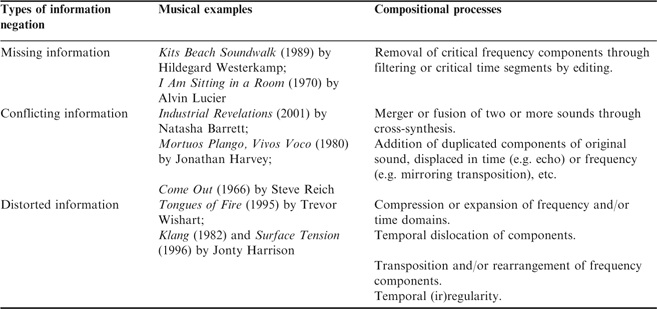
The compositional processes shown in Table 1 can be observed in many of the musical examples discussed in this paper. It is important to note that, while Table 1 identifies examples of music using only one type of negation, in practice composers often use the different processes simultaneously; in other words, challenge to or negation of any one sound image can result from the simultaneous use of more than one type of negation.
Pieces and compositional processes associated with informational negation.

4. Conclusion
In this paper, I have proposed a quaternary framework for electroacoustic music based on the examination of key sound-images that emerge from imaginal listening. I have also discussed in detail how crucial it is to discern from our act of listening the two processes of perceiving and imagining and have argued how imagining fills the gap; that is, how it supplies what is not given, and how the addition of missing parts completes the sound-images any given piece seeks to represent. Additionally, I have observed three ways in which we engage in the process of imagining. Finally, I have explored properties of the four poles of the framework while reviewing several electroacoustic compositions with these properties.
It is not this paper’s intention to propose a theory of electroacoustic music listening; its goal is to identify a process that listeners may employ – perhaps unintentionally – while listening to electroacoustic music. In other words, it attempts to explore one path by which listeners may navigate and interpret the vast world of electroacoustic musical sound.
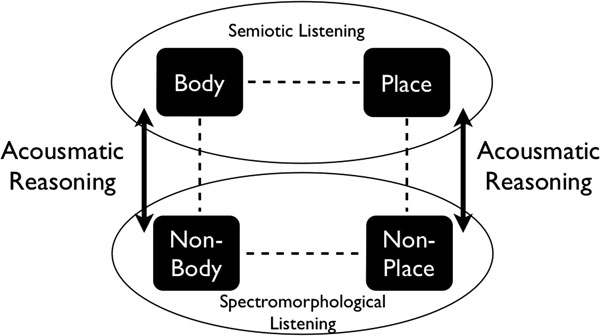
The observations made in this paper about the production and negation of sound-images and the quaternary framework have given me elsewhere (Kim Reference Kim2008) an opportunity to consider a listening mechanism called acousmatic reasoning based on which listeners employ the two processes to move about within the proposed framework (figure 7).Footnote 4
A quaternary listening framework for electroacoustic music based on acousmatic reasoning (Kim Reference Kim2008: 43).

This paper has persistently argued that listening to electroacoustic music is as much an act of perceiving as of imagining. Good listeners are not only attentive to both acts of listening, but also balance their attention in accord with the piece they hear.