In some respects an attempt to focus on equity in public health results in an understatement of the extent of the neglect of social justice in the health economics literature. Despite being the fundamental reason for intervention in the health sector in virtually every country in the world with a functional government, equity represents only 2.5% of the cumulative total keywords used in the Journal of Health Economics in its first 25 years (Phelps, 2007). Most would agree that the subject matter of public health is health per se and that in the treatment of unknown beneficiaries priority should be given to activities which benefit disadvantaged groups. Also for this reason, the restricted subject area neglects many of the most interesting issues on the research-developmental agenda. Unsurprisingly, therefore, Cookson, Drummond, and Weatherly (CDW) stray into more general and controversial issues of health equity and comments below will not draw a clear distinction between them. Comments cover five issues: (i) what is equity and how clearly is it defined, (ii) incorporating equity, (iii) the equity–efficiency distinction, (iv) neglected issues, and (v) the need for a new framework.
What is equity?
For reasons discussed later, I think that this question (what is equity?) should never be asked. It narrows, excludes, and diverts analysis. The type of anomaly which arises is neatly illustrated in the paper. Initially ‘equity’ is an unproblematical concept. Three types are identified which ‘decision makers have in mind’ (which should not, of course, limit economists to these). These are health inequality, priority to meritorious groups (CDW fail to nominate health economists!), and observance of other ethical rules. Each category consists of groups, not individuals. In the penultimate section, however, Tsuchiya et al. (Reference Tsuchiya, McCabe and Wailoo2007) are quoted (without disagreement) as arguing that there are ‘so many potential dimensions of equity that equity weights substantially complicate the analysis’.
This is unsatisfactory. What are these other categories? Why have they not been discussed in the paper or even alluded to earlier? A possible reason is that CDW considered group but not individual analyses practicable, and perhaps this is defensible in the context of a discussion of public health but clarification and the reasoning behind this argument would have been helpful.
Tsuchiya et al. (2007) are certainly correct with respect to the range of measurement issues which emerge once the early broad categories of CDW are probed. But complexity occurs at both the group and individual levels. Health equity in the literature is usually equated with health per se. But it need not be limited in this way. Sen has famously argued for capabilities to be the subject of policy. Hard line welfarists would, presumably, still argue for utility; ‘soft line’ welfarist-extra-welfarists argue for weighted or unweighted QALYs, which themselves weight life years by utility. But why (preference) utility and not subjective wellbeing (happiness)? Why not retain a partly medical-biological notion of health (as does the medical profession)? Should life years be the base unit or lives or a diminishing function of life years? With respect to welfarism-extra welfarism and capabilities, the debate is far from resolved. With respect to the role of subjective wellbeing, it has scarcely begun.
Complexities multiply when quality of life is also considered to be a component of equity. QALYs have evolved historically and a very large number of issues are unresolved. QALYs, HYES, and DALYs represent three of at least 240 possible scaling instruments, most unexplored for historical, not methodological reasons (5+ rating instruments – TTO etc; 3+ time frames; 4+ possible groups to conduct ratings; 2+ time perspectives; 2+ social perspectives). Of particular interest for public health or evaluation for a NHS is the largely unexplored question of whether the attributes of QoL nominated by individuals for their own wellbeing correspond with those they would wish to finance as the citizens/taxpayers who fund a country’s NHS.
A final notable problem with either group or individual equity is illustrated in Table 1. Simplifying the illustration to the subject of life years, it is unclear how benefits should be summed using either efficiency or equity criteria. Efficiency usually means maximizing life years – program I. But two-thirds of the population then obtain a lower life expectancy. If ‘efficiency’ was defined by population preferences, it is very likely that program II would be selected in preference to program I. The higher median in program II indicates a higher probability of each individual reaching a greater age, and, without the advantages of an economics education, people may fail to pay obeisance to EUT but apply a statistical rule that they understand to their decision making. The ethical implications are equally indeterminate. (Ex post) hedonic utilitarians would probably opt for program I, since this maximizes the number of life years and total (hedonic) utility. By contrast, Rawlsians would opt for program III, since this maximizes the number of life years for the worst off group and (ex ante) preference utilitarians might opt for program 2 because of the higher median.
Life expectancy from 3 programs

Incorporating equity
CDW outline four approaches to incorporating equity. Despite the form of expression, these do not appear to be alternative approaches but a progression in the complexity and comprehensiveness of the analyses. Providing background information on equity to decision makers (‘approach 1’) and generating quantitative evidence on likely inequalities (‘approach 2’) are clearly desirable and unproblematical. That they should need to be recommended is perhaps the most telling fact. It is indicative of a lamentable standard in the literature and in the expectations of policy makers that these recommendations are necessary.
The third approach – estimating the opportunity cost of equity in terms of population health sacrifice – is problematical. Unless there is a rigidly fixed budget, this is infeasible. The possibility of ad hoc budget supplementation for disadvantaged groups, for example, would invalidate the approach. Even with a fixed budget, the order in which programs are introduced is generally unknown and the meaning of health sacrifices and their comparison through time would probably be uninterpretable.
Comments on equity weighting are also troublesome. First, this ‘fourth approach’ is different in kind. It moves from the positive analysis of programs to an attempt to assist with the normative issue of social benefits. In this context, the authors understate the progress that has been made in population value measurement. For a review, see McKie and Richardson (2005a, b). The authors also cite somewhat misleading conclusions. At least four studies support the intuitively appealing result that health gains to children are less highly valued than gains to adults with their larger social networks and economic dependents (Institute of Medicine, 1986; Johannesson and Johansson, Reference Johannesson and Johansson1996; Lewis and Charny, Reference Lewis and Charny1989; Nord et al., Reference Nord1995). (This is a lot of ‘noise’.) In contrast to the implication that equity weights have rarely been used in economic evaluation studies, time and age weights have been explicitly included in the highly influential WHO Burden of Disease study (Murray and Lopez, Reference Murray and Lopez1996) and its replications around the world. While controversial, this represents a major step in the direction of using equity weighting. This, however, is a caveat and not a disagreement with the authors’ concern over the dearth of analyses.
While agreeing with the need for additional methodological work on population value weights (new approaches generally do need developmental work), the authors’ reservations about this approach are unpersuasive. The key elements of equity must be identified for any approach, not just, as implied by the authors, when weights are used. The evidence base is, of course, inadequate – the approach has not been implemented except by the WHO. Philosophical differences about the role of economic evidence are a problem for decision makers once they have been given the data; it is not a reason for censoring the data. Equity weights do not imply an algorithmic approach to decisions, rather decision makers should be provided with both disaggregated and aggregated data relating to equity. Well-conducted surveys remain an important instrument for obtaining a representative cross section of public opinion: surely a prerequisite for matters concerning equity.
The authors have usefully noted that the role of economic evaluation per se in the achievement of equity is limited as problems of equity are often systemic. At least three cases may be distinguished. First, when inequity arises from geographic or financial barriers, increasing the benefit to cost ratio achieves little if services, now in the NHS, cannot be accessed or afforded. Secondly, inequalities arising from cultural impediments (SES, migrant or ethnic groups) may also benefit little from a favourable economic evaluation unless it is for a program which specifically addresses these cultural problems. Third, inequities which arise because of special need or virtue amongst well-informed groups may, in contrast, benefit by an evaluation which identifies them as eligible for services others may not receive. Obvious candidates are the chronically ill and health economists!
The equity–efficiency distinction
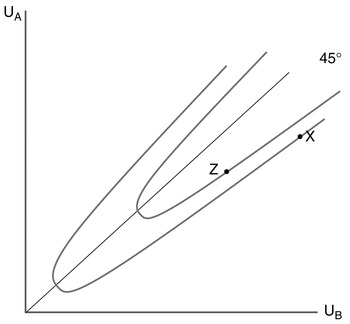
I believe CDW – and most economists – understate the potential importance of social values. CDW accept that Pareto efficiency ‘does not make a strong value judgement about equity and efficiency’ and a common conclusion would be that Pareto efficient improvement could be recommended without raising issues of equity. But even this most determined attempt to define a value free improvement fails. In Figure 1 ‘X’ is unambiguously Pareto superior to ‘Z’, but ‘Z’ achieves higher social welfare. Reinterpreted, individual utilities (potentially including positive or negative utility from the direct observation of other individuals) are higher at X. But the highly egalitarian society represented by the Figure 1 deems the resulting inequalities to make the society – but no individual – worse off. Despite the authority of Margaret Thatcher, society may be more than the sum of its individuals or, at least, be perceived to be so. This conclusion could be avoided in theory with sufficiently convoluted definitionsFootnote 1 but, in terms of what has been measured in economic evaluation to date, the treatment of Pareto efficiency as value free improvement in social welfare is invalid and there is empirical support for populations rejecting the desirability of ‘Pareto efficient improvement in income’ (Anderson et al., Reference Anderson, Richardson, McKie and Iezzi2007).
Is Pareto efficient?

In terms of CDW’s numerical example, a QALY gain of 1,000 to one group and a loss of 900 to another may be less ethically problematical if it equalizes life expectancy more than a net gain of 100 and 0 to a privileged and underprivileged group respectively, which may even reduce social wellbeing. This raises the question of the usefulness of the distinction between equity and efficiency goals; that is, ‘efficiency’ as defined by the Pareto criterion is neither necessary nor sufficient for the recommendation of a policy and ethical considerations cannot be circumvented. The rejoinder that the circumstances described above are likely to be very uncommon would only be persuasive if population values had been thoroughly researched, but they have not.
The reason for this technical comment is to suggest that a less coercive analytical approach would be to adopt the framework of Decision Analysis and maximize an objective function consisting of social objectives without attaching the value laden terms ‘efficiency’ and ‘equity’. (‘Efficiency’ being unquestionably desirable; ‘equity’ being a bit vague and waffly and understandably sidelined in ‘hard’ analyses.) ‘Social objectives’ are unambiguously and unavoidably normative and likewise the function which combines them. Identifying and measuring objectives opens up a wider range of issues which are not pre-censored because they do not fit the usual linguistic connotations of ‘efficiency’ and ‘equity’ in the economist’s lexicon.
Neglected issues
Expanding the set of contestable questions to any ‘social objectives’ raises two prior questions: how are these to be determined and what issues need investigation? The former question is too large for discussion here but the suggested answer does not involve recourse to abstract axioms but, inter alia, to empirical evidence of public preferences (Richardson, Reference Richardson, Murray, Salomon, Mathers and Lopez2002; Richardson and McKie, Reference McKie and Richardson2005, Reference Anderson, Richardson, McKie and Iezzi2007). In addition to the questions of welfarism, extra welfarism, capabilities mentioned earlier, additional questions include (i) whether there should be equal health status (Australians, at least, reject this); (ii) should there be greater equality of health status than at present (Australians generally agree with this); (iii) should there be equal service access (Australians generally agree with this); (iv) what form of discounting should apply (the pivotal issues for inter temporal equity); (v) should the person’s health potential count (non-discrimination against less healthy groups); (vi) is there a role for the rule of rescue (McKie and Richardson, Reference McKie and Richardson2003); (vii) is preservation of hope an issue; and (viii) how is quality of life to be measured (which, of course, subsumes an enormous number of separate questions).
Perhaps the most intriguing issue is the role of net resource use. Australian surveys find an overwhelming rejection of prioritization on the basis of indirect benefits and, more generally, social contribution. Economists commonly argue for their inclusion. More controversially, a number of studies summarized in Richardson and McKie (2007) find a rejection of the orthodox role of direct costs. When asked, respondents appear to feel it inequitable to discriminate against those with high cost illnesses or at least to the extent implied by present economic practice.
The need for a new framework?
The last result seems self-evidently absurd from the perspective of a framework based upon disembodied costs and benefits but less absurd when the seldom-discussed fact is recalled that achieving ‘allocative efficiency’ usually involves distributing resources to different patients. If people regard a universal public health system as bestowing a universal entitlement upon people to receive care, then it is less surprising that the role of cost should be modified. Along with severity of illness, age, capacity to improve, health potential, and possibly other factors, it simply becomes one more variable for qualifying the right to treatment. As a NHS is generally universal, the way in which the right to treatment is curtailed for different people, fairness is – or would be expected to be – of pivotal interest rather than an ‘add-on’. In such a framework, the weight attached to cost is unlikely to be unity: it might not be given the special status accorded by present theory. This implies, of course, less than maximum health per dollar, but this is only disturbing in the present framework and perhaps of less concern than the unethical treatment of different individuals.
The label for the value system underlying such a fairness-focused framework is of some interest. ‘Egalitarianism’ is probably inappropriate, as an NHS does not necessarily seek equality but access to benefits defined by social objectives; neither is it a safety net system as an NHS usually clearly seeks to provide widespread coverage. Rather, like access to parks and the protection of the law, they are a reflection of the type of society people wish to have, a concept described as ‘solidarity’ in Europe but not in Anglo Saxon countries. It is possibly because economics also does not have this word in their technical vocabulary that analysis has been truncated to concepts covered by the economist’s lexicon.
In sum, an expanded framework may have profound implications for the role of social objectives, including those presently and imperfectly described under the heading of ‘equity’.