


Background
Deliberate self-harm (DSH) is a frequent occurrence within psychiatric hospital settings (DiClemente, Ponton and Hartley, Reference DiClemente, Ponton and Hartley1991; James and Warner, Reference James and Warner2005; Sansone, Songer and Miller, Reference Sansone, Songer and Miller2005; Thomson, Bogue, Humphreys and Johnstone, Reference Thomson, Bogue, Humphreys and Johnstone2001). Defining deliberate self-harm is not straightforward. A recent report from the Royal College of Psychiatrists (2010) defines deliberate self-harm as: “intentional acts of self-poisoning or self-injury, irrespective of the type of motivation or degree of suicidal intent”. It can be noted, then, that an act of self-harm is not necessarily an attempt or an indicator of intent to die by suicide (Swales, Heard and Williams, Reference Swales, Heard and Williams2000). In many cases, self-harm is frequently the least possible amount of damage and represents the extreme of self-restraint (National Self-Harm Network, 1998). Thus, for many people, self-harm is a coping mechanism for regulating intense and unbearable emotional distress (Royal College of Psychiatrists, 2010).
Mental health staff in psychiatric hospitals devote large amounts of time and resources working with this high-risk patient group (Lawlor, Reference Lawlor2002). In spite of this, much of the research to date has focused on the application of interventions to reduce deliberate self-harm in community settings, and many studies have excluded patients who required psychiatric inpatient care because of severe mental illness or serious suicide risk. For example, a Cochrane Review of interventions for DSH (Hawton et al., Reference Hawton, Townsend, Arensman, Gunnell, Hazell and House2009) identified only one randomized controlled trial conducted in a psychiatric hospital. Reviews of non-randomized studies (e.g. Koerner and Dimeff, Reference Koerner and Dimeff2000; Robins and Chapman, Reference Robins and Chapman2004), however, suggest that Dialectical Behaviour Therapy (DBT) is an effective inpatient treatment for deliberate self-harm for patients with Borderline Personality Disorder (BPD).
DBT (Linehan, Reference Linehan1993a,Reference Linehanb) is based on biosocial theory, which regards self-harm as a maladaptive coping mechanism for reducing intense emotional distress. In essence, problematic coping skills such as self-harm are considered to be the result of a skills deficit in regulating emotions. Published studies have shown DBT to be a cost effective intervention when compared to other treatments (e.g. Pasiceczny and Connor, Reference Pasiceczny and Connor2011). Despite this, in practice in the UK and Ireland it is rare to find a DBT team that can provide a service that adheres strictly to the DBT protocol. It is the opinion of some that this may be because DBT can be extremely resource intensive and difficult to sustain in the longer term (Pitman and Tyrer, Reference Pitman and Tyrer2008). For example, DBT protocols recommend that patients commit to treatment for at least a year, and this treatment includes four elements: (i) individual 1-hour weekly therapy; (ii) 2.5 hours weekly group skills training; (iii) after hours telephone access to the therapist; and (iv) weekly consultation team meetings.
In addition to concerns regarding sustainability, it has also been suggested that the psychiatric hospital environment may not be wholly conducive to delivering DBT (Swenson, Sanderson, Dulit and Linehan, Reference Swenson, Sanderson, Dulit and Linehan2001). For example, on a practical level, short inpatient stays often preclude the year long therapy proposed in DBT, whilst intense individual therapy for all patients is often not viable given the numbers of patients engaging in deliberate self-harm. Limiting DBT to those with a diagnosis of BPD may mean that a large proportion of high risk patients are excluded from treatment. It has been noted (Royal College of Psychiatrists, 2010; Sansone et al., Reference Sansone, Songer and Miller2005) that amongst psychiatric hospital samples there is a large proportion of individuals who self-harm (approximately 45%, Soderberg, Reference Soderberg2001), but who do not meet the diagnostic criteria for BPD.
Concerns about the sustainability and suitability of DBT delivery in psychiatric hospital settings (e.g. DiGiorgio, Glass and Arnkoff, Reference DiGiorgio, Glass and Arnkoff2010; Hawton et al., Reference Hawton, Townsend, Arensman, Gunnell, Hazell and House2009; Springer and Silk, Reference Springer and Silk1996) have led to the development of DBT informed interventions, which may prove better suited to psychiatric hospital service provision. There is some evidence supporting the effectiveness of shorter, more intensive versions of DBT (e.g. Bohus et al., Reference Bohus, Haaf, Simms, Limberger, Schmahl and Unckel2004; Kroger et al., Reference Kroger, Schweiger, Sipos, Arnold, Kahl and Schunert2006). Other studies (e.g. Blackford and Love, Reference Blackford and Love2011; Koons et al., Reference Koons, Robins, Tweed, Lynch, Gonzalez and Morse2001, Reference Koons, Chapman, Betts, O'Rourke, Morse and Robins2006; Sambrook, Abba and Chadwick, Reference Sambrook, Abba and Chadwick2006; Soler et al., Reference Soler, Pascual, Tiana, Cebrià, Barrachina and Campins2009; Springer and Silk (Reference Springer and Silk1996) have shown that DBT skills-only groups alone can result in significant improvements in emotional regulation, mood, and general psychiatric symptoms. However, many of these recent studies did not assess or report on the impact of such skills-only groups on measures of DSH. Thus it remains unclear to date whether such “skills-only” groups have a similar positive impact on reducing deliberate self-harm.
Development of the Living Through Distress Group
Staff of a large psychiatric hospital in Dublin identified a pressing need for a practical, brief, effective response to the increasing number of patients engaging in deliberate self-harm (either with, or without a diagnosis of BPD). It was decided to develop and offer a group programme adapted from the DBT skills training group (Linehan, Reference Linehan1993b). A team of clinical psychologists, who were familiar with DBT, selected eight core DBT skills (outlined below). Skills were chosen based on the psychologists’ own clinical experience of working with this patient population, in combination with a review of the literature examining the types of DBT skills patients most frequently reported using (Lindenboim, Comotois and Linehan, Reference Lindenboim, Comtois and Linehan2007).
Aims and objectives
This study aimed to explore the effectiveness of the Living Through Distress group as a brief intervention for decreasing deliberate self-harm and increasing distress tolerance.
Method
Participants
Participants were hospital patients, who were required to be over 18 years of age and to have a history of deliberate self-harm, or to have strong ideation or risk of such (as determined by the referring psychiatrist). Self-harm was defined as per the Royal College of Psychiatrists Report (2010). Individuals displaying traits of borderline personality disorder were particularly welcomed in the group, although this was not a prerequisite for participation. Only patients who were not permitted to leave the hospital's special care ward were excluded from participating.
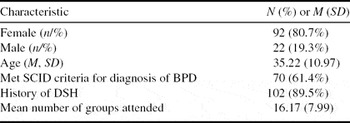
Of the 167 individuals who were recruited, 114 (68.9%) attended 8 or more sessions (i.e. completed at least one 2-week cycle). For the purposes of this study, only those participants who attended at least one complete cycle of the eight skills are included in the analysis. There were no statistically significant differences between those who attended one complete cycle of eight skills (n = 114) and those who did not (n = 53) in terms of age, gender, diagnosis of BPD or pre-group levels of self-harm, distress tolerance or number of inpatient days. Table 1 outlines the sociodemographic and clinical characteristics of the 114 included participants.
Sociodemographic and clinical characteristics of participants

Measures
The Structured Clinical Interview for DSM-IV Axis II Personality Disorders (SCID-II; First, Gibbon, Spitzer, Williams and Benjamin, Reference First, Gibbon, Spitzer, Williams and Benjamin1997) was completed by the participants. Questions relevant to Borderline Personality Disorder were further investigated using the SCID-II Interview (First et al., Reference First, Gibbon, Spitzer, Williams and Benjamin1997).
The Deliberate Self-Harm Inventory (DSHI; Gratz, Reference Gratz2001) is a 17-item questionnaire that assesses various aspects of self-harm, including type, frequency, severity, and duration. The outcome variable considered in this study is the frequency of all types of self-harm for the previous 6 weeks. The measure is designed to be self-administered but, for clinical and ethical reasons, questions were asked in an interview format. This was a condition of the hospital ethics committee, given the hospital setting and the vulnerable nature of the patient population.
The Distress Tolerance Scale (Simons and Gaher, Reference Simons and Gaher2005) is a 15-item self-report questionnaire that measures the extent to which individuals experience negative mood states as unbearable. Four sub-scales are combined to give a general distress tolerance score, with lower scores indicating a tendency to find negative affect intolerable.
Inpatient days. The final outcome measure was the number of days per year that participants spent as hospital inpatients subsequent to completing the LTD group. As a baseline measure, participants’ mean number of pre-group inpatient days per year was calculated based on the average of their inpatient days for the previous 4 years. All admissions took place in the hospital described.
Procedure
Participants were referred to the group by the hospital's multi-disciplinary teams. Prior to commencing the group, all potential participants were individually assessed by one of the authors. Participants were fully informed about the study's purpose, and their explicit consent to participate was obtained. At this time participants completed the Deliberate Self-Harm Interview, and the Distress Tolerance Scale. Participants were invited to complete these measures again immediately upon completion of the group, and at 3-month follow-up.
Treatment protocol
The Living Through Distress Group was run for an hour a day, 4 days a week, over a 6-week period (24 sessions in total). Groups were run by a team of four clinical psychologists on a rota basis, with each group session facilitated by two senior clinical psychologists, with a minimum of 5 years experience post qualification. Eight skills were taught in a cyclical fashion, three 2-week cycles of the eight skills occurring over the course of 6 weeks. A different facilitator taught each skill each time. The eight skills were: self-soothe; wise mind; mindfulness; labelling emotion; opposite action; distraction; radical acceptance; and building a life worth living. The mindfulness session combined the DBT “what and how” mindfulness skills. The “building a life worth living” session incorporated the skills of improving the moment, accumulating and increasing positives, and pleasure and mastery. Repetition of the skills was an important element of the group, and participants were encouraged to come to as many groups as possible.
Similar to skills training in other behavioural therapies, the Living Through Distress Group includes teaching, in-session practice of skills, and homework assignments. Each session commences with a brief mindfulness exercise, followed by a review of the homework from the day before. The remainder of the hour session focuses on teaching the skill for that day, and the session concludes with distribution of the relevant homework assignment. Facilitators engage in a debriefing session with each other immediately after the group.
Statistical analysis
Three one-way repeated measures ANOVAs were conducted to explore whether there were any changes over time in (1) incidents of deliberate self-harm and (2) distress tolerance scores and (3) inpatient days per year.
Results
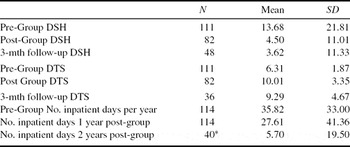
Table 2 presents the mean frequency of participants Deliberate Self-Harm (DSH), mean Distress Tolerance Scores (DTS) and number of inpatient days per year, at each relevant time point. The number of participants with completed outcome measures at each time point can also be seen in Table 2.
Frequency of deliberate self-harm and distress tolerance scores across time

*To date only 40 participants have reached the 2-year follow-up time-point
Deliberate self-harm
With regards to the frequency of mean incidences of deliberate self-harm, there was a significant effect for time (Wilks Lamda = 0.837, F (2, 46) = 4.40, p = .01, N = 48), with the multivariate partial eta (Ηη) squared statistic (0.16) indicating a large effect size. Pairwise comparisons using the Bonferroni test indicated a statistically significant decrease in the frequency of self-harm incidents between Time 1 (M = 13.68, SD = 21.81) and Time 2 (M = 4.50, SD = 11.01) (p = .02, N = 48) and between Time 1 and Time 3 (M = 3.62, SD = 11.33) (p = .01, N = 48). There were no statistically significant differences between Times 2 and 3 (p>.05, N = 48).
For 27 participants, their frequency of deliberate self-harm had dropped to 0 at post-group i.e. they had not self-harmed in the previous 6 weeks. Nineteen participants reported reduced frequency of self-harm, four reported no change, and 10 participants reported an increase. Ten participants reported no history of deliberate self-harm (but had strong ideation of such), and 18 participants did not report any self-harm in the 6 weeks prior to commencing the group.
Distress tolerance
With regards to distress tolerance scores, there was a significant effect for time (Wilks Lambda = 0.449, F(2, 30) = 21.46, p = .00, N = 32), with the multivariate partial Ηη squared statistic (0.59) indicating a large effect size. Pairwise comparisons using the Bonferroni test indicated a statistically significant increase in distress tolerance between Time 1 (M = 6.32, SD = 2.35) and Time 2 (M = 10.36, SD = 3.68) (p = .00, N = 32) and between Time 1 and Time 3(M = 9.72, SD = 4.33) (p = .00, N = 32). However, there were no statistically significant differences between distress tolerance scores at Times 2 and 3.
Inpatient days
With regards to number of inpatient days per year, there was a significant effect for time (Wilks Lambda = 0.434, F(2, 63) = 25.53, p = .00, N = 65), with the multivariate partial Ηη squared statistic (0.45) indicating a large effect size. Pairwise comparisons using the Bonferroni test indicated a statistically significant decrease in inpatient days between Time 1 (M = 39.90, SD = 33.25) and Time 2 (M = 23.09, SD = 40.56) (p = 0.01, N = 65), Time 1 and Time 3 (M = 8.78, SD = 25.40) (p = .00, N = 65) and between Times 2 and 3 (p = .00, N = 65). For 54.5% (62/114) of participants, their number of inpatient days had dropped to zero in the year following their participation in the group; in other words, they had no subsequent admissions to hospital.
Missing data
As can be seen from Table 2, data for DSH was available for 75% of participants (86/114) at post-group, and for 40% (46/114) at 3-month follow-up. Data for distress tolerance was available for 87% (99/114) of participants at baseline, 63% (71/114) at post-group, and for 29% (32/114) at 3-month follow-up. Information regarding bed days was available for 100% of participants, as this information could be directly accessed from patients’ files. Missing data were dealt with utilizing a technique of listwise deletion; thus analysis and results were based on available data. However, there were no statistically significant differences between participants with missing and complete data, in terms of age, gender, diagnosis of BPD, or pre-group levels of self-harm, distress tolerance or number of inpatient days. However, participants with complete outcome data attended significantly more groups than those with missing data (M = 17.30, SD = 8.50 vs. 12.7, SD = 4.64, t = -2.69, p = .008).
Discussion
The results from this study indicate that a brief 6-week group intervention, adapted from the group skills training component of Dialectical Behaviour Therapy, and delivered in an inpatient setting, was effective in reducing deliberate self-harm and increasing distress tolerance. These gains were maintained for at least 3 months post-group. There was also a reduction in participants’ inpatient days at 1-year follow-up (and also at 2-year follow-up for 40 participants who have reached this time-point). In the year following their participation in the Living Through Distress Group, more than half of the sample had no further inpatient admissions.
Existing evidence supports the effectiveness of shorter, more intensive adaptations of DBT in inpatient settings (e.g. Bohus et al., Reference Bohus, Haaf, Simms, Limberger, Schmahl and Unckel2004; Kroger et al., Reference Kroger, Schweiger, Sipos, Arnold, Kahl and Schunert2006). However, these studies have included both individual and group therapy components. Studies to date suggest that offering DBT skills groups without corresponding individual therapy is not effective in reducing rates of DSH (e.g. Springer and Silk, Reference Springer and Silk1996). Findings from the current study provide some tentative evidence that such skills-only groups may in fact have a positive impact on DSH. This is promising, given that both NICE (2004) and the Cochrane Review (Hawton et al., Reference Hawton, Townsend, Arensman, Gunnell, Hazell and House2009) have highlighted the lack of evidence for effective short-term interventions for reducing deliberate self harm in psychiatric hospital settings.
Significant increases in participants’ distress tolerance levels were also observed in this study. This is noteworthy, as one of the key aims of such skills-groups is to improve participants’ ability to regulate and/or tolerate negative emotions and distress. Studies evaluating other DBT skills-only groups have reported improvements in emotional regulation and distress tolerance skills (e.g. Berking et al., Reference Berking, Wupperman, Reichardt, Pejic, Dippel and Znoj2008; Gratz and Gunderson, Reference Gratz and Gunderson2006; Koons et al., Reference Koons, Robins, Tweed, Lynch, Gonzalez and Morse2001). These studies, however, have not assessed DSH. This is surprising, given that an improvement in these skills is hypothesized to result in corresponding reductions in DSH. Results from this study provide some initial support for this hypothesis, although a formal mediational analysis would be required before any definitive conclusions could be drawn in this regard.
Patients with a history of deliberate self-harm (particularly those with a diagnosis of BPD) are high consumers of mental health services, with high rates of hospital admissions and increased length of inpatient stays (Ansell, Sansilow, McGlashan and Grilo, Reference Ansell, Sanislow, McGlashan and Grilo2007). Thus, the significant reduction in participants’ number of inpatient days per year evidenced in this study is a critical finding. It may also indicate that the positive treatment outcomes seen at 3-month follow-up may be being maintained in the longer-term, although this is only suggestive. It would have been preferable to follow-up participants to investigate if the observed reductions in deliberate self-harm are maintained in the longer-term (e.g. at 6 or 12 months).
It must also be noted that the outcome variable for this study was simply the total frequency of the incidences of all forms of deliberate self-harm behaviours for the previous 6 weeks. Given that an increase in deliberate self-harm is often a key reason patients access psychiatric hospital services, it is plausible that this 6-week time frame may represent a “low point” for participants in terms of deliberate self-harm (and also distress tolerance). Thus, the observed improvements may be due to natural recovery, rather than the intervention. In addition, no distinction was made between different types of self-harm (e.g. cutting, burning, medication overdose). Also, in line with the Royal College of Psychiatrists’ definition (2010), no distinction was made regarding the intention of the behaviour (e.g. suicide attempt vs. non-suicidal self-harm). Whilst a history of DSH is a strong risk factor for completed suicide (Hawton et al., Reference Hawton, Townsend, Arensman, Gunnell, Hazell and House2009), it has been argued that non-suicidal DSH differs from a suicide attempt in its function (Gratz, Reference Gratz2003), and also often in its form (Messer and Fremouw, Reference Messer and Fremouw2008). Thus, it may be useful in future studies to distinguish between DSH behaviours, with and without the intent to die, in order to more effectively target interventions.
Although the findings from the current study are initially promising, the results must be interpreted with caution, given the methodological limitations of the study. This study was not a randomized controlled trial. Given the lack of a control group, it can not be concluded that any observed improvements are due to the intervention rather than other factors, such as natural recovery and/or concurrent interventions (e.g. medication, engagement in therapies, other multi-disciplinary team input, partial hospitalization). The large proportion of missing data for each measure, at each follow-up time point, is also a key concern and introduces a substantial amount of bias. However, this reflects the practical difficulties of contacting patients once they have been discharged from this national service, and return to their local communities.
Additional research is currently ongoing, which includes a waiting list control group. This research also plans to investigate in more detail the mechanisms of change and key active ingredients of the intervention (e.g. improvement in emotional regulation and distress tolerance skills, group dynamics, therapeutic alliance). This research will examine the influence of other possible confounding variable or non-specific factors, which were not accounted for in this study (e.g. medication, engagement in other therapies, partial hospitalization). It will also include an assessment of treatment fidelity, by having an observer measure the degree of facilitator adherence to skills-teachings.
Despite its methodological limitations, the results from this study have practical and clinical implications for both service providers and clinicians alike. For service-providers attempting to deliver effective, sustainable treatments, there are clear advantages to the Living Through Distress Group as a shorter, less resource intensive adaptation of the group skills training component of DBT. A group approach maximizes the numbers of patients who can benefit from learning the skills, as does opening the group to those without a diagnosis of BPD. It is interesting to note that only two-thirds of the sample met criteria for a diagnosis of BPD. Future studies may examine if there are any differences in treatment outcomes between those who meet diagnostic criteria for BPD, compared to those who did not.
The group approach may also be beneficial to clinicians working with this cohort. It has been noted that individual therapeutic work with people who engage in deliberate self-harm can be difficult and demanding for therapists in DBT teams (Pitman and Tyrer, Reference Pitman and Tyrer2008). Anecdotally, facilitators of the Living Through Distress group have commented that a group format seems to circumvent many of these difficulties. In the long-term, this makes such an intervention easier to sustain. The Living Through Distress Group is delivered by two facilitators, with facilitator debriefing following each session, both of which also provide additional support for clinicians. Finally, facilitators have also noted that the Living Through Distress group may function as a type of “pre-therapy” intervention. From the group, participants gain a set of emotional regulation and distress tolerance skills, which may better equip them to engage in individual therapeutic work at a later stage.
In conclusion, deliberate self-harm remains a significant issue for mental health services and staff and, perhaps more importantly, for the people themselves who engage in these behaviours. Although requiring further evaluation, initial findings suggest that the Living Through Distress Group may be a clinically effective and pragmatic intervention for reducing deliberate self-harmful behaviours. As such, it may be a beneficial treatment addition to the management of this difficult and significant problem.



Comments
No Comments have been published for this article.